




Abstract
The purpose of this study was to examine the cross-cultural validity of the effects of attachment, career-choice pessimism, and intrinsic motivation on career adaptability (CA) in American (n = 198) and Korean (n = 294) college students. We hypothesized that the association between attachment and CA is sequentially mediated by career-choice pessimism and intrinsic motivation in both samples, and the results supported the hypothesized multilevel model. These results have important implications for practice to promote CA for college students across cultures by providing evidence for cross-cultural validation of factors influencing on CA.
Attending college after high school has been a worldwide trend for better job prospect with higher earnings (Carnevale, Rose, & Cheah, 2011). Considering the fact that about 1.5 million (around 54%) of recent college graduates in the United States were underemployed in 2011 (Times, 2012) and around half a million (43.8%) of college graduates in South Korea were underemployed in 2015 (Statistics Korea, 2015), it seems that getting a college degree does not guarantee a job. Changes in the job market require individuals to become more flexible with their career skills; therefore, promoting adaptability in career issues is important.
Career adaptability (CA) is defined as the readiness to cope with predictable and unpredictable tasks and changes prompted by the work environment (Savickas, 1997). According to career construction theory (Savickas, 2005), CA consists of the following four self-regulative strategic factors: concern, control, curiosity, and confidence. Career concern is about helping individuals to anticipate and prepare for their possible future career path. Control is the perceived responsibility to make preferable and alternative plans about themselves and career-related decisions. Curiosity is initiated and pursued by the individual’s interest in exploring various opportunities, situations, and roles related to career-related issues (Savickas, 2005). Confidence is gained by the individual in his or her decision about the kind of lifestyle and career he or she would like to pursue. Overall, confidence is anchored in his or her sense of concern and control within the ongoing career decision-making process (Savickas & Profeli, 2012).
The importance of CA in career-related outcomes has been empirically tested across various cultures. Hirschi (2009) reported a significant positive correlation between CA and life satisfaction with Swiss adolescents. In another study, individuals who seek new employment and have higher CA are more likely to have several job offers and, subsequently, higher job satisfaction than individuals with lower CA (Koen, Klehe, Van Vianen, Zikic, & Nauta, 2010). Therefore, CA is a factor that can promote positive career-related outcomes across cultures.
Other studies have focused on identifying other factors that could increase CA. For example, attachment has been found to play a central role in exploring and making decisions about one’s career path (Blustein, Prezioso, & Schultheiss, 1995). Exploring career options and making career decisions require taking risks, at times, in an unfamiliar setting. Attachment theory suggests that when one feels security in a close relationship, she or he then feels comfortable to explore the environment (Bowlby, 1982). Empirical researchers supported the idea that secure attachment was associated with the career decision-making process (Vignoli, 2009), career decision-making self-efficacy (O’Brien, Friedman, Tipton, & Linn, 2000), and the career development process (Blustein et al., 1995) even in cross-cultural samples (Turkey: Cenkseven-Onder, Kirdok, & Isik, 2010; China: Okubo, Yeh, Lin, Fujita, & Shea, 2007). Furthermore, having secure attachments with one’s peer group can also be critical in the career decision-making process, because peer relationships are directly connected to their social competency in the social/work setting. However, limited attention has been given to the importance of peer groups in the career development process and how the mechanism of how peer attachment might influence CA. Understanding how the quality, or attachment, of a peer relationship has an effect on CA might provide useful information to identify facilitators of strong CA.
To understand the mechanism of how peer attachment influences CA, we focused on possible changes in cognitive and motivational processes, because attachment influences the way people feel and perceive the world. These emotional and cognitive processes influence individuals’ motivation to take action (Blustein, 1991; Bowlby, 1988). Thus, we decided to investigate how attachment would influence career-specific cognitive and motivational factors of CA. For the career-related emotional and cognitive factors, we focused on career-choice pessimism and career-related intrinsic motivation. Career-choice pessimism refers to the negative perceptions one has about the career-related decision process, the world job market, and the general sense of control he or she has in obtaining a desired career (Saka, Gati, & Kelly, 2008). Career-related intrinsic motivation is a well-known mediator in the career development process (Shin & Kelly, 2013). Flum and Blustein (2000) have suggested that intrinsic motivation is created by perceiving that one’s behavior is influenced by a sense of feeling in control. Therefore, we hypothesized that career-choice pessimism and intrinsic motivation would sequentially mediate the link between peer attachment and CA.
Peer Attachment
Attachment theory explains behavior patterns and characteristics related to separation from an emotionally important person (i.e., the attachment figure) throughout life (Bowlby, 1988). One of the defining features of the attachment system is the secure base, which refers to the attachment figure being a psychological base for the person to use when exploring an environment (Bowlby, 1988). When the secure base function is met, individuals can take risks, and explore the self and environment with confidence. Although some research has examined cross-cultural differences in how secure attachment style is expressed or perceived in their cultures (Wang & Mallinckrodt, 2006), the consensus is that attachment system is universal (van IJzendoorn & Sagi, 1999).
Close relationships in adolescents and early adulthood include peer relationships and social groups to which they belong (e.g., fraternity, sorority, church group, and sports team). Particularly, because late adolescents and individuals in early adulthood have experienced the separation–individuation process with their parents, peer groups become an important source of emotional security in close relationships (Lapsley & Edgerton, 2002). Peer attachment can be defined as an emotional bond to peers, which specifies the attachment figure as a peer or peer groups to which an individual attached to. Secure peer attachment predicts emotional and social competence (Laible, 2007) and even scholastic competence (Fass & Tubman, 2002). Interactions with a peer group that is accessible in times of need and provides support will facilitate positive views of self and the ways they experience the world (Brickman, 2009). Research demonstrated that adolescents with greater levels of peer attachment have greater levels of career exploration and commitment (Felsman & Bluestein, 1999). Secure attachment has been reported to be linked to lower career thought dysfunction (Ecke, 2007). Therefore, attachment with peers would influence CA because secure peer attachment promotes career explorations and commitment (Blustein et al., 1995).
Secure attachment is related to a positive representation of the self and the world, whereas insecure attachment is related to a negative and pessimistic representation of the self and the world (Bowlby, 1988). Having secure attachment with the belief that others can be trusted and available would prevent an unrealistically pessimistic view of the world (Mikulincer, Shaver, & Pereg, 2003), including a career-related worldview. Also, individuals with secure attachment are more likely to develop an optimistic expectation about self-regulating ability and engage in achieving their goals more eagerly than individuals with insecure attachment (Braunstein-Bercovitz, Benjamin, Asor, & Lev, 2012; Heinonen, Räikköen, Keltikangas-Järvinen, & Strandberg, 2004). The plausible effect of attachment style on forming pessimistic and irrational thoughts was empirically tested and confirmed. Among 423 Finnish adults, insecure attachment accounted for 48% variance of pessimism (Heinonen et al., 2004). Taken together, these results suggest that insecure peer attachment might contribute to a higher level of career-choice pessimism. Thus, Hypothesis 1 states that peer attachment would be negatively associated with career-related pessimism.
Career-Choice Pessimism
Pessimism has been considered a reflection of a negative expectation that bad things will happen, including future expectation about one’s life (Chang, 2001). Within the career development literature, Saka, Gati, and Kelly (2008) considered pessimism as a main emotional and personality factor that significantly contributes to career indecisiveness. More specifically, career-choice pessimism is defined as a tendency to focus on the negative aspects of the world job market, and it is highly related to low career decision-making self-efficacy and a low degree of control over the career decision-making process and outcomes (Saka et al., 2008).
Previous studies indicated that career-choice pessimism is associated with career-related problems, including career indecision and low CA (Creed, Patton, & Bartrum, 2004). Kelly and Shin (2009) investigated the mediating effects of career pessimism between neuroticism and lack of information, which is considered the main factor in career indecision. They found that the indirect effect of career pessimistic thoughts explained 35% of the variance of lack of information. Saunders, Peterson, Sampson, and Reardon (2000) also found that pessimistic thoughts explained 25% of the variance in career indecision. These results indicated that pessimistic career-related thought is a significant contributor to career-related difficulties.
The pervasive negative expectations of pessimism may result in a sense of hopelessness, which leads one to avoid engaging in activities out of intrinsic motivation. Previous research indicated that the pessimistic individuals are more likely to avoid failure and less likely to be motivated intrinsically (Elliot & Church, 2003). Empirical study supports the strong negative association between pessimism and intrinsic motivation (Thompson & Gaudreau, 2008). A qualitative research reported that college students with pessimistic tendencies have more fear of failure and heightened concerns with others’ perception, thereby indicating a lack of self-determined motivation to engage in academic activities (Martin, Marsh, & Debus, 2001). These results suggest that pessimistic thoughts about one’s career prospects contribute to the lack of intrinsic motivation and low CA. Given the above findings, Hypothesis 2 states that career-related pessimism would be negatively associated with intrinsic motivation.
Career decision-making intrinsic motivation
Motivation can be referred to as the reasons for underlying behavior and is considered as willingness or volition (Guay et al., 2010). On the basis of self-determination theory (Ryan & Deci, 2000), intrinsic motivation is formed by an individual’s interest or enjoyment and is in contrast to external motivation, which is governed by reinforcement contingencies, such as external rewards. Intrinsically motivated individuals are likely to engage in activities for his or her own sake to satisfy their need for autonomy (Ryan & Deci, 2000). Thus, individuals with a high intrinsic motivation in the career decision-making process are likely to express interest and excitement. They perceive uncertainty as a challenge rather than a threat. Given that intrinsic motivation makes individuals energetic and enables them to take actions with high-level self-regulated strategies voluntarily, we infer that having career pessimistic thoughts will make people less active, less excited, and less energetic in engaging in the career decision-making process.
A substantial body of empirical research studies has suggested that intrinsic motivation is associated with a higher level of CA across cultures. For example, Hirschi (2010) conducted a 1-year longitudinal study with Swiss adolescents and found that intrinsic motivation was the core factor that explained students’ capability to explore, plan, and make decisions in the career decision-making process. Pouyaud, Vignoli, Dosnon, and Lallemand (2012) reported that intrinsic motivation was highly correlated with CA (r = .49, p < .001) with French high school students. Shin and Kelly (2013) conducted a cross-cultural study and found that intrinsic motivation partially mediated the effects of optimism on vocational identity among both American and Korean college students. In addition, Shin (2012) found that intrinsic motivation has a significant mediating effect on the relation between career calling and CA with Korean college students. The previous empirical findings implied that intrinsic motivation, which is created by perceiving one’s behavior as self-initiated, was a significant factor that influenced CA, and such association may be a universal phenomenon. On the basis of these findings, Hypothesis 3 states that career-related intrinsic motivation is positively linked to CA.
Summary and Hypotheses
Interpersonal situation provides a context for expressing personal tendency with peer group as one of the main relational contexts for emerging adulthoods (Heinonen et al., 2004; Lapsley & Edgerton, 2002). Insecure peer attachment is likely to be tuned for individuals with more career-choice pessimism, as attachment style influences how people cognitively process information (Mikulincer et al., 2003). Pessimism can be seen as an inner base that prevents individuals from positively appraising stressful experiences (Chang, 2001). Individuals with pessimistic tendencies might be more passive because they tend to find excuses not to engage in career-related activities willingly (Kelly & Shin, 2009). In addition, lack of intrinsic motivation is one of the main factors that cause career indecision or indecisiveness that reflects low CA (Pouyaud, Vignoli, Dosnon, & Lallemand, 2012; Shin & Kelly, 2013).
Given the integration of the theoretical and empirical evidence, the purpose of this study was to investigate the hypothesized mediation model describing the pathways of how peer attachment would be associated with CA via career-choice pessimism and intrinsic motivation sequentially. Specifically, we hypothesized that insecure peer attachment would be associated with more career-choice pessimism (Hypothesis 1) and that career-choice pessimism would be associated with less intrinsic motivation (Hypothesis 2), which, in turn, would be associated with low CA (Hypothesis 3).
The overarching hypothesis of the study was that the U.S. and Korean models would be equivalent, given the cross-cultural commonalities of the influence of attachment, pessimism, and motivation on CA. The United States and Korea are considered as having different cultural atmosphere, such as individualistic and collectivistic cultures. However, regarding the career development situation with college student is quite similar. For example, the entry rate into university-level education is around 70% for both countries (Organization for Economic Cooperation and Development, 2013). Therefore, the pressing needs to investigate how to promote and maintain college students’ CA to help them adjust to unpredictable and challenging job market is also alike across cultures. In addition, there has been a consensus that attachment system functions universally (Cenkseven-Onder et al., 2010; Okubo et al., 2007). Previous studies indicate that how secure attachment functions as a secure base and safe heaven is universal phenomena (van Ijzendoorn & Sagi, 1999), although there are differences in how attachment bonds are expressed (e.g., how to provide caregiving). Although there might be differences that exist in the world of job market depending on cultural contexts, how attachment would be associated with CA might not be different, especially regarding the developmental aspects of peer attachment in early adulthood. The association between attachment and pessimism might be similar across cultures as well because the relationship between secure attachment, positive sense of self, and worldview is the universal aspect of the attachment system (Cassidy & Shaver, 2008). In addition, the significant positive impact of intrinsic motivation on career decision-making process was similar between the United States and Korea, although the influence of family support on fostering intrinsic motivation was less prominent with Korean college students compared to the U.S. sample (Shin & Kelly, 2013). In summary, with support from previous literature, we hypothesized that the suggested sequential mediation model would be equivalent across the two cultures.
Method
Participants
A total sample of 492 undergraduate students were included as participants in the study. The U.S. sample (n = 198) included 43 (21.7%) men and 153 (77.3%) women, aged 18–39 (M = 23.20). With regard to their current standing in at the university, 31 individuals (15.7%) were in their first year, 30 (15.2%) were in their second year, 59 (29.8%) were in their third year, 58 individuals (29.3%) were in their fourth year, and 20 individuals (10.1%) were in their fifth or more year. Ethnicity for the U.S. sample was 155 (78.3%) European American, 25 (12.6%) Hispanic American, and 19 (9.6%) African American. The Korean sample (n = 294) included 167 (56.8%) men and 126 (42.9%) women, aged 18–29 (M = 22.26). Of these, 114 individuals (38.8%) were in their first year, 76 individuals (25.9%) were in their second year, 49 individuals (16.7%) were in their third year, and 49 individuals (16.7%) were in their fourth year.
Measurements
Attachment
The 12-item Experiences in Close Relationship Scale–Short Form (ECR-S; Wei, Russell, Mallinckrodt, & Vogel, 2007) was used to measure attachment to peer groups. ECR-S is designed to measure attachment across multiple domains, and ECR has been used in measuring parental relationships and peer relationships (Fraley, Heffernan, Vicary, & Braumbaugh, 2011; Zayas, Mischel, Shoda, & Aber, 2011). For the current study, the scale was revised by changing the words the partner to the peer group to measure the attachment to the peer group to which they belong. The questionnaire measures two attachment dimensions: anxiety about abandonment, which has 6 items (e.g., “I do not often worry about being not accepted by group of friends I have”), and avoidance of closeness, which also has 6 items (e.g., “I usually discuss my problems and concerns with my group of friends.”). Participants rated items based on how they generally experience their relationship with their peer group, using a 7-point Likert-type scale. Higher scores on the overall scale indicate higher anxiety and avoidance.
As for psychometric information, the ECR-S (Wei et al., 2007) is a short form of the 36-item ECR Scale (Brennan, Clark, & Shaver, 1998), which has an internal consistency reliability of at least .90 for both anxiety and avoidance scores (Mikulincer & Shaver, 2007). The ECR-S demonstrates construct validity, where a confirmatory factor analysis yielded two subscales (Wei et al., 2007). Also, internal consistencies of ECR-S were .77–.86 for anxiety and .78–.84 for avoidance (Wei et al., 2007). Cronbach’s αs for the current study for each subscale were .72 for anxiety and .73 for avoidance for the U.S. sample and .72 (anxiety) and .78 (avoidance) for the Korean sample.
Career-choice pessimism
Career-choice pessimism was measured by the Pessimistic View subscale of the Emotional and Personality Career Difficulties (EPCD) Scale (Saka & Gati, 2007). The Pessimistic View subscale consisted of three subscales, which measured pessimistic views about the career decision-making process (e.g., “I can’t take all the relevant considerations into account when choosing a career.”), pessimistic views about the world job market (e.g., “Few careers are really interesting.”), and pessimistic views about one’s general control of the process (e.g., “I have no control over the career possibilities that will be available for me in the future.”). Each item was rated on a 9-point Likert-type scale (1 = does not describe me at all, 9 = describes me very well). The mean of each subscale was used in the study and a higher score indicated higher levels of pessimistic views.
The EPCD has demonstrated validity and reliability. A confirmatory factor analysis confirmed the three-factor model across cultures (Gati & Meyers, 2003; Saka et al., 2008). Korean version of EPCD also showed enough evidence for convergent and discriminate validity by being related to career indecision, locus of control, and career self-efficacy (Jin, Nam, Joo, & Yang, 2015). During scale development, the Cronbach’s α was reported as .80 for the total Pessimism scale, and .77, .67, and .66 for each subscale, respectively, in an American sample, and .79 for the total Pessimism scale, and .74, .70, and .77 for the process, the world job market, and one’s control about Pessimism scales in an Israeli sample (Saka et al., 2008), which provides cross-cultural validation for the instrument. A previous study using EPCD with a Korean sample had Cronbach’s α for each subscale as .68, .60, and .78 (Shin, 2013). In this study, the Cronbach’s α for each subscale was .83, .80, and .82 in the U.S. sample and was .70, .70, and .87 in Korean sample.
Intrinsic motivation
The Intrinsic Motivation subscale of the Career Decision-Making Autonomy (CDMA) Scale (Guay, 2005) was used to measure CDMA. The Intrinsic Motivation subscale has 8 items, and each item is rated on a 7-point Likert-type scale (1 = does not correspond at all, 7 = corresponds completely).
Construct and convergent validity was demonstrated by examining its correlations to a Career Decision-Making Self-Efficacy (CDMSE) Scale (Taylor & Betz, 1983). With Korean, discriminant validity was demonstrated by the relations with career-related pessimism, CDMSE, and career exploration behavior (Shin, 2013). Furthermore, test–retest reliability was in the range of .91–.95 (Guay, 2005). The CDMA was previously used with a Korean sample and the Cronbach’s α was reported as .91 (Shin, 2012). In this study, the Cronbach’s α was .91 for both the U.S. and Korean samples.
CA
CA was measured by the CA Scale (CAS)—International Form 2.0 (Savickas & Porfeli, 2012), which consisted of four subscales: Concern (e.g., “Becoming aware of the educational and vocational choices that I must make”), Control (e.g., “Taking responsibility for my actions”), Curiosity (e.g., “Becoming curious about new opportunities”), and Confidence (e.g., “Working up to my ability”). There is a total of 24 items with 6 items in each subscale, rated on a 5-point Likert-type scale from 1 (not strong) to 5 (strongest). Researchers from 13 countries collaborated in constructing a scale to measure CA across cultures. The reliability and validity of the scale was tested and cross-validated 13 countries including Korea. Construct and concurrent validity of the CAS was demonstrated (Porteli, Vondracek, & Weigold, 2011). Specifically, with Korean, discriminant validity was also demonstrated by the relation to career calling, career self-efficacy, and career motivation (Shin, 2013). Furthermore, the internal reliability of the total scale was reported as .92, and the Cronbach’s α reliability for each subscale is reported as .83, .74, .79, and .85 for concern, control, curiosity, and confidence, respectively (Savickas & Porfeli, 2012). The CAS was translated into Korean and tested with a Korean sample in a previous study. The reported Cronbach’s α for each subscale was .89, .87, .85, and .87, respectively (Shin, 2012). In this study, the internal consistency reliability for each subscale was .87, .87, .87, and .89 in the U.S. sample and .85, .88, .85, and .89 in the Korean sample.
Procedure
U.S. participants were recruited for a web-based survey with an extra credit option in psychology classes at a large Southern university. Korean participants were recruited for a paper-and-pencil survey with an extra credit option at a large university located in central South Korea. For measures published only in English, we created a Korean version by following the steps suggested by Ægisdóttir, Gerstein, and Çinarbaş (2008). First, the English version of each measurement was translated into Korean by both authors in this article who are native speakers of Korean with education, training, and work experiences in the United States. Second, the Korean version of the measurement was back-translated to English by a hired professional translator. Third, a pilot study was conducted by using the original and back-translated versions with college students in the United States to check for consistency of responses. Using paired t-tests, there were no statistically significant differences in the way students answered either instrument, p values range from .10 to .81. For the Korean participants, the Korean-translated set of instruments was used.
Results
Both the U.S. (n = 198) and Korean (n = 294) data sets normally distributed. Pearson correlation coefficients for the U.S. and Korean data revealed positive and negative associations among variables in this study (rs = −.39 to .73; Table 1). Significant correlations are below .85, which addresses the potential concern with multicollinearity (Tabachnick & Fidell, 2007).
Zero-Order Pearson Correlation Among Variables in the United States (n = 198) and Korea (n = 294).

Note. U.S. correlations are below the diagonal in the matrix and Korean correlations are above the diagonal in the matrix. Anxiety and avoidance are attachment.
*p < .05. **p < .01.
Multivariate analysis of variance was conducted to determine possible differences in the variables between the U.S. and Korean samples. Differences among the variables were significant, and the effect size was large, F(10, 482) = 60.72, p < .001, η2 = .56. The effect size of each variable indicated that CA is the biggest difference between the U.S. and Korean samples (control η2 = .38, confidence η2 = .21, concern η2 = .20, curiosity η2 = .19), followed by intrinsic motivation (η2 = .19) and attachment anxiety (η2 = .02).
Testing the Multigroup Model
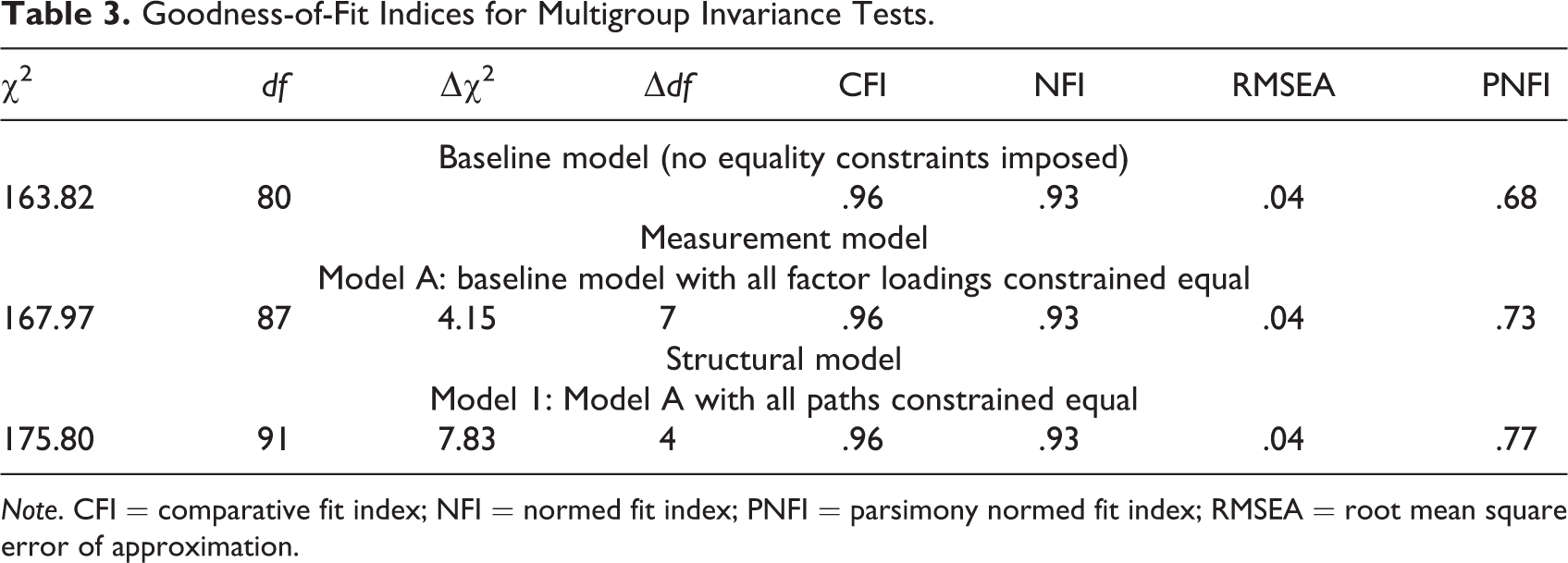
Before testing for measurement and structural invariance, the equivalence of both models was examined. Byrne’s (2010) directions were used in evaluating model fit (e.g., comparative fit index [CFI], root mean square error of approximation [RMSEA]). The first step in testing multigroup invariance is testing the configuration model to see if the number of factors and the structure of the model are consistent across the two samples. The hypothesized model was tested separately for the U.S. and Korean data. Results indicated an acceptable fit of the data to the model for both groups: (a) for the U.S. sample, χ2(40) = 68.96, p < .001; CFI = .97, normed fit index (NFI) = .93, RMSEA = .06 and (b) for the Korean sample, χ2(40) = 94.86, p < .001; CFI = .96, NFI = .93, RMSEA = .07. All factor loadings were significant (p < .001), thereby indicating that attachment, pessimism, intrinsic motivation, and CA were well represented by the indicators. Configural invariance was confirmed; thus, the baseline χ2 value, which was calculated by computing a model fit for the U.S. and Korean data, obtained, χ2 (80) = 163,82, p < .001. CFI, NFI, and RMSEA values were .96, .93, and .04, respectively.
After establishing goodness of fit, in Step 2, the measurement invariance across the two groups was examined to determine whether the scores on each construct have the same meaning across the two groups. We compared the baseline value, which was computed from the configural model testing, with a model that has all factor loadings constrained as equal across samples. Results obtained equivalence for the measurement models because the χ2 difference value between the baseline and constrained models was not significant, Δχ2 = 7, Δdf = 4.15, p > .05. Given that the equivalence of the measurement model was established, the structural invariance between the two groups was examined. As seen in Model 1 in Table 2, the test of structural invariance obtained a χ2 value of 175.80, df = 91; the computation of the Δχ2 between this model and the baseline model obtained a difference of 7.83, df = 4. The χ2 difference value between the baseline and constrained models was not significant, thereby indicating that the paths in the structural model operated equivalently across the two groups (Table 3). Therefore, the overarching hypothesis that the U.S. and Korean models would be equivalent was supported (Figure 1).
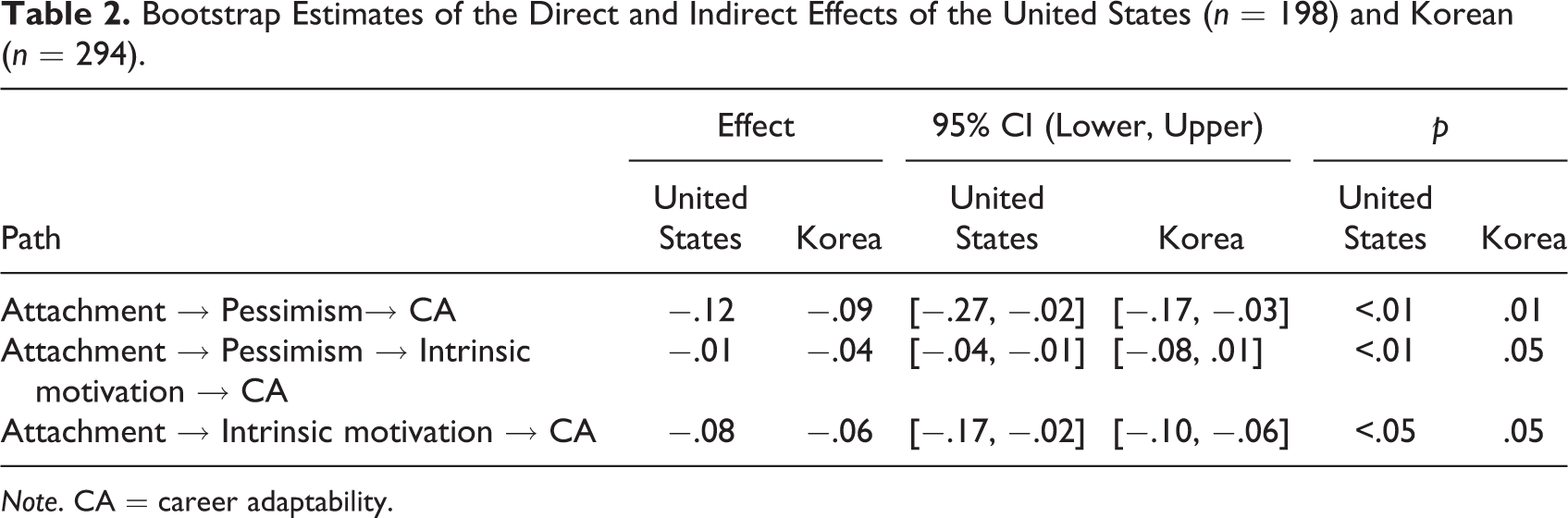
Bootstrap Estimates of the Direct and Indirect Effects of the United States (n = 198) and Korean (n = 294).
Note. CA = career adaptability.
Goodness-of-Fit Indices for Multigroup Invariance Tests.
Note. CFI = comparative fit index; NFI = normed fit index; PNFI = parsimony normed fit index; RMSEA = root mean square error of approximation.
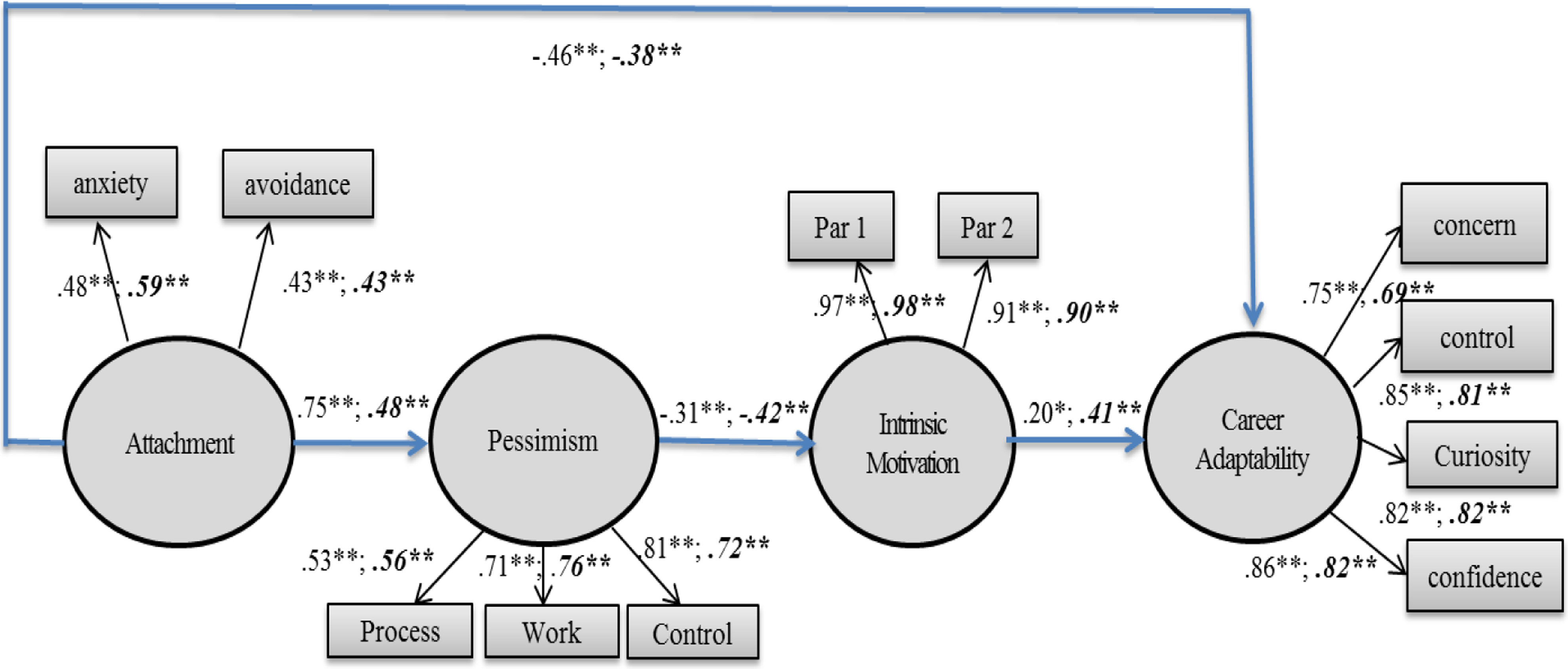
Model with the U.S. versus Korea comparison. Regular font numbers are the United States; bold, italicized numbers are Korea. *p < .05. **p < .01.
Testing Indirect and Direct Effects
Bootstrapping was used to examine the significance of the mediated effect of pessimism and intrinsic motivation. For this analysis, the SPSS macro program (SPSS 22) developed by Hayes (2013) was utilized. Bootstrap data samples (n = 5,000) were created by randomly sampling with replacements from the original data set. If the 95% confidence interval (CI) for the estimated indirect effect does not include zero, then the indirect effect can be concluded to be statistically significant at the .05 level. Results indicated that the total effect of attachment on CA (b = −.54, p < .001; b = −.38, p < .001 for the U.S. and Korean samples, respectively) remained significant when the mediators were included in the model (direct effect of attachment on CA in the U.S. and Korean samples: b = −.32, p < .05; b = −.20, p < .05). Furthermore, the analyses suggested with 95% CI that the total indirect effect, which is the difference between the total and direct effects of attachment on CA through the mediators, was significant. Therefore, the indirect effect of two mediators supported the significant mediation effect of both pessimism and intrinsic motivation on the relationship between attachment and CA in both the U.S. and Korean samples (Table 2).
Discussion
The results provided empirical support for cross-cultural validation of the hypothesized model that links insecure attachment with CA through career-choice pessimism and intrinsic motivation. In this study, participants with insecure peer attachment reported a higher level of pessimism, which decreased intrinsic motivation and led to inadequate CA across cultures.
Attachment and CA
The findings of the current study are consistent with the previous research, which found that insecure attachment affects an individual’s ability to cope with challenges and tasks related to the career decision-making process (Blustein et al., 1995). Previous findings indicated that individuals who are insecurely attached had a tendency to adopt dysfunctional strategies to deal with distress, and they tend to resist changes of organizational and social circumstances, which might later lead to difficulties in dealing with career-related problems appropriately and effectively (Allen, Moore, Kuperminc, & Bell, 1998; Mikulincer & Shaver, 2007). Our research specifically focused on the insecure attachment with peer groups. Thus, the results emphasized the quality of peer relationships in college students’ career decision-making process. This condition aligns with the developmental stage of the sample, where peer groups are important for emotional security and are utilized as a foundation for exploring the world and even the job market in early adulthood (Lapsley & Edgerton, 2002). The negative relationship between insecure attachment and CA did not differ across two cultures even though the mean difference existed; the mean score of attachment anxiety was higher in the U.S. sample (M = 3.09) than in the Korean sample (M = 3.36). In addition, the mean scores of the four subscales in CA were lower with the Korean sample (M = 3.24) than the U.S. sample (M = 3.77). However, similar factor loadings on latent variables and the comparable strengths and direction of the associations among latent variables between two models suggest that the mechanism of how insecure peer attachment influences CA may be a universal phenomenon instead of a culture-specific one.
Career-Choice Pessimism and Intrinsic Motivation as Sequential Mediators
The results of this study confirmed the association between insecure peer attachment and career-choice pessimism. On the basis of attachment theory, a securely attached person can explore the environment because of a secure base (Bowlby, 1988), whereas insecurely attached individuals have negative beliefs and expectations of themselves, others, and the world (Bowlby, 1988), thereby potentially leading to negative expectations and outcome of their career. The current findings confirmed that peer relationship in late adolescents and early adulthood was essential in determining their way of thinking, particularly the way they think about future. Considering that attachment style is a reflection of qualities of a relationship (Mikulincer & Shaver, 2007), these data suggest that the quality of an individual’s interpersonal relationships, especially with peer groups in early adulthood, might need to be considered when addressing career-choice pessimism.
The findings of this study confirmed the hypothesis that career-choice pessimism was negatively associated with intrinsic motivation and are consistent with previous findings (Martin et al., 2001; Thompson & Gaudreau, 2008). Career-choice pessimism can influence how individuals perceive, interpret, and analyze surrounding information about oneself, others, and the job market (Saka et al., 2008); thus, people with a negative outlook of their career choice are likely to feel a lack of intrinsic motivation, thereby leading to more difficulties when engaging in a career-related process.
Counseling Implications
The findings of this study suggest that career counselors may need to address a client’s peer relationships when they provide help for college students who have career-related issues. As such, with a more secure relationship with peers, the client might be able to develop an adequate sense of CA. Although the function of stable peer relationships with peers was equivalent across cultures, cultural differences might exist in how close relationships are expressed and experienced. Counselors who work with college students can reflect on the meaning of stable peer relationships to access each client’s unique individual and cultural definition of secure peer relationships.
Given that career-choice pessimism and intrinsic motivation significantly mediated the link between insecure peer attachment and CA, addressing the mediators as a tailored intervention would provide satisfying and effective therapeutic outcomes for clients, especially when addressing the peer relationship issue may not be optimal for the client. For example, counselors can assist clients with low CA by using Cognitive Behavioral Therapy techniques to change their maladaptive pessimistic thoughts with regard to their career decision-making. Counselors can help them understand the link between these maladaptive thoughts and intrinsic motivation. Also, counselors can use motivational interview techniques to determine what stimulates the client to increase the client’s self-initiated motivation.
These recommendations for counseling align with the idea that career counseling and personal counseling are not discrete. Career counselors should be encouraged to incorporate personal–emotional interventions (Schultheiss, 2003). The findings of this study provide more flexible and efficient therapeutic intervention options for counselors when they work with a client whose imminent presenting issue is career-related difficulties, but he or she may also seem to have peer relationship issues. Also, given the findings of the study, a counselor can provide ample multicultural-oriented interventions by considering that the client’s cultural background can make a difference in the extent of a client’s career-related problems. Despite cultural similarities in the associations among variables in this study, other factors showed cultural differences in the career development process for college students in the United States and Korea, such as parental influences and family support (Shin & Kelly, 2013), and can be addressed together in future studies. Also, in this study, we assumed homogeneity within the group, but we cannot ignore the individual differences within the same cultural contexts. Thus, future cross-cultural research is required to study within-group and between-group differences.
Limitations
Some limitations should be considered with this study. First, the model suggests causal relationships through the use of Structural Equation Model, but given the cross-sectional design of the research, the proposed causality needs to be tested further. In addition, cultural differences of the hypothesized model with American and Korean college students were examined. Even though no cultural differences in the relationship were found among the variables, the generalization of the current findings cannot be considered representative of each culture. Also, the gender and age differences between Korean and American samples are a potential limitation of this study. Finally, we did not use a specific measurement that was originally developed to measure peer attachment.
This study demonstrated cross-cultural validation of the association between insecure peer attachment and CA through the mediation of career-choice pessimism and intrinsic motivation in sequence.
Despite its limitations, this study provided empirical cross-cultural evidence of the mechanism of how peer attachment influences the CA of college students.
Specifically, our findings supported the hypothesized mechanism that attachment to a peer group influences career-specific cognitive factors, such as thoughts and motivation that lead to the development of CA.
Footnotes
Declaration of Conflicting Interests
The author(s) declared no potential conflicts of interest with respect to the research, authorship, and/or publication of this article.
Funding
The author(s) disclosed receipt of the following financial support for the research, authorship, and/or publication of this article: This work was supported by the 2014 Research Fund of the University of Seoul for Yun-Jeong Shin. Ji-Yeon Lee’s work was supported by Hankuk University of Foreign Studies Research Fund of 2016.