



Abstract
The Career Adapt-Abilities Scale (CAAS), a measure developed to evaluate an individual’s level of career adaptability, was initially validated as consisting of four factors (concern, control, curiosity, and confidence). The following study explores the structural validity of the CAAS when a fifth factor, cooperation, is included. Beyond examining the structural validity, we additionally conducted a cross-cultural validation of the five-factor model across American, Chinese, and Taiwanese samples. Our cross-cultural comparisons provided some support for the factorial equivalence of the five-factor Career Adapt-Abilities Scale (CAAS-5) in terms of the configural model. However, the results for the scalar model gave some indication of nonequivalence. Follow-up analyses showed that all items functioned similarly across groups, suggesting that small deviations in item functioning may have resulted in nonequivalence when aggregated to the scale level. Given the conceptual importance of cooperation’s inclusion, we contend that future research on career adaptability should explore the CAAS-5 further.
Keywords
The nature of careers has changed rapidly in recent years (Frese, 2000; Savickas, 2005). Although the number of young adults obtaining tertiary education continues to rise, organizations frequently report that young adults do not possess skills that fit with job opportunities that are available in the current workforce, and that education systems do not always train young adults in the skills necessary for career success (Casner-Lotto & Barrington, 2006; Hart Research Associates, 2015; Jackling & De Lange, 2009). Given such concerns, it is important for individuals to be aware of their environments and to exercise flexibility and adaptability when seeking out and leveraging opportunities to prepare and equip themselves with essential skills for career advancement (Goodman, 1994).
Career adaptability refers to one’s resources for dealing with vocational development tasks, transitions, and traumas that alter their social integration (Savickas, 1997). In a review of the literature, Leong and Ott-Holland (2014) summarized the relevance of Super’s model for the career adaptability construct. They noted the importance of distinguishing between career maturity and career adaptability. According to Leong and Ott-Holland (2014), career maturity was conceptualized by Super (1951, 1991) as describing a person’s ability or willingness to engage in the developmental tasks that are appropriate to the age and career level in which he or she finds himself or herself (e.g., choosing an academic major in college). Hence, career maturity pertains primarily to the Growth and Exploration stages in Super’s (1951, 1991) theory and occurs prior to career choice. However, because career maturity is concerned mainly with career choice and focused on adolescents and college students, Super’s (1951, 1991) theory did not feature an organizing construct for dealing with the issues faced by adults after a career choice has been made and as they face the challenges of work adjustment. In contrast, career adaptability is concerned with postcareer choice and pertains more to the establishment and maintenance stages of Super’s model. In other words, career maturity is a critical factor in career development leading to career choice, whereas career adaptability is critical for postcareer choices and meeting the challenges associated with work adjustment.
Without a doubt, career adaptability has been shown to be related to several important outcomes. For example, Koen, Klehe, Van Vianen, Zikic, and Nauta (2010) found via a two-wave study that career adaptability positively predicted reemployment quality made up of job satisfaction, turnover intentions, and needs–supplies fit in a sample of 248 unemployed individuals. In another study conducted on 245 college students, Creed, Fallon, and Hood (2009) found that both learning goal orientation and performance-approach goal orientation positively predicted career adaptability, which in turn negatively predicted career worries and apprehension. Further, Spurk, Kauffield, Meinecke, and Ebner (2016) found that career adaptability was positively related to perceived internal and external marketability, which were both negatively associated with job insecurity in a sample of 142 research associates. Finally, Koen, Klehe, and Van Vianen (2012) provided undergraduates with training aimed at enhancing their career adaptability and found that trained participants reported greater career adaptability and higher employment quality after obtaining employment upon graduation 6 months later.
However, there was little standardization in the operationalization of career adaptability across the abovementioned studies due to the lack of a common career adaptability measure in previous research. For example, Koen and colleagues (2010) operationalized career adaptability as a higher order variable made up of planning, decision-making, and exploration, while Creed et al. (2009) formed a career adaptability score by aggregating self-reported ratings on career planning, career exploration, self-exploration, decision-making, and self-regulation. The lack of a common measure posed serious limitations to the literature in this area because different operationalizations and measures prevented the results from being readily generalized to other frameworks and samples. In response to this, a team of psychologists from multiple countries collaborated to develop a measure of career adaptability in 2012 (Savickas & Porfeli, 2012).
Following Savickas’ (1997) definition, where career adaptability refers to one’s resources for dealing with vocational development tasks, transitions, and traumas that alter their social integration, a team of psychologists came up with the Career Adapt-Abilities Scale (CAAS) which was made up of four subscales—concern, control, curiosity, and confidence (Savickas & Porfeli, 2012). Concern means that individuals are forward-looking and care about their career development; control refers to being motivated and disciplined to mold oneself and one’s environment to achieve career goals; curiosity prompts one to explore options and to seek out relevant information to help one make sound career decisions; and confidence refers to one’s belief about his or her ability to actualize career aspirations (Savickas & Porfeli, 2012). According to Savickas and Porfeli (2012), individuals with high career adaptability care about their careers, take control and responsibility over their pursuits of career goals, explore possible selves and career situations, and build confidence to pursue their goals.
Career adaptability is conceptualized as a psychosocial construct. In other words, career adaptability is not a stable trait but instead consists of resources that individuals develop through interacting with their environments (Creed, Fallon, & Hood, 2009; Savickas, 1997). Therefore, how much career adaptability individuals possess depends in part on the environments in which they are embedded. Due to this psychosocial nature, the team of psychologists tested and validated the CAAS in 13 countries, including the United States, Belgium, France, and China, to obtain a better understanding of its factor structure and psychometric properties. In general, data collected revealed sound reliability and metric invariance of the CAAS across all 13 countries tested (Savickas & Porfeli, 2012). Researchers have continued to validate the CAAS in countries beyond those initially examined, including Lithuania (Urbanaviciute, Kairys, Pociute, & Liniauskaite, 2014), Papua New Guinea (de Guzman & Choi, 2013), and Australia (Tolentino et al., 2014).
What has not been addressed in the literature is that the CAAS was originally conceptualized as a five-factor construct. Prior to the validation procedures described above, a cooperation construct (focusing on interpersonal aspects of career adaptability) was also outlined and examined alongside the four included factors. The cooperation factor was conceptually distinct from the other dimensions such that it was primarily concerned with external relations outside of the self rather than the four internally focused factors. Specifically, this factor was conceptualized as one’s ability to successfully interact with and work alongside others. Ultimately, the cooperation factor was not included in the final measure, as the five-factor model did not fit for all 13 countries (F. Leong, personal communication, May 10, 2017).
We contend that the inclusion of cooperation is theoretically appropriate given previous conceptualizations of overall adaptability. For example, in building their taxonomy of adaptive job performance, Pulakos, Arad, Donovan, and Plamondon (2000) identified “interpersonal adaptability” as one of their eight subdimensions of overall adaptability. Characteristics of this subdimension include “being flexible and open-minded when dealing with others, listening to and considering others’ viewpoints and opinions, and working well and developing effective relationships with highly diverse personalities,” elements we consider to be highly related to the cooperation dimension. Further, Ployhart and Bliese’s (2006) individual adaptability theory and measure reinforces the conceptual inclusion of an interpersonally oriented dimension in overall adaptability. Building on the work of Pulakos et al. (2000), Ployhart and Bliese (2006) included interpersonal adaptability as a lower order latent dimension subsumed within a higher order overall adaptability factor. As the characteristics comprising the interpersonal adaptability component are not represented within the current four-factor conceptualization of the CAAS, we argue that the addition of the cooperation factor is necessary when attempting to embody the full career adaptability construct. Consistent with this idea, other researchers have also incorporated the interpersonal aspects of perceived support and mentoring in their assessments of career adaptability (e.g., Rottinghaus, Buelow, Matyja, & Schneider, 2012).
Further, we suggest the inclusion of an interpersonally oriented career adaptability factor would increase the measure’s cross-cultural generalizability. Given that the original cross-cultural validation was largely comprised of Westernized countries, we wonder if constructs relevant to East Asian cultures subsequently received less focus. With respect to Hofstede’s (1980) program of research which differentiated between individualistic and collectivistic cultures, we contend that the inclusion of an interpersonally oriented construct would balance the measure’s current individualistic focus. Such balance would bolster the CAAS as a measure representative of cross-cultural perspectives and would help correct for any previous ethnocentric bias based in Western thinking.
One example of the Western individualistic bias in research and the associated tendency to ignore the interpersonal dimension comes from Hardin, Leong, and Osipow’s (2001) research with the construct of career maturity. They argued that there has been some cultural relativity in the conceptualization of career maturity in Western research such that independent self-construal (individualistic orientation) is viewed as more mature than interdependent self-construal (collectivistic orientation) when it comes to career choice attitudes and processes. Furthermore, it is this cultural relativity (or Western bias) in the construction and interpretation that resulted in many Asian and Asian American career clients (with collectivistic orientations) being classified as career immature in the Career Maturity Inventory (CMI). To test these hypotheses, Hardin et al. (2001) administered the CMI to 182 Asian American and 235 European Americans, which also included measures of self-construal and acculturation. As expected, Asian Americans were found to score lower in career maturity than European Americans. However, this ethnicity main effect was moderated by acculturation such that highly acculturated Asian Americans had lower interdependent self-construal (i.e., more westernized and individualistic orientations) and were scored as more career mature. Hence, it appears that the CMI is biased toward Western independent self-construal such that those who are more interdependent (collectivistic) are scored as less career mature. To the extent that career maturity is theoretically related to career adaptability, then the findings from Hardin et al. (2001) are consistent with that of Cheung and colleagues (Cheung et al., 2001) and call for the inclusion of relational or interpersonal dimensions in personality and adaptability research. Specific to our current research project, the inclusion of the cooperation dimension within the CAAS represents the inclusion of the relational or interpersonal dimension in career adaptability research.
Further support for the inclusion of a cooperation dimension comes from cross-cultural research in personality. Cheung and her colleagues (Cheung et al., 1996, 2001) developed an indigenous measure of Chinese personality (Chinese Personality Assessment Inventory and found that only four of the Big Five factors were found in their Chinese samples (i.e., Openness could not be retrieved as a separate factor). More importantly, Cheung and colleagues found a fifth factor that was not in the Big Five model of personality (Cheung et al., 2001). This fifth factor was labeled the Chinese Tradition Factor and consisted of subscales, such as Harmony, Renqing, and Filial Piety. As the Chinese Personality Assessment Inventory was used in non-Chinese samples and found to be valid, it was relabeled as the Cross-Cultural Personality Assessment Inventory (CPAI). The fifth factor was also relabeled as the interpersonal relatedness (IR) factor given the associated subscales. In essence, the research by Cheung and colleagues has found that Western models of personality tend to focus primarily on individualistic dimensions (i.e., Neuroticism, Extraversion, Agreeableness, Openness, and Conscientious) but ignore collectivistic dimensions such as the IR factor found in the CPAI. It appears that IR or a relational self is a central component of personality in collectivistic cultures (and collectivistic persons in individualistic cultures) and needs to be integrated into our models of adaptability.
Beyond supporting the inclusion of the cooperation factor, we also aim to replicate previous validation research on the USA form of the CAAS with a more relevant sample. It should be noted that the sample used by Savickas and Porfeli (2012) was made up of 10th and 11th graders with a mean age of 16.5. Although 10th and 11th graders would have received some vocational training and guidance from their schools and parents, many of them do not immediately seek employment after graduating from high school and instead pursue a college degree. In support of this, industrial surveys show that the number of college students entering the American workforce has continued to increase exponentially compared to high school graduates in recent years (Casner-Lotto & Barrington, 2006). In addition, existing studies have demonstrated that college students possess greater career commitment and maturity than younger students (Nevill & Super, 1988; Powell & Luzzo, 1998). Such trends and findings suggest that it may be more appropriate and relevant to use a college sample instead of a high school sample for the validation of the USA form of the CAAS.
Given this background, we seek to examine the structural properties of the CAAS-5, which includes the cooperation dimension, while concurrently replicating the previous USA-CAAS validation with a more relevant sample of participants. To accomplish this, we examined a five-factor model of career adaptability across samples from three countries: the United States, China, and Taiwan. Through the use of a combination of Western and Eastern samples, we tested the extent to which the five-factor model operated similarly across diverse cultures, while also assessing how well the cooperation factor fits in the CAAS-5.
Method
Participants
American sample
Data were collected for this sample at a large Midwestern university from 581 undergraduate students with a minimum of 6 months prior work experience. Of these participants, 115 were removed after failing an attention check, leaving us a final sample of 446 participants. The attention check consisted of a single-item directing participants to select a specific response option; participants who followed this direction were retained in our sample. Included participants were 20.25 years old on average (standarddeviation [SD] = 2.59). 79.6% of the sample was White, 6.9% were Black or African American, 6.4% were Asian, 2.1% were Hispanic, and 2.8% were Multiracial. 0.8% of the sample reported race as “Other” and 1.3% did not report race. With regard to gender, 70.7% of the sample was female, 25.1% male, and 4.2% did not report gender. Students were evenly distributed across class years, with 22.4% freshmen, 20.1% sophomores, 29.5% juniors, 22.7% seniors, and the remaining 5.3% either unreported or Other. A majority of participants (57.3%) reported that they were currently working, and most students reported working between 10 and 20 hr at their longest paid job. Participants responded to surveys for psychology course credits. The survey was approximately 40 min in length.
Chinese sample
Data from 208 Chinese workers were used in our analyses. Participants were on average 32.80 years old (SD = 6.43). With regard to gender, 53.4% of the sample was male. Participants were recruited via an online survey website frequently used by Chinese researchers. Those who completed the questionnaire in an unreasonably short amount of time or failed attention and honesty checks were removed from the final sample. Participants held a variety of occupations, including clerical roles, business staff, and government positions. With regard to education, the majority of our sample held an undergraduate degree (77.4%). The remainder of the sample had some college experience (12.0%), held a graduate degree (9.1%), or had only a high school diploma (1.4%).
Taiwanese sample
Responses from 493 working adults comprised our Taiwanese sample. Of these participants, 180 were males (36.5%) and 313 were females (63.5%), ranging in age from 19 to 63 years (M = 35.56, SD = 8.55). Participants were recruited individually either via snowball sampling or through their organizations. With regards to occupations, participants worked in a variety of fields ranging from engineering, arts and services, and business. The majority of participants held a bachelor’s degree (45.2%), with the next largest group holding a master’s degree (26.6%). The rest of the sample ranged from individuals with some high school education (1.0%) or a high school diploma (10.1%) to those with doctoral degrees (1.6%).
Measures
Career adaptability
Career adaptability was measured using the CAAS-5, the five-factor version of the CAAS (Savickas & Porfeli, 2012). This measure stemmed from the efforts of an international research collaboration that started in 2008 at the International Congress of Psychology in Berlin (Leong & Walsh, 2012). Extensive cross-national efforts to validate this measure can be found in the Journal of Vocational Behavior’s (2012; volume 80, issue 3) special issue focusing on career adaptability.
Participants completed five subscales of the CAAS-5: control, curiosity, concern, confidence, and cooperation. Control represents how individuals seek out career opportunities and shape their career context through persistent efforts. Example items include “sticking up for my beliefs” and “taking charge of my future.” Curiosity allows individuals to envision and explore new career experiences. Example items include “probing deeply into questions I have” and “imagining what my future will be like.” Concern reflects efforts to plan and strategize career experiences. Example items include “planning how to achieve my goals” and “preparing for the future.” Confidence entails individuals believing that they are capable of meeting the demands of career challenges. Example items include “learning from my mistakes” and “doing challenging things.” Cooperation involves working well with others and includes items such as “acting friendly” and “playing my part on a team.” Participants completed 6 items per subscale, except for cooperation, which consisted of 11 items.
For all items, participants were asked to rate the strength to which they had developed each ability on a 5-point Likert-type scale (1 = not strong, 5 = strongest). Items were averaged to form scale scores as well as an overall score (across scales).
Data Analyses
Several analyses were conducted to incorporate the cooperation dimensions into the Career Adaptability construct. First, we sought to reduce the number of cooperation items from 11 to 6 to match the length of the other Career Adaptability scales. To do this, a measurement model using all 11 items was estimated among American participants only, and 6 items were retained based on the strength of their factor loading and absence of excessive correlations with other items. Further, to increase the generalizability of our findings, any of the 6 items selected for cooperation that exhibited measurement nonequivalence across cultures was replaced with 1 of the remaining cooperation items to create a scale that operated similarly across groups. After the 6 cooperation items were finalized, descriptive statistics, interitem correlations, and scale reliabilities were computed. Next, analyses were conducted to examine the relevance of the cooperation factor as a subdimension of career adaptability. Specifically, a higher order model was estimated whereby cooperation was added as the fifth lower order factor alongside concern, confidence, curiosity, and control, all five of which were indicators of the second-order career adaptability factor. Finally, this model was compared across American, Chinese, and Taiwanese participants, and measurement nonequivalence was evaluated at both the item and scale levels (Nye & Drasgow, 2011).
Results
As mentioned previously, initial analyses were conducted to refine the proposed cooperation dimension. All structural equations modeling analyses were conducted using Mplus 7 (Muthen & Muthen, 2012). Model fit using all 11 cooperation items in the American sample was suboptimal, χ2(44) = 378.62, root mean square error of approximation (RMSEA) = .128, comparative fit index (CFI) = .855, standardized root mean square residual (SRMR) = .060, but was used to identify problematic items and select a final subset of items with high factor loadings 1 and reasonable interitem correlations (for item content and factor loadings, see Table 1). Six items were selected based on these criteria, but subsequent analyses (discussed below) revealed that one of the items selected exhibited signs of nonequivalence across groups (“Contributing to my community”). Another high loading item (“Sharing with others”) from the remaining cooperation items was used to replace the biased item and was found to be equivalent across groups. The final set of 6 items was used to estimate the factor structure of the cooperation scale, and results indicated that the model fit the data well, χ2(9) = 24.10, RMSEA = .060, CFI = .983, SRMR = .026. These items were retained and used to model cooperation in subsequent analyses.
Cooperation Item Pool and Factor Loadings.
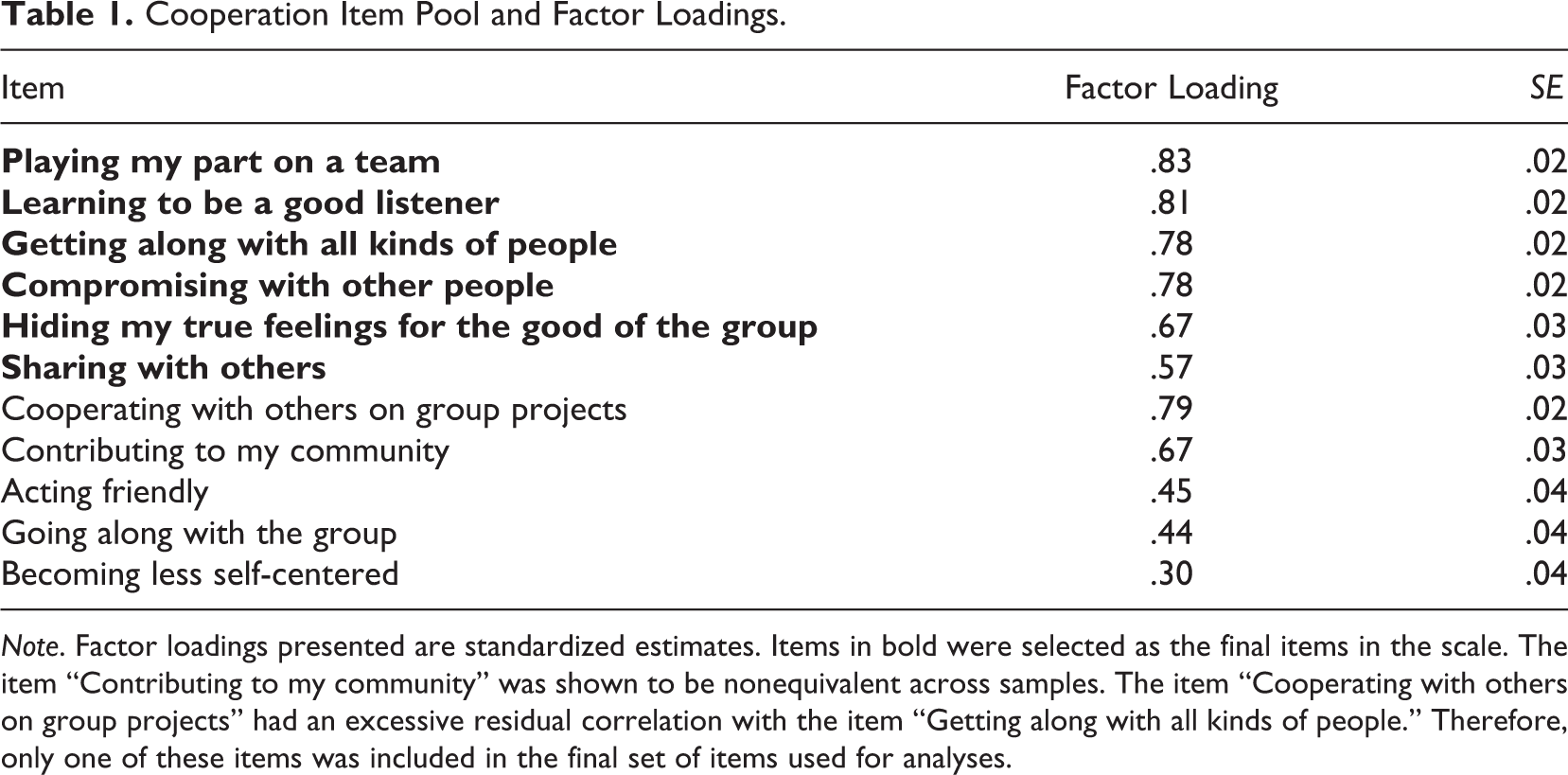
Note. Factor loadings presented are standardized estimates. Items in bold were selected as the final items in the scale. The item “Contributing to my community” was shown to be nonequivalent across samples. The item “Cooperating with others on group projects” had an excessive residual correlation with the item “Getting along with all kinds of people.” Therefore, only one of these items was included in the final set of items used for analyses.
With the cooperation dimension finalized, descriptive statistics, interitem correlations, and scale reliabilities were computed for each participant group. This information is provided in Tables 2 –4. Across all groups, Ms and SDs appeared reasonable. In addition, the correlations between dimensions were relatively large as expected given their theoretical relationships as subdimensions of a higher order construct (or the higher order construct itself). However, among American participants, the concern subdimension yielded somewhat lower correlations. This was likely due to the relatively low reliability of this dimension among American participants. However, the reliability was not so low as to preclude use of the concern dimension in subsequent analyses. All other reliabilities were high.
Descriptive Statistics, Intercorrelations, and Reliabilities of Variables Among American Participants.
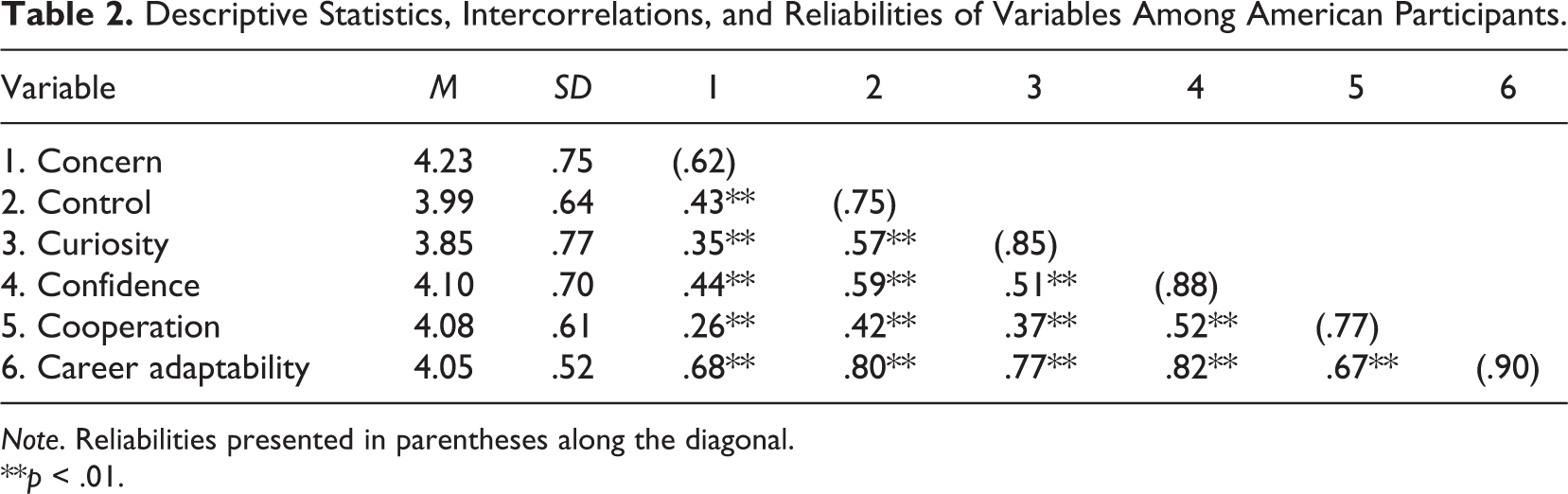
Note. Reliabilities presented in parentheses along the diagonal.
**p < .01.
Descriptive Statistics, Intercorrelations, and Reliabilities of Variables Among Chinese Participants.
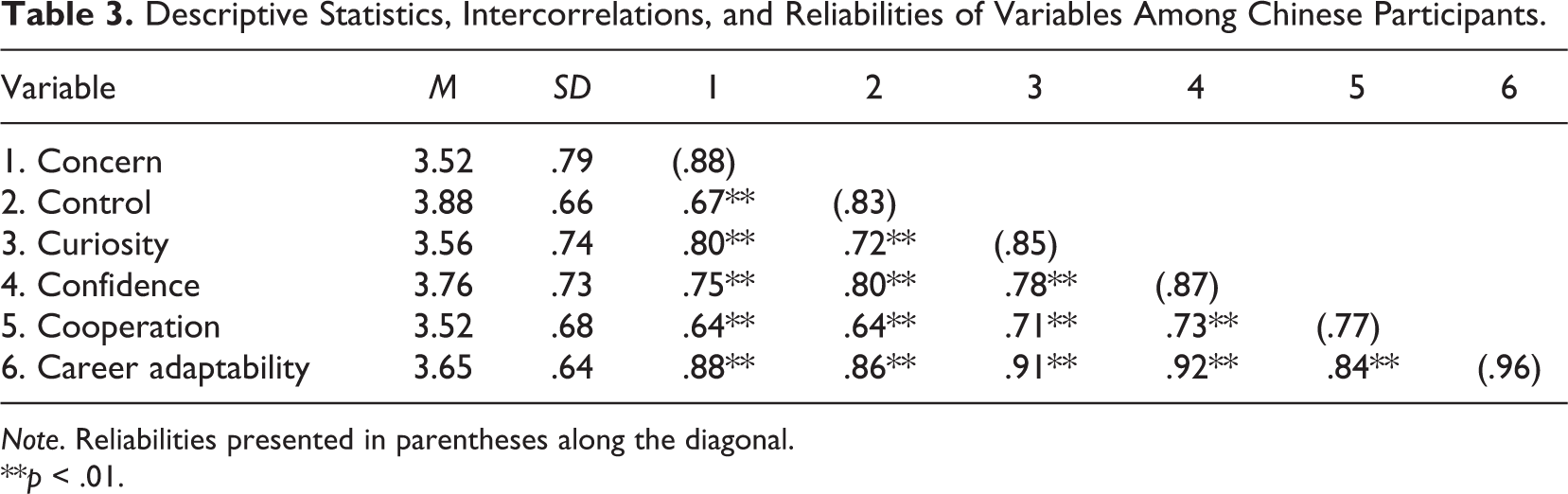
Note. Reliabilities presented in parentheses along the diagonal.
**p < .01.
Descriptive Statistics, Intercorrelations, and Reliabilities of Variables Among Taiwanese Participants.
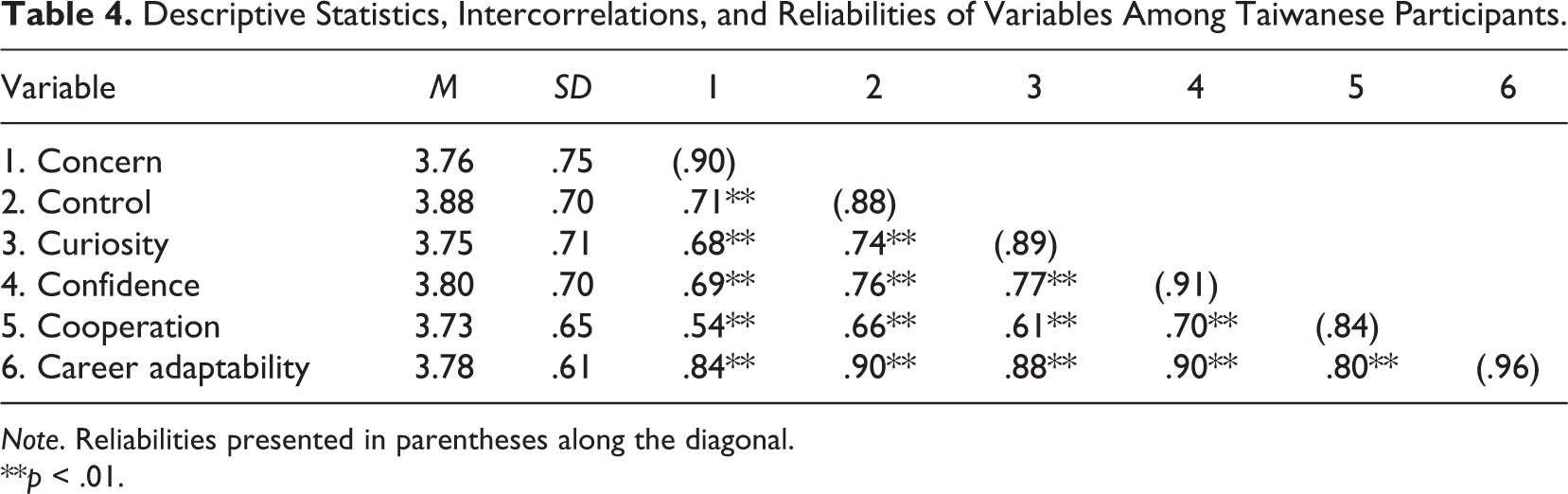
Note. Reliabilities presented in parentheses along the diagonal.
**p < .01.
A higher order model was estimated across American, Chinese, and Taiwanese participants to assess both how well cooperation fit in a model of career adaptability and the extent to which this model operated similarly across groups. Before doing so, equivalent referent items and a lower order factor had to be identified to ensure the accuracy of the measurement equivalence analyses. Referent items for this analysis were selected by first constraining all of the items for a particular measure to be equivalent across groups. Next, the item constraints were relaxed sequentially, and the changes in CFI were evaluated to identify significant nonequivalence. This approach, known as the constrained baseline approach, has been shown to have high power for detecting nonequivalence (Stark, Chernyshenko, & Drasgow, 2006). Items were identified as nonequivalent and, therefore, inappropriate for use as a referent item, if the change in CFI after freeing the constraints was greater than .002 (Meade, Johnson, & Braddy, 2008). Using this approach, referent items were identified for each of the lower order latent factors, and the control dimension was selected as the referent for the second-order career adaptability factor. We next examined the equivalence of these latent factors across cultural groups.
Measurement equivalence was assessed by examining both configural and scalar invariance models. Estimation of a configural measurement model examines the equivalence of the factor structure across groups. A scalar measurement model, on the other hand, examines the equivalence of the factor loadings and intercepts across groups (Nye & Drasgow, 2011; Stark et al., 2006). Again, nonequivalence was identified as changes in the CFI greater than .002 between the nested invariance models. The configural model fit the data reasonably well, χ2(1,204) = 3,084.16, RMSEA = .063, CFI = .906, SRMR = .059, suggesting that the addition of the cooperation dimension resulted in a well-fitting model of career adaptability across groups. The scalar model of the data resulted in somewhat poorer model fit, χ2(1,304) = 3,751.866, RMSEA = .069, CFI = .878, SRMR = .074. The significant decrease in CFI suggests that although the factor structure may be similar, direct comparisons of observed scale scores across groups may be misleading (Nye & Drasgow, 2011; Stark et al., 2006).
To assess the extent to which individual items contributed to the nonequivalence across groups, item-level nonequivalence was examined next. This involved starting with the configural model and sequentially constraining the intercepts and loadings of each item to be equivalent across groups. Again, an item was flagged as nonequivalent if constraining the item loading and intercept resulted in a decrease in the CFI of greater than .002 when compared to the free baseline model (Meade et al., 2008). Table 5 contains a summary of all the items included in these analyses and the resulting fit indices when a particular item was constrained. Using these analyses, none of the items were identified as nonequivalent. To evaluate the magnitude of differences across groups, and to provide additional information about how these items resulted in nonequivalence at the scale level, we next estimated effect sizes both for the items and for the overall effects of bias on the scale (Nye & Drasgow, 2011). This approach allowed us to examine the contribution of nonequivalence to observed score differences across groups by correcting these differences for nonequivalence. The results, as displayed in Table 6, showed that measurement bias had little overall influence on observed differences between groups on the CAAS-5. However, the results did indicate that the observed score difference on the control scale between American and Taiwanese respondents was almost entirely due to bias (observed d = .17, corrected d = .02). In addition, a sizeable portion of the observed score difference on the confidence scale between Chinese and American respondents (observed d = .49, corrected d = .23) was attributable to bias. Finally, the magnitudes of the observed differences in overall career adaptability were also inflated by bias when comparing American respondents to both Chinese (observed d = .77, corrected d = .47) and Taiwanese respondents (observed d = .52, corrected d = .18). As such, it appears that although none of the individual items were nonequivalent, aggregating the effects of small levels of nonequivalence to the scale level may influence comparisons of overall career adaptability across these groups.
Summary of DIF Analyses.
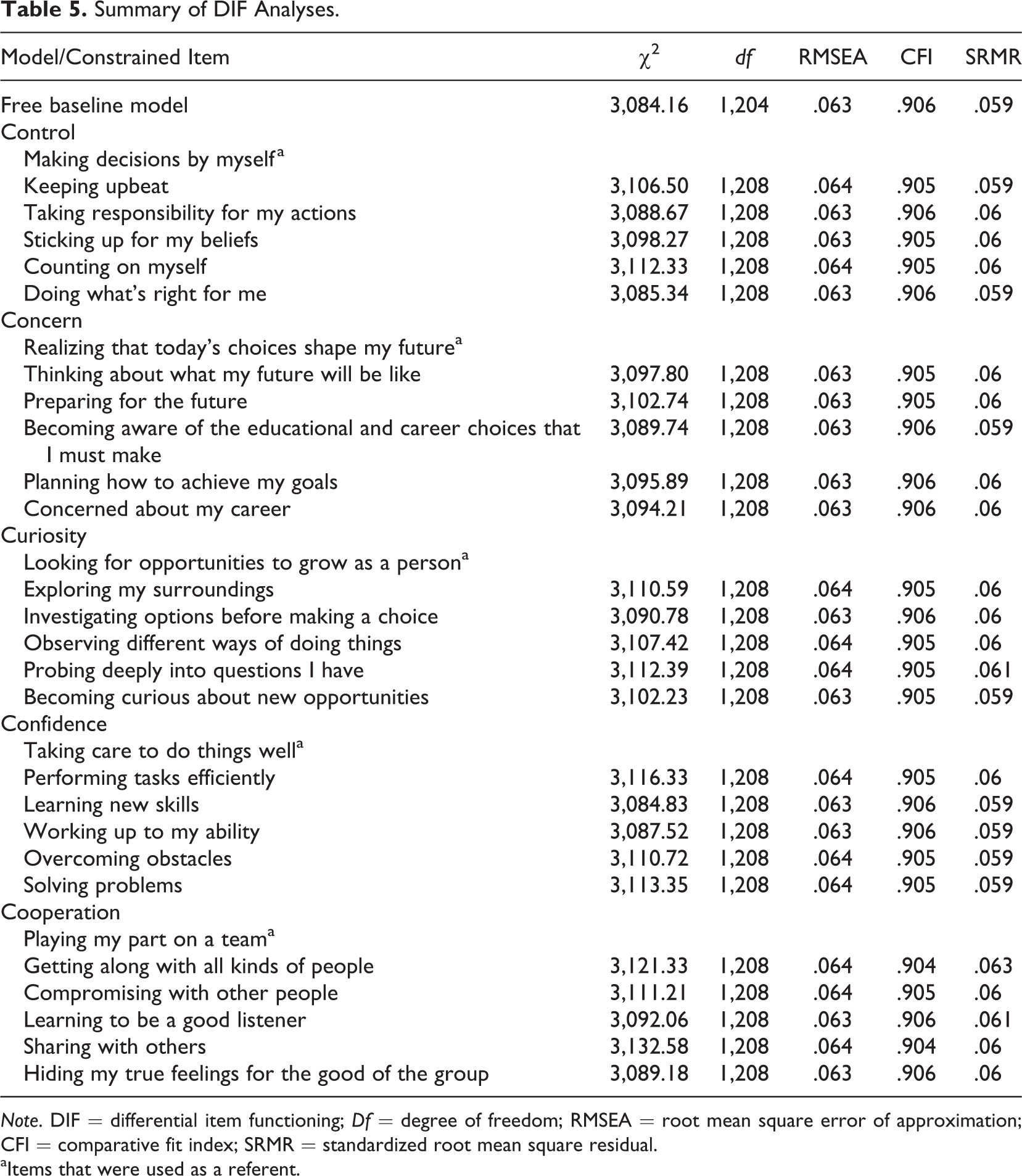
Note. DIF = differential item functioning; Df = degree of freedom; RMSEA = root mean square error of approximation; CFI = comparative fit index; SRMR = standardized root mean square residual.
aItems that were used as a referent.
Observed and Corrected Effect Sizes for the Mean Differences on the CAAS-5 Dimensions across American, Chinese, and Taiwanese Samples.
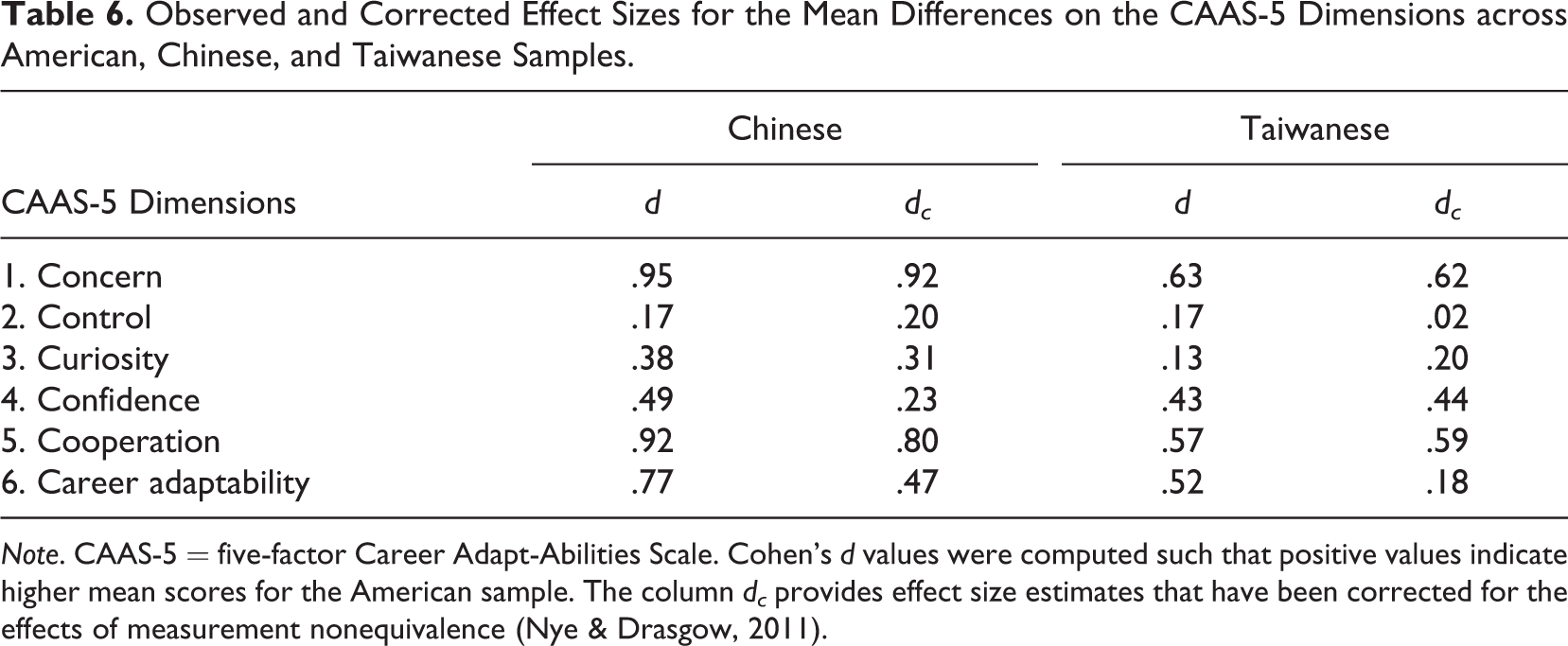
Note. CAAS-5 = five-factor Career Adapt-Abilities Scale. Cohen’s d values were computed such that positive values indicate higher mean scores for the American sample. The column dc provides effect size estimates that have been corrected for the effects of measurement nonequivalence (Nye & Drasgow, 2011).
Discussion
The construct of career adaptability, with its accompanying CAAS, is one of the most significant recent additions to the field of vocational psychology. To add to this growing literature, we provide an expanded five-factor conceptualization of the construct to include a cooperation dimension. Furthermore, the first study to examine the structural validity of the CAAS within the United States consisted only of high school students. We wanted to extend that previous work to a sample of older college students with work experience. Given the program of research on individualistic and collectivistic cultures and their influence on careers, we decided to examine the validity of the five-factor model with cross-cultural samples from Chinese contexts to represent both types of cultures. Hence, our study provides not only a structural validity examination of the CAAS-5 but also a cross-cultural validation of the five-factor model across samples in China and Taiwan.
Using a measurement equivalence approach, we found moderate support for the five-factor model with the current sample of college students as well as the cross-cultural working samples from China and Taiwan. Specifically, a higher order model was used to estimate invariance across American, Chinese, and Taiwanese participants. In our assessment of how well the cooperation dimension fit into a model of career adaptability, we found that the configural model of the data fit reasonably well and the factor structure of the model was similar between groups. On the other hand, the scalar invariance model resulted in somewhat poorer model fit. The significant decrease in CFI within the scalar model suggests that direct comparison of observed scale scores across groups may be misleading even though the latent structure of the data may be similar.
To further understand the nature of the problems with the scalar model, item-level analyses were conducted to try to identify items that may have contributed to the drop in CFI. However, we did not find any specific items that were contributing significantly to the decrease in CFI. Measurement nonequivalence was also examined at the scale level via analyses that corrected observed effect size differences between groups for bias (Nye & Drasgow, 2011). Results showed that for the most part bias did not contribute much to observed score differences for most scales but did play a role when comparing American respondents to Taiwanese or Chinese respondents on the control scale. In addition, comparing scores on the overall career adaptability factor also resulted in biased estimates of group differences. A possible explanation for the lack of differential item functioning, but the presence of bias at the scale level, is that nonsignificant item-level biases may have aligned in such a way to create a meaningful effect in the aggregate. Such an explanation may also explain how the influence of bias was relatively minor across the lower order factors, but clear at the level of higher order career adaptability. Because previous studies (Porfeli & Savickas, 2012) were conducted with high school students, and the current study was conducted with college students, future research should examine the equivalence of the CAAS-5 with working samples of adults as well.
A major rationale of our argument for a five-factor model of career adaptability that includes the cooperation dimension comes from cross-cultural research, suggesting a cultural bias toward individualistic conceptualizations of career constructs such that relational or interpersonal dimensions are often ignored (e.g., Cheung et al., 2001; Hardin, Leong, & Osipow, 2001). Hence, the initial support for the five-factor model of the CAAS presented here demonstrates the value and utility of the inclusion of the interpersonal dimension in career adaptability. In essence, we believe that a model of career adaptability which includes the interpersonal dimension is a more complete model than one which only measures individualistic dimensions. Support for this completeness argument comes from other highly established models of adaptability such as self-determination theory (Ryan & Deci, 2017), which posits that it is the experience of autonomy, competence, and relatedness that fosters high levels of motivation and engagement. Similarly, in Bandura’s (1977, 1997) self-efficacy model, a key source for the development of self-efficacy beliefs comes from social modeling, that is, the vicarious experiences and social learning from models. More than a passive process of observation learning, Bandura (1997) has actually argued that people seek out proficient models who possess the skills which they aspire to develop. In the field of career development, this occurs through the highly important process of mentoring. Another key interpersonal dimension in Bandura’s model is that of social persuasion as a key source for the development of self-efficacy beliefs. Again mediated through mentoring, people are supported, empowered, and persuaded that they possess the capabilities to master certain tasks and skills. Bandura’s (1997) social modeling and social persuasion components are central to his social learning model and strongly support our argument for the inclusion of the interpersonal dimension in the measurement of career adaptability.
Whereas the current study examined the internal validity (measurement model) of the CAAS-5, it is only the first step in establishing the validity of the expanded measure. Although more internal validity studies are needed, future research should also examine the external validity of the CAAS-5 in terms of its predictive validity for appropriate career and work outcomes. Studies of the external or predictive validity of the CAAS-5 constitute an important aspect of the evaluation of the utility of the expanded measure. Indeed, such external validity studies could also compare and contrast the four-factor versus the five-factor model of the CAAS to determine their relative predictive value.
As with all studies, the present study has several limitations that should be noted. First, the three samples examined here differed in age, level of work experience, and the proportion of men and women. Specifically, while the American sample was comprised of university students with work experience, the Chinese and Taiwanese samples consisted of older workers. In addition, 70.7% of the American sample were women, which is larger than in either of the other groups and is not representative of the broader U.S. population. Despite these differences, we were still able to find support for the configural model across groups. Nevertheless, one potential explanation for differences observed for the overall career adaptability construct could be the sex or age differences between groups. Therefore, future research should replicate these results with additional samples that are more comparable in age.
An additional limitation is that this study looks only at the structural validity of the CAAS-5, and does not examine the measure’s predictive validity. Future research should examine the extent to which the CAAS-5 predicts important workplace outcomes and whether the measure’s predictive validity is cross-culturally stable. Finally, in terms of the structure of the CAAS-5, it is also worth emphasizing that the concern dimension had low reliability in the sample of U.S. participants. Although this result does not negate the finding that cooperation is a separate dimension of career adaptability, it does contradict previous research which has found higher reliability for this scale (Porfelli & Savickas, 2012) and would have affected the intercorrelations among the observed scores. Therefore, future research should examine the reliability of the concern scale and test the structure of the CAAS-5 in other U.S. samples to replicate these results.
In summary, we found support for a five-factor model of career adaptability, as measured by the CAAS-5. This was true with a sample of U.S. college students with work experience as well as in samples from China and Taiwan. Second, our cross-cultural comparisons provided some support for the measurement equivalence of the CAAS-5 in terms of the configural model. The results for the scalar model were somewhat mixed with the omnibus test indicating nonequivalence at the scale level, but item-level analyses did not identify specific items that were responsible for the scale-level differences. Given this set of findings, we recommend continued research with the CAAS-5 in view of the importance of the interpersonal cooperation dimension to career adaptability.
Footnotes
Acknowledgments
The authors would like to thank Catherine Ott-Holland and Sin Hui Chong for their assistance with early stages of this project.
Declaration of Conflicting Interests
The author(s) declared no potential conflicts of interest with respect to the research, authorship, and/or publication of this article.
Funding
The author(s) received no financial support for the research, authorship, and/or publication of this article.