



Abstract
Among the approaches to the study of career interests, the person-centered profile approach (i.e., studying the career interest profiles of individuals), rather than the traditional construct-centered approach, has gained more attention in recent years. In our research, we intend to advance our understanding of career interests with the person-centered profile approach and address some important conceptual and methodological issues raised by previous studies. Based on the cultural context of Hong Kong after the 1997 handover, we hypothesized four general career interest profiles for Hong Kong high school graduates. Using a sample of senior secondary school graduates who were not admitted into undergraduate programs and a cohort sample of first-year university students, we found support for this hypothesis. This classification was validated by its relationships with career decisiveness, parents’ open communication style, and life satisfaction. Our research provides guidelines to test the validity of the proposed forms of career interest profiles.
Career interests describe an individual’s vocational orientation toward certain work activities and work environments (Holland, 1985). There are six different types of career interests (RIASEC): realistic (R), investigative (I), artistic (A), social (S), enterprising (E), and conventional (C). Classifying work activities into six major types is one of the important contributions of Holland’s (1985) career interest model. Past approach to career interests is construct-centered, assuming the homogeneity of respondents and focusing on relationships among constructs (McLarnon, Carswell, & Schneider, 2015). While this approach can investigate the consequences of each career interest such as career maturity (Liu, Peng, Mao, & Wong, 2017), it cannot address the combinations of the six types of career interests for a particular individual (McLarnon et al., 2015). With few exceptions, a job usually involves more than one type of activity. For example, a mechanic’s job involves realistic and investigative activities (i.e., analyzing and fixing mechanical problems) as well as social activities (i.e., communicating with customers). Thus, focusing on each career interest construct may miss the larger picture of the match between individuals and work activities of a particular job.
To overcome the above disadvantage, construct-centered career models offer some possible solutions. One is to identify the most important work activities for a job to match an individual’s career interests and the nature of the job (Holland, 1985). For example, the critical activities of a programmer’s job, in order of importance, are investigative, realistic, and conventional activities. Another solution is to examine the relationships among the six types of career interests (Tay, Su, & Rounds, 2011). According to Holland’s hexagonal model of career interests (in the order of RIASEC), proximity among interests represents their similarities and distance for disparities. Alternatively, we can borrow past research on career interests and career decidedness to derive two possible categories, one being individuals having high and the other being individuals having low interest in most types. Briefly, Holland’s model and related adaptations indicate that individuals may be classified as I-R-C type or A-S type of interests, mostly high or mostly low of career interests.
Despite the potential advantages of the above methods, the construct-centered approach still cannot offer the optimal configurations of different career interests. A remedy is to adopt the person-centered approach to career interests, which can detect unobserved population heterogeneity in career interest types (Leuty, Hansen, & Speaks, 2016; McLarnon et al., 2015; Perera & McIlveen, 2018). This approach has been called for application (e.g., Taber, 2013) to research on career interests.
Conceptually, the person-centered approach uses an optimal number of career profiles to classify individuals. Bransal and Kevin’s (2012) arguments suggest two possible ways of identifying the potential career profiles in a particular society. One is “theory-based” research, in which researchers derive profiles from an established theory. Researchers have adopted person–environment fit theory to examine career interests (e.g., Van Iddekinge, Putka, & Campbell, 2011). According to this theory, a good match between individuals and their work environments may lead to positive outcomes (Edwards, 2008). However, it is hard to judge whether this theory is suitable for identifying patterns of career interest profiles for two reasons. First, the construct-centered approach was used to study the person-environment fit perspective on career interests. Since career interest profiles focus on subgroup heterogeneity, it would be hard to base predictions of career interest profiles on this theory. Second, person-environment fit theory primarily explains how career interests may affect individuals and have few hints on how individuals may form patterns of career interest types. The other is “phenomenon-based” research, in which researchers analyze a specific phenomenon to uncover the underlying principles of a social context that may affect the form of career interest profiles. This approach seems to be more reasonable at this stage, when there are only a few studies all in Western countries such that we lack evidence to compare societies concerning different career interest profiles.
To minimize the threat of hypothesizing after the results (Kerr, 1998) in identifying profiles, it is especially important to have a prior hypothesis regarding the number of career interest profiles. The previous studies using the person-centered approach, despite their statistical results, lack rationale explaining the number of profiles they expected. This may refrain the generalizability and validity of their findings in a particular context. In addition, these studies obtained samples of students from America, Canada, and Australia. The numbers of profiles they found were somewhat inconsistent. Seven profiles were found in Leuty, Hansen, and Speaks (2016), eight in McLarnon, Carswell, and Schneider (2015), and six in Perera and McIlveen (2018). And the categories of their profiles varied. For example, an artistic-dominant profile was absent in Perera and McIlveen (2018), but it was obtained in both McLarnon et al. (2015) and Leuty et al. (2016). Perera and McIlveen (2018) recognized cultural context to be important for examining the validity of career interest profiles, but those studies did not investigate and analyze specific social contexts that may affect the identified profiles.
Another issue is the choice of outcomes and predictors to further verify the validity of the identified profiles. The three studies reported above included some variables and examined their relationships with the identified profiles. However, only one study used predictors and outcomes as evidence for validity (Perera & McIlveen, 2018). Not all the three studies presented hypotheses concerning how certain variables related to the profiles, probably due to the lack of an analysis of the specific context in which career interest profiles are formed.
Finally, cross validation by independent samples is also important to demonstrate the validity of profiles. McLarnon et al. (2015) and Leuty et al. (2016) investigated only one sample. Perera and McIlveen’s (2018) study analyzed two samples, but the two samples were divided from the initial sample such that they were dependent rather than independent.
We believe that the three issues mentioned above are important and should be addressed when the person-centered approach is applied to study the profiles of career interests. Focusing on Hong Kong as a specific context, our research derives the profiles of career interests, cross validates the identified profiles, and tests their outcomes and predictors with two independent samples.
Hong Kong as a Particular Context for Career Interest Profiles Development
Three characteristics of Hong Kong’s society may affect the career interest development of high school graduates and undergraduate students in Hong Kong (Law, Wong, & Leong, 2001). First, business activities in Chinese societies are highly related to interpersonal relationships such that business and social interests are relatively similar and closely related to each other. Second, the education system in Hong Kong divides students into science and nonscience streams early. After completing 9 years of mandated education (primary and junior high school), some students choose either science or nonscience streams to continue their senior high school study, while others seek employment or receive vocational training. Third, Hong Kong’s society has a strong social preference for the science stream, which tends to be chosen by students with relatively better academic performance. Students in the science stream take lessons in science subjects such as mathematics and biology, along with language subjects, but not in social sciences and arts. Their formal education is limited to activities closely related to realistic and investigative occupations. For those who are not in the science stream, their curriculum is more diversified, facilitating them to develop career interests that are related to artistic, social, enterprising, and conventional occupations. Based on these three characteristics, Law et al. (2001) found that the R–I end of the Holland hexagon is further away from the A–S–E–C ends. This finding was confirmed in Wong and Wong’s (2002, 2006) studies with multiple samples of Hong Kong students who receive senior secondary and undergraduate education. These studies suggested two profiles of career interests: “science” having particularly high levels of realistic and investigative interests and “nonscience” having particularly high levels of social, enterprising, and conventional interests.
Those investigations were conducted before 1997. With the changes after the return of Hong Kong from Britain to China in 1997, two additional patterns of career interests may have occurred. Under British colonial rule before 1997, the colonial government adopted an elite education system in which a significant portion of students could not continue their senior secondary education. Among those who received senior secondary education, only a small percentage could be admitted to government subsidized undergraduate programs. After 1997, the Hong Kong Special Administrative Region Government (HKSAR) began to provide free, while not compulsory, senior secondary school education so that most students could continue their school education. Although the portion of students entering undergraduate programs is still limited to less than 20%, the government expanded postsecondary education by introducing many associate degree programs (HKSAR, 2016). Students completing these programs can seek employment or apply for undergraduate programs depending on their academic performance. With these changes, almost all students now continue their senior secondary education after junior secondary education.
Although the government has introduced some curriculum reform to reduce the sharp distinction between the science and nonscience streams (Cheng, 2009), differences are still substantial and further reinforced by Hong Kong’s segregation of schools into three bands (Bray, Zhan, Lykins, Wang, & Kwo, 2014). Band 1 schools admit students with the highest academic levels who would concentrate mostly on their academic studies instead of on potential careers or jobs. These students’ career interests may be delayed since their priority is to perform well in the university entrance examinations. In contrast, graduates from Bands 2 and 3 schools have lower chances of being admitted by undergraduate programs. They may consider career training after graduating from senior high school. Band two and three schools are also willing to provide guidance to help their students gain clarity of career interests and the possible types of future jobs or careers they may select. However, some students who are extremely weak in academic subjects may choose to enroll in senior secondary programs because it is free and everyone is doing it. These students may not develop any type of career interest. Hence, some students may have the chance to develop interests in most types of occupational activities, while others may not have such chance. We propose the following:
Outcomes and Predictors of Career Interest Profiles
Decisiveness in career choice refers to the extent to which an individual has made up his or her mind concerning what kinds of jobs and future careers he or she will pursue (Lee, 2001). This concept has received wide attention from career researchers. The six types of vocational interests are showed to be positively related to occupation considerations (Lent, Brown, Nota, & Soresi, 2003). Individuals with strong investigative and social interests experience low career indecision (Burns, Morris, Rousseau, & Taylor, 2013). These findings suggest that when young adults have a strong interest in some occupational activities, it is likely that they have a clearer idea about their preferred kinds of jobs and careers. Following the logic of these findings, we expect that students in the Mostly High Profile have higher levels of career decisiveness than their counterparts in other three groups, while students in the Mostly Low Profile may feel difficult to make career decisions. Students in the other two groups are interested in some job types, but their limited interests are likely to impede their career choice. We thus hypothesize the following:
Chinese young adults tend to be influenced by their parents. As evidenced in their investigation of college students in Hong Kong, Wong, Wong, and Peng (2011) found that the career interests of parents (both father and mother) are related to students’ career interests. We thus reason that parental open communication style may be associated with students’ career interest configurations. Parents with a high level of open communication style may encourage their children to exchange ideas, express feelings, and consider an issue from multiple points of view (Jaskiewicz, Combs, Shanine, & Kacmar, 2017). Parents’ willingness to communicate openly on issues from various perspectives can enable students to gain more experience and advice regarding the development of career interests. Furthermore, students whose parents communicate openly are more likely to possess positive characteristics because they have a stronger desire to control the events in their lives (Jaskiewicz et al., 2017). Therefore, we expect the following:
Career is along the span of a person’s life (Hall, 1976), which leads us to propose life satisfaction as an outcome of career interest profiles. Referring to something that one likes to do, interests can serve as motivating forces pulling individuals toward certain activities (Almeida, Ahmetoglu, & Chamorro-Premuzic, 2014). When individuals perform interested tasks, they do so because they want to and not because they have to, leading to enjoyment and comfort. As noted in Holland’s model of vocational interests, individuals with a particular career interest tend to feel comfortable in a work environment that matches their interest (Kantamneni, 2014). Thus, if individuals have a strong interest in various types of occupational activities, they have more opportunities to be engaged in those activities with feelings of happiness and enjoyment. As the Mostly High and Nonscience Profiles encompass a wider range of vocational interests than the Science and Mostly Low Profiles, we expect that students in these two profiles are more likely to engage in the activities they are interested, therefore experiencing a higher level of life satisfaction than their counterparts in the other two profiles.
Method
Study 1: Participants and Procedure
The HKSAR government sets up career centers for young adults in Hong Kong so that they can seek career advice. After the announcement of admission decisions of local universities, some graduates of senior secondary schools who are not admitted often seek employment information from the centers. The centers require them to rate their career interests and career decisiveness so that career counselors can provide advice. All the surveys were completed on the computers in the centers and the computer system did not allow the respondents to skip any item, yielding no missing data in the current sample. We successfully invited a sample of 188 of these graduates to participate in our study within a 3-month period after the admission decisions were announced. About 50.5% of them were males and their ages were either 18 or 19 because of the mandated age of school education in Hong Kong. The graduates participating in this study agreed to release the data on their career interests and career decisiveness for use in our research.
Measures
Career interests
We measured the six types of career interests using Wong and Wong’s (2006) 72-item scale on a 4-point Likert-type scale, ranging from 1 (dislike it at all) to 4 (like it very much). This scale was developed for the Hong Kong public agency and has been applied to measuring career interests of young adults when they seek consulting services. Liu, Peng, Mao, and Wong (2017) have already demonstrated acceptable reliability and validity of this scale in a Hong Kong sample. The reliabilities for the six types of interests were larger than or close to .70. Regarding the validity, social, enterprising, artistic, and conventional interests were positively correlated with conscientiousness, openness, and extroversion (most coefficients were larger than .20); realistic and investigative interests were negatively correlated with agreeableness (r = −.06) and extroversion (r = −.05), respectively. In the current study, the Cronbach’s αs (RIASE) are .88, .86, .78, .82, .75, and .70.
Career decisiveness
We adapted Lee’s (2001) 10-item scale to measure career decisiveness on a 5-point Likert-type scale ranging from 1 (strongly disagree) to 5 (strongly agree). This scale has been used in a Hong Kong sample and has acceptable reliability and validity (e.g., Liu, Chen, Wong, & Peng, 2014). Their findings showed acceptable reliability of .88 and also demonstrated that this scale was positively correlated with extroversion (r = .17), openness (r = .13), and conscientiousness (r = .24). One sample item was “In order to obtain the occupation I want, I need to plan ahead.” In the current research, the Cronbach’s α is .84.
Strategy of Data Analyses
To test the hypotheses, we conducted latent profile analysis (LPA) in Mplus Version 7.30 (Muthén & Muthén, 1998–2014). Following Nylund, Asparouhov, and Muthén (2007), we began by specifying two latent profiles and then increased the number of latent profiles until the increased model fit no longer merited the reduction in parsimony. We used seven fit statistics to evaluate profile structures (Foti, Bray, Thompson, & Allgood, 2012): log likelihood (LL), Akaike information criterion (AIC), Bayesian information criterion (BIC), sample size–adjusted BIC (SSA---BIC), Lo–Mendell–Rubin (LMR) likelihood ratio test, bootstrap likelihood ratio test (BLRT), and entropy. In comparison with other profile solutions, the LL, AIC, BIC, and SSA-BIC values of the best model should be lower and entropy should be larger; LMR and BLRT should be significant (p < .05). We used the DE3STEP command in Mplus 7.30 (Asparouhov & Muthén, 2013) to test the potential differences of career decisiveness among the career interest profiles.
Results
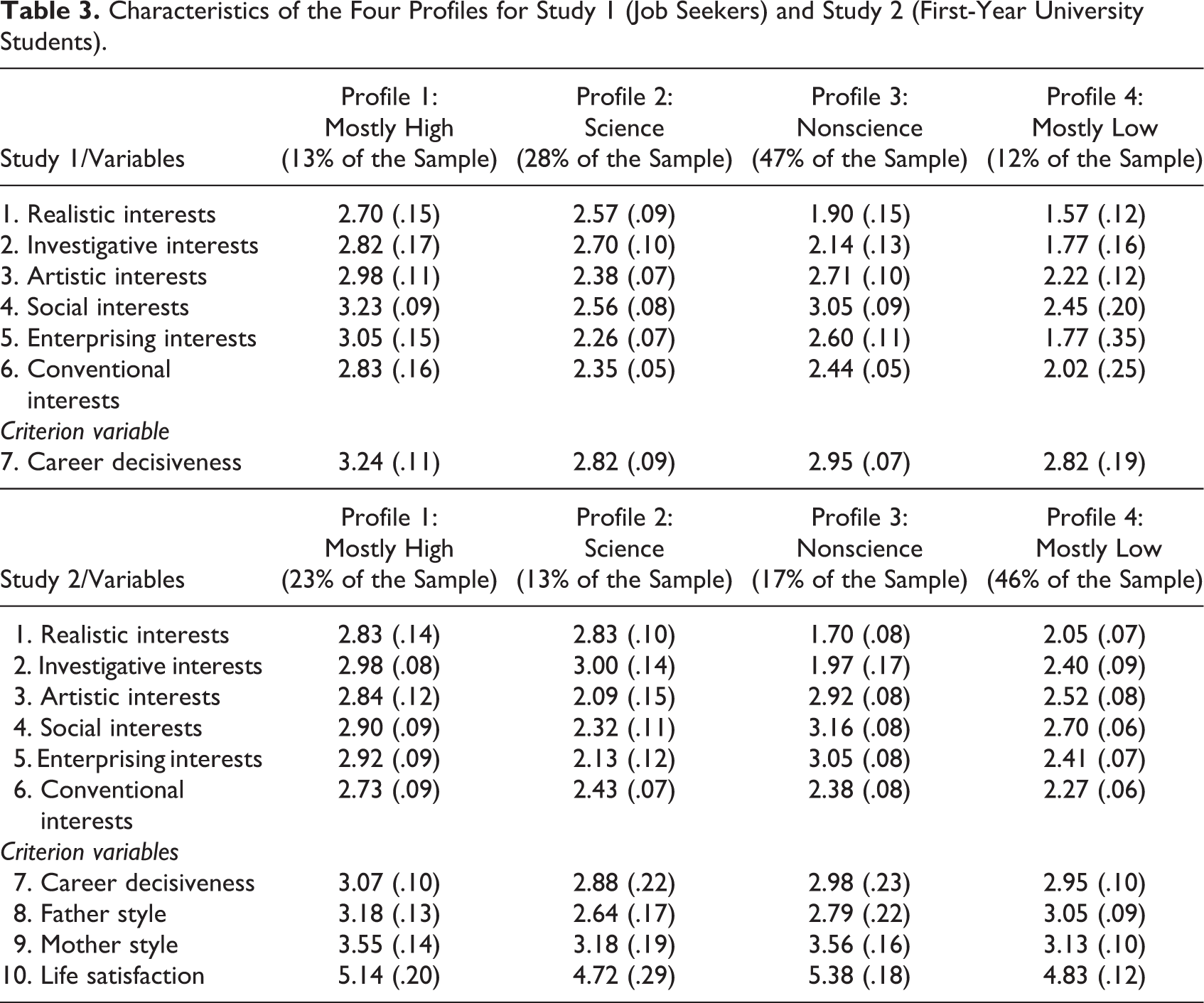
Table 1 shows internal consistency reliability, descriptive statistics, and correlation coefficients of the study variables. Table 2 shows the fit statistics for possible latent profile solutions, and Table 3 presents the characteristics of the four-profile structure that includes the six interest ratings and the score of career decisiveness. The results support Hypothesis 1 because the four-profile model has good fit, and the characteristics of the profiles are consistent with our expectations for the four proposed profiles. Specifically, the four-profile model has lower LL, AIC, BIC, and SSA-BIC values, compared with the two- and three- profile models, and LMR and BLRT are marginally significant. Although the five-profile model has slightly lower LL, AIC, BIC, and SSA-BIC values, its LMR is nonsignificant (p > .10). As shown in Table 3, individuals with a Mostly High Profile (13%) reported similarly high levels of realistic (M = 2.70), investigative (M = 2.82), artistic (M = 2.98), social (M = 3.23), enterprising (M = 3.05), and conventional (M = 2.83) interests. Individuals with a Science Profile (28%) reported high levels of realistic (M = 2.57) and investigative (M = 2.70) interests but low levels of other career interests; in contrast, individuals with a Nonscience Profile (47%) demonstrated low levels of realistic (M = 1.90) and investigative (M = 2.14) interests but high levels of other career interests. Individuals with a Mostly Low Profile (12%) reported extremely low scores for all six types of career interests: realistic (M = 1.57), investigative (M = 1.77), artistic (M = 2.22), social (M = 2.45), enterprising (M = 1.77), and conventional (M = 2.02) interests. Table 3 also shows that the obtained four profiles are associated with different levels of career decisiveness. A χ2 test indicates significant differences of this variable among the four career interest profiles (χ2 = 12.13, p < .01). As shown in Table 3 and Figure 1, Hypothesis 2 is supported because the Mostly High Profile group shows the highest level of career decisiveness (M = 3.24).

Means of career decisiveness by latent class for Study 1 (job seekers).
Descriptive Statistics and Correlations.
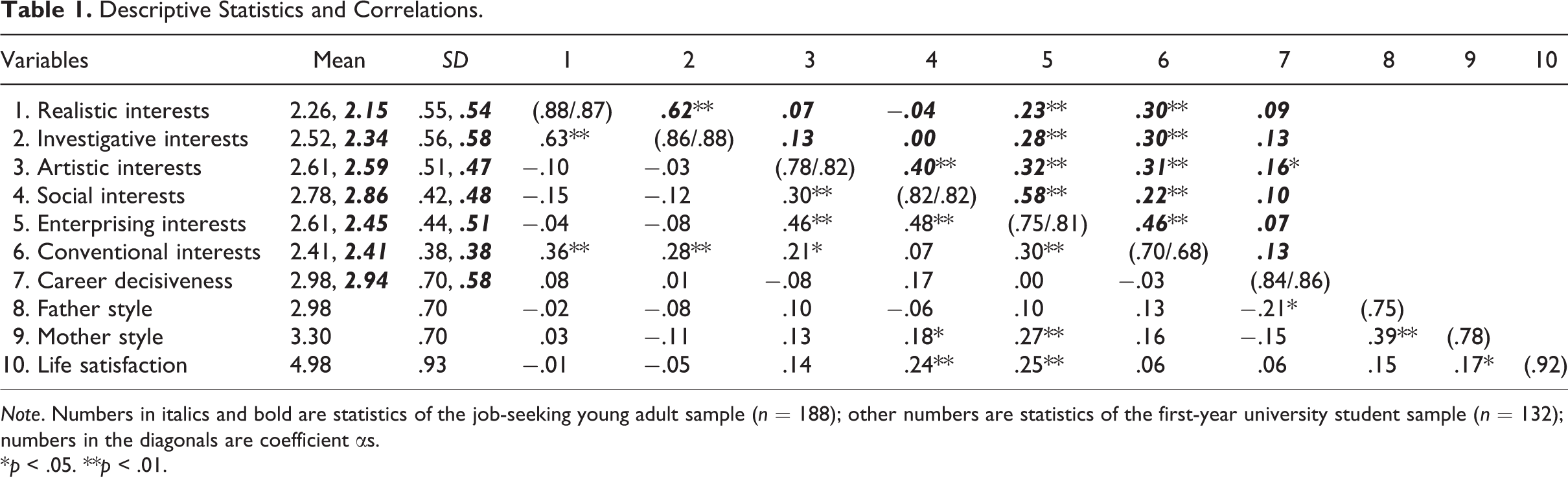
Note. Numbers in italics and bold are statistics of the job-seeking young adult sample (n = 188); other numbers are statistics of the first-year university student sample (n = 132); numbers in the diagonals are coefficient αs.
*p < .05. **p < .01.
Fit Statistics for Profile Structures in Study 1 (Job Seekers) and Study 2 (First-Year University Students).
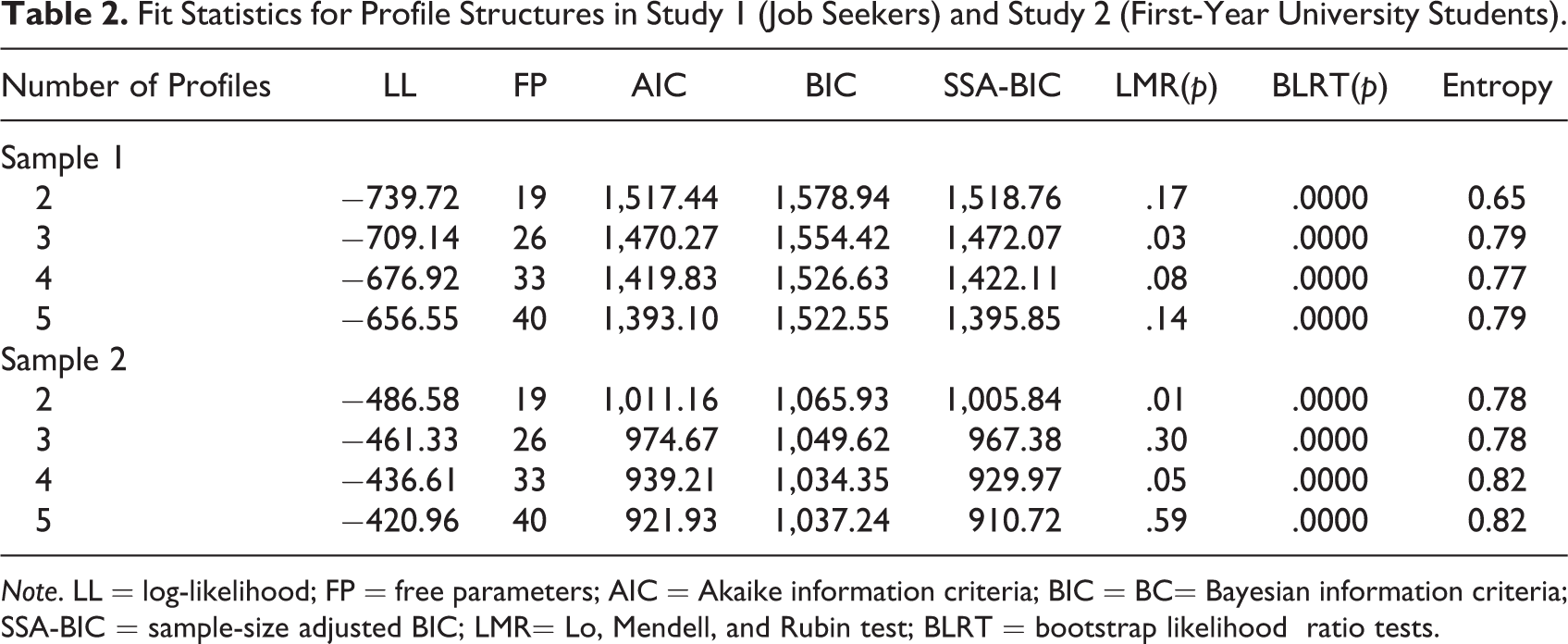
Note. LL = log-likelihood; FP = free parameters; AIC = Akaike information criteria; BIC = BC= Bayesian information criteria; SSA-BIC = sample-size adjusted BIC; LMR= Lo, Mendell, and Rubin test; BLRT = bootstrap likelihood ratio tests.
Characteristics of the Four Profiles for Study 1 (Job Seekers) and Study 2 (First-Year University Students).
Study 2: Participants and Procedure
Study 2 replicated the four-profile structure observed in Study1 and further examined the relationships among career interest profiles, parental communication style, career decisiveness, and life satisfaction. We invited first-year students of a large university in Hong Kong (who were enrolled in a general education course) to participate in our survey. One hundred and thirty-two students volunteered to complete the questionnaire. They rated the same variables in Study 1 along with parental communication style and life satisfaction. We hired a research assistant to help check whether there were items left unanswered before he collected questionnaires on site; if so, he would remind the respondents to fill in all the blanks before submitting their questionnaires. With such efforts, no missing data were found in the current study. About 51.5% of them were male and their age was either 18 or 19. This sample was a cohort of the first sample because they graduated from their senior secondary program in the same year and took the same university admission examination. The only difference is that respondents in this sample were admitted to undergraduate programs, while those in the first sample did not receive admission offers from universities.
Measures
Career interests and career decisiveness
These two variables were measured using the same scales used in Study 1. The Cronbach’s αs for RIASEC are .87, .88, .82, .82, .81, and .68, respectively, and that for career decisiveness is .86.
Parental open communication style
Six items adapted from Rogers’ (1987) scale were used to measure parent communication openness. Rogers’ scale has been adopted in communication openness research (e.g., Kay & Christophel, 1995; Schiller & Cui, 2010). Kay and Christophel’s (1995) study showed that this scale had a reliability of .93 and was correlated with motivation (r = .66) and nonverbal immediacy (r = .19), respectively. In our research, sample items were “My father (mother) always chats with me openly to share with me about his (her) life experiences,” “My father (mother) encourages me to express my feelings and emotions.” The Cronbach’s αs are .75 for the communication style of father and .78 for that of mother.
Life satisfaction
Life satisfaction was measured with the 9 items of Campbell, Converse, and Rodgers (1976). The first 8 items of this scale are pairs of opposite adjectives (e.g., enjoyable vs. miserable) with a 7-point Likert-type scale. The respondents were requested to circle the number that best described their feelings toward their lives. The last item directly asked the level of satisfaction in life (i.e., “how satisfied or dissatisfied are you with your life as a whole?”). This measure has been used in a Hong Kong sample before (Wong & Law, 2002), in which the reliability of this scale was above .70. They further found that this scale was positively correlated with self-emotion appraisal (r = .23), regulation of emotion (r = .29), and negatively correlated with powerlessness (r = −.37). In the current research, the Cronbach’s α for this scale is .92.
Results
We used the same analytical procedures used in the first study to identify the best profile structure and to examine the relationships of parental communication style, career decisiveness, and life satisfaction with the identified profiles. Table 1 shows the internal consistency reliability, descriptive statistics, and correlation coefficients of the study variables. Table 2 provides the fit statistics for possible latent profile structures, and Table 3 presents the characteristics of four-profile model. The results support Hypothesis 1 because the four-profile model has the best model fit, and the characteristics of the profiles are consistent with our expectations for the four proposed profiles. The graphical illustration of different profiles for both studies is presented in Figure 2, in which the values of different career interests are centered around the group means to see how much the value is deviating from the group mean. Specifically, the four-profile solution exhibits lower LL, AIC, BIC, and SSA-BIC values, along with significant LMR and BLRT values, compared with the two- and three-profile solutions. Although the five-profile solution has slightly lower LL, AIC, BIC, and SSA-BIC values, its LMR statistic is nonsignificant and the entropy value becomes lower.
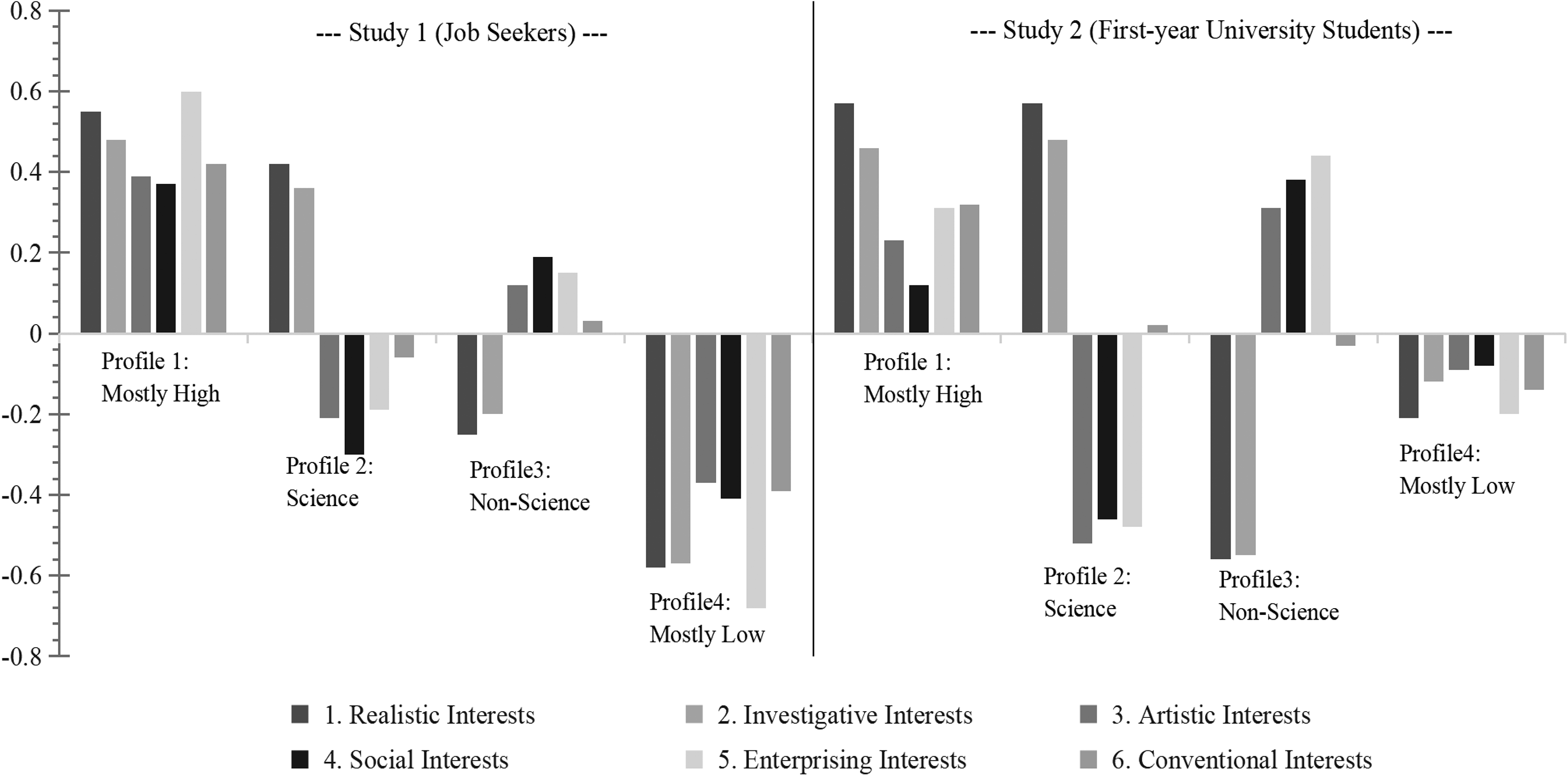
Graphical illustration of different profiles in Study 1 (job seekers) and Study 2 (first-year university students).
As shown in Table 3, individuals with a Mostly High Profile (23%) are high in all six types of career interests: realistic (M = 2.83), investigative (M = 2.98), artistic (M = 2.84), social (M = 2.90), enterprising (M = 2.92), and conventional (M = 2.73). Individuals with a Science Profile (13%) reported high levels of realistic (M = 2.83) and investigative (M = 3.00) interests but low levels of artistic (M = 2.09), social (M = 2.32), enterprising (M = 2.13), and conventional (M = 2.43) interests. In contrast, individuals with a Nonscience Profile (17%) reported low levels of realistic (M = 1.70) and investigative (M = 1.97) interests but high levels of artistic (M = 2.92), social (M = 3.16), enterprising (M = 3.05), and conventional (M = 2.38) interests. People with a Mostly Low Profile (46%) reported similarly low scores on all six types of interests: realistic (M = 2.05), investigative (M = 2.40), artistic (M = 2.52), social (M = 2.70), enterprising (M = 2.41), and conventional (M = 2.27).
As expected, the general four-profile structure is replicated, supporting Hypothesis 1. Hypothesis 2 is not supported because the χ2 statistics (3.08, p > .05) indicate that differences of career decisiveness among the four profiles are not statistically significant (see Figure 3). Hypothesis 3 is mostly supported because the father’s communication style is significantly different across the four profiles (χ2 = 14.50, p < .01) and the highest for the Mostly High Profile students (M = 3.18). This difference for mother communication style is marginally significant (χ2 = 6.51, p < .10), and it is relatively higher for the Mostly High Profile (M = 3.55) and Nonscience Profile (M = 3.56) students than students of the other two profiles (see Figure 3). Hypothesis 4 is partially supported because life satisfaction shows marginal significant differences among the four profiles (χ2 = 6.687, p < .10). The Mostly High Profile (M = 5.14) and the Nonscience Profile (M = 5.38) exhibit higher life satisfaction than the other two profiles. The results (see Figure 3) also reveal that the Science Profile demonstrates the lowest level of life satisfaction (M = 4.72), which is significantly different from the Nonscience Profile (χ2 = 6.06, p < .05).

Means of outcomes by latent class for Study 2 (first-year university students).
Discussion
Data collected from the two independent samples in Hong Kong generally support our hypotheses regarding the profiles of career interests and the associated predictors and outcomes. There is one unexpected finding, that is, the Science group exhibited lower life satisfaction than did the Mostly Low group. This may be because students taking science-related courses experience more pressure than their counterparts in the other three groups. Therefore, their enjoyment when performing related tasks might be canceled out by their experienced stress. In addition, we found support for the relationship between career profiles and career decisiveness in Study 1 but not in Study 2. One possible reason is that the students in Study 2 had better academic performance and enrolled in undergraduate programs. For these university students, the Mostly Low profile displayed a similar but moderate level of all six types of career interests. However, participants in the first study were not admitted by universities, so the resulting Mostly Low Profile group tended to be lower in all six types of career interests, which is associated with lower career decisiveness. Thus, the Mostly Low Profile of the first-year university student sample still appeared superior to their counterparts of the first sample in the development of various career interests.
Theoretical Implications
Our research contributes to the literature on career interests in general and to the interest profile approach specifically. The literature has largely examined the impact of each type of interest on people’s career-related issues (Van Iddekinge et al., 2011). This traditional approach to vocational interests is construct-centered and has not identified the interest patterns that individuals form in real life, despite some studies having suggested such a possibility (e.g., Tay et al., 2011). Recognizing this limitation, researchers have turned to a profile approach and identified patterns of individuals’ career interests (Leuty et al., 2016; McLarnon et al., 2015; Perera & McIlveen, 2018). Consistent with their studies, our research found that individuals could be classified into different configurations of career interest types. In the specific context of our research, four profiles appeared: Mostly High, Science, Nonscience, and Mostly Low. We provide additional evidence showing the significance of investigating career interest profiles. Our study, together with prior three studies, enriches the understanding about individuals’ vocational interests by demonstrating alternative patterns of individuals’ career interests.
Our research contributes to the interest profile approach specifically. First, we provide guidelines for empirical studies designed to test the validity of the proposed forms of career interest profiles. The guidelines are identifying patterns of career interests based on a strong rationale or a specific social context, using multiple samples to cross validate the identified patterns, and including outcomes and predictors to test the validity of the identified profiles.
Second, we conducted our research in Hong Kong, whose cultural context differs from those of prior studies. Although patterns of career interests have been identified, some of them are similar whereas others are not. Cultural context may be a way to examine the validity of the interest profiles (Perera & McIlveen, 2018). In Hong Kong, the education system divides students into science and nonscience streams very early. Given such characteristic, science and nonscience groups may be unique to young adults in Hong Kong. Our results support this possibility and suggest that how individuals’ career interests are configured is contingent on specific cultural contexts.
Third, our research examined individuals’ interest patterns via two independent samples. The limited number of studies on career interest profiles mostly studied one sample. This makes it difficult to arrive at a robust conclusion on the identified patterns. To know whether identified latent profiles can be replicated across distinct samples in a particular population (Perera & McIlveen, 2018), at least two samples should be used to verify the profiles unless a truly large and random sample can be drawn from the population. We tested our proposed profiles of interest from cohorts of senior secondary school graduates who were job seekers and first-year university students, and similar results were obtained from these two independent samples. Hence, our research contributes to the literature on career interest profiles by providing evidence from two independent samples in a particular cultural context.
Practical Implications
By identifying four patterns of career interests in the context Hong Kong, our research provides implications for career counselors in this society. The four patterns (Mostly High, Science, Nonscience, Mostly Low) suggest that there are cohorts of young people in Hong Kong who may be interested in some, all, or not much interested in any work activities. With such knowledge, career counselors can differentiate individuals more accurately in terms of their vocational interests and provide more appropriate career services. For example, individuals in the Mostly High Profile have strong interests in many areas, and career counselors can help them solidifying a career choice rather than considering a number of different options. For individuals in the Science Profile and the Nonscience Profile, career counselors may help them practice more on their interested work activities so as to well prepare for future jobs. For individuals who display the Mostly Low pattern, practitioners may focus on finding out why these individuals have little interests and then take interventions to foster their interests in some job activities. Our study also provides insight into the design of school curriculum. Hong Kong’s career education is quite deficient in the senior secondary education curriculum. Some students are deprived of early opportunities to develop interests in various occupational activities, as evidenced in the 12% Mostly Low Profile group in the first sample and 46% Mostly Low Profile group in the second sample. When designing education curriculum, school leaders may take into consideration of a valid classification of students according to their career interests and accordingly design curriculum and extracurricular activities to broaden their students’ exposure to various occupation-related activities.
Limitations and Future Research Directions
First, we cannot include all of the hypothesized outcomes and predictors in our first sample because the government agency only allowed us to include career-related variables in the survey. Hence, our results regarding parental communication and life satisfaction must be interpreted with caution. Second, we cannot claim the causal relationships between the correlated variables and career interest profiles with a cross-sectional and self-report design. Future research may use a more rigorous design to test the antecedents and consequences of different career profiles to further validate our findings. Third, our hypotheses are based on the specific situation in Hong Kong. We are cautious about generalizability of this study to other regions. It will be interesting to see whether these profiles are equally applicable to other Chinese or even non-Chinese societies, where similar education systems or cultures are in effect. Fourth, our two samples were small, which might have influenced heterogeneity and the identified profiles. Given that students are heterogeneous on career interests (Perera & McIlveen, 2018) and the principle of parsimony in the class solutions of LPA, our results may not be affected much by the two small samples. Nonetheless, we call for future studies with larger samples in cultural contexts similar to ours. In case an additional profile merged, it would be interesting and meaningful for career counseling.
We also recommend future efforts on the Science group identified in our research and its relationship with life satisfaction. As found in our research, the Science group exhibited lower life satisfaction than the Mostly Low group. It would be meaningful to explore why this happens. Besides, the Mostly Low Profile in Study 2 is superior to their counterparts in Study 1 in the development of various career interests (Table 3). Due to the specific education of Hong Kong, this difference may be a function of the students’ academic proficiency. Future research may examine the relationship between academic proficiency and career interest development. We also recommend future research to explore whether there are specific differences regarding the relationships between four profiles and career decisiveness and parental openness communication.
To conclude, this research established a guideline for investigating career interest profiles by illustrating Hong Kong as a specific context. Four career interest profiles were identified across two independent samples: Mostly High, Science, Nonscience, and Mostly Low Profiles. Theoretically, this study extends vocational interest theory in general and the interest profile research specifically. Practically, our findings can provide Hong Kong’s practitioners with appropriate vocational counseling service.
Footnotes
Declaration of Conflicting Interests
The author(s) declared no potential conflicts of interest with respect to the research, authorship, and/or publication of this article.
Funding
The author(s) disclosed receipt of the following financial support for the research, authorship, and/or publication of this article: Ministry of Education Funds for Humanities and Social Science (17YJA630062) and National Natural Science Foundation of China (71872083, 71872135, and 71832006).
