



Abstract
Family influence is a key factor in many aspects of career development; however, very little research has examined the relationship between family and well-being. Drawing on social cognitive career theory, this study examined the influence of the family on college students’ academic and overall life satisfaction. The participants were 312 college students at a south Brazilian university who completed measures of family influence, along with measures of environmental supports and barriers, academic self-efficacy, goal progress, academic satisfaction, life satisfaction, and positive affect. Academic and life satisfaction were each well predicted in the model (R2 = .69 and .42, respectively). Results suggest that family expectations had a negative contribution in the model, and family support seemed to be very positive for academic and life satisfaction. The findings inform the practice, evidencing which family factors can booster and which can hamper college students’ academic and overall life satisfaction.
Career development scholars have analyzed contextual factors of career decision-making and development processes. Among these factors, family influence has a prominent role (e.g., Fouad et al., 2010; Whiston & Keller, 2004). While scholars have examined the role of family, much of this has focused on family influence in the United States, a distinctly individualistic culture (Fouad et al., 2010). Family influence in career-related processes is especially salient in more collectivistic cultures (Kim et al., 2016; Ojeda et al., 2011). Due to their cultural characteristics, Brazilians are a cultural group with a collectivist orientation (Gouveia & Clemente, 2000). Therefore, we can assume that the family plays a key role in career development–related processes for the Brazilian population (Magalhães et al., 2012). In later periods of the educational pathway, such as the college period, family influence can be weaker but still a relevant factor (Buhl et al., 2018). The literature in the career field suggests that family influence has an impact on academic and overall life satisfaction during the college years in the Brazilian population (Bardagi & Albanes, 2015; Fiorini et al., 2017). Satisfaction in educational and work settings has been a focus of vocational psychology (Duffy & Lent, 2009; Lent & Brown, 2008; Sheu & Lent, 2009). Lent (2004, 2013) proposed a unifying perspective on subjective and psychological well-being in which cognitive, behavioral, social, and personality/affective variables jointly determine domain-specific (e.g., academic, professional) and overall life satisfaction. In this model, contextual variables such as family structural and processual influences play a key role (Kim et al., 2016; Lent, 2013).
Family Influence and Well-Being
Past studies analyzing family influence on well-being identified four major areas of influence (e.g., Ferry et al., 2000; Fouad et al., 2010; Kim et al., 2016): financial support, informational support, expectations, and values and beliefs. Family informational and family financial support are associated with life satisfaction (Fouad et al., 2010; Kim et al., 2016). Ferry et al. (2000) found a relationship between family encouragement (support) and life satisfaction in college students. Fiorini et al. (2017) suggest that in Brazilian culture, family support helps students cope with the challenges imposed by the academic experience. These challenges have an impact on domain-specific satisfaction, which can in turn affect overall life satisfaction (Bardagi & Albanes, 2015; Fiorini et al., 2017). Nonetheless, there is evidence that overall life satisfaction influences satisfaction in specific domains (e.g., Kozma et al., 2000). This suggests a bidirectional path (Lent et al., 2005, 2009, 2012). In turn, family influence can predict both academic and overall life satisfaction through direct and indirect effects (Lent, 2013; Lent et al., 2001). Kim et al. (2016), for example, found a direct effect of family influence on overall life satisfaction and an indirect effect through academic satisfaction.
Social Cognitive Career Theory (SCCT) and Family Influence
SCCT (Lent et al., 1994) is anchored in Bandura’s (1997) social cognitive approach and provides a set of theoretical propositions well supported by cross-cultural evidence (Sheu & Bordon, 2017). In SCCT, contextual influences can be visualized as concentric rings that surround a person. Family is in the first ring and acts together with other factors as a filter of more distal influences, such as the extended social context (Lent et al., 2000). Thus, perceptions about family influence can vary depending on the cultural context, including race, ethnicity, national origin, and socioeconomic level (Fouad et al., 2016). Based on the idea that family is a filter from more distal influences (Lent et al., 2000) and that contextual influences could be organized from more distal to proximal factors (Lent, 2013), it is possible to propose a similar relationship among family influence dimensions on the basis of previous evidence. Family values and beliefs were associated with distal components, mainly related to culture (Fouad et al., 2016; Guan et al., 2016). Family expectations were in turn associated with family values and beliefs (Kim et al., 2016; Muola, 2010) and with family financial support and family informational support (Feinstein et al., 2008). Financial and informational support are directly associated with career-related constructs (e.g., Fouad et al., 2010; Guan et al., 2016) and are also directly associated with each other (Guan et al., 2016). These associations can support a structural model of family influences (Ferry et al., 2000). Such a structural model allows the possibility of directly integrating those family influence factors and interrelations within the social cognitive model of well-being proposed by Lent (2004), applied to the academic domain of life (Lent et al., 2005). The original well-being model posits that people are likely to be satisfied in the academic domain to the extent that they are involved in activities they value, see themselves as making progress in personally relevant goals, possess strong self-efficacy in performing necessary tasks and achieving their goals, and have access to resources in the environment for promoting their self-efficacy (Lent, 2013; Lent et al., 2005). Since this model unifies social, cognitive, and behavioral mechanisms and trait influences (Lent, 2004), specific domain satisfaction (e.g., academic satisfaction) and overall life satisfaction depend, in part, on certain personality traits and affective dispositions (e.g., positive affect [PA]). Positive or negative affectivity may partially affect people’s view of their efficacy and environmental support and barriers (Lent, 2013; Lent et al., 2005). This study was designed to examine the role of family influence on academic and overall life satisfaction (Lent, 2013). We theorize that family is one of the most important contextual factors influencing career development-related factors, namely academic satisfaction, which in turn predicts overall life satisfaction. Hence, we propose a model integrating family influence within a modified version of the SCCT well-being model (Lent, 2013). The proposed model is depicted in Figure 1. This model is close to the SCCT academic well-being model and hypothesizes how family influence can affect social cognitive variables, especially satisfaction, by placing family as a contextual variable (Lent, 2013; Lent et al., 2001, 2005). The model postulates that overall life satisfaction and academic satisfaction are related in bidirectional terms (Path 1; Lent et al., 2012, 2014, 2018) and that each is influenced by PA (Paths 2 and 3, respectively) and by goal progress (Paths 4 and 5). Academic satisfaction is also affected by environmental support and barriers and self-efficacy (Paths 6 and 7, respectively). Self-efficacy influences goal progress (Path 8). Environmental support and barriers also influence self-efficacy and goal progress in the academic domain (Paths 9 and 10, respectively). Self-efficacy is in turn influenced by family expectations (Path 11; Sawitri et al., 2013).
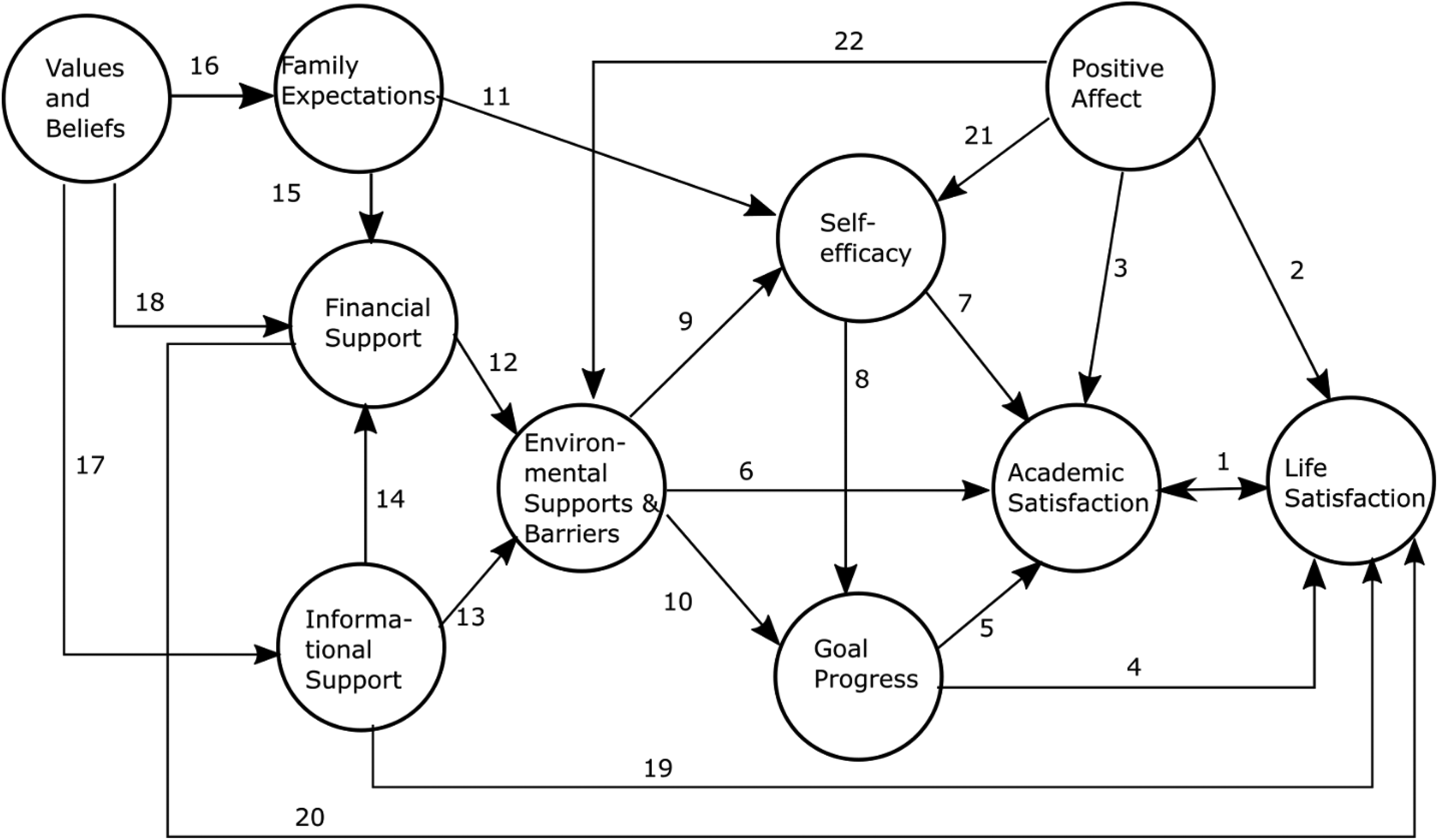
Integrative approach of family influence on academic and life satisfaction based on the social cognitive career theory well-being model.
Environmental support and barriers are influenced by family financial support and family informational support (Paths 12 and 13, respectively; Ferry et al., 2000). Financial family support is influenced by informational family support (Path 14; Araújo et al., 2015) and by family expectations (Path 15). Family expectations, family informational support, and family financial support are influenced by family values and beliefs (Paths 16 and 17; Leung et al., 2011; and Path 18, respectively). In addition, life satisfaction is influenced by family informational support and by family financial support (Paths 19 and 20, respectively; Kim et al., 2016). Finally, self-efficacy and environment support and barriers are influenced by PA (Paths 21 and 22, respectively) and by family values and beliefs (Path 18), which in turn influences family expectations.
Method
Participants and Procedure
The participants were 312 college students recruited from a south Brazilian university. The students received a request for participation in the study through an email message authorized by the institution and program directors. They were asked to respond to an online survey with informed consent, demographic information questions (sex, age, school year, major, family education, and occupation), and the instruments, using the SurveyMonkey tool. The data were collected at the end of the spring semester and the beginning of the autumn semester of the 2016/2017 school year. Participation was voluntary and anonymous. Overall, 217 (69.6%) of the participants were women, and 95 (30.4%) were men. The age range was 18–34 years (M = 23.31, SD = 3.80). For their current majors, 85 (27.2%) were in medical and health sciences, 71 (22.8%) in social sciences, 60 (19.2%) in humanities or arts, 60 (19.2%) in engineering and technology, 27 (8.7%) in natural sciences, and 9 (2.9%) in agricultural sciences.
Instruments
Family influence
Family influence was assessed with the Family Influence Scale (FIS; Fouad et al., 2010), designed to assess perceptions concerning four domains of family influence (Tate et al., 2014): family informational support, family financial support, family expectations, and family values and beliefs. The original North American actual and recommended version of the FIS has 20 items (Fouad et al., 2010) with a 5-point Likert-type response scale (5 = strongly agree, 5 = strongly disagree). Eight items measure family informational support (e.g., “My family shared information with me about how to obtain a job”), 3 items measure family financial support (e.g., “Because my family supports me financially, I can focus on my career development”), 6 items measure family expectations (e.g., “My family expects me to make career decisions so that I do not shame them”), and 3 items measure family values and beliefs (e.g., “My family expects my career to match our family’s values/beliefs”). To assess the construct validity of the FIS, a previous version of the measure with 22 items, that is, with two reverse-coded items in the Family Financial Support subscale, was also included in the analysis (Fouad et al., 2010). This procedure was followed in order to compare our results with the results of previous studies with the FIS with respect to the factorial structure and the measurement model fit indices (Fouad et al., 2010). The Portuguese version of the FIS (Taveira et al., 2018) was adapted for Brazil by a committee of Portuguese and Brazilian researchers. This step was not a translation since the same language is spoken in both countries. The committee looked only for terms and expressions in the item content that would be culturally inadequate. Previous studies with the FIS reported internal consistency reliability estimates (Cronbach’s α) from .75 to .89 (Fouad et al., 2010), from .78 to .92 (Fouad et al., 2016), from .82 to .89 (Kim et al., 2016), and from .70 to .84 (Taveira et al., 2018). Additionally, the FIS subscales were associated with life satisfaction and career-related self-efficacy (Fouad et al., 2010; Kim et al., 2016).
Environmental support and barriers
Perceived environmental support and barriers in the academic domain were assessed with a Brazilian version (Lent et al., 2018) of a 9-item measure listing a variety of conditions that may support students’ academic career (e.g., “I am encouraged by my friends to go on with my studies”). Responses were obtained on a 5-point scale (1 = strongly disagree, 5 = strongly agree). Lent et al. (2005) found internal consistency reliability estimates of .81. The Brazilian sample yielded internal consistency estimates of .74 and reported that the scale was correlated with measures of self-efficacy, goal progress, and academic satisfaction (Lent et al., 2018).
Self-efficacy
Self-efficacy was assessed with a Brazilian version of the academic self-efficacy measure used by Lent et al. (2005). The scale contains 12 items, divided into two subscales, designed to assess the degree of confidence that the individual has in his or her ability to handle academic tasks (5 items, e.g., “deal with lack of support from the teachers or supervisors”) and to cope with barriers (7 items, e.g., “do well on your exams”). Responses were obtained on a 9-point scale (0 = no confidence, 9 = complete confidence). A study with a Brazilian sample yielded internal consistency estimates of .90 and reported that the scale was correlated with goal progress, environmental support and barriers, PA, and academic satisfaction (Lent et al., 2018).
Goal progress
Goal progress was assessed by an instrument with 8 items developed by Lent et al. (2005) to assess how well students felt they were working toward different academic goals (e.g., “Completing all course assignments effectively”). Responses were obtained on a 5-point scale (1 = strongly disagree, 5 = strongly agree). The measure produced internal consistency reliability estimates of .84 to .86 in two reported studies (Lent et al., 2005). In the Brazilian sample, the scale yielded a coefficient α value of .88 and was correlated with measures of academic self-efficacy and satisfaction, outcome expectations, and environmental support (Lent et al., 2018).
Academic satisfaction
Academic domain satisfaction was assessed with a 7-item measure using a 5-point (1 = strongly disagree, 5 = strongly agree) Likert-type scale (Lent et al., 2005). The measure asks participants to indicate the degree to which they felt satisfied with various aspects of their academic lives (e.g., “In general, I am satisfied with my academic life). A study with a Brazilian sample yielded internal consistency estimates of .83 and found that the scale was correlated with measures of overall life satisfaction and PA (Lent et al., 2018).
Life satisfaction
Overall life satisfaction was assessed using the 5-item Satisfaction with Life Scale (Diener et al., 1985). Participants indicated their level of agreement with each of the 5 items (e.g., “I am satisfied with my life”) on a 7-point scale (1 = strongly disagree, 7 = strongly agree). In the Brazilian sample, the scale yielded a coefficient α value of .83 and was correlated with measures of academic satisfaction and PA (Lent et al., 2018).
PA
The PA Scale of the Positive and Negative Affect Schedule (Watson et al., 1988) was used to assess the tendency to experience positive emotions. Participants indicated the extent to which they generally feel 10 positive emotions (e.g., “proud”) using a 5-point continuum (1 = very little or not at all, 5 = extremely). The scale has been found to yield reliability estimates (Cronbach’s α) of .87 and was correlated with measures of life satisfaction, academic self-efficacy in the Brazilian version (Lent et al., 2018).
Analyses
The analyses were conducted using the Statistical Package for the Social Sciences Version 20 (IBM SPSS Statistics 20, SPSS Inc., Chicago, IL) and the AMOS statistical package Version 21.0 (Arbuckle, 2012). Model-data fit was assessed with the χ2/degrees of freedom ratio (χ2/df), the comparative fit index (CFI), the root mean square error of approximation (RMSEA), and the standardized root mean square residual (SRMR). According to Hu and Bentler (1999), good model-data fit may be inferred from SRMR values close to .08 in combination with CFI values close to .95 or RMSEA values close to .06. For χ2/df, values larger than two indicate an inadequate fit (Byrne, 2010). An additional criterion, the Akaike information criterion (AIC), was used in model comparison, with smaller values indicating a better model fit (Jiang, 2017).
Results
FIS Confirmatory Factor Analysis (CFA)
Before proceeding to the measurement, model analysis was necessary to examine the construct validity of the FIS for the Brazilian sample. Given that the four-factor structure of the FIS has been supported in previous research (Fouad et al., 2010, 2016; Ghosh & Fouad, 2015; Kim et al., 2016; Tate el al., 2014; Taveira et al., 2018), only CFA has been performed (Kline, 2016). To contrast the original four-factor solution with other factorial solutions and to compare the 20- and 22-item scales, we proposed four models. A two-factor solution and a four-factor solution were used in the analyses. The two-factor solution was based on previous studies with the FIS that found that family informational support and family financial support could act together on constructs such as well-being (Fouad et al., 2010; Kim et al., 2016). At the same time, family values and beliefs and expectations are close constructs (e.g., Muola, 2010). Thus, Model 1 includes a two-factor solution and all 22 items, Model 2 includes the two-factor solution and 20 items, Model 3 includes a four-factor solution and 22 items, and Model 4 includes a four-factor solution and 20 items. Table 1 presents a summary of the fit indices for the FIS confirmatory factor analyses.
Summary of Fit Indices for the FIS Confirmatory Factor Analyses.
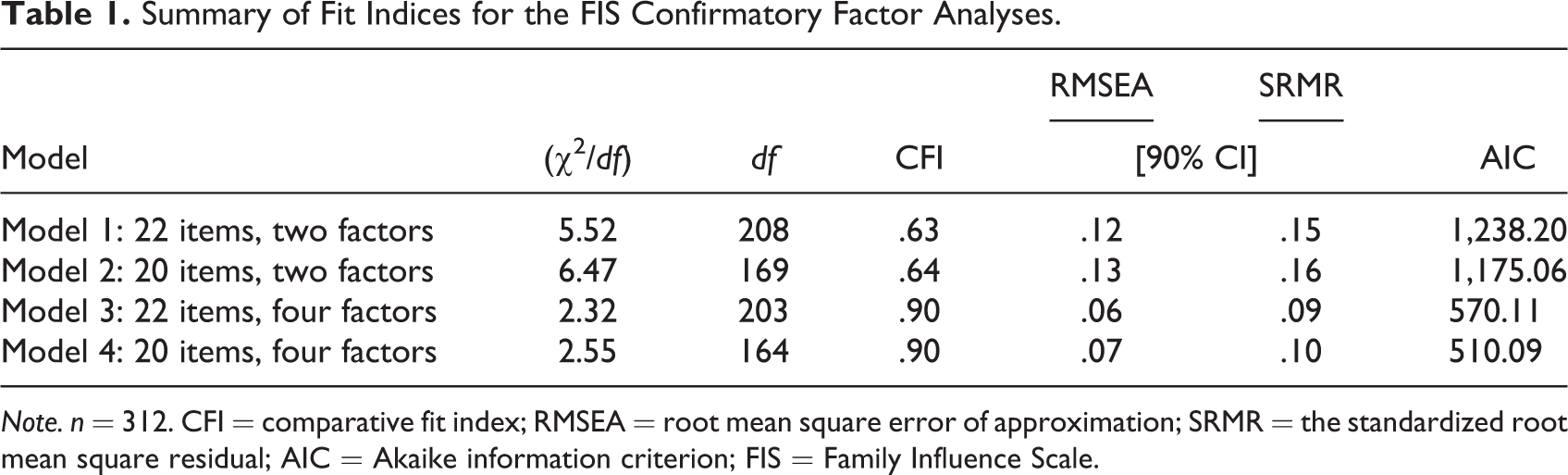
Note. n = 312. CFI = comparative fit index; RMSEA = root mean square error of approximation; SRMR = the standardized root mean square residual; AIC = Akaike information criterion; FIS = Family Influence Scale.
The model comparison indicates that model four presents a better fit to the data: χ2(164) = 418.09, CFI = .90, SRMR = .10, RMSEA = .07, and AIC = 510.09. Models 3 and 4 show very similar fit values. Although Model 4 with the 20-item version shows a better χ2/df ratio, there is no universal agreement about that indicator (Kline, 2016). However, the smaller AIC value of Model 4 indicates a better fit for this model. Therefore, the original four-factor solution showed better goodness-of-fit indices than the other three competing models. The Cronbach’s α coefficients are similar to those for the original FIS study, the Portuguese version (Taveira et al., 2018), and the 20-item study (Fouad et al., 2016), ranging from .78 to .85.
Measurement Model
After conducting the construct validity analysis of the FIS, we proceed with the verification of the overall adequacy of the measurement model with all latent constructs. Means, standard deviations, reliability coefficients, and correlations among each of the constructs are presented in Table 2. To reduce common problems in the analyses of instruments with a high number of items, we decided to group the items of our instruments into parcels (Little et al., 2002) using the same procedure used in previous studies with the same scales (e.g., Kim et al., 2016; Lent et al., 2014). Parcels were created by conducting an exploratory factor analysis for the items in each scale, considering that only under conditions of unidimensionality should parceling be considered (Little et al., 2002). Family values and beliefs, family financial support, and environmental support and barriers each contained 3 items, and as such, each item was used to represent one observed indicator. Self-efficacy was represented by two indicators: academic milestone and coping self-efficacy scale scores. Informational support, goal progress, academic satisfaction, and PA were each represented by 3-item parcel scores, with 2–4 items per parcel. Life satisfaction and family expectations were indexed by two parcels of 2–3 items each. After the parcels were created, a CFA using maximum likelihood estimation was conducted, with items/parcels assigned to the appropriate latent construct. The 10-factor measurement model (family value and beliefs, family expectations, family informational support, family financial support, academic self-efficacy, goal progress, environmental support and barriers, academic satisfaction, PA, and life satisfaction) produced a good fit to the data in the full sample: CFI = .96, GFI = .907, RMSEA = .051, SRMR = .050, χ2/df = 1.84.
Means, Standard Deviations, Cronbach’s αs and Correlations Among the FIS and SCCT Well-Being Constructs.
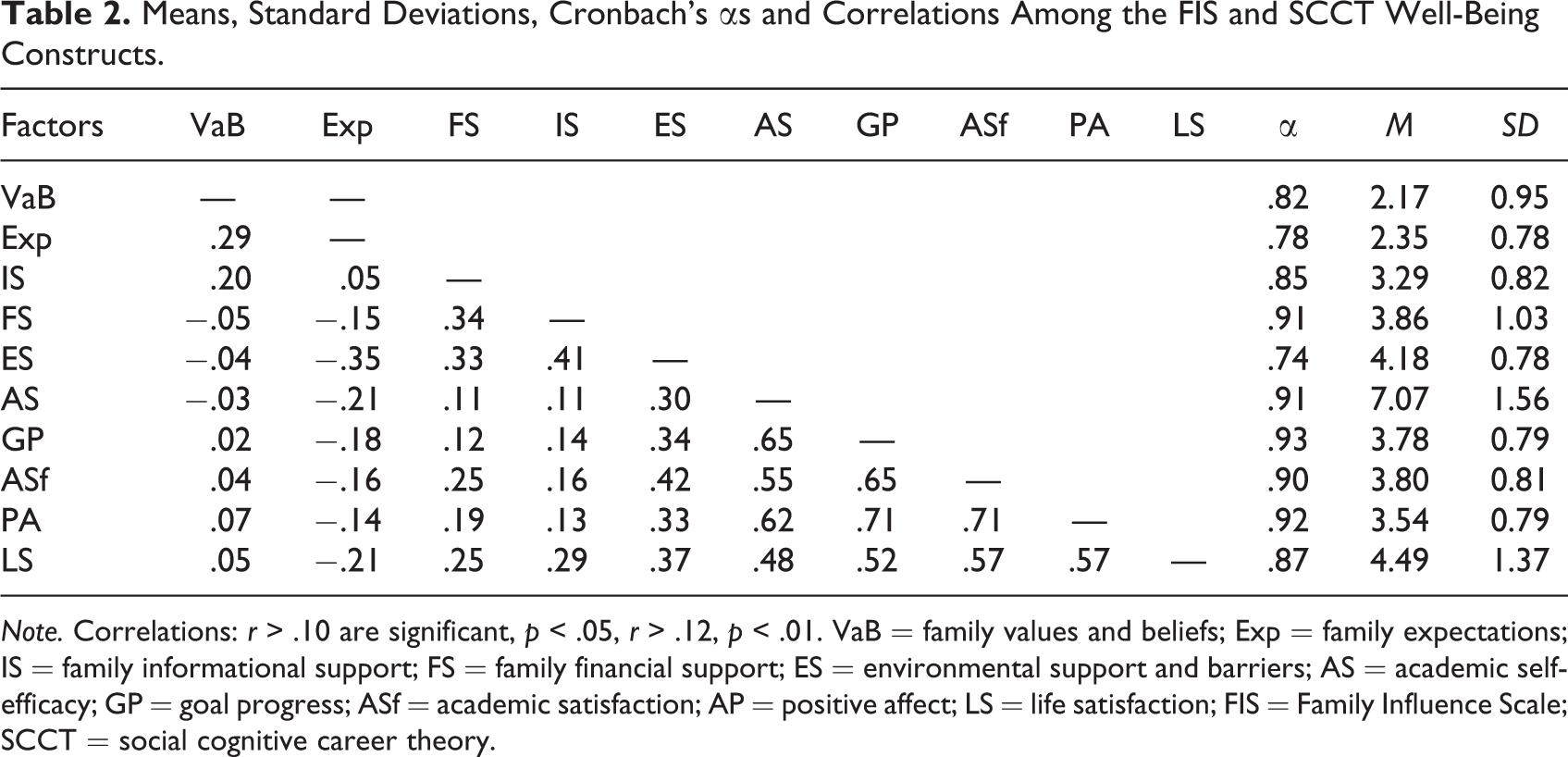
Note. Correlations: r > .10 are significant, p < .05, r > .12, p < .01. VaB = family values and beliefs; Exp = family expectations; IS = family informational support; FS = family financial support; ES = environmental support and barriers; AS = academic self-efficacy; GP = goal progress; ASf = academic satisfaction; AP = positive affect; LS = life satisfaction; FIS = Family Influence Scale; SCCT = social cognitive career theory.
Structural Model
The initial hypothesized model had a poor fit, χ2(22) = 159.80, χ2/df = 7.26, CFI = .88, SRMR = .09, and RMSEA = .14. Therefore, we tested an alternative plausible model and compared it to the hypothesized model through a path analysis. Consistent with the aim of integrating the family influence with SCCT constructs, we tried to make these two elements closer. The main link was through the variable environmental support and barriers, which can be associated with family expectations (Roach, 2010). Thus, we carried out an alternative model test adding a path from family expectations to support and barriers. The alternative model produced a better fit to the data, χ2(23) = 130.25, χ2/df = 5.92, CFI = .90, SRMR = .08, RMSEA = .12, and AIC = 196.345. To improve the adjustment, modification indices for covariance were observed (Byrne, 2010). It was noted that the path from PA to goal progress showed modification indices quite different from that suggested by the others, a result also noted by Lent et al. (2009). Adding this path, the analysis produced a good improvement in the data fit for both models. Therefore, the alternative model with modified indices presents better results. Table 3 presents a summary of the fit indices for the FIS.
Summary of Fit Indices for the FIS Confirmatory Factor Analyses.
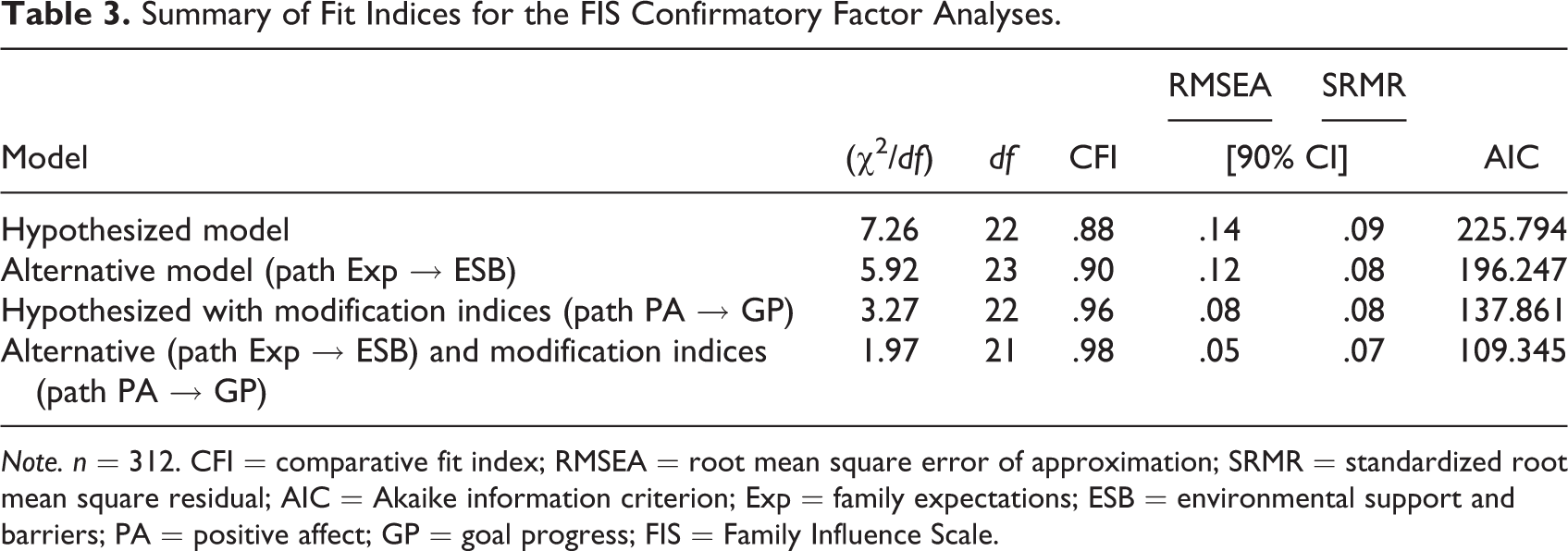
Note. n = 312. CFI = comparative fit index; RMSEA = root mean square error of approximation; SRMR = standardized root mean square residual; AIC = Akaike information criterion; Exp = family expectations; ESB = environmental support and barriers; PA = positive affect; GP = goal progress; FIS = Family Influence Scale.
We found support for most of the hypothesized paths depicted in Figure 1. The only nonsignificant coefficients were for the direct paths from environmental support and barriers to self-efficacy, from self-efficacy to academic satisfaction, from values and beliefs to financial support, and from family informational support to life satisfaction. These nonsignificant paths suggest that self-efficacy is less influenced by family support and less associated with academic satisfaction than hypothesized. The other two nonsignificant paths are also related to support dimensions. The family values and beliefs have no direct effects on family financial support but only on family informational support. On the other hand, financial support was related to life satisfaction but not informational support. In general, academic and life satisfaction were each well predicted in the model (R2 =.69 and .42, respectively). The R2 values for self-efficacy, goal progress, and environmental support and barriers were .40, .42, and .22, respectively. Figure 2 presents the factorial weights of the variables included in the model.

Sociocognitive model of family influence on academic and life satisfaction: Factorial weights of the included variables. *p < .05. ***p < .001.
Students were more likely to indicate overall life satisfaction when they were satisfied with their academic life (β = .24, p < .001) and with their academic goal progression (β = .25, p = .02), when they felt financially supported by their families (β = .18, p<.001), and when they maintained high levels of PA (β = .27, p < .001). Their academic satisfaction was influenced by their perception of goal progress (β = .23, p < .001) and by how their families supported their academic lives (β = .18, p < .001). Their progressing attitudes (goal progress) were positively related to self-efficacy attitudes in the students of this sample (β = .32, p < .001) and when they felt more environmental support and lower barriers (β = .09, p = .02). The families of those students were more likely to give information about their son’s or daughter’s academic and occupational life and provide material support (β = .26 and β = .21, respectively, p < .001). The negative relationship between family expectations and financial support indicates that the more families expect of their children, the less financial support they provide (β = −.18, p < .001). Family expectations had a negative influence on self-efficacy beliefs as well (β = −.11, p = .02), indicating that the more families expect of their children, the less efficacy the child feels. Finally, family values and beliefs influence families’ expectations (β = .31, p < .001) and their willingness to give information and guidance on their children’s careers (β = .23, p < .001). The path from PA to goal progress improved all indices (β = .48, p < .001); in fact, all paths from PA were consistent with the model hypotheses. PA, beyond the positive association with life satisfaction, had a positive interaction with academic satisfaction (β = .46, p < .001), self-efficacy (β = .59, p < .001), and environmental support and barriers (β = .22, p < .001).
Discussion
Studies regarding family influence on academic and overall life satisfaction in terms of a theory-driven understanding (Kim et al., 2016; Whiston & Keller, 2004) are still needed in vocational psychology. Family influence is a key factor in career development, but little research has been conducted in this field in later periods of career development, such as the college years (Whiston & Keller, 2004). In the Brazilian culture, there is also a gap in studies of family influence among college students (Fiorini et al., 2017). To address these needs, the aim of this study was to analyze how family influence is associated with academic and life satisfaction among Brazilian college students. For this purpose, the study tested a model based on the SCCT perspective on well-being in specific work life contexts including the academic life context.
Overall, the results highlight not only the family influence on students’ academic and overall life satisfaction but also the ways that people select, adapt to, and develop within their career paths to experience opportunities to use their strengths and skills, which in turn influence satisfaction in the academic domain and ultimately life satisfaction (Dik et al., 2019). For this reason, the proposed model makes it possible to observe how satisfaction in a valued life domain, such as the academic domain, can also affect overall satisfaction with life (Lent et al., 2012, 2009). The results indicate that the final model was somewhat different from the hypothesized model. Two paths were added. The first new path links family expectations to environmental support and barriers in order to better integrate family factors into the social cognitive model. The second new path links PA to goal progress and was added considering the suggested modification indices in the analysis and previous evidence on this association (e.g., Lent et al., 2009). In the final model, family expectations had a negative influence on self-efficacy and support (financial support and environmental support and barriers). This finding is not surprising since previous studies have found a negative relationship between family expectations and self-efficacy (Fouad et al., 2010). However, other studies have found a positive influence of family expectations on related variables such as academic success (e.g., Sawitri et al., 2013; Shen, 2015) and as a source of career self-efficacy (Lent, 2013; Shen, 2015). Lent et al. (2001) found that contextual variables have indirect effects by bolstering or lessening self-efficacy beliefs. High expectations could likely be associated with parents who pressure their children by making excessively high demands, which may lead to anxiety and fear of failure instead of providing effective motivation to do well in their academic work (Muola, 2010). Even with indirect effects, it is worth noting that excessive family expectations can affect students’ satisfaction with their academic lives and with life in general. Family values and beliefs showed a positive association with family expectations (with a negative effect in the model) and a positive association with family informational support (with a positive effect in the model). It seems that in Brazilian child-rearing practices, a suitable combination of support and compliance requirements favors career goals (Magalhães et al., 2012). The ambiguity of the effect of family values and beliefs illustrates that distal influences are affected by the family (Lent et al., 2000). If a family is surrounded by cultural values and beliefs that can hamper their children’s career development, having reasonable expectations (Muola, 2010) along with support (Ferry et al., 2000) strengthens students’ sense of competence, reduces parental interference, and increases their sense of autonomy (Guan et al., 2016). The results for family values and beliefs and for family expectations together can indicate that the more distal variables in the model can play a negative role in the perception of satisfaction in the academic domain and, in turn, in overall life satisfaction. Family support has the potential to play a key role in the social cognitive career model. The willingness to give information about career plans to their children could influence the disposition to give financial support in a family, consistent with other study results (e.g., Araújo et al., 2015). At the same time, family expectations can weaken the willingness to give financial support. These findings strengthen the perception of environmental resources and decrease the perception of barriers (Lent, 2013), which can in turn directly influence academic satisfaction. Family financial support was directly associated with life satisfaction but not family informational support, contrary to previous studies (Fouad et al., 2010; Kim et al., 2016). It is possible to argue that among Brazilian students, financial support is a source of well-being, which is not surprising since Brazil is not a developed country, with considerable socioeconomic inequalities. Overall, these findings may indicate that family support without high pressure can improve academic and life satisfaction. In this sample, self-efficacy was not affected by environmental support and barriers, contrary to past research (Sheu & Bordon, 2017). We can hypothesize that even the family plays a role in goal progress; beliefs in the ability to manage academic tasks (self-efficacy) are more influenced by peers in the academic domain than by family in the Brazilian culture. These results may have occurred because Brazil is mostly a collectivist culture (Gouveia & Clemente, 2000) where the wishes of influential others such as family may directly influence the career choice process (Lent et al., 2000). We can hypothesize that peers other than family can affect academic and life satisfaction as well. Studies with SCCT and family influence variables in similar cultures have observed the same differences (Kim et al., 2016; Ojeda, Flores & Navarro , 2004). The study also considered the underlying assumption that contextual influences on career development can be represented by different levels, from more proximal and direct to more distant and indirect influences (Lent et al., 2000). This structure was confirmed in the analysis. Some familial factors, such as cultural values and beliefs accepted by the family, were more distal in the process. These are probably associated with extended social context (Muola, 2010). Previous studies have reported an association between family values and beliefs regarding family expectations (Kim et al., 2016; Muola, 2010). The relationships found among the cited familial components, family support (informational and financial), expectations, and value and beliefs can indicate that these family influence components are organized from distal to proximal components.
Practical Implications
Counseling practice can benefit from these results by identifying the influence of families in the process of academic and overall life satisfaction. Early interventions with high school students or interventions directly with parents are possible paths. In working with college students, the results also suggest it is important to explore the perceptions of and access to family informational support. Identifying excessive family expectations should involve career interventions with parents since such expectations can hamper career development and contribute to the reduction of life satisfaction. From an institutional point of view, psychologists might also propose actions in alignment with university financial aid services to identify students with socioeconomic vulnerability who are likely to receive less financial support. Those actions, mediated by counselors, can be directed to both parents and students to bolster family support and increase academic and life satisfaction, which can in turn make students more likely to stay in college (Bardagi & Albanes, 2015). For instance, career counselors working in university students’ support services can better consider family factors, such as familial supports and barriers, and if necessary, counseling the students family members in order to foster positive familial influences.
Limitations and Future Research
Finally, this study has some limitations, but most of them suggest challenges for further research. First, all the obtained data were collected from a south Brazilian university. Brazilians in different regions exhibit major socioeconomic and cultural differences, so further sources of information from different regions could be used to observe internal similarities and differences. The negative relationship of family expectations with SCCT factors requires some attention. Future studies about this family factor could be conducted to determine a possible effect on career development. The significant relationship between family influence and goal progress and the nonsignificant relationship with self-efficacy could indicate another path to be explored within the proposed SCCT-based models, especially the satisfaction model. Moreover, we collected all the data at a single point in time, so further research could examine the stability of results through a test–retest procedure. Notwithstanding the limitations of the current study, it brings some knowledge to the topics of academic and life satisfaction, and can constitute a basis to guide career counseling services with university students’ and to utilize the potential of the student’s family to support and foster their careers.
Footnotes
Declaration of Conflicting Interests
The author(s) declared no potential conflicts of interest with respect to the research, authorship, and/or publication of this article.
Funding
The author(s) disclosed receipt of the following financial support for the research, authorship, and/or publication of this article: This work was funded by national funds from the Portuguese Ministry of Education and Science as well as the European Social Fund through the Human Capital Operational Program.
