



Abstract
This study used a person-centered approach to investigate university students’ profiles of career adaptability and determine whether different combinations of concern, control, curiosity, and confidence could be identified. We also explored the relations of these profiles with emotional intelligence, anticipatory emotions, and career decision-making self-efficacy. We found six distinct profiles of career adaptability among 307 university students who differed both on their level and on shape. Emotional intelligence was associated with profiles displaying higher levels of career adaptability. Furthermore, profiles of career adaptability significantly displayed differences in terms of positive anticipatory emotions at the prospect of the school-to-work transition and career decision-making self-efficacy but not in terms of negative anticipatory emotions. These results highlight that differentiating profiles of career adaptability provide insights for the design and the implementation of career-related interventions among university students.
Keywords
Emerging adulthood is a particularly crucial phase in individuals’ career development (Porfeli & Lee, 2012). For undergraduate students, career development tasks include the crystallization of career goals, the commitment to a career choice, and the active preparation for a chosen career path and the job market entry. Understanding undergraduates’ capabilities to prepare for and deal with these tasks and challenges is therefore crucial to sustain and help them to navigate an ever more insecure and turbulent world of work (Koen et al., 2012). Within the career construction literature, these capabilities have been referred to as career adaptability (Savickas, 2013). The construct of career adaptability has gained increasing attention in recent years. It has been defined as a “psychosocial construct that denotes an individual’s resources for coping with current and anticipated tasks, transitions, and traumas in their occupational roles” (Savickas & Porfeli, 2012, p. 662). Building on the career construction model of adaptation, vocational research has sought to identify the antecedents (i.e., adaptivity), individual responses (i.e., adapting responses), and outcomes (i.e., adaptation results) of career adaptability (Hirschi et al., 2015; Rudolph et al., 2017). Even though a vast amount of research insights has been gathered over the years, the study of career adaptability has heavily relied on variable-centered approaches and has overlooked the possibility that individuals may not only differ in their mean levels of career adaptability but also in the specific combinations of career adaptability dimensions (i.e., concern, control, curiosity, and confidence; Hirschi & Valero, 2015). These emerging approaches have been referred to as person-centered and provide promising avenues for a complementary and more thorough understanding of vocational processes (Hofmans et al., 2020; Spurk et al., 2020).
In the first study investigating the profiles of career adaptability using a person-centered approach, Hirschi and Valero (2015) found, and partially replicated, five profiles that were meaningfully related to antecedents (i.e., adaptivity) and career-related outcomes (i.e., adapting). In their first sample, they found that profiles were mostly differentiated upon their level (low vs. high levels of career adaptability dimensions) rather than their shape (qualitative distinct combinations among career adaptability dimensions), except for a small helpless-passive profile. This latter profile was characterized by very low levels of control and curiosity dimensions and average levels of concern and confidence. In the second sample, five profiles were differentiated upon their level (very low, low, below average, above average, and high career adaptability). In both studies, they demonstrated that personality factors influenced profile membership and that profiles displaying higher levels of career adaptability tended to report higher levels of career planning and exploration. Hirschi and Valero (2015) concluded “that levels effects dominate shape effects in latent career adaptability profiles” and, therefore, “that researchers can rightfully examine career adaptability using a variable-centered approach” (p. 227). However, the replication of profiles in different populations and (educational) contexts, as well as the investigation of additional theoretically driven antecedents and outcomes, is an important prerequisite in order to shed light on the (in-)adequacy of person-centered approaches as well as their complementariness with variable-centered methods when studying important vocational processes (Hofmans et al., 2020; Spurk et al., 2020). Given that person-centered approaches are rather exploratory in nature and highly sample-dependent, Morin et al. (2018) proposed the following steps to address the construct validity of profiles and their generalizability: (1) demonstrating their theoretical value, (2) demonstrating meaningful relations with key covariates, and (3) replicating profile solutions across samples and across time. Investigating the construct validity and their generalizability to different samples is not only important for theoretical purposes but also for practice in order to confirm their rightful use in identifying at-risk students as well as designing and implementing tailored interventions among university students (Koen et al., 2012).
The objectives of this study were threefold. First, we sought to replicate Hirschi and Valero’s (2015) findings with regard to career adaptability profiles among undergraduate students in Belgium. For this purpose, we used latent profile analysis (LPA) to examine the emergence of distinct profiles with different combinations of the dimensions of concern, control, curiosity, and confidence. In order to address the emotional nature of career transitions and to respond to calls for a better inclusion of emotional processes in vocational research (Hartung, 2011; Kidd, 2004), our second objective was to investigate the relations between career adaptability profiles and two important emotional correlates: emotional intelligence and anticipatory emotions. On the one hand, emotional intelligence has been identified as a key antecedent of career adaptability (Celik & Storme, 2017; Coetzee & Harry, 2014; Udayar et al., 2018). However, the number of empirical efforts regarding their relation is still limited (Parmentier et al., 2019), and it remains unclear how these relations would translate in a person-centered framework. On the other hand, as future graduates anticipate their transition into the world of work, the various events it entails (e.g., finding a job), and how they will cope with these challenges, they experience what has been called anticipatory emotions (Baumgartner et al., 2008), that is, emotions currently experienced at the prospect of a future event. These anticipatory emotions are close to constructs such as career hope or career anxiety—even though the latter was mainly considered as a trait or disposition—and have been identified as important correlates of career adaptability (Parmentier et al., 2021; Santilli et al., 2017; Vignoli, 2015). Third, we investigated career decision-making self-efficacy as an additional outcome of career adaptability profiles in order to strengthen the replication approach of our study. As such, both emotional intelligence and career adaptability have been identified as antecedents of career decision-making self-efficacy (Di Fabio & Saklofske, 2014; Rudolph et al., 2017).
In doing so, this study offers several contributions to the field. First, it provides a direct replication in another sample of previous research on career adaptability profiles. Such replication efforts are important to assess and ascertain the utility of person-centered approaches in vocational research (Hofmans et al., 2020; Spurk et al., 2020). Second, we contribute to the existing evidence about career construction theory by testing a broad model of relations between adaptivity (i.e., emotional intelligence), adaptability, and adapting responses (i.e., anticipatory emotions and career decision-making self-efficacy). Investigating the broader career construction model of adaptation using a person-centered approach is important to provide insights into how different profiles are related to different antecedent and outcome variables (Hofmans et al., 2020; Spurk et al., 2020). Third, we echo previous calls for more research on the role of emotional processes in career development (Hartung, 2011; Kidd, 2004).
Profiles of Career Adaptability
Career adaptability has been defined as a set of psychosocial self-regulatory, transactional, and malleable resources that allow individuals to prepare for, cope with, and manage career transitions and the associated career- or work-related issues (Savickas & Porfeli, 2012). Career adaptability is a multidimensional construct composed of four dimensions: concern (i.e., being future-oriented and prepare for the future), control (i.e., being responsible in constructing one’s own career), curiosity (i.e., exploring possible selves and fit between oneself and the environment), and confidence (i.e., beliefs of own capacities to manage career goals). Meta-analytic findings have confirmed that career adaptability was related to a wide range of career-related outcomes such as job and career satisfaction, career identity, lower job stress, and employability (Rudolph et al., 2017), among other outcomes. Accordingly, career adaptability is considered as a key career meta-competency that individuals may rely upon when anticipating and preparing for major career events, deal with work and career changes, proactively plan their career, develop new skills, engage in career behaviors, and ultimately build sustainable careers (Buyken et al., 2015).
Even though substantial empirical evidence has now demonstrated the role of career adaptability in individuals’ careers (see Johnston, 2018, for a review), the existing stream of research is mainly dominated by variable-centered approaches. This focus overlooked the possibility that individuals may differ in their intraindividual combinations on the specific dimensions of career adaptability. In other words, while variable-centered approaches study the extent to which variables are related to each other on average for the entire sample, they fail to describe how the specific dimensions of career adaptability combine together, that is, the patterns and the relative intensity of their combinations. These arguments gave rise to calls for the use of person-centered approaches in vocational research (Hofmans et al., 2020; Spurk et al., 2020).
In this study, we used LPA to investigate the combinations of the career adaptability dimensions of concern, control, curiosity, and confidence among a sample of university students. In LPA, profiles are described based on their level and shape. While level differentiates profiles on their mean level for each specific dimension (e.g., low vs. high concern), shape refers to the different forms displayed by the specific combination of the dimensions taken together (e.g., low concern with high curiosity). Contrary to classical clustering, LPA lies within the structural equation modeling framework and thus have several advantages such as the availability of fit indices to choose the best profile solution, the consideration of measurement errors, and the inclusion of covariates (Hofmans et al., 2020; Spurk et al., 2020), among other advantages.
Consistent with Hirschi and Valero (2015), we expected the emergence of at least five profiles differentiated mainly according to level (from low to high levels on all dimensions). However, theoretical arguments cast doubt on the ubiquity of such profiles only differentiated according to their mean levels. While the higher-order construct of career adaptability has attracted most of researchers’ attention, there are several arguments in investigating the specific contributions of each dimension separately (see also Hirschi & Valero, 2015). A first argument stems from the numerous empirical efforts that showed the unique explanatory and predictive validity of career adaptability dimensions, independently of the broad construct of career adaptability, with several antecedents and outcomes (Rudolph et al., 2017, for a meta-analysis). The second line of argument stems from the theoretical conceptualization of the career adaptability dimensions that explicitly theorize the presence of different profiles (Savickas, 2013). Actually, the four dimensions of career adaptability do not necessarily develop at the same rates, and experienced career-related tasks, transitions, and traumas are likely to intervene in the development of these dimensions, sometimes leading to regressions or fixations (Savickas, 2013). Consequently, significant intraindividual differences between the four dimensions are likely to emerge depending on their development trajectories. As such, counselors are invited to assess potential career-related problems associated with each specific dimension finely: indifference (low concern) or anxiety (high concern), indecision (low control) or impulsivity (high control), unrealism (low curiosity) or overstimulation (high curiosity), and inhibition (low confidence) or overconfidence (high confidence). According to Savickas (2013), investigating these differences with regard to the four dimensions could be crucial for understanding the antecedents and consequences of individuals’ career-related problems and implementing tailor-made interventions. Consequently, while we expected the emergence of specific profiles following Hirschi and Valero’s (2015) findings, we still left the research question relatively open. This is consistent with the inductive and exploratory nature of person-centered approaches (Hofmans et al., 2020).
Correlates of Career Adaptability Profiles
The second and third goals of this study were to explore the relationships of distinct career adaptability profiles with antecedents and outcomes. Building on the career construction model of adaptation, we considered emotional intelligence as a facet of adaptivity (Hirschi et al., 2015; Rudolph et al., 2017) and hypothesized that emotional intelligence would predict profile membership. This is consistent with previous variable-centered research evidence considering emotional intelligence as an important factor of adaptive functioning in individuals’ careers. Previous research has already shown that emotional intelligence was an antecedent of career adaptability (Coetzee & Harry, 2014; Parmentier et al., 2019) and that career adaptability mediated the impact of emotional intelligence on several outcomes such as academic satisfaction, academic engagement, employability, and career decision-making (Celik & Storme, 2017; Udayar et al., 2018). We expected that emotionally intelligent individuals would be more aware of their career aspirations and more future-oriented (i.e., concerned), perceive better control over career-related tasks (i.e., control), evaluate career-related tasks positively and more able to anticipate the emotional consequences of their choices and behaviors (i.e., curiosity), and build confidence in overcoming emotional situations (i.e., confidence). We therefore hypothesized that individuals with a high level of emotional intelligence would be more likely to belong in profiles with high levels of the four career adaptability dimensions.
Furthermore, we explored the relations between career adaptability profiles and anticipatory emotions at the prospect of the school-to-work transition and career decision-making self-efficacy. Building upon the career construction model, these two variables are both considered as adapting responses. Adapting, or adapting responses, refers to the display of adaptive behaviors or reactions and the development of adaptive attitudes that help when addressing changing career conditions and dealing with career development tasks (Savickas, 2013). Within the career construction model of adaptation (Hirschi et al., 2015), adapting or adapting responses are considered as outcomes of career adaptability: Individuals are more likely to display adapting responses in response to career-related tasks when they feel that they have career adaptability resources in terms of concern, control, curiosity, and confidence to prepare for and face these tasks.
On the one hand, previous research has highlighted the impact of career adaptability on positive and negative future-oriented affect and emotions (Buyukgoze-Kavas, 2014; Parmentier et al., 2021; Santilli et al., 2017; Vignoli, 2015). Related research also showed that career adaptability was a key predictor of positive and negative affect and well-being (Celen-Demirtas et al., 2015; Fiori et al., 2015; Konstam et al., 2015; Maggiori et al., 2013; Urbanaviciute et al., 2018). On the other hand, self-beliefs in making career-related decisions is a core ingredient of the career decision-making process (Di Fabio & Saklofske, 2014). Building upon social cognitive theory, career decision-making self-efficacy beliefs have been developed to account for individuals’ confidence in their ability to successfully complete the tasks required to make a career decision (Betz et al., 1996). Previous research has consistently shown that higher levels of career adaptability were associated with higher levels of career decision-making self-efficacy (Rudolph et al., 2017). According to Savickas (2013), concerned individuals develop plans to achieve their career goals and are more future oriented. Individuals with a high level of control are more able to shape their environment and to develop adaptive behaviors toward their future career goals. Curious individuals explore their environment as well as their future self. Finally, confident individuals in regard to their career develop a form of confidence in their abilities to overcome career difficulties. We therefore predicted that individuals with high levels of the four career adaptability dimensions would display higher levels of positive anticipatory emotions and career decision-making self-efficacy levels and lower levels of negative anticipatory emotions.
Method
Participants and Procedure
Data were collected among 307 university students from various programs in Belgium. Students were contacted and invited to participate in an online survey that was approved by the institutional review board of the university. Students were assured of both the anonymity and the confidentiality of the study and gave their informed consent. Of the participants, 78.8% were women and mean age was 22.33 years (standard deviation [SD] = 4.19). With regard to the year of study, 140 participants were bachelor students (47.3%), while 156 participants were master students (52.7%). Proportions of study programs were as follows: social sciences (69.2%), health sciences (25.7%), and science and technology (5.1%).
Measures
Career adaptability
Career adaptability was investigated with the short version of the Career Adapt-Abilities Scale (Maggiori et al., 2017). This instrument consists of 12 items ranging from 1 (not one of my strengths) to 5 (my greatest strength) and is composed of four separate dimensions: concern (α = .73; e.g., preparing for the future), control (α = .74; e.g., making decisions by myself), curiosity (α = .63; e.g., observing different ways of doing things), and confidence (α = .70; e.g., taking care to do things well).
Emotional intelligence
We measured emotional intelligence using the intrapersonal dimension of the profile of emotional competence (α = .89; Brasseur et al., 2013). The measure includes 25 items rated from 1 (strongly disagree) to 7 (strongly agree) and provides separate subscores for five dimensions (i.e., identification, comprehension, expression, regulation, and utilization). Examples of items are when I am touched by something, I immediately know what I feel (identification dimension) or I find it difficult to handle my emotions (reverse scoring, regulation dimension).
Anticipatory emotions
We assessed positive anticipatory emotions with the five following items: excited, strong, enthusiastic, proud, and determined (α = .85). Negative anticipatory emotions were assessed with the five following ones: jittery, upset, scared, nervous, and afraid (α = .87). For both subscales, response scales ranged from 1 (not at all) to a great deal). The instructions for the emotional induction were as follows: stop for a moment and think about your situation at the end of your studies and the entry on the labor market. Please indicate how do you feel right now at the prospect of your transition from university to the job market using the following statements.
Career decision-making self-efficacy
Career decision-making self-efficacy was assessed with a validated French version of the Career Decision Self-Efficacy Scale–Short Form (α = .84; Betz et al., 1996; Gaudron, 2013). Previous research has demonstrated the good psychometric properties of the French version (Storme et al., 2019). This scale consists of 18 items ranging from 0 (no confidence at all) to 5 (complete confidence). Sample items are determine what your ideal job would be and identify employers, firms, institutions relevant to your career possibilities.
Results
Preliminary Analyses
All statistical analyses were conducted using Mplus 8 with the robust maximum likelihood estimator. The means, SDs, and bivariate correlations are displayed in Table 1. Second, we performed confirmatory factor analyses to assess the measurement reliability and discriminant validity of our constructs. All construct-specific measurement models for career adaptability, emotional intelligence, anticipatory emotions, and career decision-making self-efficacy, respectively, demonstrated satisfactory to excellent fit to the data (root mean square error of approximations [RMSEAs] ≤ .09; comparative fit indices [CFIs] ≥ .95; Tucker–Lewis Indices [TLIs] ≥.92; standardized root mean square residual [SRMR] ≤ .07). Our theoretical model in which all constructs and their respective items were modeled altogether fitted the data satisfactorily—χ2(406) = 685.57; RMSEA = .05; CFI = .91; TLI = .89; SRMR = .07—and was superior to all more constrained models. Factor scores were saved from this theoretical measurement model to be used as profile indicators in the subsequent analyses (Morin et al., 2016).
Correlation Matrix.
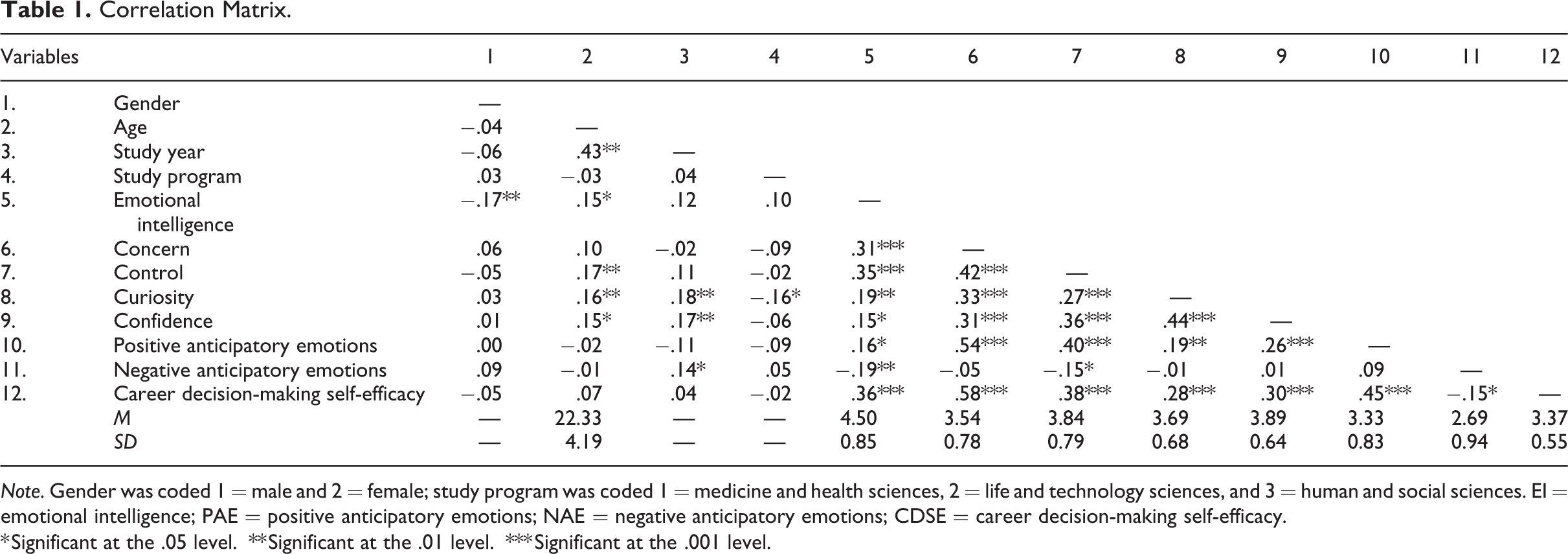
Note. Gender was coded 1 = male and 2 = female; study program was coded 1 = medicine and health sciences, 2 = life and technology sciences, and 3 = human and social sciences. EI = emotional intelligence; PAE = positive anticipatory emotions; NAE = negative anticipatory emotions; CDSE = career decision-making self-efficacy.
* Significant at the .05 level.
** Significant at the .01 level.
*** Significant at the .001 level.
LPAs
We performed several LPAs in a stepwise procedure from one up to eight profiles. Besides the availability of fit statistics, issues of parsimony, theoretical adequacy, substantive meaning, profile redundancy, and profile size also drive the profile enumeration process (Nylund et al., 2007). LPAs were performed using 5,000 random sets of starting values and 1,000 iterations, while retaining the 100 best solutions for optimization. Several fit statistics were used to evaluate each profile solution: Akaike information criterion (AIC), consistent AIC (CAIC), Bayesian information criterion (BIC), sample-size adjusted BIC (SABIC), adjusted Lo-Mendell-Rubin likelihood ratio test (aLMR), bootstrap likelihood ratio test (BLRT), and entropy. The best profile solution should display smaller AIC, CAIC, BIC, and SABIC values, an entropy greater than .70, and significant aLMR and BLRT statistics. Recommendations from simulation studies encourage researchers to favor the CAIC, BIC, SABIC, and BLRT (Nylund et al., 2007). Means and variances of each indicator were allowed to vary during the enumeration process, providing a more realistic parameterization and less biased parameter estimates (Morin et al., 2011).
The fit indices associated with the profile enumerations are displayed in Table 2. The AIC and SABIC kept on decreasing and suggested the continuing addition of profiles. However, they tended to reach a plateau after the six-profile solution. Values for the BIC and CAIC are more informative as they reached a plateau after four profiles and both reached their lowest point at six profiles and increased afterward. The values associated with aLMR and BLRT supported a three- and a seven-profile solution, respectively. However, aLMR is known to underestimate the number of profiles (Nylund et al., 2007), and the results of the BLRT were inconsistent and regularly failed to converge for the seven- and the eight-profile solution. These results thus supported the six-profile solution as the best description of our data. In order to check the theoretical adequacy and meaning carried out by the different profile solutions, we carefully examined the solutions from four up to six profiles. These qualitative investigations brought further support for the six-profile solution as additional profiles were systematically qualitatively distinct and meaningful. The six-profile model was thus retained as the best description of the data and is graphically represented in Figure 1 (see Table 3 for means levels of the indicators).
Latent Profile Enumeration Fit Statistics.

Note. LL = log likelihood; fp = free parameters; SCF = scaling correction factor; AIC = Akaike information criteria; BIC = Bayesian information criteria; SABIC = sample-size adjusted BIC; CAIC = consistent AIC; aLMR = adjusted Lo-Mendell-Rubin likelihood ratio test; BLRT = bootstrap likelihood ratio test.
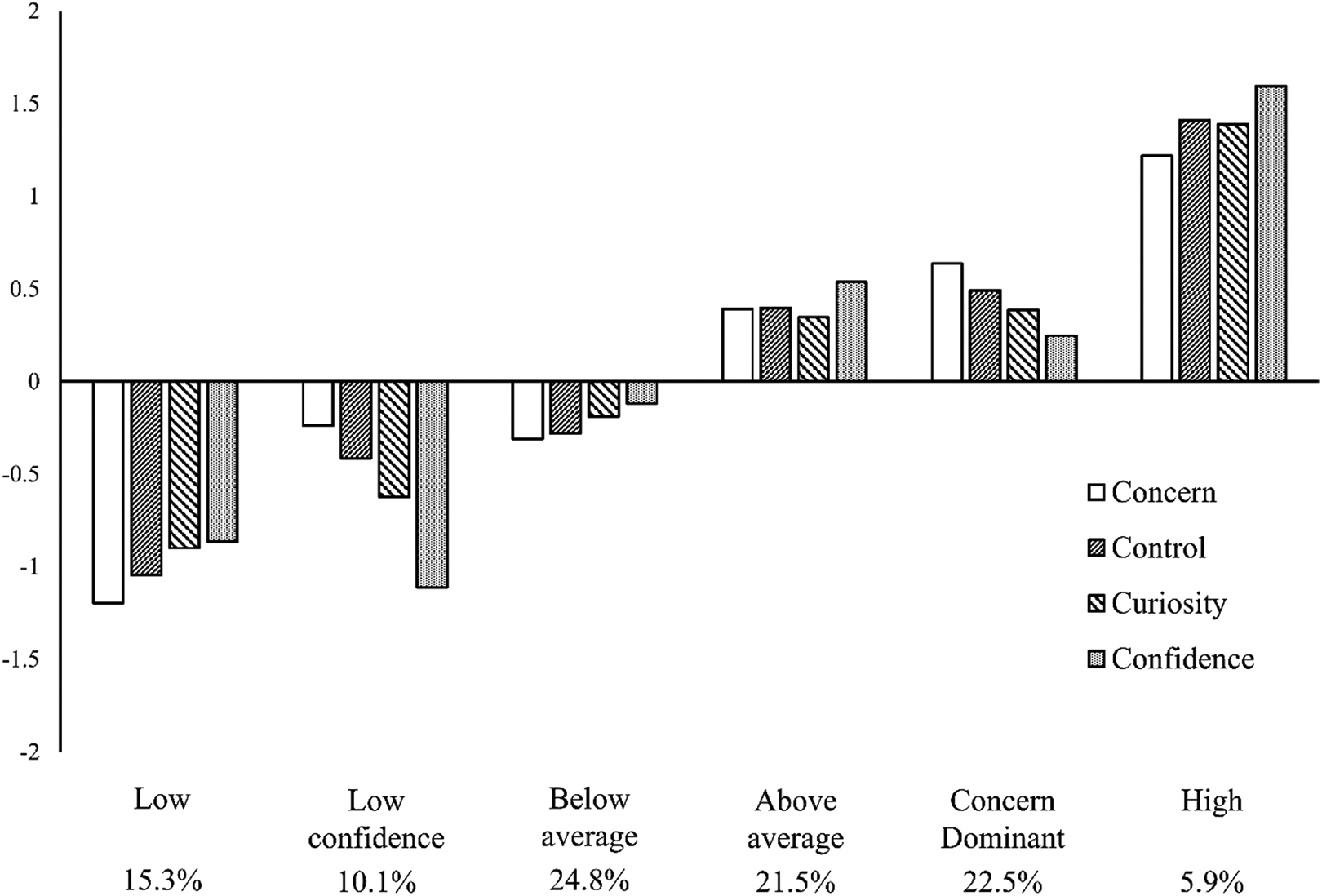
Final six-profile solution of career adaptability.
Means of Indicators of Career Adaptability Profiles.
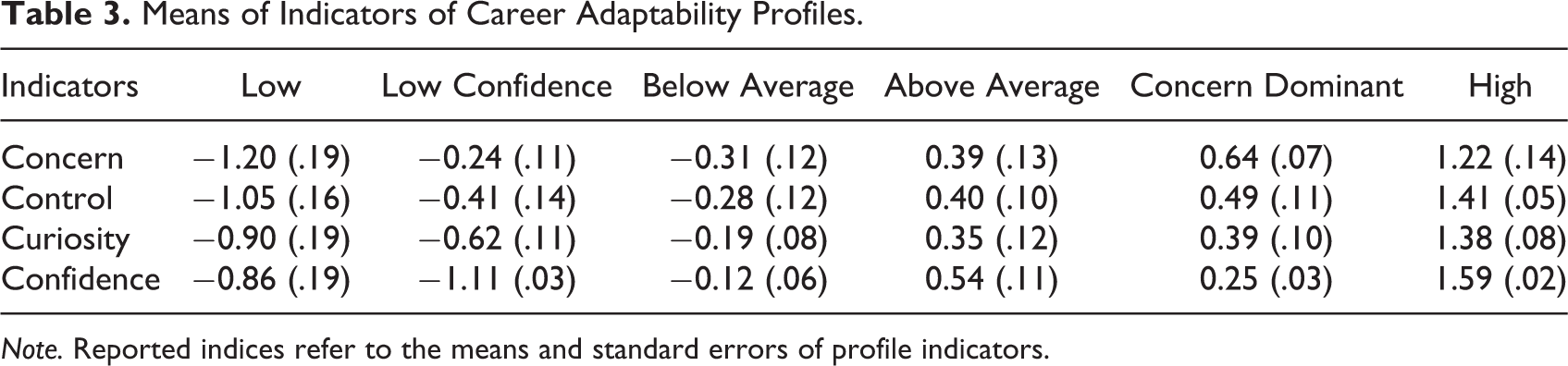
Note. Reported indices refer to the means and standard errors of profile indicators.
Given the balanced proportions between bachelor and master students and the significant correlations between age, study year, and several dimensions of career adaptability, we performed additional analyses to investigate the replicability of the six profiles between bachelor and master students. Following a procedure developed by Morin et al. (2016), our analyses revealed that the profiles in both groups were equivalent in terms of their shape (structural similarity), their within-profile variance (dispersion similarity), as well as the relative size of each profile (distributional similarity), as demonstrated by decreasing AIC, BIC, SABIC, and CAIC fit statistics.
Interpretation of Profiles
Profile 1 encompassed students with very low levels on the four dimensions of career adaptability. This low profile was composed of 15.3% of the total sample. Profile 2 was composed of students exhibiting low levels on the four dimensions, but the confidence dimension was especially low compared to the other dimensions. To reflect this pattern and differentiate it from the low profile, this profile was labeled the low-confidence profile. The third profile was the largest (24.8%) and displayed levels of career adaptability dimensions moderately below average. The fourth and the fifth profiles were both composed of a substantial proportion of students (21.5% and 22.5%, respectively) and displayed above-average levels of career adaptability dimensions. The main difference between these two profiles lied in the dominance of the concern dimension for the fifth profile compared to the fourth one. To reflect these differences and consistent with previous results (Hirschi & Valero, 2015), we used the following labels: the above-average and the concern-dominant profiles. Finally, the smallest and last profile (5.9% of the sample) was composed of students displaying high levels of career adaptability dimensions.
Antecedents of Career Adaptability Profiles
First, when comparing a model in which the control variables were allowed to predict profile membership to a model that constrained their effects, our results showed that the impact of control variables was negligible. Second, using the R3STEP function in Mplus, we conducted the multinomial logistic regression analyses. Overall, higher levels of emotional intelligence were consistently associated with profiles characterized by higher levels of the career adaptability dimensions. High levels of emotional intelligence were associated with a higher probability to belong to the high compared to the other profiles (B = −2.96, p < .001, B = −2.08, p < .001, B = −1.82, p < .001, B = −1.77, p < .001, and B = −0.96, p < .05, for the low, low-confidence, below-average, above-average, and concern-dominant profiles, respectively). Similar results were found for the concern-dominant profiles compared to the other profiles (B = −2.00, p < .001, B = −1.12, p < .01, B = −0.86, p < .01, B = −0.81, p < .01, for the low, low-confidence, below-average, and above-average profiles, respectively). High levels of emotional intelligence were associated with a higher probability to belong to the below-average and above-average profile compared to the low profile (B = −1.15, p < .01 and B = −1.19, p < .01, respectively). However, no significant effects were found between the above-average profile and the low confidence. In addition, no significant effects were neither found between the low-confidence and the below-average profiles, nor between the low and the low-confidence profiles. Emotional intelligence also discriminated profiles with rather high levels of career adaptability but with varying patterns (i.e., the above-average and concern-dominant profiles). However, emotional intelligence did not differentiate profiles with low levels of career adaptability but with different patterns (e.g., below-average, low, and low-confidence profiles). Overall, these results brought support for Hypothesis 1.
Outcomes of Career Adaptability Profiles
Differences between profiles in terms of anticipatory emotions and career decision-making self-efficacy were performed using the BCH function in Mplus. Results are displayed in Table 4 and graphically represented in Figure 2. Significant differences between career adaptability profiles could be found for positive anticipatory emotions and career decision-making self-efficacy. However, no significant differences were found between profiles with regard to negative anticipatory emotions. Overall, profiles with higher levels of career adaptability dimensions displayed higher levels of positive anticipatory emotions and career decision-making self-efficacy. However, profiles displaying similar levels of career-adaptabilities but with different shapes hardly displayed significant differences. For example, while the low profile displayed much lower levels of career adaptability and career decision-making self-efficacy compared to the low-confidence and the below-average profiles, these two last profiles did not statistically differ. A similar pattern was found for the profiles displaying higher mean levels of career adaptability but with varying shapes (i.e., the below-average, concern-dominant, and high profiles). These results supported our third hypothesis and partially our second hypothesis.
Differences of Outcomes Between Career Adaptability Profiles.

Note. Overall χ2 tests were performed with 5 degrees of freedom. PAE = positive anticipatory emotions; NAE = negative anticipatory emotions; CDSE = career decision-making self-efficacy. Subscripts indicate significant differences between profiles at the .05 level. Subscripts from a to e refer to significant pairwise comparisons with the high, concern dominant, above average, below average, and low confidence, respectively.
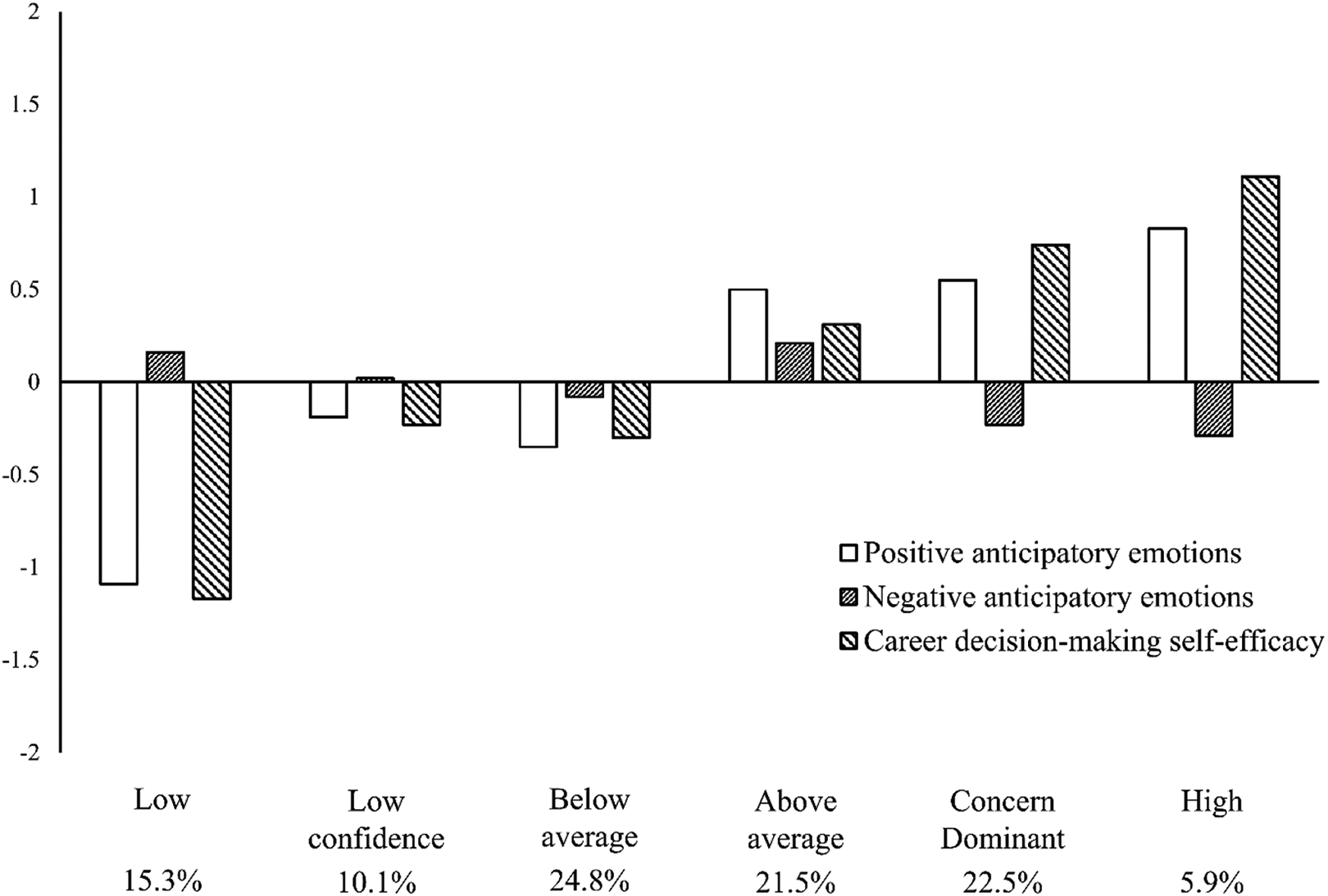
Outcomes for the final six-profile solution of career adaptability.
Discussion
The objectives of this study were to investigate career adaptability profiles using a person-centered approach and examine their relations with emotional intelligence, anticipatory emotions at the prospect of the school-to-work transition, and career decision-making self-efficacy in a sample of university students in Belgium. In doing so, we sought to replicate Hirschi and Valero’s (2015) findings and extend the investigation of antecedents and outcomes to emotional processes in a different national and educational context. This article therefore aimed to expand existing knowledge pertaining to the profiles of career adaptability within the career construction model of adaptation. Due to the rather exploratory and inductive nature of person-centered approaches, such endeavors are important in order to ascertain that profiles are useful for practice and interventions (Hofmans et al., 2020; Spurk et al., 2020). This study also aimed to address previous calls for the inclusion of emotional processes in career development whose importance is stressed out in stressful and emotional career events such as the school-to-work transition.
First, our results yielded six distinct and meaningful career adaptability profiles. Three profiles encompassed rather low levels of career adaptability and, together, were composed of half of the sample. The low profile described students who displayed low levels on all dimensions. The low-confidence profile displayed low levels on all dimensions but specifically on the confidence dimension. The below-average profile was composed of almost a quarter of the total sample with levels on all dimensions somewhat below average. The other three profiles exhibited students with rather high levels of career adaptability. Two profiles displayed moderately high levels of career adaptability but were qualitatively differentiated especially with regard to the concern dimension. The last profile was the smallest and encompassed students that had higher levels on all dimensions. Finally, these profiles were found to be similar in number, shape, within-person variance, and size among bachelor and master students. These results are partially consistent with Hirschi and Valero’s (2015) findings as our results yielded a six-profile solution, instead of a five-profile solution. However, most profiles were differentiated upon their level (the low, below-average, above-average, and high profiles), which is consistent with Hirschi and Valero (2015). Having said that, several differences between Hirschi and Valero’s study and ours are noteworthy with regard to the sample (e.g., different country, different educational context, sample size) and analytical procedure (e.g., operationalization of the indicators, underlying assumptions, fit statistics) that could potentially account for the differences between the two studies. Still, we did observe the emergence of two qualitatively differentiated profiles: the low-confidence and the concern-dominant profiles. The emergence of profiles that display qualitative different patterns in terms of shape is critical and suggests that level does not always dominate the investigation of career adaptability profiles. In addition, while profile sizes were relatively similar for the low and below average, the proportion of students in the high profile was smaller in our study (5%) compared to Hirschi and Valero’s (2015) study (15%). While we agree with Hirschi and Valero’s (2015) conclusions that level effects are generally predominant, our results bring more nuance with regard to this important issue and provide evidence that, in specific contexts, shape differences may occur. Especially, these two qualitatively distinct profiles accounted for approximately a third of our sample and emerged early in the enumeration process, precluding the emergence of spurious profiles due to violations of the model’s distributional assumptions (Bauer & Curran, 2003). Actually, this study sheds light on the complementariness of both approaches, in that they provide distinct but equally useful information to the study of career adaptability (Collins & Lanza, 2010). As such, the reliance on either a variable- or a person-centered approach is directly dependent upon the research question or the practical issue at hand (Hofmans et al., 2020). When adopting a variable-centered approach, one is able to study the relations, on average, between career adaptability and key covariates, establishing these relations for the entire sample. The person-centered approach is well suited to bring nuance in these relationships and investigate whether subpopulations with distinct patterns of these relations exist.
Emotional intelligence was found to be a strong and consistent predictor of profile membership. As hypothesized, individuals with higher levels of emotional intelligence had a higher probability to belong to profiles with higher levels of career adaptability. Interestingly, not only emotional intelligence differentiated profile membership between profiles with varying levels of career adaptability but emotional intelligence also differentiated profiles with varying shapes of career adaptability dimensions. Actually, this was only true for profiles with high levels of career adaptability as high levels of emotional intelligence were associated with a higher probability to belong to the concern-dominant compared to the above-average profile. However, emotional intelligence did not predict differences in profile membership between the low-confidence and the above-average or the low profile. Importantly, the examination of predictors of profile membership is of great importance in order to address the construct validity of the profiles and show that they reflect substantial and valid different populations (Hofmans et al., 2020). Nonetheless, these results are largely in line with previous research highlighting the predictive effect of emotional intelligence on career adaptability in cross-sectional and longitudinal studies (Celik & Storme, 2017; Coetzee & Harry, 2014; Parmentier et al., 2019; Udayar et al., 2018). This suggests that disposing of a high level of general adaptive functioning, particularly in emotional situations, stimulates the use and the development of career-adapt abilities.
The examination of differences between profiles with regard to anticipatory emotions at the prospect of the school-to-work transition and career decision-making self-efficacy also brought critical insights. Consistent with our hypotheses, we found significant differences with regard to positive anticipatory emotions and career decision-making self-efficacy. Profiles with higher levels of career adaptability displayed consistently higher levels on these two variables. Contrary to the effects found for emotional intelligence, the impact on outcomes was mainly an effect of the levels as results failed to distinguish profiles with similar levels of career adaptability but varying shapes (i.e., the above-average and concern-dominant profiles or the low-confidence and below-average profiles). This is nonetheless consistent with previous research highlighting the positive impact of career adaptability on positive future-oriented affect and career decision-making self-efficacy (Rudolph et al., 2017). Surprisingly, no significant differences were found for negative anticipatory emotions. This is rather inconsistent with existing evidence showing the important protective role that career adaptability plays with regard to career anxiety or negative affect. Additional research efforts are certainly needed to disentangle this pattern of results as these previous studies offer only limited value as they mainly relied on trait and dispositional approaches to affective processes in career development.
Limitations and Future Directions
This study is not without limitations. First, we relied on a cross-sectional design, limiting our ability to make any inferences about the causal relations between the antecedents and outcomes of career adaptability profiles. Future research could focus on longitudinal studies in order to better investigate the temporal precedence between the variables of interest and further address the construct validity and replicability of career adaptability profiles (Morin et al., 2018). Second, our sample was mainly composed of women, limiting our ability to generalize our findings to other samples or populations. This issue should especially be addressed as the samples used in Hirschi and Valero’s (2015) studies shared similar sample characteristics. Replication efforts could bring additional support for the profiles found in these studies. Third, our sample size may be considered small with regard to latent profile analyses standards (Tein et al., 2013). This issue would be important to address in subsequent replication efforts.
Practical Implications
Besides the theoretical contributions brought about by this study, several implications for practice could be raised. Differentiating profiles of career adaptability provides a more realistic representation that goes beyond the impact of a single construct and is useful for the development of typologies that can be used for counseling and interventions. Actually, the classification into career adaptability typologies is appealing for counselors and naturally aligned to their efforts to tailor their interventions based on the type of client they are trying to help (Hofmans et al., 2020). Our study highlights, for example, that counselors should pay attention to students showing profiles with low levels on the four career adaptability dimensions and profiles with low level on one specific dimension (e.g., low confidence), as they represented a quarter of the entire sample. Following Savickas (2013), a lack of career confidence, for example, can lead to career inhibition and threaten the ability of students to achieve career goals. With students in the low-confidence profile, counselors are invited to primarily focus on improving clients’ confidence and self-esteem through emotional support but also the engagement in activities whose successful attainment will strengthen their sources of self-efficacy and confidence. Finally, emotional intelligence and career adaptability have been demonstrated as reflecting malleable self-regulatory processes that can be taught and improved (Hodzic et al., 2018; Koen et al., 2012). Our findings thus offer important avenues in the development and the use of tailor-made interventions specifically designed to increase both global levels of career adaptability alongside with its specific dimensions.
Footnotes
Authors’ Note
The first two authors equally contributed to this article and thus share first authorship.
Declaration of Conflicting Interests
The author(s) declared no potential conflicts of interest with respect to the research, authorship, and/or publication of this article.
Funding
The author(s) received no financial support for the research, authorship, and/or publication of this article.
