




Abstract
The present study is the first of its kind using a dyadic and prospective research design to test whether traditional Asian cultural values and internalized racism among Chinese American adolescents and their first-generation immigrant parents are influential factors in the educational and vocational goals of the adolescents by the time they become young adults. While results show that traditional Asian cultural values and internalized racism were not related to adolescents’ educational aspiration or young adults’ major choice, results do show an intergenerational correlation in internalized racism. Furthermore, results show that youth who planned to pursue science/health professions had significantly higher levels of internalized racism than those who planned to pursue business/law professions. Findings suggest that internalized racism may restrict parents’ expectations and goals for their children and, in tandem, serve as a barrier for youths’ self-determination or sense of autonomy in their selection of college majors and career development.
Asian Americans have often been stereotyped as the model minority, a label that connotes that Asian Americans exhibit apparently positive characteristics (such as being good at math, science, and technology and being hard-working, obedient, and self-reliant) that enable them achieve a high degree of success in American society (Shen et al., 2011; S. Sue et al., 1995; Suzuki, 2002). The use of the term “model minority” to characterize Asian Americans can be traced to the 1960s, and use of these apparently positive racial/ethnic stereotypes persisted and became increasingly perpetuated or reinforced by the popular press and media throughout the 20th and into the 21st century (Chou & Feagin, 2015; Poon et al., 2016). The term “model minority” was constructed in the context of Black–White race relations and used as a racial wedge to dismiss injustices, inequities, and racism against African Americans by perpetuating racial/ethnic stereotypes about Asian Americans as model minorities who were given the same opportunities as other people of color or ethnic minorities and were able to achieve educational, occupational, and economic success.
Despite the pervasiveness of these supposedly positive racial/ethnic stereotypes (Kawai, 2005), there has been limited research on the effects of internalization of model minority stereotypes among Asian American adolescents (Kiang et al., 2016; Thompson & Kiang, 2010; Thompson et al., 2016). Given that identity formation and vocational development are major developmental tasks during adolescence and early adulthood (Umaña-Taylor et al., 2006, 2014), this study aims to contribute to the literature by using a prospective research design to examine whether and how adherence to traditional Asian cultural values and internalization of model minority stereotypes during adolescence among Chinese American youth and their first-generation immigrant parents relate to the youth’s future educational and vocational goals in early adulthood. Recognizing the diversity and heterogeneity within Asian Americans, we focused on Chinese Americans, the largest proportion of Asians in the United States (Lopez et al., 2017), as a starting point for this line of inquiry.
Racial/ethnic stereotypes are forms of racial/ethnic biases and prejudice that often intentionally or inadvertently lead to racial/ethnic discrimination (Dovidio et al., 1996; Fiske, 2000). Studies have shown that racial/ethnic stereotypes, regardless of whether such stereotypes reflect positive or negative characteristics, typically have negative impacts on individuals’ sense of self or identity development and their goal pursuits and performance (Kiang et al., 2016; Steele, 1997; Thompson et al., 2016). For example, research has shown that supposedly positive stereotypes about African Americans (such as exhibiting superior athletic skills) represent a form of internalized racism with insidious and harmful effects on members who identify as African American, including increased discriminatory beliefs and attribution of genetic reasons for differences between racial/ethnic groups by those who endorse these stereotypes (Kay et al., 2013). In a study on internalized racial/ethnic stereotypes and academic and vocational goals in Asian Americans, Shen (2015) found that Asian Americans who internalized racial/ethnic stereotypes were likely to pursue culturally valued and/or stereotyped college majors and vocations. Furthermore, Shen et al. (2011) found that Asian American college students who internalized racial/ethnic stereotypes were likely to exhibit worse psychological well-being. Thus, we advance the argument that internalization of racial/ethnic or model minority stereotypes is a form of internalized racism that constrains and limits Asian American parents’ expectations and goals for their children, as well as constrains and limits Asian American youths’ self-determination or sense of autonomy in their selection of college majors and career aspirations. As such, we refer to the internalization of racial/ethnic (model minority) stereotypes as internalized racism in the present study (also see Gupta et al., 2011).
Theoretical Framework
According to Career Construction Theory (Savickas, 1995) and Social Cognitive Career Theory (Lent et al., 1994), youth’s aspirations and self-concepts about future vocations or careers develop through interactions between individuals and their environment including sociocultural contexts, with the evaluation and feedback from valued others being particularly influential in this process. These theories are helpful in understanding the complex relations between cultural values, internalized racism, and educational and career choice goals. Specifically, these theories emphasize how educational and career aspirations and goals are shaped by the combination of individual and contextual factors such as cultural values and societal expectations or stereotypes (Lent & Sheu, 2010).
To understand what college majors and vocations might be considered culturally valued for Chinese Americans, it is important to consider some of the core traditional Asian or Chinese cultural values. Traditional Chinese culture emphasizes filial piety that is rooted in Confucian philosophical and ethical teachings that have guided intergenerational relationships in Chinese families for many centuries. Filial piety is a virtue and role ethic requiring every person to show respect for and to care for their parents (Liew & Zhou, 2021). Adolescents and young adults show filial piety by obeying or carrying out their parents’ expectations and wishes in academic performance and career goals (Hui et al., 2018). Traditional cultural values such as filial piety play an influential role in Chinese Americans’ academic success and career goals. Despite the fact that studies have shown intergenerational shifts in traditional Asian or Chinese cultural values between parents and their children (e.g., Wu & Chao, 2011; Zhang & Fuligni, 2006), multiple studies found that Asian Americans continue to exhibit career-related filial piety by selecting careers that are aligned with the expectations or wishes of their parents (Leong & Chou, 1994; Leong & Gupta, 2007; Li, 2001). For example, Chinese American college students were more likely to choose investigative occupations which includes most science, technology, engineering, and mathematics (STEM) careers that aligned with their parents’ expectations (Hui & Lent, 2018; Tang, 2002; Tang, Fouad, & Smith, 1999).
The Present Study
To our knowledge, the present study is the first of its kind using a dyadic and prospective research design that allowed for exploring the role of cultural values and internalized racism in future educational and career choice goals in young adults from immigrant families. Specifically, dyadic data allowed us to test whether there were intergenerational correlations in traditional Asian cultural values and internalized racism between Chinese American adolescents and their first-generation immigrant parents. We hypothesize that we will find an intergenerational correlation in internalized racism because of the pervasiveness of the racial/ethnic (model minority) stereotypes in American society that are explicitly or implicitly perpetuated in the popular press and media (Kawai, 2005), but not in traditional Asian cultural values because of generational differences in acculturation (Park et al., 2010) as well as intergenerational shifts in traditional Chinese cultural values (Wu & Chao, 2011; Zhang & Fuligni, 2006).
In addition, we used a prospective research design to test whether traditional Asian cultural values and internalized racism among Chinese American adolescents and their first-generation immigrant parents are influential factors in the educational and vocational futures of the adolescents by the time they become young adults. Specifically, we tested whether measures of parents’ or adolescents’ cultural values and internalized racism were prospectively associated with adolescents’ educational aspirations, choice of college major or field of study, and vocational goals when they became young adults. Based on Career Construction Theory (Savickas, 1995) and Social Cognitive Career Theory (Lent et al., 1994) and consistent with prior research that indicates STEM majors or careers are culturally valued by Chinese American parents (Hui & Lent, 2018; Tang, 2002; Tang, Fouad, & Smith, 1999), we hypothesized that Chinese American adolescents with high levels of adherence to traditional Asian cultural values and high levels of internalized racism would be more likely to show career-related filial piety as well as conform to racial/ethnic stereotypes by selecting STEM-related majors and careers compared to peers with low levels of adherence to traditional Asian cultural values and low levels of internalized racism.
Method
Participants
Participants were 107 Chinese American adolescents (64 females and 43 males) and their parents at Time 1 of the study from the city of Houston, the largest city in Texas. According to the U.S. Census Bureau (2019), Texas has the third largest Asian population in the United States, with ethnic Chinese as one of the top three largest Asian ethnic group in Harris County, where Houston is the county seat. The adolescents’ average age was 16 years (SD = 1.4) at Time 1. Three years later, at Time 2, 65 of the 107 adolescents who originally participated at Time 1 expressed interest to participate in a follow-up study as young adults. The majority of adolescents (82%) were born in the United States with the minority of adolescents (18%) born outside of, but were raised as children in, the United States. The majority of their parents (95%) were first-generation immigrants or born and raised in Asia (mostly in China or Taiwan). Parental education ranged from primary grade school to doctoral degree (M = completion of 4-year college). Annual family incomes ranged from less than US$25,000 to more than US$100,000, with 8% of the participants reported to have family income less than US$25,000, while 38% reported family income greater than US$25,000 but less than US$100,000, and 54% reported family income greater than US$100,000.
Procedure
To be eligible for this study, families must self-identify as of Chinese descent, be able to speak and read English, and have children between the ages of 14 and 18 years. Recruitment and data collection protocols for this study were approved by the university institutional review board and participants provided informed consent prior to the data collection process at Time 1 and Time 2 of the study. A majority of participants were recruited from Chinese language schools, cultural community or religious centers, and referrals from families that have completed the study. Data for this study were collected across two time periods, each 3 years apart. The 3-year gap in data collection from Time 1 and Time 2 was purposeful in that adolescents were in high school at Time 1 and we wanted to collect follow-up data on their majors/field of study in college as well as vocational or career goals when they were young adults in college or university at Time 2. At Time 1, data were collected from participants using online surveys that the parent/primary caregiver and adolescent completed separately to report on their adherence to Asian cultural values and their endorsement of the model minority stereotype. Three years later, at Time 2, the adolescents who originally participated at Time 1 were young adults enrolled in college or university and were contacted to participate in the follow-up study. Those who were interested in participating provided consent and then responded to online surveys to provide information on their educational aspirations, college major field of study, and vocational goals.
Measures
Parent and adolescent traditional Asian values
At Time 1, dyadic data from the parents and adolescents were collected on their traditional Asian values using the Asian Value Scale (AVS; Kim et al., 1999). The AVS has demonstrated good psychometric properties among Asian American adolescents and adults, including coefficient α of .82 for internal consistency and a coefficient of .83 for 2-week test–retest reliability (see Kim et al., 1999) and the AVS has been used in prior published studies on Asian American parents and adolescents (e.g., Ahn et al., 2008; Omizo et al., 2008). The questionnaire consists of 36 items and uses a 7-point Likert-type scale from 1 (strongly disagree) to 7 (strongly agree) for participants to rate how much they agreed or disagreed with each item. Items represent conformity to Asian cultural norms (e.g., “One should not deviate from familial and social norms”), collectivism (e.g., “One’s achievements should be viewed as family’s achievements”), family recognition through achievement (e.g., “One need not achieve academically to make one’s parents proud”; reverse scored), filial piety (e.g., “Elders may not have more wisdom than younger persons”; reverse scored), emotional self-control (e.g., “The ability to control one’s emotions is a sign of strength”), and humility (e.g., “One should be humble and modest”). Higher scores indicate greater adherence to traditional Asian cultural beliefs. The AVS demonstrated adequate reliability for parents and adolescents (αs = .73 and .82, respectively) in the present sample.
Parent and adolescent internalized racism
At Time 1, dyadic data were also collected on parent and adolescent internalized racism using the Internalization of Model Minority Myth Measure (IM-4; Yoo et al., 2010). The IM-4 includes 15 items with two subscales of Achievement Orientation and Unrestricted Mobility, which has demonstrated good psychometric properties among Asian American adolescents and adults, including coefficient αs of .91 and .75, respectively, for internal consistency of Achievement Orientation and Unrestricted Mobility subscales, and a coefficient of .72 and .70, respectively, for 2-week test–retest reliability for Achievement Orientation and Unrestricted Mobility subscales (see Yoo et al., 2010). The IM-4 has been used in prior published studies with Asian American adolescents and adults (e.g., Atkin et al., 2018; Yi & Todd, 2021). The Achievement Orientation subscale assesses participants’ endorsement of racial/ethnic stereotypes associated with their stronger work ethics, perseverance, and drive to succeed (e.g., “Asian Americans have stronger work ethics”). The Unrestricted Mobility subscale assesses belief in fairness of treatment and lack of perceived racism or barriers in school and work settings (e.g., “Asian Americans are less likely to face barriers at work”). All items are rated on a 7-point Likert-type scale from 1 (strongly disagree) to 7 (strongly agree), with higher scores representing higher levels of internalized racism and lower scores representing lower levels of internalized racism. The IM-4 demonstrated good reliability for parents and adolescents (αs = .94 and .93, respectively) in the present sample.
Aspirations for higher education
At Time 1, adolescents reported on their aspirations for higher education by indicating the highest type of degree that they would like to pursue if they planned to pursue higher education. Possible responses included certificate, professional license, associate’s degree, bachelor’s degree, master’s degree, and doctoral degree.
College major/field of study
At Time 2, young adults reported on the type of major or field that they would like to pursue if they planned to pursue higher education. Participants were asked to select one major or field that they would like to pursue from six broad categories that included art-related, science and math-related, environment-related, business-related, engineering and technology-related, and literature/language/social sciences majors (see Burrell, 2020). Given some majors/fields had no or few responses, participants’ responses were classified as humanities/social sciences (i.e., art-related, literature, language, and social science majors), STEM (i.e., science and math-related, environment-related, engineering and technology majors), or business-related major.
Vocational goals
At Time 2, young adults reported on their vocational goals by selecting one type of occupation that best matches the type of career that they would like to pursue or are currently pursuing. The possible responses were categories of vocations provided from the U.S. Department of Labor’s Standard Occupational Classification System. Given some vocations had no or few responses, adolescents’ responses were classified as humanities/education/entertainment/sports, STEM (life, physical, and social sciences and health), or business/law.
Results
Major variables were first screened for normality and outliers. None of the major continuous variables were skewed according to the cutoff values of 2 for skewness and 7 for kurtosis (West et al., 1995). Descriptive statistics were conducted, and the means and standard deviations for the major variables are presented in Table 1. In addition, analyses were conducted to explore whether there were differences across adolescents’ gender on major study variables, and no gender differences were found. To address the main research questions for this study, correlational analysis and multivariate analysis of variance (MANOVA) were used to examine associations between measures of cultural values and internalized racism with educational or professional/vocational outcomes.
Descriptive Statistics and Correlation Among Major Variables.
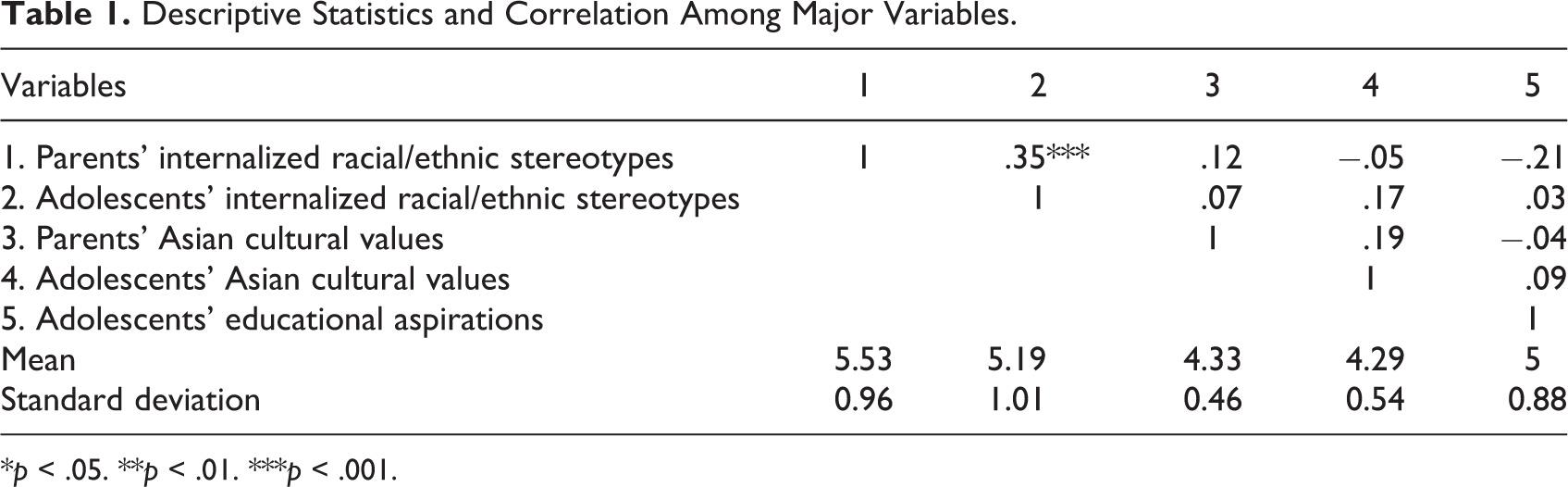
*p < .05. **p < .01. ***p < .001.
Attrition and Missing Data Analyses
Recall that at Time 1, there were 107 parent–adolescent dyads who participated in the study. Three years later, at Time 2, 65 of the 107 adolescents who originally participated at Time 1 participated in the follow-up study as young adults. To examine whether Time 2 participants are representative of those who participated in Time 1, we conducted independent t-tests to examine whether participants with both Time 1 and Time 2 data differed from participants with only Time 1 data in demographic and Time 1 predictor variables. No significant differences were found between the longitudinal group and the “Time 1 only” group in any of the variables examined, including the adolescent variables of age, gender, birth country, internalized racism, traditional Asian cultural values, as well as the parent variables of family income, years in United States, internalized racism, and traditional Asian cultural values. In addition, we conducted missing value analysis with the expectation maximization (Little’s test of Missing Completely at Random or MCAR) option in SPSS. Results from Little’s MCAR test (χ2 = 7.948, df = 6, significance = .242) suggest that the data are missing completely at random. In subsequent correlational analyses, we handled missing data using listwise deletion.
Traditional Asian Cultural Values and Internalized Racism With Educational Aspirations
Correlational analyses showed no relations between measures of parents’ and adolescents’ adherence to Asian values and internalization of model minority stereotypes with adolescents’ educational aspirations (see Table 1). However, results showed an intergenerational correlation in internalized racism. Descriptive results also showed that the majority of the adolescents (47.7%) planned to pursue a master’s degree as their highest level of education, with significant portions planning to pursue a doctoral degree or a bachelor’s degree (29.2% and 20%, respectively). Only 3.1% planned to pursue a professional license.
Traditional Asian Cultural Values and Internalized Racism With Choice of College Major
Results from an MANOVA showed no differences on measures of parents’ and adolescents’ adherence to traditional Asian values and internalized racism depending on adolescents’ choice of major/field of study, Wilks’s λ = .89, F(8,116) = .84, p = .57, partial η2 = .05. Descriptive results also showed that the majority of adolescents were pursuing STEM and business majors in school (50.8% and 35.4%, respectively), and only 13.8% were pursuing humanities and social science majors or field of study.
Traditional Asian Cultural Values and Internalized Racism With Vocational Goals
Results from an MANOVA showed that there are significant differences on measures of parents’ and adolescents’ adherence to traditional Asian values and internalized racism depending on adolescents’ vocational goals; a significant multivariate main effect, Wilks’s λ = .71, F(8,116) = 2.74, p = .008, partial η2 = .15, was found. Univariate results indicate a significant vocational goal difference on adolescents’ internalized racism, F(2, 61) = 8.26, p < .001. Post hoc multiple comparisons showed that those who planned to pursue science/health professions reported higher levels of internalized racism than those who planned to pursue business/law professions (mean difference = .03, p < .001; CI [0.37, 1.5]). Of interest from the descriptive findings is that the majority of adolescents planned to pursue business or law (60%).
Discussion
To our knowledge, this is one of the first prospective studies to examine whether and how cultural values and racial/ethnic (model minority) stereotypes during adolescence may link to educational and vocational goals or decision-making during young adulthood. While results show that traditional Asian cultural values and internalized racism were not prospectively related to educational aspirations or college major/field of study, results do show that parents’ and adolescents’ internalized racial/ethnic stereotypes were significantly related to one another. According to Career Construction Theory (Savickas, 1995) and Social Cognitive Career Theory (Lent et al., 1994), youth’s educational and career aspirations and goals are shaped by the combination of individual and contextual factors such as cultural values and societal expectations or stereotypes (Lent & Sheu, 2010). Thus, in light of the model minority stereotypes, it is not surprising that our results showed that young adults who planned to pursue science/health professions reported significantly higher levels of internalized racism than those who planned to pursue business/law professions.
Intergenerational Correlation in Internalized Racism
In this study, we expected to find an intergenerational correlation in internalized racism because of the pervasiveness of the racial/ethnic (model minority) stereotypes that are perpetuated in the popular press and media (Kawai, 2005) and the fact that generational differences in acculturation (Park et al., 2010) and intergenerational shifts in traditional Chinese cultural values (Wu & Chao, 2011; Zhang & Fuligni, 2006) have been observed among immigrant families. Indeed, we found an intergenerational correlation in internalized racism but not for traditional Asian cultural values in our sample of Chinese American immigrant families. We propose that there are at least three reasons for the intergenerational link between parents’ and children’s internalized racial/ethnic stereotypes. First, parents’ ethnic-racial socialization practices and messages may be transmitted to and learned by children, and such practices and messages become internalized over time (Hughes et al., 2006). Second, according to the Chinese cultural value of filial piety that calls for obligatory respect of, and deference to, parents and elders in the family, children may feel the need to follow the racial/ethnic beliefs or expectations of their parents. Third, parents and children are exposed to and share many contextual and environmental effects such as experiences in the neighborhood and community that shape parents’ and children’s racial/ethnic attitudes and identities (Caughy et al., 2006; White et al., 2018).
The finding of an intergenerational correlation in internalized racism calls attention for the need to not only to actively redress the perpetuation of racial/ethnic (model minority) stereotypes in the popular press and media, but also to support parents and their children to become aware of and to resist internalizing, as well as resist perpetuating and transmitting, such racial/ethnic stereotypes. Indeed, “racism is pervasive, operating at the interpersonal levels simultaneously” and “its effects are cumulative, spanning generations, individuals, time, and place—encompassing much more than discrete acts” (Speight, 2007, pp. 126–127). Furthermore, when parents and their children internalize racial/ethnic (model minority) stereotypes, “this acceptance, the internalization of racism, maintains the vicious self-perpetuating cycle of oppression” (Speight, 2007, p. 131). By documenting the intergenerational correlation in internalized racism in this study, it is one step toward revealing this problem and the need to break this cycle of oppression.
Culturally Valued and Stereotyped Educational and Vocational Goals
Although adherence to traditional Asian cultural values and internalized racism were not directly related to educational aspiration or college major choice, majority of the young adults chose a STEM or business college major and planned to pursue at least a master’s degree. Consistent with Shen (2015)’s findings, our results show that Chinese Americans with high levels of internalized racism during adolescence planned to pursue vocations or professions in science/health more so than other types of fields such as business/law in early adulthood. Our findings are also compatible with Li (2001)’s finding that Chinese immigrant parents overwhelmingly advised their children to pursue science-related or STEM careers, with some parents explicitly advising their children against pursuing a career in law because of their racial/ethnic minority status and concern about discrimination against their children. One of the parents in Li’s (2001) study expressed that “As a minority member, your choice of specialization is crucial for your future employment…Minority groups, especially visible (racial/ethnic) minority groups are in a very disadvantaged situation…I advise my daughter not to choose lawyer as a career because a lawyer represents justice, but how can you argue with the dominant society…If she wants to become a doctor or a computer expert, that will be easier” (p. 486). Recall that we found an intergenerational correlation in internalized racism, and this advice from the parent about career decision-making highlights how Chinese immigrant parents may be engaging in ethnic-racial socialization practices and messages through explicit guidance to their children in light of their ethnic/racial minority status (Hughes et al., 2006). Furthermore, these ethnic-racial socialization practices related to educational and career paths may begin earlier than the high school or college years. It has been noted that Asian parents socialize their children to pursue STEM careers in early childhood, and such “STEM identity imprinting” for Asian youth may begin before they even begin formal schooling (Craig et al., 2018). Similarly, other studies have documented that “positive” racial/ethnic stereotyping of Asian Americans is linked to their avoidance of careers in the humanities and social sciences (Kay et al., 2013).
Limitations and Future Directions
This study expands our understanding of aspirations for higher education, selection of major/field of study in college, and vocational goals for Chinese Americans from immigrant families. In light of research documenting that internalized racial/ethnic (model minority) stereotypes are associated with pressure to succeed and psychological distress (Gupta et al., 2011; Kiang et al., 2016; Shen, 2015) and problems with interpersonal relationships (Gupta et al., 2011; Rosenbloom & Way, 2004), our study further contributes to the literature on internalized racial/ethnic stereotypes as a form of internalized racism that has impact on career development of young adults. There are unique strengths in the research design and methodological approaches of this study that allowed us to address our research questions of intergenerational correlations in cultural values and internalized racism and their associations with future educational and career outcomes. Specifically, the inclusion of measures for both the parents and adolescents on cultural values and internalized racism, as well as measures of adolescents’ educational and vocational goals 3 years later when they were young adults in college or university allowed us to test our key research questions.
However, this study also has some limitations. Regarding the null finding on whether young adult’s choice of college major/field of study differed by traditional Asian cultural values and internalized racism, post hoc power analysis showed that we had statistical power of 20% to detect this effect and we would need a sample size of 204 to detect the same partial η2 effect size of .05 with 95% power. Thus, this research question remains inconclusive and warrants future study with a larger sample size to be able to address this question. A larger sample would also allow for the use of a person-centered approach and methodological techniques such as latent-profile analysis to explore low and high levels of both cultural values and internalized racism and how different profiles are associated with educational and career outcomes. In addition, the present study design does not allow for informing questions on how or why parents’ and children’s internalized racism are linked to each other, nor when they became aware of racial/ethnic stereotypes and how these stereotypes became internalized. Furthermore, future studies need to explore whether the pattern of results we found in Chinese American youth with first-generation immigrant parents is similar or different for other Asian ethnic groups and for other generation immigrant status. These research questions have largely been unexplored and are important future directions to consider for researchers interested in the short- and longer term impacts of internalized racism and racial/ethnic identity development on aspirations for higher education and on career development. Another area that warrants further research is the role that heritage cultural values plays in educational and career decision-making among students of color and those from bi- or multicultural backgrounds. In traditional Asian or Chinese culture, filial piety is influential in young people’s educational and career decision-making (Leong & Chou, 1994; Leong & Gupta, 2007; Li, 2001) and further research is needed to understand the role of the family and filial piety among students from racial/ethnic or cultural backgrounds where collectivism and familism is highly valued, including Asian, Latino, and Hispanic students (Schwartz et al., 2010). Indeed, there are parallels between cultural values and concepts of filial piety and familismo as well as filial piety and respeto that are found in Asian and in Latino and Hispanic families. Furthermore, future studies could explore potential similarities and differences in the cultural and parental influences on educational and career aspirations among youth who share the similar heritage cultural values but differ in whether they are from immigrant families or families living in their native country.
In conclusion, internalization of racial/ethnic or model minority stereotypes can be considered as a form of internalized racism that oppress both the parents and their children. Specifically, internalized racism may restrict parents’ expectations and goals for their children and, in tandem, serve as a barrier for youths’ self-determination or sense of autonomy in their selection of college majors and career development. The intergenerational correlation or transmission of internalized racism highlights its long-term and multigenerational impact on individuals’ educational and career futures. Thus, efforts to deconstruct racial/ethnic stereotypes such as the model minority myth will help challenge or debunk group-based career beliefs and group-based career myths (Peterson et al., 1996). Our study findings have implications for educators and practitioners or school and career counselors to be aware of issues related to racial/ethnic (model minority) stereotypes among Asian Americans and be mindful to overcome implicit racial bias, unintentional racism, and racial/ethnic microaggressions when working with Asian Americans (Ridley, 2005; D. W. Sue et al., 2007). To continue making advances in diversity, equity, and inclusion in education and career development, it would be important for educators, school and career counselors, and school or university leaders to engage in culturally sensitive and culturally responsive practices that empower parents and youth to resist internalized racism and to break the cycle of intergenerational transmission of internalized racism.
Footnotes
Acknowledgments
Funding for this research was supported from the Hogg Foundation for Mental Health and the Texas A&M Presidential Impact Fellowship awarded to Jeffrey Liew. The authors express gratitude for the families that participated in this research and for the assistance and support from organizations and social services agencies serving Asian American and Pacific Islander communities in the Houston metropolitan area, including the Chinese Community Center, the HOPE Clinic, and the Asian American Health Coalition.
Declaration of Conflicting Interests
The author(s) declared no potential conflicts of interest with respect to the research, authorship, and/or publication of this article.
Funding
The author(s) disclosed receipt of the following financial support for the research, authorship, and/or publication of this article: This research was supported by a grant from the Hogg Foundation for Mental Health and the Texas A&M Presidential Impact Fellowship awarded to Jeffrey Liew.
