



Abstract
Examining vocational interests is a central component of career counseling; yet, little research has investigated structural differences for specific subpopulations or the role of cultural factors on vocational interests. The purpose of this study was to examine the structure of interests, congruence between expressed and measured interests, and the relationship between contextual factors, congruence, and vocational interests for South Asian Americans. Circular unidimensional scaling analyses examined the structural nature of interests for females and males and found a better fit with Holland’s model for South Asian American females when compared to males. Correlation and multiple regression analyses found that contextual variables, such as acculturation, cultural values, and gender did not predict congruence but did predict vocational interest themes. Gender, acculturation, and individualistic and collectivistic cultural values predicted Realistic and Social interests.
Holland’s theory of vocational interests has gained widespread acceptance in the United States becoming the most utilized and researched career theory in history (Swanson & Gore, 2000). Although historically much of this research has focused on European American males (Subich, 2005), the past 20 years have seen an abundance of research examining between group racial/ethnic differences in vocational interests (e.g., Armstrong, Hubert, & Rounds, 2003; Fouad, 2002; Fouad & Walker, 2005). As a whole, research has found only small differences in interests among racial/ethnic groups (Subich, 2005) and has supported the use of the Holland’s theory, and interest inventories developed from this theoretical framework, with diverse populations (Fouad, Harmon, & Borgen, 1997). However, much of this research focused solely on examining between-group differences, with very little research examining within-group differences among various cultures. For example, whereas research indicated that the Strong Interest Inventory (SII) can validly be used with African Americans (Fouad et al., 1997), Latinos (Davison Aviles & Spokane, 1999), Native Americans (Hansen, Scullard, & Haviland, 2000), and Asian Americans (Haverkamp, Collins, & Hansen, 1994), little research has investigated specific groups within these broad cultural groups (e.g., research has not focused on specific Latino groups such as Puerto Ricans or specific Asian American groups such as Korean Americans). Thus, the purpose of this study is to examine vocational interests from a within-group perspective, investigating the vocational interests of South Asian American college students.
Although investigations on the career development of Asian Americans have attracted a great deal of attention from researchers (e.g., Hardin, Leong, & Osipow, 001; Leong, 1991; Leung, Ivey, & Suzuki, 1994; Tang, Fouad, & Smith, 1999), most studies have focused on examining group differences between Asian Americans and European Americans (Leung et al., 1994). The Asian American population displays great with-in group variability, with various subcultures possessing their own values and norms. In fact, the Asian American population is composed of at least 40 distinct subgroups that differ in language of origin, values, and religions (Sandhu, 1997). Hence, researchers have recommended that future research examine within-group differences in the career development of various Asian subcultures (Leung et al., 1994).
One such subculture, South Asian Americans, is often overlooked within the career development literature on Asian Americans, even though this group is a growing population within the United States. For example, according to the United States Census Bureau (Barnes & Bennett, 2002), South Asian Americans constitute close to 2 million of the United States population, making them the third largest Asian subculture residing in the United States. The South Asian community is also one of the fastest growing ethnic groups in the United States, growing at a rate of 38% between 2000 and 2005. Similarly, South Asian Americans are highly represented within higher education settings; they have the highest educational attainment rate of all ethnic groups in the United States, with approximately 64% of South Asians attaining at least a bachelor’s degree, compared to 28% of all Americans nationally (U.S. Census Bureau, 2002). Clearly, South Asian Americans are highly visible in higher education settings, an area in which career decisions are often first made. Yet, even though South Asian Americans are now representing a growing population within the United States, and are highly visible in higher education settings, research has not investigated whether interest inventories are applicable and valid within the South Asian American population. For example, although an abundance of research (e.g., Armstrong et al., 2003; Fouad, 2002) has examined structural differences among racial/ethnic groups, no research to date has examined the structure of interests of South Asian Americans.
Another avenue of research that is of particular importance in Holland’s theory focuses on examining congruence between measured interests and occupational choices. Congruence is defined as the degree of fit or similarity between an individual’s personality and the work environment he or she chooses (Holland, 1997). A large number of studies and three meta-analyses have investigated Holland’s congruence hypothesis, providing equivocal support for the relationship between congruence and job satisfaction (Assouline & Meir, 1987; Tsabari, Tziner, & Meir, 2005), leading some theorists to conclude that the relationship between person–environment fit and satisfaction remains unsettled (Osipow & Fitzgerald, 1996). For example, a recent meta-analysis found that the correlation between congruence and job satisfaction was quite weak in an analysis of 26 studies between 1988 and 2003 (Tsabari et al., 2005). This finding highlights the unclear relationship between congruence and career-related outcomes and supports the need for research to further explicate this relationship. Considering that current research has only examined between-group differences in interests for broad racial/ethnic populations, further research is needed to investigate congruence with underresearched cultural groups, such as South Asian Americans.
Additionally, research needs to focus on understanding the multidimensional role that contextual factors may have on the career decision-making process for South Asian Americans (Blustein, 2006; Fouad, 2007; Fouad & Kantamneni, 2008; Lent, Brown, & Hackett, 2000). Researchers have recently called for vocational psychologists to integrate culture into vocational assessments (Blustein & Ellis, 2000) and to investigate contextual factors such as acculturation, cultural values, gender, socioeconomic status, and familial influences when guiding individuals through the career counseling process (Comas-Diaz & Greiner, 1998; Fouad, 2007). However, while cultural factors such as values and acculturation have been hypothesized to play an influential role in career development, little research has investigated this relationship empirically. A few studies that have focused on investigating cultural influences have been qualitative in nature and found that cultural factors do, indeed, influence vocational development and career decision making (Gomez et al., 2001; Juntunen et al., 2001; Richie et al., 1997). Specifically related to career interests, quantitative studies have found a relationship between cultural factors and vocational interests. Tsabari, Tziner, and Meir’s (2005) meta-analysis investigated culture as a moderating variable between congruence and job satisfaction and found a stronger correlation between congruence and job satisfaction in Israel than in the United States. Tang, Fouad, and Smith (1999) found that cultural factors, such as acculturation, influenced the relationship between interests and career choices for Asian Americans; individuals who were more Asian acculturated were influenced more by family expectations than by their interests. Furthermore, Fouad and Walker (2005) recently found differences in endorsement pattern of items on the SII across groups, suggesting that the items may have additional meanings across racial/ethnic groups. The authors suggest that the differences may be due, in part, to cultural expectations and role modeling. As a whole, these studies suggest that cultural factors may be influencing the relationship between expressed and measured interests as well as their relationship with career choices.
Despite these initial studies, research investigating cultural factors related to career interests is limited and further research is needed in this area to fully understand the role cultural factors may have on career interests. For example, the research investigating the role of cultural factors on South Asian Americans’ vocational interests is extremely limited, with only one published study investigating this topic. Gupta and Tracey (2005) investigated the relationship between the cultural value of dharma, or familial duty, and interest-occupation congruence and found that South Asians expressed higher adherence to the value of dharma than their Caucasian counterparts. Furthermore, they found that South Asians were less congruent in their expressed and measured interests when compared to Caucasians, although dharma did not significantly predict interest–occupation congruence. Gupta and Tracey provided a much-needed investigation on the role of cultural factors in South Asian career development; yet, further research is needed to fully understand how cultural variables influence South Asian career development.
Purpose of Study
The purpose of this study was to investigate the vocational interests of South Asian Americans. Tracey, Watanabe, and Schneider (1997) argue that each culture is different and that the structure of interests need to be examined in each culture prior to claiming applicability of Holland’s typology. Thus, the primary purpose of this study was to examine whether the career interests of South Asian Americans correspond with Holland’s structural hypothesis. Furthermore, considering that researchers have argued for incorporating cultural values into the investigation of vocational assessments, a second purpose of this study was to examine the relationship between cultural factors (e.g., gender, values, and acculturation), congruence between expressed and measured interests and interests in specific General Occupational Themes (GOTs). The high concentration of South Asian Americans on college campuses suggests that this is a population that may highly utilize career counseling services and interest inventories. Thus, this study was intended to provide insight into how individuals in this Asian American subculture make career decisions in the United States. Specific research questions for the study are as follows: (1) Does the structure of vocational interests for South Asian Americans follow the hexagonal pattern hypothesized by Holland’s typology (RIASEC)? (2) Do men and women differ in their structure of interests? (3) Are South Asian Americans expressing career choices that are congruent with their interests as measured through the Strong Interest Inventory? (4) Are cultural values, acculturation, and gender related to interest–occupation congruence for South Asian Americans? (5) Are cultural values, acculturation, and gender related to measured specific RIASEC interest themes?
Method
Participants
Participants were 110 students who self-identified as South Asian or South Asian American. All participants were undergraduate or graduate students who were either currently enrolled in colleges or universities across the United States or had graduated within 6 months of completing the study. Participants comprised of more women (n = 63) than men (n = 47) and ranged in age from 18 to 47, with a mean age of 23.5 (SD = 4.7). Ninety-three percent of the participants identified as having Indian heritage, 1% identified as having Pakistan heritage, 5% identified as having Sri Lankan heritage, and 1% identified having an “Other” heritage (e.g., Kashmir). The sample was split evenly in regard to generation status; 54 participants identified as first generation and 56 participants identified as second generation. Study participation was limited to participants who were 18 years or older, English speaking, and self-identified as South Asian or South Asian American. Considering that participants were required to complete various questionnaires on two separate websites, only participants who completed all of the measurement tools were included in the data analysis.
Measures
Demographics questionnaire
Participants completed a demographic questionnaire soliciting information regarding their age, gender, country of origin (India, Pakistan, Nepal, Sri Lanka, or Other), college major, and intended career choice.
SII
Participants completed the Newly Revised SII, which includes 291 items intended to measure career interests (Donnay, Morris, Schaubhut, & Thompson, 2005). The SII assesses for preferences for a variety of occupations, activities, and school subjects and compares these preferences with people employed in various occupations. Specifically, the SII compares an individual’s pattern of responses to patterns of responses of people employed in various occupations (Donnay et al., 2005). Participants in this study indicated the extent to which they liked or disliked six different categories of questions using a 5-point Likert-type scale ranging from strongly like to strongly dislike. The 2005 SII was normed on a reference group, the General Representative Sample (GRS), which included 2,250 employed adults representing more than 370 occupations (Donnay et al., 2005). The GRS sample was split equally in half in regard to gender; 50% men and 50% women were included with an average age of 35 and a mean of 9 years of experience in their occupations. Furthermore, the GRS consists of 30% non-Whites in the sample.
The SII has four types of scales including GOTs, Basic Interest scales, Occupational scales, and Personal Styles scales (Donnay et al., 2005). The GOTs are the broadest level of interest assessment in the SII and measure the six Holland (1997) RIASEC themes. For the purposes of this study, participants’ responses on the GOT scales were used to decipher a three-letter Holland code for measured interests. Internal consistency estimates for the GOTs ranged from 0.90 to 0.95 and test–retest estimates ranged from 0.84 to 0.89 for each of the GOT scales. Test–retest reliability estimates indicate a high level of stability of scores for both short (2–7 months) and long (8–23 months) intervals (Donnay et al., 2005). Substantial evidence has been provided for the validity of previous versions of the SII and an extensive review can be found in the manual (Donnay et al., 2005). For example, Savickas, Taber, and Spokane (2002) provided evidence of convergent and discriminant validity for the GOTs.
Asian cultural values
The Asian Values Scale–Revised (AVS-R) was used to assess Asian cultural values. The AVS-R is a 25-item measure designed to assess dimensions of Asian cultural values, including conformity to norms, family recognition through achievement, emotional self-control, collectivism, humility, and filial piety (Kim, Atkinson, & Yang, 1999).
The AVS-R uses a 4-point Likert-type scale ranging from strongly disagree to strongly agree. Sample items include “One need not focus all energies on one’s studies” and “Family reputation is not the primary social concern.” Internal consistency estimates for the current sample was 0.80 indicating a high level of internal consistency. Evidence of convergent validity was established when examining the high correlation between the AVS and measures of collectivism. Discriminant validity was established for the original AVS by examining the low correlation between the AVS and the Suinn-Lew Asian Self-Identity Acculturation scale, which measures behavioral acculturation.
Suinn-Lew Asian Self-Identity Acculturation scale (SL-ASIA)
The SL-ASIA (Suinn, Rickard-Figueroa, Lew, & Vigil, 1987) was used to assess behavioral acculturation. The SL-ASIA is a 26-item instrument that assesses acculturation in Asians and Asian Americans. The SL-ASIA assesses several dimensions of acculturation including language, identity, friendship choice, behaviors, generation/geographic history, and attitudes. Items on the SL-ASIA are worded in such a manner that they are appropriate across diverse Asian American groups (Ponterotto, Baluch, & Carielli, 1998). Participants responded to each item using a 5-point scale, with responses corresponding to a range from very Asian to very Anglicized. A mean acculturation score was computed, with 1 corresponding to Asian acculturation and 5 corresponding to Western acculturation. Suinn, Rickard-Figueroa, Lew, and Vigil (1987) argued that the mean scores can be viewed at in three ways, those who are highly acculturated or Anglicized-identified (score of 5), those who are low in acculturation or Asian-identified (score of 1), or those who possess a bicultural identity (score of 3). For the current sample, the Cronbach’s α was .90 indicating a very high level of internal consistency. The SL-ASIA has been found to differentiate between low and high acculturated individuals in Asian Americans and Asians living in Singapore, providing evidence for the validity of the SL-ASIA in measuring acculturation (Ponterotto et al., 1998).
Individualism–collectivism
The INDCOL was used to measure cultural values orientation as conceptualized by Triandis (1995). The INDCOL is a 32-item measure that asks respondents to indicate their agreement or disagreement to items on a 5-point Likert-type scale (Singelis, Triandis, Bhawuk, & Gelfand, 1995). The INDCOL measures individualism, a cultural value that prioritizes the needs of the individual over group needs, and collectivism, a cultural value that prioritizes the needs of the group over individual needs. The horizontal scales assess for a view of relationships in egalitarian terms whereas the vertical scales assess for a view of relationships in hierarchical terms. Eight items measure each of four subscales: horizontal collectivism (HC), vertical collectivism (VC), horizontal individualism (HI), and vertical individualism (VI). Sample items include “Winning is everything” and “Family members should stick together, no matter what sacrifices are required.” For the purposes of the current study, specific items on the INDCOL were reverse-scored and subscales were calculated by summing items on each subscale. Subscale scores ranged from 8 to 50, with higher scores indicating higher levels of each specific value orientation. For the current sample, the Cronbach’s α for the vertical individualism subscale was .85; the Cronbach’s α for the horizontal individualism subscale was .79; the Cronbach’s α for the vertical collectivism subscale was .78; finally, the Cronbach’s α for the horizontal collectivism subscale was .69. Cronbach’s αs for all of the subscales indicated sufficient internal consistency. Furthermore, support for construct and concurrent validity was reported by Singelis, Triandis, Bhawuk, and Gelfand (1995) for the 32-item measure and support for convergent and divergent validity was reported by Triandis and Gelfand (1998) for a slightly modified version of the INDCOL.
Procedures
The primary investigator recruited participants for this study from Asian American and South Asian student organizations at universities and colleges throughout the United States as well as South Asian professional organizations (e.g., South Asian Journalism Association). All participation was completed online. After providing online consent, participants were asked to complete a demographic questionnaire, the SL-ASIA, the AVS, and the Individualism–Collectivism scale (INDCOL). Information pertaining to the participants’ major and career choices was used to derive a three-letter Holland code based on the Dictionary of Holland Occupational Titles. After completing this collection of surveys, participants were directed to a CPP webpage where they completed the SII in order to derive measured interests. Participants were provided with an interpretation of their SII results and were entered in a raffle to win a gift card upon completion of the study.
Data Analysis
The research questions set forth were investigated through various statistical tests. First, tests of circular and circumplex models were used to examine the structure of interests in this sample. Circular unidimensional scaling (CUS) was used to analyze the structure of interests; CUS analyses examined whether a circular RIASEC ordering of interests existed as well as analyzed whether the structure of interests fit both a less restrictive quasi-circumplex model that allows for unequal distances between adjacent types and a more restrictive circulant model with equal distances between adjacent types (Armstrong et al., 2003). CUS analyses provide a Variance Accounted For statistic (VAF) which was examined to test the fit with each of these models using Armstrong et al.’s (2003) guidelines; a minimum VAF of 0.60 represents a good fit for the quasi-circumplex model and a minimum VAF of 0.33 represents a good fit for the circulant model. In order to test whether gender differences existed, male and female structures of interests were analyzed separately and the VAF statistics were compared.
Second, an interest–occupation congruence index was calculated to examine congruence between expressed and measured interests. Participants’ intended occupations were categorized into Holland environment types (RIASEC) using the Dictionary of Holland Occupational Codes (Gottfredson & Holland, 1996). Based on results from the SII, participants also received a three-letter Holland interest code for their measured interests. Congruence between participants’ interests and environments was measured by calculating a C-Index. The C-Index compares the primary, secondary, and tertiary codes of both personality and environment (Brown & Gore, 1994); the C-Index for participants in this study was calculated using the following formula: C = 3(X 1) + 2(X 2) + (X 3). Finally, bivariate correlations and multiple regression analyses examined the relationships between acculturation, Asian values, cultural values, gender, congruence, and interest themes. If significant correlations were found among the variables, follow-up regression models were tested to examine the predictive nature of contextual influences for both congruence and RIASEC interest themes.
Results
Structural Ordering
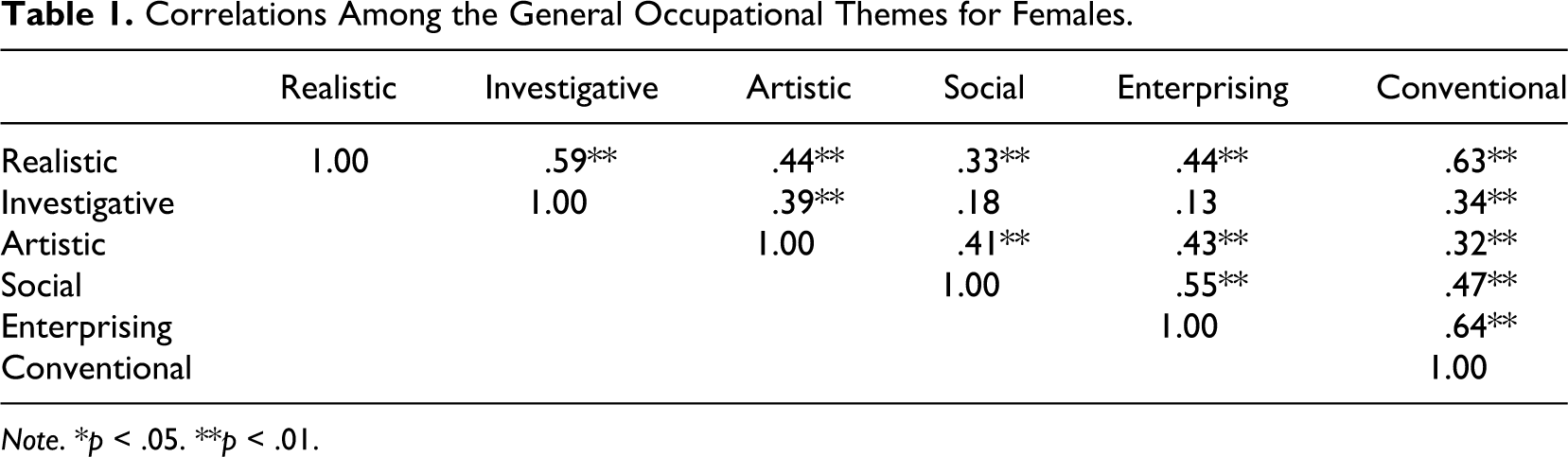
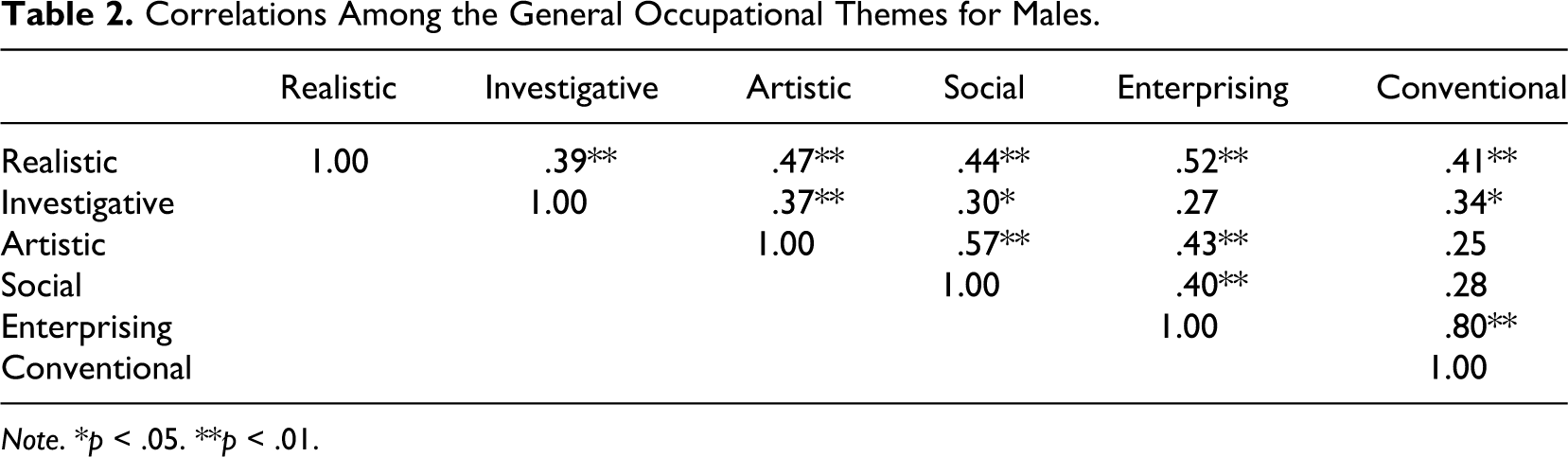
Considering that previous research has found substantial gender differences in the structure of interests (e.g., Armstrong et al., 2003; Fouad, 2002), the structure of interests for males and females were examined separately. The MATLAB-based CUS techniques were obtained from Hubert, Arabie, and Meulman’s (2006) recent statistical book discussing structural examinations of structural matrices as well as a guide outlining how to use MATLAB to structurally investigate vocational interests developed by Armstrong et al.(2003). Correlations among the GOTs are presented in Tables 1 and 2. In order to investigate the structure of interests using circular unidimensional scaling, correlations needed to be translated into proximities using a linear transformation (1 − r). These proximities were then used to analyze the structural nature of the interests.
Correlations Among the General Occupational Themes for Females.
Note. *p < .05. **p < .01.
Correlations Among the General Occupational Themes for Males.
Note. *p < .05. **p < .01.
Results from the CUS analyses are presented in Table 3. CUS analyses yielded a circular R-I-A-S-E-C ordering of interests for female participants. Additionally, CUS analyses for females yielded a VAF of 0.73 for the quasi-circumplex model (the less restrictive version of Holland’s model) and a VAF of 0.53 for the circulant model (the more restrictive version of Holland’s model). These results fall within Armstrong et al.’s (2003) guidelines for evaluating CUS results; a minimum of VAF of 0.60 represents a good fit for the quasi-circumplex model and a minimum VAF of 0.33 represents a good fit for the circulant model. For males, CUS analyses yielded an I-A-S-R-E-C ordering of interests. Additionally, CUS analyses for males yielded a VAF of 0.66 for the quasi-circumplex model and a VAF of 0.23 for the circulant model. The VAF for the circulant model does not fall within Armstrong et al.’s guidelines. Visual representations of the CUS analyses are presented in Figures 1 and 2. Figure 2 highlights that there was little differentiation between Conventional and Enterprising interests for the male participants.

Circular unidimensional scaling results for South Asian American female participants, VAF = 0.73.
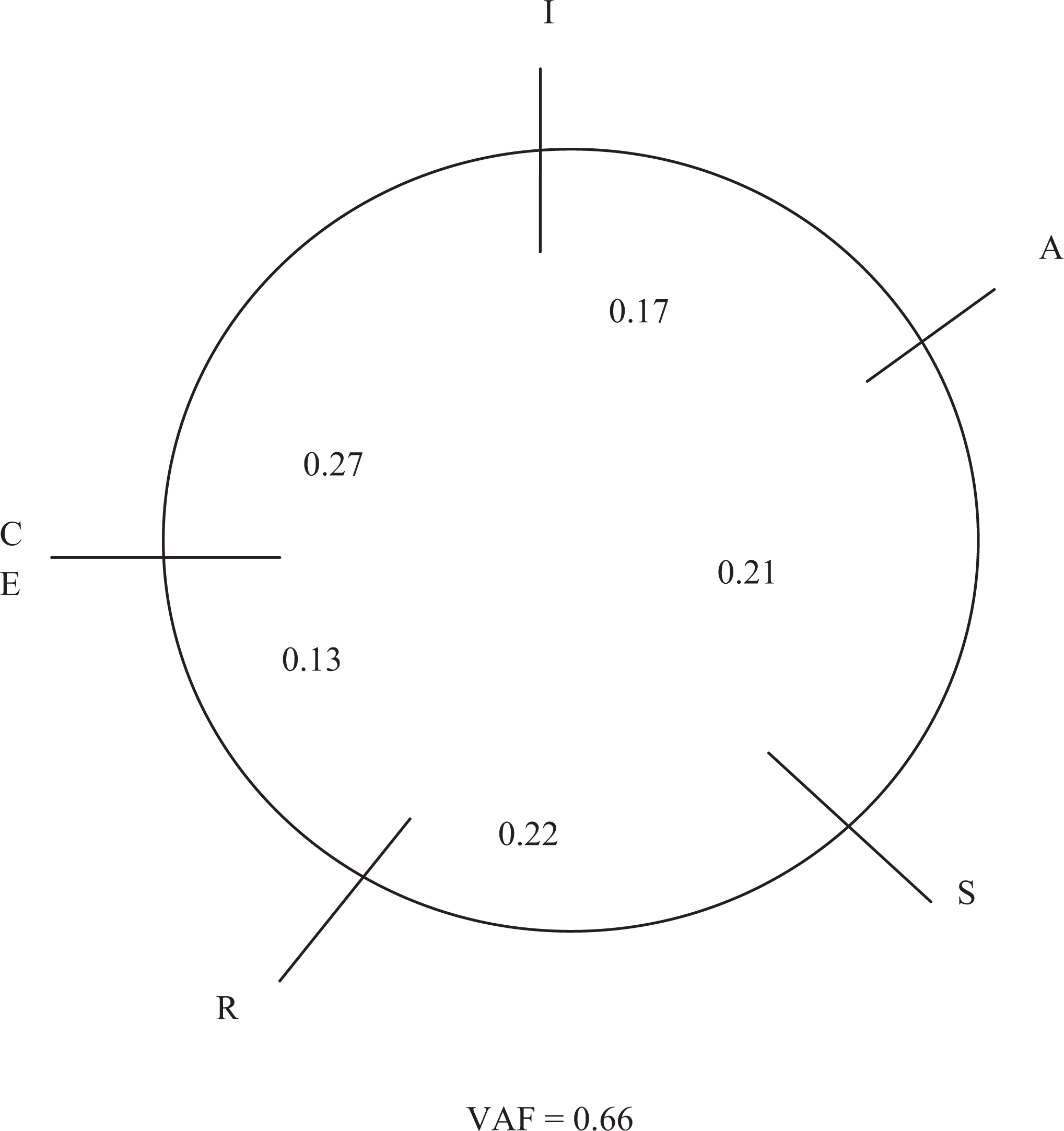
Circular unidimensional scaling results for South Asian American male participants, VAF = 0.66.
Structural Analysis of Interests for South Asian American Female and Male Participants.

Gender Differences
When comparing the male and female participants in this South Asian American sample, clear differences can be seen in the ways in which interests are structured. Specifically, the VAF statistics for females (VAF = 0.73; VAF = 0.53) were higher than males (VAF = 0.66; VAF = 0.23) for both the quasi-circumplex and the circulant models, respectively. These findings suggest that the structure of interests for the South Asian American female participants fit better with Holland’s hypothesized model when compared to the South Asian American male participants. Clear differences can be seen in the visual depictions of the structure of interests for males and females (see Figures 1 and 2). Although gender differences are evident, CUS analyses cannot statistically test whether one model fits better than another.
Congruence
A C-Index was calculated to measure congruence between expressed and measured interests; the means and standard deviations for the C-Index were 10.61 and 3.90, respectively.
Participants in this study made moderately congruent career choices. When developing the C-Index, Brown and Gore (1994) found a mean (M = 9.00) and standard deviation (SD = 3.69) in their simulated sample to be lower than what was found in the present sample. This suggests that participants in this study had slightly higher congruence between their intended occupation and measured interests when compared to Brown and Gore’s simulated sample. An analysis of variance test examined whether gender differences in congruence existed; no significant differences were found in the C-Index, F(1, 108) = 0.74, p = .39.
Contextual Factors and Congruence
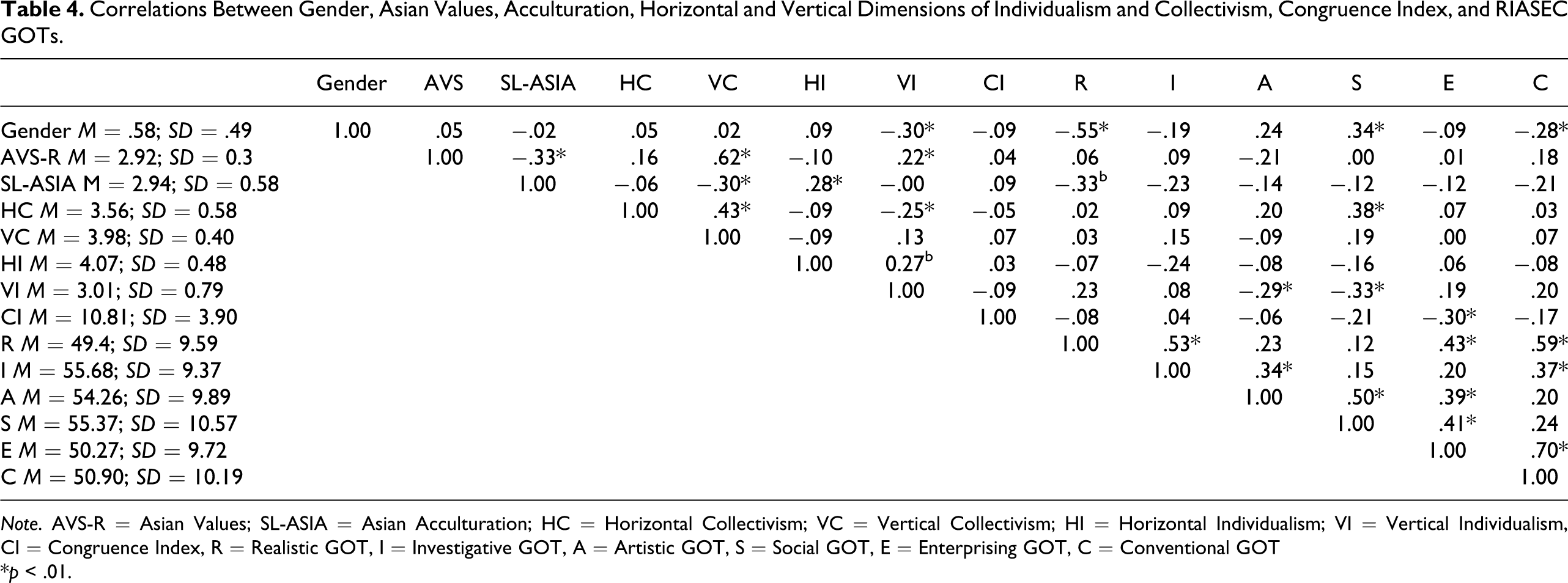
Descriptive information and correlations among the contextual variables, congruence, and RIASEC GOTs are presented in Table 4. Contextual factors were correlated with one another in expected ways; adherence to traditional Asian values was negatively correlated with Western acculturation. Vertical collectivism was significantly correlated to Asian values, Asian acculturation, and horizontal collectivism. Additionally, horizontal individualism was significantly correlated with Western acculturation and vertical individualism.
Correlations Between Gender, Asian Values, Acculturation, Horizontal and Vertical Dimensions of Individualism and Collectivism, Congruence Index, and RIASEC GOTs.
Note. AVS-R = Asian Values; SL-ASIA = Asian Acculturation; HC = Horizontal Collectivism; VC = Vertical Collectivism; HI = Horizontal Individualism; VI = Vertical Individualism, CI = Congruence Index, R = Realistic GOT, I = Investigative GOT, A = Artistic GOT, S = Social GOT, E = Enterprising GOT, C = Conventional GOT
*p < .01.
Correlational analyses did not find significant relationships between contextual factors such as gender, acculturation, individualism, and collectivism and congruence between expressed and measured interests (see Table 4). Considering the lack of significant correlations, regression analyses were not run to examine whether the contextual influences predicted congruence. However, correlational analyses did find significant relationships between the contextual variables and measured interests in the RIASEC GOTs. Significant correlations were found between gender and Realistic and Social interests, acculturation and Realistic interests, horizontal collectivism and Social interests, and vertical individualism and Social interests.
Considering these significant correlations, separate regression analyses were run to examine the predictive nature of contextual factors and gender on measured interests in RIASEC themes. Due to the large number of analyses, a significance level of p < .001 was used. Gender did not significantly predict Investigative, Artistic, Enterprising, or Conventional interests but did significantly predict Realistic interests accounting for 30% of the variance, F(1, 108) = 45.2, p <0.001 and Social interests accounting for 11% of the variance, F(1, 108) = 13.4, p < .00. Men (M = 55.36, SD = 7.97) had significantly greater Realistic interests when compared to women (M = 44.83, SD = 8.14) and women (M = 58.46, SD = 9.22) has significantly greater Social interests than men (M = 51.36, SD = 10.95). Acculturation did not significantly predict any of the RIASEC interests with one exception; acculturation significantly predicted Realistic interests accounting for 11% of the variance, F(1, 108) = 12.9, p < .00. Participants who scored lower on the SL-ASIA and identified more with their South Asian cultural background and less with Western culture had higher Realistic interests. Collectivistic values did not significantly predict Realistic, Investigative, Artistic, Enterprising, or Conventional interests. However, horizontal collectivism significantly predicted Social interests, F(1, 108) = 18.2, p < .00 accounting for 15% of the variance; higher scores on horizontal collectivism were related to higher Social interests. Similarly, individualistic values did not predict Realistic, Investigative, Artistic, Enterprising, or Conventional interests yet vertical individualism significantly predicted Social interests, F(1, 108) = 13.4, p < .00 accounting for 11% of the variance; higher scores on vertical individualism were related to lower Social interests.
Discussion
The purpose of this study was to investigate South Asian Americans' vocational interests; specific research questions examined the structural nature of interests, congruence between expressed and measured interests for South Asian Americans, and the relationship between cultural factors (e.g., gender, cultural values, and acculturation), congruence between expressed and measured interests and interests in RIASEC occupational themes. In regard to the first and second research questions, results indicated that the theoretical framework underlying the SII, Holland’s theory, may be applicable to South Asian American females but not for males whose interests possessed an IASREC ordering. These results suggest that the underlying structure of interests as measured by the SII may be different from the structures reported for the normative groups of the SII. For example, Armstrong et al. (2003) conducted a study examining the structural nature of the normative groups of the 1997 version of the SII and found a circular RIASEC ordering for Asian American males and females. Furthermore, VAF statistics for the quasi-circumplex and circulant models for both males (VAF = .76; VAF = .53) and females (VAF = .91; VAF = .68) met Armstrong et al.’s guidelines for a good fit. In the present study, the variance accounted for was lower for both females and males than for the normative groups of the SII. This difference is striking for males, considering that the RIASEC ordering was not found and the variance accounted for in the circulant model for this sample was less than half of the variance accounted for in the normative group. These findings coincide with earlier research that has indicated that the RIASEC ordering has not been found in some minority samples. For example, a study by Flores, Spanierman, Armstrong, and Velez (2006) examined the structure of interests for Mexican American students and found a RAISEC ordering for Mexican American males.
The distances between interest types (as illustrated in Figure 2) also suggest concerns with the fit of the Holland’s model for the South Asian males in this sample. Upon visual inspection of the structures of interests for the South Asian males in this study, it appears that they do not identify Realistic and Investigative interests as similar but rather as opposite to one another. This finding is surprising considering that other studies (e.g., Armstrong et al., 2003) have found that certain racial/ethnic groups (e.g., African American and Hispanic American males and females) often order Realistic and Investigative interests closer to one another than is hypothesized by Holland’s equidistance hypothesis. The high differentiation between Realistic and Investigative interests for the South Asian males in this sample could be due to higher value and prestige placed on Investigative occupations when compared to Realistic occupations in South Asian culture, although further research is needed to explore this hypothesis. Additionally, visual inspections show that distances between Enterprising and Conventional interests were compressed to a single point, suggesting that South Asian males may have difficulty differentiating between these two interest types. A recent study by Flores et al. (2006) found similar results for a female sample; Mexican American female students had difficulty differentiating between Enterprising and Conventional interests to the degree that interest types were also compressed to a single point. Tang (2002) also found that the vocational interests of Chinese male and female college students did not follow the RIASEC ordering; males reversed the order of Social and Artistic interests, and Enterprising interests were opposite from Social/Artistic interests. Females ordered Realistic and Investigative interests closer than is hypothesized by Holland (1997).
The gender differences in the structural nature of interests are interesting. The present study found that Holland’s model fit better for females than for males, as evidenced by more variance accounted for in both the quasi-circumplex and the circulant models for females. Previous research has found equivocal support for gender differences. For example, a meta-analysis by Anderson, Tracey, and Rounds (1997) found no gender differences in the structure of interests whereas separate investigations by Hansen, Collins, Swanson, and Fouad (1993), Fouad, Harmon, and Borgen (1997), and Flores et al. (2006) found significant differences between men and women in their interest structures. The findings from the present study correspond with similar findings that gender differences do indeed exist; South Asian American men and women are organizing their interests differently. Perhaps gender role socialization, exposure to role models, and environmental supports and barriers are affecting how men and women organize and understand vocational interests.
With regard to the third research question, results indicated that the South Asian American participants in this study made moderately congruent career choices; participants in this study had slightly higher congruence between their intended occupation and measured interests when compared to a simulated sample used in Brown and Gore’s (1994) study on congruence. Moreover, gender differences in congruence were not found; males and females did not differ from one another in their congruence between expressed and measured interests. These findings are similar to those found in Gupta and Tracey’s (2005) recent investigation examining congruence in South Asian and Caucasian college students. Gupta and Tracey found that South Asians made moderately congruent career choices; the average congruence for South Asians and Caucasian college student were 8.86 and 10.20, respectively. The present study found slightly higher congruence between intended occupation and measured interests (M = 10.61) suggesting that the participants’ congruence in this study were more comparable to the Caucasian sample in Gupta and Tracey’s study. Previous researchers (Leung et al., 1994) have argued that Asian Americans may not express congruent career choices due to a variety of contextual factors, such as family influences, influencing their career choices. The findings from the present study did not validate this hypothesis yet further, more extensive research needs to examine the relationship between the structure of interests and Holland’s construct of congruence.
With regard to the final two research questions, findings from this study suggest that contextual factors such as acculturation, individualistic, and collectivistic values, and gender do not predict congruence between expressed and measured interests. This finding was surprising considering that previous qualitative research has found that contextual factors influenced the career decisions made by racial/ethnic minorities. For example, a qualitative investigation by Fouad et al. (2007) found that cultural factors had an influential role on the career choices made by their Asian American participants. However, this finding coincides with a study by Gupta and Tracey (2005) that found the cultural value of dharma, or familial duty, did not significantly predict interest–occupation congruence for South Asian Americans. Together, these findings suggest that congruence is not influenced by contextual factors for South Asian Americans, although more research is needed to fully understand this relationship.
Conversely, results from the present study found that gender, acculturation, and individualism and collectivism predicted vocational interest themes. Gender significantly predicted Realistic and Social interests with men measuring greater Realistic interests and women measuring greater Social interests. This finding corresponds with previous studies (e.g., Fouad, 2002) that have found that men possess significantly greater Realistic interests whereas women possess significantly greater interests in Artistic and Social interests and provides further support that gender differences do indeed exist. Similarly, cultural differences in acculturation and cultural values also predicted Realistic and Social interests. Participants who identified more strongly with their South Asian cultural background scored higher in Realistic interests. This finding corresponds with previous research by Tang et al. (1999) who found that Asian Americans display limited occupational choices, predominantly within Investigative and Realistic areas. This finding is also consistent with current labor force data which indicate that Asian Americans are overrepresented in technology fields (U.S. Census Bureau, 2007). For example, 25% of the computer engineers in the United States are Asian American; yet, Asian Americans only make up 4% of the overall population (U.S. Census Bureau, 2007). Perhaps, South Asian Americans who adhere more strongly to their Asian cultural values are developing greater interests in vocations that they view as more acceptable or viable due to the high visibility and representation of Asian Americans in these fields. Additionally, participants who adhered to horizontal collectivistic values scored higher in Social interests whereas participants who adhered to vertical individualistic values scored lower in Social interests. Considering that a collectivistic orientation emphasizes group needs, interdependence, and collaboration, it makes sense that participants who adhered to a collectivistic orientation would have greater Social interests.
Implications
The results from this study have several implications for vocational psychologists and career counselors alike. First, career counselors need to be aware that the theoretical framework underlying the SII may not fully capture the career interests of South Asian American males accurately, as evidenced by the structural nature of interests found in the present study. Second, career counselors should explore the influences of contextual factors on students’ vocational development. Gender, acculturation status, and cultural values all appear to be related to vocational interests, specifically in the expression of Realistic and Social interests. It is imperative that career counselors integrate more comprehensive assessment in career counseling to fully capture the dynamic and complex ways context can influence career choices made by individuals from diverse cultural backgrounds. Finally, considering that this is a preliminary investigation in the career decision making of South Asian Americans, career counselors and vocational psychologists need to further examine how students in this Asian American subgroup make career decisions. It is important for vocational psychologists to gain further knowledge on the career development of South Asians rather than simply applying broad knowledge of the career decisions of Asian Americans with this subgroup.
Limitations
Several limitations exist in this study. First, a major limitation of this study is concerned with the subject sampling pool and the method used to recruit participants. Participants were recruited from student organizations on college campuses across the United States. Although participants represented broad geographic backgrounds, only students who were involved in South Asian student and professional organizations were included in the study. Students who choose to be involved in South Asian groups may inherently be different from students who choose not to be involved in these cultural groups. Additionally, this study investigated only college students and the findings from this study can only be generalized to South Asian college student populations and not to non-college educated South Asian Americans.
The small sample size in the present study is also a limitation. Although the sample is large enough to complete the circular unidimensional scaling, stronger assertions could be made in regard to the structural analyses if a larger sample was obtained. Further research should replicate the structural analyses in this study with a larger sample of South Asian Americans. The survey design of this study also has limitations. All of the instruments included in this study were self-report measures, thus responses were subjective. There is the potential for bias in self-report measures. Furthermore, due to the fact that the measures were lengthy (participants responded to over 400 questions) and on two separate webpages, many participants did not complete all the survey material. Participants who completed all of the questionnaires may differ from those who chose not to complete all of the questions.
Future Research
In order to better understand the role of contextual influences on the career decisions of South Asian Americans, future research needs to examine the various ways cultural factors may influence numerous dimensions of career decision making, such as career aspirations, self-efficacy, and work values of South Asian Americans. Additionally, further research needs to examine how context influences career interests for students who are younger in age, perhaps in middle or high school. By the time students are enrolled in college, their interests may have already been shaped by cultural influences, schooling and extracurricular opportunities.
Future research also needs to directly examine how other dimensions of contextual influences such as family influences, perceptions of barriers and opportunities, perceptions of discrimination, and social class influence the career decision-making process for South Asians. The role of generation status and how it influences career decisions for South Asians are also important. Do first- and second-generation South Asians differ in their career decision making and how they construct meaning in their work decisions? Finally, future research needs to examine effective ways of integrating cultural context into the career assessment process.
Footnotes
Declaration of Conflicting Interests
The authors declared no potential conflicts of interest with respect to the research, authorship, and/or publication of this article.
Funding
The authors disclosed receipt of the following financial support for the research, authorship, and/or publication of this article: The authors received support from CPP, Inc. for the research of this article.