



Abstract
Prior research has established a direct belonging–interest pathway among students underrepresented in science, technology, engineering, and mathematics (STEM) fields; however, evidence related to how a sense of belonging in STEM may operate to affect career interest remains limited. Drawing on data from 103 students (female: n = 70; male: n = 33) participating in grant activities at a Hispanic-serving institution, the present study seeks to address this gap by examining a model relating STEM sense of belonging, career interest, and STEM attitudes. Results of multigroup analysis revealed that, whereas female students’ STEM sense of belonging had an indirect impact on their career interest via its correlation with STEM attitudes, the impact of male students’ STEM sense of belonging on their career interest was both direct and indirect. Implications of the findings for educational and counseling practices on supporting women in STEM are discussed, along with future research directions.
Keywords
In the United States, women and minorities represent about 70% of all college students but less than 45% of these represent science, technology, engineering, and mathematics (STEM) degree holders (Office of Science and Technology Policy, 2016). Increasing representation of underrepresented groups in STEM remains one of the most pressing concerns for educators and education policymakers. Faced with significant challenges, researchers posit strategies for enhancing STEM career interest among women and minorities in college, with the ultimate goal of increasing their likelihood of connecting early with STEM-related occupations (i.e., persistence; Estrada et al., 2016; Jelks & Crain, 2020). Empirical studies that build upon this vision and purpose have identified a range of factors that operate to impact STEM interests, including STEM sense of belonging.
For decades, sense of belonging has been viewed as a fundamental human need in the literature of psychology (Baumeister & Leary, 1995). Recent research efforts have begun to use this principle to guide inquiry into the causes of gender disparities in STEM career interests and choices. Prior studies have shown that women in general feel less accepted into the culture of STEM than do men (Espinosa, 2011; Rainey et al., 2018). Cheryan et al. (2015) ascribed this feeling of marginalization in STEM education and workplaces to gender-role socialization that has profoundly shaped and continues to shape the culture of STEM in American society. As an example, the authors pointed out that girls are more likely to be imbued with the notion that they are good at collaborative tasks while boys are being told that they are good at independent tasks involving considerable skills such as programming. Such phenomenon has also been noted by many other researchers and put succinctly as “Men and Things, Women and People” by Su et al. (2009). These patterns highlight a need to elucidate psychological pathways linking sense of belonging and career interests in gender-specific contexts.
In a seminal work, Good et al. (2012) investigated the extent to which students’ sense of belonging in mathematics affected their intent to pursue future studies in mathematics. Drawing on data collected from students at a highly selective university in the United States, Good and colleagues tested a path model with perceptions of negative stereotypes as exogenous variables, sense of belonging in mathematics as a mediating variable, and intent to pursue mathematics as an endogenous variable. Results of multigroup path analysis demonstrated that sense of belonging in mathematics has a direct impact on intentions to pursue studies in mathematics regardless of gender. Gender differences were found in the pathway through which perceptions of negative stereotypes contribute to mathematics interest via sense of belonging in mathematics. Findings from Good et al. (2012) underscored academic sense of belonging as a psychological factor that helps predict female students’ interest in pursuing mathematics-related majors and/or careers. Likewise, the association between academic belonging and interest has been reported across STEM disciplines (Master et al., 2016; Smith et al., 2013), with mathematics sense of belonging found to have stronger predictive power on algebra learning as compared to mathematics interest (Barbieri & Miller-Cotto, 2021).
Although much of research efforts has been devoted to validating a direct belonging–interest pathway, major theories of achievement motivation also posit that academic attitudes (comprising competence and value beliefs) constitute a key driver of academic and career interests. To date, empirical data supporting this prediction have accumulated. For example, Simpkins et al. (2006) found that high school students with higher expectancy-value beliefs showed more interest in taking both advanced mathematics and science courses. Wiebe et al. (2018) investigated the relationships between attitudes toward core STEM subjects and career interests. Given two career interest clusters —Biol/Med and CoreSTEM—that emerged from cluster analysis, the researchers found that students’ attitudes toward science, mathematics, and engineering were positively associated with CoreSTEM interest among students across K–12 grades. In addition, both science and engineering attitudes were positively associated with Biol/Med interest while mathematics attitudes were not.
Prior research highlights the importance of sense of belonging or academic attitudes in shaping one’s career interest, but research gaps still exist. One important question left to be addressed is how STEM sense of belonging may operate to affect STEM career interest, particularly when multiple STEM attitude components are incorporated into the analysis. Second, due to the pervasiveness of gender-role stereotyping in STEM education and workplaces, it is important to determine whether the same belonging–interest pathway is applicable across male and female students. If not, gender as a grouping variable may moderate the belonging–interest pathway and the differences in this pathway may have practical implications for designing effective interventions to reduce stereotype threat to women. To address these gaps, this study seeks to examine a gender-related path model linking STEM sense of belonging, STEM attitudes, and career interest among a sample of 103 students studying at a Hispanic-serving institution.
The Present Study and Rationale
To help understand how STEM sense of belonging may influence women and men’s career interest differently, the present study draws on the STEreotypes, Motivation, and Outcomes (STEMO) model proposed by Master and Meltzoff (2020), which in turn relies heavily upon Eccles and colleagues’ contemporary expectancy-value theory (EVT; Eccles & Wigfield, 2020). According to EVT, students make academic and career decisions based on their beliefs about how much they value an activity (i.e., subjective task value) and how well they will do on that activity (i.e., expectations for success). The STEMO model extends prior research by incorporating STEM sense of belonging into EVT; hence, it is clearly differentiable from other EVT-derived models of academic and occupational choices and provides added information on motivational pathways that may lead to gender differences in STEM career choices.
A central tenet of the STEMO model posits that gender disparities in STEM self-representations, as an outcome of negative stereotypes and social identity perceived by women, contribute to their lower interest in some STEM fields. The self-representations construct is conceptualized as being composed of STEM sense of belonging, identification, and ability beliefs. Specifically, identification in the STEMO model corresponds to the task value construct in EVT, as it refers to the extent to which “students personally identify with that domain or value it” (Master & Meltzoff, 2020, p. 154). In congruence with EVT nomenclature, we continue to refer to this construct as value beliefs hereafter. Ability beliefs in the STEMO model correspond to the expectations for success construct in EVT. Moreover, STEM sense of belonging in the STEMO model refers to the extent to which students feel they are accepted into the STEM community in the face of negative stereotypes about their social and academic identity.
As with Unfried et al. (2015), STEM attitudes in the present study are operationalized to consist of task value and expectations for success in accordance with expectancy-value models of academic attitudes. In this regard, it is reasonable to posit that, based on the STEMO model, STEM attitudes and STEM sense of belonging together (i.e., self-representations) have a direct and positive impact on STEM career interest. Namely, a student with a stronger sense of belonging and higher attitudes is more likely to be impervious to negative stereotypes about one’s social and academic identity, such that the two constructs together buffer against the negative impact of stereotypes and social identity on STEM interest. Overall, the STEMO model provides a viable framework for guiding empirical inquiry into STEM career interest, as it permits the researchers to conduct an integrated analysis of the processes by which STEM sense of belonging and STEM attitudes contribute to this STEM retention-related outcome across gender.
In this study, we tested several hypotheses based on the STEMO model’s propositions as well as prior empirical work reviewed herein. The hypothesized relationships are incorporated into a direct path model, as illustrated in Figure 1. First, we hypothesized that a sense of belonging in STEM would have a direct and positive impact on CoreSTEM and Biol/Med interests (Paths 1 and 5). This career path classification is consistent with that in Wiebe et al. (2018). Second, attitudes toward science, engineering, and mathematics were posited to also have direct and positive impacts on CoreSTEM interest (Paths 2–4) and Biol/Med interest (Paths 6–8). Third, we hypothesized that the link between the two interest clusters (Path 9) and those between STEM self-representation components (Paths 10–15) are bidirectional. Lastly, to account for the likely impact of gender on the pathways through which STEM sense of belonging and STEM attitudes contribute to career interests, we fit the hypothesized model across the male and female samples within a multigroup modeling framework.
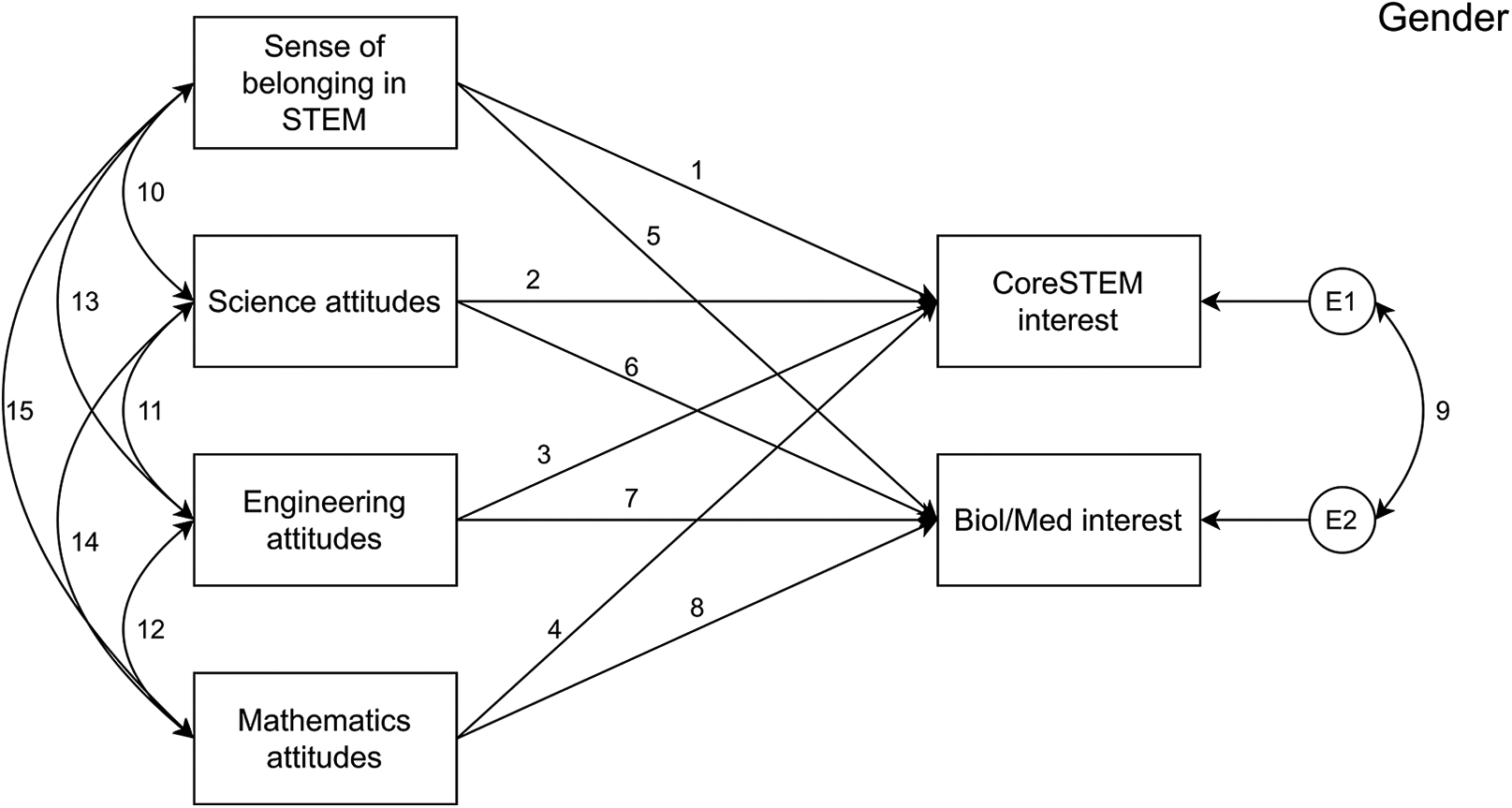
Gender-related relationships between science, technology, engineering, and mathematics sense of belonging, academic attitudes, and career interests hypothesized in accordance with a subset of STEreotypes, Motivation, and Outcomes model’s propositions in Master and Meltzoff (2020). E1 and E2 represent residual errors for the interest variables.
Method
Data and Sample
Participants for the present study were undergraduates majoring in a STEM field at a Hispanic-serving institution in a southwestern state in the United States. This university had received a U.S. Department of Education grant to increase Latinx and economically disadvantaged students in STEM workforce by offering opportunities to receive funding for participation in grant activities. These activities included learning communities for STEM students, peer mentoring, working with STEM faculty as undergraduate research assistants, and participating in internships with local STEM-related companies. All students who were affiliated with the grant activities for the duration of the grant were asked to complete survey questionnaires as part of the evaluation of the grant. A total of 123 students took the survey at the beginning of their coursework in STEM. The students were sent an email with a link from Qualtrics, a survey software program, from the grant coordinator explaining that they were being asked to take surveys. The present research was approved by the university’s Institutional Review Board.
We constructed the analytic sample by omitting students who had missing responses on all survey items. This restriction resulted in a final sample of 103 students (female: n = 70; male: n = 33), whose age was between 18 and 43 (M = 25.36, SD = 6.57). Administrative data show that 69% of them (n = 71) met eligibility requirements for the federal Pell grant program (i.e., economically disadvantaged). Of the 103 participants, about 72% were Latinx (n = 74); close to 57% of the Latinx were Pell-eligible (n = 42). The remaining 29 students were Pell-eligible and identified in the administrative records as from a mix of other racial/ethnic groups: African American/Black (1.9%), Asian (1.9%), Multiracial (1.9%), and White (22.3%). The reported majors were those pursuing teacher certification with a focus in a STEM field (female: n = 26; male: n = 0), computer science/engineering (female: n = 7; male: n = 17), biology (female: n = 18; male: n = 1), mechanical engineering (female: n = 3; male: n = 8), mathematics (female: n = 5; male: n = 5), physics/chemistry (female: n = 5; male: n = 2), and environmental science (female: n = 6; male: n = 0). The final data set is available upon request.
Measures
Table 1 presents a detailed description of the variables included in data analysis. The sense of belonging construct was assessed using a four-item scale drawn from the Math Sense of Belonging Scale (Good et al., 2012), which was originally designed to measure sense of membership in mathematics community. All items were modified to be preceded by the statement, “When I am in a STEM setting”. A sample item, for example, reads “I feel like I am part of the STEM community.” A STEM sense of belonging score was calculated for each student as the mean of the four items. Higher scores represent stronger sense of belonging in STEM. For the sample in this study, Cronbach’s α value was 0.87 indicating a reliable measure of STEM sense of belonging.
List of Variables.
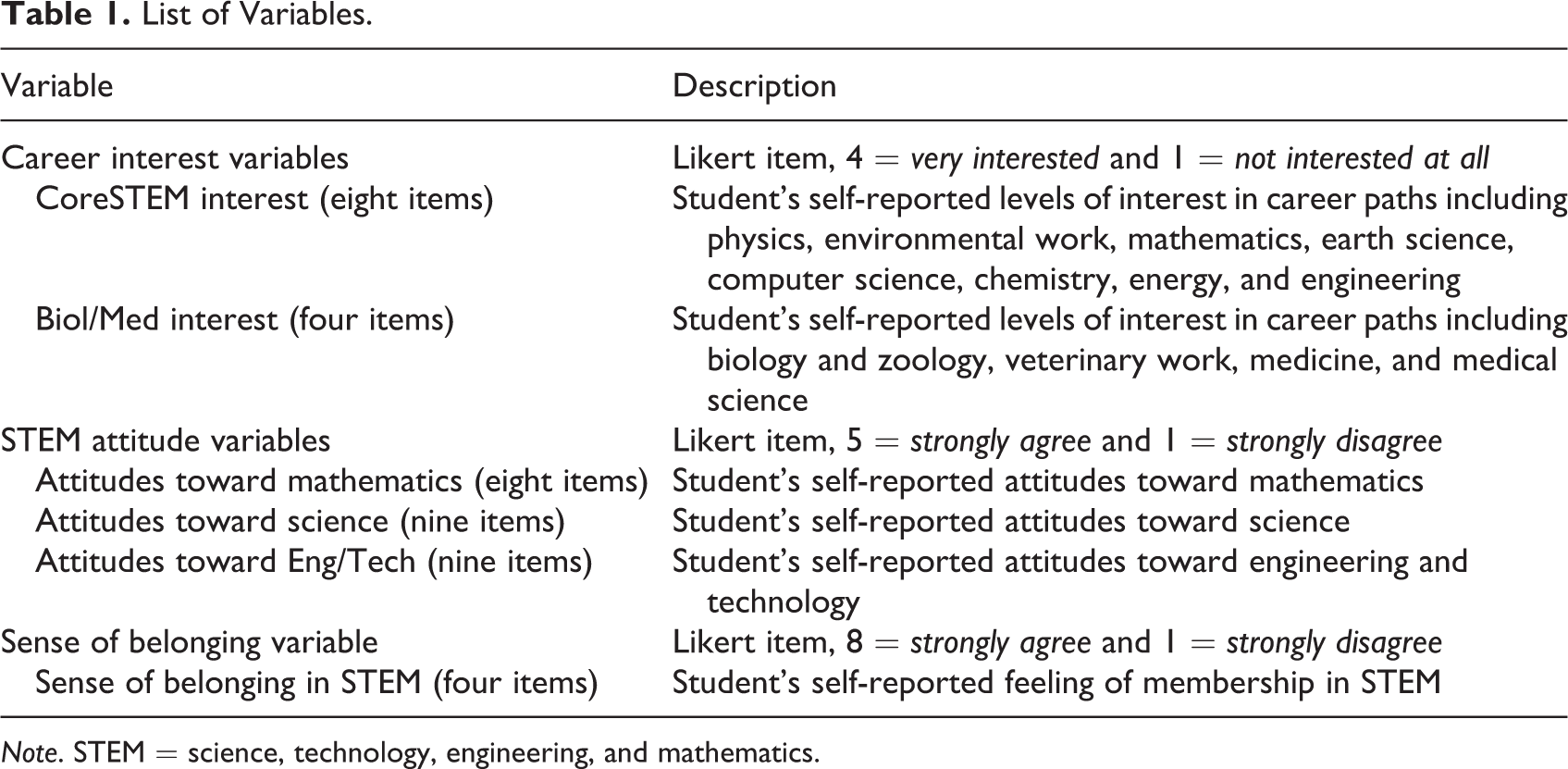
Note. STEM = science, technology, engineering, and mathematics.
Students’ STEM attitudes were measured by three subscales of the Student Attitudes Toward STEM survey (S-STEM; Unfried et al., 2015): mathematics, science, and engineering/technology. Responses to three negatively worded mathematics items and one negatively worded science item were reverse-coded before scoring. Attitude scores were calculated for each student as the mean of the items within each of the three S-STEM subscales. Higher scores represent more positive attitudes toward STEM subject areas. Full descriptions of the attitude items as well as the evidence on the psychometric soundness of the S-STEM, including validity, reliability, and measurement invariance, can be found in Unfried et al. (2015). Wiebe et al. (2018) found STEM attitude components to be positively related to STEM career interests in a large sample of K–12 students. For the sample in this study, Cronbach’s αs of the mathematics, science, and engineering/technology subscales were 0.94, 0.95, and 0.93, respectively indicating reliable measures of STEM attitudes.
The outcome variables are STEM career interest assessed by the entire set of 12 STEM career interest items drawn from Wiebe et al. (2018). In line with Wiebe and colleagues’ career path classification, we delineated two broad career areas—CoreSTEM and Biol/Med (see Table 1). A career interest score was calculated for each student as the mean of the items within the respective career cluster. Higher scores represent stronger interest in specific career areas. For the sample in this study, Cronbach’s αs of the CoreSTEM and Biol/Med interest scales were 0.77 and 0.85, respectively indicating reliable measures of STEM career interests.
Analyses
Missing data
Missing responses were not common in our sample; only 14 students (13.6%) had missing values on the survey items. The percentage of missing data by item ranged from 0% to 1.9%. Little’s missing completely at random (MCAR) test, which was conducted at item level, revealed statistically nonsignificant results, χ2(217) = 238.22, p = .15, indicating that the data were missing completely at random. Missing data were handled with the hot-deck imputation method via the VIM package in the R programming language (Kowarik & Templ, 2016). As missing data are MCAR, we used the imputed data for all subsequent analyses.
Multigroup analysis
To conserve space, the procedure for multigroup path analysis is detailed at the time when the results are presented. We reported standardized path coefficient estimates which, due to different within-group covariate variances, will differ for the male and female samples even when a parameter is constrained to equality across the two groups. Path models were fit to the data using robust maximum likelihood (MLR) approach. MLR performs well across different sample sizes and accounts for a degree of non-normality present in the outcome variables. Model estimation was implemented using the R lavaan package (Rosseel, 2012). Model-fitting indices included χ2 statistic, comparative fit index (CFI), root mean square error of approximation (RMSEA), and standardized root mean square residual (SRMR). As recommended by Hu and Bentler (1999), a path model provides a good fit to the data when CFI is close to or greater than 0.95, RMSEA is close to or less than 0.06, and SRMR is close to or less than 0.08.
To test for the significance of indirect effects, we bootstrapped standardized parameter estimates using the bootstrapLavaan feature in the lavaan package. We generated 5,000 samples, as recommended by Preacher and Hayes (2008), and summarized 95% bootstrap confidence intervals (CIs) based on 5,000 simulated draws from the distributions for the indirect effects quantified as the product of two standardized path coefficient estimates. R code for path model specification and parametric bootstrapping is available upon request.
Results
Preliminary Analysis
Table 2 presents sample means, standard deviations, and bivariate correlations by participants’ gender designation. A multivariate analysis of variance was used to investigate the effects of gender on the six variables. Results suggested that the overall difference in these variables within the gender group was statistically significant (F(6, 96) = 7.71, p < .001). The effect size attributable to gender was relatively large, as indicated by the partial eta-squared value (η2 = 0.14). Males scored higher on CoreSTEM interest (p < .001), attitudes toward engineering and mathematics (both p < .001), and sense of belonging in STEM (p = .03) than females, whereas females scored higher on Biol/Med interest (p < .001). In addition, both groups reported similar average scores on attitudes toward science (p = .78). The p values above were adjusted for multiple comparison. The significant differences in average scores supported the need to model across gender within a multigroup modeling framework.
Sample Bivariate Correlations, Means, and Standard Deviations.
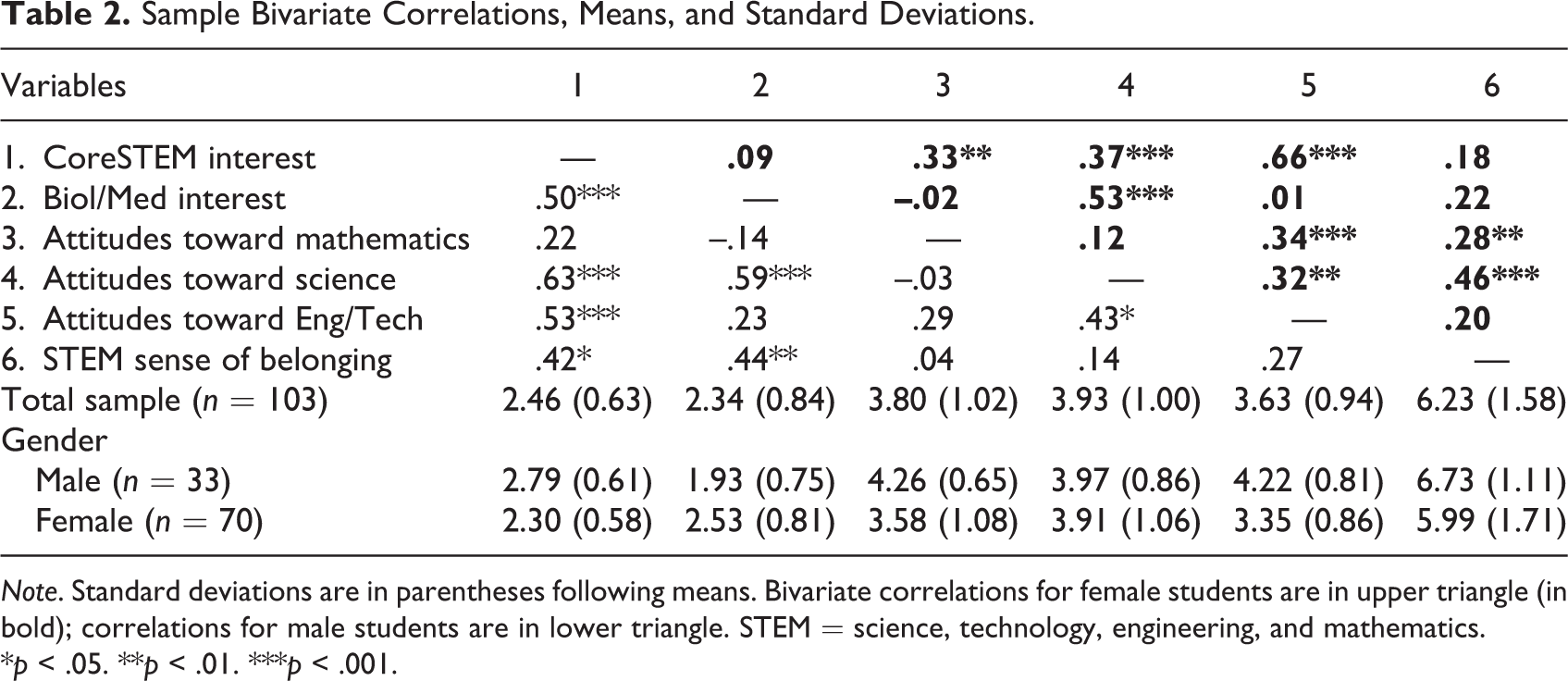
Note. Standard deviations are in parentheses following means. Bivariate correlations for female students are in upper triangle (in bold); correlations for male students are in lower triangle. STEM = science, technology, engineering, and mathematics.
*p < .05. **p < .01. ***p < .001.
Relationships Among STEM Sense of Belonging, STEM Attitudes, and Career Interest
To test the hypothesized model (see Figure 1), we conducted a series of multigroup path analyses to determine the extent to which this model would differ by gender. We began by fitting a fully constrained multigroup model in which all path parameters were equated across the male and female samples. This model provided an overall poor fit to the data, χ2(17) = 33.68, p = .01, CFI = 0.88, RMSEA = 0.14, and SRMR = 0.10, suggesting that at least one path would need to be freely estimated across gender. As a result, we rejected the fully constrained path model and concluded that the same path model was not applicable across the male and female samples.
To determine the model with the adequate number of paths to be equated across gender groups, we conducted a χ2 difference test for each path by comparing the fully constrained model with a slightly less constrained one in which each path was allowed to vary across groups one at a time (see Table 3). Likewise, the χ2 difference test was also applied to determine whether any residual variance for the career interest variables differed across the male and female samples. The results suggested that only two directional paths differed significantly across the male and female samples: STEM sense of belonging to CoreSTEM interest (Path 1) and Biol/Med interest (Path 5). In addition, the difference in the covariance between STEM sense of belonging and science attitudes (Path 10) was also significant across gender.
χ2Difference Tests Used to Determine the Partially Constrained Multigroup Model.
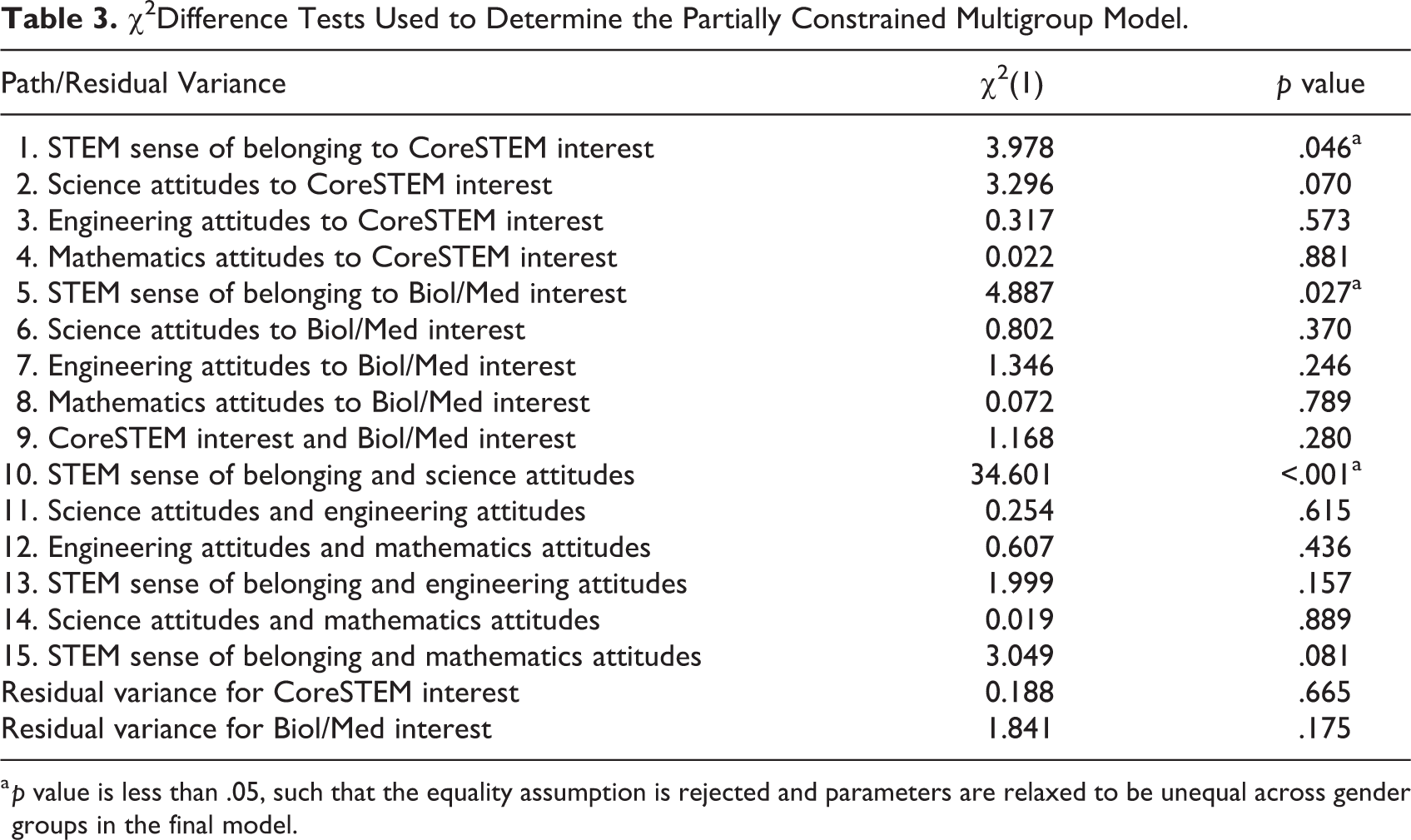
a p value is less than .05, such that the equality assumption is rejected and parameters are relaxed to be unequal across gender groups in the final model.
As a result, we fit a partially constrained model in which all directional paths, covariances, and residual variances were equated across gender except the two directional paths and one covariance previously found to differ significantly. This model provided a good fit to the data, χ2(14) = 14.78, p = .39, CFI = 0.99, RMSEA = 0.03, and SRMR = 0.07. In addition, the change in χ2 statistic between the fully constrained model and the partially constrained one was significant (Satorra–Bentler scaled-Δχ2 = 21.41, Δdf = 3, p < .001), indicating that the latter model had significantly better fit to the data as compared to the former. The partially constrained model was therefore favored and used to produce all subsequent results.
Figure 2 presents the standardized path values along with individual paths estimated from the partially constrained model. Testing the first hypothesis revealed that female and male students differed in two key paths in the hypothesized model. This hypothesis, positing direct paths from STEM sense of belonging to CoreSTEM and Biol/Med interests (Paths 1 and 5), was not supported for female students (see Figure 2A). In contrast, significant relationships between STEM sense of belonging and career interests were found for male students (see Figure 2B). The second hypothesis, positing direct paths from mathematics, engineering, and science attitudes to CoreSTEM and Biol/Med interests, was partially supported. Although engineering and science attitudes were related to CoreSTEM interest (Paths 2 and 3), only science attitudes (Path 6) were related to Biol/Med interest. These paths were invariant across gender. The third hypothesis, positing covariance structures between variables, was also partially supported. Covariance was not found between the two interest clusters (Path 9), science and mathematics attitudes (Path 14), and STEM sense of belonging and mathematics attitudes (Path 15). Notably, STEM sense of belonging was found to covary with science attitudes only for females (Path 10) but not for males, suggesting that sense of belonging had an indirect relationship with career interest through STEM attitudes.
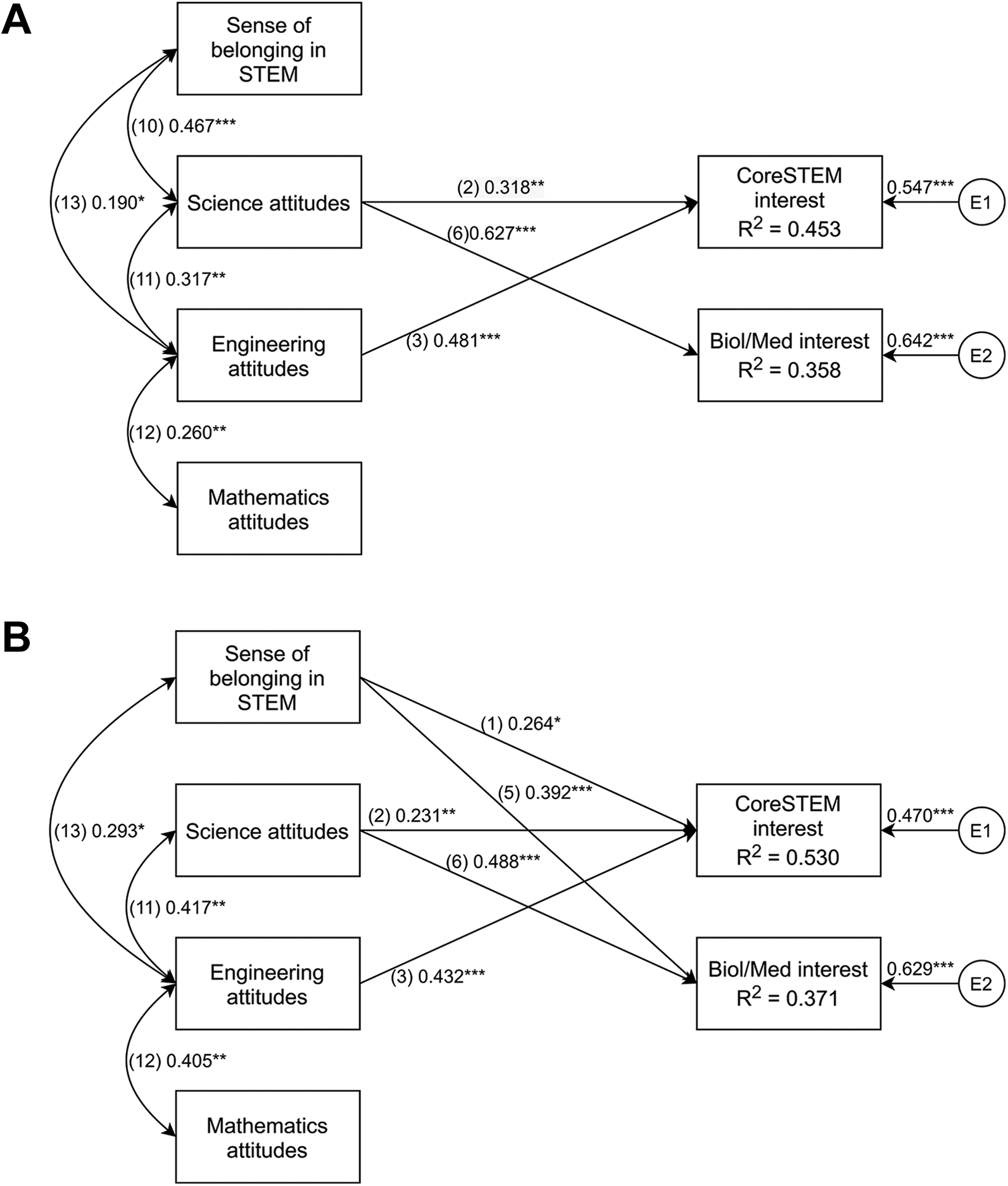
Hypothesized relationships tested in the partially constrained model. (A) Female students. (B) Male students. Path coefficients are standardized and appear next to individual path numbers in parentheses. Statistically nonsignificant paths are omitted in the interest of visual ease. * p < .05, ** p < .01, *** p < .001.
Results of significance testing for indirect effects demonstrated that the indirect paths from STEM sense of belonging to Biol/Med and CoreSTEM interests via science attitudes were statistically significant for females (coefficient estimate [CE] = 0.29, p < .001, 95% bootstrap CI = [0.17, 0.43] and CE = 0.15, p = .01, 95% CI = [0.03, 0.27], respectively). By contrast, these indirect effects were insignificant for males (CE = 0.06, p = .44, 95% CI = [–0.11, 0.23] and CE = 0.02, p = .45, 95% CI = [–0.07, 0.10], respectively). Additional significance testing revealed that the indirect path linking sense of belonging and CoreSTEM interest via engineering attitudes was statistically significant for females and males (CE = 0.09, p = .03, 95% CI = [0.02, 0.20] and CE = 0.13, p = .03, 95% CI = [0.02, 0.25], respectively) whereas such indirect path leading to Biol/Med interest was insignificant for both groups (CE = –0.03, p = .19, 95% CI = [–0.08, 0.02] and CE = –0.05, p = .19, 95% CI = [–0.12, 0.02], respectively).
Taken together, our multigroup analysis indicated that, for females in this sample, the contribution of STEM sense of belonging to career interests was indirect via the correlations between STEM sense of belonging and attitudes toward both science and engineering. For males in this sample, STEM sense of belonging contributed directly to Biol/Med interest while its contribution to CoreSTEM interest was both direct and indirect. The indirect relationship was formed through the correlation between STEM sense of belonging and attitudes toward engineering.
Discussion
In this study we first examined the average levels of STEM sense of belonging, STEM attitudes, and career interest. Our findings agreed largely with previous studies, thus confirming the mainstream conclusions that women perceive certain STEM subjects and careers very differently from men (Cheryan et al., 2015; Su et al., 2009). Such convergence has important implications as it offers some insight into the feasibility of generalizing our findings to a broader population. Moreover, results of finer-grained multigroup analysis were largely consistent with propositions of the STEMO model (Master & Meltzoff, 2020) and thus allowed us to conclude that this theoretical model holds value for studying students traditionally underrepresented within STEM contexts, for identifying mechanisms by which STEM sense of belonging operates to impact career interest, and for investigating gender-related phenomena associated with these mechanisms. Main findings are categorized into three significant themes.
Theme 1: STEM Sense of Belonging Has a Positive Impact on Career Interest
STEM sense of belonging was found to positively impact career interest for students in our sample, although the impact could be direct or indirect. These findings indicate that a student who felt valued and connected in the STEM community was more likely to express interest in both CoreSTEM and Biol/Med career paths. Our study, with females making up about two thirds of the sample, serves as an important complement to prior research examining the effects of academic belonging on interests for female college students (Good et al., 2012; Rattan et al., 2012; Smith et al., 2013). Women often face the “I am not a STEM person” type of ability-impugning stereotypes. For instance, this negative stereotype has affected many female students’ sense of belonging in mathematics by imbuing them with the notion that ability to do well in mathematics is a fixed talent rather than an attribute that can grow (Rattan et al., 2012). Given that connectedness in academics developed through interpersonal relationships can be considered a fundamental element of learning activities (Good et al., 2012), our findings suggest that STEM degree programs with more emphasis on nurturing STEM sense of belonging in the curriculum are more likely to signal to female college students that their underrepresentation in STEM fields and workforce is not embedded in the core value of STEM education.
Despite remarkable progress made in implementing programs to support women in STEM fields (e.g., Szelényi et al., 2013), addressing unwelcoming STEM environments remains a significant challenge in American colleges and universities. Rodriguez and Blaney (2020) examined the impact of collegiate experiences on STEM sense of belonging of Latina students in a predominantly White university. Many of these students reported that it was difficult for them to find both social and academic support on campus. In this sense, our study is timely for provoking further discussions regarding the necessity and validity of large educational programs aimed at increasing the retention of female college students in STEM fields.
Theme 2: The Impact of STEM Sense of Belonging on Career Interest Is Gender-Specific
For male students, we found no evidence of a correlation between STEM sense of belonging and science attitudes, suggesting a direct impact of sense of belonging on Biol/Med interest. In contrast, the impact of STEM sense of belonging on career interests was found to be indirect via the correlations between STEM sense of belonging and attitudes toward both science and engineering for the female sample. These findings indicate that a female student’s poor sense of belonging in STEM can compromise her STEM attitudes relative to her career interest. That STEM attitudes act as a liaison suggests that females with positive academic attitudes may be less susceptible to poor STEM sense of belonging than those with neutral or negative attitudes.
The notable differences between gender groups in the belonging–interest pathway demonstrated in this study may reflect the influences exerted by environmental conditions, which might provide varied opportunities to translate STEM sense of belonging into career interests. For example, student development of interest has been found to rely heavily on group memberships, such as fields of study (Byars-Winston et al., 2010). In the context of the present study, 70 female students were sampled, with most of them studying in the field of biology or pursuing teacher certification with a focus in a STEM field, whereas the majority of the male students sampled were pursuing degrees in quantitative disciplines, such as computer science or mechanical engineering. As a result, male students in our sample might have received certain supports from peers, staff, faculty, and institutions that their female counterparts did not receive. These supports might in turn enhance male students’ sense of belonging in STEM and translate this feeling directly into their career interests. It is therefore possible that the differences in the belonging–interest pathway across gender may have captured the impact of STEM fields of study as well as other important environmental factors that went unmeasured in this study.
Theme 3: Women’s STEM Attitudes May Serve as a Target for Interventions
We noted that the STEMO model does not give special attention to interventions targeting STEM attitudes although one of its foci is on interventions that strengthen STEM sense of belonging. Based on our analysis of the female sample, STEM attitudes may be targeted as a specific point for educational interventions because STEM sense of belonging appears to indirectly impact career interest via its correlation with STEM attitudes. In this sense, our findings contribute conceptually to the continued development of the STEMO model.
The STEMO model, along with empirical data (e.g., Rainey et al., 2018), supports direct and positive associations between STEM sense of belonging and STEM attitudes. That is, students who have higher attitudes (i.e., ability and value beliefs) perceive themselves as being more connected to others in STEM than do those who do not hold this perspective. Conversely, it may be that a feeling of connectedness in STEM enhances academic attitudes in the face of adversity and setbacks. Future longitudinal research may be undertaken examining the direction of causality. For example, does initial sense of belonging in STEM predispose students to develop positive academic attitudes, or does the reverse direction of causality seem more plausible? This line of research is needed to determine whether postsecondary STEM educators will effectively intervene to improve STEM attitudes that may serve as a possible protective mechanism against low STEM sense of belonging for female college students.
Implications for Research in Vocational Psychology
The present study, albeit focused on expectancy value as the guiding framework, offers important implications for empirical inquiry into social cognitive career theory (SCCT; Lent et al., 1994, 2000). SCCT and EVT share considerable similarities in their core theoretical constructs. Namely, self-efficacy and outcome expectations in SCCT are conceptually similar to expectations for success and task value in EVT. In addition, both theories postulate motivation pathways in a manner similar enough to link antecedent variables to academic and occupational outcomes through their core constructs.
These areas for substantial overlap would enable an examination into how gender may moderate the fit of SCCT models in the presence of gender differences in belongingness. Future research investigating this problem would offer important insight into how women’s experiences of marginality in STEM can hinder college success and limit career decision-making. Specifically, key to SCCT is a construct of social supports and barriers. Fouad and Santana (2017) hinted at the possibility of integrating sense of belonging, as a psychological factor perhaps functioning in tandem with perceptions of social supports and barriers, into SCCT in STEM settings. Only recently have Ma and Shea (2021) empirically tested this idea in a non-STEM setting, with sense of belonging found to be a moderator that reduced the negative effects of perceived barriers on career outcome expectations. The importance of sense of belonging, contrasted with a sparse extant literature aimed at examining its place in SCCT, highlights a need to delve into the development of self-efficacy and outcome expectations in the contexts of interpersonal connectedness. To this end, our study urges SCCT scholars to consider exploring a broader construct of perceived social supports and barriers inclusive of sense of belonging in future research.
Implications for Career Counseling
Our study suggests practical value for career counseling in colleges and universities. At this life stage, many students still are in the process of sorting out their career choices. Of them, only a few have tentatively decided on a STEM occupation. Having these students in a counseling session with an assessment of career interests and goals to begin with may not be optimal for them, as has been noted by Bonifacio et al. (2018). Rather, college career counselors and advisors might need to tap into the levels of students’ commitment to a career in STEM, particularly among female students, by relating them to their experiences in terms of whether and to what extent they feel a sense of belonging to the STEM community. This suggestion builds directly on the vision of counseling interventions described by many other researchers with the aim of enhancing career development by recognizing the importance of experiences related to environmental supports and barriers among Latinas (e.g., Bonifacio et al., 2018; Flores & O’Brien, 2002), who made up nearly half of the participants in the present study.
Moreover, our findings imply that female students, even with adequate STEM sense of belonging, may not develop interest in STEM careers unless they develop positive attitudes toward STEM. Given this, career counselors might help female students by asking them to explore their ability and value belief systems (i.e., academic attitudes) in the context of STEM connectedness. It is important in practice to raise a student’s awareness about his/her attitudes toward STEM, particularly the value portion of attitudes, considering that (a) the culture surrounding STEM predominantly characterizes these fields as having low communal value (Brown et al., 2015), (b) female students are more likely to endorse STEM careers with altruistic goals than their male counterparts (Su et al., 2009), and (c) perception of communal value in a task contributes to an individual’s value belief system and subsequently gives rise to STEM field choices (Wegemer & Eccles, 2019). College career counselors can leverage these findings alongside ours by helping female students construct images of STEM careers that do not engender stereotype threat to women. For example, using a values card sort as an assessment tool may facilitate this process. In the interview that follows card sorting, counselors can discuss with clients their sorting styles in relation to the altruistic aspects of STEM-related occupations, such that the clients will have opportunities to internalize the communal values of STEM. This approach to value intervention is based on an expectancy-value framework, but the potentials of its use in career counseling are conspicuous given the natural correspondence between SCCT and EVT.
Limitations
There are several limitations to this study that should be considered in interpreting findings. First, we used a convenience sampling approach with students who participated in grant activities. These students already likely had positive attitudes and experiences in STEM relative to those who were not in the grant activities. Thus, our sample may not provide a representative result. Second, this study is limited by its sample size although it is consistent with the minimum sample size (i.e., 100–150 participants) suggested for conducting structural equation models with a small set of variables (Ding et al., 1995). Third, this study used a survey originally intended to measure mathematics sense of belonging that we altered to address the more general STEM construct, therefore findings should be viewed with caution. Fourth, the variables included in our model were limited to the variables in the survey administered to the students. Thus, we were unable to fully account for all of the constructs framed in the STEMO model. Lastly, given the observational nature of our data, the relationships among the constructs found in this study should be interpreted at best as suggestive rather than conclusive.
Conclusion
Our analysis reinforces the long-held notion that female students perceive themselves to be more extraneous to the STEM community than their male counterparts. Through the elucidated pathway linked by STEM attitudes that exists for women, doubt about belonging in the STEM community may negatively impact attitudes before it weakens female students’ interests in STEM careers and therefore their intent to join the STEM workforce. Overall, findings of the present study continue to highlight the need to address female college students’ disengagement from the STEM community and for universities to expand the programs that support their sense of belonging to their institution and to STEM.
Footnotes
Authors’ Note
We agree to make the data supporting the results presented in this article available to other researchers upon request.
Acknowledgment
We thank Dr. George V. Gushue (the associate editor) and one anonymous referee for many helpful comments.
Declaration of Conflicting Interests
The author(s) declared no potential conflicts of interest with respect to the research, authorship, and/or publication of this article.
Funding
The author(s) disclosed receipt of the following financial support for the research, authorship, and/or publication of this article: Part of this work (data collection) was supported by the grant Pathways to STEM Careers, P031C160242, funded by the HSI STEM program of US Department of Education.
