



Abstract
The persistent gender gap in STEM (Science, Technology, Engineering, and Math) career choice represents a perplexing problem for researchers and policy makers alike. We contribute to the body of research on the gender gap in STEM careers by testing a “surplus model” of vocational interests as a predictor of STEM career choice. The model suggests that, controlling for ability, female adolescents with strong STEM-related interest should be less likely to pursue STEM careers when they also have strong interests in other areas, due to wider career options. We tested the surplus model in a large national longitudinal data set and translated the results into differences in annual wages. Our findings illuminate the predictive validity of a surplus model of interests on STEM career choice across gender, provide insight into the gender gap in STEM, and suggest opportunities for future research.
…the perception that a college major may be unwelcoming to women is related to gender differences in students’ choice of major and may contribute to the lower proportions of women in certain math- and science-based fields and not in others.
The persistent gender gap in STEM (Science, Technology, Engineering, and Math) career choice represents a perplexing problem for researchers and policy makers alike. As the opening quote suggests, one significant reason for this gap is that women may find math- and science-based fields unwelcoming due to anticipated gender bias (see also Chen & Moons, 2015; Fouad et al., 2011; Hill et al., 2010). This means that even when women have interests aligned with STEM careers, they may still choose not to enter those fields, particularly if they perceive other careers—where they are less likely to experience bias and discrimination—as equally consistent with their interests, and thus equally viable. Based on this premise, in this paper we put forth and test what we refer to as a “surplus model” of vocational interests as an explanation for the gender gap in STEM careers.
The surplus model refers to the idea that when young women have strong STEM-related and strong additional interests (beyond those most related to STEM), their propensity to choose STEM careers should be lower than those women with strong STEM-related interests but weak other interests. According to the surplus model, young women’s lower propensity to choose STEM careers may be due, not only to gender differences in absolute levels of STEM-related interest, as suggested by prior research (Collier et al., 1998; Hardin & Longhurst, 2016; Jacobs, 2005; Su et al., 2009; Tracey & Ward, 1998), but additionally to the possession of additional interests which provide them with a greater array of career choices and thus perceptions of career fit with either STEM or non-STEM fields (McCabe et al., 2020).
Given that vocational interests shape perceptions of occupational fit (Holland, 1997), and that women contemplating work in STEM fields anticipate gender bias, chilly professional and organizational climates, and lack of inclusion (e.g., Chen & Moons, 2015; Fouad et al., 2011; Hill et al., 2010; Ganley et al., 2018), having broad interests may cause women who do possess strong STEM-related interests to still gravitate away from STEM careers because they may find other career choices equally aligned with their interests while not posing the same high risk for negative experiences in the form of gender bias and discrimination.
To our knowledge, a surplus model of vocational interests as a possible explanation for the gender gap in STEM has not been empirically tested. Using the Project Talent data set, where vocational interests were measured in high school and STEM career was measured 11 years later, we test the surplus model in a large, national data set. The Project Talent data set is one of the largest in the world that allows for a longitudinal evaluation of the effect of adolescent interests on work outcomes in adulthood. Moreover, the data were collected in the 1960s and 1970s, a period when women were breaking out of traditional career paths and expected to have access to the same careers as men (Isserman & Kazin, 2000). Though these data were collected over 50 year ago, this data set is uniquely suited to test our surplus model as large studies that follow people from adolescence to adulthood are extremely rare and allow valuable insight into the predictive validity of youth characteristics on adult outcomes. Consistently, numerous recent studies have relied on Project Talent data to investigate the relationship between individual characteristics in high school and career outcomes in adulthood (e.g., Atit et al., 2018; Damian et al., 2017; Gohm et al., 1998; Humphreys et al., 1993; Lang & Kell, 2020).
To test a surplus model, we examine gender differences in the effect of Investigative and other interests—specifically, Enterprising, Social, and Artistic—on STEM career choice. We focus on Investigative interest in combination with other interests because Investigative interest has been shown to be “the best indicator for the interests in pursuing education or careers in STEM fields” (Le et al., 2014; Su & Rounds, 2015: 3). Our outcome of interest—STEM career—refers to the extent to which occupations represent work environments that require higher (vs. lower) STEM/Investigative interest, as opposed to occupations that are categorized dichotomously as STEM/non-STEM. We use the term STEM career for parsimony in language. If the surplus model of under-representation holds, we would expect female (more than male) adolescents with stronger Investigative interest to be increasingly less likely to select into STEM careers when they are also high on other interests. This pattern could mean a greater gender gap in STEM careers than that predicted by level of Investigative interest alone.
Vocational Interests and STEM Career Entry
Vocational interests—multi-level dispositional traits that represent preferences for distinct work-relevant characteristics (Holland, 1997; Holland & Gottfredson, 1992)—can be categorized into six types: Realistic (R), Investigative (I), Artistic (A), Social (S), Enterprising (E), and Conventional (C), collectively referred to as RIASEC (Holland, 1997). The interests follow the form of a hexagon such that adjacent interests (e.g., R and I) are generally more similar than alternate interests (e.g., R and A), which are generally more similar than opposite interests (e.g., R and S; Gurtman & Pincus, 2003). Realistic interest relates to the systematic manipulation of tools or animals; Investigative interest relates to science, technology and research, and is tied to activities associated with being analytical, curious, and precise; Artistic interest reflects opportunities to be expressive, original, and introspective; Social interest relates to working with and helping others, as well as developing relationships, but avoiding ordered activities involving tools and machinery; Enterprising interest is tied to activities that entail managing and persuading others to attain organizational goals or economic gain, and is linked to low scientific ability; Conventional interest is associated with the enjoyment of the systematic manipulation of data, filing records, or reproducing materials.
Based on prior research, we expect a positive relation between Investigative interest and STEM career (e.g., Su et al., 2009). Moreover, we expect the positive relation to be stronger for women than men. This stronger effect for women should be based on a combination of two factors. First, for women seeking entry into male-dominated careers (e.g., engineering, physics), the P-E fit relationship is complicated by gender. Because women shy away from STEM-oriented fields for reasons other than interests (e.g., anticipated bias, lower power, lack of belongingness, family preferences; Chen & Moons, 2015; Robinson & McIlwee, 1991; Steele, 1997), having strong Investigative interest should be even more important to women as compared to men. Strong Investigative interest, and the strong perceived fit with STEM careers based on interest, may push young women to pursue STEM careers even in the face of anticipated gender or lifestyle challenges. Second, men with low Investigative interests should be more likely than similarly interested women to select STEM careers due to perceived fit with careers gendered male and their absence of risk for gender-related bias and discrimination in these careers (Ganley et al., 2018).
Accordingly, we predict the following:
Surplus Interests and the Gender Gap in STEM
There are several reasons why it may be important to test a surplus model of vocational interests as a predictor of the gender gap in STEM careers. First, in contrast to a surplus perspective, much existing research on person-centered explanations for this gender gap has taken what can be referred to as a “deficit” perspective on young women’s choices to pursue STEM. By this we mean that research has on person-centered explanations suggests that young women don’t pursue STEM careers to the same degree as men because, particularly by the time they reach high school, because they are lacking in certain characteristics (e.g., abilities, interests) aligned with STEM career choice. 1 For example, researchers have shown that strong math ability is a significant predictor of entry into STEM careers (Bernstein et al., 2019; McCabe et al., 2020), and that female adolescents show lower levels of exceptional math ability (Ceci & Williams, 2010; Lubinski & Benbow, 2006), as well as lower levels of math self-efficacy (e.g., Sáinz & Eccles, 2012; Skaalvik & Skaalvik, 2004). Similarly, with respect to vocational interests, studies have shown that Investigative interest is the most significant predictor of pursuing education or careers in STEM fields (Su & Rounds, 2015), and that female adolescents score lower than male adolescents on Investigative interest (Collier et al., 1998; Hardin & Longhurst, 2016; Jacobs, 2005; Su et al., 2009; Tracey & Ward, 1998). Although girls and boys show similar interests and perceived abilities in earlier childhood, they begin to show greater gender differences starting in middle school (Tracey & Ward, 1998). In short, this research suggests that a reason for the gender gap in STEM is women’s comparably lower ratings of exceptional math ability, math self-efficacy and Investigative interest. Moreover, this deficit perspective has informed numerous initiatives to increase adolescent girls’ STEM-related interests and abilities (Valla & Ceci, 2014).
This extant research, while providing important insights, has tended to implicitly emphasize that women do not enter STEM careers because they lack some characteristic (e.g., ability, interest) associated with strong perceptions of anticipated fit with STEM careers. The surplus model suggests that women may also gravitate away from STEM careers due to a relative abundance (i.e., surplus) of interests that make non-STEM careers equally or more appealing.
Second, some prior research suggests that looking at broad vs. single characteristics of cognitive functioning in women is useful for understanding the gender gap in STEM. In particular, Wang and colleagues (2013) showed that being high on both math and verbal ability (a combination that is more prevalent in women; McCabe et al., 2020)—was associated with lower STEM entry than being high on math ability alone (Wang et al., 2013). Extending this research to an examination of vocational interests is fruitful because interests precede abilities (Schmidt, 2011), such that initial interests create a developmental pathway whereby any advantage in math, technical and science aptitude stems from greater initial interest in these areas leading to greater pursuit of learning. Moreover, interests tend to predict occupational outcomes independent of cognitive ability (Stoll et al., 2017). Thus, a surplus model of vocational interests may represent an important “upstream” and unique predictor of gender differences in multiple ability profiles, and ultimately in STEM career choice (Valla & Ceci, 2014).
Third, general support for the potential importance of broad interests in predicting STEM careers comes from research showing that, for college women, finding other fields more interesting is the main reason given for switching out of STEM majors (Seymour & Hewitt, 1997). This research, though conducted among college-age women, is also suggestive that broad, or surplus, interests reduce young women’s long-term pursuit of STEM careers.
In terms of our specific predictions related to a surplus model of interests and the gender gap in STEM, we suggest that when female students (vs. male students) with strong Investigative interest are also high on other types of interests, their propensity to pursue STEM careers should be disproportionately lower because they should perceive other careers to be an equal fit with their interests while posing fewer risks for gender bias and discrimination (Ganley et al., 2018). We predict that three specific interest types—Enterprising, Social, and Artistic—will exert the strongest influences on the relation between Investigative interest and STEM career choice, especially for women.
We selected Enterprising, Social, and Artistic interests for several reasons. To begin, based on the previously reported gender differences between the “people” and “things” dimensions of the RIASEC model (Lippa, 1998; Su et al., 2009; Thorndike, 1911), these interest types, all associated with the RIASEC “people” dimension (Prediger, 1982), should exert the strongest influence on the relationship between Investigative interest and STEM career choice, especially for women. Indeed, several researchers have linked a gender-related individual difference—masculinity–femininity—to the people–things dimension, suggesting a parallel between gender and the people-things dimension that might explain gender differences in occupational interests (e.g., Lippa, 1998). In accordance with this distinction, the people–things dimension has been used to explain sex differences in occupational membership in general and the gender gap in STEM in particular (Browne, 2006; Su et al., 2009). We also base our predictions on the specific features of each of these interest types, as well as the hexagon-shaped structure of RIASEC interests implies a configuration of relative interest levels within individuals (Gurtman & Pincus, 2003). The positioning of the interests on the hexagon has consequence for an individual’s likely overall interest profile. That is, the more positionally “opposite” the interests on the hexagon (e.g., I and E), the less compatible the interests. In contrast, the more proximal the interests (e.g., I and A), the more compatible the interests (Nagy, et al., 2010).
Enterprising interest is not only part of the “people” dimension of the RIASEC, but as noted, it is also opposite of Investigative interest on the RIASEC hexagon (Nagy et al., 2010; Prediger, 1982). As opposite interests on the RIASEC hexagon are least related, a preference for Investigative activities and work environments assumes relatively low Enterprising interest (Holland, 1997). For example, Investigative people generally avoid leading, selling, or persuading people, while Enterprising people enjoy these activities. Thus, people who are high on both Investigative and Enterprising interests may feel attracted away from STEM careers if they feel that their Enterprising interest makes them a poor fit (Dawis & Lofquist, 1984). Consistent with this prediction, research has shown that opposite interests introduce additional complexity into career choice decisions because they complicate perceptions of person-environment fit (Holland, 1997; Nagy et al., 2010; Prediger, 1982). One of the considerations to career decision-makers is what will make up someone’s ideal occupation; an ideal occupation is that which is preferred to all other occupational alternatives (Gati & Winer, 1987). When individuals have opposite interests, they should find it more difficult to select a single preferred occupation that aligns with their interests, and should thus be more likely to consider a broad array of possibilities. We suggest that this consideration should make individuals with strong Investigative and Enterprising interests less likely to select STEM careers than those with strong Investigative interest and low Enterprising interest. However, because women are more likely than their male counterparts to be drawn away from STEM careers due to anticipated gender-based challenges, we expect this effect to be stronger for women than men.
Social interest anchors the “people” dimension of RIASEC interests and is considered one of the interests least aligned with entry into STEM careers (Su et al., 2009). It is well-established that women, compared to men, have a stronger penchant for work environments that provide opportunities and activities to work with people. This preference has been shown in a number of theoretical frameworks, such as people-orientation (e.g., Thorndike, 1911; Woodcock et al., 2013), Social interest (e.g., Su et al., 2009; Robertson et al., 2010), task values (e.g., Meece et al., 1982; Eccles, 2007), and communal goals (e.g., Diekman et al., 2010; McCarty et al., 2014). Moreover, these distinct preferences of men and women have been linked to the gender disparities in STEM fields (e.g., Su et al., 2009; Woodcock et al., 2013). For example, Diekman and colleagues (2010) demonstrated that strong communal goals—such as those associated with Social interest—impede intention to pursue STEM careers, even when controlling for math and science aptitude and self-efficacy. Taken together, this evidence suggests that for women with strong Investigative interest and strong Social interest should have reduced likelihood to select into STEM careers.
Because Artistic interest is positionally adjacent to Investigative interest, one might expect that Artistic interest will not necessarily draw those with strong Investigative interest away from STEM careers. However, there are several reasons to question this assumption. First, as noted above, Artistic interest lies on the “people” dimension of the RIASEC structure (Prediger, 1982), which has been shown to be both less predictive of STEM entry, and is an interest type that shows large sex differences—favoring women—in prior research (Betz & Fitzgerald, 1987; Lippa, 1998; Su et al., 2009). Second, and consistently, evidence suggests that women pursue art and design majors at a higher rate than men (College Factual, 2017; Humanities Indicators, 2017), suggesting that women with strong Artistic interest may be more likely than men with similar Artistic interest to pursue artistic careers. Consistently, research shows that girls with Artistic interests perceive more occupational opportunities than boys with Artistic interests (Naylor & Krumboltz, 1994).
Based on this evidence, we theorize that these other interests—Enterprising, Social and Artistic—when combined with strong Investigative interest, will encourage women, relative to men to choose careers with less of a STEM-orientation.
Method
Participants
We used data from Project Talent (Wise et al., 1979), a longitudinal study that started in 1960 with a 5% representative sample of US high school students (N = 377,016, with 346,660 coded as “credible” by the Project Talent [PT] staff; details on PT credibility coding are provided in our “Data Analysis” section). In the present study, we used data from the original survey (Baseline) and the 11th year follow-up. This was the final large-scale follow-up and occurred long enough after high school for most participants to hold jobs representative of their occupational training. The response rate for the 11th year follow-up was 22% (N = 85,342), but not all participants had data available on all variables of interest, most typically, occupation. Additionally, in 1971, when these data were collected, a large portion of the female participants, who were then in their late 20s, were not employed, but instead had homemaker roles. This reduced our analyzed longitudinal sample to 44,094 people (see Data Analysis section for data exclusion criteria).
The longitudinal sample was 38.2% female, 95.7% Caucasian, and the average age was 16 at Baseline and 27 at the 11th year follow-up. Although the PT sample available at the 11th year follow-up cannot be considered a representative sample of the US population, it remains one of the largest samples in the world that allows the effect of adolescent interests on work outcomes to be evaluated. 2
Measures
The original survey (Baseline) recorded students’ demographics, vocational interests, and math and verbal abilities. The 11th year follow-up recorded job titles. Below we describe the measures used in the present study, coding procedures, and any transformations performed.
Demographic measures (Baseline)
Four demographic control variables were included in the analyses as these variables have well documented effects on occupational outcomes: age cohort, parental SES, race/ethnicity, and cognitive ability (Damian et al., 2015). For parental SES, we used the original composite (Wise et al., 1979), which included answers to nine questions regarding home value, family income, number of books in the house, number of appliances, access to media, availability of a private room for the child, father’s job status, father’s education, and mother’s education (α = .69). These are all frequently used indicators of SES (Galobardes et al., 2006). 3 The SES variable approximates a standard score with a mean of 100 and standard deviation of 10. Age cohort, coded as a numeric variable ranging from 9 to 12, corresponds with the students’ high school grade level at the Baseline survey. Age cohort is an important variable because it captures the variation in cognitive ability scores that naturally vary by age. Because the numbers in each of the non-Caucasian racial categories were very low, we recoded race into a dummy variable where 0 was Caucasian and 1 was Other. 4 To measure cognitive ability, and following previous research using Project Talent data (e.g., Damian et al., 2015; Damian et al., 2017; Spengler, Damian & Roberts, 2018), we used several well-validated and highly reliable standardized tests of verbal and math ability (Wise et al., 1979). Verbal ability consisted of three scales (α = .88): Vocabulary (30 items that measured general knowledge of words), English Composite (113 items measuring capitalization, punctuation, spelling, usage, and effective expression in English), and Reading Comprehension (48 items measuring the comprehension of written text covering a broad range of topics). Math ability consisted of four scales (α = .87): Mathematics Information (23 items measuring knowledge of math definitions and notation), Arithmetic Reasoning (16 items measuring the reasoning ability needed to solve basic arithmetic items), Introductory Mathematics (24 items measuring all forms of math knowledge taught through the 9th grade), and Advanced Mathematics (14 items covering math topics taught in Grade 10 to 12 college preparatory courses, such as algebra, plane and solid geometry, probability, logic, logarithms, and basic calculus). The correlation between the verbal and math ability composite measures was .73. To reduce multicollinearity between the verbal and math measures, we computed an overall cognitive ability index by averaging the standardized scores of the two ability indices. Finally, gender was coded as female = 1, male = 0.
Vocational interests in high school (Baseline)
Holland’s (1959, 1997) model of vocational interests formed the basis for our evaluation of interests. In a prior study, one of the current study’s authors (Wiegand, 2018), formed RIASEC scales from Project Talent’s interest inventory. In the initial survey, respondents rated their degree of (dis)liking on 205 interest items, 122 occupations and 83 activities, using a five-point scale with a neutral midpoint (1 = “I would dislike this very much” to 5 = “I would like this very much”). Since the Project Talent interest inventory was not created to model Holland’s RIASEC interests (for a factor analysis of the Project Talent interest inventory, see Su, 2012), previous research carefully matched Project Talent interest items to RIASEC interests (Wiegand, 2018). This resulted in nine-item scales for each of the six RIASEC interests. Reliabilities (Cronbach’s α) ranged from .83 (Conventional) to .88 (Realistic) across interests. Scales are available upon request. Individual interest scores were computed as the mean of each interest scale. 5
STEM career (Year 11)
This variable refers to the extent to which occupations represent work environments that require higher (vs. lower) STEM/Investigative interest, as opposed to occupations that are categorized dichotomously as STEM/non-STEM. 6 STEM career (operationalized as an occupation’s Investigative interest score) was derived from participants’ self-reported job titles at the 11th year follow-up. The job titles were initially captured using a free-response format. Project Talent staff then reduced the original job titles to 250 job categories, which were assigned accordingly to each participant and are now the only job information available to researchers. Trained expert raters used these available job categories and matched them to Occupational Information Network (O*NET) codes using the publicly available online database: http://www.onetonline.org/. The O*NET is a comprehensive system for collecting, organizing, and describing data on occupational characteristics and worker attributes developed by the U.S. Department of Labor, and it is currently the primary source of job information in the U.S. (Peterson et al., 2001). Thus, extensive information is now available for about 925 jobs, and the publicly available database includes job titles, synonym titles, and associated O*NET codes, which can be used to match specific job titles with their coded characteristics.
To transform the available job categories into O*NET codes, two expert raters independently assigned an O*NET code to each available job category by using the search tool available in the online database. Agreement reached 64% in this phase, meaning that the two independent raters assigned the exact same O*NET code for 64% of the job categories, which is impressive given that each code for each job had to be selected out of 925 options, some of which were very similar to each other. Next, the two raters met and resolved their disagreements through discussion. Upon discussion, the two raters agreed on 94% of the assigned O*NET codes. Next, two new independent raters read through the remaining 6% of job categories and resolved any remaining disagreements. Finally, by transforming the original job codes into O*NET codes, we were able to match each participant’s job code to the corresponding RIASEC occupational interest environment profiles recorded in the O*NET database.
The O*NET database provides Occupational Interest Profiles (OIPs) for occupations represented in the O*NET database. The OIPs are comprised of six numerical scores (obtained by averaging scores of expert raters) that correspond to one of each of the six RIASEC interests. OIPs were developed based on Holland’s (1997) RIASEC interest-based classification of occupational interests (Rounds et al., 2008). Each job title was assigned a score for each of the RIASEC interest areas, and each score indicated how characteristic the occupation was for the respective interest area. The OIPs are unique in vocational assessment and classification research because they represent the first effort to create full, numerical profiles, covering all six RIASEC environments for each job. The expert raters used a seven-point scale, where higher scores meant that the job was more characteristic of the respective occupational profile. As noted, and consistent with suggestions in prior research (Su & Rounds, 2015), we used Investigative interest scores of the O*NET occupational profiles as proxies for the STEM-orientation of careers. Of note, these O*NET expert ratings are more accurate than the degree to which an occupation is or is not Investigative, and a qualitative STEM/non-STEM distinction of jobs (i.e., a face value decision about what counts as STEM) that we might calculate as a substitute for these ratings would introduce unwanted error.
Data Analysis
Participants were excluded prior to all analyses based on two factors: (a) response credibility and (b) response availability on STEM career at Year 11. The first criterion was meant to guarantee data quality—we selected only cases that were coded as “credible” on the original Response Credibility Index (Wise et al., 1979). 7 The second criterion was introduced because our dependent variable requires participants to have been employed at Year 11. Missing data were handled using listwise deletion. We evaluated our hypotheses using moderated regression analyses (with two- and three-way interactions) predicting STEM career. When interaction terms associated with our focal variables were statistically significant, simple slopes were analyzed at ±1 SD (Aiken et al., 1991) for two-way interactions, and via Dawson and Richter’s (2006) methodology for testing differences between pairs of interacting variables at ± 1 SD for three-way interactions. We evaluated pairs of RIASEC interests instead of controlling for all RIASEC interests because of inherent multicollinearity when evaluating all RIASEC interests at once. This occurs because adjacent and alternate interests correlate to form the RIASEC hexagon—the interests do not exhibit simple structure (Holland, 1997).
In addition to regression coefficients and significance testing, we also provided a raw metric interpretation of our effects to help with understanding effect sizes, their applicability, and meaning in a real-world context. As the STEM career score by itself is not easily understood as a raw metric, we transformed predicted changes in STEM career scores into predicted changes in annual wages. To arrive at this raw metric interpretation, we followed several steps. First, we obtained publicly available data from O*NET (O*NET codes and their associated STEM career scores, as described earlier). Second, we obtained the publicly available crosswalk between O*NET codes and Standard Occupational Classification (SOC) codes (another occupational classification system similar to O*NET from the website of the US Bureau of Labor Statistics; BLS, 2018). Third, we obtained the publicly available crosswalk between SOC job codes and matched average annual wages (at the national level) for 2017 from Occupational Employment Statistics (OES), a program of the US Bureau of Labor Statistics (BLS, 2018). Fourth, we conducted a simple regression analysis, where the predictor was STEM career score and the outcome was the natural logarithm of annual wage. 8
We conducted raw metric analyses across all US jobs available after completing all of the crosswalks. Of the jobs that had STEM career scores assigned, 683 jobs also had wage information. We found that an increase of one scale point in STEM career score was associated with a 16% increase in annual wages (b = .16, p < .001). Because the main analyses in this paper used STEM career score (in its raw metric) as the main outcome of interest, we were able to transform the predicted changes in the STEM career outcome into predicted changes in annual wages (e.g., a predicted increase of half a scale point on career STEM score would be equivalent to an 8% increase in annual wages). Next, we transformed the percentage increase in annual wages into actual dollar amounts (computed at the average US income in May, 2017, which was $50,620 according to OES).
Results
Table 1 presents means, standard deviations, reliabilities, and correlations of the study variables. As expected, STEM career choice is most strongly and positively related to Investigative interest, but negatively related to Enterprising, Social and Artistic interests. Consistent with prior research, being female is negatively related to Investigative interest and STEM career entry.
Means, Standard Deviations and Correlations for all Variables.
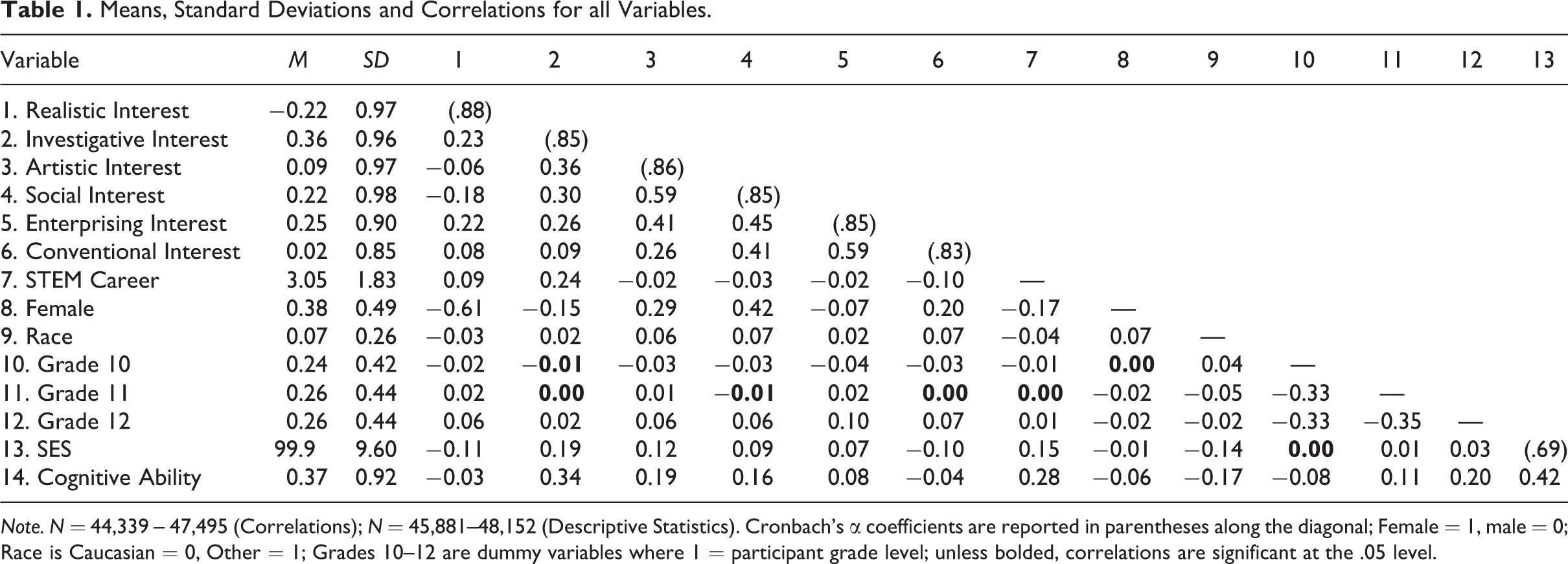
Note. N = 44,339 – 47,495 (Correlations); N = 45,881–48,152 (Descriptive Statistics). Cronbach’s α coefficients are reported in parentheses along the diagonal; Female = 1, male = 0; Race is Caucasian = 0, Other = 1; Grades 10–12 are dummy variables where 1 = participant grade level; unless bolded, correlations are significant at the .05 level.
In support of Hypothesis 1a, above and beyond demographics and cognitive ability, higher Investigative interest in high school predicted higher STEM career score in adulthood (b = .19, p < .001; see Table 2, Model 1). In support of Hypothesis 1b, the moderating effect of gender on the relation between Investigative interest in high school and STEM career in adulthood was also significant (b = .15, p < .001; see Table 2, Model 1). Figure 1 plots this interaction. As the figure illustrates, as individuals move from low (−1 SD) to high (+1 SD) levels of Investigative interest in high school, women are increasingly more likely than men to select into careers with higher STEM career scores (.66 increase for women vs. .38 increase for men; note that any second decimal differences compared to the figure are due to rounding in the figure).
Regression Output for Investigative Interest, Other Interests and Gender Predicting STEM Career.
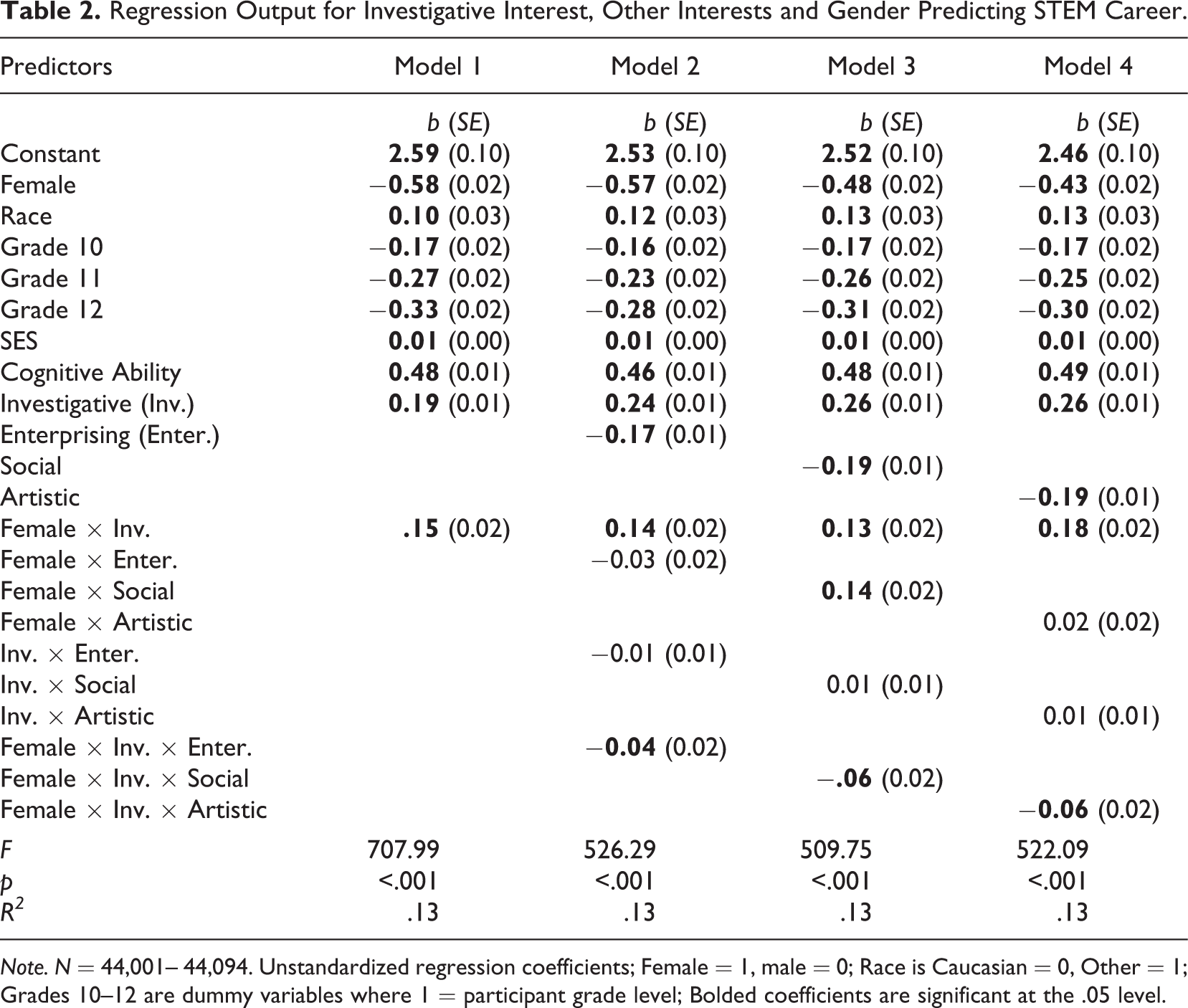
Note. N = 44,001– 44,094. Unstandardized regression coefficients; Female = 1, male = 0; Race is Caucasian = 0, Other = 1; Grades 10–12 are dummy variables where 1 = participant grade level; Bolded coefficients are significant at the .05 level.
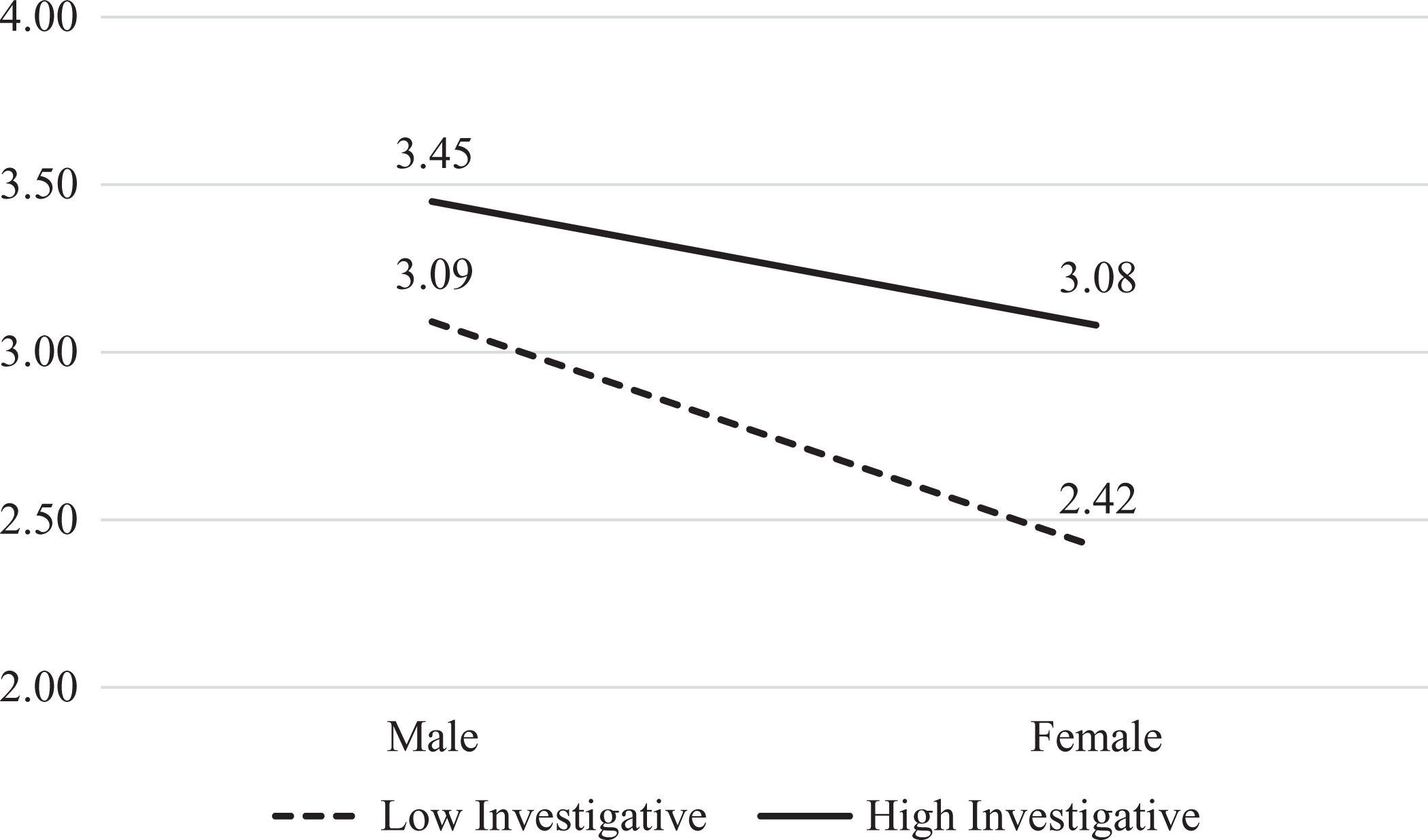
Gender × Investigative Interest Predicting STEM Career Scores.
These results show that, although young women have lower levels of Investigative interest compared to young men (as predicted by prior research [Su et al., 2009] and a “deficit perspective”), and a lower base rate of STEM career entry, increases in Investigative interest have a stronger effect on young women (vs. young men). In raw metrics, this effect can be translated as follows: by increasing from −1 SD to +1 SD in Investigative interest, the average woman’s STEM career score would increase by .66 STEM career score points, whereas the average man’s STEM career score would increase by only .38 STEM career points. When translated into annual wages, that would be the equivalent of a 10.6% gain in annual income (or $5,366) for women, versus a 6.1% gain for men ($3,088). Thus, increasing from −1 SD to +1 SD in Investigative interest would give women an additional gain of $2,278 annually, highlighting the relatively more positive wage impact for women (vs. men) of higher Investigative interest.
We next tested our predictions pertaining to the surplus model of interests (Hypotheses 2a-c). We first examined the interactive effects of Investigative interest, Enterprising interest, and gender to predict STEM career scores. Results showed a significant three-way interaction (b = −.04, p = .040; see Table 2, Model 2). In Hypothesis 2a, we predicted that the moderating effect of Enterprising interest on the relation between Investigative interest and STEM career scores to be stronger for young women than young men. Supporting this hypothesis, and as shown in Figure 2, compared to young men, young women with higher Investigative interest had disproportionately lower STEM career scores as their Enterprising interest increased (i.e., STEM career score difference was −.45 for women, but −.31 for men, when going from high Investigative/low Enterprising interests to high Investigative/high Enterprising interests). The statistical test for these differences was significant (p = .003; Dawson & Richter, 2006).
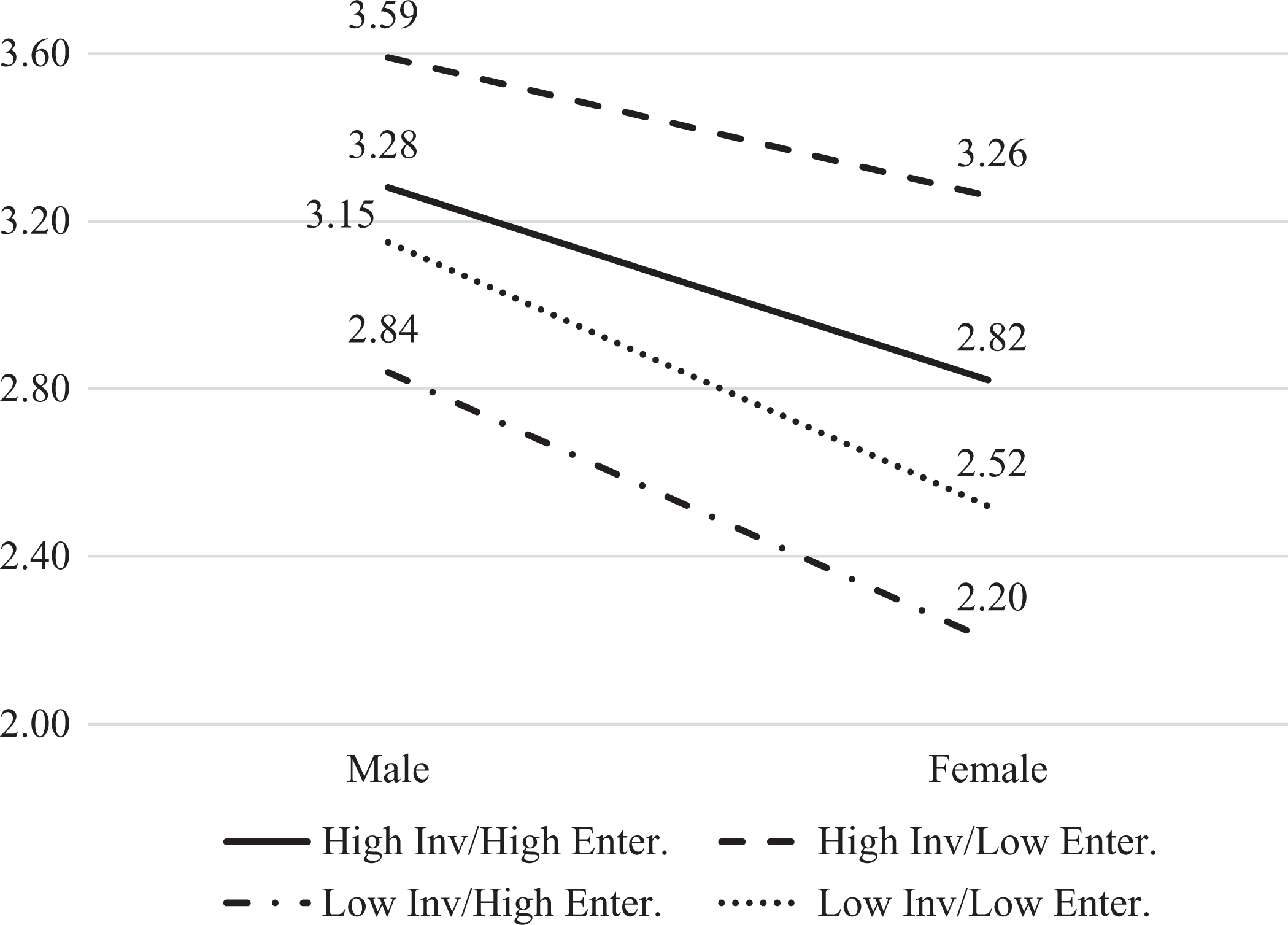
STEM Career Scores for Gender × Investigative Interest × Enterprising Interest Interaction.
When transformed into annual wages, for women 1 standard deviation above average in Investigative interest, going from −1 SD to +1 SD in Enterprising interest decreased their annual wage by 7.2%, the equivalent of a $3,645 loss annually. For men, their annual wage decreased by 5%, the equivalent of a $2,531 loss annually. Thus, women had an additional loss of $1,114 annually, highlighting the relatively more negative wage impact for women of high Enterprising interest when Investigative interest is high.
Next, we examined the interactive effects of Investigative interest, Social interest, and gender to predict STEM career scores to test Hypothesis 2b. Results showed a significant three-way interaction between Investigative interest, Social interest and gender (b = −.06, p = .002; see Table 2, Model 3). As shown in Figure 3, although STEM career scores decreased for both women and men when going from high Investigative interest/low Social interest to high Investigative/high Social, contrary to our prediction, compared to men, women had disproportionately higher STEM career scores as their Social interest increased (i.e., STEM career score difference was −.24 for women, but −.37 for men, when going from high Investigative/low Social interests to high Investigative/high Social interests). The statistical test for these differences was significant (p = .025; Dawson & Richter, 2006). Young women with higher Investigative interest did decrease on STEM career score as their Social interest increased; however, contrary to our prediction, this effect was stronger for men than women. Thus, Hypothesis 2b was not supported.
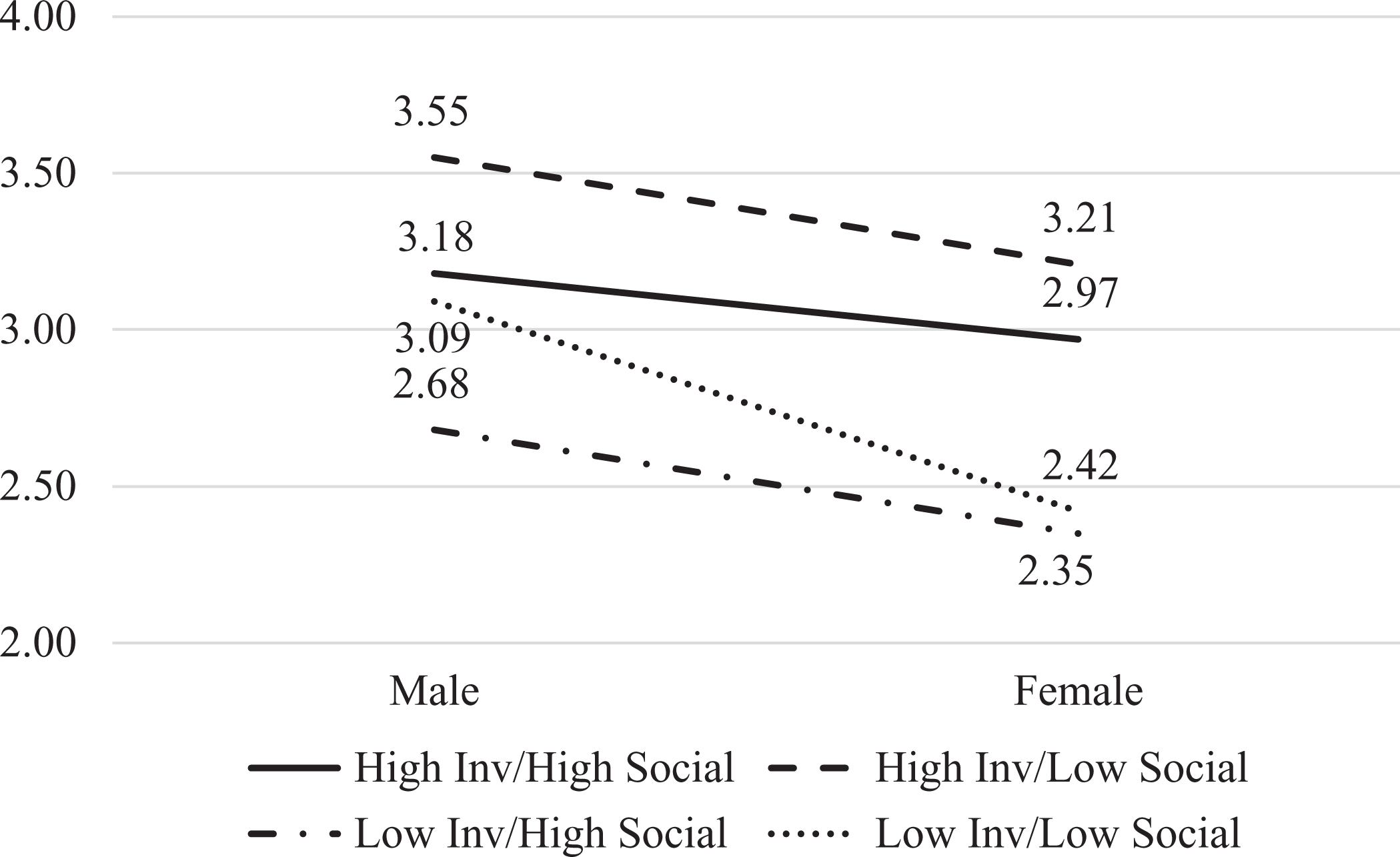
STEM Career Scores for Gender × Investigative Interest × Social Interest Interaction.
When transformed into annual wages, for women one standard deviation above average in Investigative interest, going from −1 SD to +1 SD in Social interest decreased their annual wage by 3.8%, the equivalent of a $1,924 loss annually. For men, their annual wage decreased by 5.9%, the equivalent of a $2,987 loss annually. Thus, men had an additional loss of $1,063 annually, highlighting the relatively more harmful wage impact for men of high Social interest when Investigative interest is high.
We next examined the interactive effects of Investigative interest, Artistic interest, and gender to predict STEM career scores to test Hypothesis 2c. Results showed a significant three-way interaction (b = −.06, p = .001; see Table 2, Model 4). We expected the moderating effect of Artistic interest on the relation between Investigative interest and STEM career scores to be stronger for young women than young men. Supporting our predictions, and as shown in Figure 4, compared to young men, young women with higher Investigative interest had disproportionately lower STEM career scores as their Artistic interest increased (i.e., STEM career score difference was −.45 for women, but −.34 for men, when going from high Investigative/low Artistic interests to high Investigative/high Artistic interests). Dawson and Richter’s (2006) statistical test for these differences was significant (p = .023). Thus, Hypothesis 2c was supported.

STEM Career Scores for Gender × Investigative Interest × Artistic Interest Interaction.
When transformed into annual wages, these effects are as follows. For women one standard deviation above average on Investigative interest, going from −1 SD to +1 SD in Artistic interest decreased their annual wage by 7.2%, the equivalent of a $3,645 loss annually. For men, their annual wage decreased by 5.4%, the equivalent of a $2,734 loss annually. Thus, women had an additional loss of $911 annually, highlighting the relatively more negative wage impact for women of high Artistic interest when Investigative interest is high.
For robustness, we re-ran all three-way interactions with Realistic interest (which has also been linked to STEM careers; Su et al., 2009) as the independent variable instead of Investigative interest. Tabulated results of these analyses are available from the authors by request. Two of the three-way interactions were significant—Gender x Realistic x Artistic (b = −.07, p = .011) and Gender x Realistic x Social (b = −.08, p = .005). However, in both cases, the differences between men’s and women’s STEM career scores as their Artistic and Social interest increased were not significant following the Dawson and Richter (2006) test. Gender x Realistic x Enterprising was not statistically significant (b = −.04, p = .115). Thus, although the surplus model was generally supported by the RIASEC interest most directly related to STEM careers—Investigative —Realistic interest did not offer the same support.
Additionally, to test the comprehensiveness of the surplus model, we ran the three-way interaction with Conventional interest (the only remaining RIASEC interest type). Conventional interest—which lies on the “things” dimension of the RIASEC hexagon—should complement Investigative interest in predicting STEM educational choices (Patrick et al., 2011), thus we did not predict that it would encourage women with Investigative interests away from STEM careers. Consistently, this interaction was not supported (b = −.02, p = .333). Taken together, our results find support for the proposed surplus model as it pertains to the Investigative/Enterprising and Investigative/Artistic interest combinations.
Discussion
In a national longitudinal sample with over 44,000 participants, we tested a surplus model of vocational interests as a predictor of the gender gap in STEM careers. Results showed that young women had lower levels of Investigative interest than young men (as predicted by prior research; Su et al., 2009), and a lower base rate of STEM career entry than young men. However, results also showed that increases in Investigative interest had a stronger effect on young women’s (vs. young men’s) STEM career entry. Further, in support of a surplus model of vocational interests, we found that, as Enterprising and Artistic interests increased for high Investigative interest young women, their STEM career scores decreased more relative to those of young men, translating to an average annual additional wage loss of $1,114 and $911, respectively, for women. Opposite to these patterns, we found that as Social interest increased for high Investigative interest young women, their STEM career scores decreased less relative to those of young men. This translated to men losing an average of $1,063 more annually than women, highlighting the relatively more harmful wage impact for men of higher Social interest when Investigative interest is also high.
Theoretical and Practical Implications
Our results have several theoretical implications. To begin, this research informs the literature on vocational interests as predictors of STEM career choice. Prior research has shown that interests predict STEM career choice, and that women’s under-representation in STEM careers may be due to gender differences in interests (Benbow & Minor, 1986; Su et al., 2009). These studies have taken what we refer to as a deficit perspective, concluding that the gender gap in STEM can be explained by women’s lower levels (i.e. deficit) of Investigative interest. However, extant research had not considered whether or how women’s combinations of multiple interests—i.e., a surplus of interests—might influence STEM career choice. Our study extends prior research by finding general support for a surplus model of interests as a predictor of STEM career entry, particularly when Investigative interests combine with Enterprising and Artistic interests. This is an important extension because it shows that even when adolescent females have strong Investigative interest, they may still gravitate away from STEM careers particularly if they also have strong Enterprising or Artistic interests, and thus perceived interest fit with either STEM or non-STEM fields. Though female adolescents with strong Investigate interests appeared to gravitate away from STEM-oriented careers as their Social interests increased, this was also, and more, true of male adolescents. Thus, men with high Investigative and Social interests appeared more inclined than women to select into jobs increasingly aligned with interests other than Investigative. This could be because men do not fear the same gender bias penalties when selecting into female-typed careers (Williams, 1992) as women do when selecting into male-typed careers (Ganley et al., 2018). Future research is needed to test potential explanatory mechanisms associated with the effect of combinations of interests on both women’s and men’s career choices.
Interestingly, our results show that consistency of interests does not appear to be an explanation for our findings related to support for the surplus model. According to the RIASEC hexagon structure, Artistic interest is relatively consistent with Investigative interest, whereas Enterprising interest is least consistent, and Social interest is somewhat consistent. As such, an individual with high Investigative and Enterprising interests represents a highly inconsistent interest profile, perhaps increasing the likelihood that such an individual would choose occupations that match either Enterprising or Investigative interests. However, we found that more consistent interests (i.e., high Investigative and high Artistic) also predicted lower likelihood of STEM-oriented career choice for women as compared to men. These patterns align with the surplus model, which suggests that, regardless of interest consistency, both of these interest combinations predict lower degrees of STEM career choice for women compared to men. For Investigative/Artistic and Investigative/Enterprising comparisons, the relative drop in STEM career choice for high Artistic and Enterprising conditions was nearly the same. For Artistic interest, women decreased .11 more scale points than men in their STEM career choice and .13 scale points more than men for Enterprising interest. Thus, Social interest notwithstanding, consistency of interests does not appear to dramatically affect the surplus model.
Our study extends prior research which has examined combinations of ability in women as a predictor of STEM career choice, but not the more developmentally “upstream” phenomenon of vocational interests (Valla & Ceci, 2014). Consistent with prior research showing that women’s ability surplus—being high on both math and verbal ability—predicted their lower STEM career entry (Wang et al., 2013), our analysis found general support for a surplus model of vocational interests and showed that the effect of interest breadth is stronger among young women when combining Investigative with Enterprising and Artistic interests. These findings highlight the foundational idea of the surplus model—that young women with strong Investigative and certain other interests may be selecting away from STEM careers because their broader interests allow more occupations to choose from when considering anticipated fit.
Our findings concerning the impact of interest interactions in adolescence on STEM careers in adulthood are also significant from a practical standpoint. First, if, as our research suggests, interest surplus drives STEM career choice apart from absolute levels of Investigative interest, it points to a misdirection of current vocational counseling interventions and policies designed to improve girls’ interest in STEM careers. Adolescent girls who opt out of STEM may be doing so not only because they lack interest in STEM-related areas (as predicted by a deficit perspective), but also because they are selecting fields that allow them to tap into their other interests. This may mean that efforts to increase girls’ interests in STEM should focus not on simply exposing them to Investigative work in seeking to increase their Investigative interest, but also on increasing the perceptions among adolescent girls that STEM careers will allow them to fulfill their other interests. Applying such an approach to engineering, for example, might be accomplished by exposing female engineering students to information about engineering management roles which would also complement their Enterprising interest (Cardador, 2017; Cardador & Hill, 2018), or to design features of the engineering profession which would complement their Artistic interest (Carlson & Sullivan, 2004).
However, our research still places strong emphasis on the importance of fostering Investigative interest in adolescence, particularly among girls. As Schmidt (2011) suggested, initial interest creates a developmental pathway to learning and aptitude in STEM areas. Schmidt’s research led Valla and Ceci (2014) to contend that when the gap in STEM-related interests is closed, a narrowing of the gender gap will follow. Our research supports this notion by showing that Investigative interest generally appears more important for STEM career choice for female versus male adolescents.
Finally, the raw metric interpretation of our results into predicted changes in annual wages suggests that men and women’s different interest combinations have important practical implications for wages in adulthood. These results suggest that gender differences in combinations of interests in high school matter not just for tendency to pursue a STEM career in adulthood, but also for gender differences in wages.
Limitations and Directions for Future Research
This research has limitations that suggest directions for future research. First, although our data set is one of the largest in the world that allows for an longitudinal evaluation of the effect of interests in high school on work outcomes in adulthood, and although longitudinal investigations of patterns of abilities have also relied heavily on data collected in the 1970s (Bernstein et al., 2019; Lubinski & Benbow, 2006), the data used in this study were dated. Thus, additional longitudinal research is needed to validate our results in a more contemporary sample. Nevertheless, our findings are still likely generalizable for several reasons. To begin, the time period in which the data were collected represents the start of women breaking out of traditional career paths in the US (Isserman & Kazin, 2000). Many societies in the world still resemble the US in the 60s with respect to gender roles and work (Gibbons et al., 1997) and, although women’s representation in STEM careers has increased somewhat since the 60s and 70s, women remain severely underrepresented in many STEM occupations (Hill et al., 2010). For example, current research has stressed that, despite considerable efforts to enhance the participation of women in STEM, achieving gender diversity in STEM education and STEM workplaces remains far from complete (Fouad & Santana, 2017). Highlighting this problem, only 14.7% of STEM bachelor’s degrees were awarded to women and other underrepresented minorities, in 2010 (National Center for Educational Statistics [NCES], 2017). Thus, the problem of underrepresentation of women in STEM continues to be a significant concern, and failure to retain women STEM is a continuing and costly problem (Chen, 2013; Glass et al., 2013).
Second, the Project Talent data set lacks racial diversity which limits our ability to draw conclusions about how the surplus model may or may not apply to other underrepresented minority groups. As racial minorities are even more severely under-represented than women in STEM (Miriti, 2020; Stolle-McAllister, 2011), future research is needed to test the surplus move in a more racially diverse sample.
Third, although our focus on interests, above and beyond abilities, represents a novel contribution, our data set did not allow us to control for additional factors that may contribute to women’s interest in STEM careers (e.g., anticipated bias or lack of culture fit; Chen & Moons, 2015; Fouad et al., 2011). It is possible that these factors operate in concert with a surplus model of interests, such that when female adolescents have broad interests and negative expectations about some STEM careers, they are most likely to gravitate away from STEM careers. Future research should test the surplus model attempting to model additional factors relevant to STEM career choice.
Similarly, we were not able to investigate why the tested interest interactions and STEM career choices occur. Thus, future research is needed to explore the mechanisms underlying our results. For example, gender differences in self-efficacy may be a causal mechanism such that adolescent women with strong other interests have higher self-efficacy in the related areas as compared to areas related to Investigative interest. These differences in efficacy may influence them to choose non-STEM careers when interest surplus is high. Another opportunity could be to test a surplus model of self-efficacy versus interests. Prior research has shown that self-efficacy and interests are both necessary to approach a career goal, thus self-efficacy surplus could be tested as a rival hypothesis to the interest-based approach taken here (Falk et al., 2017).
Fourth, because raw job title data was not available, we relied on 250 job categories assigned by Project Talent staff, which were coded into O*NET occupations to provide STEM career scores. The coding procedure may have increased the error variance in our models, although previous research supported the validity of the resulting scores and inter-rater reliability was high when recoding the jobs into O*NET codes (Damian et al., 2017). Finally, our sample was limited to people who were employed at Project Talent’s Year 11 follow-up. A sizable proportion of women were not employed in the 1970s, and unemployed women had, of course, not selected into STEM careers. Thus, our results pertain only to women who had made the choice to pursue employment.
Conclusion
In a large, national, longitudinal sample, our research showed that female, more than male adolescents, with strong Investigative interest decreased their tendency to choose STEM careers as their Enterprising and Artistic interests increased. Furthermore, both young men and women with strong Investigative interest decreased their tendency to choose STEM careers as their Social interest increased, but young men decreased more. These results translated to meaningful gender wage differences. Our findings highlight the predictive validity of a surplus model of vocational interests on STEM career choice across gender and provide insight into the gender gap in STEM careers.
Supplemental Material
Supplemental Material, R1_Reponses_to_Editor_and_Reviewers_FINAL_5.1.20 - Does More Mean Less?: Interest Surplus and the Gender Gap in STEM Careers
Supplemental Material, R1_Reponses_to_Editor_and_Reviewers_FINAL_5.1.20 for Does More Mean Less?: Interest Surplus and the Gender Gap in STEM Careers by M. Teresa Cardador, Rodica Ioana Damian and Justin P. Wiegand in Journal of Career Assessment
Footnotes
Declaration of Conflicting Interests
The author(s) declared no potential conflicts of interest with respect to the research, authorship, and/or publication of this article.
Funding
The author(s) received no financial support for the research, authorship, and/or publication of this article.

Notes
References
Supplementary Material
Please find the following supplemental material available below.
For Open Access articles published under a Creative Commons License, all supplemental material carries the same license as the article it is associated with.
For non-Open Access articles published, all supplemental material carries a non-exclusive license, and permission requests for re-use of supplemental material or any part of supplemental material shall be sent directly to the copyright owner as specified in the copyright notice associated with the article.
