




Abstract
Emerging adults need opportunities to clarify their work values. Although researchers have examined how transitions and work experiences influence emerging adults’ work values and job choices, less is known about how seasonal employment shapes work values. Using the theory of work adjustment as a guide, we conducted semi-structured interviews with 20–27 year olds (n = 76; mage = 22.03, SD = 1.82) to understand how their seasonal employment at summer camps influenced their work values. We found that seasonal camp employment aligned with and helped participants clarify their desire for dynamic work that makes a difference and that offers a supportive social environment with adequate work-life balance. Our findings suggest that seasonal employment affords emerging adults important opportunities to discover, reinforce, and prune work values in a temporary employment setting. We conclude by discussing implications for emerging adults’ career development and offer suggestions for career counselors.
Keywords
Emerging adults (ages 18–29) need employment experiences that help them understand what they want in future work (Arnett, 2015; Super, 1990). Work values are one way to consider what people want in work experiences as they focus on the desirability of characteristics and outcomes of employment (Rounds & Jin, 2013). Research suggests that knowledge and alignment of work values positively impacts employment satisfaction, job performance, and longevity within a career (Somers & Birnbaum, 1998). For example, in their study of 270 managerial personnel, Hochwarter et al. (1999) found that value attainment and affective disposition moderated the relationship between job satisfaction and job performance. Other studies have demonstrated that the fit between an employee’s values and those present in the workplace predicted both contextual and task performance (Goodman & Svyantek, 1999). Work values can also influence the evaluation of current and future employment (Cheung & Tang, 2012; Hüttges & Fay, 2015), which is critical to career development (Super, 1990).
Understanding one’s work values is an important component of career development during emerging adulthood, which is often a time of significant exploration of one’s occupational identity (Arnett, 2015; Super, 1990). Knowledge of one’s work values can provide useful rubrics for evaluating career decisions (Dawis & Lofquist, 1984), and although scholars have examined emerging adults’ work value development (e.g., Cheung & Tang, 2012; Chow et al., 2014; Johnson, 2001), little is known about how common types of employment, such as seasonal employment, impact work values. For this study, we defined seasonal employment as temporary work with distinct start and end dates often corresponding with seasons (e.g., summer). Recent reports from the U.S. Bureau of Labor Statistics (2021) suggest that employment of 16–24 year olds increases nearly 12% (2.1 million more youth) during the summer months. About 45% of the 20.3 million youth working in July of 2021 were employed in the leisure, recreation, hospitality, or retail industries (U.S. Bureau of Labor Statistics, 2021).
Given the prevalence of seasonal employment (Geremew & Gourio, 2018), it is important to discern how these employment experiences impact critical elements of career development during emerging adulthood, such as understanding one’s work values. Understanding the importance of seasonal employment to work values, and the characteristics of the employment that influence these values, may illuminate seasonal employment’s contribution to career development and provide useful information for career counselors who support emerging adults’ career development. Therefore, the purpose of this study was to understand the role of seasonal employment, specifically summer camp, in work values clarification.
Background
Work Values
Work values are beliefs about the desirability of certain qualities of work (Dawis & Lofquist, 1984). For example, some people value clear work-family boundaries and good benefits, while others value workplace relationships and feeling like their work makes a difference. Scholars have proposed and tested several conceptualizations of work values; however, there is little consistency about the conceptual nature of work values (Rounds & Jin, 2013). Subsequently, scholars have synthesized existing conceptualizations. For example, many scholars have categorized work values as either intrinsic or extrinsic (Rounds & Jin, 2013), while others have proposed models with up to eight categories (e.g., Dawis & Lofquist, 1984; Macnab & Fitzsimmons, 1987). Dose (1997) suggested that work values fell along personal–social and preference–moral dimensions resulting in four types of work values that encompassed other common conceptualizations. Taking an empirical approach, Leuty and Hansen (2011) suggested a six-category model that included work values related to the work environment, competence, status, autonomy, organizational culture, and relationships.
Description of Four-Category Work Values Model.
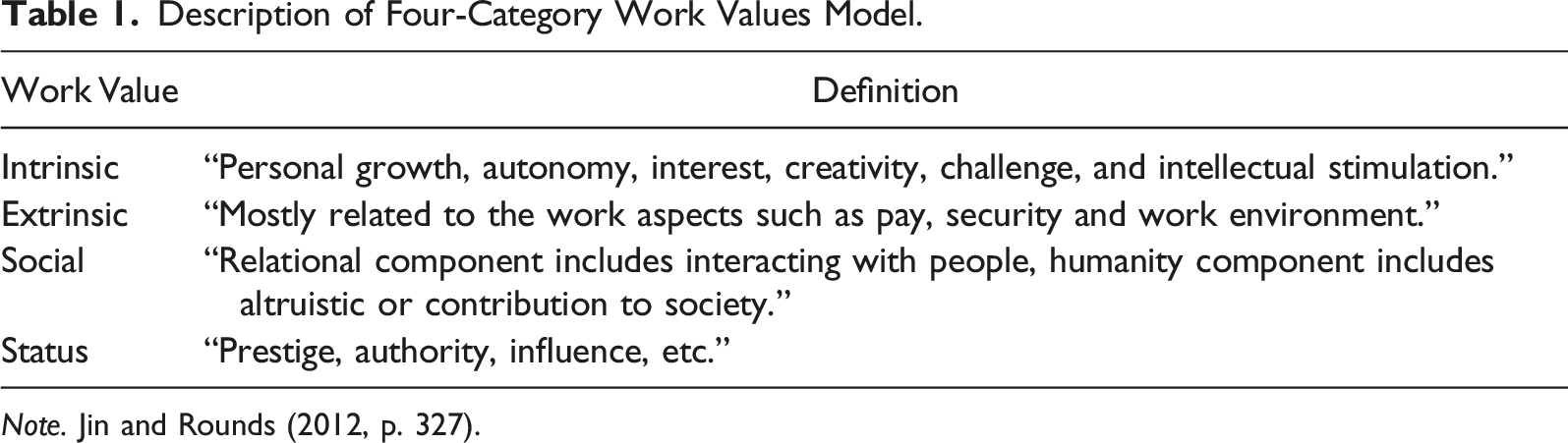
Note. Jin and Rounds (2012, p. 327).
Work Value Development during the Transition to Adulthood
The transition to adulthood in many industrialized Western societies affords some emerging adults opportunities to be self-focused and explore their identities (Arnett, 2015; see Côté, 2014 for a critique). This exploration often occurs through less committed relationships, education, and employment (Arnett, 2015). As emerging adults make decisions about who they want to be and how they want to live, employment experiences and career development become increasingly important to broader developmental processes, such as identity development (Arnett, 2015).
Understanding work values influences one’s career development choices (Super, 1990). Scholars have examined how work values change during the transition to adulthood (e.g., Chow et al., 2014 (Johnson, 2002)). For example, researchers have explored how school and work experiences influence work values during transitions into full-time employment (e.g., Cheung & Tang, 2012; Johnson & Mortimer, 2011), as well as how work values shape early-career choices (e.g., Brown, 2002).
Although emerging adults often report many work values, the importance of these values narrows and stabilizes as they secure better fitting work (Johnson & Monserud, 2010). For example, Mortimer et al. (1996) found that part-time employment that offered adolescents opportunities to learn new skills influenced extrinsic and intrinsic work values. Similarly, Johnson (2001) suggested that working in helping professions (e.g., education, social service) developed altruistic values. Given the importance and variety of work during the transition to adulthood, there is reason to believe these early-career development experiences may influence work values.
Despite a growing literature, researchers have not studied how seasonal employment shapes work values during the transition to adulthood. This gap is notable considering career development theories’ emphasis on this time in life as a critical period for developing work values (e.g., Super, 1990) and the commonplace of seasonal employment (Geremew & Gourio, 2018). Therefore, seasonal employment’s impact on work values is worth consideration.
Seasonal Employment
Unlike past generations, fewer emerging adults in post-industrial societies today pursue full-time work immediately after high school (Arnett, 2015). This delayed entry into the full-time workforce allows other types of employment, such as seasonal employment, to become important for career development (Zimmer-Gembeck & Mortimer, 2006).
Seasonal employment may offer emerging adults, and in particular, college students, opportunities to explore different types of work during breaks from school in ways that their part-time jobs during the school year might not allow. That is, the temporary nature of seasonal employment may allow emerging adults to discover characteristics of jobs that align with their values without the commitment expected in full-time employment. As a result, seasonal employment may provide emerging adults opportunities to learn how their abilities and values relate to paid work (Arnett, 2015; Vondracek et al., 2014). Seasonal employment may also offer emerging adults opportunities to explore their interests, meet new people, and experiment with how they act and present themselves, without the commitments associated with permanent full-time work. Despite these affordances, very little is known about how seasonal summer employment experiences contribute to development during the transition to adulthood.
Summer camp employment is one type of seasonal employment that has been linked to development. Summer camps, which are often described as an adult-facilitated, structured out-of-school-time summer experience (Henderson et al., 2007), are a common seasonal employment setting in the USA, employing over one million staff each summer (ACA, 2016). Although most summer camp research has focused on developmental outcomes for youth (e.g., Henderson et al., 2007; Richmond et al., 2019), scholars have also studied the impact of camp employment (see Warner et al., 2021a for a review of seasonal camp staff literature). Scholars have linked camp employment to identity development (Johnson et al., 2011), transformative changes (Garst et al., 2009), growth in social-emotional and leadership skills that complements school and other employment (Povilaitis et al., 2021), and the development of career-related skills, such as communication and problem-solving (e.g., Duerden et al., 2014). Others have suggested that camp can be meaningful work (Warner et al., 2021b) and that the outcomes of camp employment can be long lasting (DeGraaf & Glover, 2003).
Scholars have suggested that the benefits of camp employment result from the embeddedness (Johnson et al., 2011), supportive nature (Garst et al., 2009; Povilaitis et al., 2021), experiential learning (Duerden et al., 2014), and meaningfulness (Warner et al., 2021b) often associated with the setting. These characteristics may afford experiences that emerging adults reference when considering future employment, and thus make seasonal camp employment well-poised for work values clarification. However, the importance of camp employment likely relies on adequate person-environment fit (e.g., Vondracek et al., 2014).
Theoretical Background
The theory of work adjustment (TWA) may be a useful framework for examining the person-environment interactions that influence career development and understanding the role of seasonal employment in work values clarification. Scholars have considered how person-environment fit theories, such as TWA, may be integrated into theories of development (e.g., Dahling & Librizzi, 2015; Foley & Lytle, 2015; Savickas, 2013). TWA suggests that people desire work environments that align with their work values, which represent higher-order groupings of needs (Dawis, 2005). Through interactions in work environments, people determine if their work values align (congruence) with the characteristics (reinforcers) of their employment.
People are motivated to find employment that meets their needs and make decisions about resolving poor fit (discongruence) by changing their values or seeking other employment. For example, integrating TWA and Ros et al.’s (1999) model, if an individual seeks out employment that satisfies intrinsic or social values, and they determine that their current position only offers extrinsic benefits, there is discongruence. Seasonal employment offers emerging adults opportunities to understand their works values and make a decisions to attain employment the following year that they expect to more closely align with their values. Although TWA also discusses person-environment fit regarding abilities and a person’s fit for their work environment, in this study, we focused on work values and the reinforcing characteristics present in seasonal camp employment.
TWA is an appropriate frame for examining work values in the seasonal employment context for two reasons. First, since TWA is concerned with person-environment interactions, it is useful for explaining how work values may be influenced by characteristics of seasonal employment. Second, TWA is about work adjustment, and because moving on from the seasonal employment is definitionally inevitable, TWA is useful for considering how interactions in seasonal employment influence work values. TWA provides a useful framework for understanding how characteristics of seasonal employment, such as camps, may reinforce work values or provide opportunities to discover new values that impact career development.
Current Study
Understanding if and how characteristics of seasonal employment impact work values may highlight how employers can design early-career work experiences to prepare emerging adults to enter the workforce, as well as show the value of seasonal employment for career development. Summer camp may be a useful setting for considering the role of seasonal employment in work values clarification. In this study, we aimed to understand how camp employment shapes work values. Two research questions guided our investigation: (1) What work values do emerging adults attribute to their seasonal camp employment? and (2) What characteristics of seasonal camp employment influence emerging adults’ work values?
Method
We used a qualitative instrumental case study approach to understand how seasonal camp employment influenced work values. Instrumental case studies are useful when researchers can define the case as being part of a larger category (Stake, 1995). In this study, camp employment served as an instrumental case study for seasonal employment. That is, camp employment is but one type of seasonal employment, and therefore, cannot solely represent how work values clarification might occur through seasonal employment, but may instead serve as useful example for illuminating the process at play. This study was approved by the lead author’s Institutional Review Board.
Procedures and Sample
In the Spring of 2020, we emailed a sample of emerging adults participating in a national USA-based study about the impact of camp employment a link to complete an online survey. The survey included topics related to camp and non-camp employment, school, and other aspects of life, including ideal job characteristics. Following voluntary completion of the survey, participants were invited to participate in semi-structured phone interviews. Interviews lasted 30–45 minutes and included some topics beyond the scope of this study. Participants were compensated with a $25 gift card for completing interviews.
Our sample (n = 76) consisted of a subset of the 20–27 year olds (mage = 22, SD = 1.82) participating in the national USA-based study about the impact of camp employment who had volunteered to be interviewed after completing the online survey. Participants identified as 62% women (n = 47), 37% men (n = 28), and 1% gender non-binary (n = 1); 2.6% Asian American (n = 2), 9.2% Black (n = 7), 2.6% Latinx (n = 2), 7.9% multiracial (n = 6), and 77.6% White (n = 59). About 45% of participants (n = 33) only worked one summer at a camp; 55% of participants (n = 41) worked at a camp for two summers. These demographics resemble the broader population of camp staff in the USA (Warner et al., 2021a). Participants worked at a variety of camps (n = 39) across the USA. Camps were from different regions (22 states; East n = 19, Central n = 18, West n = 40), different models (day camp n = 16, overnight n = 51, day and overnight n = 9), and types (agency n = 26, medical specialty n = 4, independent for profit n = 29, and independent not-for-profit n = 14).
Data Collection
Prompting participants to consider the characteristics of their ideal job is one way to assess work values (e.g., Krumboltz et al., 1994). We used semi-structured interviews to ask participants to tell us more about the characteristics of their ideal job they listed on the survey and how they came to realize they were important (i.e., “I see you listed ______ on the survey as the top characteristics of your ideal job, please tell me more about each one of these characteristics and how you came to realize they were important to you”). We also asked participants if working at a camp influenced these values, and if so, in what ways (i.e., “In what ways did your experiences working at camp influence your understanding of what you want and do not want in future work”). When participants identified camp employment as important to their understanding of their desires for future work, we asked follow-up questions to understand the characteristics influencing these values (i.e., “What characteristics of your job at camp helped you realize these qualities of your future work were important to you?”). The first and third authors conducted the interviews by phone, and with permission from participants, took notes and audio-recorded interviews.
Data Analysis
Prior to analysis, the first author transcribed the audio for all interviews. We then uploaded all transcripts to NVivo (Version 12; QSR International Pty Ltd., 2020) for analysis. Our thematic analysis used a combination of deductive and inductive coding (Nowell et al., 2017) to understand the work values attributed to camp employment and the characteristics of the employment influencing these values. The purpose of the first round of coding was to identify the work values participants attributed to camp employment and to create a codebook for the characteristics that influenced these work values. During this round of coding, the first author used Ros et al.’s (1999) four-category model of work values (i.e., intrinsic, extrinsic, social, and status) as a priori codes to deductively code the interview transcripts. Although we used an a priori coding scheme, we remained open to other codes emerging from the data during our analysis. The first author also used an inductive technique of open-coding (Miles et al., 2014) to identify the characteristics of camp employment (reinforcers) that participants identified as influencing their work values. Once the initial codebook was created, the first and third authors used the codebook to code the same random selection of interview transcripts (n = 20). After coding was completed, we discussed the codebook to clarify disagreements through consensus and finalize the codebook.
The first author then used the codebook to deductively code the interview transcripts. The first and third authors then met to discuss emerging themes about the relationships between the camp employment characteristics and work values. We conducted a final round of selective coding (Miles et al., 2014) to compare emergent themes to the literature to refine our interpretation and theoretical relevance. The first and third authors reached consensus agreement on the themes presented in this manuscript. As we were primarily interested in linking the characteristics of the camp employment setting that shaped participants’ work values, for the purposes of this paper, we focus on work values that participants explicitly linked to their camp employment.
Trustworthiness
We used several trustworthiness strategies recommended for thematic analysis (Nowell et al., 2017). As described below, we carefully maintained records of audio files, transcripts, the codebook, analysis procedures, and notes, to ensure clarity in an audit process. To address dependability (Nowell et al., 2017), we are outlining our analysis process in detail here. First, we developed the interview protocol and coding schemes after reviewing the work values literature and through a collaborative process among the first and third authors of this study (Miles et al., 2014). This collaboration included frequent meetings to ensure credibility (Nowell et al., 2017; Tobin & Begley, 2004) of the interview process and to discuss confirmability of themes emerging throughout data collection and analysis (Miles et al., 2014; Nowell et al., 2017; Tobin & Begley, 2004). The authors engaged in a self-critical process of reflexivity (Tobin & Begley, 2004), acknowledging the human as a research instrument (Lincoln & Guba, 1985). In particular, the first and third authors discussed their assumptions (i.e., seasonal employment impacts work values, summer camp is a valuable employment experience), personal work values, and previous seasonal employment experiences, including those as summer camp staff, and how these experiences and biases may have impacted the data collection and analysis process. The first author documented these conversations in a reflexivity journal of memos (Nowell et al., 2017). These conversations were ongoing in weekly meetings throughout all steps of analysis. Finally, our use of NVivo for all data analysis allowed us to engage in an additional step to ensure a clear audit trail through electronic notes and documentation (Nowell et al., 2017).
Results
Participants described camp as seasonal employment that offered them opportunities to discover and confirm what they wanted in their future work. Many participants identified work values clarified by camp employment and linked these values to characteristics of the employment.
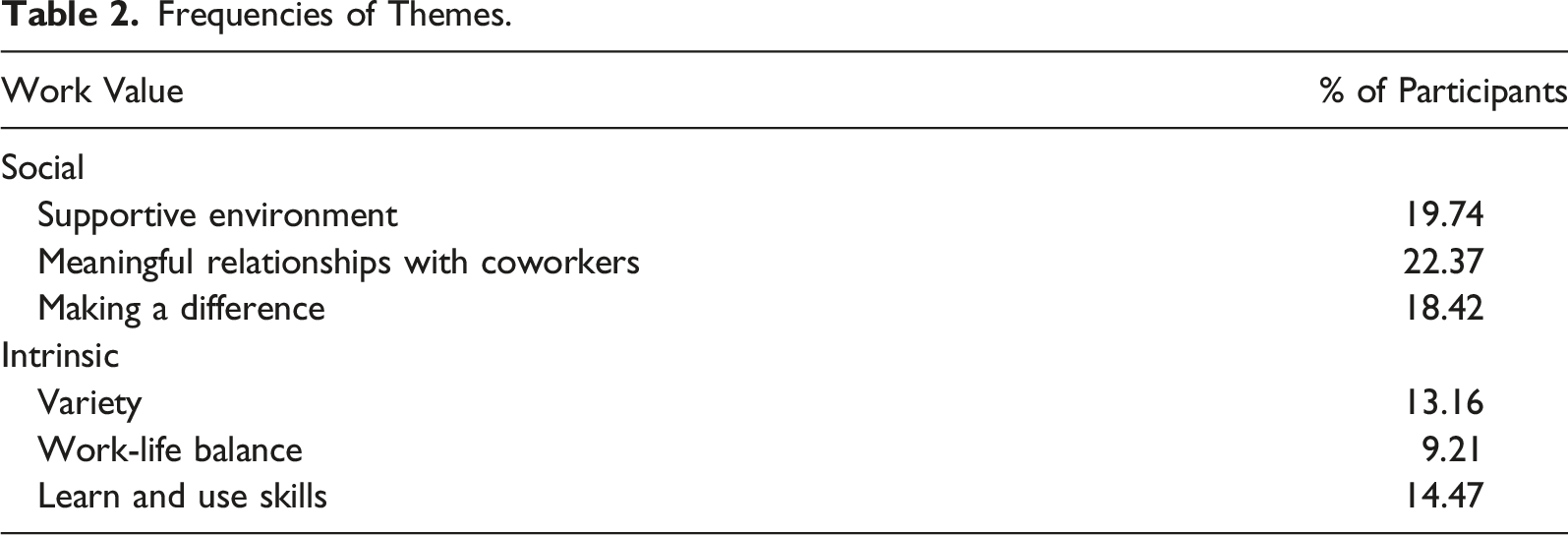
Our first research question was focused on understanding the work values emerging adult staff linked to their seasonal summer camp employment. Our analyses suggested that camp employment shaped work values in the social (i.e., supportive environment, meaningful relationships with coworkers, making a difference) and intrinsic categories (i.e., variety, work-life balance, learn and use skills). Participants did not associate extrinsic or status work values with their camp employment.
Our second research question was focused on understanding the characteristics of the employment that influenced these values. Our analysis of participants’ responses suggested that characteristics of the summer camp employment setting influenced work values. More specifically, we found that seeing the impact of their work, the novel social environment, the embedded and intense work environment, and the variety of the work helped the emerging adult staff understand the qualities they desired in their future work.
Frequencies of Themes.
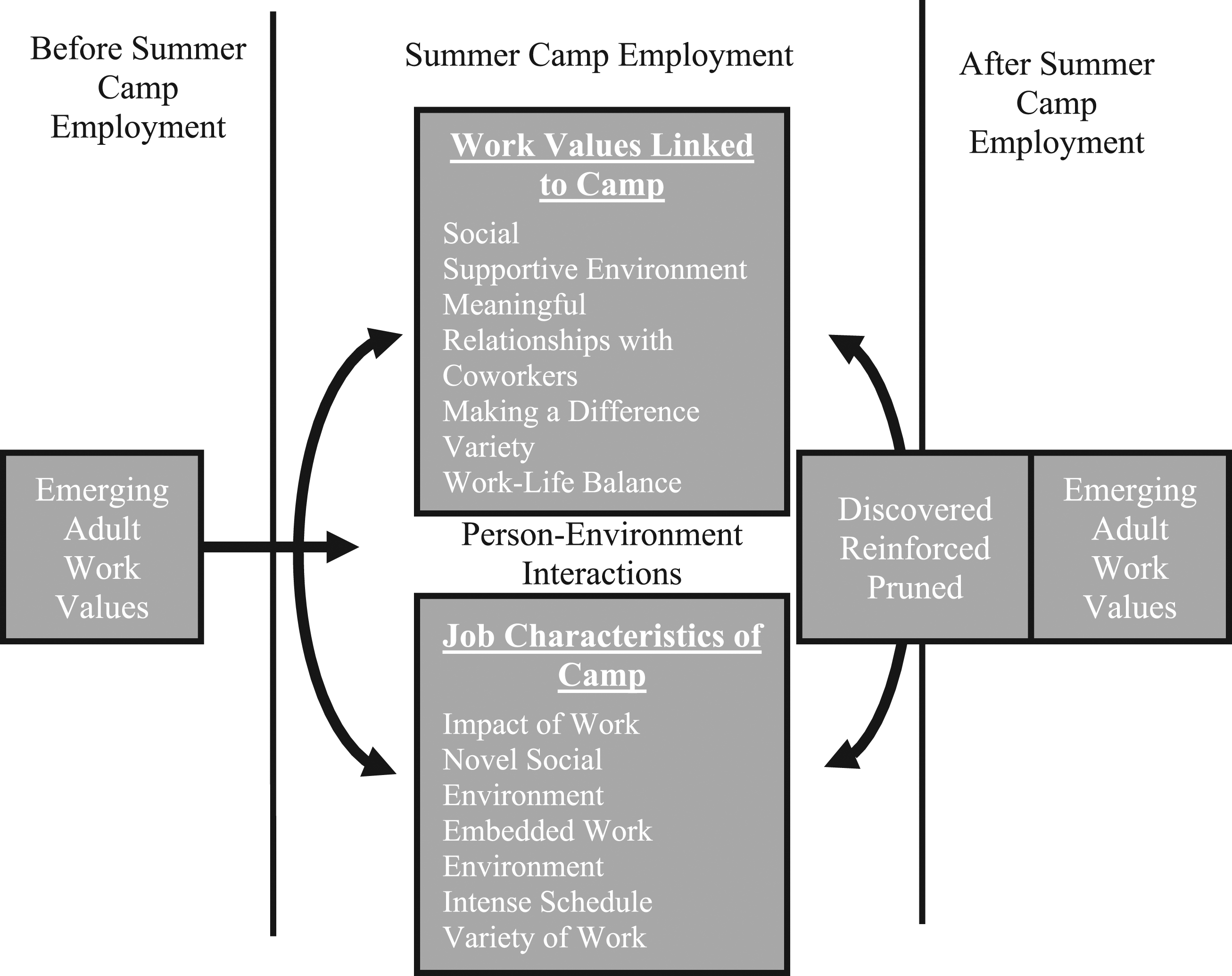
Work values clarification through seasonal summer camp employment.
Social
Supportive environment
The social environment of camp employment was important to participants’ (n = 15) desire for supportive work environments. Many participants said the camp where they worked had a supportive environment that taught them “the value of good coworkers and having that strong support system” and that the camp environment allowed them to feel comfortable being themselves without the fear of being judged because their coworkers supported them unconditionally. Others said that camp was “a really positive work community where everyone’s kind and supportive and pushing each other” compared to other work settings and that “camp helped me realize that I need support in my job.” After experiencing this level of support in a work setting, many participants said they sought future employment that allowed for similar levels of support as they had at the camp where they worked.
Some participants described their relationships with camp management as influencing their desire for a supportive work environment in future employment. For example, one staff said they “always picked up on how supervisors interact with their employees” and that it is more difficult to “put on a smile and fake-it-until-you-make-it if they're not setting up an environment that values their employees.” Another participant said, “a supervisor who always has your back” is something they “definitely would love in a job.”
Others said that the negative or challenging relationships “left a lasting impact on my life in terms of things I like and don’t like when I'm working with other people.” Poor and unsupportive management was especially discouraging. Similarly, some noted their need for alone-time. The constant social contact working at camp was difficult and forced the realization for some participants that they valued employment that allowed some time alone.
Camp employment also offered some participants opportunities to experience an organization that fostered a sense of belonging and inclusion. For example, one participant who identified as a person of color said they liked their camp’s values and described the management as “extremely aware and sensitive to different groups. I'm actually transgender and so that camp has been really supportive.” They went on to describe that the camp had “made forms all-inclusive for anybody by putting more boxes for different races, different sexual orientations, and gender identities,” and that this was a sign that the management cared. Many participants said that they felt cared about by their camp management through direct actions, structural elements built into the culture, and organizational procedures. The supportive nature of camp led many participants to seek future employment that aligned with this value.
Meaningful relationships with coworkers
Despite the potential downsides of the embedded nature of camp employment, the unique social environment of camp influenced participants’ (n = 17) desire for positive coworker relationships in future employment. Many participants said camp employment offered them opportunities to develop meaningful relationships with other counselors and that these positive relationships led them to consider the types of work relationships they wanted in future work. For example, one participant said, “I think that [camp] definitely impacted the way that I see myself working with others and how important it is for me to have strong working relationships.” Other participants said, “[Camp] opened my eyes to the fact that I want to be in a place where I’m developing close relationships with my co-workers” and that “[camp] really reaffirmed for me that I don't want my co-workers to be just my co-workers. I want them to be my friends.”
Some participants said their value for these types of relationships existed prior to working at a camp but that the experience reinforced this value. For example, one participant said, “I already had a lot of those interests and passions before camp” but that, “camp draws those sorts of people to me and maybe that’s why I was interested in camp, because I was already interested in things like community and interacting with others.” In general, participants said that positive relationships resulted from interactions with people that camp employment often attracts.
Making a difference
Many participants (n = 14) said that camp employment helped them realize they valued doing work that impacted others. Although participants linked this value to different characteristics of camp employment, most said it was because they could see the difference they were making. Several participants said camp was a place where they developed this value; however, the extent their employment helped them discover or affirm their value for helping others varied.
For example, one participant said, “camp has definitely played a role in it being important for me to make a difference.” For some participants, working at a camp was the first time they realized they valued doing work that connected them to something outside of themselves. For example, one participant said, “when you go into freshman year, you're pretty self-consumed…Camp was the first time in that year or two that I had looked outwards and it felt good. It felt cool to be a part of something bigger.”
Other participants described why it was important for them to do work that positively impacted others. For some, camp employment aligned with their beliefs and that “helping people out or giving them experiences that they might not otherwise have…and makes me feel like I'm doing something good for someone else.” Others noted that doing work that made a difference was fulfilling and that they “want to be proud of the work that I'm doing in a job and…whether it paid the bills or not, I want to be able to…feel like I made a long-lasting impact.”
Many participants said working at a camp allowed them to see the impact of their actions. For example, one participant said they “could immediately see the change in [the kids] from the start of the week to the end of the week,” and that seeing the impact was critical to understanding their value for helping others. Participants said that seeing their impact reinforced this value and that camp fostered this type of praise and feedback. One participant said “seeing campers after a year remembering a little conversation with me…makes me think I had a positive impact on them.” These experiences helped them realize the importance of this type of work.
Intrinsic
Variety
Participants (n = 10) said working at a camp helped them realize they valued active work with a variety of daily tasks and opportunities to have new experiences. Overall, the dynamic nature of camp employment often required participants to perform myriad tasks each day and adapt to new groups of campers which showed them that having work offering variety was not only possible, but that they valued it. For example, one participant said, “camp helped me realize that I need to have an active job and liked to always be doing stuff.” Another participant said working at a camp helped them learn they “would be scared of getting bored” if they “didn’t have a job that was dynamic and gave me opportunities to meet new people and do different things.” These realizations about their desires for dynamic work resulted from the multi-faceted nature of the camp counselor role and the structure of the employment experience.
Many participants said that although their work each day did not necessarily change, the cyclical nature of camp that meant regularly having new campers helped them stay engaged. Participants also said camp employment involved doing activities with varying responsibility each day and across the season and that “having the opportunity to go with the flow was a big eye-opener” and helped them understand they “don't want a job that is the same every day.” This participant further suggested that “camp made me realize that… switching it up keeps it fresh and more exciting for me.”
Some participants also said their realizations of camp employment’s role in learning that they wanted a dynamic job did not come until they compared it to other employment after camp. For example, one participant said working at a camp helped them realize, “being dynamic and critical thinking is really important to me” and that they were “already thinking about quitting [their current job] just because of how boring my current job has become.”
Work-life balance
Participants (n = 7) suggested that camp employment was rewarding, but its intensity was unsustainable. Many participants attributed the intensity to the embeddedness of working as an overnight camp counselor that required living where they worked. This characteristic helped participants recognize their desire for greater work-life balance in future employment.
Similarly, many participants said that the time commitment of camp employment resulted in a less robust life outside of work. Although many participants acknowledged that camp employment was not their long-term career, the absence of balance they experienced informed their desire for work-life balance. For example, one participant said, “Camp helped me realize I don’t want to be working all the time. Camp is a huge commitment. A 24/7, three-months-of-the-year commitment…I wanted to have more of a life other than camp.” Others said the non-stop nature of camp employment provided little physical or emotional distance from coworkers, which helped them understand or reinforced their desire to have work with opportunities for self-care through flexible schedules and time off. Even participants who said they liked being around people were surprised camp employment made them value being alone. For example, one participant said that camp’s intense social nature helped them discover “a new love for having time for myself, which was new for me, because normally I want to be around people all of the time.” Overall, participants suggested that the embedded nature of camp employment helped them realize or reinforce their value of work-life balance.
Learn and use skills
Participants (n = 11) said that camp employment helped them realize their desire for challenging work that allowed them to use their existing skills, develop new skills, and take on new roles. Some participants said camp employment helped them appreciate challenging work “because there’s not really an option to not work hard at camp.” Other participants said working at a camp helped them realize the importance of doing work where they “get to use my skills,” and that the “constant learning” was something they “want to take with me wherever I go.”
Some participants suggested that camp employment showed them they “want to take on some leadership in my future career,” and that opportunities to take on more responsibility and develop proficiencies were important to them. Other participants suggested that camp employment helped them discover their desire for training that “makes you feel prepared and more confident” and that “the opportunity to do something different shows that management trusts [your] ability to handle responsibility. And knowing that someone has that trust in you can help you grow in other aspects of your job.” Participants attributed these values to the dynamic and multi-faceted nature of being a camp counselor and the structure of the job.
Summary of Themes
Participants responses suggest that seasonal camp employment supported work values clarification. The work values most influenced by camp employment included those in the social (i.e., supportive environment, meaningful relationships with coworkers, making a difference) and intrinsic categories (i.e., variety, work-life balance, learn and use skills). Participants said seeing the impact of their work, the novel social environment, the embedded and intense work environment, and the variety of the work helped them understand the qualities they desired in their future work. This increased understanding of work values resulted from participants finding alignment between existing work values and discovering new work values through the characteristics of camp employment.
Discussion
The purpose of this study was to understand the role of seasonal employment in work values clarification. Our first research question was focused on understanding the work values emerging adult staff linked to their seasonal summer camp employment. Our second research question was focused on understanding the characteristics of the employment that influenced these values. We found that participants linked some of their work values to their camp employment and could identify the characteristics of camp that influenced their work values.
We sought to contribute to the literature on seasonal employment as a useful setting for career development through the discovery and affirmation of work values. To the best of our knowledge, this study was the first to explore seasonal employment’s role in developing work values. Our findings add to the literature examining how work values evolve through employment (e.g., Cheung & Tang, 2012; Johnson & Monserud, 2010), and highlight employment characteristics that can influence work values, and therefore, may be useful to organizations focused on enhancing their employees’ experiences, as well as career counselors supporting the career development of emerging adults.
Work Values Clarification through Seasonal Employment
Using camp employment as an instrumental case study, we focused on identifying the work values emerging adults associated with their seasonal employment and the characteristics of the employment that influenced these values (see Figure 1). Our findings suggest that camp employment may be one type of seasonal employment that can be a fertile setting for emerging adults to clarify what they want in their careers. Indeed, most participants could identify the characteristics of camp employment that influenced their work values.
Several themes regarding work values associated with camp employment were evident, with the most common work values identified by participants falling into social and intrinsic categories. Participants identified the social qualities of the work, such as having a supportive culture where others were motivated to be part of a community and developing positive relationships with coworkers, as being important characteristics. Our findings echo literature discussing the characteristics of camp employment (e.g., Garst et al., 2009; Povilaitis et al., 2021); however, unlike most literature about the social nature of camp, our findings situate the experience within the context of emerging adults’ meaning-making regarding seasonal employment and future careers. A focus on the social qualities of work can be identified in most work value models (Dawis & Lofquist, 1984; Leuty & Hansen, 2011; Rounds & Jin, 2013).
Many participants also associated their value of doing work that helps others with their camp employment. For some participants, working at a camp was the first time they turned their focus outward, which led to the discovery of this value; however, for other participants, the characteristics of camp employment reaffirmed their desire to helps others. Indeed, some participants noted that their desire to work at a camp was partly based on their value to give back and make a difference. Although literature has linked feeling like one is making a difference to camp employment’s meaningfulness (e.g., Warner et al., 2021b), researchers have not yet connected camp employment’s meaningfulness to career development.
The intense, embedded nature of camp employment led many participants to identify their value for work-life balance. When put in a position of constantly working and living with coworkers, many realized the importance of being alone. Others found that camp employment separated them from their support systems which led to their desire for work that supported their value for spending time with loved ones. Some participants thought the intense social nature of camp employment would be a good fit. After being immersed in it, they realized their limits for constant social contact. Our findings regarding the intense, embedded nature of camp employment align with literature that has identified these characteristics in camp employment (e.g., Johnson et al., 2011) and further illustrate how a lack of fit can shape work values.
Finally, many participants said the dynamic nature of camp employment helped them realize they desired work affording continued learning and variety. Some participants said this realization did not surface until they compared camp employment to other employment. Although the experiential learning through camp employment has been identified previously (Duerden et al., 2014), scholars have not yet linked this feature to work values. Our findings suggest that not only can camp employment be characterized as active, its experiential nature can help people understand their values for work that offers variety, opportunities to try new things, and allows for the development of new skills or the use of existing abilities.
Implications
Our findings have several implications for career development research and career counseling. Our results suggest that identified work values linked to camp employment align within common conceptualizations of work values (e.g., Jin & Rounds, 2012; Ros et al., 1999). Although participants’ responses indicated development or affirmation of social and intrinsic work values, no participants attributed extrinsic or status work values to their seasonal camp employment. These findings are not surprising considering the social nature of camps and the low pay that often accompanies seasonal camp employment. The breadth of work values participants associated with camp suggests that this type of employment may influence emerging adults’ work values, thus offering evidence of seasonal employment’s role in work values clarification and extending knowledge about seasonal employments’ role in career development.
Our findings also suggested numerous characteristics of camp employment that served as reinforcers of work values. Our findings align with TWA’s assertion that person-environment interactions allow characteristics of work environments to influence work values (Dawis, 2005). Emerging adults discovered new and affirmed existing work values through their camp employment through finding a good or poor fit with camp employment’s characteristics. The characteristics identified as influencing work values are consistent with previous literature on camp employment: (a) it is often a novel experience involving a supportive social environment (Garst et al., 2009), (b) it affords rich experiential learning (Povilaitis et al., 2021), (c) it facilitates the development of transferable job-related skills (Duerden et al., 2014), and d) it can lead to more meaningful work than other summer employment (Warner et al., 2021b).
Future research should use different research designs to better understand the role of seasonal employment in career development. For example, a narrative identity approach may be useful for understanding how people integrate their seasonal employment into their lives and careers. Alternatively, a pre-posttest design exploring work values before and after a seasonal employment would provide quantitative data suggesting the impact of these experiences on career development by examining changes over an employment experience and may allow for ruling out confounding variables. Other research might examine seasonal employment’s role in vocational identity development through a longitudinal study of different seasonal employment and targeted characteristics to provide further evidence of the value of seasonal employment and the characteristics that most support development.
Our findings also may serve as a starting point for practitioners considering how seasonal employment contributes to career development during emerging adulthood. TWA suggests that the person-environment fit catalyzes employment-related behaviors such as continued employment or adjustment through seeking other employment (Dawis, 2005). The temporary nature of seasonal employment forces employees to make decisions about their future work. The availability of options and the known temporary nature of the employment may afford emerging adults opportunities to explore different types of work because know they will be presented with an opportunity to appraise their seasonal employment experience at the end of the summer. As a result, emerging adults who engage in seasonal employment have opportunities to use the work values discovered or reinforced through these experiences to guide their career decision-making, without the stress and logistics that may accompany year-round employment. We argue that because seasonal employment offers emerging adults opportunities to return to their same seasonal job or explore different types of employment, seasonal employment affords discovering, reinforcing, or pruning work values. Our findings highlight how specific characteristics can make seasonal employment experiences important to career development through the discovery and reinforcement of work values.
Employers and career counselors might consider using several strategies to intentionally design early-career employment experiences that are useful to their emerging adult staff. Findings from this study suggest that seasonal employment offers an impactful way for emerging adults to explore their values. It may also be true that seasonal employment offers a meaningful way for emerging adults to explore their interests. Because of this, employers might consider encouraging their seasonal employees to complete vocational interest inventories during hiring or early on in employment and then provide employees with opportunities to work in ways that align with the results of these inventories. These opportunities would allow emerging adults to maximize the exploration possible through their seasonal employment, thus increasing the value of seasonal employment to career development. Employers may consider using strategies, such as frequent check-ins to prompt reflections and to help their employees identify how their job developed, reinforced, or challenged their work values and interests. Similarly, employers might also consider facilitating other reflective activities, such as values card sorts, to provide employees with structured opportunities to reflect on their experiences and their work values moving forward.
Intentional self-reflection, targeted to explore an emerging adult’s values and related career alignment could be useful for many reasons, including workplace satisfaction. Several participants noted that their seasonal work provided them with opportunities to make a difference, a finding that connects with broader literature on the importance of meaning-making in careers. Duffy et al. (2018), for example, highlight the importance of capitalizing on and connecting a career with one’s calling. Journaling may offer one avenue for emerging adults to self-reflect on the meaning they derive from their employment experiences. Potential reflection questions might include: (1) What advice would you give yourself about how to live and what is important if you could revisit the “you” from the beginning of your seasonal work experience? What values are embedded in that advice? (2) Who do you admire and why? Which qualities in each person inspire you? (3) What are you passionate about? What makes you angry? Emotional? What values are implied in those passions? (4) If you were asked to share a message to a large group of people, what would your message be and who would be in the audience? (5) What moments from your seasonal job were most impactful and why? (adapted from Su, 2015). These questions may serve as a springboard for further values exploration and meaning-making.
While many participants derived great meaning from their seasonal work experience, participants also highlighted challenges they experienced related to work-life balance and the importance of personal time. In response, employers should be intentional about interventions to support stress management and self-care in particularly intensive work environments, such as summer camps. Helping employees develop tools to better cope with high-intensity work environments may enable them to manage stressors in future long-term employment settings. Stress management workshops, mindfulness practices, and opportunities to take a self-care hour may all facilitate better work-life balance.
Our study underscores the critical role seasonal work can play in assisting emerging adults in exploring and clarifying their work values in areas such as connection building, meaning-making, and work-life balance, despite the dearth of research in the field of seasonal work and its career development outcomes. Based on our findings, career counselors may consider encouraging clients to use seasonal employment as short-term, low-risk opportunities to explore potential careers and experientially learn about their work values. Helping emerging adults become aware of seasonal employment’s influence on their career development extends the value of seasonal employment beyond fun and skill development to an experience supporting greater self-awareness and career development during the transition to adulthood.
Limitations
Several limitations should be considered when interpreting our findings. First, data collection began during COVID-19’s initial influence on the U.S. economy and life, and thus, participants may have been influenced by the changing employment landscape. Additionally, some participants were graduating college soon or had already graduated, which, when considered in light of the pandemic, may have influenced their thoughts about future employment. Second, participants may have assigned meanings to their camp employment that allowed for a more coherent description of how the experience fits into their career development. Similarly, participants may have already held the work values and/or vocational interests they reported as being attributed to camp; therefore, participants may have linked camp employment to existing values to either justify or enhance the value of camp employment. Additionally, given participants’ involvement in the broader research study, participants may have felt it was necessary to associate their work values with camp employment.
Conclusion
Our findings demonstrate the potential value of seasonal employment for career development through its influence on work values. We found that seasonal camp employment aligned with and helped participants clarify their desire for dynamic work that makes a difference and that offers a supportive social environment with adequate work-life balance. Our findings suggest that camp employment may shape work values through characteristics related to the tasks and work environment. The impact of the embedded, social, and dynamic nature of camp employment on work values highlights the strengths of seasonal employment that supports career development. These findings may provide scholars and practitioners with useful insight into the design and implementation of seasonal employment that influences work values.
Footnotes
Declaration of Conflicting Interests
The author(s) declared no potential conflicts of interest with respect to the research, authorship, and/or publication of this article.
Funding
The author(s) disclosed receipt of the following financial support for the research, authorship, and/or publication of this article: This work was supported by this Spencer Foundation, Research-Practice Partnership; 201700088; American Camp Association; ACA 2017-01.
