




Abstract
Women’s departure or nonentrance into science, technology, engineering, and mathematics professions, particularly engineering, has been a lively source of scholarly inquiry for the past three decades. Much of the literature in this area has been with solely female samples of participants, begging the question as to whether or not men and women either choose to leave the profession or not enter for the same or similar reasons. This present study collected a large sample of men (n = 1,273) who had either left or never entered the engineering profession and compared their responses to a large sample of women (n = 1,235) on a set of categorical response variables. Using the perspective of the Theory of Work Adjustment, our results suggest that there are gender differences in reasons for departure, raising the possibility that engineering climates differentially reinforce needs for men and women. Implications of this research are discussed.
It is well known that men are 6 times more likely to be engineers than women and White and Asian men make up much of the engineering workforce (National Science Foundation [NSF], 2017). This is a statistic that has been fairly stable for over three decades. Although over half of college degree holders are women and while women of color represent one of the fastest growing groups of college degree holders, only about 15% of engineers are women (NSF, 2017). A Society of Women Engineers Report (2007) noted that twice as many women left the profession of engineering as men, a statistic held up when the number of women graduating in engineering (20%) is compared to the number of women engineers (11%; NSF, 2017). As suggested by a recent report (National Academies of Engineering [NAE], 2019), there are at least two concerns with continuing this gender imbalance. The first is that society loses out on a potential talent pool and the second is the issue of social justice that will ensure fair and equal access to the profession for men and women.
Efforts made by scholars over the past three decades have given valuable insights into the choice and interest development of women who pursue a career in engineering. This has led, for example, to high school and college intervention programming aimed at increasing women’s participation in the engineering workforce. Similarly, an increasing amount of work has gone into understanding why women would leave the field of engineering. This research conducted on women engineers has primarily uncovered that work environment factors appear to play a significant role in a woman’s decision to either enter or exit the field (Fouad, Chang, Wan, & Singh, 2017; Fouad, Singh, Cappaert, Chang, & Wan, 2016; Singh et al., 2013; Singh, Zhang, Wan, & Fouad, 2018).
Significant as these results may be, a rival hypothesis in this work is that women may either leave or choose not to enter the engineering profession for the same reasons that men do: that there is a lack of congruence or fit with the engineering environment. Person–environment fit refers to the degree to which an individual’s traits or characteristics match the traits or characteristics of the working environments. Generally speaking, the greater the degree of fit between the characteristics of individuals and the characteristics of an organization, the greater chances of success and satisfaction in work-related outcomes (Juntunen & Even, 2012). In other words, individuals of any gender may choose to leave engineering because it is not a good fit with their abilities, interests, or values. However, little empirical work has been done to understand why men may leave the engineering field or the differences, if any, that exist between men and women’s reasons for leaving the field. There is even less research on understanding gender differences in choosing not to enter the field of engineering after graduating with an engineering degree.
Therefore, this exploratory study seeks to address these two questions by comparing reasons for departure between male and female engineers, as well as reasons that men and women do not enter the field after completing a degree in engineering. We believe such comparisons would allow researchers to make inferential statements about the probable reasons for departure and investigating whether women leave engineering for different reasons than male engineers. We draw from one person–environment fit theory, the Theory of Work Adjustment (TWA; Dawis, 2005; Dawis & Lofquist, 1984), to examine why women and men left engineering or why they chose not to enter after graduating in engineering.
Overview: TWA
There are several models of person–environment fit within vocational psychology and organizational psychology (Ostroff, 2012). For this study, we draw from Dawis and Lofquist’s (1984) TWA to conceptualize the decision to not persist in, or not enter, the engineering field. TWA conceptualizes person–environment fit as an ongoing dynamic process between the psychological mechanisms by which individuals fit—or do not fit—within their environments. If a worker’s abilities match the demands of the job environment, the worker is considered “satisfactory” within the TWA framework.
The other major construct within TWA is satisfaction from the worker’s perspective. Work environments have a set of characteristic reinforcers, so workers who find environments with reinforcers that “match” or “correspond” to their needs are predicted to be satisfied. Satisfaction hinges on the notion that individuals have needs that must match the “reinforcers” within the context of their work environment. Because the TWA always adopts the workers’ perspective, when employee “needs” match the reinforcers provided by the environment, then satisfaction is expected to ensue. Central in TWA theorizing is the premise that workers and their needs are the lens through which adjustment and satisfactoriness unfolds. For example, if someone needs to have a lot of autonomy in his or her work, and the environment allows a great deal of autonomy for workers, the environment has autonomy reinforcers, and therefore that worker is expected to be satisfied with his or her environment.
Dawis and Lofquist (1984) originally identified 21 needs that individuals may find important to be reinforced in the work environment. These can be measured by one of the versions of the Minnesota Importance Questionnaire (MIQ; Rounds, Henly, Dawis, Lofquist, & Weiss, 1981), or through a card sort, asking individuals which needs are more important than others or whether needs are not at all important to be met in the work environment. The assessment of values was intended to be an ipsative one, or what mattered to the individual, as opposed to a normative assessment, or how important needs were compared to others. Later, Dawis and Lofquist proposed six value dimensions that undergird worker’s needs, developed through factor analyses of large samples of MIQs. Dawis and Lofquist further collected data from occupations to determine the reinforcer patterns in those occupations, using the Minnesota Job Description Questionnaire (MJDQ; Borgen, Weiss, Tinsley, Dawis, & Lofquist, 1968). Ninety occupations are presented on the MIQ, including the occupation of Engineering. Although the MIQ is no longer available, the underlying theory and identification of needs and values have been incorporated into the O*NET Work Importance Locator (McCloy et al., 1999), the Department of Labor’s online informational tool for career exploration.
The six TWA values include achievement, comfort, status, altruism, safety, and autonomy. Achievement values include using one’s abilities in the work environment and the job providing individuals with a meaningful sense of accomplishment. Comfort values capture various aspects of the work environment that provide security, compensation, good working conditions, engaging work, variety in work, and the ability to be independent. Status values reflect the occupation’s provision of opportunities for advancement, recognition, authority, and social status. Altruism values include having good relations with coworkers, doing things for other people and doing work that does not feel morally wrong. Autonomy values include being able to be creative, having responsibility, and being able to be autonomous. Safety values reflect fair company policies, good supervisors who back up their workers and provide good training.
Again, as we noted above, if the reinforcers or rewards in the work environment match (or correspond) to the individual’s needs, the individual is predicted to be “correspondent with the environment” and predicted to be satisfied with that work (Swanson & Schneider, 2013, p. 31). Conversely, discorrespondence occurs when a worker’s values and the reinforcers within the work environment are not aligned. In discorrespondent situations, individuals enter a range of adjustment strategies whereby they are predicted to either actively engage in changing the environment (altering the reinforcers to be more correspondent) or reactively engage in trying to change themselves and their needs or values. For example, if compensation needs are not met by the work environment, active adjustment would involve asking for a raise, while reactive adjustment would involve adjusting the need for compensation, telling oneself that “I don’t need that much money.” If adjustment does not produce a better correspondence between their needs and the reinforcers provided by the environment, individuals are predicted to leave the environment. Departure, by definition, signals that the discorrespondence between needs and reinforcers is intolerable.
Thus, TWA provides a compelling framework with which to investigate why individuals depart from the engineering profession. Because, based on work with the MJDQ, engineering jobs have a characteristic set of reinforcers of achievement, status, and comfort, TWA would predict that men and women leave engineering jobs because their values are no longer a good match with the reinforcers in the environment. TWA also provides a useful and relevant framework to examine why individuals do not enter a field for which they have prepared (i.e., completing an engineering degree). It is possible they anticipate that their needs will not correspond with the professional environment they will encounter. If we can understand why individuals leave (or do not enter) the field of engineering, we will gain some understanding of how environments can alter their reinforcers to better retain their employees. It further allows us to understand whether men and women differ in the lack of correspondence with their needs or anticipated lack of correspondence with their needs.
Very little research has examined differences in needs across groups. One exception is the original development of the Work Importance Profiler (McCloy et al., 1999). They found that women in their validation sample differed from men in reporting safety and autonomy to be more important to them. They also found that status was more important to African American and Hispanic participants and safety was more important to African Americans than to Whites but did not find any race/ethnicity by gender interactions. Others have also examined the racial and ethnic group differences in needs (Eggerth & Flynn, 2012; Lyons, Velez, Mehta, & Neill, 2014), but few have studied gender differences in needs. For example, Hesketh, McLachlan, and Gardner (1992) analyzed various components of the TWA model with a sample of 87 male and 83 female Australian bankers. Their cross-sectional analyses yielded results indicating that female participants had greater levels of satisfaction overall, suggesting that their needs were matched by the reinforcers in the environment. In the field of medicine, Rogers, Creed, Searle, and Hartung (2011) developed a scale to understand the specific values of physicians in practice using the TWA framework. Initial validation of the scale, using a sample of medical students, revealed significant gender differences between males and females in their identified factors of “lifestyle” and “service.” However, few studies have examined gender differences in reasons for leaving a work environment, and none have examined why men and women leave engineering.
Research Background on Engineering Profession
Gender Differences in Departure and Nonentrance
Much of the research on why professional engineers leave the field has been qualitative, theoretical, or focused only the experiences of women. For example, Blickenstaff (2005) outlined a number of possible causes for the “leaky pipeline” of women in science, technology, engineering, and mathematics (STEM) careers, suggesting that a lack of female role models in STEM careers and the “chilly” dynamics in the environment in which women work may contribute to why young women do not enter STEM fields or why they choose to leave. Buse, Bilimoria, and Perelli (2013) interviewed 31 female engineers using a Social Cognitive Career Theory (Lent, Brown, & Hackett, 1994) paradigm. They found that the 21 women who persisted in engineering demonstrated more self-efficacy in finding new projects, handling challenging situations, and addressing difficult technical problems, while those women who opted out reported their struggles with uncertainty, confusion, and self-doubt. Buse et al. (2013) also noted that women who persisted in engineering often spoke about their work as a reciprocal engagement between colleagues and identified career accomplishments as personal fulfillment. They also noted that engineers who persisted in the profession were less likely to be married and to have children than those who opted out of the profession. Crucially, these researchers observed that both groups of women reported difficulties with discrimination and harassment in the workplace and the male-dominated culture of the profession.
Fouad, Chang, Wan, and Singh (2017) also took a qualitative approach and used a person–environment fit perspective to study why women left the field of engineering; their coding was also based on TWA. They found that women’s comments about why they left predominantly fell into the categories of achievement, status, and comfort, noting that women still needed those reinforcers but left the field because those needs were not met. In an earlier study, Fouad, Fitzpatrick, and Liu (2011) interviewed 25 women who had departed or remained in engineering. Across the board, women reported how they managed workplace inequalities, negotiated between work and family responsibilities, and experienced some challenges in developing a professional identity in a male-dominated profession. In addition, women who had left engineering identified the need to care for their children, challenges moving into roles with more opportunities such as in management and leadership positions, and a dislike of engineering tasks or environment.
Several key studies on a large sample of female engineers suggest that a woman’s decision to leave the field of engineering is best explained by work environment factors rather than personal variables (Fouad et al., 2016; Singh et al., 2013, 2018). Instead of diminishing interests or a lower sense of self-efficacy to perform engineering tasks or negotiate the work environment, women who stayed in engineering differed from those who left the field in terms of organizational support they received from their supervisors as well as in their perception of opportunities for advancement (Fouad et al., 2016). Although these findings are useful in describing the experiences of women engineers, they do not answer the question whether women leave engineering for reasons that are similar to, or different from, men.
To our knowledge, a direct comparison between men and women’s reasons for leaving the field has been generally understudied, although some work has begun to examine these questions. A recent study by Cardador and Hill (2018) examined how different career paths within the field of engineering may contribute to the gender differences in attrition from the field. These researchers studied 274 engineers on different career paths (managerial, technical, or hybrid) and investigated their intent to leave the field, their identification with colleagues, sense of intragroup respect, how meaningful their work was, and their work satisfaction. Women were more likely than men to be in either a managerial or hybrid role, in that they were more likely to be in positions that involved organizational and supervisory activities. Men were more likely than women to take a path focused on a project-based approach with a highly technical focus. These authors found women on the managerial path were more likely to report intentions to leave the field, lower levels of identification with colleagues, lower perceived intragroup respect, and lower levels of work satisfaction than male colleagues and to women on other career paths. Alternately, women on the hybrid path reported greater work satisfaction and perception of meaningful work while the hybrid path was associated with greater intentions to leave for men (Cardador & Hill, 2018).
Considerably less is known about a student’s decision to not enter the engineering workforce despite graduating with a degree in engineering, although some findings suggest that students experience a level of increasing ambivalence about entering the field as they approach graduation. Lichtenstein et al. (2009) conducted a longitudinal study examining the career decision-making of students who entered the engineering field. One key finding these researchers uncovered is that less than half of a sample of 74 students intended to enter the engineering profession. These students appeared to be considering several options for graduate study or career paths outside of STEM. Although inherently an interesting finding, these authors did not take gender into consideration, so it is not known whether gender differences were observed. Further, institutional differences were observed suggesting that a decision not to enter the field might be somewhat influenced by the institution a student attended. This finding seems to point to a need for a larger study examining the reasons why a prospective engineering major may choose not to enter the field after they graduate from college. Given the stagnant graduation rate for women engineering students, it is imperative to explicitly consider gender in any analysis of intentions to not enter the engineering profession.
The current study focuses on addressing gap in understanding gender differences in reasons for leaving (or not entering) engineering and aims to advance our understanding of this area by comparing a large nationally drawn sample of women and men engineers. Doing so would allow us to contextualize the themes drawn from prior research and specifically examine the question whether the reasons given for departure are unique only to women engineers or whether they resonate more broadly with men as well.
This Present Study
This study was designed to investigate whether there are differences between men and women in reasons for leaving engineering or not entering engineering and, by extension, whether there is a mismatch between their needs and environmental reinforcers. For individuals who hold bachelor’s degree in engineering but chose not to enter the field, gender differences in reasons for not entering would inherently suggest that previous experiences in engineering classrooms and/or internship experiences would play a key role in influencing a decision not to enter the field. Thus, we pose the following three research questions to examine in this study:
Method
Participants
We identified a total of 71 universities from the American Society of Engineering Education that typically graduate a large number of women and people of color in engineering programs. Ultimately, 30 universities agreed to participate in our research, and the survey was either sent to alumni officers who forwarded a survey link on to engineering alumni or the alumni list was sent to our research team and we reached out to the alumni directly. The participating universities were located across the country and were all R1 or R2 institutions and included both private institutions (e.g., Stanford University, Massachusetts Institute of Technology) and public universities (University of Florida, University of Washington) and represented large engineering colleges (e.g., Georgia Institute of Technology, Purdue University, California Polytechnic University). A total of over 13, 000 male and female engineers responded; over half of whom were currently working as engineers. Respondents for this study included individuals who had left the engineering profession over 5 years ago or never entered the engineering profession. We asked a different set of questions to those engineers who left more than 5 years ago to account for biases in memory. Altogether, the sample for this study consisted of 802 participants who did not enter the field of engineering (414 men and 388 women) and 2,386 participants who left the field more than 5 years ago (862 men and 1,524 women). Because there were so nearly twice as women than men, we took a random sample of women to create roughly equivalent groups (862 men and 847 women).
The mean age for engineers who had left the profession was 47 for men (SD = 12 years) and for women was 42 (SD = 9 years). Women who chose to disclose their racial identity for the group of engineers who had left the profession (N = 607) mostly identified as White (84%) followed by Asian or Asian American (7%). All other racial/ethnic groups who made up the remaining sample were those who identified as multiracial (1%), Hispanic (2%), Black American (3%), and American Indian (1%). Only 42 of the sampled men reported their racial identity, of which 35 men were White (84%). There were only one or two participants in each of the remaining reported categories: Asian or Asian American (One participants), multiracial (One participants), Hispanic (One participant), Black American (One participant), and American Indian (One participant). The top five engineering majors represented in our sample were mechanical engineering, electrical engineering, industrial engineering, chemical engineering, and civil engineering. This did not vary by gender. The average industry tenure was 9.3 years for men and 8.7 years for women.
The mean age for engineers who had never entered the profession was 42 for men (SD = 13 years) and for women was 36 (SD = 8 years). Respondents who chose to disclose their racial identity (165 men and 384 women) mostly identified as White (91% of men and 81% of women), Asian American (6% of men and 8% of women), or Black American (1% of men and 4% of women). American Indian, Latino/a/x and made up either 1% or less of the remaining sample. The top four engineering majors represented in our sample were mechanical engineering, electrical engineering, industrial engineering, and chemical engineering. The rest of the majors were evenly disbursed in our sample. This also did not vary by gender.
Procedures
A survey was sent to the alumni groups via e-mail containing items scaled on a binary response format assessing the reasons that people left and never entered engineering. If respondents had an engineering degree but indicated that they had not entered the field of engineering, then they were given a set of reasons that they may not have entered the field. If respondents had an engineering degree and had previously worked as an engineer, but were no longer working in the engineering field, they were presented with another set of reasons why they may have left the engineering field. Respondents were asked to indicate a reason for either leaving or never entering engineering after indicating that they had already left or never entered the field. Participants were entered into a drawing for gift cards as an incentive to participate in the study.
Measures
TWA response items
The survey was designed to present a set of questions based on whether a respondent indicated that he or she had previously worked as an engineer or not. These questions containing reasons for departure or nonentry were developed by the first and third authors based on prior research conducted on women’s attrition or persistence in the engineering field (e.g., Fouad et al., 2017; Fouad, Fitzpatrick, & Liu, 2011) and included the central needs that would match the reinforcers found in engineering, including aspects of achievement, status, and comfort values. A binary scaling format was chosen as it reflected a decision that was made rather than intention to make a decision or a scaling of possibly considering a decision from 1 to 5. Following the ipsative rationale for the assessment of values, a normed scale was not used. We were interested in the reasons the participants gave for leaving, not how the strength of their reasons compared to others. The reasons were scaled on a presence/absence format, and there was no limit as to how many reasons could be endorsed. Respondents could simply endorse the reasons they chose to leave the profession.
Specifically, the following reasons were presented to the respondents for not entering the engineering profession following their undergraduate degree: “I never planned to enter engineering,” “I’m not interested in engineering,” “management is not appealing,” “the work is not flexible enough,” “the work is too difficult,” “low salary,” “I didn’t like culture,” and “there was no advancement in my career.” In terms of the reasons for leaving the engineering profession, the following were presented to respondents: “I lost interest in the field,” “I didn’t like my boss,” “I didn’t like my coworkers,” “there was conflict with my family,” “too many hours are required of me,” “I wanted more time with my family,” “I did not like the daily tasks,” “the salary was too low,” “I did not like the work culture,” “there were no opportunities for advancement,” “I could not find a position,” and “I chose to start my own business.”
There was an open response field where participants could write in a reason they had chosen either to not enter the profession or to leave the profession. There was also an “other” option with a textbox that allowed respondents to write in their own reasons. Our analyses revealed that every participant who had exercised this other choice had also endorsed one of the provided reasons. Of the subset of participants who expressed the other reason for either not entering the field (N = 67) or choosing to leave the profession (N = 287), responses fell into two categories: first, participants stated they could not find work due to geographical restrictions, and second, participants stated they found another more interesting job than their engineering work.
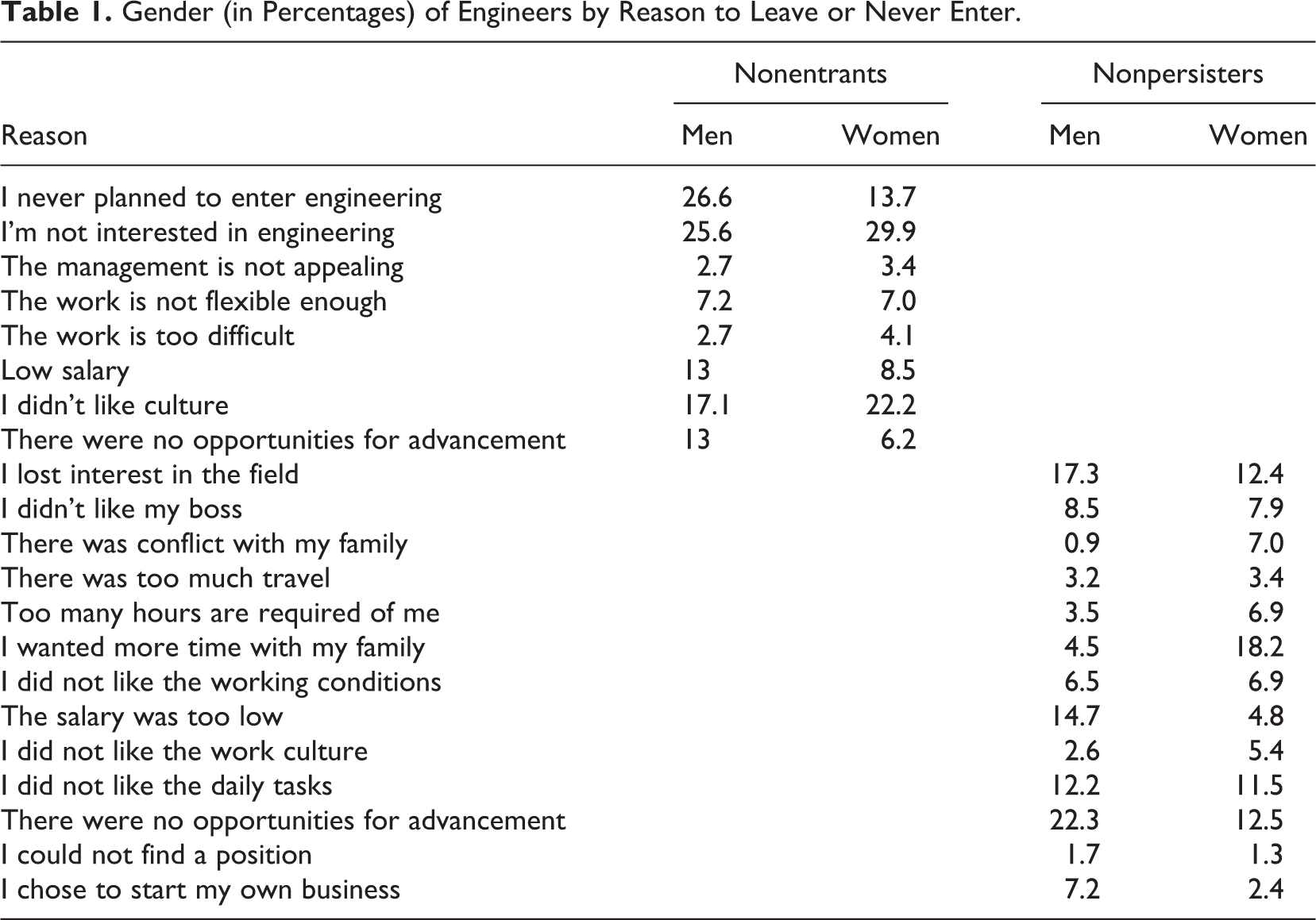
We did not analyze cases that endorsed an environmental reason for exiting the profession (e.g., medical condition, laidoff/fired, company folded) because theoretically, this would represent either a mismatch in their abilities to do the job (leading to individuals being unsatisfactory) or unavailability of the job and consequently have little to do with correspondence between an individual’s needs and the environment’s reinforcers and the process of work adjustment. We also removed items from the analysis with extremely low response rates using 95% of the sample as a cutoff point to determine this. For engineers who left the field, the eliminated items were “there was too much travel” and “I couldn’t find a position.” For students who did not enter engineering, the eliminated items were “management is not appealing” and “the work is too difficult.” Table 1 presents the percentages of men and women that endorsed each item.
Gender (in Percentages) of Engineers by Reason to Leave or Never Enter.
Results
To answer our research questions, we conducted a series of χ2s on each item for both engineering graduates who chose not to enter the field and engineers who left the field. Considering our study design, we also calculated odds ratios (ORs) to ascertain the directionality of the differences in gender and provide evidence of the strength of the gender differences. The odds of women leaving the field for a stated reason were in the denominator, while the odds of men were in the numerator. Interpretively, this suggests that ORs that are less than 1 and statistically significant suggest that women were more likely than men to endorse this specific reason for leaving engineering while ORs that are greater than 1 and statistically significant suggest that men are more likely than women to endorse this reason for leaving engineering. Statistical significance is determined by the result of the χ2 significance test and if the confidence interval (CI) for the OR passes through 1.00. An OR of 1.00 in the CI indicates statistical independence of the two events (i.e., gender and reason left or never entered the engineering profession). The χ2 tests and ORs were bootstrapped with 1,000 resamples.
Reasons for Leaving Engineering
The top four reasons that men indicated they left an engineering position were lack of opportunities for advancement (status; endorsed by 22.3%), lost interest in the field (17.3%; achievement), the salary was too low (comfort; 14.7%), and they did not like the daily tasks (achievement; 12.2%). The top four reasons that women left the field were that they wanted more time with family (comfort; 18.2%), lack of opportunities for advancement (status; 12.5%), lost interest in the field (achievement; 12.4%), and they did not like the daily tasks (achievement; 11.5%). These reasons would indicate that both male and female engineers were leaving because they anticipated a mismatch in achievement, status, and comfort needs.
Reasons for Never Entering Engineering
The top three reasons for not entering the field of engineering for men were that they never planned to enter the field (e.g., some chose to use the degree as a foundation for further study in medicine or law), that they lost interest in the field (achievement), or that they did not like the culture (comfort). The top two reasons were endorsed by men nearly equally, 26.6% and 25.6%, respectively, and 17.1% endorsed the third reason. These three reasons would indicate that male engineers chose not to enter the field because they anticipated a mismatch in achievement and comfort needs. The top three reasons that emerged for women were that they lost interest in the field (achievement; 29.9%), did not like the culture (comfort; 22.2%), or never planned to enter (13.7%). These indicated that women, too, anticipated a mismatch in achievement or comfort needs, although more women than men indicated concerns about the culture.
Gender Differences in a Decision to Leave or Never Enter Engineering
Odds favoring men in reasons for leaving the profession
For men who entered the profession and left, we observed significance for male engineers who lost interest in the profession, χ2(2) = 17.94, p < .001, OR = 1.45, 95% CI [1.22, 1.73], concerns that the salary was too low, χ2(2) = 96.40, p < .001, OR = 4.22, 95% CI [3.06, 5.83], concerns there was no advancement in the field, χ2(2) = 87.79, p < .001, OR = 2.68, 95% CI [2.15, 3.34], or that they decided to start their own business, χ2(2) = 42.45, p < .001, OR = 4.64, 95% CI [2.77, 7.76]. We also observed significance for male engineers who left their profession due to issues with supervisors (e.g., I didn’t like my boss), χ2(2) = 5.98, p = .01, OR = 1.48, 95% CI [1.07, 2.05], complaints with the workplace culture, χ2(2) = 4.95, p = .03, OR = 1.42 95% CI [1.04, 1.94], and dislike of the daily tasks of work, χ2(2) = 7.28, p = .008, OR = 1.40, 95% CI [1.09, 1.81]. In sum, the odds for men, compared with women, were greater in leaving the field for concerns due to low advancement (status), low pay (comfort), losing interest (achievement), problems with supervisors or the workplace culture (comfort), a desire to start their own business (achievement), and dislike of the daily work tasks (achievement).
Odds favoring women in reasons leaving engineering
For women who entered the profession and left, we observed significance for women engineers, conflict with family, χ2(2) = 29.47, p < .001, OR = 0.29, 95% CI [0.18, 0.47] (comfort) and desiring more time with family, χ2(2) = 84.83, p < .001, OR = 0.24, 95% CI [0.17, 0.34] (comfort). Interpretively, it appears that the odds of women leaving the profession due to either wanting more time with family or due to a family conflict were greater than men leaving for the same reasons, although Fouad et al., 2017 found that women left to be with family because the environment was difficult to navigate.
Insignificant gender differences in reasons leaving the profession
We observed nonsignificance in those reporting poor working conditions, χ2(2) = 3.44, p = .06 OR = 1.37, 95% CI [0.98, 1.93] and working too many hours, χ2(2) = 1.07, p = .33, OR = 0.80, 95% CI [0.54, 1.20].
Odds favoring men in reasons for nonentry
For graduates who choose not to enter the profession, we observed significance by gender for a decision to never enter the profession in the first place, χ2(2) = 5.91, p = .01, OR = 1.37, 95% CI [1.06, 1.78], significance on concerns that the pay was too low, χ2(2) = 4.26, p = .04, OR = 1.53, 95% CI [1.01, 2.31], and significance on concerns that there was no advancement in the field, χ2(2) =10.72, p = .001, OR = 2.10, 95% CI [1.33, 3.34]. All of these ORs were greater than 1, indicating that men endorsed these reasons more than women did. Interpretively, it appears the odds that a man would obtain an engineering degree but choose not to enter the profession were greater than women for all of our identified reasons. Notably, the odds of men choosing not to enter the engineering profession due to concerns about advancement were 2 times greater than a woman making the same decision.
Nonsignificant gender differences in reasons for nonentry
For students who did not enter the profession, we observed nonsignificant results by gender for the following reasons: because they lost interest in the field, χ2(2) = 1.84, p = .18, OR = 0.85, 95% CI [0.68, 1.07], the engineering work appeared inflexible, χ2(2) = 1.32, p = .30, OR = 1.31, 95% CI [0.82, 2.11], because of negative perceptions of the workplace culture, χ2(2) = 3.20, p = .07, OR = 0.77, 95% CI [0.58, 1.02] and finally because they expressed a desire to start their own business, χ2(2) = 1.58, p = .23, OR = 0.84, 95% CI [0.65, 1.09].
Discussion
This present study sought to extend the literature on women’s departure in STEM in two significant ways. First, we compared the reasons for departure from engineering by gender. Second, compared the reasons stated by men and women for not entering the engineering profession after graduating with an engineering degree. The reasons for departure and nonentry were created based on previous literature and to reflect the six sets of values described in the TWA framework.
With regard to our first and third research questions, we suggest that engineers leave the profession for reasons associated with comfort, status, and achievement. Men, when compared with women, tended to leave the profession for reasons associated with all three identified reinforcers, while women, when compared with men, tended to leave for reasons associated with comfort and status. It is important here to reiterate the theoretical definition of comfort within the TWA reflects the various aspects of the work environment that can provide security, compensation, good working conditions, engaging work, variety in work, and ability to be independent. It seems that female engineers in our sample did not perceive their comfort needs were being met. The unmet comfort needs along with unmet status needs, specifically in terms of lack of opportunities for advancement, led to their discorrespondence with the work environment, which manifested as a decision to leave the field. By contrast, the odds for men indicated that they were more likely to perceive discorrespondence between their needs for achievement, comfort, and status.
With regard to our second research question, the odds of men choosing not to enter the profession were also greater than women on each stated reason. The TWA framework provides a coherent and convincing platform with which to view not only the results of the current study but also the limited past research in this area. For example, research by Buse et al. (2013), Fouad et al. (2017), Fouad, Singh, Cappaert, Chang, and Wan (2016), Singh et al. (2013), and Singh, Zhang, Wan, and Fouad (2018) all point to the role of the work environment in inducing women to leave the engineering profession. Specifically, our results point out that women’s unmet needs in terms of job security, supportive supervisory relations, and poor advancement opportunities are consistent with the above studies that largely indicate similar reasons for leaving the field. In addition, women engineers’ departure for reasons associated with a desire to reduce work–family conflict can be likewise interpreted through the lens of the comfort needs. If the current work environment is inadequate in terms of culture, policies, or practices that meet women’s needs to balance their work–family responsibilities, the resulting discorrespondence can prompt either an active or a reactive adjustment. Active adjustment could include asking for flexibility or using company policies that allow for greater work–life balance. Reactive adjustment would suggest that women would engage in self-talk to reduce their need for greater correspondence. However, if these do not reduce the discorrespondence, past and current research seems to imply that one way that women respond to this discorrespondence is by leaving the work environment entirely and in our case, specifically the profession. It is possible that the current research (and to some extent past research) has tapped into this phenomenon.
While the current results on the reasons for women’s departure from engineering are largely consistent with existing literature in this area, our results also offer an important breakthrough in understanding the reasons men consider in their decisions to leave a highly skilled profession for which they were trained and educated. Our results point out that there is a great deal of convergence in the areas of discorrespondence identified by both male and female engineers in their decisions to leave the engineering profession. Yet there are gender differences in these patterns, and these differences speak to the prioritization of different reinforcers in the work environment. Male engineers endorsed unmet needs in comfort, status, and achievement as the top areas of discorrespondence undergirding their decision to leave the engineering profession, while women’s reasons reflected unmet comfort and status needs. These patterns reveal that different facets of the work environment in terms of opportunities for advancement, job security, are important to both groups of engineers, just in a different order and in different proportions.
Our next set of results with regard to the gendered reinforcers endorsed in not entering the engineering profession reveal interesting insights. Men and women did not differ in terms of their common perceptions of inflexible engineering work, unappealing work cultures, and losing interest in the engineering work. These reasons were cited for not entering the profession for which they were educated and trained, despite completing a rigorous engineering curriculum. The common reasons given by both men and women also included concerns of poor advancement potential. With regard to poor advancement potential, men were twice as likely than women to point out that low advancement opportunities as the reason for not entering the engineering profession.
These results point out that there is a large overlap in the values and reinforcers men and women consider important as they evaluate their decisions to enter the profession they were trained for and into which they had already invested substantial amounts of time, energy, and money thereby not recouping some of the “sunk costs” (Feldman & Ng, 2007, p. 364). Interesting as these results are, they only provide a superficial glimpse into the factors that engineering graduates considered as they opted out of the field for which they had trained and redirected their engineering training to other fields. Existing research in this area is sparse and presents an opportunity for scholars to examine factors such as career aspirations, desired workplace attributes, and labor market conditions in order to provide deeper insights into this important career transition phase.
Implications
There are several key implications from our findings on reasons for departure from the engineering profession. First, given the convergence in reinforcers endorsed by both groups of men and women suggests that it is incumbent for organizations to create workplaces that emphasize opportunities for advancement, helping employees achieve their own goals, good supervisory relationships, responsive policies that address their employees needs to balance varied life roles in order to engage and retain their male and female engineers. The second implication from these results is that organizations’ investment in developing programs to retain women engineers need to move away from trying to “fix women” by asking them to lean in (Sandberg, 2013) or equipping women engineers with more self-confidence boosting skills to fixing the work environment that can better address their needs for comfort and status, just as it would for their male counterparts. Recent reports have suggested that strategies such as asking women to “lean in” not only fail to yield desired results, but in some cases backfire and lead to departure (e.g., Kim, Fitzsimmons, & Kay, 2018; Toosi, Mor, Semnani-Azad, Phillips, & Amanatullah, 2019). A third implication of this research is that while discorrespondence between the person and the environment can be addressed either by actively changing the work environment or by changing their own needs, employees may rationalize their needs as not being that important or reprioritize their important values. It is plausible that consistent with the TWA, women who face the discorrespondence between their needs and the reinforcers offered by the environment leave the “poor fitting” (or “unfit”) environment altogether, and more critically, that includes not just the organization but also the engineering profession. This may help to explain the disproportionate number of women who leave engineering compared to men.
Cumulatively, the results reveal that both male and female engineers value similar attributes in their work environments such as respectful workplaces, advancement potential, an opportunity to achieve, and engaging work. When these values are not met or attempts to satisfy them are thwarted, these engineers are likely to leave. Organizations can take heed from these results to create workplaces that work well for everyone. Gender differences in terms of ordering of important values do suggest that for female engineers, workplaces that satisfy their comfort needs in terms of good working conditions, well-compensated, and interesting work are of paramount importance. Likewise, both male and female graduating engineering students at the cusp of entering engineering workplaces opted out of the engineering field for same sets of reasons although male engineers placed higher value on advancement potential than did female students. For engineering organizations looking to recruit these students, it is important for them to emphasize the attributes that were endorsed by both groups of students—that is, workplaces that offer interesting and engaging engineering work, advancement potential, and flexibility, and respectful workplaces.
Directions for Future Research
Our results on reinforcers endorsed by both male and female engineers in their decisions to leave engineering also offer directions for future research. For example, scholars need to delve into specific workplace experiences and opportunities of both male and female engineers that are associated with their career decisions such as departure from, or persistence in, engineering. Similarly, given that opportunities for advancement is a prominent need that emerged in both men and women’s sets of reasons for leaving engineering, it would behoove future researchers to examine gender differences and similarities in opportunity structures. Research by Cardador and Hill (2018) suggests that, indeed, there are differences in promotion ladders offered in some companies that are differentially related to male and female engineers’ advancement and attrition experiences. Although their research offers a compelling view into this area, gender differences in work experiences that are related to attrition were not specifically targeted or measured. More research on glass ceiling and gender differences in advancement and opportunity structures within STEM broadly, or specifically within engineering, would provide greater clarity on these experiences.
Future research could also examine critical career decision and transition points through the lens of occupational embeddedness. Occupational embeddedness refers to the extent to which individuals believe they are enmeshed in their occupations (Ng & Feldman, 2007) and represent the “totality of forces” acting on the individuals to prevent them from leaving. These forces have been categorized as fit, links, and sacrifice. Fit reflects the extent to which individuals skills, education, and training match the needs of the occupation; links refer to the connections that individuals develop with other people and entities within the occupation (e.g., membership in engineering associations); and sacrifice represents what they will lose or give up should they leave the occupation. The greater the fit, links, and sacrifice, the greater their level of embeddedness in the occupation. Ng and Feldman (2007) also suggested that occupational embeddedness varies according to the generalizability (portability) of one’s skills in that the more generalizable one’s skills are, the greater the interoccupational mobility.
We suggest that engineering education prepares/equips students with technical, analytical, problem-solving, and critical thinking skills that can be parlayed into most other occupations. Graduating engineering students are most at risk of leaving the occupation for which they trained if they find that engineering organizations don’t appeal to their values for advancement, interesting work, and engaging cultures. Disengaging from the profession at this stage may represent a way for them to partially recover some of the sunk costs. For engineers who leave after having worked in engineering workplaces, these is a different calculation that enters into their decision-making which may reflect a desire to avoid career plateaus and achieve satisfactorinesss even if it means breaking the ties with the occupation in which they have been enmeshed. As Ng and Feldman (2007) astutely noted, “Occupational embeddedness may dampen (or enhance) the effects of intra-individual and organizational factors on individual turnover decisions” (p. 346). They further suggested the usefulness of applying embeddedness constructs as a way to expand the TWA (p. 347).
It is interesting that so little research has focused on gender differences in needs, other than reporting norms in the 1971 Manual for the MIQ (Gay, Weiss, Hendel, Dawis, & Lofquist, 1971) or the manual for the Work Importance Profiler (McCloy et al., 1999). Researcher should ask whether women develop different reinforcers due to socialization (Eggerth, D. E., 2019, personal communication, 14 May 2019)? Are the reinforcers different for women and men in some environments due to marginalization or discrimination due to sexism? Or are they different for men and women due to different career paths or different environments? Do women pursue management in engineering because they are likely to find a more correspondent environment, or do they help to create the reinforcers that provide a more satisfying work environment? Are there gender differences in types of adjustment used in different work environments? These are but a few research questions that scholars can use to guide their development of future studies in this area.
Limitations
Several limitations of this research are noted. Although we included a field for people to write in reasons that we later coded, it is possible that there are proxy variables that affected the ratings that were not captured by our items. For instance, we didn’t capture exactly what in the environment led to the decision to leave engineering as much as we captured the decisional process itself post hoc. This is perhaps most evident in our failure to capture a stable pattern for students who majored in engineering but did not go on for an engineering degree. It is likely that other reasons or influencers factored into a student’s decision not to enter the profession that are not being captured here. Further, we did not break down gender categories by race tacitly suggesting the decision to leave the engineering profession is as much informed by gender as it is by race, which is at best a gross oversimplification. Unfortunately, we did not have sufficient data to test the question at that level of intersectionality and do recognize the associated costs to the generalizability of our findings. In this vein, future research should aim at understanding the role of intersectionality as a determinant in a decision to either leave or never enter the engineering profession. Although we understand that this is easier said than done, we also understand the existing imperative to capture these workers’ experiences and specific reasons for exiting the field. Here, nearly any empirical data would strengthen findings from qualitative research by allowing us to make generalizations from which to develop intervention programming.
From this endeavor, we can conclude that the odds of women reporting leaving the profession due to needs for a secure and predictable work environment are greater than men where the odds of men to report leaving for a perception of fair work policies and a perceived limitation on what they were able to achieve tended to be greater when compared with women. Although we did not identify a stable discorrespondence pattern for nonentrants, we did observe that men, when compared with women, reported choosing not to enter the profession due to concerns with low pay and low advancement.
Footnotes
Declaration of Conflicting Interests
The author(s) declared no potential conflicts of interest with respect to the research, authorship, and/or publication of this article.
Funding
The author(s) disclosed receipt of the following financial support for the research, authorship, and/or publication of this article: This work was funded by the National Science Foundation through Grant MIL101530 and the National Science Foundation through Grant MIL105527.
