



Abstract
As critical educational policy scholarship continues to move toward transformational knowledge production, critical and contextualized quantitative methods are central to justice and equity. In this study, the authors used Structural Equation Modeling (SEM), guided by quantitative critical race methodology, to examine teachers’ beliefs about their ability to instantiate critical pedagogy—critical pedagogical efficacy. We parametrized a latent path model to examine the additive influence teacher solidarity for justice has on the relationship between teacher justice collaboration frequency and critical pedagogical efficacy. The model estimate indicated the cruciality of teacher solidarity in improving critical pedagogical efficacy beliefs. Our study’s discussion section offers implications for teachers, leaders, policy actors, and critical quantitative researchers contributing to, or planning to join educational justice movements.
Keywords
Introduction
Educational policy scholars have argued an intentional focus on systemic racism and justice transgresses the lack of racialized inequity and educational policy analyses that leads to the perpetuation of anti-Blackness and Indigenous erasure (Dumas, 2016; Tuck & Gorlewski, 2016). One example relates to some states and the US federal governments’ continued reliance on high stakes, standardized tests as the sole measurement of achievement. This continued reliance renders anti-racist and equitable school improvement as a post-racial quantification project void the influence of structural racism (Au, 2016). Yet, teachers have built solidarity in educational justice movements to transform these oppressive educational policy structures (Gutierrez & Lipman, 2016; Welton & Freelon, 2018). Educational policy studies will continue to benefit from scholarship exploring factors bolstering teachers’ movement-building activities. Teachers, in partnership with students, are learners and policy actors because of their potential location at the center of public knowledges. Therefore, our study contributes to educational policy studies and explores teachers’ sense of solidarity in its potential to influence the relationship between collaboration frequency and how teachers perceive their ability to engage in critical pedagogy.
Our quantitative critical race methodological study purposed to explore educators’ perceived beliefs about their collective ability to advocate for justice, how frequently they collaborate for racial justice, and their individual beliefs about their critical pedagogical instruction. Our survey instrument asked over 1,000 teachers to think about their beliefs in relation to challenging racialized oppression and their critical pedagogy. We found a stronger sense in teachers’ beliefs about collective efficacy for racial justice may increase the relationship strength between frequency of collaboration and critical pedagogical efficacy, or a teachers’ sense of their ability to teach their students to engage in racial justice activities.
Our study’s findings and implications contribute to policy arguments focused on teacher solidarity-building as a crucial factor in improving beliefs about critical pedagogy. These findings are important because of a trend in quantitative scholars’ knowledge-creation in educational policy studies that may avoid examining racialized constructs or critical pedagogy and educational policy convergences. Further, our implications provide educational equity leaders quantified knowledge to support their acts to co-create and bolster teacher solidarity-building policies. Knowledge-creation activities that support teacher solidarity-building policy structures are essential to collective efforts to transform teaching and learning. This study contributes to educational policy studies’ critical race quantification research agenda and may hold potential to co-create knowledge capable of bolstering teachers’ sense of solidarity and critical pedagogy.
Narrative Literature Review
We firmly ground our investigation within the narrative literature of teacher collectives (Riley, 2021), schools (Tometi, 2020), and districts (Rodela & Rodriguez-Mojica, 2020) that make justice central to their pedagogical mission. Their stories, anecdotes, and lived experiences comprise the knowledges that drive this study and contributes to critical educational policy studies (Diem et al., 2019), or policy analysis that centers racialized power and privilege illumination in educational systems. Our literature review prioritizes and starts with Black, Brown, and Indigenous narrative knowledge as an intentional epistemological stance. Our assertion is quantitative modeling and knowledge co-creation must begin with the stories and lived experiences of those of us place at the margins by educational policy structures.
We decided to open with an anecdote, demonstrating the relationship between Edmunds Middle School students, teachers, and school leaders’ racialized justice, to introduce our study’s central theory. Our theory names the ways solidarity-building between teachers, bolstered by school leaders, may strengthen students’ justice-oriented activities. On February 5, 2020, Edmunds Middle School, in Burlington, VT, held a student-led rally to raise a Black Lives Matter flag and advocate for racial justice in their school and beyond. Teachers, parents, and administrators gathered to hear about their students’ research detailing how Edmunds’ Black and Brown students receive harsher punishments for the same infractions and behaviors as their similarly-situated white peers and were less likely to be enrolled in AP classes.
The racialized disparities Edmunds students identified are part of a national conversation about inequitable trends in education (Beard, 2013; Tometi, 2020; Wozolek, 2022). During the teacher-supported event, the keynote speaker, an eighth-grade student, proclaimed, “Our research at Edmunds highlights the injustices students of color face at our school, such as racist and uneducated comments made by peers as well as adults” (Asch, 2020). All Edmunds’ students engaged in pedagogical practices that raised student critical consciousness and connected them with their already-present ability to advocate for social change. Teachers collaborated with each other, students, and school leaders in their efforts to open space for youth racialized justice advocacy. The combination of classroom consciousness raising, and event planning was a community and school-wide effort. Edmunds and the University of Vermont educators participated in planning, agenda execution, cleanup, and reflections following the event. Additionally, school administrators leveraged their support for all classroom-level and school-wide efforts. Edmunds Middle School’s demonstration exemplifies school-wide efforts that supports teacher collaboration for justice, and it is an anecdote that evidences a relationship between educators’ sense of solidarity and students’ racialized justice acts. Plainly, and using Edmunds as an introductory example, we are most interested in examining the ways teachers’ sense of solidarity in racial justice influences their perceived belief in their ability to teach students to engage in similar justice-oriented efforts.
Educational Policy Studies and Critical Pedagogy
Edmunds’ justice-oriented students, leaders, and teachers’ experiences demonstrate the collective potential of converging educational policy conversations with teaching and learning through critical pedagogical lenses. Freire (1970) conceptualized critical pedagogy as curriculum, instruction, and practices that increase students’ ability to critique inequitable social structures, or policy, and act to dismantle them. Teachers’ critical pedagogical practices have led to students’ heightened awareness of how society oppressed and oppresses marginalized people (Diemer et al., 2021; Giroux, 2010; Lac, 2017). Critical pedagogist teach to collectively imagine an equitable society and then help students mobilize their knowledges to realize co-constructed imaginaries (Diemer & Li, 2011; Diemer et al., 2017). Educational researchers have suggested that students’ ability to act for equitable imaginaries may depend on educators’ perceived beliefs in executing critical pedagogy (Bartolomé, 2004), perceived beliefs about collective justice-oriented spaces (Pantić, 2015), and solidarity beliefs between collaborators (Merseth, 2018). Unequivocally, there is potential to merge educational policy studies and critical pedagogical lenses in knowledge creation activities.
Educational policy scholars have weaved critical pedagogy, racialized oppression, and justice conversations because of its potential to support racially and ethnically marginalized students in their resistance to inequitable educational policy. Critical race scholars have highlighted how current manifestations of racism in K-12 education has deleterious effects on Black, Brown, and Indigenous students (Kohli et al., 2017). The education system over-identifies Black, Brown, and Indigenous students for special education and learning disabilities (Ansalone, 2006) and under-identifies them for honors and gifted programs (Ford et al., 2001). Policymakers’ decisions subject Black, Brown, and Indigenous students to implicit bias (Bartolomé, 2004), and concentrates them in geographical locations with few resources (i.e., healthcare, recreational opportunities, grocery stores, and public transportation) (Kirwan Institute for the Study of Race and Ethnicity, 2013) crucial for engaging in educational pursuits. Moreover, educational policy structures perpetuate inequities by using deficit logics that frame Black, Brown, and Indigenous students as culturally deficient, damaged, or broken and in need of fixing (Bertrand et al., 2018). Educational inequities, such as deficit ideologies, persist despite critical educational policy scholarship.
Deficit ideologies yield political insidiousness and hinder Black, Brown, and Indigenous students’ current and eventual ability to participate in political processes. Eurocentric, western, and white curriculum has taught Black, Brown, and Indigenous students their ways of knowing and being are inferior to dominant white norms (Abdulle & Obeyesekere, 2017). This dominant form of education acts as structural pacification of Black, Brown, and Indigenous students’ social imaginaries. When students engage in teaching and learning processes that explore how to dismantle racialized inequity, the dominant curriculum may stifle students’ attempts to imagine an equitable society (Ladson-Billings, 2000), and reactionary forces attempt to ban their work (Diem et al., 2021). Critical pedagogists intervene and foster liberatory and justice-oriented, student-teacher partnerships (Kokka, 2023; McKinney de Royston et al., 2021). Thus, the educational policy studies field would continue to benefit from investigations seeking to bolster critical pedagogy.
Critical pedagogists, or teachers, educators, and leaders who instantiate critical pedagogy, intervene in the white, western curriculum normalization; in turn, resisting racialized oppression while facilitating students’ ability to similarly act. A study conducted by Romero-Little et al. (2014) centered humanizing research by demonstrating how educators working with Indigenous Pueblo youth facilitated student critical interrogation of special education policies that overlooked Indigenous students’ talents. Students centered their knowledge and intelligence as they began to interrogate social inequity and critically consume their own realities. Long after the knowledge co-creation project’s conclusion, a student knowledge contributor became involved in local politics and was elected as a leader in his community. He advocated for justice by building coalitions and raising awareness of how dominant systems erase Indigenous knowledge. The ability to critique societal injustice and mobilize knowledge were skills he learned in partnership with his critically-situated educators—a central construct association analyzed in this study.
In another opportunity to examine teacher beliefs influencing their critical pedagogy, Martinez’s (2017) forwarded a language of solidarity framework. In the solidarity framework, teachers gave students tasks that allowed them to interrogate institutionalized and racialized language, while simultaneously building solidarity within and between marginalized communities. Martinez’s framework was the product of collective attempts to dismantle racialized linguicism in partnership with students. Racialized linguicism purports that marginalized language acquisition is an asset for white students, but a deficit for Black, Brown, and Indigenous students. Martinez’s partnership with Black and Latinx youth dismantled linguicism and the knowledge co-creation was teacher-facilitated, cross-cultural, and multilingual. Martinez and his students’ contributions forwards opportunity for educational policy structures to support students and teachers in building their capacity to challenge racialized injustices.
These Black, Brown, and Indigenous-led, critical pedagogies narrate how teachers have exemplified justice-oriented acts in partnerships with students and colleagues. These partnerships take place when teachers engage in collaborative spaces, like Edmunds Middle School, purposed to transform inequitable policy structures. However, educational policy studies may underutilized critical pedagogists’ contributions. This study utilizes educational policy considerations to quantify teachers’ collaborative potential and magnify their equitable acts that stem from teacher solidarity-building. We start with Black, Brown, and Indigenous knowledge and contribute to an educational policy studies’ need to employ quantification to bolster teacher solidarity-building and critical pedagogy.
Quantified, Racialized Constructs in Educational Policy Studies
This study’s specific contribution resides in exploring quantified and racialized constructs that strengthen evidenced arguments for equitable educational policy solutions. Specifically, those policy solutions aimed at increasing teachers’ opportunities to engage in educational justice spaces and build solidarity for racial justice. A racialized construct is a model variable that allows for researchers to interpret quantified patterns juxtaposed to contextualized realities naming race and racism (Stewart & Goddard, 2023). In other words, racialized constructs may measure respondents’ beliefs, perspectives, or understandings relating to racialized and systemic realities. We introduce three racialized constructs—Frequency of collaboration to address racialized oppression (CAO), Critical pedagogical efficacy (CPE), and Collective efficacy to advocate for racial justice (CERJ)—to answer our study’s central research question. Each construct is specific in how it captures aspects of teachers’ perceived beliefs surrounding their racial justice activities. The creation and use of CAO, CPE, and CERJ supports our attempts to understand how a teachers’ sense of solidarity may have an additional effect on how frequency of collaboration influences their perceived beliefs in their ability to engage in critical pedagogy.
Teaching students to challenge and resist racialized inequity (CPE) may be more feasible when educators collaborate (CAO) and have higher levels of beliefs in their collective ability to engage in racial justice activities (CERJ). Hajovsky et al. (2020) used quantitative methods to explore the role of teacher’s self-efficacy beliefs and its impact on student relationships, but the central focus was not on race and racism. Educational policy scholars have yet to explore questions about teacher solidarity and critical pedagogy, via quantification, due to the lack of available racialized constructs able to capture the inquiry’s key concepts. However, qualitative research has demonstrated the presence and influence of teacher solidarity on critical pedagogy.
McCarty and Lee (2014) have described teacher solidarity in a research partnership with two schools that focus instruction on “balancing academic, linguistic, and cultural interests [with] direct accountability to Indigenous communities” (p. 119). The school’s teachers expressed how co-teaching, or classroom collaboration, made centering their students’ Indigenous ways of knowing easier. In turn, there was as strong sense of teacher solidarity. Implementing a co-teaching design strengthened teachers’ belief in their ability to collectively resist monolinguistic policies that devalued Indigenous languages. McCarty and Lee’s work contextualizes a vital connection between individual and collective efficacy beliefs for justice and critical pedagogy. When teachers perceive heightened solidarity levels, they may hold higher levels of individual beliefs about their ability to engage in critical pedagogy.
This study extends educational policy studies literature by quantifying the racialized constructs of CAO, CPE, and CERJ. Then, the findings provide quantified knowledge to bolster teacher solidarity-building activities. Quantified educational policy scholarship and its convergence with critical pedagogy holds major implications as educational equity stakeholders continue to build justice movements in schools.
Quantitative Critical Race Methodology as Theoretical Framework
The study is framed within quantitative critical race methodology, or the act of critical race quantification. 1 The specific quantitative method employed is structural equation modeling (SEM). Weaving SEM with critical race theory (CRT) allows for the creation of our quantitative critical race methodology framework. One conceptualization of quantitative critical race methodology is QuantCrit (Gillborn et al., 2018). QuantCrit forwards five principles to help researchers frame quantitative critical race theory studies. These five principles include “(1) the centrality of racism; (2) numbers are not neutral; (3) categories are neither ‘natural’ nor given: for ‘race’ read ‘racism’; (4) voice and insight: data cannot ‘speak for itself; (5) using numbers for social justice” (2018, p. 175). These principles are a starting point for merging CRT and quantitative methods because they illuminate how researchers have traditionally used quantitative methods to perpetuate racist and classist ideologies, challenge positivist paradigms, and purpose knowledge co-creation for justice.
Zuberi and Bonilla-Silva (2008) has described how quantitative techniques’ origins are rooted in racist ideologies. Quantitative methods’ racist history demands that researchers engage in quantitative methodology critique. Critical educational policy scholars have exposed racist ideologies researchers engage in when they pursue mythical objective truths, treat numbers as neutral, or claim non-bias in measurement (Peters & Tesar, 2016; Shahjahan, 2011; Zuberi, 2001). However, when educational researchers ground their quantitative studies within historical and socio-political understandings of racialized realities, they are better situated to create and advocate for equitable policy solutions (DeCuir-Gunby & Walker-DeVose, 2021; Diem et al., 2021). Critical race theory is one broad theoretical framework that is well suited to move quantitative research to examine racialized realities.
Although CRT began in legal scholarship, there have been continual efforts to invoke CRT to understand educational and racialized phenomena (Beard, 2019; Ladson-Billings & Tate, 1995; Lynn et al., 2013). In forwarding CRT’s methodological underpinnings, Solórzano and Yosso (2002) explained:
Critical race methodology in education challenges traditional research paradigms, texts, and theories used to explain the experiences of people of color. It exposes deficit-informed research and methods that silence and distort the experiences of people of color and instead focuses on their racialized, gendered, and classed experiences as sources of strength (p. 26).
Quantification meets critical race methodological aims when researchers acknowledge how quantitative research may perpetuate ideologies that contribute to racialized oppression and power maldistribution (Covarrubias et al., 2018; Garcia & Mayorga, 2018; Nissen et al., 2021; Zuberi, 2001). Additionally, quantitative critical race methodology tasks researchers to act and challenge traditional, oppressive research paradigms.
Through reductionism, outlier elimination, and essentialism, quantitative methods may oversimplify complex social phenomena (Sablan, 2019). Gillborn et al. (2018) argued that one way to challenge potential reductionist logics is to forward quantitative methods’ limitations:
Quantitative methods cannot match qualitative approaches in terms of their suitability for understanding the nuances of the numerous social processes that shape and legitimate race inequity. However, quantitative methods are well placed to chart the wider structures, within which individuals live their everyday experiences, and to highlight the structural barriers and inequalities that differently racialized groups must navigate (p. 160).
We agree critical race quantification may be helpful in interpreting structural phenomena and we acknowledge limitations in exploring the complexities present in the chosen racialized constructs. A study that only uses quantitative techniques must forward limitations juxtaposed to the investigation’s inability to capture nuances and complexities.
The purpose of this study as noted, was to explore educators’ perceived beliefs about their collective ability to advocate for racialized justice, and their individual beliefs about their critical pedagogical instruction. We did this through survey measurement tools my knowledge contributors and I 2 created to capture racialized constructs. Thus, using a quantitative critical race methodological framework, my co-authors and I pose the following research question (the quantified racialized construct alignment is included):
RQ: How do teachers’ perceived collective efficacy beliefs to advocate for justice (CERJ) influence the relationship between the frequency of collaboration (CAO) and individual teacher efficacy beliefs in supporting students in challenging racialized oppression (CPE)?
Our quantitative critical race methodological design, guided by the aforementioned conceptualization of critical race theory in education, supported our contextualized interpretation within lenses showing how systems are structured to disadvantage Black, Brown, and Indigenous students, families, and communities. Concurrently, we will explicate limitations, design decisions, interpretations, and implications challenging traditional and positivistic quantitative research paradigms. The study’s quantitative critical race methodological framework illuminates potential liberatory outcomes and policy solutions associated with increasing teachers’ beliefs in themselves to advocate for racialized justice.
Methodology
Critical Indigenous methodologists make an important distinction between methodologies and methods. A method is understood as techniques used to produce and analyze data, knowledge, and information; these can be qualitative, quantitative, or mixed. Methodologies on the other hand, tap researchers’ epistemological underpinnings. Methods are the “tools” or the “how to do research,” and methodologies unpack the theories and the “why” behind asking the research question (Brayboy et al., 2012). Much quantitative scholarship blurs the lines between methodologies and methods; and in doing so, preserve hegemonic positivistic paradigms that situates quantitative research superior to other forms of knowledge creation (Crawford, 2019). Forwarding a clear difference in the methods and methodologies conceptualization provides space for researchers to acknowledge and center knowledge creation that may lead to equitable educational policy solutions.
The quantitative critical race methodology employed here, is a clear example of researchers simultaneously forwarding methodological and theoretical assumptions, but we avoid conflating these assumptions with our selected research methods. Quantitative critical race methodology borrows from the contributions, theories, and assumptions of CRT, while simultaneously forwarding our broadened methodological perspectives on how knowledge is created. Gillborn et al. (2018) made it clear one purpose of introducing QuanCrit was to challenge positivism, mythical objectivity, and factual tendencies in many quantitative-based methodologies. Figure 1 shows how our study forwards the important distinction between methodologies and methods.
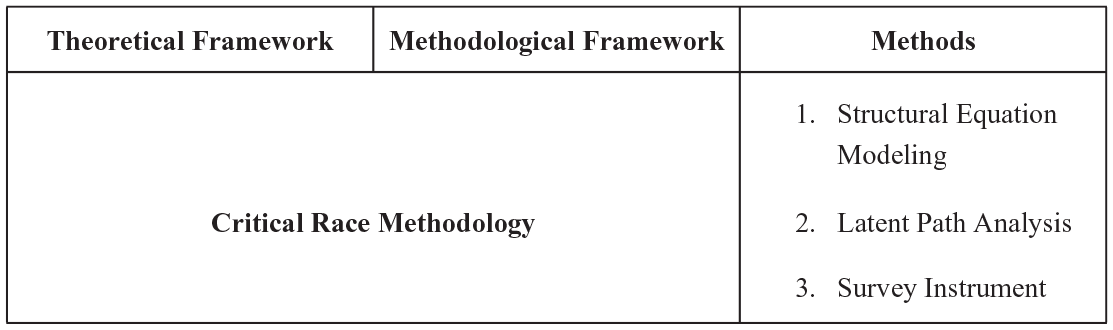
Quantitative critical race methodology as framework.
Our use of quantitative critical race methodologies demonstrates epistemological aims to counter racialized oppression in knowledge creation. We used SEM-related methods, specifically latent path analysis 3 and survey methods, as the techniques to collect and analyze data.
Methods
The specific quantitative method used in this critical race quantification study is SEM. Structural Equation Modeling provides a wide variety of tools to examine large numbers of individuals’ perspectives through the analysis of covariances. Further, SEM depends on robust theoretical foundations (Kline, 2015) because model results would be rendered immaterial absent empirical and contextual social explanation. However, we define robustness beyond knowledge gatekeeping and move toward Black, Brown, and Indigenous-focused definitions. The dependency on strong theoretically-grounded, Black, Brown, and Indigenous-focused work makes merging critical race quantification and SEM an excellent theory, methodology, and method collaboration. Justification in invoking SEM resides in its ability to capture and analyze a large quantity of educators’ voices. The capacity to produce knowledge from large numbers of voices informs systems-level analyses that may be used to inform equitable educational policy solutions (Cruz, 2020; Diem et al., 2019). The collection of many voices provides educational researchers, leaders, and activists a powerful tool to critically examine educational policy and its impacts.
We used mediation analysis to assess the ways in which one variable influences another indirectly through a mediator (A. F. Hayes, 2017). Specfic to this study, we sought to determine how teacher solidarity beliefs influences the relationship between the number of times teachers collaborate and their perceived beliefs in executing critical pedagogy. Through analyzing the indirect effect, the extent to which a teachers’ sense of collective efficacy beliefs influence the relationship between teachers’ frequency of collaboration and teacher efficacy beliefs for critical pedagogy relating to racial justice, could be explored. Mediation analysis may assume a causal link between the examined variables (Nguyen et al., 2020). In our study, causality is not an attempt to control all confounding variables to meet a hierarchical gold standard of research. Instead, we borrow definitions of causality from more complex, nuanced, and justice-oriented discussions on examining social phenomena (Fine, 2006; Zuberi, 2001). In this vein, causality means that stories, anecdotes, and literature supports the idea that collaboration frequency premises teacher solidarity beliefs which are precursors to individual teacher efficacy beliefs about critical pedagogy. This sequence supports the study implications and allows for equitable and just educational policy solutions.
Sample and District Description
The research team collected data through a survey that we administered to an urban public school district in the United States. The school district is the eighth largest in a midwestern state which serves 16,000 students. About 1,001 teachers participated in the survey out of the estimated 1,059 full-time K-12 teachers yielding a response rate of 95%. Table 1 gives the racial/ethnic demographics of the district. About 70% of participants indicated female, leaving 30% indicating male in the survey question about sex assigned at birth. The educators’ teaching assignments ranged from PK-12th grade. We will describe how the described demographics influence implications in preceding sections. However, readers should add their own analysis of contextual nuance given their district demographics and conversations.
District Demographics.

As of 2020, 8.3% of the district’s students and 2.4%, or 53/2,222, employees identify as Black. To respond to Black students, parents, guardians, and employees’ concerns, the superintendent initiated an inclusivity and justice task force to listen, learn and develop solutions to address local-level instances of racism. Recently, relative to the survey’s administration, a listening session for Black students and families was held to express their concerns. This context is provided to show district leaders’ willingness to examine racialized oppression to which Black students and families are subjected. This context helps readers situate the study’s knowledge creation relative to their own school and district settings. Teachers’ racialized beliefs, in a predominately-white district whose leaders are supportive of justice work, may be different in a non-supportive leader environment.
Critical race quantification moves away from stringent dedication to generalizability and moves toward building an understanding of the structural realities within which marginalized groups operate. Then, justice-oriented actors may collectively develop solutions from their locally controlled positionality. Educational justice policy actors should evaluate the demographic information and the study’s implications juxtaposition to the contextualized similarities and differences between this district and their own nuanced contexts.
Measures
Before survey administration, I (the first author) conducted cognitive interviews with a small group of teachers, this study’s knowledge contributors, to assess the validity of the items tapping the targeted racialized constructs (Peterson et al., 2017). The small teacher group’s racialized and sex-assigned-at-birth demographics were mostly white and female since I knew the survey would be administered in a similarly-situated district. Two of the scales could be interpreted as task-specific efficacy scales, and one is a frequency scale. 4 Teacher feedback allowed for the modifications of items that may have been confusing, too wordy, differently understood, or esoteric. A Cronbach alpha test was taken to assess the scales’ reliability. 5 The scale’s name, item wording, number of items, and Cronbach’s alpha value are found in Tables 2 to 4. I explain the constructs in their theorized causal link in the next sections.
CAO Item Wording, Reliability, and Factor Loadings.
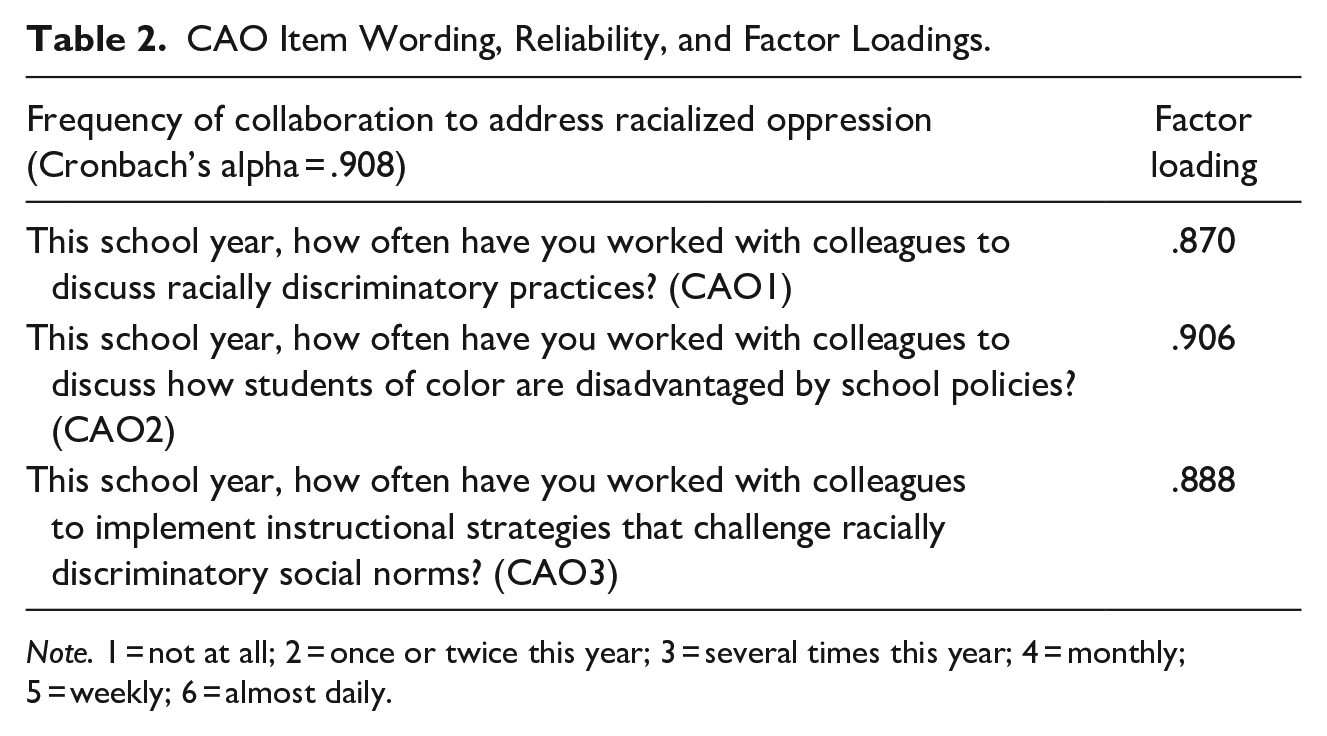
Note. 1 = not at all; 2 = once or twice this year; 3 = several times this year; 4 = monthly; 5 = weekly; 6 = almost daily.
CERJ Item Wording, Reliability, and Factor Loadings.
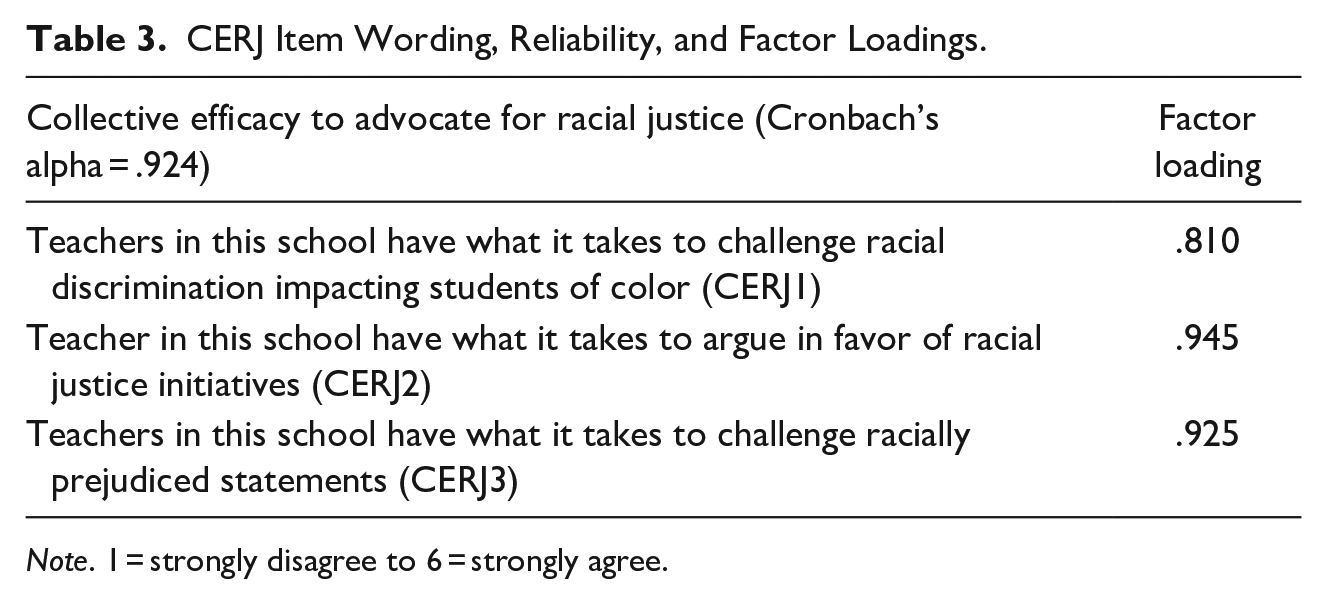
Note. 1 = strongly disagree to 6 = strongly agree.
CPE Item Wording, Reliability, and Factor Loadings.
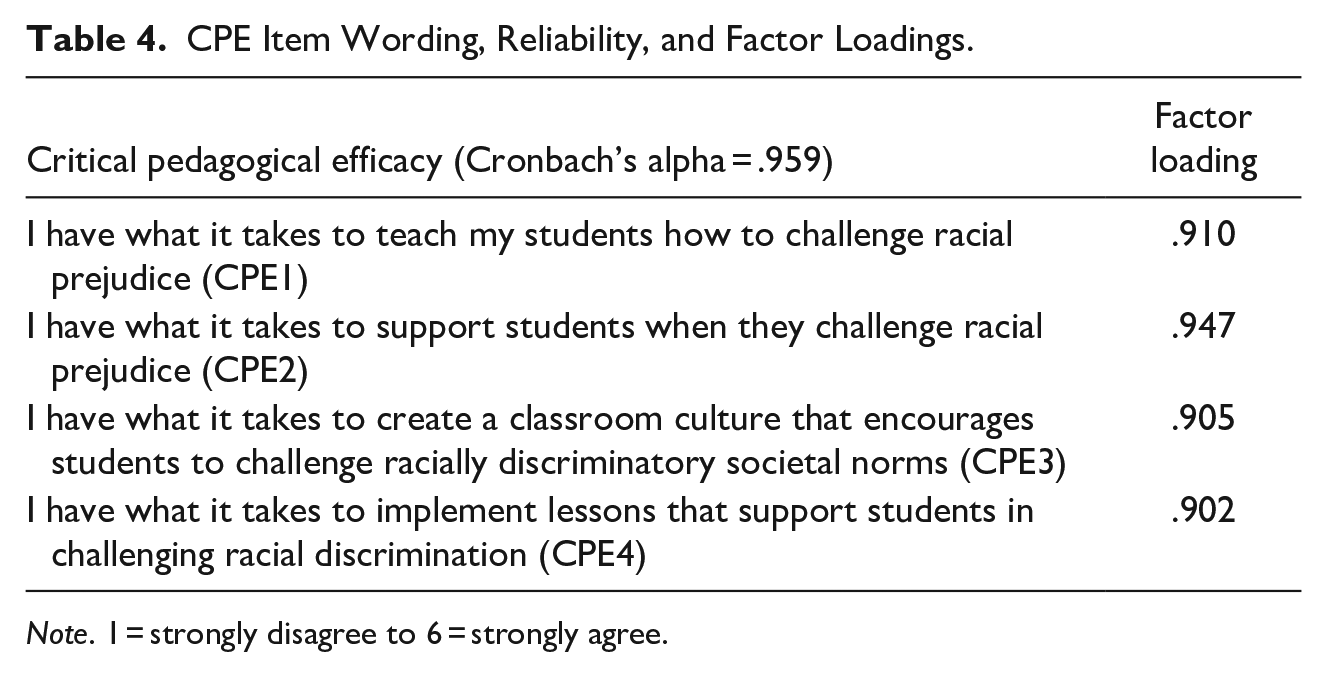
Note. 1 = strongly disagree to 6 = strongly agree.
Frequency of Collaboration to Address Racialized Oppression (CAO)
Collaboration to address racialized oppression (CAO) is a self-reported scale that captures how often teachers work together to address how the education system disadvantages students of color. Table 2 shows how each item captures various opportunities teachers have to collectively develop solutions to localized racial injustice.
A connection between teacher solidarity for racial justice and teacher collective efficacy is evident. Teachers who work together have a firmer belief in their group abilities than those in isolation (R. Goddard et al., 2015). CAO’s apprehension of collaboration frequency allows for examining whether collaboration frequency alone is sufficient in challenging racial/ethnic oppression. Teachers having space to work toward racial justice may be a vital component in improving beliefs about critical pedagogy, but teacher solidarity may have additional influence. CAO provides a tool for measuring the relationship between fostering a strong sense of a collective efficacy-related racialized construct and implicates collaboratively-created educational policy structures that bolster teacher solidarity-building.
Collective Efficacy to Advocate for Racial Justice (CERJ)
The Collective Efficacy to Advocate for Racial and Ethnic Justice (CERJ) scale, measures teachers’ collective efficacy beliefs to advocate for racial justice. Another way to think about this construct is to frame it as teacher-to-teacher solidarity. Teacher “collective efficacy beliefs are associated with the tasks, level of effort, persistence, shared thoughts, stress levels, and achievement of groups” (R. D. Goddard et al., 2017, p. 222). Teacher collective efficacy can be considered as solidarity because the CERJ items seek to understand teachers’ sense of their colleagues’ racial justice positionalities. Because the CERJ scale is task-specific, it provides a mechanism for connecting perceived beliefs in collective and individual efficacy to challenge racialized injustice in the teacher’s school (see Table 3).
R. D. Goddard and Y. L. Goddard (2001) found that collective efficacy positively and significantly predicted teacher efficacy and argued that this finding demonstrates important school climate considerations. However, their study framed teacher and collective efficacy within traditional student achievement and school improvement. This study explored how a justice-oriented teacher solidarity framed, racialized construct may situate teacher and collective efficacy’s relationship within equitable educational policy discussions. CERJ provides us a quantified scale to examine teachers working together toward equity and justice-oriented aims.
Critical Pedagogical Efficacy (CPE)
The Critical Pedagogical Efficacy (CPE) scale, measures teachers’ beliefs in themselves to affirm student agency to challenge racial prejudice and discrimination. Table 4 shows how CPE may connect to a task-specific self-efficacy or teacher efficacy scale.
Researchers have defined teacher efficacy as a belief in one’s ability to bring about desired outcomes for students (Tschannen-Moran & Hoy, 2001). Critical pedagogical efficacy is aligned with scholars’ calls to push the boundaries of teacher efficacy scales; such that quantitative scholars may imagine teacher efficacy outside of outcomes relating to traditional measures of academic achievement and learning (Hoy et al., 2009; Labone, 2004). Izadinia (2011) demonstrated the shift to more equity and justice-framed efficacy belief measurements and incorporated components of critical pedagogy in a scale to capture teachers’ efficacy beliefs related to classroom management, instruction, student engagement, and perceived beliefs about social change. However, the study’s race-neutral items did not directly ask about racialized realities.
Our study’s CPE scale provided the research team with data that pushed forward inquiry about how beliefs about critical pedagogical practices are influenced by collaboration frequency and teacher solidarity beliefs and item-wording asked respondents to think about racialized realities. CPE contributes to critical educational policy studies by quantifying, for structural understandings, the self-perception of teachers’ beliefs in designing and executing critical pedagogy relating specifically to challenging racialized oppression. CPE is the outcome variable in this study’s model. The scale’s convergence of critical pedagogy and racialized realities captures teachers’ percieved beliefs about supporting student pursuits of justice and mentoring them to be change agents.
Covariate
In the latent path model, teacher racial/ethnic identity is a covariate. Imputing racial and ethnic control variables statistically reduces the influence racialized identity may influence the outcome variable. We do not interpret the race category variable because that would mean homogenizing the dynamic ways people experience their racialized identities. Unequivocally, individuals have a variety of experiences relating to their identity, and scholarship must resist the homogenization of experiences tied to a person’s identity (Gutiérrez & Rogoff, 2003; Zuberi, 2001). The justification for including this covariate is to acknowledge Black and Brown educators’ unique experiences. A teachers’ ability to identify the nuanced issues surrounding race and racism may depend on whether they are or were subjected to racism in their lives (DiAngelo, 2018). Therefore, Black and Brown teachers, who are forced to maneuver racist spaces, may hold different perspectives than their similarly-situated white peers. This difference in experience and perspective may skew model estimates if they are not statistically controlled for. Thus, the model’s CPE variable estimate is less likely be attributed to differences related to racialized identity and experiences with racism.
Study Limitations
Following our study’s quantitative critical race methodology framework, the ways survey methods are limited in their ability to capture constructs relating to race and racism are explicated. We acknowledge the difficulty and limitations with measuring teachers’ racialized beliefs using psychometric scales (Bonilla-Silva, 2006; Grzanka et al., 2020). However, we assert solutions to addressing these limitations cannot be “racist-blind” approaches in psychometric measurement (Pak, 2021). We lean into these challenges and weave quantitative and critical-race methodological considerations throughout the study’s design, analysis, and interpretations. In doing so, we purpose to bolster equity and justice-oriented educational policy and leadership (Diem & Welton, 2020; Welton & Diem, 2021). We ask readers to investigate the study’s potential to contribute to justice-oriented aims given the following limitations.
First, although SEM is an effective tool in providing a snapshot of structural phenomena large quantities of teachers describe, there exists a significant limitation in the statistical language used to discuss the findings and results. If a teacher, school leader, or researcher does not have an applied statistics background, it is more difficult to critically consume how a SEM study arrives at its conclusions. In addition to SEM’s technical jargon, statistical software, and quantitative research courses cost thousands of dollars. Thus, SEM scholarship limits accessibility to those connected to college and university accounts, or wealthy individuals. To mediate this reality, we provide endnotes that further explain the technical SEM jargon and offer citations for readers interested in pursuing a deeper understanding. We acknowledge that this is not enough. In the spirit of critical quantification, future research must continue to interrogate SEM’s inaccessibility, and situate the quantitative method in its potential to lead to educational equity.
Second, the term “racial justice” is a study limitation. As Tuck (2016) and Patel (2015) explained, using race as the adverb in racial justice invites injustice. Race has no biological significance and is a social and political construct created by white supremacists to justify the enslavement of Africans and the theft of Indigenous land. Therefore, scholarship should decenter white-created constructs through focusing “on the humanity, the history, the psychology, the undeniable vibrancy, the embodied beingness of black and brown peoples” (Patel, 2015 as cited in Tuck, 2016, p. 214). This vibrancy is an infinitely complex reality that survey methods cannot capture. Concurrently, finding survey item terminology teachers universally understand is crucial for scale development. If the survey takers answer items based on different interpretations, instrument reliability is jeopardized, impacting model estimates (Fowler, 2013). Thus, Stewart used familiar terms (such as racial justice, prejudice, discrimination) that could be broadly understood. Although racial justice is steeped in white-crafted colonial context, the phrase itself has been used ubiquitously to describe teachers’ efforts to redress racialized oppression. To reconcile sacrificing oppressive contextual language for universal understandability we purposed our study to contribute to equitable and just educational policy in the discussion section. Recognizing again, that this is not enough, our reconciliatory justice work continues beyond the confines of this article’s written text.
Bonilla-Silva (2006) argued that surveys are “limited tools in examining how people explain, justify, rationalize, and articulate racial viewpoints” (p. 11). This study sought to understand the structural mechanisms within which teachers operate while keeping limitations at the forefront. In democratic and educational spaces, participation maximization is crucial to challenge top-down and oppressive educational policy processes. Like the collective influence of a petition signed by hundreds of people, we explored the additive influence of statistical analyses informed by hundreds of educators. We conducted our study, as Moradi and Grzanka (2017) have described, to use statistical analyses to “produce transformative knowledge and contribute to social change” (p. 502)—a central quantitative, critical race methodological principle.
Finally, the partner schools’ teacher racial demographics are made up of mostly white Americans. Therefore, the ways racialized constructs operated in the model were mostly dependent on the lenses of people systemically advantaged by society. A reader should look to qualitative work on whiteness to further interrogate conclusions and discussions (Bhattacharya et al., 2019; C. Hayes & Juárez, 2009; Hytten & Warren, 2003). These limitations demands that our research team and readers interrogate the study’s knowledge beyond the written text, and in community with other justice-oriented educational policy actors.
Data Collection
A team of six researchers, including myself (the first author) but not my co-authors, worked collaboratively to administer a teacher and a principal survey instrument. The final instruments included 138 items for the teacher survey and 108 for the principal survey. Each research team member included items and constructs related to their research interests. This study focuses on three racialized constructs within the teacher survey because of my positionality, transgression, and advisors’ support. 6
The research team asked teachers to complete the survey after one of their weekly staff meetings. Within each envelope was a one-page description of the study and a detailed description of privacy and confidentiality. Participation was voluntary, and all responses were collected anonymously. The team compensated teachers with a two-dollar bill attached to each survey envelope. Upon completion of the survey, teachers placed their completed survey back in the provided envelope. A scantron service scanned the completed surveys, and then a research team member cleaned the data for analyses. The district’s superintendent supported the team in administering the survey by emphasizing the importance of using research-supported practices and learning with the University community. Moreover, the team positioned the study to produce knowledge related to the districts’ focus on social-emotional learning (SEL). We included a set of SEL in the teacher and principal surveys. A reciprocal relationship between researchers and practitioners was the catalyst for this project. The district received valuable information about their teachers and principals’ beliefs, and the research team gained valuable experience in survey methods and design.
Data Analysis
I used Mplus 8.4 (Muthen & Muthen, 1998) to obtain the necessary path coefficients in the model. Mplus’ MODEL INDIRECT program produced the indirect effect from frequency of collaboration (CAO) through teacher solidarity beliefs (CERJ) to critical pedagogical efficacy (CPE). The bootstrap method, with5,000 iterations, tested the statistical significance of the indirect effect. 7 Maximum likelihood with robust standard errors (MLR) was the estimation method underlying the path estimates. I obtained descriptive statistics and correlations using SPSS 26 (IBM Corp, 2019).
Since non-normality may influence estimates, I examined descriptive statistics for the observed variables in the model. Table 5 shows the observed variables’ means and standard deviations.
Descriptive Statistics of Observed Variables.
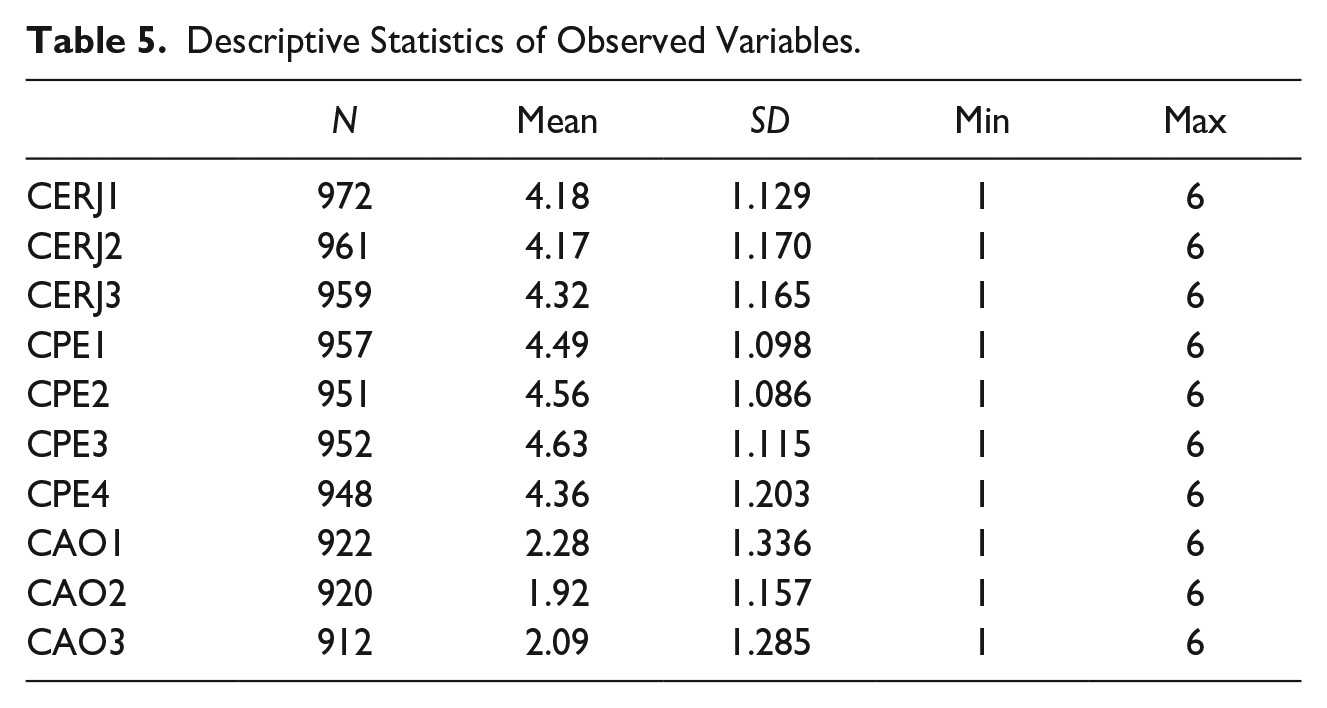
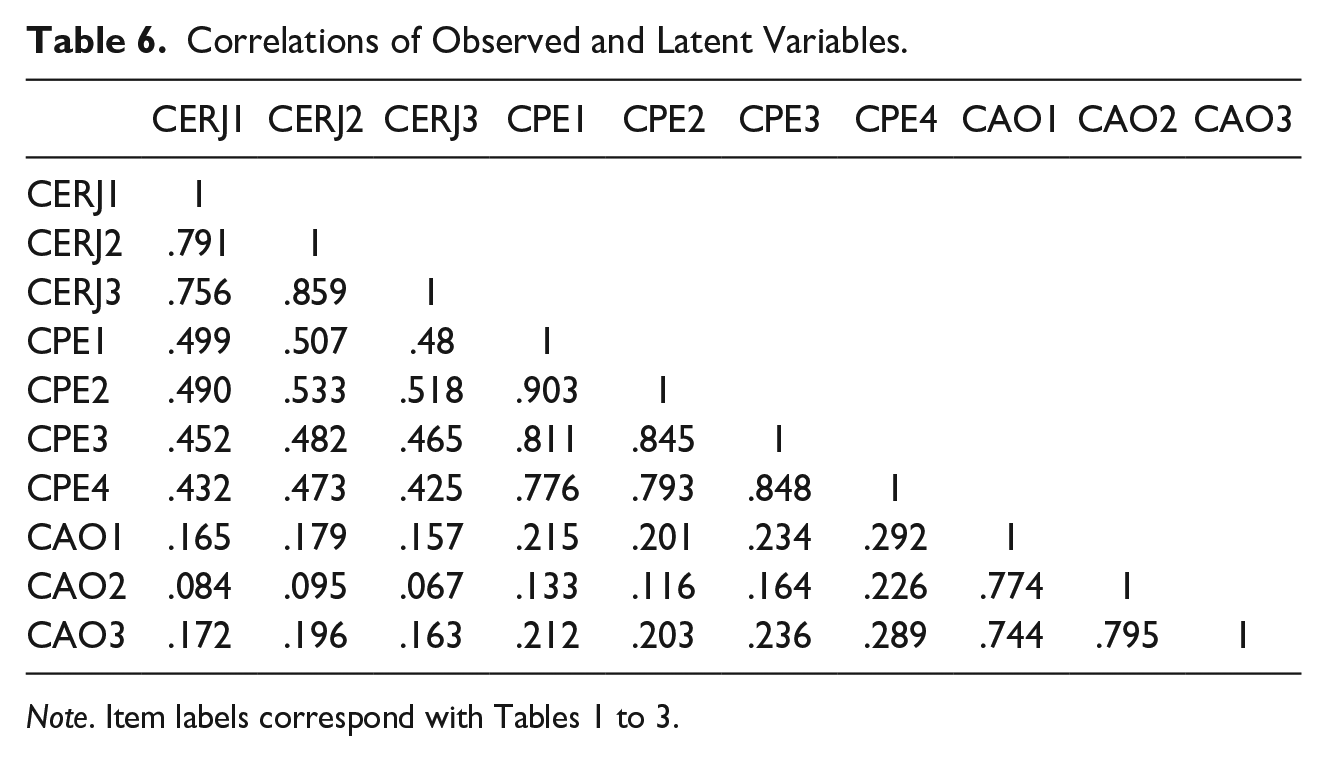
Table 6 gives the correlation coefficients for the observed and latent variables. Skewness and kurtosis showed all observed variables, except for items in the CAO scale, were normally distributed.
Correlations of Observed and Latent Variables.
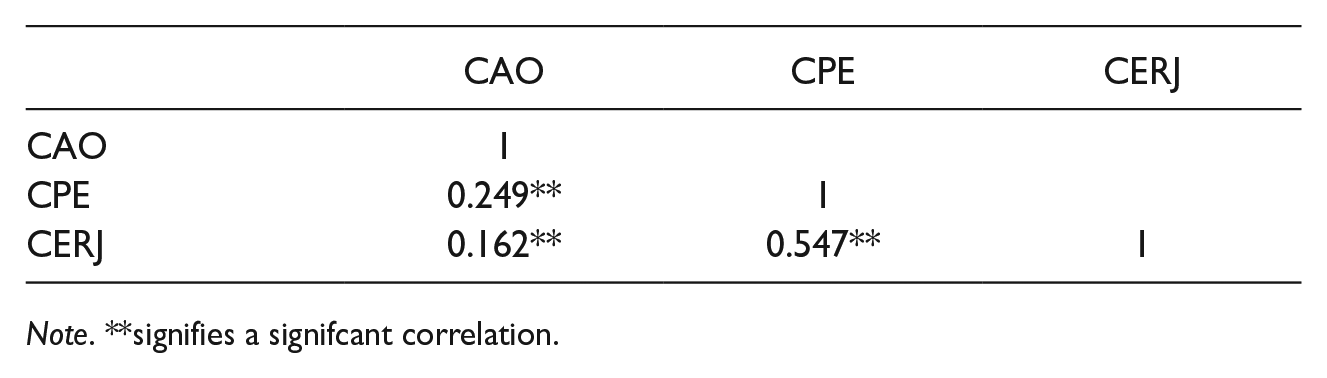
Note. **signifies a signifcant correlation.
After identifying non-normality in the CAO items, the co-authors and I set Mplus to maximum likelihood with robust standard errors (MLR). SEM researchers use MLR when variables do not meet multivariate normality; the estimation method compensates for the non-normality; thus, estimates are not compromised (Lai, 2018). With respect to missing data, all observed variables had <10%, and over 85% of teacher respondents completed every item. MLR is well suited to maximize the use of all the collected data because it considers all data in estimation.
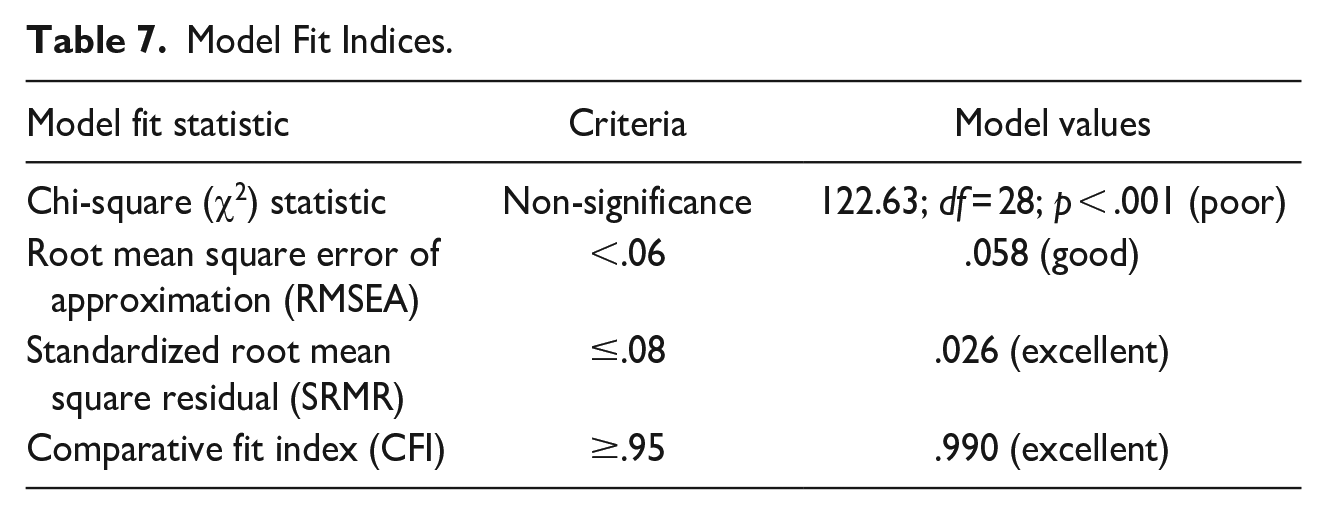
Next, the co-authors and I assessed whether the latent path model fit the characteristics of the sample. We used a collection of fit indices commonly used in SEM techniques: the chi-square test, the root mean square error of approximation (RMSEA), the comparative fit index (CFI), and the standardized root mean square residual (SRMR). 8 The chi-square statistic exhibited poor fit for the theorized model; however, this is expected for large sample sizes (Brown, 2006). Kline (2015) asserts SEM users can be confident in model fit based on the results from alternative fit indices. The criteria for the three alternative model fit indices are as follows: CFI ≥ .95, RMSEA < .06, SRMR ≤ .08 (Hu & Bentler, 1999).
Results
Due to excellent fit for the theoretical model, we used a one-step method of analysis for the three-factor latent path model. The one-step method allowed the co-authors and I to visualize the whole latent path model and its estimates in one model diagram. The model takes advantage of the flexibility of SEM by simultaneously using path analysis and factor analysis. 9
Exploratory Factor Analysis
Tables 2, 3 and 4 show the factor loadings for each item. Each latent variable (CPE, CAO, and CERJ) was constructed as the product of the averaged score across all items. By showing high factor loadings on all items, the Exploratory Factor Analysis (EFA) provided evidence that the items collectively capture the interpreted racialized construct. Upon interpreting favorable information from the EFA portion of the model, we moved to path analysis to assess the ways teacher solidarity beliefs mediates the relationship between teacher frequency of collaboration and critical pedagogical efficacy.
Path and Mediation Analysis
Table 7 shows the model fit values for the theoretical model. This evidence supports the claim of excellent fit for the model.
Model Fit Indices.
In simple mediation analyses, there are three path coefficients to estimate and three effects to calculate. The three paths in this model consist of: CPE on CAO, CPE on CERJ, and CERJ on CAO. Figure 2 shows the latent path model with its corresponding value for the path coefficients.

Latent path model estimates.
Figure 2’s path coefficients provide the necessary information to calculate the direct, indirect, and total effects. A calculation of the indirect effect will provide the necessary information to answer the study’s central research question.
The indirect effect is the product of the two paths linked to the mediation variable—the mediation variable is collective efficacy for racial justice (CERJ). Arithmetically, taking the path coefficient from CAO to CERJ (.223) and multiplying it by the path coefficient from CERJ to CPE (.551), yields a .123 value for the indirect effect. Traditional significance testing does not work in evaluating whether the indirect effect is statistically different from 0 (A. F. Hayes, 2017). Thus, we used the bootstrapping method in the Mplus syntax to test the indirect effect’s statistical significance. The bootstrap test results revealed a 95% confidence interval that did not contain zero (Bootstrap = 5,000; .069–.183); thus, it is accurate to claim that this indirect effect is significantly different from 0.
These results demonstrate that two teachers who differ by one standard deviation on CAO are estimated to differ by .123 standard deviations on CPE, on average. As a result of the effect of CAO on CERJ, which in turn affects CPE. The remainder of the difference is due to the effect of CAO on CPE independent of CERJ—this coefficient was estimated to be 0.212 (p = .031; t = 6.854) standard deviations. In other words, although there is a significant direct effect between the teacher-reported frequency of collaboration, the indirect shows the potential to further improve critical pedagogical efficacy, or teachers’ efficacy beliefs about teaching their students to address racialized oppression. We found a significant indirect effect that evidences an additive influence CERJ has on the relationship between CAO and CPE. These results have significant implications for educational policymakers, educators, and school leaders who continue to dedicate their work to redressing racialized oppression.
Discussion
The study’s results discussion is organized in the study’s contributions to critical educational policy studies. We discuss our quantitative critical race methodology framework’s contributions to educational policy studies, the significance of increased teacher critical pedagogical efficacy beliefs in schools, and implications for improved teacher solidarity in educational justice movements.
Critical Race Quantification in Educational Policy Studies
When attempting to quantify beliefs and ideologies of individuals in educational policy studies, especially when researchers’ foci are racialized constructs, heavy theoretically-grounded work is a necessity (Kline, 2015). Quantification demands complex social descriptions and racialized oppression contextualization. Without context, educational policy actors, leaders, and researchers perpetuate racialized inequity and oppressive systems (Crawford, 2019; Peters & Tesar, 2016; Shahjahan, 2011). Centering critical race quantification may support a collective turn toward equitable educational policy solutions that specifies quantification scholars’ contributions to redressing systemic oppression. For instance, Sablan’s (2019) community cultural wealth scale was contextualized, using critical race theory, to move quantitative, racialized constructs beyond descriptive statistics. Sablan acknowledges there are not enough quantitative examples scholars can turn to for exemplars and SEM has yet to be fully developed through a critical race lens. Our study provides one of many future applied-SEM studies to which scholars may use to bolster critical race quantification in educational policy studies.
This study contributes to critical educational policy scholarship seeking to move away from positivistic paradigms that forward objective epistemologies. It shows how quantitative critical race methodology may provide a more nuanced and contextual analysis of quantified, racialized constructs. We offer a racialized construct framework that holds the potential to contribute to equitable policy solutions and make it easier for teachers to collaborate for justice and improve critical pedagogical efficacy. This aim to create knowledge in support of equitable educational policy solutions is an essential critical race quantification component (Moradi & Grzanka, 2017). We offer similarly-situated, critical educational policy scholars quantifiable, justice-oriented, and racialized constructs to use in evaluation, research, and statistical analyses.
Critical Pedagogical Efficacy
Our findings evidence a 12.3% additive impact teacher solidarity beliefs have when educators collaborate for racial justice and, in turn, improve critical pedagogical efficacy. The 12.3% increase may signal a meaningful influence raising teacher solidarity beliefs have on critical pedagogical efficacy. This educational policy studies contribution was mechanized through shifting quantitative model outcomes to more equity and justice-oriented, racialized constructs. The shift stemmed from a quantitative critical race methodological framework. CPE brings a new outcome variable educational policy scholars may include in critical policy evaluation, research, and analysis.
Although we did not include students’ voices in the study’s data collection processes, youth are essential partners in critical pedagogies. When students are taught through a critical pedagogical lens, they have demonstrated heightened critical consciousness (Diemer & Li, 2011). This heightened critical consciousness supports student interest in collective action to challenge oppressive norms (Diemer et al., 2017). Thus, increasing teacher critical pedagogical efficacy, through increasing teacher solidarity beliefs, may hold potential to increase youth interest in collective action. When teachers operate within educational policy environments that bolster a strong sense of justice solidarity, students may connect with their ability to act and move toward participation in educational justice movements. 10 Importantly, establishing educational policies supportive of teacher solidarity, critical pedagogy, and student voice may depend on school leadership support, state-legislated ethnic studies curriculum, or state teacher collaboration policies.
Future studies should continue to implore scale measurement, survey methods, and SEM that attempt to quantify more equitable, racialized constructs. Zuberi (2001) described quantified racialized constructs as interdependent connections and relationships in “morphological” (p. 110) and socio-political multiplexes. We show how CPE, created from quantitative critical race methodology, moves beyond traditional outcome variables’ tendency to decontextualize. Furthermore, CPE shows how school leaders and teacher collectives may boost beliefs about critical pedagogy through producing quantifiable evidence that may bolster multi-knowledged research.
Granted, there are still limitations to the methodological, theoretical, and methods research decisions relating to the study limitations. Our study is not an exception to quantitative methods’ lack of ability to capture racialized multiplexes (Garcia et al., 2018; Gillborn et al., 2018). Major questions remain relating to the types of conversations taking place within teacher collectives at the study’s partner district, the mechanisms that yielded stronger teacher solidarity, and how improved beliefs about justice translate to action. Quantitative methods and racialized constructs alone cannot answer these collective, co-constructed, and future investigations.
An intentional turn toward acknowledging study limitations in framing, design, analysis, and interpretations, framed in quantitative critical race methodology, may be one solution. Further interrogation must be done on solely quantitative studies. It may be that multi-method and multi-knowledged approaches are better positioned in comparison to solely quantitative techniques and designs (Covarrubias et al., 2018; Garcia & Mayorga, 2018). Simultaneously, teacher collectives and school leaders interrogate the extent to which a strategically-designed, justice-oriented, and solely quantitative study produces knowledge that powerful policy actors may be more inclined to receive (Gutierrez & Lipman, 2016; Nygreen, 2017). These are negotiations that will continue beyond this study.
Teacher Solidarity in Movements for Educational Justice
The findings from this work can contribute to movements for educational justice by evidencing how increasing teacher solidarity beliefs about racial justice may yield a stronger sense of critical pedagogical efficacy. The study’s findings support the idea that educational leaders’ decisions on teacher solidarity-building may influence the strength of teachers’ beliefs about critical pedagogy. Moreover, having frequent racial justice meetings may not maximize influence if teachers’ solidarity-building activities are not central to efforts. These findings connect to literature describing how school leaders may hold the power to establish policies supportive of teachers’ solidarity and critical pedagogical efficacy beliefs. We acknowledge school leader’s acts may look different given the sociopolitical, governmental, historical, and geographical contexts.
Exemplifying these potentially differentiated implications, as noted, the district where this study was conducted was comprised of predominately-white teachers. Therefore, this district’s policy solutions may seek to dismantle how racist, classist, and historical contexts influence modern stratification based on racialized identity and socioeconomic status (Bhattacharya et al., 2019; Garcia & Mayorga, 2018; C. Hayes & Juárez, 2009; Hytten & Warren, 2003). Or, teachers and school leaders may co-plan workshops focusing on how whiteness operates in local, state, and national educational politics, and then discuss ways schools have worked to sustain/create policies where Black, Brown, and Indigenous students thrive. Moreover, their co-planning may prioritize the voices of Black, Brown, Indigenous, or low-wealth voices in the school community. To be clear, this does not mean shifting planning, execution, and labor solely to Black, Brown, or Indigenous, or low-wealth school community members. The labor should be a collective effort where those advantaged by society listen, learn, and meaningfully act to redress racialized oppression.
This study’s knowledge supports teacher, student, and school leader planning of social justice rallies, teamed with culturally sustaining pedagogy, 11 that exposes inequitable discipline practices in addition to imagining alternatives to policing in schools and beyond. An essential component to these actions may be co-teaching, co-planning, and co-learning to foster a strong sense of teacher solidarity (McCarty & Lee, 2014). The solutions to foster a keen sense of solidarity are endless; however, school leader supported educational policies can be a catalyst to solidarity-building efforts.
Future researchers may examine the influence school leaders have on teacher solidarity beliefs about racial justice. We postulate that school leaders who are dedicated to educational justice will establish equitable environments that support collective action (Diem & Welton, 2020). As educational leaders engage in equity-minded and local-level policy creation, their role becomes critical to school climate and culture. This powerful role may solidify improved teacher collective efficacy beliefs and positively influence critical pedagogical efficacy. Future studies may explore teacher collaboration with school leaders, community members, families, activists, and students.
Welton and Freelon (2018) argue school policies fostering and establishing shared leadership designs usher community organizing for justice-oriented aims. A shared leadership design is one strategy that may engender elevated levels of teacher solidarity beliefs. Our study contributes to this research vein through providing another quantified evaluative variable to extend the relational mechanism that may lead to premising the construction of stronger educational justice movement spaces. School leaders, in their powerful local positions, may use this work to mobilize knowledge creation to inform and evaluate educational policies that increase teacher solidarity beliefs. In turn, improving teachers’ critical pedagogical efficacy and inviting the next generation of justice movement policy actors.
Conclusion
This study contributes to educational policy literature that explores the combination of quantitative critical race methodology, SEM, and survey methods. The model empirically supports the claim that increasing frequency of collaboration to address racialized oppression leads to higher levels of a teacher’s beliefs in supporting students in challenging racialized oppression. However, the significant indirect effect offers evidence that this relationship is positively and statistically mediated by a sense of collective efficacy in advocating for racial justice, or teacher solidarity beliefs. All of this is to say, teachers working together to challenge racialized oppression, who also develop a sense of solidarity among their colleagues, have the potential to foster higher beliefs in themselves to support students in advocating for justice.
Teachers will continue to engage in conversations about the ways Black, Brown, and Indigenous students are disadvantaged and imagine solutions in collaborative spaces. These spaces may lead to collective efforts to disrupt racialized oppression, co-created equitable educational policy solutions, or educators holding each other accountable in thinking about Black, Brown, and Indigenous student experiences and the structural inequities to which students are forced to maneuver. If these conversations are bolstered by school leader supports and educational policies, then our finding show there may be increases in teachers’ critical pedagogical efficacy. The knowledge produced from this critical race quantification study demonstrates how teacher solidarity beliefs may increase individual confidence in teaching students to engage in similar movement-building work, reinforce collective and transformational knowledge creation, and offer hope for equitable imaginaries.
Footnotes
Declaration of Conflicting Interests
The author(s) declared no potential conflicts of interest with respect to the research, authorship, and/or publication of this article.
Funding
The author(s) received no financial support for the research, authorship, and/or publication of this article.
