



Abstract
This study proposes a conceptual framework for institutional processes shaping social enterprise that spans regional differences in the term. Over time, countries and regions have come to identify different definitions and concepts with the term social enterprise, leading to a debate among researchers and practitioners on how to define the concept. Rather than a narrow definition, this study draws on the theory of historical institutionalism, national-level empirical data, and country descriptions of social enterprise to construct a conceptual framework that informs models of social enterprise found internationally. These models are preliminarily checked against empirically based case studies of five countries’ current institutional patterns and how they relate to the types of social enterprises found there. Theoretically this research advances understanding of how context influences the development of social enterprise, which in turn informs social enterprise models with practical implications.
Over the past several decades the concept of social enterprise has grown dramatically in many regions of the world. Defined as the use of nongovernmental, market-based approaches to address social issues, social enterprise often provides a “business” source of revenue for many types of socially oriented organizations and activities. 1 However, within these broad parameters, world regions have come to identify different definitions and concepts with the social enterprise movement in their areas (Kerlin, 2006). This variation has also resulted in considerable debate among researchers and practitioners on how to define the concept (Light, 2008; Mair, Robinson, & Hockerts, 2006). To address these difficulties, this research draws on the theory of historical institutionalism to advance understanding of how context influences the development of social enterprise as well as propose a preliminary conceptual framework for social enterprise that spans regional differences in the term.
Recent research has shown that variations in social enterprise around the world are in part due to their connection with the specific socioeconomic conditions of their context (Kerlin, 2009). Such research aligns with Salamon, Sokolowski, and Anheier (2000) and Salamon and Sokolowski’s (2010) social origins approach that proposes that existing institutions influence the development of nonprofit sectors in different countries. It also aligns with research connecting national trends in entrepreneurship with government and society (Baumol, 1990; Bosma & Levie, 2010). While broad connections between levels of civil society, government, market, and international aid have been associated with variance in social enterprise (Kerlin, 2009; Nicholls, 2006; Nyssens, 2006), little is known about how these institutions directly shape, as well as constrain, social enterprise structures. Indeed, this article begins to address research questions raised by Austin (2006) involving the need for the comparison of social enterprise across dimensions of place and form.
Most literature on social enterprise in relation to place focuses on single country or regional analyses and/or case studies rather than a global comparison (Bagnoli & Megali, 2011; Borzaga & Defourny, 2001; Cooney, 2011; Dacanay, 2004; Les & Jeliazkova, 2005; Liu & Ko, 2012; Mulgan, 2006; Nyssens, 2006; Squazzoni, 2009; Young, 2003). Indirectly, Salamon et al. (2004) provide comparative data on social enterprise in nonprofit organizations. They find that for 34 countries an average of 53% of nonprofit income comes “from fees and charges for the services that these organizations provide and the related commercial income they receive from investments, dues, and other commercial sources” (p. 30). In particular, they note that the dominance of commercial revenue was most prevalent among transition and developing countries where civil society sectors are small. For these countries, fees represented, on average, 61% of civil society organization income compared to 45% for developed countries (Salamon et al., 2004), suggesting that the context for social enterprise can influence its occurrence. Salamon’s research also indicates that many similar types of social enterprise can be found across countries, most commonly nonprofits supported by commercial revenue. The focus of the present research, however, is on differences in the forms of social enterprise across countries whether it be variation in nonprofit and for-profit structures, the focus of their outcomes, or differences in resource mixes.
This study draws on theoretical findings and national-level survey research on societal institutions as well as descriptive accounts of country contexts for social enterprise to construct a preliminary framework for large institutional processes shaping social enterprise. This conceptual framework points to a preliminary typology of social enterprise models in different countries that relate to and provide explanatory power for the types of social enterprises found there. The study then preliminarily checks the framework against empirically based case studies of five countries’ current institutional patterns and how they relate to the types of social enterprises in each country. In practical terms, rather than a restrictive definition of social enterprise, the study leads to an initial conceptual framework by which a broad range of social enterprise activity can be understood.
Method
This study makes use of comparative historical analysis, a mode of investigation borrowed from sociology and political science (Mahoney & Rueschemeyer, 2003). Within this approach, the study draws on the theory of historical institutionalism, which is based on the premise that existing institutional processes and patterns constrain the options available to actors in the innovation of institutions across time (Thelen, 1999). Researchers drawing on this theory focus on the qualitative analysis of case studies of nations and regions to compare the interaction of large-scale, societal institutions over time to better understand institutional outcomes.
In line with this approach, the initial construction of a conceptual framework relies on qualitative and quantitative macro-level information on country institutions. The qualitative aspect draws on Kerlin (2009) and other authors for information on social enterprise and its context in different regions and countries. For quantitative data, the study makes use of survey data and empirically based models from the Global Entrepreneurship Monitor (GEM), 2 the Global Competitiveness Report (models include three stages of economic development; Sala-i-Martin, Blanke, Hanouz, Geiger, & Mia, 2010), and the Johns Hopkins Comparative Nonprofit Sector Project (including its proposed five civil society sector models).
Due to space constraints, supporting case studies consist of an empirical overview of measures of current macro-level institutions and how they appear to be shaping specific social enterprise models in five countries: United States, Italy, Sweden, Argentina, and Zimbabwe. Information for the empirical overviews was taken from the above referenced studies as well as from World Development Indicators (World Bank, 2008), Worldwide Governance Indicators (World Bank, 2010), and the GLOBE Research Project on culture in 61 countries (House, Hanges, Javidan, Dorfman, & Gupta, 2004).
From Macro-Institutional Processes to a Conceptual Framework for Social Enterprise, Theoretically
This study proposes that macro-institutions and processes can account for a large part of the variation in social enterprise across different countries. Recent evolving theory suggests that institutions, both formal and informal, can create causal paths whereby the development of newer institutions is shaped by both the constraints and supports offered by prior and present institutions. By institutions we mean both formal and informal rules that are consciously or unconsciously known by individuals, as defined by Rueschemeyer (2009): “Institutions are clusters of norms with strong but variable mechanisms of support and enforcement that regulate and sustain an important area of social life” (p. 210).
Our approach to institutions emphasizes the importance of underlying power relationships, both in terms of how power is involved in the creation of institutions and how institutions then create and structure power in different ways. This approach aligns with the theoretical frame of historical institutionalism, which asserts that, “Effective institutions influence—at the individual as well as the collective level—beliefs, normative commitments, and preferences. Their major effect at the macrolevel is to create and maintain power disparities and to broadly structure shared and antagonistic interests” (Rueschemeyer, 2009, p. 207). Power in this study is therefore understood not only to support the continuing existence of institutions but also to condition disparities that may ultimately work to shift power to previously subordinate groups, the latter providing the explanation for changes that occur in institutions over time. In short, in line with the historical institutionalism theory frame, this discussion focuses on how power relationships among institutions explain institutional reproduction and change following Mahoney’s description as outlined in Table 1.
Power Explanation of Institutional Reproduction

Source: Excerpted from Mahoney, 2000, p. 517, Table 1.
Evolving theory in this area suggests that current institutions largely responsible for shaping different models of social enterprise initially arose from a rich mix of culture, local (including social classes), regional, and global hierarchies, and political-economic histories. These elements structured the development of the present day state, which then helped shape the current economic situation and civil society, which in turn both influence social enterprise development. Thus we argue that the state ultimately plays a key role in understanding a country’s social enterprise model. In the following discussion we draw on theory that shows how antecedent events and processes shaped the type of state in power. We then discuss research on how the state in turn influences economic development and civil society. Figure 1 illustrates these macro-level institutions and their proposed causal paths.
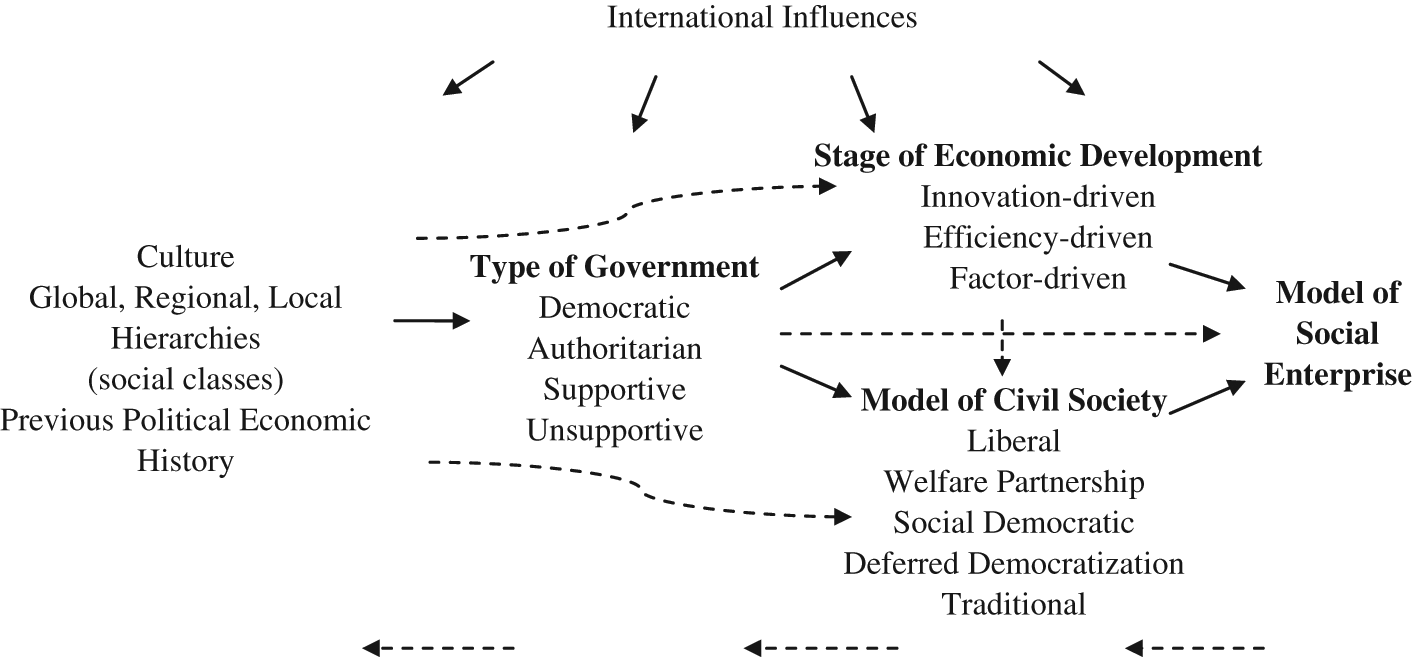
Macro-institutional processes and causal paths for models of social enterprise
The question of how states come to be democratic or authoritarian in nature is addressed by many social scientists in the comparative historical analysis tradition (Mahoney, 2003). Moore (1966), in his groundbreaking book Social Origins of Dictatorship and Democracy, spurred on research in this area, though his original hypotheses were later found to be limited (Mahoney, 2003; Skocpol, 1973). Arguably the most important work to date is Rueschemeyer, Stephens, and Stephens (1992) Capitalist Development and Democracy, which found that capitalist development is associated with democracy due to its alteration of the balance of power between the working class and the landed elite. Other groundbreaking research in this vein includes Skocpol’s (1979) States and Social Revolutions, which finds three necessary and sufficient conditions for social revolutions:
international pressure from a more advanced state or states; economic or political elites who had the power to resist state-led reforms and create a political crisis; and organizations (either village or party) that were capable of mobilizing peasants for popular uprisings against local authorities (Goldstone, 2003, p. 64).
Theorists have also long supported the idea that institutions at meso- and micro-levels, which in this case include social enterprise, business, and civil society organizations, are highly structured by state institutions and policies. As Rueschemeyer (2009) states,
Taken together, the effects of purposeful state policies (even if they may often have unintended or not fully intended outcomes) and the indirect, Tocquevillean consequences of the very presence of state structures and policies leave no doubt that states and state–society relations constitute a powerful and influential environment for social and economic dynamics at the meso-and micro-levels of social life (p. 258).
Indeed, authors writing within the specific fields of business and civil society often point to the importance of state institutions and policies in shaping their respective sectors over time.
In terms of business, Baumol (1990) questions the prevailing understanding about numbers of entrepreneurs and their effect on economic growth by showing that productive entrepreneurship (as opposed to unproductive black market or rent seeking) is likely determined by the rules of society. His hypothesis is that
it is the set of rules (and not the supply of entrepreneurs or the nature of their objectives) [parentheses added] that undergoes significant changes from one period to another and helps to dictate the ultimate effect on the economy via the allocation of entrepreneurial resources (Baumol, 1990, p. 894).
Using a historical approach, he provides evidence from four periods in history that institutions, rules, and norms in societies are a determining factor in the kind of entrepreneurship and economic development a society experiences. Most of these institutions and rules are generated by those governing society.
On the civil society side, in a key statement on the influence of democratic versus authoritarian governance on civil society, Salamon and Sokolowski (2009) summarize their comparative historical analysis of the sector:
In sum, the key dimension that shapes the state–civil society relationship is democratic governance. The presence of such governance protects the civil sector from arbitrary state control and repressions, thus allowing it to function . . . the absence of democratic governance, however, entails authoritarian measures that governments take to restrain political opposition which impede the functioning and development of the civil society sector (p. 26).
Overall, the literature lends significant support to the idea that, due to their connection to civil society and the economy, models for social enterprise may be indirectly shaped to a great degree by what government chooses to do and not to do over time. This is illustrated by the links between the state and economic stages and models of civil society, which are then linked to models of social enterprise in Figure 1. Due to its importance, in the following sections we examine the empirical research available on the government connection with the economy, entrepreneurship, and civil society. We then propose models of social enterprise that combine the characteristics of both economic stage and civil society model on the argued premise that the latter have largely been shaped by the state, though also by antecedent events and culture. 3
From Government to Type of Economy and Entrepreneurship, Empirically
Recent empirical data on government factors associated with economic development also point to the role of society’s institutions in shaping economies. The Global Competitiveness Report (GCR) outlines many of these state factors in its “twelve pillars of competitiveness,” including public institutions, infrastructure, health and education, and fiscal policy. Each of the 12 pillars “rests on solid theoretical foundations” in economics (Sala-i-Martin, Blanke, Hanouz, Geiger, & Mia, 2009, p. 4). The GCR also provides a typology of stages of economic development (see Table 2). The Factor-Driven stage is characterized by reliance on the export of mineral goods and poor supportive policies and infrastructure. The Efficiency-Driven stage is characterized by industrialization where productive efficiency is expanded and product quality improved, both facilitated by improving state policies. The Innovation-Driven stage is found in countries where a high standard of living and growth is supported by the continued introduction of unique and innovative products in a sophisticated business environment. Though largely categorized on the basis of GDP per capita, each individual country assessment shows how strengths and weaknesses in the country’s 12 pillars are often indicative of that country’s GDP and further helps explain the country’s current stage of economic development (Sala-i-Martin et al., 2010). Though the GCR categorization is currently viewed as one of the most comprehensive cross-country economic comparisons—hence its inclusion in this study—we acknowledge its limitations including its linear determinism and failure to also recognize the influence a country’s economic development can have on its institutional framework.
Global Competitiveness Report’s Criteria for Stages of Economic Development
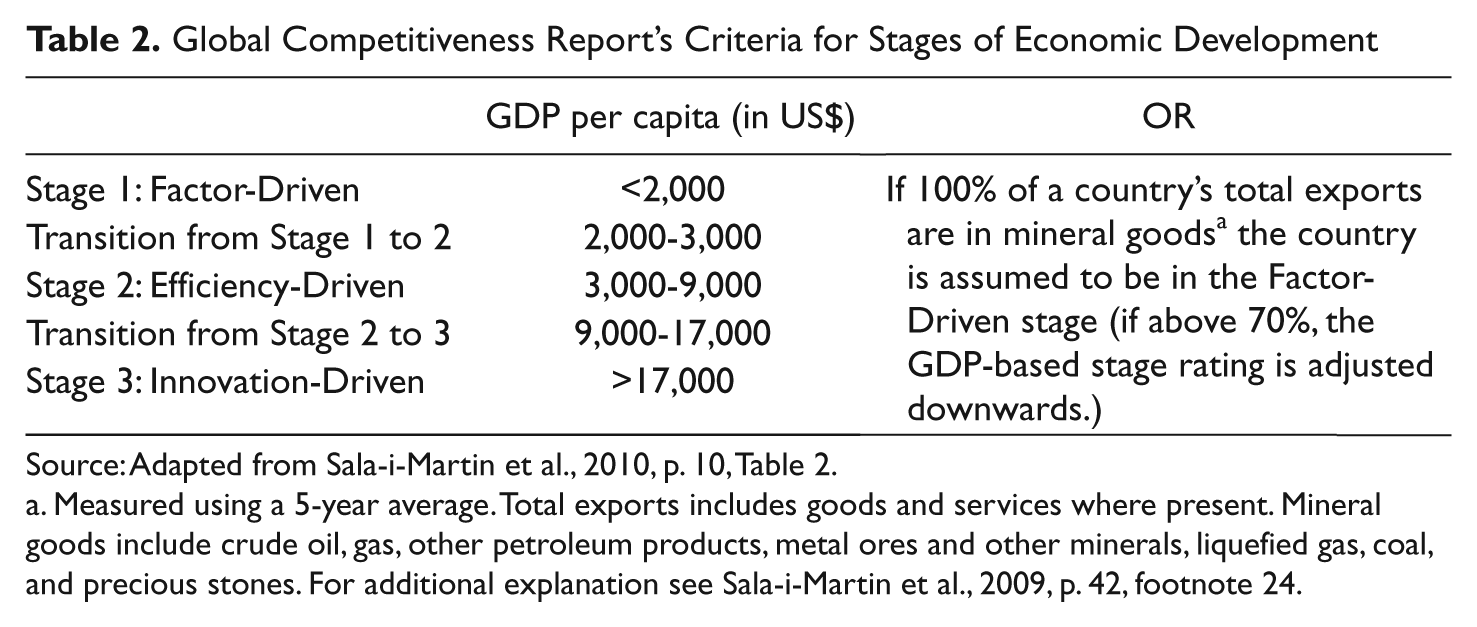
Source: Adapted from Sala-i-Martin et al., 2010, p. 10, Table 2.
Measured using a 5-year average. Total exports includes goods and services where present. Mineral goods include crude oil, gas, other petroleum products, metal ores and other minerals, liquefied gas, coal, and precious stones. For additional explanation see Sala-i-Martin et al., 2009, p. 42, footnote 24.
Drawing on GCR’s 12 pillars of competitiveness, the Global Entrepreneurship Monitor (GEM) provides recommendations for each stage of economic development (see Box 1) that give further insight into what are often government-related conditions needed for a country to enhance entrepreneurship and economic growth at its present stage and move into the next. The recommendations are supplemented by GEM’s own Entrepreneurial Framework Conditions (EFCs) in the Innovation-Driven stage. GEM’s EFCs were developed against a theoretical base to identify conditions relevant for innovation and entrepreneurship specifically (see Levie & Autio, 2008). In the 2009 survey, these conditions, including those that are government related, were found to be at expected levels for countries in each of the three stages of economic development (Bosma & Levie, 2010).
National Conditions for Economic and Entrepreneurship Growth from the GEM Model

Source: Excerpted from Bosma and Levie, 2010, p. 15, Figure 3. For a description of components under Basic Requirements and Efficiency Enhancers see Sala-i-Martin, 2009: 4-7. For Innovation and Entrepreneurship see Bosma and Levie, 2010: 33.
The GEM Report for 2009 (Bosma & Levie, 2010) also describes the role of entrepreneurship at the different stages of economic development. Of particular interest to this study, they find that for factor-driven economies the decline of agricultural work and movement of workers to extractive industries results in an oversupply of labor that leads to subsistence entrepreneurship. Indeed, the report finds that this kind of self-employment driven by necessity tends to be more prominent in less developed economies. For efficiency-driven economies, the move toward large-scale industrialization for increased productivity goes along with national economic policies that increasingly favor large businesses. Favorable conditions for emerging economic and financial institutions and openings in industrial supply chains support the development of entrepreneurship in small- and medium-sized manufacturing sectors. In innovation-driven economies, increasing wealth and desires of high-income societies support the expansion of the service sector at the same time as knowledge and research and development institutions support the aspirations of innovative entrepreneurs who are then willing to challenge larger, established economic players.
A Side Note on Culture and Entrepreneurship
Given the broad nature of culture, this research preliminarily explores the two aspects discussed in the culture literature deemed most likely to influence social enterprise: level of in-group collectivism (vs. individualism) and level of uncertainty avoidance in terms of what a society values. 4 In particular, this research takes the view supported by Tiessen (1997) that collectivism and individualism each support different key functions of entrepreneurialism. While the literature has long supported the idea that individualism supports entrepreneurial behavior broadly construed, Tiessen (1997) argues that individualism specifically supports the generation of variety through innovation (see Shane 1992, 1993) while collectivism supports the leveraging of resources internally and through external ties. Both the generation of new ideas and the ability to leverage resources are key to economic success on a societal level, which helps explain why some largely collectivist countries (the Asian tigers for example) have experienced economic success (Franke, Hofstede, & Bond, 1991). Low levels of uncertainty avoidance have also been associated with innovation (Shane, 1993). Thus the cultural aspects discussed here influence two different functions of entrepreneurship— innovation and networked resources—each of which has a positive effect on economic activity.
From Government (and Economy) to Civil Society, Empirically
Government actions also appear to be a leading factor shaping civil societies around the world. Based on two decades of empirical research, Salamon and Sokolowski’s (2010) models of civil society sectors differentiate five different types (see Table 3). The first three, liberal, welfare partnership, and social democratic, are all found in developed countries and to a significant degree are shaped by the structure of the welfare state. The last two, deferred democratization and traditional, are influenced to a lesser extent by the welfare state and more so by identifying characteristics of other aspects of government, including its absence in certain spheres. The economy is inherently important in the discussion to the degree that it makes possible the different types of welfare states or does not provide resources for one. In the latter situation, international aid may fill the gap, which has its own influence on civil society and ultimately social enterprise (the appendix provides descriptions of the models as well as country examples).
Salamon and Sokolowski’s Models of Civil Society Sector Structure

Source: Salamon & Sokolowski, 2010.
Note: Defining characteristics are shaded.
From Economy and Civil Society to Models of Social Enterprise
In Table 4, the typologies for economic development and civil society are combined to create models for social enterprise that incorporate how both contexts shape the organizational patterns for social enterprise in a given country. Models were identified only for those cross-sections between the two typologies where countries actually fell. The cross-sections where only one or two countries fell were labeled “transitional” (these countries were often identified as being in transition in terms of either their economy or civil society). The specific characteristics of social enterprise were drawn from the descriptions of social enterprise found in Kerlin (2009) for countries in the particular models (additional sources used are cited in the model descriptions). These models are meant to function as ideal types for social enterprise. Thus in some cases countries may diverge somewhat from outlined characteristics though still be considered largely aligned with the indicated model.
Models of Social Enterprise
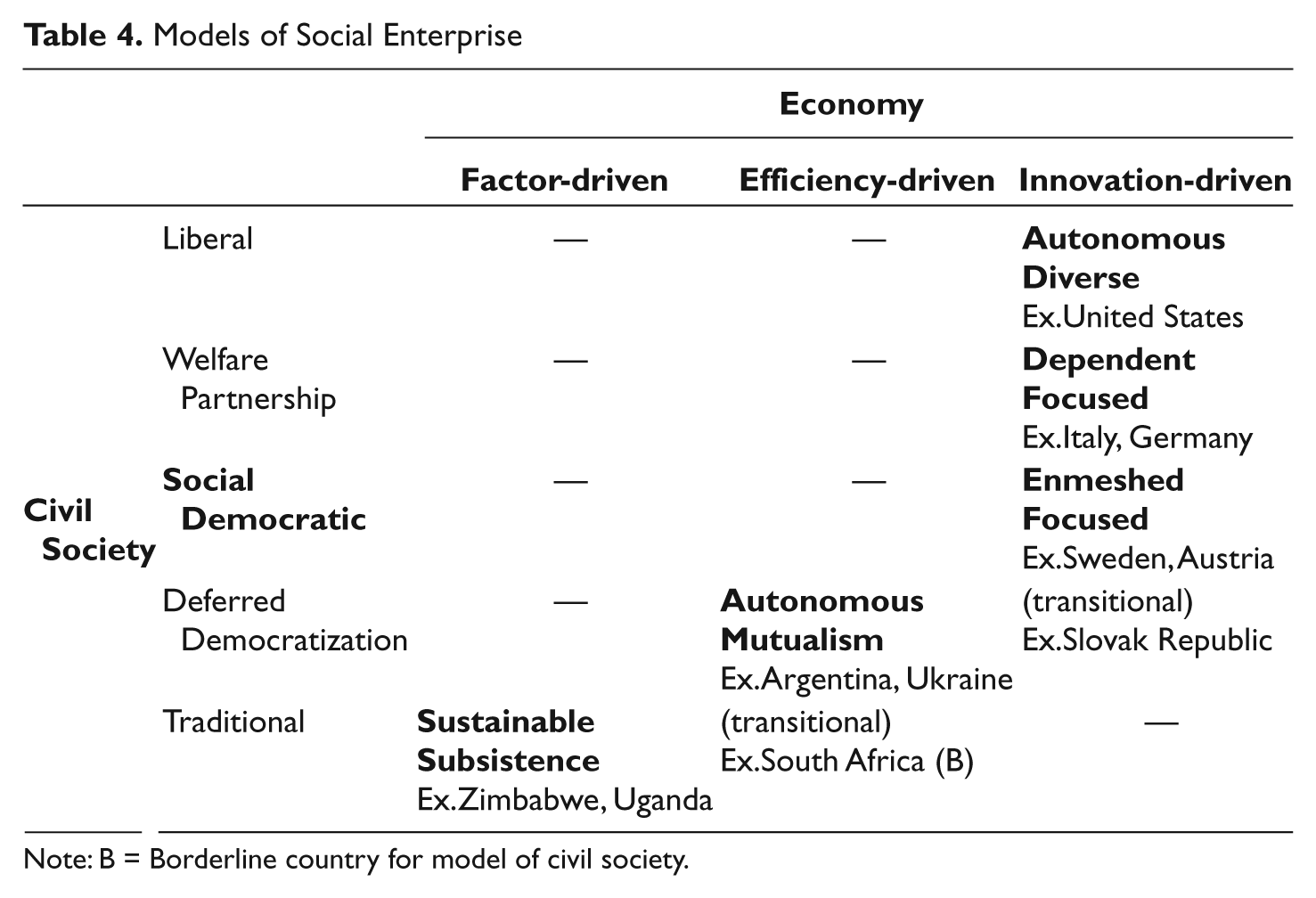
Note: B = Borderline country for model of civil society.
For the Sustainable Subsistence model, social enterprise is characterized by individualized small group efforts of entrepreneurs to provide poverty relief through subsistence employment for themselves and their families. These activities are supported by international aid and often appear in the form of microfinance-supported projects due to the need to provide a sustainable form of assistance and improve small-scale economic development. This model of social enterprise fits with the Factor-Driven stage of economic development because of the low GDP per capita that necessitates need-based entrepreneurialism and the Traditional Civil Society model that builds on traditional forms of social interaction in the small village group.
The Autonomous Mutualism social enterprise model is characterized by a postauthoritarian emerging civil society that comes together to fill gaps left in the economy and state social welfare. Cooperatives, recuperated companies, and other mutual assistance activities that provide needed services and employment are predominant forms of social enterprise. More so than other models, social enterprises may participate in and be viewed as a form of social activism, in part because of a past tradition of civil society working in opposition to an authoritarian state coupled with present efforts to provide a form of social justice for those left behind by the market and state. This model fits with the Efficiency-Driven stage because entrepreneurial activities often take the form of small- and medium-sized businesses and, in the case of recuperated companies, are involved in larger scale manufacturing activities commonly attributed to this stage. With a higher GDP per capita there is also more possibility for drawing on larger pooled resources for entrepreneurship, either formally or informally. The model also aligns with the Deferred Democracy model because social enterprises work autonomously from and sometimes in opposition to the state to address perceived deficiencies in state policies.
Both the Dependent Focused and Enmeshed Focused social enterprise models are characterized by the large presence of the welfare state, leaving in the first instance a narrow space for the development of social enterprise activities. Although social enterprise ideas may develop in the civil society sphere to provide a unique service, once proven, they can become captured in state welfare policy and dependent on state funding for their activities. Thus social enterprise runs the danger of only being associated with the narrow sphere of services popularized and supported by the state. There may also be occurrences of local municipalities running social enterprises or partnering with civil society organizations to do so.
The difference between the two models involves the number, connection to public policy, and at times the origin of social enterprises. While both models rely on state subsidies for implementation, in the Enmeshed Focused model there are fewer and less diverse kinds of social enterprises, many of which have close ties with specific public policies that may have spurred their development. Moreover, a small number of social enterprises have originated from the top down due to state privatization of sheltered workshop programs (Spear & Bidet, 2005). The two models fit with the Innovation-Driven stage because of the availability of a high degree of wealth necessary to support a large welfare state as well as government policies and other institutions supportive of innovative entrepreneurship. They each fit their respective civil society models because social enterprise has assumed a relationship with the state that aligns with the relationship between social service nonprofits and the state in each case.
The Autonomous Diverse model of social enterprise is characterized by a broader array of types of social enterprise activities in large part because of its autonomy from government due to a smaller welfare state. This autonomy from the state, in terms of the limited subsidies provided, also encourages the use of social enterprise as an income generator for organizations that at times is independent from programming for participants. There is also a highly supportive environment for innovative entrepreneurialism. Thus this model fits with the Innovation-Driven stage not only due to the latter but also due to the high level of wealth that supports private philanthropy for social enterprise. There may also be greater supply and demand for diverse social enterprise services due to a high-income society’s desire for them and ability to pay. The model fits with the liberal model of civil society because of its autonomy from the state.
Country Case Studies
Finally we examine the empirical features of key institutions representing social enterprise models in five countries to see whether and how institutional factors may be shaping social enterprise in specific countries according to the models. Table 5 shows the socioeconomic data for the five countries used in tracking large-scale differences across the five institutions relevant to social enterprise. Table 6 draws on currently available empirical evidence to show the differences in characteristics of social enterprise for the same five countries. 5
Socioeconomic Data for Five Countries
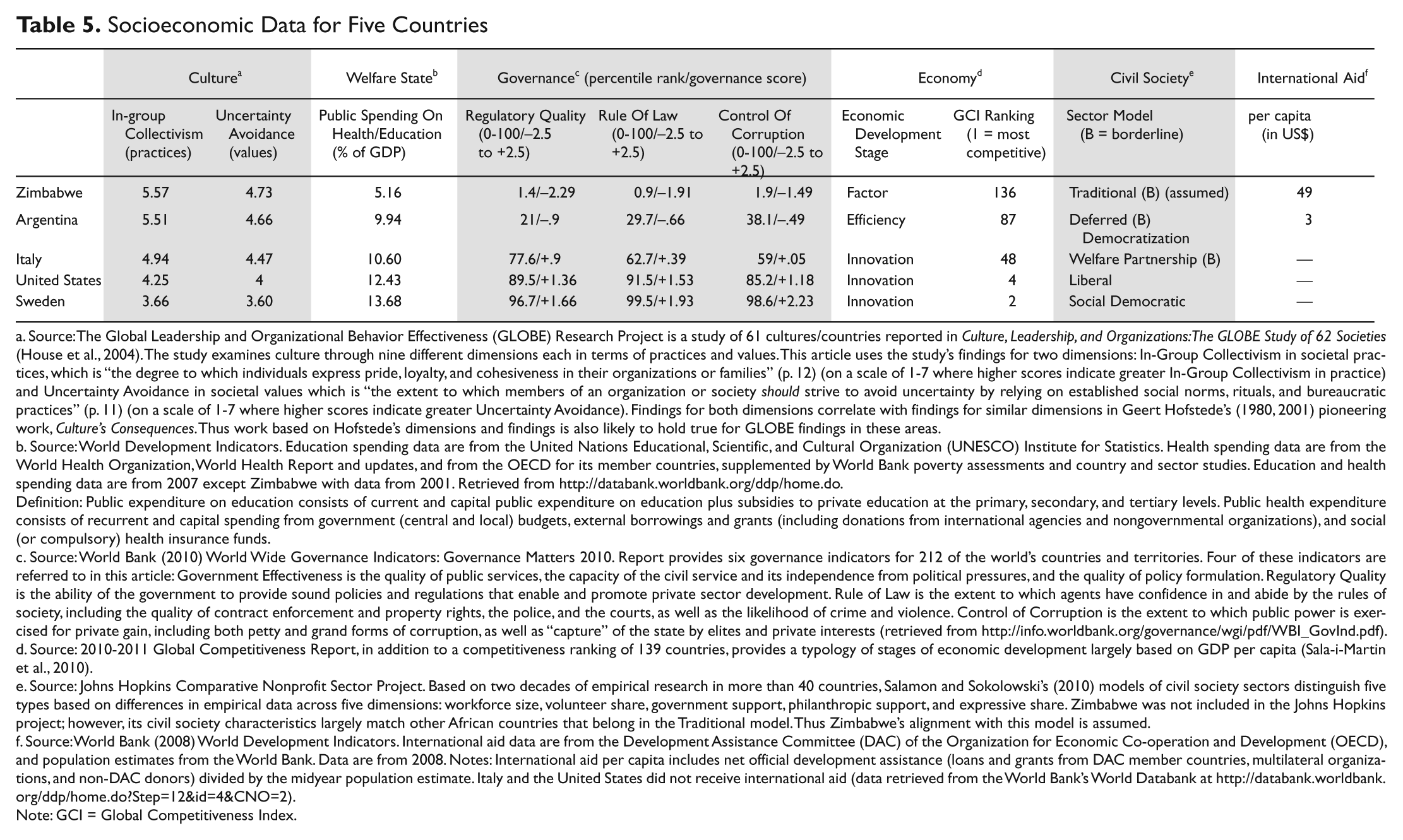
Source: The Global Leadership and Organizational Behavior Effectiveness (GLOBE) Research Project is a study of 61 cultures/countries reported in Culture, Leadership, and Organizations: The GLOBE Study of 62 Societies (House et al., 2004). The study examines culture through nine different dimensions each in terms of practices and values. This article uses the study’s findings for two dimensions: In-Group Collectivism in societal practices, which is “the degree to which individuals express pride, loyalty, and cohesiveness in their organizations or families” (p. 12) (on a scale of 1-7 where higher scores indicate greater In-Group Collectivism in practice) and Uncertainty Avoidance in societal values which is “the extent to which members of an organization or society should strive to avoid uncertainty by relying on established social norms, rituals, and bureaucratic practices” (p. 11) (on a scale of 1-7 where higher scores indicate greater Uncertainty Avoidance). Findings for both dimensions correlate with findings for similar dimensions in Geert Hofstede’s (1980, 2001) pioneering work, Culture’s Consequences. Thus work based on Hofstede’s dimensions and findings is also likely to hold true for GLOBE findings in these areas.
Source: World Development Indicators. Education spending data are from the United Nations Educational, Scientific, and Cultural Organization (UNESCO) Institute for Statistics. Health spending data are from the World Health Organization, World Health Report and updates, and from the OECD for its member countries, supplemented by World Bank poverty assessments and country and sector studies. Education and health spending data are from 2007 except Zimbabwe with data from 2001. Retrieved from http://databank.worldbank.org/ddp/home.do.
Definition: Public expenditure on education consists of current and capital public expenditure on education plus subsidies to private education at the primary, secondary, and tertiary levels. Public health expenditure consists of recurrent and capital spending from government (central and local) budgets, external borrowings and grants (including donations from international agencies and nongovernmental organizations), and social (or compulsory) health insurance funds.
Source: World Bank (2010) World Wide Governance Indicators: Governance Matters 2010. Report provides six governance indicators for 212 of the world’s countries and territories. Four of these indicators are referred to in this article: Government Effectiveness is the quality of public services, the capacity of the civil service and its independence from political pressures, and the quality of policy formulation. Regulatory Quality is the ability of the government to provide sound policies and regulations that enable and promote private sector development. Rule of Law is the extent to which agents have confidence in and abide by the rules of society, including the quality of contract enforcement and property rights, the police, and the courts, as well as the likelihood of crime and violence. Control of Corruption is the extent to which public power is exercised for private gain, including both petty and grand forms of corruption, as well as “capture” of the state by elites and private interests (retrieved from http://info.worldbank.org/governance/wgi/pdf/WBI_GovInd.pdf).
Source: 2010-2011 Global Competitiveness Report, in addition to a competitiveness ranking of 139 countries, provides a typology of stages of economic development largely based on GDP per capita (Sala-i-Martin et al., 2010).
Source: Johns Hopkins Comparative Nonprofit Sector Project. Based on two decades of empirical research in more than 40 countries, Salamon and Sokolowski’s (2010) models of civil society sectors distinguish five types based on differences in empirical data across five dimensions: workforce size, volunteer share, government support, philanthropic support, and expressive share. Zimbabwe was not included in the Johns Hopkins project; however, its civil society characteristics largely match other African countries that belong in the Traditional model. Thus Zimbabwe’s alignment with this model is assumed.
Source: World Bank (2008) World Development Indicators. International aid data are from the Development Assistance Committee (DAC) of the Organization for Economic Co-operation and Development (OECD), and population estimates from the World Bank. Data are from 2008. Notes: International aid per capita includes net official development assistance (loans and grants from DAC member countries, multilateral organizations, and non-DAC donors) divided by the midyear population estimate. Italy and the United States did not receive international aid (data retrieved from the World Bank’s World Databank at http://databank.worldbank.org/ddp/home.do?Step=12&id=4&CNO=2).
Note: GCI = Global Competitiveness Index.
Social Enterprise (SE) Characteristics for Five Countries
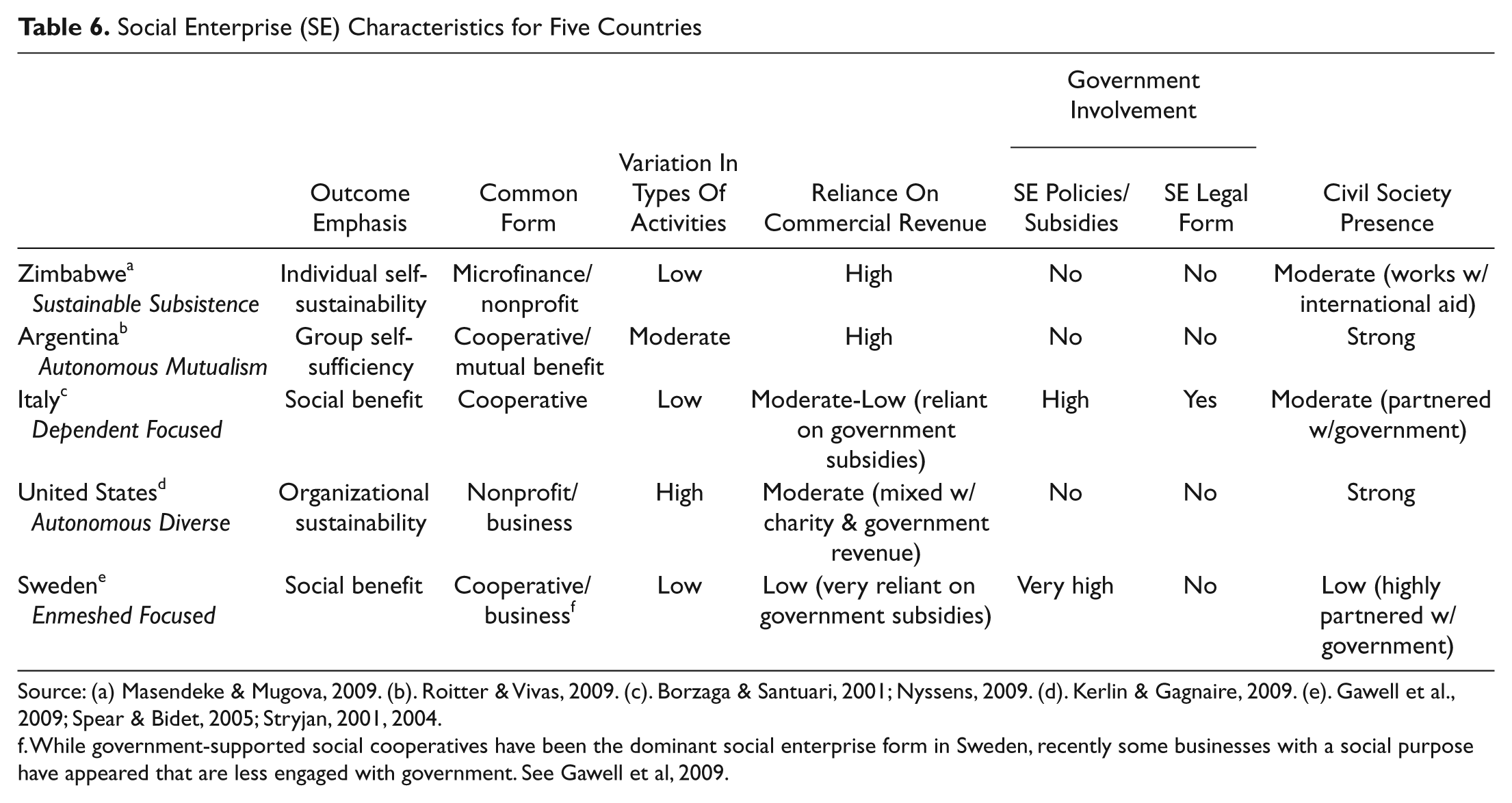
Source: (a) Masendeke & Mugova, 2009. (b). Roitter & Vivas, 2009. (c). Borzaga & Santuari, 2001; Nyssens, 2009. (d). Kerlin & Gagnaire, 2009. (e). Gawell et al., 2009; Spear & Bidet, 2005; Stryjan, 2001, 2004.
While government-supported social cooperatives have been the dominant social enterprise form in Sweden, recently some businesses with a social purpose have appeared that are less engaged with government. See Gawell et al, 2009.
Zimbabwe
Zimbabwe has a long and varied history of precolonial, colonial, and then authoritarian restrictions that interrupted and limited the development of the economy and civil society and helped shape the present state, a largely authoritarian-run “democracy.” However, cultural indicators show that citizens have a strong tradition of supportive collective activity. According to the GLOBE analysis Zimbabweans rate the highest of the five countries in terms of in-group collectivism (House et al., 2004). Here, collectivism is theorized to support social innovation and enterprise through the generation of “variety through group-based, incremental improvements and changes” and the leveraging of “their own resources by harnessing ‘clanlike’ affiliations” (Tiessen, 1997, p. 368). Given the current instability in Zimbabwe, a feeling or need for more uncertainty avoidance aligns with the situation in the country (House et al., 2004).
Indeed, World Governance Indicators and the Global Competitiveness Index (GCI) in Table 5 show that Zimbabwe has one of the poorest institutional environments in the world. In 2009 it had a GDP per capita of US$375 and is currently categorized as a Factor-Driven economy (Schwab, 2010, p. 350). Given its high poverty level, the country receives international aid estimated at US$49 per person in 2008 (World Bank, 2008). In terms of civil society, in 2010 the Zimbabwe National Association of Non-Governmental Organisations (NANGO) described government suspicion, mistrust of the sector, and recent victimization of civil society through arrests and intimidation as well as restrictions on its freedom of expression in the independent media (Zimbabwe National Association of Non-Governmental Organisations [NANGO], 2010). As far as civil society sector model, Zimbabwe best aligns with countries belonging to the Traditional model though it is a borderline case because it varies from them due to repression likely limiting the share of volunteer participation (Salamon & Sokolowski, 2010).
The failure of political and economic institutions and a weak civil society in Zimbabwe have led to a necessity-driven type of social enterprise characterized by microfinance supported by international aid. As such, immediate outcomes for social enterprise are focused on individual self-sustainability and the maintenance of livelihoods. Indeed, Masendeke & Mugova (2009) report that high levels of unemployment and the negative social impact of structural adjustment reforms promoted by international financial institutions have led to the recent movement toward social enterprise solutions. Not surprisingly, given the high collectivism rating, descriptions of social enterprise in Zimbabwe do indeed have a strong emphasis on collective microfinance forms of social enterprise that receive initial direction and support from international aid (Masendeke & Mugova, 2009). With little recourse to welfare state or philanthropic support, social enterprise is heavily reliant on commercial revenue. With its high level of poverty, lack of a supportive state, and need for sustainable livelihoods, Zimbabwe’s situation most closely aligns with the Sustainable Subsistence social enterprise model.
Argentina
Argentina transitioned from authoritarian to democratic rule in 1983. That event, as well as structural adjustment programs in the late 1990s and the 2001 economic crisis, had a dramatic effect on government policies, the economy, and civil society. Culturally, Argentina has a moderate risk avoidance rating and a high collectivism orientation, the latter manifesting itself in many forms of mutual association that have a long tradition. Reflective of recent events, Worldwide Governance Indicators for 2010 (see Table 5) show that Argentina has experienced declines in a number of areas since 1996 (World Bank, 2010). The 2010-2011 GCR finds that economic factors in Argentina have only recently improved in some respects (Schwab, 2010). The report, which places the country in the efficiency-driven stage of economic development, puts GDP per capita in at US$7,726 in 2009 (Schwab., 2010, p. 80).
According to Salamon and Sokolowski (2010), Argentina has a borderline Deferred Democratization civil society sector model. The recent changes in government and the economy have encouraged a restructuring of the relationship between civil society and the state. With the return of democracy in 1983, many associations were restored, though they were largely tied to the welfare state. Structural adjustment reforms in the 1990s, however, brought privatization and a dismantling of the welfare state, dramatically changing the landscape for civil society (Jacobs & Maldonado, 2005). When coupled with the 2001 economic crisis, the situation encouraged a (re)turn to mutual forms of civil society organizations (Roitter & Vivas, 2009).
With little recourse to the state or the economy during economic downturns, social enterprise in Argentina has developed in part around mutual benefit forms of organization that have a historical legacy in the country including cooperatives, mutual benefit associations, and cooperative recuperated companies. 6 Thus the immediate outcome emphasis of social enterprise is group self-sufficiency. Indeed, higher levels of GDP than Zimbabwe likely make it possible for groups to aggregate resources for mutual benefit and also be in less need of international assistance. Interestingly these larger scale social enterprise structures, at times including entire factories, align with the aggregation of production reflective of the efficiency driven economic stage Argentina is currently in. With little support from the welfare state, philanthropy, or even international aid, social enterprise is characterized by the large presence of civil society. The institutional context and their connection to social enterprise in Argentina thus best align with the Autonomous Mutualism social enterprise model.
Italy
With the start of the 21st century, Italy has experienced greater overall political and economic stability than in previous decades, though problems of corruption persist. Similar to other West European countries, Italy has a strong welfare state. Culturally, however, unlike other West European countries that value low uncertainty avoidance and have low collectivism, Italy values moderate uncertainty avoidance and practices moderate in-group collectivism. Worldwide Governance Indicators consistently rank Italy in the 60 and 70th percentile on a number of important indicators (see Table 5; World Bank, 2010). Categorized as an innovation-driven economy, the GCI ranked Italy 48th out of 139 countries in 2010. In 2009 Italy had an average GDP per capita of US$35,435 (Sala-i-Martin et al., 2010, p. 27).
The civil society sector in Italy is considered to be a borderline Welfare Partnership model (Salamon & Sokolowski, 2010). Historically, the foundation for civil society in Italy 7 was city corporations or guilds among other entities. These were self-managed forms of mutual assistance that had legal and financial autonomy. More recently the development of the welfare state meant many service-oriented civil society organizations became public entities. In the 1980s, however, budget restrictions and dissatisfaction with welfare state services spurred the development of new forms of civil society organizations, including social cooperatives (Barbetta, Cima, Nereo, Sokolowski, & Salamon, 2004).
The rise of social enterprise in Italy provides an example of a reemerged collective civil society tradition in the form of social cooperatives. 8 As Barbetta et al. (2004) note, social cooperatives “revitalized the mutuality sentiments of the guild, and at the same time sought to merge market means with charitable purpose” (p. 251). Initially a civil society response to a crisis of unemployment among hard-to-employ populations, the success of social cooperatives brought the attention and support of the welfare state, which used them to help further its policy agenda in the area of work integration for the hard-to-employ. Thus immediate outcomes for social enterprise in Italy focus on social benefit and social cooperatives have a reliance on government subsidies and supportive policies. Indeed, in 1991 Italy became the first country in Western Europe to pass legislation designating a legal form for social enterprise known as “type B” social cooperatives (Borzaga, 1996; Borzaga & Santuari, 2001; Nyssens, 2009). Given the mutual dependence of the welfare state and social cooperatives and the focus on work integration, the Italian case best aligns with the Dependent Focused model of social enterprise.
United States
In the United States, the stability and strength of its institutions over long periods of time have supported innovation and high economic growth, though the 2008-2009 economic recession has brought new challenges. Compared to West European countries, the United States has a small welfare state but similarly rates low on uncertainty avoidance and low on collectivism, both indicating a culture that drives innovation through the generation of variety. On government performance, the United States slipped into the high 80th percentile in 2010 after a decade in the 90th percentile on a number of factors due to the economic recession. Similarly, according to the 2010-2011 GCR, the United States ranked 4th of 139 countries, down from second place in 2009-2010 and first place in 2008-2009 (Sala-i-Martin et al., 2010). In the innovation-driven stage, its domestic economy remains the world’s largest with a 2009 GDP per capita of US$46,381 (Schwab, 2010, p. 340).
According to Salamon and Sokolowski (2010), the civil society sector in the United States belongs to the liberal model and is characterized by its large size, diverse activities, volunteer support, and autonomy from the state. Over the past few decades, it has experienced dramatic growth, making it difficult for traditional forms of nonprofit revenue (philanthropy and government) to keep up with the increased demand. Kerlin and Gagnaire (2009) suggest that this situation may have been a factor in a 20-year increase in commercial revenue supporting nonprofits (see also Kerlin & Pollak, 2011).
Like civil society, social enterprise in the United States is characterized by its autonomy from government due to lack of involvement of the welfare state as well as diverse activities. In addition to for-profit forms of social enterprise, it also has a growing foundation in the increasing number of nonprofits that are pursuing commercial activities as a revenue maintenance and growth strategy due to stagnation in government and philanthropic sources (see above). Given this function, unlike most other countries, social enterprise in the United States at times provides revenue generation without a programming component, though it can also provide both. Thus the immediate outcome for social enterprise is often organizational sustainability, which then supports social benefit. In the United States, innovation and effective governance spurs wealth that supports social enterprise development through private philanthropy and some government funding and a moderate but increasing reliance on commercial revenue. Given these institutional outcomes, social enterprise in the United States aligns with the Autonomous Diverse model.
Sweden
Sweden is known for its strong, stable institutions that include a healthy economy and a large welfare state that offers a high degree of social protection. Though the last few decades have witnessed a divestiture of some state responsibilities, this effort is ongoing. Culturally, Sweden scores the lowest among the five countries on both in-group collectivism and uncertainty avoidance in terms of what society values, the latter perhaps assisted by state social protections.
Sweden ranks among the highest in the world on both governance and economic factors. As the governance figures show in Table 5, it has among the highest rankings in government effectiveness, regulatory quality, rule of law, and control of corruption. In terms of its economy, Sweden moved from 4th to 2nd in the 2010 Global Competitiveness Ranking, replacing the United States in the number 2 position. This ranking can be attributed, among other variables, to highly efficient and transparent public institutions, trust in public officials, innovation, and a low level of corruption. The country falls into the innovation-driven economic stage and had a GDP per capita of US$43,986 in 2009 (Schwab, 2010, p. 310).
In terms of civil society, Sweden has a social democratic model characterized by less diversity but a high degree of volunteering (Lundstrom & Wijkstrom, 1995; Salamon & Sokolowski, 2010). The large presence of the welfare state in Sweden means that service delivery in certain areas such as health, education, and social welfare is almost entirely provided by the state. According to some theorists this has led to a smaller nonprofit sector that is focused on activities such as culture, adult education, and sports. However, for those few social service nonprofits that overlap with the state’s social welfare domain there is a high degree of financial and in-kind state support (Wijkstrom, 2000). Indeed, cooperation is so close that “it can be difficult to separate these entities one from the other” (Lundstrom & Wijkstrom, 1995, p. 22).
The dominance of the welfare state in Sweden has led to fewer social enterprises that operate in fewer spheres of activity. Because many of the work integration social enterprises that dominate social enterprise activity in Sweden fall into the welfare state’s sphere of activity (like some nonprofits), they have close ties with specific public policies and government institutions that in some cases spurred their development. These include social work cooperatives and community development businesses. Thus, in Sweden, social enterprise in many ways is a labor market policy tool that the welfare state uses to address problems of unemployment (Levander, 2010; Stryjan, 2001, 2004). Innovation and effective governance have supported a strong economy that in turn supports a strong welfare state. We also note, however, that recently in Sweden some businesses with a social purpose have appeared that are less engaged with government (Gawell, Johannisson, & Lundqvist, 2009). Overall it appears though that macro-level institutions in the Swedish context have helped shape larger outcomes for social enterprise that align it with the Enmeshed Focused model.
Conclusion
The five case studies attempt to illustrate how macro-level institutions (or at times the relative lack of them), including culture, the state, the economy, and civil society, put pressure on social enterprise organizations to fulfill particular functions and be structured in specific ways. Thus, generally speaking, this discussion has attempted to show that the resulting types of social enterprises appear to fit the particular needs as well as the institutional structures of each country. These case studies provide preliminary evidence for the existence of distinct models of social enterprise presented earlier. The models were formulated on the basis of a dynamic framework showing how socioeconomic institutions shape social enterprises in different countries. As supported by the theory of historical institutionalism, it can be expected that these socioeconomic institutions will change over time due to shifts in power relations and that social enterprise models for different countries will change over time as well.
Future research is needed to investigate current and additional country case studies from a deeper historical perspective. Indeed, the present study is only a preliminary overview based on the most widely available information. Such research will help validate the grouping of countries into like social enterprise models and also identify any new models. Other countries with significantly different contexts yet to be explored include Asian and Middle Eastern countries among others. Moreover, additional in-depth research may reveal greater differentiation within the models presented here. For example, differences across countries within the Autonomous Mutualism model may call for separate models for Latin American and East European countries. More rigorous formal testing of the models, including the extent to which they minimize within-group differences and maximize between-group differences, will be undertaken once models for social enterprise have been more fully expanded and fine-tuned. Though to a large extent theoretically based, this research has practical implications for the facilitation of cross-regional dialogue, the transfer and replication of social enterprise ideas, and the structures developed for their support.
Footnotes
Appendix
Descriptions of Salamon and Sokolowski’s Five Models of Civil Society Sectors
|
|
| In this model civil society is large due to greater reliance on nongovernmental services in the face of a relatively small welfare state (compared to other industrialized countries). Government funding is more limited and there is a sizeable reliance on private support including volunteers. Examples include United States, United Kingdom, and Australia. |
|
|
| Here civil society is large due to government reliance on the sector for implementation of its sizable welfare state policies. Funding is characterized by a large share of government revenue rather than resources coming from private sources including volunteers. Examples include Belgium, Germany, and Israel. |
|
|
| Civil society in this model can be large but circumscribed to expressive roles and activities due to a sizable welfare state that both funds and delivers social services. Expressive functions include advocacy, sports, recreation, and culture supported by a high level of volunteering and fees-for-service. Examples include Austria, Norway, and Sweden. |
|
|
| Here civil society remains small due to repressive or neglectful policies of a state that views certain forms of civil society activity as a threat to itself and/or economic development. With little government support, the sector relies on fees where it provides services for the upper class and international aid where it serves the poor. Volunteerism is limited. Examples include Brazil, Colombia, and Poland. |
|
|
| In this model civil society is small and is characterized by the persistence of traditional social relationships and forms of helping. With the government providing little support even for welfare services, the sector focuses on antipoverty services and maintains itself primarily through fees and international aid. Volunteerism can be sizable because there is little opposition from the state. Examples include Kenya, Pakistan, Uganda. |
| Source: Salamon & Sokolowski, 2010. |

Declaration of Conflicting Interests
The author declared no potential conflicts of interest with respect to the research, authorship, and/or publication of this article.
Funding
The author received no financial support for the research, authorship, and/or publication of this article.