



Abstract
This article studies the influence of the procedural justice resulting from participation in decision-making on employees’ affective commitment in social enterprises. It also examines whether any potential link between participation and commitment is due to social exchange, as is the case with for-profit companies. The study is based on data from employees of French work integration social enterprises. The results confirm the positive relationship between procedural justice and affective commitment and the mediating role of perceived organizational support and leader–member exchanges. Managerial recommendations are then given to best maintain or increase employees’ involvement in the decision-making processes of social enterprises.
Keywords
The last two decades have seen an increasing number of innovative entrepreneurial initiatives to combat social exclusion and poverty in Europe (Defourny, Develtere, Fonteneau, & Nyssens, 2009). These organizations, known as “social enterprises,” combine a variety of resources from the market and the public and civil spheres to achieve not-for-profit economic activity (Herranz, Council, & McKay, 2011). They are particularly active in the areas of social services and work integration (OECD, 2009).
Participation in decision-making is a characteristic of the “ideal type” of European social enterprise (Borzaga & Defourny, 2001); this participation is an asset for this type of not-for-profit business. It fosters employee perceptions of procedural justice in the organization, which is a factor of performance. Rhodes and Steer (1981) highlighted this “participation effect” in a comparative study of attitudes in cooperatives and capitalist firms. As the decision-making process in not-for-profit organizations includes workers, it can increase job satisfaction (Benz, 2005; Borzaga & Tortia, 2006), enthusiasm for work (Frohlich, Godard, Oppenheimer, & Starke, 1998), and organizational commitment (Bacchiega & Borzaga, 2001). Organizational commitment is of particular importance for an organization because it can affect outcomes such as turnover and generates many citizenship behaviors, among others (Meyer, Stanley, Herscovitch, & Topolnytsky, 2002). It is also crucial for social enterprises for several reasons. First, employees of social enterprises identify more readily with their organization (Ridder & McCandless, 2010). Second, social enterprises are underpinned by their employees’ affective commitment to the organization (Ohana & Meyer, 2010). Finally, not-for-profit employees are partly values driven (De Cooman, De Gieter, Pepermans, & Jegers, 2011; Ridder & McCandless, 2010). Thus, the link established between the employee and the organization is essential in the social economy, as it strengthens commitment to the social mission and its inherent values. Social enterprise managers have a particular stake in supporting this commitment, especially because the limited financial resources make it difficult to award conventional monetary incentives.
However, participation in decision-making is far from pervasive in social enterprises; it is currently threatened by factors both inside and outside the organization. In particular, as is true for other not-for-profit organizations, social enterprises have become more market oriented (Defourny & Nyssens, 2008). Their leaders tend to adopt an approach that does not use a participative management style. This can make the organization appear unfair and may risk losing the commitment of employees who were initially attracted by its mission.
Thus, there are two opposing forces: one in favor of a culture that includes participation in decision-making and another that is against. The purpose of this article is to analyze the link between the perceptions of procedural justice resulting from participation in decision-making and employee organizational commitment in social enterprises. If a relationship demonstrates the necessity of a participative environment, we will attempt to discover the reasons for this relationship. More precisely, social exchange mediation will be tested (Allen, Shore, & Griffeth, 2003; Masterson, Lewis, Goldman, & Taylor, 2000; Rhoades, Eisenberger, & Armeli, 2001). Indeed, a two-phase social exchange process may explain the link between procedural justice and commitment (Lavelle, Rupp, & Brockner, 2007): employee participation is perceived as support from authority and, in turn, reciprocated as commitment.
There is a growing literature on governance of not-for-profit enterprises (Cornforth, 2003; Enjolras, 2009; Van Puyvelde, Caers, Du Bois, & Jegers, 2012), particularly in social enterprises (Low, 2006; Mason, 2009; Ridley-Duff, 2010; Spear, Cornforth, & Aiken, 2009). Yet the impact of governance on employee management in social enterprises has never been properly addressed. This article aims to fill this gap by analyzing the consequences of procedural justice in terms of commitment within social enterprises and the mechanisms responsible for it.
The following section deals with employee involvement in the decision-making process within social enterprises. The theoretical model and hypotheses are described in the section “Theoretical Model and Hypotheses.” The section “Method” explains the methodology, and the penultimate section presents the results. The last section analyzes the results and outlines some managerial implications.
Participation in Decision-Making Within European Social Enterprises: From Principles to Reality
In Europe, social enterprises are not-for-profit organizations that work toward social goals, such as the integration of disadvantaged people, in an entrepreneurial way. The EMES European Research Network has defined a set of social and economic criteria for social enterprises (Borzaga & Defourny, 2001). The economic criteria include the production of goods and/or services on a continuous basis, the willingness to undertake economic risk, a high level of autonomy, and a certain percentage of paid workers. The social criteria include an explicit goal to serve the community, an initiative launched by a group of citizens, decision-making power not based on capital ownership, a participatory structure that involves various groups of stakeholders, and limited profit distribution.
Social enterprises are deeply embedded in the culture of participation in decision-making (Defourny et al., 2009). Decision-making power in social enterprises descends from the cooperative tradition, which generally means “one member, one vote,” or at least that each member has voting power not based on capital shares. Stimulating stakeholder involvement in general, and employee involvement in particular, helps build the social, economic, and sometimes environmental aspects of the mission. It makes it easier to identify new needs, seek innovative solutions, and commit the financial resources needed to offer a quality service (Siciliano, 1996). But several factors may keep employee involvement in decision-making from producing the expected results.
First, social enterprises, like most businesses, want to develop. Yet, as the organization grows, the procedures for collective decision-making become denser and more complicated (Cornforth, Thomas, Lewis, & Spear, 1988; Rothschild & Whitt, 1986). Employee representation on the decision-making bodies may also be problematic, primarily due to the worker profile (Davister, Defourny, & Grégoire, 2004). Employees with demanding supervisory roles often lack the time to become involved, feel disconnected from economic issues, and may feel incompetent at strategic decision-making. Moreover, the paternalistic culture of some social enterprises, mainly in France, will hinder participation in decision-making as employees in this type of organization tend to cede power to the leaders, whom they deem more competent (Eme & Gardin, 2003). The legitimacy of a participative decision-making process is also currently being undermined by the changing context of social enterprises. The sharp drop in public funding has prompted social enterprise leaders to intensify their search for private financing and to develop their commercial activity. Participation in decision-making no longer seems to be a managerial priority (Dart, 2004; Eikenberry, 2009).
Due to the difficulties in maintaining participatory decisions within social enterprises, a crucial question arises: Is it really beneficial for social enterprises to involve employees in the decision-making process? The next section presents the expected positive consequences of such practices on employees’ commitment to their organization. It is framed as a series of hypotheses to be tested to assess their adequacy in the context of social enterprises.
Theoretical Model and Hypotheses
Procedural Justice and Affective Commitment to the Organization
Procedural justice refers to the perception of justice with regard to decision-making procedures (Folger & Greenberg, 1985); that is, how a given result is achieved. Participation in decision-making (or “voice”) is thus an operationalization of procedural justice. It is subsumed in Thibaut and Walker’s “process control effect” (1975), defined as having control over the presentation of our arguments and having sufficient time to present our case, and Leventhal’s “representativeness” criterion (1980), defined as the assurance that the opinions of the various groups affected by a decision have been taken into account. Employees will be more likely to perceive the decision-making process as fair if they participated (Folger & Cropanzano, 1998; Korsgaard & Roberson, 1995). In social enterprises, where participation in decision-making is a principle, the strength of this perception will vary according to the extent to which employees are involved in decision-making. The meta-analyses carried out by Cohen-Charash and Spector (2001) and Colquitt, Conlon, Wesson, Porter, and Ng (2001) have shown the wide variation in attitudes and behaviors of employees affected by procedural justice, such as the intention to quit (Aryee, Budhwar, & Chen, 2002), citizenship behavior (Podsakoff, MacKensie, Paine, & Bachrach, 2000), intention to volunteer (Price, Lavelle, Henley, Cocchiara, & Buchanan, 2006), and organizational commitment (Viswesvaran & Ones, 2002). Recent empirical findings confirm that voice has an effect on outcomes (Wood & Wall, 2007), including job satisfaction (Farndale, Van Ruiten, Kelliher, & Hope-Hailey, 2011) and organizational commitment (Holland, Pyman, Cooper, & Teicher, 2011).
Organizational commitment refers to the extent to which an employee identifies with his or her organization and is committed to it (Steers, 1977). There are several types of organizational commitment: affective, continuance, and normative (Meyer & Allen, 1991). Affective commitment implies an affective connection between individuals and the organization, expressed through common values and goals and a feeling of belonging that produces a sense of pride. People remain in the group because they want to. Continuance or rational commitment involves the use of reason. Individuals stay in the group because they have performed a cost–benefit calculation based on their rational or financial interests. Finally, normative commitment is a norm- or value-based type of commitment (Meyer & Herscovitch, 2001). Those who remain do so out of a sense of duty, obligation, or guilt. In this article, we will only consider affective commitment to the organization.
Affective commitment is the type of commitment that is the most empirically linked to our study’s variables of interest. Procedural justice and organizational support, as well as various outcomes with vital implications for social enterprises such as turnover, absenteeism, and citizenship behaviors, are primarily related to the affective form of commitment (Meyer et al., 2002). Affective commitment is also more appropriate when studying social exchange mediation variables. As Kacmar et al. state, “feelings of affective commitment toward the organization can be considered an important part of reciprocating perceptions of fair treatment, whereas continuance or normative commitment occurs because of a felt need or obligation” (Kacmar, Andrews, Blakely, & Bucklew, 2008, p. 740). With regards to organizational commitment, factors relating to the organization’s structure or employee personality traits have less impact than work experience, which includes procedural justice (Meyer & Allen, 1997; Rhoades et al., 2001). Thus, procedural justice is expected to be a determinant of affective commitment, as has been shown in numerous studies.
A first explanation lies in the group value model (or relational model) of justice (Lind & Tyler, 1988; Tyler & Lind, 1992). Being given the opportunity to express an opinion about a decision that needs to be made reinforces self-esteem and identity. When the organization applies fair procedures, it spreads information about the quality of the relationship with its employees. Employees who are involved in decision-making by their organization or supervisors assume that they have a certain status in relation to the authority in question. This will foster positive attitudes such as organizational commitment.
A second explanation can be found in the social exchange literature. The two-phase social exchange relationship of the target similarity model (Lavelle et al., 2007; Lavelle et al., 2009a; Lavelle, McMahan, & Harris, 2009b) can help to understand the mechanism. Employees who contribute to organization decision-making will positively interpret the exchanges that occur and believe the organization is taking care of them (Wayne, Shore, Bommer, & Tetrick, 2002). They will have a positive perception of the support of their organization (Phase 1). In return, the employees will feel attached to their organization as a result of reciprocity (Phase 2).
Hypothesis 1: Procedural justice is positively related to affective commitment in the context of social enterprises.
Theory of Social Exchange and the Mediating Effect of Perceived Organizational Support (POS) and Leader–Member Exchange (LMX)
The relationship between procedural justice and affective commitment can be explained in terms of social exchange (Blau, 1964; Gouldner, 1960). From this perspective, there are two types of exchange: economic and social. Economic exchanges refer to exchanges where the parties focus on the output of the exchange relationship. These exchanges are usually short-lived and impersonal and the interests of the other party are not a major concern (Balkin & Richebé, 2007; Sparrow & Liden, 1997). On the contrary, social exchanges are long term. The obligations of each party, whether in terms of type or duration, are not specified in advance. Social exchange can take two forms depending on whether it takes place between the employee and the organization, or between the employee and the supervisor (Wayne, Shore, & Liden, 1997). These relations refer respectively to the theories of perceived organizational support (POS) and leader–member exchange (LMX).
One concept deriving from the theory of social exchange is the concept of organizational support (Eisenberger, Huntington, Hutchison, & Sowa, 1986). POS represents employee perceptions of how much the organization values their contributions and cares for their welfare. Thanks to social exchange, POS induces employees to feel indebted to their organization. This feeling becomes personified and, because of this personification (Levinson, 1965), the norm of reciprocity is activated to return the favor. This reciprocity engenders employee attitudes and behaviors that are beneficial to the organization. For example, high levels of POS lead to high levels of performance (whether in-role or extra-role), involvement, commitment, and lower levels of absenteeism and staff turnover (Rhoades & Eisenberger, 2002). More specifically, POS is positively correlated with affective commitment to the organization. Social enterprise employees, who feel that their company is committed to them, will commit to their company on a reciprocal basis.
A second concept arising from the theory of social exchange is that of the LMX (Graen & Uhl-Bien, 1995). This refers to the quality of exchanges between employees and supervisors (Graen & Scandura, 1987). Unlike with standard theories, there is no average leadership style; there are as many management styles as there are employee–supervisor dyads (Dansereau, Graen, & Haga, 1975). The LMX theory posits that both parties exchange tangible and intangible assets that they deem to be fair. The more exchanges there are, the better the employees’ perception of LMXs. Employees with high LMX thus receive preferential treatment with more trust, respect, and obligation (Graen & Uhl-Bien, 1995). This is beneficial for them and will improve their job satisfaction (Lapierre & Hackett, 2007). They will then reciprocate with positive attitudes and behaviors toward the originator. The consequences will differ depending on who is determined to be responsible for this positive treatment. For example, if the superior is not seen as representative of the organization as a whole, the LMX will have no direct effect on organizational commitment (Masterson et al., 2000). However, social enterprises tend to be small-scale structures and there is significant ideological proximity with the manager. Therefore, it is reasonable to assume that the superior will be seen as representative of the organization. We thus hypothesized a correlation between LMX and affective commitment.
Hypothesis 2a: POS is a mediator between procedural justice and affective commitment in the context of social enterprises.
Hypothesis 2b: LMX is a mediator between procedural justice and affective commitment in the context of social enterprises.
The hypotheses are represented in the model depicted in Figure 1. The next sections of the article consist of testing the relationships assumed in the hypotheses and represented in the model.
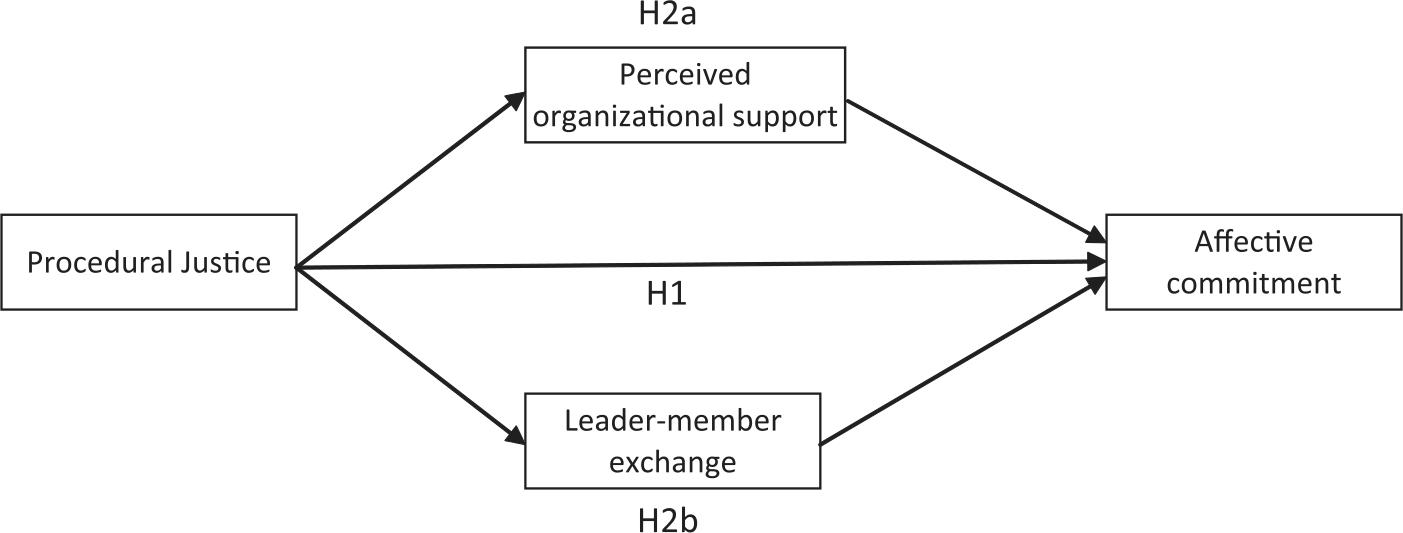
Hypothesized model.
Method
Population
The data were collected through a survey of work integration social enterprises. These organizations aim to facilitate the integration of disadvantaged people through work. They provide social or environmental services such as recycling waste or maintaining public spaces.
Following initial telephone contact, a questionnaire was mailed to the directors of French WISEs between October 2007 and July 2008. Permanent staff responded to the questionnaire in writing and returned it in a prepaid envelope. Subjects were informed that their anonymity was guaranteed.
In total, we contacted 27 companies with 261 permanent employees. We received 101 replies, yielding a response rate of about 39%. The median age category of the respondents was 36 to 45 years. Seniority in the company was relatively evenly distributed, ranging from less than 2 years to over 10 years. About two thirds of respondents had pursued post–high school studies and 54% were male.
Measurement
Procedural justice
Procedural justice is measured using the scale devised by Beehr, Walsh, & Taber (1976) and later applied by Rhoades et al. (2001). It contains three items measured on a scale ranging from 1 to 7. An example item from this scale is “Decisions in work are usually made without consulting the people who have to live with them” (reverse coded). Cronbach’s α is 0.67, which is slightly below the threshold of 0.7. However, this concurs with previous studies where Rhoades et al. (2001) found a α of 0.62.
POS
POS is measured using a reduced version of the scale devised by Eisenberger et al. (1986), proposed by Tekleab, Takeuchi, and Taylor (2005). An example item included is: “My organization cares about my general satisfaction.” The scale has three items and Cronbach’s α is 0.82.
LMX
LMX is measured using the LMX–MDM scale devised by Liden and Maslyn (1998). This is a Likert-type scale, ranging from 1 to 7. We selected 11 of 12 items from the original scale after removing one item that correlated poorly with the others. As an example, one item asked participants: “My supervisor would defend me to others in the organization if I made an honest mistake.” Cronbach’s α is 0.93.
Affective commitment
Affective commitment is measured through the work of Hartline and Ferrell (1996) and Netemeyer, Boles, McKee, and McMurrian (1997). The scale is one used by Ackfeldt and Coote (2005), and it has four items with responses ranging from 1 to 5. It refers specifically to affective commitment. As an example, one item is “This company has a great deal of personal meaning for me.” Cronbach’s α is 0.79.
Control variables
We also included several control variables that may influence the relationship, such as age, gender, seniority in the company, years of study, and type of contract.
Results
We first conducted a CFA with Lisrel 8.8 to test for convergent and discriminant validity. Given the small sample, we employed structural equation modeling using item parceling (Aryee et al., 2002; Bagozzi & Heatherton, 1994). An exploratory factor analysis was used to create item parcels for the constructs. Parcels were created by averaging items with the highest and lowest loadings for each construct, followed by the items with the next highest and lowest loadings until all of the items were included. This procedure is necessary to reduce the number of parameters estimated in the measurement models. We then conducted the CFA with the parceled items (detailed results available upon request). All individual path loadings from an item to its specified latent construct were significant, providing evidence of convergent validity. Moreover, the hypothesized four-factor model produced a good and significantly better fit compared with the one-factor model (for the four-factor model: χ2 = 26.4, df = 21, RMSEA = 0.05, SRMR = 0.04, GFI = 0.95; compared with the one-factor model: χ2 = 155.6, df = 27, RMSEA = 0.22). In addition, we compared our initial four-factor model with all possible alternative measurement models. The hypothesized model produced significantly the best fit with the data (for PJ and POS together Δdf = 3, Δχ2 = 21.7***; PJ and LMX Δdf = 3, Δχ2 = 45.7***; PJ, POS, and LMX Δdf = 5, Δχ2 = 69.2***; POS and LMX Δdf = 3, Δχ2 = 45.3***; POS and OC Δdf = 3, Δχ2 = 39.8***; LMX and OC Δdf = 3, Δχ2 = 56.3***; POS, LMX, and OC Δdf = 5, Δχ2 = 92.6***).
To test our hypotheses, we used a series of regressions. To test the mediation hypotheses, we applied the Baron and Kenny (1986) method, including a four-step strategy for establishing that a variable is a mediator. This leads to the analysis of three regressions. The first step involves showing that the independent variable is correlated with the dependent variable. The second step aims to show that the independent variable is correlated with the mediating variable. The third step demonstrates that the mediator affects the dependent variable. The fourth step involves proving that the effect of the independent variable on the dependent variable is reduced (partial mediation) or zero (complete mediation) when the mediating variable is introduced. To follow this process, we tested the effect of the control variables on affective commitment. We then introduced the independent variable (i.e., procedural justice) and then the mediating variables (i.e., POS and LMX).
The first model in Table 2 shows that none of the control variables have any impact on affective commitment. The second model of Table 2 shows that Hypothesis 1 is confirmed. There is indeed a significant positive relationship between procedural justice and affective commitment (B = 0.16, p < .01).
To test Hypotheses 2a and 2b, we used the Baron and Kenny (1986) method. Procedural justice was correlated with affective commitment and with POS and LMX (see Table 1). The third model in Table 2 shows a significant positive relationship between affective commitment and the mediating variables (i.e., POS [B = 0.32, p < .01] and LMX [B = 0.21, p < .01]). Moreover, introducing the mediating variables reduced the effect of procedural justice (B = 0.02, p > .05).
Variable Correlations.
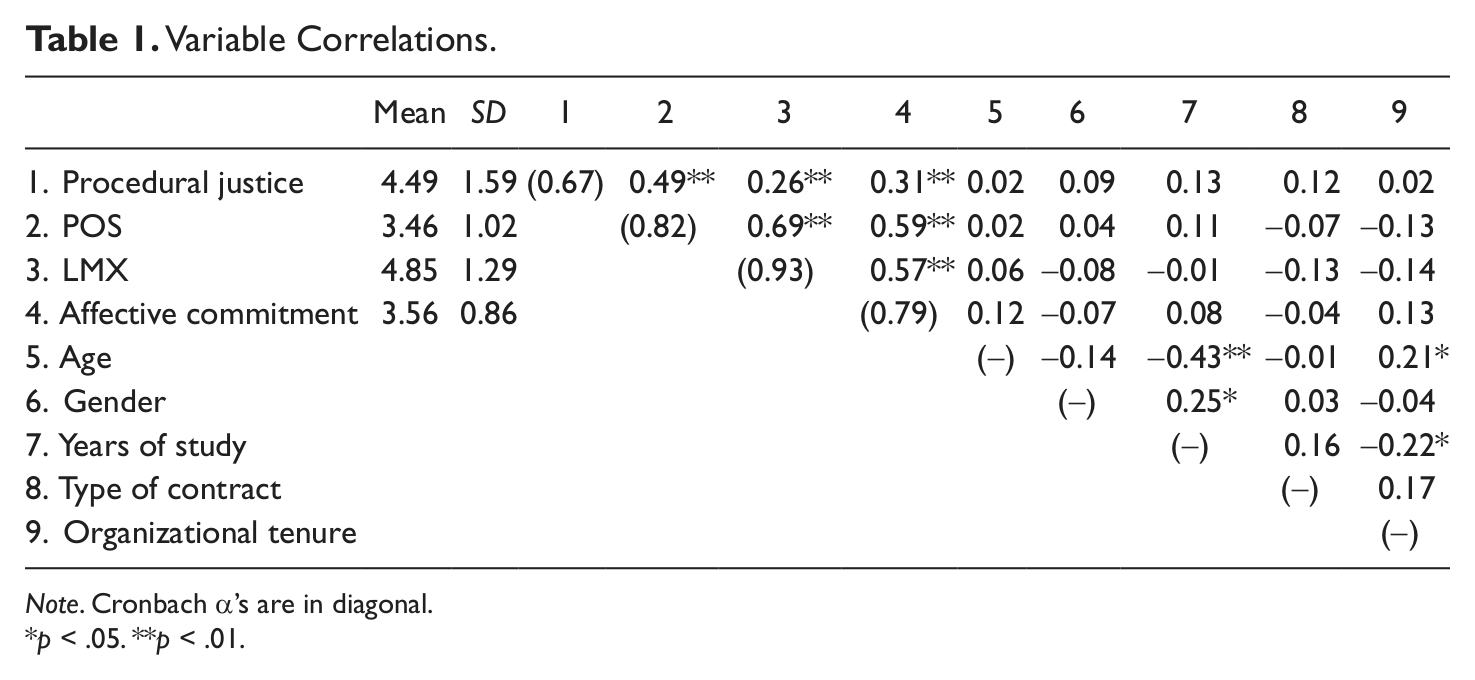
Note. Cronbach α’s are in diagonal.
p < .05. **p < .01.
Regression Analysis of Affective Commitment.

p < .05. **p < .01.
The Sobel tests of the indirect effect of procedural justice on commitment revealed significant statistics. Specifically, Sobel z-statistics equal 2.64 for POS (p = .01) and 2.04 (p = .04) for LMX. The statistics satisfy all the prerequisites for a partial mediating role of the support variables between procedural justice perception and affective commitment. We can therefore accept Hypotheses 2a and 2b.
Discussion and Managerial Implications
As participation in decision-making is a controversial issue in the current context of social enterprises, identifying its potential effect on employee attitudes is essential. Our research accomplished this challenge by showing that participation in decision-making leads to greater employee commitment to the organization. First, this research was the first that empirically studied the effect of voice on commitment in nonprofits. Second, the mediating effect of social exchange variables was explored.
Several results merit further discussion. First, we find a direct positive relationship between procedural justice, LMX, and organizational affective commitment. This runs counter to the empirical results of Masterson et al. (2000), which show no significant link between procedural justice and LMX. Wayne et al. (2002) explain this latter result as the supervisor being perceived as having no control over organizational policies and thus not responsible for deciding whether employees are allowed to voice their opinions. However, social enterprises are generally small-scale operations, essentially headed by the manager who is, at least in part, the guarantor of the firm’s participative management. In this case, employees may well attribute responsibility for their sense of procedural justice to the manager. Also, our measure of procedural justice does not stipulate whether the supervisor or the organization is accountable for the procedures. In their target similarity model, Lavelle et al. (2007, 2009a, 2009b) show that relationships will be stronger when targets are matched across the constructs of procedural justice, support, and commitment, and the model allows for weaker cross-foci effects. The fact that the source of justice is not explicitly specified could explain why procedural justice and LMX are strongly linked. More research about these kinds of cross-foci effects are needed to better understand the consequences of LMX.
Second, our investigation supports the mediating role of social exchange between procedural justice and affective commitment. This means that when employees can express their views about their organization, they feel indebted and will reciprocate through their commitment to the organization. Although demonstrated in many studies (Masterson et al., 2000), this result should not be overlooked as it relates to social enterprises. While much organizational behavior research has studied public or private organizations, there has been little focus on social enterprises (with the exception of Borzaga & Tortia, 2006 and Ohana & Meyer, 2010). The results from social enterprises may differ from those obtained in conventional firms. For example, Meyer and Ohana use the context of social enterprises to explain the specificity of their results concerning the relationship between organizational justice and both organizational citizenship behavior (Meyer & Ohana, 2009) and the intention to quit (Ohana & Meyer, 2010). In fact, a recent trend in management research has been to study management issues in specific contexts (Antonakis & Liden, 2009; Helmig, Spraul, & Tremp, 2012). Boundary conditions to known relations by studying them in a different environment may be found. It is also necessary to question the application of for-profit business tools to the context of not-for-profit organizations, as this can lead to unintended negative consequences (Beck, Lengnick-Hall, & Lengnick-Hall, 2008). More specifically, the social exchange phenomenon observed in this article in the context of social enterprise is sound.
From a practical standpoint, safeguarding participative decision-making requires an approach to human resource management that encourages social enterprise employees to express themselves, not only in governing bodies but also in local discussion forums. First, individuals need to learn how to participate in decision-making. In addition to technical skills, certain social and intellectual skills appear to be essential to contribute to decision-making effectively. Nevertheless, these skills cannot be acquired through practice alone. The challenge is therefore to provide staff training in listening, speaking, and discussion skills. Employees may perceive this training as a gift that they will repay through their commitment to their employers (Balkin & Richebé, 2007).
However, voting is not the only way to exercise democracy. Not all employees can be involved in the development of corporate strategy. Therefore, employees need to be offered other ways to be involved in the life of their organization. Employees may directly contribute to the activities of the group in which they work. Social enterprise managers can thus involve employees in setting goals for the enterprise and defining the content of their activities. A participatory approach to management is appropriate, given the specific profile of social enterprise employees; this can be accomplished by the establishment of local discussion forums that work toward achieving the mission.
When people work together on a project and learn from each other through their joint efforts, they become what sociologists call “a community of practice” (Brown & Duguid, 1991; Lave & Wenger, 1990). Based on three basic principles—commitment, shared culture, and practice—these communities operate independently and their strength lies in the social bonds they create or consolidate. They also lead to collective learning without the production of knowledge being a declared objective. In the context of WISEs, communities of practice may emerge in multidisciplinary working groups in which technical employees mingle with administrative and managerial staff. This may happen without stigmatizing those who are just returning to the labor market and who are instead seen as genuine stakeholders. Collective discussion becomes possible and makes sense within these smaller and more diverse communities. It focuses on simple, local problems that are not directly related to the production of goods or services, such as redesigning workstations or fitting out premises (i.e., problems about which everyone can express an opinion). The community of practice emerges from a spontaneous joint initiative. Because it has not been set up arbitrarily, employees feel supported by their superiors and, more generally, by their organization. LMX is thus enhanced through opinion sharing and the exchange of viewpoints. Employees are encouraged to speak, understand the other’s point of view, codesign a project, and think about how they can bring it to fruition. By working together, they not only learn about each other but also about themselves. Collective discussion makes them more independent and gives them a feeling of competence. A deliberative participatory decision-making process at a local level strengthens the ties between employees and their organizations and enhances individual skills.
Conclusion
The data collected from French social enterprises support the positive relationship between participation in decision-making and employees’ affective commitment, as well as the mediating role played by POS and LMX.
Our results give a better understanding of the interdependence between governance and management, representing an important issue for the future of social enterprises (Spear et al., 2009). The participative decision-making process must be preserved in a competitive environment and adapted to the specific profile of social enterprise employees. Managers should develop a new approach to participation in decision-making that is local, permanent, and informal. This will foster organizational efficiency. Furthermore, given the crisis of democracy experienced by our modern societies, employees’ involvement in the management of social enterprises can play a crucial role because it builds both the individual and the collective capacity to exercise citizenship (Rothschild, 2009).
Some limitations of our study should be noted and can be improved through further developments. The first is methodological. All data were obtained from the same source in a cross-sectional design. This could have caused inflated relationships due to common method variance (Podsakoff, Mackenzie, Lee, & Podsakoff, 2003). Other studies could use a longitudinal design to minimize this bias and obtain more robust results.
The second limitation concerns the ability to generalize our research. Social enterprises are a special type of nonprofit and we cannot guarantee that our results apply to all types of nonprofits. Although understanding how to manage social enterprises is necessary, it is also beneficial to research and understand this phenomenon for other types of nonprofits, such as cooperatives.
In addition, we only considered the procedural form of fairness in this study, although three other forms exist: distributive, interactional, and informational (Colquitt, 2001). It would be of interest to study their respective impacts in the context of nonprofits. Indeed, the peculiarities of nonprofits provide a stimulating environment for discovering new reactions to perceptions of justice. For example, an employee’s identity derived from belonging to a not-for-profit organization or an employee’s nonpecuniary motivation make interactional and distributive justice, respectively, particularly interesting to explore. Moreover, recent research has decomposed procedural justice depending upon the source of the fairness (Lavelle et al., 2007, 2009a). Participation in decision-making can be due to the organization, the supervisor, or the work unit. Each of these sources may have distinctly different consequences. A multisource procedural justice study in nonprofits may be necessary to better understand this process. The “target similarity” model of Lavelle et al. (2007) predicts that the perception of procedural justice due to a certain source would have consequences regarding the same source. Nevertheless, our study has shown cross-foci effects. A multisource research study with respect to nonprofits seems to be particularly interesting, given the importance of participation in decision-making in this kind of organization.
Footnotes
Acknowledgements
The authors thank Kathleen Bentein, Christian Vandenberghe, and three anonymous referees for their helpful comments. Of course, any errors are the authors’ responsibility.
Declaration of Conflicting Interests
The authors declared no potential conflicts of interest with respect to the research, authorship, and/or publication of this article.
Funding
The authors received no financial support for the research, authorship, and/or publication of this article.