



Abstract
Research on individual board members has tended to focus on attitudes and personal characteristics with research on behaviors limited to the fulfillment of prescriptive tasks. This article develops a nine-behavior model of board member behavior using three board member roles (individual, board, and organizational) and three types of behavior (proficient, adaptive, and proactive). The model was tested using survey data acquired from Canadian provincial sport governing bodies. The data did not support adaptive behaviors, but a revised model was supported by the data. The results suggested board members perceive expectations to fulfill individual tasks, work together, and implement positive change. This research provides an empirically tested framework for continuing the advancement in governance research beyond a structural and compositional approach to an approach that captures the social and behavioral nature of boards.
Measurement in nonprofit governance research is complex and complicated due to the nature of both the context and the variables involved (Ford & Ihrke, 2019; Van Puyvelde et al., 2018). As research on governance increasingly focuses more on topics such as board behavior, group dynamics, and leadership as opposed to structural elements like board size, this challenge is exacerbated (Gazley & Nicholson-Crotty, 2018). This research note addresses some of the measurement complexity by providing guidance on a measure for researchers to consider when examining individual board member behaviors.
Individual board member behaviors differ from board behavior (Ihm & Shumate, 2019). Board behavior has been described as the board’s decision-making culture, norms, and interactions (Huse, 2005); a group level construct. The presumption that existing models of board behavior (e.g., Gabrielsson & Huse, 2004; Pye, 2004; Stiles, 2001) also describe individual board member behaviors is an example of an ecological fallacy which “wrongly infers relationships at the lower level based on either observations or analysis only at the higher level” (Slater et al., 2006, p. 378). While a meso analysis can identify group level behaviors such as board dynamics, individual behaviors are not captured from this meso perspective (Gazley & Nicholson-Crotty, 2018; Van Puyvelde et al., 2018). This research note differentiates board member behaviors and board behavior by identifying that individual behaviors are the actions of a single individual while board behavior refers to group action.
It is also important to differentiate between behaviors and actions. Behaviors are collections of actions which have a shared purpose, therefore accounting for a variety of specific activities rather than focusing on one specific task or action. For example, altruistic behaviors are intended to provide help. Altruistic behavior may manifest in the workplace through actions such as providing aid to someone temporarily experiencing a heavy workload, voluntarily assisting a colleague with a new task, and informally orienting new staff (Podsakoff et al., 2000). A list of actions which could be considered altruistic is potentially endless. Within the governance context, the focus has typically been on actions rather than behaviors with numerous studies examining lists of normative prescriptive actions such as attending meetings or donating money (e.g., Doherty & Hoye, 2011; Garnes & Mathisen, 2014; Hoye, 2007; Preston & Brown, 2004). A focus on actions makes generalization more complex because of the almost limitless list of potential actions, the normative nature of actions rather than the theoretical grounding of behavior, and the increased likelihood that context will influence actions. In addition, actions provide limited insight into motivation unlike the nature of behaviors.
Recognizing the limitations of prescriptive actions, some researchers have built conceptual models explaining different board member behaviors. Brown (2013) and Hillman et al. (2008) developed explanations for board member engagement while Westphal and Zajac (2013) included individual behavior in their behavioral theory of corporate governance. Yet, while the development of conceptual models of individual board member behaviors has advanced the behavioral approach to understanding governance, empirical testing and tools are still needed (Zona et al., 2018). The following literature review develops a behavioral model of board member behavior for empirical testing.
Literature Review
In considering behaviors, the multidimensional nature of the responsibilities of board members must also be considered. The functions, structures, and context of a board require board members to fulfill individual, board, and organizational roles within an organization (Hillman et al., 2008). An individual role describes individual positions such as president or secretary as well as the individual tasks related to being a board member (e.g., attending meetings; Doherty & Hoye, 2011). In addition to the tasks that make up the individual role, board members are expected to work with other board members. The board role describes the interactions board members are expected to have with other board members. In boards, these interactions occur in formalized ways (e.g., through subcommittees) and informal ways (e.g., discussing board matters between board meetings; Doherty et al., 2004). The organizational role of a board member describes the shared expectations of an individual board member to act as a representative and in the best interests of the organization and its members. There are expectations from board members, other organizational members such as volunteers and staff, and people outside an organization that board members should be positive representatives of an organization and contribute to advancing the overall mission of an organization (Shilbury, 2001).
Thus, board members have at least three different roles—individual, board, and organizational. Within these roles, board members are likely to enact certain behaviors based on the context of a board. The following paragraphs describe three types of behavior likely to occur within boards—proficient behaviors, proactive behaviors, and adaptive behaviors.
Proficient behaviors describe how individuals use proper procedures and standard practices to meet the tasks and requirements of a position (Griffin et al., 2007; Martin et al., 2013). Thus, proficient behaviors align with the expectations of board members to contribute to the strategic and control functions of the board while also following certain practices in fulfilling their role (Brown, 2013; Doherty et al., 2004; Kikulis, 2000). Proficient behaviors are particularly important when the tasks are predictable and stable with a set of agreed upon techniques for completion (Martin et al., 2013). In boards, both functions and processes are institutionalized and perceived as the standard and accepted procedures (Kikulis, 2000). Thus, the enactment of proficient behaviors is particularly relevant for the well-defined elements of a board member’s role. Actions reflecting proficient behaviors include reading board papers before the meeting or questioning the CEO about the financial statements.
Proactive behaviors are self-initiated and future-oriented (Grant & Ashford, 2008). The future-focused nature of proactive behaviors means board members may engage in such behaviors to address the expectation of their contribution to the board’s strategic function (Ferkins & Shilbury, 2012). While the future-focused nature of proactive behaviors is particularly relevant to the fulfilling the board’s strategic function, proactive behaviors may also assist in the control role by anticipating and preventing issues from developing. In addition, proactive behaviors fit within the operating environment of a board. Board members are expected to engage in independent thinking around complex issues (Brown, 2013; Ferkins & Shilbury, 2015); the situation which calls for the autonomous and ambiguous nature of proactive behaviors (Crant, 2000; Grant & Ashford, 2008). Some actions which are reflective of proactive behaviors include suggesting a new board evaluation process or engaging in a strategic brainstorming session with the CEO.
Board members may use adaptive behaviors to fulfill expectations of responding to the changing environment of the board and addressing ambiguity in their roles. “Adaptive behaviors involve individuals responding constructively to unexpected and new circumstances” (Griffin et al., 2010, p. 175). Examples of adaptive behaviors include learning new skills or using new processes. Adaptive behaviors are most commonly viewed as a response to external stimulus (Jundt et al., 2015). The focus of adaptive behaviors on responding to change, learning new skills, and adapting to the environment suggests these behaviors would help board members address the challenges created by change in the sport governance setting (Shilbury et al., 2016).
When combined, the three different board member roles (individual, board, and organizational) and three different types of behavior (proficient, proactive, and adaptive) create nine distinct constructs describing distinct but related board member behaviors. As example, the “individual proficient” construct describes the execution of the core duties of a specific board position (e.g., secretary) while the “organizational adaptive” construct would describe how a board member changes their behavior to help better promote the organization. These nine constructs come together to form the proposed board member behavior model for this study and forms the basis for the following research question: How does the proposed board member behavior model fit the sport governing body context?
Method
Participants
Participants were board members of provincial sport organizations within the Canadian provinces of British Columbia, Alberta, Saskatchewan, Manitoba, and Nova Scotia. Following data cleaning, there were 289 usable responses. It was not possible to calculate a response rate as ethical restrictions, due to privacy laws, prohibited the receipt of third-party contact lists so board members were contacted through the CEO or president of the organization meaning there is uncertainty to how many potential participants were contacted. The sample included 174 males (61.1%) and 111 females (38.9%) with a mean age of 51 and a range from 18 to 83. Most board members were currently employed full-time (n = 159, 55.8%). Board members were well educated with most having a bachelor degree or higher (n = 173, 60.7%).
Board size ranged from 4 to 21 members with a median of 10 members and a mean of 9.9 members. Participants were mostly from moderate-sized organizations with a budget between US$100,000 and US$499,999 (n = 129, 44.6%) and a staff size between one and eight (inclusive; n = 232, 80.5%) ranging from zero staff members to 18 staff members.
Compared with the general population of Canada, board members tended to be older, were more likely to be male, and were more likely to have tertiary/post-secondary education (Statistics & Canada, 2009, 2013). While there were differences between the sample and the general population, the similarities in the profile of board members to previous sport governance studies (e.g., Hamm-Kerwin & Doherty, 2010; Hoye, 2004; Shilbury, 2001) suggested the sample was reasonably representative of the population and, therefore, suitable for this research.
Measures
Prior to this study, no instrument had been used in a governance setting to measure the nine behaviors making up the board member behavior model. Thus, after reviewing different measures, the Work Role Performance (WRP) scale (Griffin et al., 2007), which asks participants to self-evaluate how frequently they exhibited certain behaviors, was adapted to fit the nature of this study . The WRP has demonstrated a high level of model fit, validity, and reliability across three different organizations (Griffin et al., 2007), suggesting it could be adapted to another context (Anderson & Gerbing, 1988).
While the WRP was developed within public sector organizations for employees, there are similarities with nonprofit bodies which suggest the WRP could be adapted to the nonprofit context. Both types of organizations rely on public funding, serve a range of stakeholders, and are expected to provide services without the primary focus of financial return (Stone & Ostrower, 2007). Furthermore, the similarities in model structure and content provide additional justification for the use of the WRP instrument as the foundation for the board member behavior instrument. Both the WRP and the board member behavior model described nine behaviors that were based on the combination of types of behaviors (proficient, adaptive, and proactive) and roles (individual, board or team, and organization). Minor modifications (e.g., changing “job” to “role”) were made to items by drawing on the language used in the governance literature and discussion among the researchers.
Procedures
The questionnaire was administered through an online survey tool. Emails which introduced the study, described its purpose, and provided a link to the questionnaire were sent to publicly available contacts for each provincial governing body with the request to forward the email to members of the organization’s board or email board members the link to the questionnaire. Each organization was contacted twice with a reminder email sent after a minimum of 14 days had passed from the first communication to increase response rate and response quality (Dillman, 2011).
Analysis
The structural composition of the board member behavior model, Figure 1, was tested using Confirmatory Factor Analysis (CFA) with maximum likelihood estimation in AMOS 26. Within the figure are nine distinct and correlated (indicated by double-ended arrows) behaviors (indicated by ovals). The behaviors were linked by arrows to the measurement items (rectangles) with associated error terms (e1–e27). The direction of the arrows indicate the constructs account for the variation of the observed items (Jarvis et al., 2003).
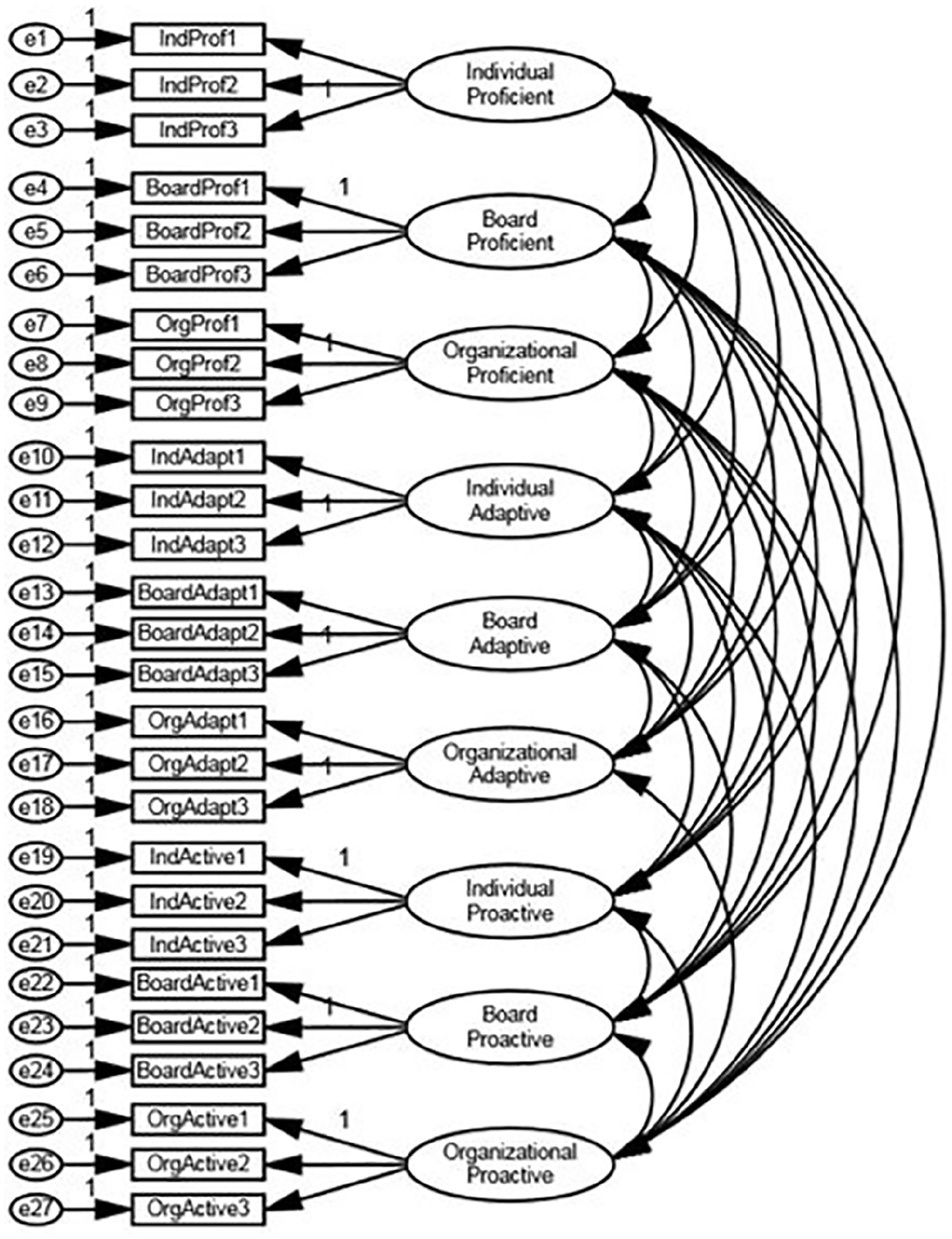
Nine-behavior model of board member behavior.
Model fit was based on the analysis of multiple indices as recommended by Hu and Bentler (1999) and Bagozzi and Yi (2012). Specifically, the analysis of fit considered the significance of the chi-square value, comparative fit index (CFI > 0.95), Tucker–Lewis index (TLI > 0.95), root mean square error of approximation (RMSEA < 0.06), and standardized root mean residual (SRMR < 0.06) in determining overall model fit. Convergent validity was tested by examining average variance extracted (AVE > 0.5) as well as composite reliability (CR > 0.7; Hair et al., 2009). Divergent validity was tested using the nested chi-square technique by comparing the chi-square value of the model to the chi-square value of a model in which the variance between two different behaviors has been constrained to one—implying they represent the same construct (Bagozzi et al., 1991). Each combination of behaviors was tested.
Results
The model from Figure 1 failed the CFA test as the inter-construct covariance matrix was not positive definite. A not positive definite result means the matrix, or a nested submatrix, has a negative determinant and, therefore, is an inadmissible solution (Wothke, 1993). Determinants were calculated for the submatrices based on each of the three roles and the three behaviors used to create the model. All determinants were positive with the exception of the submatrix based on the adaptive behaviors (–0.0002) suggesting adaptive behaviors may have been the cause of model failure.
The failure of the nine-behavior model to produce an admissible solution led to the re-examination of the model and the underlying principles. An alternative interpretation suggested adaptive behaviors were not used in the sport governance setting; a thorough explanation of which is found in the “Discussion” section. Thus, the adaptive behaviors were removed and the nine-behavior model was revised to a six-behavior model based on three roles and two types of behaviors (individual proficient, board proficient, organizational proficient, individual proactive, board proactive, and organizational proactive). The six-behavior model was tested using the same CFA procedures described earlier.
The six-behavior model demonstrated good overall fit by meeting the fit criteria, with the exception of the chi-square value (χ2 = 226.132, df = 120, p = .000; CFI = 0.96; TLI = 0.95; SRMR = 0.058; RMSEA = 0.055). Standardized factor loadings, the critical ratio, AVE, and composite reliability are presented in Table 1. All CR scores were above 0.7 and AVE scores were greater than 0.5 for all behaviors except board proficient behavior (0.492). However, as AVE is a conservative measure of convergent validity (Malhotra, 2010) and all behaviors met the criteria for CR, it was determined that convergent validity was achieved. A statistically significant result was found for every combination of behaviors meaning divergent validity was achieved.
CFA Results and Item List.

Note. CFA = confirmatory factor analysis; AVE = average variance extracted; CR = composite reliability; CFI = comparative fit index; TLI = Tucker–Lewis index; SRMR = standardized root mean residual; RMSEA = root mean square error of approximation.
Factor loadings presented are the standardized factor loading. bThe critical ratio is the t value of the unstandardized factor loading. χ2 = 226.132, df = 120, p = .000; CFI = 0.96; TLI = 0.95; SRMR = 0.058; RMSEA = 0.055.
p < .001
Discussion
A proposed nine-behavior model of board member behavior was not supported by the data, specifically because of the three adaptive behavior constructs. However, a revised, six-behavior model was supported as it met the criteria for model fit and passed validity tests. The support for the six-behavior model provides insight on individual board member behaviors as well as guidance for future measurement as outlined in the following discussion.
Board Member Roles
The six-behavior model supports the assertion that individual board members fulfill their duties through individual, board, and organizational roles (Hillman et al., 2008). The discriminant nature of the different roles means board members recognize and respond to expectations to engage with the board’s work beyond an individual’s specific duties. Thus, board members also act upon expectations regarding the functions of a board and a board’s responsibility for organizational leadership (Ferkins & Shilbury, 2012; Hoye, 2004; Schoenberg et al., 2016; Shilbury, 2001).
Proficient Behaviors
Proficient behaviors are used to accomplish core tasks, fulfill formal requirements, and meet role expectations (Griffin et al., 2007; Martin et al., 2013)—evidence of which was found within the individual, board, and organizational roles. The evidence for proficient behaviors suggests each board member perceives a set of expected tasks and appropriate actions for accomplishing these tasks (Griffin et al., 2007). As an example, chairpersons and secretaries on the board may feel an expectation to structure board meetings and will use an agenda to accomplish this task (Inglis & Weaver, 2000).
The evidence supporting proficient behaviors means that board members—within the setting of provincial sport organizations—had a sense of the obligations and expectations that accompany a board member position. Due to the federated sport model, elected board members of provincial sport organizations are likely to have experience in governing at more localized levels of sport or, in the case of appointed board members, have potentially been selected because of their knowledge or experience in a governance setting.
Proactive Behaviors
The evidence supporting proactive behaviors suggests board members engage in future-focused behavior aimed at creating change. These behaviors align with the notion that board members are expected to make a contribution to improving an organization (Brown, 2007; Doherty et al., 2004). By identifying deliberate attempts by board members to create change across individual, board, and organizational roles, this study identifies multiple pathways through which board members seek to improve their organization.
The identification of proactive behaviors in a governance setting can be linked to the research on motivations. In the context of this study, previous research described board members as motivated to make a positive impact on the organization (Inglis & Cleave, 2006; Prouteau & Tabariés, 2010; Taylor et al., 1991). As proactive behaviors are intended to create positive change (Crant, 2000; Grant & Ashford, 2008), it may be that board members enact their motivations through these behaviors.
Adaptive Behaviors
The argument for adaptive behaviors in a sport governance context was based on the assertion that sport organizations experience regular and ongoing change which requires action on the part of board members. However, despite the changing environment, the evidence from this study did not find empirical support for the adaptive behaviors constructs within provincial sport organizations (i.e., board members adjusting behaviors in response to change or learning new skills to address board issues). This discussion draws on multiple, possibly conflating, explanations regarding the lack of evidence of adaptive behaviors. These explanations are drawn from governance literature rather than empirical evidence as a part of this study so caution should be used in the interpretation of the following points.
First, board members tend to receive limited ongoing training (Hoye & Cuskelly, 2004), despite the benefits of such activities (Renz, 2010). As board members of sport organizations are often part-time volunteers, there may be limited time and willingness to engage in training exercises at the expense of “actual board work” (Hoye & Cuskelly, 2004). Furthermore, other research suggested board members may believe “they have acquired all the relevant experience and learning needed to carry out the role effectively” (Ward & Preece, 2012, p. 631)—whether they have or not—meaning board members may not see the need for or seek to engage in training. Thus, board members may not be engaging in adaptive behaviors as they may not be deliberately developing new skills.
Second, institutional theory suggests boards continue to use similar institutionalized processes (Kikulis, 2000). Therefore, despite change in the external environment, the effect of normative and mimetic institutional pressures has resulted in a level of stability within the processes and structures of a board. For example, many boards conduct much of their work in meetings governed by agendas (Inglis & Weaver, 2000) and delegate work to subcommittees (Carson, 2002). Thus, while the board, as a whole, may operate in a changing environment (Shilbury et al., 2016), individual board members may operate in a stable, institutionalized internal environment and, therefore, may not recognize the same need to adapt.
Third, the lack of evidence of adaptive behaviors may relate to design and measurement issues as items asked board members how they responded to change. However, it was unclear how participants should respond if they had not perceived or experienced change. Also, as the items were self-reported measures, board members may not recognize changes in their own behaviors. Furthermore, the cross-sectional design may not have been effective in capturing change.
Conclusion
Previous empirical examinations of board member actions have focused on the fulfillment of specific individual tasks rather than adopting a broader perspective that considers how board members interpret and fulfill their roles (i.e., behaviors). This research note provides empirical evidence for the consideration of behaviors as a valuable construct for further examination.
The support for the six-behavior model suggests board members perceived group expectations to fulfill individual tasks, work together, and implement positive change in their individual role, as a member of the board, and as a leader of the organization. The complexity of being a board member is illustrated by the shared expectations developed in response to interactions between board members as well as external pressures (Kikulis, 2000). Some of these expectations were clear and well-defined, evidenced by the use of proficient behaviors, yet there remained a level of ambiguity around board member roles, evidenced by the use of proactive behaviors. Thus, the use of both proactive and proficient behaviors may be evidence of how board members seek balance between ambiguity and clarity. Furthermore, the balance of ambiguity and clarity extended beyond a specific role. Board members used proficient and proactive behaviors in their individual role, their interactions with other board members, and as a representative of an organization.
Change appears to play a nuanced role in board member behavior. Board members did not appear to engage in adaptive behaviors as a technique for responding to environmental change. Rather, board members continued to rely upon traditional board processes to align with institutionalized expectations of board member behavior. In contrast to the potential limited influence of environmental change on board member behaviors, board members sought to create change within their individual, board, and organizational roles through proactive behaviors highlighting board member motivations to positively influence the board and organization (Inglis & Cleave, 2006).
There were some limitations with this study. The use of an intermediary survey distribution channel meant it was not possible to calculate a response rate. This reflects the ethical consideration of individual privacy of board members. In addition, as participants were not asked to indicate which organization they were affiliated with and CEOs and presidents did not confirm if they had or had not distributed the invitation to participate, and there is no way of knowing how many of the 309 organizations contacted participated in the study. However, as noted, the sample resembles similar studies giving some confidence to the findings of the study. It is possible that adapting an instrument from a paid employee setting may have contributed to the issues within the adaptive behavior construct. Finally, the sample consisted only of board members of Canadian provincial sport organizations meaning it is difficult to generalize beyond this setting.
The findings from this research suggest two pathways of future research. The first involves using the board member behavior model developed in this study to identify relationships with other elements of governance. A second path for future research could focus on developing a deeper level of understanding of board member behaviors—particularly given the unexpected, although explainable, finding regarding adaptive behaviors.
Footnotes
Acknowledgements
We thank the editor and reviewers for providing constructive feedback which improved the focus and quality of this research note.
Declaration of Conflicting Interests
The author(s) declared no potential conflicts of interest with respect to the research, authorship, and/or publication of this article.
Funding
The author(s) received no financial support for the research, authorship, and/or publication of this article.
