



Abstract
In 2017, about 30% of all U.S. adults volunteered for a total of 6.9 billion hours. This raises the question, why do so many people volunteer? Extant research has produced highly variable estimates of the effect sizes of various motivating factors, and there has been little to no research on potential moderators (i.e., study-level covariates that might strengthen or weaken the main effect of volunteer motives). We meta-analyzed 61 studies (N = 38,327) to estimate the effect sizes of six volunteer motivators (Volunteer Functions Inventory [VFI]; Clary et al., 1998) in predicting outcomes (satisfaction, commitment, intention to continue, and frequency). Results demonstrate that all six motivators significantly predicted the three outcome variables (
Volunteers have always formed a significant but sometimes overlooked backbone of society. From the first volunteer firehouse founded by Benjamin Franklin in the 1700s, to the unpaid individuals who led key social reform movements that improved the lives of millions, those who gave their time and talents without payment in return were crucial instruments in shaping society (Dreyfus, 2018). In 2017, about 30% of all adults in America volunteered for a total of 6.9 billion hours and an estimated value of $167 billion in human capital (AmeriCorps, 2017). Given the immense contribution of volunteering to society and the economy, it is critical for organizations to recruit and retain volunteers. Moreover, while employee motivation is still primarily explained by pay or perceived fairness in pay (Rynes et al., 2004), volunteer motivation differs in that it focuses primarily on non-monetary psychological drivers in the absence of pay. Thus, the study of volunteer motivation draws from unique theories that emphasize non-monetary psychological drivers of behavior.
The dominant conceptual framework for understanding these non-monetary psychological drivers of behavior was developed by Clary et al. (1998) in their Volunteer Functions Inventory (VFI). The authors drew from functional analysis theory to argue: “acts of volunteerism that appear to be quite similar on the surface may reflect markedly different underlying motivational processes” (p. 1517). In other words, they argue that people intentionally engage in volunteering, driven by internal “needs” or “functions” that volunteering meets and satisfies. These “needs” were called functional motives, in that volunteers are best motivated when the functions of the work or organization (e.g., a community of volunteers) meet a specified need (e.g., need for social interaction). The resulting instrument, the VFI, was a 30-item measure assessing the degree to which a volunteer’s current organization or work met each of the six motives. It is the most widely used measure in research on volunteerism across multiple contexts (Chacon et al., 2017) and subsequently has the largest number of empirical studies available for meta-analyses found during our literature search. Despite this, there has not yet been an empirical meta-analysis to aggregate the effects found in individual studies and derive more comprehensive estimates of effects across multiple studies and samples. Doing so would be vital to address some of the extant challenges in volunteer motivation research as described in the following sections.
Current Challenges in Volunteer Motivation Research
Several important scholarly questions arise from the present state of research on volunteerism, which this study addresses. First, many studies question the theoretical justification for the VFI’s six dimensions: career, enhancement, social, protective, understanding, and values. Career is defined as motivation arising from potential career-related benefits that volunteers could experience, such as gaining new skills relevant to future career plans. Enhancement is defined as motivation arising from benefits to the volunteer’s ego growth and positive development associated with volunteering. Social is defined as motivation arising from relationships with others through volunteering, such as engaging in friendships. Protective is defined as motivation due to guilt or feeling external pressure to volunteer to escape from problems. Understanding is defined as motivation due to personal non-career-related growth in skills, knowledge, or abilities from volunteering. Finally, values is defined as motivation due the volunteer’s desire to express altruistic values to help others.
In fact, Clary et al. (1998) acknowledged that there would be debate over “whether six is the optimal number of functions” (p. 1518), and they did not provide theoretical rationale for why these specific six dimensions should be highlighted and whether they are equally important drivers of volunteerism. Accordingly, later researchers have argued different conceptualizations of volunteer motives. For example, Cho and colleagues (2018) administered the VFI and found that only four motives were significant predictors of actual behavior, while Brayley et al. (2015) compared the VFI to other measures of motivation and found that the understanding function was most important. Moreover, entirely different measures have also been proposed. For example, the Volunteer Motivation Scale (VMS; Cnaan & Goldberg-Glen, 1991) presents a unidimensional measure of volunteer motivation across 22 items, while the Motivation to Volunteer Scale (MTV; Grano & Lucidi, 2005) identified six factors ranging from intrinsic motivation to external regulation based on self-determination theory.
A second problem is that the six dimensions of the VFI intersect with different theories of motivation and behavior. Based on Clary et al.’s (1998) description of the functional theory foundations of the VFI, one might expect all six dimensions to align with the theory of planned behavior (Ajzen, 1991), which built from the theory of reasoned action to argue that actual behavior is a result of intentions influenced by attitudes, subjective norms, and perceived behavioral control (see Southey, 2011 for a review). However, Brayley et al. (2015) describes how the six VFI dimensions differ in that some are driven more by attitudes (e.g., values), others more by subjective norms (e.g., social), and others more by perceived behavioral control (e.g., career). They investigated the relationship between the VFI and the three aspects of the theory of planned behavior (attitudes, subjective norms, and perceived behavioral control), and they found that only the understanding function represented a driver not accounted for by these three constructs. Subsequently, Cho et al. (2018) found a different set of results despite also basing their hypotheses on the theory of planned behavior. They report that values and career from the VFI were most important, at least among Gen Z volunteers. In short, the VFI is unclear, both in data and in theory, as to what element (attitude, subjective norms, perceived behavioral control, or something else) is the strongest driver of volunteering outcomes, and if a few of the six factors are significant predictors of outcomes, or if all six factors are equally as important. Our study seeks to address this by meta-analyzing the multitude of studies on the VFI to obtain a holistic picture of which factors are truly the best predictors of volunteer outcomes. Of note, while there have been other scales of volunteer motivation as noted above, none of these scales were as widely used. The VMS has been cited 1115 times compared with the VFI having been cited 3,726 times, and the MTV scale was cited fewer than 500 times. In addition, as discussed later in the methods, our literature search found less than 20 articles using the VMS measure (and even fewer for the other measures), compared with over 50 articles using the VFI.
Third, the existing studies that examined the unique effect sizes of the VFI dimensions report inconsistent results. For example, while Spicer (2012) reported a correlation as large as r = 0.51 (n = 116) between social motives and satisfaction with the volunteering work, Salas (2008) reported a correlation as small as r = 0.03 (n = 229) for the same relationship. Similarly, while Alkadi and colleagues (2018) reported a strong positive correlation (r = .69, n = 223) between self-enhancing motives (e.g., volunteering for personal growth) and intention to continue volunteering, Bock and colleagues (2018) reported a non-significant (r = -.02, n = 231) correlation between the same variables. This wide variation in effect sizes may be due to the localized sampling used by most of these studies. Specifically, researchers using the VFI have tended to apply it to a specific organization for the purposes of local research and applied practice, creating the classic problem of low generalizability (e.g., Hsieh, 2000; Kramarek, 2016). Thus, our study takes a quantitative meta-analytical approach to estimating the true effect sizes of the VFI dimensions onto desirable volunteer outcomes. Specifically, we chose to study satisfaction, commitment, intention to continue, and volunteering frequency. These outcomes are most commonly studied in research on volunteer motivations (Chacon et al., 2017), and rightfully so given their practical importance. Burger (2017) described the importance of volunteer retention, keeping volunteers satisfied and committed, in reducing the negative impact of turnover, often in the form of training and recruiting costs. Moreover, while the average hours spent volunteering per person was 137 in 2017 (i.e., 2.63 h per week; Statista Research Department, 2022), this can vary dramatically from people who do not volunteer at all (around 75% in 2015; Bureau of Labor Statistics [BLS], 2016) to people who volunteer full-time. Because consistency in volunteering is important for volunteer managers (Hawley, 2017), we also looked at predictors of frequency of volunteering.
Finally, there has been little research but much speculation on how these volunteer motives differ between demographic variables. Given the extent of heterogeneity in the evidence that has been published so far, it is likely that there are moderators of the strength of the VFI dimensions. Moreover, recent best practices in meta-analyses have emphasized the importance of testing potential moderators of main effects: “if there is nonartifactual variation in actual construct-level correlations, that variation must be caused by some aspect of the studies that varies from one study to the next, that is, a ‘moderator’ variable” (Schmidt & Hunter, 2015, p. 40). In our study, we focused on eight potential moderator variables that have been proposed or discussed in prior studies: geographic location, gender, age, education (i.e., obtained Bachelor’s degree), employment status, and student status (i.e., proportion of sample being undergraduate students). Demographic variables such as these are often important moderators in work-related behavior (e.g., Jain & Nair, 2020; Shirom et al., 2008), and previous research in volunteering have identified some differences within these demographic variables. For example, Taniguchi (2006) found that women were more likely to volunteer while employed part-time and in volunteer roles related to elderly care; likewise, Mesch and colleagues (2006) found racial-ethnic differences in volunteering behavior, such that blacks were 26% more likely to volunteer than whites. Moreover, the moderator analysis allows us to meta-analyze prior studies that have examined cross-cultural applications of the VFI as well (e.g., Niebuur et al., 2019; Wu et al., 2009). For example, Grönlund and colleagues (2011) reported varied mean difference levels of career motives between U.K.- and U.S.-based samples compared with samples from the Netherlands; likewise, Dávila and Diaz-Morales (2009) reported that career motives from the VFI decrease with age while social and values motives increase.
Importantly, we could not find any studies that treated the demographic variables as moderators, such that there would be differences in the effect size of each motive in predicting desirable volunteering outcomes (i.e., satisfaction, commitment, and intention to continue). A few studies have examined this question without using the VFI, but the results have been mixed. For example, Chevrier and colleagues (1994) found that female hospice volunteers were more satisfied by importance of their work, while male volunteers were more satisfied by staff support from the hospice; on the other hand, Chou (1998) reported no significant gender differences on the relationship between altruism and volunteer frequency. In addition, regarding cross-cultural applications of the VFI, there has yet to be a systematic review of cultural variation in the use of VFI to predict volunteering outcomes. By examining geographic location as a moderator, we take a step toward understanding how the VFI motivation dimensions differ between cultures. Thus, our use of moderators within the meta-analysis aims to answer this exploratory question of whether there are differences in effect size between demographic variables.
In short, our study is the first to meta-analytically derive estimates of overall effect sizes of volunteer motivations in predicting outcomes such as satisfaction, commitment, intention to continue, and volunteer frequency. In addition, we synthesize the vast array of data on volunteer motivations to provide more concrete evidence of how demographic variables (e.g., age, location, gender, employment status) moderate the overall effect sizes. This systematic review of the literature combines evidence to estimate overall effects and identify potential sources of heterogeneity in the evidence, thus summarizing the scholarly literature on the VFI and providing an important empirical systematic review to drive forward future research on volunteerism. In addition, the review will help summarize the vast literature on volunteerism to offer practical implications for volunteer managers. For example, there is immense value in knowing how demographic differences such as gender or geographic location may affect volunteers’ motivation to join and stay with the organization. As such, not only does our study address unanswered questions of scholarly research and pose new avenues of study, but it also provides direct practical impact to help organizations maximize their efforts in engaging and retaining volunteers.
Method
Study Variables
The VFI conceptualizes volunteer motivations into six sources: career, enhancement, social, protective, understanding, and values (Clary et al., 1998). The VFI is a 30-item Likert-type self-report measure with five items per dimension.
We chose outcomes identified in prior research: satisfaction, commitment, intention to continue volunteering, and frequency of volunteering. Clary and colleagues’ (1998) original publication proposed volunteer satisfaction and volunteer commitment as outcome variables; since then, most studies using the VFI followed their example and studied these as outcomes (Chacon et al., 2017). However, such studies only examine cognitive outcomes rather than behavioral. While the link between satisfaction and commitment has been established (e.g., Dwiggins-Beeler et al., 2011), researchers have also argued that there are several other factors that may interrupt the direct path between satisfaction-commitment and behavior, such as cultural influences or life events (Fairley et al., 2013; Locke et al., 2003). As such, estimates of the direct effects of dimensions of volunteer motivation onto behavioral outcomes are desirable. In this study, we specifically focus on intention to continue volunteering and frequency of volunteering (e.g., hours per week), as these are the outcome variables most often included in prior studies using the VFI.
For the moderator variables, we operationalized each variable to the study level. For example, gender was operationalized as the percent of sample being male, and age was operationalized as the mean age of the sample. For geographic location, due to small cell sizes (i.e., few studies in a specific location), we followed Stoltenborgh and colleagues’ (2013) example of aggregating to the continent level, thus creating a categorical variable indicating the continent from which the sample was collected.
Identification of Studies
We identified articles for our study that fit our primary requirements: predictor variable(s) included the VFI dimensions, outcome variable(s) included volunteer satisfaction and/or commitment, intention to continue, and frequency. All articles also needed to report a correlation matrix or the information necessary to compute correlation coefficients; we also requested correlation matrices from authors of articles that did not report full correlation matrices. We searched through all articles that cited the original VFI measure (e.g., Clary et al., 1998), plus additional articles found by searching “Volunteer Functions Inventory” for unpublished manuscripts on Google Scholar, for a total of 1491 initial studies. Next, we screened each article to identify ones that, based on their abstract, appeared to meet the primary requirements described above, leaving us with 164 articles. Of these, we then downloaded the full text, leaving us with 126 articles (38 were not accessible via all traditional search engines, e.g., APA PsycNet, Google Scholar, EBSCOHost). Finally, we read the full text of each article to confirm they met the eligibility criteria described above, contacting the study authors if necessary to obtain correlation matrices. All retained articles measured the VFI dimensions using Clary et al.’s (1998) measure or some variation of it, and measured outcome variables with traditional Likert-type self-report measures. The exception was frequency of volunteering, which varied widely in how it was reported (i.e., some articles reported actual hours per week, others used an ordinal scale). We noted this as a limitation in our analysis for predicting frequency of volunteering. Our final sample included 57 articles reporting 61 studies (N = 38,327) (Figure 1).
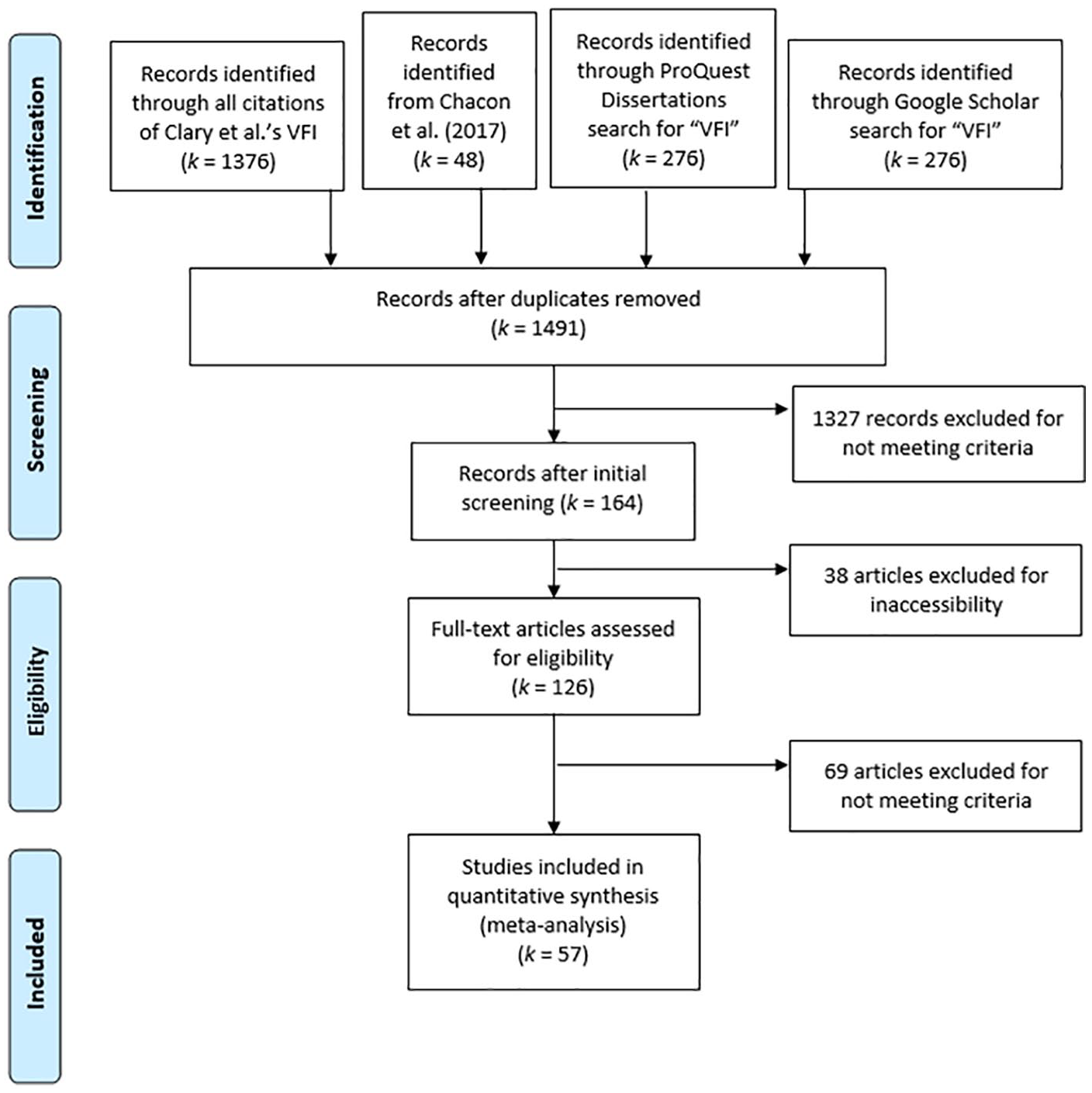
PRISMA (Moher et al., 2009) flowchart
Coding Method
Each article’s correlation matrix was subsequently coded (see Appendix A) by the two authors on this paper. Due to the established overlap between satisfaction and commitment (Aydogdu & Asikgil, 2011) and small k, we combined the constructs into one outcome when coding. As a quality check, we added a moderator for the construct used in the original study (either satisfaction or commitment). This was non-significant for all six predictors (B ranging from −.110 to −.001, p-value ranging from .175 to .987), suggesting that whether the study used satisfaction or commitment as the outcome did not significantly change the main effects.
For moderator variables, we operationalized each construct of interest to the study level (e.g., age as mean age in years of sample, gender as percent of sample being male). Next, the alphas, means, and standard deviations for each relevant variable were recorded if reported. Finally, the full correlation matrix of each VFI dimension with the dependent variables was recorded using the reported standardized Pearson’s r values. Composite correlations were calculated as needed using Schmidt and Hunter’s (2015) composite correlation formula (p. 444).
Analytical Strategy
All analyses were run in RStudio using the psychmeta package with a random-effects model. First, overall effect sizes for each dimension were estimated using the ma_r() function without any moderators. We used the Hunter and Schmidt (2004) method for correcting for unreliability for at the primary study level based on each study’s reported correlation coefficients, before calculating an overall weighted effect size for each of the six predictors. Missing reliabilities were handled using the default impute_artifacts argument in psychmeta, which estimates the reliability by bootstrapping random values from the known reliabilities and averaging. For details on this, we direct readers to the psychmeta reference pages: https://rdrr.io/cran/psychmeta/man/impute_artifacts.html. We used a 95% confidence interval as an indicator for significance of each overall effect size. Next, each moderator was analyzed separately using the metareg() function, which regressed the overall effect sizes onto each moderator separately (e.g., values and age, then career and age, and so forth). This was done to avoid issues of multicollinearity between moderators (Markfelder & Pauli, 2020). Publication bias was assessed using the sensitivity() function for cumulative sensitivity analysis (McDaniel, 2009). Cumulative sensitivity analysis sorts the effect sizes in the meta-analysis by precision, then adds them one at a time with the most precise effect size first, while recalculating mean effect sizes in each step (Borenstein et al., 2009). Positive drift, or movement of the estimated mean effect size from smaller to larger as studies are added, suggests the presence of publication bias (McDaniel, 2009).
Results
Main Effect Sizes
This meta-analysis incorporated 61 samples from 57 qualifying studies (N = 38,327). Our first research question examined what the overall effect sizes were for each dimension of the VFI in predicting volunteer satisfaction-commitment, intention to continue, and frequency of volunteering. All six predictors were significant in predicting each of the three outcome variables, as evidenced by the fact that none of the 95% confidence intervals around mean true-score correlation overlapped with zero. This supports the overall assertion that the VFI can be used to predict important volunteer outcomes, despite the aforementioned heterogeneity in effects found in prior literature. Interestingly, there were few instances where the 80% credibility interval overlapped with zero, suggesting that there would be little evidence of significant moderators. We also noted that there was a clear pattern in the overall effect sizes, such that values consistently demonstrated the strongest relationship with each of the three outcome variables, compared with the other five dimensions. Similarly, the career and social dimensions were consistently among the weaker relationships in each of the three outcome variables. This suggests that the values dimension is the strongest motivator when it comes to desirable volunteer outcomes.
Moderator Analyses
Each moderator was analyzed separately with a meta-regression, which is a method of meta-analysis that tests for a moderating or interaction effect by regressing the main effect sizes onto the moderator variable (Gonzalez-Mulé & Aguinis, 2018). Table 2 reports the unstandardized coefficient estimate for each moderator when predicting each of the six VFI dimensions’ effect sizes; this is repeated for each of the three outcome variables. As expected based on the main effect results, there were limited significant findings for the moderator analyses. First, geographic location was only significant in three out of 18 pairwise comparisons (six motivation dimensions with three outcomes). Following the methodology reported by Berry and colleagues (2013) in counting the number of significant pairwise comparisons out of the total tests run, the number of significant cases (3 out of 18; or 16.7%) is somewhat higher than the number of cases one would expect to find by chance alone (assuming an alpha level of 5%). In other words, location does seem to moderate the overall effect sizes of volunteer motivations. Specifically, samples drawn from Australia demonstrated weaker effect sizes of career onto satisfaction-commitment (B = −.36, p = .002), and samples drawn from North America demonstrated weaker effect sizes of both career and protective onto intention to continue (B = −.26, p = .029; B = −.30, p = .019). This makes sense when compared with single studies of the VFI discussed earlier; for example, in Greenslade and White’s (2005) investigation of the VFI among a sample of older Australian adults, career did not predict self-reported volunteerism.
Interestingly, gender was not a significant moderator in any case featuring intention to continue or frequency as outcome variables, but it was a significant moderator for the effect sizes of four out of the six motivation dimensions onto satisfaction-commitment. Specifically, samples that were composed of a larger proportion of males tended to have stronger effects of career (B = .59, p = .001), enhancement (B = .38, p = .045), protective (B = .42, p = .025), and social (B = .41, p = .007). On the other hand, age showed an opposite pattern; age was not a significant moderator for satisfaction-commitment or frequency, but it was significant in four of the six effect sizes of motivation dimensions onto intention to continue. Specifically, samples composed of an older average age tended to have stronger effects of enhancement (B = .01, p = .009) but weaker effects of social (B = −.01, p = .015), understanding (B = −.01, p = .005), and values (B = −.01, p = .001). For the moderator variables of race-ethnicity, education attainment, and employment status, very few cases were significant. For example, race-ethnicity was only significant in one out of the 18 pairwise comparisons, such that samples composed of a greater proportion of whites were likely to have weaker effects of social onto frequency of volunteering (B = −3.53, p = .001). Similarly, employment status was only significant in two out of 18 pairwise comparisons. Samples composed of a greater portion of individuals with paid employment elsewhere were likely to have stronger effects of understanding onto satisfaction-commitment (B = .76, p = .034) and social onto intention to continue (B = .50, p = .003). Educational attainment was not significant in any of the 18 tests. The general lack of significant results for these moderator variables was surprising. Most prior studies using the VFI have suggested some variance in motivations depending on gender, age, race, and other demographic variables (Davila & Diaz-Morales, 2009; Grönlund et al., 2011; Mesch et al., 2006; Taniguchi, 2006). While gender had a substantial effect in this meta-analysis, the other demographic variables had fewer or weaker effects. This would suggest that volunteer motives may not differ as widely as prior studies have suggested across various demographic variables.
Finally, we found that student status was significant in a large number of cases (i.e., 10 out of 18, or 55.6%), much more than what would be expected by chance. Specifically, samples composed of a greater proportion of college students were likely to have stronger effects of career onto satisfaction-commitment (B = .32, p = .007), stronger effects across the board of all motivation dimensions onto intention to continue (B ranging from .36 to .60), and stronger effects of enhancement, social and values onto frequency (B = .56, .66, and .54 respectively). In other words, student status appears to be a significant moderator that strengthens the effects of the VFI volunteer motivation dimensions onto desired outcomes such as satisfaction-commitment, intention to continue, and frequency of volunteering. This substantial effect is not surprising and concurs with prior research using the VFI to show differences in volunteer motives and behaviors between students (e.g., Beehr et al., 2010).
Publication Bias
We ran a cumulative sensitivity analysis to assess for publication bias. This produced results for each of the six overall effect sizes separately, repeated for each of the three outcome variables. The mean effect size at each step is shown in a series of forest plots for each of the six overall effect size estimates. The analysis shows little evidence of publication bias in the estimates of career, enhancement, social, understanding, and values motivation effect sizes for the outcomes of satisfaction-commitment and intention to continue. In each of these, the estimated mean effect sizes with the first few studies (the most precise ones) are very similar to the final estimated mean effect size, which indicates little to no publication bias (Kepes et al., 2012; McDaniel, 2009). However, there is evidence of publication bias in the estimate of protective motivation effect sizes, especially with the outcome variable of intention to continue. In the protective effect size onto intention to continue, the estimated mean effect size based on the first few studies hovered around 0.45, but the final effect size was estimated to be 0.36. This suggests small to moderate levels of publication bias (Kepes et al., 2012). Moreover, the sensitivity analysis for frequency of volunteering as the outcome variable demonstrated potential bias in career, protective, and social dimensions, such that the first few estimates (the most precise ones) were larger than the final (Figure 2).

Forest plots of cumulative sensitivity analysis for (A) satisfaction-commitment, (B) intention to continue, and (C) analysis for frequency
Post Hoc: Relative Importance Analysis
As an additional post hoc analysis, meta-relative-importance analysis was conducted using the code supplied by Tonidandel and LeBreton (2014) in RWA-Web. Relative importance analysis is often a useful tool for examining multiple predictors when they are highly correlated with one another (Tonidandel & LeBreton, 2011). It offers information regarding each predictor’s contribution to explaining variance in the outcome variable more accurately than a simple multiple regression. The VFI, used to predict volunteer outcomes, presents a situation where use of relative importance analysis is both methodologically possible and practically important. Examinations of the VFI factor structure have reported intercorrelations ranging from .12 (career with values) to .88 (understanding with enhancement) (Okun et al., 1998). In addition, in its original conceptualization, the VFI argued for six equally relevant motives without a clear distinction between intrinsic (e.g., values) and extrinsic (e.g., career and protective). This has led to some criticism over the VFI that it downplays the importance of the intrinsic (i.e., values) motivation when it comes to volunteerism (e.g., Cnaan & Goldberg-Glen, 1991; Okun et al., 1998; Wu et al., 2009).
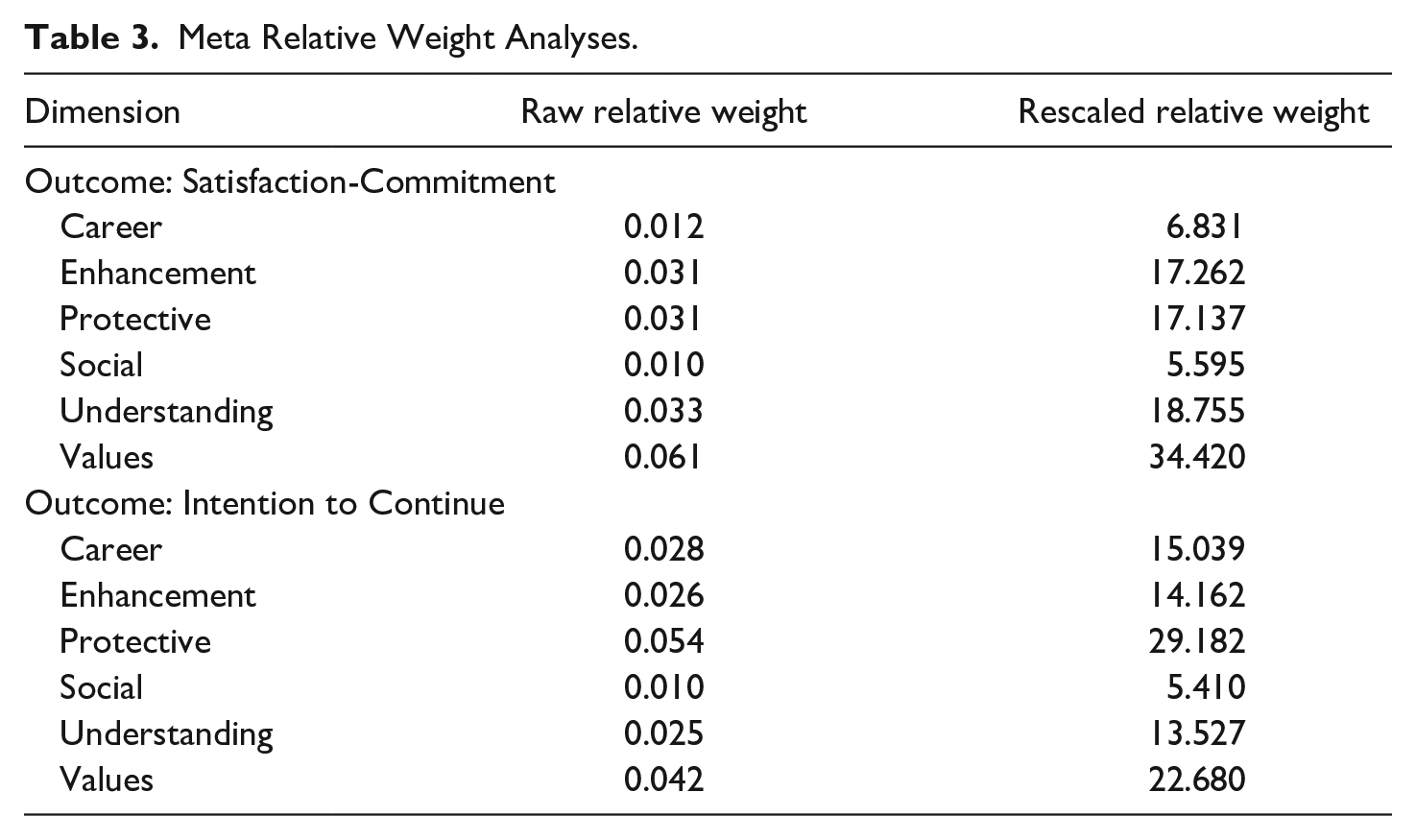
To obtain the meta-correlation matrices inputted into the relative importance analysis, we followed the process of using meta-analytic structural equation modeling to fit pooled correlation matrices under a random effects model, using the metaSEM package in R (Cheung, 2014). The relative importance analysis revealed a similar pattern of findings as the main effect analyses. For satisfaction-commitment, values had the largest rescaled relative weight (34.42), followed by understanding, enhancement, and protective (18.76, 17.26, and 17.14, respectively), then career and social as the smallest (6.83 and 5.60, respectively). For intention to continue, values and protective had the largest rescaled relative weights (22.68 and 29.18, respectively), followed by career, enhancement, and understanding (15.04, 14.16, and 13.53, respectively), and social last (5.41). Due to lack of studies, we were unable to construct a pooled correlation matrix for the purposes of the relative importance analysis using frequency of volunteering as the outcome variable. Taken together with the main effect results, we concluded that values was generally the strongest and most important motivator, followed closely by understanding (for satisfaction-commitment) and protective (for intention to continue).
Discussion
Our key findings were as follows. First, all six VFI predictors were significant in predicting each of the three outcome variables, with the average effect size after correcting for attenuation ranging from 0.12 to 0.44 (see Table 1). Second, Table 1 suggests that the largest effect sizes are consistent with the values predictor (0.42, 0.44, and 0.22 when predicting satisfaction-commitment, intention to continue, and volunteering frequency, respectively). This was also supported by the relative importance analysis (Table 3), which found that values held the strongest relative importance when predicting satisfaction-commitment and the second strongest when predicting intention to continue. Finally, Table 2 shows that there were not very many significant results in the moderator analyses. Significant results were primarily found with gender as a moderator of VFI predicting satisfaction-commitment, age and student status as a moderator of VFI predicting intention to continue, and student status as a moderator of VFI predicting volunteering frequency. The following paragraphs describe in more detail each of our findings and their implications for both research and practice (Tables 3 and 4).
Main Effect Analyses.
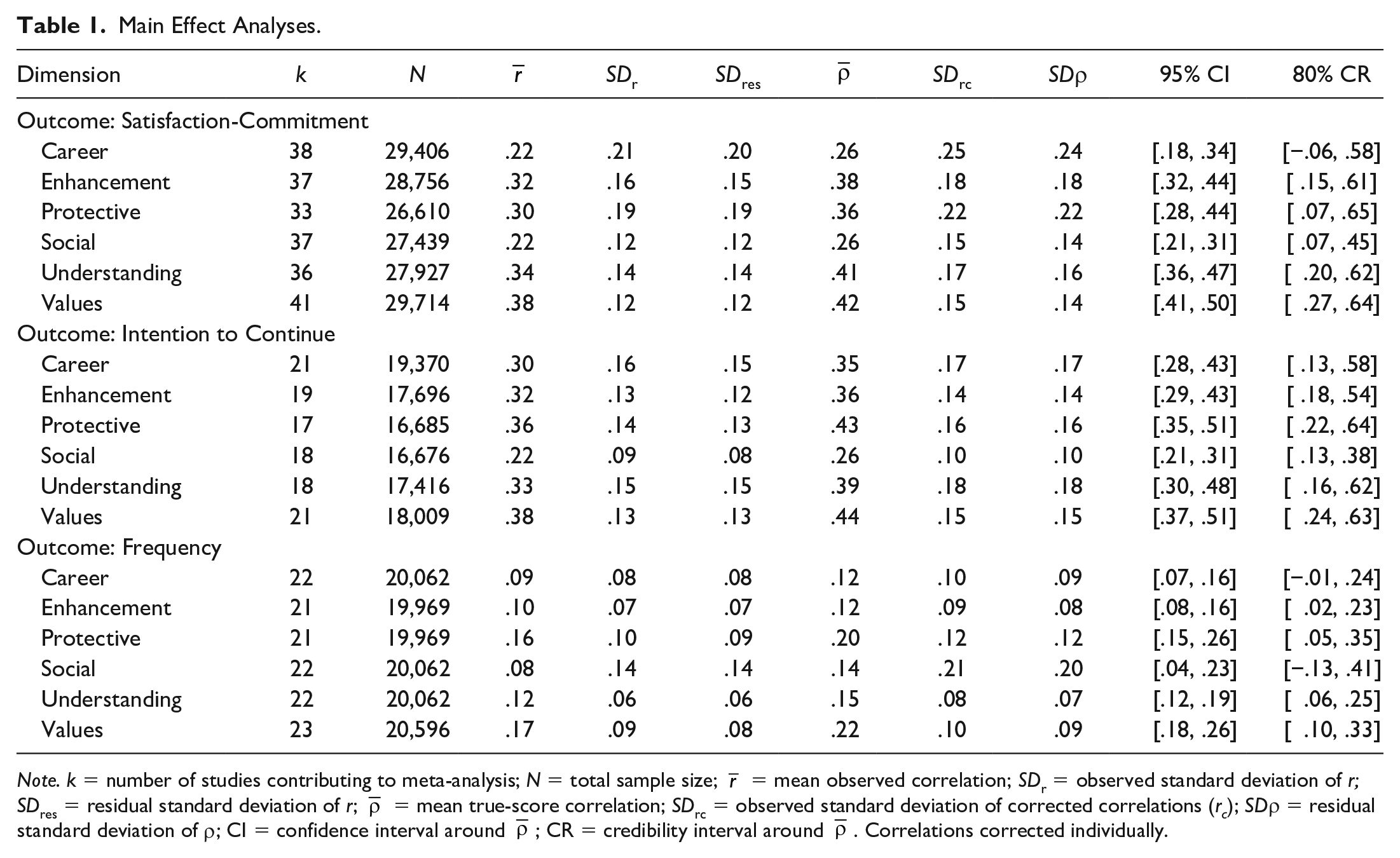
Note. k = number of studies contributing to meta-analysis; N = total sample size;
Moderator Analyses.

Note. Male = proportion of sample identifying as male; White = proportion of sample identifying as white; Age = average age of the sample; Bachelors = proportion of sample that has obtained a Bachelor’s degree; Employed = proportion of sample employed full-time; Student = proportion of sample that are undergraduate students.
Insufficient studies from the Middle East reported the correlation between understanding and intention to continue.
p < .05. **p < .01.
Meta Relative Weight Analyses.
Number of Studies for Each Moderator Variable (Total k = 61).
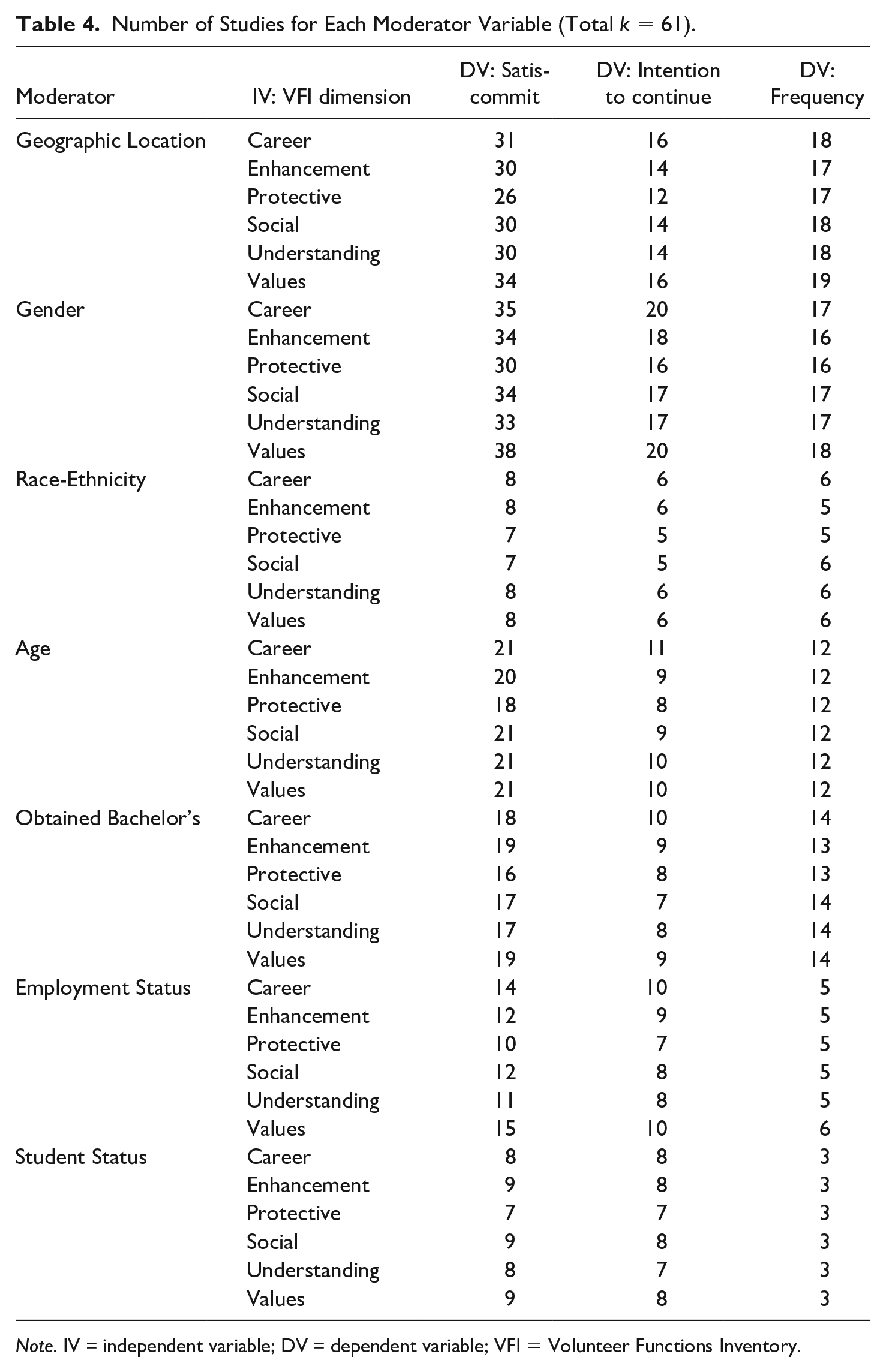
Note. IV = independent variable; DV = dependent variable; VFI = Volunteer Functions Inventory.
First, all six effect sizes were significantly larger than zero. By modern standards (Bosco et al., 2015; Paterson et al., 2016), effects were medium-large in predicting satisfaction-commitment and intention to continue (
Second, our meta-analysis revealed that the values motive was the strongest predictor of all outcome variables, especially satisfaction-commitment. Prior theories have challenged the six-dimensional structure of the VFI, suggesting that volunteerism is best explained by a higher-order values factor (Cnaan & Goldberg-Glen, 1991; Okun et al., 1998). Our study provides indirect empirical support for this theory that, while other volunteer motivations are important, volunteers who are motivated by values (i.e., desire to express altruism in serving) are most satisfied and committed to their organization. Thus, the findings suggest that volunteer managers should focus on recruiting individuals who have an intrinsic, altruistic motive to serve as opposed to volunteering solely for external motives. This finding offers two interpretations that can drive future research. First, according to the Deci and Ryan’s (1985) self-determination theory (SDT), the most basic distinction in motivation is between intrinsic and extrinsic motives. Our finding suggests that SDT can be used to explain volunteerism because the values motive, which is the only intrinsic factor of the six VFI factors, was the strongest predictor of volunteer outcomes. This directly challenges the existing conceptual framework behind the VFI (theory of planned behavior). Alternatively, if one were to stick to the theory of planned behavior, our finding suggests that attitudes (as opposed to subjective norms or perceived behavioral control) are most important in explaining volunteerism. In other words, volunteers are satisfied, committed, intend to continue volunteering, and frequently volunteer primarily because of a positive attitude towards the value of volunteering, as opposed to the rewards they might gain (whether career or social benefits) through volunteering.
Interestingly, when predicting intention to continue, the protective motive had a larger relative weight than the values motive. This suggests that regardless of satisfaction and commitment, some volunteers may continue serving due to external pressures to remain with the organization, such as those exerted by fellow volunteers (Haski-Leventhal & McLeigh, 2010; McGinley et al., 2010). The fact that the protective motive is an important psychological driver indicates that some may continue volunteering not for personal fulfillment but because of external influences, which supports the application of the theory of planned behavior to volunteerism. Meaning, while volunteering primarily seems to be driven by attitude (i.e., values), there are times when it may be driven by subjective norms (i.e., protective). Both are possible pathways to motivating the same behavior, in this case, staying with the organization. This could lead to harmful effects of burnout if organizations are not intentional about giving volunteers the opportunity to leave if they so desire (Jansen, 2010). Thus, we recommend that volunteer managers regularly check in with volunteers to ensure that they are not experiencing burnout due to feeling an external pressure to remain with the organization, which could lead to downstream negative effects for both the volunteer and the organization.
Finally, the moderator analyses uncovered interesting findings with important implications. Most of the motives (except for understanding and values) showed stronger effects onto satisfaction-commitment among males than females. Prior evidence suggests that men tend to be more strongly motivated by extrinsic factors (i.e., careers, protective; Vallerand & Blssonnette, 1992), which could be reflected in these results. Interestingly and contrary to prior theories, gender was not a significant moderator for the other two outcome variables, suggesting that the gender differences in motivations ultimately do not lead to behavioral differences. On the other hand, age was a significant moderator for intention to continue; younger individuals’ decision to keep volunteering was more influenced by social, understanding, and values than older individuals. Research on volunteerism in retirement suggests that volunteering fills an absence of “other productive roles” (Greenfield & Marks, 2004). In other words, older adults may pursue volunteering to fulfill a sense of personal purpose, as opposed to the need for social community or personal growth. Finally, student status was a significant moderator, suggesting a new idea that college student volunteers have different motives than other adults, especially when predicting intention to continue. This finding makes sense as college students are sometimes required to volunteer as part of their degree program (Beehr et al., 2010; Henney et al., 2017), though we note that these findings were based on U.S. samples. Our results suggest that the six VFI motivation dimensions are more important to college student volunteer retention, because many college students are likely to stop volunteering after their program ends. These moderator analyses can help volunteer managers strategically design volunteer programs that meet the particular needs and motives of their target volunteer. For example, managers can design volunteer programs aimed at recruiting youth (especially relevant given recent declines in youth volunteering; Sparks, 2018) by focusing on the social benefits of volunteering communities. Moreover, the non-significant findings were of interest as well; geographic location in general was not a significant moderator which suggests that there is some consistency in how the VFI predicts volunteering outcomes across different geographic locations. This finding, with additional research, could support the cross-cultural applicability of the VFI.
Limitations and Future Research Directions
As with most meta-analyses, our study is limited by the lack of available data on moderator variables, thus narrowing the power of our moderator analyses to detect effects. In addition, even though geographic location generally had sufficient sample sizes, there were inconsistencies in the methods that original studies reported the location of the sample (e.g., ranging from a specific city to the entire United States). Thus, future studies should continue looking into differences in volunteer motivations between demographic characteristics, especially geographic location. Prior evidence that volunteering behavior is extremely different across cultures (Aydinli et al., 2013; Randle & Dolnicar, 2009) points to the possibility that differences in the psychological drivers and motives are causing these behavioral differences. There has been growing interest to expand beyond the white and Western samples on which most research is conducted (Jones, 2010; Muthukrishna et al., 2020), and the question of how volunteer motives differ across cultures should be explored in future research studies.
In addition, our study focused on the six dimensions of the VFI as the predictor variables. Although the VFI is the most widely used measure of volunteer motivation, there are other available measures (e.g., Motivation to Volunteer scale; Monga, 2006). A quick search of the first 40 results for empirical studies on volunteer motivation revealed 75 different but overlapping theorized dimensions. Future studies should incorporate additional measures of volunteer motivation, with a goal of “cleaning up” the cluttered space caused by the proliferation of overlapping and perhaps redundant constructs (see Shaffer et al., 2016). In doing so, future scholars can clarify for practitioners whether there are additional important motivators of volunteering outside of the six VFI dimensions, and if so, the degree to which they offer incremental validity in predicting outcomes.
Finally, as with any meta-analysis, our findings are only as good as the data that were inputted into the analysis. This is particularly important with regard to the sampling method and research design of the prior studies that we meta-analyzed. Most prior studies were cross-sectional, which limits the ability of findings to show a causal relationship (Stone-Romero & Rosopa, 2008). Meaning, just because values significantly and strongly predicted volunteer satisfaction and commitment, it does not prove that being motivated by values causes a volunteer to be satisfied and committed. Ideally, future scholars can collect longitudinal or experimental data to add further evidence and potentially demonstrate a causal relationship.
Conclusion
Both volunteer managers and researchers are very interested in understanding why people volunteer their valuable time and resources without being formally paid for their work, and this meta-analysis contributes a set of important main findings and implications drawn from 57 previously published studies. Specifically, our meta-analysis is the first to (a) assess the true effect sizes of VFI dimensions in predicting desirable volunteer outcomes, (b) assess the relative importance of each dimension, and (c) identify demographic moderators of the effect sizes of these dimensions. First, the VFI can and should be used by volunteer managers to survey their volunteer population and better understand their motives, with the goal of designing volunteer programs and work that meets said motives and leads to better satisfaction and commitment and reduced turnover. Second, of all the motives, values was the strongest driver. It is not uncommon for organizations to assume that their volunteers are aware of or are aligned with the organization’s mission and values. Most importantly, volunteer managers must effectively communicate the organization’s mission and values and encourage volunteers to participate because of the impact they are making in supporting the organization. Finally, there were only a few significant moderators, many of which had weak effects. This means that volunteer motives do not appear to differ substantially between demographic groups in terms of age, race-ethnicity, educational attainment, employment status, and geographic location. While volunteering behavior may differ, the motives that drive such behavior appear to be similar. However, gender and student status were particularly strong moderators. Meaning, volunteer managers should pay attention to how volunteers of different gender identities and student volunteers may be motivated by different areas, and they should adjust their volunteer program accordingly.
We believe that our findings will be of substantial use to the hundreds of thousands of organizations relying on volunteers to make a difference in the world. Meta-analyses in particular are useful in that they can empirically “summarize” a large number of individual studies, making academic research more readily accessible for busy working professionals who do not have time to read hundreds of individual studies. We hope that this meta-analysis, which is the first of its kind, will provide future volunteer managers with accessible and valuable insight into volunteer motives that can directly translate into improved practices and better organizational outcomes.
Research Data
sj-docx-1-nvs-10.1177_08997640221129540 – Supplemental material for Meta-analysis of Volunteer Motives Using the Volunteer Functions Inventory to Predict Volunteer Satisfaction, Commitment, and Behavior
Supplemental material, sj-docx-1-nvs-10.1177_08997640221129540 for Meta-analysis of Volunteer Motives Using the Volunteer Functions Inventory to Predict Volunteer Satisfaction, Commitment, and Behavior by Steven Zhou and Kailee Kodama Muscente in Nonprofit and Voluntary Sector Quarterly
Footnotes
Appendix
Declaration of Conflicting Interests
The author(s) declared no potential conflicts of interest with respect to the research, authorship, and/or publication of this article.
Funding
The author(s) received no financial support for the research, authorship, and/or publication of this article.

Data Availability Statement
Supplemental Material
Supplemental material for this article is available online.
Author Biographies
References
Supplementary Material
Please find the following supplemental material available below.
For Open Access articles published under a Creative Commons License, all supplemental material carries the same license as the article it is associated with.
For non-Open Access articles published, all supplemental material carries a non-exclusive license, and permission requests for re-use of supplemental material or any part of supplemental material shall be sent directly to the copyright owner as specified in the copyright notice associated with the article.
