



Abstract
Governments in Europe have emphasized the development of more autonomous public universities over the last couple of decades. Often, the aim of these reform policies has been to stimulate to a more competitive and agile higher education sector, where increased formal autonomy is perceived as a key condition to strengthen the strategic capacity of universities. These reforms have resulted in considerable shifts in the internal governance models of some universities, while others have kept their traditional governance models. In this article, instrumental and cultural perspectives derived from organizational theory are used as lenses to compare how universities with different internal governance models organize and structure their strategic development processes. Our findings suggest that internal governance models have little impact on the design and organization of strategic processes. In conclusion, it is argued that changes in internal governance arrangements alone are not enough to drive transformation in higher education institutions, and the issue of formal institutional autonomy is intimately linked to how various policy instruments at the system level are designed and coordinated.
Introduction
Echoing the general reform wave in public sector governance (Christensen et al., 2002; Djelic and Sahlin-Andersson, 2006; Pollitt, 2013), the relationship between the state and higher education institutions in Europe has changed significantly during recent decades (Capano, 2011; Maassen and Stensaker, 2011; Paradeise et al., 2009). Key trends include shifts in the legal status of higher education institutions, resulting in more formal institutional autonomy being granted to institutions (Christensen, 2011; King, 2015), not least concerning their financial room to maneuver, the ways in which they choose to organize internally, and in their decision-making structures (for an empirical overview, see European Commission 2010). The idea of formal institutional autonomy in higher education research has moved from mainly denoting community self-governance and an emphasis on academic freedom to denoting organizational autonomy of the university as a more unitary and strategic actor (Krücken and Meier, 2006). Analyses of this trend have noted that despite the convergence in formal governance arrangements around the world (Ramirez, 2006), there are indications that formal institutional autonomy may actually imply less actual institutional freedom (Christensen, 2011), and that governance changes taking place in higher education institutions are affected by a complex set of factors including path-dependent trajectories and external constraints (Enders et al., 2013; Frølich and Caspersen, 2015; Paradeise et al., 2009).
Political interest in increased institutional autonomy is often legitimized by the argument that increased autonomy will stimulate intra-organizational engagement, creativity, and adaptability to local characteristics, which again will boost organizational efficiency and effectiveness (Aghion et al., 2010; Verhoest et al., 2004). From this perspective, increased strategic capacity is about utilizing internal resources and organizational characteristics through thoughtful internal governance processes and designs. In this way, the concept addresses more processual aspects rather than the substance of a given strategy (Stensaker et al., 2014). However, while strong correlations can be found between institutional autonomy, competition, and institutional efficiency and performance (Aghion et al., 2010; Enders et al., 2013), there is very little understanding about how strategic capacity can be developed through careful governance designs. In this article, we shed more light on the relationship between institutional governance and strategic capacity. Acknowledging the complexity of higher education institutions as organizations (Clark, 1983; Frølich et al., 2013; Weick, 1976), we draw upon both instrumental and cultural perspectives in organizational theory to develop expectations as to how the relationship between university governance and strategic capacity may be conceptualized. We then investigate these relationships empirically based on a sample of higher education institutions. Two research questions guide our study:
How and to what degree is the internal governance model of universities, reflecting internal and external development factors, connected to the strategic capacity of these institutions? How can we interpret this relationship based on instrumental and cultural perspectives taken from organizational theory?
The empirical context for the study is the Norwegian higher education system and the changes in institutional autonomy and in internal governance models of universities and colleges in the system throughout the latter decade. By studying eight Norwegian universities and colleges with different internal governance models, the significance of a range of organizational factors which are often seen as important in public sector reform are explored (Egeberg et al., 2016), including external representation and influence within the executive boards and the selection and appointment of the rector/president of universities and colleges (Capano, 2011; Christensen, 2011; de Boer et al., 2007; Paradeise et al., 2009).
Key reform trends in “modernized” public sector management in higher education
Reforms in higher education resemble reform efforts in other public sectors aiming at improving public sector efficiency, effectiveness, and quality (Christensen, 2012; Christensen et al., 2002; Pollitt, 2009). As such, a general ambition behind a number of higher education reforms in Europe has been to “modernize” higher education institutions (Maassen and Olsen, 2007; Maassen and Stensaker, 2011). The inspiration for these reforms has often been related to the spread of global ideas of effective organization aiming at transforming public agencies into bounded, rationalized actors (Djelic and Sahlin-Andersson, 2006; Ramirez, 2006; Sahlin, 2012).
Three developments can be said to have been central in the reform initiatives taken. First, a number of governmental tools have been transformed, introducing policy instruments that aim to link performance closer to political priorities and ambitions (Hood, 2007). Changes include the establishment of more targeted, outcome-based funding systems where specific performance indicators are used to steer the organizational attention and activities (Beatty and Zajak, 1994; Frølich, 2011), but may also imply the establishment of intermediate bodies to strengthen the external oversight and insight into qualitative and quantitative aspect of organizational performance (Egeberg, 2003). While more formal autonomy has often been granted to public sector organizations, the state has usually accompanied such autonomy with stronger accountability measurements with respect to organizational performance (Capano, 2011; Christensen, 2011).
Second, external representation has increased in the central decision-making bodies, not least in the executive boards of public sector organizations (Tollefson et al., 2010). As part of this increased external influence over public sector organizations, reforms have often been modeled after corporate governance arrangements in the private sector (Christensen et al., 2002), where an externally appointed chairman is intended to represent the “shareholders/owners” and where the control function of the board is emphasized, ensuring that the owners get a return on their investment (Aguilera et al., 2008). This controlling function is intended to constrain managerial opportunism, although there is inconsistent empirical evidence that board composition, size, or structure consistently affect organizational performance (Dalton et al., 1998).
Third, reforms have also put much weight on the need to improve the quality of the leadership of public sector organizations (Rutherford and Meier, 2015; Stensaker and Vabø, 2013). As public sector organizations have adopted characteristics of generic organizations, there is an increasing tendency to assume that strategic management of public sector organizations is both possible and desirable (Ferlie and Ongara, 2015). As a consequence, new models for appointing the academic leadership of higher education institutions have been introduced in a number of countries, where former internal election models have been replaced with models where the institutional leadership is appointed by the board (de Boer et al., 2007). Accompanying changes also include the establishment of incentive structures for institutional leaders (Rutherford and Meier, 2015), and the introduction of strategic management tools as a way to guide leadership practice (Teelken, 2015).
Although one could claim that these reform efforts have been ideologically driven (Pollitt, 2013), the reform initiatives taken are often characterized by an attempt to pack various governmental tools together (Howlett and Rayner, 2013) and to create quite comprehensive policy mixes adapted to specific policy contexts (Howlett, 2014). Hence, although similarities between reform efforts in various countries are indeed visible, it is also possible to identify national variations (Capano, 2011; Ramirez and Christensen, 2013) due to institutionalized characteristics of higher education institutions (Clark, 1983), the historical nature of regulation of the higher education sector (Friedman, 2006), and established domestic traditions of bargaining and negotiation (Klein and Marmor, 2006).
Theoretical perspectives and expectations
Instrumental and a cultural perspectives are very relevant as theoretical points-of-departure for the current study, as such perspectives offers a range of explanations concerning the relationship between governance reforms and the strategic capacity of universities and colleges (Christensen, 2012; Christensen et al., 2002; Egeberg, 2003; Egeberg et al., 2016).
An instrumental perspective emphasizes the structural design of the governance models and arrangements within universities; it also assumes that organizational behavior will be impacted on by changes in decision-making structures and changes in management and leadership (Egeberg et al., 2016). However, specific governance models within a given organization could still be affected by outside factors, such as the degree of autonomy given to the organization as part of autonomy reforms (Christensen, 2011; de Boer et al., 2007). Hence, the instrumental perspective comes in two versions. The first version stresses the role of the government and the degree of formal autonomy given to universities and colleges. This version acknowledges that the state may still play an influential role in the governance of the individual organization, as institutional autonomy is only one of a range of policy options and instruments at the disposal of the principal when steering higher education (Frølich, 2011; Hood, 2007). The second version gives more weight to internal governance arrangements and emphasizes actual autonomy in terms of how strategic capacity at the institutional level could be designed and organized (Christensen, 2011). This actual autonomy could, however, be curbed by instrumental side-effects of the formal autonomy given to institutions; autonomy often implies a delegation of tasks and responsibilities and an accompanying build-up of an administrative staff which may standardize and professionalize governance processes and subsequently limit institutional discretion (Bleiklie et al., 2015).
The cultural perspective embraces the general perception that cultural material, practices, and identities are found both inside and outside organizations, and that these elements constitute significant influence on public reform initiatives (Christensen, 2012). Thus, the cultural perspective also comes in two versions. The first version stresses intra-organizational characteristics and features developed over time and how these features influence values, norms, and behavior in universities and colleges, thereby enabling them to develop unique identities (Clark, 1983; March, 1994). The second version pays more attention to cultural aspects found in the environment and how global reform ideas and templates are difficult to resist and that they, as a consequence, are translated into individual organizations in a more standardized way (Djelic and Sahlin-Andersson, 2006; Ramirez and Christensen, 2013).
Key instrumental and cultural explanations for the development of strategic capacity.
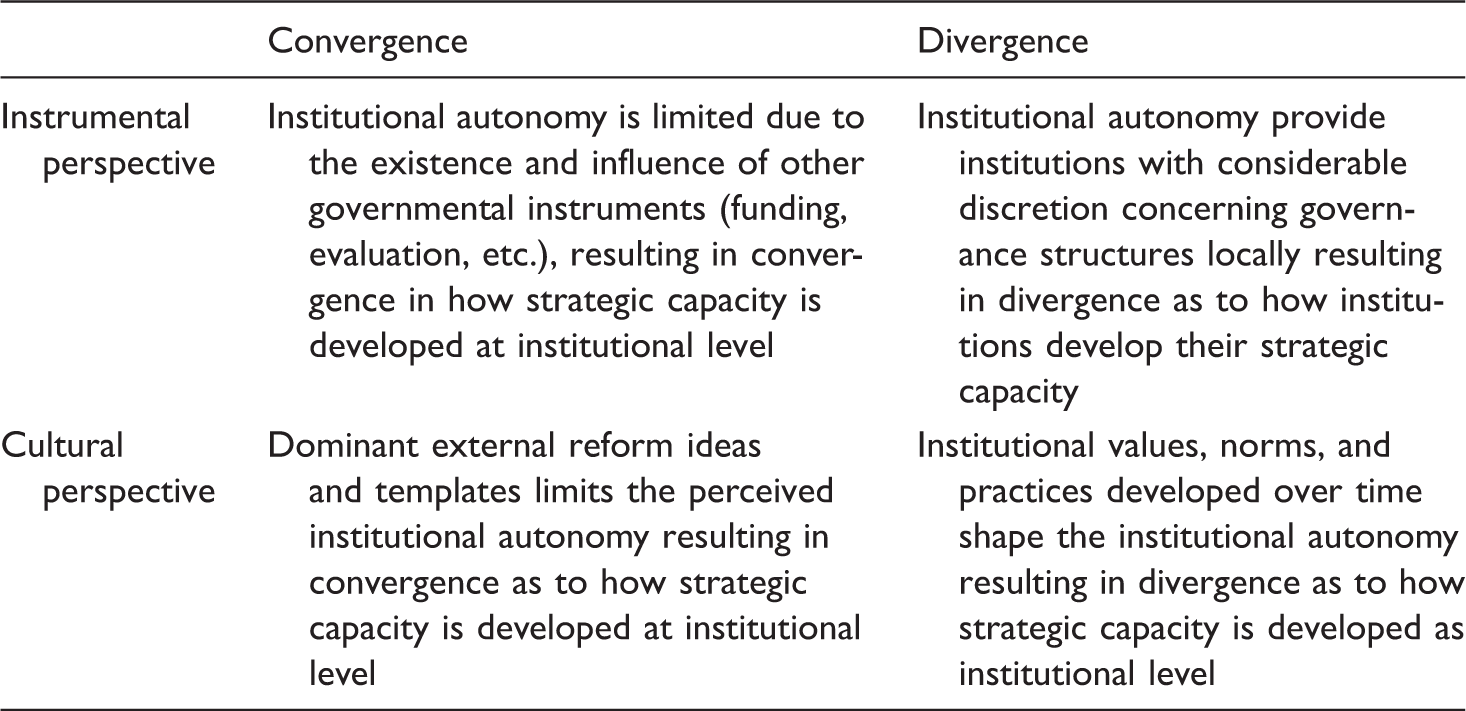
Governance arrangements for strategic capacity—Key expectations
Strategic capacity is, in the current article, a concept that relates to the processes associated with the formation, organization, and implementation of strategies in universities and colleges. This understanding is in line with newer approaches to analyzing strategy where it is not seen as a specific product, but as a form of practice that is on-going and dynamic (Frølich et al., 2013; Jarzabkowski, 2005). This way of conceptualizing strategy is particular relevant to public sector organizations where institutional autonomy is embedded in a larger set of governance arrangements at system level (Ferlie and Ongaro, 2015). In this article, four different elements of a strategizing process are analyzed in detail; the relationship between the Ministry and the individual institution when a strategy is developed; how strategic issues are identified and prioritized; how strategies are decided upon, and; how they are implemented in the organization.
The first of these, the relationship to the Ministry, concerns the degree of autonomy enjoyed by the individual organization when a strategy is under development. From an instrumental perspective, it can be expected that public authorities are still able to influence strategic processes through identifying system level objectives and key priorities (Capano, 2011), and that they may communicate their priorities through the formal governance structures established, leading to more convergence. From a cultural perspective, the expectation is that public authorities are exposed to global ideas and templates (Ramirez, 2006), and so the relationship between the authorities and the individual university is more determined by contemporary fashions in public sector governance, also leading to convergence.
The second element focused upon is how strategic issues are identified and prioritized within the individual organization. From an instrumental perspective, it is expected that the board of institutions is very important in influencing and controlling their strategic process including key priorities, especially if boards have a majority of external representatives (Dalton et al., 1998). Such discretion is expected to lead to more divergence. An alternative expectation within an instrumental perspective is that more professional university managers and a more professional administration may have an important role in identifying key strategic issues, and that they through this process they also have much influence with respect to priorities (de Boer et al., 2007). Such professionalization may reflect taken-for-granted assumption of what it means to be “strategic,” and may lead to more convergence (Bleiklie et al., 2015). From a cultural perspective, the expectation is that individual organizations have developed specific beliefs, routines, and practices concerning the identification of key issues, and how these are put on the institutional agenda (Sahlin, 2012), and that this lead to considerable diversity as to the possible actors and processes involved in the agenda setting process (Tollefsen et al., 2012; Vakkuri, 2010).
The third element studied is the formal decision-making process related to the strategic plan, and especially whether strategies are decided upon in a climate of consensus or conflict. From an instrumental perspective the expectation is that conflict is more likely as executive boards may wish to reflect priorities highlighted by public authorities, and that such priorities may create tensions both within the board and within the institution (Aguilera et al., 2008; Beatty and Zajac, 1994; Bleiklie et al., 2015), leading to diverse outcomes. From a cultural perspective, the expectation is that executive boards contain embedded, broadly accepted institutional values and norms, and that decisions taken are therefore characterized by consensus both within the board and within the institution leading to more convergence (Seeber et al., 2015). An alternative expectation is that executive boards are exposed to dominant cultural scripts in the environment, which then triggers conflict within the board and within the organization as such global templates do not match institutional values and norms (Ramirez and Christensen, 2013). In this situation, both convergence and divergence may occur.
The forth element concerns how strategic decisions are followed up and implemented in the organization. In the instrumental perspective, the expectation is that realization of the strategy should be implemented along vertical command lines, where a professional administration is given an important role, and where the institutional management and the executive board take responsibility for supervision and control (Rutherford and Meier, 2015). This professionalization of the follow-up process, embedded in standardized evaluation and risk-management techniques, can be expected to lead to more convergence between institutions. Within the cultural perspective, the expectation is that realization of the strategy unfolds more organically, and is conditioned by unique institutional traditions, with more emphasis put on creating organizational engagement and involvement and by creating joint arenas for communication and information sharing (Stensaker et al., 2014; Teelken, 2015).
Study design and empirical data
Empirical context and case selection
Over the last two decades, higher education in Norway has been exposed to several reforms making the Norwegian higher education landscape a very interesting laboratory for studying the possible impact of internal governance arrangements in universities and colleges, not least since the reform elements in Norway are quite similar to those seen in other European countries (European Commission, 2010). Both universities and colleges in Norway are exposed to the same national regulatory framework, the same funding system, and the same legal requirements, but national regulations allow institutions to freely decide on their own institutional governance arrangements, and how traditional or “modern” they want to be in their governance structures. There are regular “steering dialogs” between the Ministry and the individual higher education institution where overarching and long-term strategic issues are on the agenda.
However, in the current system higher education institutions can only choose between two different institutional governance arrangements. The first model provides for an appointed institutional leadership (rector), although this is dependent on having an external chairman of the board. This is a model that resembles governance arrangements in private sector organizations, and is seen as the preferable model by national authorities strengthening the instrumental governance of the sector. The second model reflects Norwegian governance traditions, cultures and practices in higher education, and allows for an internally elected rector, who subsequently takes up the role as chairman of the board. In the latter model, the rector also has to share the governance responsibilities with an administrative director, resulting in a dual hierarchical command structure. The director has, on certain issues, the obligation to report directly to the Ministry of Education. In both models, the board comprises 11 members consisting of a mix of representatives of staff, students, technical/administrative employees, and external representatives, where no single stakeholder group has the majority. In both models, the board can decide to change its current composition, for example, by allowing for a majority of external representatives. Furthermore, both models provide the board with full autonomy with respect to decisions on the structure of the internal organization and decision-making structure of the institution.
For our analysis, we have selected eight Norwegian institutions, four universities, and four colleges, which have chosen two very different internal governance models at the central level. Four of them (two universities and two colleges) have opted for a governance structure with an external chairman, and a rector appointed by the board. The four others (two universities and two colleges) have chosen to maintain the traditional institutional governance model in Norwegian higher education with an elected rector who also takes up the position of chairman of the board.
Data and methods
To examine the potential similarities and differences of the two governance arrangements, qualitative interviews have been undertaken with all chairmen of the board of the eight institutions, all rectors, and all of the administrative directors, and with a selection of internal and external representatives on the board. To increase the opportunity for structural comparisons, interviews and data collection have been concentrated on how the eight institutions have worked to realize their strategic and long-term ambitions, and how the actions and means to realize these have been implemented. A total of 32 interviews were undertaken. In addition, the strategic plan from each institution was analyzed along with a range of other documents that during the interviews—by the informants—were identified as important. In the analysis of the documents, we sought to (1) identify key strategic priorities highlighted by the institutions, (2) the measures and means the institution highlighted as important in realizing the strategic priorities.
Following our focus on studying the “strategic capacity” of the institutions, four issues have guided the empirical part of the analysis: the role the internal governance model seems to have regarding (1) how the institutions relate to the Ministry with respect to strategic matters, including the degree of contact and consultation, and the ways in which such dialog has potentially taken place; (2) the strategic agenda set by the institution as exemplified in their strategic plans, their priorities and how the agenda came about; (3) how strategic decisions are taken, including the preparation of the strategic issues presented to the board, the role of the rector and the director in the preparations and when presenting the issues to the board; and (4) the way strategic processes are organized and followed up internally, including the degree of delegation, the organization of the work in designated project groups, and the role of the institutional leadership in the follow-up process.
Results
The relationship with the Ministry concerning strategic issues
Based on the document analysis and interviews, formal structural links between the Ministry and the individual institutions does not seem to play an important role in framing the strategic process at institutional level. Some structural links do exist though, and the normal contact between the Ministry and the individual institution is through annual budget appropriation letters from the Ministry and in annual/biannual governance dialogs between the two actors. The institutions with external chairmen do not report about a relationship with the Ministry very different than those having the rector also functioning as chairman of the board.
At the same time, there seems to be some difference in the how often institutions are in contact with the Ministry. But this difference seems more related to other institutional characteristics and the type of matters that are dealt with rather than to the internal governance model. Some matters require more contact with the Ministry, for example, where an institution is having new buildings funded. Also data suggest that the Ministry seems to be more often in contact with the smaller institutions compared with the larger ones. It is not clear whether this is due to a less professionalized administration in smaller institutions, but data from the document analysis suggest that larger institutions have more professionalized administration and that this impact the frequencies of the meetings. In smaller institutions, many formal meetings seem quite focused on solving particular problems experienced either by the Ministry or the individual organization.
Many of our informants noticed that the relationship with the Ministry, most notably as communicated through the annual/biannual governance meeting, had changed over the few last years. Many observed that the Ministry had become less oriented to details and more concerned with overall and strategic matters. One explanation given by the informants is that the meetings now have a biannual schedule and that the number of administrative staff from the institutions taking part in the meetings has been reduced. Moreover, the number of board members taking part in the governance meetings has been increased together with more emphasis on strategy, the institution’s profile and priorities. Several of the informants have noticed that the dialog with the Ministry has become more balanced and less characterized by the Ministry controlling the institution.
However, the change of focus of the governance dialog does not imply that the Ministry communicates more clearly and underlines their priorities. Many of the informants interviewed experience that it is a very difficult task to interpret the governance signals from the Ministry—as underlined in one of the interviews: Of course we wish the Ministry and political leadership could back us better and provide more support when we try to implement changes and prioritize locally. The people from the Ministry tell us in the biannual governance meetings that this is our responsibility, but it is a bit strange they do not support us more officially. After all they are our owners. Traditionally the Ministry of Research and Education has been one of the more professional Ministries. I myself am also the chairman of other boards reporting to other Ministries, and the Ministry of Research and Education is 10 years ahead of a few other Ministries. I have worked in the sector for a long time and I have noticed a shift in the Ministry putting more emphasis on the role of the rector—although the law says that both the rector and the director have a direct line to the Ministry.
The interviews seem also to imply that external board members—regardless of the internal governance model—do not have particular close contact with the Ministry, even though they are directly appointed by the Ministry. Several of the external board members express that they would like to have more contact with the Ministry, especially regarding their role and responsibilities on the board.
The strategic agenda set by the institutions
When analyzing strategic documents and the interviews, data show few differences between institutions with different governance modes as to how strategic agendas are set. A comparison of the strategic documents of the institutions also shows few differences as to the key objectives and the key priorities. Generic objectives about enhanced quality, strengthened relevance, and increased efficiency dominate the strategic documents. Furthermore, there are few signs indicating that the other governmental instruments such as the national funding system has had any special effect on the institutional priorities in their strategic plans. In general, all institutions demonstrate a will to balance short-term and long-term obligations, and also to balance specific performance targets with more overarching societal responsibilities. The formal strategic plans could as such be seen as documents that try to maneuver between external and internal interests, and the interviews with key decision-makers echo this.
In general, interviews also disclose few differences in how priorities are set by the boards. The data also suggest that a governance arrangement with an external chairman is not very different from arrangements where an elected rector is acting as the chairman. As one of the informants on a board with an external chairman argued: Many would perhaps say that the board model we have is similar to a corporate model, but that is not really true. The model rather reminds me of how many cultural and voluntary institutions are governed.
Strategic decision-making at institutional level
As suggested earlier, it can be argued that a governance arrangement having an external chairman and an appointed rector could affect how decision-making takes place within the institution, and especially whether the decisions taken are characterized by consensus or conflict. In all eight institutions, informants report that internal changes in decision-making processes have taken place during the last decade, not least in that the support structure surrounding the rector has been considerably built-up and strengthened. This support structure seems to have enabled all institutions to increase their analytical capacity, especially concerning more sophisticated analysis and evaluations on which decisions are based.
Furthermore, in all institutions, a very strong process orientation is visible, suggesting that strategic decision-making takes time, and is allowed to take time, as illustrated by the following statement from a board member: With respect to the strategic decision making there are a number of phases we go through. Strategic decisions often start having an open discussion in the board on an issue where different perspectives are raised. This is normally followed by a phase with different inputs from various parts of the organization. When these are processed further, the board picks up the issue again with specific alternatives concerning what options to make. At our university, consensus was central in our decision making in the old model as well as in the new arrangement with an appointed rector and an external chairman. We have a tradition for consensus. This is the culture here.
The organization and follow up of strategic processes
Also concerning the final element investigated it is possible to identify distinctive traits with respect to how strategic processes are organized and followed up at institutional level. As illustrated in the previous section on how decision making takes place, actions and organizational follow-up are often characterized by a mixture of formal and informal measures and arenas. A high number of informants mention informal board seminars and informal meetings as important arenas for follow-up and assessment of how processes are unfolding in the organization, and that such arenas for discussions have a long tradition in the institutions.
Still, informants also highlight the importance of the administration when decisions are to be implemented and followed up. As the administration of all eight institutions are reportedly becoming more specialized and professionalized, the organization and follow-up of strategic decisions are becoming rather similar, as organizational approaches such as project management techniques, formal evaluation schemes, and risk analysis seem to be increasingly familiar tools.
However, some of the informants seem to think that academic leaders are not always in the driving seat as to how issues are followed up after a decision has been made. As one of the board members interviewed stated: The follow-up of strategic decisions happens in a way where the academic leaders and those with an academic responsibility are not involved enough. The administrative directors and staff have too much say in these processes. It was rather typical that it was one of the administrative directors that presented at our latest strategic seminar.
Discussion
This comparison between institutions with different institutional governance models identifies a number of interesting issues regarding the relationship between the state and the institutions, and more specifically the importance of the institutional governance structure for the handling of strategic issues. We have analyzed in detail the relationship between the Ministry and the individual institutions in: framing the strategic process, the strategic agenda set by the institution, how strategic decisions are taken and the way strategic processes are organized and followed up internally. In this section, we return to our two theoretical perspectives in order to interpret the results.
The instrumental perspective was outlined in two different versions; one version underlining the significance and importance of public authorities despite increased institutional autonomy, and one version underlining the discretion formal autonomy may provide the individual institutions. Given the fact that few differences can be observed as to how institutions act in various stages in their strategic process, these data suggest considerable convergence in institutional adaptations to strategic processes, and that “governments are continuing to do their job” (Capano, 2011) in governing the higher education sector. Thus, the re-shuffling of policy instruments at national level experienced in higher education in general (Enders et al., 2013; Paradeise et al., 2009), seems to have little impact on the importance of the Ministry as a key player in the governance of the higher education sector in Norway. In general, all institutions studied displayed rather similar strategic agendas, where societal goals and academic ambitions were quite well balanced. As all institutions report that strategic matters have become more important over the last decade, this does suggest that system governance has changed and that governmental ambitions to exert coherent transformations in policy instruments may be underway (Howlett, 2014; Howlett and Raynor, 2013). A sign of such change in system governance is that the annual/biannual strategic dialogs between the Ministry and each university and college, show the Ministry to have become less detail-oriented and more concerned with long-term matters and long-term development. The dialog with the Ministry has, according to our informants, become more balanced and less directed at controlling the institution.
The instrumental perspective is also relevant in explaining the similarities in how the institutions work to establish their strategic agendas; here, the increased professionalization and specialization of the university administration seems to be an important factor (Enders et al., 2013; Ramirez and Christensen, 2013). In all institutions, the strategic processes have become routine and are characterized by a rather standardized set of procedures and processes, where faculties and departments are allowed to provide input, and where the administration is given the job of trying to balance external and internal needs (King, 2015; Krücken and Meier, 2006). Hence, there is considerable convergence found in how institutions organize their strategic processes. As the administration is heavily involved in institutional evaluations of past performance, conducting risk-based analysis and developing the first draft of the strategy, their role has become more important in strategic processes, a trend similar to that witnessed in other European countries (Seeber et al., 2015; Stensaker et al., 2014). This finding is also supported by the fact that the Ministry still seems to be engaged in some “control” of the smaller institutions—those with less administrative capacity—as manifested through more frequent meetings between the smaller institutions and the Ministry. The latter tendency suggests a more conditional autonomy being applied to institutions, underlining the importance of investigating the different aspects of autonomy (see also Christensen, 2011; Verhoest et al., 2004).
The cultural perspective offers valid explanations for other results of our study, not least concerning how external reform ideas can influence specific organizational practices. This is clearly illustrated when looking into the role of the institutional leadership—the rectors—in the two governance models. Our data suggest that rectors took an active and dominant role with respect to initiating and driving strategic change regardless of the internal governance model they worked within. In all institutions, the institutional leadership spent more time and effort on issues related to external accountability, profiling, branding, and marketing, and so appear to be taking on a role similar to that of corporate governance (Bleiklie et al., 2015; Ferlie and Ongaro, 2015; Rutherford and Meier, 2015). This seems to have an interesting consequence with respect to how decisions are organized and followed up internally. In a recent study on higher education management and leadership, Teelken (2015) underlined that academic managers generally employ a variety of coping strategies to tackle the new expectations directed at them. Our data indicate that because much of the strategic attention of the institutional leadership is directed outwards, there is less capacity available for internal matters. This creates a situation where the more professional and specialized administrations have space to take on a more prominent role. As such, dominant cultural scripts concerning how a “modernized” management should act create new ambiguities and complexities in higher education institutions (Vakkuri, 2010). While institutions may indeed benefit from more professionalized administrative support regarding the way strategic processes are initiated, organized, and followed up, the consequences include a potential de-coupling of the academic leadership from how change processes unfold internally. This may offer a more nuanced explanation for earlier studies that have reported on a stronger hierarchy in reformed universities (Bleiklie et al., 2015; Paradeise et al., 2009; Seeber et al., 2015).
Furthermore, the cultural perspective is also relevant for explaining how cultural traditions and practices influence reformed internal governance models in the institutions analyzed. For example, the assumption that modernized governance models with an external chairman and an appointed rector would lead to the board being engaged in more control activities; this was not confirmed by the data. Boards with an external chairman spent no more time on control activities, nor were they reported to be more interested in control. In general, external board members did not indicate that they saw the control function as especially important, and they also interpreted the lack of dialog between the Ministry and themselves as an indication that their role was broader than just being representatives of the Ministry. While these findings are in line with studies from both public and private organizations that provide inconsistent evidence for the impact of boards in general (Aguilera et al., 2008; Dalton et al., 1998), this finding also suggests that sector specific values, norms, and practices have infused all boards regardless of their composition. The cultural perspective is also significant for explaining that all external board members, regardless of governance model, demonstrated a very high respect for their institution and the expertise and academic authority of the rector. Such sector specific values and norms seem to have contributed to the convergence of the institutions’ strategic process.
Some institutional divergence can still be observed within a cultural perspective. In implementation and follow-up processes, external board members as well as rectors and directors emphasized the importance of informal meetings and seminars held in between formal board meetings, with such arenas clearly reflecting long-standing traditions and practices in the individual university and college. In these settings, representatives of the board met various representatives of the institution, including deans, department heads, center leaders, and research group leaders, allowing for more open exchange of views. Although they seem almost “co-opted” into these arenas, the board representatives viewed these sessions and events as very important input to later decision making. As such, long-standing governance traditions in many of the institutions seem to have been well adapted into the changed formal decision-making structures. That new governance structures adapt to existing cultural practices within the institutions, is a finding that is familiar within the reform literature (Christensen, 2012; Hood, 2007; Pollitt, 2009), also suggest that corporate governance models may have a different function than is often assumed. As the board appoints the rector in the modernized governance model applied in Norway, this appointment may also create a bond between the board and the institutional leadership that limits the control functions a board is expected to maintain.
Limitations, conclusions, and the contributions of the study
In this study, we have, due to methodological reasons, focused on strategic issues only. As such, a clear limitation is that a focus on other issues may have yielded different results. The study has also limitations in that our study yields few indications as to what the outcomes of the strategic processes are with respect to institutional performance. However, given the few differences in how institutions in general work to realize their strategies, it can be argued that the role and impact of specific institutional governance modes perhaps are exaggerated, and that institutional performance may be driven mainly by a range of other factors.
The strong tendencies in the current study toward convergence in how institutions design and organize strategic processes confirm other studies pointing to the importance of environmental changes when explaining institutional transformations (Krücken and Meier, 2006; Ramirez, 2006; Ramirez and Christensen, 2013; Stensaker and Vabø, 2013). However, through applying an instrumental and a cultural perspective in the analysis the current study add to the existing knowledge in several ways. First, while much attention has been directed at the redesign of institutions’ governance structures (de Boer et al., 2007; Enders et al., 2013), the current study demonstrate how different driving forces intertwine and reinforce each other, resulting in strong tendencies toward convergence and less emphasis on the institutional diversity and distinct institutional profiles which often legitimize the reforms arguing for more institutional autonomy. Second, by analyzing strategy as a process, the current study has identified several elements that contribute to a better understanding of how hybridity and complexity arises during organizational adaptation, and that much more attention should be given to the administrative and professional micro-processes of university affairs than to the formal governance structures and leadership.
One implication of our study is that while institutional autonomy indeed may be important for institutional performance (Aghion et al., 2010), we need to study in more detail the conditions which determines the “actual” autonomy (Christensen, 2011; Vakkuri, 2010) to be able to better specify governance factors that may allow us to distinguish better between formal and real autonomy. The current study should be seen as a step in this direction.
Footnotes
Declaration of conflicting interests
The author(s) declared no potential conflicts of interest with respect to the research, authorship, and/or publication of this article.
Funding
The author(s) disclosed receipt of the following financial support for the research, authorship, and/or publication of this article: The Research was funded as part of a Strategic Project funded by the Norwegain Ministry of Education and Research.