



Abstract
A patient with digital ischaemia and gangrene was treated with iloprost and antiplatelets for two weeks. His vasculitic screen was negative except for a positive HIV test. His vasculitis improved three weeks after treatment with antiretroviral medications. Though vasculitis is well known to be associated with HIV infection, very few cases of HIV present as vasculitis.
Case report
A 68-year-old Caucasian man was admitted with cold, painful fingers and a three-day history of worsening black discolouration of his right middle finger (Figure 1). He was a smoker for 15 years (15–20/day), who stopped the habit 20 years ago. There was no other history of relevant symptoms, travel abroad, autoimmune disease, occupation involving vibrating tools or treatment with beta blockers or bleomycin.
On examination, there were widespread nail fold infarcts with splinter haemorrhages. The right middle finger appeared gangrenous and was covered with dry skin. Radial and ulnar pulses were intact. Cardiovascular examination revealed a low-grade systolic murmur. There was no joint involvement or rash. Investigations showed a C-reactive protein of 53 mg/L, and a raised erythrocyte sedimentation rate (118 mm/h) and high total protein (91 units). Full blood count, liver function tests, kidney function tests, chest X-ray, X-ray of the hands and ECG were normal.
A normal echocardiogram ruled out infective endocarditis and he was started on an iloprost infusion. A chest, abdomen and pelvis CT scan showed no significant abnormalities. His autoantibody profile was negative (rheumatoid factor, anti-ccp, ANA, ANCA). He was discharged on a reducing dose of prednisolone, aspirin 75 mg and clopidogrel 75 mg with a planned follow up in rheumatology outpatients section.
Two weeks later there was further progression of digital gangrenous changes involving the second and third digits of the right hand, and the second digit of the left hand was felt to be cold with widespread pain and tingling. Peripheral pulses were all intact. His feet, generally unaffected, felt cold to touch. Cryoglobulins (twice), thrombophilia screen, hepatitis B, hepatitis C, protein C and S were negative and a HIV test was requested (fourth generation Abbott Architect HIV Ag/Ab combo assay). His protein electrophoresis showed polyclonal increase but no paraprotein was detected.
He was reviewed by the vascular team and a duplex ultrasound was performed on his right radial, ulnar, brachial and axillary arteries which were patent with biphasic flow; however, it was too difficult to examine the digital arteries. He was reviewed by the rheumatology team and was given his positive HIV test result and referred to the HIV clinic. Assessment for HIV risk factors included a history of unprotected sex with female partners from Africa including a current partner of three years from South Africa. His previous HIV test was 10 years ago, and his current partner tested negative.
He had a baseline CD4 count of 230 cells/mm3 (15%) and an HIV viral load (VL) of over one million copies/millilitre. Serology for CMV, Cryptococcus, Syphilis and Toxoplasma screen was all negative. With all results available, his vasculitis was diagnosed to be secondary to chronic HIV. Within two weeks he was started on HIV treatment with tenofovir/emtricitabine and raltegravir. His gangrenous fingers were treated with silicone caps with plans for limited debridement +/− skin graft at a later stage.
Within three weeks of starting his antiretroviral therapy, the symptoms of tingling disappeared, the second finger on the right hand became normal, the gangrene in the middle finger localised to a smaller area (1×1 cm) at the tip of the proximal phalanx, which then dropped off after two weeks (Figure 2). He did not need any debridement or skin graft as the fingers of his right hand looked nearly normal, except for a slightly shorter middle finger. He did not develop any immune reconstitution symptoms, his VL became undetectable after 10 weeks and his CD4 count was 420.
Discussion
The incidence of vasculitis in HIV is low and reported to be around 1%. 1 Although relatively rare, vasculitides are an important complication of all stages of HIV infection.2,3
Vasculitis in the general population is classified using the Chapel Hill nomenclature which is based on clinical and histopathological features in addition to the size of vessels. 3
HIV affects small, medium and large vessels with wide variations in clinical presentation and also the stage of HIV at the time of presentation of vasculitis.2,4
The factors contributing to vasculitis in HIV are drug-induced hypersensitivity, infectious process and immunological disorder. 5 HIV can be identified in the inflammatory cells using in situ hybridisation on tissue biopsy. 6
We cannot prove that our patient’s vasculitis is secondary to HIV as he did not have a biopsy, but the absence of any other infective agent, negative autoantibody screen and good response with ARVs are strongly suggestive of HIV as the major factor. Our patient has been followed for 24 months and remains well without any recurrence of vasculitis. There is evidence that HIV is the aetiological agent in some cases and these are particularly associated with a good prognosis.4,5
There are reported cases of vasculitis in HIV patients, but digital vasculitis leading to gangrene is very rare.
6
Our case highlights the importance of including a HIV test among the screening tests in vasculitis cases.
Gangrenous changes in right index & 3rd finger. Post treatment with ARVs.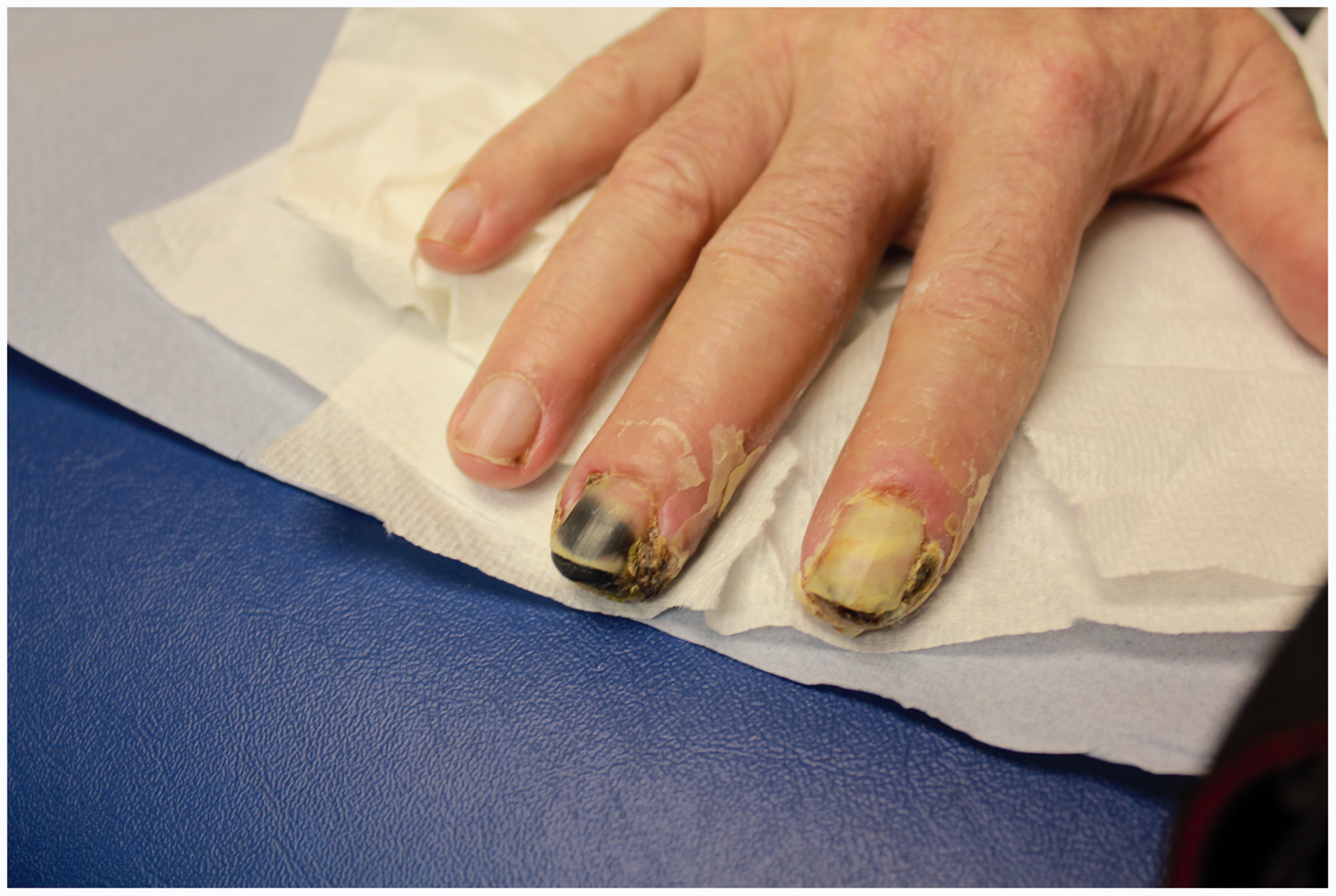

Footnotes
Declaration of conflicting interests
The authors declared no potential conflicts of interest with respect to the research, authorship, and/or publication of this article.
Funding
The authors received no financial support for the research, authorship, and/or publication of this article.