



Abstract
Purpose
To determine the incidence of non-alcoholic fatty liver disease (NAFLD) by non-invasive methods in people living with HIV (PLWH).
Methods
Prospective cohort, in PLWH naïve to antiretroviral therapy, starting bictegravir (BIC) or dolutegravir (DTG) at the Hospital de Infectología “La Raza”, in Mexico City, from February 2021 to August 2023. We measured at baseline and 48 weeks triglycerides and glucose index (TyG), fatty liver index (FLI), hepatic steatosis index (HSI) and liver ultrasonography; relative risk (RR) for developing NAFLD was determined.
Results
At 48 weeks, TyG index in BIC-group 4.54 (IQR 4.36–4.75), in DTG-group 4.66 (IQR 4.49–4.80), p = .080; HSI in BIC-group 30.30 (IQR 28.12–33.70), in DTG-group 30.85 (IQR 28.02–34.50), p = .650; FLI in BIC-group 14.88 (IQR 7.91–31.80), in DTG-group 19.49 (IQR 8.49–32.28), p = .729; NAFLD was detected by US in 6 [10.3% (95%CI 4.8%–20.7%)] in BIC-group and, 7 [10.9% (95%CI 6.4%–20.9%)] in DTG-group, p = .916. Risk factors for NAFLD development were baseline BMI ≥25 kg/m2, baseline HDL-c <40 mg/dL, and FIB-4 >1.3 at 48 weeks.
Conclusion
There is a high incidence of NAFLD in PLWH who start a second generation INSTI at 48 weeks; baseline overweight, low HDL-cholesterol and FIB-4 >1.3 at 48 weeks of treatment were independent risk factors for NAFLD development.
Background
Non-alcoholic fatty liver disease (NAFLD) is the most frequent chronic liver disease worldwide; its prevalence is estimated from 17% to 46%. 1 In Mexico, “metabolic dysfunction-associated steatotic liver disease” (MASLD), became the leading cirrhosis cause with 36% incidence in 2019, the same year obesity increased to 36%; NAFLD/MASLD progress to steatohepatitis (NASH), fibrosis and liver cirrhosis.2–4 NAFLD prevalence in people living with HIV (PLWH) has been reported up to 55%; liver disease has become the third cause of death not associated with human immunodeficiency virus (HIV) in PLWH.5,6 Weight increase has been related to antiretroviral therapy (ART) especially integrase inhibitors (INSTI) and HIV7,8; low CD4 + cells count and longer exposure to INSTI are associated with hepatic steatosis diagnosed by controlled attenuation parameter (CAP). 9 Fatty liver index (FLI), hepatic steatosis index (HSI) and triglyceride/glucose index (TyG) are non-invasive serological tests validated for NAFLD diagnosis in PLWH; in the same population, ultrasonography (US) reported 95% and 85% sensitivity and specificity, respectively, for hepatic steatosis diagnosis. 10 The aim of this study was to determine the incidence of NAFLD by non-invasive methods in PLWH naïve to ART starting dolutegravir compared with bictegravir after 48 weeks of follow-up.
Methods
Design
A prospective cohort nested in a randomized clinical trial comparing Bictegravir/Emtricitabine/Tenofovir Alafenamide (BIC/FTC/TAF) with Dolutegravir/Lamivudine/Abacavir (DTG/3TC/ABC) in PLWH was conducted in the HIV clinic at the Hospital de Infectología “La Raza” National Medical Center in Mexico City, from February 2021 to August 2023. This study was approved by local health research committee 3502 and local research ethics committee 35028 with approved registration number R-2022-3502-104. Written informed consent was obtained from all participants.
Study population
Study subjects were men living with HIV (MLWH) naïve to ART, ≥18 years old. Patients were excluded if they had any liver disease, previous diagnosis of NAFLD or baseline ultrasound (US) with liver steatosis, AUDIT score ≥16 points, 11 coinfection with hepatitis B (HBV) or hepatitis C viruses (HCV).
Measurements
Examinations included waist circumference, size, weight, complete blood cells count, blood chemistry, liver function tests, lipids, RNA HIV-1 viral load, CD4 + cells count and, B and C hepatitis test. Alcohol consumption was obtained through AUDIT questionnaire. TyG, FLI and HIS were calculated.
Quantitative US with a transient elastography (TE) reported in kilopascals (kPa) and acoustic radiation force impulse (ARFI) technique (QelaXto) with multi-frequency convex transducer equipment for US was performed by a single, experienced operator. The measurements were considered reliable with at least 10 successful acquisitions in kPa and an IQR less than 30% of median.
All measurements were collected at baseline and at 48 weeks of treatment to determine the incidence of NAFLD in PLWH who started BIC/FTC/TAF (BIC-group) or DTG/3TC/ABC (DTG-group). NAFLD was defined as TyG >8.38 and FLI ≥76.5 or, US reporting liver steatosis [insert Figure 1]. All patients were under control with a nutritionist. NAFLD diagnostic algorithm.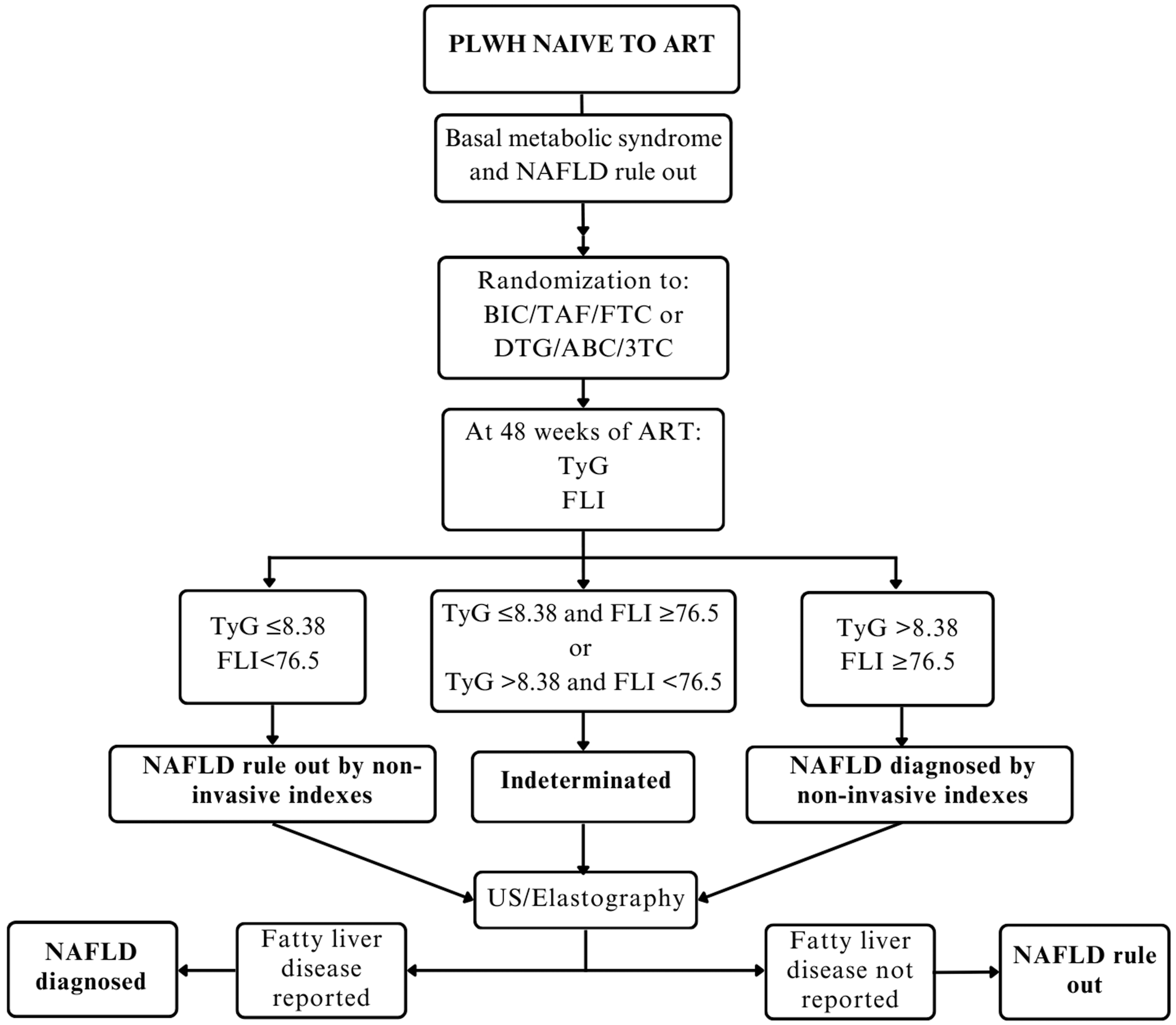
Statistical analysis
Sample size was calculated with confidence interval (CI) of 95% and, power of 80%, using a finite sample size formula with 71 patients in each group, based on studies in the Mexican population (Castro MG et al.). 12 Descriptive results were summarized with median and interquartile ranges (IQR) or mean with standard deviation. The incidence rate of NAFLD during first 48 weeks of ART was calculated according to the diagnosis algorithm, and cumulative incidence was obtained. A comparison of baseline TyG, FLI, HSI, US and TE at 48 weeks in each group and between groups using Mann Whitney U-test and Wilcoxon test respectively was made. Relative risk (RR) factors were obtained through x 2 or Fisher exact test; RR found with a p-value ≤.25 for developing NAFLD were included in a logistic regression model to obtain adjusted RR (aRR). A p value ≤.05 was considered statistically significant. The statistical analysis was done with SPSS 29.0 version.
Results
Patients baseline characteristics, N = 122.

BMI: body mass index. HDL: high-density lipoprotein, LDL: low-density lipoprotein. AST: aspartate transaminase. ALT: alanine transaminase. GGT: gamma-glutamyl transferase. HIV: human immunodeficiency virus. TyG: triglycerides/glucose index. FLI: fatty liver index. HSI: hepatis steatosis index. kPa: kilopascals. APRI: aspartate aminotransferase to platelet ratio index. FIB-4: fibrosis-4 index for liver fibrosis.
aT-student´s test.
bChi square or Fisher´s test.
At 48 weeks, TyG index in BIC-group was 4.54 (IQR 4.36–4.75), in DTG-group 4.66 (IQR 4.49–4.80), p = .080; HSI in BIC-group was 30.30 (IQR 28.12–33.70), in DTG-group 30.85 (IQR 28.02–34.50), p = .650; FLI in BIC-group was 14.88 (IQR 7.91–31.80), in DTG-group 19.49 (IQR 8.49–32.28), p = .729; TE was 4.4 (IQR 4.0–5.1) kPa in BIC-group and, 4.6 (IQR 4.0–5.2) kPa in DTG-group, p = .866 (Table S4).
Relative risk factors and adjusted relative risk factors for NAFLD development.

TAF: tenofovir alafenamide. DTG: dolutegravir. BIC: bictegravir. BMI: body mass index. HDL: high-density lipoprotein, LDL: low-density lipoprotein. AST: aspartate transaminase. ALT: alanine transaminase. GGT: gamma-glutamyl transferase. HIV: human immunodeficiency virus. TyG: triglycerides/glucose index. FLI: fatty liver index. HSI: hepatis steatosis index. kPa: kilopascals. APRI: aspartate aminotransferase to platelet ratio. Adjusted relative risks that maintained statistical significance.
Discussion
The incidence of NAFLD in MLWH at 48 weeks with second generation INSTI was high in this cohort, and no differences were observed between BIC or DTG; baseline BMI ≥25 kg/m2, HDL <40 mg/dL and, FIB-4 >1.3 at 48 weeks of treatment were independent risk factors for NAFLD development. None of participants had TyG >8.38, four had FLI ≥76.5; of these, one had steatosis by US.
Liver disease is the third cause of death not related to HIV in PLWH. In Mexico, the main cause of liver cirrhosis is MASLD; weight gain led to metabolic disturbances and liver fat accumulation; in addition, HIV and ART also contribute to weight gain.2,6–8,13
The incidence of NAFLD in this cohort was lower than reported by Bischoff et al., who found a prevalence of 45%, which maybe is explained by use of CAP for NAFLD diagnosis and older PLWH; they also found an association with TAF, a finding also reported by Riebensahm et al., unlike this cohort the association with TAF was not found, probably because of the short period of follow up.13,14 In concordance with Kirkegaard and Maurice, baseline BMI higher (≥25 kg/m2) and HDL-cholesterol (HDL-c) <40 mg/dL were independent risk factors for NAFLD development.15,16 These findings are related to that reported in other studies, where BMI is strongly linked to NAFLD risk possibly because it is related to visceral adipose tissue (VAT). Excess of free fatty acids by lipolysis, triglycerides (TG) and, the loss of capacity of subcutaneous adipose tissue to store excess of energy, lead to ectopic fat accumulation, resulting in TG accumulation in the liver. 17
TyG index, HSI and FLI were lower than that reported by Busca et al.; however, their population was older, with different demographic characteristics and longer period of ART; in addition, they found that sensitivity of US is greater to diagnose NAFLD in PLWH. 10 Scores and cut-off points for non-invasive methods could change depending on the sociodemographic characteristics, according to Priego et al. In Mexico, Triglycerides Glucose-Waist Circumference (TyG-WC), a modification of TyG index used in this cohort, has an area under the curve of 0.87 in men; however, that population was not living with HIV 18 ; Non-invasives scores could be adjusted in Mexican PLWH in the future. High AST, ALT, gamma-glutamyl transpeptidase and longer HIV infection are associated with progression of NAFLD19,20; although, in this study this association was not found; instead, a decrease in liver enzymes in both groups after 48 weeks of ART was observed; it may be due to reduction in liver inflammation caused by HIV once patients start ART, as Mata-Marín et al., reported. 21
Kirkegaard et al., showed an association between first generation INSTI and NAFLD, but they did not find this relationship with DTG, unlike this cohort where 13 MLWH developed NAFLD (6 in BIC-group and 7 in DTG-group) in the first year with ART. 22 TG were higher in DTG-group, in contrast to Mallon et al., reporting the OPERA cohort, where TAF containing regimens were associated with higher triglycerides. 23
Another risk factor for NAFLD was FIB-4 >1.3., Gastroenterology guidelines classify it as low or intermediate risk for fibrosis; magnetic resonance imaging or liver biopsy should be considered. 24
This study has several limitations. Only men were included, CAP and insulin were not measured, and the period of follow-up was 48 weeks at the time of this analysis, maybe a short period to find more changes associated with NAFLD.
The strengths are that in our knowledge, this is the first report that evaluates incidence of NAFLD in PLWH with no prior experience to ART, comparing recommended regimens for HIV treatment worldwide and in Latin-America; performing transient liver elastography and, use of non-invasive indexes for NAFLD diagnosis corroborated by US at the same time.
Regarding the high incidence of NAFLD during first year of ART with INSTI, liver evaluation is necessary for an early diagnosis and therapeutical interventions to prevent liver damage, longer follow-up is necessary, and probably an adjustment of TyG, FLI and HSI for diagnosis of NAFLD in Mexican and maybe in Latin-American MLWH.
In conclusion, there is a high incidence of NAFLD in PLWH who start a second generation INSTI at 48 weeks, similar in DTG and BIC regimens; physicians should consider NAFLD detection and implement strategies to lose weight and decrease the risk of hepatic steatosis.
Supplemental Material
Supplemental Material - Incidence of NAFLD in antiretroviral therapy-naïve people with HIV who start DTG/ABC/3TC compared to BIC/FTC/TAF at 48-week follow-up
Supplemental Material for Incidence of NAFLD in antiretroviral therapy-naïve people with HIV who start DTG/ABC/3TC compared to BIC/FTC/TAF at 48-week follow-up by Ana Luz Cano Díaz, Salma Triana González, Gloria E Salinas Velázquez, José A Mata Marín, Jesús Enrique Gaytán Martínez and Stefan Mauss in International Journal of STD & AIDS.
Supplemental Material
Supplemental Material - Incidence of NAFLD in antiretroviral therapy-naïve people with HIV who start DTG/ABC/3TC compared to BIC/FTC/TAF at 48-week follow-up
Supplemental Material for Incidence of NAFLD in antiretroviral therapy-naïve people with HIV who start DTG/ABC/3TC compared to BIC/FTC/TAF at 48-week follow-up by Ana Luz Cano Díaz, Salma Triana González, Gloria E Salinas Velázquez, José A Mata Marín, Jesús Enrique Gaytán Martínez and Stefan Mauss in International Journal of STD & AIDS.
Footnotes
Acknowledgements
We want to thank to the study participants and physicians team.
Author contributions
A. L. C. D design of work, data acquisition, analysis, interpretation of data, drafting the work; S.T.G data acquisition; G. E. S. V data acquisition; J.A.M.M. design of work, analysis, interpretation of data, drafting the work and reviewing; J.E.G.M. data acquisition, drafting the work and reviewing; S. M. Drafting the work and final approval of the version to be published.
Declaration of conflicting interests
The author(s) declared no potential conflicts of interest with respect to the research, authorship, and/or publication of this article.
Funding
The author(s) received no financial support for the research, authorship, and/or publication of this article.
Ethical statement
Study registration
Local health research committee 3502 with institutional registration number R-2022-3502-104.

Data availability statement
The database contains personal information therefore is not publicly available. Access to the study data is governed by local health research committee 3502 and local research ethics committee 35028 of Instituto Mexicano del Seguro Social. Requests can be submitted for review to the principal investigator (Ana Luz Cano Díaz,
Supplemental material
Supplemental material for this article is available online.
References
Supplementary Material
Please find the following supplemental material available below.
For Open Access articles published under a Creative Commons License, all supplemental material carries the same license as the article it is associated with.
For non-Open Access articles published, all supplemental material carries a non-exclusive license, and permission requests for re-use of supplemental material or any part of supplemental material shall be sent directly to the copyright owner as specified in the copyright notice associated with the article.
