



Abstract
Research shows that reflecting on benefits received can make people happier, but it is unclear whether or not such reflection makes them more helpful. Receiving benefits can promote prosocial behavior through reciprocity and positive affect, but these effects are often relationship-specific, short-lived, and complicated by ambivalent reactions. We propose that prosocial behavior is more likely when people reflect on being a benefactor to others, rather than a beneficiary. The experience of giving benefits may encourage prosocial behavior by increasing the salience and strength of one’s identity as a capable, caring contributor. In field and laboratory experiments, we found that participants who reflected about giving benefits voluntarily contributed more time to their university, and were more likely to donate money to natural-disaster victims, than were participants who reflected about receiving benefits. When it comes to reflection, giving may be more powerful than receiving as a driver of prosocial behavior.
As people muddle through their daily lives, they often fail to appreciate meaningful experiences and interactions. Research suggests that structured reflection is an antidote to this problem: When people contemplate and write about emotional experiences, they become happier and healthier (Frattaroli, 2006; Pennebaker & Seagal, 1999). In particular, when people count blessings, they feel grateful for the benefits they have received, and this in turn fosters greater psychological and physical well-being (Emmons & McCullough, 2003).
Although reflecting on benefits received may make people happier, it remains to be seen whether such reflection can make people more helpful. This is an important question given that prosocial behaviors are critical to individual, group, and societal well-being (Penner, Dovidio, Piliavin, & Schroeder, 2005). Helping, giving, and volunteering are examples of prosocial behaviors undertaken to benefit other people, and these behaviors play a critical role in protecting health, promoting education, fighting poverty and hunger, and providing disaster relief. Theoretically, understanding how reflection influences prosocial behavior can enrich current knowledge of how expressive writing affects interpersonal actions, not only individual experiences (Pavey, Greitemeyer, & Sparks, 2012). Practically, such an understanding can provide psychologists with new techniques for motivating people to participate in helping, giving, and volunteering behaviors that benefit individuals and communities.
There are two dominant theoretical explanations for why reflecting on benefits received may increase prosocial behavior: reciprocity and positive affect. According to the norm of reciprocity (Gouldner, 1960), when people receive a benefit from another person, they feel obligated to reciprocate by giving back to or helping that person (for a review, see Cialdini & Goldstein, 2004). In addition, emotion research has long shown that receiving a benefit cultivates positive affect, which encourages prosocial behavior by fostering a more favorable view of other people and by reducing the perceived costs of helping (Isen, Clark, & Schwartz, 1976; for a review, see Carlson, Charlin, & Miller, 1988). More recently, psychologists have demonstrated that receiving a benefit fosters feelings of gratitude, promoting prosocial behavior by encouraging people to focus on long-term relationships rather than short-term personal costs (Bartlett & DeSteno, 2006). Together, these perspectives suggest that when people reflect on benefits received, they may experience positive affect and a greater sense of obligation, which will motivate them to engage in prosocial behavior.
However, there are reasons to believe that reflecting on benefits received may not be sufficient to promote prosocial behavior. First, because reciprocity norms are often relationship-specific, receiving a benefit can create feelings of obligation toward one’s benefactor while failing to encourage repeated prosocial behaviors toward other people (Cialdini & Goldstein, 2004). Second, because emotions are temporary states, their effects on prosocial behavior are known to be short-lived. For example, Isen et al. (1976) found that when people received a gift, the increase in helpfulness that they demonstrated typically disappeared in less than 30 min. Similarly, DeSteno, Bartlett, Baumann, Williams, and Dickens (2010) noted that feeling grateful for benefits received is likely to encourage prosocial behavior only if one is “quickly confronted by another individual requesting exchange or assistance” (p. 293). Third, receiving a benefit often leads people to feel helpless, dependent, incompetent, or embarrassed (Fisher, Nadler, & Whitcher-Alagna, 1982), and some receivers seek to escape feelings of indebtedness by avoiding opportunities to reciprocate (Flynn & Brockner, 2003). Even when individuals are grateful for the benefits they receive, they are likely to attribute substantial responsibility for their good fortune to another person, which may undermine their sense of self-efficacy and control (Chow & Lowery, 2010; Weiner, 1985). Moreover, the experience of receiving help can foster a passive mind-set, reducing people’s motivation to exert effort (Fitzsimons & Finkel, 2011). Thus, receiving carries the risk of fostering an identity as a passive beneficiary, which may not engender the self-efficacy and commitment necessary for prosocial behavior.
In this article, we examine whether a different form of structured reflection is more conducive to prosocial behavior. We propose that people are more inclined to initiate and sustain prosocial behavior when they reflect on benefits given than when they reflect on benefits received. According to self-perception theory (Bem, 1972), people often infer their attitudes and identities by observing their own behaviors. When people reflect on their experiences of giving rather than receiving, they are likely to see themselves as benefactors rather than beneficiaries, and such a perception will activate and strengthen their values and their identities as caring, helpful, prosocial individuals who are capable of succeeding. Indeed, research shows that the experience of giving to other people can enhance feelings of self-efficacy as a capable contributor (Alessandri, Caprara, Eisenberg, & Steca, 2009) and feelings of social worth as a valued contributor (Grant & Gino, 2010). As Alessandri et al. (2009) explained, “by engaging in prosocial actions, people may come to think of themselves as prosocial individuals. . . . Prosocial behavior changes individuals’ self-perceptions about their own empathic and prosocial dispositions and capacities” (p. 1237).
Seeing oneself as a benefactor is likely to be particularly motivating given that benevolence values, which emphasize the importance of protecting and promoting the well-being of the people with whom one is in personal contact, are the most strongly held and widely shared values across the majority of the world’s cultures (Schwartz & Bardi, 2001). When people view themselves as benefactors, these core values are salient, and engaging in prosocial behavior provides the opportunity to express, affirm, and fulfill the desire to help effectively (Verplanken & Holland, 2002), which results in consistency between values and behaviors (Cialdini & Goldstein, 2004). Indeed, both laboratory and field studies have shown that when their self-concept as benefactors is situationally or chronically salient, people demonstrate greater commitment to helping, giving, and volunteering (e.g., Grant, Dutton, & Rosso, 2008; Nelson & Norton, 2005; Penner & Finkelstein, 1998).
In summary, we expect that recalling experiences of being a benefactor (i.e., giving benefits) will be more likely to enhance prosocial behavior than recalling experiences of being a beneficiary (i.e., receiving benefits). To test this hypothesis, we conducted two experiments. In Experiment 1, a field experiment, university fund-raisers wrote journal entries about recent experiences in which they had either received benefits from other people or had given benefits to other people. In Experiment 2, a laboratory experiment, participants listed three ways in which they had recently given help, received help, or neither (i.e., they wrote about a different topic). In both experiments, mindful of the importance of examining real behavior (Baumeister, Vohs, & Funder, 2007), we obtained objective measures of prosocial behavior by tracking actual expenditures of time (in voluntary calls to help a university) and money (in donations to help earthquake victims).
Experiment 1
Method
Participants
This study involved 32 fund-raisers working at a call center for a large public university in the midwestern United States. These fund-raisers were responsible for obtaining alumni donations to support student scholarships, faculty salaries, and new buildings and programs. We contacted the university’s 66 fund-raisers by e-mail, offering $25 for participating in a study of journal writing at work, and 32 agreed to become involved (response rate = 48.5%). The sample was 53% male and 47% female, and participants had an average job tenure of 4.08 months (SD = 3.87 months).
Design and procedure
All of the fund-raisers kept journals. We selected journal writing as the medium of expression because it is known to be an important vehicle for expressing emotions and reflecting on one’s experiences (for reviews, see Frattaroli, 2006; Pennebaker & Seagal, 1999) and because it has been used in previous experiments on experiences of gratitude (Emmons & McCullough, 2003; Lyubomirsky, Sheldon, & Schkade, 2005). We asked each participant to write daily journal entries for 4 consecutive days, for 15 min each day, and submit the entries on a password-protected Web site.
Using a random-number generator, we assigned the fund-raisers to one of two between-subjects conditions: beneficiary or benefactor. We adapted the prompts from existing research on gratitude reflection (Emmons & McCullough, 2003). In the beneficiary condition, we asked participants to write about recent experiences at work in which they had felt grateful for a benefit received from other people; in the benefactor condition, we asked participants to write about recent experiences at work in which they had made a contribution that enabled other people to feel grateful. In both conditions, guided by evidence about the value of forming a coherent narrative (Pennebaker & Seagal, 1999), we asked participants to write a story about a different experience each day, reflect on what brought it about, and describe how it affected their thoughts, feelings, and actions. To eliminate methodological artifacts and create a fair comparison between conditions (Cooper & Richardson, 1986), we designed the experiment so that the only difference in the instructions between the two conditions was whether participants wrote about the experience of receiving or giving a benefit.
Measures
We measured prosocial behavior in terms of the voluntary efforts that the fund-raisers undertook in their jobs to benefit the university (Grant & Gino, 2010). The fund-raisers’ jobs involved only one task: calling alumni to solicit donations. They were paid a fixed hourly wage without any goals, rewards, or incentives, so they had the freedom to choose how much effort to expend in raising money for the university. Consequently, the number of calls made is a direct measure of prosocial behavior, reflecting a personal choice—without obligation—to devote time and energy to benefiting other people (e.g., Brief & Motowidlo, 1986; Omoto & Snyder, 1995; Penner et al., 2005). Given that the number of calls made is a strong predictor of the total donation money that fund-raisers obtain (Grant, 2008), any fund-raisers who made more calls after journal writing would be demonstrating increased behavioral commitment to helping the university raise more money. We measured prosocial behavior as the number of hourly calls that each fund-raiser made during the 2 weeks before the week of journal writing (the pretest) and the 2 weeks after the week of journal writing (the posttest). The number of calls per hour was automatically recorded by call-tracking software and verified by two managers, and these data were reliable across the 2-week pretest period (α = .81) and the 2-week posttest period (α = .70). Calls were the only measure of prosocial behavior that we collected; we did not have access to other behavioral data.
The average fund-raiser submitted 2.81 journal entries (SD = 1.53). Two independent coders blind to our hypothesis counted the number of times each journal entry mentioned receiving a benefit from other people and giving a benefit to other people. The mean scores showed excellent interrater reliability, ICC(2) = .99 for receiving and .96 for giving, ps < .001.
Results and discussion
Table 1 reports the means and standard deviations of the measured variables in the two conditions. As expected, receiving a benefit was mentioned more frequently by fund-raisers in the beneficiary condition than by those in the benefactor condition, t(15.22) = 3.96, p < .01, prep = .99. Conversely, giving a benefit was mentioned more frequently by fund-raisers in the benefactor condition than by those in the beneficiary condition, t(16.05) = 4.26, p < .01, prep = .99. These results support the effectiveness of our manipulation. 1
Means of Measured Variables in Experiment 1
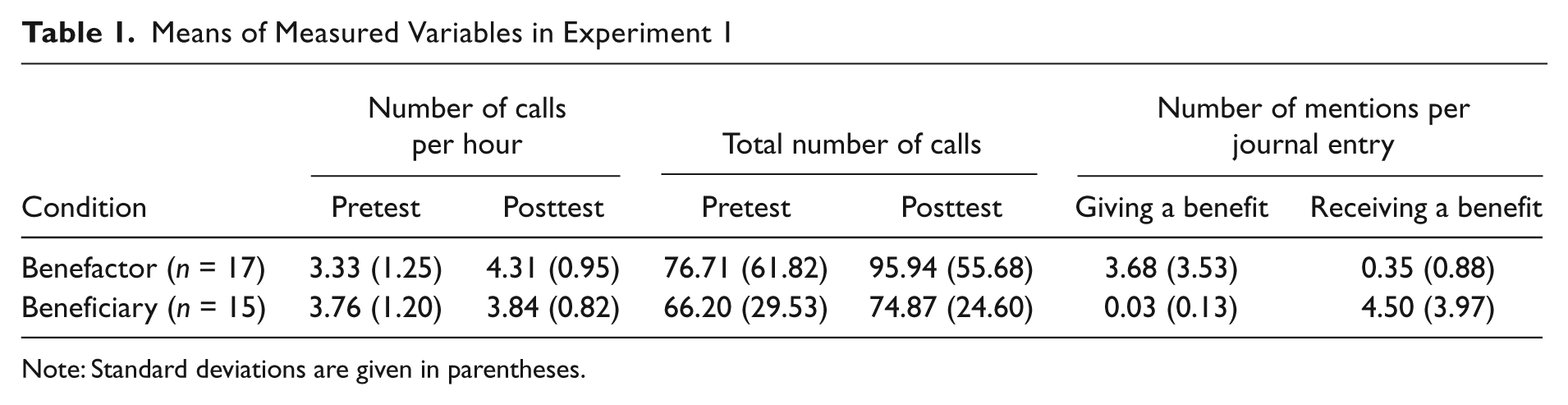
Note: Standard deviations are given in parentheses.
A repeated measures analysis of variance showed a significant time-condition interaction effect on the number of calls per hour, F(1, 30) = 4.45, p = .04, prep = .89, η2 = .11. Paired-samples t tests revealed that the number of hourly calls made by fund-raisers in the benefactor condition increased significantly from the pretest to the posttest, t(16) = 3.34, p < .01, prep = .98, d = 0.88. The number of hourly calls made by fund-raisers in the beneficiary condition did not show a significant change, t(14) = 0.23, p = .82. 2 The total number of calls showed the same pattern of results: The number increased significantly in the benefactor condition, t(16) = 2.91, p = .01, prep = .96, d = 0.33, but not in the beneficiary condition, t(14) = 1.25, p = .23.
Experiment 2
In our next experiment, we sought to constructively replicate these findings (Lykken, 1968) with a different sample, manipulation, and measure of prosocial behavior. Instead of measuring changes in prosocial behavior over time using a within-subjects comparison, we added a control condition to facilitate a stronger between-subjects comparison.
Method
Participants and design
This study involved 84 students from a subject pool at a private university in the northeastern United States. The participants logged in to the Qualtrics survey Web site for an online study of life events that would pay $5. They were randomly assigned to one of three between-subjects conditions: beneficiary, benefactor, or control. In the beneficiary condition, participants were asked to describe three recent experiences of receiving benefits from other people:
We often receive from other people. We receive when others help, contribute, donate, assist, volunteer, express compassion, or provide support to us—any act of offering their time, knowledge, skills, money, connections, or other resources to benefit us. Thinking back over the past few weeks, please identify three ways in which you received from another person. What did you receive, and how did you benefit?
In the benefactor condition, participants were asked to describe three recent experiences of giving benefits to other people:
We often give to other people. We give when we help, contribute, donate, assist, volunteer, express compassion, or provide support to another person—any act of offering our time, knowledge, skills, money, connections, or other resources to benefit another person. Thinking back over the past few weeks, please identify three ways in which you gave to another person. What did you give, and how did the recipient benefit?
Participants in these two conditions wrote about experiences of receiving from, or giving to, three different people. In the control condition, participants were asked to write about a neutral topic: “We often eat different types of foods. Thinking back over the past few weeks, please identify three different foods that you ate. What did you eat, and what did it taste like?”
Procedure and measures
After answering the prompts, all participants completed manipulation checks, indicating their agreement with several statements using a 7-point Likert-type scale ranging from 1 (disagree strongly) to 7 (agree strongly). All the statements began with the prompt, “In the situations that I wrote about at the beginning of the study, I was. . . .” For the beneficiary manipulation check, the prompt was completed with “a recipient,” “a beneficiary,” “a target of help,” and “a receiver” (α = .85). For the benefactor manipulation check, the prompt was completed with “a giver,” “a helper,” “a provider,” and “a supporter” (α = .93).
During the following month (June 2011), participants visited the university’s behavioral lab to pick up their payment. On average, the participants arrived 2 weeks after completing the online study (range: 1–4 weeks). When they arrived, the experimenter handed them a form that described the March 11, 2011, earthquake and tsunami in Japan, and provided estimates of the number of casualties, number of people displaced, and shortages of electricity, food, and water. The form noted that a group of students at the university had launched an earthquake relief initiative for the victims, and that the funds raised from this effort would be donated to the American Red Cross.
On the form, participants indicated whether or not they would like to donate a portion of their $5 payment to the earthquake relief fund, and if so, how much they wanted to donate. If they did not want to donate, the experimenter paid them $5. If they did want to donate, the experimenter subtracted the amount listed and paid them any remainder of the $5. We measured prosocial behavior as the decision to donate money to the relief fund. Donations were the sole measure of prosocial behavior that we obtained; no other behaviors were assessed in this study.
Results and discussion
Table 2 presents the means and standard deviations of the measured variables in the three conditions. As expected, participants in the beneficiary condition saw themselves more strongly as beneficiaries than did those in the benefactor condition, t(52) = 8.39, p < .001, prep > .99, d = 2.33, or the control condition, t(55) = 7.94, p < .001, prep > .99, d = 2.14. Conversely, participants in the benefactor condition saw themselves more strongly as benefactors than did those in the beneficiary condition, t(52) = 10.29, p < .001, prep > .99, d = 2.85, or the control condition, t(53) = 7.33, p < .001, prep > .99, d = 2.01. These results support the effectiveness of our manipulation.
Means of Measured Variables in Experiment 2
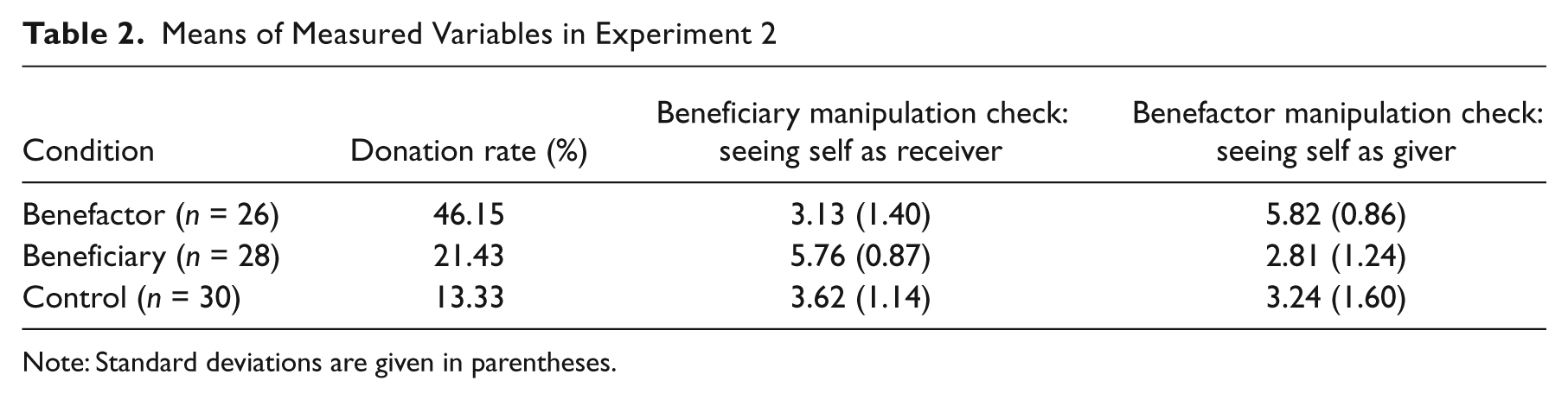
Note: Standard deviations are given in parentheses.
To examine whether the manipulation affected prosocial behavior, we conducted contingency-table analyses. In total, 26% of participants donated money, and an omnibus analysis showed significant differences in the donation rate between conditions, χ2(2, N = 84) = 8.25, p = .02, prep = .94, d = 0.66. Participants in the benefactor condition were significantly more likely to donate money (46.15%) than were those in the beneficiary condition (21.43%), χ2(1, N = 54) = 3.71, p = .05, prep = .87, d = 0.54, and the control condition (13.33%), χ2(1, N = 56) = 7.35, p < .01, prep = .96, d = 0.78. 3
General Discussion
Our studies show that reflecting on experiences as a benefactor, rather than a beneficiary, is more likely to enhance prosocial behavior. After merely writing about their contributions for 15 min per day for 2 to 4 days, fund-raisers increased their hourly calls to help their university by more than 29% in the following 2 weeks. A few weeks after simply describing three recent experiences of giving, participants were more than twice as likely to donate money to an earthquake relief fund as were participants who described recent experiences of receiving or who wrote about a neutral topic.
These findings have important implications for knowledge about prosocial behavior and expressive writing. With respect to prosocial behavior, recent evidence suggests that giving can promote greater happiness than receiving (Dunn, Aknin, & Norton, 2008). Our results go further by revealing that reflecting on giving, rather than receiving, can also lead to greater helpfulness. Our research demonstrates that reflecting on the experience of giving can exert a powerful influence on naturalistic behavior in the field, not only on psychological states in the laboratory (Baumeister, Vohs, & Funder, 2007). In this way, our studies answer calls to enrich knowledge about giving by exploring the experiences of benefactors, and not just beneficiaries (Brown, Nesse, Vinokur, & Smith, 2003; Grant & Gino, 2010).
Our findings also have meaningful implications for the expressive-writing literature. Although evidence that writing about positive experiences can improve well-being and health behaviors has begun to accumulate (e.g., Burton & King, 2004; Emmons & McCullough, 2003), little research has examined the implications for interpersonal behaviors. One exception to this generalization is found in new research indicating that reflecting about relatedness can strengthen feelings of connectedness, increasing prosocial behavior (Pavey et al., 2012). Our research extends knowledge in this area by showing that, when it comes to motivating prosocial behavior, not all experiences of relatedness are created equal. Reflecting on connections to other people as a giver is more conducive to prosocial behavior than is reflecting on connections to other people as a receiver.
Although we expected that reflecting on giving benefits to other people would yield greater increases in prosocial behavior, we were surprised that reflecting on receiving benefits from other people did not produce significant increases in prosocial behavior in either study. Future research is necessary to explore whether such an effect was absent because emotions of gratitude are most likely to influence short-term, immediate behaviors (Bartlett & DeSteno, 2006; DeSteno et al., 2010). On the one hand, it is tempting to assume that reflecting on grateful emotions may cause them to come flooding back, spurring prosocial behaviors. On the other hand, any ensuing prosocial behaviors are likely to be temporary, given the short-lived nature of emotions themselves. Reflecting on receiving may have an enduring impact on prosocial behaviors only when the memories leave affective residue and facilitate learning, and thereby result in lasting behavior change (Baumeister, Vohs, DeWall, & Zhang, 2007). However, it is worth noting that the effects of expressive writing are known to change and even reverse over time. For example, writing about a traumatic experience has an initial negative effect on well-being, but becomes positive after approximately 2 weeks (Pennebaker & Seagal, 1999). Thus, in our research it is plausible that the positive effects of reflecting on giving emerged after a delay, rather than immediately, and that reflecting on receiving had positive short-term effects that had faded by the time we measured prosocial behaviors.
In addition, it may be that we asked the fund-raisers in Experiment 1 to count their blessings too frequently (see p. 126 in Lyubomirsky et al., 2005) and that donating money to earthquake victims was too distally linked to the types of benefits that participants in Experiment 2 reflected on receiving. Given that domain-congruent psychological states appear to have a particularly powerful influence on behaviors (e.g., Ajzen, 1991), reflection may yield the strongest effects when it is matched to the behavior in question. When people reflect on receiving the same type of benefit that they have the opportunity to give, they may perceive prosocial behavior as more descriptively or prescriptively normative: The person who gave them benefits may serve as a role model (Bandura, 1977), providing social proof that giving is common and desirable in the situation in question (Cialdini & Goldstein, 2004).
More generally, it will be critical for further studies to test the psychological mechanisms that mediate the effects of reflecting on being a benefactor, which may include feelings of responsibility; an identity as a capable and valued contributor; guilt for failing to contribute more; and value activation, expression, affirmation, and fulfillment. In particular, we hope to see researchers tease apart the effects of identity and self-efficacy. Are the effects we observed driven by seeing oneself as helpful, capable, or both? Furthermore, our research does not address how reflecting on negative benefactor experiences, rather than positive benefactor experiences, affects prosocial behavior. If people recall experiences in which they declined to give help, will their prosocial behavior increase because of guilt or decrease because they perceive themselves as less generous or more selfish? If people recall experiences of attempting to help but failing to do so effectively, will this strengthen their prosocial identities as givers but reduce their self-efficacy? Investigating this question might shed light on the relative roles of identity and self-efficacy in mediating the observed effect of reflection on prosocial behavior. Finally, it is worth noting that other studies have found that reflecting on giving decreases, rather than increases, prosocial behavior (Jordan, Mullen, & Murnighan, 2011; Sachdeva, Iliev, & Medin, 2009). Although future research is necessary to resolve these competing findings, one likely explanation lies in the breadth of the reflection undertaken. In previous studies participants wrote more general stories about themselves as givers, which may have allowed them to avoid giving in a particular situation but still maintain prosocial identities as givers. In our studies, participants focused on specific giving behaviors in which they had engaged, which may have motivated them to engage in prosocial behavior to develop or reinforce their identities as givers.
From a practical perspective, our research demonstrates that self-reflection is a powerful vehicle for motivating prosocial behavior. Merely thinking about recent experiences of giving encourages people to give more time and money. Our research provides empirical support for a kernel of wisdom from La Rochefoucauld (1691/2003): When it comes to motivating prosocial behavior, it may be true that it is better to confer benefits than to receive them.
Footnotes
Acknowledgements
For generative feedback, we thank Associate Editor Julie Fitness, Francesca Gino, Maurice Schweitzer, and Alison Wood. For assistance with data collection, we are grateful to Howard Heevner, Jenny Schumaker, and Laurita Thomas.
Declaration of Conflicting Interests
The authors declared that they had no conflicts of interest with respect to their authorship or the publication of this article.
Funding
This research was generously supported by a University of Michigan Interdisciplinary Committee on Organizational Studies (ICOS) grant and the Wharton Behavioral Lab.