



Abstract
People with extreme political opinions are alternatively characterized as being relatively unthinking or as confident consumers and practitioners of politics. In three studies, we tested these competing hypotheses using cognitive anchoring tasks (total N = 6,767). Using two different measures of political extremity, we found that extremists were less influenced than political moderates by two types of experimenter-generated anchors (Studies 1–3) and that this result was mediated by extremists’ belief superiority (Study 2). Extremists and moderates, however, were not differentially influenced by self-generated anchors (Study 2), which suggests that extremists differentiated between externally and internally generated anchors. These results are consistent with the confident-extremist perspective and contradict the unthinking-extremist perspective. The present studies demonstrate the utility of adopting a basic cognitive task to investigate the relationship between ideology and cognitive style and suggest that extremity does not necessarily beget irrationality.
Scholars have long considered how people on the political extremes—those with the strongest political opinions—differ from people with more moderate political views. In the current literature, there is an ongoing tension between two different perspectives on political extremism. One perspective views extremism as being rooted in uncertainty (Hogg, Kruglanski, & van den Bos, 2013) and characterizes extremists as psychologically rigid, dogmatic, and intolerant of ambiguity (McClosky & Chong, 1985; Tetlock, 1986; Toner, Leary, Asher, & Jongman-Sereno, 2013). This unthinking-extremist perspective is based on findings that politicians from more extreme political parties use less integratively complex language (Tetlock, 1986), that people who support more extreme political parties score higher on measures of intolerance of ambiguity (McClosky & Chong, 1985), and that extreme liberals and conservatives in the United States view their political opinions as objectively correct (Toner et al., 2013). In contrast, political moderates are considered to be more complex thinkers who are tolerant of ambiguity and uncertainty.
In contrast, political extremists are also sometimes characterized as more engaged and confident consumers of political information compared with moderates (Palfrey & Poole, 1987; Sidanius, 1984, 1988; Sidanius & Lau, 1989; Van Hiel & Mervielde, 2003; Zaller, 1992). This confident-extremist perspective is based on findings that political extremists tend to take a more cognitively oriented approach to politics, consume more political media, score higher on measures of political knowledge, are more willing to discuss contentious issues with opponents, and have more self-confidence in general (e.g., Palfrey & Poole, 1987; Sidanius, 1984, 1988; Raimi & Leary, 2014). In comparison, moderates have less knowledge about politics, are relatively disengaged from political life, and report less confidence. Extremism in this view may also have underpinnings in uncertainty (Hogg et al., 2013), but this uncertainty is resolved with conviction and zeal (McGregor, Prentice, & Nash, 2013; Proulx & Major, 2013) rather than with unthinking rigidity. Here, we report three studies that critically tested these opposing perspectives against each other.
To empirically distinguish between the unthinking-extremist and the confident-extremist perspectives, we investigated how political extremism relates to the effects of anchors on numerical judgments (Jacowitz & Kahneman, 1995). In an experimenter-generated-anchoring task, participants estimate a quantity that they are unlikely to know (e.g., the population of Chicago), having been given either an extremely high estimate or an extremely low estimate (5,000,000 or 200,000, respectively). Studies show that the anchor given biases their ultimate judgments (Tversky & Kahneman, 1974). An experimenter-generated anchor influences the decision-making process by giving people an anchor from which they must adjust (Simmons, LeBoeuf, & Nelson, 2010) and by nudging them to selectively focus on evidence consistent with the anchor (Mussweiler & Strack, 2000; Strack & Mussweiler, 1997). Thus, anchors lead participants toward systematic over- or underestimation of the correct values.
The unthinking-extremist and confident-extremist perspectives make divergent predictions for how extremism affects sensitivity to experimenter-generated anchors. People who are relatively unlikely to think things through and have a high need for closure should be particularly biased by anchors (and should also exhibit related cognitive biases) because focusing on an anchor, rather than expending effort to consider alternative information, allows one to arrive at an answer more quickly and clearly (De Dreu, Koole, & Oldersma, 1999; Epley & Gilovich, 2006; Kruger, 1999; Kruglanski & Freund, 1983). Thus, according to the unthinking-extremist perspective, people with extreme political beliefs should be more influenced by experimenter-generated anchors than moderates are. In contrast, the confident-extremist perspective suggests that because extremists are more confident than moderates, they should be more likely to reject an experimenter’s anchor and come to their own decisions. That is, the conviction associated with extremism may extend to politically irrelevant decisions.
In Study 1, we tested these competing predictions using a large, publicly available data set that included data from four experimenter-generated-anchoring items (i.e., the Many Labs data; Klein et al., 2014a, 2014b). In Study 2, we replicated Study 1 and extended our research from experimenter-generated anchors to self-generated anchors to test whether the effect observed in Study 1 was due to rejection of the experimenter-generated anchors or to participants’ particular reliance on their own views. In Study 3, we tested whether these effects of extremism generalized to an experimenter-generated-anchoring task in which the direction of the needed adjustment was uncertain to the subjects.
Study 1
Method
Data for this study were originally collected for the Many Labs project (Klein et al., 2014a, 2014b). During this project, researchers administered the same set of 12 experiments to 36 samples throughout the world; much of the data came from the United States. We analyzed the data from the 25 samples from the United States, because it was not possible to ensure the cross-cultural reliability and validity of the political-attitudes variables for the samples from outside the United States. These 25 samples included 4,846 participants (1,566 men, 3,275 women; mean age = 26.9 years, SD = 12.3). The participants completed the tasks either in person or online, including online samples from Amazon’s Mechanical Turk (MTurk) and from Project Implicit. Each sample contained at least 80 participants, and some samples consisted of more than 1,000 participants. 1
The experiments were administered in a random order and included four experimenter-generated-anchoring items adapted from Jacowitz and Kahneman (1995). For each anchoring task, participants were randomly assigned to receive high-anchor items or low-anchor items. The low-anchor items were as follows:
“The distance from San Francisco to New York City is longer than 1,500 miles. How far do you think it is?”
“More than 100 babies are born per day in the United States. How many babies do you think are born in the U.S. each day?”
“The population of Chicago is more than 200,000. What do you think the population of Chicago is?”
“Mount Everest is taller than 2,000 feet. How tall do you think Mount Everest is?”
The high-anchor items were as follows:
“The distance from San Francisco to New York City is shorter than 6,000 miles. How far do you think it is?”
“Less than 50,000 babies are born per day in the United States. How many babies do you think are born in the U.S. each day?”
“The population of Chicago is less than 5,000,000. What do you think the population of Chicago is?”
“Mount Everest is shorter than 45,500 feet. How tall do you think Mount Everest is?”
All analyses were conducted on the cleaned data file of the Many Labs project, which is available at Open Science Framework (Klein et al., 2014c; see the Data Cleaning section in the Supplemental Methods and Results available online). Data cleaning included, for example, removing responses that were out of range (Jacowitz & Kahneman, 1995). To create a common metric across the anchoring items and conditions, for each question and each participant we calculated the distance between the anchor provided and the participant’s answer (anchor distance). To manage the skew in anchor distance, we rank-transformed the responses in each condition (for the same approach with these data, see Klein et al., 2014c). To make the scores on the tasks directly comparable, we rescaled the rank-transformed anchor-distance variable to range from 0 to 1. This coding scheme has the added benefit of making the unstandardized regression coefficients that we report from our multilevel models more interpretable: Each coefficient represents the percentage change in the rank-transformed anchor-distance measure for every 1-point change in the predictor variable. For example, a b of 0.01 indicates a 1% change as one moves from moderate (0) to slight (1) on our measure of political beliefs (see next paragraph) and a change of 3% as one moves from moderate (0) to extreme (3) on our measure of political beliefs.
Two measures of political opinions were available and were used to construct the indices of political extremity. The first measure was included as part of a demographic questionnaire. Each participant was asked to select his or her political ideology from a standard 7-point scale (1 = strongly liberal, 7 = strongly conservative). To most directly test our hypotheses concerning the role of extremity, we “folded over” this scale to create a measure of ideological extremity (cf. Wegener, Downing, Krosnick, & Petty, 1995). The highest scores represented strongly liberal or strongly conservative ideology (0 = moderate, 1 = moderately liberal/conservative, 2 = liberal/conservative, 3 = strongly liberal/conservative). To control for ideological direction, we included the midpoint-centered (i.e., moderate-centered) 7-point measure of ideology as a covariate in our analyses.
The second measure of political opinions gauged support for eight political issues (α = .72) rated on a scale from 1 (completely disagree) to 7 (completely agree). This attitudinal measure was included in the Many Labs project as part of a replication of Carter, Ferguson, and Hassin’s (2011) work on citizens’ unconscious associations with the American flag. We treated this measure in the same way as the one-item measure of political ideology: We created an attitudinal-extremity measure by folding over the scores and included the midpoint-centered 7-point measure of attitudinal direction as a covariate in our analyses. Ideological and attitudinal extremity were positively correlated (r = .41, p < .001).
Results
Previous analyses conducted on this data set revealed the typical effect of experimenter-generated anchors: High anchors resulted in higher estimates than did low anchors (the weighted meta-analytic Cohen’s d for the four items ranged from 1.17 to 2.42; Klein et al., 2014b). Anchor distance was nested within participants, and participants were nested within samples. We took advantage of this nested structure by adopting a three-level multilevel modeling approach specifying random slopes and random intercepts. These models were created using Hierarchical Linear and Nonlinear Modeling software (HLM, Version 7.01; Raudenbush, Bryk, & Congdon, 2013). We examined two separate models testing ideological extremity and attitudinal extremity as predictors of anchor distance. The unthinking-extremist perspective predicts a negative association between extremity and anchor distance, whereas the confident-extremist perspective predicts a positive association. Results were consistent with the confident-extremist perspective: There was a positive effect of ideological extremity, b = 0.013, SE = 0.003, t(24) = 4.02, 2 p = .001, and attitudinal extremity, b = 0.026, SE = 0.005, t(24) = 5.05, p < .001, on anchor distance, such that people with more extreme ideology (Fig. 1a) and more extreme attitudes (Fig. 1b) made numerical estimates that were further away from the experimenter-generated anchors. Neither measure of ideological direction significantly predicted anchor distance—ideology: b = −0.00002, SE = 0.002, t(24) = −0.01, p = .99; attitudes: b = 0.003, SE = 0.003, t(24) = 1.09, p = .29.
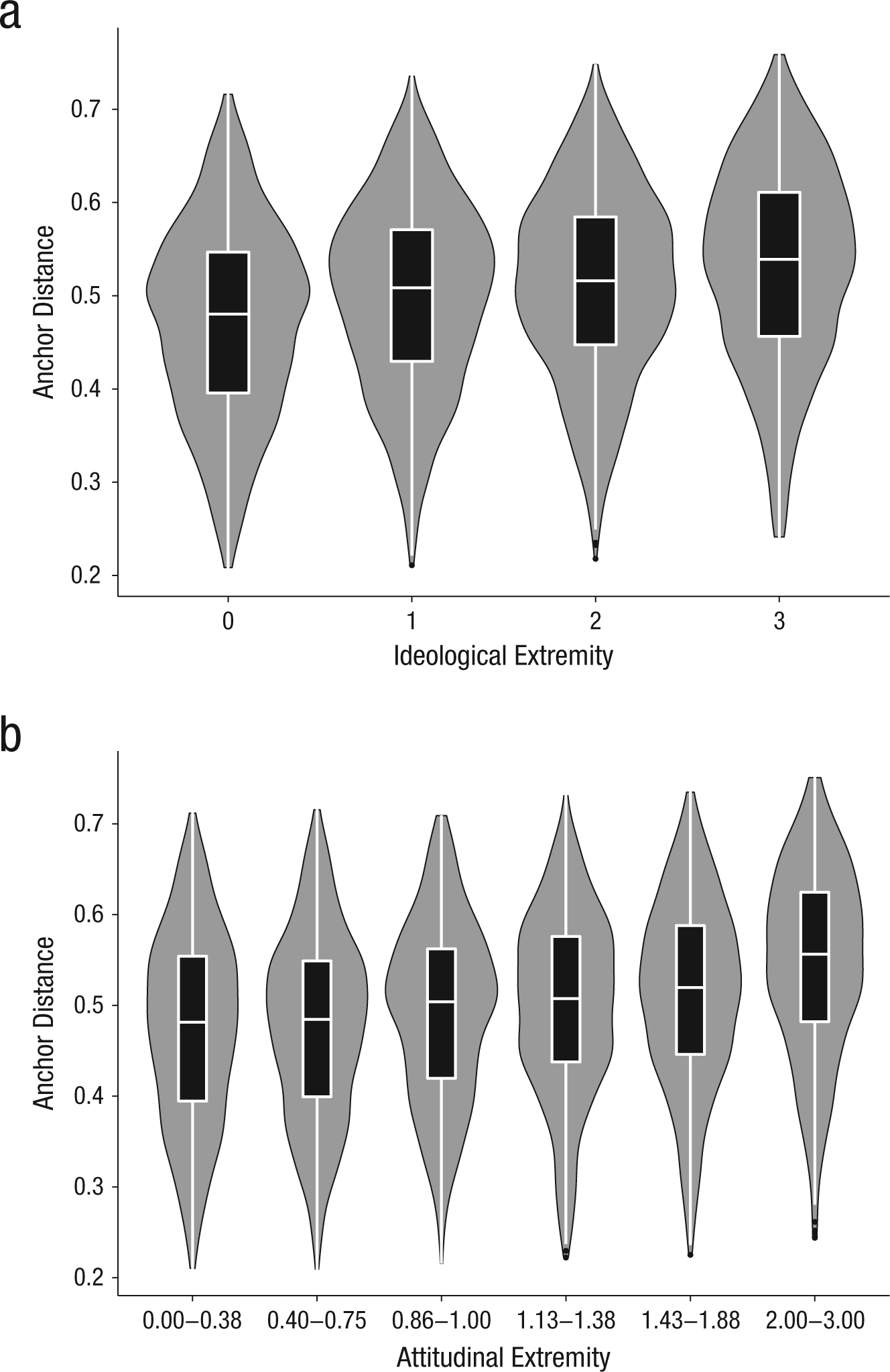
Results from the multilevel models in Study 1: violin plots of the estimated anchor-distance intercept as a function of (a) ideological extremity and (b) attitudinal extremity. In each plot, the top and bottom of the box indicate the 75th and 25th percentiles, respectively, and the white line near the middle of the box is the 50th percentile. The whiskers represent the lowest and highest data points within 1.5 times the interquartile range of the lowest quartile and the highest quartile, respectively. Overlaid on the box plots are probability density estimations. Values for attitudinal extremity were binned into six groups of approximately equal size.
In both models, there was significant between-participants variation in the level of anchor distance left to be explained (ideology: σ = .030, p < .001; attitudes: σ = .026, p < .001), but there was relatively little between-samples variation left to be explained in the effect of extremity (ideology: σ = .006, p = .44; attitudes: σ = .003, p = .19) and direction of ideology (ideology: σ = .003, p > .50; attitudes: σ = .005, p > .50). These results suggest that the size of the effect of extremity was relatively homogeneous across the 25 samples studied. 3
Study 2
Study 1 provided support for the confident-extremist perspective. Greater extremity on two different measures of political ideology predicted increased distance from experimenter-generated numerical anchors. Political moderates were more likely than extremists to form estimates that were consistent with the initial anchors. This finding is opposite that predicted by the unthinking-extremist perspective. In Study 2, we attempted to replicate and extend this finding. Previous work has demonstrated that people with more extreme political opinions are more likely to rate their own opinions as superior (Raimi & Leary, 2014; Toner et al., 2013). We included a measure of belief superiority (Toner et al., 2013) as an indicator of participants’ confidence in their political opinions, and we predicted that belief superiority would mediate the relationship between extremity and distance from experimenter-generated anchors.
We also included an additional anchoring task to test the generalizability of the previous results by investigating whether the results of Study 1 extended to self-generated anchors. In an experimenter-generated-anchoring task, participants are presented with anchors that have unclear or ambiguous informational value. In a self-generated-anchoring task, however, participants make judgments that call to mind well-known and useful reference points (Epley & Gilovich, 2001, 2006). For example, in estimating the boiling point of water on Mount Everest, a participant might first think of the boiling point of water at sea level (212 °F, 100 °C) and adjust away from this value until a suitable response is reached. Thus, in contrast to experimenter-generated anchors, self-generated anchors are based on participants’ own knowledge and experience.
A self-generated-anchoring task allowed us to test whether the effects of the experimenter-generated anchors in Study 1 might have been driven by extremists rejecting experimenter-generated anchors more than moderates or by extremists overvaluing their own views (or perhaps a combination of both). If the effects of extremity on distance from experimenter-generated anchors were due to extremists overvaluing their own views, then extremity would predict less anchor distance for self-generated anchors, because such anchors should serve as particularly valid points of reference. However, if the effects of extremity on distance from experimenter-generated anchors were due primarily to extremists rejecting outside information, then extremity would not influence anchor distance for self-generated anchors. Whereas the confident-extremist perspective predicts an interaction between anchoring condition (self-generated vs. experimenter-generated) and extremity (but is agnostic as to whether the slope in the self-generated-anchor condition will be negative or null), the unthinking-extremist perspective predicts less anchor distance as extremity increases for both types of anchoring tasks.
Method
We aimed to collect data from 1,000 participants to ensure that there would be participants at both ideological extremes. We used Amazon’s MTurk, and we received data from 1,040 participants. After removing 3 participants who reported being younger than 18, 17 participants who reported at the end of the study that they had used outside information to complete the anchoring tasks, and 53 participants who left blank the question regarding use of outside information, we were left with 967 participants, 957 of whom completed the necessary measures (431 men, 524 women, 2 did not specify gender; mean age = 35.9 years, SD = 12.5).
Participants first completed the same nine-item measures of political attitudes (α = .75) and belief superiority (α = .87) used by Toner et al. (2013; for a replication of their analyses, see Table S1 in the Supplemental Methods and Results available online) and a short need-for-closure scale. Examples of the items include, for political attitudes, “How much should health care be paid through the government versus paid by people’s private insurance?” (1 = health care should be paid for completely through the government, 5 = health care should be paid for completely by private insurance), and for belief superiority, “In your view, how much more correct are your beliefs about health care than other people’s beliefs about this issue?” (1 = no more correct than other view points, 5 = totally correct [Mine is the only correct view]).
After completing these scales, participants performed the anchoring tasks. Participants were presented with 8 experimenter-generated-anchoring items (including the four items used in Study 1) and 7 self-generated-anchoring items (see Tables S2 and S3 in the Supplemental Methods and Results). The self-generated-anchoring items were selected from Study 1 of Inbar and Gilovich (2011; e.g., “How many U.S. states were there in 1840?”). The additional experimenter-generated-anchoring items were selected from Jacowitz and Kahneman (1995; e.g., “The maximum speed of a house cat is more than 7 [less than 30] miles per hour. What do you think the maximum speed of a house cat is (in miles per hour)?”). There were two versions of the survey, so that half of the participants received low anchors for the first four experimenter-generated-anchoring items in Table S3 and high anchors for the remaining four, and the other half of participants received the opposite.
In this study, participants also rated their certainty in their responses to the anchoring tasks. After each item, they rated their certainty on a scale from 1 (not at all) to 7 (very much).
The 15 anchoring items were presented in a random order for each participant. After completing the anchoring tasks, participants responded to demographic questions (age, gender, education, income), including the same single-item measure of political ideology used in Study 1.
We created an anchor-distance index for the experimenter-generated-anchoring items following the same process we used in Study 1. For the self-generated-anchoring items, after removing implausible values (for the justification for the implausible values, see Data Cleaning in the Supplemental Methods and Results), we calculated the absolute value of the distance between each response and the anchor, rank-transformed these values, and rescaled the measure to range from 0 to 1. 4 We did this separately for each item. Steps for creating the ideological- and attitudinal-extremity measures as well as ideological and attitudinal direction were identical to those in Study 1. Ideological and attitude extremity were positively correlated (r = .47, p < .001).
Results
We replicated the typical effect of experimenter-generated anchors: High anchors resulted in higher estimates than low anchors (see Table S3 in the Supplemental Methods and Results). The values for Cohen’s d for the eight items ranged from 1.15 to 2.52, which suggests large anchoring effects, similar in size to those in Study 1. Anchor distance was nested within participants. We adopted a two-level multilevel modeling approach specifying random slopes and random intercepts. These models were created using HLM (Raudenbush et al., 2013).
As in Study 1, we examined two models, one for ideological extremity and one for attitudinal extremity. Anchoring condition (−1 = self-generated, 1 = experimenter-generated) was included as a within-participants predictor, and extremity and ideological or attitudinal direction were included as between-participants predictors. We also included the cross-level interactions between extremity and anchoring condition.
The unthinking-extremist perspective predicts a negative association between extremity and anchor distance for both self-generated and experimenter-generated anchors. The confident-extremist perspective predicts a positive association between extremity and anchor distance for experimenter-generated anchors, and it predicts either a null or a negative association between extremity and anchor distance for self-generated anchors.
The results for both models are in Table 1. In both models, there was a significant cross-level interaction between extremity and anchoring condition, consistent with the confident-extremist perspective. Probing this interaction, we found that people with more extreme ideology, b = 0.020, SE = 0.005, t(954) = 3.65, p < .001 (Fig. 2a), and more extreme attitudes, b = 0.063, SE = 0.013, t(954) = 4.87, p < .001 (Fig. 2b), made estimates further away from the experimenter-generated anchors. For self-generated anchors, however, there was no association between anchor distance and either ideological extremity, b = −0.001, SE = 0.004, t(954) = −0.32, p = .75, or attitudinal extremity, b = −0.002, SE = 0.010, t(954) = −0.18, p = .86.
Results From Multilevel Models Predicting Anchor Distance in Study 2
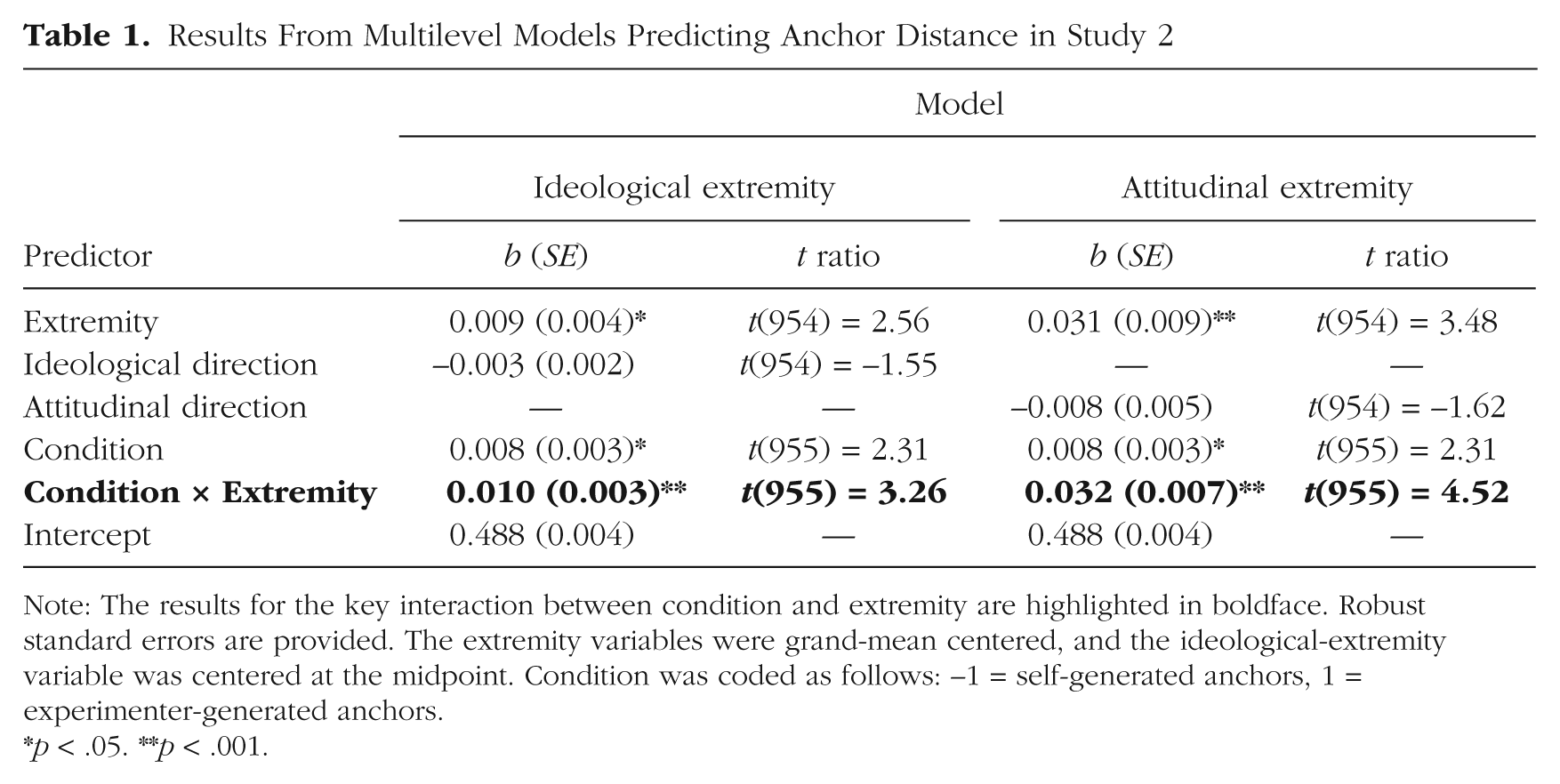
Note: The results for the key interaction between condition and extremity are highlighted in boldface. Robust standard errors are provided. The extremity variables were grand-mean centered, and the ideological-extremity variable was centered at the midpoint. Condition was coded as follows: −1 = self-generated anchors, 1 = experimenter-generated anchors.
p < .05. **p < .001.
Results from Study 2. Graphs show violin plots of the estimated anchor-distance intercept as a function of (a) ideological extremity and (b) attitudinal extremity. In each plot, the top and bottom of the box indicate the 75th and 25th percentiles, respectively, and the white line near the middle of the box is the 50th percentile. The whiskers represent the lowest and highest data points within 1.5 times the interquartile range of the lowest quartile and the highest quartile, respectively. Overlaid on the box plots are probability density estimations. Values for attitudinal extremity were binned into six groups of approximately equal size.
Mediation analyses
We predicted that if political extremists are confident and therefore rely on their own beliefs, belief superiority would mediate the association between extremity and anchor distance for the experimenter-generated anchors. We tested this idea by using Mplus (version 6.11; Muthén & Muthén, 2011) to conduct multilevel moderated-mediation path analyses for both ideological and attitudinal extremity. We constructed 2-2-1 multilevel mediation models (Preacher, Zyphur, & Zhang, 2010), such that extremity predicted belief superiority and belief superiority predicted anchor distance. We moderated this mediation model by using anchoring condition (self-generated or experimenter-generated) as a moderator of the path between extremity and anchor distance and of the path between belief superiority and anchor distance (for the full results of the model, see Fig. S1 in the Supplemental Methods and Results).
Results were consistent with the idea that belief superiority mediates the association between extremity and anchor distance for experimenter-generated anchors: Greater attitudinal and ideological extremity predicted higher levels of belief superiority (Fig. 3a). Greater belief superiority, in turn, predicted more anchor distance (ideological extremity: indirect effect = 0.005, SE = 0.002, p = .003, 95% confidence interval, or CI = [0.002, 0.008]; attitudinal extremity: indirect effect = 0.012, SE = 0.005, p = .02, 95% CI = [0.002, 0.022]). Belief superiority, however, did not predict anchor distance for self-generated anchors (Fig. 3b; ideological extremity: indirect effect = 0.001, SE = 0.001, p = .38, 95% CI = [−.001, .003]; attitudinal extremity: indirect effect = 0.004, SE = 0.004, p = .38, 95% CI = [−.004, .012]).
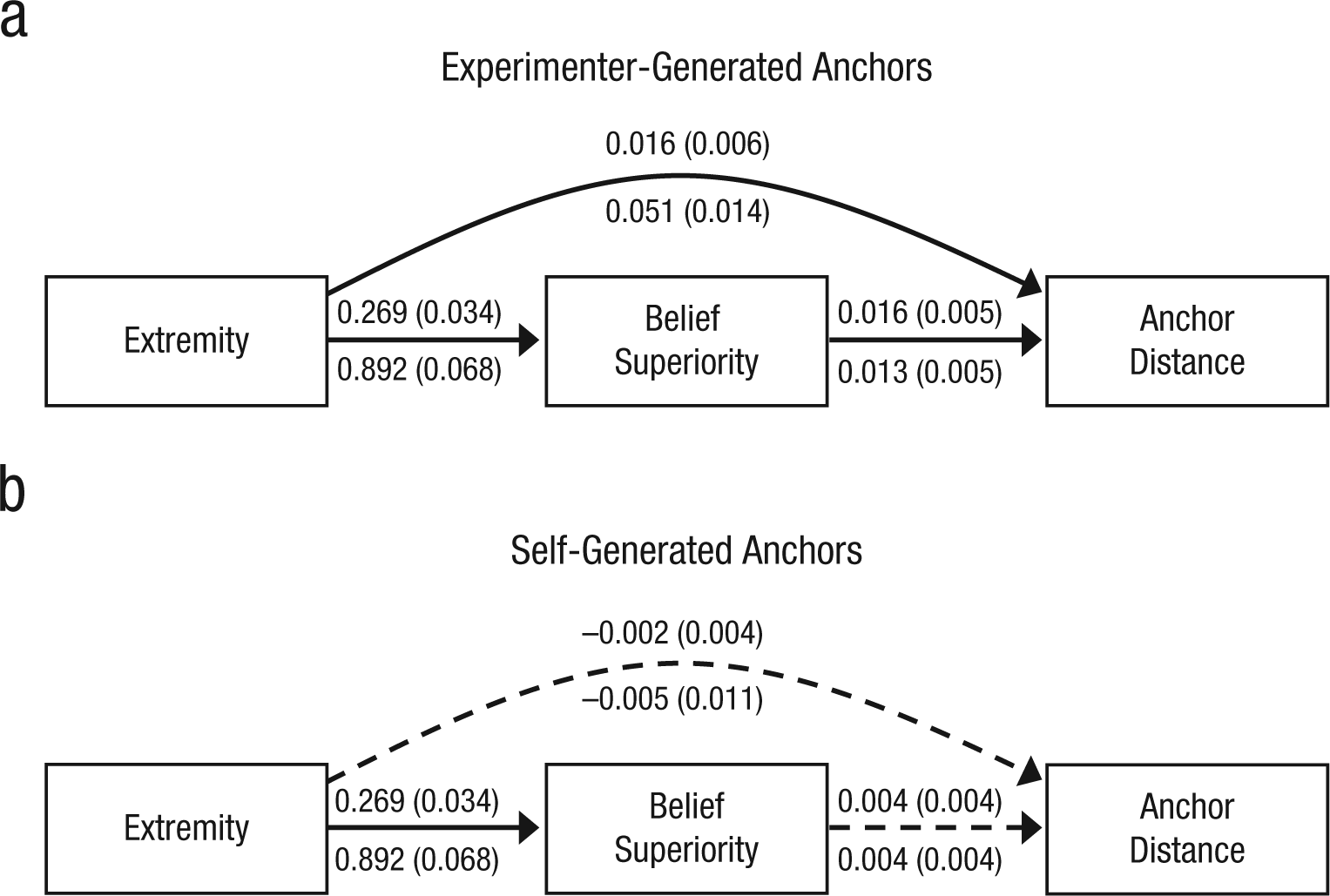
Results from the multilevel moderated-mediation models for (a) the experimenter-generated-anchoring condition and (b) the self-generated-anchoring condition in Study 2. The path diagrams show the effects of ideological extremity (coefficients above the lines) and attitudinal extremity (coefficients below the lines) on anchor distance as mediated by belief superiority. All models included ideological or attitudinal direction as a covariate. The coefficients are unstandardized, and values in parentheses are standard errors. Solid lines represent significant paths (p < .05), and dashed lines represent nonsignificant paths.
As a formal test of moderated mediation, we tested whether the differences between the indirect effects of extremity on anchor-distance through belief superiority for self-generated and experimenter-generated anchors were significant (Hayes, 2013). There was a marginally significant difference in the model for ideological extremity (difference = 0.004, SE = 0.002, p = .054, 95% CI = [0.000, 0.007]), but not in the model for attitudinal extremity (difference = 0.008, SE = 0.006, p = .19, 95% CI = [−0.004, 0.021]). That is, although we found clear evidence that belief superiority was a mediator of the association between extremity and anchor distance for experimenter-generated anchors, the evidence was inconclusive regarding whether the mediation process differed significantly between self- and experimenter-generated anchors. The lack of conclusive evidence was probably due to the weak or nonsignificant moderation of the association between belief superiority and anchor distance by anchor type (ideological extremity: b = 0.007, SE = 0.003, t(954) = 2.00, p = .05; attitudinal extremity: b = 0.005, SE = 0.004, t(954) = 1.32, p = .19).
Additional analyses
In an attempt to further understand the scope of the effects of political extremity on anchoring, we included and tested measures of need for cognitive closure (Webster & Kruglanski, 1994), education, and perceived certainty of individual judgments (see Study 2: Additional Analyses in the Supplemental Methods and Results). First, when we controlled for the need for cognitive closure, the effects of extremity remained, and there were no significant effects of the need for cognitive closure (see Table S4 in the Supplemental Methods and Results). This suggests that self-reported differences in cognitive style did not predict differences in the use of anchors, contrary to what past work has demonstrated with an experimental manipulation of cognitive style (i.e., cognitive load; Kruglanski & Freund, 1983).
Second, because political extremists tend to take a more cognitive and knowledgeable approach to politics than moderates do, the pattern we uncovered may have been primarily the result of educational levels. However, when we controlled for participants’ education, the conclusions for extremity did not change (see Table S5 in the Supplemental Methods and Results).
Third, we were curious whether political extremists reported more certainty about their answers to the anchoring items. We found that participants felt more certain of their responses to experimenter-generated anchors than their responses to self-generated anchors (see Table S6 in the Supplemental Methods and Results; cf. Simmons et al., 2010). There was also an interaction between attitudinal extremity and anchoring condition; for experimenter-generated anchors, attitudinal extremity was marginally and negatively associated with item-level certainty, b = −0.151, SE = 0.084, t(954) = −1.79, p = .07, and for self-generated anchors, this effect was even smaller, b = −0.019, SE = 0.081, t(954) = −0.24, p = .81. Overall, these results suggest that the self-reported meta-attitudinal quality of certainty about individual estimates did not influence extremists’ responses to anchors.
Study 3
The results of Studies 1 and 2 raised two questions. First, an additional difference between experimenter-generated and self-generated anchoring tasks concerns the direction of the needed adjustment from the anchors. In the former case, the direction of adjustment is certain, whereas in the latter case, the direction is less certain. Participants may be aware of a self-generated anchor but remain unsure about the direction of the needed adjustment. Previous studies (Simmons et al., 2010) have demonstrated that processing is different in conditions of directional certainty than in conditions of directional uncertainty, and so the former could also have led to the differences between results for experimenter- and self-generated anchors we found in Study 2. Second, it is not clear whether the effects of extremism on performance of anchoring tasks are related to cognitive differences between moderates and extremists or are caused by differences in how they perceive the persuasive intent of experimenter-generated anchors (cf. Grice, 1975).
To address these questions, we tested whether effects of experimenter-generated certain-direction anchors, such as those used in Studies 1 and 2, differed from effects of experimenter-generated uncertain-direction anchors. The latter anchors are presented with less communicative intent because participants are first asked if they think the answer is higher or lower than a given anchor (Simmons et al., 2010). Arguably, compared with certain-direction anchors, uncertain-direction anchors are less likely to be perceived as implicit recommendations from the experimenter. If communicative intent or the certainty of the direction is at the root of the previous results, the directional certainty of the anchors should interact with extremity when predicting anchor distance. However, given the prior results supporting the confident-extremist perspective, we predicted that extremism would have the same effects on responses to both types of anchoring tasks, because both types of anchors are based on external information.
Method
We aimed to collect data from 1,000 participants. Individuals who had already participated in Study 2 were excluded from completing the experiment. We used Amazon’s MTurk, and we received data from 1,103 participants. After removing 2 participants who reported being younger than 18, 11 participants who reported at the end of the study that they had used outside information to complete the anchoring tasks, and 88 participants who had left blank the question regarding use of outside information, we were left with 1,002 participants, 964 of whom completed the necessary measures (535 men, 429 women; mean age = 31.8 years, SD = 10.7).
Participants first completed the same nine-item measure of political attitudes (α = .78) used by Toner et al. (2013) and in Study 2. Participants were then randomly assigned to complete experimenter-generated-anchoring items with either certain-direction anchors (n = 479) or uncertain-direction anchors (n = 485). The certain-direction anchoring items were like those used in Studies 1 and 2: Participants were told that the correct answer was either higher or lower than some value. In uncertain-direction anchoring items, participants were first asked whether the correct answer was higher or lower than some value (e.g., “Is the population of Chicago more or less than 200,000?”). After answering this question, they were asked for their estimate (“What is the population of Chicago?”). To further generalize our results, we presented the participants with 12 anchoring items, including the 8 items used in Study 2 and 4 additional items. The items and anchors were based on items used by Simmons et al. (2010). There were two versions of the survey: Half of the participants received low anchors for the first 4 items, high anchors for the next 4 items, low anchors for the next 2, and high anchors for the remaining 2, whereas the other half of the participants received the opposite (see Table S7 in the Supplemental Methods and Results). The 12 anchoring items were presented in a random order for each participant.
After finishing the anchoring tasks, participants responded to demographic questions (age, gender, education, income), including the single-item measure of political ideology used in Studies 1 and 2.
We created an anchor-distance index following the same method used for experimenter-generated anchors in the previous two studies. We removed responses outside the range of the high and low anchors, calculated the distance from each response to the anchor, rank-transformed this distance measure for high and low anchors to remove skew and standardize the measure, and rescaled the measure to range from 0 to 1. Steps for creating the ideological- and attitudinal-extremity measures and the ideological- and attitudinal-direction measures were identical to those in Studies 1 and 2. Ideological and attitudinal extremity were positively correlated (r = .46, p < .001).
Results
We replicated the typical experimenter-generated-anchoring effect for both certain- and uncertain-direction anchors: High anchors resulted in higher estimates than did low anchors (see Tables S7 and S8 in the Supplemental Methods and Results). The values for Cohen’s d for the 12 items ranged from 0.72 to 2.49, which suggests that the anchoring effects were large and similar in size to those in Studies 1 and 2. Anchor distance was nested within participants. We used a two-level multilevel modeling approach specifying a random-intercept model. These models were created using HLM (Raudenbush et al., 2013).
We tested models in which anchor distance was regressed on extremity, ideological or attitudinal direction, anchoring condition, and the interaction between extremity and anchoring condition (certain vs. uncertain direction; see Table 2). There was no support for the idea that certain-direction anchors had driven the effects found in Studies 1 and 2. In both models, the interaction between extremity and condition was nonsignificant. In the model for ideological extremity, the interaction was positive and nonsignificant (b = 0.006, 95% CI = [−.003, .016]); in the model for attitudinal extremity, the interaction was negative and nonsignificant (b = −0.004, 95% CI = [−.023, .016]). These results are consistent with an effect ranging from small and negative to small and positive. Although we do not claim to have proven the null hypothesis, we believe that the large sample size, combined with nonsignificant effects in opposing directions, suggests that directional certainty does not play a practically meaningful role in explaining the effects uncovered in Studies 1 and 2.
Results From Multilevel Models Predicting Anchor Distance in Study 3
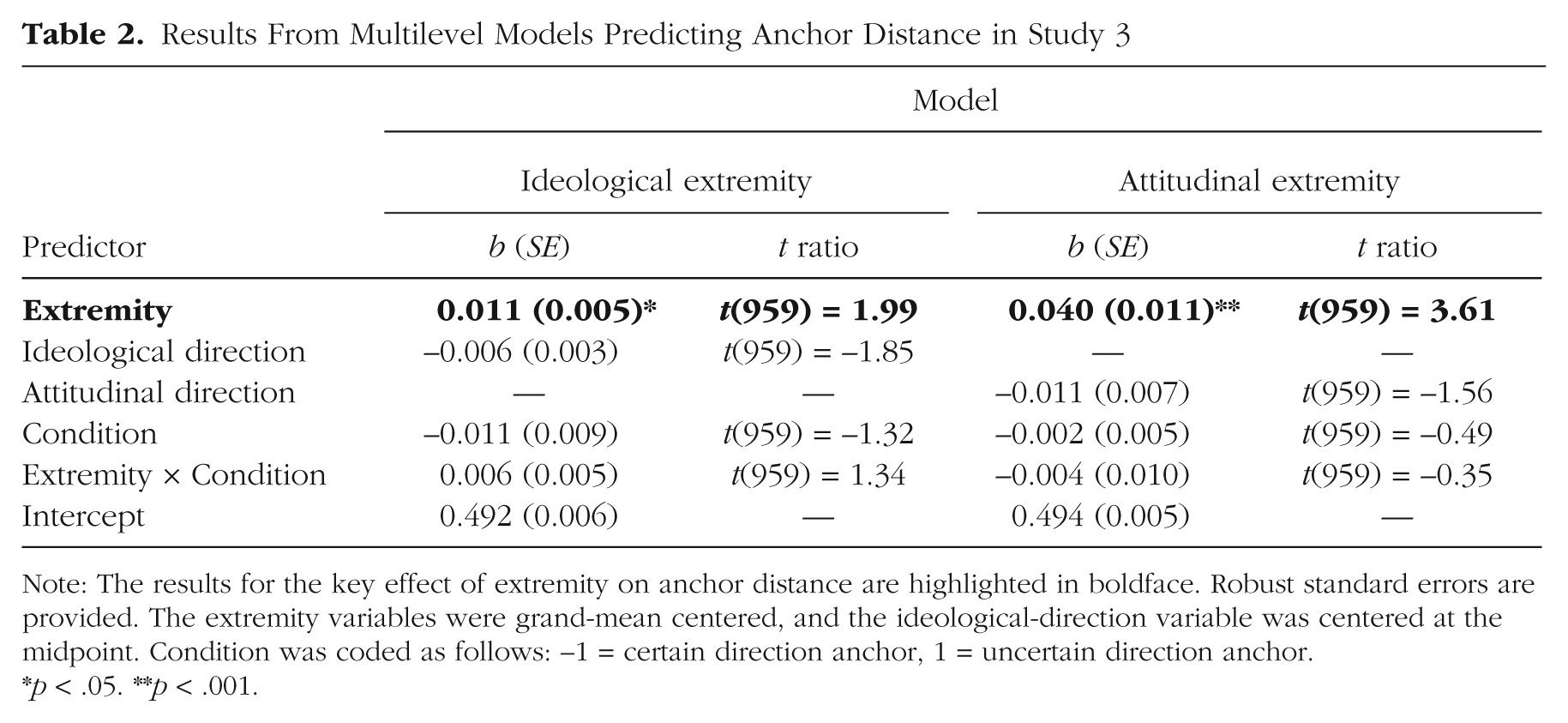
Note: The results for the key effect of extremity on anchor distance are highlighted in boldface. Robust standard errors are provided. The extremity variables were grand-mean centered, and the ideological-direction variable was centered at the midpoint. Condition was coded as follows: −1 = certain direction anchor, 1 = uncertain direction anchor.
p < .05. **p < .001.
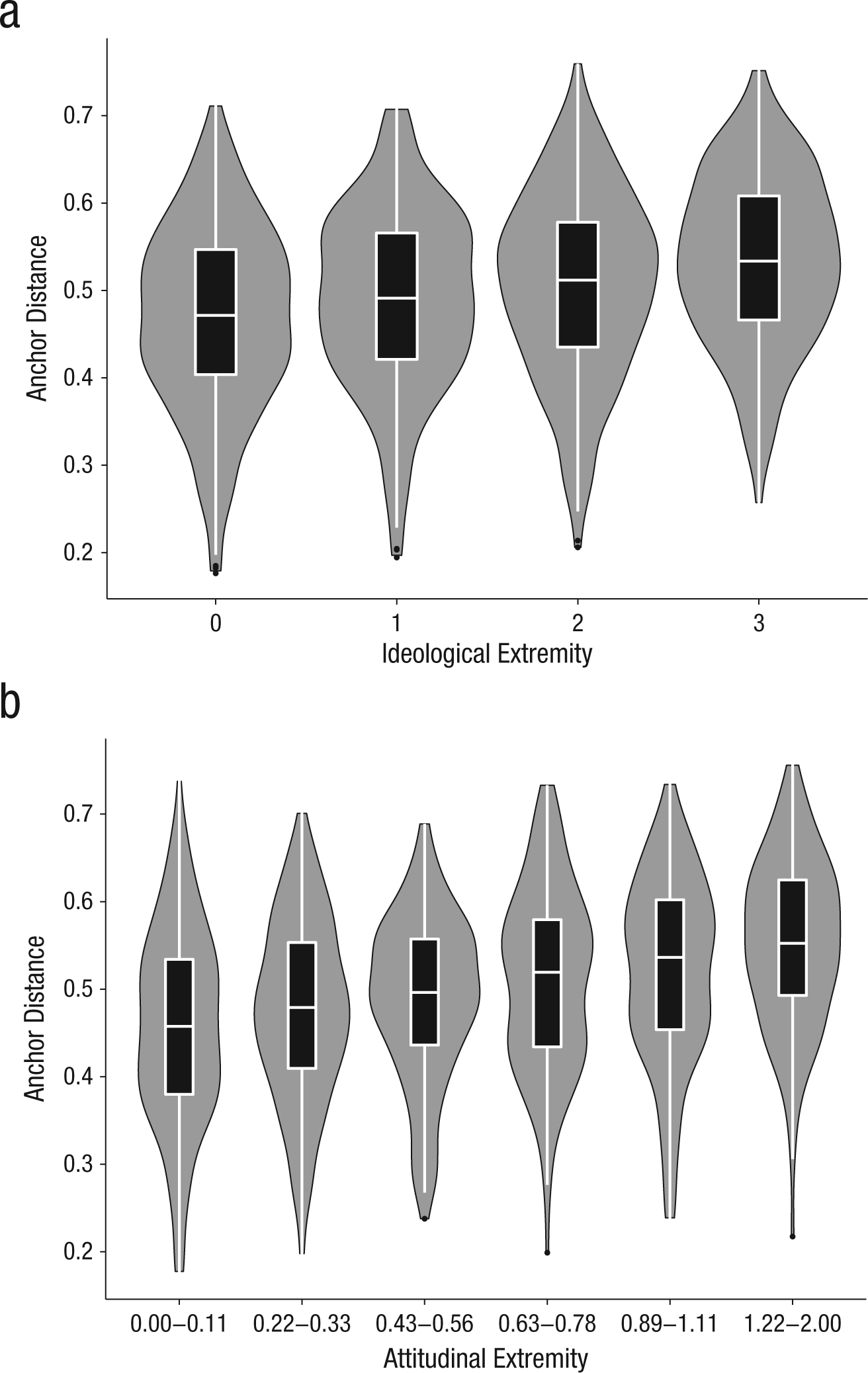
In further simplified models, we removed the nonsignificant interactions between extremity and anchoring condition (certain vs. uncertain direction). These models replicated the results of Studies 1 and 2: Both greater ideological extremity, b = 0.011, SE = 0.005, t(960) = 2.02, p = .04 (Fig. 4a) and greater attitudinal extremity, b = 0.040, SE = 0.011, t(960) = 3.54, p < .001 (Fig. 4b) were associated with greater anchor distance. Anchoring condition and ideological or attitudinal direction had no significant effects (ts < |1.79|, ps > .07). In additional analyses, we included the measure of education and found that the effect of attitudinal extremity remained positive and significant, whereas the effect of ideological extremity was reduced to nonsignificance (p = .12; see Table S9 in the Supplemental Methods and Results). This result and the additional analyses from Study 2 suggest that education may play a role in some anchoring tasks but that it cannot fully account for the effects of extremity.
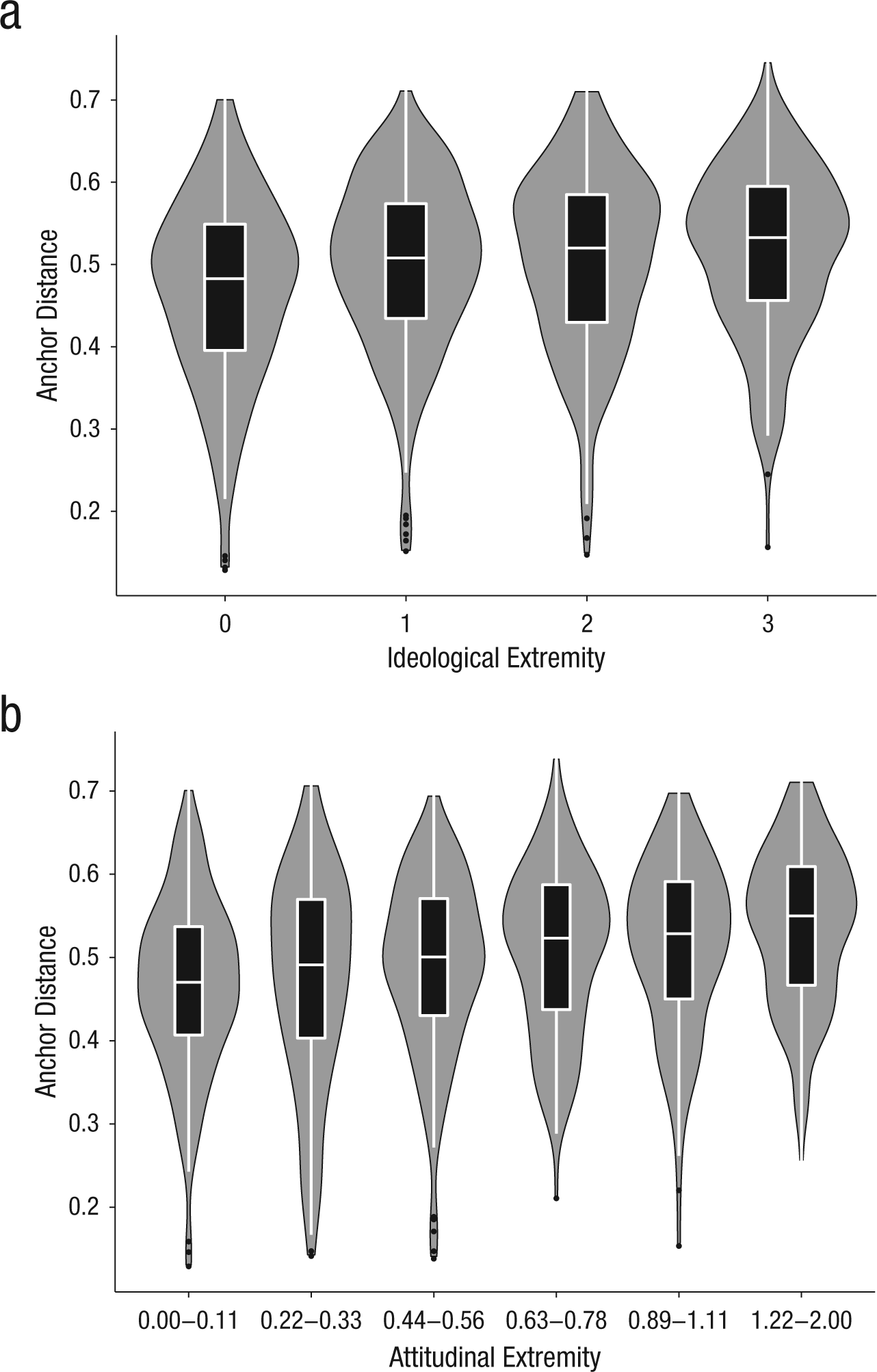
Results from Study 3. Graphs show violin plots of the estimated anchor-distance intercept as a function of (a) ideological extremity and (b) attitudinal extremity. In each plot, the top and bottom of the box indicate the 75th and 25th percentiles, respectively, and the white line near the middle of the box is the 50th percentile. The whiskers represent the lowest and highest data points within 1.5 times the interquartile range of the lowest quartile and the highest quartile, respectively. Overlaid on the box plots are probability density estimations. Values for attitudinal extremity were binned into six groups of approximately equal size.
General Discussion
We used basic anchoring tasks to test two competing hypotheses about the cognitive styles of political extremists. The unthinking-extremist perspective predicts that political extremists will be less likely than moderates to reject any anchor, whereas the confident-extremist perspective predicts that political extremists will be more likely than moderates to reject experimenter-generated anchors. In three large studies, using data from geographically diverse student and nonstudent samples in the United States, political extremists were more likely than people with more moderate political views to reject experimenter-generated anchors. Moreover, Study 2 suggests that this association was mediated, in part, by the extent to which political extremists believed their political beliefs to be superior. When anchors were self-generated, however, extremity did not predict anchor distance, which suggests that the effects may have been driven by extremists being more likely than moderates to reject outside information rather than by extremists overvaluing their own opinions more than moderates. This full pattern of results is more consistent with the confident-extremist perspective than with the unthinking-extremist perspective.
These results have implications for the study of extremism, political ideology, and anchoring effects. Although extremists may rely on belief-congruent heuristics to form potentially inaccurate politically relevant perceptions and decisions (Kahan, Hoffman, Braman, Evans, & Rachlinski, 2012), this does not necessarily equate to irrational and heuristic-based decision-making processes in all domains. Rather, extremists seem willing to reject experimenter-generated anchors and, compared with moderates, make estimates that are less influenced by these initial values. It is therefore not accurate to simply characterize extremists as succumbing to biased decision making. These results raise the intriguing possibility that political extremists are also better able than moderates to resist the coercive force of unethical authorities and inspire other people—with more moderate political beliefs—to do the same (cf. Milgram, 1965).
Although hundreds of studies have explored anchoring effects, few have examined why individuals differ in how much they are influenced by anchors. The results of our three studies suggest that looking at individual differences related to moral conviction, zeal, and extremism (McGregor et al., 2013; Skitka, Bauman, & Sargis, 2005) may be a fruitful approach for exploring anchoring effects and use of heuristic-based decision-making strategies more generally.
Additional studies could address the limitations of the current research. First, although we used large and geographically diverse samples, they were not representative of any predefined population; the different composition of a more representative sample might produce different results. Second, we did not manipulate political extremism; thus, it is possible that a third variable representing general confidence leads people to be both more influenced by experimenter-generated anchors and more extreme in their political beliefs, although our general conclusion that extremists are not unthinking in all domains would still be consistent with such a finding. Third, the effects in the current studies were small yet important, because they help distinguish between two perspectives on extremism; however, additional work is necessary to understand their practical significance. Fourth, we did not distinguish between plausible and implausible anchor values (Simmons et al., 2010), and future work should push the boundaries of the observed effects by using both plausible and implausible anchors and comparing their effects. A strong version of the confident-extremist perspective would suggest that similar results should be obtained for plausible and implausible anchors. Fifth, we found some evidence suggesting that belief superiority mediated the association between extremism and distance from experimenter-generated anchors; however, we did not account for the entire relationship, and additional research will be needed to explore other possible explanations for this mediation effect. Sixth, in future work, researchers should consider including other cognitive tasks to enhance understanding of individual differences in decision making associated with political extremism.
The unthinking-extremist and confident-extremist perspectives make opposite predictions about how political extremism will be associated with the influence of experimenter-generated anchors. We obtained results consistent with the confident-extremist perspective: Extremists rejected experimenter-generated anchors more than moderates did. Extremists are not uniquely prone to cognitive biases; indeed, in this case, they were resistant to them. The present studies demonstrate the utility of adopting basic cognitive tasks for investigating the relationship between ideology and cognitive style, and they suggest that extremity does not necessarily beget irrationality.
Footnotes
Acknowledgements
We thank Richard Klein, Kate Ratliff, Michelangelo Vianello, and the rest of the Many Labs team. Study 1 would not have been possible without the data they diligently collected. Yoel Inbar provided helpful feedback on a previous draft of the manuscript.
Declaration of Conflicting Interests
The authors declared that they had no conflicts of interest with respect to their authorship or the publication of this article.
Open Practices
All data and materials have been made publicly available via the Open Science Framework and can be accessed at https://osf.io/pqf9r/. The complete Open Practices Disclosure for this article can be found at http://pss.sagepub.com/content/by/supplemental-data. This article has received badges for Open Data and Open Materials. More information about the Open Practices badges can be found at https://osf.io/tvyxz/wiki/view/ and  .
.
Notes
References
Supplementary Material
Please find the following supplemental material available below.
For Open Access articles published under a Creative Commons License, all supplemental material carries the same license as the article it is associated with.
For non-Open Access articles published, all supplemental material carries a non-exclusive license, and permission requests for re-use of supplemental material or any part of supplemental material shall be sent directly to the copyright owner as specified in the copyright notice associated with the article.
