




Abstract
In recent years, there has been an enormous increase in the number of studies examining mind wandering. Although participants’ reports of mind wandering are often assumed to largely reflect spontaneous, unintentional thoughts, many researchers’ conceptualizations of mind wandering have left open the possibility that at least some of these reports reflect deliberate, intentional thought. Critically, however, in most investigations on the topic, researchers have not separately assessed each type of mind wandering; instead, they have measured mind wandering as a unitary construct, thereby conflating intentional and unintentional types. We report the first compelling evidence that an experimental manipulation can have qualitatively different effects on intentional and unintentional types of mind wandering. This result provides clear evidence that researchers interested in understanding mind wandering need to consider the distinction between unintentional and intentional occurrences of this phenomenon.
Humans spend a considerable amount of time mind wandering (Killingsworth & Gilbert, 2010). Although mind wandering sometimes has beneficial functions, such as facilitating creative thinking (Baird et al., 2012) and problem solving (Ruby, Smallwood, Sackur, & Singer, 2013), at other times, it has serious negative consequences. For example, mind wandering has been associated with an increased risk of injury while driving (Knowles & Tay, 2002), problems in educational settings (Risko, Anderson, Sarwal, Engelhardt, & Kingstone, 2012), affective dysfunction (Smallwood et al., 2003), and impaired performance in daily life (McVay, Kane, & Kwapil, 2009). Given the prevalence and consequences of mind wandering, the number of studies examining it has increased rapidly in recent years, and these studies are spread across various domains.
When the term mind wandering was first introduced in psychological science roughly a decade ago, Smallwood and Schooler (2006, p. 946) defined it as a situation in which executive control shifts away from a primary task to the processing of personal goals. Mind-wandering shares certain similarities with standard views of controlled processing, however, there is an important difference. Controlled processing is generally associated with the intentional pursuit of a goal. Mind-wandering, however, often occurs without intention . . . or even awareness that one’s mind has drifted.
Smallwood and Schooler (2006) clearly implied that although mind wandering often occurs without intention, such lack of intention is not a prerequisite for an experience to be classified as mind wandering. That is, the authors made it clear that people can intentionally engage in mind wandering. Research consistent with this proposition has demonstrated that individuals do indeed engage in both intentional and unintentional mind wandering, both in the laboratory (e.g., Giambra, 1995; Seli, Cheyne, Xu, Purdon, & Smilek, 2015; Seli, Wammes, Risko, & Smilek, 2015) and in everyday life (e.g., Carriere, Seli, & Smilek, 2013; Seli, Carriere, & Smilek, 2015; Seli, Smallwood, Cheyne, & Smilek, 2015).
Despite this initial conceptualization of mind wandering as reflecting both intentional and unintentional thought, standard approaches to investigating mind wandering (in which individuals self-report being either on task or mind wandering) have largely ignored this distinction. As a result, over time, many researchers have come to assume that mind wandering is, by definition, unintentional (e.g., Bixler & D’Mello, 2014; Blanchard, Bixler, Joyce, & D’Mello, 2014; Carciofo, Du, Song, & Zhang, 2014; Fox, Spreng, Ellamil, Andrews-Hanna, & Christoff, 2015; Qu et al., 2015; Rummel & Boywitt, 2014; Wilson et al., 2014).
Perhaps as a direct consequence of the lack of attention given to intentional mind wandering, Smallwood and Schooler (2015) recently called for an increased focus on issues surrounding intentionality in mind-wandering research. Specifically, they suggested that achieving a clear understanding of the causes and consequences of mind wandering would require researchers to make this distinction in their work. Of course, if intentional and unintentional mind wandering always behaved similarly under experimental manipulations, then the need to make this distinction might be considered superfluous, especially given the apparent overlap between these two constructs. Indeed, both types of mind wandering appear to be characterized by self-generated thoughts that involve decoupling from the external environment (as suggested by the process-occurrence account; Smallwood, 2013); consequently, it may not be necessary to distinguish between the two. That said, if unintentional and intentional forms of mind wandering are at least sometimes differentially influenced by certain factors or experimental manipulations, this would present an important challenge to previous work and a new framework for future research aimed at understanding mind wandering.
In this article, we hope to provide a compelling demonstration of the utility of distinguishing between unintentional and intentional mind wandering. Specifically, we hope to demonstrate that a manipulation can have opposing effects on unintentional and intentional mind wandering.
The Present Experiment
Participants performed an easy or difficult variant of the sustained-attention-to-response task (SART; Robertson, Manly, Andrade, Baddeley, & Yiend, 1997) and responded to thought probes that measured intentional and unintentional mind wandering. We chose to manipulate task difficulty because of its importance in theories of mind wandering (see Smallwood & Schooler, 2006) and because we reasoned that such a manipulation would be likely to influence rates of intentional mind wandering. We suspect that when people are completing an easy task, they may deliberately disengage from the task and engage in mind wandering. Conversely, when completing a difficult task, people should engage in intentional mind wandering less often because doing so would lead to performance costs. Critically, then, the foregoing suggests that there should be more intentional mind wandering in the easy task than in the difficult task.
Method
Participants
One hundred thirteen undergraduate students participated for partial course credit (no participants were excluded). It was determined a priori that we would collect data from as many participants as possible before the end of the academic term.
Our manipulation of task difficulty consisted of difficult and easy versions of the SART.
The standard SART (difficult version)
On each standard-SART trial, a single digit was presented for 250 ms in the center of the monitor and was followed by an encircled “x” mask presented for 900 ms (total trial duration = 1,150 ms). A single digit (1–9) was randomly chosen and was presented in white on a black background in each trial of a nine-trial block; each digit appeared only once per block. The digits were presented in the Courier New typeface, and there were five possible type sizes: 120, 100, 94, 72, and 48 points. In a given nine-trial block, four of the type sizes appeared twice and one appeared only once; this was determined randomly. Participants were instructed to respond to each go digit (i.e., digits 1–2 and 4–9) by pressing the space bar on a computer keyboard and to withhold responses to the no-go digit (i.e., 3). After 18 practice trials, participants completed 900 experimental trials.
The sequential SART (easy version)
The sequential SART was very similar to the standard SART, except that the series of digits was completely predictable. Specifically, the digits were presented in sequential order (1 through 9, repeated in each block).
Thought probes
Throughout both versions of the SART, we tested for mind wandering using intermittent thought probes. One probe was randomly presented in each block of 45 trials (total of 20 probes). When a probe occurred, the task stopped and the participant was presented with the following question: “Which of the following responses best characterizes your mental state just prior to the presentation of this screen?” The possible response options were “(1) On task,” “(2) Intentionally mind wandering,” and “(3) Unintentionally mind wandering” (Seli, Cheyne, et al., 2015). Participants were instructed to respond via key press (1–3), after which the SART resumed.
Procedure
In our between-subjects design, we randomly assigned participants to complete either the difficult version (difficult-SART condition) or the easy version (easy-SART condition) of the SART. We used a between-subjects design because we were concerned that in a within-subjects design, exposure to one of the conditions might influence performance in the other condition. In particular, we were concerned that exposure to the easy-SART condition might influence performance in the difficult-SART condition, such that after completing 900 trials of the easy SART, participants might maintain the expectation that the critical digit would be presented in the same position among every nine trials; such an expectation might negatively influence their performance in the difficult SART.
After providing informed consent, participants were given instructions to familiarize them with the requirements of the SART (instructions were identical across both conditions). Before beginning the experiment, participants were also given detailed instructions regarding thought-probe responses. In particular, they were told that being on task meant that they were thinking about things related to the task (e.g., thoughts about their performance, thoughts about the digits, or thoughts about their response), whereas mind wandering meant they were thinking about something completely unrelated to the task (e.g., thoughts about what to eat for dinner, thoughts about plans with friends, or thoughts about an upcoming test). They were further instructed that if they experienced any mind wandering, they should indicate whether it was intentional or unintentional (for exact instructions, see the Supplemental Material available online). In total, the experiment took roughly 20 min to complete.
Measures
Performance measures included no-go errors, go-trial response times (RTs), and mind-wandering rates for the two types of mind wandering (intentional and unintentional). No-go errors occurred when participants failed to withhold a response to the digit 3. Go-trial RTs were the mean response latencies for all go trials on which a response was made. Mind-wandering rates were calculated as the proportion of each type of response provided (i.e., proportion of intentional and unintentional mind wandering).
Results
First, we were interested in determining whether our task-difficulty manipulation was effective. To this end, we computed a skill index (mean no-go-trial accuracy divided by mean go-trial RT; Jonker, Seli, Cheyne, & Smilek, 2013) for each participant. This method produces a value that represents the participant’s efficiency by accounting for both response speed and accuracy (for discussions on the utility of computing a skill index in the SART, see Seli, Cheyne, Barton, & Smilek, 2012; Seli, Cheyne, & Smilek, 2012; Seli, Jonker, Cheyne, & Smilek, 2013). 1 An independent-samples t test indicated that skill-index scores were significantly higher for the easy-SART condition (M = 2.80, SD = 1.26; n = 56) than for the difficult-SART condition (M = 1.32, SD = 0.41; n = 57), t(66.201) = 8.36, SE = 0.18, p < .001, d = 1.77, confirming that the task-difficulty manipulation was effective.
Following the typical approach to measuring mind wandering, we conducted an independent-samples t test to examine overall mind-wandering rates as a function of condition (easy SART or difficult SART). Overall mind-wandering rates were computed by simply summing the rates of intentional and unintentional mind wandering. Results of the t test indicated that there was no significant difference in overall mind-wandering rates between the easy-SART condition (M = 0.51, SD = 0.22) and the difficult-SART condition (M = 0.54, SD = 0.24), t(111) = 0.79, SE = 0.04, p = .429, d = 0.13.
Next, we examined the possibility that the relative proportions of intentional and unintentional mind wandering differed as a function of task difficulty. We conducted a 2 (condition: easy SART, difficult SART) × 2 (mind-wandering type: intentional, unintentional) mixed analysis of variance with proportion of mind-wandering type as the dependent variable (Fig. 1). Across conditions, there was a significant main effect of mind-wandering type, F(1, 111) = 28.37, MSE = 0.04, p < .001, η p 2 = .20, indicating that unintentional mind wandering was reported more often than intentional mind wandering. Most critically, there was a significant Condition × Mind-Wandering Type interaction, F(1, 111) = 10.62, MSE = 0.04, p = .001, η p 2 = .09. To follow up on this interaction, we next conducted two independent-samples t tests to determine whether there was (a) more intentional mind wandering in the easy-SART condition than in the difficult-SART condition, and (b) more unintentional mind wandering in the difficult-SART condition than in the easy-SART condition. There was a significant difference in the proportion of intentional mind wandering across the two conditions: More intentional mind wandering was reported for the easy-SART condition than for the difficult-SART condition, t(111) = 2.15, SE = 0.03, p = .034, d = 0.41. In addition, there was a significant difference in the proportion of unintentional mind wandering across the conditions, with higher proportions of unintentional mind wandering in the difficult-SART condition than in the easy-SART condition t(102.789) = 2.85, SE = 0.04, p = .005, d = 0.54.
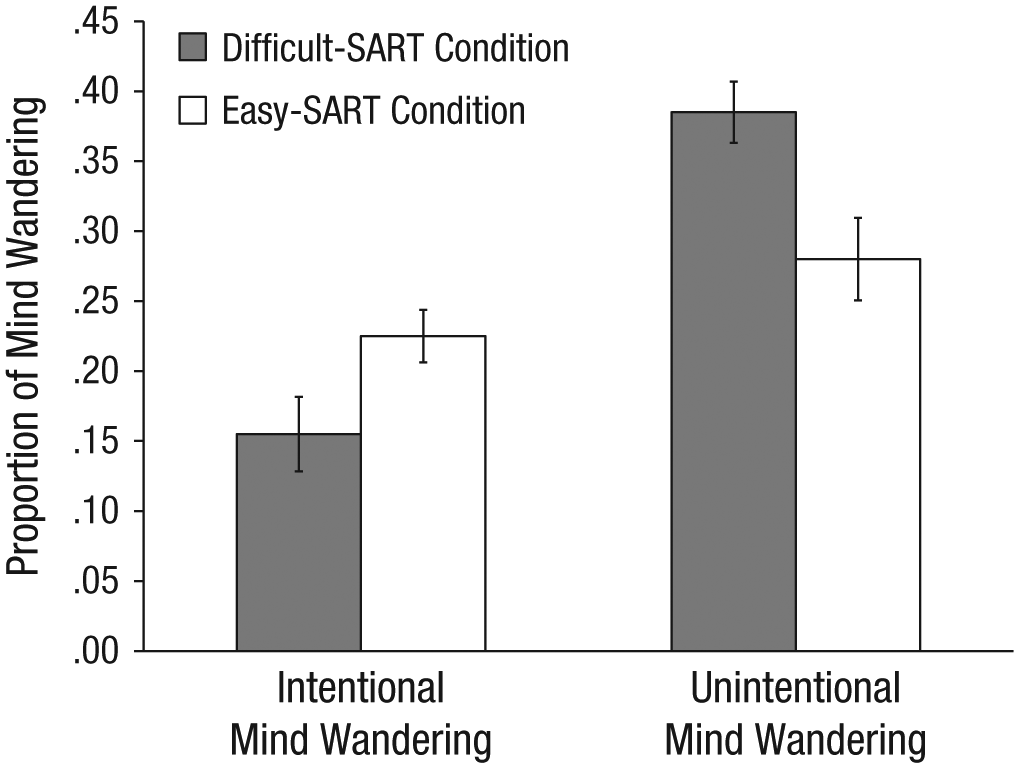
Proportion of mind wandering as a function of mind-wandering type (intentional and unintentional), presented separately for the easy-SART and difficult-SART conditions. Error bars represent ±1 SEM. SART = sustained-attention-to-response task.
Discussion
Although our manipulation of task difficulty did not result in different rates of overall mind wandering, it did produce very different distributions of mind-wandering types. Thus, had we ignored the distinction between intentional and unintentional mind wandering, we would have drawn the incorrect conclusion that mind wandering remains unchanged across conditions. The findings of the current study, in addition to related evidence (e.g., Seli, Cheyne, et al., 2015), make a strong case that researchers interested in understanding mind wandering need to consider the distinction between its unintentional and intentional types; such consideration promises a deeper theoretical understanding of why the mind wanders.
Task difficulty and mind wandering
The present findings also shed light on the relation between mind wandering and task difficulty. In particular, researchers have frequently observed higher rates of mind wandering during easy tasks relative to difficult tasks (e.g., Smallwood et al., 2013; Thomson, Besner, & Smilek, 2013). A common assumption made in much of this research was that the observed decreases in mind wandering that accompany increases in task difficulty reflect decreases in unintentional mind wandering. In the current study, however, we observed the opposite result: There were increased rates of unintentional mind wandering in the difficult task relative to the easy task. 2 These results challenge the common view that manipulations of task difficulty specifically influence rates of unintentional mind wandering and suggest that it will be exceptionally important for future research to investigate the interaction between task difficulty and the intentionality of mind wandering.
Awareness and intentionality
It should be noted that the distinction between intentional and unintentional mind wandering is somewhat similar to an earlier distinction made between mind wandering with awareness and mind wandering without awareness (Smallwood, McSpadden, & Schooler, 2007). That is, intentionally engaged mind wandering seems to be accompanied by awareness, whereas unintentionally engaged mind wandering does not. To determine where intentionality and awareness might diverge, however, we must consider the difference between the “ignition point” of a mind-wandering episode and the continuation of that episode (Smallwood, 2013). In particular, Smallwood argued for the need to differentiate the specific point at which a bout of mind wandering is initiated (its ignition point) from the maintenance or continuation of mind wandering after initiation. The overlap among these types of mind wandering (i.e., with and without awareness, with and without intention) need only be observed at the onset (or the ignition point) of the episode. Thereafter, however, it seems likely that intentionality and awareness would sometimes take opposing trajectories. In support of this view, it has been reported that people can self-catch mind wandering without being prompted by a probe (Schooler, Reichle, & Halpern, 2004). In this case, the mind-wandering episode may have begun without intention but was nevertheless later brought into awareness. Thus, although there might be overlap between intentionality and awareness, the foregoing suggests that they are distinct concepts.
That said, to make a strong case for the distinction between intentionality and awareness, one would have to show that these ostensibly different types of mind wandering are associated with different performance outcomes. Critically, previous research has found that periods of mind wandering without awareness were associated with faster SART RTs than periods of mind wandering with awareness (Smallwood et al., 2007). Thus, if intentional and unintentional mind wandering are indeed redundant with mind wandering with and without awareness, respectively, then we ought to find that during periods of unintentional mind wandering, participants produce faster RTs than they do during periods of intentional mind wandering. However, the current results do not bear out this expectation: We found no evidence of RT differences across periods of intentional (M = 330.55) and unintentional (M = 338.73) mind wandering (p = .660; for a detailed report of this analysis, see the Supplemental Material). Thus, notwithstanding common concerns about interpreting null effects, the empirical evidence suggested that intentionality and awareness are in fact distinct concepts that need to be further evaluated in future research.
Thought content and intentionality
Another important consideration has to do with potential differences in the content of the thoughts associated with intentional or unintentional mind wandering. Recent research has shown that the content of mind wandering varies under different conditions (e.g., Smallwood, Nind, & O’Connor, 2009). For instance, Smallwood et al. (2011) found that participants were more likely to engage in future-oriented mind wandering when completing an easy task than when completing a difficult task. Moreover, as we have shown in the current study, participants engaged in more intentional mind wandering during the easy-SART condition than during the difficult-SART condition. Thus, one possibility is that intentional mind wandering might be associated specifically with an increase in future-oriented thinking. Indeed, if one assumes that intentional mind wandering is at least sometimes engaged strategically, it would make sense for people to intentionally disengage from a task to engage in future-oriented thought, which has been shown to be beneficial in that it facilitates autobiographical planning (Baird, Smallwood, & Schooler, 2011) and self-reflection (Smallwood et al., 2011). Moreover, given that intentional mind wandering requires willful engagement, it may be associated with positive thinking more often than unintentional mind wandering would be. We suggest that future research should explore these potentially interesting differences in the content of mind wandering as a function of intentionality.
Alternative explanations
Although the evidence presented makes a compelling case for the utility of distinguishing between unintentional and intentional mind wandering, it is important to recognize the challenges inherent in doing so. One such challenge lies in the difficulty of believing participants’ self-reports about intentionality. For example, one could argue that all mind wandering is unintentional but that participants label their experiences as unintentional or intentional on the basis of self-generated criteria. This is a reasonable position and is certainly worth exploring. However, in the present context, this position would be equally problematic for the common view that all mind wandering is unintentional. Furthermore, if we disavow the validity of an individual’s self-report in the context of distinguishing between unintentional or intentional mind wandering, then how do we accept self-reports in the context of distinguishing between being on task and mind wandering? To be clear, we are not minimizing the importance of a healthy degree of scepticism regarding self-report; rather, we are suggesting that a reasonable level of skepticism needs to be consistently applied (i.e., we cannot simply abandon self-report when those self-reports challenge our assumptions).
Concluding remarks
Our findings suggest that it is time to seriously consider the distinction between unintentional and intentional mind wandering. Although mind wandering is almost invariably indexed as a unitary construct, research continues to demonstrate that people readily report that they are mind wandering intentionally. This clearly challenges a unitary view of mind wandering and suggests that more refined models that take seriously the issue of intentionality ought to be considered.
Footnotes
Action Editor
John Jonides served as the action editor for this article.
Declaration of Conflicting Interests
The authors declared that they had no conflicts of interest with respect to their authorship or the publication of this article.
Funding
This work was supported by Natural Sciences and Engineering Research Council of Canada Grants 06459 (to D. Smilek) and 04532 (to E. F. Risko).
Open Practices
All data have been made publicly available via Open Science Framework and can be accessed at https://osf.io/7nwa6/. The complete Open Practices Disclosure for this article can be found at http://pss.sagepub.com/content/by/supplemental-data. This article has received the badge for Open Data. More information about the Open Practices badges can be found at https://osf.io/tvyxz/wiki/1.%20View%20the%20Badges/ and  .
.
Notes
References
Supplementary Material
Please find the following supplemental material available below.
For Open Access articles published under a Creative Commons License, all supplemental material carries the same license as the article it is associated with.
For non-Open Access articles published, all supplemental material carries a non-exclusive license, and permission requests for re-use of supplemental material or any part of supplemental material shall be sent directly to the copyright owner as specified in the copyright notice associated with the article.
