




Abstract
This article presents the results of a collaborative interdisciplinary multimethod research project on psychosocial risks and communication in the workplace that involved the Union of Metro Workers in Buenos Aires, Argentina. The objective of this article is twofold: on one hand, to understand an apparent contradiction in the results of the quantitative survey, which showed very high levels of stress and, at the same time, very high levels of satisfaction. To do this, we conducted a discourse analysis of in-depth interviews with subway workers. On the other hand, the results of this analysis allowed us to coin the concept of ‘double stance discourse’ as a way of describing a specific type of response that differentiates both personal and collective perspectives toward the issue of job satisfaction. We conclude that these ‘to me’ and ‘to others’ responses are a resource for individuals to reconcile, in discourse, conflictive individual and social experiences of working conditions.
Keywords
Although Discourse Analysis is an interdisciplinary research practice, it seldom interacts with data other than discursive. In contexts of actual multidisciplinary applied research, however, discourse analysis can be very helpful to better understand and complement other kinds of data generated from the standpoints of other disciplines (Arnoux, 2006; Bonnin, 2019a). Sociological surveys, for example, are useful to reveal the factual configuration of variables that have been isolated and defined beforehand, dependent on a well-established theory (Hammarberg et al., 2016: 498; Vasilachis, 2006). However, since the (inter)subjective meaning of those variables is embedded in social and individual identities negotiated in actual interaction (Holmes, 2006), it is not visible with quantitative methods.
In this article, I will argue that qualitative discourse analysis helps to understand and interpret quantitative data, especially in what appears to be contradictory. To do so, I analyze data from an interdisciplinary research project on working conditions among subway workers in Buenos Aires, which involved a quantitative survey and a set of qualitative in-depth interviews. The quantitative data showed very high levels of burnout (about 74% for some indicators) as well as a very high level of general job satisfaction (about 76%). Faced with this inconsistency, I resorted to a battery of in-depth interviews conducted in the qualitative stage of the research, where one specific question, ‘What does your work mean to you?’ proved to be relevant. It triggered two different kinds of answers: (1) straightforward, preferred answers expected by researchers, which can be generalized as ‘to me-answers’, focusing exclusively on a positive or negative evaluation of the interviewee’s experience and (2) more-than-the-question or ‘expanded’ type answers (Bonnin, 2014; Stivers and Heritage, 2001), in which respondents contrasted what work meant to them and what it meant to their co-workers. These ‘to me/to others-answers’ helped me develop the theoretical concept of double stance discourse as a means to manage, without confronting, two opposing evaluations of the job.
In what follows, I first develop the concept of double stance as related to discourse identity. Then I present the methodological design of my research and the contradictory quantitative data that emerged from it. Finally, I analyze qualitative in-depth interviews as a way to understand, through double stances, how individuals managed to reconcile in discourse contradictory individual and social experiences of working conditions.
Double stance discourse and identity: theoretical framework and literature review
The concept of stance has been used to understand how speakers position themselves with respect to the form or content of their utterances. As neutrality is, in itself, a stance (Jaffe, 2009: 3), it can be observed in a wide range of discourse practices and genres, such as journalistic and media discourse (Haddington, 2007; Marín Arrese, 2015; Paterson et al., 2016), threatening discourse (Gales, 2011), courtroom discourse (Chaemsaithong, 2012), organizational discourses (McEntee-Atalianis, 2013) and workplace narratives (Holmes, 2005; Holmes and Marra, 2005; Vásquez, 2007). From a methodological point of view, analytical perspectives are also heterogeneous, ranging from conversation analysis to corpus linguistics, as shown in recent books on the matter of stance in academic genres (Sancho Guinda and Hyland, 2012), qualitative sociolinguistics (Jaffe, 2009) and pragmatics and conversation analysis (Englebretson, 2007, ed. 2012).
Stancetaking is an action performed in (and through) discourse. It has been defined as ‘the lexical and grammatical expression of attitudes, feelings, judgments, or commitment concerning the propositional content of a message’ (Biber and Finnegan, 1989: 92). Understood in these terms, it is indistinguishable from evaluation (Hunston and Thompson, 1999) or appraisal (Gales, 2011; Martin and White, 2005). Englebretson’s (2007) thorough review of the concept of stance shows that it cannot be understood exclusively in grammatical or lexical terms (cf. Hyland, 2005, 2008; Marín Arrese, 2015; Sancho Guinda and Hyland, 2012). On the contrary, stancetaking is a fundamentally interactional and contextualized phenomenon. This intersubjective view on stance (which does not understand interaction only as conversation, but also as a dimension of written discourse) has been characterized by Englebretson (2007: 14–15) as follows: (1) stance expresses personal as well as collective beliefs, attitudes and/or evaluations; (2) it is an open, public act which is recognizable and, thus, can be evaluated by others (Du Bois, 2007; Gales, 2011); (3) it only exists as a relational category, which emerges as a collaborative or as a confrontative output of interaction (Scheibman, 2007); (4) stance indexes broader aspects, such as systems of meaning or belief, of the sociocultural context in which it is embedded; (5) taking a stance in discourse has consequences for people or institutions, because they have to stand by their stance (Keisanen, 2007).
Du Bois (2007: 149) points out the need to analyze what previous stance the stancetaker is responding to. From this perspective, stance is a key aspect in the relational process of constructing identity (Bucholtz and Hall, 2005; Johnston, 2007), because identity is dynamic and requires different acts from the individual to ‘construct and manage different aspects of subjective and intersubjective identity’ (McEntee-Atalianis, 2013: 321). Identity, as ‘the social positioning of self and other’ (Bucholtz and Hall, 2005: 586), emerges not only in the interpersonal relation with others, but also in conflict and negotiation with others (Paterson et al., 2016). Chaemsaithong (2012) sees the collective dimension of stancetaking as a process of co-orienting ‘personal or social attitudes towards the referential information being presented in the discourse’ (p. 470).
The studies reviewed here have analyzed mainly what I call ‘single stance’ utterances, that is, the perspective of the speaker in his or her own discourse (cf. e.g. Vásquez, 2007). When another point of view is included, it is usually the opposite perspective, which enables the best signaling of the speaker’s own stance. In this article, I propose the concept of double stance to describe how a speaker positions her/himself by introducing two different, but not polemic, perspectives: her or his own, and others’. 1
By taking a double stance, the stancetaker presents two related evaluations of an object or topic, one personal and the other collective. Although different, they are not opposed as in single stance discourse, because there is no polemic or disqualification of the others’ stance. On the contrary, they belong to the same group as the speaker and share a common identity with her or him. By taking a double stance as defined herein, two subjects are positioned, the self and other/s, with whom the speaker does not align nor disalign. Double stance is therefore not polemic: rather than being confrontative, it shows an individual stance that simply does not correspond with the others’.
In the corpus analyzed herein, I observe this double stance in answers to the personal question ‘What does your work mean to you?’. One group of respondents answered with the expected single stance: ‘to me, my work means…’, whereas another group answered not only ‘to me’, but also ‘to others’, using a kind of generalization (sensu Scheibman, 2007: 111) which is not provided to evaluate, demonstrate solidarity or authorize opinions, but to better define the speaker’s own singularity. Generalizations thus serve as a tool to differentiate collective stances from individual stances. As the (inter)personal dimension of discourse becomes key to understand double stance, analysis needs to be embedded in the participants’ own biography and the singular context of the conversation in which it emerges (Bonnin, 2019a).
I will argue that the ‘to me/to others’ answer acts as a double stance discourse, in which two contrasting perspectives are presented as a single relevant answer to a personal question. It is a discursive device to provide a complex answer, which includes traces of both social (as collective) and personal (as individual) identity.
Methodology, data and settings
During 2017, my research team invited members of the Union of Metro and Premetro Workers (Asociación Gremial de Trabajadores del Subte y Premetro, AGTSyP) to participate in a research project which I led, the PIO CONICET-UMET-20620150100043C ‘Psychosocial risks and communication in the workplace: an interdisciplinary study’. In early 2017, the research team collaboratively designed the approach to the issue and defined working conditions from a communicational and psychosocial perspective, including physical and environmental aspects. Two successive stages were planned for the study, one qualitative and the other quantitative. The first stage comprised two components: (1) on-site observation and documentation of jobs and (2) individual and group interviews. The second stage was a survey conducted among members of the union to which most subway workers belong. A more detailed description of both studies can be found in the published technical report (Bonnin, 2019b).
The qualitative study
The qualitative stage was carried out from April to July 2017. It included individual and group semi-structured interviews to observe the main dimensions of selected psychosocial risk factors: clarity of roles, control over the task, freedom and autonomy, predictability of work, responsibility, emotional demands, interpersonal relationships, meaning of work, job insecurity and general satisfaction with working conditions (see Bonnin, 2019b). The dimensions were selected jointly with union members from a comparative meta-study between the main PSRW measurement instruments: the Copenhagen Psychological Questionnaire (COPSOQ), the Job Content Questionnaire (JCQ) and the Maslach Burnout Inventory (MBI). The interview guidelines are available in the published technical report (Bonnin, 2019b).
The interviews were conducted on an intentional sample of station and traffic sector workers of subway line B. As the sample was non-representative, the following criteria were used: (1) jobs in contact with the public, since the team assumed that these are the positions with the greatest exposure to psychosocial risk factors, (2) diversity of positions within each sector and (3) presence of men and women, since the issue of gender inequality had emerged from the first interviews.
In this article, I will only take into account the answers to a question typically formulated as ‘What does your job mean to you?’ and intended to describe the personal meaning of work.
The quantitative study
On a statistically small population of 2455 members of the AGTSyP, a random probabilistic sample of 726 cases was designed, with a confidence level of 95.5% and a margin of error of ±3.1%. Cases were assigned in a stratified manner according to two variables: (1) Sector (four categories: stations, traffic, rolling stock maintenance and general maintenance) and (2) Seniority (dichotomized as 1: employees hired before 2008 and 2: employees hired as from 2008). Cases were allocated to each stratum based on their population weight, while individuals within each stratum were allocated by simple random selection. Only the data that passed the 95% statistical significance test were taken into account (statistical test: Chi square). The sample was designed by Alejandro Aníbal Coronel, who also performed the statistical analysis.
The survey questionnaire included seven modules: (1) Demographics; (2) Level of training and labor data; (3) Psychosocial risks and work environment; (4) Hygiene and safety; (5) Basic services; (6) Risk factors; (7) Physical activity. In this article, I will only analyze some of the data from module three: indicators of burnout and job satisfaction.
Statistical results. High burnout and high satisfaction: a quantitative contradiction?
Burnout is defined as the sensation of being ‘burned out’, a progressive process (not a state) of chronic stress, produced by the accumulated contact with users, leading to exhaustion and emotional distancing from work (Maslach and Pines, 2005). Recognized by the World Health Organization, it is manifested as physical, emotional and mental exhaustion caused by regular participation in emotionally demanding situations for a long time (Pines and Aronson, 1989). It is the result of certain working conditions; the lack of personal, economic and recognition stimuli at work; and shortage of free time and inadequate schedules (Novick, 2012: 51). Its impact is felt not only in the workplace, but in all areas of workers’ lives. In our survey, I used the burnout index developed by Novick, (2012), which is an adapted version of the Maslach Burnout Inventory (Maslach, 1981), which includes 47 items and can be consulted online. 2
The burnout index shows that 50% of the total study population is burnt out to some degree. These numbers, however, vary widely within different populations. As expected, more direct contact with the public causes higher burnout indices: traffic (57%), stations (51%), rolling stock maintenance (42%) and general maintenance (39%). Gender is also relevant, because women suffer more from burnout (55%) than men (48%). Seniority also influences burnout, with 57% of the workers hired before 2008 suffering from burnout, compared with only 46% of those hired as from 2008.
These differences are even more pronounced for certain dimensions of the Burnout Index developed by Novick (2012), of which I selected two: depersonalization and discouragement.
Depersonalization
Depersonalization or cynicism is an attitude whereby someone distances himself/herself from his or her work and from other people – a preservation strategy in the face of emotional exhaustion (Marsollier, 2013). In the survey, depersonalization was measured through answers to a Likert scale of 5 points to items 23 (‘As time goes by, you take emotional distance from users’) and 26 (‘I feel my coworkers have developed a cold and distant relationship toward users’). A total of 54% of the surveyed workers reported a high or very high degree of depersonalization. It is presented more clearly among women, of whom 70% feel dissociated from their work, while among men, depersonalization reaches 47%. Within sectors, the greatest emotional distance occurs among those who have the most contact with the public: 68% of traffic workers have symptoms of depersonalization, followed by 57% of station workers. In contrast, it only affects 31% of general maintenance workers and 27% of rolling stock maintenance personnel. In terms of seniority, as with other indicators, depersonalization affects the oldest (56%) more than the newest (52%), although the gap between both is not as wide as might be expected.
Discouragement
In the survey, discouragement was measured through answers to a Likert scale of 5 points to item 27 ( ‘In my area of work there is a strong discouragement, a strong demotivation about the importance of our interventions’). In all, 66% of the respondents answered that in their work area they perceive strong demotivation about the importance of their interventions. This discouragement especially affects women, of whom 75% were affected, while only 63% of men were affected. The impact of discouragement is significantly higher in traffic (76%), followed by stations (64%), rolling stock maintenance (60%) and general maintenance (53%). In terms of seniority, the most experienced are also the least motivated: 75%, compared with 61% of those hired as from 2008.
Satisfaction
In spite of these high levels of burnout, in general terms there is a positive evaluation of salary: 63% consider that their salary is adequate for their training and experience. Among sectors, station workers are the most satisfied with the relationship between salary and training (73%), followed by general maintenance (64%), rolling stock maintenance (59%) and traffic workers (56%). In terms of gender, women and men have similar levels of salary satisfaction: 67% among women and 63% among men. There is no significant difference according to seniority.
In addition to a high level of salary satisfaction, there is a very high level of overall satisfaction with work, which exceeds salary satisfaction and is opposite to burnout results: 7 out of 10 workers feel satisfied or very satisfied with their work (76%). The most satisfied sector is the one with the highest burnout figures: traffic (83%), followed by general maintenance (76%), stations (72%) and rolling stock maintenance (64%). In terms of seniority, those who are most satisfied with their work are, paradoxically, the oldest – and the most burnt out – (80%), although the most recent are not far behind (72%). There is no difference in satisfaction levels according to gender.
How can we understand this contradiction between high levels of burnout and satisfaction among women, traffic and station workers and personnel with more seniority? As ‘overall satisfaction’ is a potentially ambiguous term, which involves what can be different feelings and emotions, we need to analyze the answers to the interview question about personal ‘job meaning’.
Discursive results. ‘to me’ and ‘to me/to others’ answers to the question about job meaning
Discourse analysis was performed using descriptive tools of conversation analysis from an interactional perspective, which privileges the negotiation of meaning and subjective positions (Heller, 2001) and the construction of voice through discourse (Bonnin, 2019a).
The question ‘What does your job mean to you?’ was asked consistently in every interview. In the case of multiparty conversations, it was asked specifically to other-select the next speaker.
The preferred answer to this question is what I call ‘to me’ answers, in which a single stance – the speaker’s – is provided. As in any preferred second term of a pair, it is a direct response (Liddicoat, 2007: 111).
Single stance discourse: ‘to me’ answers
The ‘to me’ answers were consistent with one, or both, satisfaction items in the survey: either the job was considered meaningful because of the salary, or because of the general working conditions, usually related to the vocational meaning of work.
Negatively valued ‘to-me’ answers usually were uttered by women with less seniority in the company who, consequently, occupy lower positions. In the following example, Viviana and Rosa are station cleaners, the entry-level job at the company, where they have worked for 2 and 2.5 years, respectively. They are friends and accustomed to cooperating by answering our questions in an affiliative way. Throughout the interview, they said that they felt undervalued by the company, the union delegates and the users. Therefore, they took single stances, which appealed to oppositions as a form of defining the subjective meaning of their job (Vasilachis, 2016).
1. Women with less seniority in the company, lower position
1. Translation

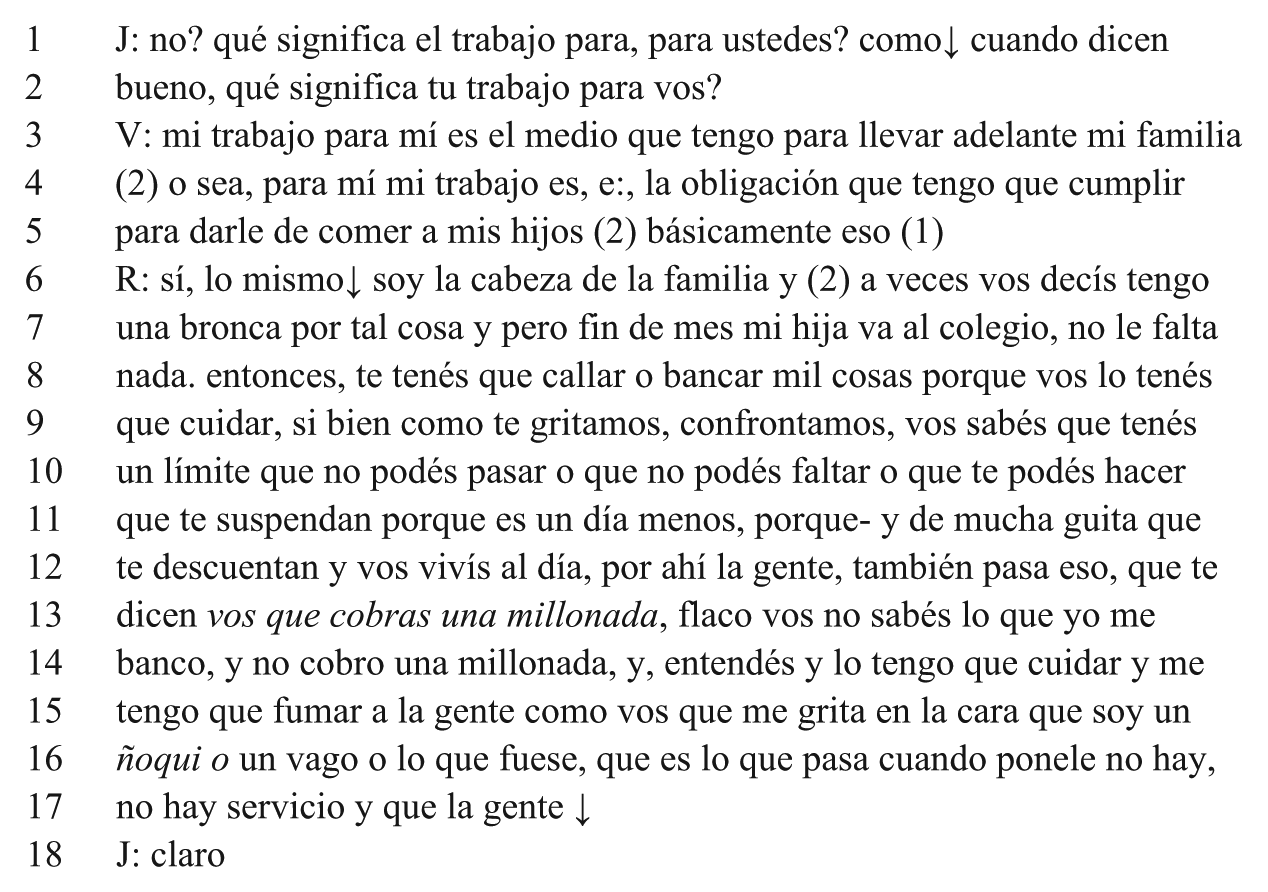
Ex. 1 shows a highly subjective account of what the job means to V and R. V’s short, straightforward answer in lines 3–6 is a single stance response, which includes a slightly negative evaluation of the job (as in ‘obligation’, ‘have to fulfill’). In V’s response, the salary is positively valued (lines 3 and 5) but the job itself is negatively valued as an obligation (line 4).
R explicitly affiliates to V in line 7. However, she elaborates further in a double voiced discourse (Baxter, 2011) to install an explicit polemic with the users of the service. This explicit polemic responds to media criticism of subway workers because of their relatively high salaries (cf. Arias et al., 2015), expressed in the hyperbole ‘cobrás una millonada’ (‘you make millions’, line 14), and subway workers’ relatively frequent union actions, such as surprise strikes and protests (so she recalls previous discourses of being called ñoqui, ‘lazy’, 3 line 17). Her stance is, therefore, moral, she ‘earns’ her (satisfying) salary through suffering, ‘I have to put up with people like you’ (lines 15–16). It is also presented as an opposition between her subjective experience of suffering and the negative representation by users who call her ñoqui. R’s answer, therefore, complements V’s: my job means subsistence through suffering. Both answers, however, are presented as single stances: two shared individual positions about the meaning of their jobs.
In other cases, the opposite (but also single) stance can be taken by similar means:
2. Woman with less seniority in the company, medium-low position

2. Translation

A is a subway ticket seller who was recently fired from a media company where she had worked for 20 years as a professional graphic designer and acted as union delegate. She had thus developed many political relationships with the Metro-delegates, who secured her an intermediate position as ticket seller after she lost her previous job. This is why, although she has the same seniority as V and R, she has a better position at the company.
Asked about the meaning of her job, she provides a single stance answer, anchored in the first-person singular, positively evaluated twice as a ‘second chance’ (lines 3 and 5). The nature of this second chance is presented both as economic ( ‘live very decently’, lines 6–8) and political (her link with ‘union activism’ in lines 9 and 10). To A, the positive meaning of her job is attached both to her political identity and salary satisfaction, and is opposed to her previous situation of unemployment at a mature age (lines 2 and 3). As a single stance evaluation, it is complex but not contradictory, because overall satisfaction prevails.
The last example shows pure satisfaction:
3. Woman, medium seniority, medium position

3. Translation

GR is an enthusiastic young guard who has been in the company for 6 years and was promoted to guard 3 years ago. In (3), she answers our question with a single positive stance ( ‘I love it’, lines 5, 9 and 13). There is a polemic double voicing in line 7, which allows her to better present her own single positive stance, as GR says she is happy with every aspect of her job: her past positions and her current position, as well as her future prospects in the company. This is observed in the repetition of a stance of absolute satisfaction in lines 3, 5–6, 9, and 12–13.
Double stance discourse: ‘to me/to others’ responses
Although we were expecting single stance ‘to me’ answers, many respondents offered an alternative, dispreferred response. As in any dispreferred second term of a pair, they are indirect and elaborated, requiring an extra conversational work (Liddicoat, 2007: 111).
4. Woman, medium-high seniority, medium-low position
4. Translation

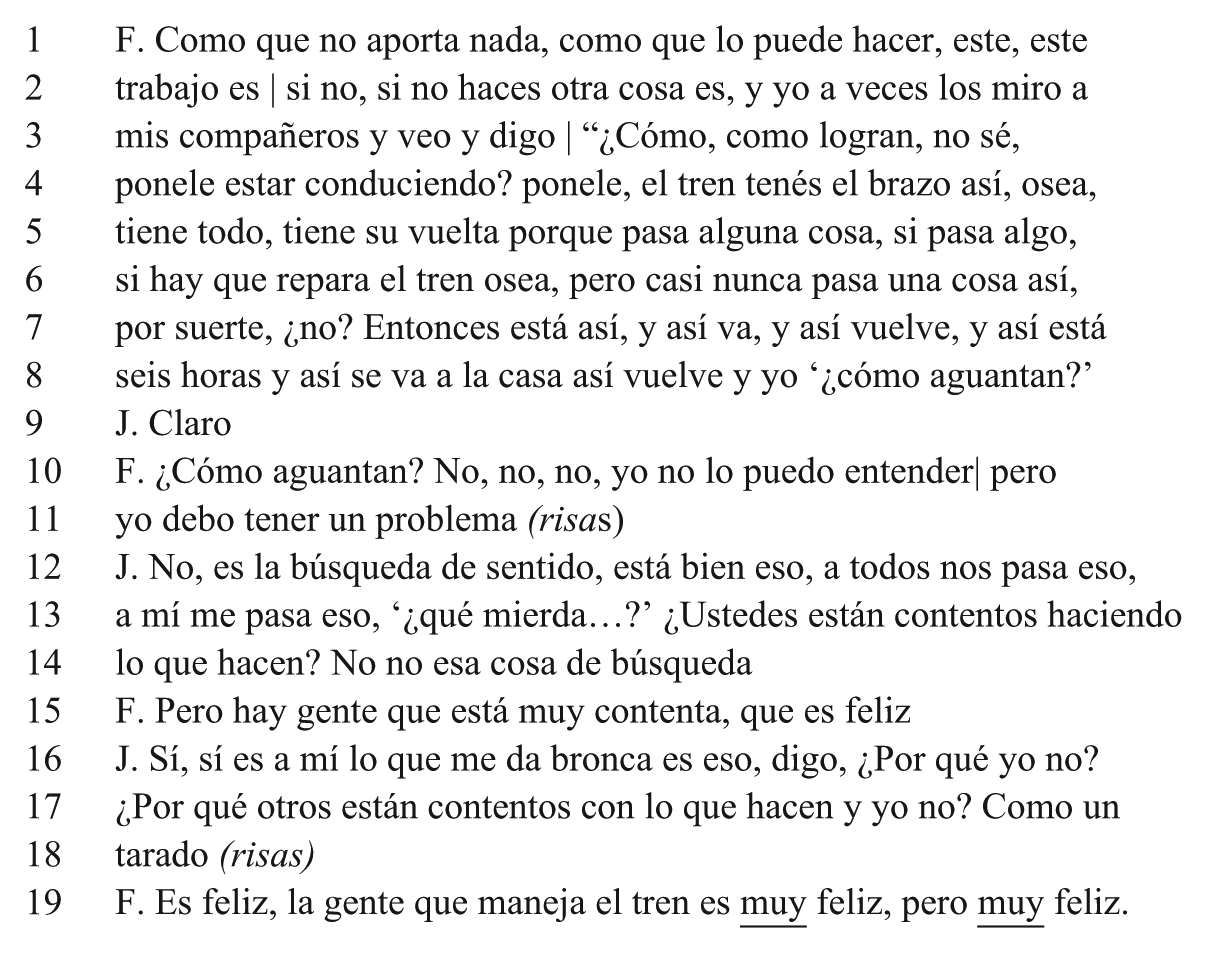
F is a ticket seller who has worked at the company for 24 years. She was very active in the creation of the union in her youth, her closest friends are subway workers or former workers and her son’s father also participated at the Metrodelegates’ foundational strikes. However, she graduated as a social worker at the University of La Matanza and currently works part-time at a public hospital and part-time at the subway due to economic reasons, because she earns twice as much at the subway. Salary, however, is not presented as a subjective source of satisfaction but simply as an economic need.
In (4), F presents a double stance discourse about the meaning of her job. On one hand, her personal perspective is plainly negative (‘it’s useless’, line 1; ‘how can they stand it?’, lines 8 and 10). Her ‘to me’ stance expresses her job’s lack of meaning to her, which is a typical sign of burnout (Maslach and Pines, 2005). It does not define work as generally meaningless, however; on the contrary, the ‘to others’ stance appears as a positive contrast: to others, working at the subway makes them happy (lines 15 and 19). The individual ‘to me’ stance, then, expresses burnout; the collective ‘to others’ stance, on the contrary, expresses satisfaction.
She presents a collective, other’s perspective, which is plainly positive ( ‘they are happy, very happy’, line 19). This positive, other-attributed stance is not justified or argued, but simply stated in opposition to her own. It is also a collective other-attributed stance, which contrasts with the perceived singularity of her own dissatisfaction.
The singularity of her own perspective is also apparent in other double stance discourses, as in the case of A. She is a ticket seller with less seniority who has worked for 30 years as a journalist and, having lost her job, feels her salary is the main reason to endure a ‘very unrewarding’ job:
5. Woman, ticket seller, less seniority

5. Translation

In (5), A’s ‘to me’ answer is straightforward and simple: her job means dissatisfaction to her ( ‘the job is dissatisfactory, always dissatisfactory, never satisfactory’, lines 1 and 2). This dissatisfaction is presented as general, but her co-worker’s stance ( ‘to others’) is different: the ‘big bikes, with big helmets and big cell phones’ (lines 3 and 4) is understood as a response to the job’s dissatisfaction. The job means, to A, complete dissatisfaction, while it is presented as an opportunity for luxury and consumer goods to others, who ‘feel more satisfied’ (line 15). Salary satisfaction is explicitly presented as the base of this ‘to others’ stance (lines 11–13), naming one of the variables measured in our survey, although she does not perceive it as an opportunity for luxury, but simply as ‘reasonable’ (line 11).
A similar double stance, opposing ‘to me’ salary satisfaction and ‘to others’ general satisfaction can be seen in the case of L, a train guard with 16 years at the company who does not contemplate going further in his career:
6. Male, medium seniority, train guard

6. Translation
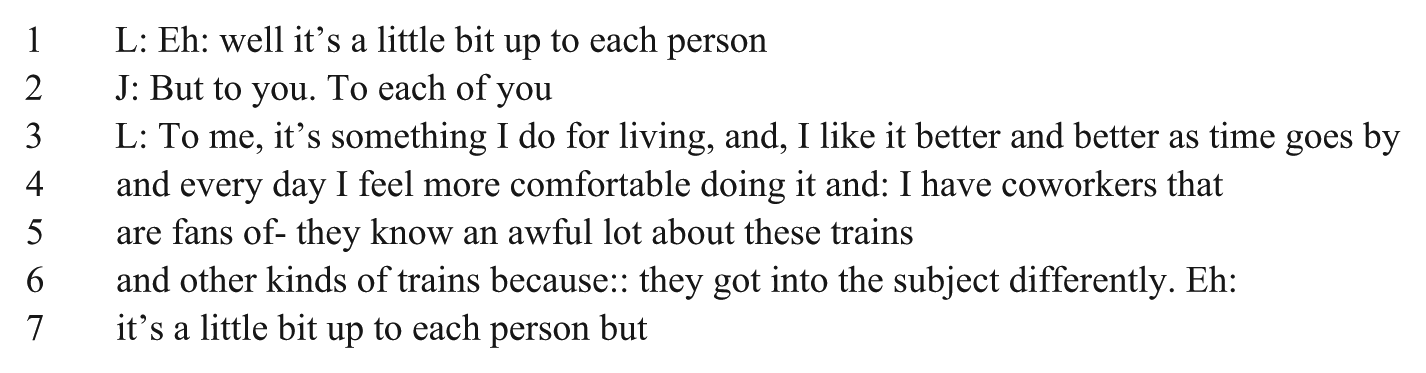
In 6, L presents his own stance toward his job in terms close to V and R in Ex. 2. ‘To me’ the job means subsistence, ‘it’s something that I do for a living’ (line 3). In contrast to V and R, however, L finds his job increasingly appealing. However, his own stance is presented in opposition ‘to others’, a collective stance which is based in his coworkers’ taste: ‘they are train fans, they know an awful lot about these trains’ (lines 5 and 6). His double stance answer allows for combining a personal meaning of subsistence with a collective ‘to others’ meaning of pleasure and vocation. This opposition is not contradictory, however, as L states his own tendency to ‘like it better and better’ (line 3).
Conclusion
Discourse analysis of single stance responses in the interviews showed the personal meanings of the job as related to the workers’ personal situations: as mothers and heads of families who endure suffering to provide for their children (Ex. 1), as a second chance to someone who has suffered unemployment at a relatively mature age (Ex. 2), but also as a source of plain and complete satisfaction (Ex. 3). Double stance responses, on the other hand, enable speakers to differentiate their own individual positions with regard to their co-workers as a homogeneous collective: to F, her job is meaningless and useless, although she says it means happiness to others (Ex. 4); to A, the job is the dissatisfactory way of earning a reasonable salary, although she understands that it means luxury to others (line 5); and finally, L relates to his job as an economic means to an end but, unlike V and R in Ex. 1, he sees that to others it is a pleasure and a vocation.
Double stance responses in these interviews can be interpreted as a discursive mechanism to manage a complex experience of women and senior workers, who suffer stress individually but feel collectively satisfied. This is what preserves them from full burnout (the reason why some indicators are as high as 70% but the general index is 50%): the existence of a network of interpersonal relationships, shared experiences and collective organization mitigates burnout and its effects (Leiter and Maslach, 1988; Rodríguez-Mantilla and Fernández-Diaz, 2017).
In methodological terms, this article shows the usefulness of discourse analysis to interpret quantitative data, not as a control or triangulation device, but as a critical approach to human experience which enables these data to be enriched and reinterpreted. It also shows the theoretical potential of interdisciplinary mixed-methods research, as it helped to develop a new concept, double stance discourse, to understand what would be seen as a contradiction in terms to a single discipline or method. Survey results in themselves were contradictory, as they showed subjects who were satisfied and at the same time, burnt out. Discourse analysis helped understand these quantitative results by offering other possible, alternative interpretations to an apparent contradiction. In this regard, the empirical question about the meaning of the job to subway workers can be addressed from other, complementary points of view, as it is relative to different situations and discourse practices.
The contribution of discourse analysis to this kind of research, therefore, is not to decide which is the authentic or actual meaning of a quantitative variable, but to open its potential meanings as they unfold and develop in discourse and actual interaction.
Footnotes
Acknowledgements
The author thanks the thorough work and suggestions made by the anonymous reviewers of this article.
Declaration of conflicting interests
The author(s) declared no potential conflicts of interest with respect to the research, authorship, and/or publication of this article.
Funding
The author(s) disclosed receipt of the following financial support for the research, authorship, and/or publication of this article: This research was funded through the project PIO CONICET-UMET20620150100043CO, “Riesgos psicosociales y comunicación en el lugar de trabajo: un estudio interdisciplinario” (Psychosocial Risks and Communication in the Workplace: an Interdisciplinary Study).