



Abstract
The significant allure of widely available fossil energy sources at a reasonable cost engenders formidable impediments to the transition toward renewable energy sources in Saudi Arabia, one of the world's foremost energy-producing nations. Mitigating the escalating levels of emissions and addressing the substantial ecological deficits requires a comprehensive investigation of the prospective contributions of energy efficiency and high-tech industry as integral components in the strategic response to environmental challenges. In light of this, our current study employs quarterly data spanning from 1990 to 2021 and introduces an innovative approach known as time-varying quantile regression (TVQR), which has not been previously utilized in the existing literature. We complement this with time-varying nonparametric quantile causality to assess the impacts of disaggregated energy efficiency, the high-tech industry, and social globalization on ecological quality (proxied by load capacity factor (LF)) across different quantiles and time intervals in Saudi Arabia. Our TVQR analysis reveals that both the high-tech industry and oil and gas efficiency have a positive impact on environmental quality, as evidenced by their ability to enhance the LF indicator across a significant portion of quantiles and time intervals. Conversely, economic growth and social globalization have a negative impact on environmental quality. Additionally, the selected explanatory variables exhibit significant predictive power over LF across various time frames and quantiles. Lastly, we have formulated a comprehensive policy framework aimed at enhancing ecological quality.
Keywords
Introduction
In the contemporary era, nations grapple with a myriad of economic and environmental challenges, necessitating innovative approaches to sustain economic growth (EG), enhance public health, and promote ecological sustainability. Foremost among these challenges is the enduring escalation of global warming and its associated ramifications on climate patterns, precipitating an array of severe meteorological phenomena and calamities, resulting in substantial human casualties and economic losses. 1 The sustained escalation in economic endeavors has engendered heightened levels of resource consumption and production, thereby exacerbating energy utilization and waste generation.2,3 Consequently, carbon emissions, recognized as the primary catalysts of global warming, have exhibited a twofold surge since 1970. 4 Notably, approximately 75% of worldwide carbon emissions emanate from the energy sector, underscoring the pivotal role that energy-related policies can play in mitigating climate change and ameliorating environmental conditions.
In light of the fact that many nations predominantly depend on the utilization of petroleum products to foster and maintain economic development, the associated increase in fossil energy consumption, coupled with development efforts, has led to a concurrent escalation in pollutant emissions, resulting in a noticeable deterioration of ecological quality. 5 While scholars have posited the adoption of green energy as a viable solution to mitigate dependence on fossil fuel use, the persistently alluring attributes of fossil fuels in numerous countries, including their comparatively lower initial costs, the absence of mature green energy production technologies, the limited availability of green transportation alternatives, and the better accessibility of fossil energy, continue to present formidable barriers to the widespread adoption of renewables. Notably, such appealing characteristics of fossil energy sources are pronounced in countries such as Saudi Arabia, a prominent member of the largest global oil-producing nations. Hence, the importance of energy efficiency underscores its pivotal role in mitigating resource depletion, as it fundamentally rests upon the principle of achieving equivalent output while curbing energy input. Augmentations in energy efficiency not only curtail reliance on fossil fuels but also confer an array of ancillary advantages, encompassing the alleviation of electricity deficits, diminution of operational expenditures, bolstering industrial competitiveness, promoting the underpinning of energy security, and boosting ecological quality.6,7 The augmentation of energy efficiency mandates the utilization of advanced technologies and the implementation of sustainable practices, as highlighted by Jin et al.8,9 These include various measures including the deployment of energy-efficient household appliances, the establishment of intelligent grid infrastructure, the adoption of industrially efficient machinery and equipment, and the construction of environmentally friendly infrastructures. Collectively, such endeavors hold the potential to catalyze economic development, curtail energy consumption and emissions, and advance ecological sustainability.
This research evaluates the impacts of oil efficiency (OEF) and coal efficiency, high-tech industry (HTI), and social globalization (SGLO) on environmental sustainability. In the endeavor to diminish energy consumption, a paramount imperative lies in directing attention toward industrial restructuring, with an emphasis on the promotion of HTIs. This strategic orientation is underpinned by the capability of high-tech sectors to reduce energy utilization, thereby conferring a beneficial impact upon ecological quality.10,11 HTIs predominantly leverage contemporary technological advancements, innovation, rigorous research, and automation to fabricate complex products, implement novel organizational methodologies, embrace advanced production techniques, and optimize supply chain operations. Consequently, this multifaceted approach can yield reductions in energy consumption, waste generation, and the generation of emissions, thereby contributing to environmental sustainability.12,13
In the examination of the ramifications of energy efficiency and the HTI on environmental quality, due consideration is accorded to the pivotal role of SGLO. SGLO constitutes a significant channel for the dissemination of information, knowledge, and awareness pertaining to both the advantageous and detrimental facets of consumption and production. This function is realized through the facilitation of cross-border connections among individuals from diverse countries and regions, as well as the encouragement of international media and internet penetration and heightened international mobility. 14 According to Ahmed et al., 15 SGLO assumes a pivotal role in the advancement of environmental consciousness, thereby inciting practices conducive to energy conservation, recycling, water preservation, and the adoption of cleaner product choices. Consequently, these affirmative consequences of SGLO have the potential to foster ecological sustainability, enabling societies to assimilate environmental awareness, and embrace eco-friendly practices that are prevalent in other nations.
In the context of comprehending the influence of energy efficiency, the HTI, and SGLO on ecological quality, it becomes imperative to employ a comprehensive metric of environmental sustainability capable of holistically encapsulating environmental degradation while duly considering the availability of resources, as indicated by biocapacity. In this context, it is noteworthy that conventional metrics, such as CO2 emissions and ecological footprint (EF), have certain critical limitations. For instance, CO2 emissions primarily gauge energy utilization, while EF fails to adequately account for the essential dimension of biocapacity16,17 posit that the omission of biocapacity, which reflects the Earth's capacity to produce resources, results in a diminishment of both the comprehensiveness and precision of ecological quality assessments. Thus, in alignment with contemporary research studies,18,19 this investigation uses the load capacity factor (LF) to measure ecological quality, as this indicator (i.e. biocapacity/EF) utilizes the data of both biocapacity and EF and represents a holistic proxy of environmental sustainability.
This empirical study opted to include Saudi Arabia as a research sample for several compelling rationales. Saudi Arabia stands as a notable case due to its pronounced reliance on the energy sector, positioning itself among the foremost global energy producers. 20 Saudi Arabia possesses significant energy assets, including substantial reserves of oil and natural gas. Approximately 90% of its export revenue is derived from petroleum products, and the oil sector alone constitutes a substantial 45% share of the nation's gross domestic product. 21 As petroleum products are affordable and easily available in the country, the Saudi economy predominantly relies on oil and gas. Saudi Arabia was using 19615.88 (per capita kWh) of oil and 37569.61 (per capita kWh) of gas in 1990. However, escalated EG bolstered the consumption of oil and gas in Saudi Arabia, recording an increase of 69% and 38% in oil and gas, respectively, from 1990 to 2021. 22 As a result, carbon emissions have experienced an escalation, warranting the inclusion of the nation within the ranks of the top 10 global carbon emitters. 23 Saudi Arabia had a biocapacity of 1.32 (gha per capita) and EF of 2.40 (gha per capita) in 1990, with an LF of 0.55, implying that the biocapacity of Saudi Arabia was enough to support only 45% of its EF. Nevertheless, persistent environmental degradation coupled with high consumption of energy and other resources expanded the EF (5.58) and reduced biocapacity (0.71), and the LF reached the level of only 0.13 in 2021.24,25
As the LF values of 1 or above depict ecological sustainability (see Figure 1), the persistent reduction in LF in Saudi Arabia shows high ecological degradation and unsustainability in the production and consumption of resources. In the particular context of Saudi Arabia, the imperative of augmenting the energy efficiency within the oil and gas sectors assumes paramount significance, as it serves as a pivotal strategy for mitigating the substantial dependence on fossil energy sources, ameliorating environmental degradation, and steering toward the attainment of a sustainable environment. Under the Saudi Vision 2030, the country is looking to diversify its economy and increase its competitiveness to become a powerhouse of global investment. Furthermore, this endeavor encompasses a multifaceted array of initiatives aimed at curtailing environmental degradation. Consequently, an economic restructuring approach, coupled with a transition towards HTIs, might be advantageous for diminishing reliance on oil-based resources and enhancing energy efficiency, ultimately facilitating the realization of environmental sustainability objectives. Moreover, SGLO may elevate the level of awareness and sensitiveness within Saudi Arabia concerning the imperative of curbing energy consumption in the pursuit of fostering a healthy and sustainable environment.

Ecological sustainability.
Against this background, this research investigates the effects of OEF and gas efficiency (GASEF), HTI, and SGLO on the LF. This is the first empirical investigation that assesses the impacts of these important variables on LF. Therefore, this study makes a considerable contribution to previous scholarly works. Secondly, this research introduces a novel concept of time-varying quantile regression (TVQR), which has never been used before in the available literature. TVQR will enable us to analyze the impacts of disaggregated energy efficiency, HTI, and SGLO on different quantiles of the distribution of the response variable across various subperiods. Therefore, this methodology offers supplementary insights that can be instrumental in formulating apposite environmental policies. Moreover, the adoption of the LF as an environmental quality metric serves to differentiate this empirical inquiry from prior research endeavors. This distinction arises from LF's encompassing nature, which takes into account both demand and supply facets, thus providing an inclusive evaluation of ecological quality.
Theoretical framework and literature
Theoretical framework
Theoretical frameworks concerning the impact of the HTI, GASEF, OEF, and SGLO on various aspects of society are crucial for understanding their complex interactions and implications.
The HTI, known for its swift innovation and technological progress, exerts profound transformations on economies, societies, and the environment. From a macroeconomic viewpoint, this sector fuels economic expansion by boosting productivity, fostering job opportunities, and enhancing competitiveness.12,26 Nevertheless, its effects are not evenly distributed across society, giving rise to apprehensions regarding digital disparities and societal inequality. Furthermore, the high-tech sector's reliance on finite resources and its environmental impact present sustainability hurdles, underscoring the need for policies aimed at advancing green technologies and embracing principles of the circular economy. 27
İncreased GASEF and OEF plays a pivotal role in mitigating ecological harm, curbing greenhouse gas emissions, and bolstering energy stability. Economically, advancements in GASEF and OEF can yield cost decreases, heighten competitiveness, and diminish reliance on fossil fuel imports. 28 Nevertheless, realizing efficiency improvements demands investments in R&D, infrastructure enhancements, and the establishment of regulatory frameworks. Additionally, the shift toward RE alternatives and the electrification of transportation present hurdles for existing industries, mandating workforce retraining initiatives and transition strategies. 29
SGLO, marked by the interconnectivity of cultures, societies, and individuals, holds significant ramifications for values, identity, and social unity. It fosters the flow of knowledge, ideas, and cultural norms, fostering diversity and enriching societies.30,31 However, SGLO also sparks tensions and obstacles, such as cultural assimilation, identity societal fragmentation and dilemmas. Addressing these issues necessitates policy initiatives that endorse cultural plurality, hearten intercultural discourse, and enact inclusive social strategies. 32
Summary of past studies
In pursuit of achieving their individual carbon neutrality objectives, numerous nations have formulated diverse strategies aimed at reaching this compelling goal. Additionally, the adverse impacts of climate change and global warming have compelled several nations to transition from pro-growth approaches to more environmentally friendly ones. Consequently, numerous research initiatives have been launched to investigate the influence of economic variables on ecological quality. These endeavors are intended to assist governments and various policymakers in crafting precise and effective sustainable development policies.
When it comes to examining the connection between the HTI and ecological quality or degradation, there is a limited body of empirical literature available. For instance, Xu and Lin10,11 conducted a panel analysis using regional data from China to explore the impact of the HTI on reducing ecological degradation over the period from 1999 to 2015. Their study revealed that the decline in CO2 in the selected regions could be attributed to the growth of the HTI. With the motif of devising SDGs measures for China, Shahzad et al.12,13 utilized a dynamic estimator to research the implication of the HTI on ecological integrity, with the results indicating that growth in ecological excellence is accredited to the intensification of the HTI. A similar angle is viewed by the investigation of Xu and Lin10,11 and Du et al., 33 who, in their respective studies, highlighted that ecological deterioration is attributed to the initiatives put in place to promote HTI; though, these initiatives damage the ecosystem. On the contrary, the investigation put forward by Rafique et al. 26 showcased that the policies regarding HTI are sustainable since they lessen ecological damage by intensifying ecological integrity.
SGLO showcases the growing integration and linkage of various societies as well as cultures that expound beyond their domestic borders. This occurrence is triggered by factors such as global travel, trade, technological progress, and communication. Nonetheless, these drivers can have both detrimental and enhancing impacts on the ecosystem. For illustration, Shi et al., 34 with the goal of proposing SDGs measures, used the N-11 nations in analyzing the nexus between SGLO and ecological integrity. The results, with the aid of the Method Of Moment Quantile Regressions (MMQR) estimator, showcased that the green environment in the selected nations is accredited to the growth of SGLO. Conversely, Wang et al., 35 study contradicts the findings put forward by Shi et al., 34 by showcasing the effect of SGLO in promoting the ecological excellence of China. Moreover, Kirikkaleli and Adebayo's 36 analysis using the Brazilian case affirmed that ecological excellence bolsters the role of SGLO. Similarly, Sharif et al.31,37 investigated the role of SGLO in promoting ecological quality, using the G7 countries as a case study. Their study highlighted the significant positive impact of SGLO on ecological quality. These studies collectively demonstrate the complexity of the interrelationship between SGLO and the environment, and they pave the way for further research as concrete results regarding the SGLO-environment nexus remain elusive.
Recent empirical literature has increasingly emphasized the role of energy efficiency (EF) in bolstering ecological integrity. The interrelationship between ecological degradation and energy efficiency is of paramount importance in the context of ecological sustainability and the global effort to combat climate change. These two factors often exhibit an inverse correlation, meaning that as energy efficiency improves, ecological degradation tends to decrease. Conversely, a decrease in energy efficiency is allied with an increase in CO2. For instance, Liu et al., 38 in their study focusing on the role of energy efficiency, specifically coal efficiency, on CO2 in the USA, utilized Wavelet tools to underscore the positive impact of coal efficiency in enhancing ecological integrity. Similarly, Alola et al., 39 in their research examining the Indian context, and Jin et al.,8,9 in their study of Germany, reported the positive influence of EF on ecological excellence. Furthermore, studies conducted by Akram et al.,6,7 for the BRICS and Naimoglu and Akal 40 for Turkey highlighted the emissions-reducing effect of energy efficiency. Additionally, Zhang et al., 41 using data from China's 30 provinces spanning from 2012 to 2019 and employing panel threshold regression, emphasized the constructive role of energy efficiency in strengthening ecological integrity. Table 1 offers a comprehensive summary of the reviewed studies.
Glimpse of the literature.

AMG: augmented mean group; ARDL: Auto Regressive Distributed Lag; CO2: carbon emissions; CCEMG: common correlated mean group; COEF: coal efficiency; EFC: energy efficiency; EF: ecological footprint; EG: economic growth; HTI: high-tech industry; MINTS: Mexico, Indonesia, Nigeria, Turkey South Africa; MMQR: method of moment quantile regressions; OEF: oil efficiency; SGLO: social globalisation; SGMM: system generalized method of moments.
Gap in the literature
The literature review reveals a growing but still limited body of research focused on assessing the influence of globalization, EG, HTI, and energy efficiency on CO2 emissions and ecological footprint. These studies primarily target individual countries (e.g. the USA, Germany, France, and China) or groups of nations (e.g. BRICS, Mexico, Indonesia, Nigeria, Turkey South Africa, G20, ASEAN, G7). Various econometric techniques, including CCR, Granger causality, DYNARDL, NARDL, FMOLS, MMQR, DOLS, Dumitrescu-Hurlin panel causality test, GMM, and DOLS, are employed for empirical analysis. This approach represents a significant advancement beyond the traditional quantile regression proposed by Koenker and Bassett. 48 Notably, our study introduces the innovative concept of TVQR for the first time in empirical analysis. TVQR allows us to examine the impact of independent variables on different quantiles of the distribution of the dependent variable across various subperiods. To the best of our knowledge, no existing literature examines the effects of disaggregated energy efficiency (specifically, OEF and GASEF) and HTI on LF, which serves as a detailed proxy for ecological quality encompassing both the demand and supply sides of the environment. In addition to addressing this research gap, our study pioneers the use of TVQR to explore the effects of disaggregated energy efficiency (OEF and GASEF), HTI, and SGLO on LF in the case of Saudi Arabia. This innovative method enriches our comprehension of the complex interplay between these variables and their impact on ecological quality across various quantiles and time intervals.
Data and methods
Data
In this article, Saudi Arabian data for the period from 1990 to 2021, which are the longest periods available for the variables, are employed. As a proxy for environmental quality, which is our dependent variable, we use the LF. The LF represents a precise ecological threshold by combining biocapacity and ecological footprint. This combination makes the LF a more comprehensive environmental quality measure than traditional carbon dioxide and ecological footprint measures, which do not take into consideration the environmental issues’ supply side. 49 Due to these important features, the LF is preferred as an indicator of environmental quality in this study. On the other hand, our explanatory variables are HTI, GASEF, OEF, SGLO, and EG. Table 2 presents the sources from which the variables are obtained and the measures used to measure them. Furthermore, Figure 2 illustrates the time plots of the annual raw values of the study variables. From the figure, it is seen that LF, GASEF, and OEF followed a decreasing trend during the sample period, while SGLO showed an increasing trend. Moreover, EG decreased until 2002 but has started to increase since this year. Lastly, although HTI increased significantly in 2001, it has been stagnating recently.

Time plots of the variables’ annual values from 1990 to 2021.
Data sources and measurement.

GDP: gross domestic product; PPP: purchasing power parity.
In order to reach a sufficient observation size, we first take the natural logarithm of the annual data in order to encounter any potential heteroscedasticity and then convert logarithmic values into quarterly series by applying the quadratic match-sum approach, as in the studies of Alola et al. 50 and Ozkan et al. 53
Methods
Time-varying quantile regression
Quantile regression (QR), introduced by Koenker and Bassett 48 and developed by Koenker, 54 is a statistical technique that extends the concept of linear regression by focusing on estimating conditional quantiles of a dependent variable rather than just the mean or expected value. The QR method particularly allows practitioners to see how the dynamics of the relationship between variables across distinct quantiles of the conditional distribution of the dependent variable change. In other words, the QR method primarily focuses on estimating the impact of an explanatory variable on the conditional quantiles of a dependent variable. 55
The QR model can be described as follows:

In the model presented in equation (1),
Unlike ordinary least squares (OLS) regression, which reduces the sum of squared residuals, QR minimizes a different objective function that involves the sum of absolute deviations. Mathematically, the estimation requires solving the following optimization problem for each quantile

The estimated coefficients
QR has three important advantages over OLS regression: (1) QR is less sensitive to outliers than OLS regression because it minimizes the sum of absolute deviations; (2) QR provides a more complete image of the interrelationship between variables by estimating multiple quantiles, not just the mean; (3) QR can handle datasets with varying levels of dispersion or heteroscedasticity; and also, it is less sensitive to model misspecification. These advantages make QR a powerful tool for exploring and modeling the conditional distribution of a dependent variable.54,56–58
Although the QR method has the important advantages mentioned above, it does not take into account the relationship between variables that may change over time. To overcome this very important shortcoming of the QR method, we combine traditional QR and rolling subsample windows approaches by following the ideas of.Lee et al. 59 and Olasehinde-Williams 60 Our new TVQR method allows us to analyze the time-varying impact of an explanatory variable on the conditional quantiles of a dependent variable.
The empirical application stages of the TVQR method are as follows:
Determine the quantiles (in this study, 0.1, 0.2, …, 0.9) and subsample windows size (in this study, 30). Set the values of the explanatory and dependent variables for the first subsample window. Estimate the quantile regression model presented in equation (5) to obtain the slope coefficient Create a new subsample window by moving the window one observation forward, and repeat steps 2 and 3. Repeat step 4 until the end of the sample period.
Time-varying nonparametric quantile causality
This study employs the time-varying nonparametric quantile causality (TVNQC) technique to examine the dynamic quantile causality between HTI, GASEF, OEF, SGLO, EG, and LF in Saudi Arabia. The nonparametric quantile causality (NQC) approach was introduced by Balcilar et al., 61 by extending the frameworks of Nishiyama et al.,62,63 to analyze the nonlinear causal relationship between not only means but also variances of two variables by considering their conditional quantiles.
Balcilar et al.,
61
proposed the following hypotheses to successively test the quantile causality in means and variances of the variables:


The hypotheses of the NQC method given in equations (3) and (4) can be tested with the feasible kernel-based test statistic for distance measure D calculated as follows:

Balcilar et al.,
61
state that

The advantages of the NQC approach can be listed as follows: (1) NQC provides a more comprehensive vision about the causal impact of an explanatory variable on a dependent variable as it considers all joint distributions of the variables, not just their means; (2) NQC is less sensitive to misspecification errors because it takes into consideration underlying dependency among variables; (3) NQC allows practitioners to analyze quantile causality among the variables not only in mean but also in variance. 64
Since the NQC method is able to analyze quantile causality in both mean and variance between the variables by using the whole sample period, it inherently assumes that the relevant causalities do not change over time. However, as Granger (1996) points out, time series exhibit structural changes in certain periods, and these changes can cause shifts in the parameters, so the underlying type of causality among the variables can shift over time. 65 In order to overcome this shortcoming of the NQC method, Olasehinde-Williams et al. 60 developed the TVNQC technique by combining the NQC with the rolling subsample windows method. This novel approach allows practitioners to investigate time-varying nonlinear quantile causal relationships in the means and variances of an explanatory and a dependent variable.
In this study, we perform the empirical implementation of the TVNQC method in the following steps:
Determine the quantiles (in this study, 0.1, 0.2, …, 0.9) and size of the subsample windows (in this study, 30). Set the values of the explanatory and dependent variables for the first subsample window. Estimate the feasible kernel-based statistics presented in equation (3) to test the hypotheses given in equations (1) and (2) for the first subsample window.
a
Create a new subsample window by moving the window one observation forward, and repeat steps 2 and 3. Repeat step 4 until the end of the sample period.
To provide a comprehensive overview of the study's analysis, we present the sequential flow of the techniques utilized (see Figure 3).
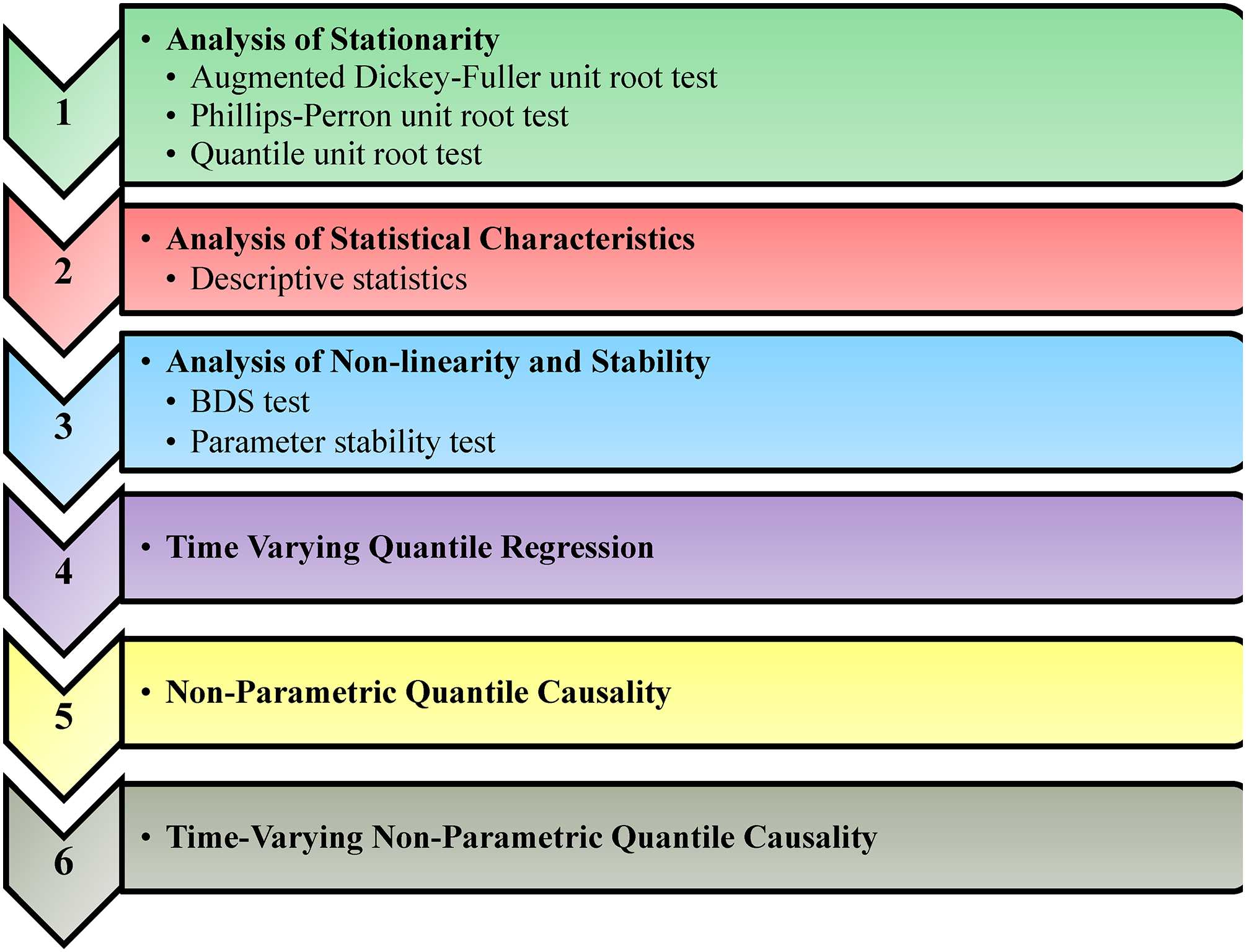
Flow of analysis.
Findings and discussion
Analysis of statistical characteristics
Before delving into the analyses of TVQR and TVNQC, we first examine the statistical characteristics of the stationary series that will be employed in our analysis. In Table 3, we present the descriptive statistics for the variables under consideration. The mean values indicate that, over the sample period, the average monthly values of LF, HTI, GASEF, EG, OEF, and SGLO stand at −0.3936, 0.8508, 1.8959, 2.4545, 1.7509, and 1.0115, respectively. Regarding volatility, the standard deviation highlights that LF exhibits a notably higher level of volatility compared to all other variables, whereas EG shows relatively lower volatility. Examining skewness, we observe a positively skewed distribution for all the variables under investigation. Furthermore, the kurtosis values reveal that these variables exhibit platykurtic characteristics, as their values are less than 3. The Jarque-Bera (J-B) values provide insights into the distribution's normality, indicating that all series, except EG, depart from a normal distribution. These findings collectively suggest that methodologies considering the entire distribution, rather than focusing solely on the distribution's center, are more suitable for our analysis. Overall, these observations align with our rationale for employing quantile-based approaches.
Descriptive statistics.

***P < 0.01, and **P < 0.05
EG: economic growth; GASEF: gas efficiency; HTI: high-tech industry; LF: load capacity factor; OEF: oil efficiency; SGLO: social globalization.
Analysis of nonlinearity and stability
As previously discussed, quantile-based approaches are well-suited to the statistical attributes of the studied variables. However, before proceeding with the primary analysis, it is imperative to assess the appropriateness of the nonparametric approach for these variables. Following the methodology established in prior studies by Balcilar et al., 61 Olasehinde-Williams et al., 60 and Alola et al., 50 we employ both the Brock, Dechert, and Scheinkman (BDS) test by Broock et al., 66 and the parameter stability test developed by Andrews and Ploberger 67 and Andrews. 68 The results of the BDS test, presented in Table 4, are used to evaluate nonlinearity in each variable. These findings indicate that the null hypothesis of independent identical distribution is dismissed across all embedded dimensions. This dismissal offers strong evidence of the presence of nonlinearity in all the indicators. This showcases that the variables under investigation do indeed exhibit nonlinear characteristics. Considering the nature of these series, it becomes clear that our nonparametric methodologies, including TVQR and TVNQC, are exceptionally well-suited for this study. These approaches effectively concurrently tackle both the nonlinearity and non-normality inherent in the dataset.
BDS test results.

M denotes the dimension. Values inside () represent showcases P-values. ***P < 0.01.
EG: economic growth; GASEF: gas efficiency; HTI: high-tech industry; LF: load capacity factor; OEF: oil efficiency; SGLO: social globalization.
Table 5 showcases the results of the parameter stability test conducted to assess the stability characteristics of the study series. The findings from the parameter stability BDS test indicate the rejection of the null hypothesis (Ho) of stability for the variables under investigation at a significance level of 1%. This suggests the presence of structural breaks in these variables.
Parameter stability test results.

Value inside () represents showcases P-values calculated via the method of Hansen. 69 ***P < 0.01.
EG: economic growth; GASEF: gas efficiency; HTI: high-tech industry; LF: load capacity factor; LR: long-run; OEF: oil efficiency; SGLO: social globalization.
Stationarity test results
It is worth noting that, as pointed out by Sim and Zhou 70 and subsequently corroborated by Balcilar et al., 61 and Das et al., 71 quantile-based analysis necessitates the use of stationary data. Furthermore, based on the nonlinearity and non-normal distribution of the series, using linear unit root tests inclusing augmented Dickey Fuller (ADF) and Philip Perron (PP) tests will produce misleading results. Thus, the study rest on using nonlinear ADF test suggested by Galvao 72 with the results presented in Table 6. This test provides estimates relevant to the examination of data stationarity through quantile analysis. Specifically, the quantile unit root test presents estimates concerning the persistence and t-statistics for H0: α(τ) = 1 across a grid of 19 quantiles. The outcomes of the quantile unit root test reveal that HTI, LF, EG, SGLO, GASEF, and OEF exhibit nonstationary behavior when observed at the level series for all quantiles within the conditional distribution. These findings align with the results obtained from the ADF and PP tests, which were discussed previously.
Quantile unit test results.

Table 6 presents the estimated points and t-values at a 5% level of significance. t-values < CV, leads us to dismiss the null hypothesis of α(τ) = 1.s
CV: critical value; EG: economic growth; GASEF: gas efficiency; HTI: high-tech industry; LF: load capacity factor; OEF: oil efficiency; SGLO: social globalization.
Time varying quantile regression results
This study introduces, for the first time, the application of TVQR to explore the relationship between LFs and variables such as the HTI, energy efficiency (GASEF and OEF), and SGLO. This approach represents a significant advancement beyond the traditional quantile regression proposed by Koenker and Bassett. 48 TVQR allows us to capture the impact of Y on different quantiles of the distribution of X across various subperiods. Figure 4 illustrates the results obtained through TVQR. The vertical axis on the right-hand side presents a color bar ranging from light yellow to dark red (indicating the sign of the relationship). Additionally, the vertical axis on the left-hand side displays the quantile distribution. Meanwhile, the horizontal axis represents the subperiods under consideration. The TVQR results are shown in Figure 3.

TVQR from HTI, GASEF, OEF, SGLO and EG to LF. (a) Time-varying impact of HTI on LF. (b) Time-varying impact of GASEF on LF. (c) Time-varying impact of OEF on LF. (d) Time-varying impact of SGLO on LF. (e) Time-varying impact of EG on LF. EG: economic growth; GASEF: gas efficiency; HTI: high-tech industry; LF: load capacity factor; OEF: oil efficiency; SGLO: social globalization; TVQR: time-varying quantile regression.
Figure 4(a) illustrates the outcomes of the TVQR analysis pertaining to the impact of the HTI on the LF in Saudi Arabia. Within the middle and high quantiles (ranging from 0.3 to 0.90), particularly spanning from 1992 to 2000, strong evidence emerges of a significant association between the HTI and LF. This suggests that the presence of an HTI contributes positively to ecological quality during this period. Furthermore, from 2001 to 2021, across a range of quantiles (from 0.1 to 0.90), there is discernible but weaker yet positive evidence of a connection between the HTI and LF. This implies that the HTI continues to promote ecological quality in Saudi Arabia over these years. In essence, the development of the HTI appears to be a catalyst for improving ecological quality in the country. These findings align with the conclusions drawn by Xu and Lin,10,11 who employed a nonparametric additive regression model, as well as those of Shahzad et al.,12,13 in the case of China, who utilized a dynamic connectedness vector autoregressive model. However, it is noteworthy that these findings run counter to the results reported by Du et al., 33 in their analysis of the MINT nations.
The rationale behind our findings can be elucidated as follows. Firstly, the HTI has the capacity to enhance energy efficiency through several mechanisms. Technological advancements within the high-tech sector can lead to energy savings by improving the efficiency of equipment and machinery. Simultaneously, it can foster the development of a skilled workforce with a heightened environmental consciousness, leading to more energy-efficient practices. 26 Notably, certain segments of the HTI, such as resource utilization and ecological preservation, actively promote the adoption of energy-saving technologies and equipment, including waste generation and automobile exhaust afterburning technologies.12,13 This contributes to reductions in energy and CO2. Second, the HTI plays a pivotal role in popularizing a low-carbon lifestyle. High-tech products are progressively reshaping lifestyles and societal operations in various regions. These products can create cleaner and cost-effective living environments, prompting an increasing number of individuals to embrace various high-tech solutions, such as solar heat pipes, wind power motors, biomass energy, coal gasification and geothermal energy. 27 Thirdly, the HTI plays a pivotal role in driving the transition to a low-carbon economy. This sector not only provides cutting-edge equipment and technology for the modernization of conventional industries but also offers essential technical support for the manufacturing services industry. 26 On the one hand, the HTI facilitates the transformation of traditional sectors, ushering them into the realm of a low-carbon economy. For instance, it significantly enhances the productivity of the equipment manufacturing industry, resulting in reduced energy usage and diminished utilization of natural resources. Consequently, the HTI contributes to the enhancement of ecological quality in Saudi Arabia.
Figure 4(b) provides a visual representation of the TVQR analysis concerning the relationship between GASEF and the LF in Saudi Arabia. Across all quantiles (ranging from 0.10 to 0.90), the impact of GASEF on LF exhibits a consistently positive and robust pattern from 1992 to 2015. Additionally, within the medium and higher quantiles (ranging from 0.40 to 0.90) spanning the years 2015 to 2017, there is evidence of a noteworthy negative effect of GASEF on the LF that cannot be ignored. Furthermore, from 2017 to 2021 and across all quantiles (ranging from 0.10 to 0.90), the influence of GASEF on LF returns to a positive direction. In summary, it can be concluded that GASEF promotes ecological quality in Saudi Arabia by enhancing the LF. This outcome aligns with expectations, given that natural gas is generally considered to be a relatively environmentally friendly energy source when compared to oil and coal. Moreover, improvements in natural GASEF naturally contribute to a more environmentally tolerant energy landscape. Connecting this finding with existing literature 29 provides significant evidence that innovative utilization of natural gas and other energy sources, such as nuclear and oil energy, benefits the environment in Finland. However, studies also reveal that in the absence of technological innovation or environmentally focused approaches to natural gas, it can have detrimental effects on environmental quality.6,7,39,42
Figure 4(c) illustrates the impact of OEF on the LF across various quantiles and subperiods. As anticipated, in the majority of quantiles and subperiods, the influence of OEF on the LF is notably positive. This outcome indicates that the utilization of OEF has mitigated environmental degradation in Saudi Arabia by elevating ecological quality. The plausible explanation for the consistently positive and significant effect of oil energy efficiency, as revealed in this study, demonstrates that when oil energy is used efficiently, it can contribute to ecological improvement. This finding underscores the role of technological advancement as a means to promote energy efficiency. Consequently, it implies that oil energy efficiency can play a pivotal role in ensuring a sustainable environment. This result aligns with past studies initiated by Liu et al., 38 and Jin et al.,8,9 both of which documented the positive impact of energy efficiency on ecological integrity.
Figure 4(e) provides an overview of the impact of EG on LF in Saudi Arabia. Across all quantiles (ranging from 0.1 to 0.90), particularly from 1992 to 2003, there is evidence of a positive effect of EG on LF, implying that EG has improved ecological quality during this period. However, from 2004 to 2021, across the majority of quantiles and subperiods, the effect of EG on the LF is negative, suggesting that EG has exacerbated ecological deterioration. These results challenge the Load Capacity Curve (LCC) hypothesis for Saudi Arabia. Our study's findings align with the conclusions drawn by Adedoyin et al., 74 Ahmed and Galal, 75 Akram et al., 76 Olasehinde-Williams and Özkan, 77 and Pata et al., 78 who conveyed a negative impact of EG on ecological excellence. In light of these findings, there is reason for concern regarding the attainment of the objectives outlined in SDG 13, as the persisting pattern of EG in Saudi Arabia may pose challenges to achieving the objective of climate action. This evidence underscores the unsustainable nature of Saudi Arabia's EG. It underscores the importance of exploring alternative and clean energy solutions, not only for the betterment of ecological integrity but also for ensuring energy security. This issue may also have implications for the attainment of the objectives of SDG 7, as continued dependence on fossil fuels could hinder progress toward the goal of clean and affordable energy.
Nonparametric quantile causality results
Having established the relationship between the LF and its determining factors, we proceeded to employ nonparametric quantile causality (NPQC) to assess how the LF responds to these drivers. The outcomes of this analysis are visually presented in Figure 5. In Figure 5, the black line above the horizontal line signifies the rejection of the null hypothesis at a 10% significance level within the respective quantile. The vertical line represents the test statistic, while the broken red and blue lines depict the mean and variance, respectively. The plots in Figure 5(a) reveal the null hypothesis dismissal, indicating the presence of causality in both mean and variance, as the HTI influences the LF across the middle and higher quantiles (ranging from 0.20 to 0.90). These findings empirically demonstrate that the HTI exerts a statistically significant causal impact on the mean and variance of the LF in Saudi Arabia. Similarly, Figure 5(b) and (c) illustrate the dismissal of the Ho regarding causality in mean and variance, respectively, as it pertains to GASEF and OEF affecting the LF. These results imply that across the majority of quantiles, both GASEF and OEF possess predictive power over the LF. Furthermore, Figures 5(d) and (e) demonstrate the rejection of the null hypothesis concerning causality in mean and variance from SGLO and EG to the LF, spanning the majority of quantiles. These findings suggest that SGLO and EG have a causal influence on the LF across various quantiles.

NPQC from OEF, GASEF, HTI, EG, and SGLO to LF.
Time-varying nonparametric quantile causality results
After establishing the causal effects of the HTI, energy efficiency (GASEF and OEF), and SGLO on the LF using traditional NPQC for the entire dataset, the examination of their time-varying effects commences through the application of the innovative time-varying non-parametric quantile causality (TVNPQC) method. A moving window size of 7 years, comprising approximately 28 observations, is employed to assess time-varying causality. Within this framework, NPQC is utilized, and test statistics are computed as indicators of time-varying causality. This approach allows for the identification of periods characterized by significant causality, both in terms of returns and volatility, originating from the HTI, energy efficiency (GASEF and OEF), and SGLO toward the LF. These findings can subsequently be linked to crucial developments in the study context.
Figures 6 and 7 illustrate the time-varying non-parametric quantile causality (TVNQC) results across different time periods and quantiles. The estimated test statistics are represented in the heatmaps, progressing from black to bright yellow. Figures 6(a) and 7(a) depict TVNQC results for the causal relationship from the HTI to LF in terms of mean and variance. The findings indicate the rejection of the null hypothesis of “no causality” in mean from HTI to LF within the middle quantiles (ranging from 0.3 to 0.65) during the periods of 1997–2004 and 2009–2014. Conversely, the results demonstrate the dismissal of the null hypothesis of “no causality” in the lower and middle tails (ranging from 0.2 to 0.65) during specific periods such as 1997–2004, 2005–2006, and 2012–2016.

TVNQC in mean from HTI, GASEF, OEF, SGLO, and EG to LF. (a) TVNQC in mean from HTI to LF. (b) TVNQC in mean from GASEF to LF. (c) TVNQC in mean from OEF to LF. (d) TVNQC in mean from SGLO to LF. (e) TVNQC in mean from EG to LF. EG: economic growth; GASEF: gas efficiency; HTI: high-tech industry; LF: load capacity factor; OEF: oil efficiency; SGLO: social globalization; TVNQC: time-varying nonparametric quantile causality.

TVNQC in variance from HTI, GASEF, OEF, SGLO, and EG to LF. (a) TVNQC in variance from HTI to LF. (b) TVNQC in variance from GASEF to LF. (c) TVNQC in variance from OEF to LF. (d) TVNQC in variance from SGLO to LF. (e) TVNQC in variance from EG to LF. EG: economic growth; GASEF: gas efficiency; HTI: high-tech industry; LF: load capacity factor; OEF: oil efficiency; SGLO: social globalization; TVNQC: time-varying nonparametric quantile causality.
Figures 6(b) and 7(b) present evidence of causality from GASEF to LF in terms of mean and variance. In the middle quantiles (ranging from 0.35 to 0.60), the null hypothesis of “no causality” from GASEF to LF in mean is rejected between 2009 and 2012. On the other hand, the outcomes reveal the dismissal of the null hypothesis of “no causality” in variance within the lower and middle quantiles from 1997–2004 and 2009–2016. Figures 5(c) and 6(c) display causality in mean and variance from OEF to LF. The results indicate the rejection of the null hypothesis of “no causality” in mean from OEF to LF in the lower tails (ranging from 0.1 to 0.30) during 2007–2006 and in the middle tails (ranging from 0.30 to 0.60) from 2009–2012. Conversely, the Ho of “no causality” from OEF to LF is dismissed in the lower tails during 1997–1998 and in the middle tails (ranging from 0.25 to 0.55) from 2012 to 2016.
Figures 6(d) and 7(d) reveal the causality from SGLO to LF. Causality in mean from SGLO to LF is observed across the majority of the quantiles during 1998–2002, 2006–2012, and in the middle quantile from 2014 to 2018. Conversely, the results show the dismissal of the null hypothesis of “no causality” in variance from SGLO to LF across the majority of the quantiles from 1997 to 2021. Lastly, Figures 6(e) and 7(e) demonstrate causality from EG to LF in terms of mean and variance. Causality is evident mostly across the quantiles (ranging from 0.20 to 0.75) from 1997 to 2017, indicating that EG can predict LF in both mean and variance during these periods. In conclusion, the novel insights uncovered in this study emphasize the critical importance of factoring in the HTI, energy efficiency (both GASEF and OEF), and SGLO when crafting ecological quality policies. These findings underscore that any changes or shifts in these factors can exert a substantial influence on ecological quality.
Conclusion and policy paths
Conclusion
Utilizing quarterly data spanning the period from 1990 to 2021, this study innovatively applied the TVQR methodology to scrutinize the impacts of explanatory variables on distinct quantiles within the distribution of the response variable across diverse time intervals. Furthermore, the research employed the TVNPQC test to assess causal relationships among variables at diverse quantiles and time intervals. In the process of variable selection, this study employed segregated energy efficiency (specifically, OEF and GASEF), the HTI, and SGLO as independent regressors, while the comprehensive LF served as the dependent variable. The analysis conducted through the application TVQR unveiled that both the HTI and OEF and GASEF exert a positive influence on environmental quality, as indicated by their capacity to augment the LF indicator across a substantial portion of quantiles and time intervals. In contrast, EG and SGLO pose a decreasing impact on environmental quality by decreasing the LF. Furthermore, the selected explanatory variables influence LF across different time frames and quantiles.
Policy recommendations
In the context of policy implications, given the HTI's role in advancing environmental sustainability, policymakers should prioritize the reinforcement of R&D efforts, as R&D plays a pivotal role in fostering the growth of the high-tech sector. Consequently, special funds may be established, and substantial investments can be allocated toward the cultivation and promotion of the HTI. Since the HTI is based on knowledge, innovation, and talent, educational institutions can focus on expanding their educational curriculum by offering more subjects related to ecology, marine sciences, vehicle engineering, environmental science, and others. Strategies and initiatives must also be formulated to transition from small emissions-intensive enterprises to high-tech industries, which can be facilitated through the provision of targeted tax incentives and incentives to encourage the establishment of enterprises leveraging advanced and sophisticated technologies. Also, starting a nationalized HTI by offering high incentives to foreign employees and offering them special perks and privileges to retain the talent is necessary as Saudi Arabia currently lacks the required domestic talent for this transformation. Building modern high-speed trains, low-energy vehicles, and infrastructure based on modern technology will consume less energy. However, supportive government policy and high funding and subsidies can increase the production of such HTIs in the country. Enhancing environmental quality necessitates educational initiatives aimed at encouraging residents to embrace energy-efficient lifestyles, which encompass the utilization of electric vehicles, solar-powered heating systems, and the adoption of collective public transportation modes such as buses and subways.
Regarding energy efficiency, the changes in the above behavioral aspects can also enhance energy efficiency. Further, practices like carpooling, regulating speed limits, imposing vehicle fuel economy standards, using hybrid and electronic vehicles, and strengthening public transport can encourage energy efficiency. Notably, the policies related to enhancing R&D can not only drive the HTI but also improve energy efficiency. Saudi Arabia should prioritize a reevaluation of its construction methodologies, incorporating contemporary energy-conservation techniques such as energy-efficient air conditioning, ventilation systems, and advanced heating solutions. The introduction of energy audit practices to curtail excessive energy consumption is also recommended as a beneficial measure for reducing overall energy usage. Enhancing the use of energy-efficient consumer electronics (such as smartphones, smart thermostats, computers, and laptops) and industrial products and machinery (such as highly efficient motors, energy monitoring systems, and modern sensors) can promote energy efficiency, which in turn can decrease the LF.
Apart from this, promoting SGLO with a view to enhancing environmental awareness is necessary. Currently, SGLO is enhancing environmental degradation, underscoring that interaction with the world promotes a more luxurious lifestyle in Saudi Arabia rather than bringing environmental awareness and connected environmental conservation priorities. In this context, practices like increasing the penetration of information technology, introducing more exchange programs in the universities particularly related to energy saving and environmental science, initiating more debates related to environmental protection in the educational institutions with suitable media coverage, promoting travel and mobility to countries with more green environmental practices, and offering incentives for participation in international conferences to students of Saudi Universities, might help to promote environmental conservation aspects of SGLO in the country.
Limitations and future perspective
This study employed a novel TVQR method to comprehensively assess the repercussions of segregated energy efficiency, SGLO, and the HTI on the LF in Saudi Arabia, yielding innovative and previously unreported findings. Nonetheless, this research selectively applied this method to a limited subset of variables. Future investigations may employ this methodology to examine the impacts of a broader array of factors, including technology, economic complexity, energy innovation, and other variables, which could yield interesting and insightful outcomes. This research has the potential to resonate with various international organizations and aid in advancing their objectives, spanning across MINT countries, G7 nations, ASEAN nations, EU nations, and BRICS countries. Consequently, conducting comparative studies could offer valuable insights and foster collaboration toward bolstering global environmental conservation endeavors. Lastly, data from diverse nations can be used for analysis. Furthermore, comparative research studies can serve as a valuable avenue for elucidating novel insights into the relationships among determinants of environmental quality and environmental quality itself.
Footnotes
Data availability
Data is readily available at a request from the corresponding author.
Declaration of conflicting interests
The authors declared no potential conflicts of interest with respect to the research, authorship, and/or publication of this article.
Funding
The authors received no financial support for the research, authorship, and/or publication of this article.
