




Abstract
This study develops an empirically based typology of life course regimes using data on life histories of individuals in 14 European countries from the third wave of the Survey of Health, Ageing and Retirement in Europe (SHARELIFE). The concept of life course policy serves as a theoretical basis to describe the impact of welfare state regime differences and long-term historical developments on the structure of individual employment histories. Sequence and cluster analysis are applied to generate aggregate life course indicators for the degree of labour market inclusion, the degree of career volatility and the heterogeneity of employment histories. The resulting life course regime typology is only partly consistent with commonly applied welfare state typologies. Contrary to these, the life course regime typology also reflects long-term economic and political developments in the countries under examination. Large variation exists within the ‘Conservative’ and the ‘Post-Socialist’ welfare state types with regard to the standardisation and gender inequality of careers.
Keywords
‘[T]he study of social policy cannot be isolated from the study of society’
Introduction
The construction of typologies in comparative welfare state analyses and their application in individual-level research normally follows a top-down approach. Macro indicators on social policies and institutions are utilised to build typologies of welfare regimes that are then applied to explain micro-level outcomes. This study chooses a contrary approach and uses micro-level information on life histories of individuals in 14 European countries as the basis for generating a typology of life course regimes. One general understanding in social science research is that individuals’ living situations and life courses are shaped by institutions and policies of the welfare state through various mechanisms (Buchholz et al., 2009; Esping-Andersen, 1990; Kohli, 2007; Leisering, 2003; Mayer, 2001, 2005; Weymann, 2003). While welfare state research typically deals with the structure of social policy and stratification from a macro-level perspective, sociological life course research analyses the effects of these policies on individual life courses from a micro-level perspective. This article aims at combining both of these approaches with the concept of life course policy as a theoretical basis.
Previous studies have empirically proven the large consistency of welfare regimes and current economic outcomes related to individuals’ income position (e.g. Goodin et al., 1999; Kammer et al., 2012). This study goes one step further and examines the interdependency of welfare regimes with the structure of individual life courses covering a long historical time span. The underlying research questions are as follows:
How are the employment histories of men and women in Europe structured and what patterns can be found in a country comparison?
Do specific institutional frameworks and historical developments go along with similar employment history patterns?
Are these patterns consistent with welfare state regime typologies?
The study focuses on the life courses of persons who are now at least 65 years old, and thus, have mostly finished their working life. Their life histories cover a long historical period from the end of the Second World War up to the beginning of the 2000s. The retrospective biographical data comes from the Survey of Health, Ageing and Retirement in Europe (SHARE), in particular wave three (SHARELIFE). It includes the 14 European countries of Austria, Belgium, the Czech Republic, Denmark, France, East Germany (the former German Democratic Republic until 1990), West Germany, Greece, Italy, the Netherlands, Poland, Spain, Sweden and Switzerland (Börsch-Supan et al., 2013; Schröder, 2011).
To my knowledge, this is the first analysis of individuals’ life histories across a broad sample of European countries representing different welfare arrangements, gender regimes, and historical economic and political developments. To reduce complexity, I focus on individuals’ employment histories, as employment is the central domain, both for the analysis of welfare states and of individual life courses in modern societies (Esping-Andersen, 1990; Kohli, 1985, 2007). However, I also implicitly take into account the family domain through the inclusion of family care as labour market status in the empirical estimations.
The article is organised as follows: in the section ‘Life course policy of the welfare state’, I expand on the theoretical link between welfare state analysis and life course research, describe the relevant historical developments, and finally, derive assumptions for the empirical analysis on the basis of differences between welfare state regimes. The section ‘Data and methods’ includes a description of data, methods and operationalisation. The empirical results of the sequence and cluster analysis and the life course regime typology are presented in the section ‘Results’. In the section ‘Discussion and conclusion’, I discuss the results of the study and derive policy implications and recommendations for further research.
Life course policy of the welfare state
Theoretical framework
Modern welfare state research is concerned not only with analysing governmental institutions and their development in the field of social policy but also with the interrelation of welfare state institutions and individuals’ lives (Esping-Andersen, 1999, 1990; Titmuss, 1958, 1974). Commonly, welfare state research focuses on the impact of social policy on the social structure and stratification of a society, the emergence of social classes and groups – hence the stratification between individuals (inter-individual perspective). Yet, institutions of the welfare state also influence the structure and order of transitions and trajectories within individuals’ lives (intra-individual perspective) (Kohli, 2007, 1985; Leisering, 2003; Mayer, 2005). Therefore, a longitudinal perspective on the interplay of social policy and individuals’ lives is required (Dewilde, 2003; Leisering and Leibfried, 1999). The concept of life course policy combines ideas from life course sociology and welfare state research and serves as the theoretical basis for the analysis of life course regimes in this study.
The welfare state is considered to be the crucial factor shaping the overall structure of, as well as specific transitions and developments within, individual life courses. In this view, life course policy embraces all governmental institutions, policies and regulations, which directly or indirectly shape the structure of individual life courses, and exerts influence through different channels (Kohli, 2007, 1985; Leisering, 2003; Mayer, 2001). First, social security institutions and policies impose a structure on individual life courses as they define distinct life stages and the related status roles and welfare classes. One main characteristic of life courses in modern societies is their tri-partition into youth, mid-life (working life) and retirement. This structure has emerged as a result of welfare state expansion, specifically the establishment of public schooling and pension systems (Kohli, 1985). Second, institutions of the welfare state integrate different life stages, and thereby, produce continuity over the life course. This becomes clear in the close interrelation of the educational system, labour market regulation and the pension system, which involves a transmission of achievements in one life phase to subsequent phases through institutionalised linkages: educational certificates lead to certain career pathways, pension rights are based on working life achievements, and so on.
Finally, the welfare state intervenes not only by means of direct regulations and institutions but also through rather indirectly operating social norms related to certain cultural and normative settings, the ‘hidden agenda of social policy’ (Dewilde, 2003: 121). The central concept underlying social security provision and financing in industrialised societies is the ‘normal work biography’ with a continuous career in standard (permanent and full-time) employment (Kohli, 1985, 2007). During and due to industrialisation and welfare state expansion, this biography pattern was institutionalised as a societal norm and the normative basis of social policy. It became the benchmark for the organisation of social security in modern welfare states: as the qualifying condition for the receipt of social benefits which secure the risks of working life, and as the financial basis of welfare state spending through employees’ and employers’ contributions (Kohli, 1985, 2007). This development is closely related to the gender role model of the male breadwinner/female housewife family with the ‘normal work biography’ being valid for men, while women are assigned to marriage and childcare in the ‘normal family biography’ (Kohli, 2007; Lewis, 1992).
When we take a closer look at the mid-phase of life (i.e. the employment history), the different functions of life course policy become clear. Social security institutions, such as unemployment or parental benefits, integrate and at the same time, structure different phases within working life. Individual transitions, such as re-entering employment after inactivity or retirement entry, are regulated, and thereby, biographical landmarks for individuals’ life planning are institutionalised (Kohli, 1985). Continuity over the working career is produced as the level of benefits is oriented at previous earnings. Furthermore, as benefits are related to eligibility criteria, for example, a certain contribution history, they also serve the normative modelling of life courses. Also a lack of governmental intervention, a ‘negative life course policy’ (Leisering, 2003: 210), influences the structure of individual life courses, as these are then more prone to the impact of non-state actors such as the market and the family.
Based on these theoretical considerations, I analyse the relationship between life course policy and individual’s lives by means of three indicators, which describe the structure of employment histories. First, the degree of career standardisation represents the average orientation towards continuous regular employment, hence, the prevalence of the ‘normal work biography’ in a country. It is a measure of the extent of state regulation, and at the same time, a barometer for the stage of economic advancement and industrialisation. Second, the volatility of employment histories in a country is a sign of instabilities, yet, also reflects the degree of flexibility provided by governmental life course policy. Third, the heterogeneity of employment histories within a country shows the degree of diversity, as well as of inequality because it can be a sign of labour market segmentation but also of policies which allow for the diversity of individual career choices. Additionally, gender differences in these three indicators reflect the normative modelling of the welfare state with respect to the predominance of the male breadwinner model. Cross-national variation in these employment history characteristics may stem from, on one hand, differences between welfare regimes, and on the other hand, divergent historical, political and economic developments (Allmendinger and Hinz, 1998; Lyberaki et al., 2013; Mayer, 2005). In the remainder of this section, I will expand on both issues.
Historical developments
The close relationship between welfare state institutions and individual life histories has evolved in a long-term historical process. One outcome of this process is the institutionalisation of the ‘normal life course’ as described in the previously. Generally, economic progress and welfare state expansion are mutually reinforcing developments. On one hand, the welfare state buffers the effects of industrialisation through the establishment of social security systems, poverty prevention and labour market regulation. It acts as an ‘institutional filter’ (Buchholz et al., 2009: 55) regarding the impact of macro-economic developments on individuals’ lives. On the other hand, the welfare state fosters economic growth through the formation of a skilled labour force by means of public schooling and through securing the risks of working life.
The biographies included in the empirical analysis of this study cover a period from the Second World War until the beginning of the 21st century – including the economic industrialisation and the establishment of modern welfare states in Europe during the 20th century and, depending on the specific country, political change, upheavals and democratisation processes. This section provides a brief summary of these historical developments.
Welfare state institutions, as well as individual lives, underwent major changes during the 20th century, first of all due to political developments. The degree of political instability throughout the second half of the 20th century largely differs between European countries. While the Nordic and Continental European countries’ democratic political systems were established after the Second World War at the latest, in some Southern European countries autocratic dictatorships persisted until the mid-1970s. Eastern European countries experienced the change from state socialism to democracy and a market economy after the revolutions in 1989/1990 and underwent an economic and societal transition period in the following decades (Buchanan, 2006).
The 20th century was also characterised by major economic changes. In the majority of countries under examination, the shift from first sector agricultural to industrial employment took place in the mid-20th century. Industrialisation reached its peak and rural employment was reduced to a large extent in the 1960s. Related to this, many European countries experienced exceptional economic growth and full (male) employment in the post-war decades (Esping-Andersen, 1999; Häusermann and Schwander, 2012). While the 1950s and 1960s represent the ‘Golden Era’ of economic and welfare state expansion, the decades after the oil crises in the mid-1970s were marked by high unemployment, stagnating growth and welfare state retrenchment. However, this did not lead to a systematic change of welfare policies (Korpi and Palme, 2003).
These economic developments progressed differently within Europe. In the Southern European countries, the decrease in agricultural employment in favour of industrial production was delayed until the 1980s at least. Also, France experienced this shift somewhat later than other Continental European countries (Esping-Andersen, 1999). A second structural change took place during the 20th century: working places in the industrial sector started to diminish in favour of service-sector jobs, again with cross-national differences in the timing. While Continental and Eastern European labour markets remained largely industrial until the 1990s, in Sweden and other Scandinavian countries the service sector growth started already in the 1970s, largely due to the increase in public service employment (Häusermann and Schwander, 2012).
Also, regarding the presence of gender role norms, distinct national developments can be identified. In Continental and Southern European countries the male breadwinner model was predominant throughout the 20th century. However, the early expansion of public service employment in the Scandinavian countries produced vast possibilities for female employment. In Eastern European countries, full employment of both genders was enforced by the Socialist regime and fostered through compulsory public childcare.
Life course policy according to welfare state regime
The impact of governmental life course policy on individual life courses becomes clear when the characteristics of different welfare state types are compared (Esping-Andersen, 1990; Leisering, 2003; Mayer, 2001). In the following, I describe how differences in welfare state institutions and historical developments are expected to translate into specific characteristics of individual employment histories. Therefore, the regime typology by Esping-Andersen (1990) extended with the Southern and the Post-Socialist regime types is applied (Arts and Gelissen, 2002; Buchholz et al., 2009; Ferrera, 1996). Table 1 summarises the main characteristics of the life course policy and of the historical development for the countries considered in this study.
Historical developments and life course policy in the countries under examination.
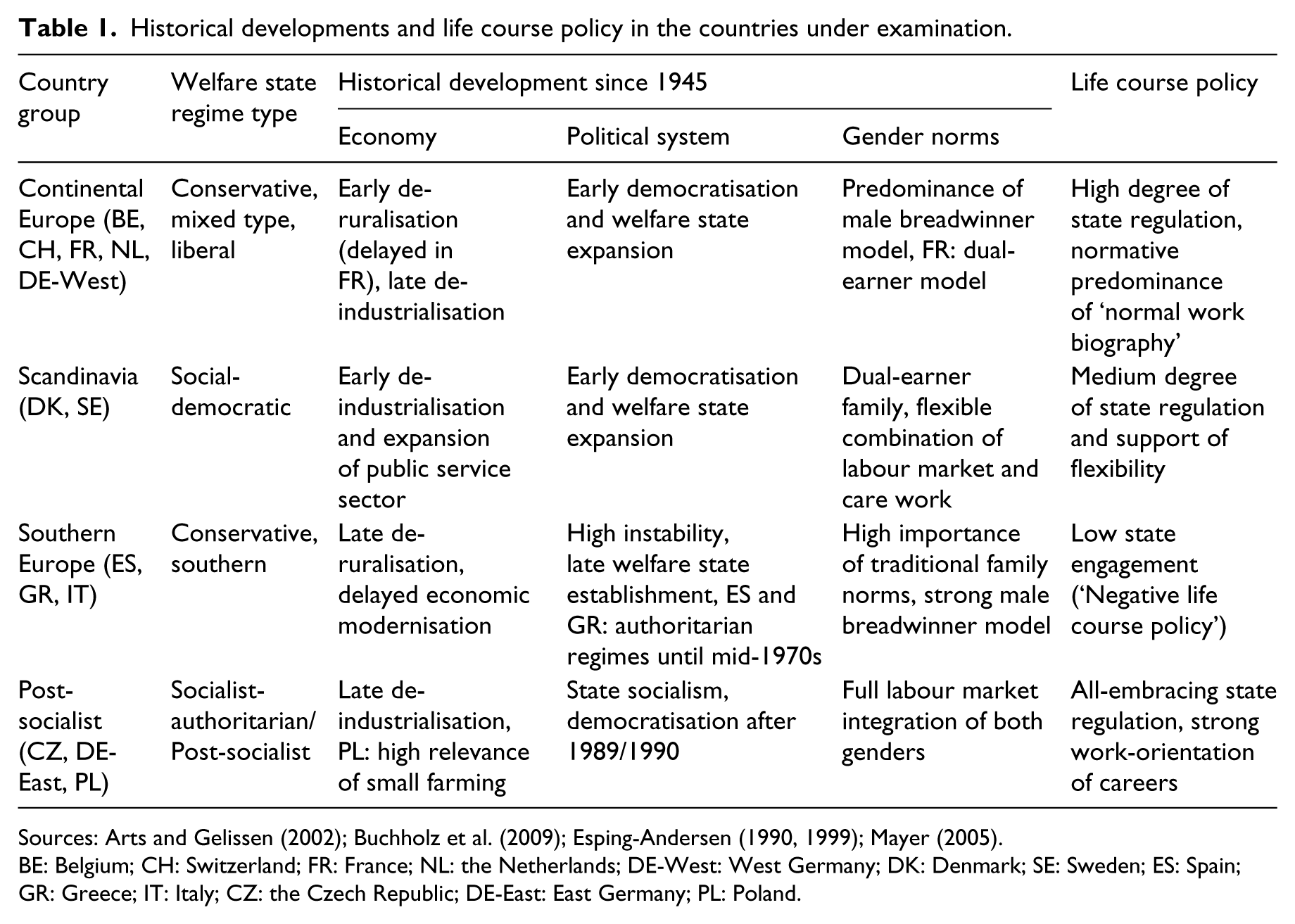
Sources: Arts and Gelissen (2002); Buchholz et al. (2009); Esping-Andersen (1990, 1999); Mayer (2005).
BE: Belgium; CH: Switzerland; FR: France; NL: the Netherlands; DE-West: West Germany; DK: Denmark; SE: Sweden; ES: Spain; GR: Greece; IT: Italy; CZ: the Czech Republic; DE-East: East Germany; PL: Poland.
Continental European countries
In Continental European countries, described as ‘Conservative’ welfare states by Esping-Andersen (1990), social insurances are the dominant mode and the ‘normal work biography’ is the prevailing normative basis of governmental social policy. 1 Here, social security systems link the provision of benefits to (previous) achievements on the labour market. Governmental regulation is extensive and benefits are generous, albeit mostly restricted to the group of labour market insiders in regular full-time employment (Esping-Andersen, 1990). Furthermore, the educational and vocational training system, the labour market and the pension system are closely linked, and therefore, inequalities are reproduced over the life course (Allmendinger and Hinz, 1998). Previous empirical results on social mobility fit this picture. Careers in West Germany, for example, are characterised by a high stability and persistent social stratification (Hillmert, 2011).
One reason for this is the stable political and economic development since the Second World War in Continental Europe as compared to other European countries. Consistent economic growth and strong industrial development were accompanied by the expansion of the welfare state and social security provision. As outlined previously, this development was somewhat delayed in France, where a comprehensive social security system was established in the late 1960s. In Belgium, the economic development was rather poor in the post-war decades due to a lack of modernisation in the industrial sector (Buchanan, 2006).
Regarding the predominant gender role regime, some variation exists within the group of Continental countries. The male breadwinner model is especially pronounced in West Germany, Switzerland and Austria. Here, gendered ‘normal biographies’ build the normative basis of social policy. Mothers typically reduce or terminate their labour market engagement. Female labour force participation has been very low also in the Netherlands until the mid-1980s, afterwards maternal part-time work became common (Hofäcker et al., 2013; Visser, 2002). France is closer to a dual-earner model than other Continental European countries, as many mothers work full-time (Anxo et al., 2006).
Against the background of these characteristics and developments, I assume that the Continental countries in the SHARELIFE-sample (Austria, Belgium, France, West Germany, the Netherlands and Switzerland) are marked by a high standardisation of employment histories towards the ‘normal work biography’. Furthermore, I expect to find pronounced gender inequality of employment histories with homogenously stable careers for men and frequent changes between paid work and unpaid care work as well as a high prevalence of part-time employment for women. However, due to the previously described inconsistent results regarding the economic development and the predominant gender regime, I also assume that the Conservative country group is highly diverse and does not constitute one unique life course regime type.
Scandinavian countries
The Scandinavian countries are described as ‘Social-democratic’ welfare states where high levels of de-commodification and low stratification are achieved through generous universal social security (Esping-Andersen, 1990). The social-democratic welfare regime is marked by a strong egalitarianism which is achieved through social security benefits based on citizenship, low stratification in the educational system and the prevalence of a dual-earner model. The high degree of gender equality is based on generous public childcare, individual taxation and high female employment in the expanding public service sector (Esping-Andersen, 1999; Mayer, 2005). Previous empirical results on employment histories and gender relations in the Scandinavian countries are largely consistent with its social policy structure (Anxo et al., 2006).
The economic development of the Scandinavian countries since the Second World War was stable. In Sweden, early welfare state expansion went along with strong economic development based on high technological investment and a protected domestic market. Economic recovery was more burdensome in Denmark, which however regained its strength also due to US recovery payments (Buchanan, 2006). Besides these differences, one major common feature of social-democratic welfare states is the high social consensus which manifests itself in a close cooperation between social partners. Furthermore, flexible labour markets and relatively weak job protection are combined with generous welfare benefits (Esping-Andersen, 1999; Mayer, 2005).
Taking these characteristics together, I assume that the employment careers in the Scandinavian countries included in the SHARELIFE-sample (Denmark and Sweden) are more work-oriented, and at the same time more flexible for both genders, than in other countries. Furthermore, the diversity will be much lower than within the Continental European group.
Southern European countries
The countries of Southern Europe are characterised by ‘a low degree of state penetration of the welfare sphere’ (Ferrera, 1996: 30) and a high relevance of the family as provider of social welfare (Esping-Andersen, 1990, 1999; Ferrera, 1996; Mayer, 2001). The lack of governmental action with regard to social security shapes individual lives in the sense of a ‘negative life course policy’ (Leisering, 2003: 210). This is further enforced by the late economic modernisation and the instability of the political system – especially in Greece and Spain, where the post-war decades were marked by authoritarian leaderships and civil wars. Although Italy was politically more stable, social reforms were largely neglected in the post-war decades (Buchanan, 2006). The segmentation of the labour force is even more pronounced than in the Conservative welfare regime and social mobility is very low. In a micro-level study, Barone et al. (2011) report high career stability for Italy with little modification of the initial occupational status throughout careers. In previous research, the strong familialism and the predominance of traditional gender norms in the Southern European countries are frequently highlighted, which lead to a high gender stratification (Ferrera, 1996; Mayer, 2001). Esping-Andersen (1999) denotes that ‘[f]amilies in Continental and especially in Southern Europe must absorb the social risks that, in Scandinavia, are collectivised by the welfare state’ (p. 141). The persistence of traditional norms is driven and further reinforced by the cultural dominance of the Catholic and the Orthodox Church.
Taking these characteristics and developments into account, I assume that individual life courses in Southern countries in the SHARELIFE-sample (Greece, Italy and Spain) are less regulated by governmental institutions than in other European countries. Therefore, employment histories are not dominated by regular employment but by self-employment in subsistence farming or by family care. Furthermore, the strong labour market segmentation should result in a dualisation of careers. Due to the predominance of traditional gender roles and the insignificance of service sector employment, I expect that gender differences in employment histories will be more pronounced in the Southern European countries than anywhere else.
Post-Socialist countries
Research on individuals’ life courses and employment in the Post-Socialist countries of Central and Eastern Europe is rare due to the lack of reliable individual-level data sources. In comparative micro-level studies, Eastern European countries are frequently summarised as one unique ‘Post-Socialist’ country group (Buchholz et al., 2009). 2 This seems to be justified as State Socialism was associated with a uniform work regime: working was virtually obligatory due to a policy of full employment and the incorporation of the social infrastructure into the workplace. This resulted in a strong governmental imprinting of individual life courses. Employment histories were characterised by standard full-time working arrangements with life-long attachments to one employer.
Generally, the economy of the socialist countries considered in this study remained largely industrial throughout the 20th century. The service sector was underdeveloped; self-employment and entrepreneurship were virtually non-existent. However, considerable cross-national variation regarding the economic development and labour market structure existed. In Poland, self-employment in the agricultural sector remained relatively high during socialist times; here, 14.2 percent of the labour force was self-employed in the 1980s compared to only 0.1 percent in Czechoslovakia (Drobnič, 1997).
Female labour market attachment was high in socialist countries. The ‘dual-earner model’ was promoted by the state through extensive public childcare and generous family benefits (Hofäcker et al., 2013; Mach et al., 1994). Mothers interrupted employment typically only for a short period of several months and then returned to full-time work (Blossfeld and Drobnič, 2001). However, previous studies on Post-Socialist countries also report ambiguous results and point out country differences. Mach et al. (1994) find more frequent job changes for Polish men and women under State Socialism than for their West German counterparts. 3 Also female labour market attachment was not uniformly high. Again, Poland deviates from the socialist dual-earner model, as here the proportion of married women exiting employment was higher than elsewhere (Drobnič, 1997).
Based on these explanations, it has to be assumed that the employment histories of men and women in the three former socialist countries in the SHARELIFE-sample (Czech Republic, German Democratic Republic/East Germany and Poland) will generally be more dominated by work and more homogenous, and gender inequality will be lower than in the other countries. However, due to their divergent developments, the countries will not display a uniform picture. The ideal-typical socialist model will be most prevalent in the Czech Republic due to the highly developed industry, while employment histories in Poland are expected to deviate from this pattern, especially regarding high levels of self-employment, mainly in the farming sector, and lower female labour market participation.
Data and methods
Data and sample
Data are provided by the SHARE (Börsch-Supan et al., 2013; Börsch-Supan, 2010; Schröder, 2011). The third wave ‘SHARELIFE’, conducted in 2008/2009, includes unique biographical data of older individuals in the 14 European countries described earlier. The employment biography information is retrospective, starting with the first job after leaving school. I include employment histories of 12,680 respondents from the ages of 20 through 65 years. The sample consists of respondents of the birth cohorts 1908 to 1944, with the majority born between 1925 and 1943. 4 Hence, their employment histories cover mainly the period of 1945 to 2009. Appendix 1 Table 3 provides an overview of the sample structure in each of the countries. Problems of recall error may impact the retrospective biography information towards an underestimation of inconsistencies and changes between different labour market statuses. However, the SHARELIFE survey applied several tools to enhance the biographical memory of the respondents (Schröder, 2011).
Methods and operationalisation
The empirical analysis proceeds in two steps: first, indicators summarising the individual employment histories are generated using sequence analysis, and second, a country grouping is generated with a cluster analysis on the basis of these indicators. Sequence analysis subsumes a set of techniques which provide a holistic view on complete biographies and allow for the identification of typical patterns (Abbott and Forrest, 1986; Brzinsky-Fay et al., 2006; Sackmann and Wingens, 2003). A sequence is defined as an ordered list of successive episodes consisting of distinct elements. With regard to employment histories, these elements refer to different labour market statuses. In this analysis, the following statuses are distinguished: regular full-time employment, self-employment, atypical employment (part-time and fixed-term employment), inactivity (unemployment, retirement and other types of inactivity), and family care. By means of different sequence analysis techniques, three indicators are generated to identify typical patterns of employment histories in a country:
A measure of career standardisation is generated by means of an optimal matching procedure comparing every individual employment history against the ‘normal work biography’ of continuous full-time employment (see Appendix 2 for detailed information). The higher this measure is, the closer an individual employment history is to the ‘normal work biography’, that is, the higher the career standardisation.
The indicator of career volatility refers to the number of changes between different employment statuses. The more often a person switches between statuses (e.g. employment and family care), the higher is their career volatility.
The heterogeneity of careers is operationalised as the percentage of different employment histories in a country (Brzinsky-Fay et al., 2006; Simonson et al., 2011). Hence, higher values of this indicator reflect a greater diversity of careers in a country.
While the degree of heterogeneity is a country-level indicator per se, the measures of career standardisation and career volatility are generated at the individual-level and then aggregated to the country mean. The indicators are computed separately for men and women in order to account for gender differences. All values are z-standardised, and thus, represent the relative position within the group of men and women, respectively. Table 2 gives an overview of the country values for the three life course indicators, displaying the unstandardised values in parentheses.
Values of the employment history indicators and resulting life course regime clusters.

Source: Own estimations using SHARELIFE (Release 1).
CZ: the Czech Republic; DE-East: East Germany; DK: Denmark; SE: Sweden; AT: Austria; CH: Switzerland; DE-West: West Germany; NL: the Netherlands; BE: Belgium; FR: France; IT: Italy; PL: Poland; ES: Spain; GR: Greece.
All life course indicators z-standardised, non-standardised values in parentheses.
In a final step, a country grouping of life course regimes is generated by means of hierarchical cluster analysis using Ward’s linkage procedure. This method reduces the variance within clusters and tends to produce stable clusters (Uprichard and Byrne, 2011).
Results
Employment histories in country comparison
The scatter plots in Figure 1 show the z-standardised values of the three employment history indicators in country and gender comparison. The x-axis displays the value of the career standardisation indicator, the y-axis the value of the heterogeneity indicator, and the sizes of marker symbols indicate the average career volatility in a country. The degree of career standardisation varies largely between men and women in all countries. Women in the Czech Republic, East Germany, Denmark and Sweden show a high work-orientation over their careers. In contrast, the employment histories of women in Southern Europe and the Netherlands, on average, largely deviate from the pattern of continuous full-time employment. Countries like West Germany, Poland and Belgium lie in between these extremes. For men, low career standardisation exists in Greece, Italy and Poland, whereas the biographies of men in the Czech Republic, East and West Germany, Switzerland and Sweden are close to the pattern of continuous full-time employment.
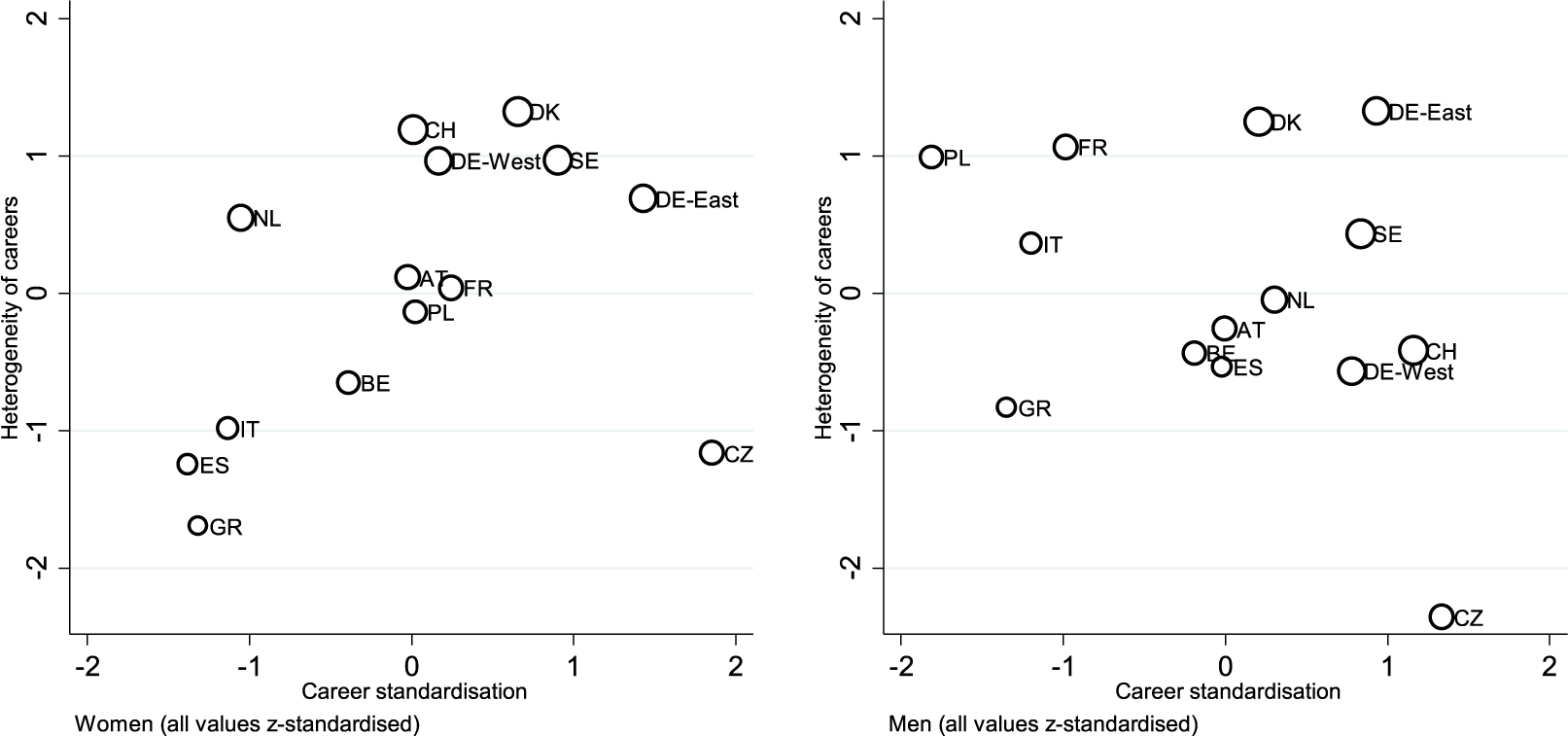
Scatter plots of the employment history indicators (women left, men right); Career volatility is represented by the size of the hollow scatter points.
Only in a few countries, such as the Czech Republic, East Germany and Sweden, are the relative degrees of career standardisation of men and women similar, while the majority of countries display substantial gender inequality. Men’s employment histories are more homogenous and more oriented towards continuous full-time employment. Only in France and Poland, do women (relative to women elsewhere) perform better in terms of labour market integration than men (relative to men elsewhere).
Also regarding the heterogeneity of careers, I find large cross-national variation. For women, the relationship between heterogeneity and career standardisation is almost linear. In Sweden and Denmark, a high average labour market inclusion of women goes along with a high heterogeneity of careers. In contrast, both indicators in Greece and Spain exhibit low levels. Only the Czech Republic and the Netherlands deviate from this pattern, with the former showing an exceptionally high standardisation and at the same time high homogeneity of female’s careers, while the latter is characterised by a combination of high heterogeneity and rather low standardisation.
Life course regime typology
To group the countries according to the predominant life course patterns, the indicators of career standardisation, career volatility and heterogeneity of employment histories, as described in section ‘Methods and operationalisation’, are included (separately for both genders) in a hierarchical Ward’s linkage cluster analysis (see Table 2). As a result, five clusters of countries are identified: 5
Homogenous high standardisation: Czech Republic
Flexible standardisation: Denmark, East Germany, Sweden
Gendered high standardisation: Austria, the Netherlands, Switzerland, West Germany
Heterogeneous medium standardisation: Belgium, France, Italy, Poland
Gendered low standardisation: Greece, Spain
The map depicted in Figure 2 gives an overview of the life course regimes clusters. Additionally, Figure A.2 in the Online Appendix shows the employment history patterns of men and women for each cluster using sequence index plots.

‘Life course regime’ typology resulting from the sequence and cluster analysis of individual employment histories.
The Czech Republic constitutes the single-case cluster of homogenous high standardisation because continuous full-time employment over the whole career is the predominant pattern for both genders. Employment histories are highly homogenous and stable. A second, similar cluster of life course patterns with flexible standardisation of careers is formed by Denmark, East Germany and Sweden. Individuals in these countries exhibit very high labour market integration over their biographies. At the same time, high levels of career volatility and heterogeneity of employment histories exist. Thus, despite the generally high labour market integration, individuals change labour market statuses more often and employment histories are more diverse than elsewhere. Furthermore, like in the Czech Republic, the biographies are characterised by high gender equality.
The third cluster of gendered high standardisation comprises Austria, the Netherlands, Switzerland and West Germany. These countries show pronounced gender differences. While men’s employment histories are highly standardised towards continuous full-time employment, women’s careers are more diverse with a medium level of career standardisation and high shares of part-time employment. However, women often do not completely withdraw from the labour market but re-enter after a period of family care, which is mirrored in their relatively high career volatility, or supplement the family income by means of part-time work.
The cluster of medium standardisation includes Belgium, France, Italy and Poland. Here, both genders show medium to low levels of career standardisation. Compared to their counterparts in the gendered high standardisation cluster, men in these countries have more flexible and heterogeneous careers. In contrast, women have slightly less volatile employment histories, that is, they change less often between labour market participation and family care than their counterparts in the second cluster. Rather, a polarisation between working women and those who are constantly involved in family care exists (see Figure A.2 in the Online Appendix).
The Southern European countries of Greece and Spain form the cluster of gendered low standardisation. Here exists a pronounced labour market segmentation with a minority in continuous regular employment, while career standardisation on the average is very low. Self-employment plays an important role; women are mainly engaged in family care and men have high shares of inactivity. Furthermore, the employment histories are very stable and homogenous, mostly with maintenance of the initial labour market placement over the whole career. This especially applies to women, who exhibit even lower levels of volatility than men.
Discussion and conclusion
Summary and discussion of results
In this analysis, a country grouping of life course regimes in Europe was developed taking individual employment histories, which cover a time span from 1945 to 2009, as the basis. Rather than being consistent with common welfare state typologies, the life course regime typology mirrors long-term economic and political developments. Furthermore, differences within welfare state regime types become clear.
The Southern European countries either belong to the cluster of medium standardisation (Italy) or to the cluster of gendered low standardisation (Greece and Spain). Employment histories in the latter two countries strongly deviate from the ‘normal work biography’. This mirrors the high political and institutional instability, the large absence of a public social infrastructure and the delayed economic modernisation. However, contrary to their counterparts in Greece and Spain, Italian women exhibit a higher labour market attachment and more flexible careers.
The Continental European countries show a high diversity of employment history patterns, and thus, belong to different life course regime clusters. Austria, West Germany, the Netherlands and Switzerland are part of the group of countries with highly standardised and gender-differentiated employment histories. In contrast, Belgium, France and Italy belong to the medium standardised group, where also men’s employment histories are more fragile and less oriented towards regular full-time employment. This result is due to the more instable economic development and partly delayed industrial modernisation in these three countries compared to the other Continental European states (Buchanan, 2006). Another reason for the diversity within the Continental country group are differences in the predominant gender role models; with the male breadwinner model being valid in the gendered high standardisation countries, while women are more work-oriented in the medium standardisation countries.
The Social-democratic countries of Denmark and Sweden are in the cluster of flexible standardisation. Individuals in these countries reach higher labour market integration than elsewhere but also have more flexible and heterogeneous careers. This result is in line with Esping-Andersen (1990), who describes the social security arrangements of Social-democratic welfare states as a combination of generous public benefits and flexible regulations. Likewise, the normative orientation of the Social-democratic welfare states towards the dual-earner model is reflected in the rather low gender inequality of careers. East Germany also fits into this cluster due to the high work-orientation of both genders but more diverse and volatile careers than in the Czech Republic.
I find diverse patterns of life courses in the three Post-Socialist countries included in the sample. The assignment of all former socialist countries into one unique ‘Post-Socialist’ group neglects these within-group differences. While the Czech Republic and East Germany are rather similar, Poland clearly deviates from the socialist pattern of generally highly standardised employment histories. Here, lower labour market attachment of both genders, fragmented careers also among men and a high share of self-employment exist. The variance within the post-socialist country group reflects divergent historical developments, which also led to differences in the economic progress during State Socialism. While in Poland the industrialisation process proceeded rather slowly and the agricultural sector was dominant, the Czech Republic had a long-standing tradition of highly developed industrial production (Buchanan, 2006). Likewise, the employment histories in post-war Poland are characterised by a high share of self-employment – presumably small-scale farming – as well as generally more fragmented careers. Life courses in the Czech Republic, on the other hand, largely follow the highly standardised, centrally controlled and work-oriented socialist regime. East Germany lies in between these extremes with more flexible careers; this to some extent reflects the approximation to the Western German system after reunification.
Conclusion and implications
In a nutshell, I find that the empirically derived country grouping of life course regimes corresponds with long-term historical developments in the countries examined, while not being consistent with welfare state typologies. Especially stratified economic modernisation processes and normative orientations of governmental life course policy become visible in the structure of individual employment histories. The fact that the life course regimes deviate from common welfare state typologies can be interpreted in two ways. First, it is a sign that the latter provide a rather static view on social policy because they neglect long-term historical developments, especially regarding the early welfare state expansion phase in the post-war decades. Second, it demonstrates that individual behaviour and biographies show much more diverse patterns than a policy-oriented typology can encompass. Therefore, in the sense of Titmuss (1974), social policy analysis and welfare state modelling needs to further incorporate the dimension of policy outcomes regarding their impact on individuals’ lives. Additionally, further research in the field of welfare regime modelling and social policy analysis should pay attention to the historical development of welfare states.
The analysis also gives rise to wider social policy implications. It shows that the link between governmental life course policy and individual lives is ambiguous. On one hand, extensive state regulation may limit individuals’ possibilities since it standardises careers according to normative patterns as the ‘normal work biography’. On the other hand, the provision of income security and social services also releases individuals from market forces and care responsibilities, and thus, enables them to be more flexible in their career choices. This becomes clear with respect to gender inequality: the study demonstrates that both a lack of welfare state intervention and economic development, as in the gendered low standardisation cluster, and an overly strict regulation and normative modelling, as in the gendered high standardisation cluster, produce adverse effects as both exhibit high levels of gender inequality. In contrast, a well-developed welfare state, which underpins individual flexibility rather than standardising careers, leads to less inequality as well as generally more work-oriented life courses.
Footnotes
Appendix 1
Overview of the sample structure in the countries under examination.

| Country | N | Mean birth year | Percentage of |
||||
|---|---|---|---|---|---|---|---|
| Men | Married | Low education level | Medium education level | High education level | |||
| AT | 456 | 1934.8 | 47 | 52 | 37 | 44 | 19 |
| BE | 1264 | 1933.9 | 50 | 67 | 52 | 21 | 27 |
| CH | 578 | 1934.2 | 51 | 63 | 38 | 54 | 8 |
| CZ | 929 | 1935.5 | 41 | 58 | 45 | 41 | 13 |
| DE-East | 235 | 1935.3 | 39 | 62 | 17 | 53 | 30 |
| DE-West | 685 | 1935.2 | 52 | 63 | 22 | 54 | 24 |
| DK | 933 | 1934.8 | 47 | 60 | 28 | 42 | 30 |
| ES | 1009 | 1933.6 | 50 | 69 | 89 | 5 | 6 |
| FR | 1124 | 1933.4 | 45 | 61 | 59 | 23 | 18 |
| GR | 1300 | 1934.7 | 47 | 65 | 76 | 17 | 8 |
| IT | 1378 | 1933.9 | 44 | 66 | 83 | 13 | 4 |
| NL | 863 | 1934.7 | 53 | 62 | 57 | 24 | 19 |
| PL | 805 | 1934.1 | 38 | 56 | 69 | 26 | 5 |
| SE | 1121 | 1934.1 | 46 | 62 | 58 | 22 | 20 |
AT: Austria; BE: Belgium; CH: Switzerland; CZ: the Czech Republic; DE-East: East Germany; DE-West: West Germany; DK: Denmark; ES: Spain; FR: France; GR: Greece; IT: Italy; NL: the Netherlands; PL: Poland; SE: Sweden.
Appendix 2
Acknowledgements
I am grateful to Anita Kottwitz, Peter Krause, Mandi Larsen, Herbert Obinger, Patrick Sachweh, Simone Scherger, Frank Schulz-Nieswandt, Melike Wulfgram, and the anonymous reviewer for helpful comments on earlier versions of this article. Furthermore, the statistical estimations would not have been possible without the IT infrastructure during my research stay at the German Institute for Economic Research (DIW Berlin), as well as the support by the Collaborative Research Center 597 (University of Bremen) and the Research Training Group SOCLIFE (University of Cologne), both funded by Deutsche Forschungsgemeinschaft DFG. All remaining errors are mine.
Funding
The author(s) disclosed receipt of the following financial support for the research, authorship, and/or publication of this article: The author received financial support by the Deutsche Forschungsgemeinschaft DFG (SFB597, GRK1461). This paper uses data from SHARE Wave 3 (SHARELIFE) (DOI: 10.6103/SHARE.w3.100), see Börsch-Supan et al. (2013) for methodological details. The SHARE data collection has been primarily funded by the European Commission through FP5 (QLK6-CT-2001-00360), FP6 (SHARE-I3: RII-CT-2006-062193, COMPARE: CIT5-CT-2005-028857, SHARELIFE: CIT4-CT-2006-028812) and FP7 (SHARE-PREP: N°211909, SHARE-LEAP: N°227822, SHARE M4: N°261982). Additional funding from the German Ministry of Education and Research, the U.S. National Institute on Aging (U01_AG09740-13S2, P01_AG005842, P01_AG08291, P30_AG12815, R21_AG025169, Y1-AG-4553-01, IAG_BSR06-11, OGHA_04-064) and from various national funding sources is gratefully acknowledged (see  ).
).