



Abstract
The nature and tempo of Holocene climate variability is examined in the record of forest vegetation from western Mediterranean marine core MD95-2043. Episodes of forest decline occurred at 10.1, 9.2, 8.3, 7.4, 5.4–4.5 and 3.7–2.9 cal. ka BP, and between 1.9 cal. ka BP and the top of the record (1.3 cal. ka BP). Wavelet analysis confirms a ~900 yr periodicity prior to and during the early Holocene and the dominance of a ~1750 yr periodicity after 6 cal. ka BP. The ~900 yr periodicity has counterparts in numerous North Atlantic and Northern Hemisphere palaeoclimate records, and in solar irradiance proxies (Δ14C and 10Be), and may relate to a Sun–climate connection during the early Holocene. Comparisons between the MD95-2043 forest record and strategically located records from Morocco, Iceland, Norway and Israel suggest that the ~1750 yr mid- to late-Holocene oscillation reflects shifts between a prevailing strong and weak state of the zonal flow, with impacts similar to the positive and negative modes of the present-day North Atlantic Oscillation (NAO). The mid- to late-Holocene millennial oscillation in zonal flow appears closely coupled to North Atlantic surface ocean circulation dynamics, and may have been driven by an internal oscillation in deep-water convection strength. The findings suggest that the mid-Holocene transition in western Mediterranean climate was accompanied by a shift in the fundamental tempo of millennial-scale variability, reflecting contrasting sensitivity of the North Atlantic climate system to different forcing factors (solar versus oceanic) under deglacial and fully interglacial conditions.
Keywords
Introduction
While it is now well-established that the current interglacial period, the Holocene (11.6 cal. ka BP to present), has been characterized by pervasive millennial-scale climate variability and abrupt climate changes (Mayewski et al., 2004; Wanner et al., 2008), the spatiotemporal patterns and underlying mechanisms of this variability remain unclear. In the subpolar North Atlantic, palaeoceanographic records reveal millennial-scale variability in ocean surface temperatures (Bond et al., 2001; Came et al., 2007) and in the dynamics of surface and deepwater components of the Atlantic meridional overturning circulation (AMOC) (Bianchi and McCave, 1999; Giraudeau et al., 2010; Oppo et al., 2003; Thornalley et al., 2009). High-latitude North Atlantic terrestrial records indicate significant millennial-scale variability in temperature, precipitation and wind patterns (Allen et al., 2007; Bakke et al., 2008; Bjune et al., 2005; Jackson et al., 2005). In a recent study, Giraudeau et al. (2010) highlight striking similarities between the oceanic and terrestrial records during the mid to late Holocene and suggest that coupled ocean–atmosphere changes in the subpolar North Atlantic were driven by shifts in the strength and position of the winter storm track similar to present-day changes in the mode of the North Atlantic Oscillation (NAO). However, in order to test whether these high-latitude Atlantic patterns were related to NAO-like variability, it is critical to examine palaeoclimate data from other regions sensitive to NAO impacts, notably the western Mediterranean (Trigo et al., 2004).
One of the intriguing features of the northern North Atlantic records is that millennial-scale variability is particularly evident during the mid to late Holocene despite the absence of forcing by ice-sheet disintegration and meltwater surges implicated in early-Holocene events (e.g. Clark et al., 2001). A range of other forcings have been proposed to account for millennial-scale climate anomalies, such as solar irradiance changes (Bond et al., 2001), lunar-tidal cycles (Keeling and Whorf, 2000) and internal oceanic oscillations, perhaps related to the operation of a weak Holocene bipolar see-saw (Denton and Broecker, 2008) or to inherent instabilities in deepwater formation (Schulz et al., 2007). Recent studies using wavelet analysis, a technique suitable for the detection of periodic components and, critically, for changes in the periodic components over time, furthermore suggest that the fundamental tempo of climatic variability changed during the mid Holocene (Debret et al., 2007, 2009). In the North Atlantic region, this change is marked by the emergence of a low-frequency millennial oscillation of 1600–1800 yr after 6 ka in several records of atmospheric and oceanic conditions (Debret et al., 2007, 2009). However, the precise climatic significance, underlying mechanisms and spatial impact of this oscillation are not fully constrained. Moreover, while there is now a wealth of recent data to support both a mid-Holocene transition in long-term climate state in the western Mediterranean (e.g. Carrión et al., 2010; Magny et al., 2011; Roberts et al., 2011), and significant shifts in hydrological regime during the late Holocene (notably in high-resolution lake and marine records, e.g. Magny et al., 2007b, 2009; Martín-Puertas et al., 2008, 2010; Nieto-Moreno et al., 2011; Rodrigo-Gámiz et al., 2011), there is as yet little evidence to suggest a mid-Holocene shift in the tempo of Mediterranean climatic variability, and relatively few high-resolution records in which this phenomenon can be evaluated.
Here we examine the Holocene pollen record of forest vegetation preserved in a marine sediment core (MD95-2043) from the westernmost Mediterranean Sea (Figure 1), in a location ideal for testing the role of past changes in the westerlies and the NAO implicated in the subpolar North Atlantic records. We use wavelet analysis of the forest record to test for a mid-Holocene shift in the tempo of western Mediterranean climate variability. Recent studies have shown that the past dynamics of Mediterranean forest vegetation provide a remarkably sensitive indicator of changes in atmospheric conditions linked to North Atlantic variability, including millennial-scale (Dansgaard-Oeschger and Heinrich) variability of the last glacial period (reviewed in Fletcher et al., 2010a), and multicentennial-scale variability of the last deglaciation and early Holocene (Combourieu Nebout et al., 2009; Fletcher et al., 2010b; Pross et al., 2009). However, few studies have explored Holocene Mediterranean vegetation records in order to examine explicitly the nature and tempo of mid- to late-Holocene climate variability, or to test for past activity of a NAO-like pattern. While a number of studies have pointed to NAO influence on Mediterranean palaeoclimate (e.g. Lamy et al., 2006; Magny et al., 2009; Roberts et al., 2012), there is as yet little consensus on the preferred timescales of related variability.
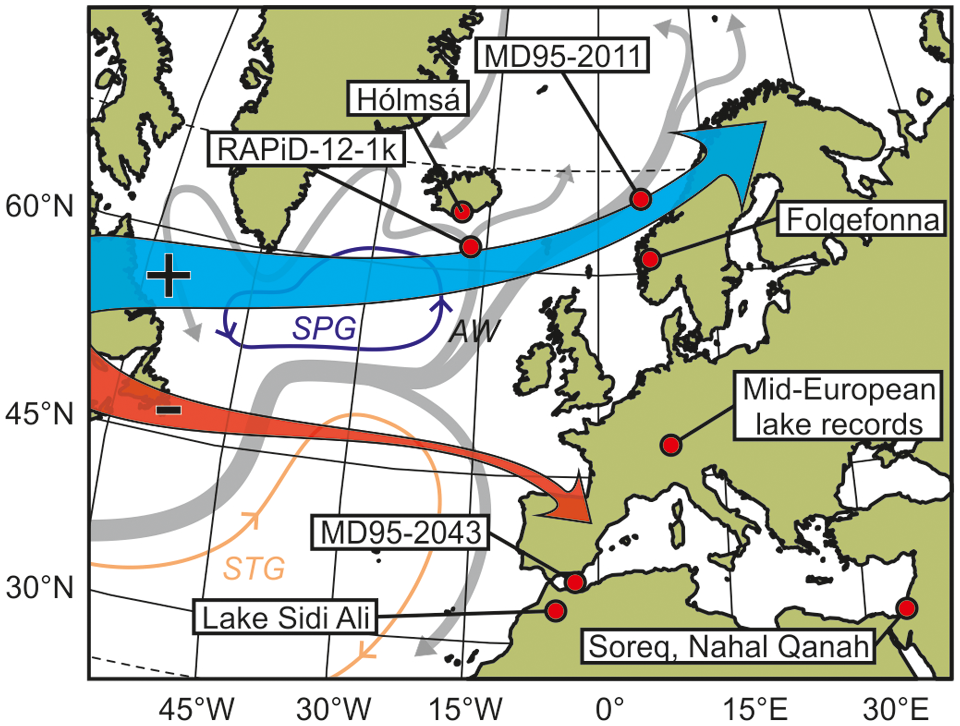
Location of core MD95-2043 (36°9′N, 2°37′W, 1841 m water depth) and other records plotted in Figures 4–7. The general trajectory of the atmospheric westerlies is shown for an intensified (+) and weakened state (−) as associated at present with the positive and negative modes, respectively, of the North Atlantic Oscillation. Grey arrows indicate the major North Atlantic surface currents defining the subtropical gyre (STG), subpolar gyre (SPG) and Atlantic water (AW) inflow into the Nordic Seas.
Material and methods
The MD95-2043 sequence is characterized by continuous deposition of hemipelagic muds and high sedimentation rates throughout the Holocene (30–80 cm/ka). The Holocene timescale is constrained by nine AMS radiocarbon dates on monospecific planktonic foraminiferal samples (Cacho et al., 1999). In order to identify millennial-scale changes, pollen analysis (Figure 2) was undertaken at 5 cm resolution following standard procedures for the extraction of pollen from marine sediments employed at the UMR EPOC, Bordeaux 1 University and described in Fletcher and Sánchez Goñi (2008), yielding an average temporal resolution of 110 yr for the Holocene (100 yr for the interval 11.7–4.3 cal. ka BP, and 150 yr for the interval 4.3–1.3 cal. ka BP). Pollen counts and a full taxon list are available on the Pangaea data base at doi:10.1594/PANGAEA.711649. Long-term trends reflected in the pollen zonation scheme are described in Fletcher and Sánchez Goñi (2008). Alboran sea surface temperature (SST) data derived from the UK'37 unsaturation index of alkenones from the same core is also shown (Cacho et al., 1999).
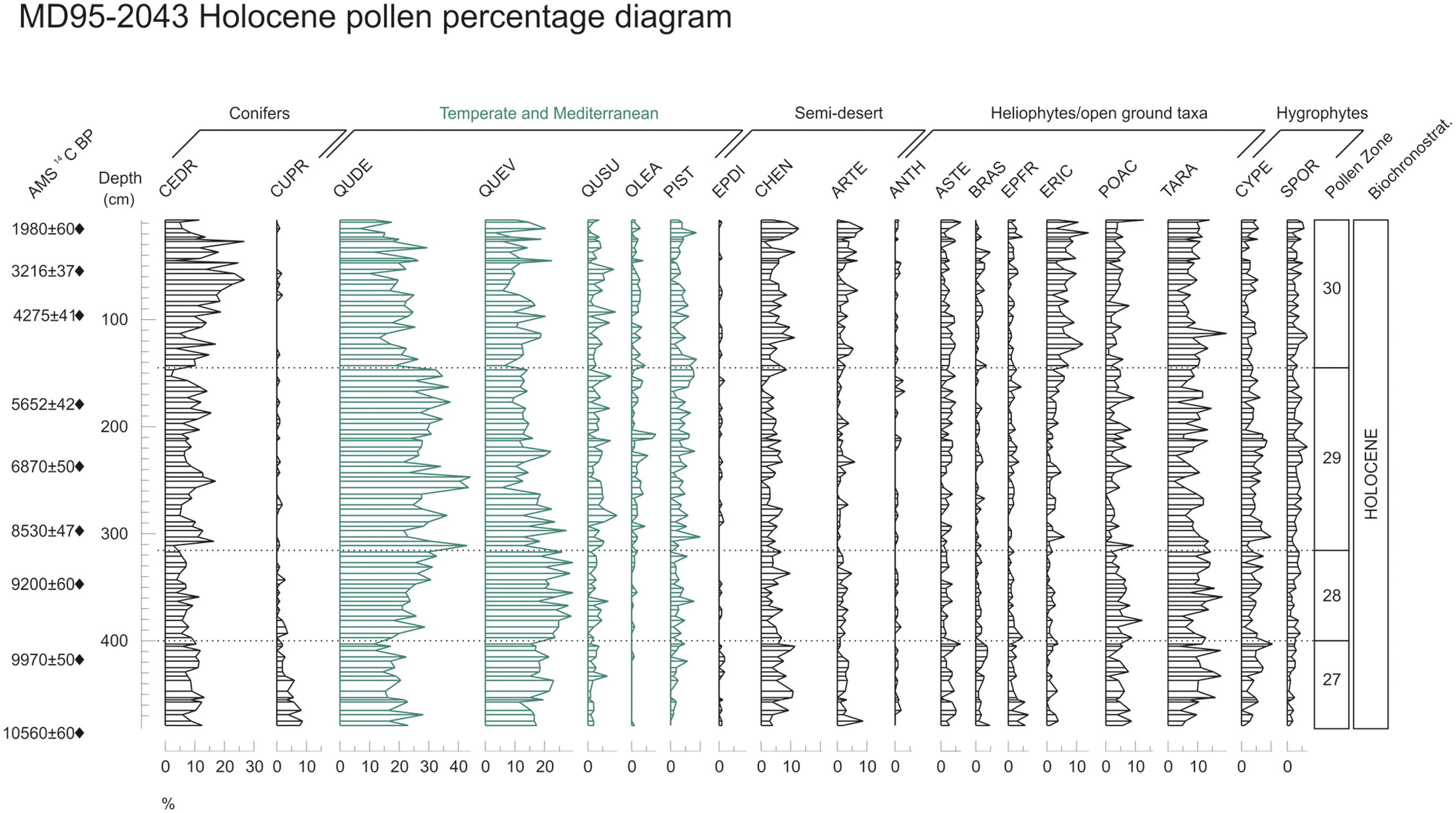
Pollen percentage data plotted against depth for major pollen taxa in marine core MD95-2043: Cedrus (CEDR), Cupressaceae (CUPR), Quercus deciduous type (QUDE), Quercus evergreen type (QUEV), Olea (OLEA), Pistacia (PIST), Ephedra distachya type (EPDI), Chenopodiaceae (CHEN), Artemisia (ARTE), Anthemis type (ANTH), Aster type (ASTE), Brassicaceae (BRAS), Ephedra fragilis type (EPFR), Ericaceae (ERIC), Poaceae (POAC), Taraxacum (TARA), Cyperaceae (CYPE) and fern spores (SPOR).
Wavelet analysis (WA) is a technique used for the identification of spectral signatures in palaeoclimate time series, with the particular advantage of describing non-stationarities, i.e. discontinuities and changes in frequency or magnitude (Torrence and Compo, 1998). Redundancy of the continuous wavelet transform is used to produce a time/frequency or time/scale mapping of a power distribution, called the local wavelet spectrum (or scalogram). In contrast to classical Fourier analysis, the local wavelet spectrum provides a direct visualization of the changing statistical properties in stochastic processes over time. Wavelet analysis was used in this study to detect periodic components in the pollen record. The pollen percentage data for temperate and Mediterranean forest taxa was detrended using a third order polynomial prior to wavelet analysis. This polynomial closely approximates the insolation curve shown in Figure 3, and detrending may represent, in effect, the removal of the long-term influence of declining summer insolation on forest development. Owing to the difficulty of detrending across the abrupt, step-like increase in temperate and Mediterranean forest taxa at 397 cm (10.6 cal. ka BP, base of pollen zone 28), only the interval 10.6 cal. ka BP to 1.3 cal. ka BP (top of record) was included in the analysis.
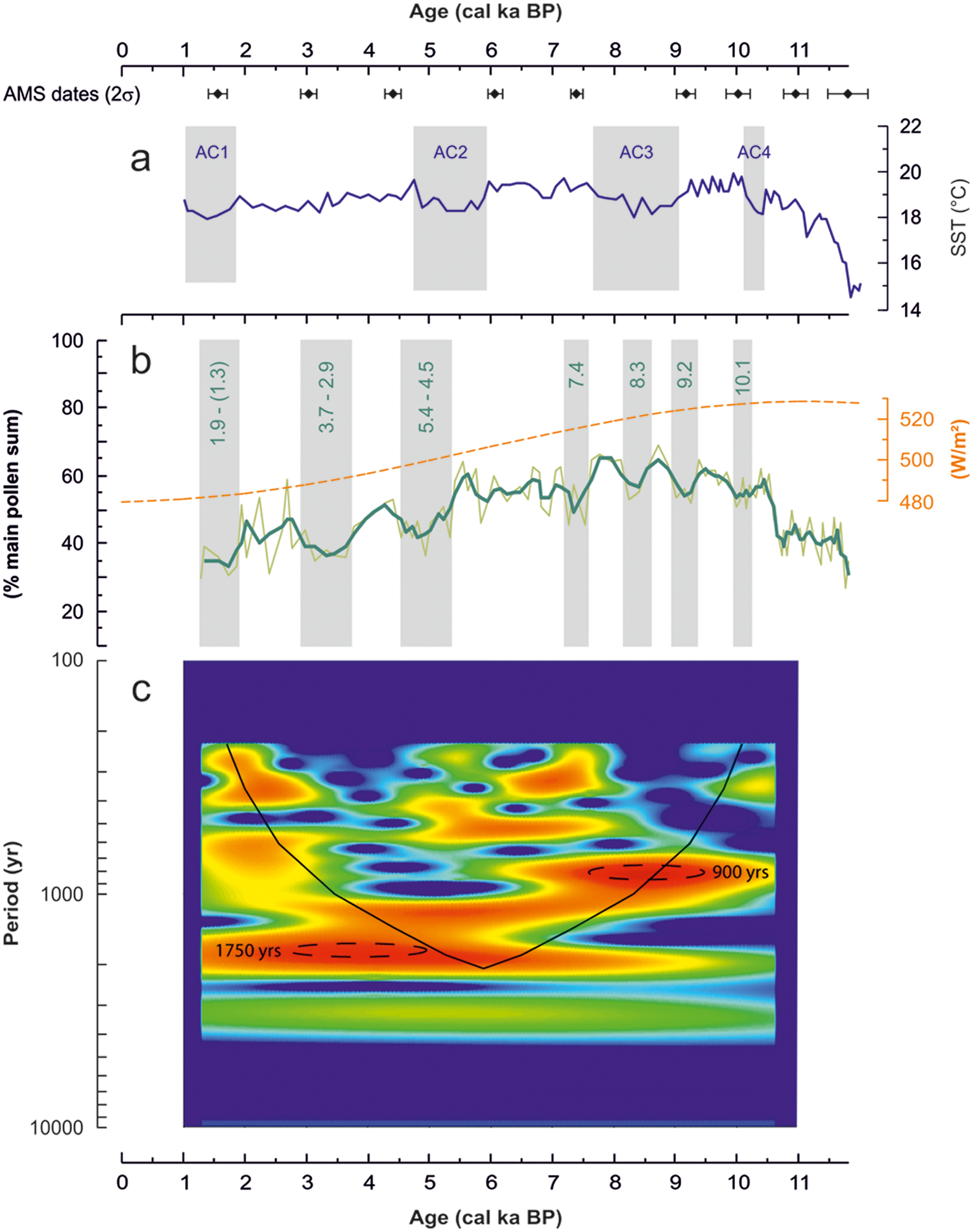
Holocene palaeoclimate records from core MD95-2043. (a) Alkenone sea surface temperature (SST) reconstruction; shading indicates Alboran Cooling (AC) events (Cacho et al., 2001). (b) Pollen record from core MD95-2043 for all temperate and Mediterranean forest taxa, with three-point running mean in bold. Shading indicates Holocene intervals of forest decline, with age estimates in cal. ka BP based on the AMS radiocarbon chronology. Summer insolation curve (June, 65°N) for comparison (Berger, 1978). (c) Wavelet spectrum of the MD95-2043 forest record. Black line indicates the cone of influence; dashed lines indicate the 95% confidence level.
Here, the Morlet wavelet (a Gaussian-modulated sin wave) was chosen for the continuous wavelet transform. The data series was zero-padded to twice the data length in order to avoid edge effects and spectral leakage produced by the finite length of the time series. Zero-padding causes the lowest frequencies near the edges of the spectrum to be underestimated as increasingly more zero values enter the series. The cone of influence delimits those parts of the spectrum where energy bands are likely to appear to be less powerful than they actually are because of the increasing importance of edge effects. The statistical significance of peaks in the local wavelet spectrum was assessed using a Monte Carlo simulation. Singular spectrum analysis was employed to estimate and separate background noise. Autoregressive modelling was used to determine the AR(1) stochastic process against which the initial time series was to be tested; AR(1) background noise could be either white (AR(1) ¼ 0) or red noise (AR(1)>0). By using wavelet reconstruction it is possible to reconstruct the signal in various spectral bands. In this way, we use it to reconstruct the millennial-scale component in the palaeoclimatic data.
Results and interpretation
The pollen record of temperate and Mediterranean forest vegetation, of which deciduous and evergreen Quercus (oaks) constitute the dominant elements, is shown in Figure 3b. Forest pollen percentages indicate a two-step increase in forest development with abrupt forest expansions at 11.7 and 10.6 cal. ka BP, and a long-term Holocene decline in forest levels from ~7.5 cal. ka BP which parallels the decrease of Northern Hemisphere summer insolation. Superimposed on the long-term trend are several multicentennial scale intervals of reduced forest pollen (Figure 3b, Table 1). Early-Holocene declines are centred at 10.1, 9.2, 8.3 and 7.4 cal. ka BP and mid- to late-Holocene intervals of reduced forest occurred at 5.4–4.5 cal. ka BP, 3.7–2.9 cal. ka BP and between 1.9 cal. ka BP and the top of the record (1.3 cal. ka BP).
Holocene forest declines in the MD95-2043 pollen record.
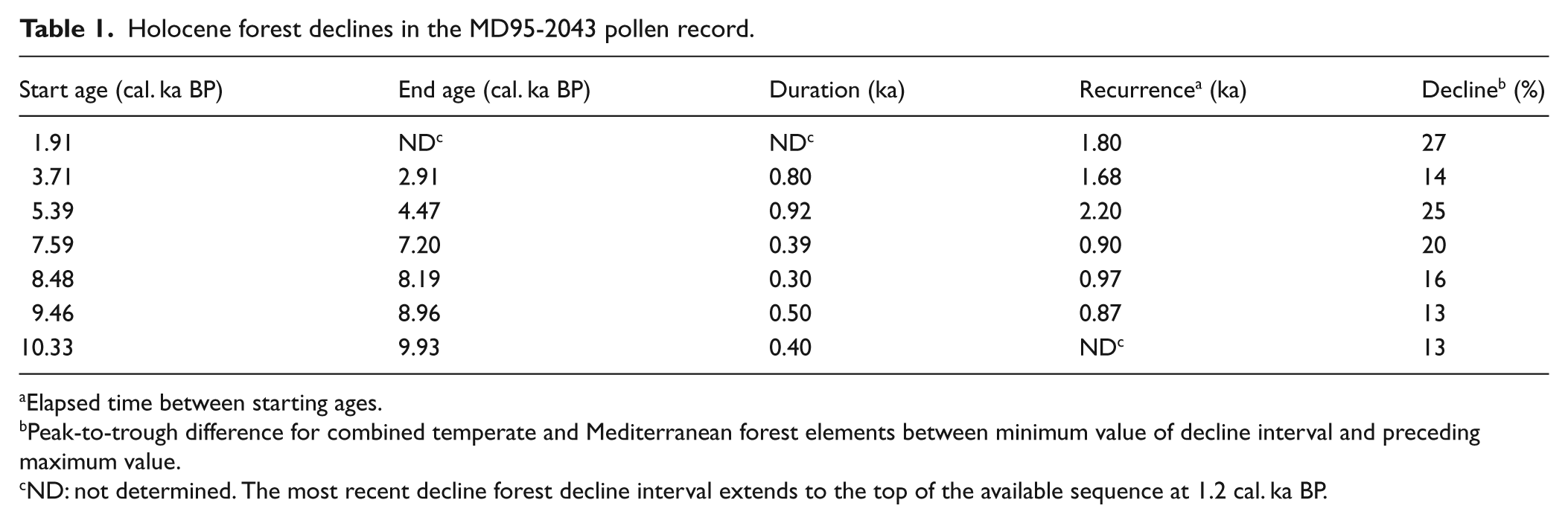
Elapsed time between starting ages.
Peak-to-trough difference for combined temperate and Mediterranean forest elements between minimum value of decline interval and preceding maximum value.
ND: not determined. The most recent decline forest decline interval extends to the top of the available sequence at 1.2 cal. ka BP.
The early-Holocene forest declines lasted approximately 400 yr (average duration, 390±80 yr) with an intervening recurrence interval of approximately 900 yr (average recurrence interval, 910±50 yr). The mid- to late-Holocene declines lasted approximately 900 yr (average duration, 860±80 yr), with a recurrence interval of approximately 1750 yr (average recurrence interval, 1740±80 yr). The amplitude of forest declines for mid- to late-Holocene episodes (reductions in forest pollen values of 14–27%) was as great or greater than that associated with early-Holocene fluctuations (reductions of 13–20%). Wavelet analysis of the detrended forest series highlights a mid-Holocene shift in periodicity, with the dominance of a submillennial oscillation of ~900 yr prior to 7 cal. ka BP and the dominance of a low frequency millennial oscillation of ~1750 yr from 6 cal. ka BP onwards (Figure 3c).
At present, the characteristic seasonality of the Mediterranean climate (warm, dry summers and mild, rainy winters) reflects the dominant summertime influence of subtropical climate dynamics related to the strengthening of the Azores high pressure system, and the dominant winter influence of North Atlantic climate dynamics including the NAO (Lionello et al., 2006). Precipitation in the study region is concentrated in the winter season, and is favoured by weakening and southward deviation of the westerlies (Figure 1), as typifies, for example, the negative phase of the NAO (Trigo et al., 2004). Recent work in remote sensing (Gouveia et al., 2008) points to a key cross-seasonal relationship in vegetation response to climate variability on annual timescales, whereby winter precipitation over the Iberian Peninsula provides a robust predictor for the vigour of forest growth (measured in terms of vegetation greenness) in the subsequent summer season. This relationship probably does not relate to direct hydric demands of arboreal vegetation during the rainy winter season, but rather to soil saturation and water availability for plant growth during the critical spring growth season and to moderation of the impacts of summer drought via recharging of the regional aquifer (Luque-Espinar et al., 2008). In this southern Mediterranean region, where temperature influences forest composition but moisture availability overall is critical for forest development (Quezel, 2002), variability in winter precipitation over longer timescales may be the primary signal recorded in periods of regional forest expansion or decline.
While high-amplitude fluctuations in forest pollen percentages are detected throughout the Holocene, Alboran sea surface temperatures (SSTs) in the same core display rather weak variability, particularly during the mid to late Holocene. Moderate cooling episodes with SST reductions of ~1°C (i.e. Alboran Cooling (AC) events of Cacho et al., 2001, which exceed the 1σ confidence interval of 0.15°C for temperature estimation) do not display a one-to-one match with forest decline events across the Holocene. Although previous work has proposed correlations between forest decline events and SST coolings at different locations in the Alboran region (Combourieu-Nebout et al., 2009), it is important to note that the evidence from direct (within-core) land–sea correlation suggests discrepancies between the SST and pollen records. These discrepancies are considered to relate to contrasting sensitivity to temperature versus precipitation signals in the alkenone versus vegetation records, respectively, and also to contrasting seasonal signals in the proxies (with alkenone SST biased towards the summer phytoplankton bloom season and the vegetation record biased towards winter season variability).
Discussion
Early-Holocene ~900 yr oscillation
The early-Holocene forest declines suggest episodes of drier atmospheric conditions in the western Mediterranean that are consistent in timing with high-latitude cooling events linked to meltwater pulse perturbation of the Atlantic meridional overturning circulation (AMOC), North Atlantic ice-rafting and regional atmospheric climate changes over Europe and Greenland (e.g. Boch et al., 2009; Bond et al., 2001; Lang et al., 2010; Magny et al., 2007a; Rasmussen et al., 2007). In this respect, the early-Holocene events follow a pattern similar to that established during the glacial period, associating aridity in the western Mediterranean with North Atlantic cooling. The early-Holocene forest declines reflect a ~900 yr oscillation in moisture supply to the western Mediterranean, which includes impacts in the Mediterranean region of the well-known ‘8.2 ka’ and ‘9.3 ka’ meltwater events (Alley and Agustdottir, 2005; Fleitman et al., 2008) but which also implies events at around 10.1 and 7.4 cal. ka BP. As eloquently demonstrated by Marchitto et al. (2010), early-Holocene climatic fluctuations can be clearly traced in North Atlantic ice-rafting, Asian monsoon and palaeo-ENSO (El Niño Southern Oscillation) climate records, implying strong atmospheric teleconnections across the Northern Hemisphere and tropics. Between 11 and 7 cal. ka BP, western Mediterranean dry episodes were coincident with weakened monsoon systems and El Niño-like conditions, while intervening intervals of forest expansion under humid conditions occurred in the context of North Atlantic warming, monsoon intensification and La Niña-like episodes.
Impacts of this atmospheric oscillation and associated atmosphere–ocean interactions may underline the widespread detection of similar periodicities in early-Holocene data sets from the circum-North Atlantic region. These include reported periodicities of 900 yr in Greenland temperatures (Schulz and Paul, 2002), 885 yr in marine tracers of shelf-water cascading, sea-ice formation and storminess in the Barents Sea (Sarnthein et al., 2003), 910 yr in lacustrine atmospheric temperature proxies in NE North America (Zhao et al., 2010), 940 yr in terrigeneous sediment supply to the NW African continental margin (Kuhlmann et al., 2004) and 900 yr in turbidite deposition on the W African margin (Zühlsdorff et al., 2008).
Mid- to late-Holocene ~1750 yr oscillation
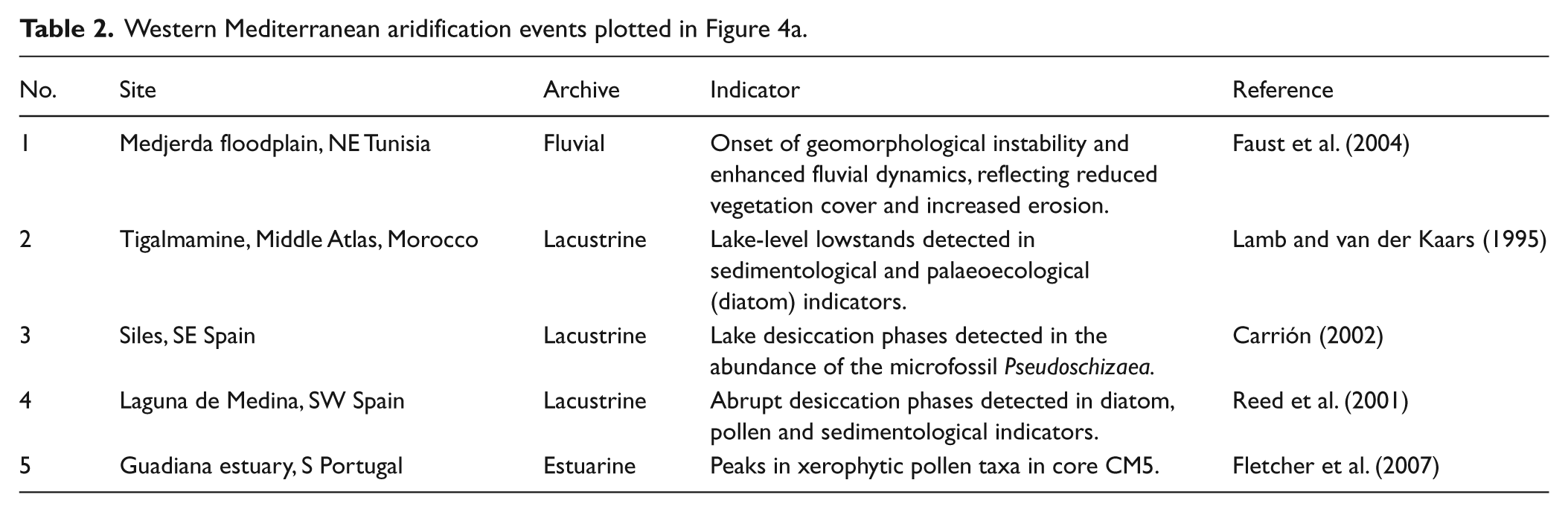
After 6 cal. ka BP, the duration and recurrence intervals of forest declines change, with a low frequency oscillation of ~1750 yr dominating the record. Despite chronological uncertainties related to the dating of lake, fluvial and estuarine sequences, the temporal clustering of mid- to late-Holocene aridification events in other regional records supports the interpretation of forest decline intervals after 6 cal. ka BP as dry episodes (Figure 4a, Table 2). In particular, the correspondence between forest decline events and lake aridification episodes at low- and mid-altitude (30–1600 m a.s.l.) sites such as Lakes Siles, Zoñar, Medina and Tigalmamine strongly supports the interpretation of recurrent dry atmospheric conditions, as these lake records are unlikely to be influenced directly by human activities or wind directions which might influence the composition of pollen spectra.
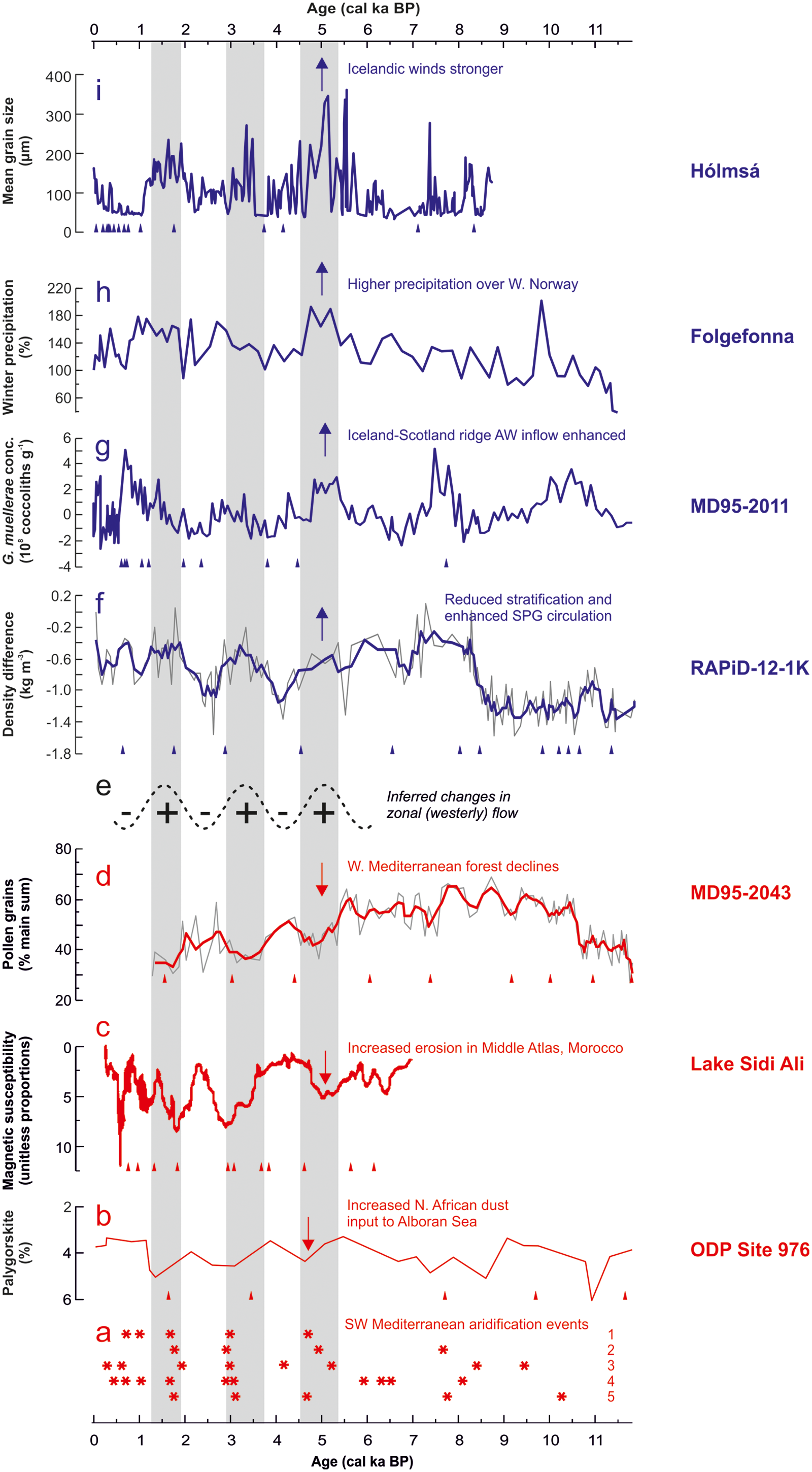
Records indicating anti-phase relationships in hydrological, wind and surface ocean circulation regimes between the western Mediterranean (records a–d) and the North Atlantic/northern Europe (records f–i). (a) Western Mediterranean aridification events (details in Table 2). (b) Palygorskite mineral percentages from site ODP 976 (Bout-Roumazeilles et al., 2007). (c) Magnetic susceptibility (proportionless units) from Lake Sidi Ali, Morocco; axis inverted (Lamb et al., 1999). (d) MD95-2043 temperate and Mediterranean forest record, with three-point running mean in bold. (e) Inferred millennial oscillation in westerly flow, with a 1750 yr sin wave reflecting the mid- to late-Holocene periodic component in the MD95-2043 pollen record. (f) Upper ocean density stratification proxy from core RAPiD-12-1K (Thornalley et al., 2009), with three-point running mean in bold. (g) Concentrations of the coccolith species Gephyrocapsa muellerae in marine core MD95-2011, detrended (Giraudeau et al., 2010). Higher concentrations reflect enhanced Atlantic water (AW) inflow into the Nordic Seas via the Iceland–Scotland ridge. (h) Winter precipitation reconstruction in percent of present-day value for northern Folgefonna, Norway (Bjune et al., 2005). (i) Loess grain size record from Hólmsá, Iceland (Jackson et al., 2005). Triangles indicate absolute dating control points; (h) is derived from independently dated summer temperature and equilibrium line altitude reconstructions (Bjune et al., 2005).
Western Mediterranean aridification events plotted in Figure 4a.
Similar millennial-scale patterns are also observed in a high-resolution soil erosion record from Lake Sidi Ali in the Middle Atlas of Morocco (Lamb et al., 1999; Figure 4c). Within age-model uncertainties, intervals of increased soil erosion at this semi-arid montane site correspond to reductions in regional forest cover in the MD95-2043 sequence. As canopy- and ground-cover by vegetation play a critical role in reducing runoff and erosion in semi-arid landscapes (e.g. Vásquez-Méndez et al., 2010), the soil erosion signal at Sidi Ali is likely to be conditioned by vegetation cover changes, which may in turn reflect the regional climatic influences evident in the MD95-2043 record. Millennial-scale variability in aeolian transport of North African clay particles into the Alboran Sea is also hinted at by the palygorskite record from site ODP 976 (Bout-Roumazeilles et al., 2007; Figure 4b) although temporal resolution of the record is low. Recent work at higher resolution examining geochemical precipitation proxies in terrestrial (Lake Zoñar) and marine (Alboran Sea) sediment records indicate major changes in hydrological activity during the last 4 cal. ka BP (Martín-Puertas et al., 2010) that are consistent with longer-term patterns of millennial variability. In particular, a good match is noted between geochemical indicators of enhanced precipitation and peak forest growth around 2.5–2.0 cal. ka BP associated with the ‘Iberian Roman Humid Period’, followed by a marked transition to arid conditions and forest decline at ~1.9 cal. ka BP.
One of the main strengths of marine pollen records is the integration of a large regional vegetation and climate signal within which the influence of heterogeneous local patterns conditioned by topography, soils, microclimates and human activity is minimized (Fletcher et al., 2010b). Overall, the MD95-2043 record displays strong similarities in terms of the sequence of Holocene millennial events to the temperate forest record in western Alboran core ODP site 976 (Combourieu Nebout et al., 2009), confirming the regional character of the mid- to late-Holocene forest signal. The more robust chronological framework available for core MD95-2043 (nine versus five Holocene AMS radiocarbon dates), suggests that characterization of the timing and periodicity of forest decline events should be more reliable in this record. However, marine pollen records cannot confirm the primary geographic and altitudinal zones driving the climatic signal. Clear parallels to the ~1750 yr oscillation in moisture availability are not evident, for example, at high-altitude sites (2900–3000 m a.s.l.) in the Sierra Nevada, Spain (Anderson et al., 2011; Jiménez-Moreno and Anderson, 2012), where vegetation development may be more strongly conditioned by climatic conditions during the summer (i.e. snow-free) season, and less sensitive to winter precipitation variability.
More widely, counterparts to the ~1750 yr oscillation are displayed in several North Atlantic palaeoclimate records. For example, Debret et al. (2007, 2009) report oscillations of ~1700 yr in oceanic surface circulation over the Gardar Drift south of Iceland (Giraudeau et al., 2000), 1700–1800 yr in marine palaeoproductivity and surface ocean conditions in the Norwegian Sea (Andrews et al., 2003; Moros et al., 2004), and ~1800 yr in temperature and moisture-source signals in speleothem δ18O from Crag Cave in Ireland (McDermott et al., 2001). Like the MD95-2043 forest record, these all display a common non-stationarity reflecting the mid-Holocene emergence of the low-frequency millennial oscillation at around 6 cal. ka BP. Allen et al. (2007) also report similar periodicities of 1650 and 1800 yr in pollen and sediment geochemical data from northernmost Scandinavia, although the detection of non-stationarities across the Holocene was not yet attempted. Over long timescales, these similarities between atmospheric and oceanic proxies suggest synergistic coupling of wind regimes and surface ocean circulation patterns in the North Atlantic region, reflecting the potential both for oceanic surface conditions to respond to variability in the overlying atmosphere via wind stress and heat flux, and for oceanic surface conditions to imprint onto the atmosphere via evaporation, precipitation and storminess (Rodwell et al., 1999; Visbeck et al., 2001).
Implications for westerly dynamics and NAO-like variability
Given the critical role of winter precipitation for regional forest growth (Gouveia et al., 2008), the recurrent mid- to late-Holocene intervals of sustained dry conditions in the western Mediterranean region suggest periodic intensification and northward displacement of the North Atlantic westerlies with consequent reduced penetration of winter storm tracks into the Mediterranean region. Convincing support for this interpretation is found in records of wind strength and precipitation at high North Atlantic latitudes. A high-resolution grain size (wind proxy) record from the Hólmsá loess profile in southern Iceland (Jackson et al., 2005; Figure 4i) is characterized by marked millennial-scale variability with a significant periodic component of ~1700 yr developing after 6 ka (Debret et al., 2007). At this location, wind strengths are strongly influenced by the prevailing strength of the westerly flow, with severe gusts at present being four times more likely to occur during a high-index (e.g. positive NAO) phase than during a low-index (e.g. negative NAO) phase (Thompson and Wallace, 2001). A clear opposition on millennial timescales is observed between forest development in the western Mediterranean and wind intensity over Iceland, with forest declines concomitant with increased wind strengths over Iceland (Figure 5).
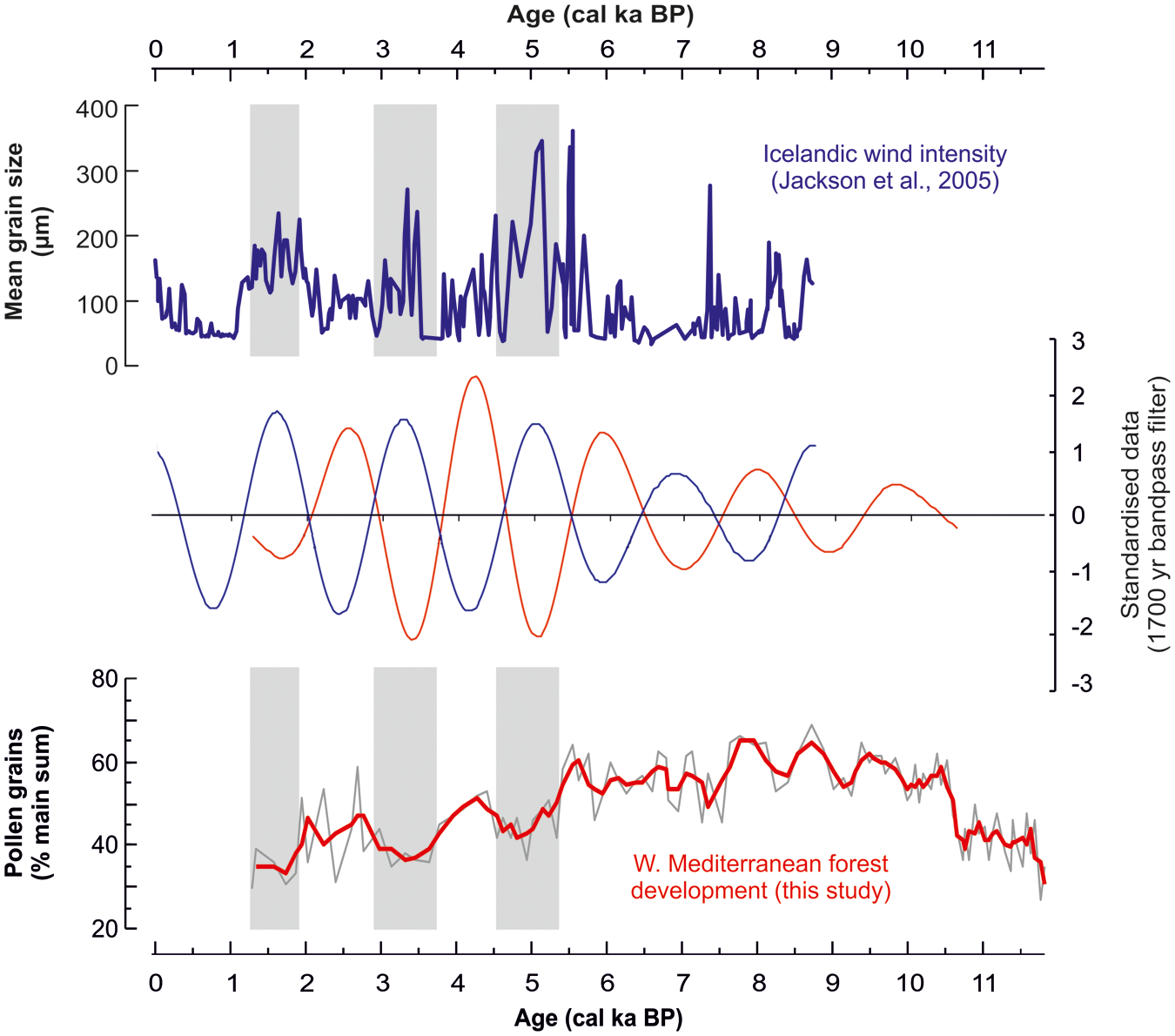
Evolution of the millennial oscillation in the Holmsa (Jackson et al., 2005) and MD95-2043 records, showing the raw data and low-frequency bandpass (1700 yr).
Millennial-scale variability has also been documented in winter precipitation reconstructions based on past glacier fluctuations in western Norway (Bjune et al., 2005; Nesje et al., 2001; Figure 4h). Winter precipitation in this region is highly correlated with the dynamics of the westerlies, notably the NAO, and glacier fluctuations have been shown to capture the signal of associated climate changes (Nesje et al., 2000). We observe that over the mid to late Holocene, above-average precipitation in this region corresponds to high wind intensity at Hólmsá, and is opposed to patterns of forest growth in the western Mediterranean. The contrasting patterns are consistent with shifts in the prevailing intensity and latitudinal position of the atmospheric westerly flow. Following this interpretation, during intervals of prevailing strong westerly flow, a northward shift of Atlantic storm tracks resulted in greater wind intensities over Iceland, higher winter precipitation over western Norway, and resulted in reduced moisture penetration into the western Mediterranean. Intervals of weakened westerly flow, in contrast, resulted in the southward deviation of Atlantic storm tracks, reduced Icelandic winds and precipitation over western Norway, and promoted increased winter precipitation in the western Mediterranean. This contrasting (anti-phase) atmospheric pattern between northern and southern latitudes of the eastern North Atlantic region is reminiscent of the dipole pattern associated with the NAO. The Alboran, Moroccan, Icelandic and Norwegian records are ideally located in regions which experience strongly significant (and opposed) climate anomalies related to this mode of variability at present (Trigo et al., 2004).
Figure 4 also highlights similarities in millennial fluctuations between the MD95-2043 record and upper ocean density stratification in the subpolar North Atlantic core RAPiD-12-1K (Thornalley et al., 2009). Increased (decreased) stratification occurred during intervals of inferred weak (strong) zonal flow (Figure 4f). This phasing is consistent with wind-driven changes in the relative contribution of cold, fresh subpolar gyre (SPG) and the warm, saline subtropical gyre (STG) to the subthermocline waters and/or surface freshening related to the position of the polar front and sea-ice export from the Nordic Seas (Blindheim and Østerhus, 2005). The findings support the view that late-Holocene variability in SPG circulation may have been governed primarily by changing wind stress (Thornalley et al., 2009). Intervals of intensified zonal flow also correspond to strengthening of Atlantic water (AW) surface inflow into the Nordic Seas via the Iceland–Scotland ridge as detected in coccolith concentrations on the Norwegian margin (Giraudeau et al., 2010; Figure 4g). At present, AW inflow via the Iceland–Scotland ridge is favoured by strong westerly winds linked to the positive NAO phase (Giraudeau et al., 2010 and references therein), and past intervals of enhanced AW inflow appear generally linked to intensified and northward shifted westerlies.
While the present-day NAO varies essentially on intra- and interannual timescales, anomalous multidecadal episodes are evident in the observational record (Hurrell, 1995), and the overall climate characteristics of centennial-scale historical intervals, such as the ‘Little Ice Age’ and ‘Medieval Climate Anomaly’, are understood to reflect prevailing NAO phases and/or clustering of extreme NAO episodes (e.g. Roberts et al., 2012; Shindell et al., 2001; Trouet et al., 2009). The N–S anti-phase patterns highlighted in Figure 4 suggest that long-term variability in the strength of the zonal flow with NAO-like impacts may be implicated in the millennial-scale oscillation expressed in the MD95-2043 forest record.
In addition to latitudinal contrasts in wind strength and precipitation, the present-day NAO is also associated with climatic variability within the Mediterranean basin (the Mediterranean Oscillation, or MO), notably with opposed precipitation anomalies between the western/northwestern and southeastern sectors (Dünkeloh and Jacobeit, 2003). Recent climatological study reinforces this view, demonstrating that winter precipitation over Israel is favoured during the positive phase of the NAO (Black, 2011). Detection of opposed hydrological patterns during the mid to late Holocene between the western and southeastern Mediterranean sectors is therefore important for the interpretation of past circulation changes (Roberts et al., 2012). Figure 6 illustrates that, set against similar orbital-scale trends of long-term aridification, mid- and late-Holocene millennial dry intervals in the western Mediterranean correspond to humid intervals detected in speleothem records from Soreq and Nahal Qanah caves in Israel (Bar-Matthews et al., 2003; Frumkin et al., 1999). An opposed millennial wet–dry–wet (MD95-2043)/dry–wet–dry (Soreq) cycle between 6 and 4 cal. ka BP is supported by recent analysis of mid-Holocene speleothems at Soreq (Bar-Matthews and Ayalon, 2011; Figure 6b). These oppositions between the western and southeastern sectors suggest spatial variability in precipitation regime consistent with NAO/MO-like impacts. For the early Holocene, comparison of the Soreq and MD95-2043 records becomes difficult because of the different resolution and chronological control of the records. Nevertheless, peak humidity is evident in both at ~7.7 cal. ka BP, and the 8.2 ka event registers in both as a dry event (Figure 6), as indeed in other studies from the southeastern sector (e.g. Langgut et al., 2011). These W–E similarities suggest that millennial-scale regional climatic oppositions reminiscent of NAO/MO variability only emerged after 7–6 cal. ka BP.
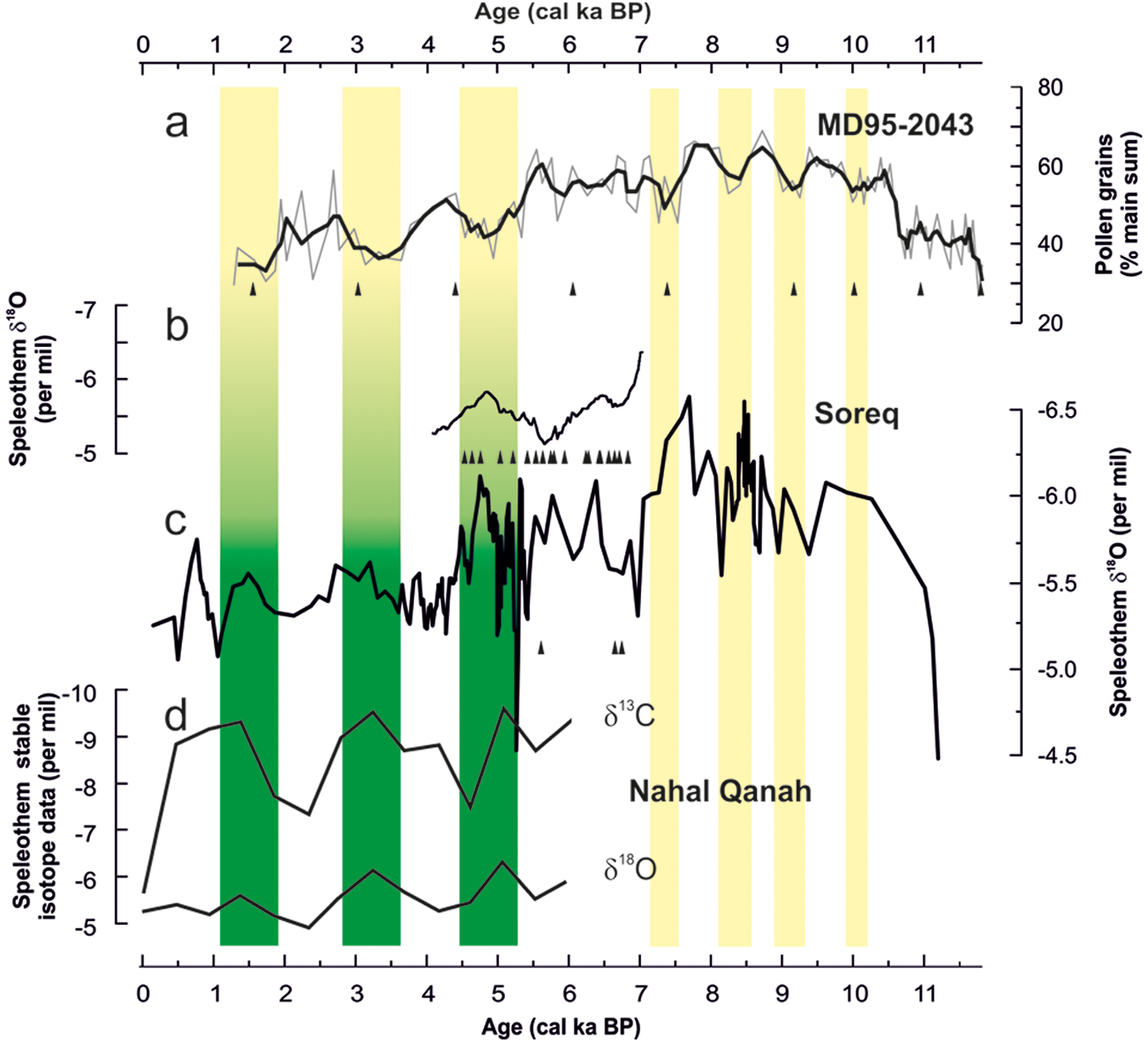
Comparison between western (MD95-2043) and southeastern Mediterranean palaeoclimate records, showing (a) MD95-2043 temperate and Mediterranean forest record, with three-point running mean in bold; (b) smoothed high-resolution δ18O record from Soreq Cave speleothems 2N and 11-24 (Bar-Matthews and Ayalon, 2011); (c) δ18O record from Soreq Cave (Bar-Matthews et al., 2003); (d) δ13C and δ18O records from Nahal Qanah Cave, stalagmite NQ38 (Frumkin et al., 1999). Triangles indicate absolute dating control points; the chronology for stalagmite NQ38 is based on multiple radiocarbon dates on underlying cave sediments. Note opposition between western Mediterranean aridity (forest decline) and indicators of humidity (speleothem δ18O) and non-desertic (C3 pathway) vegetation development (speleothem δ13C ) in the southeastern Mediterranean after 6 cal. ka BP.
Previous work by Magny et al. (2007a) proposed a tripartite hydrological pattern for early-Holocene climatic events such as the 8.2 ka event, incorporating opposed hydrological signals between central and southern (and northern) Europe. As previously described, the MD95-2043 record conforms neatly to this view, with a series of four dry episodes that correspond (within chronological uncertainties) to high lake-level episodes in central Europe (Fletcher et al., 2010b; Figure 7). The interpretation for this opposition is that during North Atlantic cooling events the mid-latitude jet was intensified and situated at mid-European latitudes resulting in reduced penetration of humid air masses to both southern and northern European latitudes. From ~5.0 cal. ka BP, however, the phasing between the records shifts broadly from anti-phase to phase, with clusters of dated low lake-level records occurring during dry western Mediterranean episodes at 4.5, 3.0 and 1.4 cal. ka BP (Figure 7). The well-known Lake Accesa record from north-central Italy closely matches the mid-European record (Magny et al., 2007b), and as such the same observation of an overall shift from contrasting to similar millennial-scale patterns can be made, despite some evidence of short-lived phases of climatic opposition with the western Mediterranean on centennial timescales (Magny et al., 2009).
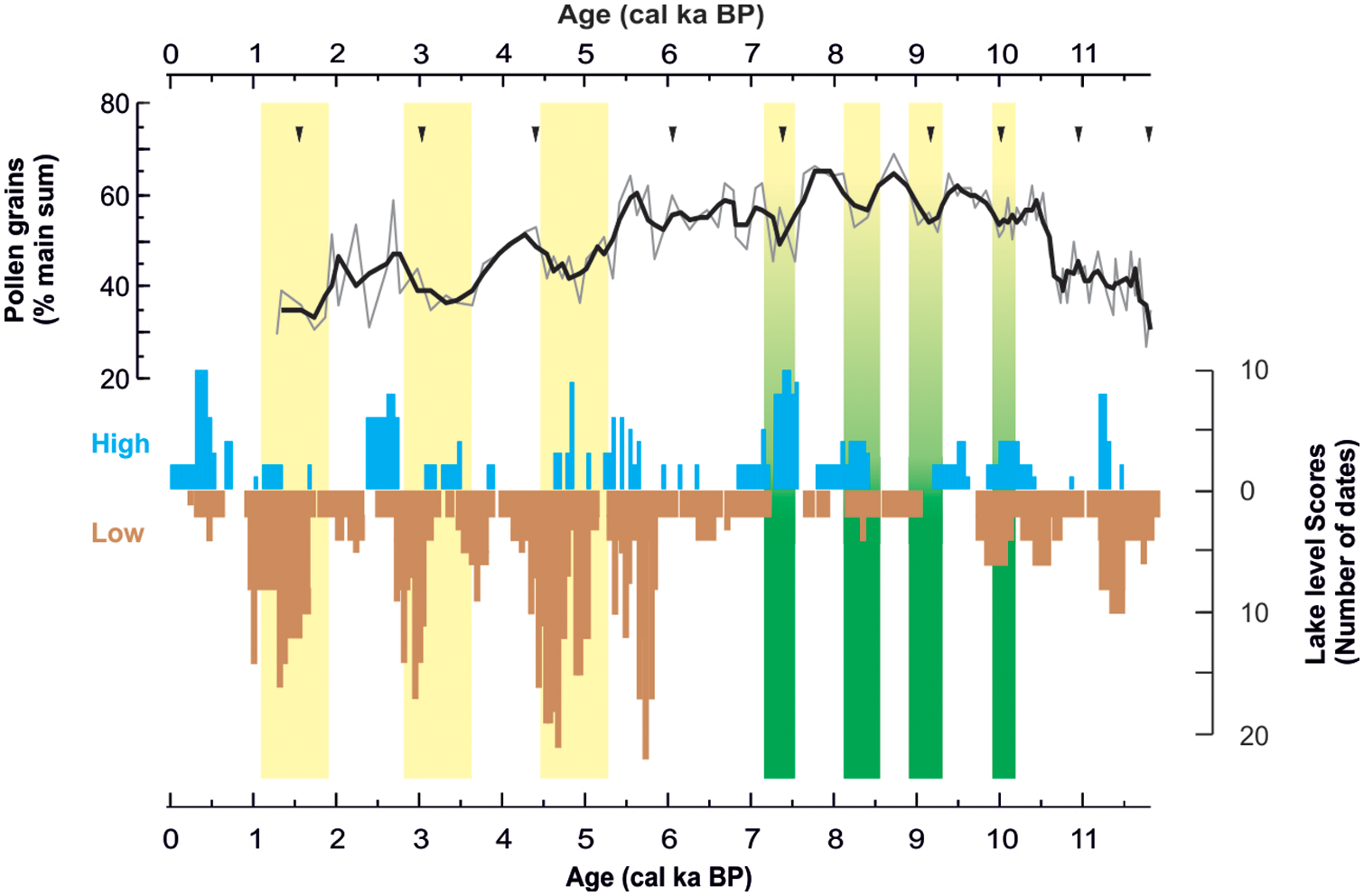
Comparison between western Mediterranean forest development in MD95-2043 and the mid-European lake level record of Magny (2007). Early-Holocene arid intervals in the western Mediterranean correspond to high mid-European lake levels, while mid- to late-Holocene arid intervals are associated with clusters of low lake-level dates. For further explanation of high and low lake-level scores, see Magny (2004, 2007). Triangles indicate AMS radiocarbon dating control on MD95-2043.
The transition from prevailing contrasts to prevailing similarities between central Europe and the western Mediterranean (Figure 7) can be explained if the position of the westerlies during sustained intervals of enhanced zonal flow only assumed a northern track (comparable to the NAO positive phase) after the early Holocene. General circulation models highlight the sensitivity of the geographic location of the Icelandic Low and the entry point of the westerly jet over western Europe to ice sheet topography and sea-ice extension during the glacial–interglacial transition (Harrison et al., 1992). During early-Holocene cooling events, a northern entry point may have been prohibited by downstream impacts of residual ice masses over North America, which should favour the development of a strong atmospheric ridge over northwest Europe and displacement of the main North Atlantic cyclone south of the present-day Icelandic Low (Harrison et al., 1992). Residual ice sheet impacts may have been reinforced specifically during cooling events by the extension of perennial sea-ice cover in the subpolar North Atlantic in response to weakening of the thermohaline circulation, which has been shown to promote regional anticyclonic conditions that push the westerly jet stream southward over mid-European latitudes (Renssen et al., 2002). In contrast, from the mid Holocene onwards, the absence of ice sheets and a weaker role of meltwater forcing on circulation may have permitted a higher-latitude entry point of the westerly jet during sustained episodes of intensified zonal flow. This view agrees with the findings of Schulz and Paul (2002) who highlight changes in the Greenland–European temperature gradient consistent with the installation of the Icelandic Low in its present-day geographic position only after the demise of the Laurentide ice-sheet within a shift in North Atlantic atmospheric circulation dynamics from glacial to interglacial mode at 6–7 cal. ka BP.
A challenge for the reconstruction of past precipitation patterns and associated air mass trajectories is that of contrasting seasonality for different proxies. For example, seasonality of precipitation signals may be different between the Mediterranean (winter-dominated) and mid-European (summer-dominated) records shown in Figure 7. However, feedbacks associated with parameters such as SSTs, snow cover and soil moisture that allow for interseasonal climate memory and an influence of winter climate on summer circulation patterns (Ogi et al., 2003) may be relevant. In particular, recent climatological data and modelling show that wintertime drought over the Mediterranean region (i.e. positive NAO phase) favours hot, dry mid-European summers because of feedbacks from soil moisture onto atmospheric climate and northward propagation of rainfall deficits (Vautard et al., 2007; Wang et al., 2011). Similar mechanisms may be implicated in parallels between Mediterranean and mid-European dry intervals after 5.0 cal. ka BP, consistent with a NAO-like character to mid- to late-Holocene millennial-scale variability.
The millennial-scale parallels evident in records presented in Figure 4 indicate variability in the zonal flow with impacts reminiscent of the present-day NAO. However, discrimination of specific atmospheric modes of variability from palaeorecords may be complicated by changes in the characteristics of specific climatic modes over time, and by synergistic interactions between different modes (Roberts et al., 2012). Dermody et al. (2012) describe a millennial see-saw in Mediterranean precipitation between 3 and 1 cal. ka BP. Their findings correspond to one cycle of the oscillation shown in Figure 4 and provide strong additional support for continental-scale impacts of late-Holocene millennial variability in the atmospheric zonal flow. For the 3–1 cal. ka BP cycle, Dermody et al. (2012) point to an in-phase relationship between northern Spain and western Norway over a dry–wet–dry cycle, and suggest an underlying signal corresponding to variability in the East Atlantic/West Russian (EA/WR) atmospheric pattern. While the dry–wet–dry cycle proposed for Spain concurs with the findings of this study, the in-phase N–S relationship disagrees with the weight of evidence presented here for predominant N–S oppositions on millennial timescales during the mid to late Holocene.
Forcing factors and the mid-Holocene transition
The periodic component of ~900 yr expressed in the early- Holocene record is close to signals detected in proxy records for external solar variability. Suess (1980) reported a fundamental periodicity of 930 yr in Holocene 14C residuals (Δ14C), and a ~1000 yr periodicity in 10Be and Δ14C has been shown to predominate during the early Holocene (Debret et al., 2007). A solar imprint on early-Holocene atmospheric variability is moreover suggested by visual comparison of the records (Figure 8), with western Mediterranean dry intervals prior to 6 cal. ka BP associated with low solar irradiance. Although the total energetic contribution is small, solar variability may be amplified in the context of deglacial climatic instability by sea ice, meltwater and oceanic circulation processes (Björck et al., 2001; Muscheler et al., 2004; Renssen et al., 2006). Atmospheric feedbacks via excitation of ENSO-like variability and global atmospheric teleconnections may also be implicated (Emile Geay et al., 2007; Marchitto et al., 2010).
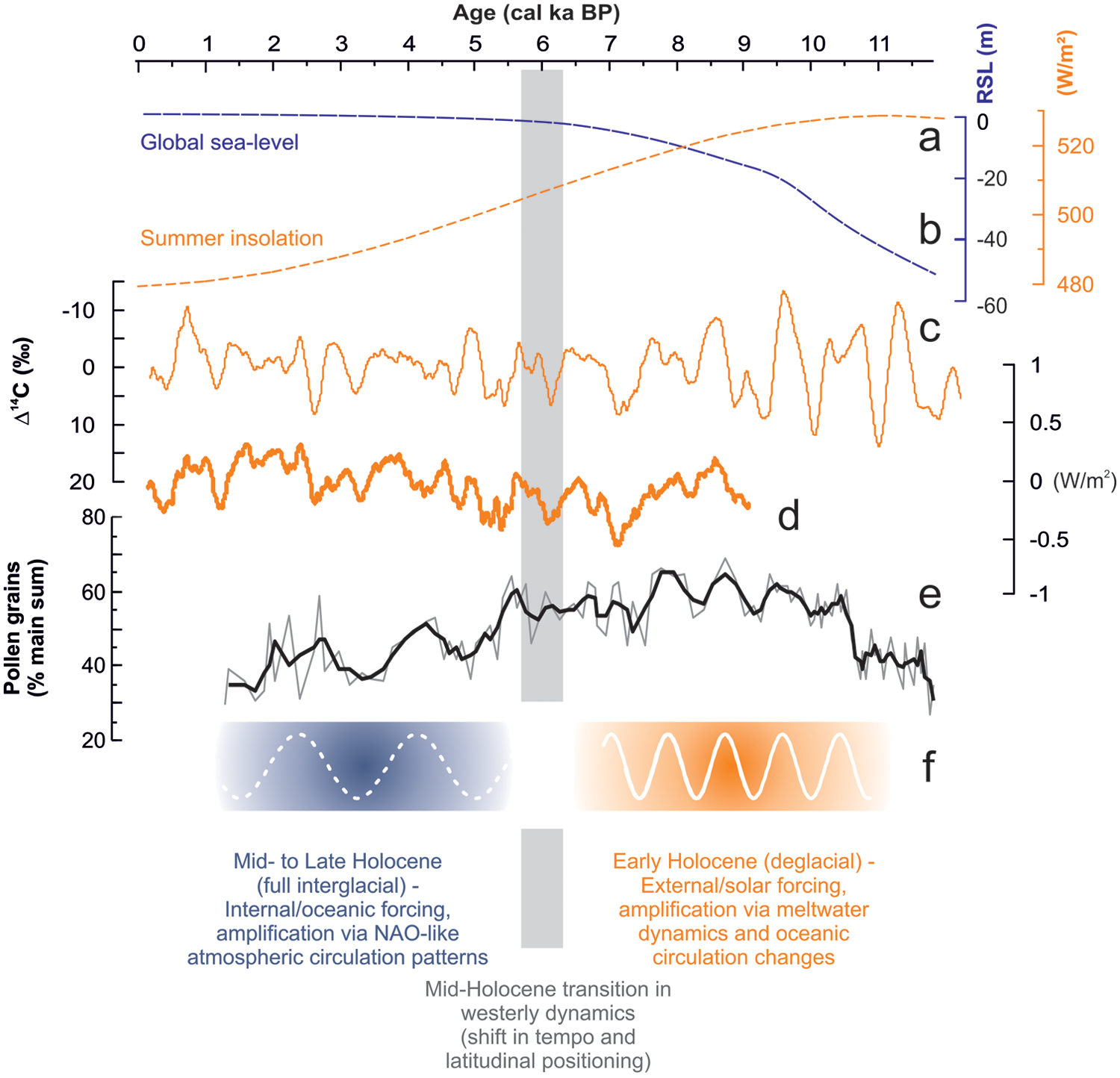
Interpretation of millennial-scale variability in the MD95-2043 record in light of key Holocene forcings. (a) Summer insolation curve (June, 65°N) (Berger, 1978); (b) global sea level based on the ICE-5G ice model (Peltier and Fairbanks, 2006); solar proxies: (c) tree-ring 14C residuals (Reimer et al., 2004) and (d) solar irradiance reconstruction derived from Greenland ice core 10Be (Steinhilber et al., 2009), 200 yr running means; (e) MD95-2043 temperate and Mediterranean forest record, with three-point running mean in bold; (f) illustration of the dominant periodic components detected in the MD95-2043 record (900 and 1750 yr) and interpretation of the shift in periodicity in terms of prevailing forcing and mid-Holocene shift in westerly dynamics.
In contrast, the ~1750 yr oscillation does not display similarities to periodic components of 2300–2400 years detected in solar proxies after 6 cal. ka BP (10Be and Δ14C) (Debret et al., 2007, 2009), and consistent phase relationships between the MD95-2043 record and solar proxies are not evident. (Figure 8). The ~1750 yr oscillation is close to the 1800 yr cycle in oceanic tidal forcing, which may influence global climate by modulating ocean surface temperatures via changes in vertical mixing intensity (Keeling and Whorf, 2000). The role of this weak forcing in pacing climatic change remains unclear, however (Munk et al., 2002). Alternatively, an internal oceanic mechanism may be responsible, either related to variable strength of convection at different sites within the North Atlantic (Schulz et al., 2007), or between Northern and Southern Hemisphere convection, following the bipolar see-saw model (Denton and Broecker, 2008). Experiments using an Earth model of intermediate complexity (Schulz et al., 2007) suggest that the AMOC can switch between strong and weak states on multicentennial to millennial timescales under modern boundary conditions and a weak, continuous freshwater perturbation. Shutdown of Labrador Sea convection in the weak AMOC state results in a temperature dipole pattern between Greenland and Scandinavia reminiscent of the NAO, deepening of the Icelandic low-pressure cell, increased wind intensities over Iceland, and enhanced wind-driven transport of Atlantic surface water into the Nordic Seas (Schulz et al., 2007). Oscillating North Atlantic convection in response to stable, weak freshwater forcing may be a particularly good candidate for explaining the atmospheric oscillation which emerged at the mid-Holocene transition (~6 cal. ka BP), i.e. at the transition to full interglacial conditions, near-present global sea-level (Figure 8) and in the absence of deglacial meltwater perturbation of the climate system.
Conclusions
The sensitivity of western Mediterranean forest development to precipitation changes underscores the value of high-resolution palynological records from this region for reconstructing the past dynamics of the atmospheric westerly flow. The Holocene forest record from marine core MD95-2043 indicates pervasive variability in western Mediterranean climate throughout the Holocene. Early-Holocene forest declines centered at 10.1, 9.2, 8.3 and 7.4 cal. ka BP reflect dry episodes recurring with a ~900 yr periodicity. This early-Holocene oscillation is evident in North Atlantic, monsoon, ENSO-like and solar proxy records (Marchitto et al., 2010), and may have been paced by changes in solar irradiance. Patterns of hydrological response to early-Holocene climate variability imply shifts between an intensified westerly flow over mid Europe and a weakened and branching or meandering flow which permitted the penetration of humid air masses into the Mediterranean basin.
Mid- to late-Holocene dry episodes at 5.4–4.5, 3.7–2.9, and 1.9–1.3 (top of record) cal. ka BP display a periodicity of ~1750 yr, and reflect the emergence after 6 cal. ka BP of a low-frequency millennial oscillation in the strength and latitudinal position of the North Atlantic westerlies reminiscent of the present-day NAO. Coherent spatial patterns of millennial variability observed in strategically located records from Morocco, Iceland and Norway support the view that fluctuating moisture supply to the western Mediterranean was integrated in a N–S anti-phase pattern in wind strength and precipitation similar to the NAO. Contrasting hydrological signals between the western and southeastern sectors of the Mediterranean basin further support a NAO-like character for the ~1750 yr oscillation, and suggest that prevailing or predominant phases of NAO-like circulation conditioned the climate pattern of the Mediterranean after 6 cal. ka BP.
Shifts between weak and strong atmospheric flow after 6 cal. ka BP appear moreover to have been coupled to surface ocean circulation changes in the northern North Atlantic in a manner consistent with wind-stress and freshwater impacts on the surface ocean. Correspondence between the ~1750 yr oscillation and solar variability is not evident, and therefore sensitivity of the fully interglacial North Atlantic climate system to internal oscillations in interglacial AMOC strength is considered the best current explanation for the coupled atmosphere–ocean oscillation. While further investigation is required to understand the interaction between millennial oscillations and variability at shorter (centennial to decadal) scales and to characterise regional responses within the western Mediterranean sector, the findings document a mid-Holocene shift in the dominant tempo of millennial-scale variability in western Mediterranean climate with notable similarities to that previously identified in northern North Atlantic records (Debret et al., 2007, 2009). The findings moreover highlight the critical role of western Mediterranean climate records in developing a physically consistent understanding of past ocean–atmosphere interactions in the wider North Atlantic region.
Footnotes
Acknowledgements
The authors thank M Jackson and J Giraudeau for valuable comments on an early version of the manuscript and for providing data from Hólmsá and core MD95-2011, respectively, and D Thornalley for helpful discussion of the RAPiD-12-1K data. Constructive reviews by Michel Magny and Gonzalo Jiménez-Moreno are gratefully acknowledged.
Funding
This research was supported by the ANR project PICC (Intégration des contraintes Paléoclimatiques pour réduire les Incertitudes sur l’évolution du Climat pendant les périodes Chaudes, ANR-05-BLAN-0312-02).