



Abstract
The objective of this research is to reconstruct the recent Holocene history of Cupressus sempervirens from the Bronze to the Roman Age in Italy. Our work consisted both in a review of published data and in the identification of novel archaeobotanical remains stored in the deposits of the National Archaeological Museum of Naples and of the Archaeological Park of Pompeii. The literature permitted to collect information linked to different plant remain typologies of the Italian cypress; 362 botanical remains were counted, of which 292 were from the Vesuvian area and 70 from other archaeological sites of the central and western Mediterranean. Data chronology spans from the second century BC to the AD fifth century for the archaeological area of ancient Campania and from the 14th century BC to the AD fourth century for the sites located in different regions. It is clear that the ‘cypress culture’ is confirmed by the archaeobotanical data found in the Roman world. Romans especially appreciated its timber but cypress was also used for many other purposes. Furthermore, the employment of timber for wells was documented in pre-Roman sites and the presence of fruits/seeds in central Italy confirms its importance also in the Bronze Age.
Introduction
During the late Quaternary period, global climate change with alternating glacial and interglacial cycles and millennial human activities have greatly shaped European forests and changed their structure, extent and composition (Birks and Tinner, 2016; Di Rita et al., 2018). Indeed, the distribution of several forest tree species has been strongly modified by human activities during the late Holocene and especially in the last three millennia (Zohary and Hopf, 2000). In particular, starting from late Neolithic (Sękiewicz et al., 2018), thanks also to plant domestication – a practice that was spreading throughout the Mediterranean basin (Bagnoli et al., 2009; Zohary et al., 2012) – the development and expansion of permanent land-use practices such as livestock farming, ploughing, crop cultivation and woodland management brought a rapid decline of forest area in Europe (Mercuri et al., 2015, 2019).
In this context, the Romans played an important role with their extensive cultivation and exploitation of natural resources, and in many cases, they seriously modified the distribution and genetic pools of several Mediterranean tree species (Sękiewicz et al., 2018). This is the case, for instance, of Cupressus sempervirens L., introduced and cultivated in many countries all around the Mediterranean countries, thanks to the quality of its wood often used for building and ornamental purposes (Sękiewicz et al., 2018).
The Mediterranean Cupressus taxa, constituted by three species (Rushforth et al., 2003), that is, C. sempervirens L., C. atlantica Gaussen and C. dupreziana A. Camus, are currently considered as part of the ancient tertiary heritage unique to the Mediterranean region; for this reason, monitoring of demographic and genetic threats is fundamental to preserve them, especially considering that, in the future, these species may be at risk because of climate change and expected reduced precipitation (Sękiewicz et al., 2018).
Regarding the Italian cypress (C. sempervirens L.), this species is a medium-sized evergreen tree characterised by a variable crown shape, from columnar to spread, dark green foliage and small ovoid brown cones. It is considered a pioneer species; it grows quickly when young on most types of soils (Quézel and Médail, 2003), including rocky and compact soils, and is well-adapted to the Mediterranean climate with its dry, hot summers and rainy winters. It can form pure forests or be the dominant tree in pine forests or Maquis vegetation.
Unfortunately, the distribution of C. sempervirens has been seriously influenced by cypress canker disease (Sękiewicz et al., 2016), a micro-fungus that was presumably imported from North America during the middle of the 20th century. Since then, the disease has spread all over Europe, particularly in the southern countries (i.e. Greece, Italy and southern France), and especially in areas where cypress trees were not native but introduced (in the distant past). Approximately 25–75% of the trees have been affected by the pathogen and have died.
The Italian cypress is also widely planted as an ornamental tree, especially the columnar and conical forms, making it a characteristic feature of the Mediterranean landscape (Di Pasquale et al., 2004). Its wood is also appreciated for its durability and scent (Giordano, 1981; Nardi Berti et al., 2006; San-Miguel-Ayanz et al., 2016).
Its natural distribution is unclear, because of its long cultural history both in the Near East and in the Mediterranean region. The traditional biogeographical approach assumes that natural populations occur only in the South-Eastern Mediterranean basin, probably continental Greece, east Aegean islands, Crete, Cyprus and Cyrenaica in Libya, reaching eastwards the Caucasus and Western Iran. In its natural habitat, cypress occurs from sea level up to 2000 m a.s.l (Crete, southern Turkey) (Farjon, 2005; Quézel and Médail, 2003). Despite its undisputed cultural role, there are few data about the Holocene history of C. sempervirens in the central and western Mediterranean region. Regarding the Italian peninsula, it is thought that this tree species was introduced and cultivated by the Etruscans (Pignatti, 1982; Quézel and Médail, 2003). Nevertheless, studies based on fossil (Follieri, 1958, 2010; Follieri and Magrì, 1961) and genetic data (Bagnoli et al., 2009) report that the quaternary persistence in the Italian peninsula of scattered populations of Cupressus is likely because of a long-term disjunction of natural populations. In particular, Bagnoli et al. (2009) demonstrate the existence of western Mediterranean natural populations of C. sempervirens, such as the ones found in Tunisia and Italy, the latter represented by the small (40 ha) forest of Fontegreca in Campania region, in southern Italy (European Information System on Forest Genetic Resources (EUFGIS), 2008).
In this context, the past relationship between humans and plants might be inspected through archaeobotany and the analysis of plant remains (Zohary et al., 2012). Archaeobotany is a very valuable method to reconstruct recent plant history (Mariotti Lippi et al., 2018; San-Miguel-Ayanz et al., 2016; Zohary and Hopf, 2000). Indeed, the plant remains found in archaeological sites provide information on the use of a species in a precise territory and during a specific historical period. Moreover, as archaeobotany can be also seen as the ‘study of plants from contexts affected by human presence’, this tool can also provide a biological perspective on past civilizations (Mercuri et al., 2010).
By (a) reviewing previously published data, and then (b) identifying and analysing novel archaeobotanical remains of the C. sempervirens species recovered from archaeological sites, the main objective of this paper is, therefore, to reconstruct the recent Holocene history of cypress from the Bronze to the Roman Age in Italy.
Materials and methods
The research was done using online search engines, grey literature and other archaeobotanical data of the ancient Campania during the Roman age obtained from a very preliminary review (D’Auria and Di Pasquale, 2018).
In addition, exhaustive research was carried out on the archaeobotanical remains stored in the deposits of the National Archaeological Museum of Naples and of the Archaeological Park of Pompeii, and the charred wood therein conserved was identified following standard procedures; the identification of these archaeobotanical remains was accomplished by comparing the results obtained from each charcoal sample after visual analysis using an incident light microscope (magnification ranging from 100X to 1000X) and information reported, respectively, by the wood atlases (Greguss, 1955; Schweingruber, 1990) and by the charcoal reference collection kept in the Laboratory of Vegetation History and Wood Anatomy of the University of Naples Federico II. Finally, cones were also visually examined with a stereomicroscope (up to 80× magnification) and identified after a thorough analysis of the relevant published literature (Anderberg, 1994; Berggren, 1969; Renfrew, 1973) and of carpological reference collection.
Results
Analysis of literature data
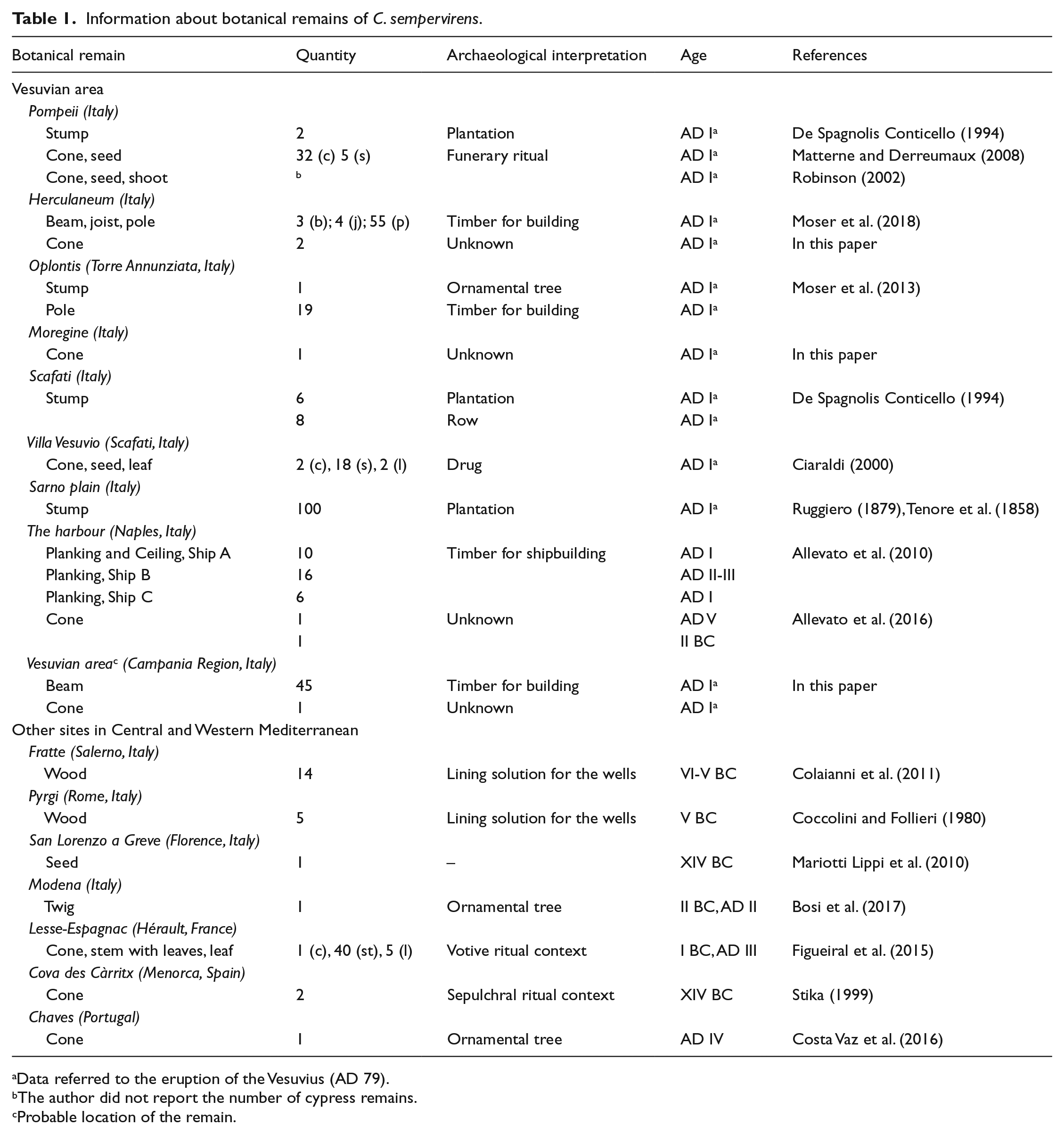
The analysis of the available literature allowed us to collect relevant information linked to different typologies of plant remains of Italian cypress from the period of interest (i.e. Bronze to Roman Age), such as stumps, timbers (beams, joists and poles), cones, seeds and leaves (Table 1).
Information about botanical remains of C. sempervirens.
Data referred to the eruption of the Vesuvius (AD 79).
The author did not report the number of cypress remains.
Probable location of the remain.
In total, 361 plant remains of C. sempervirens were counted, of which 291 were from the Vesuvian area whereas the remaining 70 from other archaeological sites of central and western Mediterranean (i.e. an area extending from Italian to Iberian peninsula) (Table 1 and Figure 1). The chronological span of the analysed data (Figure 2) were, respectively, from the second century BC to the AD fifth century for the data obtained from the archaeological area of ancient Campania, and from the 14th century BC to the AD fourth century for the other data related to different archaeological context (Table 1 and Figure 2).
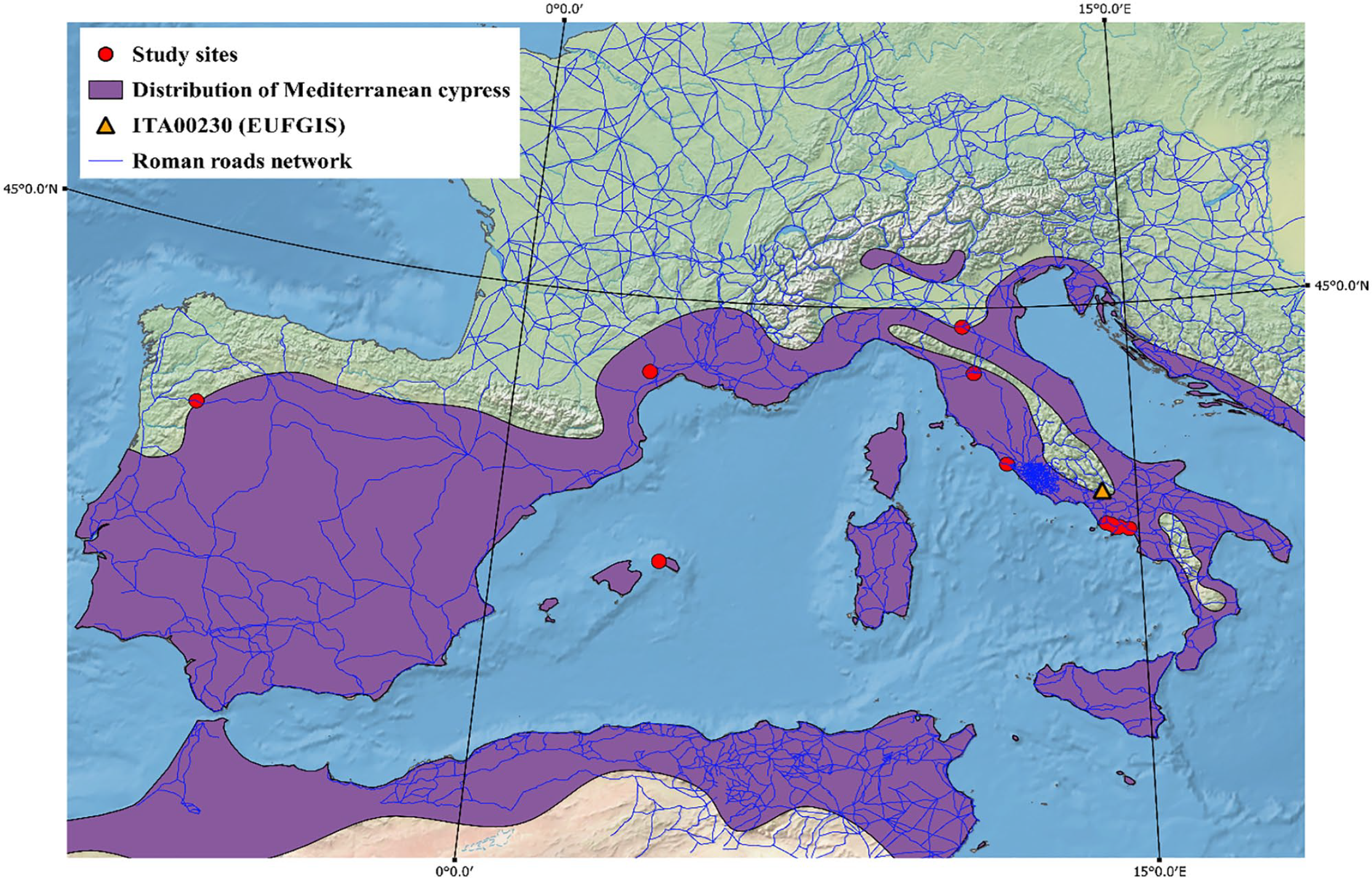
Study sites and location of the botanical remains (see Table 1 for details) are indicated by the red symbols. The road network refers to the Roman roads identified in the Barrington Atlas and digitalised by McCormick et al. (2013). The violet area is the cultivated/naturalised area of the Cupressus sempervirens L. (Caudullo et al., 2017) while the orange triangle indicates the location of the autochthonous Mediterranean cypress site as reported by the EUFGIS Network (see EUFGIS, 2008, for details).

Timeline and type of botanical remains with references used in this study.
Overall, the timber remains of the Vesuvian area were constituted by 117 samples of stumps, coming from Pompeii, Scafati and Sarno plain, as well as 81 samples of timber building materials coming from Herculaneum and Oplontis, and 32 samples of timber used in shipbuilding coming from Naples harbour. Cone remains were rarer with about 36 samples coming from Pompeii, Moregine, Scafati and Naples harbour (Table 1 and Figure 1). Thus, 23 seeds and 2 leaves were also found in Pompeii and Scafati.
For the other sites in central and western Mediterranean (Table 1 and Figure 1), the archaeobotanical remains were composed of 4 cones, 1 seed, 1 twig, 19 woods, 40 stems and 5 leaves.
Timber and plantations
Data from the buried (AD 79) town of Herculaneum demonstrated the systematic use of cypress for the production not only of poles but also of beams and joists (Moser et al., 2018). Similar findings were also reported by Moser et al. (2013) in the Villa of Poppaea at Oplontis, which was also destroyed during the same eruption of the Vesuvius in AD 79.
The use of cypress for planking and ceiling in the shipbuilding of the Roman harbour of Naples, respectively, dated to AD I (ships A and C), and AD II–III (ship B) was reported by Allevato et al. (2010). It is interesting to note that the ship B planking was entirely made of cypress (Allevato et al., 2010).
The many stumps found in the South-East slopes of Vesuvius, in the Sarno plain, provide, to the best of our knowledge, the first archaeological evidence of tree cultivation probably for timber production in the Roman Age. It is interesting to note that this finding provided the basis for a very detailed study published in 1858 by the Neapolitan botanist Michele Tenore et al. (1858) who identified this wood with the help of a reference collection specifically made for their study. In this work, the authors have also provided detailed information on planting density (2.64 × 3.17 m) and pattern (100 trees planted in quincunx) and on trees’ age (36 years old; Figure 3).
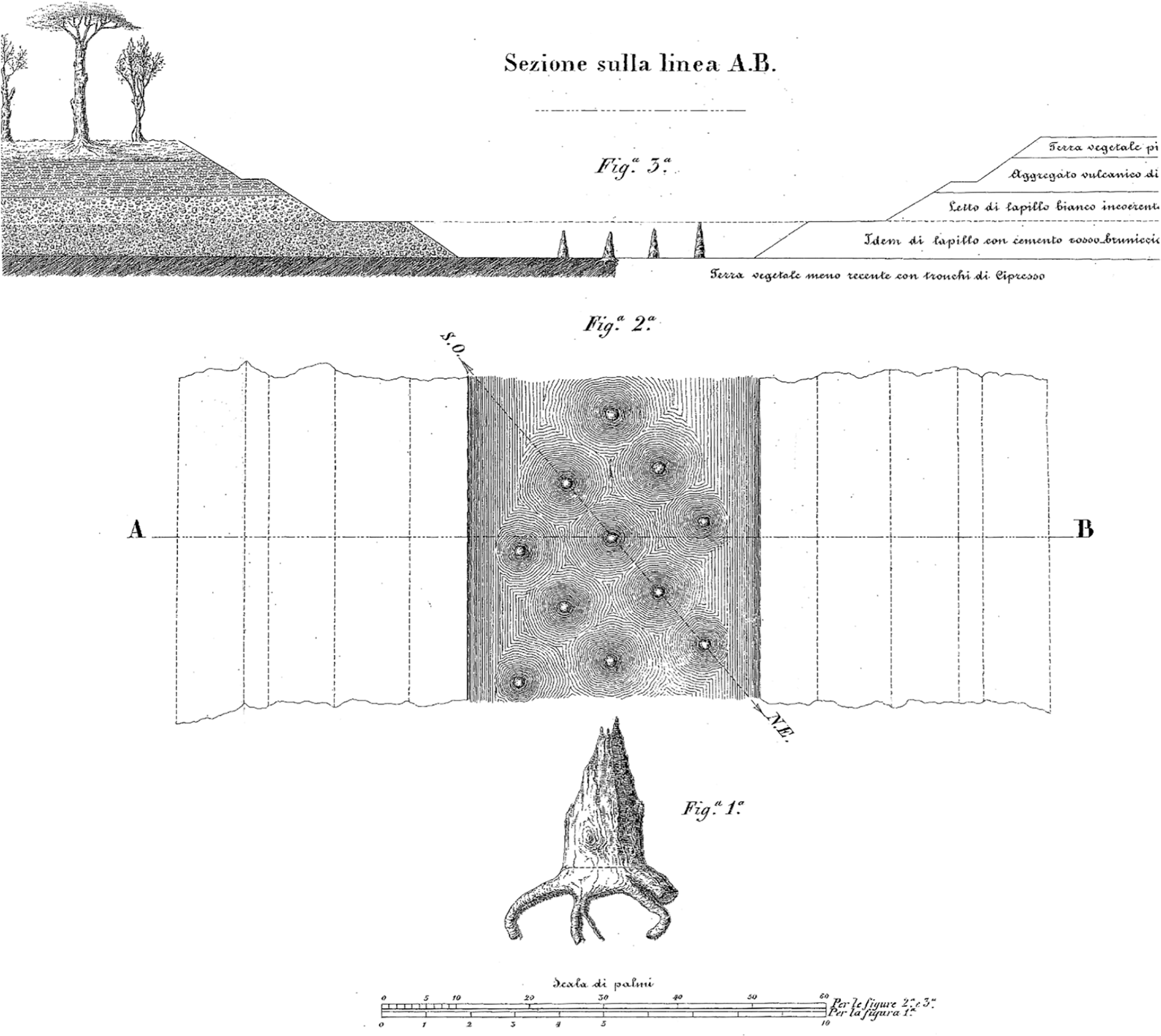
Map of the cypress plantation at the Sarno plain (Tenore et al., 1858).
Interestingly, another plantation, made up of six trees, was found near Scafati (Figure 4); in the same area, a single row of cypress was also recorded alongside a road (De Spagnolis Conticello, 1994).
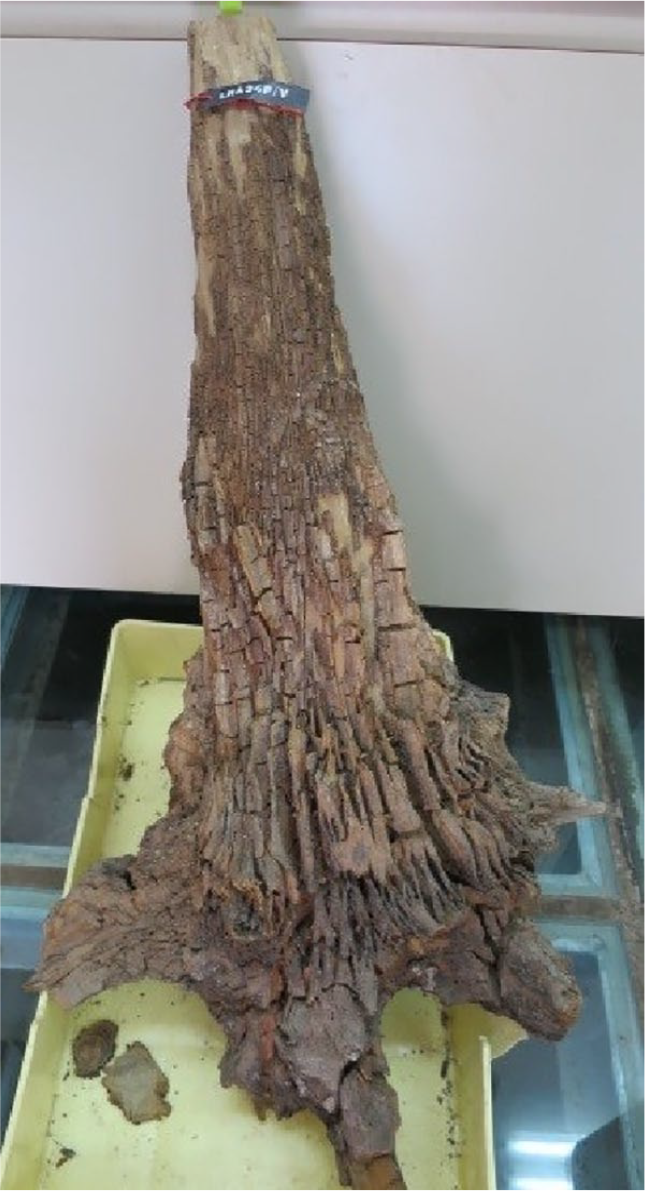
A portion of cypress trunk found in Scafati (Archaeological Park of Pompeii, Italy).
The use of cypress wood as a lining solution for wells was confirmed in the archaeological sites of Fratte (Salerno; Colaianni et al., 2011) and Pyrgi (north of Rome near Santa Marinella; Coccolini and Follieri, 1980) and were dated, respectively, from the sixth and fifth century BC.
Macroremains
In ancient Campania, the knowledge of this tree has also been established because of the presence of fruits, seeds and leaves found in some archaeological contexts. Indeed, two cones of cypress were found on the palaeo-seabed of Neapolis harbour, dated, respectively, to the second century BC and the AD fifth century. In this case, the cones are probably related to the presence of trees close to the harbour (Allevato et al., 2016).
Cones and leaves were found together with other plant and animal remains in a supposed medicinal preparation in a storage vat at Villa Vesuvio (Ciaraldi, 2000).
In Pompeii, the presence of cones and seeds interpreted as a part of funerary rituals was attested at the necropolis of Porta Nocera (Matterne and Derreumaux, 2008) and in the Garden of Room 11 of the Amarantus house (Robinson, 2002).
During the Roman period (I BC to AD III), cypress macroremains related to ritual contexts were found in southern France as a votive ritual. Scholars hypothesised that the cypress was introduced in this region during or after the Iron Age (Figueiral et al., 2015).
During the Roman epoch, the use of cypress as an ornamental tree has also been documented in Portugal (Costa Vaz et al., 2016) and in Northern Italy (Bosi et al., 2017).
Interestingly, the finding of cypress seeds has confirmed the presence of this species during the Bronze Age in Minorca (1450 BC, Stika, 1999) and in central Italy (Florence, Mariotti Lippi et al., 2010). The first data were described as part of a ritual context whereas no interpretation was given for the Italian finding.
New archaeobotanical data
The analysis of the archaeobotanical materials stored in the deposits of Archaeological Park of Pompeii and the National Archaeological Museum of Naples permitted to identify 45 charcoal samples and 4 cones (that were mixed with some charred pods of Ceratonia siliqua) of C. sempervirens. Considering that all these materials belong to the ‘Collezione de Commestibili’ (Borgongino, 2006) – a collection that includes the botanical remains recovered during the Bourbon excavations in the Vesuvian area – it was possible to circumscribe some of them in a more defined location (i.e. Pompeii or Herculaneum); the archaeological context of the provenance of these macroremains is, however, still unknown.
Discussion
The present study constitutes a first critical review of the archaeobotanical and historical literature relevant to C. sempervirens covering the area of the Italian peninsula with some data concerning the western Mediterranean and spanning from the Bronze to the Roman Age. The analysis outlined the high abundance and heterogeneity of botanical remains of C. sempervirens in the Ancient Campania, therefore confirming how during the Roman period, this species was used for many purposes in a large area that was extending from Naples to the plain located in the south of the Vesuvius.
Timber and plantations
The most relevant information obtained in this study was the presence in the South-East of the Vesuvius, in the Sarno plain (Tenore et al., 1858), of the first archaeological evidence of cypress plantation probably used for timber production in the Roman Age. Ancient authors also refer to the use of cypress trees on the boundaries of the estates (Varro, RR I.15) and for topiary work (Pliny the Elder, Naturalis Historia XVI, 140, in Conte and Ranucchi, 1982). This use was extensively confirmed in the Persian gardens where the cypress was linked to Zoroastrianism, the official religion of the Sasanian Empire (Lajard, 1854). In this context, it is meaningful that the presence of six cypress trees (Figure 4) and of a single row of cypress alongside a road was found near Scafati (De Spagnolis Conticello, 1994). Indeed, the use of cypress as an ornamental tree during the Roman period was also documented in Portugal (Costa Vaz et al., 2016) and in Northern Italy (Bosi et al., 2017).
This tree was also potentially highly profitable, and for this reason, the ancient Romans referred to the cypress plantations as the ‘daughter’s dowry’. This is confirmed by the words of Pliny the Elder (Naturalis Historia XVI, 60–141, in Conte and Ranucchi, 1982) when he states that cypresses ‘are permitted to throw out their branches, which are cut and employed for poles and props, being worth, after thirteen years’ growth, a denarius a-piece’. Also, Meiggs (1982) reports the high price of cypress timber used to construct the roof of the Temple of Apollo in Delphi. In ancient Campania, archaeobotanical data show the extensive use of cypress for timber buildings (Moser et al., 2013, 2018). The latter is also testified by remains of beams consisting of 45 charcoal samples stored in the deposits of Pompeii. It is important to note that during the Roman Age, the forest cover of the Vesuvian area was abundant and rich of tree species with good timber, for example, Castanea sativa, Quercus pubescens and other deciduous oaks (Allevato et al., 2010, 2012; Di Pasquale et al., 2010); in this context, the presence of cypress plantation suggests a precise choice, probably related to the production of structural timber of very high quality.
The use of cypress is also documented for planking and ceiling in shipbuilding (Allevato et al., 2010). Regardless shipwrecks discovered along the coasts of the Italian Peninsula (Giachi et al., 2003) showing the sporadic use of cypress wood for shipbuilding, shipwrecks of the eastern Mediterranean basin testify a major use of this wood (Liphschitz, 2015). Strabo (Geographica, I, 741: Meineke, 1877) reported that Alexander the Great requested a fleet of ships made of cypress wood when he was preparing the military expedition against Arabia. In addition, considering that in the Old Testament, it is reported that Noah’s ark was made out of cypress wood (Grilli Caiola et al., 2013), it is very likely that the use of this tree for shipbuilding has a very ancient history.
Forestry engineers and carpenters of the ancient world in both the eastern and the western Mediterranean regions knew and appreciated the technological properties of this wood (Nardi Berti et al., 2006) and especially, as Virgil says, its resistance to fungi and insects and its use in water (Georgics II, 442: Lembke, 2005). This last feature was also well known in pre-Roman populations of a large area of the Italian peninsula: indeed, as reported by Colaianni et al. (2011) and Coccolini and Follieri (1980), during the VI and V BC, the cypress was used as lining solution for the wells, therefore extending in a space-time lap the evidence of this knowledge. These findings suggest that this tree was growing around archaeological sites of Fratte and Pyrgi as surrounded by vegetation (Figure 1).
Macroremains
The presence of macroremains (fruits, seeds and leaves) found in a specific archaeological context is much more rare, and sometimes, it is difficult to give a proper archaeobotanical interpretation, so the researcher often reports only a binary note (i.e. presence/absence) of a specific botanical remain. Similarly, the analysis of the two charred cones found at the National Archaeological Museum of Naples permitted only to identify the provenance (Vesuvian area) of the Cupressus remains without giving any possibility to provide an archaeological intepretation.
The presence of cypress cones found on the palaeo-seabed of Neapolis harbour (dated, respectively, to the second century BC and the AD fifth century) was interpreted as evidence of the presence of cypress trees close to the harbour (Allevato et al., 2016).
In Pompeii, the presence of cones and seeds was interpreted as proof of part of funerary rituals (Matterne and Derreumaux, 2008; Robinson, 2002). On the contrary, the link between this tree and Dis, the Roman god of the underworld and death, was well described by Pliny (Naturalis Historia XVI, 139–141, in Conte and Ranucchi, 1982). Interestingly, Lajard (1854) in his book titled ‘Reserches sur le culte du cyprès pyramidal chez les peuples civilisés de l’antiquité’ tells about the diffusion of cypress in the cemeteries of China, thus very eastward from its natural range.
The analysis of the literature testified that the cypress macroremains found in southern France were probably used in a votive ritual during the Roman period (Figueiral et al., 2015). Concerning the cones, as in the well-known case of Pinus pinea, we have to consider the hypothesis of their specific trade for ritual employ even far from the natural range area of cypress.
However, our results spanning from the Bronze to the late Roman Age were not directly referable to the presence of natural stands of cypress in the forest landscape of the Italian peninsula.
To support the hypothesis of the persistence in Italy of Cupressus from Pleistocene to Holocene as reported by Follieri (2010), further analysis and grey literature data are, therefore, needed, and maybe, the hypotheses should also be extended to botanical remains attested during the Bronze Age in Minorca (1450 BC; Stika, 1999).
Clearly, additional molecular research on the same archaeobotanical uncharred samples collected in Campania is also needed to verify whether Roman foresters cultivated cypress genotypes in this region using plants from local forests or from the eastern Mediterranean region.
Conclusion
Based on the systematic cultivation purposes described above, it is quite clear that ‘cypress culture’ is very well documented by the archaeobotanical data found in the Roman world. Indeed, the collected information has demonstrated that Romans knew the cypress very well and appreciated its wood, and they used it for many purposes throughout a large area extending from Naples to the plain located to the south of the Vesuvius. Furthermore, the specific employment of timber for wells in pre-Roman sites and the presence of fruits/seeds in the Bronze Age in central Italy suggest how the Cupressus was largely used during the late Holocene on the Italian peninsula, perhaps because of the occurrence of native or introduced plantation. Surely, it is interesting to underline the importance of providing a biogeographical significance of plant remains to better reveal the recent history of past and current taxa. Concerning ancient Campania, data suggest that cypress was a very well-known tree that was extensively cultivated, and although the hypothesis of its presence as natural can be confirmed (e.g. Bagnoli et al., 2009; Follieri, 2010), it was probably strongly reduced because of its exploitation. In this context, a more detailed study of grey literature may further reinforce the hypothesis that a small scattered population of this species survived locally in the late Holocene, thus making contours and boundaries more precise both from a chronological and geographical point of view. Indeed, the macroremains can be an important source of information for the study of past biodiversity thanks to both the high taxonomic precision (e.g. at the species level) obtained through the identification of the remains and to a better connection with local vegetation. Surely, ‘the current landscape has its origins in the past’ (Mercuri et al., 2010), and the analysis of the interaction between humans and the environment can be obtained through the integration of archaeology and geomorphology, and it should be based on a deep knowledge of the territory, its ancient history, settlements and exploitation stages.
The duty of botanists is fundamental to providing a trustworthy interpretation of the effect of past human civilizations on plant distribution in a certain area. Therefore, by contributing to creating a ‘knowledge bridge’ that links past and present activities, it would certainly be possible to put together the pieces of the puzzle and build an overall picture that tells the past history of the Italian cypress.
Footnotes
Acknowledgements
The authors dedicate this work to the memory of Daniela Moser. This work was partially supported by the PhD programme at the ‘School of Agricultural and Food Sciences’ in the Department of Agricultural Sciences, University of Naples Federico II. We are grateful to Domenico Carputo, Boris Basile and Clizia Villano for their helpful and constructive suggestions throughout the paper and Dianna Pickens for helping in the English editing. Finally, we thank the two anonymous referees whose comments and suggestions helped to improve the manuscript.
Funding
The author(s) received no financial support for the research, authorship, and/or publication of this article.
