



Abstract
We present the first stable isotope (δ13C and δ18O) speleothem record from continental Croatia retrieved from two coeval stalagmites from Nova Grgosova Cave. U-Th dates constrain the stalagmite growth history from 10 ka to the present, revealing coeval growth between 7.8 and 5.6 ka. We interpret δ18O as an autumn/winter hydrological proxy related to changes of vapor source, precipitation amount, and/or seasonal rainfall distribution, while δ13C predominantly responds to spring/summer vegetation status and soil microbial activity. We identify several centennial to millennial-scale hydroclimate oscillations during this period that result from multiple forcing factors. Along with amount and source effect, it appears that some centennial variations were governed also by seasonal moisture balance. From 9.2 to 8.8 ka BP, the local environmental setting was characterized by enhanced vegetation activity, while during the 8.2 ka event the main feature was a change in precipitation seasonality. The most prominent change, identified in both δ13C records, is a sudden decline of vegetation and soil biological activity around 7.4 ka, indicating a precipitation decrease at a time of maximum plant growth in spring and summer and likely also reduced precipitation in autumn and winter. Although small in magnitude in these speleothems, a peak in δ18O and δ13C values at 4.3–4.1 ka suggests that both summer and winter conditions were substantially drier during the 4.2 ka event, in accordance with increased Mediterranean aridity and consistent with other global climate changes reported at this time. Compared to the present North Atlantic Oscillation (NAO) influence, we assume that millennial Holocene NAO-like variations were persistent through the Holocene via their effect on modifying local/regional air temperature, vapor origin, and inter- and intrannual precipitation distribution. Anthropogenic deforestation, which was the first major human impact on the environment during the Neolithic agricultural revolution, is excluded as a leading factor in δ13C variability since the first sedentary settlements were established further to the east in more arable locations along river valleys. However, the impact of intensive mining around the cave site during the last millennium is evident, with substantial deforestation driving an increase in δ13C.
Introduction
The Holocene interglacial is considered to have a relatively stable climate on a global, multimillennial scale. However, on a finer scale, Holocene climate records show numerous temporal and spatial variations (Lowe and Walker, 2015). A comprehensive review using a multiproxy approach by Mayewski et al. (2004) identified six periods of significant rapid climate change during the Holocene: 9.0–8.0, 6.0–5.0, 4.2–3.8, 3.5–2.5, 1.2–1.0, and 0.6–0.15 ka BP (where ka BP = 103 years before 1950). Wanner et al. (2011) placed several multidecadal to multicentennial cold periods around 8.2, 6.3, 4.7, 2.7, 1.55, and 0.55 ka BP, while other studies have identified single climate anomalies broadly coinciding with quasi-periodic Bond events (Bond et al., 1997, 2001). Some of these events fall within the Holocene Climate Optimum – a warm period between 9.5 and 5.5 ka (Lowe and Walker, 2015), in which several large-scale events are recognized; however, their local impacts are still unclear. Those events, different in terms of extent and intensity, were driven by various dynamic processes such as low solar activity, ice-sheet meltwater fluxes, fluctuations in North Atlantic overturning circulation, volcanic eruptions, and various related feedback effects (Wanner et al., 2011). Thus, local paleoclimate/environmental reconstructions require individual approaches with respect to the site and time period under investigation.
Widely recognized Holocene climate events centered on 8.2 and 4.2 ka BP are explicitly acknowledged in the Global Boundary Stratotype Section and Point (GSSP) tripartite subdivision of the Holocene, with subseries/stage boundaries at 8236 yr b2k (before 2000 CE) and 4250 yr b2k (Head, 2019; Walker et al., 2018). The latter was defined based on the stable isotope profile of the KM-A speleothem from Mawmluh Cave, India (Berkelhammer et al., 2012; Walker et al., 2018), highlighting the importance of speleothem proxy records for paleoclimate reconstructions and as stratigraphic markers. Specifically, speleothems are natural underground recorders of environmental conditions that capture modified signals of the changes within the pedosphere, biosphere, hydrosphere, and atmosphere above the cave (Fairchild and Frisia, 2013; Fairchild et al., 2006). While the number of speleothem-based reconstructions of Holocene environments is increasing worldwide, some key regions are still understudied, such as continental Croatia.
Croatia is located in the northernmost part of the Mediterranean, deeply indented into the European mainland, which makes this relatively small region very diverse in terms of environmental setting (Surić, 2018). Lying at the boundary of competing atmospheric influences from the Atlantic and the Mediterranean, it is well suited to explore spatio-temporal shifts of these dominant influences. Furthermore, a total of 43.7% Croatian territory is karstic (Bognar et al., 2012) with more than 10,000 caves (Bočić, 2017), many relatively rich in speleothems. Still, previous paleoenvironmental studies in Croatia have primarily focused on speleothems from submerged and coastal caves (see review in Surić (2018) and references therein), while caves caves from the non-coastal interior region of Croatia (referred to here as “continental Croatia”) remain underrepresented.
Here we present the first isotopic record from Croatian continental speleothems covering the majority of the Holocene, using samples recovered from Nova Grgosova Cave (NG). The aim of this study is to explore the climate-driven Holocene environmental variability of continental Croatia and to bridge the gap between speleothem records from the Adriatic (Lončar et al., 2017, 2019; Rudzka et al., 2012), the Alps (e.g. Boch et al., 2009; Fohlmeister et al., 2012a; Mangini et al., 2007; Wurth et al., 2004), and the Pannonian basin (e.g. Demény et al., 2013; Drăguşin et al., 2014; Siklósy et al., 2009). It also relies on, and complements, speleothem-based studies from a wider region, that is, from central and western Europe (e.g. Allan et al., 2018; Domínguez-Villar et al., 2008, 2009, 2017; Fohlmeister et al., 2012b; Mischel et al., 2017; Thatcher et al., 2020), eastern Europe (e.g. Constantin et al., 2007; Hercman et al., 2020; Onac et al., 2002; Siklósy et al., 2009; Tămaş et al., 2005), and from the Mediterranean area (Budsky et al., 2019; Bar-Matthews and Ayalon, 2011; Moreno et al., 2017; Psomiadis et al., 2018; Regattieri et al., 2014a, 2019; Scholz et al., 2012; Zanchetta et al., 2007), as well as on regional marine and lake core records (e.g. Bakrač et al., 2018; Ilijanić et al., 2018; Siani et al., 2013; Wunsam et al., 1999) in order to provide better insights into the broad regional changes. Contemporary monitoring of the Nova Grgosova site has revealed influences of both Mediterranean and Atlantic air masses (Surić et al., 2018), whose relative importance probably shifted during glacial-interglacial cycles, given the location of the cave in south central Europe but only 120 km from the Adriatic Sea.
As previously established, climate reconstructions from a single speleothem may be misleading due to possible site-specific influences (drip hydrology, soil and vegetation cover, cave ventilation, etc.) (Fairchild and Baker, 2012; Fohlmeister et al., 2012a). However, replicated signals in coeval speleothems from the same cave provide more confidence in paleoclimate interpretation of isotopic data. Thus, we analyzed two partially coeval speleothems in order to: (i) obtain a reliable stable isotope record of regional Holocene hydroclimate changes in continental Croatia; (ii) constrain the most pronounced centennial to millennial hydroclimate anomalies and integrate our record within the regional climatic and environmental framework; (iii) evaluate the main drivers of enhanced aridity and humidity, and (iv) compare hydroclimate signals with archaeological findings in order to detect possible anthropogenic interferences.
Site description
Nova Grgosova Cave (45°49′ N; 15°40′ E; 239 m a.s.l.) is located in the Samobor hills area (NW Croatia) with predominantly fluviokarst characteristics (Bognar et al., 2012; Buzjak, 2002) (Figure 1a). It formed in intensively karstified Neogene lithothamnium limestone (Šikić et al., 1978, 1979; Vrsaljko et al., 2005) and was accidentally exposed in 2004 during quarrying for lime production. Afterward, the cave atmosphere has been maintained by a well-sealed show-cave steel door. The morphology of the cave is simple: two chambers connected by narrow, partially artificially widened passages, with total length of 97 m (Figure 1b). Sampling and monitoring have been conducted in the second chamber which is 15 m long, up to 8 m wide, with a height of about 8 m. The overburden above the sampling sites is 5–10 m thick, covered mostly with coniferous forest (Surić et al., 2018). Clastic and mud deposits within the cave point to episodes of fluvial infilling, followed by abundant late Quaternary speleothem deposition (Figure 1c). The cave’s position in the epikarst under the hill’s summit ensures that the infiltration elevation is just a few dozen meters above the cave, so neither mixing with groundwater of the phreatic zone nor altitude-modified δ18O signal should significantly impact the dripwater chemistry.
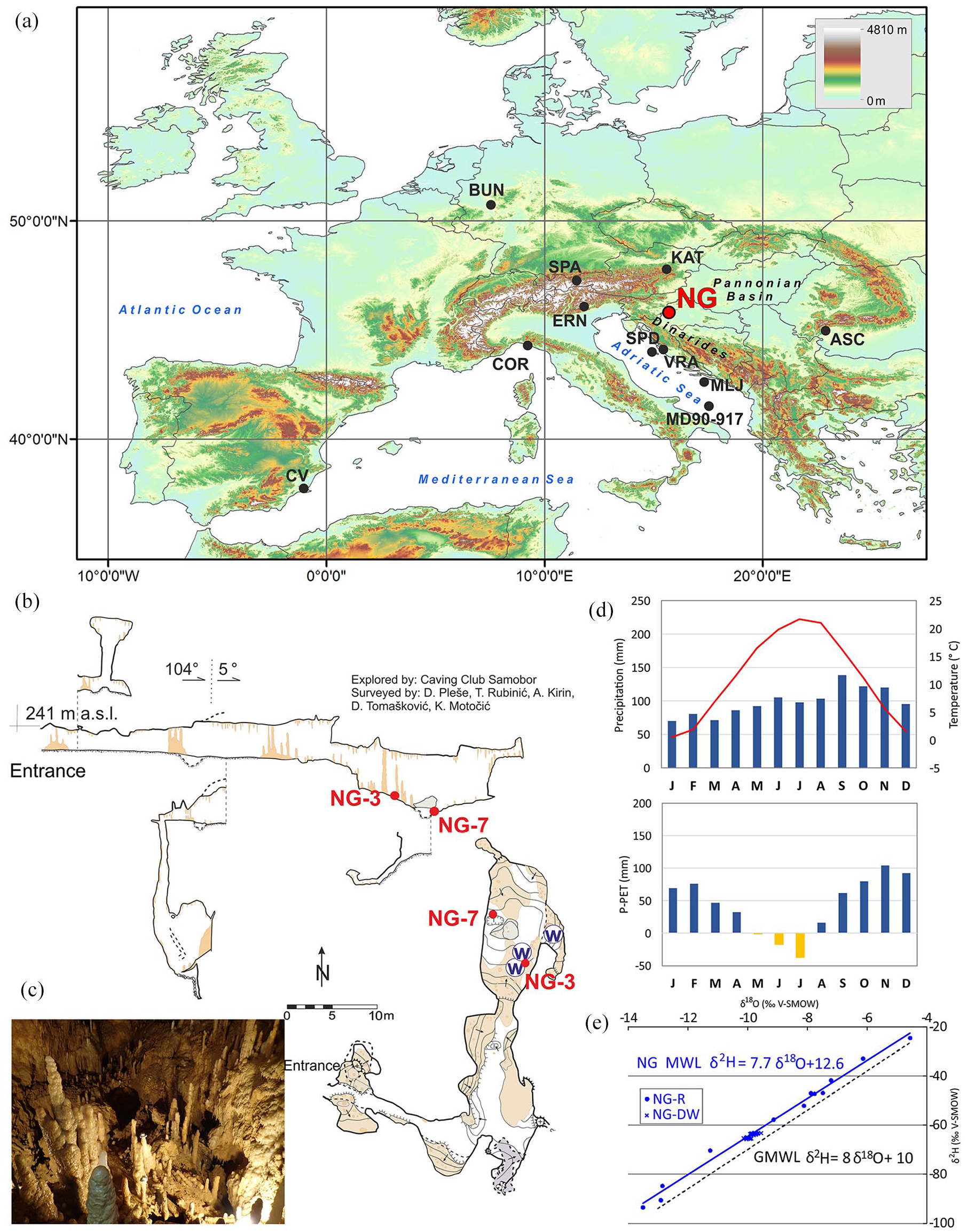
Study site: (a) Geographical position of Nova Grgosova Cave (red dot) and other sites used for correlation (black dots): SPA – Spannagel Cave (Fohlmeister et al., 2012a), BUN – Bunker Cave (Fohlmeister et al., 2012b), KAT – Katerloch Cave (Boch et al., 2009), ERN – Grotta di Ernesto Cave (Scholz et al., 2012), COR – Corchia Cave (Zanchetta et al., 2007), CV – Cueva Victoria Cave (Budsky et al., 2019), ASC – Ascunsă (Drăguşin et al., 2014), SPD – Strašna peć Cave on Dugi otok Island (Lončar et al., 2019), MLJ – Mala špilja Cave on Mljet Island (Lončar et al., 2017), and Malo jezero Lake sediment (Wunsam et al., 1999), VRA – Vrana Lake sediment (Bakrač et al., 2018) and marine core MD 90–917 (Combourieu-Nebout et al., 2013); (b) cave survey with marked speleothem (red dots and IDs) and water (W) sampling sites (according to Caving Club Samobor (Surić et al., 2018)); (c) massive speleothem deposition in the chamber where the stalagmites NG-3 and NG-7 were sampled; (d) climate data: average monthly external air temperature (station Samobor, 1981–2019), precipitation (station Rude, 1991–2019) and the relation between precipitation and potential evapotranspiration) (CMHS, 2020). Water balance (potential evapotranspiration) is calculated using the Thornthwaite evapotranspiration model (McCabe and Markstrom, 2007; Thornthwaite, 1948); (e) δ2H-δ18O relationship of monthly integrated NG drip water (crosses) and rainwater samples (dots) with associated local meteoric waterline (Surić et al., 2020).
The climate of the area corresponds to the Köppen-Geiger Cfb type (temperate humid with warm summers) with a mean annual air temperature (MAAT) of 11.4°C measured in Samobor (1981–2019) (ca. 3 km to the SE of the cave, elevation ca. 160 m) and average annual precipitation of 1186 mm (1991–2019) measured at the rain gauge station of Rude (ca. 6 km from the cave, elevation ca. 300 m). The highest recorded mean monthly temperature is in July (21.8°C), and the lowest is in January (0.6°C) (CMHS, 2020) (Figure 1d). Intra-annual distribution of precipitation is typical for continental Croatia with a peak in September (138.4 mm) reflecting the combined influence of convective and frontal rains during the late summer, and minimum in March (68.5 mm) induced by cold high-pressure continental air masses. Maximum precipitation occurs during the June to September period, but even with enhanced evaporation, aquifer recharge (and in-cave discharge) is present year-round, regardless of the potential evapotranspiration (Figure 1d).
The stable isotopic composition of the rain and drip water was monitored between November 2014 and October 2015. The local meteoric water line for rainfall was determined to be δ2H = 7.7 × δ18O + 12.6, with a weighted mean d-excess of 15.6‰ suggesting both Atlantic and Mediterranean influences (Surić et al., 2020). Drip waters from three sampling sites in the cave showed very good homogenization (Figure 1e). Site NG-3 gave δ18O and δ2H weighted mean values of −9.8‰ (σ = 0.09) and −63.5‰ (σ = 0.3) (n = 12), respectively, with no seasonal variations (Surić et al., 2018). The stable isotope composition of drip water reflects the amount-weighted annual mean δ18O and δ2H of local precipitation (−9.1‰ and −57.1‰, respectively), but the slightly more negative and stable mean value suggests a bias toward winter precipitation, as expected (Figure 1e) (Surić et al., 2018, 2020).
Seasonal shifts of moisture origin and transport pathways of the air masses affecting the study site are clearly expressed in the isotopic composition and origin of precipitation in central Croatia (Krajcar Bronić et al., 2020; Surić et al., 2020) and regional synoptic patterns. Namely, the higher d-excess values recorded in autumn and winter precipitation suggest a Mediterranean influence due to the southward-moving cyclonic frontal systems, which cross the Mediterranean Sea and bring precipitation to central Croatia. Additionally, high d-excess values indicate increased evaporation of the Mediterranean caused by inflow of cold and dry continental air (Bladé et al., 2012) and further intensified by strong winter winds, for example, bora wind in the Adriatic (Davolio et al., 2017). Meanwhile, the lower spring and summer d-excess values indicate a North Atlantic influence as the Azores High pressure ridge over western and central Mediterranean pushes storm tracks further north.
From a wider spatio-temporal perspective, the North Atlantic Oscillation (NAO), as a major synoptic meteorological feature responsible for European inter-annual to multi-decadal climate dynamics, plays an important role in the study area. Specifically, in its negative phase (NAO−, low sea-level pressure difference between Azores High and the Icelandic Low; Hurrell, 1995) generates increased storm activity and precipitation in the Mediterranean (Hurrell and Deser, 2010) and, due to the diminished North Atlantic influence, air temperature and rainfall δ18O are positively correlated to the NAO index (Baldini, 2008; Wackerbarth et al., 2012). When considering central, eastern and southern Europe, the most pronounced differences between NAO+ and NAO− precipitation amounts appear to be along the eastern Adriatic coast and the Dinarides (see Fig 1 in Perşoiu et al., 2017), making this region additionally sensitive to otherwise smaller changes.
Material and methods
Two candle-shaped stalagmites (NG-3 and NG-7) were collected in growth position from the innermost part of the cave (Figure 1b). The 50-cm-long NG-3 was actively growing while the 36-cm-long NG-7 was inactive. Upon collection of NG-3, a drip-logger Stalagmate® (Collister and Mattey, 2005) was installed between November 2014 and November 2017 to measure drip intensity and its relation to rain events. Along with NG-3, two other drip sites (NG-2 and NG-4) were also monitored, all within a few meters of one another, to assess the aquifer architecture. Speleothems were cut longitudinally, then polished to obtain a better insight into the growth layers. The layering in both stalagmites is similar in shape and diameter, while the petrography is very homogenous with the exception of the youngest part of NG-3, which is the most translucent section. Neither dissolutional nor diagenetic macro-scale alteration is evident in polished section, and the absence of dissolution cups along the central axes suggests that drip waters have never been undersaturated with respect to calcite.
Samples for stable isotope analyses were drilled at 1 mm increments along the growth axes using a tungsten carbide 1-mm dental drill attached to a computer-controlled Taig CNC micromilling lathe. In addition, samples along six single laminae of each speleothem were taken for the purpose of Hendy tests (Hendy, 1971). A total of 909 δ18O and δ13C analyses were performed by AP2003 continuous-flow isotope-ratio mass spectrometry at the School of Geography, The University of Melbourne, following the same protocol as described in Bajo et al. (2020). Results are expressed in the delta notation relative to the Vienna Pee Dee Belemnite (V-PDB) international scale. Sample results were normalized using internal NEW-1 and NEW-12 standards and the international standard reference material, NBS-19. Analytical uncertainty for δ18O and δ13C were better than 0.1‰ and 0.05‰, respectively.
U-Th ages were derived from 28 solid calcite prisms (51–200 mg) extracted along the growth axes. Chemical preparation followed the method of Hellstrom (2003). Isotopic measurements were performed by a Nu Instruments Plasma MC-ICPMS at the School of Earth Sciences, University of Melbourne, following the procedure described in Hellstrom (2003). The initial 230Th/232Th activity ratio was constrained to 2.70 ± 0.65 following the procedure explained in Hellstrom (2006). The age depth models for both speleothems were developed by using a Monte-Carlo-based Finite Positive Growth Rate Model approach (Corrick et al., 2020; Hendy et al., 2012). For each of 10,000 iterations performed, age, and depth for each sample are randomized taking into account their uncertainties, then sorted by their randomized depths. A least-squares procedure is then used to find the sequence of connecting positive growth rate age-depth line segments which best fit the uncertainty-weighted age-depth data. Finally, the 3rd-, 50th-, and 97th-percentile interpolated ages were determined at 500 evenly-spaced steps along the depth profile. Final isotopic time series were obtained by interpolating the age-depth model data onto the stable isotope depth profiles of the two speleothems.
Results
Monitoring
Reliable interpretation of speleothem proxy records partly relies on characterization of the processes operating in the overlying karst aquifer (Baker et al., 1997; Baldini et al., 2006). After the 3-year monitoring of three closely spaced drip sites, it is evident that the aquifer is characterized by triple (conduits, fracture, and matrix) porosity (Fairchild and Baker, 2012; White, 1999) which results with quite different discharge features in spite of the proximity of the drips (Figure 2). Unlike variable drip rates of the adjacent NG-2 and NG-4 sites (described in Surić et al. (2018)), drip site NG-3 was practically unresponsive to surface events, maintaining a typical 12–13 drips/hour regardless of the rainfall intensities and amounts. According to the classification of the groundwater flow types based on the relationship between mean discharge and discharge variability (after Baker et al., 1997; Smart and Friederich, 1987), the NG-3 drip site belongs to the “seepage-flow” class. Therefore, the aforementioned drip water homogenization (Surić et al., 2018) indicates that the isotopic signal transferred to the spelean calcite is most sensitive to long-term (i.e. decadal or longer) environmental changes.
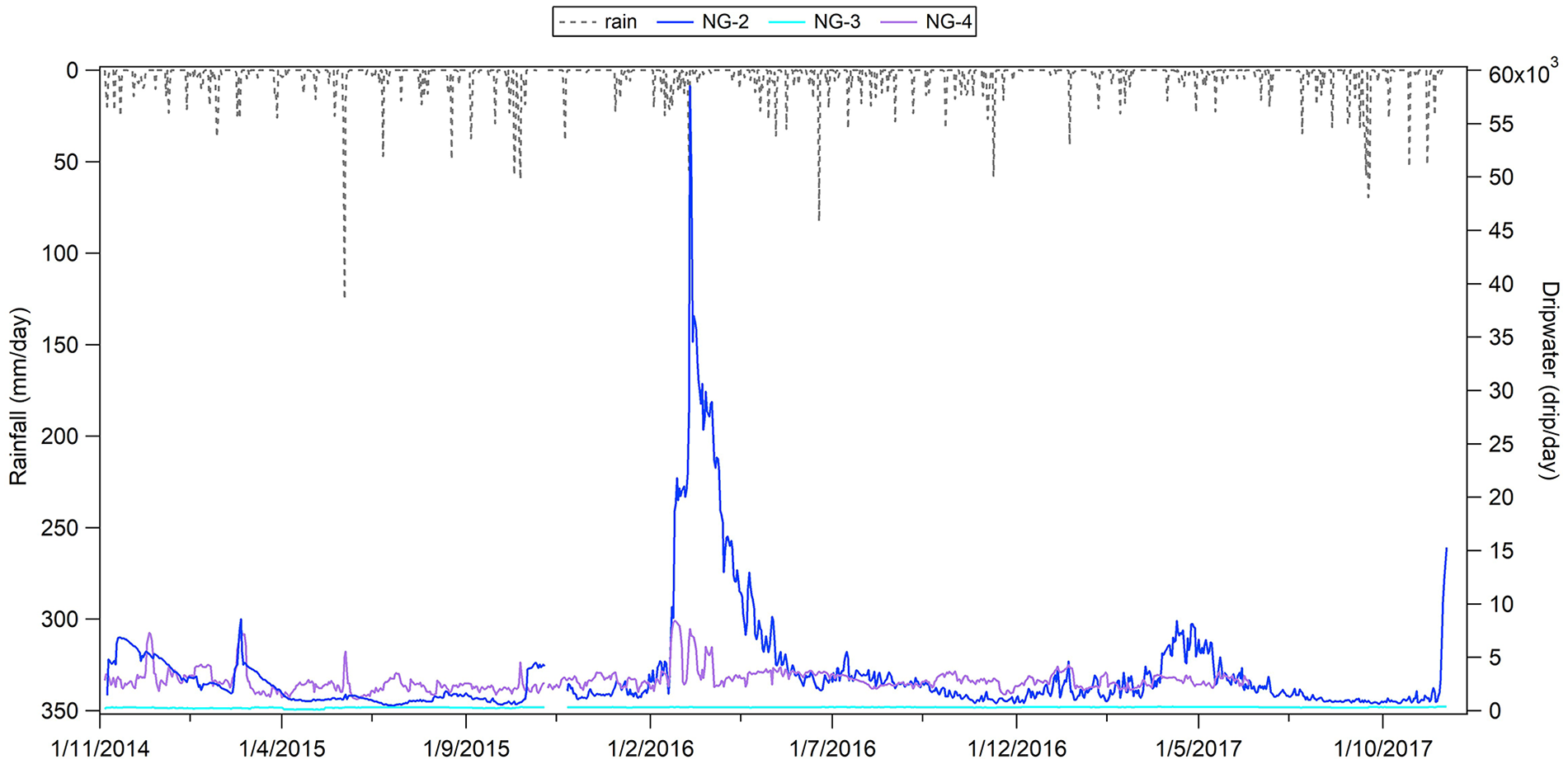
Response of the drip sites to the rain events from November 2014 to October 2017. Daily precipitation data are from the adjacent meteorological stations Rude (6 km from Nova Grgosova Cave).
Chronology
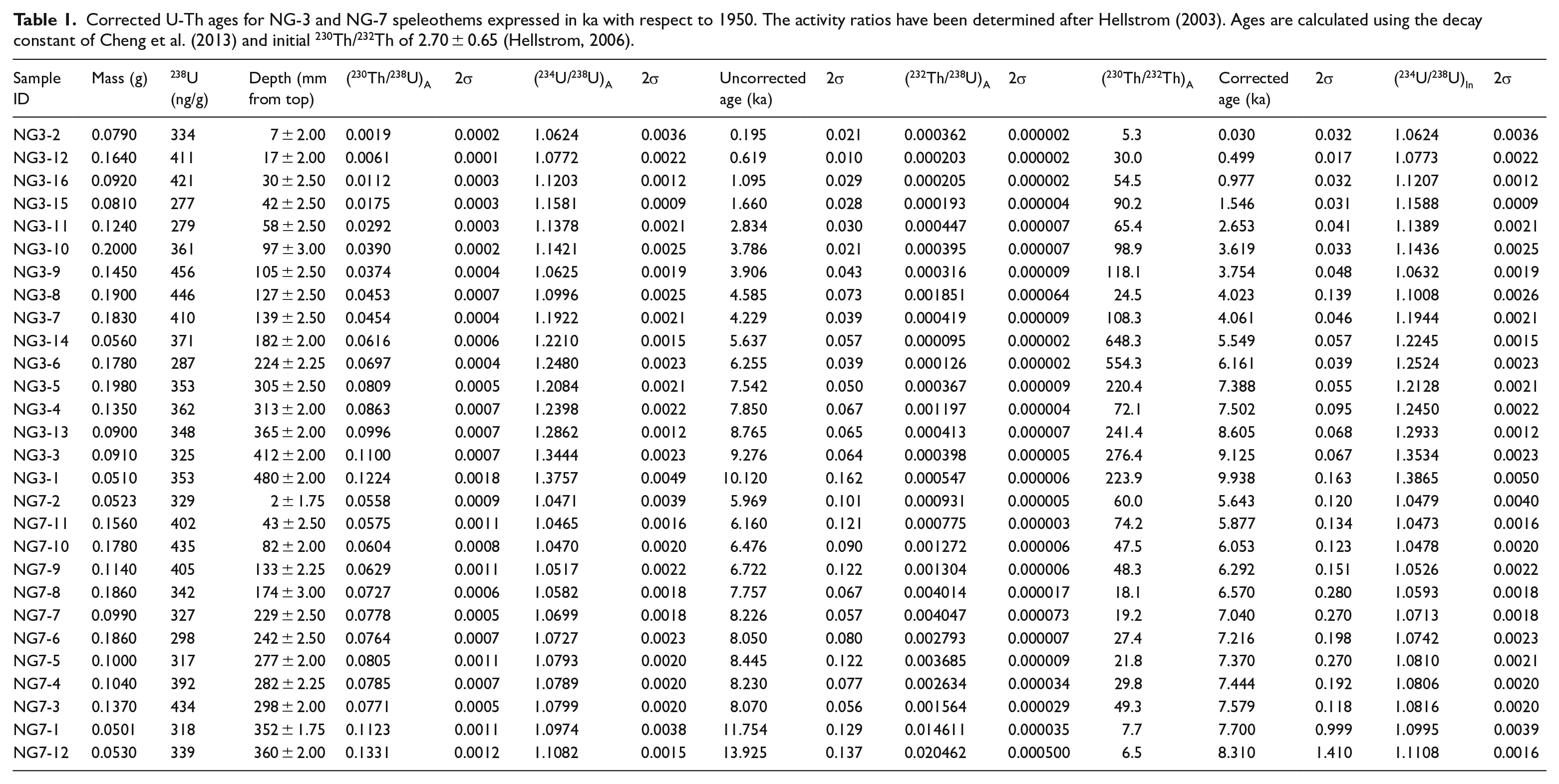
U-Th dating results are presented in Table 1. Average 238U concentration in both stalagmites was 362 ppb (227–456 ppb). Detrital contamination, expressed by the 230Th/232Th activity, ranged from 5.3 to 648.3. Therefore, correction for detrital Th content was applied using initial activity ratios of detrital thorium (230Th/232Th)i of 2.70 ± 0.65 (Hellstrom, 2006). All ages are in stratigraphic order within 2σ uncertainty; this is a further evidence of the absence of diagenetic phenomena at even the micro-scale, which would have caused modifications in the original U-Th geochemical system, resulting in age inversions or outliers (Bajo et al., 2016). According to the U-Th age models (Figure 3), NG-3 grew continuously throughout the Holocene from 10.02+0.25/−0.17 ka) until the date of sampling. NG-7 stalagmite overlaps with NG-3 for the period 7.83+0.57/−0.22 ka to 5.64+0.11/−0.12 ka (Figure 4). Stalagmite NG-7 showed relatively uniform growth (Figure 5), with an average rate of 164 mm/ka, while NG-3 grew generally slower with average rate of 50 mm/ka. The slowest NG-3 growth phases were from 5.51+0.08/−0.22 ka to 4.11+0.25/−0.07 ka, and between 2.58+0.14/−0.33 ka and 0.04+0.12/−0.05 ka with 29.9 and 20.1 mm/ka, respectively. An increased growth rate of 110.5 mm/ka occurred between 4.06+0.05/−0.05 ka and 3.77+0.07/−0.06 ka (Figure 5).
Corrected U-Th ages for NG-3 and NG-7 speleothems expressed in ka with respect to 1950. The activity ratios have been determined after Hellstrom (2003). Ages are calculated using the decay constant of Cheng et al. (2013) and initial 230Th/232Th of 2.70 ± 0.65 (Hellstrom, 2006).
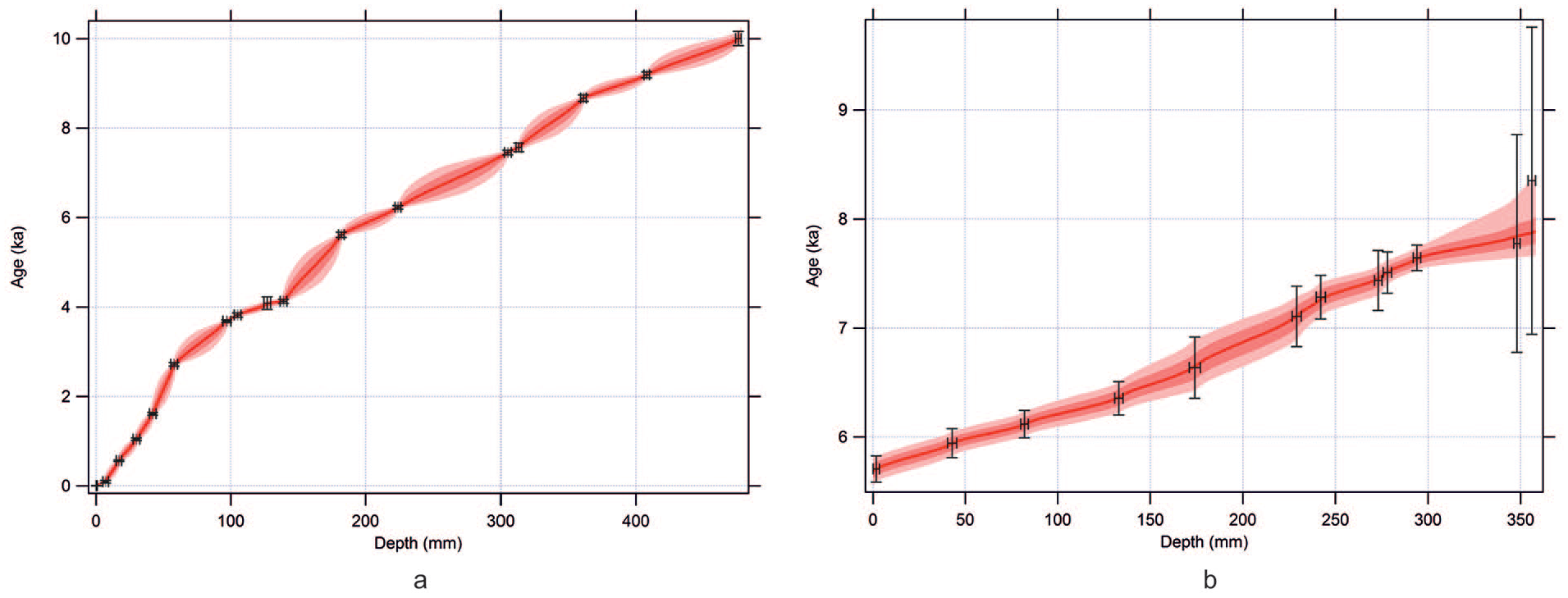
Age-depth models for (a) NG-3, and (b) NG-7. The outer shaded zone defines the 95% confidence interval.
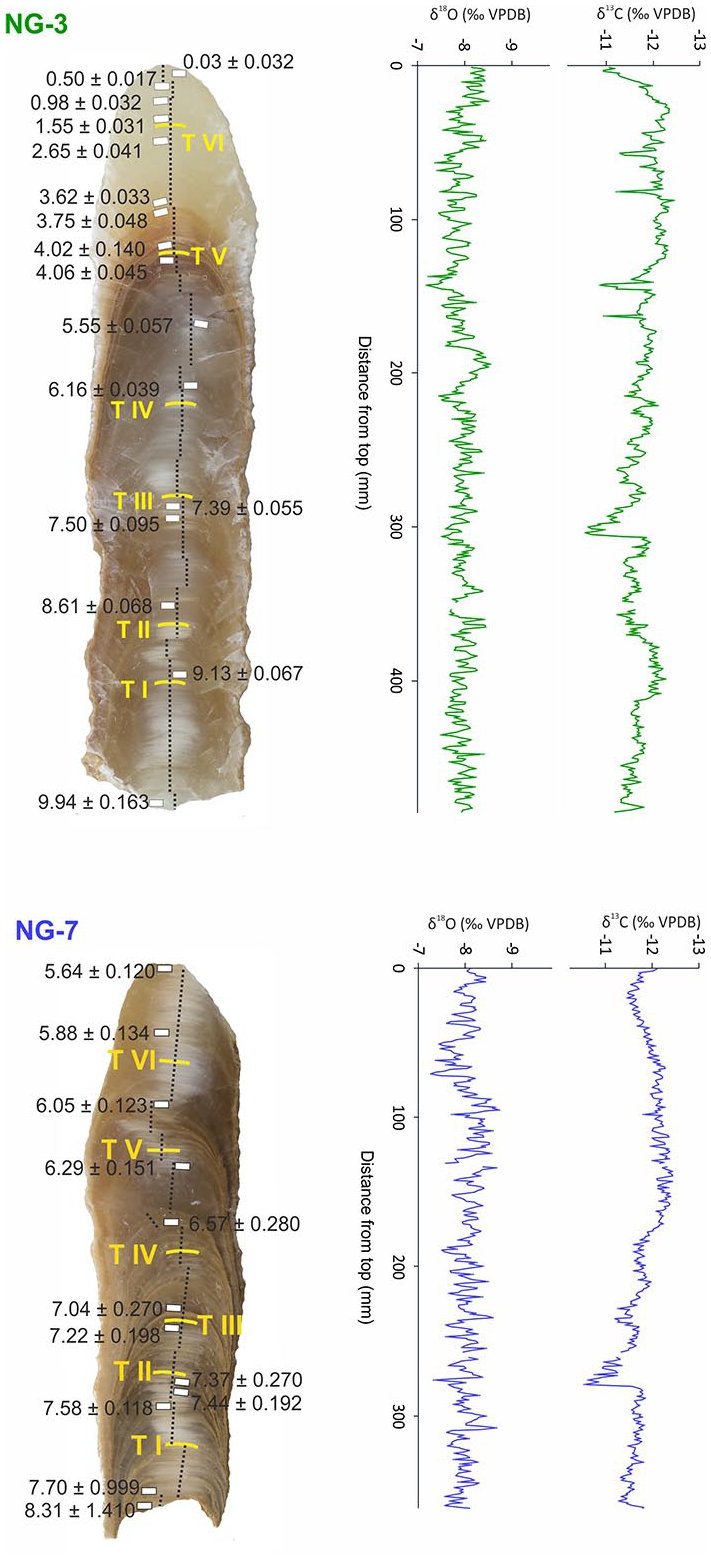
NG-3 and NG-7 stalagmites with marked sampling positions and plots of stable isotope composition against depth. White rectangles mark the positions of dated samples with U-Th ages given in ka and ±2σ uncertainties in kyr. Stable isotope sampling transects are marked with black dotted lines, while yellow lines represent laminae where Hendy tests (Hendy, 1971) were performed. Stable isotope samples from 350 to 353 mm in NG-3 and 258 to 260 mm in NG-7 are missing due to the stalagmite breakages during transport.
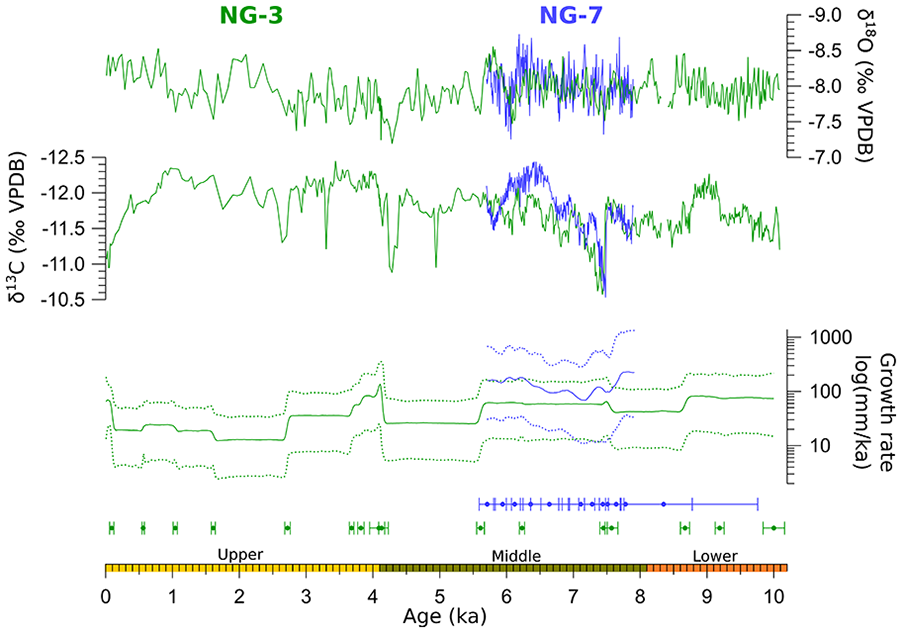
Comparison of δ13C and δ18O time series and growth rates of NG-3 (green) and NG-7 (blue) speleothems. Average growth rate (solid lines) is reported with the propagated ±2σ uncertainties (dotted lines). Dots and 2σ-error bars represent U-Th ages used for the age model. Note the inverted y-axis in δ13C and δ18O time series. The x-axis reports the Holocene subdivision (lower, middle and upper).
Stable isotopes
The δ13C and δ18O variations recorded along the growth axes of NG-3 and NG-7 stalagmites versus depth and versus age are shown in Figures 4 and 5, respectively. NG-3 has a mean δ18O value of −7.94‰ (range from −8.56‰ to −7.19‰) and mean δ13C of −11.76‰ (range from −12.45‰ to −10.57‰). In NG-7, the mean δ18O value is −8.03‰ (range from −8.73‰ to −7.25‰) and the mean δ13C is −11.81‰ (range from −12.44‰ to −10.53‰). The average temporal resolution of the stable isotope data based on the U-Th age models is 21 year (from 4.4 to 74 year) for NG-3, and 6.1 year (from 2.8 to 15.2 year) for NG-7 stalagmite. The δ18O in NG-3 was relatively invariant, with an amplitude of <1.4‰ (Figure 4), and with the highest value centered at 4.29 ka (Figure 5). In NG-7, δ18O was also relatively stable, varying within <1.2‰, (Figure 4). As for the δ13C variations, they are more pronounced and generally do not co-vary with δ18O in either speleothem. Spearman correlation coefficients between δ18O and δ13C for NG-3 (ρ = −0.011) and NG-7 (ρ = 0.259) point to very weak and relatively weak correlation, respectively. The most prominent δ13C signal, clearly recorded in both speleothems, is a positive shift around 7.4 ka (Figure 5).
Confident hydroclimate interpretation of stable isotope records is acceptable in cases where near-equilibrium isotopic fractionation during calcite precipitation from the drip water can be demonstrated (Hendy, 1971, McDermott, 2004). In the NG speleothems this was confirmed using three approaches (Supplemental Material). First, Hendy test (Hendy, 1971) results suggest that deposition of both speleothems occurred in conditions close to isotopic equilibrium (Supplemental Figures S1–S3). This is verified by the replication test (Dorale and Liu, 2009) between overlapping NG-3 and NG-7 sections (Figure S4). Finally, this conclusion is supported by comparison of measured cave air temperature (11.4°C) with that calculated (10.8°C ± 0.4°C) from the uppermost calcite of NG-3 according to empirical relationships for water-calcite oxygen isotope fractionation (δ18OW = −9.8‰ ± 0.09‰ (V-SMOW); δ18OC = −8.15‰ (V-PDB)) proposed by Tremaine et al. (2011). The latter is used with the presumption that if modern spelean calcite confirms equilibrium conditions, then ancient speleothems from the same cave environment should also have been precipitated at or near isotopic equilibrium (Mickler et al., 2004).
Discussion
δ18O and δ13C interpretation
At orbital time scales, oxygen stable isotope (δ18O) variations in stalagmites demonstrate paleoenvironmental changes generally related to global climate changes, but at shorter timescales, the response to climatic conditions is also influenced by regional and/or local/site-specific factors (McDermott et al., 2011). Along with natural causes, and often superimposed on them, human interference with the natural ecosystem can also impact the stable isotope composition (Fairchild and Frisia, 2013). Provided that near-equilibrium calcite deposition has occurred, spelean δ18O is influenced by both cave air temperature and dripwater δ18O values (Hendy, 1971), which in turn depends on meteoric water δ18O values and potential influences regarding latitude, altitude, continentality, air temperature, and rainfall amount (Rozanski et al., 1982, 1993), along with processes within the soil, epikarst, and the drip site in the cave (Fairchild and Baker, 2012). Numerous speleothem-based studies have revealed predominant environmental influences for various regions, but not yet for continental Croatia. In the Mediterranean basin, for example, δ18O is mainly governed by the precipitation amount effect, possibly modulated by the source effect, which leads to more negative (positive) speleothem δ18O values during the wetter (drier) periods, due to 18O-depleted (enriched) precipitation (Bar-Matthews et al., 2003; Columbu et al., 2020). Indeed, this has been clearly shown from north and central Italy (e.g. Regattieri et al., 2014b, 2019; Zanchetta et al., 2007), in southern Italy (e.g. Columbu et al., 2020), in Sardinia (e.g. Columbu et al., 2017, 2019), then in Greece (e.g. Finné et al., 2014; Psomiadis et al., 2018), in Israel (e.g. Bar-Matthews et al., 2003), and in littoral Croatia (e.g. Lončar et al., 2017, 2019; Rudzka et al., 2012). A similar response is recorded also further to the east, for example, in North Macedonia (Regattieri et al., 2018), Iran (Mehterian et al., 2017), as well as in France (e.g. Couchoud et al., 2009; Genty et al., 2003, 2006), and Portugal (Thatcher et al., 2020). In addition, the same isotopic effects are reported in the southern (e.g. Columbu et al., 2018) and Austrian Alps (e.g. Fohlmeister et al., 2012a).
On the other side, in continental (“non-Mediterranean”) West and Central European sites west of NG cave, the δ18O response to climate variations is governed by the temperature effect, producing isotopic values that shift in the same direction as those in Greenland ice cores (NGRIP, North Greenland Ice Core Project Members, 2004), with lower δ18O values associated with low temperatures during colder periods, and vice versa. This is reported in northern Alps (e.g. Boch et al., 2009, 2011; Moseley et al., 2015, 2020; Spötl et al., 2006), as well as SW Ireland (McDermott et al., 2001) and northern Spain (e.g. Baldini et al., 2019; Domínguez-Villar et al., 2008). Temperature controlled δ18O is also revealed in modern speleothem from Postojna Cave in Slovenia (Domínguez-Villar et al., 2018).
To the east and northeast of our study site, in the Pannonian basin and Carpathian region, δ18O also decreases during the glacial stages, as reported in Hungary (e.g. Demény et al., 2013; Koltai et al., 2017). In western Romania, Holocene δ18O variations generally reflect temperature changes too (e.g. Drăguşin et al., 2014), while in Sofular and Ovacik caves in Turkey, isotopic variations reflect temperature and moisture source effect changes related to the Black Sea (Fleitmann et al., 2009; Göktürk et al., 2011). In terms of dominant effects, such simplified regional delimitations can conceal other local drivers that interrupt the primary signal, for example, changes in the proportions of winter and summer precipitation (Mangini et al., 2005), influence of the local topography on cyclogenesis and thermal depressions (Trigo et al., 2002) or switches in the main precipitation sources (Lüetscher et al., 2015).
Based on the 43-year-long precipitation record from Zagreb (24 km east of Nova Grgosova Cave) (Krajcar Bronić et al., 2020), as well as our 1-year observations at the cave site (Surić et al., 2018), no significant correlation is found between monthly δ18O and precipitation amount as the latter evidently shows a lack of seasonality. The observed temperature gradient of rainwater δ18O in Zagreb is 0.33‰/°C ± 0.01‰/°C (n = 394; r = 0.80) (Krajcar Bronić et al., 2020) which leads to isotopic enrichment with temperature increase. At the same time, temperature dependent calcite-water oxygen isotope fractionation has a gradient between −0.24‰/°C (Kim and O’Neil, 1997) and −0.18‰/°C (Tremaine et al., 2011), implying a net calcite δ18O/temperature gradient between ~0.08 and ~0.16‰/°C. As a result, even the minimal δ18O variations in NG speleothems throughout Holocene would have required unrealistically large temperature variations (e.g. overall, the NG-3 Holocene δ18O amplitude of 1.37‰ would require a temperature shift from ~9 to ~17°C). However, at shorter timescales, temperature can change seasonally even if annual average temperature remains approximately stable; although our speleothems would be unable to record this change directly, because of the reasons explained above, this may have had an impact on seasonal rainfall distribution. In turn, the latter can affect speleothem δ18O if seasonal rainfall amount changes occur, as for example in cases of enhanced seasonal aridity and/or humidity. Accordingly, it is more likely that δ18O is a hydrological proxy related to vapor source, multiannual rainfall amount changes, as well as changes in seasonal rainfall distribution, as generally recognized and applied within the Mediterranean region.
Along with δ18O, the most frequently used speleothem proxy is δ13C, whose variations reflect the environmental changes in several ways. First-order changes are often due to climate-driven vegetation change manifested as alteration of C3 and C4 dominated plant assemblages above the cave. Given the geographical position of Nova Grgosova Cave in the temperate zone, this cause is unlikely as the region is characterized solely by C3 vegetation with typical mid-latitude speleothem δ13C values ranging from −14‰ to −6‰ (McDermott, 2004). As demonstrated in several studies (e.g. Columbu et al., 2020; Drysdale et al., 2004; Frisia et al. 2005; Koltai et al., 2017; Regattieri et al., 2014b, 2018; Rudzka et al., 2012; Scholz et al., 2012) the dominant influence in nearby locations at comparable latitude/altitude is vegetation and soil microbial activity. Indeed, this is expressed with lower speleothem δ13C values resulting from higher pCO2 in the soil, due to denser and more productive vegetation and root respiration during wetter and warmer periods, and higher δ13C values during drier and colder periods because of reduced bio-pedological activity. Furthermore, decreased precipitation and consequent reduced aquifer recharge result in slower flow rates and prolonged rock-water interaction, leading to higher contribution of host rock-derived carbon (Baker et al., 1997) and enhanced prior calcite precipitation (PCP) (Fairchild et al., 2000; McDermott, 2004). Both these processes cause higher dripwater and subsequent speleothem δ13C values (Bajo et al., 2017).
Complementary to δ18O and δ13C, speleothem growth rate is commonly used as a hydroclimate proxy, as it is determined by the Ca2+ concentration, drip water temperature and the water supply rate (Genty et al., 2001). Depending on soil CO2 production, growth rate often presents a negative correlation with δ13C (Regattieri et al., 2019).
Given the uniform annual precipitation distribution (Figure 1d), year-round stable drip rates (Figure 2), thorough homogenization of the rainwater within the aquifer (Figure 1e; Surić et al., 2018) and near-equilibrium calcite precipitation confirmed by replicated δ13C signals in both NG speleothems (Figure S4), we regard δ18O and δ13C as reliable proxies for multi-annual climate-driven changes of the local environment. Since soil microbial activity and vegetation density above the cave are at their highest during spring/summer season, the NG δ13C is here taken as a proxy for spring/summer environmental conditions, producing more (less) negative values during higher (lower) bioproductivity. Furthermore, cave monitoring data point to autumn/winter as main recharge season, so we interpret NG δ18O as a proxy for predominantly autumn/winter conditions, producing more (less) negative values during higher (lower) rainfall amounts. It follows that the seasonal-dependency of the δ18O-δ13C proxies might support different scenarios in Croatian continental environments due to seasonal climate variability. This could produce isotope signals that are at times opposite in direction to the other regional records. For example, a positive δ13C shift indicative of decreased soil productivity due to reduced water availability and/or temperature in spring/summer could be associated with relatively invariant speleothem δ18O, as long as autumn/winter humidity is not affected. Conversely, drier autumn/winters but invariant spring/summers would produce more or less stable δ13C but higher δ18O. Simultaneous increases in δ13C and δ18O values point to year-round aridity, while opposite trends, that is, concomitant decreases in δ13C and δ18O are interpreted as year-round humid events. These different scenarios characterized Croatian continental climate from the Lower to Upper Holocene, as discussed below.
Lower (Early) Holocene
The Greenlandian stage (i.e. Lower/Early Holocene: 11.6–8.2 ka) is recorded in NG-3 speleothem only from ~10 ka onwards. The δ18O and δ13C variability in the NG record is minimal, ranging between −8.46‰ and −7.51‰ and from −12.27‰ to −11.20‰, respectively. The most notable shift is a stable decrease of δ13C values between 9.2 and 8.8 ka (Figure 5). Similar excursions that could point to more favorable conditions for vegetation above the cave, to our knowledge, has not been registered in nearby speleothem records or other proxies, except as an abrupt and rather short-lived negative δ18O shift at 9.15+0.06/−0.06 ka in Spannagel Cave (Fohlmeister et al., 2012a) and at 8.91 ka in Bunker Cave (Fohlmeister et al., 2012b) in otherwise quite variable parts of these records (Figure 6). Climate anomalies recorded by δ18O decrease around 9 ka in northern Iberia La Garma Cave (Baldini et al., 2019), Herbstlabyrinth Cave at 9.1+0.20/−0.20 ka (Mischel et al., 2017) and in Alpine Katerloch Cave (Boch et al., 2009) are associated with the “9.2 ka event” which was detected in numerous climate proxies in Northern Hemisphere (Fleitmann et al., 2008 and references therein) and was ascribed as a response to one of several meltwater pulses (MWP) that preceded the major outburst at 8.2 ka. On the Mediterranean side, the Mean Anomaly Index (MAI) derived from the combined δ18O, δ13C, and Mg/Ca time series from Corchia Cave (Regattieri et al., 2014a) points to longer dry period between ca. 9.6 and 8.4 ka interrupted by one brief wet episode centered at 8.7 ka (Figure 7). However, it does not correlate with the wet episode at Nova Grgosova Cave site within the corresponding age uncertainties, although subsequent dry and wet episodes demonstrated relatively good matching of these two records. East of Nova Grgosova Cave, in Romanian cave V11, short negative δ18O shifts are recorded at 9.3 ka (Tămaş et al., 2005) and at 9.2 ka in Poleva Cave (Constantin et al., 2007), but both are brief cold episodes. Notwithstanding this, the 400-year period of lower δ13C in NG-3, associated with decreasing δ18O and increasing growth rate, suggests that the environmental conditions improved in terms of vegetation cover. However, without replication or other regional records, we tentatively ascribe this multi-centennial episode to local background hydroclimate variability for the time.
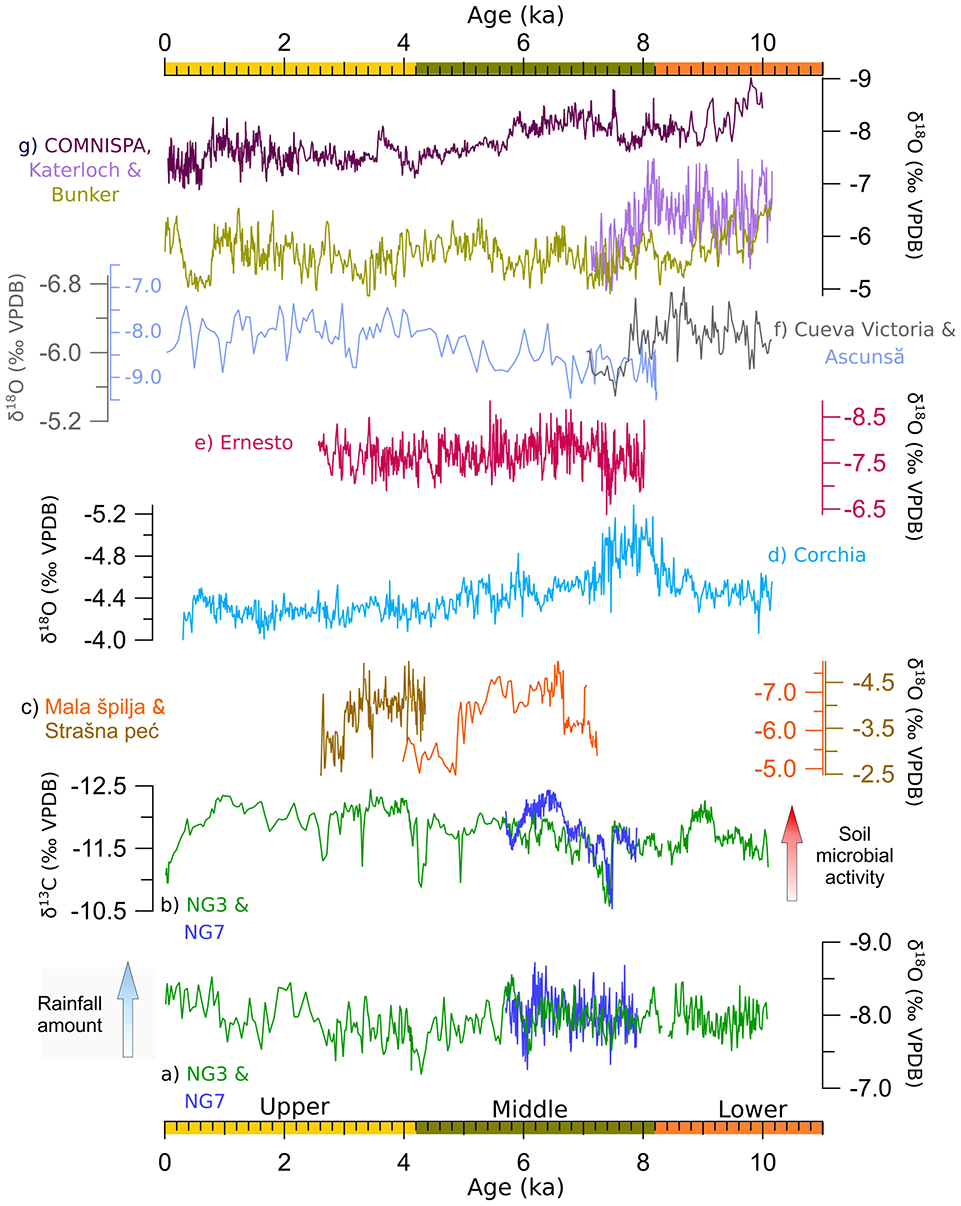
NG-3 and NG-7 stalagmites δ18O (a) and δ13C (b) time series compared to other speleothem data from: (c) Mala špilja Cave (Lončar et al., 2017) and Strašna peć Cave (Lončar et al., 2019); (d) Corchia Cave (Bajo et al., 2016; Zanchetta et al., 2007); (e) Ernesto Cave (Scholz et al., 2012); (f) Ascunsă Cave (Drăguşin et al., 2014) and Cueva Victoria (Budsky et al., 2019); (g) Spannagel Cave—composite record named COMNISPA (Fohlmeister et al., 2012a), Katerloch Cave (Boch et al., 2009) and Bunker Cave (Fohlmeister et al., 2012b). Y-axis is inverted in all curves with the exception of Ascunsǎ Cave. The x-axis (bottom and top) reports the Holocene subdivision (lower, middle and upper).
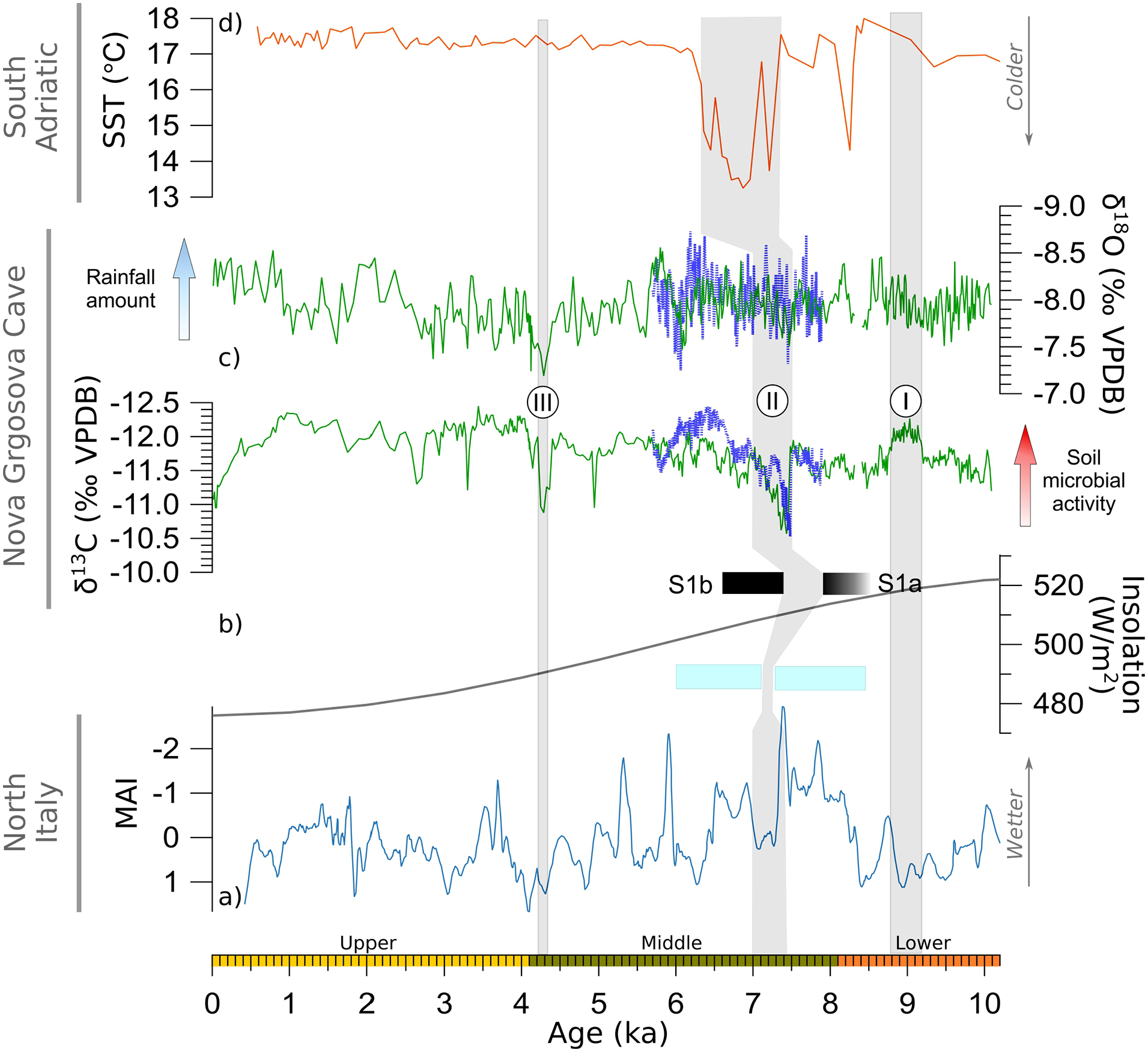
Comparison of NG-3 and NG-7 stalagmites δ18O and δ13C time series data (c) with (a) Mean Anomaly Index (MAI) derived from Corchia Cave data (Bajo et al., 2016; Regattieri et al., 2014a), (b) north hemisphere insolation and (d) sea surface temperature (SST) reconstructed from the South Adriatic marine core MD 90–917 (Siani et al., 2013). Black rectangles mark sapropelic layer S1 from Vrana Lake divided into two episodes S1a and S1b (Bakrač et al., 2018) and blue rectangles refers to Malo Jezero Lake (Mljet Island) pluvial phase interrupted from about 7.2–7.1 ka (Wunsam et al., 1999). Gray shading represents events discussed in the text: (I) 9.2–8.8 ka, (II) 7.4–7.0 ka, (III) 4.2 ka event. Y-axis is inverted in (a) and (c). The x-axis reports the Holocene subdivision (lower, middle, and upper).
Following this negative shift, the δ13C shows a trend of increasing values for the next ~600 years, toward the “8.2 ka event.” This short-lived near-global phenomenon highlighted by strong North Atlantic cooling was likely caused by an abrupt outburst of North American proglacial lakes Agassiz and Ojibway at ~8.47 ka (Lajeunesse and St-Onge, 2008). It triggered a reduction in the Atlantic Meridional Overturning Circulation (AMOC), a δ18O depletion of subpolar North Atlantic surface ocean water and a climate anomaly across Europe, as documented in various archives including speleothems. However, its registration in speleothems is inconsistent (Lechleitner et al., 2018). For example, while it has been detected in south Belgian stalagmites from Père Noël Cave (Allan et al., 2018), in Herbstlabyrinth cave system, Central Germany (Mischel et al., 2017), in Austrian Katerloch Cave (Boch et al., 2009), and in Kaite Cave in north Spain (Domínguez-Villar et al., 2009), it did not produce an unequivocal isotopic signature in Spanish El Soplao Cave (Rossi et al., 2018). Similarly, the 8.2 ka anomaly is not recorded in Romanian caves Poleva (Constantin et al., 2007) and V11 (Tămaş et al., 2005), although it is clearly identifiable in other regional records (peat bog pollen, lacustrine, marine sediments). In Ascunsă Cave, the 8.2 ka event is recorded only by higher growth rate (Drăguşin et al., 2014). In our NG record, an increase of δ18O is apparent between 8.48+0.11/−0.27 ka to 8.11+0.29/−0.34 ka, but the full amplitude of isotopic variability during this time is unknown due to the 4 mm of missing calcite at the point where the speleothem fractured (equivalent to ~4 missing samples, and spanning several 100(s) years) (Figure 6a). Based on the significantly lower δ13C variability over the same period, we can assume that water availability was perhaps only slightly disturbed at most, as notable in partly decreased growth rate (Figure 5). Increased δ18O values might thus reflect a reduction in 18O-depleted autumn-winter rainwater, suggesting a change in precipitation seasonality. Temperature shifts cannot be resolved, although they were estimated down to −3°C in Austria’s Katerloch Cave (Boch et al., 2009).
Middle Holocene
Northgrippian stage (i.e. Middle Holocene: 8.2–4.2 ka) changes were captured in both NG speleothems. The most prominent and abrupt increase of δ13C values was recorded at ~7.4 ka (7.37+0.07/−0.11 ka in NG-3 and 7.42+0.10/−0.13 ka in NG-7), potentially corresponding to Bond event 5 (Bond et al., 2001). High correlation between δ13C values of NG-3 and NG-7 speleothems strongly suggest the signal reflects at least local climate conditions, rather than individual spelothem-specific effects. Moreover, similar positive, usually short-lived, excursions have been reported in several other European speleothem δ18O records, with almost the same timing: in Spannagel Cave at 7.45+0.02/−0.03 ka (Fohlmeister et al., 2012a), Bunker Cave at 7.45+0.41/−0.28 ka (Fohlmeister et al., 2012b), Ernesto Cave at 7.45+0.44/−0.44 ka (Scholz et al., 2012), Corchia Cave at 7.46+0.09/−0.08 ka (Zanchetta et al., 2007) and in Cueva Victoria at 7.53+0.37/−0.28 ka (Budsky et al., 2019) (Figure 6) indicating a climate event with regional impact. Elevated speleothem δ18O values from Mala špilja Cave (Mljet Island, SE Adriatic) are centered at 7.23+0.10/−0.10 ka (Lončar et al., 2017). All these sites are characterized by increased speleothem δ18O values during cold and dry periods, even those short-lasting. Thus, we suggest that such an event around 7.4–7.5 ka decreased biological activity above Nova Grgosova Cave and/or prolonged residence time of groundwater in the aquifer, both leading to a δ13C increase. A positive δ13C shift is the signature of reduced vegetation in response to dry spring/summers with 18O-enriched precipitation; relatively unchanged δ18O, not biased toward lower δ18O values, might suggests autumn-winter droughts as well. The abrupt transition to dry and cold conditions was followed by gradual recovery of the vegetation cover.
In the broader temporal and spatial context, this potential centennial-scale “7.4 ka event” is an episode within the HCO which is, in the Eastern Mediterranean, usually coupled with the last Sapropel event (S1), broadly synonymous with a Holocene pluvial phase in Mediterranean (e.g. Filippidi et al., 2016 and references therein). Sapropel events are quasi-periodical occurrences of organic-rich marine sediments formed in anoxic environments due to the shutdown of local thermohaline circulation responsible for the oxygenation (Vadsaria et al., 2019). Reasons for such conditions are climate-driven surface-water freshening, reduced deep-water ventilation, and increased export production (Grant et al., 2016), mainly caused by enhanced rainfall in the Nile River catchment. Combined palynological and geochemical analysis of lake sediment core from eastern Adriatic Vrana Lake provides evidence of climate changes associated with deposition of sapropel S1. Specifically, two sapropelic layers (S1a and S1b, Figure 7) were identified, separated by a horizon at 7.9–7.4 cal ky BP that corresponds to the drier climate conditions (Bakrač et al., 2018). Similarly, a pluvial period reconstructed from eastern Adriatic former lake (presently sea bay) Malo jezero (Mljet Island) lasted from 8.4 to 6 ka, but apparently was interrupted by a drier episode from about 7.2 to 7.1 ka (Wunsam et al., 1999). This coincides with the timing of a sudden shift toward drier conditions after the significant wet period at Corchia, as revealed in the Mean Anomaly Index (Regattieri et al., 2014a) (Figure 7). Based on the combined planktonic and benthic stable oxygen and carbon isotopes from South Adriatic marine core MD 90–917, two main mid-Holocene sea surface temperature (SST) coolings were reported at 8.2 ka and within post-sapropel S1b phase between 7.3 and 6.3 ka (Siani et al., 2013) (Figure 7). These cooling episodes are related to long-term (multi-decadal) periods of strong winter inflow of cold and dry air from eastern Europe, causing severe northeast winds (bora) along the eastern Adriatic coast (Rohling et al., 2002; Siani et al., 2013) which is also the principal mechanism for cool Adriatic deep water (ADW) forming (Checa et al., 2020).
These findings of drier episode in otherwise wetter conditions in Mediterranean basin suggest regional hydroclimate instability within the relatively stable HCO. However, it has already been established that rapid climate shifts may have synchronous impact globally, although the effects can be regionally variable or even contrasting (Head, 2019). Thus, around 7.5 ka, while the NG site and southern regions experienced a drier and/or colder episode, some of the eastern European sites recorded warming, for example, Hungarian Leány Cave from 7 to 6 ka (Demény et al., 2013) or Romanian V11 cave from 7.6 to 5.6 ka (Tămaş et al., 2005).
Using a global assemblage of data from different archives (lake sediments, ice cores, marine sediments, and speleothems) and supported by known concurrent social, demographic and cultural data, Hou et al. (2019) postulated that “7.5–7.0 ka event” can be considered a worldwide, multicentennial climate event. Holocene climate instability between 8.0 and 7.0 ka has also been linked to the “7.2 ka event,” a term introduced by Feng et al. (2020), but discussed earlier by Wang et al. (2005). According to the multi-proxy speleothem-based reconstruction, it started at 7.29 ka BP ± 0.03 ka BP, lasted nearly 200 years and was characterized by the weakening of Asian monsoon (AM) and drought episodes in SW China. Due to the consistency of the speleothem record and Greenland GISP2 ice core δ18O, decreased Pacific and Atlantic SSTs, as well as sunspot activity (i.e. orbitally induced insolation changes), Feng et al. (2020) imply that “7.2 ka event” may have global significance. Either way, the NG record provides evidence of an apparent climate anomaly, which could contribute to the eventual establishment of this event on a more widespread scale, some time between 7.5 and 7.0 ka.
According to Perşoiu et al. (2017) atmospheric circulation patterns similar to NAO− phase prevailed during the early and mid-Holocene in East-Central Europe, while the late-Holocene has been characterized with conditions resembling a NAO+ phase. An abrupt transition occurred around 4.7 ka, marking a conversion from the early/mid-Holocene period of generally humid conditions with occasional episodes of intensified seasonality, to the drier period of late-Holocene (Perşoiu et al., 2017). Likewise, the end of mid-Holocene NG-3 record is also marked with an abrupt δ18O increase from 4.60+0.47/−0.33 ka toward maximum δ18O values at around 4.2 ka.
Upper (Late) Holocene
The transition to Megahayalan stage (i.e. Upper/Late-Holocene: 4.2 ka to present) is recorded solely in NG-3 stalagmite and is marked by the highest δ18O values, increased δ13C, very slow growth rate and remarkable color and textural changes (Figure 5). It corresponds to the timing of 4.2 ka event, the purportedly global aridification episode caused by deflected monsoon and ocean-atmosphere circulation system that resulted with century-scale precipitation disruptions (Weiss, 2016). The reduction in precipitation delivered by the Mediterranean westerlies in the eastern hemisphere was estimated to be 30%–50% (Weiss, 2016) and, according to the thorough overview of the 4.2 ka event in the Mediterranean region by Bini et al. (2019), hydrological conditions were generally more arid but with some locally opposed responses. Additionally, a decrease in temperature was not commonly featured across the whole region. Speleothem records from the eastern Adriatic insular caves Strašna peć (Dugi otok Island) (Lončar et al., 2019) and Mala špilja (Mljet Island) (Lončar et al., 2017) both point to dry environmental conditions around 4.2 ka (Figure 6), as well as some other regional proxies from the cores from Busuja Bay in Istria (Kaniewski et al., 2018), Lake Vrana (Cres Island) (Schmidt et al., 2000) and Bokanjačko blato in North Dalmatia (Ilijanić et al., 2018). Although the climate type of the NG region does not fully correspond to the Mediterranean climate of Bini et al. (2019) (based roughly on the reach of the olive tree), the NG speleothem clearly recorded this sudden anomaly. Contrary to the early and mid-Holocene patterns, simultaneous δ18O and δ13C increase suggests that precipitation decreased on annual level. This resulted in decreased growth rate and an apparent alteration of the speleothem color, suggesting a change in the input of soil organics. As for the temperature, based on the South Adriatic SST (Siani et al., 2013) in the absence of other temperature indicators, we can tentatively conclude that the MAAT remained stable throughout the 4.2 ka event.
The last 1000 years in NG record appear stable in terms of precipitation amount and uniform seasonal distribution, as observed also during the instrumental period (Figure 1d). However, δ13C shows a rather conspicuous increase from −12.3‰ to −11.0‰ along with modern farmed calcite having even higher δ13C values from −9.6‰ to −8.4‰. We presume that the surface above the cave has been deforested during the last millennium for various human activities, while modern values are additionally increased due to the clearance of the forest and topsoil for the lime production (which eventually led to the NG cave opening in 2004).
Millennial-scale hydroclimate variability versus short-termed features
The long-term decrease in δ13C values between 10 and 1 ka BP is probably a consequence of a progressive change in soil-cover thickness, since mature soil contains more organic matter with higher soil pCO2, which leads to lower δ13C (Scholz et al., 2012). Additionally, it may also be in response to orbitally driven variability from decreasing insolation during the course of Holocene (Figure 7b), as recorded, for example, in western Iberia (Thatcher et al., 2020). At the same time, δ18O slowly increases, suggesting a subtle drying trend. From a general perspective, it is interesting to note that the NG dataset reports, on average, more negative δ18O values than the modeled longitude spatial gradients proposed by McDermott et al. (2011); however, the latter was not supported by any record in the 14.2° and 21.0° longitude band of eastern Europe, hence preventing a robust interpolation of the data.
Although the NAO relates to inter-annual to multi-decadal atmospheric dynamics, long-term Holocene NAO-like variability is often discussed (e.g. Perşoiu et al., 2017; Regattieri et al., 2019; Thatcher et al., 2020). In that sense, the early and mid-Holocene are considered as NAO− resemblant phases (Perşoiu et al., 2017), which would have resulted in humid conditions in southern Europe during the HCO. However, our (local to regional) records within that time frame exhibit significantly different patterns: (i) the 9.2–8.8 ka event could easily fit into the NAO− mode settings, and we can speculate that it was an event of local importance, but simply enhanced by the large-scale hydroclimate system; (ii) the 8.2 ka event appears to be nullified (although the missing speleothem section might have recorded that signal) as it was opposed to NAO influence; and (iii) the very pronounced 7.5–7.0 ka event linked to apparent aridity which, we assume, could not have been sustained within a humid negative-NAO-like phase. On the contrary, due to the relative strength of the signal, we suggest that this local/regional episode was additionally maintained by the atmospheric settings resembling a NAO+ mode. Coherent with this interpretation, a strong positive NAO phase later at 6 ka is both measured from speleothem δ18O as well as modeled by Wackerbarth et al. (2012), while according to Perşoiu et al. (2017) only the Late-Holocene is considered to be more positive NAO-like. Either way, the interplay of large-scale climate patterns and local conditions of different strength and duration obviously leaves significant imprint in this sensitive area, which has yet to be critically re-examined.
Possible impact of human (pre)history on the speleothem record
The cave-based research of interrelation between Quaternary environmental changes and human occurrence can be successfully complemented by archaeological findings. During the Paleolithic, human hunter-gatherers used caves as occasional shelters or as more permanent habitats. In continental Croatia, near NG cave, rich archaeological material can be found, such as the world-famous Neanderthal site in the cave in Hušnjakovo brdo (40 km NE) (Gorjanović-Kramberger, 1906), Vindija Cave (75 km NE) (Karavanić et al., 2006), and Veternica Cave near Zagreb (15 km E) (Banda and Karavanić, 2019; Malez, 1979), at the time when NG was still a cavern without a natural entrance. By the end of the Early Holocene, Late Paleolithic, and Mesolithic sites in littoral Croatia were inhabited by forager-fishers (Pilaar Birch and Linden, 2018), but their way of life and population distribution were substantially affected and governed by the environmental changes since sea-level fluctuations considerably reshaped the landscape (Pilaar Birch and Miracle, 2017), as reconstructed, for example, in Vela Spila Cave (Korčula Island) site (Dean et al., 2020). Human activities through this period left imprints mainly in clastic cave sediments, but the speleothems were too insensitive to record the overall human impact to the environment. Finally, by the mid-Holocene, during the first agricultural revolution in the Early Neolithic, deforestation appeared as one of the earliest human impact on the environment (Fairchild and Baker, 2012). Particularly in speleothems, this should leave a paleoenvironmental signal in form of higher δ13C values (Jiménez de Cisneros and Caballero, 2011), so the earlier discussed positive δ13C shift around 7.4 ka in NG stalagmites could be explained by anthropogenic deforestation. However, Neolithisation – a shift from the hunter-gatherer nomadic to sedentary agricultural lifestyle – ushered also permanent settlements often built on the riverbanks (Botić, 2016a). In continental Croatia, Early Neolithic sites were discovered mainly in the eastern part in the lowlands (Botić, 2016b), while the hilly region of NG cave retains no sign of human settlements, supporting hydroclimate causes of isotopic variations, rather than anthropogenic. In the Slovenian region of Bela Krajina (50 km SW from NG), Andrič (2007) detected beech (Fagus) decline from 7.5 to 7.0 ka, but no archaeological site can confirm an anthropogenic cause of this vegetation change. Only archeobotanical research of Neolithic/Eneolithic sites from around 6.1 ka reveal frequent forest clearance and burning events, most likely human-induced (Andrič, 2007). At the same time, in the aforementioned Vela Spila Cave (Korčula Island), absence of clastic cave sediments from the period of the stabilized vegetation on the slopes was followed by evidence of the Late Neolithic soil erosion interpreted as a consequence of anthropogenic deforestation for agriculture and pastoralism (Dean et al., 2020).
As for the last millennium, historical documents attest to the existence of copper mines from the 13th century near the village of Rude (3 km S from NG cave), while the actual beginning of mining can be traced back to the Roman Period (Vrkljan and Lebegner, 2008). Mining was particularly intensified during the 16th and 17th centuries when copper mines in Rude were some of the largest in Europe (Vrkljan and Lebegner, 2008), so expanding copper production brought numerous miners from across the Europe (Šebečić, 1994). The increasing number of settlers required more arable lands for food production and more timber for housing, mine timber (supporting pillars) and smelting, leading to intensive deforestation, particularly when the size of the mines and their production is considered. In 1784, French naturalist Balthasar Hacquet documented fuel shortage which clearly indicates that at the time surrounding forests were already depleted (Grakalić, 2006). This anthropogenic influence could have masked the potential impact of rapid climate changes such as those of the Medieval Warm Period or Little Ice Age, but at the same time it might have marked the local Holocene–Anthropocene boundary (Waters et al., 2018).
Conclusions
The first speleothem δ13C and δ18O record in continental Croatia, from Nova Grgosova Cave, provides insights into Holocene hydroclimate variations. Several multi-decadal to multi-centennial isotope excursions were climate related, which could be linked to local, regional and global changes, as follows:
From 9.2 to 8.8 ka BP local environmental conditions improved in terms of vegetation dynamics with consequent increased speleothem growth rate, in spite of regionally decreased temperatures.
- As the 8.2 ka event has not been completely recorded by distinct isotopic shifts (due to missing samples), we assume that the site was not water limited during the period of main vegetation growth (i.e. spring/summer); the main feature recorded by NG speleothems is a change in the seasonal distribution of precipitation leading to drier autumn/winter seasons.
- Around 7.4 ka, within the Holocene Climate Optimum, an abrupt δ13C increase points to environmental deterioration, that is, reduced vegetation and soil microbial activity in response to enhanced spring-summer aridity. Given the minimal δ18O variability, it appears that the winter-autumn precipitation was also reduced, most probably due to long-term inflow of cold and dry east-European air. Recently, a “7.5–7.0 ka event” has been hypothesized to be a worldwide multicentennial climate event, but its true global importance remains to be verified. Thus, local and regional findings such as those presented here can contribute to a better understanding of this proposed climate anomaly during the HCO.
- The 4.2 ka event is marked by an overall short-term rainfall reduction. Presumably, reduced autumn/winter precipitation was more pronounced than spring/summer rainfall.
- The latest short-term (centennial) climatic variability throughout the last millennium could not be reconstructed due to an apparent human intervention into the natural forest landscape.
Finally, the competing influences of the Mediterranean and the Atlantic make Nova Grgosova Cave a key location for studying Holocene NAO-like climate variations, as well as their impact on local environmental conditions. Thus, further research using high-resolution multi-proxy approach should address shifts of dominant influences at finer spatio-temporal scale.
Supplemental Material
sj-pdf-1-hol-10.1177_09596836211019120 – Supplemental material for Holocene hydroclimate changes in continental Croatia recorded in speleothem δ13C and δ18O from Nova Grgosova Cave
Supplemental material, sj-pdf-1-hol-10.1177_09596836211019120 for Holocene hydroclimate changes in continental Croatia recorded in speleothem δ13C and δ18O from Nova Grgosova Cave by Maša Surić, Andrea Columbu, Robert Lončarić, Petra Bajo, Neven Bočić, Nina Lončar, Russell N Drysdale and John C Hellstrom in The Holocene
Footnotes
Acknowledgements
We are grateful to Grgos family, the concessionaire of the Nova Grgosova Cave and Public Institution Green Ring of Zagreb County for the long-term fruitful cooperation. N. Buzjak and S. Buzjak are acknowledged for the field assistance during the cave monitoring. We thank Roman Witt for assistance with the stable isotope analyses and Rieneke Weij for U-Th sampling at The University of Melbourne. We also thank Croatian Meteorological and Hydrological Service for providing climatological and meteorological data. Three anonymous reviewers are acknowledged for their detailed reviews which additionally improved the paper. Stable and U-series isotope data are archived in the SISAL database and will be freely available by the next update (SISAL_v3).
Funding
The author(s) disclosed receipt of the following financial support for the research, authorship, and/or publication of this article: This research was performed within the project Reconstruction of the Quaternary environment in Croatia using isotope methods (HRZZ-IP-2013-11-1623) financed by the Croatian Science Foundation.

Supplemental material
Supplemental material for this article is available online.
References
Supplementary Material
Please find the following supplemental material available below.
For Open Access articles published under a Creative Commons License, all supplemental material carries the same license as the article it is associated with.
For non-Open Access articles published, all supplemental material carries a non-exclusive license, and permission requests for re-use of supplemental material or any part of supplemental material shall be sent directly to the copyright owner as specified in the copyright notice associated with the article.
