




Abstract
Sedimentary charcoal records provide useful perspectives on the long-term controls and behavior of fire in the Earth System. However, a comprehensive understanding of the nuances, biases, and limitations of charcoal as a fire proxy is necessary for reliable paleofire interpretations. Here, we use a charcoal dispersal model to answer the following questions: (1) How does the dispersal of wood and grass charcoal particles differ? (2) Do traditional conceptual models of charcoal dispersal reliably characterize grass charcoal dispersal? We find that small differences in shape (length:width (L:W)) and density of grass and wood charcoal can cause substantial differences in particle dispersal and source area. Whereas the modeled dispersal of wood charcoal shows a localized deposition signal which decays with distance, grass charcoal shows more diffuse deposition lacking a localized center (for both >125 µm and >60 µm). Although paleofire research has typically not distinguished between fuel types when interpreting source area, we show that the dispersal of charcoal derived from different fuels is unlikely to be uniform. Because differences in localization, production, and preservation could bias aggregate charcoal accumulation, caution should be taken when interpreting wood and grass-derived charcoal particles preserved in the same record. Additionally, we propose an alternative, dual background conceptual model of grass charcoal dispersal, as the traditional, two-component (peak and background) conceptual model does not accurately characterize the modeled dispersal of grass charcoal. Lastly, this mismatch of conceptualizations of dispersal mechanics implies that grass charcoal may not fit the criteria necessary for peak analysis techniques.
Introduction
The impacts of anthropogenic climate change on global fire regimes are complex and intertwined with land management and vegetation dynamics (Andela et al., 2017; Bond et al., 2005; Hantson et al., 2016; Pausas and Ribeiro, 2013). This interplay between fire and vegetation in the Earth System is intrinsic and spans broad temporal scales (Bowman et al., 2009; Scott, 2000). Although historical data such as recorded observations and satellite imagery can characterize short-term fire-vegetation relationships, long-term archives of fire and vegetation are needed to resolve these relationships on time scales exceeding observational records (Marlon, 2020; Rehn et al., 2021; Vachula et al., 2019; Whitlock and Larsen, 2002). Sedimentary charcoal records are among the most ubiquitous paleofire archives (Hawthorne et al., 2018; Power et al., 2008; Remy et al., 2018) and have provided unique insight into the dynamic relationships between fire, climate, vegetation, and humans (Marlon, 2020; Whitlock et al., 2010). Despite the continuous development of paleofire research, many uncertainties remain regarding the interpretation and controls of paleofire archives and proxies (Hennebelle et al., 2020; Rehn et al., 2022; Vachula, 2021; Vachula and Cheung, 2021).
Efforts to model charcoal dispersal have helped to inform interpretation of sedimentary charcoal records. Beginning with the pioneering conceptualizations of charcoal particle transport, deposition, and source area made by Clark (1988), increasingly sophisticated modeling efforts have been made to computationally characterize the likely behavior of charcoal particles. Notably, as explained by Peters and Higuera (2007), Clark (1988) adapted equations developed to understand the diffusion and transport of smoke particulates in the mid-20th century (Chamberlain, 1953; Sutton, 1947a, 1947b) to develop a one-dimensional model that has since come to undergird traditional thinking about the size dependence of charcoal dispersal and directly informed the interpretation of pollen slide charcoal. Peters and Higuera (2007) later expanded this model into a two-dimensional form, making key insights about dispersal and sourcing. This model was further enhanced and integrated with other modules simulating sediment mixing and sampling to create the Charcoal Simulation Model (CharSim), arguably the first proxy system model for sedimentary charcoal (Higuera et al., 2007). This systematic approach was further expanded with the development of a Bayesian point process model (Itter et al., 2017). Alternative modeling perspectives emerged several years later. Gilgen et al. (2018) implemented microscopic charcoal into a global aerosol climate model resolving atmospheric transport and particle, cloud, and radiation interactions. Concurrently, Vachula and Richter (2018) developed a kinetics-based model as an alternative to the diffusion-based charcoal dispersal models (Clark, 1988; Higuera et al., 2007; Peters and Higuera, 2007), which enables testing of the influence of particle characteristics (e.g. shape, size, density) on charcoal dispersal. This alternative model was used to show that particle shape irregularities (i.e. non-sphericity) could significantly blur the size dependence of dispersal that had previously been supported by the diffusion-based models (Vachula and Richter, 2018).
The advent of charcoal particle morphological and morphometric analysis underscores the importance of understanding how individual particles are dispersed and preserved in lacustrine sediments or soils. Early experimental work showed that morphometric characteristics of charcoal could differentiate fuel types (Umbanhowar and Mcgrath, 1998), effectively founding a new subfield of paleofire research. Subsequent experimental efforts have built on this foundation to link morphometric characteristics with fuel types (Crawford and Belcher, 2014; Feurdean, 2021; Ogura, 2007; Pereboom et al., 2020; Vachula et al., 2021). Concurrently, efforts have been made to assess charcoal particle morphotypes as a means of characterizing fuel changes (Enache and Cumming, 2006; Jensen et al., 2007; Mustaphi and Pisaric, 2014). Although the morphological characterizations are informative, they have been criticized for their subjectivity and regional specificity (Cheung et al., 2021). Strides have been made to automate morphological characterization (Rehn et al., 2019), but questions regarding the universality of classification systems remain (Frank-DePue et al., 2022). In contrast, classification based on aspect ratio, which differentiates charcoal sourced from woody and grass/non-woody fuels, has demonstrated relative universality (Vachula et al., 2021). The ability of aspect ratio to distinguish fuel types raises new questions regarding the taphonomy of these two sets of charcoal particles. Kinematic-based modeling has shown that particle shape can have a significant impact on charcoal dispersal (Vachula and Richter, 2018), thereby highlighting the need to determine and understand how particle shape characteristics relating to fuel type might influence the dispersal and preservation of paleofire archives. The reliable interpretation of sedimentary charcoal records relies upon a robust understanding of how fire activity in different ecosystem contexts and at different spatial scales is recorded in paleofire archives (Daniau et al., 2013; Genet et al., 2021; Walsh et al., 2010).
In this paper, the dispersal of charcoal particles derived from woody and grass, non-woody fuels is modeled to answer the following questions: (1) How does the dispersal of wood and grass charcoal particles differ? (2) Do traditional conceptual models of charcoal dispersal reliably characterize grass charcoal dispersal? Although empirical data has demonstrated that the model we use does reliably characterize charcoal dispersal and sourcing, our modeled results are theoretical and further field-based empirical research is needed to validate our findings.
Methods
We adapted the model presented by Vachula and Richter (2018) to characterize the differences in dispersal of charcoal particles derived from wood and grass fuels. The model is constructed in MATLAB and is composed of two parts: (1) atmospheric injection of particles by a convective smoke plume and (2) dispersal and fallout deposition of particles from this initial injection height (Vachula and Richter, 2018). The model construction and mathematics are detailed in Vachula and Richter (2018), so we forgo a thorough description herein. Briefly, the model uses a Monte Carlo approach to simulate the dispersal of charcoal particles by randomizing relevant variables within acceptable and probable ranges to generate an ensemble of solutions that is representative of a realistic result. Namely, the model incorporates variability of fire heat release rate (and subsequent injection height by the convective plume), wind speed and direction in the horizontal plane (expressed as separate vectors in the abscissa (u) and ordinate (v) directions), and particle shape, size, and density (Vachula and Richter, 2018).
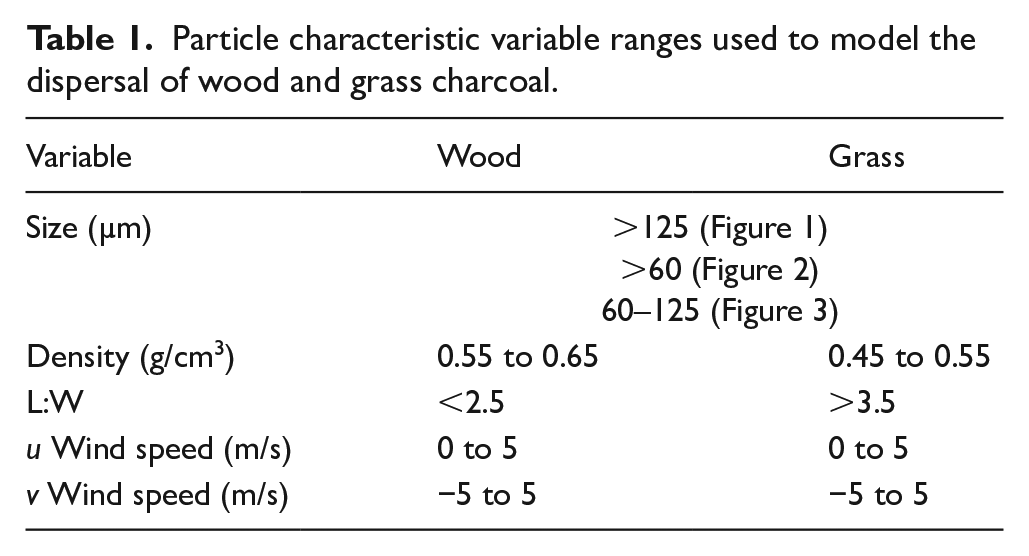
For the purposes of the analyses undertaken in this paper, we modified the model and its parameters in several ways. Firstly, we increased the maximum heat release rate to 100 × 106 cal/s (from 50 × 106 cal/s in the original model runs) to more accurately mimic the range of convective plume heights observed in nature (Val Martin et al., 2010, 2018). Second, we constrained particle size to mimic sieving of three charcoal particle size fractions (e.g. >125, >60, and 60–125 µm; Table 1). These size fractions were chosen to be comparable with size fractions that have been the subject of recent charcoal calibration research (Rehn et al., 2022; Vachula et al., 2018), as well as to be comparable with sieving size boundaries typically used in paleofire research (Vachula, 2019). Third, we implemented two sets of particle characteristic constraints (Table 1) for each of these size fractions to mimic the likely ranges of charcoal derived from wood and grass. As wood charcoal tends to be denser than grass charcoal, and the length:width ratios of wood and grass derived charcoal vary sufficiently to distinguish these particles (Vachula et al., 2021), we imposed slightly different variable constraints to differentiate the dispersal mechanics of these particles (Table 1). Although we were primarily interested in modeling the dispersal of macroscopic charcoal particles (Vachula, 2019), we also modeled finer size fractions because grass charcoal tends to produce smaller particles falling within the 60–125 µm size range (Leys et al., 2017; Saiz et al., 2018). Initial modeling results found that some grass charcoal particles achieved neutral or negative settling velocities due to extreme elongation which exceeded the empirical constraints for the aspherical particle settling velocities (Le Roux, 1996), so we added a safeguard to remove these unrealistic particles from the analysis.
Particle characteristic variable ranges used to model the dispersal of wood and grass charcoal.
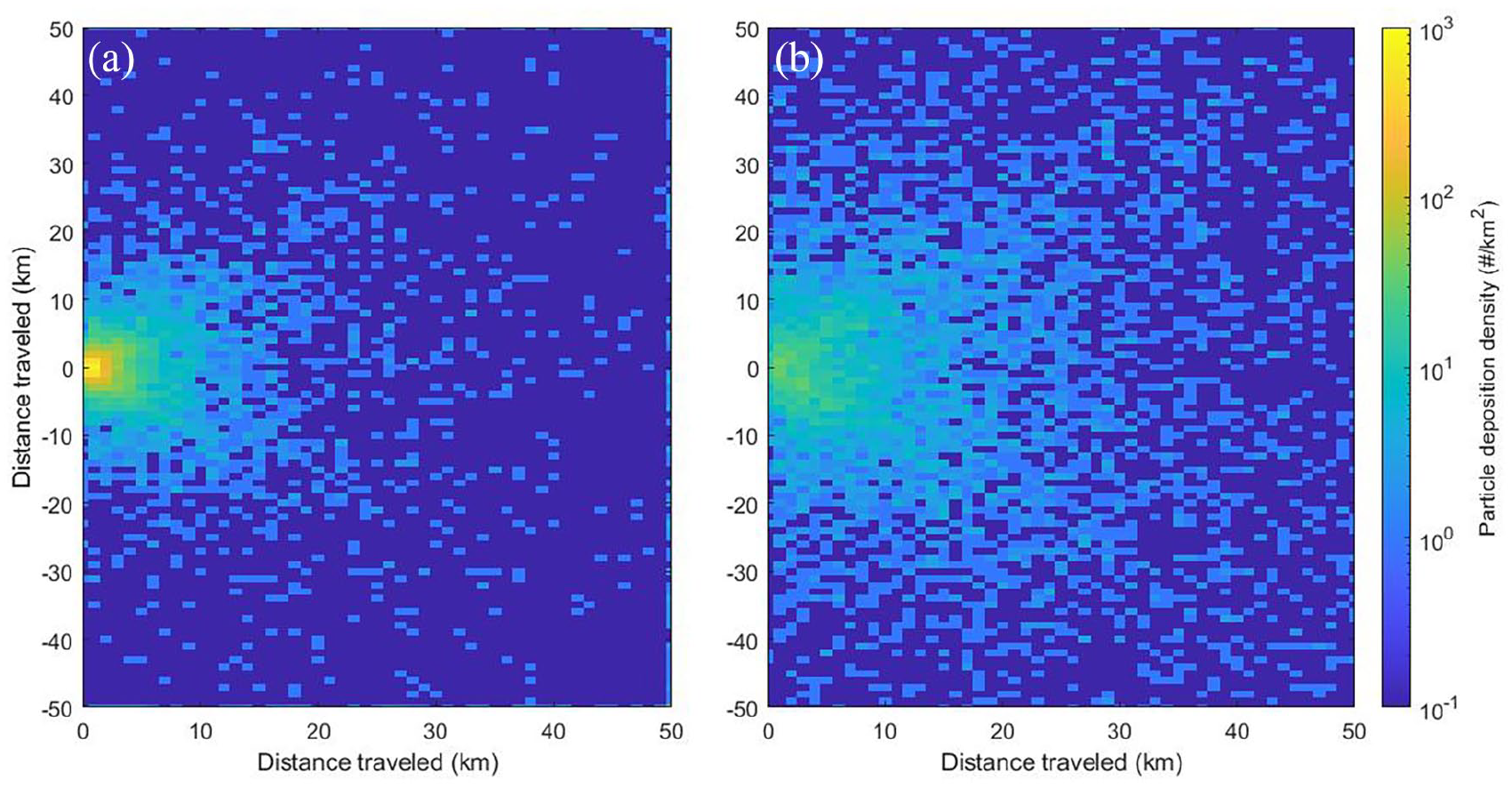
Modeled charcoal particle dispersal and deposition of >125 µm (a) wood and (b) grass charcoal particles. Horizontal and vertical directions denote distance from a fire source.
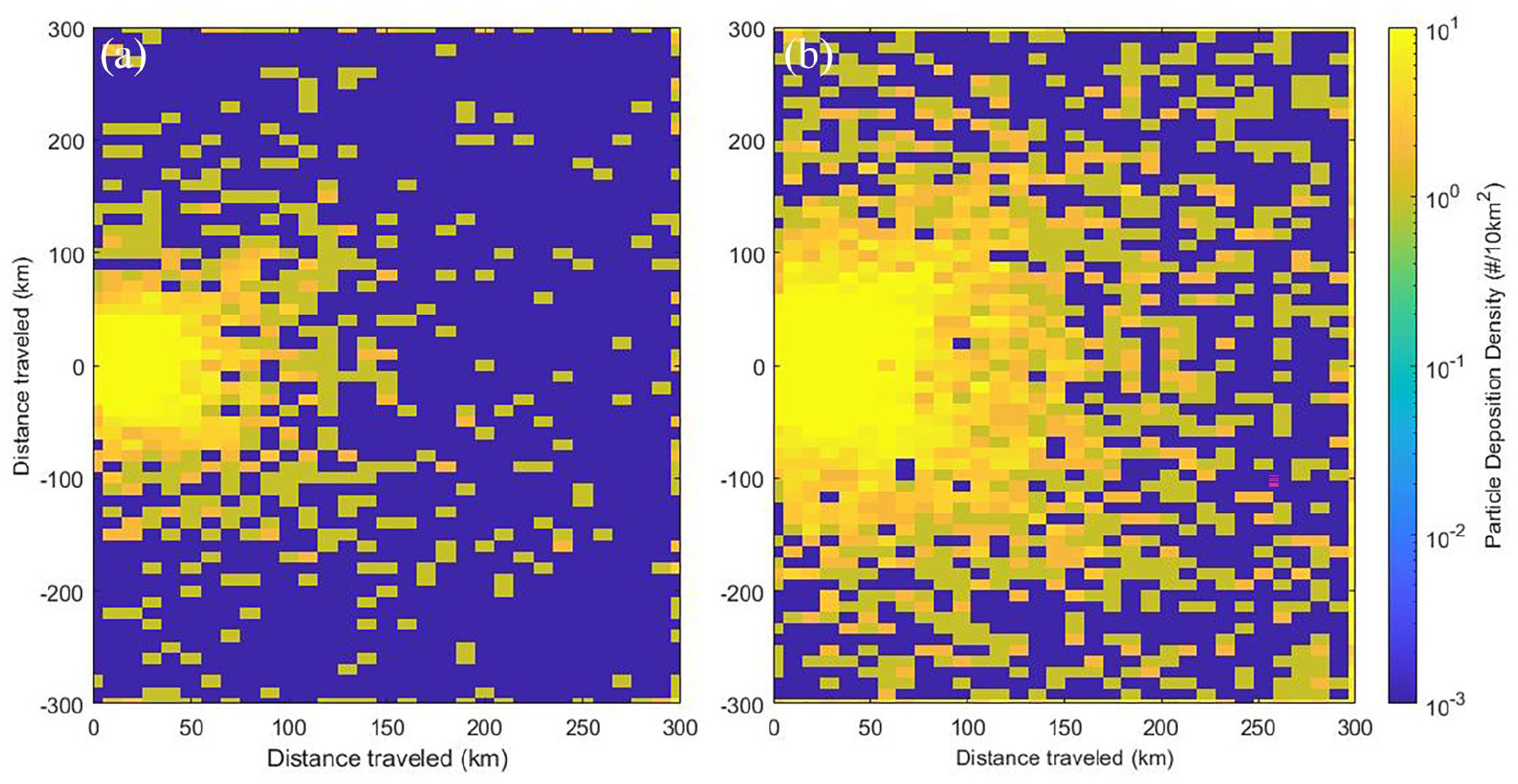
Modeled charcoal particle dispersal and deposition of >60 µm (a) wood and (b) grass charcoal particles.
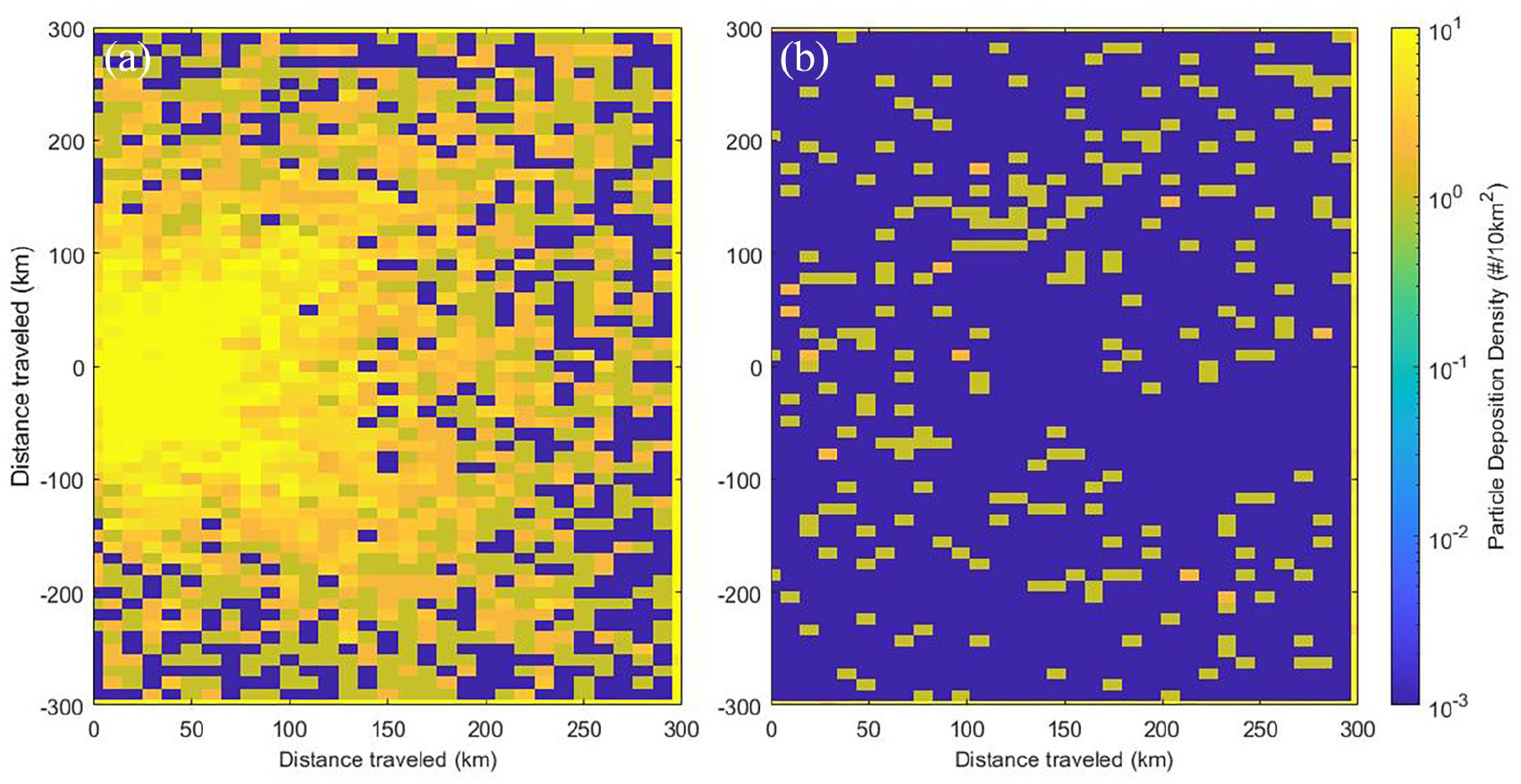
Modeled charcoal particle dispersal and deposition of 60–125 µm (a) wood and (b) grass charcoal particles.
Results
Our model results show that the dispersal of wood and grass charcoal particles varies markedly across all size fractions modeled (Figures 1–3). For >125 µm particles, modeled wood charcoal exhibits a primarily localized (within a few kilometers) deposition signal that decays with distance from the source (Figure 1a). In contrast, modeled grass charcoal exhibits a more diffuse depositional pattern which lacks a localized deposition center (Figure 1b). This same pattern also occurs when the particle size is decreased to >60 µm, although the spatial scale of dispersal is much greater (Figure 2). When the intermediate size fraction (between 60 and 125 µm) of charcoal particles is modeled (Figure 3), even starker differences between wood and grass charcoal emerge. Whereas wood charcoal 60–125 µm in size exhibits a relatively diffuse dispersal pattern (Figure 3a) akin to that of coarser grass charcoal (e.g. Figures 1b and 2b), grass charcoal 60–125 µm in size does not exhibit a clear depositional pattern at all. In fact, the bulk of modeled grass charcoal 60–125 µm in size were not deposited within the shown boundary conditions. This nuance will be explored in greater detail in the Discussion.
Discussion
How does the dispersal of wood and grass charcoal particles differ?
The model results show that the dispersal patterns of wood and grass charcoal particles are inherently different due to particle-scale differences in dispersal mechanics. Our results show that the small differences in particle shape (length:width (L:W)) and density (Table 1) which distinguish charcoal sourced from wood and grass fuels can significantly alter the dispersal mechanics and subsequent depositional patterns of these charcoal particles (Figures 1–3). These results agree with previous findings that suggest particle shape irregularities could alter dispersal distributions (Vachula and Richter, 2018). For each of the size fractions for which dispersal was modeled, we found that wood- and grass-derived charcoal particles exhibited distinctly different depositional patterns. This finding is significant; whereas the dispersal of charcoal particles has implicitly been assumed to be uniform between fuel types in paleofire research (Vachula, 2021), our results suggest that this is unlikely to be the case. Rather, charcoal derived from varying fuel types could be reflected differently in paleofire archives and therefore could have important implications for paleofire interpretations.
Importantly, our modeled results are theoretical and further empirical research is needed to validate our findings. Although empirical data has demonstrated that the Vachula and Richter (2018) model reliably characterizes charcoal dispersal and sourcing (Vachula et al., 2018), it has not been collected to test our modeled results. To this end, our results provide important insights but are not necessarily conclusive in the absence of field-based validation.
Notably, the extremely distal modeled deposition of 60–125 µm grass charcoal suggests that these particles are deposited on much larger distance scales than are plotted in Figure 3. Although this is theoretically possible, an abundance of published empirical data disagrees with this notion and shows that finer charcoal particles are in fact deposited on these distance scales (Adolf et al., 2018; Clark and Royall, 1995; Hennebelle et al., 2020; Higuera et al., 2011; Vachula, 2021). Rather, we infer that the mismatch of this modeled result with observed charcoal dispersal insinuates that processes which were not explicitly modeled have a role in the deposition of these particles. In other words, depositional mechanisms other than simple gravitational settling (e.g. rain, adsorption onto other particles) likely play an important role in the deposition of fine grass charcoal particles. In this way, more sophisticated modeling efforts like those of Gilgen et al. (2018) may be required to completely characterize charcoal dispersal within modeling frameworks.
Several aspects of the modeled dispersal results are supported by empirical observations. Saiz et al. (2018) demonstrated that savanna fires may generate pyrogenic carbon dominated by grasses, creating small particles that may be widely dispersed. Our results also demonstrate that >125 µm grass charcoal particles are likely to be dispersed further than woody particles of the same size fraction, further compounding the dispersal effects of grass charcoal typically generating smaller particles overall (Leys et al., 2017; Saiz et al., 2018). Conversely, smaller (60–125 µm) wood-derived particles may originate from more local fire events (Pitkänen et al., 1999), rather than the more regional signal typically interpreted from this size fraction. The more diffuse dispersal of grass charcoal particles relative to wood charcoal suggests that sedimentary paleofire records in grass-dominated and mixed wood-grass ecosystems represent more regional fire history than wood-dominated ecosystems. Our findings also suggest potential morphological biases in the source areas of charcoal, with wood-derived morphologies being overrepresented due to localized deposition while grass-derived particles may be spread over large distances (e.g. Leys et al., 2017; Saiz et al., 2018). This is demonstrated by Leys et al. (2015) where a charcoal morphotype identified as woody fuel made up 80% of the total recorded charcoal from controlled burns in a prairie ecosystem with 65% “pure herbaceous grassland” cover.
In addition to dispersal mechanics, other factors could also contribute to the differential representation of wood and grass derived charcoal in paleofire archives. Grasses producing finer charred material may also have implications for preservation potential (Crawford and Belcher, 2014). Estimates of wood versus grass cover based on charcoal morphology may therefore require correction similar to corrections for pollen productivity (e.g. Mariani et al., 2016). Additionally, there are likely complex interactions between fuels, fire intensity and/or severity, and subsequent dispersal and sourcing. Crown fires have been shown to potentially produce long, thin, and more aerodynamically efficient particles from burning leaves (Woodward and Haines, 2020), increasing dispersal distance through morphology as well as injective height (Li et al., 2017; Vachula and Richter, 2018). High intensity fires burning more woody fuels may also produce elongated charcoal from twigs (Jensen et al., 2007; Leys et al., 2017). Indeed, further work is needed to fully disambiguate and characterize the source-to-sink differences between wood and grass fuels in paleofire archives.
The differentiation of charcoal derived from grass and wood fuels has emerged as the primary relationship of interest in paleofire fuel interpretations across both closed and open wooded environments. This has led to the development of several techniques involving the physical and chemical characterization of individual particles. Specifically, charcoal morphologies (Enache and Cumming, 2006; Mustaphi and Pisaric, 2014), morphometric characteristics (Crawford and Belcher, 2014; Leys et al., 2017), and other optical properties (Gosling et al., 2019; Hudspith et al., 2015, 2017; Maezumi et al., 2021) have provided additional insights for these more nuanced paleofire approaches. Our results indicate that differences of particle sourcing should also be integrated into the interpretation of particle-scale measurements. Refining these interpretations is particularly important for understanding fire’s role in the gradients between closed to increasingly open environments as they are critical to understanding changing human impacts on landscapes (Aleman et al., 2013).
The stark mismatch between the modeled dispersal of grass and wood charcoal reflects a broader oversight of paleofire research to be inclusive of diverse biomes. For example, methodological development in paleofire research has previously been dominated by studies in Northern Hemisphere forested ecosystems and recent work has attempted to address this gap. Indeed, all proposed morphological keys for sedimentary charcoal have been developed and calibrated in North American boreal forests (Enache and Cumming, 2006; Mustaphi and Pisaric, 2014), and as a result, their efficacy and universality in other regions has been questioned (Cheung et al., 2021). Likewise, pioneering research calibrating charcoal morphometry to fuel types was conducted in high latitude North America (Umbanhowar and Mcgrath, 1998), although subsequent studies have been conducted in new regions (Crawford and Belcher, 2014; Li et al., 2019; Ogura, 2007; Pereboom et al., 2020; Zhang and Lu, 2006). More broadly, the tendency of paleofire research to focus on forested regions has been noted in the literature (Leys et al., 2018; Rehn et al., 2022; Vachula et al., 2020). Differences in fuel types, fuel loads, and fire frequency in these other biomes represent important points of resolution for the reliable transferability and application of paleofire approaches in new regions. As the model results demonstrate, researchers should be careful to not assume universality from geographically focused studies. In conjunction with our analysis, the increased interest of paleofire research in non-forested ecosystems highlights the need for new paradigms to be developed for these systems and serves as a cautionary tale of the potential pitfalls of misappropriation of these inferences.
Do traditional conceptual models of charcoal dispersal reliably characterize grass charcoal dispersal?
Our model results suggest that the dispersal of charcoal particles derived from grass does not conform to traditional conceptualizations and paradigms of charcoal dispersal. Traditionally, charcoal dispersal has been posited to consist of two components (Figure 4a): peak charcoal (coarser particles which are locally sourced) and background charcoal (finer particles which are regionally sourced) inputs (Crawford and Vachula, 2019; Higuera et al., 2007; Whitlock and Larsen, 2002). Our computational model results for wood charcoal particles generally support this conceptual model of charcoal dispersal, supporting the reliability of this paradigm for wood charcoal (Figure 4b). However, our results also suggest that this conceptual model is not appropriate for grass charcoal particles as these particles exhibit diffuse regional sourcing for both coarse and fine particles alike. As such, we propose an alternative conceptual model for grass charcoal dispersal: a dual background model wherein the difference of dispersal distance between fine and coarse particles is muted relative to the dispersal of wood charcoal particles (Figure 4c). Although further work is needed to test the reliability of our proposed dual background model in characterizing the dispersal of grass charcoal, we assert that recognition of the distinct difference between wood and grass charcoal dispersal is a necessity for reliable paleofire interpretations.
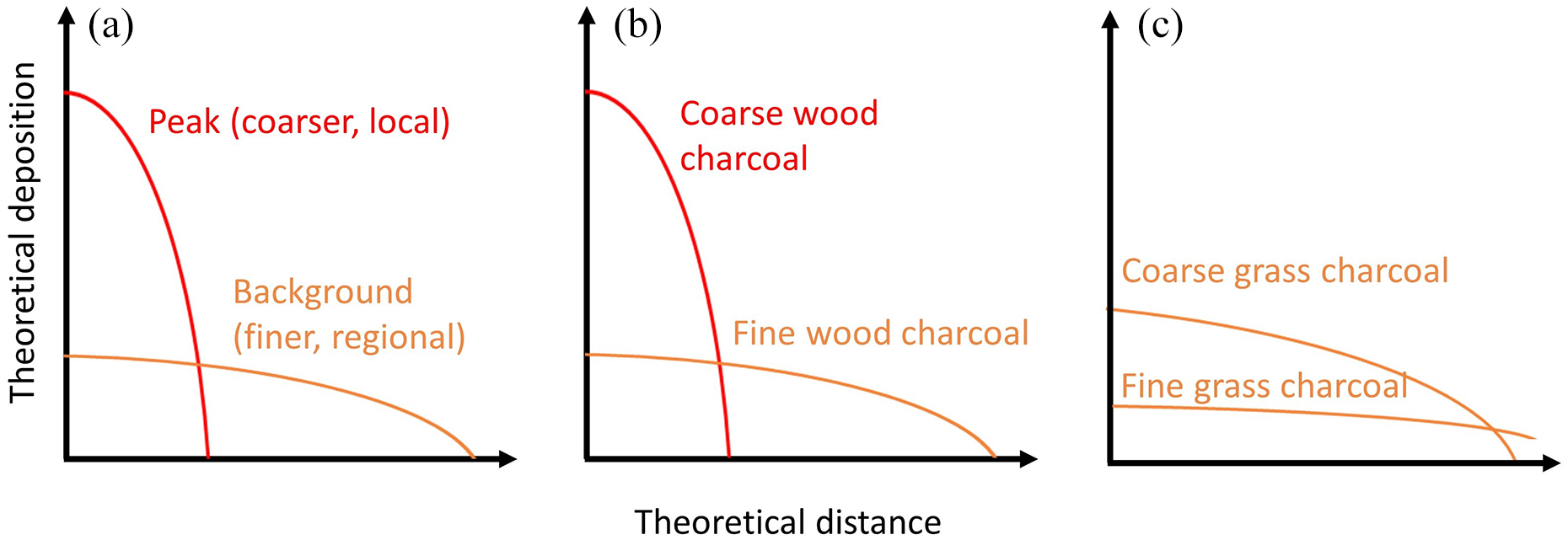
Conceptual figure characterizing the how our model results compare to the established paradigms of charcoal dispersal. Whereas the traditional model (a) of charcoal dispersal posits a two-component system of peak (coarser particles which are locally sourced) and background (finer particles which are regionally sourced) inputs, our model results indicate that this only holds true for wood charcoal particles (b). In contrast, the dispersal of grass charcoal particles (c) is characterized by diffuse regional sourcing for both coarse and fine particles alike.
Differences between the fire regimes of biomes pose important potential barriers for the reliable application of peak analysis techniques to sedimentary charcoal records. Peak analysis refers to the decomposition of CHAR time series into low-frequency, background, extra-locally derived and high-frequency, peak, locally-derived components (Finsinger et al., 2014; Higuera et al., 2010, 2011). This statistical analysis is grounded in theoretical postulations of diffusion-based charcoal particle dispersal which were borne out of the computational models of Clark (1988), Peters and Higuera (2007), and Higuera et al. (2007). Specifically, these models find evidence for two components of charcoal delivery to sediment archives: regional background and localized peak components. Peak analysis therefore involves the decomposition of total charcoal accumulation time series to identify the local fire events and reconstruct fire frequencies and return intervals.
The modeled dispersal of grass charcoal particles does not exhibit a pattern that agrees with the assumptions inherent to peak (signal-to-noise) analysis, indicating that peak analysis may not be appropriate in grassland systems. This builds on previous observations of peak analysis being inappropriate for grasslands due to fire frequency in these ecosystems because frequent fire events cannot be distinguished from a background signal (Leys et al., 2015, 2017). As peak analysis is based on the concept of identifying discrete fire events or episodes, this technique is unsuitable in grassland systems where fire return intervals (the time between discrete fire events) is often even shorter than the sampling resolution of charcoal records (Aleman et al., 2013; Leys et al., 2015, 2017); for example, Yates et al. (2008) report fire return intervals of 2–3 years in parts of northern Australia, and Alvarado et al. (2018) note fire return intervals of 1.8–3.2 years for protected areas in Madagascar and 7.9 years for a protected region in Brazil. Clark (1988) notes that for a site with sediment accumulating at 0.1 cm yr-1, individual fire events cannot be identified for fire return intervals of less than 50 years; Clark (1988) and Higuera et al. (2007) therefore recommend sampling at <0.12–<0.2 times the fire return interval which is impractical in ecosystems with sub-decadal fire return intervals.
Conclusions
Our results show that the modeled dispersal of wood and grass charcoal is different for all charcoal size fractions that we considered (>125, >60, and 60–125 µm). Whereas wood charcoal exhibits a localized deposition signal which decays with distance from the source, grass charcoal exhibits more diffuse deposition lacking a localized center (for both >125 µm and >60 µm). Model results for charcoal 60–125 µm in size suggest that processes that were not explicitly modeled (e.g. rain, adsorption onto other particles) may have a role in the deposition of grass charcoal particles, highlighting the need for more sophisticated modeling efforts. Overall, our approach therefore shows that small differences in particle shape (L:W) and density could cause substantial differences in charcoal dispersal and source area. The significance of this finding cannot be overstated; the dispersal of charcoal particles has implicitly been assumed to be uniform between fuel types in paleofire research, but our work shows that this is unlikely to be the case. Our results suggest that paleofire records in grass-dominated and mixed wood-grass ecosystems may represent more regional fire history than in wood-dominated ecosystems. Likewise, due care should be taken when interpreting the signals of wood and grass-derived charcoal particles preserved in the same record, as relative differences in localization, production, and preservation could bias aggregate charcoal accumulation.
More broadly, we recognize that charcoal-based paleofire research has traditionally focused on forested ecosystems, which beckons questions as to the universality of paleofire techniques and assumptions for non-forested ecosystems. The traditional, two-component model of charcoal dispersal envisages a peak component composed of locally sourced, coarse particles, and a background component composed of regionally sourced, fine particles. Our results show that although this conceptual model accurately characterizes the dispersal of wood charcoal, that of grass charcoal stands at odds with this paradigm. Rather, we propose an alternative, dual background conceptual model for grass charcoal in which fine and coarse particles are both regionally sourced, but with relatively muted difference in their overall distance of dispersal. Importantly, this alternative conceptual model and our computational model results show that grass charcoal records do not necessarily conform to the assumptions needed for the application of peak analysis techniques.
Footnotes
Acknowledgements
We thank Dr. Viv Jones and two anonymous reviewers for their helpful comments and improvements to this manuscript.

Funding
The author(s) disclosed receipt of the following financial support for the research, authorship, and/or publication of this article: RSV was supported by start-up funds from Auburn University.