



Abstract
Microfossil analyses of three early Neolithic pottery vessels from Xiaohuangshan, a middle Shangshan culture site in Zhejiang (ca. 9000–8500 cal. BP), revealed the earliest evidence of red rice beer brewing in China. This fermentation method involved the preparation of qu starter with Monascus mold, rice, and probably herbs; the brewing ingredients may have included mainly rice, together with Job’s tears, acorn, and lily bulb; and globular jars were used as fermenters. The dregs of the red beer may have been used for cooking with solid foods and served with them on plates at feasts. The globular jar analyzed was a part of the grave goods assemblage, suggesting that alcoholic beverages were sacrificial offerings to the dead ancestors. This mortuary practice, which involved rice-based fermented beverages, emerged in the early stage of rice cultivation under the wet-warm climatic conditions during the early Holocene, shedding new light on the driving forces of the origin and dispersal of rice domestication in China.
Introduction
Making alcoholic beverages has a very long history in human evolution. The desire for alcoholic beverages may have helped stimulate the domestication of cereals (Braidwood et al., 1953; Hayden et al., 2013; Katz and Voigt, 1986). Through feasting activities, alcohol has played a pivotal role not only in the development of various foodways, but also in establishing and maintaining communications among social groups as well as between the living and the deceased ancestors (Dietler and Hayden, 2001; Hayden, 2014; Nelson, 2003). It has long been argued that the mortuary practice involving provision of alcoholic beverages to ancestors has a deep history in ancient China, based on historical and archeological information (Fung, 2000; Li, 2022; Poo, 1999), but direct scientific evidence for alcohol production has only become available in recent decades.
Recent scientific studies of residues adhering to pottery vessels have revealed that alcoholic fermentation was a culinary technology that spread widely at the onset of the Neolithic Revolution in China. This tradition can be traced back to 9000–8000 years ago in south and north China, exemplified by the evidence from the Qiaotou site in the lower Yangzi River (Wang et al., 2021), the Jiahu site in the Huai River (McGovern et al., 2004), and Guantaoyuan and Lingkou sites in the Wei River valley (Liu et al., 2019b). The tested pottery vessels from those sites are similar in form, characterized by a restricted orifice and a large body, referred to as globular jars, which are most suitable for alcoholic fermentation and storage (Liu et al., 2019b).
These studies have also identified various fermentation techniques, including use of fruits (Jiahu) or malting grains (Lingkou) as saccharification agents, and preparation of qu starter with moldy grains for simultaneous saccharification and fermentation (SSF) brewing (Qiaotou and Guantaoyuan) (Liu et al., 2019b; McGovern et al., 2004; Wang et al., 2021). The latter method, qu starter, has become the dominant brewing technique in China for making alcoholic beverages ever since. The most important molds (filamentary fungi) used for making qu starters are species from Aspergillus, Rhizopus, and Monascus. This fermentation method is believed to have originated in China and later spread to other regions in East Asia (Hong, 2001; Huang, 2000; Ling, 1958). The production of qu requires humid and warm conditions for a set time of incubation (often 1–2 months) to stimulate growth and metabolism of microbiota, a process often carried out in summer (Bao and Zhou, 2007; Jin et al., 2017). The innovation of qu in China, therefore, may be attributable to the wet-warm climate generated by the strong East Asian summer monsoon during the early Holocene, which provided a natural environment suitable for the fungi to grow.
Archaeologically, fungal elements resembling these molds have been found in residues adhering to pottery vessels from many prehistorical sites in the Yellow River valley. The earliest examples include Aspergillus and Rhizopus from Guantaoyuan (Liu et al., 2019b) and Monascus from Peiligang (Xinhua News, 2021), both dating to ca. 8000 cal. BP. These molds have also been identified on a wide range of vessel forms from later Neolithic and early Bronze Age sites (Beixin, Dawenkou, Yangshao, Longshan, and Erlitou cultures), dating to ca. 7000–3500 cal. BP (He et al., 2021; He et al., 2022; Liu, 2021; Liu et al., 2020b, 2022a). These findings indicate a continuous practice of using qu starter as fermentation agent for alcohol production, associated with the development of agricultural intensification and social complexity in north China.
In contrast, only sporadic finds of alcohol fermentation have been made in the Yangzi River region. While the analysis of pottery from Qiaotou in Zhejiang has revealed rice-based fermented beverages associated with Aspergillus and Rhizopus molds (ca. 9000 cal. BP) (Wang et al., 2021), the evidence for the use of Monascus mold for making alcohol has only been found in pottery vats of the Song dynasty (ca. 1050 AD) at Shangshan, also in Zhejiang (Liu et al., 2022b).
Monascus mold produces bright red color, and has been used as fermentation starter, food pigments, and ingredients in traditional Chinese medicine. It is believed that the rice-based red beer fermented with Monascus mold, called hongqujiu, is likely to have originated in the lower Yangzi River region, where this fermentation method is still in practice today, particularly in Zhejiang and Fujian provinces (Bao and Zhou, 2007). This hypothesis is plausible, since the earliest evidence for rice cultivation and the earliest pottery globular jars have all been found in the Shangshan site in Zhejiang, dating to 10,000–8600 years ago (Zhejiang provincial Institute of Archaeology and Pujiang Museum, 2016; Zuo et al., 2017). It is possible that the simultaneous development of rice cultivation and making globular jars in this region was related to the brewing of red rice beer, but the current archeological evidence does not provide sufficient information for understanding the history of red rice beer fermentation.
To test this proposition, we would need to analyze residues from the earliest globular jars in the earliest deposits at the Shangshan site; but the Covid situation has prevented us from collecting samples in China in the past 3 years. In this study, we analyzed residue samples from three pottery vessels collected in 2007, including a globular jar, unearthed at the Xiaohuangshan site, dating to the middle phase of the Shangshan culture. Although these are not the earliest Shangshan pottery vessels, the results of the current analysis add important information to the early stage of alcohol fermentation technology in Neolithic south China.
Archeological background and research method
The Xiaohuangshan site
Xiaohuangshan is located in Shengzhou city, Zhejiang province (Figure 1a). The site was excavated in 2005–2007, revealing burials, storage pits, semi-subterranean house foundations, and numerous ceramic and lithic artifacts. All of the deposits at this site date to ca. 9000–7800 cal. BP, based on seven AMS dates (Jiang et al., 2020: Figure 4). The climate during the site occupation was warm and humid, with abundant rainfall in Phase I (ca. 9000–8600 cal. BP), but became dryer in Phases II (ca. 8500–8200 cal. BP) and Phase III (ca. 8200–7800 cal. BP) (Hu and Yang, 2011). The pottery assemblage is dominated by pen basin, pan plate, bo bowl, guan jar, and fu caldron (Zhang et al., 2005). The acidic sedimentary environment at the site has corroded organic matters almost entirely, resulting in very poor preservation of human, faunal, and floral remains. However, analysis of the soil samples has revealed abundant phytoliths from rice, Panicoideae, reed, and bamboo. The rice phytoliths show both wild and domesticated forms, suggesting rice domestication was already underway (Zheng et al., 2013). Previous studies of residues from stone tools and pottery vessels also revealed starch and phytoliths from variety of plants, including rice (Oryza sp.), Job’s tears (Coix lacryma-jobi), yam (Dioscorea opposite), lotus root (Nelumbo sp.), Triticeae plants, beans (Vigna sp.), and acorns (Quercus sp., Lithocarpus sp.) (Liu et al., 2010; Yao et al., 2016). These results indicate that the Xiaohuangshan Neolithic population explored a wide range of plants, and microfossil analysis has great potential for recovering their remains.

Location of sites and artifacts analyzed in this study: (a) location of sites discussed in this study, 1: Xiaohuangshan; 2: Shangshan; 3: Qiaotou; 4: Yuchisi; 5: Jiahu; 6: Peiligang; 7: Dingcun; 8: Xipo; 9: Lingkou; 10: Guantaoyuan; 11: Shimao, (b) burial XHSAM1, arrow pointing to the location of JAR, (c) JAR, (d) rim of JAR, showing damaged surface, (e) PLATE, (f) BASIN, (g) perforated stone, and (h) whetstone.
Research methods
The current study focused on food residues from interior surfaces of ceramics; therefore, it is important to understand how such residues were formed and why they may help the survival of starch. An experimental study of residue deposits on pottery vessels after 1 year of cooking, by means of combined isotopic and biomarker analyses, demonstrates that the thin-layer patina residues on the vessels represent a mixture of previous cooking events (Miller et al., 2020). A recent study focusing on the thin-layer patina residues in jiandiping amphorae for alcohol fermentation from a Neolithic Yangshao culture site in China has revealed that the chemical composition of such residues consists of mainly calcium carbonate and other minerals, which were derived from local water and deposited on the vessels after repeated brewing events. When brewing fermented beverages that contain starch and other microorganisms, these microparticles have a tendency to flocculate and coalesce. As a result, these food particles become mixed with calcium carbonate scale, forming cemented residues deposited on the interior walls of pottery. This residue layer functioned as a niche to protect the embedded microparticles. Therefore, the formation process of the thin-layer patina residues indicates that the microfossils trapped in such deposits were isolated from the pollution in the natural environment. This research also demonstrated that the residues deposited on the vessel were composed of multiple accumulated layers, and starch granules were found embedded in the crystal matrix on the SEM imagery, as well as in the extracted residue sample (Sun, 2022).
In recent years, we have analyzed over 100 pottery vessels related to alcoholic fermentation from more than 10 Neolithic sites in China, and most of those vessels show a layer of visible, yellowish residues on the interior surface (Liu, 2021). A general pattern is that the more residues visible on the pottery, the higher the number of microfossil remains found on the sample. Such residues are most likely associated with the foodstuffs processed in the vessels.
Post depositional contamination of starch remains in the field and lab has also been a significant issue (Crowther et al., 2014; Laurence et al., 2011; Ma et al., 2017; Mercader et al., 2017). Our method for testing the authenticity of starch remains is to obtain multiple types of microfossils (starch, phytoliths, and fungi) for corroborative evidence. We also analyze various forms of vessels as well as control samples from non-fermentation related objects for comparison. Our lab has been regularly cleaned and checked to prevent starch contamination.
In the current project, we collected residue samples from sherds belonging to three pottery vessels, dating to ca. 9000–8500 cal. BP. These include a fine-clay hu jar (XHSAM1:2), a sandy tempered pan plate (XHSBT6④), and a fiber tempered pen basin (XHSBT6④) (Figure 1b–f). These vessel forms are typical of Shangshan culture (Zhejiang provincial Institute of Archaeology and Pujiang Museum, 2016). The hu jar (JAR, hereafter), rendered with a restricted orifice and a globular bully, is likely a liquid container, which is consistent in form with globular jars for fermentation found in other early Neolithic sites (Liu et al., 2019b). JAR was associated with six other objects (one stone knife and five pottery vessels) in a rectangular shaft pit, identified as tomb M1 in Zone A. A human skeleton may have been placed in the center of this pit but later disappeared due to the acidic soil in the region. This inference is based on the observation that some fragmentary human bones have been found in other rectangular shaft pits, similar to M1 in structure and grave-goods furnishing, suggesting that such features were human burials. Accordingly, JAR was likely part of a grave-goods assemblage offered to the deceased in M1. The pan plate (PLATE, hereafter), found in the cultural layer 4 of Zone B, was likely for serving solid food. The pen basin (BASIN, hereafter), also unearthed in the cultural layer 4 of Zone B, may have been used for processing plants, such as acorn meal, based on residue analysis of similar vessels in the Shangshan culture and ethnographic comparison (Wang and Jiang, 2022). The three vessels were examined for functional differences (Figure 1b–f).
The sample collection task was conducted at the Xiaohuangshan site station in 2007 before the vessels were restored. Each sherd was first brushed to eliminate the surface dust, and then scraped with a clean blade to remove residues adhering to the interior surface. Each residue sample, less than 1 ml in volume, was completely dried and securely sealed in a plastic bag for storage until the current research was conducted in the Stanford Archeology Center in 2022.
The residue extraction process follows the protocols established in the Stanford Archeology Center, including two procedures: (1) EDTA (ethylenediaminetetraacetic acid; 0.1%) dispersion to release microparticles from small soil microaggregates; and (2) SPT heavy liquid (sodium polytungstate, density 2.35) separation to extract microfossil remains, including starch, phytoliths, and fungi (Liu et al., 2019b). Extracts were mounted in a 1:1 (vol:vol) solution of glycerol and distilled water on glass slides, scanned under a Zeiss Axio Scope A1 fitted with polarizing filters and differential interference contrast (DIC) optics. Images were taken using Zeiss Axiocam HRc digital cameras and Zeiss Axiovision software Version 4.9.1. The microfossil remains were identified based on the comparative data generated in the Stanford Archeology Center, as well as published materials for phytoliths (Duncan et al., 2019; Liu et al., 2014; Piperno, 2006), starch (Henry et al., 2009; Wang et al., 2017), and fungi (Bao and Zhou, 2007; St-Germain and Summerbell, 2011).
We collected sediments from two stone tools as control samples. One is a perforated stone, resembling digging stick weight, a tool type for digging soil distributed worldwide (Sutton, 2014; Waldron, 1987). Another is a whetstone with grooves, possibly used for shaping stone or bone tools. Both tools are unlikely related to food processing based on their morphology (Figures 1g and h). They were processed and analyzed with the same methods used for pottery sherds.
Results
We recovered reasonably abundant starch, phytolith, and fungal particles, given the small sample size of the residues.
Starch remains
A total of 104 starch granules were recorded, of which 98 (94.2% of the total) can be identified as four types corresponding to certain taxonomy. The great majority of the granules (n = 97; 93.3% of the total) show various forms of damage. By comparing with our reference data, these damaged starch granules can be classified into three categories: (1) enzymatic digestion, (2) fermentation and cooking, and (3) gelatinization through high heat cooking (steaming or boiling). In addition, some starch granules (n = 6; 5.8% in total) are too damaged to be identified or, by lacking any diagnostic features, are classified as unidentifiable (UNID) (Table 1).
Starch remains from Xiaohuangshan pottery sherds.
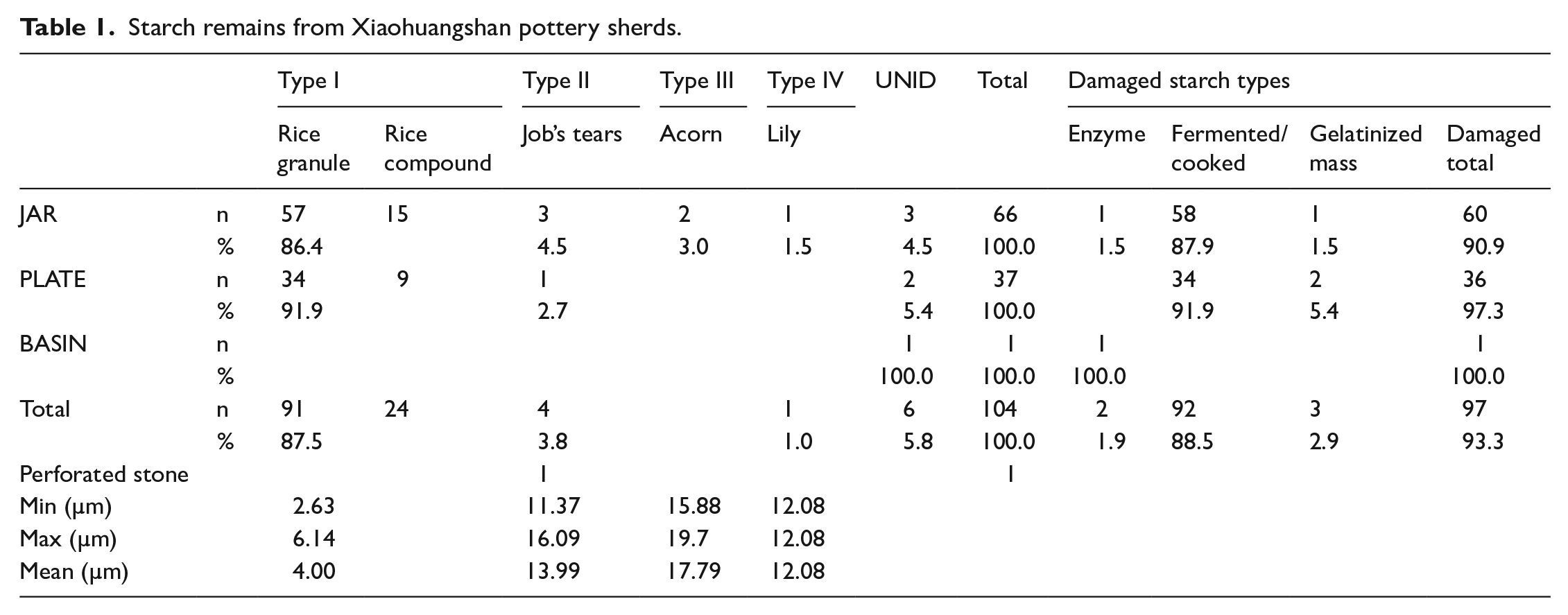
Type I, rice (Oryza sp.): appearing in a compound form consisting of multiple small granules, found in JAR and PLATE. Most individual granules are blurry, but when visible, they are polygonal in shape. Some of the granules are birefringent, but no extinction cross is visible. These forms match rice starch in fermented conditions based on our modern reference data (Figure 2: 1, 2 compared with 7, 8). A total of 24 rice compounds were recorded, and 91 granules (2.63–6.14 μm) were measured. We count the percentage of Type I starch based on visible individual granules, which give the most numerous counts in the assemblage (87.5% of the total).

Xiaohuangshan starch types compared with modern references (each image showing DIC/brightfield and polarized views). Xiaohuangshan starch 1, 2: Type I, rice, fermented; 3: Type II, Job’s tears; 4: Type III, acorn; 5: Type IV, lily bulb; 6: gelatinized starch. Modern starch 7,8: fermented rice grains in red rice beer; 9: Job’s tears; 10: acorn Lithocarpus glaber; 11: lily bulb (Lilium lancifolium); 12: gelatinized starch (Scales 1–8: 10 µm; 9–12: 20 µm).
Type II, Job’s tears (Coix lacryma-jobi; n = 4; 3.8% of the total): appeared in JAR and PLATE. The shape is polygonal or near-circular, hilum is centric or slightly eccentric, fissures are often present, and the size range is 11.37–16.09 µm. These granules most resemble Job’s tears in our reference data (Figure 2: 3 compared with 9).
Type III, acorn (Fagaceae; n = 2; 3.0% or the total): found in JAR. The granules are oval or sub-round with facets, the hilum is centric, the extinction cross is either straight or slightly curved, and the size range is 15.88–19.7 μm. These granules most resemble acorn starches, such as species in Lithocarpus and Quercus (Figure 2: 4 compared with 10).
Type IV, bulb of lily (Lilium sp.): a single starch granule was found in JAR. It is irregular elongate oval, the hilum is extremely eccentric, lamellae are faint, and the size is 12.08 μm (Figure 2: 5 compared with 11).
Starch granules of rice, Job’s tears, Fagaceae acorn, and lily bulb have been previously found on grinding stones and pottery vessels at several Shangshan culture sites, including Xiaohuangshan (Liu et al., 2010; Wang and Jiang, 2022; Yao et al., 2016). These plants, mostly perhaps wild, may have been used as staples. Several observations in the starch assemblage are also noted: (1) Most starch granules in JAR and PLATE are damaged by fermentation or cooking, suggesting the two vessels once contained fermented beverages and cooked foodstuffs, respectively; (2) JAR, a vessel type for liquid storage, revealed the highest number of starch granules and most diverse starch types among three vessels, indicating that fermented beverages were made of rice, Job’s tears, lily, and acorns; and (3) BASIN yielded only one unidentifiable starch granule without sign of fermentation/cooking damage, thus, this vessel probably had functions other than food fermentation.
Only one starch granule, resembling Type II starch (Job’s tears) was recovered from the perforated stone.
Phytolith remains
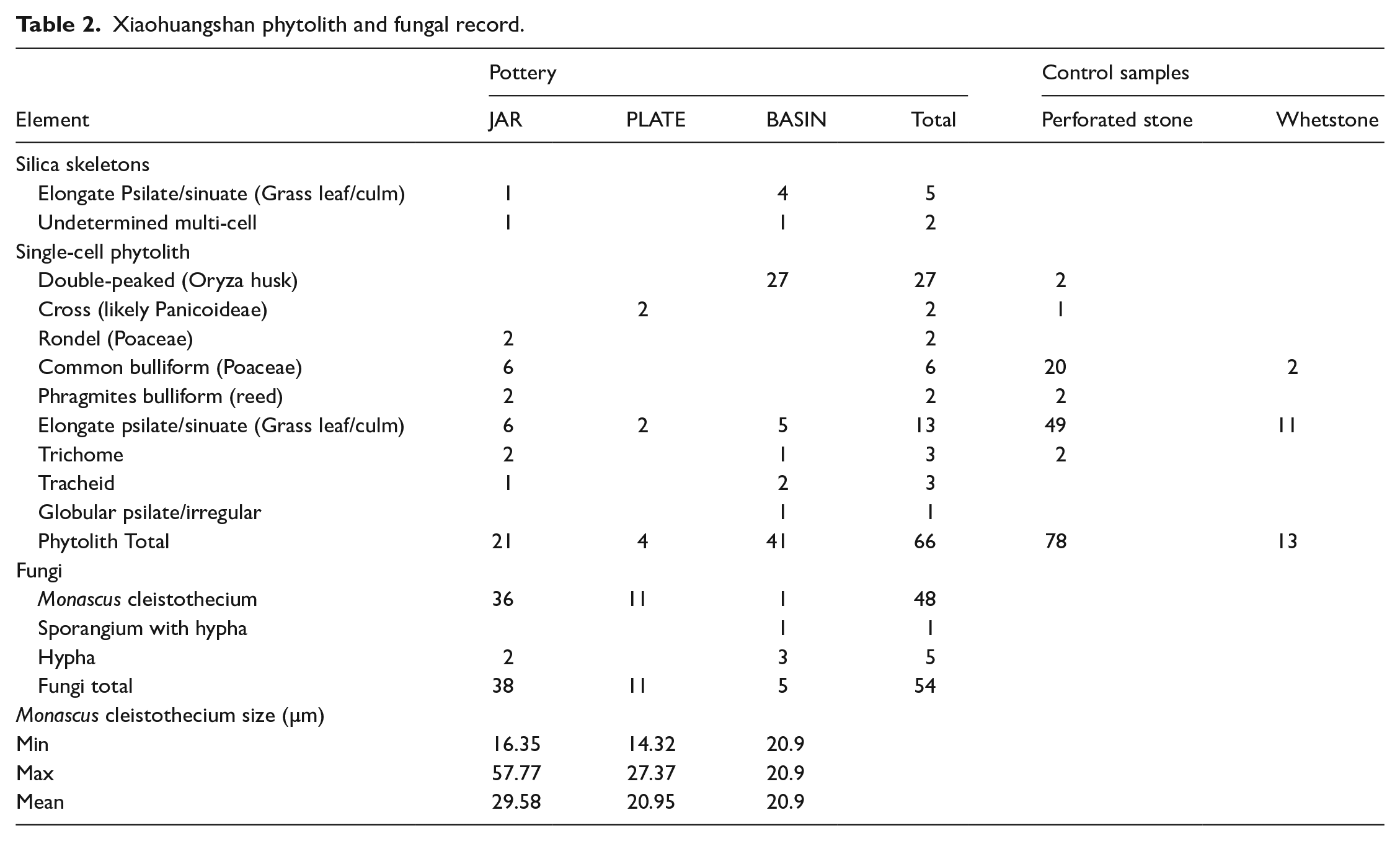
A total of 66 phytoliths were recorded, predominantly from Poaceae. The morphotypes include double-peaked cells from rice husk, cross, rondel, bulliform, trichome, elongate, and tracheid (Figure 3: 1–5; Table 2). Cross and rondel phytoliths found on JAR and PLATE are likely derived from Panicoideae. It is notable that starch granules of Job’s tears (belong to Panicoideae) were also found in JAR and PLATE, and the seed glume of this plant produces various crosses and rondels (Duncan et al., 2019; Liu et al., 2019a). Thus, the presence of cross and rondel phytoliths in these vessels correlates well with the starch identification for Job’s tears.
Xiaohuangshan phytolith and fungal record.

Xiaohuangshan fungal and phytolith remains compared with modern references.
Two Phragmites bulliforms (from reed) (Figure 3: 3) were found in JAR. Drinking alcoholic beverages from containers (large or small) through reed (or bamboo) straws has been a common practice throughout the history worldwide (Hiên, 2007; Katz and Voigt, 1986; McGovern, 2009). Phragmites bulliform phytoliths and use-wear traces of vertical striations on interior surface of rims have been found in some alcohol-related amphorae from the Yangshao culture in north China, indicating that such a drinking tradition was also practiced in Neolithic China (Liu, 2021). It is possible that the Xiaohuangshan people also drank fermented beverages though reed straws, based on the presence of reed phytoliths in JAR. If so, this would be the earliest evidence of such drinking method in the world. More vessels need to be studied to test this hypothesis in future.
Other phytolith morphotypes, such as common bulliform and elongate, are likely derived from grasses, but they are not diagnostic. It is possible that some of them were involved in making qu starter, often referred to as caoqu, herbal qu starter. Doing this adds various wild plants, which are rich in certain microorganisms, to the qu ingredients for aiding fermentation process. Such a method is still commonly practiced for alcohol fermentation in the Lower Yangzi River region and Taiwan (Ling, 1958; Yu, 2003).
Abundant double-peaked cells (n = 27) from rice husk were found only in BASIN. This vessel is made of fiber-tempered clay, and the rice husks have been identified as the main components in the fiber-tempered Xiaohuangshan pottery (Zheng and Jiang, 2007). This type of pottery paste is rather soft and brittle. The double-peaked phytoliths in our sample therefore likely come from the pottery temper, which may have been scraped off together with the residues from the vessel surface during sample collection.
The perforated stone revealed abundant phytoliths (n = 78), predominantly from grass leaves and stems; this tool may have been in contact with soil, consistent with its hypothetical function as a digging stick weight. The whetstone, on the other hand, yielded only 13 phytoliths; such a low concentration of phytoliths is also in line with its possible function for manufacturing tools (Table 2).
Fungal remains
A total of 54 fungal particles were recovered from the samples, and the most identifiable ones are cleistothecium from Monascus (n = 48). Others include a few hyphae and an unidentified sporangium connected with hypha (Table 2). Monascus Cleistothecia are spherical or oval (25–75 µm), normally orange or red in color, developed from hyphae, and contain asci which consist of ascospores; ascospores are spherical (ca. 5 µm in diameter) or oval (6 × 5 µm); the hyphae are branched and septate; the mycelium is white during the early stages of development, but rapidly changes to orange and later to red or crimson (Bao and Zhou, 2007: 166–169; Manan et al., 2017; Pan and Hsu, 2014; Young, 1931). In our samples, Monascus cleistothecia are spherical or oval, 14.32–57.77 µm in size, red or crimson in color. Many of them are fragmentary. Some small ones contain hyphae and asci, indicating early stages of development, while some large ones contain all small ascospores in a mature form (Figure 3: 6–10 compared with 11–13).
JAR yielded the most numerous cleistothecia (n = 36), followed by PLATE (n = 11). These two vessels apparently once contained fermented drink and food made of Monascus mold.
In comparison, BASIN has fewer fungal particles (n = 5), including a cleistothecium and an unidentifiable sporangium connected with hypha, which may have been accidentally in contact with the vessel. BASIN apparently had a culinary function different from other two vessels. In contrast, no fungal particle was found on the two stone tools.
Discussion
Combining the results from starch, phytolith, and fungal analyses, we can summarize several important observations.
JAR revealed most diverse types of starch and highest number of Monascus cleistothecia, and its rice starch grains are all gelatinized. The traditional method for making red rice qu compound is to mix Monascus mold starter with steamed rice, and the main fermentation ingredient is also steamed rice (Bao and Zhou, 2007). As a result, rice in the fermented beverages would have been heavily gelatinized. The rice starch grains in JAR resemble those of the steamed and fermented rice in our experimental brewing. Therefore, the combination of Monascus mold with fermentation-damaged starch residue provides strong evidence for brewing red rice beer in this vessel. Monascus mold and, probably, also some herbs were likely involved in the qu preparation, and the fermentation ingredients may have included predominantly rice, together with Job’s tears, acorn, and lily. In addition, the rim of JAR appears worn-out, showing a lighter color than other areas (Figure 1d). This may have been caused by repeatedly fitting a cover to seal the vessel. Sealing the container during alcoholic fermentation is done to create an anaerobic environment so that yeasts can convert sugars to alcohol and carbon dioxide. Given that this JAR was a part of grave goods in the burial, the alcoholic content in the vessel was apparently provided for the dead ancestor to enjoy in the afterlife.
Plates are normally used for serving solid food, as indicated by the vessel form. The residues from the Xiaohuangshan PLATE contain rice and acorn starches, as well as Monascus mold, suggesting that foods cooked with a red rice beer component may have been served with this vessel. Cooking meat with the dregs of red rice beer has been a long culinary tradition in China, as recorded in ancient texts (Bao, 2001; Bao and Zhou, 2007). So, it is possible that the tradition of using byproducts of red rice beer to cook foodstuffs can be traced back to early Neolithic times in the lower Yangzi River region.
Residues from BASIN contain negligible quantities of starch and fungal elements, showing little evidence of food fermentation. The two stone tools revealed no fungal particle and only one starch granule. These results are in sharp contrast to other two vessels, serving well as control samples in this study.
Fungal elements with low concentrations exist in nature, but their growth occurs in specific environments. During fermentation process, fungal reproduction (indicated by the development of hyphae, cleistothecia, and sporangia) require certain conditions, such as the presence of sources of nutrients (e.g. starchy plants), a moist environment, and a certain temperature range (Chen et al., 2014; Jin et al., 2017). Such conditions do not naturally occur in normal soil matrix but may be achieved by using particular types of containers. Therefore, a combination of fermentation-related starches and molds in high concentrations does not occur in ordinary soils or non-fermentation-related objects, as demonstrated by the basin and stone tools in this project (Tables 1 and 2). Similar results have also been found in control samples from our previous studies (Liu et al., 2019b, 2020a, 2022a). Thus, we are confident that most starches and fungi in the residues from XHS globular jar and plate examined here are linked to the original function of the vessels for holding fermented foodstuffs.
Conclusions
The results of microfossil analyses of three Xiaohuangshan pottery vessels shed new light on the origins and development of alcoholic beverages in early Neolithic south China. This fermentation practice involved the preparation of qu starter with Monascus mold, rice, and probably herbs; the fermentation ingredients may have included mainly rice, together with Job’s tears, acorn, and lily bulb; and globular jars were used as fermenters. The dregs of the red beer may have been used for cooking with solid foods and served with plates. This is, so far, the earliest evidence of red rice beer brewing in China.
The Xiaohuangshan JAR once contained red rice beer as part of grave goods for the dead ancestor, suggesting that this mortuary tradition can be traced to the Shangshan culture 9000 years ago. This mortuary practice, which involved qu and cereal-based alcoholic beverages as sacrificial offerings, became widespread during the early Neolithic period, exemplified by the presence of globular jars (some testing positive for alcoholic contents) in burials over south and north China. The transformation from moldy rice to red rice beer may have been seen by the Neolithic peoples as a magical event, so the bright red color of this beverage would have been regarded as being symbolically significant. The red beer may have played a pivotal role for connecting the dead ancestors with living descendants in mortuary rituals.
The dispersal of rice domestication from the lower Yangzi River region to the Yellow River region appears to correlate with the sequential appearances of globular jars from south to north. These parallel developments suggest that making alcoholic beverages in specialized pottery forms for ritual activities, including mortuary practice, may have been one of the driving forces leading to the domestication and dispersal of rice. This proposition, nevertheless, needs to be tested by analyzing more globular jars from the Shangshan culture sites and other Neolithic sites in south China.
Footnotes
Acknowledgements
We thank the Center for Cultural Relics Preservation in Shengzhou City, Zhejiang Province. We appreciate the constructive comments made by two anonymous reviewers. Dr. Thomas Bartlett edited the English of an early version of the manuscript.
Funding
The fieldwork in China was supported by Australian Research Council Discovery Grant; project title: Settlement Patterns, Craft Production, and the Rise of Early States in China (Fund Number 500982). The lab research and publication fees were supported by the Stanford Archaeology Center, Stanford University, USA.
