



Abstract
The natural environment of the Gansu-Qinghai region in northwest China exhibits spatial variation, resulting in distinct adaptive strategies among populations in different geographical areas. In this study, we analyzed the diachronic trend and regional variations in caries prevalence among 10 different middle and late-Holocene groups by examining dental caries data to explore the correlation between different adaptation strategies and caries frequency. Frequency data was used to compare dental caries between populations, and the Chi-square test was employed to detect statistical differences. A multidisciplinary approach was employed to investigate the relationship between these changes and the adaptive strategies adopted by the populations in this region. The result shows that there was a gradual increase in caries prevalence over time in eastern Gansu, which corresponded with development of millet farming and social hierarchy. In the Hexi Corridor, caries prevalence exhibited fluctuations attributable to climate variability, human migration, and regime change. The research proposes that changes in adaptive strategies due to various social and environmental factors are reflected in human teeth, while also presenting a novel endeavor of aggregating a large, multisite bioarchaeological dataset in order to investigate the interactions between Holocene populations and palaeoenvironments in northwest China.
Keywords
Introduction
With the increasing breadth and depth of multidisciplinary research, the interrelationship between human evolution and environmental change has become a popular concern in many disciplines including geography, archeology, biological anthropology, and genetics. More and more attention has been paid to the study of how human beings adapt to changing living environments. The process of human adaptation can be conceived as consisting of three levels, namely physiological, genetic, and social/cultural (Relethford, 2000). In the early stages of human evolution, adaptation was mainly reflected in human anatomical, physiological, and genetic characteristics (Harvati and Weaver, 2006; Ruff 1993, Ruff 2002, Harvati and Weaver, 2006; Ruff, 1993, Ruff 2002). With the improvement of cognitive-behavioral abilities and increasingly complex cultural systems, sociocultural adaptation gradually became prominent. The adaptation of the sociocultural system includes several aspects, such as the change of subsistence strategy, technological innovation, social system change, and even large-scale population migration. The regulation of socio-cultural systems can buffer the impact of environmental changes on humans, while the system leaves evidence of adaptation in human bones and teeth (Goodman, 1984, 2002).
Caries is a process in which cariogenic bacteria in dental plaque convert carbohydrates in food into organic acid, thus causing local demineralization of hard tissues (Larsen, 1995, 2015), and its occurrence is controlled by a combination of “food-bacteria-host” factors (Lingström et al., 2000; Paine et al., 1998; Yue, 1993; Zheng and Zhang, 1993). Human teeth excavated from archeological sites are generally well preserved, and the lesions caused by caries can be easily observed with the naked eye, which is why there are numerous studies on this disease in bioarchaeology. One of the most widely known topics is “caries and agriculture.” This global study was initiated by Turner (1979), who investigated the prevalence of dental caries in many modern and archeological hunter-gatherers and agricultural populations. The study found that the prevalence of caries was much higher in agricultural populations than in hunter-gatherers, thus establishing a triadic theory of the relationship between “subsistence-diet-teeth.”
Since then, numerous regional or continental studies have been conducted. Most studies in North America, Europe, northeastern Africa, and northern East Asia, where dry farming is predominant, have demonstrated a positive correlation between caries and the level of agricultural development. In these areas, with the origin and intensification of agriculture, increasing carbohydrate intake, and increasingly sophisticated food processing methods, the prevalence of dental caries shows a significant increase (Cohen and Armelagos, 1984; He, 2004; Larsen, 1995; Larsen et al., 1991; Moore and Corbett, 1971, 1973, 1975; Ran, 2022; Steckel et al., 2002; Steckel and Rose, 2002; Temple and Larsen, 2007). However, rice-growing regions such as southern East Asia, Southeast Asia, and South Asia are exceptions (Domett, 2001; Newton et al., 2013; Ran, 2022; Tayles et al., 2000; Willis and Oxenham, 2013). Some scholars have suggested that the lower prevalence of dental caries in rice-farming populations may be related to methods of food processing, as well as the rich natural resources and more diversified food sources in the rice-farming area (Tayles et al., 2000, 2009). Recently, some studies have also shown that dental disease has a complex multifactorial pathogenesis, and the prevalence of dental caries does not correspond to subsistence strategies in a simple way. There is a high overlap in caries prevalence among populations with different subsistence strategies, and there is also large variation within populations with similar subsistence strategies (Marklein et al., 2019; Ran, 2022). In response, researchers need to adopt a more holistic, contextualized analysis that combines multidisciplinary evidence (e.g. historical records, archeological evidence, zooarchaeological data, stable isotopic data, etc.) to gain a clearer understanding of the dietary, socioeconomic, political, and environmental conditions of past populations, as all of these factors can have an impact on oral health (Cucina et al., 2011; Marklein et al., 2019; Xiong et al., 2022).
Located in the northwest of China, the two modern-day Chinese provinces of Gansu and Qinghai are located at the intersection of the Tibetan alpine area, the eastern monsoon area, and the northwestern arid area, with strong transitional characteristics and instability in the natural environment (Hou et al., 2009). Because of the similarities in topography, climate, and archeological material culture, they are generally referred to together as the “Gansu-Qinghai region” or “Ganqing region” in various studies of Chinese prehistoric archeology. The region has a fragile ecology and is very sensitive to climate change. It is also characterized by complex topography, large altitude differences, and differences in temperature distribution. Therefore, the adaptation strategies of ancient populations in different geographical areas within the Ganqing region differ significantly (Lu and Dong, 2022; Ma et al., 2016; Zhang and Dong, 2017).
Gansu can be further divided into two subregions, the Hexi Corridor and eastern Gansu, with clear differences in natural environment and geography. The Hexi Corridor is an intermountain region that skirts the northern Qinghai-Tibetan Plateau and connects the Loess Plateau to Xinjiang, constituting a narrow land strip oriented in a northwest-southeast direction. It is situated at an elevation ranging from 1000 to 1500 masl, exhibiting a temperate continental climate characterized by limited precipitation and high evaporation rates. The average annual precipitation falls below 200 mm. Eastern Gansu is located on the western portion of the Loess Plateau, which includes the upper reaches of the Yellow River. It is characterized by elevations ranging from 1000 to 2000 masl. This area falls within the northwestern sector of the monsoon zone, exhibiting a semi-arid to semi-humid climate with an average annual precipitation exceeding 400 mm (Gansu Provincial Institute of Cultural Relics and Archaeology, & Peking University, 2011; Ma et al., 2016).
In this study, human teeth from the middle and late Holocene (6300-1730 BP) excavated from multiple archeological sites in Gansu Province were compared. With the prevalence of dental caries as the main variable under study, we combine the archeological and historical background with paleoenvironmental evidence to discuss the following two issues: (1) the diachronic changes of caries frequency in the human population of ancient Gansu; (2) the correlation between different adaptation strategies and caries frequency.
Archeological and historical context
The archeological cultures of the Neolithic and Bronze Age (8000-2200 BP) in the Ganqing region can be divided into four phases.
The initial phase, spanning from 8000 to 6500 BP, witnessed a relatively warm and humid climate, coinciding with the emergence of Neolithic archeological cultures in the central and western regions of the Loess Plateau (Li, 2009; Lu and Dong, 2022). The human settlements were primarily concentrated in eastern Gansu, the upper reaches of the Yellow River on the western portion of the Loess Plateau, where hunting and gathering served as the predominant subsistence strategy. There was limited cultivation of millets (Gansu Provincial Institute of Cultural Relics and Archaeology, 2006).
The second phase was 6500-5500 BP, during which the distribution of human activities expanded significantly, gradually spreading from eastern Gansu to the Hehuang Valley. This is located in the northeast of present-day Qinghai Province, in the region between the Yellow River and the Huangshui River basin where the Loess Plateau transitions to the high-altitude Qinghai-Tibetan Plateau. A large amount of millet remains dating to this period have been excavated, and millet farming became the most important subsistence strategy in the area (Lu and Dong, 2022). The analysis of animal remains indicates that during this period, the consumption of wild animals remained predominant in terms of meat resources; however, there was a discernible increase in the proportion of domesticated pigs and dogs. The carbon and nitrogen isotopes of animal remains indicate the utilization of millet by-products for raising pigs and dogs, providing further evidence for the advancement of agriculture during this period (Barton et al., 2009).
The third phase, spanning from 5500 to 4000 BP, witnessed the westward expansion of human settlement and the formation of an independent cultural region in the Ganqing area in terms of archeological material culture, represented by the Qijia Culture and the Majiayao Culture. Millet agriculture as a key subsistence strategy was further consolidated. Moreover, as cross-continental cultural exchange intensified, domesticated cattle and sheep were introduced to the Ganqing region during this period (Dong et al., 2020; Wang, 2012).
The fourth phase, from 4000 to 2200 BP, was the Bronze Age, characterized by global cooling and drought events, as well as a discernible trend toward aridity in the Ganqing region. The archeological culture of the region transitioned from a singular dominant material culture to a pattern of coexisting multiple bronze-using cultures, and subsistence strategies became diversified (Shui, 2001; Wang, 2012). In eastern Gansu, the impact of climate change on subsistence patterns was not readily apparent, and agriculture continued to play a pivotal role. In addition to millets, wheat cultivation was also featured (d'Alpoim Guedes et al., 2015). In the Hexi Corridor, the archeological materials exhibited discernible influences from the nomadic cultures of the northern steppe regions (Jaang, 2015). In terms of subsistence strategy, there was a rapid intensification in mixed agriculture involving millet and wheat, and pastoralism also experienced an increase. In addition to a substantial quantity of animal remains, there was also an emergence of pottery artifacts associated with the production and utilization of dairy products (Dong et al., 2020; Gansu Provincial Institute of Cultural Relics and Archaeology, 2001; Ma et al., 2016).
In the post-2200 BP historical period, each geographic unit essentially maintained its subsistence strategy from the preceding era. During 221 BC-220 AD—or the Qin and Han periods, the first two imperial dynasties—Central Plains culture expanded its jurisdiction over most regions in present-day Gansu and Qinghai. Before 221 BC, however, the Hexi Corridor and the Hehuang region were multi-ethnic areas. Chinese historical texts record the presence of groups such as the Qiang, Di, Rouzhi, and Wusun 1 where animal husbandry dominated.
In 176 BC, the Hexi Corridor and the Hehuang region both fell under the control of the Xiongnu 2 and became their nomadic territories. At the end of the third century BC, the Xiongnu formed a large tribal confederation that posed a threat to China’s northern border. It was not until 121 BC that the victory over the Xiongnu enabled the Han empire to expand into the Hexi Corridor and northeastern Qinghai. Gansu served as the center of the Han-Xiongnu conflict, prompting the Chinese government to adopt a comprehensive strategy encompassing the establishment of military garrisons along the original Great Wall, deployment of troops, and promotion of immigration of subjects of the Han empire into border regions to fortify the borders. Soldiers were also mandated to engage in agricultural activities to achieve self-sufficiency. During this period, there was also immigration of nomadic pastoralists and oasis state agriculturalists into the north of China. As a result, agricultural and pastoral activities were both dominant subsistence strategies in these areas (Wang, 2009).
Materials and methods
The materials utilized in this study consist of human teeth excavated from archeological contexts. The analysis is based on the presence or absence and location of carious lesions on permanent teeth from 558 individuals excavated at a total of 10 archaeological sites in modern-day Gansu Province. A portion of the data was obtained through direct observation by the first author, while another portion was sourced from published literature.
The samples can be classified into two groups corresponding to the subregions of Gansu, the Hexi Corridor and eastern Gansu. The Hexi Corridor group of sites includes the Wuba cemetery (WB), the Haizang site (HZ), the Huoshaogou cemetery (YH), the Ganguya cemetery (GGY), the Hamadun/Xigang cemeteries (SH/SX), and the Heishuiguo site (HSG), with a time span of 4400-1730 BP (Figure 1, Table 1). The eastern Gansu group of sites includes the Gedachuan site (GDC), including both a Neolithic period and a historic period, the Mogou cemetery (MG), and the Xishan site (XS), with a time span ranging from 6300-1730 BP (Figure 1, Table 1)

Map of Gansu Province illustrating the approximate locations of the sites used in this study, and the modern provincial capital of Lanzhou.
Permanent teeth used in this study.
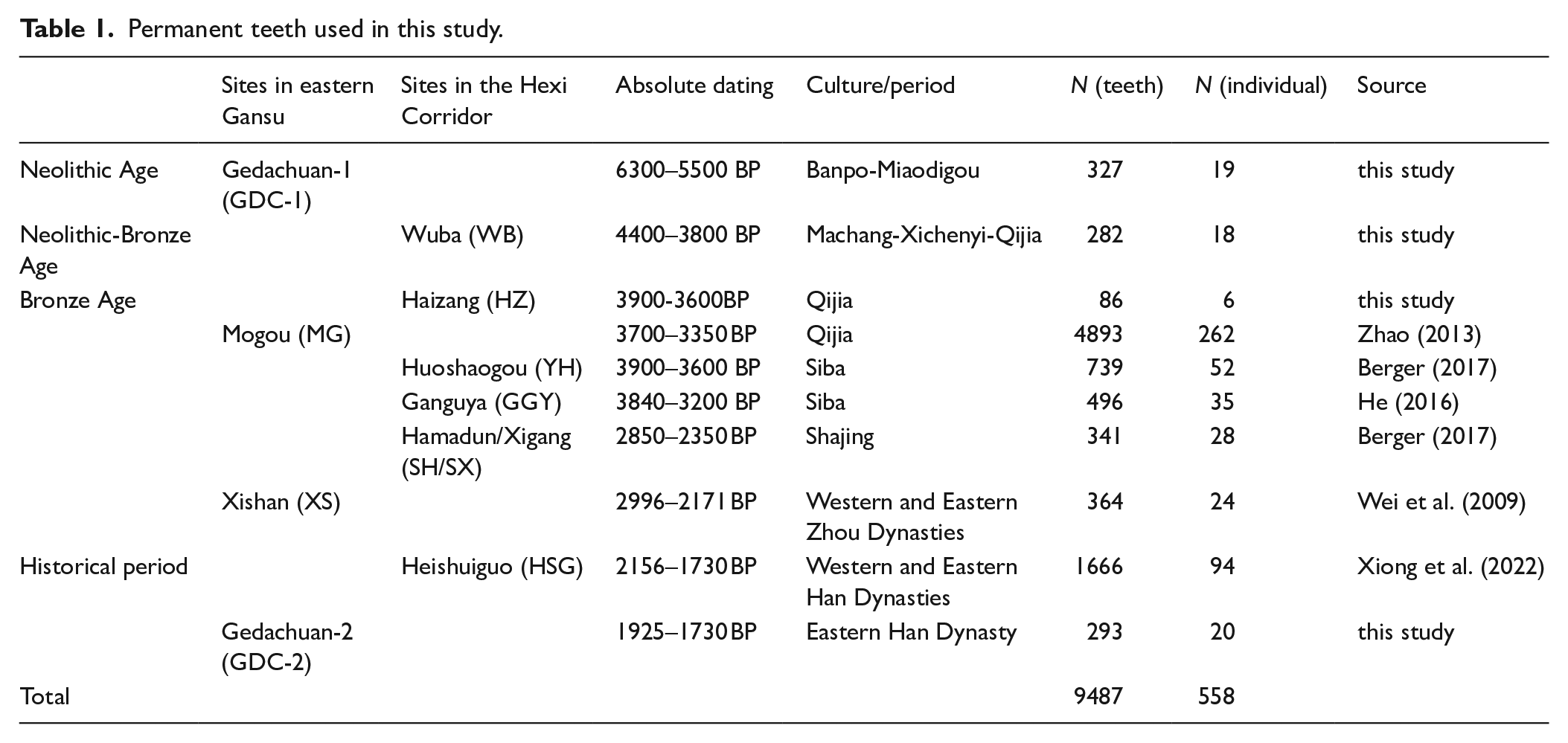
Caries are macroscopically necrotic cavities on the surface of the dental crown or root. Samples directly observed by the first author were assessed for caries through macroscopic observation after identifying sex and age-at-death. The sex of adults was determined by pelvic and skull morphology (Buikstra and Ubelaker, 1994; Klales et al., 2012). Age-at-death was estimated by pubic symphyseal morphology, auricular surface morphology, and dental wear (Brooks and Suchey, 1990; Buckberry and Chamberlain, 2002; Zhang, 2010). Only lesions that could be penetrated with a dental probe were recorded (Hillson, 2001; Temple and Larsen, 2007). Additionally, the location of dental caries was also recorded. Based on the site of the lesion, caries can be classified into occlusal, interproximal, cementoenamel junction (CEJ)/root, and lingual/buccal caries. The lesion is categorized as undetermined when its initial location cannot be identified (Buikstra and Ubelaker, 1994; Hillson, 2001). Interobserver error could not be tested directly, as the data from different sites were collected by different observers at different times. However, at the site of MG, the study cited here (Zhao, 2013) and an ongoing study (Dittmar, Berger et al., unpublished) found virtually identical carious lesion frequencies in adult individuals (45.75% and 45.51% respectively), which suggests the reliability of these data.
Comparisons of dental caries between populations typically rely on frequency data. The caries prevalence therefore is determined by dividing the number of teeth or individuals with carious lesions by the total number of teeth or individuals observed. The data utilized in this study are based on the percentage of teeth with caries, concerning both caries prevalence in individuals and lesion location information. The Chi-square test was employed to compare the prevalence of dental caries among the different populations, and a p-value less than 0.05 was considered statistically significant (with pairwise comparisons between multiple groups corrected using the Bonferroni method). The statistical analysis of caries’ location was not feasible due to the heterogeneity in reporting formats and classification criteria across published studies.
According to previous research, when comparing the prevalence of dental caries between populations, attention should be paid to the following factors: (1) age distribution of the population, as numerous studies have shown a correlation between dental caries and age; (2) sex ratio, as due to behavioral patterns, hormonal influences, and pregnancy, females generally experience higher caries frequencies than males; and (3) dental categories, as it is generally believed that the prevalence of caries in posterior teeth is higher than in anterior teeth (Larsen, 2015; Lukacs and Largaespada, 2006). However, the published caries studies in Gansu lack uniformity in terms of data reporting format and standards. Addressing age, sex, and tooth type biases would significantly reduce available data for this study due to insufficient information provided by many studies. The inability to consider the aforementioned factors constitutes one of the primary limitations of this study. Nevertheless, we argue that we can still identify trends in dental caries prevalence across time periods and regions, since age, sex, and tooth type preservation biases would likely affect samples from different periods equally. In addition, some groups do have information on age and sex distribution, so we will incorporate this demographic data in the discussion section (Table S1).
Caries prevalence is also affected by the rate of ante-mortem tooth loss (AMTL). Although some correction methods are available (Duyar and Erdal, 2003; Lukacs, 1995), most published data in this region have not utilized these methods. In this article, the rate of AMTL is described, but statistical comparisons are not feasible due to variations in reporting among studies, with some solely presenting the prevalence of individuals (not teeth) with AMTL, while others omit such information altogether. In samples directly observed by the first author, AMTL was documented based on criteria such as alveolar bone resorption or visible signs of healing (Buikstra and Ubelaker, 1994).
Results
The caries frequency and statistical results of 10 sites in Gansu from the Neolithic to the historic period are presented in Table 2 and Figure 2. The caries prevalence of groups during the Neolithic to Early and Middle Bronze Ages was predominantly between 5% and 7%. However, this trend underwent a significant shift in the Late Bronze Age and Early Iron Age, with instances of extreme high values (XS) and extreme low values (SH/SX). During the historical period, the caries prevalence in both areas slightly exceeded those observed in the Neolithic to Early and Middle Bronze Ages. Additionally, carious lesions predominantly affected the interproximal surface across all groups (except for the gross lesion), except the HZ population, where carious lesions were most prevalent on the occlusal surface (this information was unavailable for the GGY group) (see Table S2).
Prevalence of caries and antemortem tooth loss in each of the series.
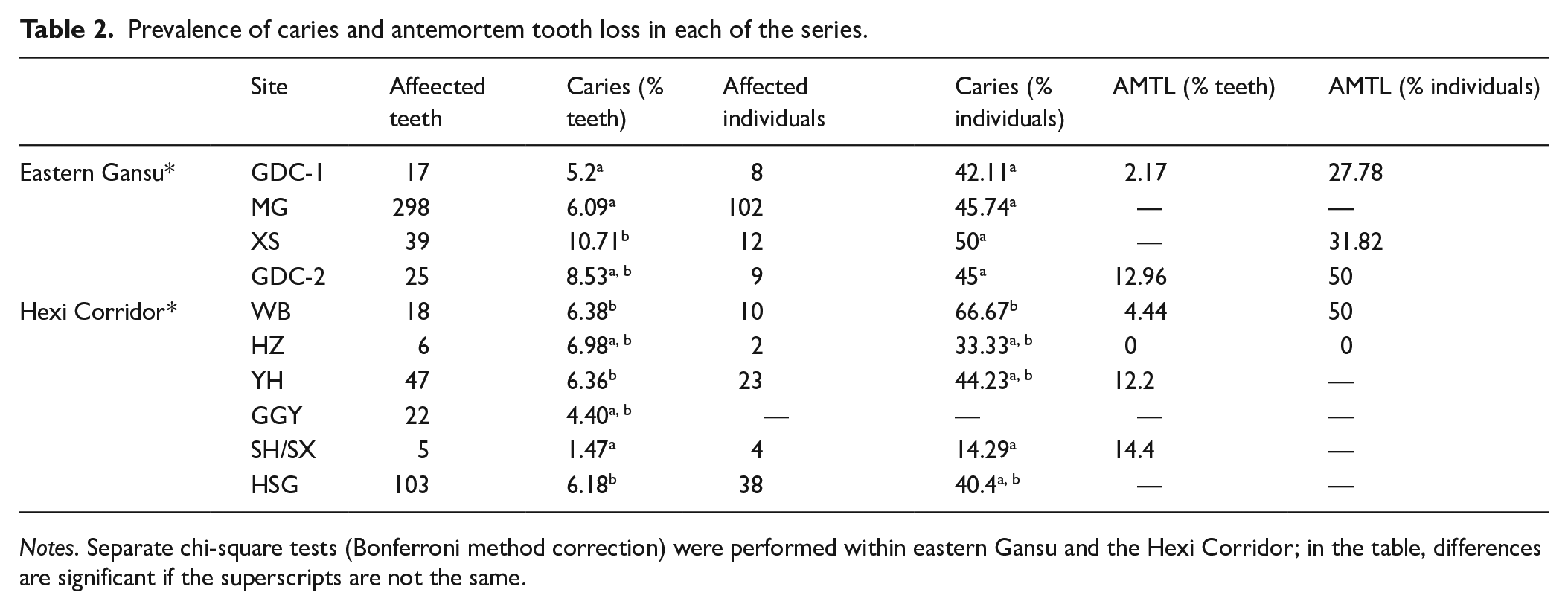
Notes. Separate chi-square tests (Bonferroni method correction) were performed within eastern Gansu and the Hexi Corridor; in the table, differences are significant if the superscripts are not the same.
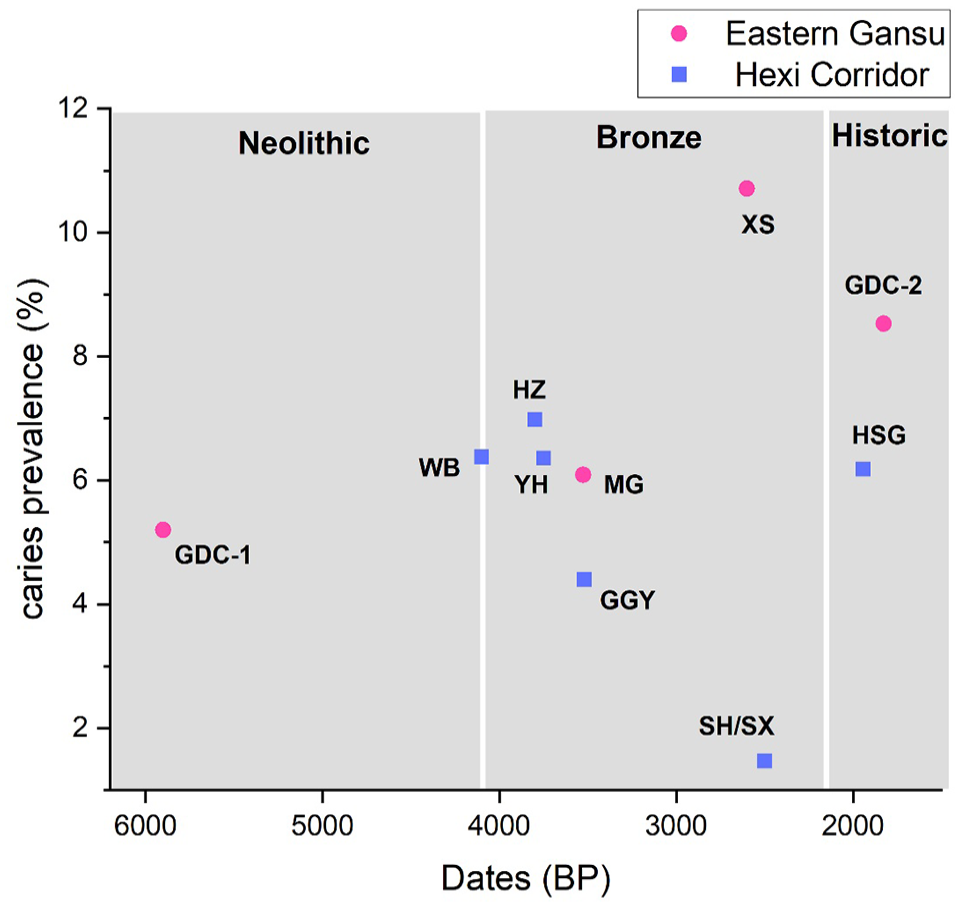
Diachronic trend of dental caries prevalence in middle to late Holocene populations in Gansu.
The caries prevalence in eastern Gansu tended to increase over time. Among the study sites, the highest caries prevalence (10.71% of teeth, 50% of individuals) was observed in the XS population during the Late Bronze Age, which exhibited significant differences from both the Neolithic (GDC-1) and Early Bronze Age (MG). Although there was a slight decrease in caries prevalence in the historic period (GDC-2), no statistical significance was found from the Zhou Dynasty (XS) to the Han Dynasty (GDC-2). Furthermore, the AMTL rate among the GDC-2 population was higher (12.96%, 50%), which may have reduced the caries prevalence.
The situation in the Hexi Corridor differed from that of eastern Gansu, as there was no significant difference in caries prevalence found between the late Neolithic to Early and Middle Bronze Ages, despite an increase in AMTL rates. The caries prevalence among the GGY population during the Middle and Late Bronze Age exhibited a slight decrease. By the late Bronze Age and Early Iron Age, caries prevalence in the SH/SX population had reached the lowest point (1.47%, 14.29%). The SH/SX population exhibited a high prevalence of ATML. To correct for AMTL, Berger (2017) employed the method proposed by Lukacs (1995), resulting in a corrected prevalence of 2.2% of teeth, which remained notably low. In the historical era, there was a significant increase in caries prevalence in the HSG population (6.18%, 40.4%).
In order to elucidate the disparity in caries prevalence between eastern Gansu and the Hexi Corridor populations in different periods, we conducted a paired comparison using the Chi-square test (Figure 3). In comparison to the GDC-1 group (6300-5500 BP), the WB population in the Hexi Corridor (4400-3800 BP) exhibited higher prevalence of caries and AMTL. However, statistical analysis did not reveal a significant difference between the two groups (ATML: X2 = 3.624, p = 0.057). However, by the Bronze Age, there were notable disparities in the caries prevalence between eastern Gansu and the Hexi Corridor. Chi-square test results indicate that there were no significant differences between eastern Gansu (MG) and the Hexi Corridor (YH, HZ, and GGY) during the Early and Middle Bronze Age, but However, statistically significant differences emerged in the Late Bronze Age and Early Iron Age between eastern Gansu (XS) and the Hexi Corridor (SH/SX).

Distribution of caries lesion prevalence by teeth in eastern Gansu and the Hexi Corridor, in the Neolithic to historical period.
Finally, we found that during the historical period, the disparity in caries prevalence between the two regions narrowed again. Eastern Gansu (GDC-2) exhibited a slightly higher prevalence than the Hexi Corridor (HSG), but this difference is not statistically significant.
Discussion
The Gansu-Qinghai region served as a crucial conduit for cultural exchange across Eurasia during both prehistoric and historical periods. Consequently, research into the adaptive strategies and their divergence among ancient peoples within this region has garnered considerable attention. Scholars have extensively researched various aspects, including archeological material culture, animal and plant remains, and stable isotopes, among others (Chen et al., 2015; Lu and Dong, 2022; Shui, 2001; Wang, 2012; Wang et al., 2020). However, there is a dearth of studies that have examined the differences in adaptive strategies based on indicators from human skeletons. The present study offers a distinctive perspective to investigate this issue by conducting comparative assessments of dental caries prevalence rates.
Neolithic period
He (2004) and Ran (2022) demonstrated that the prevalence of caries among Neolithic populations in northern China ranged from 1.2% to 8.3% of teeth within a primitive dryland farming economy, with an average prevalence of approximately 5%. The GDC-1 population in eastern Gansu examined for this study exhibited a caries prevalence of 5.2%, which falls within this range (Figure 4).
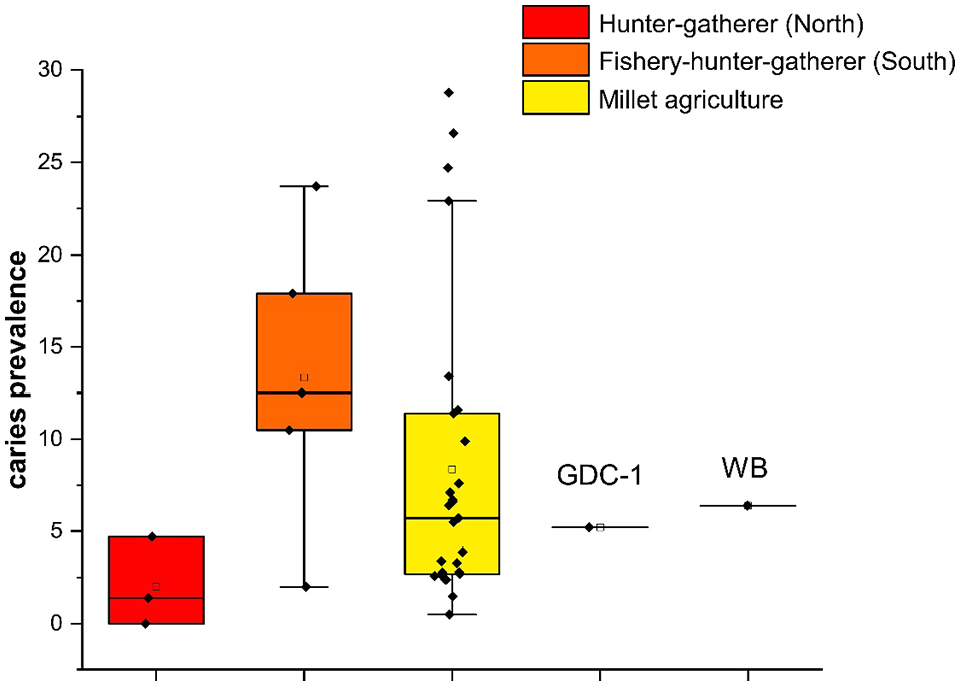
The distribution of caries lesion prevalence by teeth among populations with different subsistence strategies in Neolithic China (data cited from Ran (2022)), and comparison with the GDC-1 and Wuba populations.
As many scholars have noted, there is a significant overlap in caries prevalence among populations with different subsistence strategies. It would be inaccurate to simply correlate caries frequency with subsistence type. Nevertheless, the multidisciplinary research findings from the GDC site offer valuable context for investigating the relationship between caries frequency and subsistence strategies. A large quantity of carbonized millet was discovered in the Neolithic strata of the GDC site, accompanied by large cellars for grain preservation. Zooarchaeological studies have shown that pigs and dogs were kept by humans at the site, while hunting remained a crucial subsistence strategy (Yang, personal communication). Moreover, the analysis of carbon and nitrogen stable isotopes from human bone collagen has shown that the protein portion of the diet of GDC Neolithic individuals was largely from C4-plants or animals fed on C4 plants, in this case, likely millet, and that meat played an important role in their diet (Ma et al., 2023). Based on this information, it can be inferred that the GDC-1 population practiced agriculture but also relied on animal products for food, which is consistent with the moderate prevalence of caries.
During the same period, there was no evidence of intensive agricultural activity in the Hexi Corridor, and Neolithic farmers only began settling in the area at 5300-4600 BP (Li, 2009). The caries prevalence of 6.38% of teeth among the WB population (4400-3800 BP) was higher than that of GDC-1, although this difference did not reach statistical significance. Notably, no individuals under 20 years old were found in the GDC-1 group, and when we recalculated the caries prevalence for WB to also exclude those younger than 20 years old, an even higher prevalence of 8.33% was observed (see details for Table S1, Table S4). Analysis of carbon stable isotopes from human bone collagen excavated from the WB cemetery also indicates that the population mainly consumed a C4 plants, probably millet, or livestock foddered with millet (δ13C: −8.4‰~−5.6‰) (Liu et al., 2014). This high caries prevalence was therefore likely the outcome of extensive development in millet agriculture and the growing significance of agriculture in subsistence patterns after 5300 BP (An et al., 2010; Jia et al., 2013; Ma et al., 2023; Zhou et al., 2010).
After controlling for age, there was still no significant difference observed between the GDC-1 and WB populations (X2 = 2.119, p = 0.145). Additionally, there was a similar proportion observed between the two groups in terms of lesion location (see Table S2). This can be attributed to a high degree of similarity in food types, processing methods, ingestion patterns, and broader subsistence strategies between these two regions during the Neolithic period.
Early and Middle Bronze Ages
Around 4000-3500 BP, cooling and drought events occurred in the mid and high-latitude regions of the Northern Hemisphere. In response, populations in eastern Gansu and the Hexi Corridor began to develop different adaptive strategies.
The carbon and nitrogen isotope of bone collagen studies of the MG population showed that they had the characteristics of a plant diet (δ15Nhuman-herbivore = 1.7‰), and the 13C value showed a mix of C3/C4 plants in the protein portion of the diet (Ma et al., 2016). The starch granules of millet and wheat plants accounted for 70% of the total starch granules in the study of dental calculus in the MG population (Li et al., 2010). These findings serve as evidence for agriculture continuing to be a significant means of subsistence for the MG community.
The impact of this subsistence practice is evident in the high prevalence of dental caries. The caries prevalence of the MG population was 6.09% of teeth (7.52% after excluding individuals younger than 20 years old, see Table S4), which constitutes an increase compared to the Neolithic GDC-1 population in the same region. Such an elevation in dental caries is probably attributed to advancements in production levels and food processing technologies. For instance, a novel food preparation technique emerged during this era: millet noodles were discovered at the Lajia site (4000BP) located in the same region (Lü et al., 2005). The production process of millet noodles necessitates intricate processing techniques (Lü et al., 2014). The more refined the food processing, the greater its adhesive properties, resulting in prolonged oral retention and increased susceptibility to caries.
In the Hexi Corridor, a combination of archaeobotanical, zooarchaeological, and isotopic evidence reveals a cultural landscape that is characterized by both semi-agricultural and semi-pastoral practices (Dong et al., 2020). The local populations engaged in animal husbandry activities such as raising pigs and dogs while also grazing sheep, cattle, and horses, in parallel with dryland agriculture. However, agriculture likely still maintained a relatively important position in the Hexi Corridor. The archaeobotanical evidence from the HZ site shows that 95.68% of carbonized plant seeds were identified as domesticated crops (Gansu Provincial Institute of Cultural Relics and Archaeology, unpublished data).
The Bronze Age samples from the Hexi Corridor come from the HZ, YH, and GGY populations. Among them, the caries prevalence of HZ and YH populations, which are dated slightly earlier than GGY, are 6.98% and 6.36%, respectively. It is worth noting that over 80% (n = 6) of the HZ population consisted of individuals under the age of 20 (Table S1), suggesting that the actual prevalence of caries in this population may exceed 6.98%, as it tends to be more prevalent among middle and older adults. Meanwhile, the HZ population exhibits a higher prevalence of occlusal surface caries due to subadults’ reduced dental wear, which increases the likelihood of retained occlusal lesions. After correction for AMTL, the dental caries rate of the YH population, which had the highest rate of AMTL, also increased to 8.2% (Berger, 2017). These two datasets closely align with the caries prevalence observed in the WB population during the preceding period.
However, the caries prevalence in the GGY population, which dates to a slightly later period, was lower (4.4%). The observed value cannot be attributed to the demographic profile. Only 14.28% (5/35) of individuals in this group were under 20 years old at death, and the sex distribution within the GGY is well balanced (Tables S1 and S4). When examined from a cultural perspective, the situation at GGY appears to contradict the traditional perspective. A analysis of animal and plant remains at the site indicates that the proportion of animal husbandry in the GGY community was lower than that at YH, and their subsistence strategy was more agrarian. Isotope and trace element analyses also indicate that GGY population primarily consumed plant-based foods with meat-based foods as a supplement (He, 2016). Hence, it is imperative to contemplate alternative explanations for the low prevalence of dental caries in this particular population.
The GGY site is situated atop the alluvial fan of the Fengle River in the Hexi Corridor, which falls within the premontane zone of the Qilian Mountains and exhibits high levels of fluoride in its shallow groundwater, in contrast to the HZ and YH sites, which are located in low-fluoride water zones (Ba & Yan, 2010 Ba and Yan, 2010). The fluoride concentration in the soil at the site is also elevated, measuring 563 ppm (compared to a typical range of 30–300 ppm for soil in China), indicating a high-fluoride area (Zheng, 1991). Zheng (1991) reported on the oral health of the GGY population, noting that “severe periodontal disease is prevalent while caries is infrequent.” Modern medicine has demonstrated that fluoride can facilitate the remineralization of tooth enamel, thereby enhancing the resistance of teeth to carious lesions. Additionally, fluoride fortifies tooth enamel’s resistance to acid erosion and impedes bacterial growth and reproduction (Paine et al., 1998; Ten Cate, 1999). Fluoride, however, does little to alleviate periodontal disease (Perry, 1982; Reddy and Grobler, 1988). Therefore, the lower dental caries prevalence in the GGY population was possibly a result of the geological context in which the population lived.
In conclusion, despite the evident climatic deterioration during the Early and Middle Bronze Ages, agriculture remained a crucial component of the adaptive strategy, or more accurately, domesticated plant foods remained predominant in the human diet, in both eastern Gansu and the Hexi Corridor. This is consistent with the lack of significant difference in caries prevalence among all groups in these two areas.
Another noteworthy aspect of the Early and Middle Bronze Ages in the Gansu-Qinghai region is that, besides millet, there is emerging evidence of wheat consumption in eastern Gansu and the Hexi Corridor during this period (Li et al., 2010; Dong et al., 2020; Ma et al., 2016; Peking University of Archaeology and Museology & Gansu Provincial Institute of Cultural Relics and Archaeology, 2016). The cariogenic potential of different foods varies, and since wheat generally has a higher starch and oligosaccharide content than millet, its cariogenicity may be higher. However, culinary traditions can also significantly impact cariogenicity. Considering that wheat has been prepared and consumed in granular form since its introduction to China (boiling and steaming, consistent with the cooking method of millets) (Liu and Reid, 2020), the increase in wheat consumption and regional variations did not elevate the prevalence of caries in ancient Gansu populations, nor did it substantially widen the gap in dental caries prevalence between populations in eastern Gansu and the Hexi Corridor.
Late Bronze Age and Early Iron Age
By the Late Bronze Age to Early Iron Age (3200-2100 BP), the divergence in adaptive strategies between the populations of eastern Gansu and the Hexi Corridor was further amplified.
The climate within the Hexi Corridor experienced a further shift circa 3000 BP, characterized by a consistent decline in temperature as well as drought (Herzschuh et al., 2004; Zhao et al., 2008). Zooarchaeological studies indicate that during this time, cattle, horses, and sheep replaced pigs as the primary livestock in the Hexi Corridor. The diet and living requirements are different between pigs and herd animals. Herd animals graze on grass while pigs are omnivores. When the climate became colder and drier, the environment was difficult for pigs but still suitable for grazing animals. Additionally, there was a significant decrease in crop remains compared to the previous period (Dong et al., 2020). These findings suggest that animal husbandry played a more prominent role in the subsistence strategy for the Hexi Corridor population during this time. The alteration of subsistence strategy cannot solely be attributed to environmental degradation. The Hexi corridor witnessed substantial population movements, political unrest, and warfare during this period. Numerous nomadic people moved from the Eurasian steppes to the south, and the Hexi region switched political alliances between the Xiongnu and Chinese state several times. Changes in subsistence strategies in this area were also likely influenced by variations in population structure (Han, 2001; He, 2024).
The caries prevalence in SX/SH exhibited a significant decrease (1.4% of teeth). Many individuals in this population were fragmentary, so demographic data are limited, but attributing such a substantial reduction solely to biological factors such as age composition is unconvincing. This phenomenon is more likely to be the imprint on the teeth of behavioral changes.
Both global and continental studies on East Asian populations have demonstrated a negative correlation between higher protein intake and lower carbohydrate consumption with the prevalence of dental caries (He, 2004; Inoue et al., 1997; Murphy et al., 2013; Ventresca Miller et al., 2014; Zhang et al., 2016). In the Hexi Corridor, climate change and migratory behavior led to significant transformations in the utilization of natural resources by ancient populations, which are subsequently reflected in human remains. Berger and Wang (2017) compared three physiological stress indicators in the YH and SX/SH populations in the Hexi Corridor, and found that despite ongoing climate deterioration, the prevalences of linear enamel hypoplasias and tibial periostitis were lower in the SX/SH population than in the YH population, while fertility did not differ significantly. This appears to be the result of successful adaption. The new subsistence strategies improved the ability of ancient humans to cope with environmental degradation and buffer against environmental stresses; their adaptative strategies led to a less cariogenic diet, reflected in the low prevalence of dental caries.
In the same time frame, the caries prevalence among the XS population in eastern Gansu was 10.7%, which falls within the range of more developed agricultural communities in northern China (4.3%− 14.8%), and also at the upper end of the range for agropastoral populations (0.5%−10.7%) (He, 2004). The caries prevalence of this population was significantly higher than that of the previous period in eastern Gansu, and higher than that of the SX/SH population during the same period in the Hexi Corridor. This is partly attributable to the fact that eastern Gansu falls within the monsoonal zone, which exhibits a low sensitivity to climate change, and where traditional agricultural subsistence still prevails (Ling, 2010; Wei et al., 2009).
The high prevalence of dental caries among the XS group may be also linked to the social complexity of the western Hanshui River basin during the Western and eastern Zhou Dynasties. The XS site was a large settlement on an urban scale. The population of this community demonstrates evident hierarchical differentiation, as evidenced by the diverse range of burial shapes, sizes, and quantities of funerary objects, along with variation in δ15N isotopes extracted from human bone collagen (Ling, 2010). The correlation between social complexity and high caries prevalence has been documented in numerous studies (Cucina et al., 2011; Cucina and Tiesler, 2003; Hubbe et al., 2012; Klaus and Tam, 2010; Ran, 2022). Urban lifestyles, large-scale public events, complex trade practices, and social stratification all contribute to the refinement of food processing techniques. This includes more intricate cooking methods and fermentation of grains (alcoholic beverages and fermented milk) which can increase the cariogenicity of food, ultimately leading to a significant rise in dental caries prevalence within populations.
In conclusion, during the Late Bronze Age to Early Iron Age, populations in eastern Gansu and the Hexi Corridor adopted distinct adaptative strategies due to climatic fluctuations and population migration. The significance of agriculture in the Hexi Corridor declined, yet it still maintained a crucial position in eastern Gansu. While acknowledging the potential influence of biological factors, it is reasonable to attribute the significant disparity in the frequency of dental caries during this period to variations in subsistence strategies between the two areas.
Historical period
During the historic period (after 2200 BP), eastern Gansu was incorporated into the jurisdiction of China during the Qin and Han dynasties, and its subsistence strategy continued to rely on agriculture and animal husbandry as in previous periods (Wang, 2009). The Hexi Corridor, on the other hand, was controlled by the Xiongnu empire, with a predominantly livestock-based subsistence. It was not until Han Empire’s military victory in 121 BC (2071 BP) that the Hexi Corridor was incorporated into China. Beginning in 119 BC (2069 BP), the Han government implemented a policy of immigration and military settlement from the middle and lower reaches of the Yellow River to the Hexi Corridor to control and develop it (Huang, 2012; Wang, 2009). This resulted in rapid changes in subsistence strategies within the region, with agriculture experiencing renewed growth while animal husbandry continued to play an important role (Li, 2021; Xiong et al., 2022). This shift in adaptive strategy, driven by national policy, is also evident in the caries prevalence among the population. The caries prevalence in the GDC-2 population in eastern Gansu was 8.53%, which was similar to the high prevalence in the preceding period at XS. Following the low point of both agriculture and caries prevalence in the Hexi Corridor during the Late Bronze Age, the caries prevalence among the HSG population reached 6.18%. Due to the specific historical context, the HSG group is predominantly composed of males under 35 years of age (Table S1). As females and older individuals typically have higher caries prevalence, the increase in the frequency of dental caries cannot be attributed to the demographic composition of this group.
The disparity between the Hexi Corridor and eastern Gansu had markedly decreased, reflecting a rise in carbohydrate consumption within the Hexi Corridor population as well as agricultural redevelopment throughout this region. Moreover, as a pivotal segment of the ancient Silk Road, the frequent commercial interactions in the Hexi Corridor during this era introduced novel grains, fruits, vegetables, and culinary technology, possibly also raising the prevalence of dental caries in the local population.
Conclusion
In eastern Gansu, the rise of agriculture and social complexity contributed to an increased prevalence of dental caries in the population. Meanwhile, fluctuations in the prevalence of dental caries were evident in the Hexi corridor due to climate change, population migration, and regime change. During the Neolithic period, both regions had similar subsistence strategies and a comparable prevalence of caries. In spite of the climatic deterioration and changes in dietary patterns during the Early and Middle Bronze Ages, agriculture remained a crucial part of subsistence activities in both regions, with no significant differences found in dental caries prevalence between groups from eastern Gansu and the Hexi Corridor. During the Late Bronze Age and Early Iron Age, due to climate fluctuations and the migration of steppe populations toward the south, distinct adaptive strategies were adopted in eastern Gansu and the Hexi Corridor, resulting in discernible differences in caries prevalence between the regions. During the historical period, the central government implemented similar migration policies in eastern Gansu and the Hexi Corridor, which led to agricultural revitalization in the Hexi area and convergence of dental caries prevalence between the two populations.
This study focuses on diachronic changes and regional differences in caries prevalence among Middle and Late-Holocene populations in Gansu. It employs a multidisciplinary approach to explore the adaptative strategies of these populations and their correlation with dental caries prevalence. Despite our best efforts to mitigate bias, the final results may still be influenced by biological variables due to limitations in sample size and incomplete information on sex and age distribution. Nevertheless, this study presents a novel endeavor toward investigating the interactions between Holocene populations and paleoenvironments in northwestern China.
Supplemental Material
sj-docx-1-hol-10.1177_09596836241236348 – Supplemental material for Carious lesions as evidence for different adaptation strategies during the middle-late Holocene in the Gansu region, northwest China
Supplemental material, sj-docx-1-hol-10.1177_09596836241236348 for Carious lesions as evidence for different adaptation strategies during the middle-late Holocene in the Gansu region, northwest China by Letian He, Guoke Chen, Yishi Yang, Jianing He and Elizabeth Berger in The Holocene
Footnotes
Acknowledgements
We express our gratitude to the Gansu Provincial Institute of Cultural Relics and Archeology for their generous provision of research samples.
Funding
The author(s) disclosed receipt of the following financial support for the research, authorship, and/or publication of this article: This work has been supported by grants from the National Natural Science Foundation of China (Grant No. 42001073, Grant No. 42372001) and the National Social Science Fund of China (Grant No. 21CKG011)

Supplemental Material
Supplemental material for this article is available online.
Notes
References
Supplementary Material
Please find the following supplemental material available below.
For Open Access articles published under a Creative Commons License, all supplemental material carries the same license as the article it is associated with.
For non-Open Access articles published, all supplemental material carries a non-exclusive license, and permission requests for re-use of supplemental material or any part of supplemental material shall be sent directly to the copyright owner as specified in the copyright notice associated with the article.
