



Abstract
The Lower Yangtze valley is widely recognized as the earliest center of rice agriculture. The process of rice domestication, based on the morphology of spikelet bases, has been traced between 9000 and 5000 BP. However, the domestication status of rice before 9000 BP remains a subject of debate due to the near absence of macrobotanical remains in the region. This research aims to address this gap by investigating rice impressions and inclusions found in ceramic sherds from Shangshan site, the earliest Neolithic site in the Lower Yangtze valley. Utilizing microCT analysis, this study examined 184 impressions of Oryza sp. spikelet bases from ceramics sherds, generating the most extensive database of rice remains dating to the early Shangshan phase. The results offer valuable insights into the early onset of rice domestication in the Lower Yangtze during the 10th millennium BP. This study represents a pioneering use of microCT analysis of ceramic sherds with early plant impressions.
Introduction
The advent of agriculture represents a critical milestone in the annals of human civilization. The Lower Yangtze valley is widely recognized as the earliest center of rice agriculture (Bellwood, 2023; Crawford and Shen, 1998; Molina et al., 2011). Previous archaeobotanical studies investigating rice remains from 9000 to 5000 cal BP have unveiled a largely progressive increase in the proportion of non-shattering domesticated rice spikelet bases (Fuller et al., 2009; Zheng, 2022; Zheng et al., 2007, 2016, 2021). However, the relatively gradual rate of evolutionary change and molecular clock estimates suggest that the domestication process may have initiated even earlier (Molina et al., 2011). One site of particular interest in this context is Shangshan, which has yielded the earliest evidence of rice utilization in the Lower Yangtze valley (Long and Taylor, 2015; Zhejiang Provincial Institute of Cultural Relics and Archaeology and Pujiang Museum, 2016; Zuo et al., 2017). Despite its significance, the near absence of macrobotanical rice remains from the site presents a challenge in fully comprehending the status of rice domestication prior to 9000 cal BP (Fuller et al., 2007, 2008b; Jiang and Liu, 2006; Liu et al., 2007; Zheng and Jiang, 2009).
One approach with great promise, yet relatively unexplored, is the examination of rice impressions found on and within ceramic sherds. This method has proven successful in analyzing archaeological materials in other regions (Abdel-Magid, 1989; Mortimer, 1905; Renfrew, 1973), particularly in cases where macrobotanical preservation is limited. In the context of Shangshan site, thin-section petrographic analysis has revealed that rice was predominantly used as tempering material in pottery (Kwan et al., 2018; Zheng and Jiang, 2009). While most rice temper oxidizes during the firing process, some leaving visible husk or grain impressions on the ceramic surfaces. By analyzing the morphologies of these rice impressions, this approach offers a fresh avenue of investigating the domestication status of rice before 9000 BP.
Among the various methods of examining plant impressions, microCT stands out due to its high resolution, lack of limitations in the plane of view, and its ability to reconstruct the entire plant (An et al., 2024). Moreover, it enables morphological analysis of plant impressions within ceramic sherds, capturing all internal information and significantly expanding the pool of rice husks and spikelet bases available for analysis (Barron et al., 2017, 2020a, 2020b; Fuller et al., 2021). Consequently, this technique has great potential to reconstruct the history of rice domestication by generating a substantial dataset.
The evaluation of the abscission scar on spikelet bases is often considered as the most reliable diagnostic marker of rice domestication (Fuller et al., 2009; Thompson, 1996; Zheng et al., 2007). These scars represent the selection for non-shattering seed dispersal by human, in contrast to the natural shattering dispersal mechanism observed in wild species (Barron et al., 2020a; Fuller et al., 2009; Thompson, 1996; Zheng et al., 2007), accordingly regarded as a key domestication trait. This methodology has been refined and applied by various researchers to archaeobotanical assemblages at multiple sites in the Lower Yangtze valley (Fuller et al., 2008a, 2009; Zheng et al., 2007, 2016).
The Shangshan site, located in the upper reaches of the Puyang River, a tributary of the Qiantang River that flows into the East China Sea, holds significant importance as the earliest open-air residential community in the Lower Yangtze valley (Figure 1). Excavations carried out in 2001, 2004, 2005–2006, and 2007–2008 uncovered an expansive area of over 1800 m2 at the site. However, extensive flotation work yielded only two charred rice grains (Zhao and Jiang, 2016), which were insufficient for statistical analysis. While phytolith analyses from the Shangshan site provided evidence of ongoing rice domestication (Huan et al., 2014, 2021; Ma et al., 2016; Wu et al., 2014; Zuo et al., 2017), it remains unclear when human selection for key domestication traits occurred, particularly non-shattering phenotypes. The domestication status of Shangshan rice remains a subject of intense debate (Fuller et al., 2007, 2008b; Jiang and Liu, 2006; Liu et al., 2007).

Location of Shangshan site in the Lower Yangtze valley, East China (29°27′36″ N, 119°58′25″ E).
This study employs microCT technology to analyze the plant impression assemblage within ceramic sherds from the Shangshan site, aiming to establish an improved chronology of the onset of the rice domestication process. It has successfully generated the most extensive database of early rice remains dating to the early Shangshan phase. The results offer valuable insights into the early onset of rice domestication in the Lower Yangtze during the 10th millennium BP, presenting a pioneering use of microCT analysis of ceramic sherds with early plant impressions.
Materials and methods
Materials
Two ceramic sherds, exhibiting distinct and visible plant impressions, were deliberately selected from Level 7 and Level 6 of the Shangshan site’s early strata (Figure 2). The selected pottery sherds are fragments of Dakoupen (namely basin featuring wide opening) (Figure 2c), a characteristic pottery type of the Shangshan Culture. These sherds display a distinct red coating applied to both their interior and exterior surfaces, accompanied by a noticeable black hue observed in the interior (Zhejiang Provincial Institute of Cultural Relics and Archaeology and Pujiang Museum, 2016).

The two pieces of ceramic sherds analyzed in the current study and their respective microCT visualizations. (a) Sherd from Level 7 of the Shangshan site. (b) Sherd from Level 6 of the Shangshan site. (c) An example of a Dakoupen vessel, characteristic of Shangshan culture.
AMS radiocarbon dating
The sherds underwent a 7-day immersion in 40% hydrofluoric acid with daily shaking. The resulting residue was filtered, and organic fragments were carefully extracted and dried. Two samples, one from each sherd, were prepared and sent to the Beta laboratory for AMS radiocarbon dating. The dates were modeled in BetaCal4.20, using IntCal20 calibration curve.
Visual examination using optical microscope
External plant impressions were examined, measured and photographed under a Keyence VHX-5000 microscope at x100 magnification.
MicroCT analysis
For internal impressions, the ceramic sherds underwent scanning using microCT (NIKON XTH 320/225 LC CT) at the X-ray computed tomography and multiscale modeling laboratory of Zhejiang University. Ten pieces were divided from sherd A (Figure 2a), ranging from 1 to 3 cm in size, before scanning. This fragmentation aimed to enhance resolution and visualize the details of spikelet bases in the tomographic data. Sherd B was scanned as a whole piece. Prior to CT scanning, each sample was securely positioned on the sample holder of the device and immobilized with styrofoam to prevent any movement during rotation. The X-ray transmission projection was acquired at the accelerating voltage of 120 kV and the beam current of 120 μA. The exposure time for each projection is 708 ms and totally 2000 projections were generated from all directions as the sample evenly rotated with the sample holder. The resolution of the data set for all impressions ranged from 6 to 17 μm. Following scanning, the projections were manually reconstructed to obtain three-dimensional volume data using the CT Pro 3D software. These visualizations were subsequently rendered and processed using VG Studio MAX 3.1 to distinguish organic inclusions from sand, clay matrix and cracks. Due to different X-ray attenuation, the low-density organic inclusion can be easily differentiated from the surrounding high-density matrix.
Observing rice spikelet bases
The evaluation of the abscission scar on spikelet bases is often considered as the most reliable diagnostic marker of rice domestication (Fuller et al., 2009; Thompson, 1996; Zheng et al., 2007). Reduction of shattering, which is reflected on the morphology of spikelet abscission scar, lead to more efficient harvesting and closer human-plant relationship, accordingly regarded as a key domestication trait. This methodology has been refined and applied by various researchers to archaeobotanical assemblages at multiple sites in the Lower Yangtze valley (Fuller et al., 2008a, 2009; Zheng et al., 2007, 2016). In our project, impressions of spikelet bases were categorized into three groups: shattering phenotype, non-shattering phenotype and protruding phenotype. Shattering phenotype has more wild traits like a smooth, flat, and rounded depression with small distinct cavity after the spikelet detaches. Non-shattering types can be identified by their torn, irregular, and deep medullary cavity, deep dimpled appearance and less symmetrical scars. Protruding types refer to those rachillae with protruding vascular bundles. The nature of protruding types is still a subject of debate (Fuller et al., 2009; Pan, 2011; Zheng et al., 2007). In cases where the above criteria were indistinct, spikelet bases were classified as indeterminate.
Observing and measuring rice spikelets
Morphometry of rice spikelet, a subject of debate regarding domestication status (Fuller et al., 2007; Liu et al., 2007; Pan, 2011; Qin, 2012), provides valuable insight into the diachronic changes in biological traits that occur during the domestication process. The morphological features and measurements of rice spikelet impressions in this study were compared with those from other findings of rice spikelets in the Lower Yangtze valley to further evaluate the domestication status of Shangshan rice.
Results
Chronology
The two ceramic sherds discussed in this paper were excavated from the South Area of the Shangshan site, whose stratigraphy has been rationalized into eight levels (Zhejiang Provincial Institute of Cultural Relics and Archaeology and Pujiang Museum, 2016). Levels 8–5 represent the early to middle Shangshan cultural periods. Level 4 corresponds to the Hemudu cultural period, Level 3 to Shang and Zhou period, and Levels 1 & 2 are more recent. The two sherds in this study were recovered from within Levels 7 & 6, both attributed to the early Shangshan Culture. Previous radiocarbon analyses of organic-tempered ceramics, charcoal, and bulk phytolith samples from the Shangshan site have resulted in 15 published dates (Zhejiang Provincial Institute of Cultural Relics and Archaeology and Pujiang Museum, 2016; Zuo et al., 2017). Three published dates from Level 7 of the South Area range from 12,711 to 8538 cal BP, while two dates from Level 6 fall within the range of 10,163–9,023 cal BP.
The organic inclusions within the two sherds have been radiocarbon dated to approximately 12,000 and 11,000 cal BP, respectively (refer to Table 1). This broadly aligns with two most recent Optically Stimulated Luminescence (OSL) dates published for the early Shangshan strata at the Shangshan site, indicating ages of 11,900 ± 1,000 BP and 9,900 ± 800 BP (Zhang et al., 2024). Moreover, charred remains with reliable radiocarbon dating exist from other middle and late Shangshan sites. These sites are presumed to provide a terminus ante quem for our samples, estimated at 9300–8400 BP (Zhejiang Provincial Institute of Cultural Relics and Archaeology and Pujiang Museum, 2016; Zheng et al., 2016). Accordingly, the contextual dates are more consistent with a deposition of the two potsherds from early Shangshan strata at different stages during the 10th millennium BP, constituting a terminus ante quem for the production of those sherds (and inclusion of the plant impressions).
AMS radiocarbon dating results for ceramic sherds from the early Shangshan site. Dates are modeled in BetaCal4.20, using IntCal20 calibration curve.

Spikelet base morphology
A total of 184 impressions of rice rachilla were visualized in high resolution (see Supplemental Material), including five derived from intact rice spikelets. Among the rice rachilla impressions, 65% (n = 120) were identified as shattering wild rice types (Figure 3e–h), while 12% (n = 22) were classified as non-shattering rice types (Figure 3i–l). Additionally, 19% (n = 34) of the impressions represented the protruding type (Figure 3a–d). The remaining 4% (n = 8) could not be definitively categorized and were classified as indeterminate (Supplemental Figure S19).
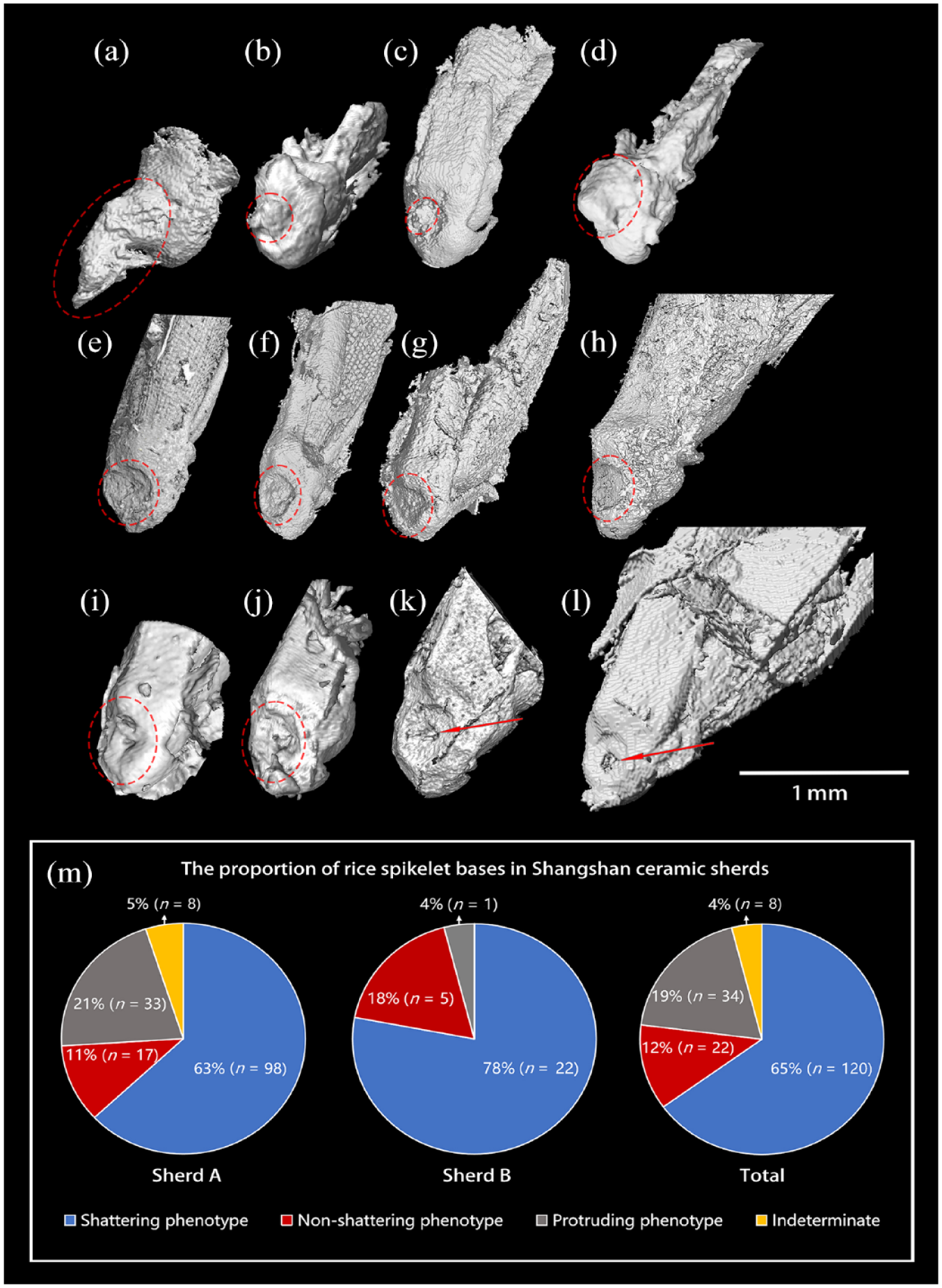
Visualizations of rice spikelet bases in Shangshan ceramic sherds. (a)–(d) Protruding phenotype with attached vascular bundles (highlighted in the red circle). (e)–(h) Shattering phenotype with smooth, flat, and rounded depression. (i)–(l) Non-shattering phenotype either with deep dimpled appearance and less symmetrical scars (i–j), or with torn, irregular, and deep medullary cavity (k–l).
Rice spikelets
We closely examined five intact rice spikelets, of which three exhibited the shattering phenotype (Figure 4a, b, and e; Supplemental Figure S18), one displayed the protruding phenotype (Figure 4d), and the remaining one was indeterminate (Figure 4c). The dimensions of the rice spikelets, including length, width, length-to-width ratio (L/W ratio) and thickness, are summarized in Figure 4. Among the five most intact spikelets, one showed a distinct shattering spikelet base and was still attached to an incomplete awn (Figure 4e). The length of the awn barbs ranged from 40 to 120 μm, similar to those observed in wild rice (Gu, 2007; Tang et al., 2003). However, in comparison to the wild type (Figure 4h) and domesticated type (Figure 4f), the density of the awn barbs (Figure 4g) fell within the intermediate range, suggesting that this spikelet likely exhibits characteristics of both wild and domesticated rice. Awns are considered structures that aid in seed dispersal and defense against birds (Ishikawa et al., 2022; Elbaum et al., 2007). Wild rice typically possesses long awns with long and dense barbs, which are crucial for efficient seed propagation. In contrast, domesticated rice either lacks awns or has short and barbless awns (Fuller, 2007; Hua et al., 2015).

Microscopic images and microCT visualizations of rice spikelets in Shangshan ceramic sherds. (a and b) Rice spikelet with shattering spikelet base. (c) Rice spikelet with indeterminate spikelet base. (d) Rice spikelet with protruding spikelet base. (e) Rice spikelet with shattering spikelet base and (incomplete) awn. (f) Awn of modern domesticated rice (O. sativa ssp. indica). (g) Awn adhering to Spikelet E. (h) Awn of wild rice (O. rufipogon).
Discussion
The ceramic forms allow a typological attribution to the Shangshan Culture. Within that cultural period, the contextual dates, as argued above, are consistent with a deposition of the two potsherds at different stages during the 10th millennium BP, and the production of the pottery (and inclusion of plant materials) sometime between 12/11,000 and 9,000 BP. While we acknowledge the persisting challenges associated with radiocarbon dating of organic inclusions within pottery (Gilmore, 2015), it currently represents the most viable option available.
Turning to the microCT analysis, the non-shattering phenotype in this study—characterized by spikelets with torn, irregular, and deep medullary cavity, deep dimpled appearance and less symmetrical scars (Figure 3i–l; Supplemental Material)—constitutes 12% of the overall assemblage. While a significant minority of contemporary wild rice populations exhibit this non-shattering phenotype, it is important to note that the proportion of such types in modern wild rice assemblages consistently falls within single digits (Cai and Morishima, 2000; Inoue et al., 2015; Lin et al., 2007; Niruntrayakul et al., 2009; Thurber et al., 2010; Xiong et al., 1999; Zhu et al., 2012). In scenarios where adjacent domesticated populations are absent and there is minimal introgression from cultivated to wild species (a phenomenon frequently observed in contemporary rice, as indicated by Wang et al., 2017), the prevalence of the non-shattering phenotype in wild populations during the Shangshan period would presumably be minimal. This leads us to deduce that the observed 12% resulted from human selection within a domestication trajectory.
At 19%, the proportion of the protruding type in our study surpasses that of the non-shattering phenotype at 12%. As shown in Figure 4d, the spikelet base exhibiting the protruding feature appears thinner compared to the shattering phenotype in Figure 4e, suggesting potential immaturity. One plausible explanation, according to Fuller et al. (2008a, 2010), is that rice was often harvested before reaching full maturity during the early stages of cultivation to reduce grain loss. In other words, the elevated percentage of the protruding type corresponds to the prevalence of the shattering phenotype observed in our study and is likely linked to the gathering of immature rice during the early onset of rice domestication in the Lower Yangtze.
Alongside spikelet bases, our study presents an additional five intact rice spikelets (Figure 4), along with the one previously published (Zheng and Jiang, 2009), which collectively offer valuable data for enhancing our comprehension of rice domestication. Through a comparative analysis of spikelet measurements between the Shangshan site and subsequent sites in the region, we can discern chronological variations in their dimensions and shapes (Figure 5). On average, rice spikelets from the Shangshan site exhibit smaller and slimmer dimensions compared to those from later sites, yet they are still wider than the spikelets of wild rice, which generally possess a larger L/W ratio (Zheng et al., 2011). Moreover, as shown in Figure 4, the microCT analysis reveals that the two intact spikelets measure 1.32 mm (Figure 4e) and 1.14 mm (Figure 4d) in thickness, respectively, indicating a notable thinness compared to the average thickness of rice spikelets and grains found in other younger sites with published results (Zhejiang Provincial Institute of Cultural Relics and Archaeology and Jiaxing Mesuem, 2019; Zheng, 2022; Zheng et al., 2011, 2021). Additionally, the examined awn (Figure 4g) falls within the intermediate range between wild (Figure 4h) and domesticated awns (Figure 4f).
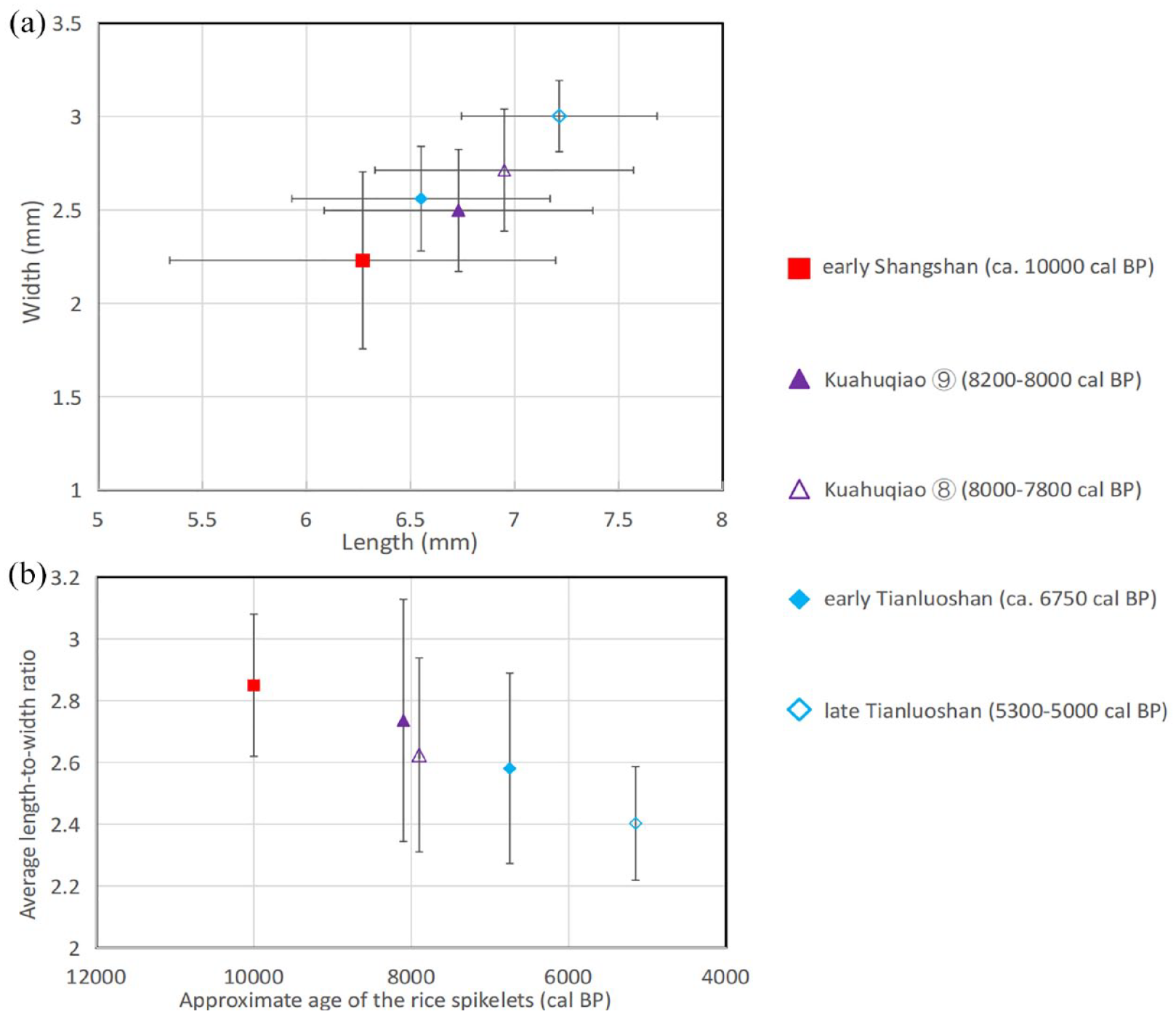
Comparison of the average dimension (a) and L/W ratio (b) of Shangshan rice spikelets with those from multiple younger sites in the Lower Yangtze valley (Fuller et al., 2009; Zhejiang Provincial Institute of Cultural Relics and Archaeology and Xiaoshan Museum, 2004; Zheng et al., 2011). Error bars indicate one standard deviation (1σ).
Overall, the visualized rice spikelets from the Shangshan site display distinct wild characteristics when compared to those found in younger sites within the Lower Yangtze valley, but they also exhibit early indications of the domestication process, such as less dense barbs on the awn and a smaller L/W ratio compared to wild rice. While relying on just two sherds, our study provides a total of 184 spikelet bases, a substantial significant dataset. Additionally, we may note that the figure for the stratigraphically earlier sherd (sherd A) is 11%, while that of the later sherd (sherd B) is 18% (see Figure 3m). If these figures were to be borne out by a larger data set, they might well have captured that domestication process which was underway during the 10th millennium BP.
Our results align with previous studies concerning Shangshan rice, supporting the beginning of rice domestication in the Lower Yangtze during the early Shangshan phase (Huan et al., 2014, 2021; Ma et al., 2016; Wu et al., 2014; Zhang et al., 2024; Zhao and Jiang, 2016; Zheng and Jiang, 2009; Zuo et al., 2017). In particular, Zhang et al. (2024) has demonstrated the growth of wild rice in the Lower Yangtze at least 100,000 years ago, its initial exploitation as a gathered resource at about 24,000 years ago, its pre-domestication cultivation at about 13,000 years ago, and eventually its domestication at about 11,000 years ago. This consistency across different analytical approaches reinforces the reliability and significance of our findings. Transitioning to the middle and late Shangshan phases, a noteworthy rise in the proportion of the non-shattering phenotype becomes evident (Zheng et al., 2016), reflecting the continuing domestication process.
In the broader archaeological context, Shangshan people are often credited with establishing sedentary communities and pioneering rice cultivation in the Lower Yangtze (Jiang and Liu, 2006; Wang, 2019; Wang et al., 2022; Zhao, 2018, 2023). The construction of pile-dwelling houses and open-air villages is indicative of increased sedentism (Jiang and Liu, 2006; Wang, 2023). The abundance of pottery vessels tempered with rice husks underscores the intimate connection between human and rice, implying that the scale of rice processing and utilization may have been rather substantial (Zhao, 2018; Zhao and Jiang, 2016). Collectively, this wealth of evidence strongly supports our argument regarding the early establishment of rice cultivation (and sedentary lifestyles) among the Shangshan people during the early Shangshan phase.
Conclusion
Our analysis of spikelets and spikelet bases from the Shangshan site has led to the establishment of the most extensive database of early rice remains dating to the early Shangshan phase. The identification of the non-shattering domesticated phenotype, constituting 12% of the recovered rice assemblages, alongside other discernible domestication traits of rice spikelets, offers novel insights into the early stage of rice domestication during the 10th millennium BP. This study marks a pioneering application of microCT analysis on ceramic sherds with early plant impressions. This emerging research field holds significant potential for re-evaluating archaeological materials, particularly those with plant impressions, which have historically been under-estimated and under-valued. Future investigations will involve analyzing additional ceramic sherds from multiple strata within the Shangshan site, as well as other sites associated with the Shangshan Culture.
Supplemental Material
sj-pdf-1-hol-10.1177_09596836241269658 – Supplemental material for MicroCT analysis reveals insights into the beginning of rice domestication in the Lower Yangtze during the 10th millennium BP
Supplemental material, sj-pdf-1-hol-10.1177_09596836241269658 for MicroCT analysis reveals insights into the beginning of rice domestication in the Lower Yangtze during the 10th millennium BP by Ting An, Zhiheng Zhang, Yunfei Zheng, Yu Peng, Jiajing Wang, Leping Jiang, Xinyi Liu and Martin K. Jones in The Holocene
Footnotes
Acknowledgements
We thank Prof Zhijun Zhao and Dr Jun Chen for valuable suggestions to improve the quality of the work.
Author contributions
Funding
The author(s) disclosed receipt of the following financial support for the research, authorship, and/or publication of this article: This study was supported by the National Social Science Fund of China grant No. 20CKG024 (TA) and Zhejiang University Experimental Technology Research grant No. SYBJS202308 (YP).

Supplemental material
Supplemental material for this article is available online.
References
Supplementary Material
Please find the following supplemental material available below.
For Open Access articles published under a Creative Commons License, all supplemental material carries the same license as the article it is associated with.
For non-Open Access articles published, all supplemental material carries a non-exclusive license, and permission requests for re-use of supplemental material or any part of supplemental material shall be sent directly to the copyright owner as specified in the copyright notice associated with the article.
