




Abstract
Does consensus messaging about contested science issues influence perceptions of consensus and/or personal beliefs? This question remains open, particularly for topics other than climate change and samples outside the United States. In a Spanish national sample (N = 5087), we use preregistered survey experiments to examine differential efficacy of variations in consensus messaging for vaccines and genetically modified organisms. We find that no variation of consensus messaging influences vaccine beliefs. For genetically modified organisms, about which misperceptions are particularly prevalent in our sample, we find that scientific consensus messaging increases perception of consensus and personal belief that genetically modified organisms are safe, and decreases support for a ban. Increasing degree of consensus did not have consistent effects. Although individual differences (e.g. a conspiratorial worldview) predict these genetically modified organism beliefs, they do not undercut consensus message effects. While we observe relatively modest effect sizes, consensus messaging may be able to improve the accuracy of beliefs about some contentious topics.
Misperceptions about humans’ contribution to climate change (Egan and Mullin, 2017), the fallacious link between the measles, mumps, and rubella (MMR) vaccine and autism (Motta et al., 2018), and the risk of consuming genetically modified (GM) foods (Hasell and Stroud, 2020) remain widespread. These misperceptions can delay climate action, reduce vaccination rates, and lead to the prohibition of bioengineered foods (DeStefano and Shimabukuro, 2019; Egan and Mullin, 2017; Wunderlich and Gatto, 2015). These misperceptions exist despite clear scientific consensus on these claims: global warming is anthropogenic, vaccines do not cause autism, and consuming genetically modified organisms (GMOs) is safe (Cook et al., 2016; Landrum et al., 2019; Gust et al., 2008; National Academies of Sciences, Engineering, and Medicine, 2016). The result is a “consensus gap” (Cook et al., 2018). In part, the discrepancy between the scientific community and the public has been attributed to an awareness issue—many members of the public simply do not know that scientists agree on these issues.
If misperceptions on these important issues are largely an information deficit problem, communicating scientific consensus on contested issues should improve the accuracy of beliefs on these topics. Such messages would convey descriptive norms about the actual level of agreement among experts (van der Linden, Clarke and Maibach, 2015). While descriptive norms as traditionally conceived convey information about social groups’ normative beliefs and behaviors (Lapinski and Rimal, 2005), messages communicating scientific consensus further imply an appeal to authority, as the norms described come from experts (Landrum and Slater, 2020). Ultimately, though, the literature on consensus messaging remains unsettled (Bayes et al., 2023; Landrum and Slater, 2020). Among other outstanding questions, we do not know the degree of expert consensus citizens require to see an issue as solved, and we do not know how much more effective expert consensus is as opposed to consensus among the general public.
Accordingly, we respond to calls in the field to understand the conditions under which consensus messages are and are not effective (Bayes et al., 2023). We contribute to this knowledge base by testing consensus message variations regarding GMOs and vaccines in a national Spanish sample. We find that regardless of variations in source or degree of consensus, consensus messages are much more influential for GMO beliefs and attitudes than for vaccines. Based on descriptive data from our representative sample, we suggest that consensus messages are more likely to be effective for issues that have generated widespread misperceptions, and low awareness of the scientific community’s views, but are nonetheless not subject to political or social division.
1. The consensus messaging debate
Whether communicating scientific consensus surrounding an issue can effectively sway the public is a contested issue (Landrum and Slater, 2020). Proponents of the Gateway Belief Model argue that perceptions of scientific consensus serve as a “gateway belief” that indirectly affects personal beliefs and policy preferences (van der Linden, Leiserowitz, et al., 2015). In a number of follow-up studies, van der Linden and colleagues have replicated this basic finding, typically focusing on climate change (Goldberg, van der Linden, Ballew, Rosenthal, Gustafson et al., 2019; Van der Linden et al., 2014, 2019), but also extending to vaccines (van der Linden, Clarke and Maibach, 2015).
There are a variety of critiques to this model, however. Some have challenged the methodological choices made by these authors in specifying path models across studies (Landrum and Slater, 2020), and disagree about how best to interpret the models’ results. Importantly, consensus messages generally appear not to have direct effects on attitudes or policy preferences (Chinn et al., 2018; Deryugina and Shurchkov, 2016; Dixon, 2016; Kerr and Wilson, 2018a; Landrum et al., 2019). Although proponents of the Gateway Belief Model emphasize the role of indirect effects, outlining a two-stage sequential mediational process, it is worth noting recent critiques of this form of analysis (Bayes et al., 2023; McGrath, 2021; Rohrer et al., 2021).
Others’ tests of this general model have failed to replicate its findings (Cook and Lewandowsky, 2016; Deryugina and Shurchkov, 2016; Kerr and Wilson, 2018b; Landrum et al., 2019). Some have also noted that differential acceptance and reactance to persuasion attempts undermine consensus messaging, particularly for polarized issues such as climate change (Chinn and Hart, 2021a; Cook and Lewandowsky, 2016; Dixon, 2016; Ma et al., 2019), casting doubt on the ultimate worth of the strategy. They instead argue that targeted messaging strategies are needed to appeal to hesitant subgroups. Gateway Belief Model proponents argue that climate consensus messaging is as effective or more effective among conservatives in the United States (van der Linden et al., 2019).
Variations in consensus messaging
Consensus messages can be constructed in a number of ways that might moderate their efficacy. One way they can vary is in the conceptualization of consensus itself. Although the majority of studies rely on numerical or summary statements (Landrum and Slater, 2020), others highlight the process of achieving consensus (Landrum et al., 2019; e.g. describing how a panel of scientists reviewed hundreds of scientific studies to arrive at their conclusion), and some have tested metaphor and pie charts (Van der Linden et al., 2014). Another variation is in the level of consensus depicted. Some work shows that when presented with varying degrees of scientific consensus on apolitical issues in the United States—the gravitational pull of the moon’s effects on earthquakes, repeated motions’ effects on bone damage, or artificial sweeteners’ effect on the composition of gut microbiota—respondents shift their perceptions of the science’s certainty to match. However, as Chinn and colleagues showed, any consensus below 65% decreased perceptions of certainty (Chinn et al., 2018). The authors also detected indirect effects on personal agreement and funding support, in line with the Gateway Belief Model. Similarly, Kerr and Wilson (2018a) find that both high (97%) and low (63%) consensus messages increased perceived consensus on GMO safety in the United States. Another study (Kobayashi, 2019) tested the effects of highly divergent scientific and public consensus levels on GMO safety in Japan. Respondents were either informed that 88% of scientists agreed GMOs were safe, or that 5% of the general public agreed, or both. Only those exposed to both treatments had increased safety beliefs. More work is needed to understand tipping points in numerical consensus messages for other issues and in other contexts.
In addition, the source of consensus can be varied. The primary sources tested in the literature are scientific (Landrum and Slater, 2020). However, some scholars have examined the effects of scientific consensus when conveyed by partisan elected officials (Benegal and Scruggs, 2018), with interest in the group dynamics of source credibility in this arena. Others, like Kobayashi (2019), have examined the potential for social, rather than scientific consensus to influence the public. This can skirt around issues that arise when the public is skeptical of experts (Pasek, 2018; Lyons et al., 2020), especially if the public is unaware of widespread endorsement for topics such as anthropogenic climate change (Mildenberger et al., 2017). This research on social consensus borrows from research on descriptive norms even more directly, rather than merging such normative information with an implicit appeal to authority. These consensus messages aim then to correct beliefs about beliefs, or second-order beliefs. Individuals display egocentric bias in forming second-order beliefs about, for instance, the percentage of Americans who believe in anthropogenic climate change: individuals’ second-order beliefs are conditioned on their personal beliefs. When second-order beliefs are updated, support for climate policy increases as well (Mildenberger et al., 2017). Thus social consensus may be especially effective at influencing behavioral outcomes (Jachimowicz et al., 2018).
Looking beyond climate change
Some studies have tested consensus messaging effects for issues outside climate change, but results are likewise mixed. Van der Linden and colleagues find support for the Gateway Belief Model in the case of vaccines (van der Linden, Clarke, and Maibach, 2015). Others find a much more conditional model; in these studies, consensus messages appear to be influential only among people who already hold favorable views toward science and scientists, failing to move those most often targeted in vaccine communication (Clarke et al., 2015; Dixon et al., 2015).
A handful of studies have also applied consensus messaging about GMO safety in the United States, with mixed results. Dixon presents a pair of studies (Dixon, 2016) that find consensus messaging increases perception of consensus but only indirectly influences personal beliefs, and is less effective for those with negative prior views toward GMOs. Others show that GMO consensus can increase both perceived consensus and personal safety beliefs, the latter both directly and indirectly (Kerr and Wilson, 2018a). On the contrary, process-based consensus messages as employed in recent work appear to influence neither consensus perception nor GMO concern (Landrum et al., 2019).
Comparative work in this domain is rare. Ultimately, however, consensus messages are likely to be most effective when issue-knowledge is low and misperceptions of scientific consensus are widespread (Li and Wagner, 2020), but attitudes on the given issue are not held with great conviction or tied to identity (Flynn et al., 2017). Such conditions not only change across issues but across the cultural contexts of the public(s) in question.
2. Preregistered hypotheses
We extend the research on consensus messaging by testing variations for GMO and vaccination in a national sample from Spain. For vaccination, we vary whether the consensus is derived from scientists or the public, and whether the level of consensus is 75% or 90%. For GMOs, we focus on scientific consensus only, but vary the degree from 60% to 95% at 5% intervals. We preregistered our design, hypotheses, and analyses using the Open Science Framework: doi:10.17605/OSF.IO/7N9KT. We make two primary hypotheses. First, we pose a corrections hypothesis: any treatment condition will lead to a significant reduction in “negative” beliefs or attitudes 1 compared with the control condition (where participants receive no consensus information). Second, we pose a norms hypothesis: higher levels of descriptive norms (i.e. 90% compared with 75% consensus) will lead to a larger reduction in negative beliefs or attitudes than lower levels of descriptive norms. Both of these hypotheses are tested for both vaccination and GMOs, although the range of variation in descriptive norms we test varies. We do not have a hypothesis of whether scientific or social consensus will be most effective in reducing negative beliefs or attitudes in the case of vaccine items, and so this test is exploratory.
3. Method
Sample
The online survey firm YouGov collected survey responses (in Spanish) from a national sample in Spain in May–June 2020. YouGov recruits a large panel of opt-in respondents and then uses a weighting and matching algorithm to create a sample that mirrors the demographics of the Spanish public. (YouGov determines the specific eligibility and exclusion criteria for their panel.) Participation in the study was voluntary and participants received YouGov points for their participation. We obtained a total sample of 5087 participants (2592 men, 2495 women, 26% university educated, Mage = 45.11, SDage = 14.45), including an oversample of participants residing in Cataluña. 2 Our descriptive results that follow use the weights supplied by YouGov to match the demographics of the Spanish population, though our experimental models do not employ these weights per Franco et al. (2017).
Design
We specifically target two claims in our consensus treatments: the unsupported claim that the MMR vaccine causes autism, and the claim the GMO foods are not as safe to consume as conventional foods. Virtually no experts support the first claim; over 90% of US physicians agree that adults and children should receive all recommended vaccines (let alone MMR), for instance (Gust et al., 2008; van der Linden, 2016). Likewise, 88% of the American Association for the Advancement of Science (AAAS) members agreed that GMO foods were safe to eat (Funk et al., 2015), and the National Academies of Sciences, Engineering and Medicine (NASEM) concluded in a 2016 consensus statement that there is “no substantiated evidence of a difference in risks to human health between currently commercialized genetically engineered (GE) crops and conventionally bred crops,” and further, “no conclusive cause-and-effect evidence of environmental problems from the GE crops” (Landrum et al., 2019). Still, it should be noted that this is not an uncontested position, as other groups (e.g. the European Network of Scientists for Social and Environmental Responsibility) have questioned the consensus on GMO safety, emphasizing the uncertainty of such calculations (Landrum et al., 2019). Regardless, both the MMR vaccine and GMO foods have been broadly endorsed by relevant experts. In addition to looking at the effects of communicating such consensus on directly related beliefs, we further examine potential spillover effects on other vaccine and GMO-related attitudes.
Accordingly, we conducted two experiments that vary slightly in the specifics of the design. Participants were randomly assigned to the GMO experiment or the vaccination experiment. The vaccination experiment (n = 3539) employed a 2 (scientific vs social consensus) × 2 (90% vs 75%) between-subjects factorial design, with an additional control condition exposed to no vaccination information (the 4 treatment groups ranged from 613 to 633, with control group n = 1031). The message in this experiment targeted the MMR-autism misperception, with messages presented as follows: “More than [75/90] out of 100 [medical scientists/people] agree that the MMR vaccine does not cause autism.”
The GMO experiment (n = 3587) employed a between-subjects design with one factor (percentage of scientific norm) and 8 levels (60%, 65%, 70%, 75%, 80%, 85%, 90%, 95%), as well as a control condition (no message on GMOs) (the 8 treatment groups ranged from 284 to 349, with control group n = 1008). Messages were presented as follows: “More than [X] out of 100 food scientists agree that genetically modified food is safe to eat.” In the case of GMOs, which historically have been more distrusted in Europe than in the United States (Ceccoli and Hixon, 2012; Wunderlich and Gatto, 2015), we do not test parallel social consensus conditions as such messages may lack external validity and raise participant suspicion (this is in part borne out in our descriptive results below, which show high levels of negative beliefs about GMOs in the control group).
In other words, the two experiments differ somewhat in the specific variations in consensus treatment conditions due to the underlying nature of the two issues. Vaccines are more broadly popular and more positively perceived than GMOs in our sample (and elsewhere), and so it is more appropriate to test the effects of social consensus in this case. Similarly, the potential uncertainty in GMO effects asserted in some expert statements (Landrum et al., 2019) allowed us to test a wider range of consensus degrees going as low as 60% consensus. This variation may make it more difficult to directly compare the effects of consensus messaging across issues.
About 20% of the participants who were assigned to the GMO (vaccination) experiment were randomly assigned to answer the outcome variables of the vaccination (GMO) experiment. These participants acted as our control group for the vaccination (GMO) experiment. For this reason, the final n is about 3500 for each experiment (Supplemental Table C1).
Following the treatment, respondents provided responses on a number of outcome measures. Our main focus follows prior consensus message work: perception of consensus, personal belief, and relevant outcome (policy attitude or behavioral intent). Another important test for any intervention is whether it produces unintended spillover effects (good or bad). The literature on fact-checking, for instance, often shows not only effects of corrections on targeted beliefs, but also other relevant beliefs or attitudes (Carey et al., 2022; Khanna and Sood, 2018; Lyons et al., 2019, 2020). We follow this logic in our experiments by testing a number of potential spillover effects of interest. Specifically, in the GMO experiment, we look at effects on conspiracy beliefs concerning GMOs, an outcome that to our knowledge has not been examined in the consensus messaging literature. Consensus messaging might have a general “halo effect” that improves responses toward GMOs, regardless of the thrust of the claim, thereby reducing conspiracy beliefs. In the vaccine experiment, we look at a number of potential attitude or belief spillovers—in addition to conspiracy beliefs about vaccines, we look at general vaccine hesitancy, and beliefs about vaccines other than the MMR (flu and human papillomavirus (HPV)). Again, we test whether positive consensus messaging about the MMR vaccine has spillover effects on these untargeted outcomes. To our knowledge, these have likewise not been tested in a consensus messaging framework.
In sum, for GMOs, we look at the targeted consensus belief regarding consumption, the targeted personal belief, and potential spillover outcomes (perception of consensus on environmental harm, personal belief on environmental harm, policy attitude, and related conspiracy beliefs about GMOs). As per our preregistered analysis plan, in our primary analysis we scale together both consensus perceptions, both personal beliefs, and both conspiracy beliefs, as these respective outcomes are highly correlated. For vaccines, we similarly look at the targeted consensus perception and personal belief as well as numerous potential spillover outcomes, which we likewise group according to the preregistered analysis plan. All respondents were debriefed at the conclusion of the survey (see Supplemental Materials).
Measures
Respondents first provided demographic information and completed a series of batteries measuring predispositions that we employ as moderators (moderator measures and tests are reported in Supplemental Appendix B). They were then exposed to one of the experimental treatments, and subsequently completed the outcome measures. We describe our measures below in the order in which they appeared to participants (note that we provide the English translation of the items here). All items included a “don’t know” response option unless specified otherwise.
Covariates
We measure a set of standard demographics for use as covariates in our models in order to increase precision around our estimates. In addition to standard demographics (age, gender, and university education), we measure religiosity using the item: “Lots of things come up that keep people from attending religious services even if they want to. Thinking about your life these days, how often do you go to religious services?”on a scale the ranged from never (1) to once a week or more (7) (M = 2.39, SD = 1.71). Religiosity was included based on prior work showing its association with scientific attitudes and beliefs in the region (Pasek, 2018; Rutjens et al., 2018).
In order to examine potential political differences, we also measure left–right ideology with the following measure: “When it comes to politics, people speak of ‘the left’ and ‘the right.’ What is your position? Please place yourself on a scale from 0 to 10, where 0 indicates ‘extremely left’ and 10 indicates ‘extremely right.’ What number best describes your position?” (M = 4.65, SD = 2.17). To measure partisanship, it asked “To which of the following political parties do you feel closest to?” and most were given the following options: Partido Popular (PP), Partido Socialista Obrero Espanol (PSOE), Podemos, Vox, Ciudadanos â Partido de la Ciudadania (Cs), Other, None, or “I don’t know.” The subset of participants residing in Cataluña were given the alternative options of: PP, PSOE, Podemos, Vox, En Comu Podem, Esquerra Republicana de Catalunya/Izquierda Republicana de Cataluna, Junts Per Catalunya/Juntos por Cataluna, Other, None, or “I don’t know.” In our analyses, we use indicators for PP, Podemos, Vox, Ciudadanos, other party (collecting some of the minor parties listed above), and no party (including none and don’t know), with PSOE, currently the largest party, as the reference group. Finally, we ask about attention to politics as follows: Some people seem to follow what’s going on in government and public affairs most of the time, whether there’s an election going on or not. Others aren’t that interested. Would you say you follow what’s going on in government and public affairs
on a scale ranging from hardly at all (1) to most of the time (4) (M = 2.92, SD = 0.86).
Outcome measures
We then asked participants to use a 5-point Likert-type scale to indicate their agreement with a series of questions that reflect perceived consensus, personal beliefs, and behavioral or policy intent. Full question wordings (and response distributions) are available in Supplemental Table C2.
Per our preregistration, we group GMO items into four measures (Cronbach’s alpha and Spearman’s rho reported where appropriate): personal beliefs about GMO safety, coded with perceived safety high (items 1 and 2; item 1 reverse coded; α = .57, ρ = .40), perceived consensus on GMO safety, coded with safety high (items 3 and 4; α = .73, ρ = .56), support for a ban (item 5), and GMO conspiracy beliefs (items 6 and 7; α = .62, ρ = .44). (Note that we group items as detailed here due to their anticipated correlations, though we reiterate that only the consumption-safety items (personal belief and perceived consensus) were technically targeted by the consensus message, while others are measured for potential spillover effects.)
While the focus of the vaccine consensus message deals with the fallacious MMR-autism link, we also test for potential spillover effects on HPV, influenza, and general vaccine beliefs or attitudes. Per our preregistration, we group vaccine items into seven measures: general vaccine hesitancy (items 1 and 2; α = .59, ρ = .43), autism misperceptions (items 3 and 4; α = .88, ρ = .77), HPV misperceptions (items 5, 6, and 7; item 6 reverse coded; α = .53), flu vaccine misperception (item 8), vaccination intention (item 9), vaccine conspiracy beliefs (items 10 and 11; α = .74, ρ = .58), and finally misperception of expert consensus, which again uses items 4 and 7 (α, = .76, ρ = .64). (Again, we note that the autism items were targeted in the consensus messages, while other items are measured for potential spillover effects.)
We also report results for each experiment using latent variables revealed through (preregistered) exploratory factor analysis as outcome measures in Supplemental Table B1. Finally, we report results for all outcome measures individually (Supplemental Tables B2 and B3).
4. Results
Descriptive results
Prevalence of beliefs and misperceptions
First, we provide descriptive statistics about the prevalence of consensus awareness and personal beliefs about GMOs and vaccines in our national sample (Supplemental Table A1). These items are those most directly targeted in our consensus message treatments (though note that the GMO-environmental harm items are not directly targeted, but presented for context). These findings come from the control conditions and employ survey weights. We also distinguish between being misinformed and uninformed (Kuklinski et al., 2000), as this may be important in corrective efforts (Li and Wagner, 2020). To emphasize this distinction, we include several additional columns that indicate the proportion that are “misinformed” (their belief is inconsistent with scientific evidence), “informed” (their belief is consistent with scientific evidence), and those who are “uninformed” (neither agreeing nor disagreeing or indicating that they do not know the answer). Although the nature of scientific consensus is inherently open to ongoing contestation, for simplicity we refer here to agreement with the vaccine and GMO consensus references mentioned above (Gust et al., 2008; Landrum et al., 2019). Finally, we estimate the ratio of misinformed to informed responses. Note that in this summary and in Figure 1, we collapse strongly agree/agree as well as strongly disagree/disagree responses for simplicity.
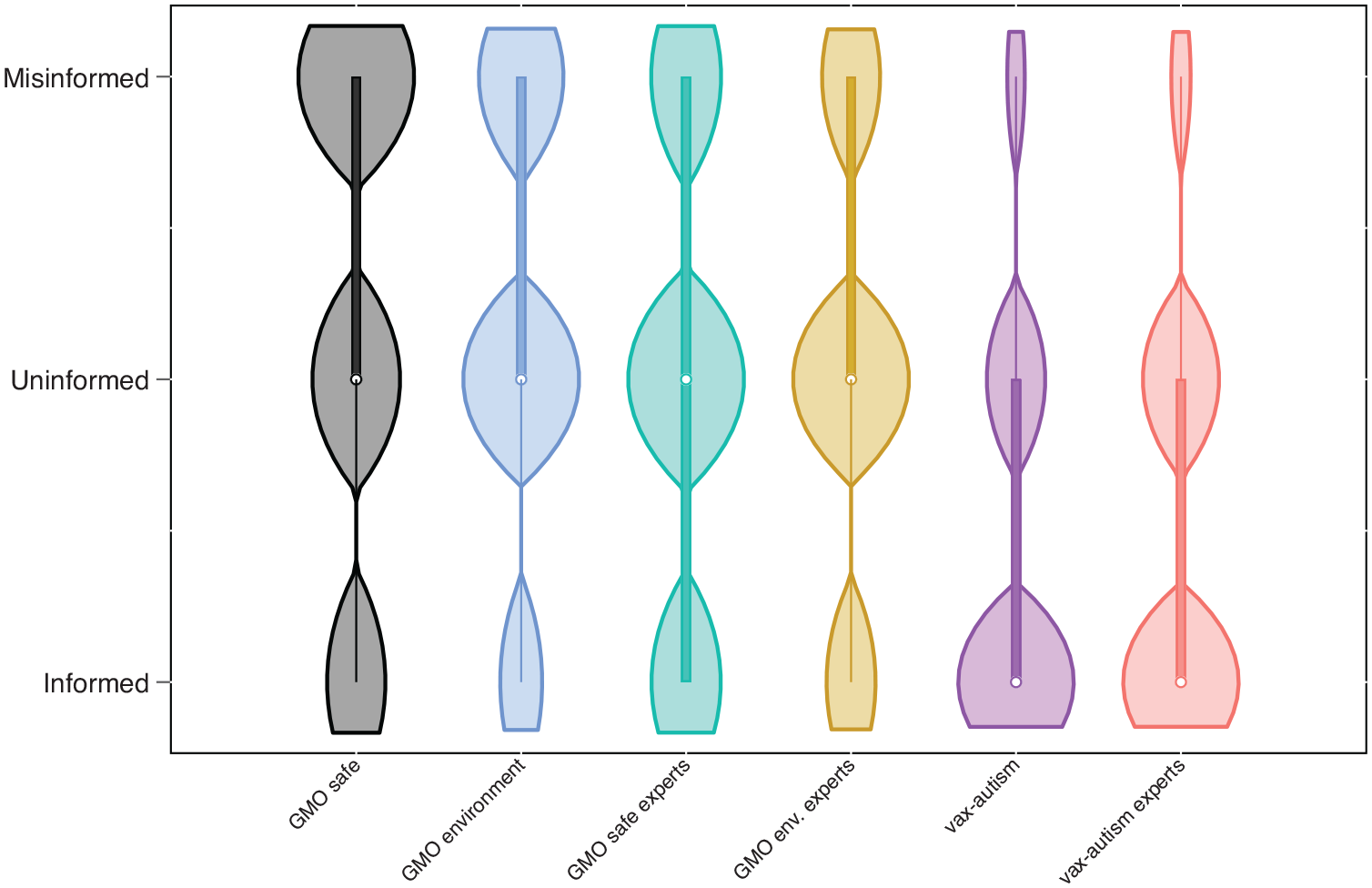
Misinformed, uninformed, and informed proportions for GMO and vaccine questions.
Negative perceptions of GMOs are common: 43.5% believe GMOs are unsafe to eat and 36.2% believe they harm the environment (only 20.4% and 16.7% are informed on these questions, respectively. The public is also misinformed regarding the scientific consensus on the questions of safe consumption and environmental harm (27% and 25%, respectively). Likewise, the proportion of the public uninformed is also large for personal GMO beliefs (e.g. 47.1% for are categorized as uninformed regarding the personal safety item), and even larger regarding scientific consensus (e.g. 53% are categorized as uninformed regarding scientists’ views on environmental harm), suggesting many citizens could be responsive to corrective efforts (Li and Wagner, 2020). Misperceptions about vaccines are less prevalent. Only 8.8% believe vaccines cause autism, while 60.9% are informed on the question, and similar numbers are misinformed/informed regarding scientists’ views. These findings are also shown in Figure 1. This violin plot shows the distribution of the data, with wider sections representing more common outcomes for the misinformed/uninformed/informed categorization across questions.
Political and social division
Next, we present a preregistered test of whether self-reported ideology is associated with GMO or vaccine beliefs. 3 These regression models look only at respondents in the control condition who received no information about the relevant issue (therefore, model ns are between 853 and 961). We use survey weights and include standard covariates of age, sex, and education, as well as religiosity and attention to politics as these may be associated with outcomes and unequally distributed across political preferences (Pasek, 2018; Rutjens et al., 2018). These tests show no association of ideology with any of the beliefs or attitudes relating to GMOs or vaccines (Supplemental Tables A2 and A3). Our models also show little to no significant differences in GMO beliefs based on other common predictors of social divisions of education or religiosity. However, education is associated with lesser agreement with most vaccine misperception measures, while religiosity is associated with greater agreement on most measures. Those who follow politics more often also exhibit greater levels of vaccine misperceptions.
Based on these model specifications but replacing ideology with party affiliation, we likewise show no polarization based around political parties for GMO beliefs (Supplemental Figure A1). For vaccine beliefs (Supplemental Figure A2), we likewise see little polarization, but note that Vox party affiliates, those affiliating with other minor parties, and those affiliated with no party are more likely to say they would skip vaccination than the reference party (PSOE, the current largest party in Spain), and other minor party and no-party respondents displayed greater endorsement of some other vaccine-hesitant items relative to PSOE (we report on party polarization surrounding these beliefs for this sample in greater detail in Spälti et al., 2023).
Finally, we conducted exploratory analyses to determine whether there were significant regional differences in these beliefs. We find no regional differences in GMO outcomes, but those in the Northeast (e.g. Cataluña) exhibit greater vaccine misperceptions than those in other regions including Madrid, the North, and the Northwest (see Supplemental Tables A6 and A7). Note that this should not be because of the oversample of the Northeast, as this should merely give us a more precise estimate with smaller confidence intervals; as it is the largest regional subgroup, we set this as the reference category. As this was exploratory, we do not speculate about the cause of any such regional differences.
Hypothesis tests
Next we test the effects of consensus. Due to the recently highlighted difficulty of satisfying the strong assumptions required in mediation analysis (e.g. Rohrer et al., 2021), we follow those who focus on direct effects on consensus messages (Benegal and Scruggs, 2018; Deryugina and Shurchkov, 2016). As Bayes et al. (2023) write in their review of this literature, for reasons explained by McGrath, 2021, the mediational evidence presented to-date is insufficient to definitively show an indirect causal path from consensus messages to consensus belief to policy support, as it requires experimental manipulation of the mediators to conclusively establish causality.
For both GMOs and vaccination, we model message effects on our various outcomes of interest separately. All models include a set of standard covariates (age, sex, education, and religiosity) to improve precision (Angrist and Pischke, 2009).
Does scientific consensus affect GMO beliefs?
To examine the correction hypothesis for GMOs, we pool all consensus conditions and compare against the control condition. The left-hand panel in Figure 2 (full results in Supplemental Table A8) shows the effect of exposure to any consensus message on perceived consensus, personal safety beliefs, support for a ban on GMOs, and belief in GMO conspiracy theories. Consensus messages increased perceived consensus (b = .13, SE = .04, p < .005), and to a lesser extent personal safety beliefs as well (b = .09, SE = .03, p < .05). In contrast to other scholars’ findings, our consensus messages also had a significant negative direct effect on support for a ban (b = −.13, SE = .04, p < .005). There was no effect on conspiracy beliefs.
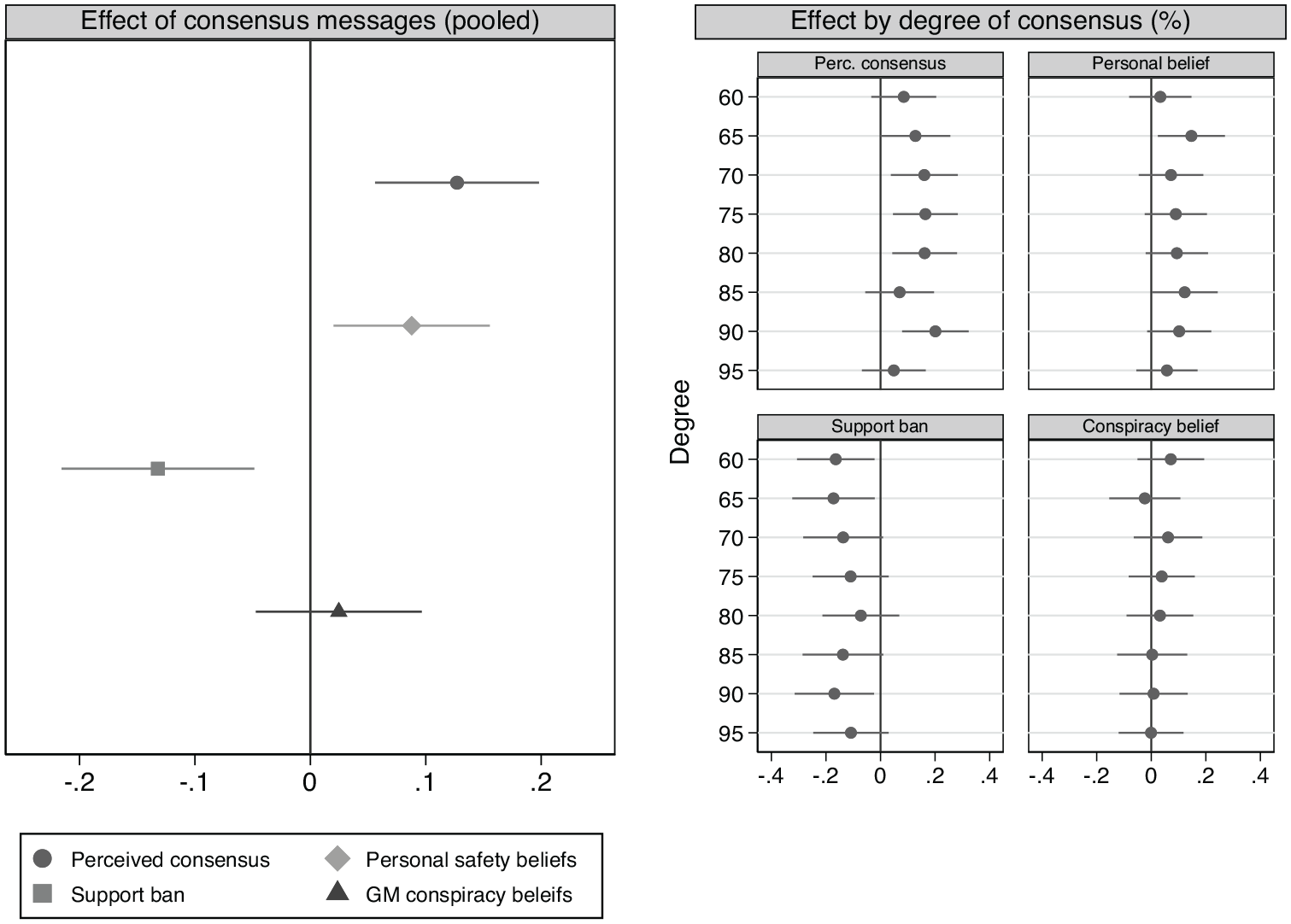
Effects of scientific consensus messages on GMO outcomes.
An alternative visualization of scientific consensus effects is shown in Figure 3. Here, we refer back to the “misinformed, uninformed, and informed” categorizations that we reported in our descriptive findings. To show effects across these categories, we use multinomial logistic regression. Our models use the same covariates as the previous models, but differ in that “don’t know” responses are now included (in the “uninformed” outcome category) and test effects on each item individually, as averaging the two consensus beliefs, for example, would not allow for discrete categorization. (Note also that for simplicity we use the same categorization scheme for policy attitude, though such an attitude cannot be deemed to be informed or misinformed.) Results suggest that messages increased the probability of informed responses on either consensus belief by about 6% (ps < .001), with about a 5% decrease in probability of uninformed responses (ps < .01). For personal safety belief, messages reduced the probability of misinformed responses by about 4% (p < .05). Messages increased the probability of opposing a GMO ban by about 4% (p < .01).
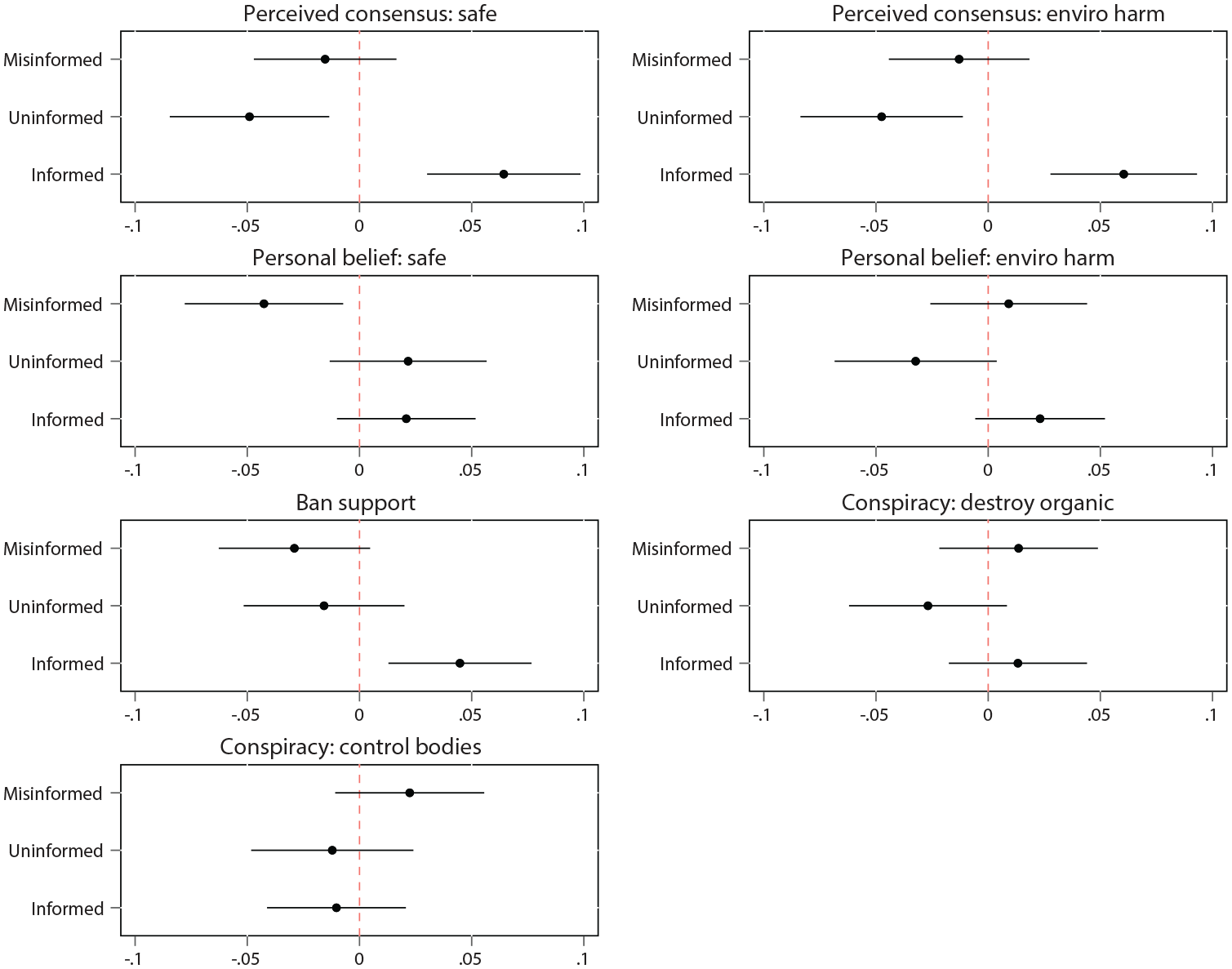
Effects of scientific consensus message on GMO outcomes: predicted change in “misinformed/uninformed/informed” by item.
Does the degree of scientific consensus matter?
To test the norms hypothesis for GMOs, we create an indicator variable for each of the eight levels of consensus, with the control serving as the reference category. When looking at perceived consensus, there is suggestion of a linear effect—60%–65% messages have no effect, while 70%–80% messages have significant effects, with 90% consensus having the strongest effect (b = .20, SE = .06, p < .005). However, neither 85% nor 95% consensus messages have significant effects on perceived consensus. Furthermore, linear comparisons of these effects showed that the only significant difference among messages was between 90% and 95% (b = .15, SE = .07, p = .041). The results for personal safety beliefs and ban support are even less consistent regarding the degree of consensus (see the right-hand panel in Figure 2 and Supplemental Table A9).
Are the effects of scientific consensus on GMO beliefs conditional?
Finally, we examined whether the GMO consensus message effects were conditional on a series of predispositions. We provide a theoretical background on differential acceptance, measurement detail, and full results for these preregistered (though exploratory) analyses in Supplemental Appendix B. Although many of these measures are associated with GMO beliefs, there is limited evidence of any consistent moderation effects. In fact, we find that consensus messages result in larger decreases in support for a GMO ban to be among the most conspiratorial, those most reliant on intuition, and those lowest in general trust. We report these models in full in the Supplemental Tables B4 to B7.
Does consensus affect vaccine beliefs?
To examine the correction hypothesis for vaccinations, we likewise pool all consensus conditions and compare against the control condition as we did for the GMO experiment. We find no effect on autism beliefs (the target of the consensus message), nor on any related vaccine beliefs about the influenza vaccine, HPV vaccine, general vaccine hesitancy, vaccine conspiracy beliefs, misperceptions of consensus, or behavioral intentions (left-hand panel of Figure 4 and Supplemental Table A10). We also model the effects of the four conditions each entered separately as an indicator variable. Neither scientific nor social consensus influence these beliefs, at either 75% or 90% levels (right-hand panel of Figure 4 and Supplemental Table A11). In other words, there was no effect on vaccine beliefs, regardless of the source or degree of consensus.

Effects of consensus messages on vaccine outcomes.
5. Discussion
When does communicating scientific consensus influence the public? In a large national Spanish sample, we find that consensus messages produced direct increases on not only perceived consensus on GMO safety, but also personal beliefs, while decreasing support for a ban on such crops. These direct effects on personal beliefs and policy preferences are surprising, and come in contrast to a literature that typically finds indirect effects (van der Linden, Leiserowitz, et al., 2015) at best (Deryugina and Shurchkov, 2016; Dixon, 2016; Kerr and Wilson, 2018a; Landrum et al., 2019). 4 These effects are not undercut by either GMO concern or a host of psychological traits that sometimes lead to the rejection of expertise or official accounts (e.g. Dixon et al., 2015). On the other contrary, we find no effects on vaccine beliefs or attitudes regardless of source or level of consensus.
Considering the proportion of the public holding relevant misperceptions and knowledge of expert consensus on these topics might help explain why we observe these differences. As stated, up to 43.5% of the sample believed GMOs are unsafe, while only about 9% reported belief that vaccines cause autism. Likewise, consensus awareness was substantially lower for GMO items (about a quarter of respondents) than for vaccine-autism (over half of respondents). Furthermore, GMO beliefs may not be tied to the elements of social identity that anti-vaccinations beliefs have taken on in and of themselves (Attwell and Smith, 2017). There is also no ideological association across GMO or vaccine beliefs among our sample (in contrast to climate change in the United States), and further, no association of GMO beliefs with party affiliation, religiosity, or national region, limiting differential acceptance. As such, it may be easier for respondents to let new knowledge of expert consensus shape their personal beliefs. It is also worth reflecting on work testing climate consensus effects across samples (Goldberg, van der Linden, Ballew, Rosenthal and Leiserowitz, 2019) that found larger effect sizes among more representative samples (as many convenience samples skew younger and more educated and thus more informed on the issue a priori); our sample quality may have contributed to our ability to detect effects on GMO outcomes.
On the contrary, our findings point to some additional limits to consider for consensus effects. Interestingly, our results did not show that increasing degrees of consensus necessarily results in larger effects on beliefs. While the pattern of treatment effects for perceived consensus mostly follow the expected pattern, personal belief and policy support did not. This is not necessarily surprising in retrospect, as these outcomes are less closely tied to the degree of consensus per se; rather, the existence of any form of consensus could represent a tipping point for influencing these outcomes (Andrighetto and Vriens, 2022). Taken together, these results are largely convergent with those of Chinn et al. (2018), who found an increasing degree of consensus increases the perception of scientific certainty (and indeed, does so nonlinearly), but not funding support across multiple issues. Finally, although updated consensus beliefs may have “spilled over” to personal beliefs about GMO safety, and policy preference, there appears to be a limit to such halo effects, as conspiracy beliefs were not affected. Overall, our findings suggest a number of possible boundary conditions for consensus effects, helping to address calls from the field to do so (Bayes et al., 2023). The boundary conditions outlined above should be examined in different cultural and political contexts, however. Most research on consensus effects has been conducted in the United States, with some exceptions for work conducted in Australia, New Zealand, and Japan (Cook and Lewandowsky, 2016; Kerr and Wilson, 2018a, 2018b; Kobayashi, 2018, 2019). We further the evidentiary base on consensus messaging by examining effects across issues and examining potential spillover effects in a large national sample in Spain, but more work is needed. Indeed, one of the key limitations of our study is that we look at only one (novel) national case. To better understand the conditions under which these messages are successful, future work would ideally consist of cross-national, multi-issue comparisons. In addition, longitudinal designs could tell us how quickly such effects might decay.
Ultimately, we test single, brief messages and detect small effects. These effects are in line with the expectations derived from prior work, and exceed those in terms of direct effects, but it is important not to over-promise large increases in public understanding and acceptance of contested science (for discussion of small effect sizes in climate attitude research, see Chinn and Hart, 2021b; Rode et al., 2021). On the contrary, it is worth reflecting on the spillover effect we detected: although the GMO consensus message targeted the safety of consuming GMO foods, this message nonetheless influenced perceptions of experts’ views about these crops’ environmental impact as well (though this is likewise supported in the 2016 NASEM statement). If such halo effects are common in consensus message processing, organizations should take care in how they craft statements on nuanced issues.
Our conclusions are also relevant to the contextual efficacy of corrections more generally. That is, understanding the contours of consensus efficacy—which may be driven by proportions of misperceptions, awareness of scientific evidence, and polarization surrounding an issue in a given population and context—can also inform corrective strategies that do not center on consensus messaging. These lessons can be useful when examining the role of information and persuasion on contested factual issues writ large.
Supplemental Material
sj-pdf-1-pus-10.1177_09636625231188594 – Supplemental material for When experts matter: Variations in consensus messaging for vaccine and genetically modified organism safety
Supplemental material, sj-pdf-1-pus-10.1177_09636625231188594 for When experts matter: Variations in consensus messaging for vaccine and genetically modified organism safety by Benjamin A. Lyons, Vittorio Mérola, Jason Reifler, Anna Katharina Spälti, Christine Stedtnitz and Florian Stoeckel in Public Understanding of Science
Footnotes
Data availability statement
The data underlying this article and code required to reproduce the analyses are available at the Open Science Framework, at DOI:10.17605/OSF.IO/7N9KT.
Funding
The author(s) disclosed receipt of the following financial support for the research, authorship, and/or publication of this article: This study was funded by the European Research Council under the European Union’s Horizon 2020 research and innovation program (Grant 682758).

Supplemental material
Supplemental material for this article is available online.
Notes
Author biographies
References
Supplementary Material
Please find the following supplemental material available below.
For Open Access articles published under a Creative Commons License, all supplemental material carries the same license as the article it is associated with.
For non-Open Access articles published, all supplemental material carries a non-exclusive license, and permission requests for re-use of supplemental material or any part of supplemental material shall be sent directly to the copyright owner as specified in the copyright notice associated with the article.
