




Abstract
Augusto Isaac d'Esaguy was a 20th century Portuguese medical historian who made contributions to the history of Portuguese-Jewish physicians and was also involved with the Jewish-Portuguese Refugee Committee which assisted with the relocation of Jews from Nazi-controlled France during the Second World War.
Cease all that antique Muse hath sung,, for now
a better Brav'ry rears its bolder brow. (The Luiciades, by Luiz Vaz de Camoens, 1572, translated
by R F Burton, 1880, London)
The poet is a man who feigns
And feigns so thoroughly, at last
He manages to feign as pain
The pain he really feels, … . (Fernando Pessoa
(1888–1935), Autopsychography, Translated by
Edouard Roditi)
Biography
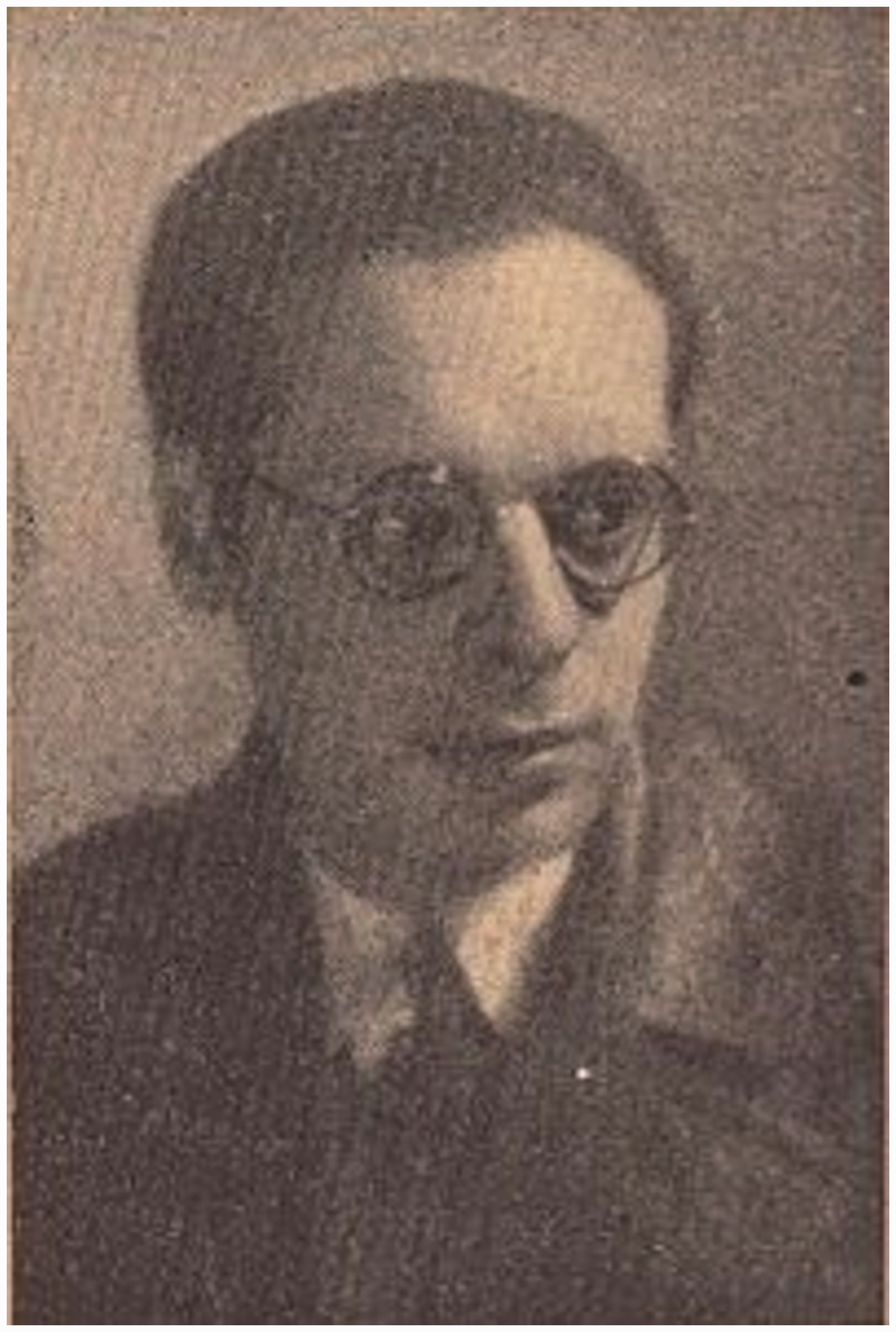
Augusto Isaac d'Esaguy was born in Faro, Portugal, in 1899. His father, Isaac Augusto d'Esaguy, was born in 1869 in Capo Verde, and his mother, Raquel Toledano-Bensimon, was born in E'vora. Augusto had three brothers and sisters. 1 Later Augusto moved to Lisbon. In 1923, whilst still a medical student, he married Sylvia Cohen Israel whom he later divorced.
He became a journalist before graduating in Medicine. In 1918, he served as a Secretary to the Minister of Foreign Affairs, Prof. Egas Moniz. At this time, he was described as tall, thin, affable, and friendly. He could be found in places like the Cafés do Chiado, Lisbon's cultural centre, or at work in the hospital. 2
According to the information given in 1932 by the Gazeta dos Caminhosde Ferro (the Railway Revue),3–5 and the Jewish Physicians' biographical Index, 6 d'Esaguy graduated in Lisbon 1926 and became a lecturer in history of medicine at his alma mater. Later he specialized in dermatology in Paris, and became a practicing dermatologist in Lisbon. From 1932, he published articles on dermatology and specifically on syphilis.
His cultural and literary contributions, mainly on the history of Portuguese-Jewish physicians, gained him the title “OSE,” The Military Order of Saint James of the Sword (Portuguese: Ordem Militar de Sant'Iago da Espada) which is a Portuguese order of chivalry. It was a distinction proposed in 1933 by the National Instruction Ministry, as part of the official beginning of the Estado Novo, “The New State” or the “Second Republic, headed by António de Oliveira Salazar between 1932 and 1968.
The 1933 Constitution was considered to reflect a conservative-fascist, anti-communist, anti-socialist, anti-liberal and anti-colonial regime which avoided most of the totalitarian and pagan elements of Mussolini and Hitler.

Works
d'Esaguy's writings appeared in newspaper editorials, in various exhibitions, and in books, and are outlined in his biography, written by the physician-professor of public health and historian of medicine Fernando Correia da Silva (1893–1966). 7 He contributed to the areas of culture, history of medicine and science, and the history of Jewish and non-Jewish Portuguese physicians. These included Isaac de Sequeira Samuda (1681–1729), 8 physician, astrologer and poet, the first Jewish Fellow of the Royal Society, appointed a few years after escaping from the Portuguese Inquisition. Samuda became a bridge between the Portuguese and British scientific communities. d'Esaguy showed that although he was a successful physician, Samuda's achievements were forgotten. However, his contemporary, Jacob de Castro Sarmento (1692–1762), 9 became well appreciated. Sarmento, Samuda's friend and relative, was also elected to the Royal Society. d'Esaguy also wrote about Moisés Maimonides and Amatus Lusitanus, 10 Balthazar (Isaac) Oróbio de Castro (1620–1689), a Jewish philosopher, physician and religious apologist, 11 Ribeiro Sanches (1699–1783), 12 Isaac Cardoso,13,14 and others.
d'Esaguy played an important scientific and cultural role in the pages of the Portuguese medical review Imprensa Médica (Medical Press) of the “Biblioteca da Faculdade de Medicina de Lisboa.” He published articles on social diseases and tropical medicine, especially in Angola. He was also active in the general Portuguese public sphere: he contributed to the periodicals “O Seculo,” La Revue Juive de Gene've and to the “Emissora Nacional,” the Portuguese national broadcasting review. “O Século” (The Century) was a Portuguese daily newspaper published in Lisbon, from 1881 to 1977. The founder was the lawyer Sebastião de Magalhães Lima. It was a newspaper of record, and a great rival of the Diário de Notícias. O Século was owned by the Sociedade Nacional de Tipografia before the Carnation Revolution in 1974. Later on, D'Esaguy's colleague, Prof. Moisés Bensabat Amzalak (1892–1978) became the newspaper's owner. 15 He was a Portuguese scholar and economist who combined a successful business career with broad academic activity: president of the Academy of Sciences of Lisbon, deputy dean of the Technical University of Lisbon and dean from 1956 until his retirement in 1962.
In 1938, Augusto published an article on a 16th century Portuguese-Jewish physician in a local journal of the Jewish community in Geneva, Switzerland, 16 adapted from a previous Portuguese work on the same subject. 17 Garcia da Orta (1501/2?–1568) was a Portuguese Renaissance Sephardi Jewish physician, herbalist, and naturalist. He was a pioneer of tropical medicine, pharmacognosy and ethnobotany, who worked mainly in Goa, then a Portuguese overseas territory. There is a modern hospital which is named after him, Garcia Orta Hospital, Almada, Portugal, and a statue, made by Martins Correia, can be found at the Institute of Hygiene and Tropical Medicine in Lisbon. It is not clear whether, in this 1938 article, Augusto predicted that the fate of the Jews under Nazi rule would be similar to, or even worse than, their fate during centuries under the Catholic Inquisition, or whether he simply contributed an historical article to the journal. Reviewing the general topics of the journal (1932–1948), no similar historical medical article could be found. The scope of d'Esaguy’s publications was broad.18–25
Jewish-Portuguese Refugee Committee
The young man who walked along the Quay d'Alcantara that Sunday morning in 1933 had other things to occupy his mind. Lecturer at the School of Medicine, doctor at the Dermatological Hospital, doctor of the police of Lisbon, and already twice secretary to the Minister of Foreign Affairs, d'Esaguy's life at 33 was fully taken up with his medical and literary activities. Once a week he lectured on medicine over the Portuguese wireless, twice weekly at the University of Coimbra. Already he had received the Ordem Militar de Sant'Iago da Espada, highest Portuguese decoration, and also the K.C. Ordem Nacional Merito Carlos Manuel de Cespedes from the Cuban Republic ... his life was changed when he met the three boats with German Jewish refugees.
26
The Portuguese historian and journalist, Jose Freire Antunes mentioned in his book “Jews in Portugal, Testimony of Fifty Men and Women” that d'Esaguy and Amsalak took care of the Jewish refugees who got visas from Aristides de Sousa Mendes do Amaral e Abranches (1885–1954), the Portuguese consul-general in the French city of Bordeaux who defied the orders of Salazar's regime by issuing visas and passports to an undetermined number of refugees fleeing Nazi Germany, including Jews. For this, Sousa Mendes was punished by the Salazar regime with one year's suspension on half-pay but afterwards he continued receiving his full consul salary until his death in 1954. Sousa Mendes was vindicated in 1988, more than a decade after the Carnation Revolution that toppled the Estado Novo. For his efforts to save Jewish refugees, Sousa Mendes was recognized by Israel as one of the Righteous Among the Nations, the first diplomat to be so honored, in 1966. 30
d’Esaguy is mentioned in the correspondence between two eminent historians of medicine: Henry Sigerist and Owsei Temkin. 31
Footnotes
Acknowledgements
The author thanks two distant relatives of Augusto d’Esaguy, Dr. João Carlos (Haim) Ezaguy Lopes Martins and Carlos Eddy Esaguy Nehab, who provided information.
Declaration of conflicting interests
The author(s) declared no potential conflicts of interest with respect to the research, authorship, and/or publication of this article.
Funding
The author(s) received no financial support for the research, authorship, and/or publication of this article.
Author biographies
 .
.