



Abstract
The objective of this study was to explore the impact of store personality antecedents on store personality dimensions. A mall-intercept survey was undertaken using a systematic sampling of department store shoppers of age 18 years and above in Kolkata, a metropolitan city of India. Questionnaire was used to collect data from busy shopping malls or centres located in different places of Kolkata with systematic sampling. The impact of store personality antecedents on store personality dimensions was explored using stepwise regression analysis.
Results revealed that different sets of store personality antecedent affect various department store personality dimensions differently. The impacts of all sets are positive and significant. Arguably, this article was the first to explore the link between store personality antecedents and store personality dimensions in Indian and department store personality contexts.
Introduction
With brands emerging as top management’s priority (Ailawadi and Keller, 2004), marketing researchers have shifted their interest towards the symbolic meaning consumers attribute to brands (Austin et al., 2003). One important symbolic association to brands is brand personality (Helgeson and Supphellen, 2004; Zentes et al., 2008) which refers to the human characteristics or traits attributed to brands (Aaker et al., 2001). For instance, the brand personality of ‘Absolut Vodka’ could be described as hip, cool and young (Aaker, 1997). A well-established brand personality differentiates a brand in a product category (Plummer, 1985), enhances consumers’ preference and loyalty to a brand (Fournier, 1998), and creates brand equity (Keller, 1993). Brand personality influences brand recognition, brand beliefs such as perceived quality (Ramaseshan and Tsao, 2007), and brand associations (Freling and Forbes, 2005). Perception of commercial objects in terms of human attributes appears to be a universal phenomenon (Brown, 1991; d’Astous and Lévesque, 2003) and is likely to be useful for the elaboration and implementation of marketing actions (d’Astous and Lévesque, 2003). Researchers argued that ‘branding and brand management principle can and should be applied to retail brands’ (Ailawadi and Keller, 2004, 340). As a result, it is now being applied to retail brands also, bringing in a change from the past when it was only applied to product brands (Burt and Sparks, 2002; d’Astous and Lévesque, 2003; Davies, 1992; Dennis et al., 2002; Helgeson and Supphellen, 2004; Willems et al., 2011; Zentes et al., 2008). With the development of ‘retail brand’ i.e., retailer as brand (Ailawadi and Keller, 2004; Zentes et al., 2008)—one of the most important trends in retail branding research (Grewal et al., 2004)—the attribution of human personality characteristics or traits to retail brands is a logical proposition to the coining of the term, retail brand personality or retailer personality or store personality (d’Astous and Le´vesque, 2003; Helgeson and Supphellen, 2004; Willems et al., 2011; Zentes et al., 2008).
Recently retailing researchers aiming at measuring the concept of retailer personality showed that this concept is a useful tool to position and differentiate retailers (Ambroise et al., 2003; Merrilees and Miller, 2001; Zentes et al., 2008), particularly within the competing markets where objective differentiation is difficult and thus the new tool becomes highly interesting and attractive for retailers (Louis and Lombart, 2011). Measuring a retailer’s personality may help to delineate the best communication strategies for reaching relevant consumers (d’Astous and Lévesque, 2003). The common response to ‘where are you going for shopping?’ is the name of a particular retail store, rather than the name of the brand of the product which we intend to purchase (Das et al., 2012a). It is important to pursue the study of retail brand personality because consumers are likely to choose brands whose personalities match their own (Kotler, 2003; Kassarjian, 1971; Sirgy, 1982; Wee, 2004). Martineau (1958) argued that retailer personality is very crucial to decide where from consumers buy when price, quality and service are constant. Retailer personality enhances store loyalty (Zentes et al., 2008), a component of consumer-based retailer equity (Pappu and Quester, 2006).
Much research focuses on developing retail store personality measurement tools (e.g., d’Astous and Lévesque, 2003; Helgeson and Supphellen, 2004; Willems et al., 2011), no empirical study attempts to understand the process of retail store personality formation over time through an examination of antecedents (Zentes et al., 2008; Das et al., 2012a). To best of our knowledge, till date the gap is unfilled. Thus, the objective of the present study is to explore the impact of store personality antecedents on store personality dimensions.
Conceptualization of Retail Brand
A retail brand has been defined as ‘a group of the retailer’s outlets which carry a unique name, symbol, logo or combination thereof’ (Zentes et al., 2008, p. 167). Ailawadi and Keller (2004) demonstrated that ‘a retail brand identifies the goods and services of a retailer and differentiates them from those of competitors’ (p. 332). Sometime retail brand is confused with store brand. Retail brand and store brand are two different concepts (Zentes et al., 2008). According to Herstein and Gamliel (2006), store brand refers to ‘a brand owned by a retailer (a marketing chain or any other typical retail structure) or by a wholesale distributor (who owns the right to sell the brand exclusively in its own retail outlets)’ (p. 307). On the other hand retail brand refers to ‘retailer as brand’ (Grewal et al., 2004; Zentes et al., 2008). Zentes et al., (2008) distinguished retail brand from store brand as follows: retail brand refers to level of stores, Walmart, B&Q, Aldi and Ikea, to mention a few. On the other hand, store brand refers to product level, Tesco Finest from Tesco, Sam’s Choice from Walmart or George from ASDA, for instance. Store brands are synonymous with private-labels or own-labels (Zentes et al., 2008). Although, sometimes retail brand names are used to label the store brands, it is not a universal characteristic (Wileman and Jary, 1997; Zentes et al., 2008). Based on this discussion, we can infer that retail brand means ‘retailer as brand’ or ‘retail store as brand’. For example, Pantaloons, an Indian department retail store, can be considered as a retail brand.
Definition of Retail Brand Personality
Personality may serve as a viable metaphor to ascribe stable characteristics/traits that are typically associated with human beings, to commercial objects like product brands and retail brands (Caprara et al., 2001). Although the symbolic use of brand is a recent marketing trend in marketing research, the retail store/brand personality has been discussed more than 50 years ago. Martineu (1958) introduced the idea that retail stores have personality. Store personality is ‘the way in which the store is defined in the shopper’s mind, partly by its functional qualities and partly by an aura of psychological attributes’ (Martineau, 1958, p. 47). The potential sources of inference for construction of a retail store/brand personality are layout and architecture, symbols and colours, advertizing, and sales personnel (Martineau, 1958). Though, Martineau (1958) used the term store personality in his article, he actually discussed the concept of store image which is argued here as a different construct. ‘Whereas store image is a mental representation that encompasses all dimensions that are associated with a store (value for money, product selection, quality of service, etc. For e.g., Marcus, 1972), store personality is restricted to those mental dimensions that correspond to human traits’ (d’Astous and Le´vesque, 2003, pp. 456–457). For instance, though product variety is an important attribute of an overall store image, it is clearly not a personality trait, as it is not attributed to a human being (d’Astous and Le´vesque, 2003). Similar argument had been made by Batra et al., (1993) in distinguishing brand image and brand personality. The present study concentrates only on store personality. A considerable number of studies argued that retail brand personality differs from format to format (Brengman and Willems, 2009; Das et al., 2012a; Willems et al., 2011). For example, the personality of specialty retailing differs from department retailing, which is the focus of the present study. Based on the arguments of differentiating store personality from store image and keeping in mind the phenomena that retail brand personality differs from format to format, we adopt Das et al., (2012b) definition of department retail brand personality as ‘a consumer’s perception of the human personality traits attributed to a department store’. A ‘department store’ is interpreted here as a store that sells apparel and accessories along with household goods and electronics (Ko and Kincade, 1997). For example, Shoppers Stop is an Indian department retail store.
The focus on department retailing is mainly based on the following reasons. First, shopping for non food products such as clothes, accessories, etc., are a scope for self-expression par excellence (Buttle, 1992). Second, non-food products (like clothing) carry higher level of symbolic content than food products (Zentes et al., 2008). Previous research has identified links between non-food product choice (like clothing, accessories), personality, self-concept and personal values (Davis, 1985; Dichter, 1985; Goldsmith et al., 1990; Thompson and Chen, 1998). Finally, the department store is an international phenomenon (Kotler et al., 2009) and in the Indian context it is gaining popularity day-by-day because it is a ‘one-stop’ shopping store, which caters to all shopping needs of the consumer in their luxurious settings (Srivastava, 2008). Since today’s consumers want to have a better shopping experience, these departmental stores are offering novelty, variety and international ambience, entertainment and convenience, all under one roof (Ibid).
Store Personality Antecedents and their Impact on Store Personality
As the concept of store personality is basically derived from the concept of brand personality, we can get an idea of store personality antecedents through discussion of brand personality antecedents. Though human and brand personality traits may share the same conceptualization (Epstein, 1977), they differ in terms of how they are formed (Aaker, 1997). The perceptions of human personality traits are inferred from an individual’s behaviour, physical characteristics, attitudes and beliefs, and demographic characteristics (Park, 1986). On the other hand, any direct or indirect contact that a consumer has with a brand forms and influences the perceptions of brand personality traits (Plummer, 1985). Aaker’s (1996) study suggested that brand personality could be created in two ways: a direct way (Non-product related) which includes age of brand, ad style, CEO image, sponsorships, user imagery, country of origin and celebrity endorsers, and an indirect way (product related) including price, packaging, product category and physical attributes. Aaker (1996) termed theses two sources (product related and non-product related) as brand personality antecedents. These two sources form the personality of a brand ‘just as the perceived personality of a person is affected by nearly everything associated with that person—including his or her neighbourhood, friends, activities, clothes, and manner of interacting’ (Aaker, 1996, p. 145). Similarly, the perception of personality of a store is formed and affected by aspects such as store name, store environment, store personnel, service quality, merchandise quality and carried brand names (Baker et al., 1994; Martineau, 1958), which are termed as ‘store personality antecedents’.
‘Although many important branding principles apply, retailer brands are sufficiently different from product brands that the actual application of those branding principles can vary’ (Ailawadi and Keller, 2004, p. 332). For instance, the concept of brand personality forms the basis of the store personality concept but differs from it in two accounts. First, the source of inferences of personality construction is different in the two cases (d’Astous and Lévesque, 2003). According to d’Astous and Lévesque (Ibid.), although there is some overlap between sources of inference for product brand and store brand personality (e.g., advertising, symbols and logo), several sources of inference are specific to retail stores. For example, while sales personnel is an important factor in forming a mental representation of a store (Martineau, 1958), it plays little or no role in the case of a brand (Ibid.). Second is the ‘favorableness of the traits’ which is explained as the phenomenon of identifying only positive personality traits in Aaker’s (1997) brand personality scale (Ibid.). d’Astous and Lévesque (Ibid.) argued that for store personality both positive and negative personality traits are applicable. For instance, many ambient, design, and social components of shopping environments are negative and irritating (e.g., d’Astous, 2000) and tend to influence the valence of the trait inferences made by consumers (d’Astous and Lévesque, 2003). Ailawadi and Keller (2004) argued that retail brands are more multi-sensory in nature than product brands. In addition, certain sources of inference for product brand personality are common to retail brand personality. However, these sources of inference may impact them differently because of the ease with which consumers can learn about them (Brengman and Willems, 2009). For example, ‘while learning about brand users in a direct manner may often be rather difficult, it is fairly easy to observe other shoppers in stores’ (Brengman and Willems, 2009, p. 347).
The importance of retail store personality in retail branding is indisputable (Ailawadi and Keller, 2004; Hartman and Spiro, 2005; Zentes et al., 2008). Some researchers have recently focused on defining and measuring the construct, retailer personality (e.g., d’Astous and Lévesque, 2003; Das et al., 2012b; Helgeson and Supphellen, 2004; Willems et al., 2011) and their works have paved the way for much needed and potentially fruitful research on creating, understanding, exploring and managing the concept. For instance, Willems et al. (2011) measured the personality of a fashion store with five dimensions: chaos, sophistication, innovativeness, agreeableness and conspicuousness. Our perception of store personality traits (like sophisticated, chaotic) are formed and influenced by a number of factors which are termed as ‘store personality antecedents’. Another study, by Das et al. (2012b) developed a retailer personality scale and subsequently examined the impact of retailer personality on consumer-based retailer equity in department retail branding and Indian contexts. This study gives an idea about how retailer personality influences consumer-based retailer equity.
Although a considerable number of studies focused on developing retail store personality measurement tools (e.g., d’Astous and Lévesque, 2003; Das et al., 2012b; Helgeson and Supphellen, 2004; Willems et al., 2011), only a few empirical studies, till date, analyzed the cues evoking specific store personality traits. Darden and Babin’s (1994) study is one of them, wherein they stated that a wholesome representation of a store’s meaning can be derived by considering the affective quality of a retail store, along with traditional functional environmental perceptions. This is rooted in the finding that consumers relate affective qualities to retail environments. This study adopted Russell and Pratt’s (1980) inventory in terms of personality-related traits or facets such as its level of pleasantness, unpleasantness, activeness and sleepiness. Several studies (e.g., d’Astous and Lévesque, 2003; Das et al., 2012b; Helgeson and Supphellen, 2004; Willems et al., 2011) confirmed that a consumer has no problem in describing a retail brand in terms of human personality traits. Merrilees and Miller (2002) tried to identify the antecedents of brand personality dimensions in terms of various controllable store image attributes (merchandise, staffing, store atmosphere, pricing and location) of Australian discount department stores. This study used two of the five dimensions of Aaker (1997) brand personality scale (namely ‘competence’ and ‘sincerity’). Merrilees and Miller (2002) found that the perceptions of ‘competence’ and ‘sincerity’ are achieved through store atmosphere and combination of merchandise and pricing respectively. The study by Fortin and Clark (2005), emphasized on colour in the retailer’s website as a specific source of inference of store personality perception. This study used the store personality dimensions developed by d’Astous and Lévesque (2003) to explore the impact of colour on perceptions of store personality of e-tailer. Fortin and Clark (2005) found that perception of store personality of the e-tailer was significantly affected by the web site colour. In details, this study revealed higher degree of association of the positive store personality dimensions of d’Astous and Levesque (2003) scale (namely solidity, enthusiasm and sophistication) with cool colours than warm colours. On the other hand, the negative store personality dimension of d’Astous and Levesque (2003) (namely unpleasantness) is associated with warm colours.
Finally, Brengman and Willems (2009) tried to explore main determinants of fashion store personality, as perceived by the customers. While applying the ‘specific’ store personality scale developed by d’Astous and Lévesque (2003), Brengman and Willems (2009) found that store environment and store design are important factors in determining the personality of fashion stores. Their study also explored that other factors such as corporate social responsibility, reputation, service level, salespeople, merchandise sold, price/quality perceptions and the consumer base determine perceptions of the store personality dimensions including ‘genuineness’, ‘solidity’, ‘sophistication’, ‘enthusiasm’ and ‘unpleasantness’. Though the aforesaid studies tried to investigate the store personality antecedents from different perspectives, the impact of store personality antecedents on store personality dimensions was found to be almost nil. Several researchers recommended this gap as a promising and highly relevant field of future retail branding research (e.g., Das et al., 2012a; d’Astous and Lévesque, 2003; Helgeson and Supphellen, 2004; Zentes et al., 2008). To our knowledge this gap is still unfilled. This phenomenon motivates us to formulate the objective of this project—Investigating the impact of store personality antecedents on department store personality.
Research Method
Measures
Department Store Personality
Store personality dimensions differ from culture to culture and format to format (Brengman and Willems, 2009; Das et al., 2012a; Willems et al., 2011). For example, the store personality dimensions measured in Canadian and specialty retailing contexts differ from Indian and department retailing contexts. Because of the cultural and format specific criteria, we have adopted Das et al. (2012b) store personality scale which is only a scale developed specifically in Indian and department retailing contexts.
Store Personality Antecedents
The sources of inference used to attribute certain personality characteristics to a store are nevertheless crucial in building store personality. Furthermore, the store personality antecedents could be format specific (e.g., Brengman and Willems, 2009). Keeping these in view, we collected the brand personality antecedents from existing studies (namely, Aaker, 1997; Batra et al., 1993; Brengman and Willems, 2009; d’Astous and Lévesque, 2003) and modified it in Indian and department retail store contexts through a panel discussion. The panel discussion (n = 15) was organized to discuss and validate the store personality antecedents in this study context. The members of the panel discussion included five retail managers, five marketing professors and five department retail shoppers. This process resulted in nine store personality antecedents namely, store ambience (A1), product price (A2), product style and variety (A3), service quality of the store (A4), advertisement (A5), word-of-mouth (A6), general attitudes toward retailer (A7), store name and carried brand name, (A8), and sales persons and other customers in the store (A9).
Population and Sample
The population of this study is composed of all Indian retail shoppers of age 18 years and above who shop from department retail stores. The sampling frame consisted of residents of Kolkata, a metropolitan city of West Bengal in India. Systematic sampling was used to collect data from a convenience sample of consumers at busy shopping malls or centres located in different places of Kolkata including Gariahat, Bhowanipur, Barasat, Elgin road, Mani Square mall, Camac street, South City mall, City Centre, Kakurguchi and Esplanade. Two trained research assistants and the researcher, who were there to collect the data approached every twentieth customer leaving the mall in the month of November to December, 2011. The data collection was done during different times of the day and on different days of the week and the weekend, to minimize periodicity and non-coverage problems (Pappu and Quester, 2008). Questionnaires were used to collect data and total of 355 usable questionnaires (out of 384 returned questionnaires) were found for seven department retail stores including one international (available in more than one nation)—Marks & Spencer, three national (available in India only)—Shoppers Stop, Westside and Pantaloons, and three regional (available in eastern part of India)—iCore planet, Baazar Kolkata and Citimart.
Questionnaire
The questionnaire started with a brief note describing the study. Following the description, respondents were asked to select one department store from the given list and to rate the store on 26 personality traits (as adopted from Das et al., 2012b) with the use of 7-point Likert scale (1 = very uncharacteristic, 7 = very characteristic). The order of the presentation of the seven retail stores was varied systematically across the participants and three versions of questionnaire presented the 26 personality traits measuring the department store personality and store personality antecedents in different orders. For measuring the antecedents, the respondents were instructed to ‘indicate how important the following parameters’ would be in their purchase decision from the selected retail store. Using 7-point Likert scale (1 = not at all important, 7 = extremely important) respondents rated the nine antecedents. To know the store familiarity by the respondents, we used 7-point bipolar scale with anchor points 1 = not at all familiar and 7 = very familiar. The questionnaire ended with demographic profiles.
Statistical Analysis
Descriptive Statistics
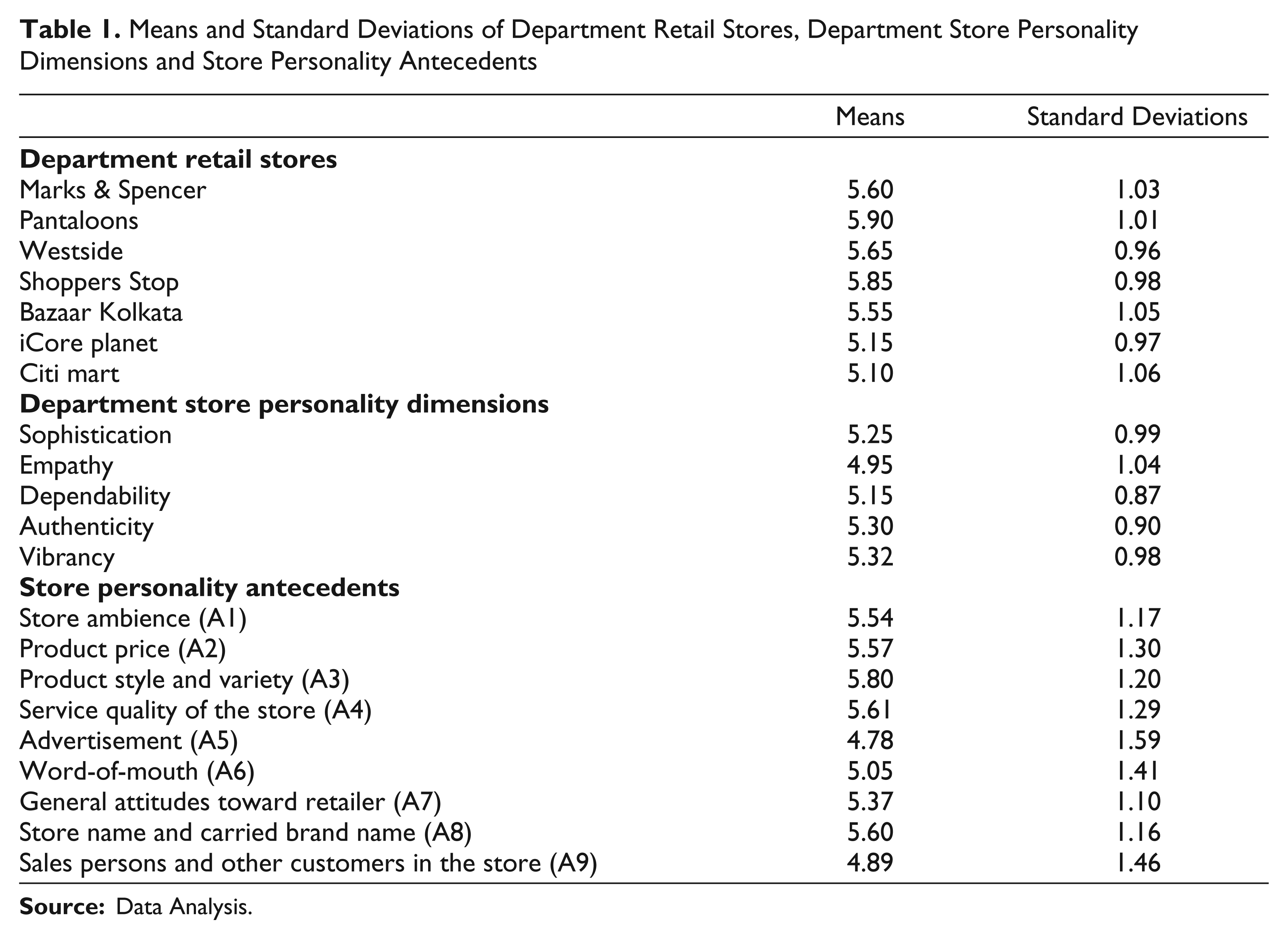
The sample profile of this study is as follows: mean age = 33 years, female = 53.0 per cent, graduate = 38 per cent, post-graduate = 26 per cent, mean monthly household income = INR 31,000. The mean scores and standard deviations of the department stores, department store personality dimensions and store personality antecedents are given in Table 1.
Table 1 shows that the mean scores and standard deviations of familiarity of seven department stores used in this study range from 5.10 to 5.90 and .96 to 1.06 respectively. The mean scores and standard deviations of department store personality dimensions range from 4.95 to 5.32 and .87 to 1.04 respectively (Table 1). The mean scores and standard deviations of store personality antecedents range from 4.78 to 5.80 and 1.10 to 1.59 respectively (Table 1).
Means and Standard Deviations of Department Retail Stores, Department Store Personality Dimensions and Store Personality Antecedents
Dimensions of Department Store Personality
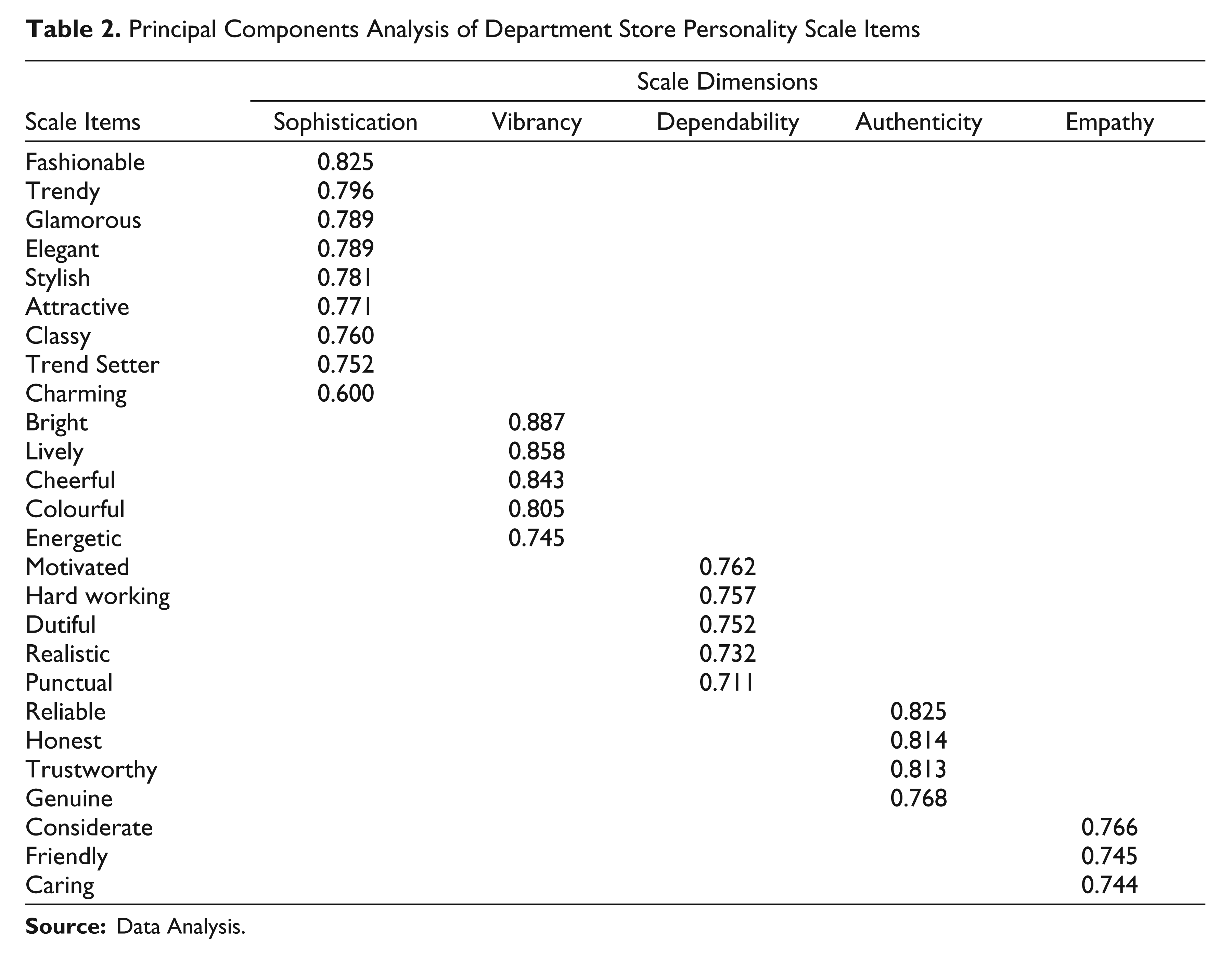
The dimensions of department store personality were assessed through factor analysis with principal components analysis and varimax rotation and it resulted in five-factor model with total 68.44 per cent variance extracted. Numbers of factor were selected based on eigenvalue (greater than one criterion). The eigenvalues of all five factors were found greater than one (sophistication = 7.061, vibrancy = 6.157, dependability = 1.857, authenticity = 1.617, and empathy = 1.102). The components under each dimension maintain the minimum standard of loading .60 (Nunnally, 1978; See Table 2). The analysis was done with SPSS, version 19. The scale reliability was tested through Cronbach’s alpha cofficient. The Cronbach’s alpha coefficients of the scale dimensions were .923 for sophistication, .811 for empathy, .853 for dependability, .880 for authenticity and .918 for vibrancy. The higher levels of Cronbach’s alpha coefficients (>.70, Nunnally and Bernstein, 1994) indicated the reliability of the scale dimensions.
Subsequently, we carried out confirmatory factor analysis using AMOS (version 18) to reconfirm the dimensionality found in principal components analysis. The results of confirmatory factor analysis showed that the five-factor model fit the data well (allowing covariance among the dimensions; e.g., Aaker, 1997; Hair et al., 2008): Chi-square = 571.384 with degrees of freedom = 289, probability level = .000, relative chi-square (χ2/df) = 1.977, GFI = .886, AGFI = .861, CFI = .949, TLI = .943, IFI = .950, RFI = .891, NFI = .903, RFI = .891, PNFI = .803, PGFI = .844, RMSEA = .05. All factor loadings are showing higher value (.50 and above, Hair et al., 2008) and are significant at the .001 level confirming convergent validity of the scale (Anderson and Gerbing, 1988; Kline, 1998).
Principal Components Analysis of Department Store Personality Scale Items
Construct Validity
The convergent validity of the scale was assessed with the variance extracted. The percentages of variance extracted calculated based on completely standardized factor loadings and error variances for all five factors were greater than .5 (.58 for Sophistication, .59 for Empathy, .54 for Dependability, .65 for Authenticity and .70 for Vibrancy), which indicated the convergent validity of the scale dimensions. The squares of the correlation between the dimensions varied between .24 and .41. Since none of the variance extracted estimates were smaller than the between-factor squared correlations (.58 for Sophistication, .59 for Empathy, .54 for Dependability, .65 for Authenticity and .70 for Vibrancy), the discriminant validity of the department store personality scale dimensions was confirmed.
Impact of Store Personality Antecedents on Department Store Personality Dimensions
To explore the impact of store personality antecedents on department store personality dimensions, we used multiple regression analysis. Since we do not have any clear idea about the specified set of antecedents that influence the department store personality scale dimensions, we considered sequential search methods over confirmatory approaches of multiple regression analysis. Literature revealed two types of sequential approach: (i) step-wise estimation and (ii) forward addition and backward elimination. The main distinction of the step-wise regression approach from the forward addition and backward elimination approaches is its ability to add or delete variables at each stage. In case of forward addition and backward elimination approaches, once a variable is added or deleted, the action can not be reversed at a later stage. Thus, the ability of the stepwise approach to add and delete makes it the preferred method among most researchers (Hair et al., 2008). Thus, the impact of store personality antecedents on department store personality dimensions was assessed through step-wise regression analysis. Before we ran the stepwise regression, a checking for violation of step-wise regression model assumptions has been done.
Checking for Violation of Regression Model Assumptions
Multicolinearity Check
Although no precise and commonly accepted definition of collinearity has been found in the literature (Belsley et al., 1980), collinearity is generally agreed to be present if there is an approximate linear relationship (i.e., shared variance) among the independent variables (Mason and William, 1991). In theory, there are two extremes: perfect collinearity (when correlation coefficient equal to one) and no collinearity (when correlation coefficient equal to zero). ‘In practice, data typically are somewhere between those extremes’ (Mason and William, 1991). Thus, collinearity is basically a matter of degree. Though some collinearity is almost always present in data, the real issue is to determine the point at which the degree of collinearity becomes ‘harmful’. ‘The econometric literature typically takes the theoretical position that predictor variable constructs are not collinear in the population’ (Mason and William, 1991, p. 269). Therefore, any observed collinearity in data is construed as a sample-based ‘problem’ rather than as representative of the underlying population relationship (Mason and William, 1991). However, multicollinearity is problematic in that it can produce model instability (Lapin, 1993). The presence of one or more large bivariate correlations (.8 and .9) are commonly used cutoffs-indicates strong linear associations, suggesting collinearity may be a problem (Mason and William, 1991). The bivariate correlations of our study range from .034 to .495. However, the absence of high bivariate correlations does not imply lack of collinearity because the correlation matrix may not reveal collinear relationships involving more than two variables (Mason and William, 1991). Thus inspite of checking the multicollinearity through bivariate correlations, we also checked multicollinearity in predictor variables by several other diagnostic tests as follows.
Tolerance
In essence, tolerance is the proportion of variability of each independent variable which is not explained by its linear relationship with other independent variables in the model. Since tolerance is a proportion, its values range from 0 (low) to 1 (high). When the tolerance is low, multiple correlation is high and hence there is a possibility of multicollinearity (Bryman and Cramer, 1997). With final model tolerances (of antecedents) of range from .674 to .762 for sophistication, .652 to .759 for empathy, .647 to .852 for dependability, .652 to .810 for authenticity, .652 to .759 for vibrancy, the likelihood of multicollinearity is low.
Variance Inflation Factor (VIF)
VIF and tolerance are closely related in that VIF is the reciprocal of tolerance (Norusis, 1993). Consequently, VIFs of independent variables range from 1.131 to 1.484 for sophistication, .1.318 to 1.515 for empathy, 1.336 to 1.174 for dependability, 1.234 to 1.534 for authenticity and 1.318 to 1.534 for vibrancy. Again this would point to the likelihood of multicollinearity being low.
Linearity, Homoscedasticity and Normality
The linearity and homoscedasticity were assessed through an analysis of residuals plots (studentized residuals versus the standardized predicted value). The residuals of five dependent variables (five department store personality dimensions) felt within a generally random pattern and showed no pattern of increasing or decreasing residuals (Hair et al., 2008). Thus, the linearity and homoscedasticity assumptions were confirmed. The normality was examined through normal probability plots of the dependent variables which are different from residual plots in that the standardized residuals are compared with the normal distribution. The normal distribution makes a straight diagonal line, and the plotted residuals are compared with the diagonal. The residual line closely follows the diagonal proved that the distribution is normal (Hair et al., 2008).
Model Fit Summary
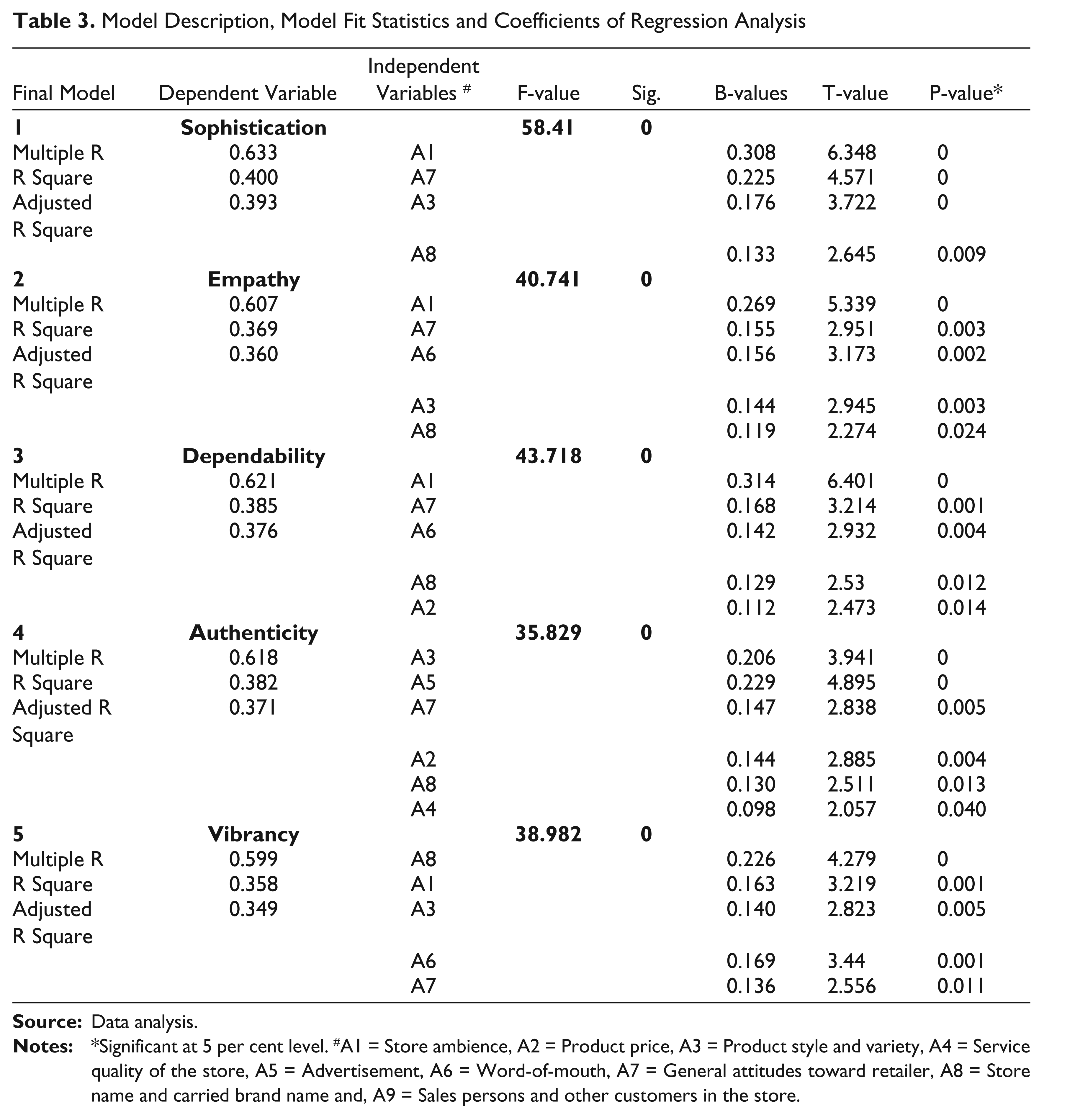
The data analysis was done using SPSS, version-19. Overall, results (final model) of the models were good with multiple correlation coefficients (multiple R), coefficient of determinants (R square) and adjusted coefficient of determinants (adjusted R square)—shown in Table 3. To determine how well the models fit the data, analysis of variance and the associated F test were conducted to test the null hypothesis B1 = B2 = Bn = 0 (Siegel and Morgan, 1996). Based on the observed significance level of F test (See Table 3) the null hypothesis could be rejected and the conclusion drawn that a linear relationship exists between the dependent variables (dimensions of the department store personality) and the independent variables (antecedents of store personality) in the equation.
Results
The significant impact of each store personality antecedent on DSP dimensions was assessed through standardized coefficients (β values), t-value, and p-value of the final model of each step-wise regression. Table 3 reveals which antecedents have what kind of impacts on each store personality dimension. As shown, all impacts are positive and significance (p <.05). The positive significant coefficients indicate that as the importance of each antecedent increases, the rating for the respective brand personality increases.
Model Description, Model Fit Statistics and Coefficients of Regression Analysis
Discussions and Implications
The objective of the study was to explore the impact of several store personality antecedents on department store personality dimensions which were assessed through step-wise regression analysis. Interestingly, the different antecedents affect various department store personality dimensions differently. The regression results indicated that the antecedents store ambience, product style and variety, general attitudes toward retailer, and store name and carried brand name have significant positive impact on the department store personality scale dimension sophistication. The same impact is revealed for the antecedents namely store ambience, product style and variety, word-of-mouth, general attitudes toward retailer, and store name and carried brand name on the scale dimension empathy. The antecedents store ambience, product quality, word-of-mouth, general attitudes toward retailer, and store name and carried brand name have significant positive impact on the scale dimension dependability. The antecedents namely product quality, product style and variety, service quality of the store, advertisement, general attitudes toward retailer, and store name and carried brand name have significant positive impact on the scale dimension authenticity. Finally, the antecedents store ambience, product style and variety, word-of-mouth, general attitudes toward retailer, and store name and carried brand name also influence positively the scale dimension vibrancy and the influences are significant (See Table 3).
The present study has several managerial implications. While a number of studies concentrated on measuring store personality, our study can be seen as the first empirical study to understand how store personality is formed. ‘We are where we purchase’ indicates we seek stores whose personality matches with our own. Thus, store managers would be better served if they understand not only what types of personality are important to their target markets, but how to create these types of personality. For example, if the personality of Shoppers Stop, an Indian department retail store, is sophistication and empathy then the retailers may get a picture from our study on how these personality dimensions are inferred. Without understanding the relationship between the importance of each store personality antecedent and the respective store personality dimension, store managers might unnecessarily examine all antecedents, instead of selecting the few that influence their desired store personality. If the store managers are able to identify which antecedents are important to their target markets, they could determine what level of the antecedents would lead to their store developing the desired personalities. The results of our study are useful because, while store personality is difficult to measure, store personality antecedents are generally policy variables under the control of retailers. For example, while retailers may face difficulty in measuring the store personality dimension ‘sophistication’, the perception of ‘sophistication’ can be achieved through controlling the variables like store ambience, product style and variety, general attitudes toward retailer, and store name and carried brand name.
Limitations and Suggestions for Future Research
The study is limited to one category of retail brand i.e., department store and one city i.e., Kolkata. Therefore, further investigation is required before any generalization of these results can be undertaken. Given the nature of goods being sold in various retail formats, the store personality inference can vary (Das et al., 2012b). So, future study can replicate the present study in other retail formats. We also recommend replicating this study in other cultures and compare how the results differ from the present study.
Situational influences impact variance in consumer behaviour (Belk, 1975). So, future researchers can investigate how different store personality antecedents influence different store personality dimensions under different situational variables (e.g., date, time, mood). Consumer behaviour varies across different segments of customer. Finally, future study can assess the impact of store personality antecedents on store personality dimensions across different segments (like, male versus female, young versus older, more experienced in shopping versus less experienced in shopping, deal-prone versus non deal-prone customers).