



Abstract
Employer brand strategy design and implementation are crucial for any organization, given the challenge of talent attraction and retention. Employer branding creates a sustainable relationship between an organization and its potential and existing employees by creating values for individuals, organization and the society at large. The primary objective of this study was to evaluate the feasibility of using a Business Model Canvas (BMC) template to map the employer brand strategy of an organization. The second objective was to use a survey research to map the elements of BMC such as value propositions and communication channels for the target employees who were the prospective talent pool. Other elements of BMC were explained based on the understanding of employer branding practices in Indian organizations.
Introduction
The changing needs and aspirations of employees and a younger workforce (Budhwar & Varma, 2011) call for Indian organizations to revamp their talent management strategy to attract and retain the best talent (Srivastava & Bhatnagar, 2010). Talent management is part of business strategy where senior leaders and HR professionals are actively engaged to achieve business results (Mathew, 2015). In an increasingly competitive employment market like India, where skilled workers have a choice in where they work (People Strong, Wheebox, & CII, 2014), developing strategies to become an employer of choice can provide a strategic advantage to the firm (Wilden, Gudergan, & Lings, 2010). Building an employer brand seems to be one of the long-term solutions in order to become an employer of choice and attract and retain the best talent (Kapoor, 2010; Sullivan, 2014; Tanwar & Prasad, 2016). Thus, employer branding (EB) can be defined as ‘a targeted, long-term strategy to manage the awareness and perceptions of employees, potential employees, and related stakeholders with regards to a particular firm’ (Sullivan, 2014).
Leading organizations have realized that creating a positive employment experience by building an employer brand requires the same degree of focus as that of a customer brand experience in marketing (Barrow & Mosley, 2006). So, EB can also be defined as ‘the effort by the organization to market its employment value proposition (EVP) in order to improve recruitment and retention and increase the value of human capital’ (Backhaus & Tikoo, 2004). It is important to note that ‘perception is more important than reality’, since EB exists in the mind of employees. So, management of EB is all about management of perceptions (Adapted from Duncan & Moriarty, 1998). Thus, EVP is defined as ‘the value or benefit an employee perceives by serving as a member of the organization and determines for themselves the extent to which this “value” is competitive’ (Heger, 2007, p. 121). EVPs are attributes made of explicit and implicit contractual terms and conditions offered to employees (Edwards, 2010). Ambler and Barrow (1996) describe EVP attributes in terms of the employer brand that consists of ‘The package of functional, economic and psychological benefits provided by employment, and identified with the employing company’ (p. 187). Some examples of EVP attributes are job security, interesting work, career prospects, pay, training and developmental opportunities, job autonomy, flexible working hours and so on. (Baum & Kabst, 2013; Berthon, Ewing, & Hah., 2005; Chhabra & Mishra, 2008; Dutta & Punnose, 2010; Heger, 2007; Jiang & Iles, 2011; Knox & Freeman, 2010; Lievens, 2007; Lievens & Highhouse, 2003; Srivastava & Bhatnagar, 2010; Vos & Meganck, 2009).
Considering the popularity of EB as a strategic human resource management (HRM) process, it is important to identify its key components and ways of mapping the long-term EB strategy for effective implementation. Thus, in this article, we first describe the theoretical and conceptual background of the EB process and its key components. Next, we evaluate the feasibility of using the Business Model Canvas (BMC) to map the long-term EB strategy of organizations. Lastly, we evaluate the viability of using survey research to arrive at some of the key components of EB which are then mapped into BMC.
Review of Literature
The Employer Branding Process
EB as a practice is based on the assumption that firm performance can be enhanced by skilful investment in human capital. Human capital is an important resource which is rare, non-substitutable and can be a strategic advantage to a firm. Theoretically, this argument is supported by the resource-based view (RBV), according to which, the firm’s resources can contribute to sustainable competitive advantage (Barney, 1991, as cited in Backhaus & Tikoo, 2004). According to Aggerholm, Andersen and Thomsen (2011, pp. 114–115), strategic, sustainable EB processes feature three distinctive characteristics:
(1) the anchoring in and supporting of the overall corporate strategy, thus being a strategic branding discipline; (2) the co-creation of values, i.e. continuous re-negotiation of values with stakeholders according to their stakes and expectations; and (3) the establishment of sustainable employer–employee relationships oriented towards a continuous reflection on mutual needs as well as current and future expectation.
Thus, according to Sullivan (2002), firms first develop the ‘value proposition’ (EVP) using information about the ‘organization’s culture, management style, qualities of current employees, current employment image, and impressions of product or service quality’ (as cited in Backhaus & Tikoo, 2004). Since EVP is also about the employees’ perception of the value and benefit received from their firm (Heger, 2007), it is important to capture employee perception to develop EVPs. Once organizations develop the set of EVPs, they market the EVPs to their target employees. External marketing involves efforts to communicate the EVPs to attract the prospective talent pool (Backhaus & Tikoo, 2004; Lievens, 2007). Internal marketing of the employer brand involves implementing the brand ‘promise’ made to the recruits inside the firm and making them a part of the organizational culture (Lievens, 2007).
Promotion covers the holistic efforts by the firm to communicate its EVP effectively, so that its target employees are aware of the distinct EVPs and the way they can be accessed (Wickham, O’Donohue, & Hanson, 2008). Prospective applicants evaluate a potential employer in terms of the EVPs offered and compare them with competitors. Since high potential applicants have multiple options available in choosing their employer, organizations need to clearly outline what they are offering in order to attract employees. Strong employer brands thus increase the attractiveness of a company as an employer (Baum & Kabst, 2013; Collins & Stevens, 2002). Promotion involves both formal and informal communication channels (Wickham et al., 2008). Different communication channels, in the context of EB, fall under any one of the following media: pre-placement talk, on-boarding presentations, job interview and appraisal meeting. They are all parts of face-to-face communication. Web-based media include company website, job portals, company blog, social media, intranet, email and print media such as magazines and newspapers (Allen, Van Scotter, & Otondo, 2004; Otondo, Van Scotter, Allen, & Palvia, 2008). Informal communications are in the form of customer feedback and through word of mouth from friends and acquaintances (Miles & Mangold, 2004). Companies need to understand that EVP attributes which are likely to attract new recruits should also use several communication channels to gain competitive advantage (Elving, Westhoff, Meeusen, & Schoonderbeek, 2012; Kapoor, 2010). From the above explanation on the EB process, it is understood that, EVP attributes and communication channels are the key components of EB strategy.
Brand Strategy Mapping
According to Osler (2003),
A brand strategy is the translation of business strategy for the marketplace. It defines the manner in which the offering will present itself to the marketplace, which will, in turn, influence the way in which targeted customers think of the offering—creating the brand’s image.
From a strategic human resource management (SHRM) view, there have been best-practice or best-fit frameworks and models looking at HR from a strategic angle (Armstrong & Taylor, 2014). Some examples are the Porter’s generic strategies for HR, the Miles and Snow typology, the Harvard model and the Michigan model to name a few (Rees & Smith, 2014). Similarly, strategic brand management boasts of several frameworks of researchers such as David Aaker, Kevin Lane Keller and Jean Noel Kapferer and several consulting frameworks to build a brand. However, EB being a part of HRM which involves brand building, it is important that we look at an overarching framework for effective EB implementation. HRM strategies have two-way focus. According to Greer (1995), HRM focuses on a vertical integration or in other words, aligns its ‘HR practices, policies and programmes with corporate and strategic business plans’ (as cited in Reece & Smith, 2014). Similarly, organizations look at effective HRM processes and practices to achieve their business goals (Armstrong & Taylor, 2014). This only reinforces the point that an EB strategy could be effectively implemented if it were aligned to the business strategy of an organization. This is possible if the EB strategy could be mapped into a framework that is used in a holistic, business perspective.
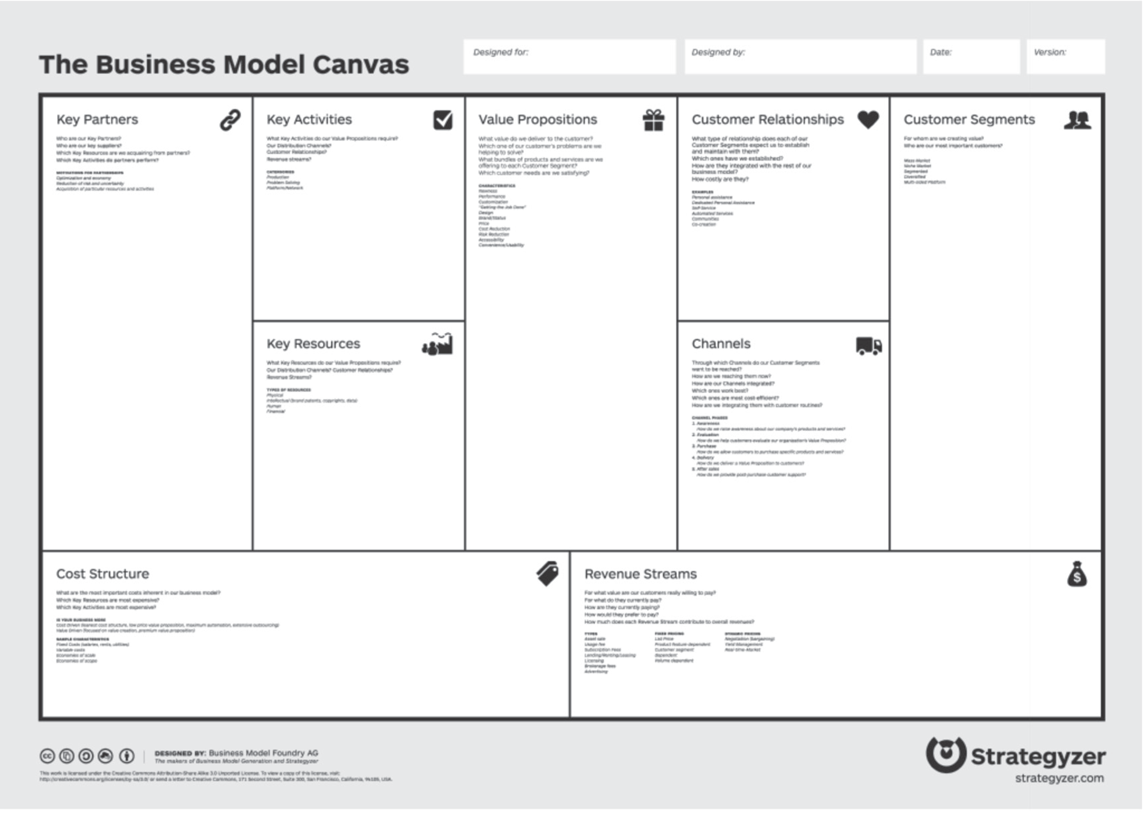
Business model reflects a firm’s strategy and plays a major role in explaining how different activities of the firm come together to execute a strategy (Zott, Amit, & Massa, 2011). Several business model frameworks for e-business, technology and innovation management and entrepreneurship are prevalent (Osterwalder, 2004; Zott et al., 2011). There are also several types of business models such as the franchise model, subscription model, razor and blade model, search engine model and so on. (Baden-Fuller & Mangematin, 2013; Ovans, 2015). However, the basic components such as value-proposition, customer-segments, channels, cost structure and revenue streams that make up a business model remain largely similar. Hence, an easy-to-understand and easy-to-use template with all the components pre-defined could be the best-fit model to implement strategy. One such framework is the Business Model Canvas (BMC), by Alexander Osterwalder (Business Model Canvas, 2014a), which aids in the translation of business strategy into a blueprint. Thus, we propose that the BMC as a template can be used to map the long-term EB strategy of an organization. But scholars of business modelling argue that business models emphasize a system-level, holistic approach to explaining how firms ‘do business’ (Osterwalder, 2004; Zott et al., 2011) and business models cannot be reduced to issues concerning the internal organization of the firms (Zott et al., 2011). However, they acknowledge that the firm’s business model and product/brand/corporate strategy interact to impact the firm’s performance. They also view business modelling as systems of boundary spanning activities in an organization (Zott et al., 2011). Researchers also agree that there are multi-sided models where managers have to consider more than one kind of customer. They see business models not as a complete description of what the firm does, but as ‘manipulable instruments’ which can be used to explore cause and effect relationships between the customer, organization and money in the world of business (Baden-Fuller & Mangematin, 2013).
Research Objectives
Thus, based on the review of literature, the primary objectives of this study are to understand how HR should map the long-term EB strategy of an organization for effective implementation and what methodology can be adopted to outline the EVP attributes and communication channels which are its key components.
Rationale of the Study
EVP attributes and several communication channels have been the key focus of EB studies. However, it becomes imperative to think beyond EVPs to understand how EB as a cross-functional strategy involving HR and marketing or corporate communication must come together to devise and implement the strategy effectively. Not only in implementation, but monitoring the progress and its subsequent outcomes becomes important. Based on constant feedback, the EB strategy can be consequently revamped from time-to-time for effective talent management and organizational success.
The Business Model Canvas (BMC)
We considered the feasibility of using the BMC template for this study. Though the template aids to look at the business as a whole, in this article it is used only as a ‘reference model’. ‘Reference is something which can be referred to as an authority. A model is a standard or example for imitation or comparison’ (as cited in Osterwalder, 2004). The BMC is a comprehensive template ‘to lay out hypotheses or assumptions related to nine key pillars viz., key resources, key activities, value propositions, customer relationships, channels, customer segments, cost structures and revenue streams of the value chain’ (Ovans, 2015). Osterwalder (2004) suggests that the elements of a business model are like Lego blocks that can be used to play around resulting in business model innovation (p. 22). The possibility of how the nine key building blocks could be viewed in the EB context is the purpose of this study. These building blocks are sketched on a single page for simplicity and ease of understanding. Based on the above description, Figure 1 represents ‘The Business Model Canvas’. BMC requires answers to a set of questions with respect to each of the key pillars. We answered relevant questions of BMC by understanding the EB practices of different organizations and through the survey research.
Qualitative Study
The EB trends in India emerged when we interacted with HR, corporate communication and EB leaders of different information technology (IT), business process management (BPM) and manufacturing organizations and EB consultants in India in a separate qualitative study. Based on the interviews, we got an understanding of the key partners, activities and resources used in EB. The interview questions are given in Appendix 1 for reference. The interviews were transcribed to understand the EB process in organizations. For example, on EVP attributes, a VP-HR of a global conglomerate said,
An important point is training. The fact that constantly learning something and becoming valuable is also a very important factor in people staying with you. Employees should feel that they’re being valued in the organization, because if they do not learn new things, one or two years down the line, they become very redundant.
Another HR leader said,
HR is responsible for employer branding. It depends on how the employees feel, how do people work with you feel and what will the external market feels. All these put together will only create a brand.
An HR manager of a manufacturing group company confessed,
We did have several other initiatives, but we also wanted to come up with something called a brand promise. So, we went to the senior management. We also discussed with them as to what would be our brand promise, which we mapped, since they are also the brand ambassadors who will take this forward.
On the communication front, a corporate communications expert gave the following opinion:
So now that we have synthesized our EVP, we need to know how we bring about the EVP to life. This is the execution part, which is the key. In the execution part, we talk about aligning everybody to the EVP. ‘Evaluate high impact channels to maximize EVP effectiveness’—This will be the work of communications team, to evaluate a communication strategy.
For understanding the two key elements of BMC—the EVP attributes and communication channels—we evaluated the possibility of using a survey research. This was based on the suggestion that defining value propositions should be customer-centric (Osterwalder & Pigneur, 2009) and EVP is also based on employee perception. The survey is discussed in detail in the following section.
The Employer Branding Survey
The survey on EVP and communication channels was for a specific segment, the prospective talent pool. They were students pursuing management studies in reputed B-schools in India. The specific objectives of the survey were: (a) to identify EVP attributes which are drivers of attraction towards an employer/organization by understanding the preferences of prospective employees and (b) to understand the usefulness of communication channels from the prospective employees’ perspective.
Methodology
Based on the literature, 76 EVP attributes were finalized. For example, challenging assignments, job security, working with customers, compensation package and fast-track promotions are some of the attributes. These are attributes which organizations generally offer as their value propositions to represent themselves as good employer brands or employers of choice.
For the prospective employee perspective, MBA students from reputed business schools in India volunteered to participate in the study. The reputation of the business schools was in line with their rankings in ‘best B-school’ surveys conducted in India. An online survey questionnaire method was adopted to collect data to reach out to a wide and diverse set of students across B-schools. Data were collected using both convenience and snowball sampling techniques. The respondents were asked to rate the importance of each of the EVP attributes on a four-point Likert scale of 1–4, where 1 is ‘not important’ and 4 is ‘very important’ while considering potential employers. Similarly, the respondents were asked to rate the usefulness of each of the communication channels on a four-point scale, where 1 is ‘not useful’ and 4 is ‘very useful’ and a fifth choice which was—‘Not aware of such options’. The four-point Likert scale was primarily used as a ‘forced-choice’ method in order to avoid the choice of neutral opinion and minimize social-desirability bias (Allen & Seaman, 2007; Garland, 1991; Matell & Jacoby, 1971). Out of 198 responses, 193 were found to be valid and were considered for further analysis.
Analysis and Results
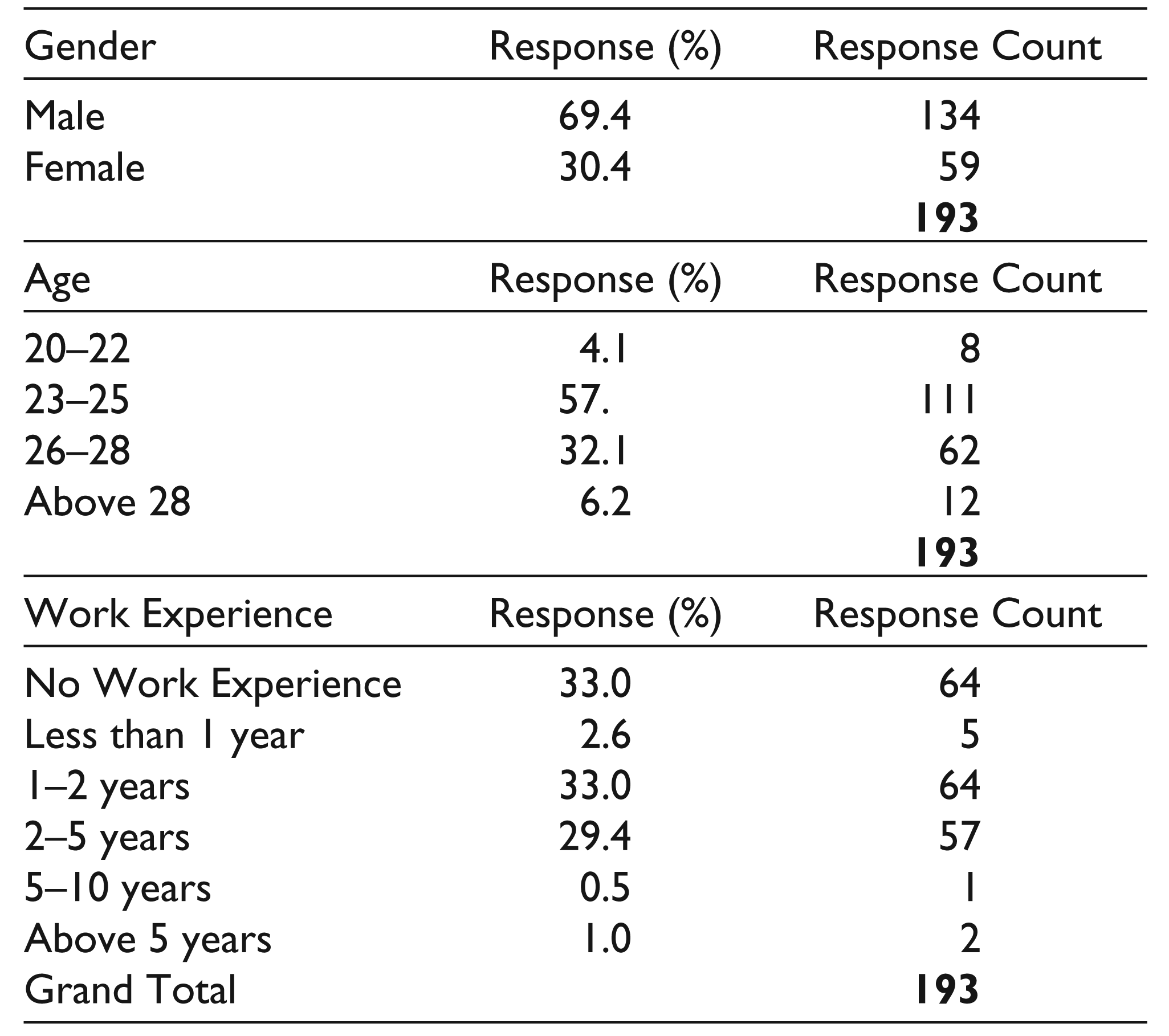
The demographic statistics, followed by analysis of significant difference between the groups in terms of gender, age and experience of the respondents are reported in the Tables 1 and 3 below. Exploratory factor analysis, using the principal components technique and varimax rotation criterion, was used to arrive at the factor structure which is given in Table 2.
Demographic Profile of Respondents
The results are reported below.
Demographic Profile of Respondents
The profile of the respondents was such that majority of them were male. Most of the respondents were between the age group of 23 and 25 years and they had no experience or 1–2 years’ experience.
Usefulness of Communication Channels
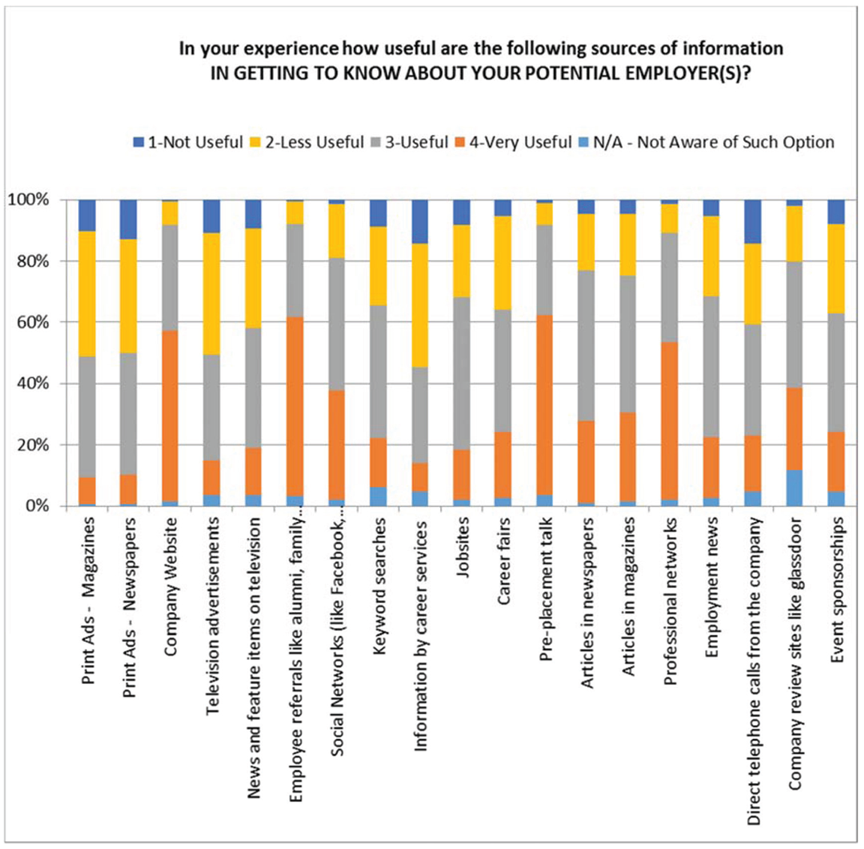
From the results of Figure 2, it is evident that the prospective talent pool has rated company website, employee referrals such as alumni, family and friends inside the organization, pre-placement talk and professional networks to be important communication channels which can be used to design the EB strategy.
Principal Component Analysis and the Resultant Factor Structure
In order to arrive at the set of EVP attributes which can be grouped into important factors, principal component analysis was done. The total variance explained by the seven-factor model was 50.05 per cent and the factor structures with several attributes loaded onto each factor are given below in Table 2. The factors are named based on the EVP attribute loadings.
Factor Structure
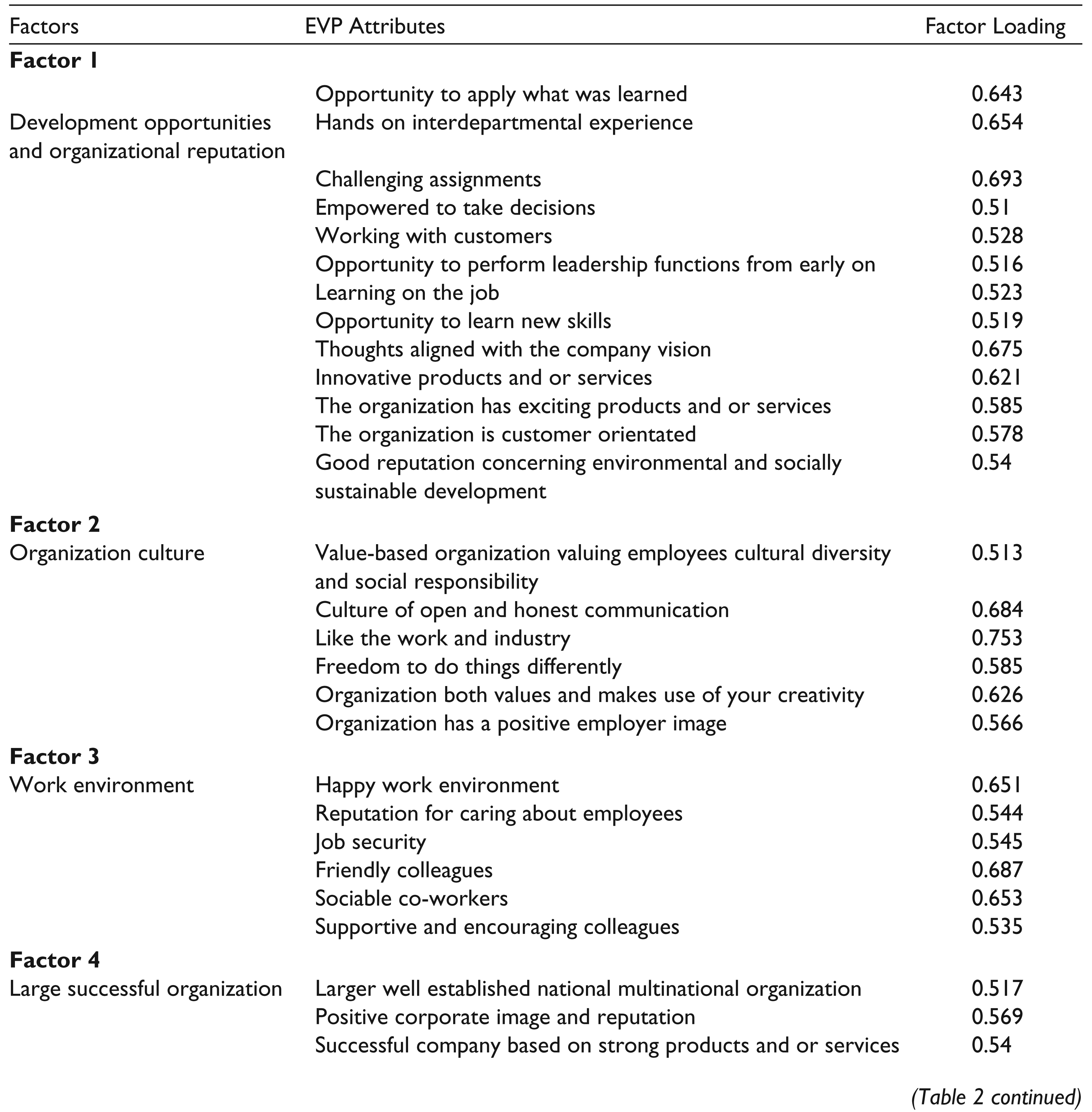
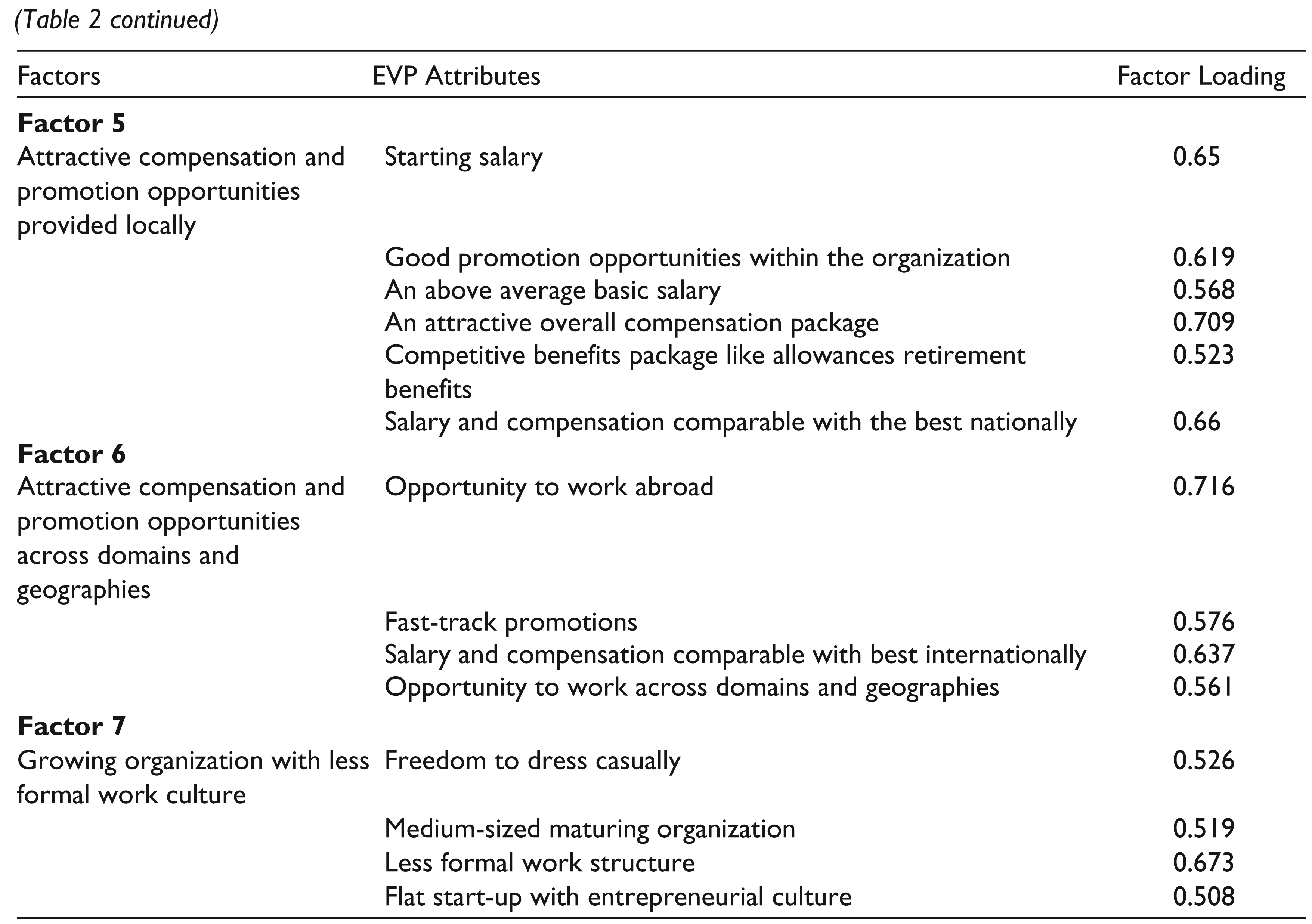
The reliability statistics estimated the Cronbach’s α for each of the EVP attributes loaded onto to the factors to be above 0.7, and hence it is suitable to be retained. The most important factors or drivers of attraction as defined by the study are: (a) developmental opportunities, (b) organizational reputation, (c) organizational culture, (d) work environment, (e) large successful organization, (f) attractive compensation and promotion and (g) growing organization with less formal work culture. These are the important EVP attributes that can be used to map the EB strategy.
Group Differences in Terms of Gender, Age and Experience
Understanding if there are any differences in the sub-groups such as age or gender with respect to their preferences for EVP attributes is important. The non-parametric Kruskal–Wallis test was carried out to identify significant differences between groups for each of the EVP attributes.
Group Differences—Gender

Gender
At α < 0.05 (significance level), the difference was statistically and significantly higher for male compared to female participants for the EVP attribute ‘salary and compensation compared with the best nationally’ and was significantly higher for female participants compared to male counterparts for the EVP attribute ‘culture of open and honest communication’. Thus, for male talent segment, salary and compensation was more important compared to females who considered a ‘culture of open and honest communication’ to be more important.
Age and Experience
At α < 0.05 (significance level), a Kruskal–Wallis H test showed that there was statistically no significant difference in EVP attributes for different age groups and different experience bands mentioned in the demographic data table (Table 1). This was because most of the respondents were at the entry level with an average age around 25 years with similar expectations. Hence, there were no significant group differences.
These were the specific outcomes of our study, which could be mapped into BMC and serve as a roadmap for effective EB strategy implementation.
The Employer Branding Canvas
The definitions of the nine key pillars are adapted from Osterwalder and Pigneur (2009). Relevant questions of the BMC were answered based on the set of questions adapted from Blank (2013) and Osterwalder and Pigneur (2009) in the EB context. As discussed, the answers were supported by industry interactions and the results of the survey research.
Key partners: These are the interdepartmental and external support system that is required to establish an EB strategy. Some of the relevant questions to be answered are:
Who are our key partners? Top management, human resources and communication strategists will be our key partners. Which key resources are we acquiring from our partners? Finance, communication technology and HR expertise. Which key activities do partners perform? Budget approval, communication from top-down, approve EVPs that could be communicated, communication strategy design such as deciding on channels and brand touch points and providing technology support for EVP communication will be the activities the partners will perform.
Key activities: These are the set of actions a company must take to create and offer EVPs, reach out to employees and maintain relationships with them.
What key activities do our value propositions require? Define EVPs, convert them into communicable messages and sub-messages, ‘dumb it down’ to different set of audience/employees at different levels and decide on different ways of reaching present/prospective employees.
What key activities do communication channels require? Distribution channels are communication conduits for conveying EVP-themed messages. Based on the channel, the storyboard for communicating the EVPs should be drawn. The overarching message should be broken down to different sub-messages for different channels and target employees. For example, recruitment advertisement should be designed to communicate the same set of EVPs differently than pre-placement talks.
What key activities are required for building employee relationships? The key activities range from HR being the first brand touch point in answering queries related to the organization, fixing up compensation and roles and responsibilities prior to joining and providing support from on-boarding to exit to build employee/customer relationship. Apart from this HR should also effectively communicate the EVP attributes through several channels and special programmes designed as part of EB.
Key resources: They are used to create and deliver EVPs, reach out to employees and maintain relationships with them. They can be physical, financial, intellectual or human.
What key resources do our value propositions require? HR expertise, field survey to understand prospective/present employee expectations, EVP formulation and communication expertise are some of the key resources required.
What key resources do our communication channels require? Communication channels should be based on employee choice. They require management’s approval for implementation. Communication also needs support from in-house communication experts and advertising, PR and brand communication agencies, if there is third party involvement.
What key resources are required for employee relationships? Brand touch points or point of contact of the employee such as HR and recruitment executives, employee help desk, grievance-redressal forums, town hall meetings, top-management communication and other internal and external communication aid in employee relationships.
Value propositions: They are the bundle of EVP attributes that create value for a specific employee segment.
What value do we deliver to our employees? The most important values are the drivers of attraction as defined by the study. Our study was aggregate in nature, where the respondents were asked to rate EVP attributes and communication channels without a specific company in mind. However, what value every organization should choose to deliver can be based on employee surveys. It also depends upon the feasibility of implementing specific EVPs in line with the organization’s vision, culture, target employees and brand image.
Which one of our employees’ problems are we helping to solve? Applicants have multiple options when it comes to employer choice. Being a strong employer brand with attractive value propositions will help them choose the right organization.
What bundles of EVP attributes are we offering to each segment? The EVP attributes that could be offered to the prospective talent segment based on our study are: (a) developmental opportunities, (b) organizational reputation, (c) organization culture, (d) work environment, (e) large successful organization, (f) attractive compensation and promotion and (g) a growing organization with less formal work culture.
Which employee needs are we satisfying? Employee needs depend upon the target segment identified, and in our study, it is the prospective talent segment.
Channels: They are the interface with employees. They are brand touch points through which the organization communicates and reaches its employees.
Through which channels do our employee segments want to be reached? The survey results give an idea on the various communication channels used by organizations and which among these do the younger workforce find useful. Company website, employee referrals like alumni, family and friends inside the organization, pre-placement talk and professional networks were important communication channels.
How do other companies reach them now? In an organizational context, a competitor analysis is important to understand how other companies are doing with respect to communication channels in EB.
Which ones work best? The usefulness of various communication channels was ranked by the prospective talent pool to answer this question in the survey. Organizations can study the reach and recall value of different channels to understand which ones work best for them. An organization-wide and an employment market survey can also help them assess employee perception of what channels they consider best.
How are we integrating them with employee routines? This question could be answered in real time. It is important that any communication should not appear distinct and intentional on the part of the organization, but sufficiently integrated with employee routines.
Which ones are cost-efficient? To decide on cost-efficiency is also a real-time exercise which has to be decided in discussion with communication specialists or with third party involvement like branding agencies.
Customer/employee relationships: An organization should specify the type of relationship it wants to establish with each of its employee segments.
What type of relationship does each of our employee segments expect us to establish and maintain with them? One of the most important relationships in research parlance is termed as the ‘psychological contract’, where perceived employer’s obligation is reciprocated with perceived employee’s obligations (Rousseau, 1990, 1995). This means job-related promises should be realistic and consistent in terms of the EVPs offered which may result in attracting prospective talent to an organization or result in long-term employee retention.
Customer/employee segments: An organization should group employees based on common needs, behaviours or other attributes and the canvas can be designed based on a strong understanding of specific employee segments’ needs.
For whom are we creating value? In our study, creating value was for the prospective talent pool. We also looked at sub-groups such as age, gender and experience. Similarly, value can be created for present employees and sub-groups based on generations like the Gen X and Gen Y and high potential employees.
Who are our most important employees? Important target segments depend on the expected outcomes/objectives of the EB strategy. In our study, we looked at management graduates as prospective employees.
Cost structure: To create and deliver value and maintain employee relationships will incur costs. Such budgeting costs can be estimated after defining key resources, key activities and key partnerships. Based on the costs, channels and value propositions can be finalized.
What are the most important inherent costs? The key resources deployed especially for EB and involvement of third party such as branding agencies are some of the inherent costs.
Which key resources and key activities are most expensive? A detailed cost structure and budget must be drawn in discussion with key partners to arrive at the expenses. Management as recommended by HR and communication experts should take a call to include those resources or activities considered expensive.
Revenue streams: They are the return on investment in communicating EVPs, reaching out to employees and maintaining employee relationships.
What would be the return on investment if the value propositions are successfully offered to employees—present/prospective? Organizations also expect a return on the value proposition offered, which would be the outcome of a successful EB strategy. Loyalty in return for job security, a high potential talent pool, long-term retention, lower recruitment and training cost, improved customer satisfaction, productivity, profits and brand equity are some of the expected returns for the organization side (Backhaus & Tikoo, 2004; Barrow & Mosley, 2006; Bernard & Mosley, 2011; Cachelin, Maas, Schlager, & Bodderas, 2009; Chhabra & Mishra, 2008; Coyle-Shapiro & Parzefall, 2008; Edwards, 2010; Heger, 2007; Hughes & Rog, 2008; Huselid, 1995; Jiang & Iles, 2011; Kapoor, 2010; Kashyap & Rangnekar, 2016; King & Grace, 2010; Knox & Freeman, 2010; Lievens, 2007; Lievens & Highhouse, 2003; Munsamy & Venter, 2009; Srivastava & Bhatnagar, 2010; Tanwar & Prasad, 2016; Vos & Meganck, 2009).
Based on the above explanation, Figure 3 represents the ‘Employer Branding Canvas’, where the key pillars adapted to the EB context are briefly described in a single page format.
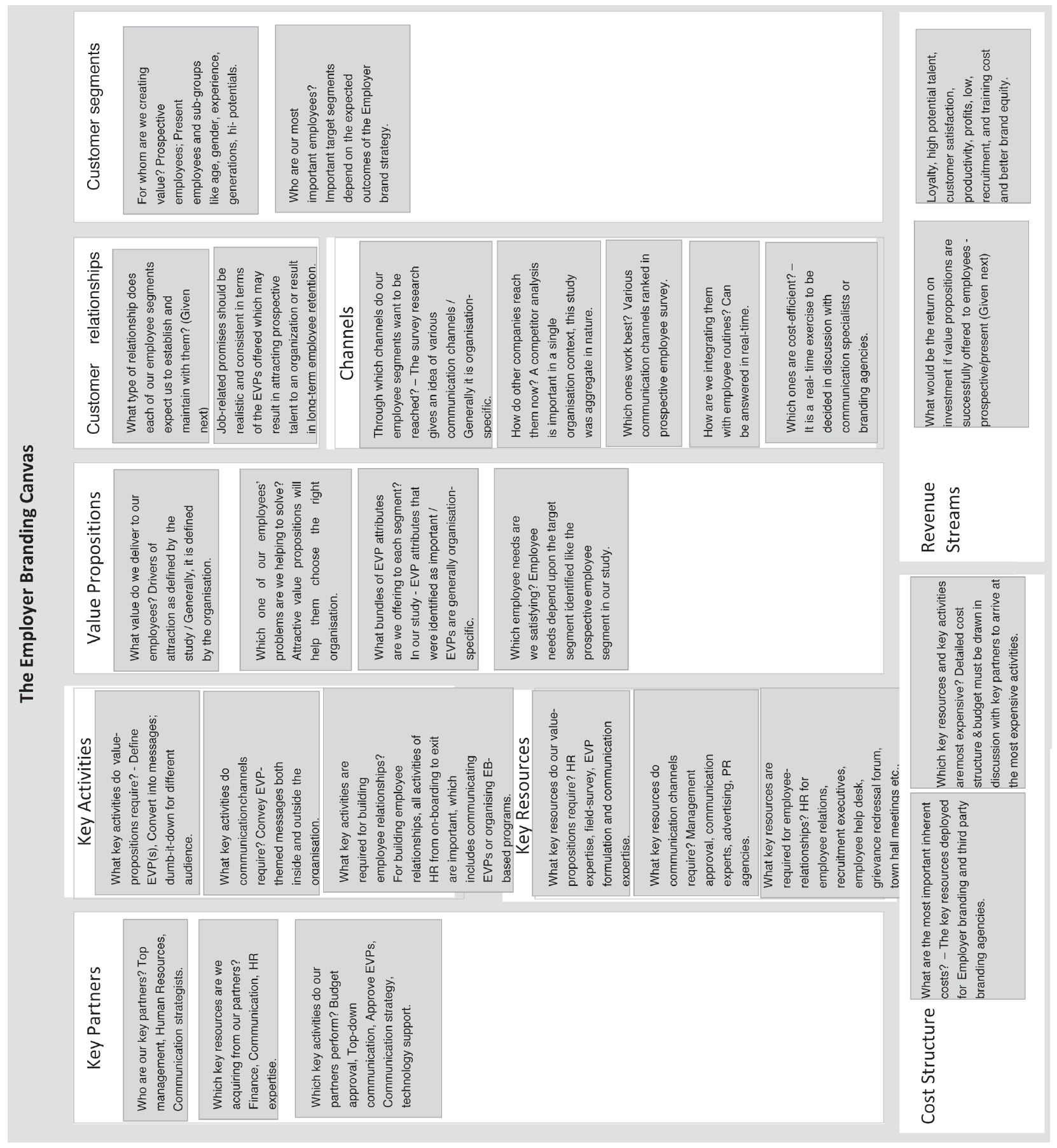
This is an example of how EB strategy can be designed and implemented in organizations. However, each organization must draw its own inference based on their specific requirement and the target employee segments. The five steps in designing and implementing a business strategy through the BMC template are:
Step 1: Mobilize resources and create the awareness for the need of a template for strategy design. Describe the motivation behind and create a common language for design and analysis. Step 2: Research and analyze the key elements needed. Understand the target, technology, market and the environment. Collect information and data from experts. Study the target and identify their needs. Step 3: Design EB strategy, by transforming the ideas and information gathered from the previous phase into the template. Step 4: Implement EB strategy. Step 5: Adapt and modify the template in response to reactions from the target segment. Set up the management structure to monitor, adapt and transform EB strategy (adapted from Dob, 2011).
[Basically, the BMC template] resembles a painter’s canvas, pre-formatted with nine blocks. The Business Model Canvas works best when printed out on a large surface, so groups of people can jointly start sketching and discussing business model elements with Post-it® notes or board markers. It is a hands-on tool that fosters understanding, discussion, creativity, and analysis. (Osterwalder & Pigneur, 2009)
Thus, EB being a multi-disciplinary concept, cross-functional integration will be required and the BMC template can bring together people from different departments to jointly devise the EB strategy.
Conclusion
This study provides evidence that a survey method will be effective in capturing the perception of the prospective talent pool or employees in an organization to arrive at EVP attributes. Broad EVP factors such as (a) developmental opportunities, (b) organizational reputation, (c) organizational culture, (d) work environment, (e) large successful organization, (f) attractive compensation and promotion and (g) a growing organization with less formal work culture could help organizations decide on the specific EVP attributes that should go into it. Similarly, organizations can make use of employees’ preferred communication channels. HR in organizations can also utilize the easy to use BMC template to arrive at a strategic management framework. This will be useful to implement the EB strategy in real time. Once the key building blocks are defined and different questions answered, HR can make a smooth transition into the implementation stage without major process bottlenecks. The BMC provides leeway for HR to monitor the progress and return on investment of EB strategy implementation. BMC also helps HR to spend less time on strategic planning and provides more time for implementation and monitoring.
Implications
It is important to identify measures to map an effective EB strategy. Though there have been several frameworks used by strategy researchers and business architects to design and implement strategy, we propose the BMC template as the most comprehensive and simplified framework. Our field survey further provides a background on how choice of EVPs and communication channels can be employee-centric for effective brand strategy implementation. Effective EB strategy mapping and implementation could be an important step for HR to share stage with the management as a strategic business partner.
Limitations
Our study is limited to the suggestion of only BMC, though there are other frameworks to address strategy formulation at different organizational levels. Every question of the BMC could not be addressed, like ‘How do other companies reach target segments now?’, ‘How are we integrating the channels with customer routines?’ and ‘Which key resources and key activities are most expensive?’ The first question requires a competitor analysis and the question on integration and cost structure must be real time in organizations.
Kaplan and Norton (2001) in their book The Strategy-focused Organization provide five principles for strategy implementation and measurement: ‘1. Translate the strategy into operational terms 2. Align the organization to the strategy 3. Make strategy everyone’s everyday job 4. Make strategy a continual process and 5. Mobilize change through executive leadership’. EB being a long-term employment strategy, it is equally important that its implementation is smooth and quick and the outcomes are observable by management and employees. Any HR strategy is effective if it can satisfy business needs, is detailed and evidence-based, can become actionable, its components are coherent and integrated and takes into account the needs of managers, employees, management and relevant stakeholders (Armstrong & Taylor, 2014). Thus, it is the role of HR to act as a bridge between management and employees to successfully implement their EB strategy and aid in effective talent management for the organization.
Footnotes
Acknowledgements
The authors are grateful to the anonymous referees of the journal for their extremely useful suggestions to improve the quality of the article. Usual disclaimers apply.