



Abstract
This article investigates the impact of information and communication technology (ICT), financial development and economic growth on electricity consumption for Malaysian economy, utilizing quarter frequency data for the period of 1990-2015. In order to examine the long-run relationship, a cointegration approach that provides for structural break is applied. The causal relationship between the variables is investigated by employing Toda-Yamamoto Granger causality approach, and robustness of causality results is confirmed by the innovative accounting method. The results provide evidence for the presence of cointegration between the variables. ICT has positive effect on electricity consumption. Financial development increases electricity consumption. Economic growth is positively associated with electricity consumption. The causality analysis indicates the feedback effect between ICT and electricity consumption. The bidirectional causality is found between economic growth and electricity consumption. Financial development causes electricity consumption and electricity consumption in turn causes financial development in Granger sense. This article opens fresh insights for policymakers to utilize ICT, financial development and economic growth as economic tools for sustainable economic development.
Highlights
We augment electricity demand function by adding financial development to the traditional determinants of electricity consumption-ICT and economic growth in Malaysia.
Providing for structural breaks, the estimations show that the independent variables have positive impact on electricity consumption
There is consistent evidence for bidirectional causality between the variables.
Introduction
The role of information and communication technology (ICT) and investment in ICT cannot be overlooked in the development of a nation, as ICT investments not only influence economic growth in a traditional way but also increase the efficiency in growth (Harindranath & Sein, 2007). ICT diffusion influences economic growth by fostering technology penetration and innovation, helps firms and households in making effective decisions, enhancing demand and decreases costs of production which consequently increases output (Vu, 2011). ICT plays an important role in transforming the productive capacities in developing economies to provide access to knowledge, abilities, resources and strong integration into the world market (Chen & Zhu, 2004). Technological convergence has substantial impacts on productivity and ICT increases labour productivity through a direct channel and total factor productivity at industrial level through an indirect channel (Jung, Na, & Yoon, 2013).
The development of ICT also serves to improve the quality of life (Madakam, Ramaswamy, & Date, 2017). Since 1990s, an extensive literature has documented the roles and impacts of ICT on the environment. One strand of researchers supported the direct and significant role of ICT in environment degradation as it acts as a source of green-house gas emissions (Irawan, 2014), whereas other strand considered that ICT put burden on energy consumption (Moyer & Hughes, 2012), increasing electricity use which as a consequence emits CO2 (Hamdi, Sbia, & Shahbaz, 2014).
The main focus of the earlier studies was how to minimize both energy use and carbon dioxide emissions via expansion of ICTs. With the expansion of ICTs in the recent years, the demand for electricity has increased incredibly. According to International Energy Agency (2009), the households, commercial and the workforces have been using extensively ICT-related electricity which increased the demand for electricity significantly. Globally, the application of ICT-related equipment has increased electricity consumption from 3.9 per cent in 2007 to 4.6 per cent in 2012 (Van Heddeghem et al., 2014). Worldwide, fast and extensive electricity consumption in network use at an annual rate of 10 per cent increased total global electricity consumption from 1.3 per cent in 2007 to 1.8 per cent in 2012 and total global electricity usage in communication networks was more than 350 TWh in 2012 (Lambert et al., 2012). The increasing pattern of ICT applications in various sectors of an economy increased the demand for electricity consumption which as a result influenced environment either positively or negatively. This has been happening in spite of the regulation and public ownership of power supply in several countries across the world (Ahluwalia, 2002; Chakrabarti & Arora, 2016).
In 2007, ICT sector contributed 1.3 per cent greenhouse gas emissions (GHG) as a share of total global emissions of GHG with a total electricity consumption of 3.9 per cent at world level (Malmodin, Moberg, Lunden, Finnveden, & Lövehagen, 2010). ICT growth rate was higher than the income growth rate in growing economies such as Malaysia, so the impact of ICT demand on electricity consumption was more than income effect on electricity consumption (Sadorsky, 2012). A positive relationship has been identified and documented in the past studies between ICT investment and economic growth. Countries with good economic infrastructure and trade policies received active ICT investments.
Efficient applications and wise adoption of ICT help in the creation of more patents, which consequently increase economic growth (Seo, Lee, & Oh, 2009). ICT investments in various sectors produced varying results—although in manufacturing sector, it resulted in more electricity consumption, in some sectors the effect differed (Batenburg & Constantiou, 2009; Cho, Lee, & Kim, 2007). ICT as an engine of economic growth contributed 60 per cent of economic growth in Finland (Jalava & Pohjola, 2008). The net effect of ICT investments, adoption and applications in SME’s sectors is still low in the case of Malaysia (Hashim, 2007).
Financial development has largely been documented as the key driver for economic development of nations (Solarin & Dahalan, 2014). Financial development has long run impacts on economic growth (Mun, Lin, & Man 2008), and a well-developed financial system contributes to the technological spill over process and economic performance of an economy (Hermes & Lensink, 2003). Energy consumption, economic growth and financial development are significantly and positively related and this relation plays an important role in the development and economic prosperity of a country (Shahbaz, Khan, & Tahir, 2013). Theoretically, it has broadly been established that financial development and ICT positively influence the growth of nations, but, empirically the conclusions in the past research works are inconclusive. Financial development might not have any consequence on the growth process if the growing private credit does not adequately serve the real sector (Ductor & Grechyna, 2015). Financial markets integration significantly influences economic growth by mobilizing savings, reducing risk management, fostering technological diffusion and minimizing information and communication costs (Ahmed & Mmolainyane, 2014).
Malaysia, a fast-growing middle-income economy in the Southeast region and energy-dependent country, has very strong financial system. A total electricity production of 2126.8 and electricity consumption of 118.5 billion kWh with 12 million kWh exports of electricity was recorded in 2012. Out of the total installed capacity, electricity is generated from various sources in Malaysia such as 87.6 per cent from fossil fuels, 11.6 per cent from hydroelectric plants, 0.8 per cent from alternative renewable resources and zero per cent from atomic energy. The recorded total primary energy supply growth was 5.9 per cent and the growth rate for final energy consumption was put at 7.5 per cent, which indicated that economic growth of Malaysia is energy dependent and requires use of energy in several sectors (Anon, 2009, 1–54).
In 2012, Malaysian exports of Liquefied Natural Gas (LNG) to various countries were 62 per cent to Japan, 17 per cent to Korea, 12 per cent to Taiwan and 9 per cent to China. The recorded amount of final energy consumption in 2012 was 7.5 per cent, with an energy demand from transport sector at 36.8 per cent—the highest—industry sector with 29.8 per cent, 16 per cent was recorded in non-energy sector, residential and commercial sector consumed 15.1 per cent, and the agriculture sector was responsible for 2.3 per cent. A rapid and upward growth trend was also recorded; however, non-energy consumption, industrial and agriculture sectors showed slower upward trends. Moreover, Economic Transformation Program projects and the MY Rapid Transit have been providing significantly and positively noteworthy spill-over impacts to activities in local manufacturing and service segments. In 2012, the construction sector showed a healthy growth which reflected economic developments (Energy Commission, 2012, 23).
Malaysia is upgrading its multimedia and communications facilities to be world-class so that it can support the rapid flow and accessibility of information within the country at competitive prices. In the 1990s, the Malaysian government introduced the Multimedia Super Corridor (MSC) Malaysia, which is the country’s ICT initiative designed to attract world-class technology companies while grooming the local ICT industry with seven flagship applications including electronic government, smart school, research and development cluster, multipurpose card, telehealth, worldwide manufacturing web and borderless marketing.
Statistics have shown that ICT usage in Malaysia is more than the global average. According to the International Telecommunications Union (2018), the mobile-cellular telephone subscriptions per 100 inhabitants in Malaysia increased from 120.44 per cent in 2010 to 133.88 per cent in 2017. The mobile-cellular telephone subscriptions per 100 inhabitants in the world increased from 76.6 per cent in 2000 to 103.5 per cent in 2017. The leading countries in terms of mobile-cellular telephone subscriptions per 100 inhabitants in the world are Hong Kong and United Arab Emirates with 249.02 per cent and 210.91 per cent, respectively (International Telecommunications Union, 2018). The percentage of population using the internet in Malaysia increased from 56.30 per cent in 2000 to 80.14 per cent in 2017. However, the percentage of population using the internet in the world increased from 28.99 per cent in 2010 to 48.0 per cent in 2017. Malaysia’s achievement is not very far from the achievement of the global leading ICT users. For instance, Kuwait and Luxembourg have the highest percentage of population using the internet, as they achieve 98.00 per cent and 97.83 per cent, respectively, in 2017 (International Telecommunications Union, 2018). The foregoing signifies that the role of ICT should be significant in Malaysia than in many other countries in the world.
Financial system has been providing the traditional role of providing liquidity to several industries including the energy sector for decades in the country. Since the 1990s, the financial sector in the country has gone through tremendous changes. The Securities Commission was established in 1993 to oversee the development of money market including securities industry, options market and unit trust. In the late 1990s, the government created two firms Danaharta and Danamodal, and Corporate Debt Restructuring Committee to recapitalize the banking system, absorb non-performing loans and for voluntary debt restructuring. With the development of ICT in the country, e-payment and mobile banking systems have been introduced, since the early 2000s (Ching, 2015). According to the World Development Indicators of the World Bank, the domestic credit provided by the financial sector as a percentage of GDP increased from 73 per cent in 1990 to 144 per cent in 2015.
Although energy has been identified as an important factor in the social and economic growth literature, the economic prosperity of an economy, however, can be evaluated from efficient and effective uses of energy in different sectors of an economy. Rapid industrial growth and better living standards of Malaysians have significantly inflated energy consumption. Owing to quick urbanization and industrialization in the three and half decades, Malaysia has dramatically experienced increase in demand for energy consumption (Anon, 2009, 1–54). The average rate of demand for energy use of 5 per cent in 1980 rose to 12 per cent in 2009 (Nanthakumar & Subramaniam, 2010).
The remainder of the paper is organized as follows. The second section reviews the existing literature on the subject. The third section discusses the objectives of the study and the fourth section focuses on the rationale of the current study. The fifth section defines the methodology, sources of data and sample frame used. The sixth section presents the analysis and discussion of the empirical results. The conclusion is contained in the seventh section and the policy implications are in eighth section.
Review of Literature
Economic Growth-ICT Nexus
Existing literature on ICT spill-over economic development relationship is traced back to the last couple of decades. Theoretically, the relationship between ICT and economic growth is reported as positive but with mixed empirical results. Numerous studies showed that ICT diffusion has positively and significantly affected economic growth. For example, Mendonca, Freitas, and Souza (2008) investigated the relationship between ICT and productivity using a cross-sectional data for Brazilian economy. They found that ICT applications by workers significantly increase production level. ICT development factors such as ICT infrastructures, ICT uses, ICT readiness and ICT productions and trade are inter-related and have positive impacts on labour productivity and overall economic growth of a nation (Mačiulytė-Šniukienė & Gaile-Sarkane, 2014).
Using the single sector aggregate production function approach with the inclusion of ICT and non-ICT capital and other components to examine the long-run causal relationship between ICT and economic growth in Australia, Shahiduzzaman and Alam (2014) found the long-run cointegration and causality running from ICT to GDP growth as well as non-ICT to economic growth. ICT plays a key role in the development of every sector of an economy, especially in the process of liberalization. For example, Farhadi, Ismail, and Fooladi (2012) investigated the relationship between ICT and economic growth using the generalized moment method (GMM) approach considering 159 countries panel for the period 2000–2009. Their results showed that ICT is positively and significantly affecting economic growth in high-income countries. However, the impact of ICT on economic growth in low- and middle-income countries is low. Thus, to enhance economic growth, these countries should adopt and implement the technology-related policies.
Jehangir, Dominic, Naseebullah, and Khna (2011) documented that the adoption of new technology and rapidly growing internet users and online spending has a positive impact on E-commerce which spurs economic development. In the case of African countries, Binuyo and Aregbeshola (2015) probed the relationship between ICT adoption and economic growth by applying GMM regression. They found that ICT adoption accelerates economic activity and increases economic growth. Kim (2015) used data on ICT investment to examine the causality relationship between ICT investment and economic growth for US economy. The empirical results indicate that causality is positive and running from ICT investment to economic growth. Salahuddin and Gow (2016) employed internet usage as a proxy for ICT while investigating the relationship between ICT and economic growth in South Africa. They applied the bounds testing approach and found that ICT and economic growth are cointegrated for long run. Moreover, their empirical analysis reveals that internet usage boosts economic activity and hence economic growth.
There are studies that have specifically focused on Malaysia. For instance, Meng, Samah, and Omar (2013) examined the relationship between ICT and economic growth in two different time periods—1960–1982 and 1983–2004. They noted that economic growth positively influenced ICT investments in Malaysia for the period 1960–1982; however, for 1983–2004 time period, ICT investment promoted economic growth in Malaysia. Meng et al. (2013) unveiled that during this period many structural changes were made in the Malaysian economy such as strategies and policies related to industrialization and technologies were suggested and implemented. Kuppusamy and Santhapparaj (2005) investigated the relationship between ICT investment and economic growth by applying the bounds testing approach over the period 1975–2002. Their results indicated that ICT investment in Malaysian economy has gained immense attention which has been identified as a key factor of economic growth.
Kuppusamy, Raman, and Lee (2009) studied the impact of ICT on public and private economic growth in Malaysia for the 1992–2006 period. Using investments in ICT as a proxy for ICT, the study shows that ICT has positive impact on economic growth during the period under study. Ramlan and Ahmed (2009) investigated the relationship between ICT and aggregate output in Malaysia for the period 1960–2005. Using telecommunication investment as the proxy for ICT, the findings illustrate that there is no causal relationship between ICT and aggregate output in the country. Ramlan and Ahmed (2010) examined the impact of ICT on economic growth during the 1965–2005 period in Malaysia. Using the telecommunication penetration rate as a proxy for ICT, the findings provide evidence for causal relationship between ICT and aggregate output in the country.
Financial Development and ICT Nexus
Theoretically, a positive relationship between ICT and financial development has been identified, but empirically the results were found to be mixed. In order to validate the theoretical view on the subject, Sassi and Goaied (2013) empirically investigated the relationship between the variables in a dynamic panel framework using system GMM in the case of MENA countries. Their results showed that ICT infrastructure has a positive and significant effect on financial development. They further reported that the MENA region financial development can be achieved only if the countries reached a particular threshold of ICT development. Stock market growth and credit promoted ICT diffusion association was significant but insignificant to the financial structure in the emerging and developed countries (Yartey, 2008). The results further suggested that financial development was a major contributor of ICT diffusion in these economies.
Anderianaivo and Kpodar (2011) investigated the relationship between ICT, financial development and economic growth in the African countries over the period 1988–2007 using the system GMM approach. They found that ICT has positive and significant influence both on economic growth and access to financial services. Their empirical evidence further unveiled that the impact of mobile phone use consolidated the financial sector which influenced the economic growth. Belderbos, Faems, Laten, and Looy (2010) analysed the relationship and effect of firms’ ICT strategies on their financial performance for a panel of 168 R&D-intensive firms of Japan, US and Europe. They found that ICT adoption significantly enhanced the firm performance. Further, it was found that value appropriation complications of joint technology related activities may counterbalance their value-enhancing perspective.
Lechman and Marszk (2015) used the logistic growth models and confirmed a positive and significant link between ICT diffusion and financial innovations. Their results further suggested that ICT applications in enterprises played a key role, particularly, in SMEs, adoption and application of ICT-enhanced efficiency, effectiveness, innovations and development, which in return made organizational and the production process effective. Pradhan, Arvin, Nair, Bennett, and Bahmani (2016) investigated the ICT–finance–growth nexus for Next-11 countries. Their empirical analysis indicates that ICT stimulates financial development which in turn leads to economic growth.
Electricity Consumption-ICT Nexus
ICT-related equipment and services are being used in every walk of life by everybody worldwide. Apart from the extensive and wide use of energy consumption and their impacts on environment, the researchers and policymakers are also concerned with electricity consumption related to ICT appliances and equipment. Sadorsky (2012) investigated the impact of ICT development on electricity consumption using dynamic panel demand models for the emerging economies over the period of 1993–2008. The empirical results showed that ICT development was positively and significantly linked with electricity consumption.
Later on, Van Heddeghem et al. (2014) investigated the evolution of ICT and electricity consumption in three different ICT categories: communication networks, personal computers and data centres for the period 2007–2012. Their results showed that these ICT sets grown annually at the rate of 10 per cent, 5 per cent and 4 per cent, respectively. They noted that ICT growth rate was higher than the overall global electricity consumption growth rate. The share of these categories in comparison to the world- wide electricity consumption rose from 3.9 per cent in 2007 to 4.6 per cent approximately in 2012. Their empirical evidence suggested that research should be focused on these three sectors rather than on a single sector. It was a common belief in Japan that ICT was responsible in reducing energy consumption. For instance, Ishida (2014) attempted to validate this belief by estimating the long-run relation between ICT, energy use and GDP using the ARDL approach over period 1980–2010 in the case of Japan. The empirical results confirmed the stable long-run relationship in both specified models (energy demand function and production function). In the production function, ICT investment is negatively linked with economic growth; however, in energy demand function, ICT investment has positive impact on electricity consumption in the long run by taking internet, mobile phone and PC users as ICT measures.
Recently, Schulte et al. (2016) examined the empirical association between ICT and energy demand in OECD countries by applying the GMM approach. Their results reported that an increase in ICT declines energy demand. Salahuddin and Alam (2016) examined the impact of ICT on energy consumption for OECD countries for the period of 1985–2012. They applied PMG regression and heterogeneous panel Granger causality. Their results indicated that usage of ICT increases electricity consumption. Unidirectional causality was unveiled, running from mobile and internet usage to electricity consumption. Shahbaz, Rehman, Sbia, and Hamdi (2016) examined the role of ICT in stimulating electricity demand over the period of 1975–2011 by applying the combined cointegration approach. Their results indicated that development in the ICT sector has positive impact on electricity consumption and electricity consumption Granger caused ICT development.
For Malaysian economy, Eva, Wee, Zhi, Chen, and Liang (2015) employed energy demand function by incorporating technological development as determinant of economic growth and energy consumption. They noted that adoption of technology weakens energy–growth nexus. Han, Jun, Yoon, and Park (2015) noted that adoption of ICT capital improves energy efficiency for South Korean economy. Han, Wang, Ding, and Han (2016) probed the association between ICT and energy consumption for Chinese economy. They reported the negative impact of ICT on energy consumption and monotonic linkage between ICT and economic growth. Khayyat, Lee, and Heo (2016) examined the empirical association between ICT and energy demand by incorporating non-ICT capital in energy consumption function for Japan and Korea. Their results indicate that ICT and non-ICT capital seem to be substitute for other inputs such as energy demand and labour as well.
Objectives and Contributions of the Study
Based on the limited literature on the subject matter, especially on Malaysia, we examine the relationship between ICT, financial development, economic growth and electricity consumption. This article contributes to existing literature in five ways as follows. (a) Augmented electricity demand function is employed to examine the relationship between ICT and electricity consumption by incorporating financial development. Financial development affects electricity consumption via wealth effect, consumer effect and business effect (Sadorsky, 2012; Shahbaz et al., 2016). (b) Traditional as well as structural break unit root tests have been applied in order to determine stationarity properties of the variables. (c) The presence of cointegration between ICT, financial development, economic growth and electricity consumption is investigated by applying Gregory and Hansen (1996) method that accommodates single unknown single structural break in the series. The robustness of cointegration analysis is probed by applying Engle–Granger cointegration test, Phillips–Ouliaris cointegration test and Hansen parameters instability test. (d) Quarterly frequency data are used for empirical analysis. Furthermore, to the best of our knowledge, most previous studies are based on annual data, and no study has used quarterly data. This is an important point because the impact of data frequency on empirical results has been clearly demonstrated by Narayan and Sharma (2015). (e) The causal association between the variables is investigated by employing Toda–Yamamato test (Toda & Yamamato, 1995) and robustness of causality analysis is tested by applying the innovative accounting approach (variance decomposition analysis plus impulse response function).
Rationale of the Study
Given the continuous increase in energy demand and especially electricity consumption, it is becoming more imperative to continuously study the determinants of electricity use in the country. The limited number of studies on this subject matter in the country enhances the need to study the determinant of electricity consumption in the country. Most of the theoretical papers pointed out the positive impact of financial development and information and communication technologies spill over on economic development. However, empirical results of the studies provided inconclusive conclusions, particularly in the case of Malaysia. Although studies have been carried out to model and investigate the relationship between finance–growth nexus and ICT–growth association, but no recent paper is available to focus on the mutual interrelationship between ICT, financial development, economic growth and electricity consumption in the case of Malaysia. The country is a good representation of emerging countries and it has continued to experience rise in most of its macroeconomic indicators including economic growth.
Methodology
The Model and Data Collection
Existing literature provides two strands of studies investigating the relationship between ICT and energy consumption. For instance, Sadorsky (2012), Saidi, Toumi, and Zaidi (2015), Shahbaz et al. (2016), Han et al. (2016), Salahuddin and Alam (2016) and Schulte, Welsch, and Rexhäuser (2016) employed energy demand function using ICT as main driver of energy consumption. On contrary, Ishida (2015) used the production function by using ICT and energy consumption as main determinants of domestic production. The empirical findings of these studies are ambiguous due to omission of relevant factors in energy demand function, that is, financial development. Financial development plays its key role in adoption and application of ICT-enhanced efficiency, effectiveness, innovations and development that organizes the production process effectively (Lechman & Marszk, 2015). Shahbaz (2012) also argued that financial sector also helps firms in importing advanced technology such as ICT for accelerating domestic production which in result affects energy demand. This motivates to incorporate financial development as addition determinant in energy demand function to avoid omission problem for reliable and efficient empirical results. The general form of energy demand function is modelled as following:

where Et, It, Yt and Ft are energy consumption, ICT (information and communications technology), economic growth and financial development, respectively. The dummy variable is included in energy demand function to capture the impact of structural breaks on energy consumption. We have transformed all the variables into log-linear specification and empirical form of energy demand function is modelled as following:

where ln Et, ln It, ln Yt, ln F and Dt are natural-log of energy demand measures by energy use per capita, ICT, economic growth measure by real GDP per capita, financial development measures by real domestic credit to private sector per capita and dummy for structural break is based on Zivot and Andrews (1992) structural break unit root test. μi is a residual term with a normal distribution.
The data on real GDP (in local currency), energy use (kt of oil equivalent) and domestic credit to private sector (in local currency) are collected from the World Development Indicators (WDI-CD-ROM, 2016). The series of consumer price index is used to convert all the series into real terms except ICT variables. All the variables have been converted into per capita units by using total population series (except ICT variables). We have generated an index of ICT using number of internet connections per 100 people (internet), number of mobile phones per 100 people (mobile) and number of personal computers per 100 people (PCs). 1 This study covers the period 1990–2015 (quarter frequency), which depends upon the availability of data for ICT variables. 2
Methods
Zivot-Andrews Unit Root Test
The existing literature on applied econometrics has provided many unit root tests meant to examine the underlying stationarity properties of macroeconomic series. These stationarity tests include the test of Dickey and Fuller (1979) or the ADF test, Phillips and Perron (1988) or the P-P test, Kwiatkowski, Phillips, Schmidt, and Shin (1992) or the KPSS test, Elliott et al. (1996) or the DF-GLS test, and Ng and Perron (2001) or the Ng–Perron test. These tests can provide spurious and biased outputs because they do not allow for the possibility of structural breaks in the economic series. As a result, Zivot and Andrews (1992) produced three models to examine the underlying stationarity dimensions of the series when there is structural breakpoint in the series: (a) this specification provides for single change in the series at level form; (b) this specification provides for single change in the slope of the trend component of the series and (c) this specification provides for single change in the intercept and trend component of the series under investigation. Zivot and Andrews (1992) advanced triple specifications to examine single structural breakpoint in the economic series as follows:



The dummy variable includes DUt which shows the mean shift that happened at each point with time break, whereas trend shift variables are represented by DTt. So,

c = 0 suggests that the series is not stationary with a drift and there is no evidence for structural breakpoint. In such a case, the null hypothesis of non-stationarity will be accepted. On the other hand, c < 0 implies that the variable is found to be trend-stationary with one unknown time break. In such case, the null hypothesis will be rejected. The Zivot–Andrews unit root test views all the time periods within the sample as potential points for structural breakpoints. This unit root test chooses that breakpoint which shrinks one-sided t-statistic into test
Gregory and Hansen Cointegration Test
We have adopted the Gregory–Hansen cointegration test to find long-run co-integration (Gregory & Hansen, 1996). This test allows for structural break while exploring the cointegration relationship between the variables. The test is univariate augmentation and is considered as a multivariate extension. The Gregory–Hansen has two-step processes. In one of the two processes, the existence of cointegration is determined. This is conducted by using instability (linearity) test advanced by Hansen (1992). Hence, we have the Gregory–Hansen test to generate cointegration between ICT, financial development, economic growth and electricity consumption. In the second process, the existence of structural break is determined endogenously in the long-run equation. The revised model of ADF test by Engle and Granger (1987) and Zt and Zα by Phillips and Ouliaris (1990) are specified as follows:



The Toda-Yamamato Non-causality Test
In the extant literature of applied econometrics, Granger (1969) causality test is utilized to decide whether the incidence of causality between the variables is unidirectional, bidirectional or neutral. It has been pointed out that Granger causality test produces ambiguous and spurious outputs due to specification problem (Gujarati, 1995). This concern has been addressed by Toda and Yamamato (1995) that advanced the novel causality method. This test produces consistent and reliable empirical results when there is no cointegration in the VAR system. The knowledge of the integrating properties of the variables is not required when implementing the method.
The Wald test is utilized to examine the significance of VAR(p) parameters where p is the optimal lag length to be adopted in the system. If statistics produced by Wald test are statistically significant then we may accept the alternative hypothesis, that is, the incidence of causality being either bidirectional or unidirectional. Consistent with Toda and Yamamato (1995), we test the causality relationship among the series by using VAR(p+dmax) where maximum order of integration is represented by dmax, while p stands for the optimal lag length. Moreover, Rambaldi and Doran (1996) recommended that the VAR process can be generated by using the seemingly unrelated regression (SUR) procedure. Therefore, in the present study containing 5 variables, the VAR system can be developed with the SUR framework as follows:

Following equation (9), we build a hypothesis, for instance, to investigate relationship between ICT and electricity consumption. If we want to test if ICT causes electricity consumption, then we evaluate the null hypothesis with chi-square statistic, that is,
Analysis and Discussion
Various tests have been developed and suggested by econometricians to investigate stationarity or non-stationarity behaviour of the variables. The most widely used tests are the ADF (Dickey & Fuller, 1979), P-P (Phillips & Perron, 1988), KPSS (Shin & Schmidt, 1992), DF-GLS (Elliott et al., 1996) and NP (Ng & Perron, 2001). However, all these tests fail to capture the stationarity of the variables in the presence of structural breaks if any in the data. Once a data series is analysed with the exogenous shock(s), then the estimated results would be spurious. Moreover, the inferences drawn on the basis of these results would be misleading and not helpful for policy implications. In order to test unit root properties, we have applied ADF and PP unit tests as well as ZA test accommodating single unknown structural break in the series. The results are shown in Table 1.
Unit Root Analysis
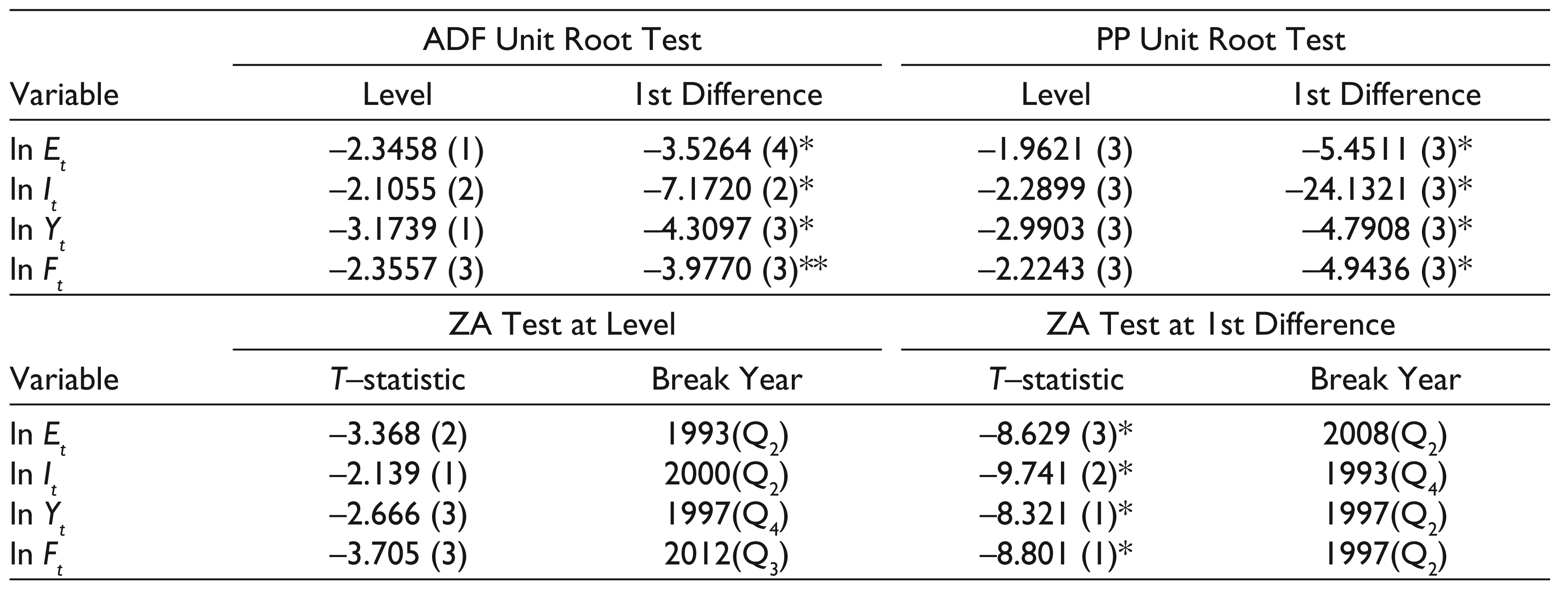
We note that ICT, economic growth, financial development and electricity consumption contain unit root problem with intercept and trend. All the variables were found stationary at first difference. To test the robustness of ADF and PP unit root tests, we applied ZA test and results were reported in Table 1 (lower segment). The results showed that all the variables are found non-stationary in the presence of structural breaks. After first differencing, all the variables were stationary with intercept and trend in the presence of structural break. It implied that all the variables were integrated at first difference, that is, I(1). This concluded that results provided by ADF and PP unit root tests were reliable and robust. It is observed that 25 per cent of the structural breaks occurred in 1997, which coincides with the onset of the Asian financial crisis.
The crisis, which began as a result of speculative attacks on national currency of Thailand (Baht), spread to other neighbouring nations and impaired both the financial sector and the real sector in Malaysia. Domestic-oriented industries including construction and services industries were adversely affected. Malaysia witnessed a large fall as market capitalization in stock market decreased by about 76 per cent. Subsequently, domestic-oriented industries, such as the construction and services sectors, were harshly affected by the economic crisis (Ariff & Abubakar, 1999).
We have applied the Gregory and Hansen (1996) cointegration test accommodating structural regime shift to examine cointegration relationship between ICT, economic growth, financial development and electricity consumption. The empirical results reported in Table 2 showed that null hypothesis may be rejected at 1 per cent level shift with constant, shift with trend as well as regime shift.
Gregory-Hansen Cointegration Test

Table 3 deals with empirical results of parameters stability test (Hansen, 1992) and notes that at lag 1, we may accept the null hypothesis of parameters stability. 3 In order to test the robustness of Gregory-Hansen cointegration (Gregory & Hansen, 1996), we have applied E-G and P-O cointegration tests developed by Engle and Granger (1987) and Phillips and Ouliaris (1990), respectively. The empirical results are shown in Table 3. We found that both tests may reject the null hypothesis of no cointegration at lag 1. This confirmed that ICT, economic growth, financial development and electricity consumption had long-run cointegration relationship for the period of 1990–2015 in case of Malaysia.
Cointegration Robustness Tests

The Gregory-Hansen cointegration test confirmed the incidence of long-run relationship between ICT, financial development, economic growth and electricity consumption. The next step is to carry out short-run and long-run impacts of ICT, financial development, economic growth and electricity consumption. The empirical results reported in Table 4 show that the effect of ICT on electricity consumption is positive and significant at 1 per cent level. The significant effect of ICT on electricity consumption indicated that the application of ICT equipment increased electricity consumption in the Malaysia economy for the period 1990–2015. The relationship between economic growth and electricity consumption was positive and significant at 1 per cent. It was noted that a 1 per cent increase in economic growth increased electricity consumption by 0.1055 per cent. This implied that with per capita income increase, people increase consumption of electricity for illuminating houses, commercial and business centres, shopping malls and offices. This empirical evidence is consistent with the line of existing literature such as Zhang and Yang (2013), Narayan and Popp (2012), Kula (2013) and Razali, Hassan, and Khan (2015).
Long-run and Short-run Analyses

Financial development positively and significantly affected electricity consumption at 1 per cent. This implied that financial investments increased electricity consumption. Ceteris paribus, a 1 per cent increase in financial development raised electricity consumption by 0.106 per cent. These empirical results are similar with existing studies such as the studies of Islam, Shahbaz, Ahmed, and Alam (2013), Shahbaz et al. (2013) for China, Komal and Abbas (2015) for Pakistan, Khan (2015) and Khan and Faisal (2016).
In short run, ICT has positive impact on electricity consumption at 10 per cent level keeping all other factors constant. The relationship between economic growth and electricity consumption was negative and significant at 1 per cent significance level. This negative impact of per capita GDP on energy consumption indicated that rising income might not lead to increase in electricity consumption in the short run. Financial development positively and significantly contributed to electricity consumption. The lagged error correction (ECMt–1) estimate was –0.0479 significant at 5 per cent level. The statistical significance of estimate of ECMt–1 showed the optimal speed of adjustment towards long-run equilibrium path.
Once the long-run and short-run relationships were confirmed, then we moved forward to test for causality links between the variables. To this end, the current study used Toda and Yamamato (1995) (thereafter T–Y) non-causality test for analysis. The empirical results of the T–Y non-causality approach were shown in Table 5. We found that ICTs caused electricity consumption, and as a result, electricity consumption caused ICT in Granger sense. These results can be justified on the premise that Internet connections and mobile phone subscriptions have increased the demand for electricity in Malaysia and vice versa.
Toda–Yamamato Non-causality Analysis

The number of cellular phone subscribers increased from 0.08 million in 1990 to about 9 million subscribers in 2002, which further increased to 43 million in 2013. The number of broadband users rose from 0.02 million in 2002, to about 4.5 million users in 2013. The expansion of telecommunications is widespread as it does not only confine to urban areas but also to the rural areas (Ching, 2015). In a space of five years, 1,122 telecentres were established to enhance digital inclusion and inculcate a culture of innovation and creativity (Economic Planning Unit, 2015). The availability of electricity has also encouraged widespread use of ICT in the country. The availability of electricity is well above 90 per cent in both urban and rural areas (Economic Planning Unit, 2015).
The relationship between financial development and electricity consumption is bidirectional, which denotes that financial development promotes electricity consumption in Malaysia. The financial sector provides about 20 per cent of the total loan (or to various segments of the manufacturing sector which consumes a lot of electricity including the electronics and electrical (E&E) and automobile clusters (Bank Negara Malaysia, 2014)). It also offers loans to households (usually through the use of credit cards) to purchase home accessories especially electronics appliances, which promote the use of electricity.
The financial system provides liquidity to the electricity and allied sector in addition to facilitating the listing of companies in the Bursa. The total loan granted by the banking system to electricity and allied sector amounted to more than RM14 billion in 2014 (Bank Negara Malaysia, 2014). Besides, several banks in the country provide different financial services to the largest electricity utility company–Tenaga Nasional (2014). Economic growth causes electricity consumption and vice versa. The causality running from electricity consumption to economic growth is true in Malaysia because the speedy expansion of manufacturing, ICTs and other industries has been due to the availability of power in Malaysia. Therefore, electricity is a key resource to Malaysia’s economic growth and development (Tang, 2008). The causality running from economic growth to electricity consumption can be explained on the basis that as the economy developed, the government has continuously allocated sizeable part of its budget for the purpose of ensuring reliable electricity supply, over the years.
The T–Y Granger causality is useful in detecting a causal relationship between the variables in the sampled period. To calculate causality outside the sample period, the innovative accounting approach is much better. The innovative accounting approach is a combination of the impulse response function and variance decomposition. The variance decomposition method specifies the size of the projected error variance for a series is responsible for innovations from each of the independent variable over different time-horizons beyond the selected period. Pesaran and Shin (1999) observed that the generalized forecast error variance decomposition method indicates the proportional contribution in one variable that is attributable to innovative shocks stemming in other variables. The key benefit of this method is that it is not affected by the ordering of the series as ordering of the series is exclusively determined by the VAR system. Additionally, the generalized forecast error variance decomposition method computes the simultaneous shock effects. Engle and Granger (1987) and Ibrahim (2007) contended that with VAR framework, the variance decomposition method provides superior outputs relative to the other conventional methods.
Table 6 reveals that 70.98 per cent of electricity consumption is explained by standard deviation shock stemming in electricity consumption itself. A standard deviation shock occurring in economic growth explains electricity consumption by 20.33 per cent. The contribution of ICT and financial development to electricity consumption is minimal, that is, 6.89 per cent and 1.78 per cent, respectively. Electricity consumption explains ICT by 3.34 per cent. Economic growth contributes to ICT minimally. The contribution of financial development to ICT is 27.06 per cent. A standard deviation shock occurring in electricity consumption, ICT and financial development explains economic growth by 7.66 per cent, 4.67 per cent and 6.75 per cent, respectively. A 25.67 per cent of financial development is explained by a standard deviation shock occurring in electricity consumption. A standard shock stemming in ICT contributes to financial development by 25 per cent. The contribution of economic growth to financial development is 17 per cent.
Variance Decomposition Analysis

Overall, we note the presence of neutrality effect between electricity consumption and ICT. The electricity conservation hypothesis is valid as economic growth causes electricity consumption. The feedback effect exists between financial development and ICT. The unidirectional causality is found running from electricity consumption to financial development but similar is not true from opposite side. ICT does not Granger cause economic growth and economic growth does not Granger cause ICT. Financial development does not Granger cause economic growth.
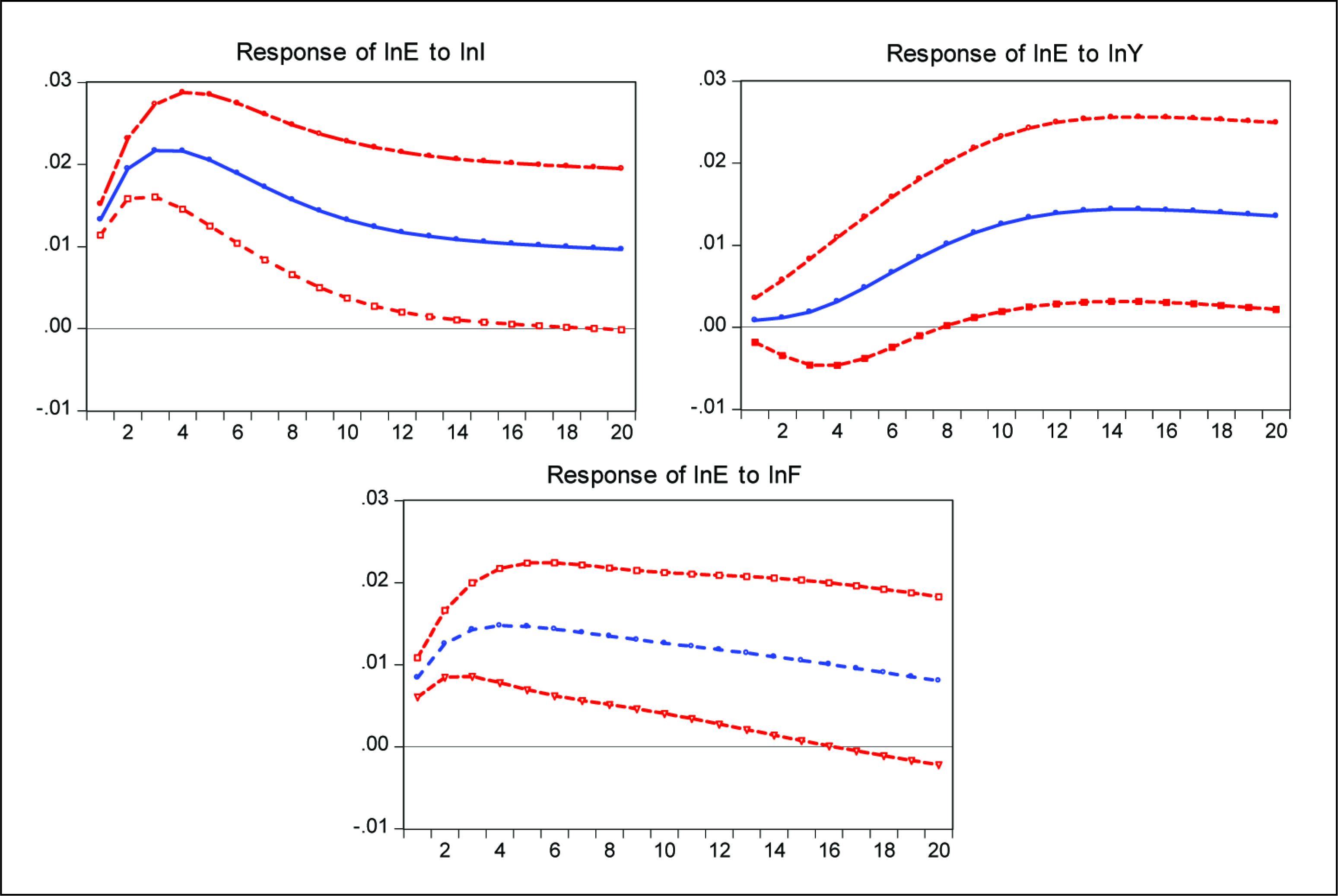
The impulse response function is used to examine the response of one variable to changes/shocks or innovations in the other variable. The empirical evidence of impulse response function is reported in Figure 1. We note that electricity consumption responds positively due to forecast error occurring in ICT. The contribution of economic growth is also positive to electricity consumption. This reveals that economic growth and ICT increase electricity consumption and similar kind of impact of economic growth and ICT on electricity consumption can be found in short run and long run. The contribution of financial development to electricity consumption is positive due to forecast error stemming in financial development.
Conclusion
This article investigates the dynamic relationship between ICT, economic growth and financial development by using the electricity demand function in case of Malaysia. The study has used the quarterly frequency data for the period of 1990–2015. The unit root properties of the variables have been tested by applying traditional as well as structural break unit root tests. Cointegration between the variables is examined by applying the Gregory–Hansen structural break cointegration approach. The causal relationship between the variables is investigated by applying the Toda–Yamamoto Granger causality technique. The empirical results validate the presence of cointegration between ICT, economic growth, financial development and electricity consumption. Moreover, ICT has positive effect on electricity consumption. Financial development adds in electricity consumption. Economic growth stimulates electricity consumption. The causality analysis indicates the presence of bidirectional causality between ICT and electricity consumption. The feedback effect is noticed between economic growth and electricity consumption. Financial development causes electricity consumption and electricity consumption in turn causes financial development in Granger sense.
Policy Implications
The findings of the current study, including the long run and causality analyses, have important policy implications. The results imply that it is not possible to reduce electricity generation to combat pollution effects; rather, Malaysia needs to pursue policies that will improve electricity generation efficiency which will have no adverse effect in the country. Malaysia has introduced several policies to improve energy efficiency including the Malaysian Industrial Energy Efficiency Improvement Project or MIEEIP (which was aimed at promoting energy efficiency within the industrial sector), Sustainability Achieved via Energy Efficiency Program or SAVE (which was meant to offer cash rebates for the acquisition of energy-efficient refrigerators, chillers and air conditioners), fiscal incentives for energy efficiency (to promote energy efficiency projects and equipment by providing tax incentives), Integrated Resource Planning (which was a project meant to offering capacity building on methodologies for operative energy planning and forecasting), The Green Technology Finance Scheme or GTFS (which was to support investments in green technology projects including energy efficiency). These initiatives have not been adequately effective due to several barriers including insufficient energy prices, inadequate fund for energy efficiency, inadequate overall nation-wide strategy for energy efficiency, absence of champions to effectively promote energy efficiency and the absence of consistency in the energy efficiency programmes (Ministry of Energy, Green Technologies and Water, 2014). Therefore, it is recommended that energy prices should increasingly reflect the market prices.
The application of a market-oriented pricing strategy for energy resources will attract potential investors to the energy supply chain sector, reduces wastages and ensures energy efficiency (Solarin & Shahbaz, 2015). There should be loan arrangements including credit card loans and term loans for individuals that want to acquire energy-efficient appliances. The authorities should also introduce blueprints action plan for the application of energy efficiency programmes with a clear harmonization among the activities and a transparent medium-term and long-term aim. In response to the inadequacy of the general national strategy for energy efficiency, the National Energy Efficiency Action Plan (NEEAP) was recently approved by the authorities in the country.
The NEEAP provides a strategy for a cost-effective and well-coordinated application of energy efficiency processes in the industrial, residential and commercial sectors, which is intended to ensure a lower energy use and monetary savings for the customers and the country. Another implication of the foregoing results is that Malaysia has not adequately achieved energy efficiency gains from the current ICT expansion and policies being witnessed in the country, which calls for policy reorientation in ICT sector. Energy efficiency is not a major focus of the MSC Malaysia and it was not included in the seven flagship applications. Applications in the area of energy efficiency, green building, green data centre and waste management should be encouraged by the government.
Footnotes
Declaration of Conflicting Interests
The authors declared no potential conflicts of interest with respect to the research, authorship, and/or publication of this article.
Funding
The authors received no financial support for the research, authorship, and/or publication of this article.
Acknowledgements
The authors are grateful to the anonymous referees of the journal for their extremely useful suggestions to improve the quality of the article. Usual disclaimers apply.