




Abstract
Brand equity is one of the prime and strategic assets for most of the contemporary business organizations. Companies are focusing on novel and innovative ways in order to build brand equity. Brand experience is one such construct which can be used by marketing managers in building and managing brand equity. Only a few studies have explored the relationship between brand experience and brand equity, particularly in the online shopping industry. This study was carried out in the State of Jammu and Kashmir to examine the influence of brand experience on brand equity. A multi-stage sampling method was employed to target 460 respondents which finally resulted in 403 functional responses. Exploratory Factor analysis (EFA) was conducted for both brand experience and brand equity followed by confirmatory factor analysis (CFA) for scale validation. The measurement scale was further subject to reliability and validity tests. Finally, structural equation modelling (SEM) was used to test the hypotheses formulated for the study. The results revealed that four dimensions of brand experience (sensory, affective, behavioural and intellectual) have a positive influence on all four dimensions of brand equity (brand awareness, brand association, perceived quality, brand loyalty). The study findings have further reinforced the research domain in brand experience which implies that producing unique and pleasing brand experiences will lead to improved perception amongst online shopping consumers and thus, influence brand equity. In the light of growing importance of brand experience in marketing, this study is a significant contribution to existing literature. The findings from this research study will provide useful insights to both academicians and marketers. Future researchers can focus on extending this study to other industries and by including additional variables.
Keywords
Introduction
Brands are living entities which drive business organizations in modern times. A brand can be defined as the subjective and abstract assessment made by the customer about a brand which exceeds the value perceived objectively (Rust, Zeithaml, & Lemon, 2000). Brands provide an immense value to the businesses, as they provide them with a dependable and continuous revenue stream which is difficult to imitate by competition (Smith & Milligan, 2002). Although branding originally evolved as a means for differentiating products in the competition (Cowley, 1991), in contemporary times, brands convey different meanings for their consumers, and consumers may develop feelings (Pitta & Franzak, 2008) and emotional attachments (Fournier, 1998) with their brands. Marketing research has also revealed that consumers no longer demand products or services but they desire experiences (Morrison & Crane, 2007). Brands in contemporary times are marketing experiences to strengthen and provide complementary support to their traditional marketing activity and to differentiate them from the competition. Experience has occurred in the literature in varied forms such as service experience (Hui & Bateson, 1991), customer experience (Gentile, Spiller, & Noci, 2007), consumer experience (Tsai, 2005), consumption experience (Holbrook & Hirschman, 1982) and brand experience (Brakus, Schmitt, & Zarantonello, 2009). But, brand experience is considered as a comprehensive construct because its scope goes beyond product and service experience. Brand experience can be described as the sensory impressions, emotions/feelings, cognitions and behavioural reactions which are produced by the brand-associated stimuli which are a component of design, character, communications, packaging and environment of a brand (Brakus, Schmitt, & Zarantonello, 2009). The concept of brand experience has gained considerable attention in marketing over the past decade, as research has shown its positive influence on various brand constructs. Researchers have examined the influence of experiential marketing on consumer behaviour, brand personality, brand relation and brand attitude. Recent studies have suggested that experiential benefits have a key role in determining brand preferences among customers, which implies possibility of direct association between brand experience and its ability to create brand equity (Brembeck & Ekstrom, 2004; Zarantonello & Schmitt, 2010). However, the studies that have explored the relationship between brand experience and brand equity have been limited (Khan & Rahman, 2015). Furthermore, only a few studies have been witnessed on the online shopping industry with respect to the brand experience. This study is an attempt to fulfil this significant gap in the literature by examining the relationship between individual dimensions of brand experience and brand equity in online shopping domain. This research study was undertaken to study causal relationship between brand experience and brand equity of online shopping portals in the state of Jammu and Kashmir in India. The following segment will begin with a literature review which will discuss brand experience and brand equity. The rationale for the study and its objectives are discussed next, followed by the theoretical framework. It will be followed by methodologies adopted in this study, including factor analysis and path analysis used for testing the relationships between endogenous and exogenous variables through structural equation modelling. At the end, conclusions, discussions, managerial implications, limitations and directions for future studies are given.
Literature Review
Brand Experience
Holbrook and Hirschman (1982) are acknowledged for the introduction of experiences with respect to consumption in the literature. Consumption includes stimulating a consumer’s innermost feelings and thoughts which form the experience content (Hirschman, 1984). Feelings, imaginations and pleasure play a significant role in influencing consumer’s decisions. This position marks a contrast to earlier theories which emphasized customer’s interest in only functional attributes in an offering. Pine and Gilmore (1998) further put forward the concept of customer experience, and more importantly, the ‘experience economy’ which marked the transition from service economy and drastic change in consumer behaviour. Environmental design is also a key factor which influences experience. This kind of experience as referred by Pine and Gilmore (1998) consists of aesthetic, entertainment, educational and escapist elements which can be designed. Consumption experiences were considered an important source for generating consumer value (Holbrook, 1999). Real experiences are quite contrary to services because purchasing services implies buying a bundle of intangible activities, whereas buying experiences means consumers pay for spending time and pleasure in return for memorable events provided by the company (Pine & Gilmore, 1999). In the famous work of ‘Experience Marketing’ by Schmitt (1999), he postulated the shift in consumer’s preferences from functional attributes to superior experiences, importance of information technology and entertainment and integrated communications which marked a new phenomenon and approach in marketing. Schmitt (1999) considered that consumers consider functional attributes, quality and a good brand image inherently present in an offering. As such, they desire product offerings and marketing communications that astonish their senses, sway their hearts and stimulate their minds, with which they can feel associated and can integrate or assimilate into their lifestyle. Experiences are induced by stimuli which provide sensory, cognitive, emotional, behavioural and relational values replacing the functional values. Thus, consumer experiences are as a result of stimuli provided by the marketers. Experience was identified as a key attribute in deciphering consumer behaviour (Addis & Holbrook, 2001). Another study described mechanic, humanics and functional clues leading to customer experience (Haeckel, Carbone, & Berry, 2003). The contemporary experiential marketing can be defined as ‘the process of identifying and satisfying customer needs and aspirations profitably, engaging them through two-way communications that bring brand personalities to life and add value to the target audience’ (Smilansky, 2009). In addition, there have been a number of concepts of experience in literature such as product experience (Hoch, 2002), service experience (Hui & Bateson, 1991), shopping experience (Kerin, Jain, & Howard, 1992), consumption experience (Holbrook & Hirschman, 1982) and some other experiences. Brakus, Schmitt, and Zarantonello (2009) introduced the brand experience in marketing which was empirically different from the consumer experience postulated by Schmitt (1999). Brakus, Schmitt, and Zarantonello (2009) define brand experiences as ‘subjective, internal consumer responses, sensations, feelings, cognitions and behavioural responses evoked by brand-related stimuli that are part of a brand’s design and identity, packaging, communications, and environments’. Brand experience comprises four dimensions, namely sensory, affective, intellectual and behavioural experiences (Brakus, Schmitt, & Zarantonello, 2009).
Sensory experiences attract and involve five senses of ‘sight, sound, touch, taste and smell’ (Schmitt, 1999) which allows a consumer to experience the entity. These experiences include the manner in which a consumer gets fascinated/involved with a brand through his/her senses, the way he/she feels or physically touches a brand, how a brand’s aroma/smell attracts him/her and the means by which a brand attracts other consumer senses (Brakus, Schmitt, & Zarantonello, 2009).
Affective experiences appeal to emotions and feelings of consumers (Schmitt, 1999). These emotions often include multitude of feelings, ranging from positive emotions (emotions for a low-involvement offering) to strong sentiments (delight for a high-involvement offering; Schmitt, 1999).
Intellectual experiences invoke consumer intellect and thinking process which leads to customer involvement through problem-solving and cognitive (analytical) experience (Schmitt, 1999). This dimension of brand experience stimulates and influences a customer’s imaginative and logical thinking.
Behavioural experiences induce different types of consumer behaviours through multiple consumer-brand interactions (Schmitt, 1999). These behaviours often include physical or body actions stimulated by brand consumption/contact. Consumer can also undergo lifestyle modification and change in behaviour or involvement through other brand interactions (Brakus, Schmitt, & Zarantonello, 2009).
Research studies have identified various antecedents of brand experience, such as brand-related stimulus (Berry, Carbone, & Haeckel, 2002), social media marketing (Beig & Khan, 2018); event-marketing (Zarantonello & Schmitt, 2013), brand-contact(s) (Chattopadhyay & Laborie, 2005) and story-telling (Lundqvist, Liljander, Gummerus, & Van Riel, 2013). Some other studies have focussed on consequences of brand experience, such as brand evaluation (Bapat & Thanigan, 2016), customer satisfaction (Brakus, Schmitt, & Zarantonello, 2009; Sharma, Tiwari, & Chaubey, 2016), brand loyalty (Bapat & Thanigan, 2016; Morrison & Crane, 2007; Nysveen & Pedersen, 2014), brand credibility (Shamim & Muhammad, 2013), brand recall (Baumann, Hamin, & Chong, 2015), brand attitude (Fransen, Rompay, & Muntinga, 2013), purchase intention (Morgan-Thomas & Veloutsou, 2013) and brand equity (Shekhar, Dash, & Chandra, 2013; Shamim & Muhammad, 2013).
Brand Equity
Brand equity according to Yoo and Donthu (2001) is defined as the differentiation between a branded and an unbranded product from the perspective of consumer choices. High levels of brand equity lead not only to good stock returns (Aaker & Jacobson, 1994), but also to purchase intentions and better consumer preferences (Cobb-Walgren, Ruble, & Donthu, 1995). Most of the studies on consumer-based brand equity (CBBE) consider it as a complex measure (Keller & Lehmann, 2006) which includes various dimensions (Datta, Ailawadi, & van Heerde, 2017). Brand equity as defined by Aaker (1991) includes five categories of brand assets or liabilities (brand associations, perceived quality, brand awareness, brand loyalty and brand assets, such as channel relationships, trademarks and patents) which are linked with a name or symbol of a brand that adds to or deducts from the value offered by a product/service. The first four components are related to the consumer, and the last dimension is concerned with the financial value of assets such as patents and trademarks. This research has considered only the first four components of brand equity given by Aaker (1991) as part of CBBE. Both Aaker (2009) and Keller (1993) have stated that brand awareness is an important element of brand equity. Brand awareness can be defined as the likelihood that a consumer could discriminate and recall that a brand pertains to a particular brand class (Aaker, 2009). Brand awareness consists of brand recall and brand recognition (Hoeffler and Keller, 2002; Keller, 1993). Brand awareness is an assurance of brand’s commitment and quality which leads to brand familiarity and inclusion of brand in customer’s consideration set during buying (Aaker, 1991). In Aaker’s (1991) model of brand equity, brand awareness is followed by brand association, because a consumer can form associations with a brand after he/she becomes aware of the brand (Washburn & Plank, 2002). Aaker (2009) defines brand association as ‘anything linked in memory to a brand’. The level and nature of an abstract determines the brand associations (Keller, 1993). Perceived quality is consumer’s intangible perception attributed to the product’s quality or superiority (Ramaseshan & Tsao, 2007). Perceived quality is an important factor leading to customer satisfaction (Szymanski & Henard, 2001). It not only provides value to consumers but also gives them a justification for brand differentiation. Perceived quality is also said to have a positive influence on purchase intention of consumers (Parasuraman, Zeithaml, & Berry, 1988). Brand loyalty is also defined as the inclination to be loyal towards a brand as demonstrated by the consumer’s intention to purchase the brand as a primary choice (Yoo & Donthun, 2001). The ultimate goal of brand management is customer’s brand loyalty (Chi, Yeh, & Yang, 2009). When a brand is considered by the consumers as their primary choice, it shows their intentions to buy that brand (Keller, 1998). Consumers who are more confident about a particular brand in comparison to its substitutes are actually more loyal and ready to pay a greater price for that brand (Lassar, Mittal, & Sharma, 1995).
Objective and Rationale of the Study
The review of literature focusses on the evolution and significance of experiences in the marketing literature. Various concepts of experience were discussed, and more importantly, brand experience was discussed in detail. Some of the studies related to antecedents and consequences of brand experience were also discussed followed by consumer-based model of brand equity. The past decade has witnessed studies in brand experience which focussed on the creation of unique consumer brand experiences in order to build strong brands (Keller & Lehmann, 2006). But, the literature shows only some studies that have described the significance of brand experience in influencing and building brand equity (Brakus, Schmitt, & Zarantonello, 2009; Hung, Lin, & Yang, 2012; Shamim & Muhammad, 2013; Zarantonello & Schmitt, 2010). Most of the studies in brand experience have focussed on goods. Further, a lack of brand experience studies in services is also a crucial issue that needs to be addressed (Khan & Rahman, 2015). Services are vastly experiential in nature (Berry, Carbone, & Haeckel, 2002), which brings additional relevance of measuring brand experiences in services (Nysveen, Pedersen, & Skard, 2013). This makes it imperative to study the relationship between brand equity and brand experience in service industry. There is a difference in customer tastes and preferences across nations (developed and developing), and also, the way an individual experiences a brand varies across geographical regions which further highlights the need to interpret experiences considering an individual’s culture and native place (Thompson, Locander, & Pollio, 1989). A majority of the brand experience studies have been conducted in developed nations (Khan & Rahman, 2015). This also requires studying the brand experiences in other developing nations. Thus, this study was conducted in Indian context which further adds to the contribution made by this study to the current literature. This study focusses on online shopping industry, as it is one of the fastest growing businesses (services) worldwide and is the future of shopping worldwide. The e-commerce sales in India are expected to surpass the United States by the year 2034 to become the world’s second biggest e-commerce market (IBEF, 2018). There are some researchers who have identified experiential attributes, inherent rewards and emotional values associated with shopping (Guiry & Lutz, 2000). The concept of experiences in shopping is getting a lot of attention in recent times with a focus on experiential characteristics while shopping for goods and services. This elicits the need to study influence of brand experience on brand equity with respect to online shopping portals.
Theoretical Framework
Brand Experience and Brand Awareness
Personalized customer–firm interaction in services results in positive experiences that form strong beliefs which in turn positively influence brand awareness (Berry, 2000). The direct experience of a customer with a brand helps customers in remembering a brand (Rossiter & Piercy, 1997). The memory of a customer experience influences brand recalls and brand identity (Hoch, 2002). The study conducted by Berry (2000) postulated service experiences increase both brand awareness and brand recall.
Brand Experience and Brand Association
Direct experiences play a significant role in forming associations in customer’s memory in terms of brand benefits and attributes (Keller, 2003). Strong brand associations are a result of additional customer experiences or contacts with brand’s communication (Aaker, 2009). The positive service experience enables strong association which results in brand differentiation (Keller, 2003). Experience in services is a vital input in forming brand associations (De Chernatony & Cottam, 2006).
Brand Experience and Perceived Quality
The customer experience with a product influences its overall quality evaluation (Paswan, Spears, Hasty, & Ganesh, 2004). Brand quality perception is due to the consequences of tangible attribute associated with a product which are driven by utilitarian and cognitive criterion (Zeithaml, 1988). Some research studies have also proved that quality perceptions are considerably influenced by product performance. Experience and use of a product are considered important for quality evaluation (Srinivasan & Till, 2002).
Brand Experience and Brand Loyalty
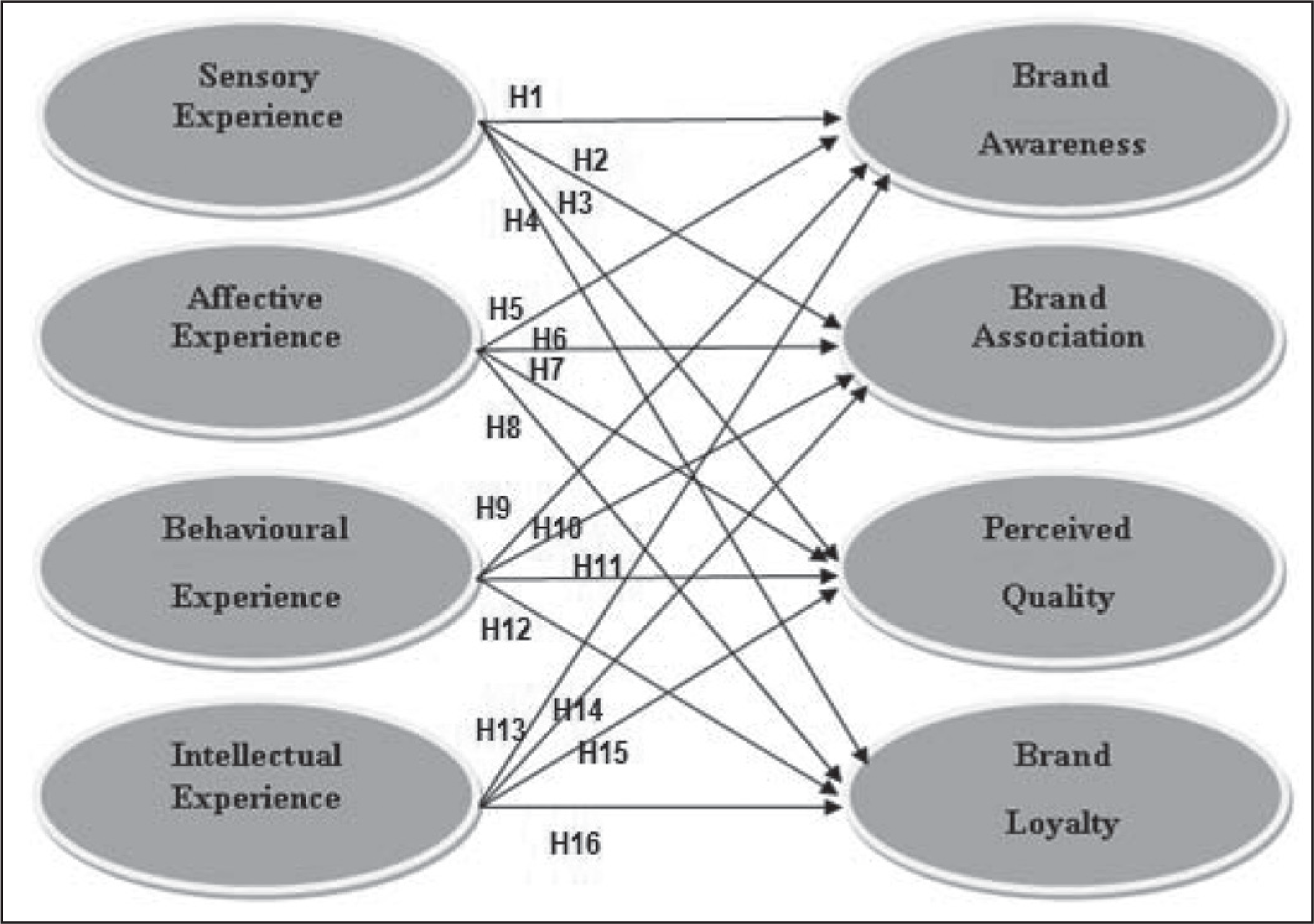
The long-term brand experiences stored in the consumer’s mind are likely to influence satisfaction and loyalty among consumers (Mittal & Kamakura, 2001). Positive brand experience is critical in developing strong and long-lasting brand loyalty (Mascarenhas, Kesavan, & Bernacchi, 2006). A study by Brakus, Schmitt, and Zarantonello (2009) postulated brand experiences influence future-directed consumer loyalty. There is also enough evidence in literature suggesting that brand experience is an important antecedent of customer loyalty and satisfaction (Schmitt, 1999). The conceptual model proposed by authors is given below (Figure 1).
Methodology
Research Design
Quantitative research design using structured questionnaire was used for this study. Extensive literature review helped in developing a self-administered questionnaire which was pretested during the pilot study. Both primary and secondary data were collected for the research study. Data collection was done using the survey method in both preliminary and final phases of the study. The sampling frame comprised the students across nine universities in the state. The rationale for choosing the university students was that university students are representative of online shoppers because they are familiar with e-commerce and computers (Lightner, Yenisey, Ozok, & Salvendy, 2002).
Questionnaire Design
For the independent variable (Brand Experience), the study adopted five-point Likert scale from the study of Brakus, Schmitt, and Zarantonello (2009). For the dependent variable (Brand equity), the study adopted five-point Likert scale from the work of Tong and Hawley (2009). The original brand equity scale has 15 items representing brand equity comprising four factors (brand awareness, brand association, perceived quality and brand loyalty). An item was dropped from Brand Association on the recommendation of experts, as it was not suitable for this study. An item was added to both perceived quality and brand association which increased the total items in Brand Equity scale to 16. The questionnaire was shared with two marketing experts for suggestions (Tull & Hawkins, 1994).
Data
The sample size of 381 for the final study was determined on the basis of the formula given by Krejcie and Morgan (1970). The questionnaire was distributed to 460 respondents, but only 403 functional responses were used in the research study. The sampling method adopted for the final study was multi-stage sampling.
Data Analysis
The total number of respondents considered for the final study was 403. The percentage of male respondents in the sample were 56.82 per cent (N = 229) and 43.17 per cent (N= 174) were female. Overall, 52.85 per cent students were pursuing post-graduation, followed by 36.47 per cent pursuing graduation, 3.22 per cent pursuing MPhil and 7.44 per cent pursuing PhD. The age group of 96.27 per cent students were 18–29 years, 3.72 per cent belonged to age group of 30–39 years and no respondents were in the age group of 40–49 years and above 50 years. Overall, 33.99 per cent of the respondents have chosen Amazon as their favourite e-commerce brand, followed by Flipkart (23.57 per cent), Snapdeal (19.10 per cent) and 23.32 per cent of the respondents have selected the other option. Additionally, 69.23 per cent of the total respondents shop 1 to 5 times a year, followed by 21.83 per cent who shop 5 to 10 times a year, 7.69 per cent shop 10–15 times a year and 1.24 per cent shop more than 15 times a year. Also, 70.23 per cent spend less than ₹10, 000 yearly, 21.58 per cent spend between ₹10,000 and ₹20,000 yearly, 5.21 per cent spend between ₹20,000 and 50,000 yearly and 2.23 per cent spend above ₹50,000 yearly.
Scale Reliability
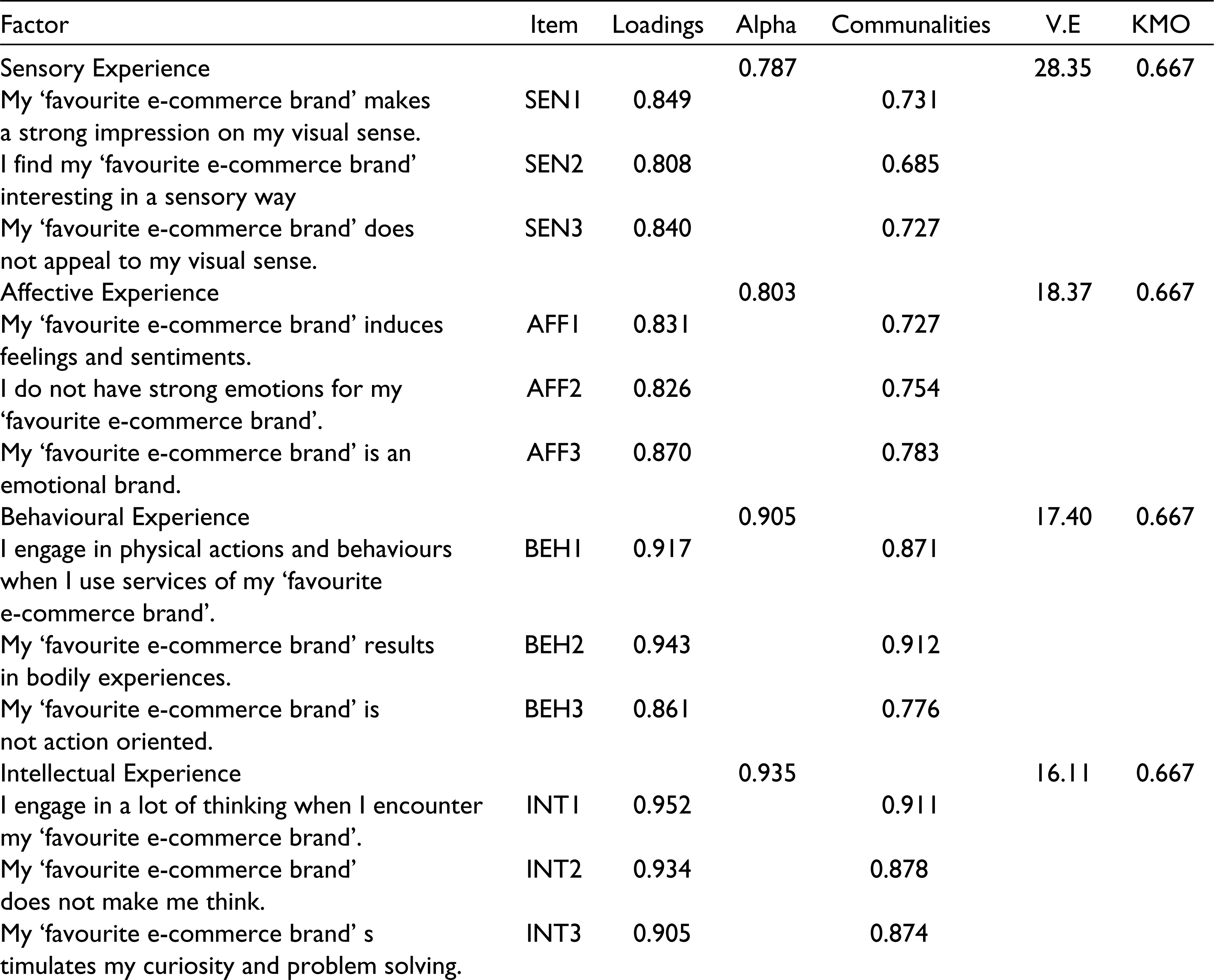
The reliability of the instrument for both endogenous and exogenous variables in pilot study was assessed using Cronbach Alpha. The values of ‘Cronbach Alpha’ (Table 1) calculated using SPSS 20.0 are above the minimum acceptable level of 0.70 in social sciences research (Hair, Anderson, Tatham, & Black, 1998).
EFA Results

Factor Analysis
Exploratory factor analysis (EFA) was performed for exploring the underlying data structure (Hair, Black, Babin, Anderson, & Tatham, 2006). EFA is run separately for each construct initially in order to ensure the dimensionality. Principal component analysis (Nunnally, 1978) and the VARIMAX rotation with Kaiser normalization were used for identifying the factor structure and classifying the items according to their respective dimensions. The value of 0.40 or more is considered as an acceptable level for factor loading but any loading above 0.50 is considered good (Hair, Black, Babin, Anderson, & Tatham, 2006) which was used as cut-off score for the current study. Sampling adequacy was measured by calculating ‘Kaiser-Meyer-Olkin (KMO) Measure of Sampling Adequacy’ for each factor which shows there are enough correlations in the data set for carrying out EFA. The value of KMO measure of sampling adequacy for the data is 0.667 (for both brand experience and brand equity run separately) which is above the acceptable level of 0.50. The value for Bartlett’s test of Sphericity is 733.950 for brand experience (.000 significance and degree of freedom is 66) and 1742.99 for brand equity (.000 significance and degree of freedom is 120) which shows variables are related with each other. The items were considered for the final study (Hair, Celsi, Ortinau, & Bush, 2008) on the basis of following criteria:
Items with factor loading greater than or equal to 0.50 Eigen value greater than 1
The factor loadings obtained using EFA, Cronbach alpha values and the results of variance extracted and communality can be seen in Table 1. The factor loadings for both brand experience and brand equity are above the minimum threshold level of 0.50. The cumulative variance extracted is 80.24 per cent for brand experience and 82.001 per cent for brand equity.
Measurement Model
The measurement model (Figure 2) consisting of eight factors was finally obtained and tested using confirmatory factor analysis. The results obtained from the measurement model indicate an acceptable data fit for the model as shown in the following paragraph:
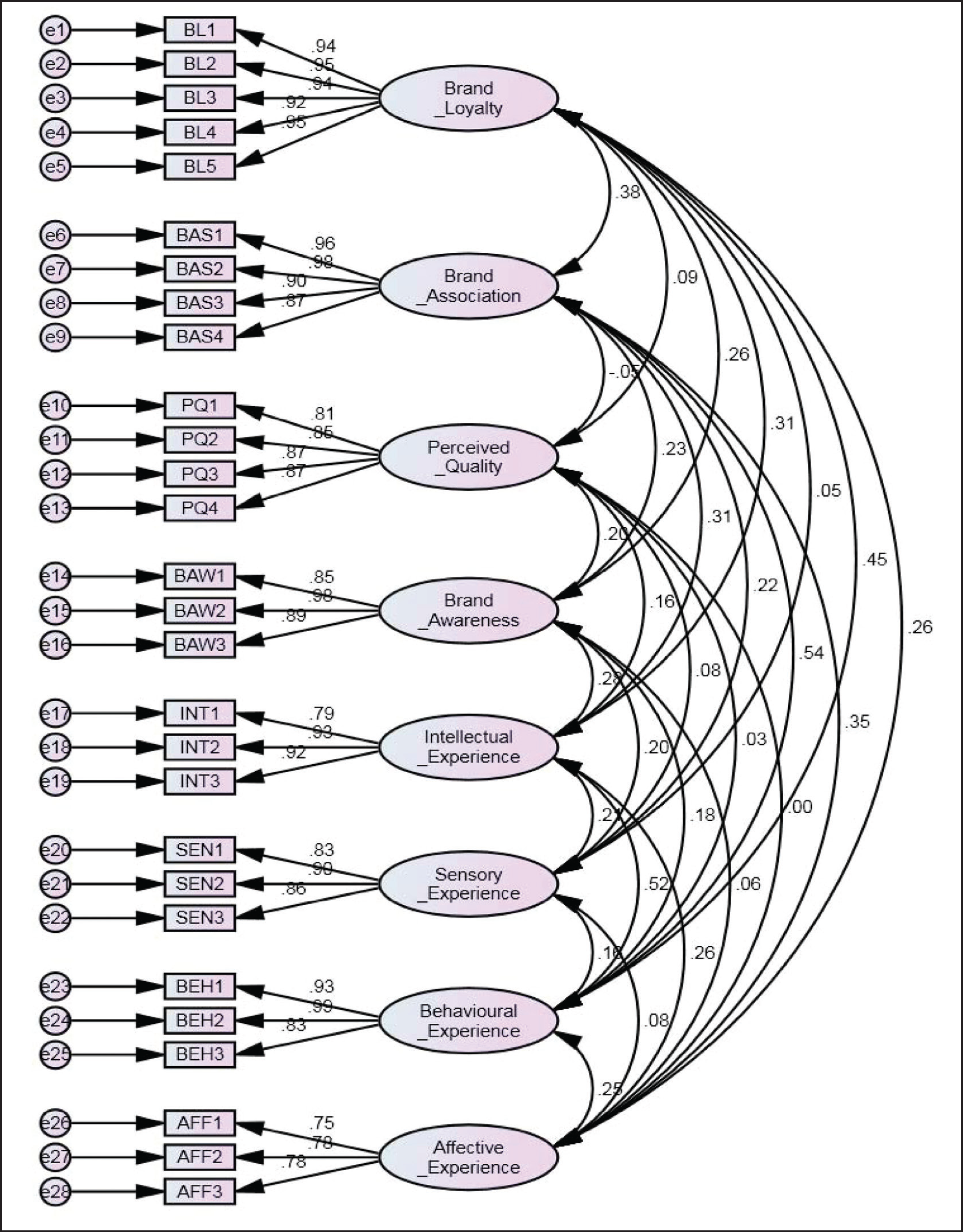
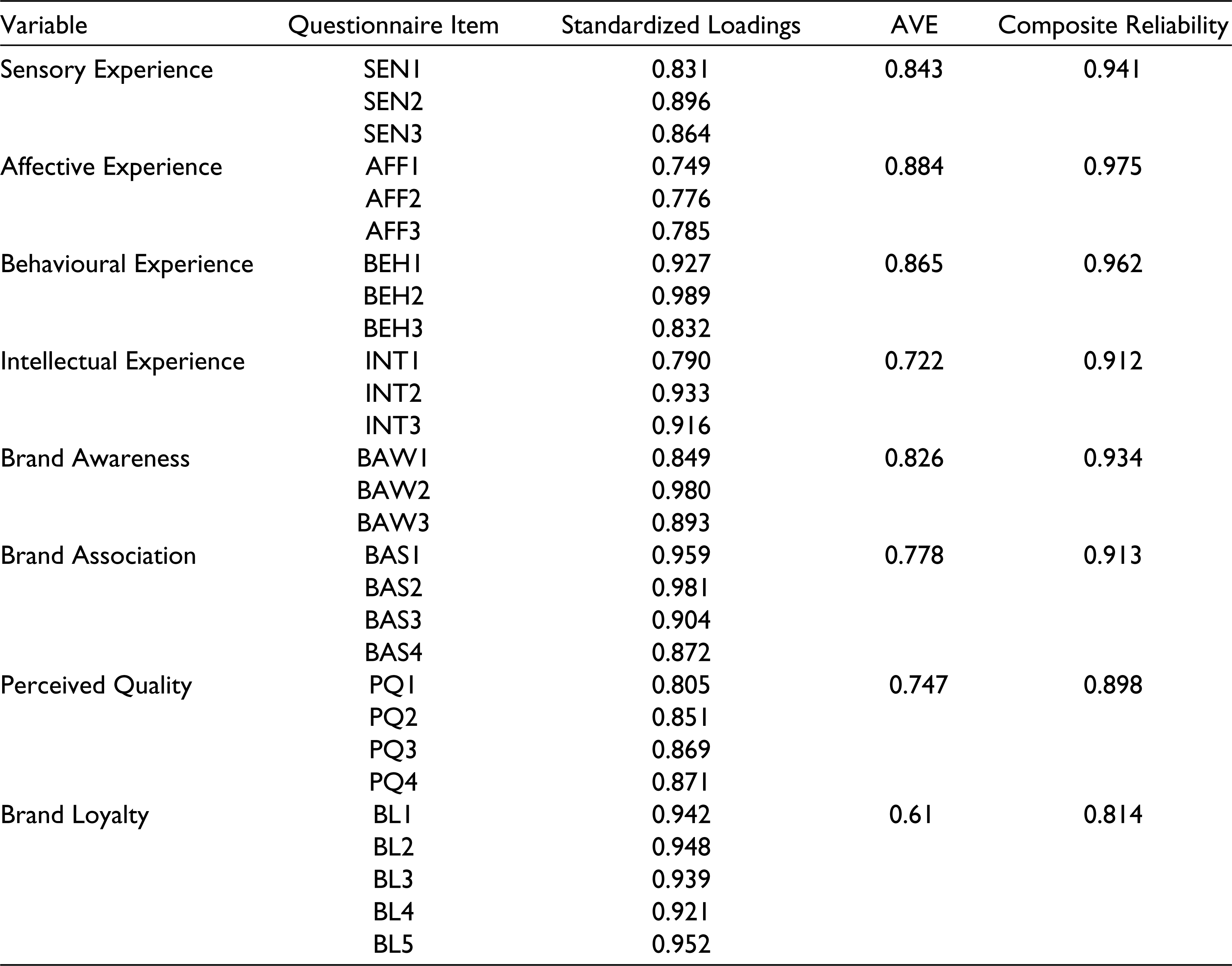
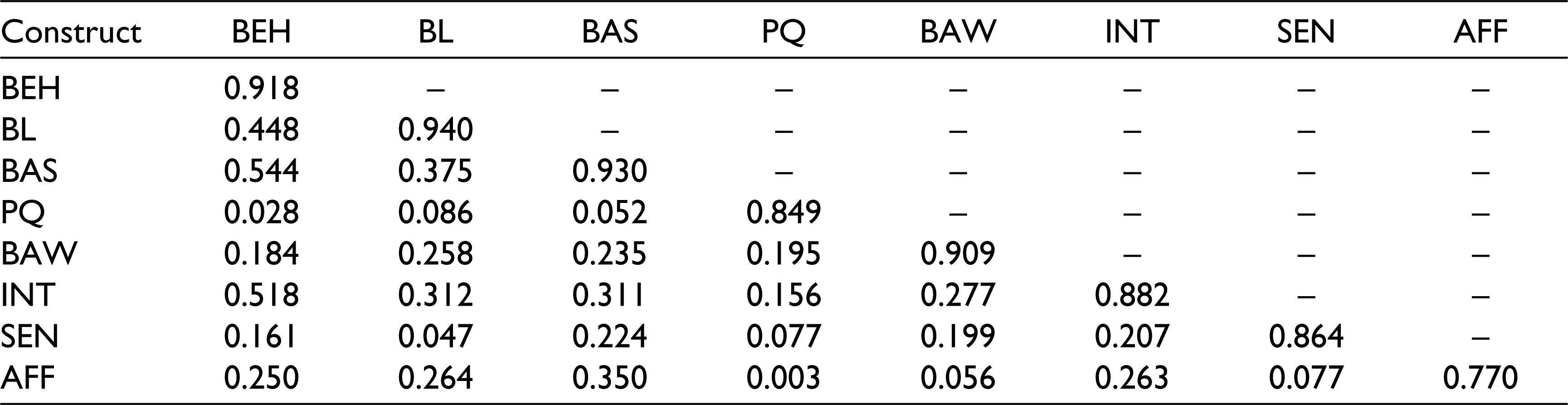
Chi-square = 1869.651, with degree of freedom 322 at probability level = .000(P < 0.05), AGFI = 0.923, CFI = 0.907, GFI = 0.943, RMSR = 0.053, NFI = 0.919 and RMSEA = 0.042. The assessment of model fit indices is not sufficient, and hence, validity and composite reliability (CR) also need to assessed. The values of CR for all constructs are above the minimum acceptance level of 0.60 (Table 2) which is evidence of Scale’s CR. CR actually measures internal consistency of factors when high inter-correlation exists between constructs (Koufteros, 1999). Construct validity assesses the degree with which a factor positively associates with other factors in a measurement scale. The values for AVE (average variance extracted) were used for determining the convergent validity of the scale. All the values of AVE as seen in Table 2 are above the minimum threshold level of 0.50 which confirms convergent validity for the constructs (Fornell & Larcker, 1981). Discriminant validity shows how a construct is different from the other constructs in the scale. Discriminant validity is established when the value of the square root of an AVE is higher than the values of its correlation coefficient (Fornell & Larcker, 1981). The values for correlation estimations and the square root of AVE (average variances extracted) as seen in Table 3 present the evidence of scale’s discriminant validity.
Standard Loadings and Composite Reliability
Discriminant Validity
Structural Model
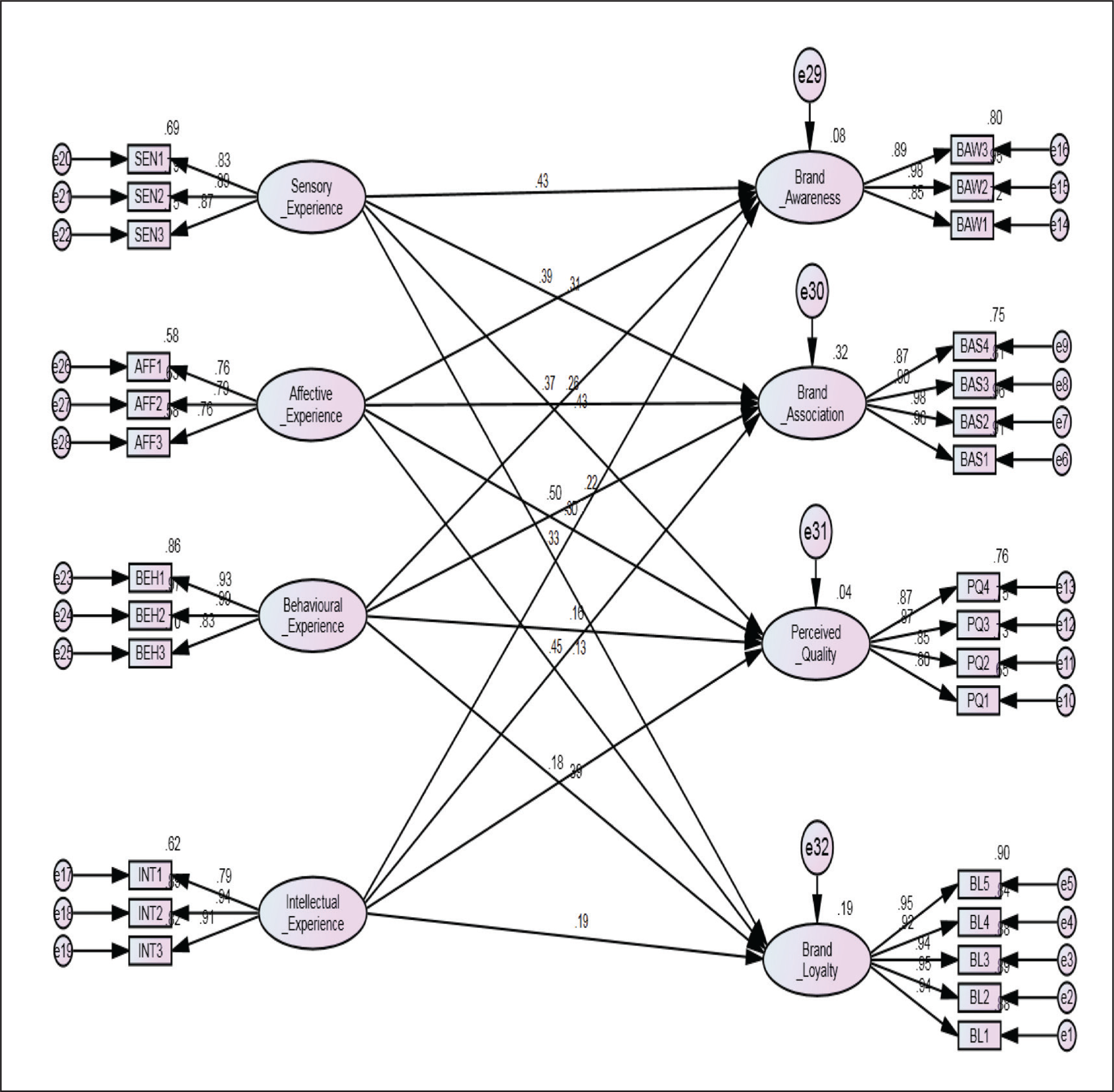
The subsequent step is to test the structural model which is based on examining the relationship between endogenous and exogenous variables in the study. Both endogenous and exogenous variables as shown in Figure 3 are defined by the latent constructs in the study. The model fit indices for the structural model were within the acceptable values. The results were obtained using AMOSS 23.0: χ2/df = 3.149, GFI = .907, CFI = .904, RMSR = .048, RMSEA = .046. The values of the result show good model fit. The results of structural equation modelling along with path coefficient are given in Table 4.
Structural Model Estimates: Relationship between Brand Experience and Brand Equity

Relationship Between Brand Experience and Brand Equity: Path Analysis
The results obtained showed that the hypotheses H1a, H2a, H3a and H4a are statistically supported which means sensory experience positively impacts the brand awareness (β = 0.431 and t value = 2.847), brand association (β = 0.392 and t value = 3.049), perceived quality (β = 0.373 and t value = 0.970) and brand loyalty (β = 0.330 and t value = 0.745).
The hypotheses H1b, H2b, H3b and H4b are statistically supported as indicated by the results which means affective experience positively impacts the brand awareness (β = 0.312 and t value = 0.221), brand association (β = 0.434 and t value = 4.668), perceived quality (β = 0.309 and t value = 0.658) and brand loyalty (β = 0.451 and t value = 2.779).
Results show the hypotheses H1c, H2c, H3c and H4c are statistically supported which means behavioural experience positively impacts the brand awareness (β = 0.500 and t value = 9.825), brand association (β = 0.160 and t value = 0.993), perceived quality (β = 0.392 and t value = 7.133) and brand loyalty (β = 0.260 and t value = 1.032).
Results showed that the hypotheses H1d, H2d, H3d and H4d are statistically supported which means the intellectual experiences positively impacts the brand awareness (β = 0.133 and t value = 0.122), brand association (β = 0.185 and t value = 2.953), perceived quality (β = 0.194 and t value = 1.867) and brand loyalty (β = 0.226 and t value = 3.740).
Discussions
Managing brand equity is important from both marketing and strategic perspectives of a firm. The results of the research study revealed that the sensory experience positively influences brand awareness, brand association, perceived quality and brand loyalty. Thus, online shopping portals need to actively concentrate on providing consumer experiences which affect and please their senses. Online shopping firms can improve their sensory experiences in multiple ways in order to influence and improve different dimensions of CBBE. Online shopping portals can improve the online aesthetics, improve website navigation, update their product information regularly and make their advertisements more appealing to improve the sensory experiences of their consumers.
This study showed that the affective experience positively influences the four dimensions of brand equity, that is, brand awareness, brand association, perceived quality and brand loyalty. The marketing managers should focus on building an emotional relationship with their consumers. This can be done through emotional marketing communications in the form of emotional advertisements (offline and online) and reliable customer service. The marketing managers need to formulate strategies to influence customer’s subconscious and inner-most thinking through pleasing experiences which will stimulate their emotions. This will create an emotional bond between the customer and a brand which will in turn influence brand equity. Customers can also be influenced emotionally through personalized marketing communications such as customized emails, better customer service, on-time service delivery and effective complaint-resolving mechanism and loyalty reward system.
Behavioural experience as shown by the study positively influences the four dimensions of brand equity, that is, brand awareness, brand association, perceived quality and brand loyalty. Behavioural experiences are depicted during purchasing, consumption and recommending the online shopping portals to other users. This experience as manifested through customer behaviour influences the brand equity. Thus, the role of behavioural experiences is crucial in building brand equity for online shopping brands/portals. The online shopping portals should provide incentive to their users in the form of better products, more product choices, pleasing services and discounts so that they frequently buy from their online shopping portals and advocate the brand to other users.
Intellectual experiences also positively influence the four dimensions of brand equity, that is, brand awareness, brand association, perceived quality and brand loyalty. The intellectual experience should invigorate the cognitive process of a customer in order attract customer attention and develop customer’s interest in the brand. The creative marketing communications and brand elements, such as logos, packaging, brand colours and design should intrigue the consumer’s mind and trigger consumer experiences.
Conclusion
The modern-day consumers are looking beyond a product/service for the satisfaction of their needs. They want memorable experiences as part of any offering to be delivered to them. This study has provided enough empirical evidence to suggest that brand experience can be used as an effective strategy to influence emotions and psyche of customers. This eventually leads to building brand equity in the highly competitive marketplace. Marketers must build an experiential brand through various activities which will captivate consumer’s positive responses. Since the traditional marketing activity only focuses on functional brand benefits which is costly and time-consuming, the current study has shown that brand equity can be positively influenced using the experiential route. Thus, brand experience can be used as an efficient and cost-effective route to achieve brand success in the online shopping marketplace. From the theoretical perspective, this research has made some important contributions. The current research framework has complemented the marketing research by providing useful insights into brand experience and brand equity in the online shopping sector. This work has endowed researchers with the use of structural model, as how different dimensions of experiences influence individual dimensions of brand equity. This study provides empirical evidence which suggests that brand experience is an important antecedent to brand equity. The four dimensions of brand experience selected for the study show a positive relationship with the four dimensions of brand equity of online shopping portals. However, the level of intensity varies across these relationships. The sensory experience has the highest influence on brand equity of online shopping portals in Jammu and Kashmir.
Managerial Implications
This research study will guide marketing managers to formulate and build marketing strategies to focus on capturing the emotional character of online shopping consumption. The online shopping webpage should be aesthetically pleasing and web navigation platform should be easy to use in order to arouse satisfying experiences from online shoppers. Online shopping portals need to identify and categorize target online shoppers to develop communication strategies which are in congruence with the characteristics of the target market. Marketers should give special attention to the design of brand logo, brand symbol and brand packaging to achieve the differential effect on their customers. They need to carefully craft their advertisements which can excite the consumer senses, arouse their emotions, induce them to buy their services and stimulate customer’s intellectual capacity. The role of service personnel is of crucial importance in delivering the brand experiences. Thus, service employees need to be trained effectively who can then handle customers with utmost care and finesse. Different marketing programmes and strategies can be formulated by the online shopping portals in order to emotionally appeal to consumers and drive the hedonic brand consumption. Brand equity of online shopping portals can be increased by making the online experience more memorable, pleasing and attractive by stimulating sensory emotions in consumers and creating an emotional bond with their consumers.
Limitations
The study findings are obtained from online shopping industry only, which is a major research limitation. The sampling frame consists of only university students which imply that this study may not be generalized to other consumers groups. The future studies can include other demographic groups of online shopping customers. Future studies can also explore this model in other industries which are more experiential in nature such as healthcare, airline and restaurants. This study can also be carried out in other regions of the country. Lastly, even though the sample size chosen for the research study is sufficient, generalizing the research results to all the online shopping portals may be limited. Therefore, future studies can include a bigger sample size for further generalizing the findings. Most of the studies in brand experience are quantitative in nature based on surveys. Future researchers can focus on qualitative research methods which will provide deeper insight into brand experience.
Footnotes
Declaration of Conflicting Interests
Funding
The authors received no financial support for the research, authorship and/or publication of this article.