




Abstract
Brands are considered as of one of the strategic and valuable assets which drive business organizations in modern times. The increasing competition in the business environment, commoditization of products and rise of informed customers in contemporary times has compelled businesses to focus on hedonic attributes in their product offerings. The scope of experiential marketing goes beyond the traditional marketing as it adds hedonic character to the marketing activity. Brand experience is one such construct which is crucial for organizations and research has shown its influence on brand equity. Thus companies pay significant attention in generating pleasing brand experiences for their customers. For businesses to stay relevant in modern times, they need to pay attention to each aspect of the brand experience for a better brand value. Brand experience provides businesses with multiple opportunities using multiple customer-brand interaction for an enjoyable experience for their customers. This paper has critically analyzed both brand experience and brand equity in the existing literature. And at the same time, relationship between these two constructs is discussed which will provide important directions for future researchers in this domain. This research paper provides valuable insights for marketing managers on the importance of delivering pleasing brand experiences for their customers for a stronger brand equity.
Introduction
The brands have become symbols which represent beliefs, values, personality and innovation. They evoke memories and emotions that represent quality. Brands are critical for the firm’s success as they become the major source of differentiation between other competitive offerings in the market. The brand creation process is often time consuming and challenging because it involves creating and developing a profound set of meanings associated with a brand (Keller, Parameswaran, & Jacob, 2011). An effort to describe the relationship between brand and a customer gave rise to the term ‘brand equity’ in the marketing literature (Wood, 2000). The research over the past few decades has shown that brand equity has become an important area of interest for academicians, marketers and business managers. According to Clow and Baack (2005), brand equity is a set of features which provides the brand a distinctive place in the market, allows a firm to charge a premium price and maintain a larger market share than would have been achieved with a non-branded product. Both brand management and branding have been recognized as strategic company objectives for decades (Kapferer, 2008; Keller, 2008). The modern marketing environment is competitive and dynamic with the increasing growth in goods, services and marketing activities. This often results in shorter product lifecycles and in such a competitive business environment, companies are focusing on providing creative product offerings to their customers rather than providing them with only utilitarian benefits. Thus, branding has undergone a change from a being as an identification element to the one creating an emotional attachment with the customer. This emotional relationship creates a unique brand value for their customers which are conveyed through interactive and innovative communication processes. The dynamics of current marketing environment has induced businesses to focus on creating memorable experiences with their customers through their offerings. They strive to communicate their brand value in a more efficient manner by focusing their activities on hedonic features and performances of the brand (Dhar & Wertenbroch, 2000; Hirschman & Holbrook, 1982) which means customers value the brands for the emotional contentment and pleasure they provide. Thus, an effective manner of providing superior brand value is to focus on the perceived hedonic (emotional) value of a brand which ‘emphasizes the significance of primary process thinking in accord with the pleasure principle’ (Holbrook & Hirschman, 1982) which is seeking fantasy, fun, sensory stimulation, arousal and pleasure with a brand. In order to create and strengthen unique brand impression in customer’s mind, the brand narrative should be communicated through interactive ways which in turn create a distinctive customer experience.
Marketing Experiences
In comparison to the traditional marketing, experiential marketing has been described as a revolutionary and a novel concept (Holbrook & Hirschman, 1982). The discipline of experiential marketing is growing rapidly due to its ability in creating strong and personalized customer engagement than achieved through any other medium. ‘Experiences provide sensory, emotional, cognitive, behavioural and relational values that replace the functional values’ (Schmitt, 1999). The overall customer experience is pivotal in forming a deep emotional bond with a brand which results in a strong customer–brand relationship (Fournier, 1998). The experiential marketing leads to a personal involvement and dual interactions between customer and a brand. Experiential marketing helps to identify important contact points which arouse emotions, senses and feelings of consumers and thus, define customer experience with a service, product or a brand (Brakus, Schmitt, & Zarantonello, 2009). The main objective of experiential marketing is to create a memorable bond between a brand and its consumer which will help a brand to differentiate it from other brands, build brand equity and influence future customer buying decisions.
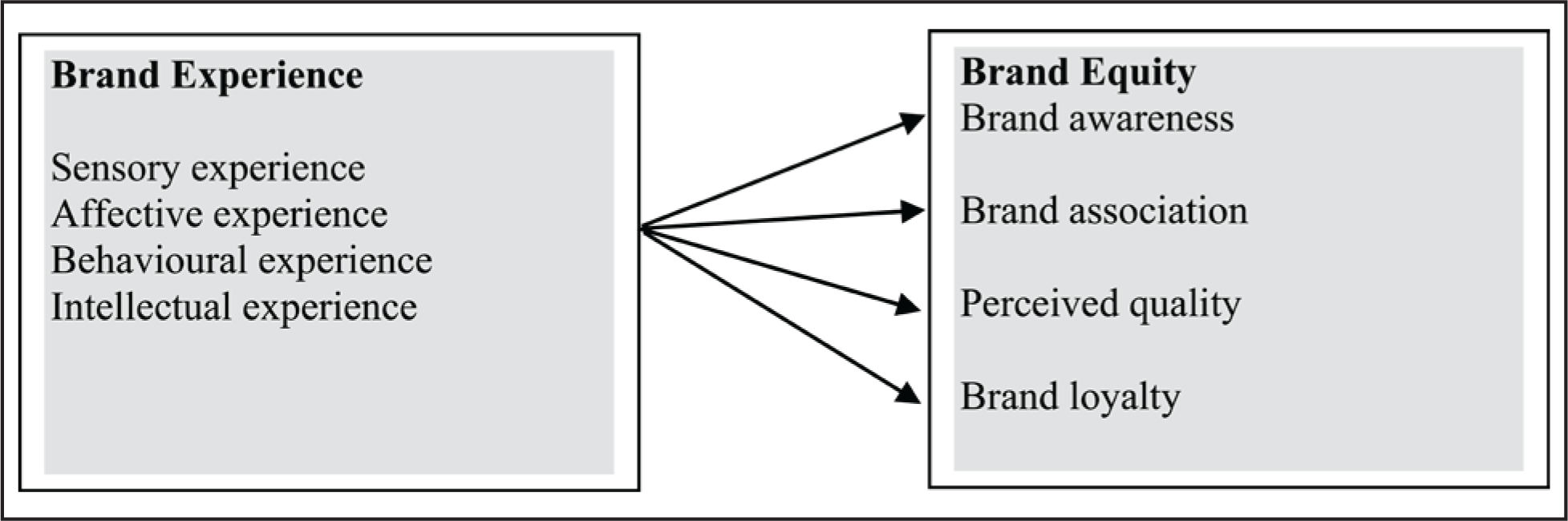
Although both brand experience and brand equity are well-researched domains, literature is dearth with studying the relationship between the two in the joint framework. Studies have largely ignored the importance of benefits which businesses could derive by building brand equity through brand experience domain. Research needs to focus on providing marketers a better understanding and mechanism as how by delivering better brand experiences for their customers can lead to a stronger brand equity. New formalized attempts need to be made as how different dimensions of brand experience influence various dimensions of brand equity. This article has focussed on various aspects of experience in the marketing literature and brand equity. In addition, the relationship between the dimensions of brand experience (sensory, affective, behavioural and intellectual) and brand equity (brand awareness, brand association, perceived quality and brand loyalty) is also discussed.
Brand Experience
The increasing pace with which services and goods have been commoditized has resulted in businesses providing consumers with a value which is beyond functional benefits. Over the past few years, there has been an increase in the business activity of creating and delivering experiences to differentiate the goods as well as services. The customer experiences created by the businesses are critical due to the commoditization of goods and services (Pine & Gilmore, 1998). Customer experience has been utilized in order to offer improved and mass customized products (Addis & Holbrook, 2001) and delivering a genuine customer value (Prahalad & Ramaswamy, 2004). The introduction of consumer experience concept in marketing has been accredited to Holbrook and Hirschman (1982) who posited that consumer experiences include hedonic attributes such as fun, fantasies and feelings. Schmitt and Rogers (2008) have also provided a holistic view of consumer perspective consisting of both emotional as well as rational routes. Concepts such as experiential marketing (Schmitt, 1999) and customer experience management (Schmitt, 2003) also started to emerge in the marketing literature.
Various researchers have contributed to some of the important underlying concepts or ideas related to experience. Pine and Gilmore (1999) have defined experience as a consumer activity or engagement with a company which is memorable and pleasing. Based on the intensity and involvement of a consumer–brand relationship, they identified four experience zones consisting of ‘aesthetic’, ‘escapist’, ‘entertainment’ and ‘educational’. Some of the customer experiences can be good, indifferent or even bad (Berry, Carbone, & Haeckel, 2002). Holbrook and Hirschman (1982) have claimed most experiences are positive such as experiential dimensions of feelings, consumption, fantasies and fun. Consumption experience is defined as the ideal basis for brand differentiation (Pine & Gilmore, 1999; Schmitt, 1999). Product experiences can be either direct with a physical contact or indirect through an advertisement (Hoch & Ha, 1986; Kempf & Smith, 1998). But direct experience is more effective in comparison to an advertisement (Wright & Lynch, 1995). Combination of both indirect and direct experiences can considerably influence attitude, purchase intention, product preference and product recall (Hoch & Deighton, 1989; Huffman & Houston, 1993). Experiences also occur during consumer’s interaction with a product, when they search for a particular product, during examination and evaluation of a product (Hoch, 2002). Holbrook (1999) suggested that consumption experiences are vital in creation of consumer value. Consumption experience consists of the creation of internal sensations and thoughts and thus constitutes the experience content (Hirschman, 1984). Experiences evoke emotions, imaginations and sensory aspects in consumers by involving them emotionally during shopping (Carù & Cova, 2003). According to Schmitt (1999), experiences are of five types, ‘sense’ (sensing), ‘think’ (intellectual), ‘feel’ (emotions), ‘act’ (physical experience) and ‘relate’ (social identity experience).
‘Sensory experiences’ which involve the five senses of sight, sound, touch, smell and taste.
‘Feel-related experiences’ which appeal to the customer’s emotions and inside feelings.
‘Cognitive experiences’ appeal to the intellectual capacity with the purpose of creating problem-solving experiences and result in engaging customer creativity.
‘Act experiences’ involve physical body experiences, interactions and lifestyle.
‘Relate experiences’ include social experiences which relates an individual to her/his ideal self, other cultures or people. Thus, it creates a sense of belongingness and social identity for consumers.
Schmitt (1999) thought that marketers need to create an enhancing and integrated experience involving all the above dimensions. The structure of customer experience management was put forward by Schmitt (2003), which involves managing the whole customer experience involving a product/company. Experience is an important element to understand consumer behaviour as explained by Addis and Holbrook (2001). The concept of experience emerged due to change in consumer lifestyle where they see an experience provided by an offering as an entertainment (Norton, 2003).
However, the concept of ‘brand experience’ was postulated by Brakus et al. (2009) which is different from other brand constructs in literature such as brand involvement, brand attitudes, customer delight, brand attachment and brand personality. The experience dimensions in the context of a brand were established initially empirically by Brakus et al. (2009) in contrast to the consumer experience framework given by Schmitt (1999). Brand experiences as defined by Brakus et al. (2009) are ‘subjective, internal consumer responses, sensations, feelings, cognitions and behavioural responses evoked by brand-related stimuli that are part of a brand’s design and identity, packaging, communications and environments’. The stimuli which appear as a component of brand’s identity and design can be in the form of a name, signage and logo; as a part of marketing communications and packaging it can be brochures, websites, advertisements; and the environment where it is sold or marketed such as websites, events and stores (Brakus et al., 2009). Thus, according to Brakus et al. (2009), brand experience occurs when consumers come into contact with brands or are exposed to them. They also postulated that there are differences in experiences when measured by valence, strength and intensity. This means some experiences can be positive, some are stronger than others and some can be negative. While some of the brand experiences occur intentionally and thus, last longer than others. And some happen abruptly and are often short lived. Even when some of the consumers do not have any personal bond with a brand or are uninterested in a brand, experiences can still happen. Over a certain period of time, emotional consumer–brand relationships are cemented and experiences remain in consumer’s memory which can influence consumer loyalty and satisfaction (Oliver, 1997; Reicheld, 1996). Brand experience needs to be communicated through all touch points and both ‘live’ and ‘non-live’ communication needs to be integrated in order to intensify the impact (Smilansky, 2017). The four dimensions (sensory experience, affective experience, behavioural experience and intellectual experience) as proposed by Brakus et al. (2009) are actually based on Schmitt’s (1999) work on experience. Sensory dimension includes sensory and aesthetic attributes; affective dimension includes emotions which are generated by brands; behavioural dimension focuses on behaviours related to brand experiences such as change in consumer lifestyle; intellectual dimension comprises of analytical and imaginative thinking due to interactions and experiences with a brand. Thus, summing up literature review on experience, it can be said that brand experience occupies an important place in marketing from both practical and theoretical point of view.
Brand Equity
The term ‘brand equity’ was first used in around the 1980s. The first study which showed how the brand caused value addition to a product was done by Srinivasan (1979). Measuring and managing brand equity has been a top priority by businesses and is at the core of marketing activity because of its strategic role in building brand value. Brand has been defined as ‘a name, term, sign, symbol, design or a combination, which is intended to identify the goods and services of a firm in order to differentiate them from competition’ (American Marketing Association [AMA], 1960). Brand equity as defined by Aaker (1991) is ‘a set of categories of brand assets (liabilities) linked to a brand’s name or symbol that add to (subtract from) the value provided by a product or service’. Customer-based brand equity (CBBE), as per Aaker (1991), is measured through brand awareness, perceived quality, brand association and future purchase intentions. According to Keller (2003), brand can be ‘a product that adds other dimensions that differentiate it from other products and services designed to satisfy the same need’. Keller posited that the brand equity can be derived from brand response and brand knowledge. Good brand equity also increases prospects for successful brand extension strategy, offers protection from competition and also acts as a strong entry barrier for competitors (Farquhar, 1989). Brand equity has been defined from both marketing and financial viewpoint (Shamim & Butt, 2013). Brand equity is a monetary or financial value added to a brand but is separate from other properties of a firm (Pappu, Quester, & Cooksey, 2005). From marketing point of view, it is the customer’s perception and knowledge related to the brand due to organized and strategic marketing activities of a firm (Aaker, 1991; Keller, 1993; Pappu et al., 2005).
Thus, in marketing, there are two definitions of brand equity:
Firm-based brand equity Consumer-based brand equity.
Firm-based brand equity has focused on the financial value created by the brand for a firm/business (Farquhar, Han, & Ijiri, 1991). Consumer-based brand equity has focussed on the consumer perception of the brand (Aaker, 1991; Keller, 1993; Pappu et al., 2005; Yoo & Donthu, 2001). The three well-established models of CBBE include that of Aaker (1991), Kapferer (1992) and Keller (1993). Aaker (1991) also proposed that higher brand value can be attributed to CBBE. A brand possessing superior brand equity can effectively promote customer loyalty, demand a premium market price and successfully compete with other brands (Aaker, 1991, 1996).
Aaker’s (1991) model of brand equity has following five components/dimensions:
Brand awareness Brand association Perceived quality Brand loyalty Other proprietary assets.
The first four components are related to the consumer and the last dimension is concerned with the financial value of assets such as patents and trademarks. Only the first four components of brand equity given by Aaker (1991) as part of consumer-based brand equity (Figure 1) (CBBE) were considered for this endeavour.
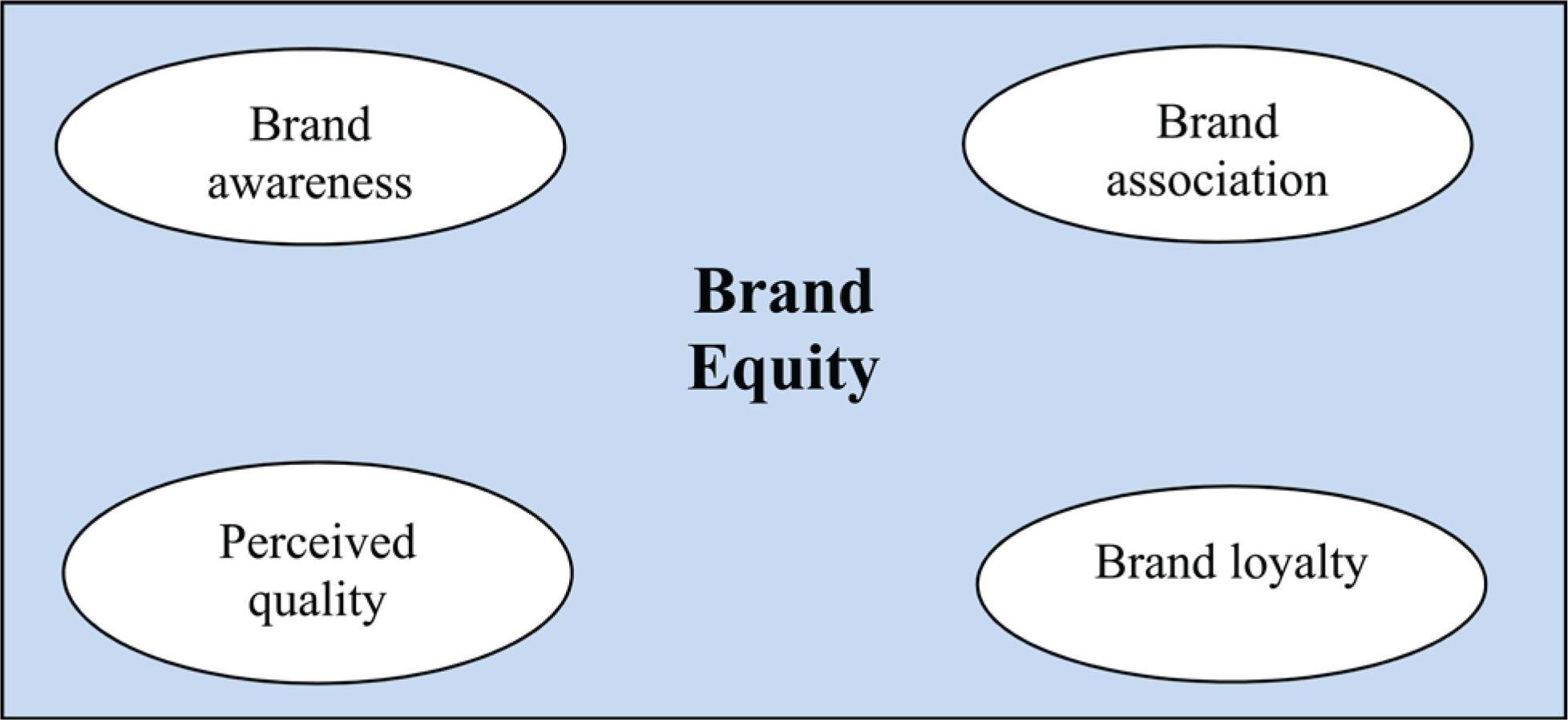
Components of Brand Equity
Brand Awareness
The familiarity of a consumer with a brand is defined as the brand awareness. Brand awareness is also defined as the ability of consumers to differentiate one brand from the other (Rossiter & Percy, 1987). Brand awareness according to Keller (1993) comprises of two components, brand recall and brand recognition. He defined brand recall as the consumer’s ability to remember a particular brand from the mind when that product class is made known. Keller (1993) also argued that ‘brand recognition may be more important to the extent that product decisions are made in the store’. ‘Brand awareness’ has also been recognized as a major component of brand equity in various models of consumer-based brand equity (Aaker, 1991; Wang, Wei, & Yu, 2008; Yoo, Donthu, & Lee, 2000).
Brand Association
Feelings, thoughts, experiences and beliefs (Kotler & Keller, 2006) that are in consumer’s memory related to a brand are brand associations (Aaker, 1991). Brand association can also include brand attitudes, emotional features and experiential benefits (Keller, 1993, 2003). Unique brand associations help consumers differentiate a particular brand from other products available in the market (Keller, 2003). Keller (1993) postulated that brand image is an association or perception formed due to consumer’s memory related to a product. Brand image is not only related to the technology or the product, but it can be formed and influenced by promotion, advertisement or even users. It allows a consumer to identify a product, assess the quality, lower the purchase risk, and acquire satisfaction and certain experiences due to product differentiation. Brands with higher brand equity have more positive brand associations in comparison to those having lesser brand equity (Krishnan, 1996). Unique, favourable and strong associations are believed to build a positive brand image which will create a prejudice or bias in the consumer’s mind and thus increase brand equity.
Perceived Quality
Zeithaml (2000) defines perceived quality as the consumer’s judgement regarding the product superiority or excellence. Perceived quality is a prime component of the consumer-based brand equity model (Aaker, 1996; Kim & Kim, 2004; Yoo et al., 2000). It is not related to an actual product quality but concerned with consumer’s perception about overall product quality in comparison to its competition (Aaker, 1991; Zeithaml, 1988). Zeithaml (1988) also argued that objective qualities are related to the technical attributes of a product, whereas the perceived quality is related to the overall product quality as perceived by the consumers. Steenkamp (1997) and Zeithaml (1988) classified perceived quality into two attributes:
Intrinsic attributes and Extrinsic attributes
Intrinsic attributes include physical characteristics such as colour, form, appearance and so on, whereas extrinsic attributes include packaging, brand name, stamp quality, price and so on (Bernués, Olaizola, & Corcoran, 2003). High levels of perceived quality makes a brand differ from the competition and demand a premium price in the market (Aaker, 1991).
Brand Loyalty
Brand loyalty is ‘the attachment that a customer has to a brand’ (Aaker, 1991). Brand loyalty is either behavioural or attitudinal (Odin, Odin, & Valette-Florence, 2001). The definition of brand loyalty from behavioural perspective deals with consumer’s genuine brand loyalty as reflected in purchase choices, whereas brand loyalty from attitudinal perspective focuses on consumer’s intention to be brand loyal. Attitudinal aspect of brand loyalty is about studying the customer’s first choice at the time of their purchases. Brand loyalty is associated with the product’s price, which is the fundamental loyalty indicator (Aaker, 1996). The threat from the competitors is reduced by building loyalty among customers (Aaker, 1991).
Theoretical Framework
Brand Experience and Brand Awareness
The ability of a customer to recognize or remember a brand under various conditions is defined as brand awareness. The repetition of experience with a brand increases the likelihood of its recognition and retention of brand name in the memory of customers (Alba & Hutchinson, 1987). The study conducted by Berry (2000) postulated service experiences increase both brand awareness and brand recall.
Brand Experience and Brand Association
Brand association can be defined as an image or linkage formed in consumer’s mind by a brand. Brand associations and brand knowledge are substantially influenced by experiences formed during usage and service interactions (Long-Tolbert, Till, & Swaminathan, 2006). Emotional and cognitive clues formed as a result of experience-based association leads to brand associations. Experience-based associations are derived from clues which are encountered during customer’s service experience (Berry, Wall, & Carbone, 2006).
Brand Experience and Perceived Quality
Perceived quality is the customer perception of brand’s superiority in its performance when compared to other products/services. The customer experience is a vital component of consumer learning. The repetition of a consumer’s usage with a product increases his/her information. This information further integrates with consumer’s knowledge and augments their quality perception. Customer experience plays a differential role in evaluating quality between products rated similar on their success/failure and on performance (Mudambi, Doyle, & Wong, 1997). Perceived quality is also considerably influenced by brand experience by building brand trust and increasing willingness to use it (Dolbec & Chebat, 2013).
Brand Experience and Brand Loyalty
Brand experiences are customer’s behavioural and subjective responses which are aroused by stimuli associated with a brand (Brakus et al., 2009). When these stimuli result in pleasing outcomes, consumers are likely to repeatedly purchase the brand (Brakus et al., 2009). Other studies have also shown the positive effect of brand experience on customer loyalty (Nysveen, Pedersen, & Skard, 2013).
Brand Experience and Brand Equity
A study conducted by Shamim and Butt (2013) examined both direct and indirect influence of brand experience on brand equity, brand credibility and brand attitude. The results showed that brand equity, brand attitude and brand credibility are directly influenced by brand experience. Iglesias, Singh, and Batista-Foguet (2011) conducted a vital research which studied both indirect and direct relationship between brand loyalty and brand experience. A study conducted by Esch et al. (2012) also showed that brand experience has a substantial influence on brand equity and on other variables such as cognitive/intellectual associations and brand awareness. Brand experience also influences loyalty and customer satisfaction directly, whereas associations related to brand personality are influenced indirectly (Brakus et al., 2009). There is also evidence which suggests that brand equity being positively influenced by sensory experience, affective experience, intellectual experience and behavioural experience (Sheng & Teo, 2012). The study ‘The impact of customer experience on brand equity in a business-to-business services setting’ conducted by Biedenbach and Marell (2010) revealed that brand equity is positively influenced by customer experience. Brand association, perceived quality, brand awareness and brand loyalty were included as the four dimensions of brand equity in the study. The results of the study showed experience has more influence on brand association and less influence on brand awareness. Research conducted by Zarantonello and Schmitt (2013) in an event marketing context shows a positive relationship between brand equity and brand experience (sensory, affective, intellectual and behavioural). Another research study conducted in Starbucks shows sensory, cognitive, affective, behavioural and relational experiences influencing brand equity positively (Cleff, Lin, & Walter, 2014). Berry and Seltman (2007) in their research also emphasized the crucial role of experience in creating brand equity.
Multitude of sensory experiences can lead to better customer service standards and ultimately in the long run improves brand recognition and brand image (Hultén, Broweus, & Van Dijk, 2009). Marketing using a sensory route makes a brand to be perceived as unique to consumers, leading to memorable experiences and persuades them to repeat and spread narratives of such experiences (Costa, Patricia, Natasha, Jessica, & Maria, 2012). Brand association is considerably influenced through sensory diversity and cognitive uniformity which allows further reliving such experiences through memory (Chang & Chieng, 2006). A study carried out by Moreira, Fortes, and Santiago (2017) shows that brand equity in a catering service is positively influenced by sensory brand experience. Customer choice is considerably influenced by both emotional and sensory components of an experience in comparison to tangible elements present in an offering (Zaltman, 2003). Consumer’s mental abstractions are also largely influenced by affective components of an experiential stimulus relative to actual attributes (Forgas, 1981). Sensory-based marketing helps in building brand image, strengthens brand reputation and increases sales (Rajput & Dhillon, 2013), which ultimately leads to long-lasting memories (Keller, 1993). Emotions/affect plays an important role in influencing brand loyalty (Dick & Basu, 1994) which is a component of brand equity (Aaker, 1991). Behavioural experience includes buying, consumption and advocacy of a brand. Such experiences have a positive relationship with customer loyalty (Brakus et al., 2009). However, experiences which are considered as superior help in determining true customer loyalty, provided that affective customer–brand relationship has been developed (Iglesias et al., 2011). But, the literature shows only few studies which have explored the relationship between brand experience and brand equity (Khan & Rahman, 2015). Thus, it becomes important for future researchers to focus on the relationship between brand experience and brand equity. Based on the relationships between brand experience and brand equity in the literature discussed above, authors have proposed a conceptual framework (Figure 2).
Conclusions
Brand experience and brand equity are important concepts in branding. Brand equity is a long-term route in building brands whereas brand experience is complex and involving from the customer perspective. Brand experience has been at the core of the marketing practices in recent times as marketing managers have come to realize that brand experiences have a substantial role in building brand equity. Brand equity is vital in determining brand purchases, increasing profitability of companies and increasing loyalty of consumers. Therefore, it becomes clear that marketers need to actively manage brand experiences in order to build stronger and valuable brand equity for their businesses. Marketers need to use different ways and mechanism through which customers can experience the brands. Marketers need to manage the complete journey of their customers which starts from searching to buying and final evaluation of services/goods provided by them.
Hence, it is useful for future researchers to examine the influence of brand experience on brand equity. Even though, some studies in the literature have focussed on the relationship between brand experience and brand equity, more attempts need to be made into this arena as how brand experience influences brand equity in various unexplored areas such as experiential services. This can provide valuable insights for businesses to tap the benefits by providing better brand experiences to their customers. Future studies should fully explore the relationship between individual dimensions of both brand experience and brand equity, in addition to the cumulative relationship between the two variables. Most of the studies in the context of studying the relationship between brand experience and brand equity have taken place in developed regions. This further elicits the future need to replicate this kind of study in developing regions of the world as well.
Footnotes
Declaration of Conflicting Interests
The authors declared no potential conflicts of interest with respect to the research, authorship and/or publication of this article.
Funding
The authors received no financial support for the research, authorship and/or publication of this article.