



Abstract
Abstract
Generation Y (Gen Y) is becoming more important to marketers as its members continue to enter the workforce. Members of this generational cohort are essential to the tourism industry as they engage in planning vacations themselves. This study accesses the information search behaviour of Gen Y and makes comparisons to the previous generation, Generation X (Gen X). A demographic profile, including information sources, is compiled. Additionally, several proposals were developed based upon the literature regarding tourism information searches and decision-making for Gen X and Y. Key constructs were identified as part of the purchase decision process. They were analysed using primary research study data. Specifically, independent-samples t-tests were used to test the propositions. The analyses revealed that there were significant differences between generational cohorts regarding technology-based information sources, risk aversion and use of information sources. As a result, this study offers a synthesis of contingency factors affecting tourist decision-making. It provides both theoretical and managerial implications.
Introduction
Generational Cohorts
A generational cohort is a group of consumers with common birth years and shared experiences, attitudes and behaviours. These groups are thought to be more viable for target marketing than a uniform, yet more arbitrary, designation of age groups. Each cohort is estimated to last approximately 20 years before the next generation arises (Pendergast, 2010).
The profile of the US travel market is characterized by multiple generations, known as the Silent Generation, Baby Boomers, Generation X (Gen X) and Generation Y (Gen Y) (Glover, 2010). According to generational theory, each generation is distinctive in terms of its traits, values/beliefs and interests/expectations (Strauss & Howe, 1997). In essence, a generation can be identified with some core values, which provide cues for behaviour patterns (Schewe & Meredith, 2004).
Gen X is defined as consumers born between 1965 and 1976 (Alch, 2000; Norum, 2003; Phillips, 2005), consisting of about 49.3 million members, approximately 17 per cent of the US population. The most commonly cited birth years for Gen Y are from 1977 to 1994 (Broadbridge, Maxwell, & Ogden, 2007; Buksa & Mitsis, 2011; Bush, Martin, & Bush, 2004; Cui, Trent, Sullivan, & Matiru, 2003; Kim, Knight, & Crutsinger, 2009; Loroz & Helgeson, 2013; Wolburg & Pokrywczynski, 2001), so for purposes of this study, Gen Y is defined as those born between 1977 and 1994, including about 60 million US consumers, which is about 41 per cent of the population (Pendergast, 2010). According to Nielsen (2015), Gen Y is the largest segment of the population and is more educated and more culturally diverse than any other generation. In essence, members of Gen X and Gen Y came out of a different history and with a different set of coping skills and expectations.
Recent research suggested that tourism growth might be dependent upon how service providers understand the social and demographic trends that influence travellers’ behaviour (Horneman, Carter, Wei, & Ruys, 2002). As such, generational theory provides a theoretical framework to pinpoint the consumption patterns and offers implications on travel attitudes, preferences and behaviours among various generations (Li, Li, & Hudson, 2013). As a result, insights gained through the lens of generational theory provide important practical and theoretical implications for a variety of behavioural phenomena (Chen & Hsu, 2000).
According to De Lollis (2005), Gen Xers have been entering their peak earning years and are categorized as both business and leisure travellers. Evidence shows that Gen X is the most free spending of travellers and outspent Baby Boomers on trips involving a hotel stay (De Lollis, 2005). In 2004, Gen X spent roughly US$1,297 per trip per person (McMahon, 2005) and the spending power of such a generation has continued to increase. In addition, Gen X runs 45 per cent of households with children (‘American generations …’, 2010) and is more likely to travel with children than other generations (‘Travel across …’, 2006). Although Gen X outspends Baby Boomers (1946–1964) on trips involving hotel stays, Gen Y consumers are the biggest potential spenders, with US$200 billion in annual buying power (Schawbel, 2015). For example, by 2020, the Gen Y market will be travelling internationally 47 per cent more than it did in 2013 (Fuggle, 2015). Trip planning involves information search.
The study generates a demographic profile as well as an information source profile for Gen X and Gen Y respondents. Proposals are developed regarding the vacation decision-making process, and several key constructs in the information search will be used to compare and contrast Gen X and Gen Y. The discussion offers theoretical and practical contributions. It should be noted that the secondary data research revealed many gaps in the literature. There was a considerable dearth of Gen-X literature, and in several cases, a general review of the tourism literature was provided.
Literature Review
Consumer Purchase Decision Process
Although there are slightly different ways of presenting it, the consumer purchase decision process is more often depicted in a five-step or five-stage model, beginning with problem recognition and ending with post-purchase behaviour (see Figure 1). The entire model is used to accommodate high-involvement purchase decisions, whereas the elimination of steps or stages two and three is appropriate for low-involvement (routinized) decision-making. In nearly all cases, the travel decision is a high-involvement purchase decision, which would involve all stages of the model. The topics in the literature review will be prefaced with their relevance/importance to the consumer purchase decision process.

Source Preferences
Consumers begin seeking information during the second stage of the consumer decision-making process, information search. Information available to individuals has a significant impact on travellers’ decision-making, especially when choosing a destination (Bieger & Laesser, 2004). Information technology (IT) has transformed travel and tourism (Werthner & Klein, 1999) and continues to impact the way travellers gain access to, and use, travel-related information.
Technology empowers travellers to control their travelling experience and the Internet has become the primary information source for travel planning (Xiang, Magnini, & Fesenmaier, 2015). Tools, such as search engines, have become a dominant force that influence travellers’ access to tourism products (Xiang, Woeber, & Fesenmaier, 2008). Social media is another platform that has changed the dynamics of online communication, and mobile apps have created new locales for information search, facilitating information search in guiding travel decisions (Wang & Xiang, 2012). Additionally, travel portals, virtual communities and websites of destination marketing organizations (DMOs) serve as different sources for travel planning (Xiang et al., 2015). As the use of the Internet for travel planning becomes more prevalent, decision-making processes are expected to be increasingly influenced by electronic word of mouth (eWOM). This phenomenon may be due to the high-involvement nature of purchasing traveling packages (Yoo & Gretzel, 2011).
Furthermore, research shows that traditional media, such as TV, radio, and even movies, still remain relevant to travellers’ information search and decision-making (Xiang et al., 2015). Moreover, there is an emerging trend that travellers who search for information through social media and mobile devices also engage in offline communication for travel needs (Xiang et al., 2015). Additionally, Benckendorff and Moscardo (2010) suggest that Internet usage may be overstated. However, information needs and search strategies can vary for different stages in the travel decision-making process (Gretzel, Fesenmaier, Formica, & O’Leary, 2006). Travel planning involves a multitude of facets for which decisions need to be made (Yoo & Gretzel, 2011). Yet, little is known about how generational cohorts make travel decisions based upon different communication channels at various stages of decision-making.
Gen X is the first generation exposed to computer technology (Losyk, 1997). Studies show that Gen X is able to work with a variety of software programmes and is willing to face cyberspace challenges (e.g., Losyk, 1997). Generally, members of this generation are technology savvy and they leverage technology to personalize/humanize many aspects of their lives (Reisenwitz & Iyer, 2009). However, Gen-Y consumers tend to place an emphasis on the integration of technology with many aspects of their lives, such as leisure (Leask, Fyall, & Barron, 2014). For instance, 65 per cent of this generation made online travel arrangements in 2008 (Jones & Fox, 2009). The use of technology is considered as an important tool for meeting their needs and expectations while travelling (Leask et al., 2014). Furthermore, many Gen Yers have used travel-related social media to share their travel experiences (Chatchaidamrong & Leelapanyalert, 2009; Moscardo & Benckendorff, 2010).
Jones and Fox (2009) found that Gen Yers are more likely to read other peoples’ blogs and write their own than other generations. Online social interaction is perceived as entertaining, customizable and exciting (Nusair, Bilgihan, & Okumus, 2013), although females tend to receive greater benefits from using online reviews than males (Gretzel & Yoo, 2011). eWOM has become a determining factor to influence travel-related decision-making (Gretzel & Yoo, 2001). For example, eMarketer (2007) reported that among travellers who use peer reviewers for their hotel bookings, 25 per cent of infrequent leisure travellers and 33 per cent of frequent travellers reported having changed their hotel stay based upon reviews by other consumers.
In essence, Gen Y is a challenging generation to connect with, as many of the traditional methods of advertising have proven to be ineffective communication (Schawbel, 2015). Like Gen Xers, Gen Y is tech savvy and is the first generation to use e-mail, instant messaging and cell phones since childhood (Tyler, 2007, 2008). But, more than previous generations, Gen Y is more comfortable with technology (Auby, 2008) and knows how to solve problems and shorten the learning curve using collaboration tools, such as cell phones, bluetooth, windows CE handhelds, laptops, e-mail and text messaging (Bradley, 2007). Barnikel (2005) notes that Gen Y is the first generation in which Internet consumption has exceeded television consumption. Based upon the previous discussion, it is proposed that Gen-Y consumers use more technology-based information sources than Gen-X consumers for their vacation planning.
Risk Aversion
Perceived risk begins early in the decision-making process during the information search stage and continues throughout the remainder of the process, including post-purchase behaviour. Consumers wish to minimize this risk, especially with high-involvement decisions. A major way of reducing this risk is accomplished by acquiring information.
In their adolescent life stage, Gen-Y consumers were described as risk averse (Morton, 2002), struggling with independent thinking and decision-making, due to the fear of making mistakes (Howe & Strauss, 2003). More recently, however, Gen-Y consumers have been described as risk-takers (Sharma, 2013). On the other hand, Gen Xers have been characterized as more cynical, more pessimistic and less idealistic than Gen Yers (Reisenwitz & Iyer, 2009). Hence, they tend to be sceptical of the status quo (Jurkiewicz, 2000), which may be due to their pessimistic nature. In fact, research shows that this generation is a reactive generation and has a low capacity for risk (Reisenwitz & Iyer, 2009).
Users of social networking websites are more likely to engage in risky behaviours than non-users (Fogel & Nehmad, 2009). Zhu, Dholakia, Chen, and Algesheimer (2012) found that online-community engagement leads individuals to make riskier financial decisions because they rationalize that, if a mistake was made, they will get help from the community, even if consisting of relative strangers. Bolton et al. (2013) note whether, and to what extent, Gen Y’s use of social media increases its risk proneness; this requires further study, especially since its risk-taking behaviours are important to firms and policymakers. Based upon this discussion and the earlier discussion of information search preferences, it is proposed that Gen-X consumers are more risk averse than Gen-Y consumers.
Source Credibility
As mentioned, information search usually follows problem recognition as the second step in the purchase decision process. Providing information to potential tourists is a major marketing activity for a typical DMO and in many cases may make up a significant portion of a DMO’s operating budget (Cai, Feng, & Breiter, 2004). In terms of consumer behaviour, environmental influences and individual differences are antecedents during the consumption process, including information search (Cai et al., 2004). Studies have shown that personal experience from past vacation travel and information from family members and friends are the most utilized information sources, whereas mass media sources, especially advertising and editorial messages (publicity), are rated as less important in the vacation decision-making process (Loda, 2003). The role of the credibility of information sources in tourists’ information search behaviour, along with the role of prior knowledge and information needs, was examined by Cho (2001). Results showed that credibility of the source was the most important criterion when deciding upon an information source, compared to prior knowledge and need for information. However, there was no distinction between advertising messages and editorial messages (publicity) in the rating process.
In contrast, more recent research found that publicity created significantly higher scores than advertising for credibility, message strength and purchase intent (Loda, Norman, & Backman, 2005, 2007). These findings confirm that publicity is an important element in the tourism marketing mix, suggesting that a publicity-then-advertising strategy is most effective in persuading prospective tourists to visit a particular destination.
More recently, Li et al. (2013) found that paid advertising has little influence as an information source for all four generational cohorts (The Silent Generation, Baby Boomers, Gen X and Gen Y), supporting the contention that the effectiveness of traditional advertising is weakening in today’s digital world (Carey, Kang, & Zea, 2012). Based on the previous discussions, the following proposals are presented: (a) Gen-X consumers have a higher attitude towards traditional vacation advertising than Gen-Y consumers and (b) Gen-Y consumers have a higher attitude towards online vacation advertising than Gen-X consumers.
Satisfaction
A satisfactory or unsatisfactory experience is an important variable in the last stage of the purchase decision process, post-purchase behaviour. Based on the disconfirmation paradigm, satisfaction is a comparison between performance and expectations (Moliner, Sanchez, Rodriguez, & Callarisa, 2007). Restated, consumer satisfaction is a function of expectations related to important attributes and judgements of attribute performance (Meng, Tepanon, & Uysal, 2006). It is regarded as one of the key judgements that consumers make in regard to a tourism service (Bowen & Clarke, 2002) and is a crucial element to sustain a competitive business in the tourism industry (Meng et al., 2006).‘Successful service providers are able to meet and, whenever possible, exceed consumers’ expectations. If tourism agencies fail to meet the expectations of tourists, they become dissatisfied. Dissatisfied tourists will not come back to such travelling agencies, for their next tour’ (Bhat, 2012, p. 328). Although satisfaction has both a cognitive and an emotional component, it is generally thought to be more affective or emotional than quality (Huang & Chiu, 2006), with the consumer addressing the question ‘Did you like it?’ versus the cognitive question ‘Was the experience high in quality?’
According to Bowen and Clarke (2002), the literature more broadly discusses a variety of elements that comprise tourism satisfaction: expectation, performance (of management, service personnel, the tourists themselves, whether in groups or as individuals, the host population), expectancy disconfirmation (the difference between expectation and performance), attribution (a consideration of the locus), stability over time, management control and importance of causal inferences (blame) made by the tourist(s), emotion (e.g., fear, surprise) and equity. These elements may act independently or in combination. An element(s) could also be suppressed or heightened in a particular tourist situation. Ko and Lui (2010) also note that tourism attraction is a significant influence on tourist satisfaction. Additionally, Neal and Gursoy (2008) found that level of satisfaction or dissatisfaction varies during different stages of travel and can affect the overall level of satisfaction with travel and tourism services.
Moreover, reviews on satisfaction in the marketing literature have emphasized the need for a context-dependent approach (Fournier & Mick, 1999). Tourist satisfaction is responsive to the service climate. Tourists deal with a product that is characteristic of most services: intangible, inseparable, heterogeneous and perishable, as well as high risk, high involvement and interdependent. Judgements are usually confined to a shorter timeframe than other purchases, with similar financial requirements or degree of involvement in decision-making (Bowen & Clarke, 2002).
Meng et al. (2006) note that tourist satisfaction is important to gain a better destination image, increase consumption of the product and services mix, increase loyalty and generate repeat business. Furthermore, Ibrahim and Gill (2005) proposed that the measurement of the customer’s perception of a destination’s services can result in the identification of attributes that can be used to lead to informed decisions of the destination’s positioning strategy. They believe that customer perception and satisfaction can be used in tandem for positioning and promotion purposes. The measurement of customer perception and satisfaction, when combined, can result in the identification of specific niche markets, which can be integral components in developing and promoting an effective positioning strategy for a destination. It is proposed that the generational cohort that utilizes more information sources is more satisfied with the vacation destination.
Self-concept
It has been suggested that some purchase decisions may be affected by the consumer’s self-image or self-concept (Sirgy, 1982). Self-concept, the sum total of an individual’s ideas, thoughts and feelings about himself or herself relative to other objects, is a multidimensional concept which includes actual self-concept, how individuals perceive themselves to be, and ideal self-concept, how an individual would like to be perceived (Sirgy, 1982). Consumers generally have favourable attitudes towards products and brands that are consistent with their self-image and less favourable attitudes towards products and brands perceived to be inconsistent with their self-image (Graeff, 1996). Subsequently, consumers may be influenced to direct their purchase behaviour towards products and services that will protect or enhance their self-concept (Litvin & Kar, 2003).
Chon (1992) is credited with first applying the self-concept congruity theory to tourism via a study of post-visit satisfaction. Satisfaction was significantly correlated with ‘self-image/destination image congruity’. Specifically, he found that tourists who perceived a low discrepancy between a destination’s user-image and their actual or ideal self-image were most satisfied with the destination, while those with high discrepancies were found to be least satisfied. Litvin and Kar (2003) affirmed the applicability of self-image in tourism research and extended their research to encompass the concept in conjunction with the cultural moderating variable of individualism/collectivism. Their message for tourism marketers is that a product reflective of the target market’s self-image has the potential to result in higher satisfaction levels when sold in individualistic markets, such as those found in Australia, versus more collectivist markets, such as those found in Japan. In sum, while applicable across cultures, self-concept may work better in some markets than in others. Although they did not employ a multicultural focus, Murphy, Benckendorff, and Moscardo (2007) found that if tourists can associate a destination with a destination brand personality and the association is consistent with their desired experience, then a high correlation between the tourists’ self-image and perception of the destination results. In contrast, Curtin (2010) focused on characteristics of the tourist, versus the destination, and found that wildlife tourism consists of individuals who ‘differentiate themselves from other tourists in terms of dress, behaviour, development of skills, equipment and intellectual capital’ (p. 17) as shown by their interest in scoping, identifying and photographing wildlife.
Gen X was labelled as ‘lacking ego strength’ and having ‘low self-esteem’ (Howe & Strauss, 1993), while Gen Yers were characterized as having inflated self-esteem issues, due to overprotection by their parents (Princeton One, 2016). In addition, Giovannini, Xu, and Thomas (2015) found that marketing strategies positioning luxury fashion brands as status symbols that support or encourage a specific lifestyle or personal value would be useful when targeting Gen-Y consumers. This type of strategy is also supported by the research of Sirgy (1985) who determined that consumers who are driven to feel a connection with the products they purchase are likely to seek out brands that reflect their self-image. Based on the previous discussion, it is proposed that the generational cohort with a higher self-image towards the vacation was also more satisfied with the vacation.
Objectives
Information search on vacation packages accompanies high-involvement decision-making. Therefore, the main objective of this study is to compare and contrast Gen X and Gen Y regarding the information search stage of the vacation decision-making process. The second objective of this study is to investigate how Gen X and Gen Y use various communication channels to make travel decisions and suggest the effective method(s) to promote tourist destinations to them.
Methodology
The study sample was a regional sample. The respondents consisted of individuals who were recently contacted by upper-level undergraduate marketing students trained in data collection procedures and used as interviewers. This approach has been successfully used in previous research (e.g., Arnold & Reynolds, 2003; Bitner, Booms, & Tetreault, 1990; Jones & Reynolds, 2006). Interviewers administered questionnaires and were instructed to screen potential respondents with three qualifying questions on the cover page of the instrument: (a) an age range that categorized the respondent as a member of Gen X or Gen Y, (b) an acknowledgement that the respondent had taken a vacation within the past year to allow retrieval of information from short-term memory and (c) confirmation that the respondent had been employed full-time for a majority of the past year, so the likelihood of the respondent planning the vacation would be greater. The questionnaires for Gen X and Gen Y were identical except for the age-qualifying question on the cover page. An introduction to the questionnaire was just below the three questions on the cover page, including an assurance to respondents that their responses would be kept confidential.
The first section of the questionnaire included demographics questions (see Table 1).
Descriptive Information of Sample

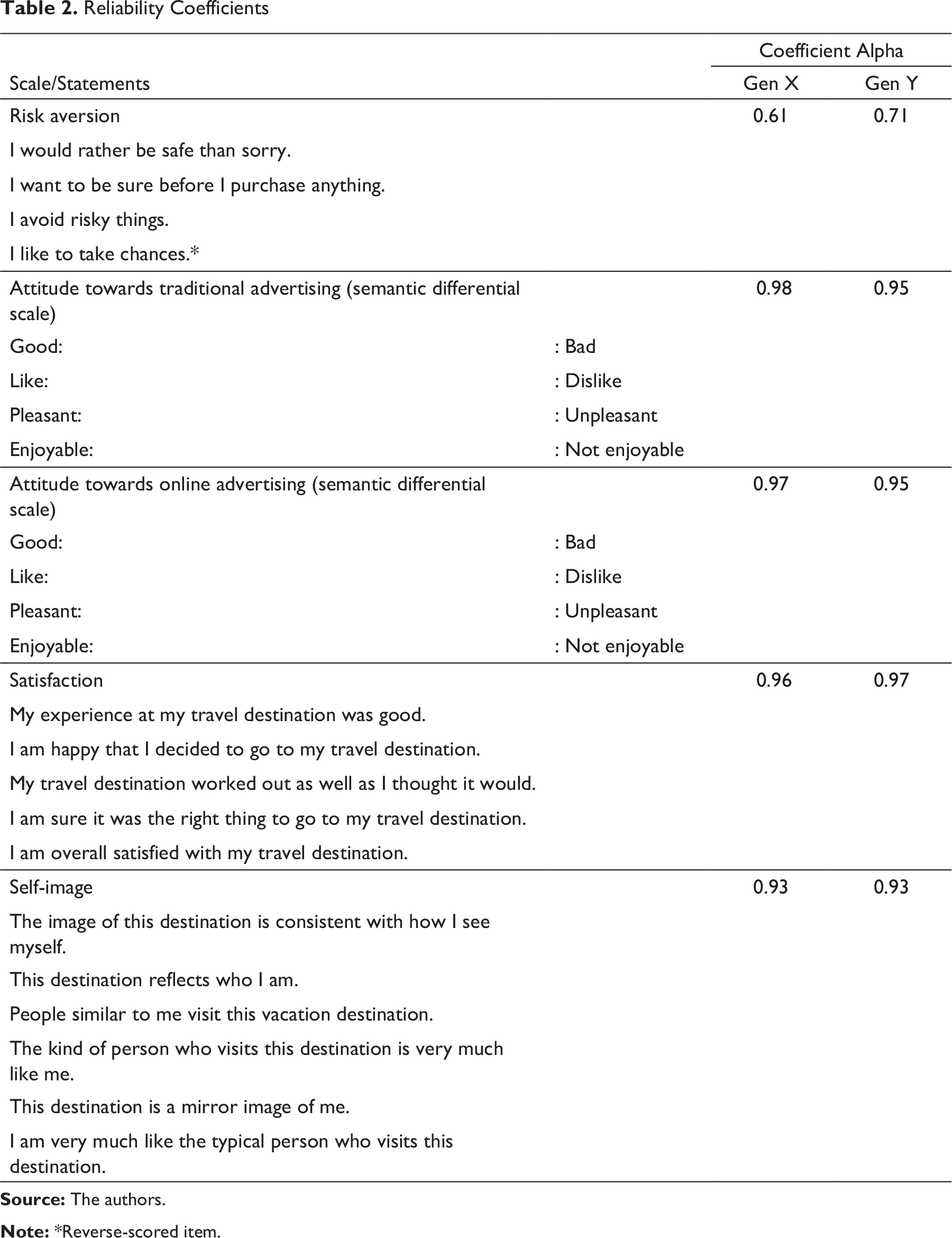
All multi-item scales were established scales, some of which were revised for use in the study. The risk-aversion scale was a four-item, seven-point, Likert scale (Donthu & Gilliland, 1996). The measures for attitude towards online advertising and the attitude towards traditional advertising of the vacation destination were identical four-item, seven-point, semantic differential scales. These items were drawn from the inventory of 64 bipolar adjective scale items from Bruner and Hensel (1998), who noted that past generated scales ‘have relied heavily on researcher judgment with respect to which specific adjective pairs are appropriate for a given situation’ (p. 818). A similar five-item, seven-point, semantic differential scale was generated for measuring attitude towards the vacation destination. A five-item, seven-point, satisfaction scale (Oliver, 1980) was adapted to assess satisfaction of the travel destination. Finally, a six-item, seven-point, self-congruency, self-image or self-concept scale was also slightly modified for use in the study regarding the vacation destination (Sirgy et al., 1997).
Two pretests were conducted to test the questionnaire. The first pretest (n = 32) was conducted with an undergraduate marketing class of traditional students (Gen Y). Some basic formatting issues were addressed as a result of the pretest. A second pretest (n = 34) was conducted with another undergraduate marketing class of traditional students (Gen Y). Modifications, including a frequency issue in one question, were made as a result of this second pretest.
The data for the main study were collected, coded and entered into the SPSS (Statistical Product and Service Solutions) program. A frequencies analysis was run to check for any outlier values. In the Gen-X dataset, multiple respondents were removed who were outside of the 40–51 years of age range. Additionally, outlier values for five other variables were checked and corrected, and one questionnaire with a blank page was deleted, resulting in a final sample size of 219 for Gen X. In the Gen-Y dataset, only age outlier values were an issue. These respondents were also deleted, resulting in a final sample size of 246 for Gen Y.
Reliability Coefficients
Analysis
The demographic data revealed that nearly all Gen-X and Gen-Y consumers use the Internet and about 10 per cent more Gen-Y consumers than Gen-X consumers use the Internet to purchase products and services. Both generational cohorts use the Internet daily and have used it for over 5 years, making purchases once every few months. In terms of vacation behaviour, both generational cohorts spent about 3 days at the vacation destination, generally using a personal car for travel with two immediate family members in the party. Expectedly, Gen X spent more on the vacation (US$501–1,000) versus Gen Y (US$101–500). The majority in both cohorts was attracted to the destination because they had visited there previously. Please see Table 1 for the demographic profiles of both cohorts.
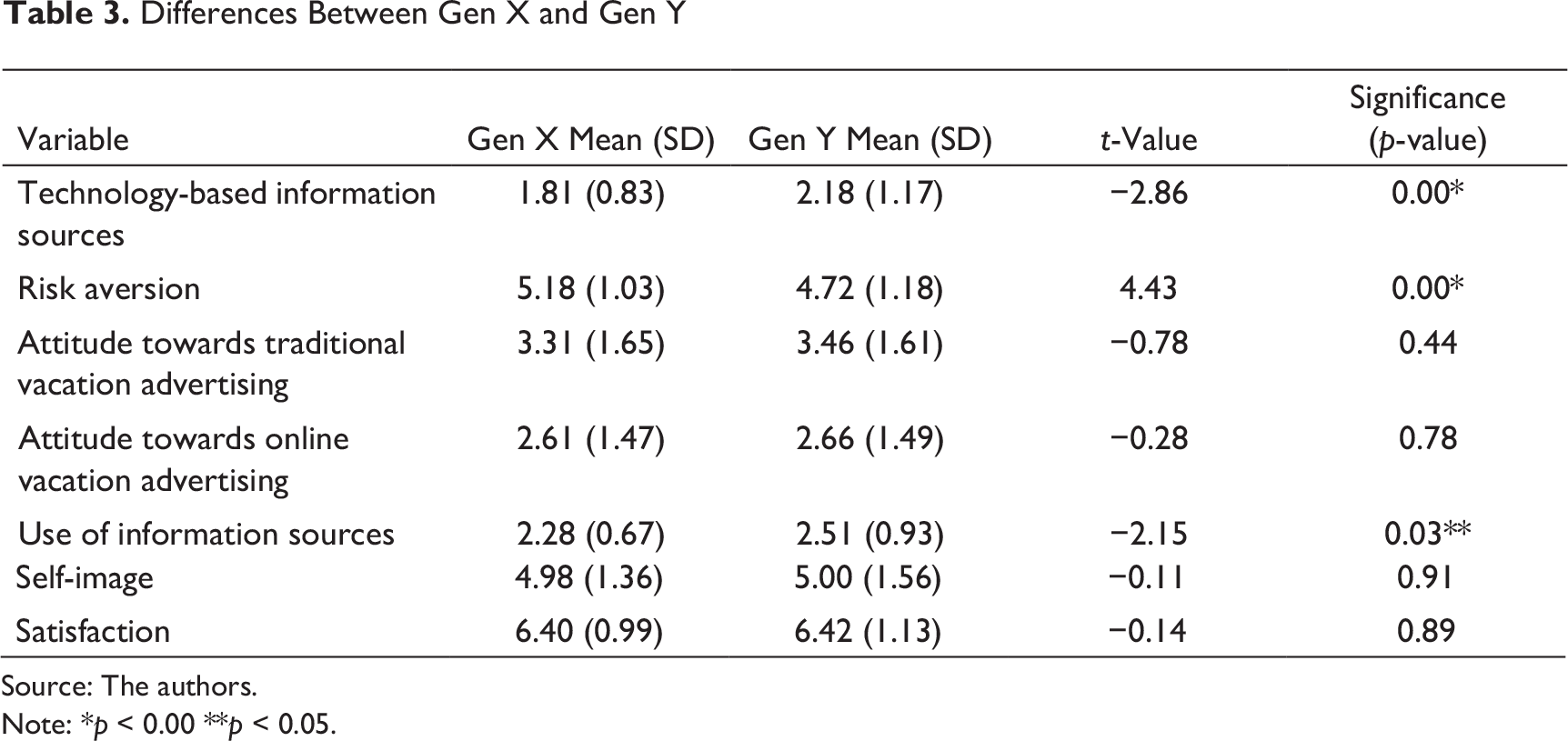
Independent-samples t-tests were used to test the propositions or proposals; the results are summarized in Table 3. The first proposition, that Gen-Y consumers use more technology-based information sources than Gen-X consumers for their vacation planning, was supported (p < 0.00). The second proposal, that Gen-X consumers are more risk averse than Gen-Y consumers, was also supported (p < 0.00). However, the third proposal, that Gen-X consumers have a higher attitude towards traditional vacation advertising than Gen-Y consumers and Gen-Y consumers have a higher attitude towards online vacation advertising than Gen-X consumers, was not supported. Furthermore, the fourth proposition, that the generational cohort that utilizes more information sources is more satisfied with the vacation destination, was not supported. It was significant (p < 0.05) that Gen Y used more information sources than Gen X; however, the satisfaction with the vacation destination was not significantly greater. For the fifth proposition, that the generational cohort with a higher self-image towards vacation was also more satisfied with the vacation, there were no significant differences between generational cohorts in terms of self-image.
Differences Between Gen X and Gen Y
Conclusion
The purpose of the research was to examine the differences between Gen X and Gen Y in terms of their information search behaviour in a tourism context. The proposed framework addresses the research gap by incorporating major factors, such as source credibility, satisfaction, risk aversion and self-concept or self-image. A series of propositions suggested by the previous literature is offered, which was tested with survey data. As a result, this study expands the discussion of tourist information search behaviour from a generational perspective. It offers a synthesis of contingency factors (e.g., risk aversion, self-concept, satisfaction) affecting vacation decision-making and information research. In addition, the research expands the literature on how Gen X and Gen Y use technology in tourist decision-making.
From a theoretical perspective, this research confirmed the notion that tourist profile and travel behaviour variables are critical to investigate the decision-making process (i.e., Ozdemir et al., 2012). As the findings indicated, Gen Y tends to use technology (non-traditional media) to search information for vacation planning. This finding is consistent with previous literature that Gen-Y consumers place an emphasis on online social interaction (Nusair et al., 2013). Additionally, our study found that Gen X is more risk averse than Gen Y. The tendency may be due to technology exposure. As Zhu et al. (2012) posited, online community engagement or frequent technology usage leads individuals to make riskier decisions.
Contrary to the previous literature (e.g., Carey et al., 2012) that traditional advertising (e.g., TV) is weakening in a digital world, our study revealed that Gen Y and Gen X share similar attitudes towards vacation advertising in both traditional and non-traditional media. Although Gen Y tends to use online media to search information, the attitude towards advertising is not affected by such behaviour. This finding may reflect the scepticism towards advertising claims (Obermiller & Spangenberg, 1998). We speculate that the usage of various media types does not have impact on trustworthiness in advertising.
Managerial Implications
‘As the tourism and hotel industry continue to prosper in the global economy, competition becomes fiercer. Possessing competitive advantages could be the key to success for those members’ (Roy, 2011, p. 51). From a practical perspective, the findings help practitioners develop a framework for segmentation, vacation package positioning and promotional strategies that relate to tourist information search behaviour. In order to target Gen Y, advertisers may put emphasis on online promotion with images and copies that attract this generation. For instance, online websites may show models below the age of 35 to draw more attention from this generation. The images may focus on more adventurous activities, such as surfing or sky diving, as Gen Y is more risk seeking than the previous generations. If the ads target Gen Y, marketers may place the ads in traditional media, such as TV or travel magazines, to increase ad exposure. However, marketers need to be aware that the exposure to various media/ads may not directly impact attitude towards advertising. The attitude towards ads may be determined by other factors, such as brand equity or travellers’ previous vacation experience. Marketers should further assess the content of the advertising and the media types, as well as other factors, such as service quality and brand awareness.
Limitations and Future Research
There are some limitations to this study that future research can address. For example, future research needs to determine if these results can be replicated with a national random sample. Also, as with most primary research studies, only a limited number of psychographic variables were assessed. Future studies could explore other variables that may also attempt to capture buyer behaviour during the information search stage of the tourism destination decision-making process. Given the growth and financial power of the Internet as well as the Gen-Y market, this topic is vital for marketers to continue to study and hopefully this article encourages additional research and discussion on these topics.
Moreover, additional research on tourist information search is needed in many areas. For example, future research could incorporate variables such as advertising scepticism. This variable may explain why there is no difference in terms of attitude towards vacation ads in various media between Gen X and Gen Y. In addition, research may focus upon the discrepancy between perception and attitude towards vacation advertising and post-vacation evaluation. This discrepancy may provide marketers further insights on how to improve customer loyalty programmes. Furthermore, tourist satisfaction should be taken into account when assessing the strengths and weaknesses of a tourist destination. Such an assessment can be useful to help form strategic and operational planning for the tourist industry.
In conclusion, this study contributes to the literature by showing the relationship between Gen X and Gen Y concerning several variables that have implications for the tourism organization and marketer. This study emphasizes that members of Gen Y are becoming an increasingly more viable segment for organizations and marketers. Those organizations and marketers that finely tune their strategies to address the needs of this emerging segment will increase their likelihood of success.
Footnotes
Acknowledgement
The authors are grateful to the anonymous referees of the journal for their extremely useful suggestions to improve the quality of the article. Usual disclaimers apply.
Declaration of Conflicting Interests
The authors declared no potential conflicts of interest with respect to the research, authorship and/or publication of this article.
Funding
The research was supported by a Rea and Lillian Steele Grant.