



Abstract
This article analyses the relationship among interest rate reforms, financial development and economic growth by using annual dataset for the period covering 1980–2014 for Bangladesh. The effect of interest rate reforms on financial development is examined using a financial deepening model, and the causal relationship between financial development and economic growth is examined, by including deposit interest rate as a third variable, thereby forming a simple trivariate causality model. The empirical results of cointegration and error correction models show that there is a positive effect of deposit rate of interest rate on financial depth in Bangladesh. Besides, multivariate Granger causality tests reveal that there is only one-way causality between financial depth and economic growth—the flow running from financial depth to economic growth. In addition, the study finds there is bidirectional causality between deposit rate of interest rate and economic growth, which is also confirmed by the pairwise Granger causality test. The inference of this study is that a deregulated deposit rate of interest will raise financial depth and eventually enhance the economic growth of Bangladesh. Therefore, the financial reforms should be directed towards accomplishing a more deregulated deposit rate of interest for progressive growth in the economy of Bangladesh.
Introduction
Many countries have made endeavours to liberalize their financial sectors by deregulating interest rates to find out its impact on economic growth after the revelation of the concept of financial liberalization. In particular, the dynamic linkage between interest rate reforms, financial development and economic growth in countries like Bangladesh has not been fully explored. Schumpeter (1912) asserted that the relationship between financial developments and economic growth should be unidirectional, running from financial development to economic growth.
It has been said by McKinnon (1973) and Shaw (1973) that liberalizing interest rate encourages savers to transform some of their savings from unproductive assets to financial assets, which will increase the supply of credit in the economy. Interest rate liberalization raises the cost of capital, increases the return on savings and allows more efficient banks to increase their role in intermediation; eventually, efficiency of investment is enhanced in the economy, which is corroborated by Feyzioğlu et al. (2009).
There is no reason to believe that the case of Bangladesh would be the same as that concluded by Odhiambo (2009a) for Zambia, that interest rate liberalization enhances financial deepening and hence economic growth.
Our study has examined the relationship between interest rate reforms, financial development and economic growth in Bangladesh. First, we have scrutinized the impact of interest rate reforms on financial development by regressing financial development on the deposit interest rate, gross domestic product (GDP) growth rate, expected inflation and the lagged value of financial depth. Then, causal relationship between financial development and economic growth has been analysed by including deposit interest rate as third variable, thereby forming a simple trivariate model. The inclusion of this third variable in the trivariate model is inferred from the theoretical link between deposit interest rate, financial development and economic growth. In addition to this, we have also employed the pairwise Granger causality model for the confirmation of the multivariate model.
Review of Literature
The existence and nature of the relationship between interest rate liberalization and economic growth has been an issue of intense contention both on the theoretical and empirical fronts. We have critically reviewed some of these important empirical studies to develop objectives in the context of Bangladesh and, further, to analyse them to draw some important conclusions and policy recommendations.
McKinnon (1973) and Shaw (1973) outlined that liberalizing interest rate encourages savers to transform some of their savings from unproductive assets to financial assets, which will increase the supply of credit in the economy. This will affect financial depth and savings, increase investment and thereby raise economic growth. This view is corroborated by Ndebbio (2004) and Abiad et al. (2004) in their studies.
According to Feyzioğlu et al. (2009), efficiency of investment is increased by liberalizing interest rate. This is because interest rate liberalization raises the cost of capital, increases the return on savings and enhances banks’ efficiency in intermediation.
McKinnon (1973) argued that, in developing countries, the supply of loanable funds is less than the demand for loanable funds, which deters investment activities. Due to the underdeveloped financial sectors in developing countries, the demand for loanable funds exceeds supply. In such a situation, increasing interest rate will encourage deposit (loanable) funds, eventually enriching financial depth, investment and economic growth.
Ngugi and Kabubo (1998) studied financial sector response to the liberalization process in Kenya by considering interest rate levels, spreads and determining factors as indicators. The study showed inefficiency in financial intermediation and underdeveloped financial markets and severe repression in the financial system, including negative real interest rates. They suggested introducing policy measures that will lead to significant positive effects of financial liberalization.
The arguments against the effects of interest rate liberalization through savings and investment on economic growth are due to the income effect of increased interest rate, that is, when interest rate increases, income will also rise and so consumption will increase. This increased consumption may counter the positive substitution effect found between savings and consumption. This has been found in the studies of Giovannini (1983), Arrieta (1988), Cho and Khatkhate (1990), Warman and Thirwall (1994) and Bandiera et al. (1999).
Likewise, Omole and Falokun (1999) suggested providing incentives to the industrial sector, such as reduction in tariffs, tax relief and provision of basic infrastructural facilities, because of the adverse effects of interest rate liberalization on industrial operations and economic growth.
Gupta (1984) and Mahambare and Balasubramanyam (2000) have asserted that increase in interest rate will only reallocate the available volume of savings to financial savings but total savings will remain unchanged, and that such reallocation does not affect the volume of total savings. This is because the increased interest rate attracts financial savings, thereby switching from savings to the more rewarding financial savings.
Japelli and Pagano (1989, 1994) and Hall (1978), found in their empirical work that by undertaking financial reforms to ease borrowing, savings are not stimulated rather consumption was increased even at high level of income. Especially, during the economic recession savings will not increase until income rises beyond the consumption level even by maintaining a high level if interest rate.
Fry (1980) conducted a study on seven Asian countries and asserted that if the real rate of interest is set below its equilibrium level by one percentage point, economic growth is put away by around half a percentage point.
Lanyi and Saracoglu (1983) observed that the association between interest rates and the rate of growth of real GDP is positive. World Bank (1989) also found a positive relationship between real interest rates and economic growth in 33 developing countries, for the period 1965–85.
Roubin and Sala-i-Martin (1992) scrutinized the link between financial liberalization and growth and finally asserted that economic growth tends to decrease due to financial oppression.
However, Gibson and Tsakalotos (1994) did not agree with the result of the Roubin and Sala-i-Martin (1992). The authors stated that in their study, Roubin and Sala-i-Martin (1992) added each measure of financial repression individually, which might have created omitted variable biasness.
Khatkhate (1988) discovered in a survey of 64 developing countries that countries having below-average and above-average real interest rates did not face a difference in average real GDP growth.
The relationship between real interest rates and economic growth might resemble an inverted U-curve: ‘Very low (and negative) real interest rates tend to cause financial dis-intermediation and hence tend to reduce growth’, as observed by De Gregorio and Guidotti (1995). Furthermore, very high real interest rates that do not reflect improved efficiency of investment, but rather a lack of credibility of economic policy or various kinds of country risk, are likely to result in a lower level of investment. (De Gregorio & Guidotti, 1995, p. 437).
The controversial relationship between interest rate liberalization, financial development and economic growth necessitates conducting an empirical study. There are at least four possibilities in the literature regarding the causal relationship between financial depth and economic growth.
First, there might be no causality between financial development and economic growth (Graff, 1999). This indicates that financial development has no impact on economic growth and economic growth also no longer affects financial development. Financial development and economic growth follow their own paths, that is, the real sector is governed by the real factors and financial sectors are regulated as per the history of financial institutions (see Graff, 1999).
Second, there might be a demand-following response, that is, economic growth might cause financial institutions to develop. According to this demand-following hypothesis, increased economic growth raises purchasing power persuaded the demand for financial services, financial assets, which fulfilled by the development of the financial sector.
The third possibility is a supply-leading response. Here, causality runs from financial development to economic development. A supply-leading response necessitates development in the financial institutions, which will lead to the development of the real sector of the economy. The empirical studies conducted in developing countries by Jung (1986), Spears (1992), King and Levine (1993), De Gregoria and Guidotti (1995), Odedokun (1996), Rajan and Zingale (1998), Ahmed and Ansari (1998), Darrat (1999), Ghali (1999), Xu (2000), Jalilian and Kirkpatrick (2002), Calderon and Lin (2003), Bhattacharya and Sivasubramanian (2003), Suleiman and Abu-Qaun (2005), and more recently, Habibullah and Eng (2006) contended that there is a supply-leading response. Agbetsiafa (2003), Waqabaca (2004) and Odhiambo (2007) explored that economic growth Granger causes financial development.
Various studies have also showed another possibility, that there might be a bidirectional causality between financial development and economic growth, that is, both financial development and economic growth Granger cause each other. This has been outlined in the studies of Wood (1993), Demetriades and Hussein (1996), Akinboade (1998), Luintel and Khan (1999), Al-Yousif (2002) and Odhiambo (2005), among others. FitzGerald (2006) observed that economic growth ensues financial development in reply to supply follow hypothesis.
The study of Odhiambo (2008) explored that financial development and econmic growth nexus may vary from one country to another country and over time as well as influenced by the policy measure of financial development used.
Best et al. (2017) analysed the question of whether bank liquid reserves to bank assets ratio and domestic credit to private sector as a percentage of GDP strengthen financial deepening on the real sector and hence catalyse economic growth in Jamaica. The empirical result suggests a ‘supplying-leading’ relationship in both the short and long run.
Kyophilavong et al. (2016) had tested two hypotheses, ‘supply-leading’ hypothesis and ‘demand-following’ hypothesis, using time series data from Laos. They observed the presence of feedback effect, that is, financial development promoting economic growth and, as a result, economic growth leading to financial development.
Khatun (2016) examined the relationship between trade in financial services (TIFS) and economic growth (real gross domestic product [RGDP]) in BRICS economies, namely, Brazil, Russia, India, China and South Africa, for the period 1990–2012. She found both short-run and long-run unidirectional causalities running from TIFS to RGDP.
Objectives
This article has examined the relationship between interest rate reforms, financial development and economic growth in Bangladesh.
The specific objectives are: (a) to scrutinize the impact of interest rate reforms on financial development by regressing financial development on the deposit interest rate, GDP growth rate, expected inflation and the lagged value of financial depth; (b) to determine causal relationship between financial development and economic growth, analysed by including deposit interest rate as a third variable, thereby forming a simple trivariate model. The inclusion of this third variable in the trivariate model is inferred from the theoretical link between deposit interest rate financial development and economic growth; and (c) to employ the pairwise Granger causality model for the confirmation of the multivariate model.
Rationale of the Studies
This article presents a framework of analysis for examining the impact of changes in interest rate policy and financial reforms on economic growth. This paper set out with an analysis of the rich literature on the finance–growth nexus. This provided vital insights into the modelling of the relationship between interest rate liberalization, financial deepening and economic growth in Bangladesh. The underpinning premise of this study is that policy directed at interest rate liberalization is relevant for financial depth, and financial depth in turn affects economic growth, through its effects on investment.
Methodology
Data Source and Definition of Variables
Data Source
Annual time series data, which covers the 1980–2014 period, are utilized in this study. The data used in the study are obtained from different sources, including various issues of the Bangladesh Bank annual reports and World Bank statistical yearbooks.
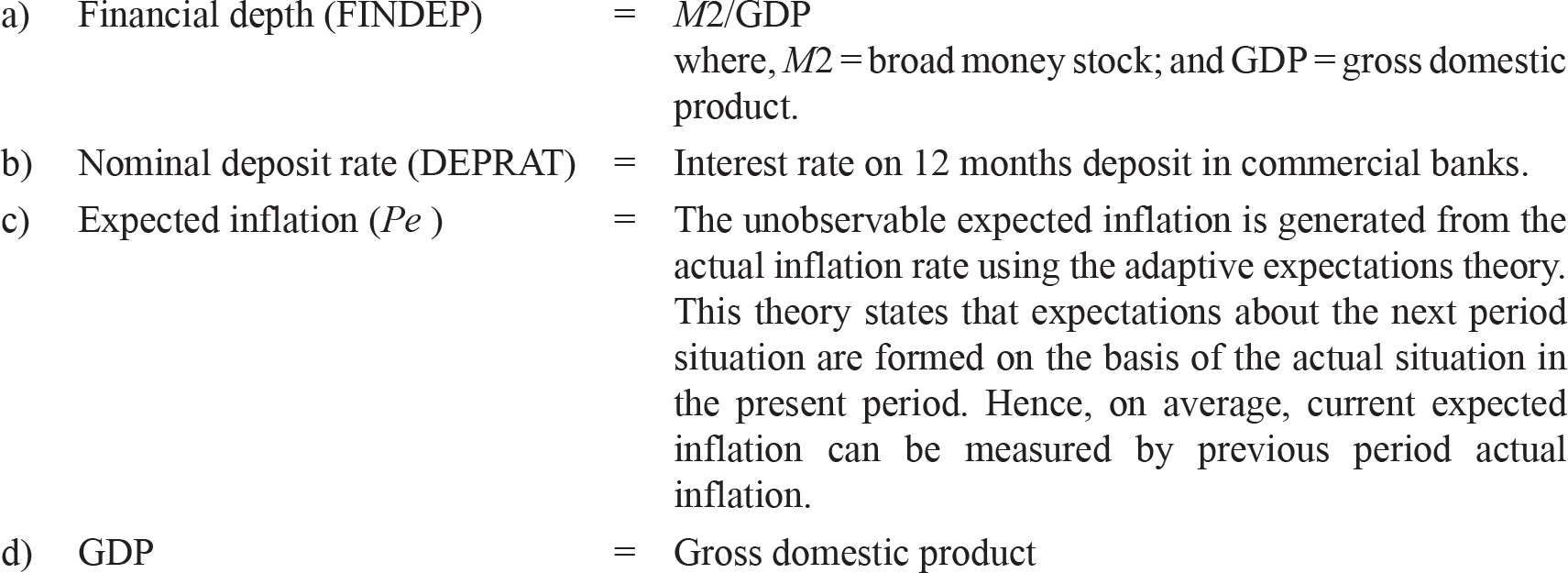
Definition of Variables
Empirical Model
Financial Deepening Model
In this section, following Odhiambo (2009a), we examined the relationship between interest rate liberalization and financial deepening by regressing the financial depth variable on gross domestic product, deposit rate, expected inflation and the lagged value of financial depth. The research question in this case is whether real interest rates positively or negatively affect financial depth. The model can be expressed as follows:

where FINDEP is the financial depth variable proxied by M2/GDP, GDP is the gross domestic product representing economic growth, DEPRAT is the nominal deposit rate, Pe is expected inflation and FINDEPt-1 is financial depth lagged once.
The inclusion of deposit rate is expected to capture the impact of interest rate liberalization on financial deepening. The coefficient of deposit rate in the financial deepening model is, therefore, expected to be positive and statistically significant. A positive relationship between real interest rate and financial depth will inevitably corroborate the positive role of interest rate liberalization on economic growth. The inclusion of inflation rate is meant to capture the impact of inflation on the various components of money. There has been an argument that inflation adversely affects the holding of all classes of financial assets and not just a narrow class. In addition, it has been argued that inflation will tend to encourage the holding of currency and discourage the holding of quasi-money (see also Ikhide, 1992; Odhiambo, 2005). According to English (1999), a higher inflation rate encourages households to substitute purchased transactions services for money balances, thereby boosting the financial sector. The coefficient of inflation in this study is, therefore, expected to be positive and statistically significant. The inclusion of real GDP is supported by the life cycle hypothesis, and the coefficient of the variable is expected to be positive and statistically significant.
Granger Causality Model
In this study, a multivariate model of causality has been used to examine the causal relationship between financial development, interest rate and economic growth in Bangladesh. A trivariate causality test has been used in this study because the causality tests based on a bivariate framework have been found to be very unreliable. The trivariate Granger Causality test based on the error correction model is expressed as follows:



where ECTt-1 is the error correction term lagged one period, GDP is the gross domestic product, FINDEP is financial depth variable (M2/GDP), DEPRAT is the nominal deposit rate (a third important variable affecting the finance–growth relationship) and μ, ν and υ are mutually uncorrelated white noise residuals.
It is worth noting that in the error correction-based causality test, the short-run causal impact is measured through the F-statistics and the significance of the independent variables, while the long-run causal impact is measured through the error correction term (see also Odhiambo, 2009b).
Analysis and Discussion
Stationarity Test
To examine the order of integration of the variables used in the study, we have employed Augmenten Dickey–Fuller (ADF) and Phillips and Perron (PP) tests.
The rationale of choosing PP test is that it is non-parametric, that is, it does not require selecting the level of serial correlation as in ADF. The Phillips–Perron test makes a non-parametriccorrectionto the t-test statistic. The test is robust with respect tounspecified autocorrelation and heteroscedasticity in the disturbance process of the test equation. PP works well with large scale data. Further, the ADF test works well when there is no sensitivity to structural breaks in the data series. The sample data used in this study have no structural breaks.
ADF Stationarity Test at First Difference
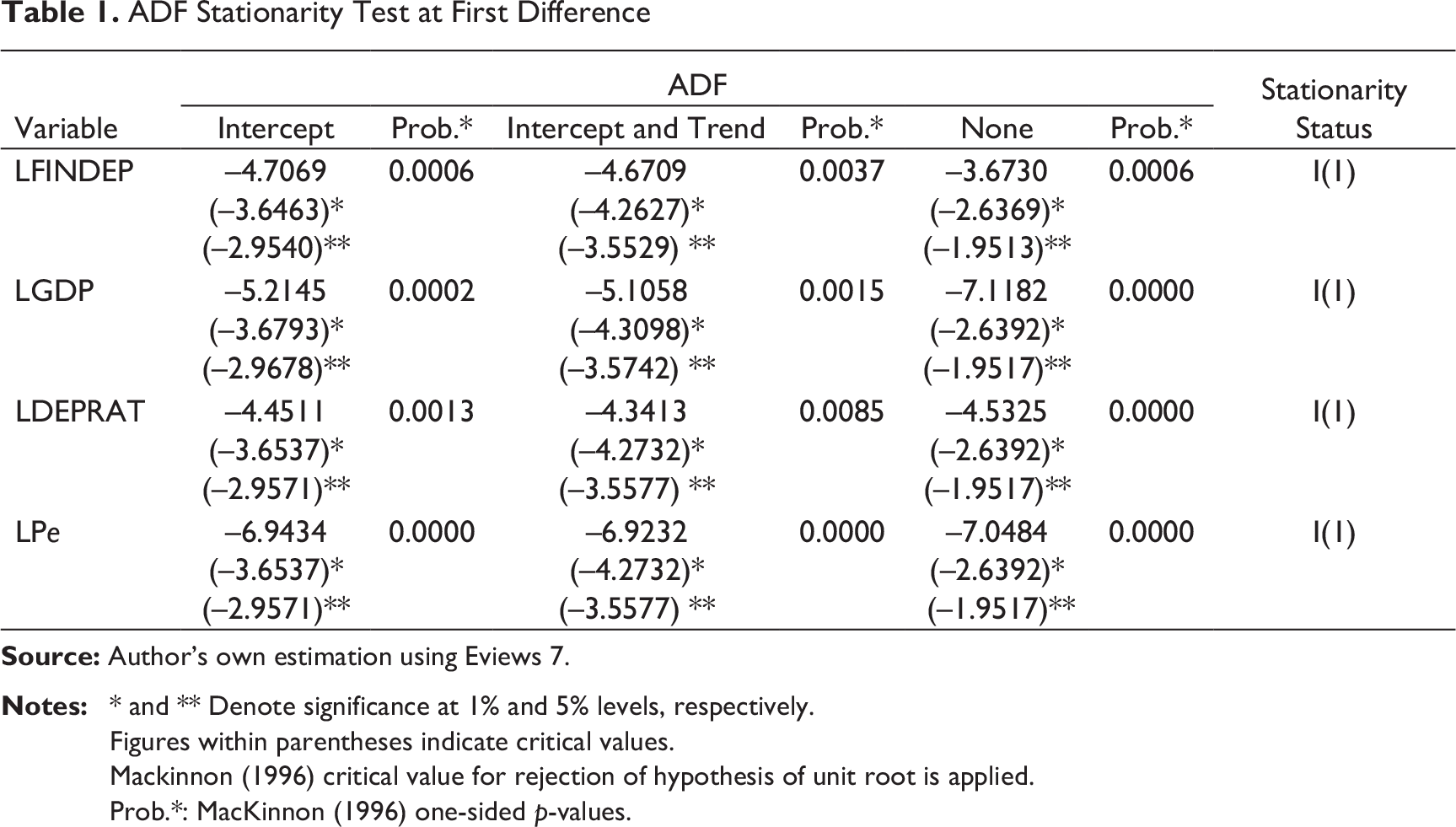
Figures within parentheses indicate critical values.
Mackinnon (1996) critical value for rejection of hypothesis of unit root is applied.
Prob.*: MacKinnon (1996) one-sided p-values.
PP Stationarity Test at First Difference
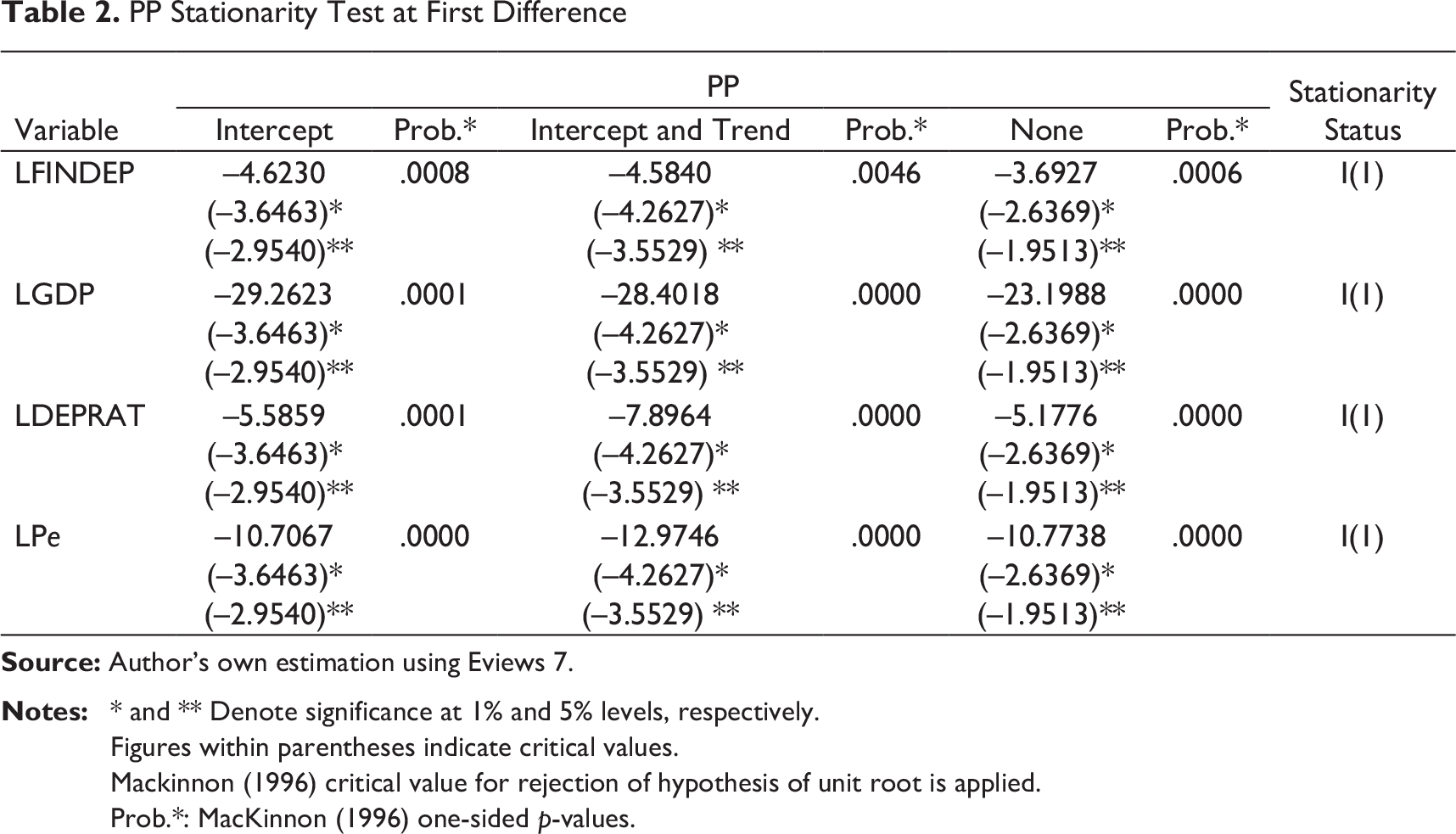
Figures within parentheses indicate critical values.
Mackinnon (1996) critical value for rejection of hypothesis of unit root is applied.
Prob.*: MacKinnon (1996) one-sided p-values.
The variables used in this study are non-stationary at level whose stationarity test result at level not presented here. The results given in Table 1 and in Table 2 confirm that after taking the first difference, all the variables become stationary. It is, therefore, worth concluding that the variables are integrated of order one.
Empirical Analysis
Cointegration Test Result and Analysis
Unrestricted Cointegration Rank Test (Trace)

* Denotes rejection of the hypothesis at the 0.05 level; **MacKinnon–Haug–Michelis (1999) p-values.
q Denote to the number of cointegrating equation.
The lag structure of VAR is determined according to final prediction error (FPE) criterion, the Akaike information criterion (AIC), Schwartz information criterion (SC) and Hannan–Quinn information criterion (HQ).
Unrestricted Cointegration Rank Test (Maximum Eigenvalue)

* denotes rejection of the hypothesis at the 0.05 level **MacKinnon-Haug-Michelis (1999) p-values.
q Denotes to the number of cointegrating equation.
The lag structure of VAR is determined according to the FPE criterion, the AIC, SC and HQ.
The trace tests statistics results given in Table 3 and the results of maximum eigenvalue tests statistics presented in Table 4 indicate that there is one cointegrating association among the variables included in both the financial deepening model and the Granger causality model. The trace and maximum eigenvalue tests statistics reject the null hypothesis of q = 0 in favour of the general alternative hypotheses of q ≥ 1 and q = 1. However, the null hypotheses of q ≤ 1, q ≤ 2 and q ≤ 3 could not be rejected by the two maximum likelihood tests. Hence, we have concluded that there is at least one cointegrating relation in both the financial deepening model and the Granger causality model.
Financial Deepening Model
I have estimated the financial deepening model, that is, the preferred model, and the results of this preferred model are presented in Table 5. It may be difficult to reach a decision from the results of the over-parameterized error correction model (not presented here), and many variables are insignificant.
Results of Financial Deepening Model

Analysis of Causality Based on Vector Error Correction Model
The cointegration test does not specify the direction of causality between variables. It stipulates the existence of causality at least in one direction. The direction of causality can be found out by employing the error correction model (ECM) derived from the long-run cointegrating vectors. Furthermore, the ECM facilitates us to make a distinction between the short-run and long-run causality. The F-statistics signify the short-run causal effects, and the ‘long-run’ causal relationship is signified through the significance of the t-test of the lagged error correction term.
Causality Test among ∆(LGDP), ∆(LFINDEP) and ∆(LDEPRAT)

The numbers in parentheses represent t-statistics.
Pairwise Granger Causality Tests Results
Pairwise Granger Causality
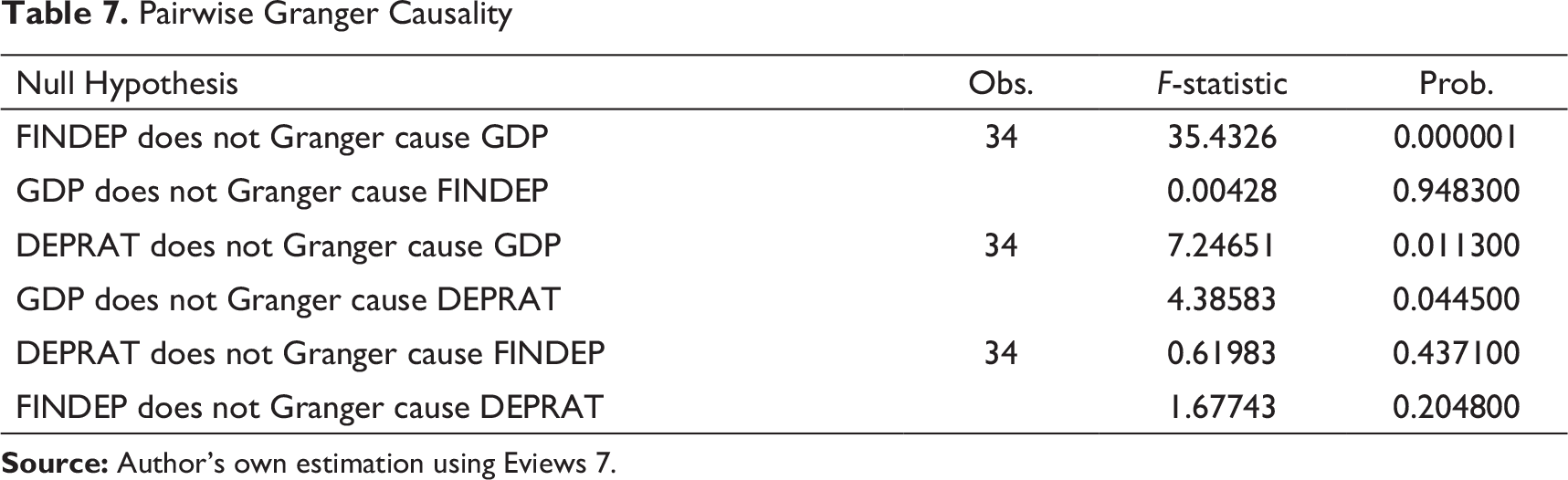
The information reported in Table 7 shows that there is unidirectional causality running from financial depth to economic growth in Bangladesh. Furthermore, there is bidirectional causality between deposit rate of interest rate and economic growth in Bangladesh. Notably, there is no Granger causality between deposit rate and financial depth. Finally, we see that our results of the pairwise Granger causality test do not markedly deviate from the findings in the previous section.
Conclusion
An endeavour has been made in this study to analyse the effects of interest rate reforms on economic growth in Bangladesh through their impact on financial depth. A comprehensive analysis of the rich literature on financial development and economic growth gives an understanding to model out the relationship between interest rate deregulation, financial development and economic growth in Bangladesh. The empirical results of this study show that there is a positive effect of deposit rate of interest rate on financial depth. Furthermore, multivariate Granger causality tests show that there is only a one-way causality between financial depth and economic growth—the flow running from financial depth to economic growth. Finally, there is bidirectional causality between deposit rate of interest rate and economic growth. Hence, the inference of this study is that a deregulated deposit rate of interest will increase financial depth and eventually enhance the economic growth of Bangladesh. Therefore, the financial reforms should be directed towards accomplishing a more deregulated deposit rate of interest.
Managerial Implications
The first significant policy implication arising out of the empirical findings in the article is that policymakers should allow the market to determine the interest rates first, and then put in place relevant policies to guard the determined interest rates by setting margins for it. Financial liberalization policies should have been supportive to realize its full potential effects on economic growth. These can be done by improvements in the financial deepening process and by the removal of the bottlenecks in the financial sectors of Bangladesh’s economy. A departure from the rigidly fixed deposit rate of interest will enhance financial depth and improve the country’s rate of economic growth.
Limitations and Future Research
The findings of this article are confined to interest rate deregulation, financial development and economic growth. However, factors other than deregulation of interest rate and financial depth affect economic growth. These factors such as market imperfection, asymmetric information, mismatch of surplus and deficit spenders, lack of corporate governance, politicization of and government interference in the financial markets, etc. are not elaborated on in this article. Due to this limitation, further and detailed investigations are necessary to confirm and provide the requisite policy implication.
One other limitation is that the size of time series data used in the empirical analysis is not as large as necessary. Further research work would have to be carried out in the future when enough data are available to ascertain the true nexus between interest rate deregulation, financial development and economic growth.
Footnotes
Acknowledgement
I am grateful to the anonymous referees of the journal for their extremely useful suggestions to improve the quality of the aticle. Usual disclaimers apply.
Declaration of Conflicting Interests
The author declared no potential conflicts of interest with respect to the research, authorship and/or publication of this article.
Funding
The author received no financial support for the research, authorship and/or publication of this article.
