



Abstract
The notion of multi-criteria decision-making is regarded as the process of finding the best possible alternative or course of action by decision-makers. Often, it entails handling vague, incomplete and inconsistent information. The intuitionistic fuzzy set (IFS) has been proven more effective than a fuzzy set in handling vagueness and uncertainty. The aim of the article is to incorporate the effectiveness of the IFS with the powerfulness of the analytic hierarchy process (AHP) and develop intuitionistic fuzzy AHP (IF-AHP) to cope with the decision problems involving imprecise and hesitant information. In this article, we develop a distance-based novel priority method, which derives unambiguous non-fuzzy priorities of the alternatives from intuitionistic fuzzy preference relations (IFPRs). The proposed priority method is simple in computation yet effective in results. To validate the method, we applied it to the adapted supplier selection problem. This article also presents a comparison of the proposed method with classic and fuzzy AHP using Monte-Carlo simulation approach.
Keywords
Introduction
The analytic hierarchy process (AHP) is an extremely popular and effective multi-criteria decision-making (MCDM) method originally developed by Saaty (1988). It is a management tool widely used in operations research and managerial science to deal with unstructured and complex problems using a multilevel hierarchic structure of objectives, criteria, sub-criteria and alternatives and pairwise comparisons. AHP provides a fundamental scale of the relative importance that functions as dominance units to express judgements in the form of pairwise comparison. Construction of pairwise comparison matrix, called preference relation, of the criteria with respect to the objective of the decision problems and then pairwise comparison matrices of alternatives with respect to each criterion are the elementary procedure of AHP. After constructing pairwise comparison matrices, ratio scale of priorities is derived from each preference relation. In the final step, all ratio scales are synthesized to rank alternatives. We can summarize the procedure of AHP in three principles: decomposition, pairwise judgement and synthesis of priorities (Saaty, 2008).
AHP has been applied to numerous decision-making problems in the area of operation strategy, project management, resource scheduling, wastewater treatment and supply chain management (Ouyang & Guo, 2016; Subramanian & Ramanathan, 2012). However, in real life scenario, decision-makers might be incapable to provide precise judgements; in this case, a part of the information might be vague or incomplete. Classic AHP is incapable to cope with these problems, and this is the reason it is often criticized in spite of its simplicity and powerfulness. It also has been criticized for its sensitivity to rank-reversal caused by small changes in preference information (Wang & Luo, 2009). In order to overcome these issues, the fuzzy set theory was incorporated to extend classic AHP to the fuzzy AHP (FAHP) (Zadeh, 1965). Many researchers considered fuzzy-valued pairwise comparison data. Saaty and Tran provided some examples to exhibit the invalidity of this procedure to fuzzify the AHP and concluded: ‘One should never use fuzzy arithmetic on AHP judgement matrices’ (Saaty & Tran, 2007). Evidently, when the pairwise comparisons provided by a decision-maker are crisp, there is no significant advantage to fuzzify them without valid justification. Nonetheless, if pairwise comparisons are fuzzy due to inadequate domain knowledge of decision-maker, FAHP needs to be applied where each pairwise comparison is represented as a fuzzy number, described by a membership function.
There are many approaches of FAHP proposed by various researchers. van Laarhoven and Pedrycz (1983) were the first, who simply extended Saaty’s AHP with triangular fuzzy numbers and applied logarithmic least squares method (LLSM) to derive fuzzy weights. After that, Buckley (1985) extended the AHP with trapezoidal fuzzy numbers and obtained the fuzzy weights using the geometric mean method. Later, Chang (1996) proposed an Extend Analysis Method (EAM), which is relatively easier than other FAHP approaches and hence, has been applied to many fields as a representation of FAHP. Chang applied a row mean method on triangular fuzzy numbers to derive priorities from fuzzy preference relations. However, Wang (2008) demonstrated that priorities derived by EAM do not always represent the true relative importance of alternatives.
We can conclude that central to the FAHP is fuzzy numbers (triangular and trapezoidal) used for pairwise comparisons. It also shows some shortcomings due to the inherent limitations of the fuzzy set itself. Fuzzy sets can only express the degree of membership of an element to a particular fuzzy set using a membership function, which is only a single-valued function. Hence, it cannot be used to express the support and objection evidence at the same time. However, in many practical situations, decision-makers do not possess precise or adequate knowledge of the problem domain due to the complexity of the factors involved in the decision problems and therefore they usually have some hesitancy in providing their verdicts for pairwise judgement. It can be inferred that the human cognitive process exhibits the characteristics of affirmation, negation and abstention.
To overcome this shortcoming of FAHP, numerous advanced fuzzy extensions of the AHP has been proposed in recent years. Sarý, Öztayşi, and Kahraman (2013) extended AHP using type-2 fuzzy sets and applied to warehouse location selection problem. Since applying ordinary type-2 fuzzy sets to a non-trivial decision problem requires immense computational burdensome operations, applications of type-2 AHP are not widespread. Owing to the relatively reduced computational requirement, interval type-2 fuzzy sets are the most prevalent variant of type-2 fuzzy sets. Chiao (2014) proposed a type-2 fuzzy extension of AHP and applied to the New Product Development (NPD) project screening problem. However, the author did not take inconsistencies of the preference relations into account. Another extension of AHP with type-2 fuzzy sets are proposed by Kahraman, Öztayşi, Uçal Sari, and Turanoǧlu (2014). The authors extended Buckley’s FAHP with interval type-2 fuzzy sets and applied to the supplier selection problem. They also checked preference relations for their inconsistencies. Other advanced fuzzy concepts employed by researchers to extend the AHP method are hesitant fuzzy sets (Torra & Narukawa, 2009), Pythagorean fuzzy sets (Yager, 2013) and intuitionistic fuzzy sets (IFS) (Atanassov, 1986). Despite substantial difference in their structure and operations, the three aforementioned advanced fuzzy sets are capable to handle uncertainty and hesitancy involved in the decision-makers’ opinions. Therefore, few studies are made to combine the AHP with these fuzzy concepts to prevail over shortcomings of the ordinary fuzzy sets. Öztayşi, Onar, Boltürk, and Kahraman (2015) extend the AHP method using hesitant fuzzy sets and applied to the supplier selection problem. Mohd and Abdullah (2017) successfully extended the AHP in the Pythagorean fuzzy context. The authors used Pythagorean fuzzy numbers (PFNs) as linguistic variables to garner experts’ opinions for the evaluation problem. Xu and Liao (2013) combined AHP with IFS and applied to the supplier selection problem. The proposed method collects experts’ judgements in the form of IFS and transforms them into interval-valued fuzzy sets to derive priorities. The priorities are obtained in the form of IFS, which produce different results while applying different rank functions on them. This issue makes the reliability of the method debatable.
However, the simplicity, less computational requirements and capability to deal with hesitancy in the judgements of the decision-makers are the factors that motivated us to extend AHP with IFS. Besides, the proposed approach derives priorities in crisp values and hence, no rank function is required to present the final results. Considering that the FAHP, where the pair-wise comparisons are usually represented by fuzzy numbers, may not be able to cope with much real-time decision-making situations involving imprecise and inadequate information; it is imperative to study AHP in the context of IFSs.
The aim of this article is to highlight the need for applying the concept of IFSs in multi-criteria decision-making (MCDM) and develop a new approach, intuitionistic fuzzy AHP (IF-AHP), to handle a wide range of decision problems involving uncertain and inconsistent information. To do so, the rest of the article is constructed as follows: the second section is dedicated to fundamental concepts of IFS and intuitionistic fuzzy preference relations (IFPRs). The proposed priority method is described in the third section. The step by step procedure of the proposed IF-AHP is presented in the fourth section. A case study of supplier selection problem is presented to validate the proposed method in the fifth section. In the sixth section, we present a comparative analysis of AHP, fuzzy AHP and the proposed IF-AHP. We summarize the article and discuss the future aspect of the proposed method in the last section.
Intuitionistic Fuzzy Set Concepts
Zadeh (1965) introduced the concept of fuzzy sets in 1965 to handle uncertain or inadequate information. A fuzzy set is an extension of the classical or crisp set. In the crisp sets, elements can be assigned with only two values; 0 for ‘not a member’ and 1 for ‘is a member’. On the other hand, in the fuzzy set concept, there is a mapping function called membership function, which assigns a membership grade to each element of universe of discourse X. Therefore, an element x ∈ X can have, say ‘0.7’ membership grade for some specific fuzzy set A; it directly implies that x is partially (70%) a member of set A and partially a non-member (30%) to set A. In fuzzy sets, non-membership grade is complement (1.0 – membership grade) of membership grade.

which is characterized by a membership function μA: X " [0,1]. Symbol μA(x) denotes membership grade or degree of membership of the element x to the set A.
Although the fuzzy set theory has enjoyed successful achievements in both theoretical advancement and practical applications, it has some limitations too. The fuzzy set concept is not able to deal with hesitancy or abstention of decision-maker while in real-life decision problems, it has been observed that decision-makers are not very sure about their verdicts. In order to deal with such sort of real-life situations and model decision-maker’s cognitive process more comprehensively, Atanassov (1986) extended Zadeh’s fuzzy set to IFS, which is a generalization of fuzzy set. Intuitionistic fuzzy sets incorporate a degree of hesitancy or indeterminacy along with a degree of membership. IFSs are capable to express decision-maker’s judgement in a more realistic way. The IFS has been applied to many different fields since its introduction, some applications are decision-making (Dong, Yang, & Wan, 2015; Mousavi, Vahdani, & Sadigh Behzadi, 2016; Xia, Xu, & Zhu, 2013), pattern recognition (Vlachos & Sergiadis, 2007), fuzzy reasoning (Jiang, Tang, Wang, & Tang, 2009) and fuzzy cognitive maps (Papageorgiou & Iakovidis, 2012).

where the function μA: X " [0,1] indicates the degree of membership of the elements x in the IFS A and vA: X " [0,1] indicates the non-membership of the elements x in the IFS A, and satisfies the condition,

In addition, πA(x) = 1 – μA(x) – vA(x), for all x ∈ X. Where πA(x) is called the degree of hesitancy or indeterminacy. When πA(x) = 0, IFS is reduced to normal fuzzy set. Atanassov also introduced some fundamental operations on an IFS. The resultant set is also an IFS.
Szmidt and Kacprzyk (2000) justified that πA(x) is the hesitancy degree difference between ordinary fuzzy sets and IFS, and should not be avoided when calculating the distance between two IFS.

Let α = (μα, vα, πα) be an Intuitionistic Fuzzy Value (IFV). In order to rank IFVs, Xu (2007) introduced the score function S(α) as:

Clearly, S(α) ∈ [–1,1]. The larger the score S(α), the greater the intuitionistic fuzzy value α. In some situations, there may be two different IFVs have the exact same score, to solve this issue (Xu, 2007) introduced the accuracy function H(α), which is defined as:

Utilizing score and accuracy functions defined above, Xu (2007) introduced an algorithm to rank IFVs If S(αi) < S(αj), then αi < αj, which implies αj is greater than αi. If S(αi) = S(αj), then
If H(αi) < H(αj), then αi < αj; If H(αi) = H(αj), then αi = αj.
Besides Xu’s method, Szmidt and Kacprzyk (2009) also proposed a method to rank IFVs, which is defined by the mathematical form:

The smaller the value of p(α), the greater the IFV α in the sense of the amount of positive information included and reliability of the information.
In an IFPR, all the pairwise comparisons are represented by IFVs. Due to the efficiency of IFVs in describing fuzziness and uncertainty, the IFPR is more powerful in communicating comprehensive preference information of a decision-maker than the multiplicative preference relation and the fuzzy preference relation. Xu (2007) introduced the notion of IFPR.

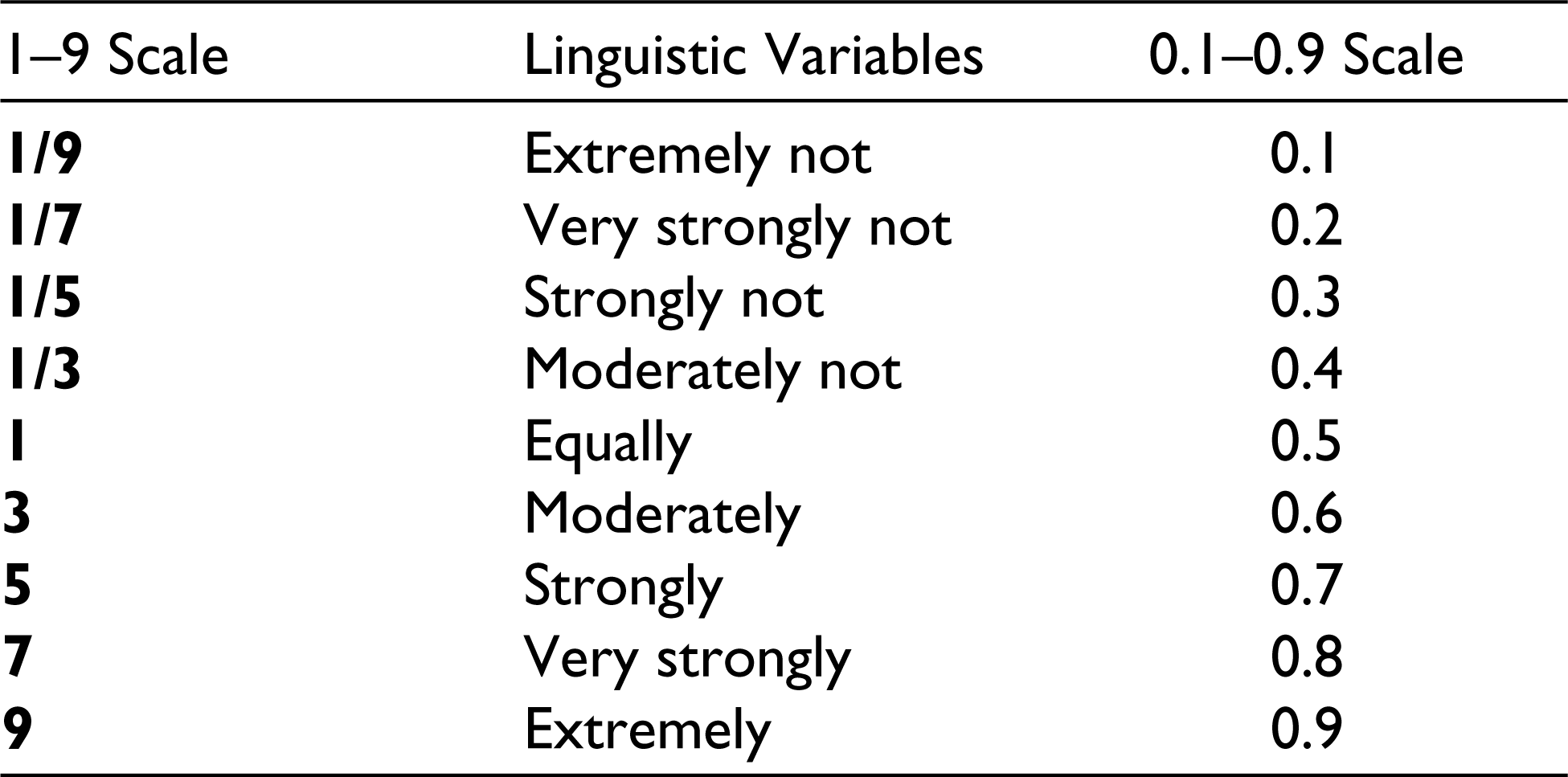
In addition, vji = μij, μii = vii = 0.5. Analogous to Saaty’s fundamental scale, a scale is presented in Table 1, which represents the intensities of support and objection of preferences.
Analogy of 0.1–09 Scale with Saaty’s 1–9 Scale
Based on Definition 3, we can introduce operations to aggregate preference relation values:
While working with preference relations, consistency is one of the key research issues as an inconsistent preference relation may lead to untruthful result (Liao, Xu, & Xia, 2014). Therefore, Saaty (1980) incorporated a consistency check with the AHP process as one of its key steps. Since the AHP method is based on operations on multiplicative preference relations, in order to maintain consistency, it is required to ensure that the actual preference relations, obtained from decision-makers, meet the condition aij = aik × akj for each value of i, j and k. To check the consistency of preference relation, Saaty (1988) provided a consistency index CI and a consistency ratio CR to measure the degree of consistency for a multiplicative preference relation, whose mathematical forms are given in Equations (9) and (10):

and,

Although it is practically impossible to achieve complete consistency (CR = 0) every time in the process of decision-making. Saaty took account of this issue and pointed out that if consistency ratio CR of a multiplicative preference relation is less than 0.1, then the multiplicative preference relation is considered as acceptable; otherwise, the multiplicative preference relation is called unacceptable and has to be returned to the decision-makers for re-evaluation until it becomes acceptable. Saaty’s method is powerful in checking the consistency, but cannot improve or repair the inconsistent preference relation automatically. It just has to return the inconsistent preference related to the decision-maker for re-evaluation. Clearly, the interactive process is time-consuming, and sometimes, the decision-maker does not want to participate in this repairing process because of a lack of interest to continue with the tedious task of re-evaluation.
To overcome this issue, Xu and Liao (2013) developed an algorithm, which facilitates automatic repairing of inconsistent IFPRs. Through the algorithm, we can improve the consistency of any intuitionistic preference relation automatically without losing much information given by decision-makers. Comparing this algorithm by asking decision-makers for the alternation in his judgement until the preference relation becomes consistent (interactive method); this algorithm can save time and energy of decision-makers. This procedure offers numerous advantages to the decision-maker to reach a quick decision.
Priority Derivation Method
A preference relation does not directly give priority weights. According to Saaty (2008), priority weights are represented as an n-dimensional vector ω = (ω1, ω2, …, ωn) derived from the multiplicative preference relation, and ωi is the weight which precisely represents the relative superiority of the alternative xi among the alternatives in the set of alternative X. Researchers have proposed numerous methods for deriving priority vector from preference relation. In their paper, Bernasconi, Choirat, and Seri (2010) have carried out an extensive investigation on some proposed priority methods for AHP.
In the following section, we propose a distance-based priority method, adapted from grey relational analysis (GRA) (Ju-Long, 1982; Kuo, Yang, & Huang, 2008). The primary advantage of the proposed method over other methods is that instead of fuzzy priority weights, it derives crisp priorities from IFPR, which is more explicit, simple to cope up with and practically applicable. Also, the GRA method produces more reliable solutions when they are compared with the results from the other existing methods. In addition, it presents a better distinction among the alternatives.
The proposed priority method is a threefold procedure: reference preference relation definition, optimality coefficient calculation and priority derivation from the optimality coefficient matrix.
The reference preference relation can be seen as n-dimensional vectors, each vector represents the ideal alternative. Since the reference preference relation is constructed for the mere comparison purpose, all the rows of the reference preference relation carry the optimum intuitionistic fuzzy values determined by to their sequence in the reference preference relation, which is practically infeasible and hence, the reference preference relation does not hold additive or multiplicative consistency constraints.
In the second step, the optimality coefficients are calculated. The optimality coefficients represent the proximity of each element of IFPRs, provided by the decision-maker, to the corresponding element of the reference preference relation. The values of the optimality coefficients lie between zero and one. One represents complete similarity while zero represents complete dissimilarity.
In the final step, the modified row-sum method is applied to the optimality coefficient matrix. The values of the diagonal elements are subtracted from the formula because the diagonal elements always hold the value one, the inclusion of those values can produce misleading results.
In the following, the priority method is given in the form of an algorithm:
Algorithm (I)
Let B = (bij)n×n be an intuitionistic preference relation of alternatives xi ∈ X provided by the decision-maker,
where bij = (μij, vij).



Where ξij is the optimality coefficient between bij and rij, and δij = d(rij,bij), δmin = min{δij,i,j ∈ M}, δmax = max{δij,i,j ∈ M}.d(rij,bij) can be calculated using Equation (4). Symbol ρ denotes the distinguishing coefficient, smaller the ρ, greater will be the distribution range. Since δii = δjj = 0, for all i,j = 1,2,…,n, we can omit the term δmin from the Equation (13) and rewrite as:


The row elements of the optimality coefficient matrix, obtained from Equation (14), represent the similarity of the corresponding alternative with reference alternative. Aggregation of the row elements can yield the overall similarity of alternatives with the optimal alternative. This step accumulates the similarity of the alternative xi with reference alternative xR by adding up the row elements of the optimality coefficient matrix excluding diagonal elements. In order to derive priorities of the alternative, each row-sum is normalized by dividing with the sum of all elements of the matrix (matrix sum) excluding diagonal elements. Since the diagonal elements of IFPRs are always (0.5, 0.5), the corresponding elements of the optimality coefficient matrix are always one. These elements just reflect the preference of the alternatives with respect to themselves. Thus, the diagonal elements are excluded from the priority calculations. To validate the notion, we compare the priority ratio obtained from our method with the priority ratios obtained from other widely used methods such as Eigenvector method, sum-of-squares method and row-sum method. We use the following IFPR A to compare the results of our priority deriving method (Equation [15]) with the results obtained from other prominent methods. We also present the optimality coefficient matrix ξ

We applied aforementioned methods of deriving ratio to the optimality coefficient matrix ξA. All methods yielded different priority vectors. In Table 2, we present the results obtained from the ratio deriving methods.
Priority Vectors with Respect to Different Methods

The results presented in Table 2 shows that all methods assign the alternatives same rank for a single IFPR. However, the priority ratios derived by listed methods show significant disagreement and it may cause a significant deviation in ranks while applied to a complete hierarchy of IFPRs representing a decision problem.
From the IFPR A, it can be observed that the alternative x1 is extremely preferred over the other two alternatives and the alternative x2 is strongly preferred over x3. It can also be observed that the results, produced by our methods, reflect that the preferences among alternatives (0.627, 0.254, 0.118) are consistent with the intuition of the decision-maker.
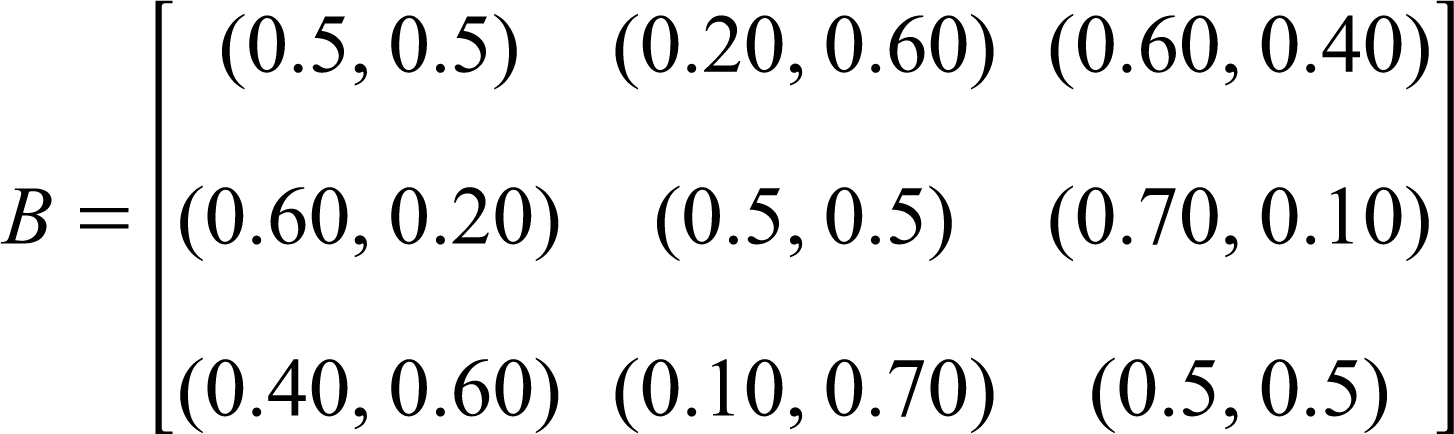
First, we define a reference preference relation 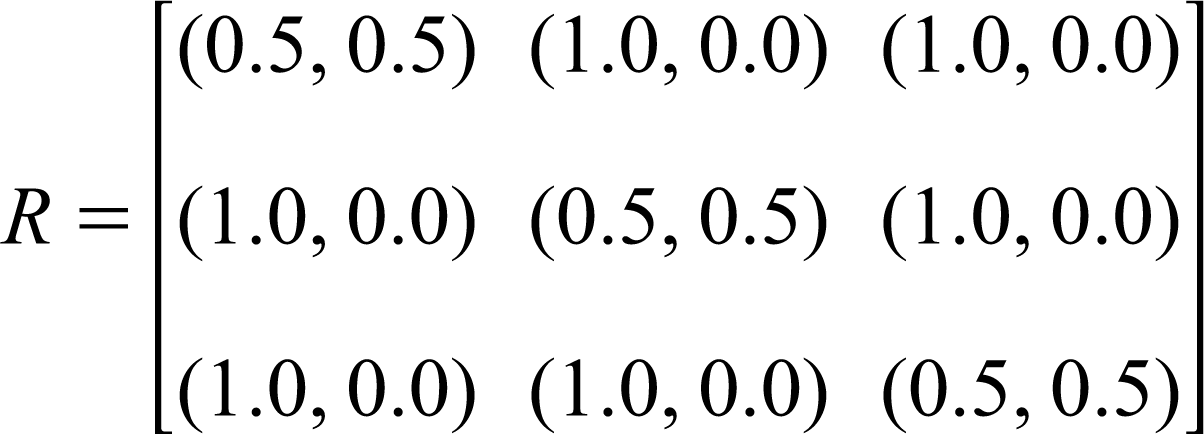
Then, we calculate optimality coefficients ξij between each element (bij) and its respective reference element rij using Equation (14). We construct optimality coefficient matrix (ξij)n×n as:
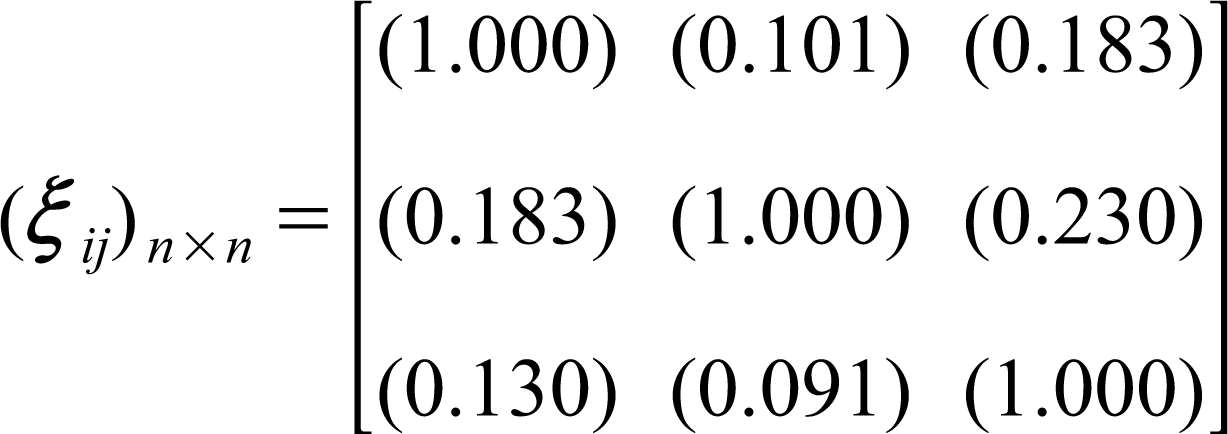
Using Equation (15), we have ϒ1 = 0.310, ϒ2 = 0.450 and Υ3 = 0.240, which indicated that the ranking of the alternatives is
Proposed Intuitionistic FAHP
In this section, we present an IF-AHP procedure for MCDM.
For a MCDM problem, let X = {x1, x2,…, xm};m ≥ 2 be a finite set of alternative. These alternatives are to be evaluated over a finite set of criteria C = {c1, c2, …, cn}; n ≥ 2. The decision-maker provides pairwise comparison judgements among criteria and alternatives in the form of IFPRs.

Numerical Illustration
In this section, we will present a numerical example to validate our proposed method and illustrate how to implement it to generate a priority vector.
C1: overall cost of the product (cost)
C2: quality of the product (quality)
C3: service performance of a supplier
C4: supplier’s profile
C5: risk factor (risk)
Suppose, there are three suppliers under consideration, then the problem hierarchy can be depicted as in Figure 1. The problem hierarchy consists of three levels: The overall objective is placed at level one, criteria at level two and alternatives at level three. Since this example is presented only for the sake of validation of our proposed method, we do not consider the pairwise comparison of sub-criteria but take them as a whole. The pairwise comparisons are represented as IFVs and shown in Tables 3–8.

Intuitionistic Fuzzy Preference Relation of Criteria with Respect to Overall Objective

Intuitionistic Fuzzy Preference Relation with Respect to Criterion C1

Intuitionistic Fuzzy Preference Relation with Respect to Criterion C2

Intuitionistic Fuzzy Preference Relation with Respect to Criterion C3
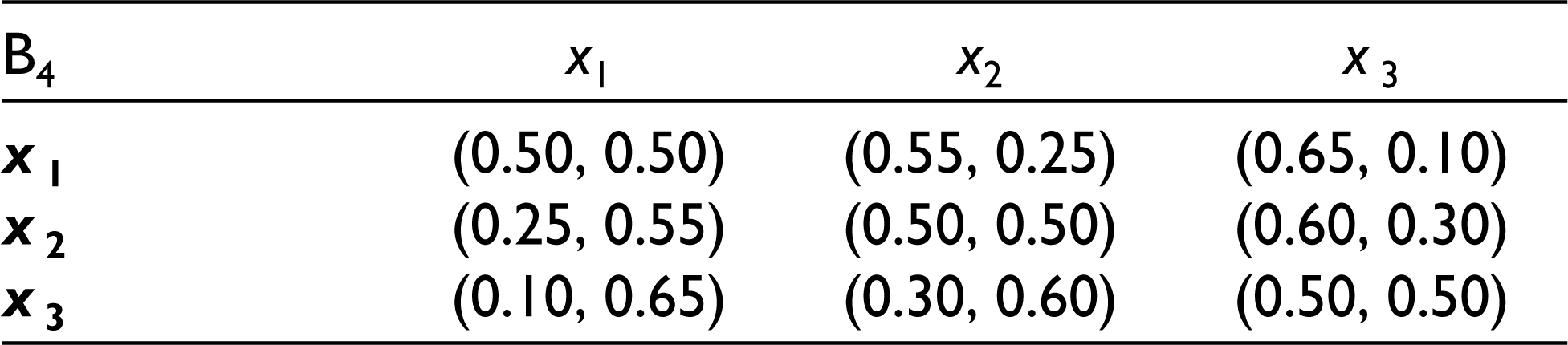
Intuitionistic Fuzzy Preference Relation with Respect to Criterion C4

Intuitionistic Fuzzy Preference Relation with Respect to Criterion C5
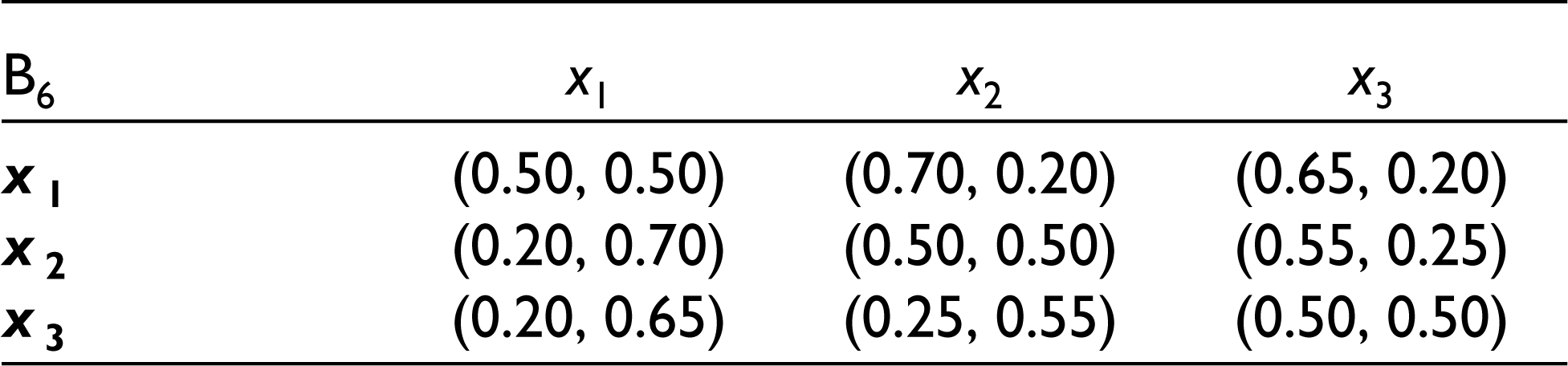
The first step is to check the consistency of pairwise judgements for each IFPR and repair the inconsistent ones using the algorithm developed by Xu and Liao (2013). The consistent IFPR corresponding to Table 3 is presented below:
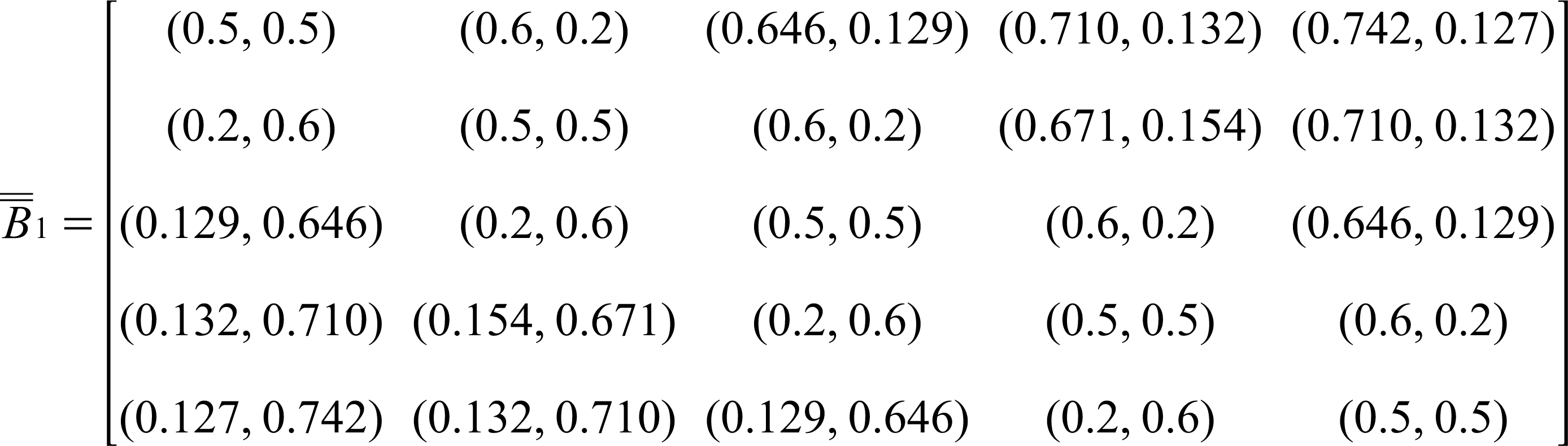
Then, we utilize Algorithm (I), with distinguish coefficient ρ = 0.1 for wider distribution range, on acceptable consistent IFPRs Br(r = 1,2,3,4,5,6) to obtain priority vectors. We obtain the relative weights of the criteria with respect to the overall objective and alternatives over criteria Cj(j = 1,2,3,4,5) that can be shown in Table 9.
Relative Weights of Criteria and Alternatives

In order to obtain the aggregated score of alternatives xi ∈ X, X = {x1,x2,x3}, we synthesize the weight of alternative ϒi with respective criteria weights ωr using Equation (16) to obtain the final score of alternative xi as:
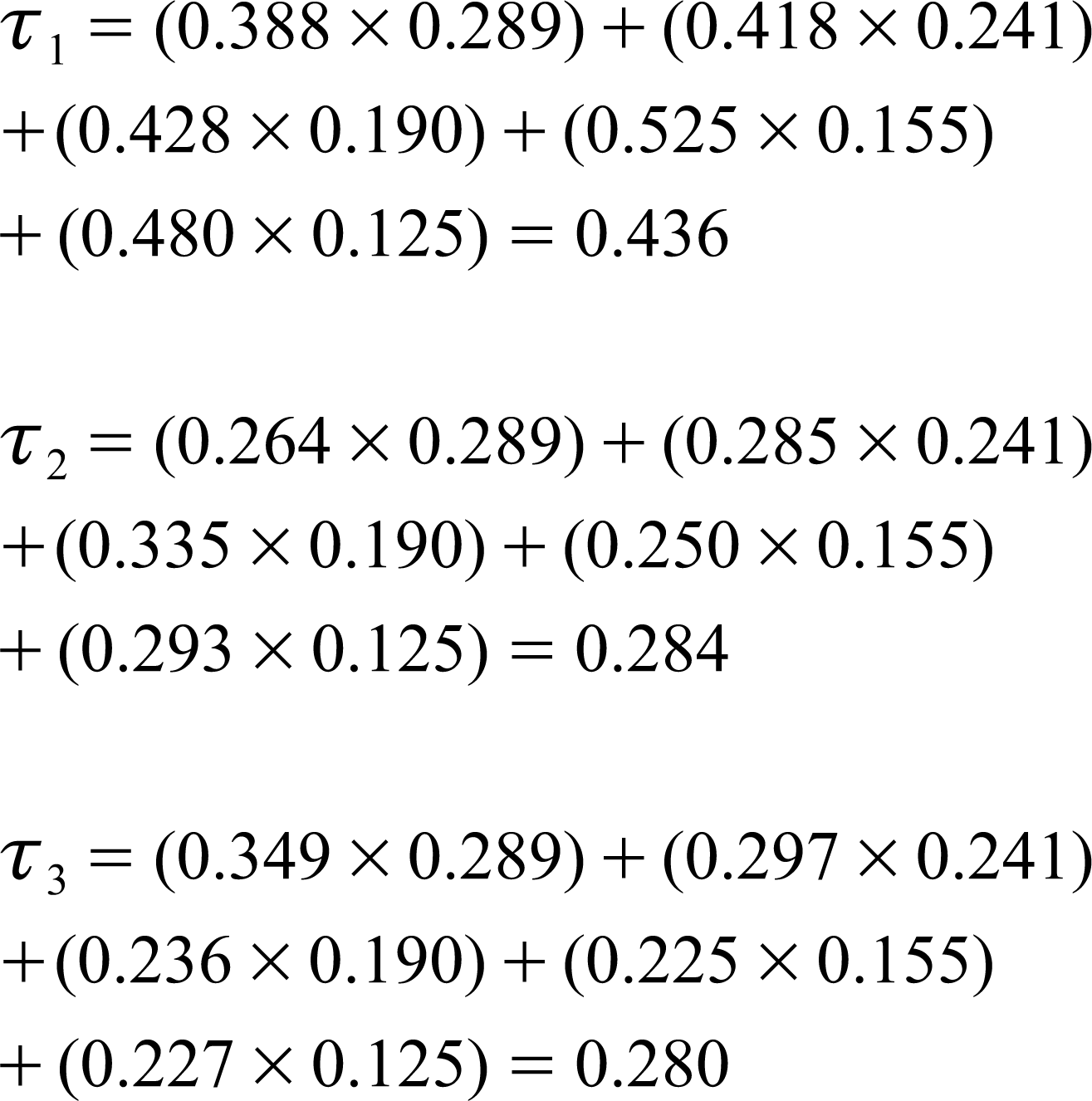
Since
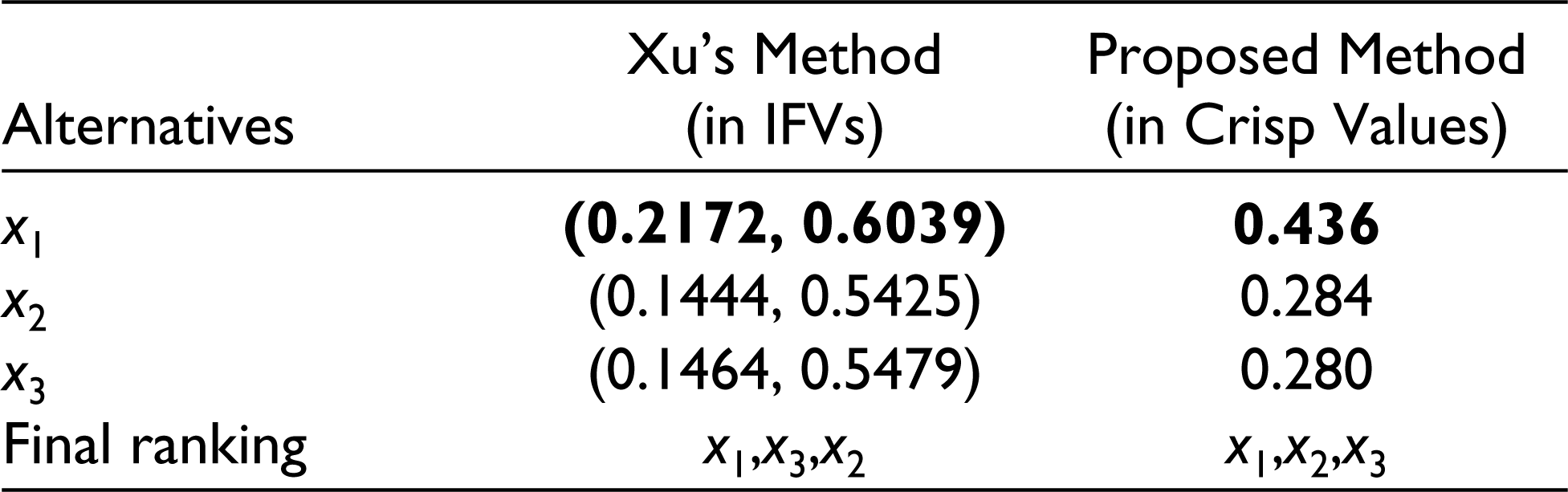
In Table 10, we present the ranking and scores of the global supplier selection problem with respect to our approach as well as Xu’s method.
Table 10 shows that the results, obtained from our method, is consistent with the intuition of the decision-maker as we can observe that alternative x1 is preferred over other alternatives with respect to almost every criterion (Tables 4–8). Further, we also examined that preferences of alternative x2 and x3 are not remarkably distinct, therefore, we can see that overall weights of alternatives x2 and x3 are very close. Table 10 also presents the scores and rankings produced by Xu’s method. It can be observed that x1 is chosen to be the best alternative by our method and as well as Xu’s method. However, due to the close scores of alternative x2 and x3, rankings of both methods show a little disagreement.
In Xu’s paper, the author used a rank function defined by Szmidt and Kacprzyk (2009), provided in the second section of this article. The rank function produces the rank x1, x3, x2 when applied on the intuitionistic fuzzy scores (Table 10). On the other hand, if the score function (provided in Section 2) is applied on the same intuitionistic fuzzy weights of the alternatives, the score value of the alternatives are obtained as S (x1) = –0.3867, S (x2) = –0.3981 and S(x3) = –0.4015. The score values of the alternatives imply the ranking of alternatives as x1,x2,x3; which is exactly the same as rankings obtained by our method. This fact shows that intuitionistic fuzzy scores can produce different ranks if different rank functions are used. Since our approach produces crisp results, it does not require a rank function and hence, the rankings produced by it are consistent.
Comparison Between Results Obtained by Our Method and Obtained by Xu’s Method
Comparative Analysis
Robustness is an essential characteristic of the decision-making process. AHP method and its variants have been criticized for their possible rank-reversals caused by small alteration of the data (Wang & Luo, 2009). Decision-makers should choose the method, which is least affected by trivial changes and hence produce robust and reliable results. In order to validate the reliability of the results produced by the proposed method under uncertain conditions, in this section, we examine and compare the robustness of the three variants of AHP, the proposed extension of AHP, Saaty’s AHP and FAHP (extent analysis method) under different levels of uncertainty. With the purpose of estimating the robustness of the three variations of AHP, we calculate the deviations between the ranks derived from original decision matrices and the ranks produced from decision matrices with a pre-specified amount of alteration. The higher deviation, exhibited by an MCDM method, indicates less robustness.
In order to test the robustness of the three methods, we design a Monte-Carlo simulation. The simulation encompasses the stochastic decision models of all three methods. We also generate required inputs for experiment through simulation. The three AHP variants function on similar input structure: one n × n decision matrix for n criteria and n number of m × m decision matrices for m alternatives. However, the elements of decision matrices are different for all the three variants and hence we design the simulation in such a way that all the inputs meet the standard scales of respective methods.
In the simulation, we generate random but consistent decision matrices for the decision alternatives over each criterion as well as a random but consistent decision matrix that represents the relative priorities of the decision criteria. We try to eliminate judgement bias and achieve neutral inputs by creating these decision matrices based on random numbers automatically generated by computers.
We introduce uncertainty in the algorithm by creating uniform distributions based on the elements of decision matrices created in previous steps. In other words, for each element of the decision matrices, instead of fixed value, an arbitrary value is picked from a uniformly distributed range of values, based on the element. As we gradually increase the range of the uniform distribution, the uncertainty increases as well. After that, we calculate the ranks based on newly formed decision matrices. These ranks indicate the deviation on ranks under a certain level of uncertainty. For all three methods, we derive the final ranks for 10,000 different iterations at each level of uncertainty and compare them with the ranks that we first created.
To ensure the accuracy of the outputs, the aforementioned procedure is repeated 1,000 times. This implies that the simulation algorithm creates 1,000 randomly generated decision problems and for each decision problem, the ranks produced by all the methods are examined utilizing previous steps.
Figure 2 shows the results of the comparative analysis carried out through Monte-Carlo simulation. The simulation results reveal that the rank deviations of the proposed method, under each level of uncertainty, are notably less than the rank deviations exhibited by other two variations of AHP. The results validate the robustness and reliability of the proposed intuitionistic fuzzy extension of the AHP. In other words, it can be inferred from the results that the proposed IF-AHP method performs fairly well in the real-world decision scenarios where decision problems are ill-structured, experts’ judgements are imprecise, and decision-makers are hesitant to provide their preference information.

Conclusion
In this article, we develop a novel GRA based priority method to derive priorities from the IFPR. We also extend Analytical Hierarchy Process (AHP) method based on the IFPRs and develop an approach to handle MCDM, which combines the simplicity and robustness of AHP and capability of dealing uncertain and incomplete information of IFS. The pairwise comparison judgements provided by the decision-maker are represented by IFV’s and an intuitionistic preference relation is constructed. Our proposed procedure can also deal with inconsistent information without much participation of the decision-maker; hence it can save a significant amount of time and energy. In order to test the robustness of our proposed approach, we design and conduct an experiment using Monte-Carlo simulation approach. We model and examine classic AHP, fuzzy AHP and our IF-AHP under different level of uncertainty. The simulation results reveal that the proposed method is significantly superior to other methods in handling uncertainties in decision scenarios. Some numerical examples have also been presented to demonstrate the computation process of the proposed procedure.
In the future, we can further investigate the possibilities of combining AHP and GRA with other fuzzy structure such as hesitant fuzzy set (Torra & Narukawa, 2009), intuitionistic multiplicative set (Xia, Xu, & Liao, 2013) and type-2 fuzzy sets (Dubois & Prade, 1980). Also, we can study on other popular MCDM methods such as VIKOR and TOPSIS. Considering the scope and advantages of our proposed method, sensitivity analysis can be conducted on different examples, and new methods can be defined for sensitivity analysis on intuitionistic preference relations as well.
Footnotes
Declaration of Conflicting Interests
The authors declared no potential conflicts of interest with respect to the research, authorship and/or publication of this article.
Funding
The authors received no financial support for the research, authorship and/or publication of this article.