



Abstract
Although researchers recommend the continuous performance evaluation of employees (CPEE), literature is scant about a procedural framework for CPEE. This article aims to develop a simple and robust method for CPEE using the modified Pugh matrix method (MPMM). The criteria for CPEE are compared pairwise using the analytical hierarchy process (AHP), followed by a comparison of employees using MPMM to determine and rank the employees based on their performance. The proposed method is successfully validated in an organisation, and the working mechanism of MPMM is demonstrated. Implications of the proposed method for CPEE and the scope for future work are also discussed.
Keywords
Introduction
Performance of organisations chiefly depends on the performance of their employees. Employee performance can be enhanced only by continuously evaluating and calibrating their performance (Boice & Kleiner, 1997). The performance of employees is typically assessed using a performance appraisal system (PAS). The PAS is a confidential system that managers use to evaluate the performance of employees once a year (Aguinis et al., 2011). Rather than waiting a year to learn about their performance, employees value timely information about their current performance (Fawcett, 2015; Jawahar, 2006). Therefore, there is a necessity for a method to facilitate continuous employee performance evaluation (CPEE). Besides, the criticism related to the subjectivity with PAS (Grund & Przemeck, 2012; Kleiman et al., 1987) can be addressed by bringing in a series of evaluations that result in objective (quantitative) scores. These scores from CPEE could act as a reliable input to the existing PAS.
Various criteria determine the overall performance of the employees. An effective CPEE process should incorporate all these criteria. Researchers have proposed utilising the multi-criteria decision-making (MCDM) method for employee performance evaluation for PAS (Haddad et al., 2019; Shaout & Yousif, 2014). Although there is literature about using MCDM for the annual employee performance appraisal, literature on MCDM, specifically for CPEE, appears virtually non-existent. This article explores the efficacy of a relatively lesser known MCDM method—the Pugh matrix method (PMM)—for CPEE.
In the remaining part of the article, the existing literature on using MCDM for the annual appraisal process is reviewed, and PMM as a possible method for CPEE is proposed. A procedural framework for CPEE is explained, and the proposed method’s validation in an organisation is detailed. Finally, implications of the CPEE method are elaborated, and the scope for future research is also included.
Methods of Employee Performance Evaluation
Performance evaluation of employees has been an active area of research for the past few decades (Pichler et al., 2020). Most of the issues related to the practice of annual performance appraisal (Kondrasuk, 2011) can be addressed to an extent by reducing the frequency of the appraisals. Despite the importance researchers’ thrust towards developing the theory of CPEE and its benefits (Palaiologos et al., 2011; Rivera et al., 2021; Sreejith, 2015), CPEE is not known to be practised in organisations. The managers may fear that the CPEE is yet another exercise that takes a considerable time to execute (Aguinis et al., 2011). Besides, there is no known procedural framework for a formal CPEE.
There are informal performance evaluation methods carried out by managers (Biernat et al., 2010) with varying frequency. However, such informal evaluations are often highly subjective, random, non-transparent and non-informative (Komendat & Didona, 2016). Organisations across the globe are moving towards a continuous feedback mechanism (Tripathi et al., 2021). Many organisations such as Adobe, Cisco and Infosys adopt software- and mobile-based applications for offering timely feedback (Fawcett, 2015; Levit, 2019). One drawback of subjective-feedback-only methods is that they are hardly quantitatively recorded. In the long run, the feedback process and appraisal data may lack proper linkage, which handicaps the organisations from effective use of such methods. Organisations want a robust mechanism that keeps track of such frequent performance feedback that can be easily integrated with the organisation’s existing PAS. In this study, a formal, periodic, cyclical, transparent and simple process for CPEE is proposed.
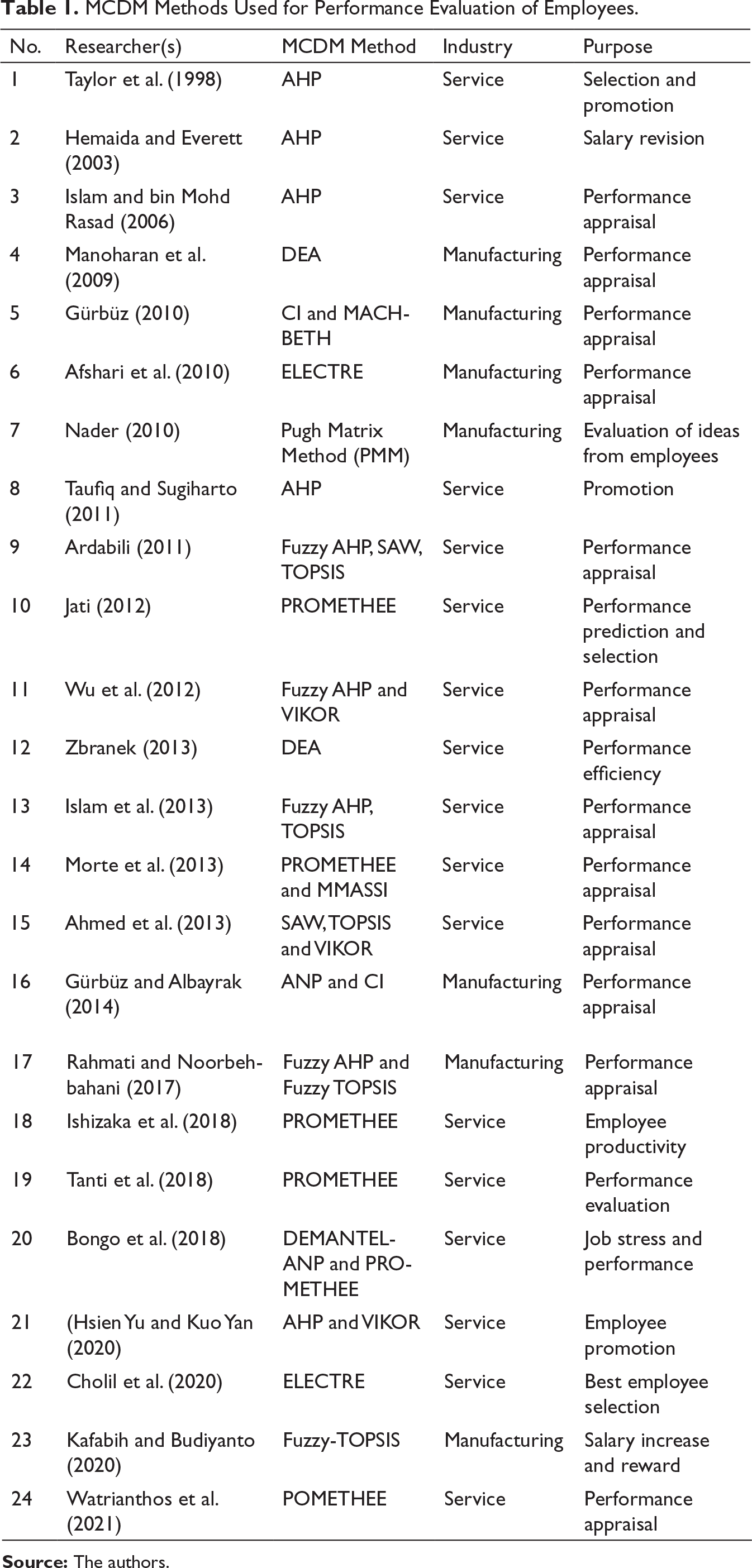
Since the past two decades, various MCDM methods (as in Table 1) are being increasingly utilised for the annual performance evaluation of employees. Table 1 indicates that analytical hierarchy process (AHP), and its variations have been extensively used. Besides, popular outranking methods are almost always combined with AHP for employee performance evaluation. Yet, none of such MCDM methods are known to be used for CPEE. This article attempts to contribute to the literature by exploring the possibility of utilising a modified version of one such outranking MCDM method for CPEE.
Pugh Matrix Method
MCDM Methods Used for Performance Evaluation of Employees.
The Proposed Modified PMM for CPEE
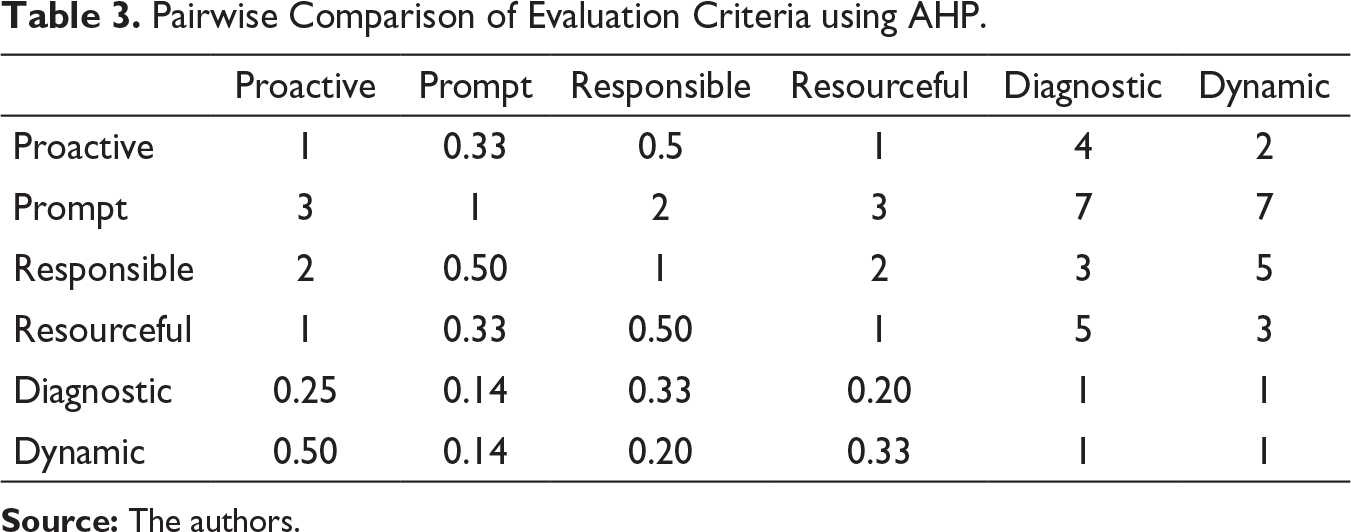
As with other MCDM methods, AHP can be used to determine the criteria weights in PMM. The evaluation scale can be extended to five points with a rating as follows: much worse than (−2), worse than (−1), equal (0), better than (+1) and much better than (+2). The limitation concerning the bias in baseline could be addressed by considering each of the alternatives as baseline in a rotational manner.
In the process of CPEE, the performance of each of the employees i (i = 1, 2, …, m employees) is compared among each other employees on every evaluation criteria j (j = 1, 2, …, n criteria) by making each of the k employee (k = 1, 2, …, m) as a baseline employee, one at a time. The sequence of the proposed MPMM is detailed:

The score of the baseline employee k will always be 0. The proposed MPMM for CPEE will have the pairwise numerical performance rating of employees (PR
ij
) as m × n matrix, considering k as baseline employee.
Step 3.1: Compute performance score (PS
ik
) for each employee i (where i = 1, 2, …, m), considering k as baseline employee using the following Equation (1):

This results in a column vector representing each employee’s performance For m employees’ performance score, there would be m iterations, considering each of the employees as a baseline employee to obtain PS ik , resulting in an m × m matrix. Each column vector in the PS ik matrix represents the performance score of each employee i (i = 1, 2, …, m), considering each employee k (k = 1, 2, …, m) as baseline.
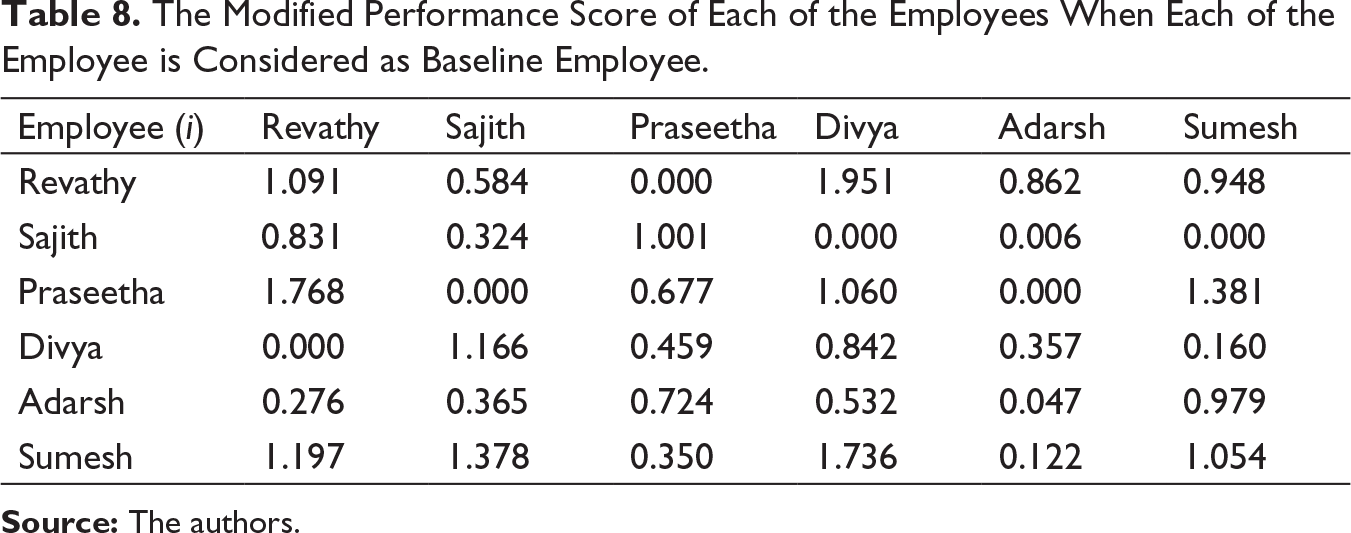
Step 3.2: Eliminate the negative scores: the column elements are added with the absolute of the minimum value of that column vector.
Step 3.3: Normalise the scores (NPS

Based on the computed score on MNPS
i
, the employees are ranked. This completes one round of evaluation.
Validation of the Working Process of the Proposed MPMM for CPEE
The proposed MPMM is validated on a team of seven employees (including the manager) working in an Indian organisation. The following five-step approach is used:
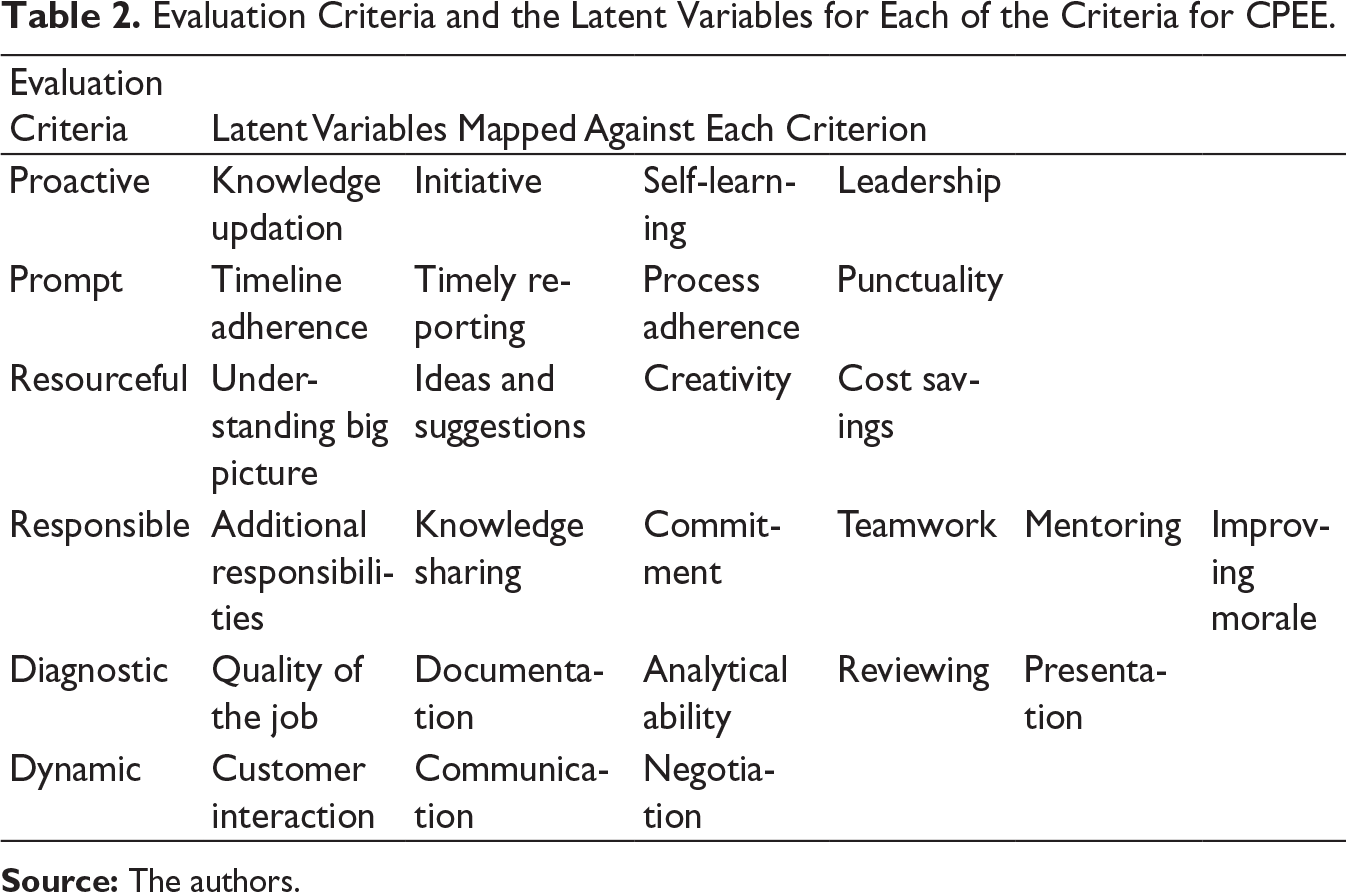
Six evaluation criteria: proactive, prompt, responsible, resourceful, diagnostic and dynamic are considered from the literature for CPEE. Sreejith and Mathirajan (2020) defined these six criteria for CPEE by conducting exploratory factor analysis among 26 latent variables, which were identified by carrying out a detailed descriptive study among 443 employees in the Indian IT organisations. The evaluation criteria with their corresponding latent variables are listed in Table 2.
Evaluation Criteria and the Latent Variables for Each of the Criteria for CPEE.
Pairwise Comparison of Evaluation Criteria using AHP.
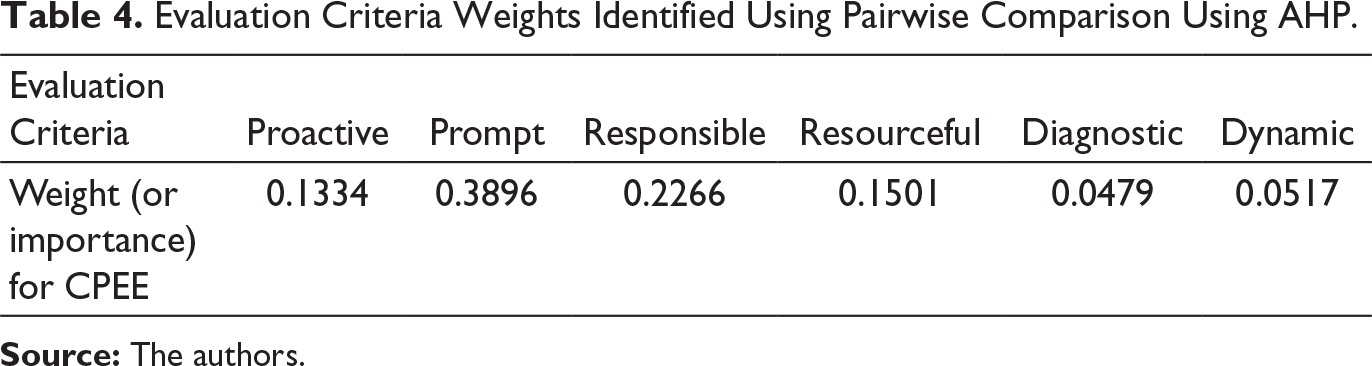
Evaluation Criteria Weights Identified Using Pairwise Comparison Using AHP.
Pairwise Numerical Performance Ratings of Six Employees for Six Criteria Using MPMM with one Employee (Revathy) as Baseline.
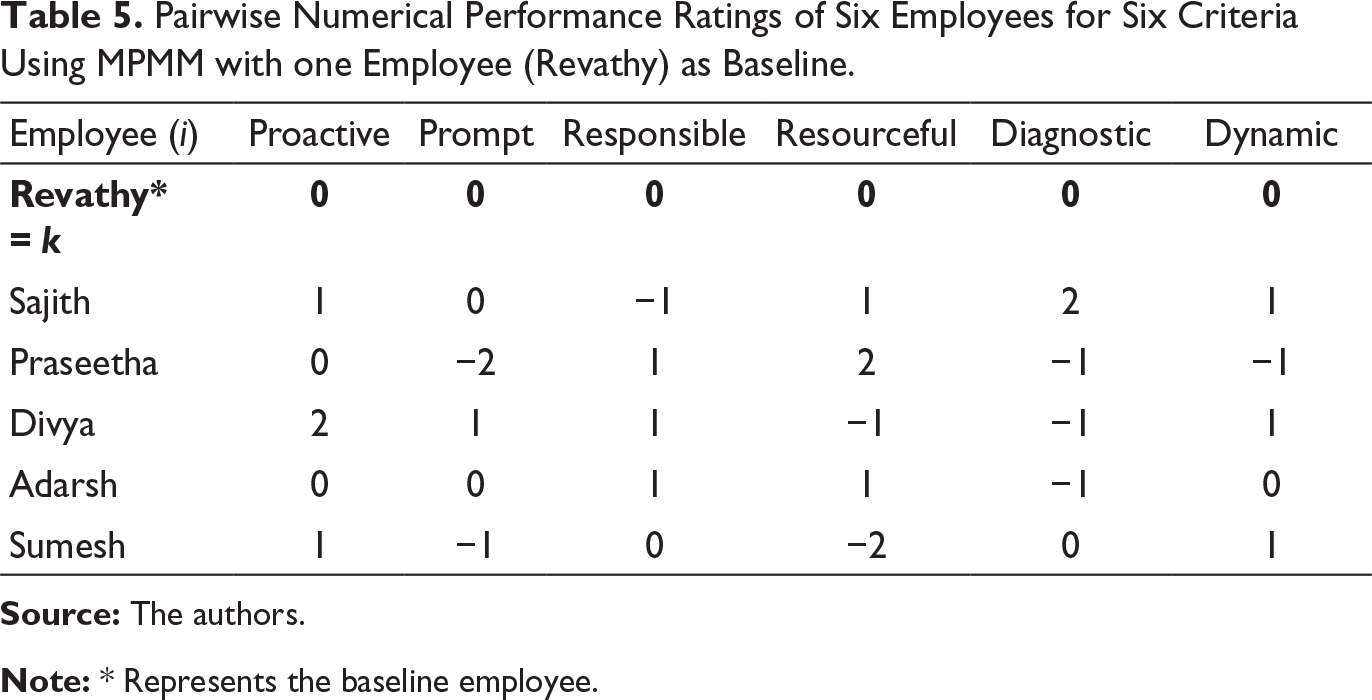
Note: * Represents the baseline employee.
Performance Score of six employees with Revathy as the Baseline Employee.
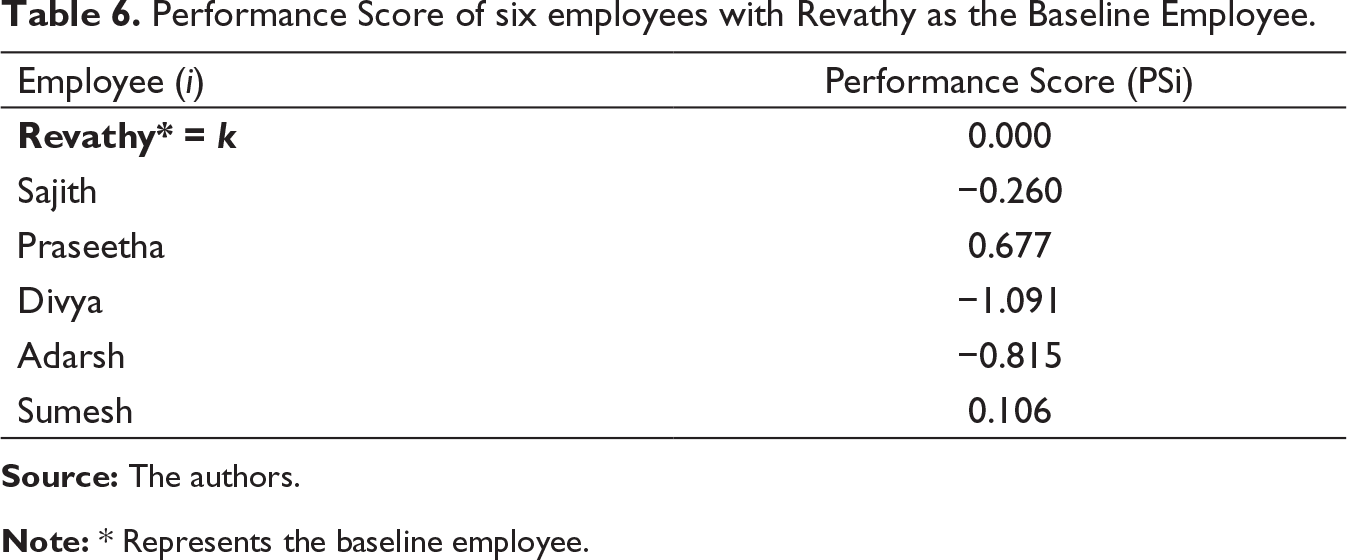
Note: * Represents the baseline employee.
Performance Scores for Employees When Each Employee Acts as Baseline Employee.
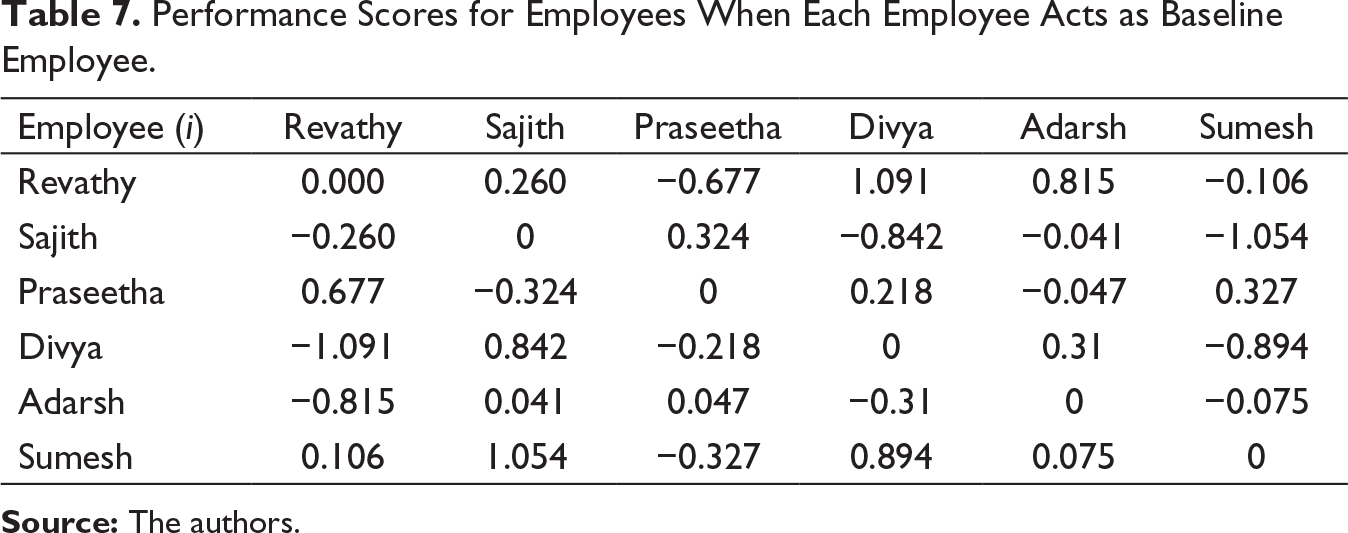
The negative signs can be eliminated using step 3.2. In the first column, each element is subtracted using the absolute of the minimum value of that column (1.091).
The Modified Performance Score of Each of the Employees When Each of the Employee is Considered as Baseline Employee.
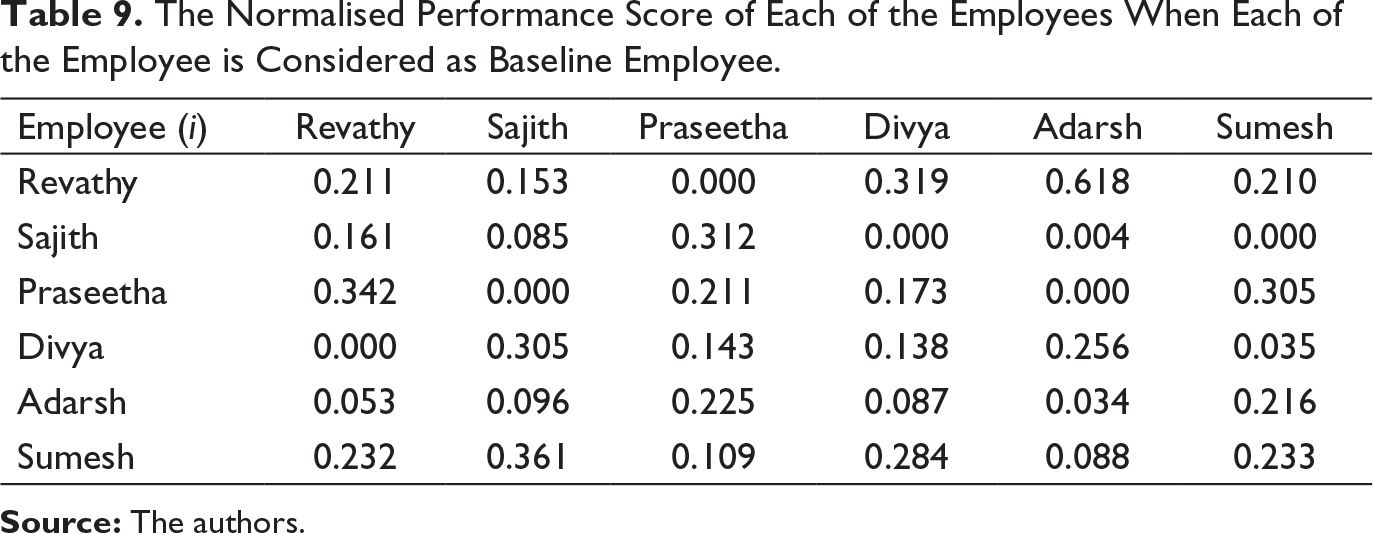
The Normalised Performance Score of Each of the Employees When Each of the Employee is Considered as Baseline Employee.
Performance Evaluation of Employees Based on the Mean Normalised Performance Score and Rank of a Particular Evaluation Period.
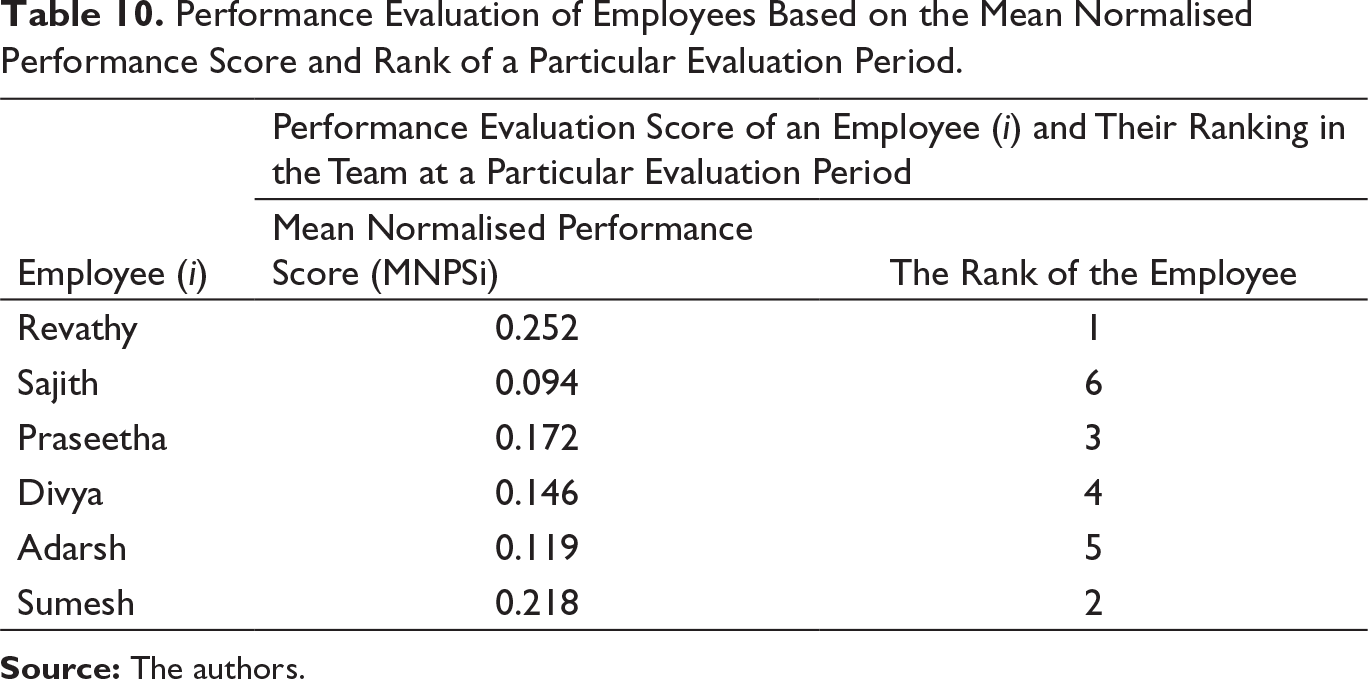
From Table 10, Revathy has the highest score, while Sajith scores the lowest. This completes one round of CPEE.
Performance Evaluation Score for Six Employees over 4 Weeks.
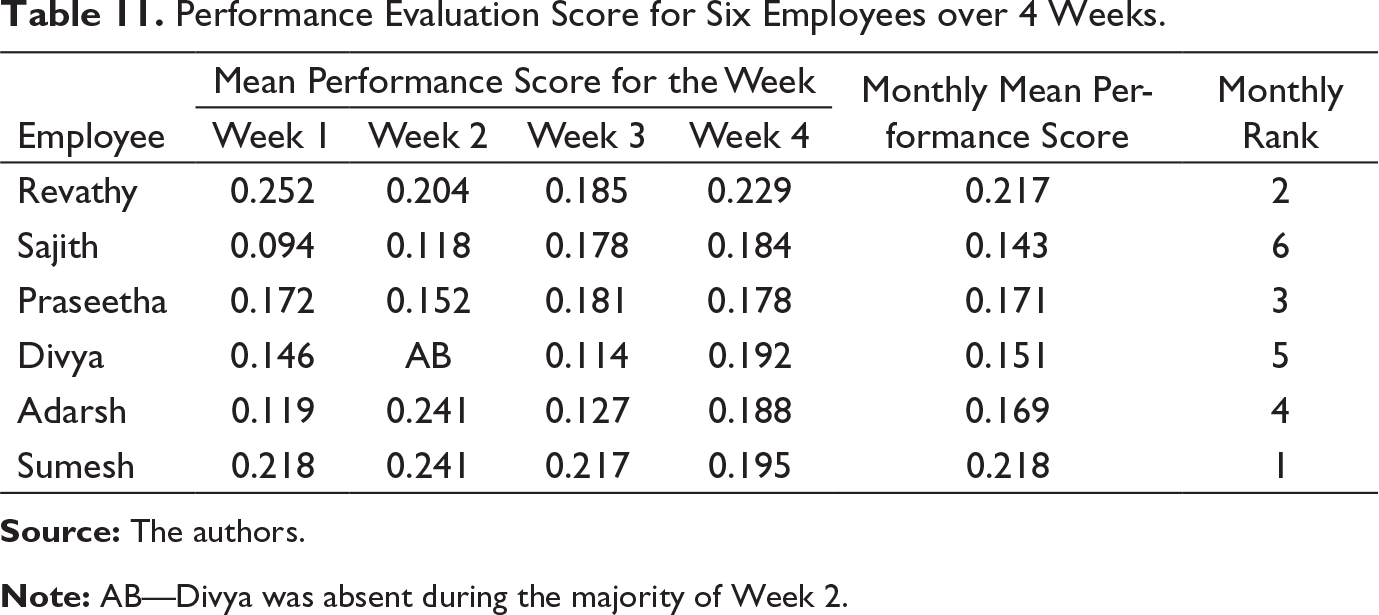
Note: AB—Divya was absent during the majority of Week 2.
Discussions and Managerial Implications
The proposed MPMM for CPEE is effortless to execute and simple to comprehend, thus making it easy to administer continuously. The proposed method offers the following grounds for discussion about administering CPEE:
Rather than relying on the manager’s memory (Steiner & Rain, 1989) during the annual appraisal process, the periodic outputs from the proposed method for CPEE could help managers easily trace employees’ performance, and necessary inputs can be passed on to the PAS with increased credibility.
The proposed MPMM process helps generate relative performance scores of employees of a homogeneous team. The managers need to interpret the performance score judiciously and use it to improve the performance of employees in a real-time manner. Importantly, managers should imbibe and own the entire process.
Conclusion
Contemporary organisations need to have an agile process to continuously evaluate their employees’ performance. A well-designed CPEE reduces the subjectivity of evaluation and informs the employees about their performance on a real-time basis. This article proposed and validated a procedural framework for CPEE using the MPMM. The following are the contributions from the article:
Although there is literature supporting the necessity and importance of CPEE, there is no known process to operationalise CPEE. The literature is augmented by designing a procedural framework for employee performance evaluation. An MPMM is proposed by eliminating the limitations of PMM. The proposed MPMM for CPEE is validated by demonstrating the workability of the proposed method in an organisation. The cumulative performance score computed from the proposed MPMM for CPEE can act as an objective input to the existing PAS.
Limitations and Future Scope
In this method, the large team size was not accounted for. As with all other MCDM methods, it is proposed that the team size (alternatives) should be less (Mukhametzyanov & Pamucar, 2018). The team composition, size and perseverance are the challenges for managers in implementing CPEE using the proposed MPMM.
This study does not address the organisational alignment or generalisability of the proposed method. Although an initial endorsement is offered, the proposed method needs further validation from an organisation-wide setting to empirically analyse the workability of the process. The linkage of the proposed method for CPEE with the organisation’s existing PAS also needs investigation. A working software or template for CPEE, using the proposed MPMM process, is an immediate future work.
