



Abstract
The coronavirus pandemic has put the spotlight on employee happiness and well-being. Employees’ job satisfaction in a post-COVID-19 scenario is a vital concern for academics and organizations. It is a crucial research question to decipher if employees can proactively rise to challenging job demands and achieve job satisfaction. Also, though the role of job crafting has been studied as an antecedent of job satisfaction, it has not been examined in alliance with job-based psychological ownership (PO). Taking note of this, this study examines the mediating role of job-based PO between seeking challenging job demands (SCJD) and job satisfaction (JS). The study contributes to the growing understanding of post-pandemic employee JS. It provides preliminary empirical evidence of the enabling roles of job-based PO and proactive job crafting in achieving JS. Data for the study were collected from Information Technology (IT) and IT enabled Services (ITeS) sector employees in India using online questionnaires. One hundred eighty-four solicited responses were included in the data analysis and analysed using SPSS and AMOS. Results establish that employees SCJD experience higher job satisfaction. The mediating effect of PO on the association between SCJD and JS has been found. The results have both practical and theoretical implications. This study provides evidence of the beneficiary aspect of proactive employee behaviour. Managers can adopt mechanisms to enable job crafting and ownership. JS can be enhanced by raising the levels of PO and proactive crafting undertaken by SCJD to further learning opportunities at work. Limitations of the study have been discussed.
Keywords
Introduction
Change is constant, and the recent COVID-19 pandemic is an example that shows how jobs are disappearing or getting modified to sustain. The onus is on the employees to proactively plan, develop and re-skill themselves (Haffer et al., 2021) to stay relevant in the job market. The importance of employee proactivity has been in focus for a few decades now, emphasizing the need for being more adaptable and innovative to thrive (Belschak & Den Hartog, 2010). Sylva et al. (2019) consider proactive behaviour as ‘self-initiated anticipatory action aimed at changing oneself or the situation’. Proactive behaviours such as job crafting can positively affect employee morale and satisfaction (Cheng & O-Yang, 2018). In the wake of the pandemic, employee satisfaction has gained significant interest (Bulińska-Stangrecka & Bagieńska, 2021).
While job satisfaction (JS) and its antecedents have been vastly studied in the Information Technology (IT) and IT enabled services (ITeS) sector, there has been scant focus on examining JS during COVID-19 (Chanana, 2021). The antecedents of JS must be examined for framing management policies to mitigate the pandemic’s effects.
The study’s novelty lies in examining the association of the study variables in a post-pandemic world. To the best of our knowledge, no prior studies have inspected the link between job crafting elements, psychological ownership (PO) and JS among IT and ITeS professionals. Our study is one of the first in the literature to investigate employee JS within the Indian IT and ITeS sectors after the onset of COVID-19. This is a unique feature of the study.
Our study aims to examine the roles of proactively seeking challenging job demands (SCJD) and job-based PO working in tandem and as direct antecedents of employee JS of professionals in the IT and ITeS sector during the COVID-19 pandemic. This objective is significant and timely, given that the service sector employees face increasing mental distress due to current job insecurity and wage issues (Kurian & Thomas, 2022).
Specifically, we examine whether proactively SCJD and job-based PO predict JS independently. We also set out to determine the mediating role of PO on the SCJD–JS relationship. Figure 1 shows the theoretical framework. While both proposed antecedents have been previously examined as drivers of JS, these variables have not been studied in the wake of the pandemic. We argue that during this period of global crisis, the importance of proactive behaviours such as job crafting on satisfaction can be further examined by considering the role of the PO as a mediator of the relationship.
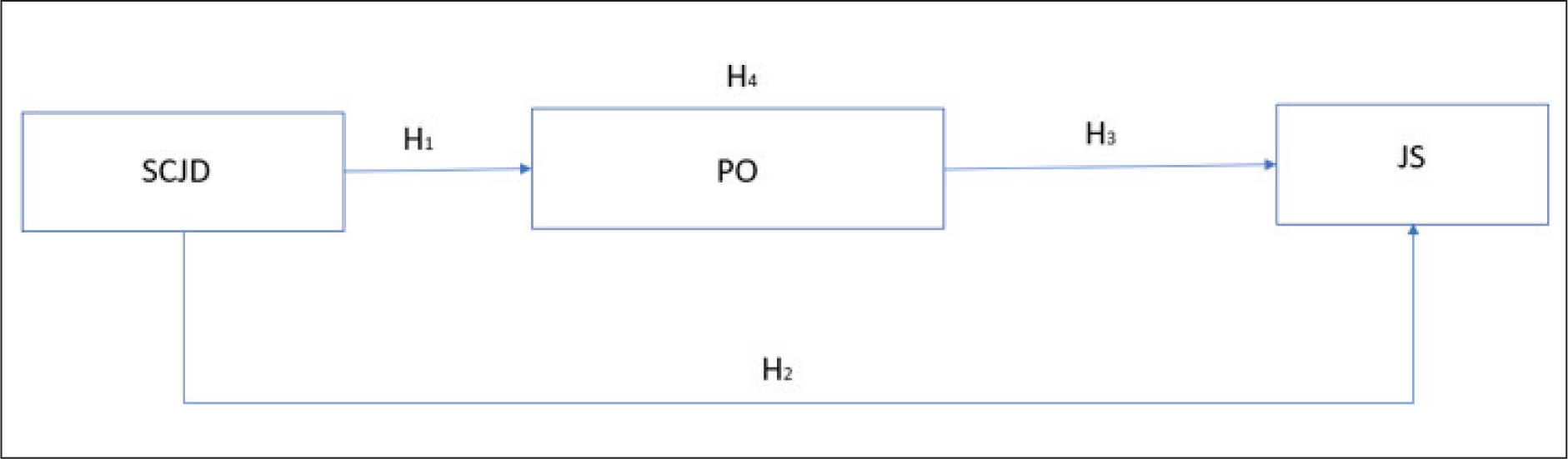
The present study contributes to understanding employee JS in at least three ways. First, there has been little research on the JS of employees during COVID-19 concerning workers in the Indian IT and ITeS sector. Though there are pre-pandemic studies concerning the manufacturing industry (de Beer et al., 2016) and the hospitality sector (Cheng & O-Yang, 2018), scant prior studies have examined the effect of job crafting within the field of the global software industry (Moulik & Giri, 2022). Second, the existing research examining job crafting elements and work outcomes has mixed findings (Rudolph et al., 2017). While some studies show a positive impact of SCJD on JS (Rudolph et al., 2017), some show no significant effect (e.g. mining group in de Beer et al., (2016)). Thus, it is crucial to examine the role of SCJD on JS during COVID-19 to understand the nature of the relationship.
Third, in contrast to the predominant person-environment fit mediated models, we consider job-based PO as a mediator (Tsai, 2021). PO and particularly, job-based PO can be a pathway to harness the potential of job crafting towards positive organizational outcomes. Tsai (2021) observed the role of PO as a mediator on overall job crafting and work engagement and counterproductive work behaviour. Since, work engagement and JS share similar positive connotations at work, and are part of employee positive outcomes (Fisher, 2010), we consider JS as an important construct to be explored in the context of PO. This brings focus to the role of employee ownership as an enabler of employee JS. Our findings offer practical implications for maximizing JS post-pandemic by harnessing employee proactivity.
Literature Review
Proactive Seeking of Challenging Job Demands
Job crafting is a proactive behaviour enabling employees to undertake self-initiatives to design their work using their skillsets (Moulik & Giri, 2022; Weisman et al., 2022). It revolves around shaping the work and work boundaries via cognitive, relationship and task restructuring strategies being deployed and can lead to better well-being, work engagement and performance (Tims et al., 2021). Active modification of the work and its environment, arising in individual pursuits, can lead to positive workplace behaviour (Hu et al., 2020; Urbanaviciute & Lazauskaite-Zabielske, 2022). It has been observed under the job demands and resources (JD-R) model (Bakker & de Vries, 2021) that the resultant behaviour of the employee is seen to be directed towards the reshaping of the job characteristics (Tims et al., 2012). As per the JD-R model, job demands and resources affect health impairment and motivational processes (Naveed et al., 2022). Under the scope of the JD-R model, scholars (Ingusci et al., 2019; Tims et al., 2021) remark that the demands can further be categorized as ‘challenging’ and ‘hindering’, suggesting the need to examine the job demands felt.
Costantini et al. (2021) provided evidence that job crafting can be visualized as a multidimensional construct comprising actively seeking to increase resources, actively seeking challenges, actively seeking to decrease demands and seeking to optimize demands. These are largely held to have positive connotations for employee wellbeing and are noted to share independent relationships with wellbeing facets (Rudolph et al., 2017). Among the primary forms of operationalization of the construct, seeking challenges is a form of proactive job crafting proposed by Tims et al. (2012) under the JD-R model (Bakker & Demerouti, 2017; Ingusci et al., 2019). This element of job crafting relates to the self-initiative of the worker to reach out for additional tasks, begin new projects to manage resources effectively and seek to learn on the job (Ingusci et al., 2019; Tims et al., 2012, 2021). Challenging demands are those job demands which enable ‘personal growth and reward’ (Ingusci et al., 2019). Comparatively, hindering demands are stressors which are caused due to work pressure and demands on the job holder. By actively SCJD, workers are speculated to desire the development of knowledge and skills, raising JS and overall motivation (Tims et al., 2012, 2021).
Psychological Ownership
PO is allied to the possessive feeling of ‘mine’ (Dittmar, 1992; Wang et al., 2018). Morewedge (2021) noted that there exist implicit and explicit forms of PO and that PO can exist when the individual experiences perceived control, a sense of investment and intimate knowledge about the target of ownership.
Recent trends have shown the increasing academic interest in PO (Feldermann & Hiebl, 2022). It is ‘a state in which individuals feel as though the target of ownership is theirs’ (Pierce et al., 2001, p. 299). PO can yield positive outcomes (Zhang et al., 2021), including improving performance and organizational citizenship behaviours (OCBs), creativity and openness to change (Chai et al., 2020). PO is widely held to espouse the feeling of what the individual perceives as ‘mine’ or ‘ours’. Scholars often distinguish between legal and PO, remarking that PO is universal (Feldermann & Hiebl, 2022; Van Dyne & Pierce, 2016). For the workplace, it has been noted that PO can be applied to the job or the organization the worker is a part of, due to the felt responsibility and concern (Degbey et al., 2021; Wang et al., 2018; Zhang et al., 2021).
Dawkins et al. (2017) remarked that PO manifests broadly in the whole organizational level, which comprises a sense of ownership towards the organization and, at a more intricate level, the job-based ownership corresponding to the ownership of the job. It differs from allied psychological constructs like organizational-based self-esteem and organizational commitment (Dawkins et al., 2017; Naeem et al., 2021).
Job Satisfaction
JS is a widely studied element in organizational research and is defined as a pleasurable or positive emotional state resulting from an appraisal of one’s job (Döbler et al., 2021; Zhao et al., 2022). Scholars hold it as an ancillary measure of employee well-being (Nguyen & Borteyrou, 2016), and consider it to denote an overall sense of satisfaction associated with the work (Madigan & Kim, 2021). JS is an important construct studied particularly with positive consequences as performance (Katebi et al., 2022) and organizational effectiveness (Yang, 2010).
The JD-R model posits that job resources motivate employees who utilize available resources to gain more resources. This can result in JS (Cheng & O-Yang, 2018) and boost well-being (Bakker & Demerouti, 2007). While crafting, workers accumulate job resources countering the job demands, leading to enhanced well-being (Bakker & Demerouti, 2007; Slemp et al., 2015).
Hypotheses Development
Seeking Challenges at Work as a Predictor of Psychological Ownership
Recent academic conversations have looked at PO from a job design perspective. Job crafting and PO may be visualized as intertwined constructs vested in the satisfaction of motives and the feeling of ownership (Wang et al., 2018). PO can be a psychological mechanism that aligns proactive crafting by job incumbents with desirable work outcomes, and it is mainly determined based on the crafting undertaken (Wang et al., 2017). Crafting the job lets the worker exert control over their job aspects (Urbanaviciute & Lazauskaite-Zabielske, 2022), leading to a job-based PO. Mainly concerning the active seeking of job demands, scholarship points out that jobs that stimulate and challenge the worker can raise the feelings of PO (Brown et al., 2014; Wang et al., 2018).
The autonomy to exercise control over aspects of the ‘object’ is a fundamental ground for the advent of PO (Mayhew et al., 2007; Rudmin & Berry, 1987; Tsai, 2022). Modern-day organizations provide employees with the opportunities to control job and task aspects (Mayhew et al., 2007) which can have a bearing on the emergence of job-based PO. The knowledge professionals in the service sector are often given the onus to discharge and schedule their tasks, subject to deadlines. The autonomy to engage with the job as per the job incumbents plan allows for flexibility which has a bearing on the likely increase of PO (Mayhew et al., 2007; Pierce et al., 2001; Van Dyne & Pierce, 2004). Crafting can take various forms, and employees craft to extend self-control over the environment (Dormann & Guthier, 2020). By actively seeking challenging demands at work, the worker exercises autonomy (control) over the job aspects to grow and learn on the job, which can be argued to lead to PO.
The association between job crafting and PO lies vested in the perceived control that the employees exhibit over the job. Roe et al. (2015) noted that, remarkably, PO at the job level is experienced by any employee interested in exercising control, investing their time and energy and delving into the nuances of the job. This is called job-based PO (Tsai, 2021; 2022). While job crafting, workers invest resources and seek challenging demands available to achieve their set goals. They thereby can derive PO over the job aspects.
Hence, we frame the hypothesis:
Seeking Challenges at Work as a Predictor of Job Satisfaction
The idea of job crafting rests on the proactive behaviours exhibited by employees. With scholars holding that anyone can undertake job craft, the essence lies in the worker’s ability to make proactive decisions (Tims et al., 2021; Weisman et al., 2022; Wrzesniewski & Dutton, 2001). Proactive decision-makers focus on achieving meaning in the work results (Boehnlein & Baum, 2022; Grant & Ashford, 2008; Kilic & Gök, 2022). They are always looking to improve and grow (Parker et al., 2010) and hence exhibit a thirst for seeking decision opportunities (Siebert et al., 2020). Workers seeking to craft by actively seeking demands can be argued to undertake the activity to address the job resource balancing. Proactively seeking challenging demands leads to the availability of decisional opportunities (Siebert & Kunz, 2016). It can be used to build and accumulate resources and generate multiple decisional avenues to choose from Siebert et al. (2020), which has been associated with increased employee satisfaction at work.
Hence, we propose that,
Seeking Challenges at Work, Psychological Ownership and Job Satisfaction
It has been speculated that additional mechanisms can influence the pathway from job crafting behaviours to employee attitudes in addition to the widely studied person-environment fit variables. One such variable can be PO (Tsai, 2021), examined through the lens of the JD-R model by Pierce et al. (2009).
PO is a positive resource (Avey et al., 2009), enabling employees’ well-being (Avey et al., 2009; Chen et al., 2021). Pierce et al. (2001) opined that PO could be resulted from (a) scope to control the object at hand, (b) ‘greater knowledge of and familiarity with an object’ and (c) creation of the object by investing ‘the self’ (Mayhew et al., 2007). PO can connect the job design and the employee response relationship. For instance, Tsai (2021) observed that job crafting is associated with engagement via PO. It is highly possible that similar processes can be found between a particular form of job crafting behaviour, namely, increasingly SCJD and JS.
The Indian IT sector is a part of the broader knowledge-oriented service sector. The knowledge worker is driven to invest in self-allowing for greater expression of individuality (De Sordi et al., 2021). Professionals such as engineers, management consultants, teachers and trainers would have a better scope to exercise jurisdiction over parts of their job and are called knowledge workers (De Sordi et al., 2021; Mayhew et al., 2007).
Knowledge-based sectors such as the IT and ITeS sectors strive to become learning organizations where the organizational members aim to increase knowledge production (Hosseini et al., 2022). IT workers work in teams or individually and generally interact with clients to meet their demands and needs. Knowledge workers have the scope to develop with their job (De Sordi et al., 2021), which may generate a feeling of ownership. The opportunity to create and co-create their job resources often lends flexibility to exercise their autonomy (Zhao et al., 2022) to schedule and prioritize their job to certain extents. This autonomy can lead to a feeling of ownership towards the task at hand and JS (Su et al., 2021). A software engineer may reach out to the team leader to gain specifics to handle the job aspects and, in doing so, may seek out more opportunities to prove themselves at work. Hence, it will likely result in a job-based PO to a certain extent.
Hence, we propose that:
Method
Data Collection and Sampling Procedure
The data were obtained from the Indian IT professionals using an online cross-sectional survey. The cross-sectional study had two sections, the first on demographics and the latter on the questionnaires on increasing challenging job demands, job-based PO and JS. Employees were selected using purposive sampling with the help of professional networking sites such as LinkedIn. In line with study objectives, the population for the study were executives employed at various functionaries and management levels of the IT service sector operating in India. Volunteering respondents were sent the online survey after assuring data anonymity and confidentiality. After floating the initial survey, the reminders were sent twice to the respondents. The data obtained were subjected to rigorous statistical analysis.
After checking for missing data and unengaged responses, 184 responses were included in the data analysis. The respondents were located in the Indian metro cities of Bengaluru, Delhi, Kolkata, Mumbai and Pune. The sample comprised 105 men (57.06%) and 79 women respondents. Respondents had at least one year of experience and represented junior, mid and senior level executives. The average age of the respondents was 38.23 years, and most were from an engineering background (64.13%). Respondents were business and technical analysts, management and technical trainees and consultants.
Measurement Scale
In this study, existing standardized scales were used for the variables. A 5-item scale developed by Tims et al. (2012) measured the active seeking of challenging job demands. A sample item of the scale is ‘When an interesting project comes along, I offer myself proactively as project co-worker’. The JS scale by Schriesheim and Tsui (1980) was used to measure JS. A sample item of the scale is ‘I am satisfied with the work I do’. PO was assessed using Van Dyne and Pierce’s (2004) adapted scale to capture the construct in this study. A representative item of the scale is ‘This is my job’. All the above scales’ responses are taken on 5-point Likert scales.
Data Analysis and Hypotheses Testing
A two-step procedure was used to analyse the nature of the relationships. We used the SPSS and AMOS software to carry out the assessments.
Descriptive Statistics
Table 1 presents the mean and correlation among the study variables. Among the constructs, JS had the highest mean value (M = 3.58), followed by SCJD (M = 3.53) and PO (M = 3.45). Positive correlations were observed among the variables at a significance level of 0.001.
Descriptive Statistics of the Study Variables.

Common Method Biases
In survey-based studies with self-reported results, common method bias (CMB) is high, and researchers must take precautions to minimize them. According to literature, common method bias is a concern when one factor emerges as the dominant factor (Podsakoff et al., 2012). To address this issue, we undertook Harman’s single factor test to examine the effect of common method variance (Podsakoff et al., 2012). In the present study, as more than one factor with an Eigenvalue greater than one was extracted from the factor analysis, it can be concluded that CMB was not an issue.
Data Analysis
The measurement and structural models were tested using structural equation modelling (SEM) (Hair et al., 2014). In the first step of the measurement model assessment, we executed a confirmatory factor analysis using AMOS software on the study variables. This was done to examine the reliability and validity of the measurement model.
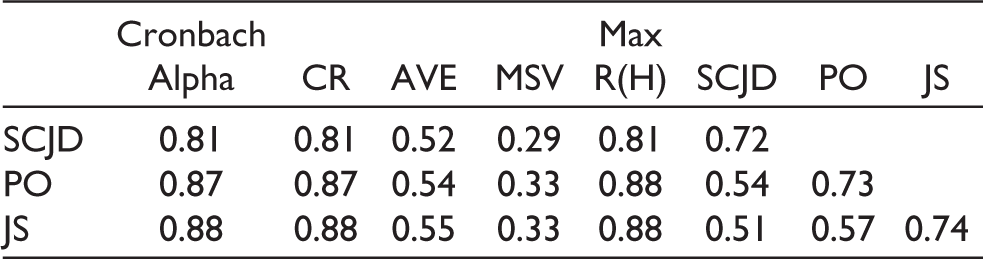
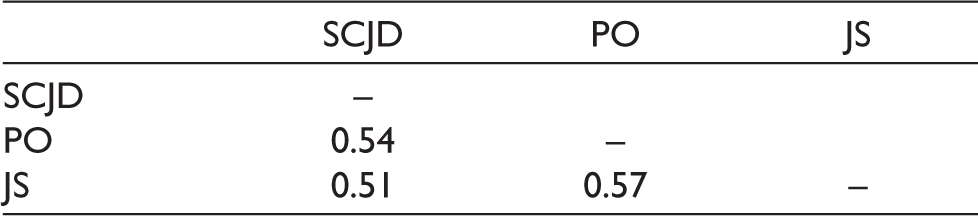
The average variance extracted (AVE) for convergent validity should be greater than 0.50. This was validated among the construct items. To assess discriminant validity, we resorted to using the Fornell and Larcker (1981) recommendations and the new Heterotrait–Monotrait ratio (HTMT) criterion. As per the Fornell and Larcker (1981) method, to establish discriminant validity, the AVE for each variable has to be greater than the square of the correlation between the constructs (MacKenzie et al., 2011). Table 2 details the convergent reliability and the discriminant validity of Fornell and Larcker’s (1981) method, which was satisfactory. As per the newer HTMT test, discriminant validity is determined when construct values are lower than 0.90 (Henseler et al., 2015). Table 3 presents the results of the HTMT test. Results establish discriminant validity.
Convergent and Discriminant Validity.
HTMT Criteria.
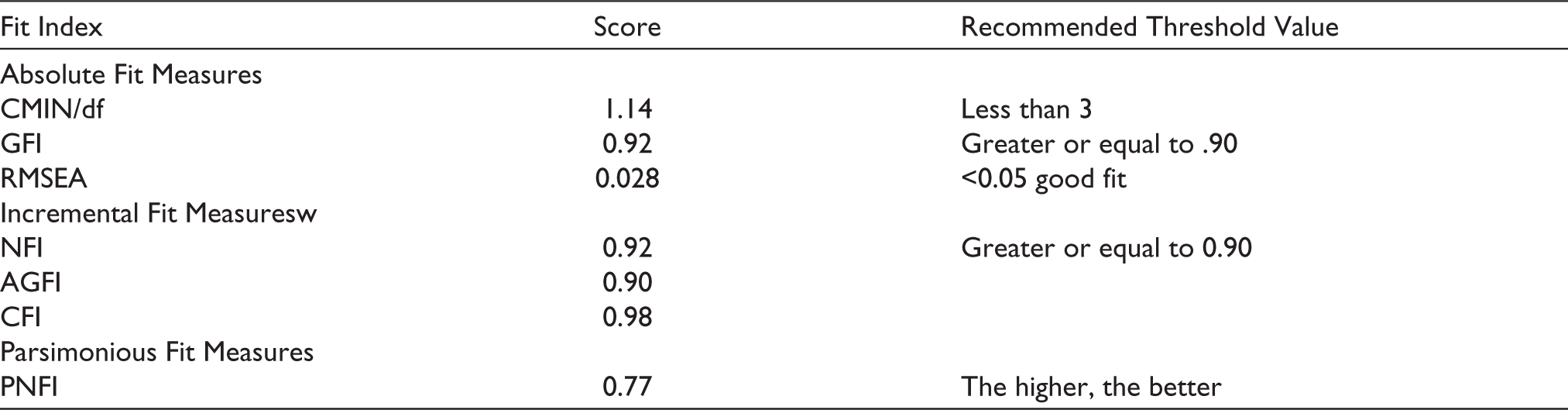
Following the determination of acceptable measurement model standards, the final structural model was designed and examined (Hair et al., 2014). We undertook hypotheses testing by proceeding to estimate the full model using structural equation modelling (SEM). The obtained model fit indices, such as the comparative fit index (CFI), the goodness of fit index (GFI), adjusted goodness of fit index (AGFI) and root mean square error of approximation (RMSEA) were in the acceptable ranges (Hair et al., 2014; Kline, 2005). Table 4 gives the fit indices of the model. For testing the mediation hypothesis (H4), we ran a bootstrap analysis with a 95% bias-corrected confidence interval and 1,000 samples in AMOS. The following section discusses the results of the study.
Overall Fit Indicators of the Model.
Results
The results of hypotheses H1, H2 and H3 were found based on the SEM analyses in AMOS (Table 5). The nature of the relationships was statistically significant. Hence the proposed hypotheses H1, H2 and H3 were accepted.
SEM for H1 –H3.

Testing Mediation Effect
Bootstrapping in AMOS was done to test the indirect effect of SCJD on JS through job-based PO. The mediation analysis is reported in Table 6. The indirect effect of SCJD to JS through PO was found to be 0.245. The corresponding bias-corrected confidence intervals (LB = 0.105, UB = 0.473; 95% CL) showed no zero at p < .01; hence the significant indirect effect was established. To determine the nature of the mediation effect, we examined the direct effect of SCJD on JS (b = 0.30), which was significant at (p < 0.01). Hence, PO partially mediated the relationship between SCJD and JS.
Mediation Effect for H4 (Bootstrap 1000 Samples, 95% BC).

Discussion
The current study empirically tested a model with PO mediating the association between crafting by SCJD and JS among a representative sample of Indian IT employees. Descriptive statistical data (Table 1) shows that the constructs depict acceptable mean and standard deviation values. In addition, the AVE values for all the latent variables are higher than the inter-construct correlation indicating the discriminant validity (Table 2). The HTMT ratio also signified the discriminant validity (Table 3). Structural equation modelling was used to test the hypotheses. In AMOS, the CR (critical ratio) of regression estimates are considered for the significance of the proposed relationships.
The hypotheses of the study were framed and tested by considering the constructs operating at the individual employee level. Table 5 shows that SCJD emerged as an antecedent of PO (b = 0.54, CR = 5.90), supporting Hypothesis 1. This is in line with the results of prior studies which have examined the relationship (Tsai, 2021). Thus, the role of a job crafting element viz., SCJD on achieving the job-based PO of the employee was attested in the present study. Also, the relationship between SCJD to JS is 0.51, which supports H2. Thereby, the role of SCJD as an active way toward achieving JS was supported, which was in line with prior studies (Rudolph et al., 2017; Tims et al., 2013). Hypothesis 3 supported the significant relationship between PO and JS (b = 0.57, CR = 6.30). In the present study, it was found that PO did share a positive relationship with JS. This aligns with previous studies (Van Dyne & Pierce, 2016; Zhang et al., 2021) and holds among knowledge workers in the Indian IT sector.
In hypothesis 4, we predicted that PO would foster the association between proactively SCJD and JS as a mediator. The derived results support the study hypothesis H4, which was accepted. The results aligned with previous findings on job crafting, satisfaction and well-being outcomes and established the mediating role (Shenavar, 2017; Tims et al., 2012; Tsai, 2021). Our findings show that a sense of PO can play a critical role in determining JS in conjunction with employee proactivity by seeking challenges to grow at work. It can be used as a learning mechanism that increases JS.
JS is a vital facet of employee happiness and can impact employee turnover intent (Basol & Demirkaya, 2017; Chavadi et al., 2021). Our study is among the first to show that PO in the workplace can raise the overall employee JS of those involved in proactively SCJD. This points out a symbiotic relationship between the study variables. By proactively SCJD, the worker creates an opportunity to accumulate more opportunities that can be instrumental in gaining access to resources at work. Our study clarifies existing research by identifying job-based PO as a mediator for understanding the associations between active crafting and JS in the Indian service sector. Hence this is a novel facet of the study.
Theoretical Contributions
The academic interest in investigating the relationship between job crafting and positive employee outcomes is growing, especially in the wake of the pandemic. A significant segment of these studies concerns the influence of job crafting as a whole (Rudolph et al., 2017). It is primarily concerned with work engagement as a consequence. Only a few have explored the independent sub-dimensions of the crafting process. The study thus makes a critical input to the growing knowledge base by positing the individual facet of crafting for challenging demands as a mechanism to achieve JS.
Shukla and Singh (2014) remarked upon the scant examination of the antecedents of PO in the Indian context. This study thus strives to address this concern. Moreover, it further helps proposition our stand on the need to examine the nature of employee-organization relationships, particularly concerning workers in the subcontinent. We further contribute by adding PO as a mediation variable in doing this. PO enables more proactive seeking challenges at work with boosted satisfaction. Thus, this study helps frame the outlook that JS can be attained by employee proactivity by SCJD and influenced by the sense of PO arising from the pursuit of the job itself.
Practical Implications
The present study has implications for the Indian IT and ITeS industry and the employees interested in exploring the benefits of proactive crafting. First, the Indian IT and ITeS industry may adopt job crafting strategies to maximize JS. Allowing the employees to take the onus for their job can lead to a healthy sense of PO, boosting employee satisfaction. Second, various studies have shown (Shukla & Singh, 2014) that PO is crucial among Indian IT professionals. Linking and expanding the knowledge base of the study variables (SCJD, PO and JS) can help employees and managers understand the benefits of seeking challenging assignments and act as a guide to designing training programmes discussing the benefits of allowing the employee to exhibit a degree of self-initiative.
Limitations and Suggestions
As a preliminary investigation among service sector professionals in India concerning the evidence of the occurrence of job crafting, this study reveals limitations that may kindle future research. First, the respondents were restricted to service sector workers associated with the Indian IT industry, limiting our findings’ generalizability. Future research may address this by examining other sectors of the Indian economy and testing the relationships. Second, though, to an extent, it was mitigated by following appropriate research guidelines, the potential of common method bias cannot be ignored entirely. Finally, given the cross-sectional nature of the research, future researchers may undertake interventional or longitudinal studies to confirm causality.
Footnotes
Declaration of Conflicting Interests
The authors declared no potential conflicts of interest with respect to the research, authorship and/or publication of this article.
Funding
The authors received no financial support for the research, authorship and/or publication of this article.