



Abstract
The purpose of this study was to examine the factors determining consumers’ attitude towards social media advertising. The survey research design was employed as the research design. Validity and reliability of the measures were assessed using confirmatory factor analysis. Additionally, structural equation modelling was used to examine the structural model. Credibility, materialism, value corruption and corporate reputation are found to have an effect on consumers’ attitudes towards social media advertising. This study provides evidence of the role of corporate reputation in consumers’ attitudes towards social media advertising. Recommendations of the study have been provided.
Keywords
Introduction
Consumers’ attitude towards advertising in general has been of much interest to both past and contemporary researchers. Elliot and Speck (1998) and Zanot (1984) noted that consumers’ attitude towards advertising had been dynamic over the years, mainly from positive to negative. Elliot and Speck (1998) found that most of the advertising-related communication problems such as hindered search and disruption, which relate more to negative attitudes and advertising avoidance, are shown on TV and in magazines. La Ferle and Lee (2002), in their comparative study investigating consumers’ attitude advertising in China and America, found that consumers in most Chinese communities have favourable attitude towards the social effect of advertising while Americans have the most negative one. Earlier, Schlosser, Shavitt and Kanfer (1999) noted that some consumers have a positive attitude while others have a negative attitude towards Internet advertising. This means that consumers’ attitude towards advertising is inconclusive and differs from one culture or environment to the other. In recent years, scholars have taken a keen interest in social media advertising, which can be defined as application of social media tools to create awareness, persuade and educate consumers about a firm’s products and services. Issues such as qualitative analysis of posts and comments and their relationship to effectiveness (Muntinga, Moorman & Smit, 2011; Smith, Fischer & Yongjian, 2012); drivers of positive online consumer reviews (Chen, Scott & Wang, 2011); extensions of existing consumer behaviour models in the social media context (Steyn et al., 2011); or correlation among psychological factors and social media advertising (Chu & Kim, 2011) have been investigated. This might be because the Internet and its related technologies like social media provide a great platform for firms to advertise their products and services (Drèze & Zufryden, 1997). Similarly, studies investigating the factors affecting consumers attitude towards social media advertising have found product-related information, entertainment (Watson, Akselsen & Pitt, 1998) or social role, materialism, value corruption (Pollay & Mittal, 1993; Shirazi, 2013) as key factors influencing consumers’ attitude towards social media advertising. Although, studies investigating consumers’ attitude towards advertising abound (Elliot & Speck, 1998; La Ferle & Lee, 2002), it appears that studies involving corporate reputation as an antecedent to consumers’ attitude towards social media advertising and its relationship are scanty. This study introduces corporate reputation as a determinant of consumers’ attitude towards social media advertising; corporate reputation has been found to influence consumers’ behavioural responses (Nguyen & Leblanc, 2001). Again, La Ferle, Edwards and Lee (2008) assert that consumers from developing countries have a more positive attitude towards advertising in general; however, it is not certain if the same can be said of social media advertising. Furthermore, individuals’ attitude towards technology and particularly social media advertising appears to be context-dependent (La Ferle & Lee, 2002). Therefore, this study intends to bridge this lacuna by providing empirical evidence from Sub-Saharan Africa. The objective of this study is to ascertain the determinants of consumers’ attitude towards social media advertising. The rest of the article is divided into four sections. The next section presents a literature review while the section after that provides the methodology. The third section presents the findings and the last section presents discussions and conclusions.
Literature Review
Social Media Advertising
Social media advertising has been defined as web advertising that assimilates users’ information like pictures in the advertisement (IAB, 2009). According to Cormier (2010), social media platforms account for 23 per cent of online advertising. It has been employed by some museums to promote their services (Kidd, 2011). Social media provides a platform for companies to advertise their products across the globe (Okazaki, Taylor & Zou, 2006) at an affordable cost. Again, according to a 2010 Social Media Marketing Industry Report 2010, most (56 per cent) marketers are now employing social media to promote their products and services (Neti, 2011). This might be because it provides consumers with personalized information, but it is sometimes seen as an ‘intruder’ (Stone, 2010). Twitter, Facebook, LinkedIn and blogs are the major social media platforms that marketers have employed over the years to advertise their products and services (Neti, 2011).
Consumers Attitude towards Social Media Advertising
Attitudes towards an advertisement are defined as ‘a learned predisposition to respond in a consistently favourable or unfavourable manner toward advertising in general’ (MacKenzie & Lutz, 1989, p. 49). Similarly, Ajzen (1991) defined attitude as an individual’s favourable or unfavourable assessment with using a particular service. Attitude towards social media advertising can therefore be defined as a consumer’s like or dislike for mobile advertising. Consumers’ attitudes towards advertising are key determinants of efficacy of advertising (Mehta, 2000). Voorveld and van Noort (2014) found that using social network sites and television concurrently in a single campaign yields a more favourable response than using these media individually. They explained that people see advertising as less persuasive when the two media are used concurrently than when used individually. This means that the kind of media used for advertising has an influence on the behavioural response of consumers. A number of variables have been found to influence consumers’ attitude towards social media advertisements. For the purpose of this study, the following variables were considered: credibility, materialism, value corruption and corporate reputation.
Credibility
Moore and Rodgers (2005) reveal that the level of believability or trustworthiness of the medium influences how the consumer views the credibility of the information offered. This is to say that, the customer’s ability to trust a social media advert depends on whether or not he/she trusts the social medium used. Furthermore, if consumers do not trust or believe the media, they are less likely to pay attention to either the content or the advertised product (Johnson & Kaye, 1998; Zha, Li & Yan, 2015). Some scholars (Schlosser et al., 1999) believe that online advertising seems to be more credible than traditional media advertising. On the contrary, Todd (1998) believes that authenticity of online is of great concern to Internet users. Brackett and Carr (2001) note a relationship between trustworthiness of online advertising and consumers’ attitude towards online advertising. It can therefore be concluded that consumers’ perceived credibility of social media advertising would influence their attitudes towards social media advertising.
Materialism
Materialism has been defined as the belief that one’s possessions is pivotal to the individual’s happiness and social progress (Belk & Pollay, 1985) and serves as a source of joy. Similarly, Richins and Dawson (1992) defined materialism as a ‘set of centrally held beliefs about the importance of possessions in one’s life’ (p. 308). The term ‘materialism’ as conceptualized by Ashikali and Dittmar (2012) encompasses the desire for a lifestyle associated with image, fame and success, as well as an emphasis on wealth and possessions. Pollay (1986) earlier has postulated that advertising increases materialism among consumers. Lasch (1978) also makes the accusation that advertising influences people to find life’s meaning in the products they purchase and that advertising manufactures a product of its own: makes the consumer perpetually unsatisfied, restless, anxious and bored. Some previous studies have shown the relationship between traditional media and the extent of a consumer’s materialism (Ger & Belk, 1999) partly because media is source of information for consumer decision making. Similarly, Chang and Zhang (2008) found materialism as a determinant of consumers’ attitude towards online gaming. Park, Burns and Rabolt (2007), found that materialism as a causal variable for consumer attitudes and behaviours towards online purchases. Therefore, it can be concluded that materialism predicts consumers’ attitude towards social media advertising.
Value Corruption
Pollay and Mittal (1993) value corruption states that advertising appeals do well to reinforce the seven deadly sins (that is, greed, lust, gluttony, envy, sloth, pride and anger) rather than they do to the seven cardinal and theological virtues (that is, prudence, temperance, justice, fortitude, faith, hope and charity). Web advertisements can demoralize the values parents intend to impress upon their children. Web advertising has the power to mould users’ values; hence, its potential to corrupt the values of its users. On the contrary, Bridis (1998) postulated that value corruption is a serious user concern prompting a business segment of its own: ‘ad blocker’ software that prevents advertisements from appearing on a web page. Wolin, Korgaonkar and Lund (2002) believe that online advertising like social media advertising has the ability to shape Internet users’ values, and therefore corrupt them. Pollay and Mittal (1993) found value corruption to negatively affecting consumers’ attitude to advertising. Therefore, it can be argued that there is a negative relationship between value corruption and consumers’ attitude towards social media advertising.
Corporate Reputation
Fombrun (1996) defined corporate reputation as an individual’s overall emotional attachment to a firm and include the total estimation how much consumers and other stakeholders uphold a particular firms. It has also been defined as the degree of trust (or distrust) in a firm’s ability to meet customers’ expectations on a given attribute (Nguyen & Leblanc, 2001). Corporate reputation is therefore the ‘value’ of a firm in the sight of its customers. Hsieh, Pan and Setiono (2004) concluded that corporate reputation affects consumer behaviour. In this case, consumers’ attitude towards social media advertising, it can be argued, is influenced by corporate reputation. It influences their judgement of credibility of information provided on the social media (de Ruyter & Wetzels, 2000). From these, it can one is save to conclude corporate reputation is a key determinant of consumers’ attitude towards social media adverting.
Methodology
Research Design, Sample and Data Collection
This study used the survey research design. This design enabled the researchers to collect data with respect to the characteristics, opinions and attitudes of consumers towards social media advertising. A total of 480 responses were obtained out of which 441 were valid and therefore were used in the final analysis. Table 1 provides the demographic characteristics of the respondents. Most (44.9 per cent) of the respondents were within the age range of 28–37 years. Again, a majority (56.0 per cent) of them were degree holders while most (58.5 per cent) of them were males. Additionally, many (35.4 per cent) have 3–5 years working experience. The items measuring credibility were adapted from Chowdhury et al. (2010). Similarly, consumers’ attitude towards social media measures was adapted from Taylor and Todd (1995) while those of materialism were adapted from Richins (2004). Value corruption and corporate reputation measures were adapted from Pollay and Mittal (1993). The items were measured on a five-point Likert scale (1 = strongly disagree, 2 = disagree, 3 = neutral, 4 = agree and 5 = strongly agree). The means and standard deviation for the constructs have been provided in Table 2. With the exception of credibility (3. 070) and materialism (2.850), all the constructs had means near 4.0. Again, all the standard deviation values are below their respective means.
Measurement Model
To assess the goodness-of-fit of the measures, confirmatory factor analysis was performed using Lisrel 8.5. Again, the factor loadings of items and the Cronbach’s alphas of the constructs were assessed. The chi-square/degrees of freedom (χ2/df) is 2.72, the comparative fit index (CFI) is 0.94, the non-normed fit index (NNFI) is 0.93, standardized root mean square residual (SRMR) is 0.056 and the root mean square error of approximation (RMSEA) is 0.054. All these fitness measures met the acceptable threshold (see Bagozzi & Yi, 2012; Scott, 1995).
Demographic Characteristics

Descriptive and Reliability

Again, all the factor loadings were above 0.60 and there was no cross loadings while all the Cronbach’s alphas met the acceptable 0.70 threshold (see Table 2). This means that the measurement model has achieved convergent validity and discriminant validity and is free from common method bias (Bagozzi & Yi, 2012). Additionally, the composite reliability (CR) and the average variance extracted (AVE) values (see Table 3) are acceptable (Bagozzi & Yi, 2012; Scott, 1995). Again, as shown in Table 4 all the AVE values exceeded the squared correlations among variables. Consequently, the measurement is acceptable to warrant further analysis.
Structural Equation Modelling
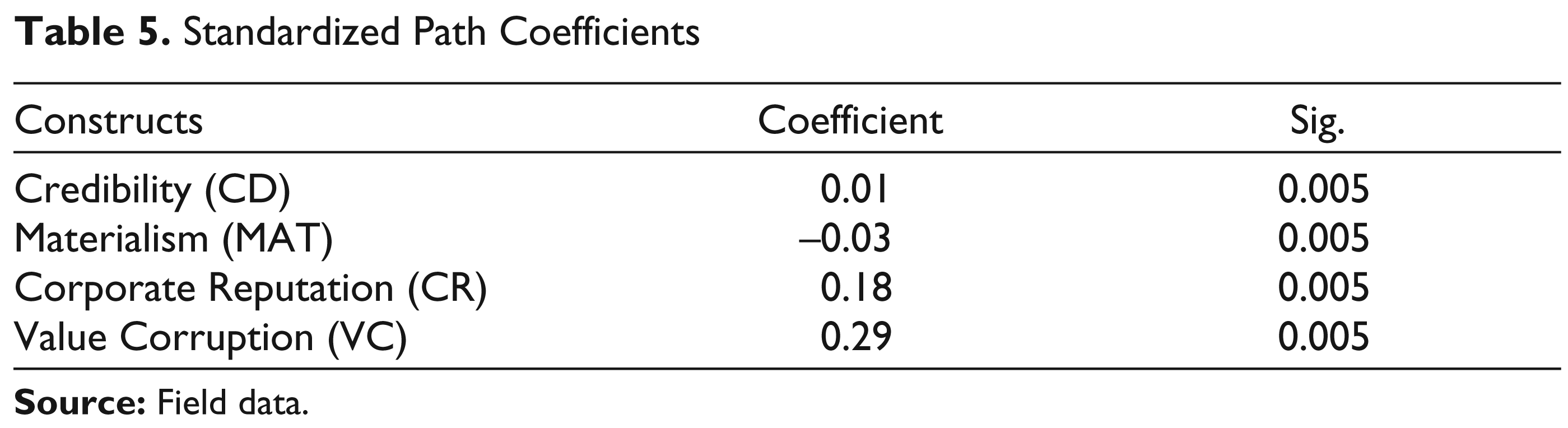
Structural equation modelling was performed to examine the effect of the predictor variables (credibility, materialism, corporate reputation and value corruption) on consumers’ attitude towards social media advertising. The R2value was 0.82 denoting that the model explains by 82 per cent of the variance in consumers’ attitude towards social media advertising and this is very substantial and significant (p < 0.05). The standardized path coefficients for constructs are as follows; corporate reputation is 0.18, credibility is 0.01, materialism is −0.03 while value corruption is 0.29 and all these values are significant (p < 0.05). This indicates that value corruption predicts consumers’ attitude towards social media advertising more than the other variables. The findings also indicate that, a unit increase in the value (thus free of nudity and leading people to buy quality products) will improve consumers’ attitude towards social media advertising by 29 per cent. The result also means that as consumers become less materialistic, they will develop a negative (3 per cent) attitude towards social media advertising. As indicated earlier (see Table 2) the respondents were not materialistic. Additionally, the findings indicate that, a unit improvement in corporate reputation will improve consumers’ attitude towards social media advertising by 18 per cent. Furthermore, credibility was found to be the least (1 per cent) determinant of consumers’ attitude towards social media advertising (See Table 5). This might be as a result of corporate reputation among the predictor variables. The consumers probably believe that since the advertisement is been sponsored by a reputable firm, it is trustworthy and credible (Nguyen & Leblanc, 2001).
Composite Reliability (CR) and the Average Variance Extracted (AVE)

Discriminant Validity Test

** Correlation is significant at the 0.01 level (2-tailed).
* Correlation is significant at the 0.05 level (2-tailed).
Standardized Path Coefficients
Further analysis shows that a majority (25 per cent) of the respondents are likely to buy mobile phones that are advertised on mobile advertising. Again, 18.1 per cent indicated their willingness to buy computers and accessories that have been advertised on mobile advertising. Table 6 captures a list of products that consumers are likely to buy through mobile advertising.
List of Products

Discussions and Conclusions
This study has found credibility, materialism, value corruption and corporate reputation as factors that drive consumers’ attitudes towards social media advertising.
Specifically, this study found a positive relationship between credibility and attitudes towards social media. Consumers like social media probably because they belief it is has no risk and they can trust the information provided in social media advertise media. This means that in order to reduce the perceived risk associated with social media advertising, companies employing social media advertising must be credible themselves (Moore & Rodgers, 2005; Nguyen & Leblanc, 2001). The companies would have to create a good impression on the minds of the consumers by fulfilling its promises to consumers (Brackett & Carr, 2001).
Materialism was also found to have a negative relationship with attitude towards social media advertising. This is probably because the consumers are not delighted in material possessions. As Chang and Zhang (2008) argued when consumers are more materialistic they develop a positive attitude towards advertising. This is because advertisements provide them information on where they can buy or access their desired products or services (Ger & Belk, 1999).
Furthermore, contrary to Pollay and Mittal (1993), this study found a positive relationship between value corruption and consumers’ attitude towards social media advertising. This is probable because the consumers belief that social media advertising does not take undue advantage of people or leads people to buy inferior products (Bridis, 1998). Again, it can be that social media advertisements contain little or no nudity (Pollay & Mittal, 1993). This implies that advertisers employing social media should censor the advert; ensure that the content of the advertisement is free of nudity. Again, products’ advertised on social media should be of good quality and should not be misleading.
Additionally, consistent with some existing studies (Hsieh et al., 2004; Nguyen & Leblanc, 2001), this study found corporate reputation to have a great impact on consumers’ attitude towards social media advertising. Consumers’ attitude towards social media depends on the experience that the company creates in every encounter with the customer (Nguyen & Leblanc, 2001). They are likely to have a positive attitude towards social media advertisement by a company that is concerned about its customers (Nguyen & Leblanc, 2001). This means that building a good corporate reputation is necessary for firms that intend to employ social media advertising.
One of the limitations of this study is that, it employed a cross-sectional survey meanwhile this area of research is evolving, therefore future studies may employ a longitudinal survey design. Again, future studies may explore more other variables that can equally predict consumers’ attitude towards social media advertising.