



Abstract
Social media advertising (SMA) is burgeoning and of great importance to both practitioners and academicians to understand how to build a corporate image (CI). The present study examined how organizations in Kenya build their CI through SMA and how consumers respond and behave towards it. This study purely relied on structured questionnaires, which were administered to research subjects. In all, 512 students were part of the survey. The data was first keyed into EpiData 13.0 software and then exported to Stata for quantitative analysis. The researchers used Stata in the data analysis because of their familiarity with the software in analysing data. The findings show that consumers have a favourable response towards SMA of companies in Kenya, which suggest that they can help companies build a good CI. This research has theoretical as well as practical value for the research community and managers. From a developing country perspective, understanding how to build CI, SMA and consumer response (CR) would be critical for both local and foreign firms. This knowledge will enable companies to craft effective marketing strategies on social media in meeting consumers’ needs.
Introduction
The growing academic literature recognized the benefits of building corporate image (CI) in an organization. The issue of CI has received considerable attention in the academic literature, dating back as far as the 1950s (cf. Baskin & Aronoff, 1988; Boulding, 1956; Denbow & Culbertson, 1985; Martineau, 1958; Olins, 1991). Early researchers such as Newman (1957), Martineau (1958), Kunkel and Berry (1968) and Aron (1960) researched on the subject of CI by looking at retail stores. Baskin and Aronoff (1988) defined CI as the ‘processes of corporate image production and audience consumption of an organisation’s image’ (p. 63). Moffitt (1994) explains that image is not just the symbolic factors, for example, logo, name or visuals of the organization, but also includes all the aspect of the organization that stakeholders observe as unique to the company. Martineau (1958) identified two main factors which underpin image when he conducted a study on the image of retail stores. The two main factors are functional and psychological factors. Martineau posits that the functional factors deal with price ranges, credit policies, store layout and other factors which separate the store from competitors. The psychological factors deal with the sense of belonging, customer friendliness, customer care and customer satisfaction.
Additionally, literature of CI identifies models such as articulation model of meaning (cf. Bennett, 1986; Gramsci, 1985; Hall, 1986; Moffitt, 1994) and the adapting meaning to image also (see Gramsci, 1985; Hall, 1986; Moffitt, 1994). These models looked at the kind of memories (i.e., positive or negative) held by stakeholders towards an organization. For instance, a study conducted by Tran, Nguyen, Melewar and Bodoh (2015) shows customers had a positive image towards brands such as Coca-Cola, Virgin, Intel and McDonalds simply because of how these brands have been communicated and positioned in the minds of their customers. Also, another theory that has gained root in the CI literature is Shee and Abratt (1989) model of the CI management process, which has three stages in the order of ‘corporate personality’, ‘corporate identity’ and ‘CI’ (cf. Abratt & Mofokeng, 2001). Albeit, studies have looked at enhancing brand image (Poon Teng Fatt, Wei, Yuen, & Suan, 2000), development and management (Abratt & Mofokeng, 2001) and CI formation process (Tran et al., 2015), yet little is known in the academic literature concerning building CI and social media advertising (SMA). The study, therefore, fills the gap in the academic literature by examining how to build CI through SMA and how consumers behave towards it and respond from a developing countries perspective.
Social media research within the academic community is on the increase of late (see Boateng & Okoe, 2015a; Diwakar, 2016; Patra, 2015). Social media phenomena are receiving much attention because of how it has altered the business landscape since its introduction (Diwakar, 2016). Many businesses have been forced to adapt to this new wave, transforming how businesses are conducted (Boateng & Okoe, 2015a). As such, businesses have no option but to re-strategize their marketing campaigns to effectively reach their customers. It has been observed (cf. Chi, 2011) that some oganizations have started devoting their resources and time into SMA. Research by Rodgers and Thorson (2000) shows the power of SMA in responding and checking the behavioural responses of social media consumers. Several scholars (such as Boateng & Okoe, 2015a, 2015b; Briggs & Hollis, 1997; Chu, Kamal, & Kim, 2013; Li, Edwards, & Lee, 2002) have noticed that a good SMA has the potential of creating a good image in the minds of consumers. So, well-crafted SMA messages could lead to a good CI and eventually a good brand. For example, Li et al. (2002) and Chu et al. (2013) observed that for SMA or online advertising, consumer’s reaction is critical. Similar research by Karson, McCloy and Bonner (2006) and Li et al. (2002) confirm the relationship between consumers’ attitude towards SMA and how they respond. Researchers such as Zinkhan, Menon, Deshpande and Perri III (2003) and Roberts and Dowling (2002) suggested that favourable marketing campaigns lead to a favourable attitude towards the firm and eventually building a good image of the organization. Research by Gupta, Melewar and Bourlakis (2010) shows that a positive behaviour towards a brand translates to a good brand. However, those with negative behaviour will lead to disapproval (Durvasula, Lysonski, & Watson, 2001). It is against this background that this study argues that when there is a favourable SMA from organizations, there is a possibility of customers responding favourably which will, in turn, improve their CI and then build a strong brand. Actually, Gray and Balmer (1998) found out that good CI predicts performance of an organization.
Critically, for organizations in Kenya and elsewhere in the world to achieve good CI and brand, it is important to allocate resources to SMA in order to have a favourable response from customers which will translate into a good image and, subsequently, good corporate performance. For example, companies such as Coca-Cola, Microsoft and McDonalds are continuously increasing their marketing expenditure on SMA (Balmer, 1998). Smaller companies are also increasing their SMA budget to enable them reach their customers. Interestingly, most Kenyan companies are yet to tap into the potential SMA in building their CI. SMA is also new to most of these companies who are now trying to learn how to explore its usage. Some businesses are currently committing resources and time in understanding the dynamics of SMA. However, there is little empirical research and information to guide these companies. This makes the study timely and important for most organizations in Kenya and also in the East African corridor. Though some studies have looked at social media in general in Kenya, this study is the first to specifically look at building CI through SMA. The current research will inform organizations on the current trend of SMA in Kenya and other parts of the world with similar conditions. Researchers such as Durvasula et al. (2001) and La Ferle, Edwards and Lee (2008) noted a difference in attitude from one country to the other as far as SMA is concerned. As already stated, the study of SMA in Kenya is still in the formative stages and, therefore, the need for empirical studies on this (Karson et al., 2006).
The aim of this article is to provide empirical evidence from Kenya on how to build CI through SMA, attitude and response from customers of social media. The rest of the article is divided into following sections: (a) literature review; (b) methodology; (c) findings; and (d) discussion of findings and conclusions.
Literature Review
Corporate Image (CI) and Social Media Advertising: An Overview
In the early 1950s, scholars introduced the notion of CI. Early researchers (such as Abratt, 1989; Eells, 1959; Greenberg, 1961; Hildebrandt, 1988; Polkinghome, 1976) have researched on CI from various perspectives. Most of these earlier research studies were looking at the image of retail stores. For example, Martineau (1958), Hildebrandt (1988) and Mazursky and Jacoby (1985), empirically tested CI of stores and observed that CI improves the performance of retail stores. Earlier studies were, however, limited to retail stores. Some researchers (see Belt & Paolillo, 1982; Gray & Balmer, 1998; Rynes, 1991) conducted empirical studies on CI and the applicant’s willingness to apply for a job. Their findings revealed a favourable relationship between a good image and a jobseeker’s willingness to apply to a particular organization. Interestingly, their findings also show that organizations with good image are more likely to attract top-notch employees. For example, Gray and Balmer (1998) indicated that companies such as Microsoft, J. P. Morgan and Merck are the beneficiaries of attracting top-notch employees as a result of a good image and reputation. This means that a good image attracts highly productive employees which leads to high performance and competitiveness. With regards to CI, Boulding (1956) established an organizational construct with ‘functional’ and ‘emotional’ meanings (Kennedy, 1977a, 1977b). Martineau (1958) demonstrated in the context of retail stores that consumers who could relate to their retailers’ projected image were more likely to purchase. Gray and Balmer (1998) also defined CI as the ‘mental picture of the company held by its audiences when asked what comes to mind when one sees or hears the corporate name or sees its logo’ (p. 696). To create this mental picture, Gray and Balmer (1998) advocated for key things creating desired image and a good reputation. The idea of creating the desired image is to position the organization in the minds of the target audience through products and service offerings. In this way, the customer will identify the products and services with this particular organization. Reputation is vital to the success of the organization, and Gray and Balmer posit that quality products and services should be the hallmark of an organization. It has been established that a negative reputation has negative consequences on the organizational performance.
The CI literature provides some selected theories which have shaped the discourse on CI. For example, theories such as Dowling’s (1986) model of image formation process, Shee and Abratt’s (1989) CI management process, Van Riel’s (1995) corporate programme and Balmer’s (1998) corporate identity formation have helped in providing better understanding of CI. These theories are still relevant to the discussion of CI today. Shee and Abratt’s theory holds that building image starts with the corporate personality, then corporate identity and, lastly, the CI. According to Shee and Abratt, corporate personality is the foundation for building CI. It deals with the organizational culture and the philosophy which is upheld by all employees of the organization. Stated differently, this stands for the vision and mission of an organization. The second stage deals with the corporate identity, and it is essentially about efficiency and effectiveness in communicating the organizational philosophy or the vision and mission to your target audience or stakeholders. For example, it deals with presentation of communication messages, that is, what to say, who to say it, when to say it, etc. In a nutshell, this stage deals with the communication and information management of processes of an organization. In the third and last stage of Shee and Abratt’s model, ‘the image interface represents the point of contact between the various stakeholders and the company’ (Shee & Abratt, 1989, p. 73). This stage explicates the nexus of audience experiences when they encounter the organization which creates image for the organization. A review of these three theories demonstrates that Shee and Abratt (1989) provide an overarching theoretical basis crucial for this research. This research is grounded on the key premises of the Shee and Abratt’s model which posit how to build a good CI through efficient and effective communication. The next talked about model in the CI literature is the Balmer’s (1989) model of corporate identity formation. This model holds that for CI and identity to manifest, in an organization, it first starts with corporate identity through corporate communication. This then creates CI and reputation which eventually leads to competitive advantage of the organization.
The extant literature discussed earlier suggests that communication plays a key role in building brand image as rightly put by Balmer (1989, p. 696) that ‘strong image can be built through a coordinated image-building campaign that encompasses a formal communication system; name, logo, signage, corporate advertising, and public relations’. The focus of the current investigation is to look at how SMA can be leveraged to create a good CI and presence. This is because with the introduction of SMA, the conventional way of communicating through advertising to the target audience stands altered (Duffett, 2015). Hence, this makes it important for the study to look into how SMA could influence CI in a developing country like Kenya where it is still uncharted. The rest of this section discuss issues in SMA.
In the contemporary business environment, marketers cannot afford to overlook the impact of social media in their communication and how it has affected the interaction with customers. Social media has changed the conventional way of communicating with clients and will continue to have a greater impact on the way organizations do business (Duffett, 2015). Currently, social media has transformed the way organizations retain and maintain customers (Leung, Bai, & Stahura, 2015). Traditionally, marketers use media such as televisions, print radio, etc., to reach out to their customers through well-crafted communication messages of their brands. Conversely, social media has changed this traditional way of communication, shifting the entire marketing communication strategy for most companies today (Duffett, 2015). This is making the orthodox way of communicating redundant. Interestingly, most people have also lost interest in paying attention to the traditional channels since the advent of social media (for more details, see Duffett, 2015; Leung et al., 2015). Several definitions have been identified in the social media literature. For the purpose of this study, we adapted the definition provided by Kaplan and Haenlein (2010) who defined social media as a group of ‘Internet-based applications that build on the ideological and technological foundations of Web 2.0, and that allow the creation and exchange of User Generated Content’ (Kaplan & Haenlein, 2010, p. 61). They gave examples such as Wikipedia, YouTube, Facebook and Second Life as forms of social media. Many more social media platforms make it possible for marketers to communicate with their customers, popularly known as SMA.
According to Interactive Advertising Bureau (IAB) report (2016, p. 23), SMA is ‘delivered on social platforms, including social networking and social gaming websites and apps, across all device types, including desktop, laptop, smartphone, and tablet’. The report grouped online advertising into digital audio, digital video advertising, mobile advertising and SMA. The report also provided highlights on the various formats of advertising. For example, banner advertising, emails, search and lead generation. The IAB (2017) reported in their first quarter report that digital advertising in the USA raked in earning of US$19.6 billion, first ever, which increased by 23 per cent (US$3.7 billion) for the same period in 2016 and represented the second-highest quarter of all time. This is an indication of how marketers elsewhere are channelizing their resources and putting efforts into digital marketing, which their counterparts also in Kenya and other developing countries should learn to explore.
Corporate Image (CI), Social Media Advertising and Consumer Response
The concept of CI is not new in the academic literature. Researchers such as Newman (1957), Martineau (1958), Kunkel and Berry (1968) and Aron (1960) have studied image of retail stores and the performance of such retail stores. These past researchers (see research commentary of Dowling, 1993; Gray & Balmer, 1998; Greyser, 1999; Markwick & Fill, 1997; Marziliano, 1998) noted that a good image and reputation leads to trust and credibility which makes an organization unique in the eyes of stakeholders. Further, they observed that good image and reputation is a source of competitive advantage for the organization and contributes to the survival of the organization. They also indicated that building image should not just be a lip service but rather, when properly managed and worked on, leads to sustainability and survival of an organization. Review of the academic literature shows that CI and reputation complement each other. For example, Balmer’s (1998) model of managing corporate reputation and image present us with the perfect example of CI, corporate reputation and advertising in general. This model shows how companies should develop and build CI and reputation which would help them to be more competitive and lead to performance (for more details, see Balmer, 1998). Researchers such as Poon Teng Fatt et al. (2000), Abratt and Mofokeng (2001) and Tran et al. (2015) have all conducted studies on CI in general from different perspective. However, studies on CI and SMA is lacking in the academic literature. Though, noticed earlier that CI and reputation go hand in hand, some researchers (cf. Boateng & Okoe, 2015a; Caruana & Ewing, 2010; Rutsaert et al., 2013) have looked at reputation and SMA and have found a favourable relationship between corporate reputation and SMA and CR. Their studies show that a favourable response from consumers leads to a good reputation of the firm, which translates into performance of the company. Based on this observation, the study would not be wrong to argue that consumers of SMA will respond to it which will lead to building a good CI.
SMA and Consumers’ Attitude
The study proceeds to examine what the extant literature talks about SMA and consumers attitude towards SMA. Before discussing SMA, let us examine what conventional advertising is all about. Researchers like Armstrong and Kotler (2000) observed that advertising is first of all paid for through various channels of media (i.e., radio, television, billboards, newspapers, etc.), a non-personal way of promoting products and services which are traced to a sponsor. Advertising using these orthodox channels has some disadvantages as observed by definition provided by Amstrong and Kotler. Some disadvantages outlined are that it is expensive, no instant feedback and can also result in wrong audience targeting. With the introduction of social media, organizations can eliminate these barriers of traditional communication channel (Mulhern, 2009). Past research (see commentary of Li et al., 2002; Mitchell & Olson, 1981) shows that there is a relationship between consumers attitude towards advertising and their responses. They posit that this could be negative or positive towards advertising.
The academic literature on SMA shows that scholars such as Schlosser, Shavitt and Kanfer (1999), La Ferle and Lee (2002), Chandra, Goswami and Chouhan (2012), Hudson and Thal (2013), Carrillat, d’Astous and Morissette Grégoire (2014), Duffett (2015) and Boateng and Okoe (2015a, 2015b) have investigated this subject from different countries’ context with different corollary. So, contributing to this ongoing academic discourse on this subject will also bring the Kenyan experience to the discussion to enrich the literature on SMA. For example, an earlier study conducted by Schlosser et al. (1999) was of the view that consumers’ attitude towards SMA could be positive or negative. This suggests that more research is needed in this area since depending on the specific context in which the study is carried out, there is likelihood of getting different outcomes. Researchers like La Ferle and Lee (2002) in their study of Chinese and Americans, show that Chinese have a positive response towards advertising while their American counterparts show the opposite. Another similar study by Bannister, Kiefer and Nellums (2013) confirmed the result of La Ferle and Lee (2002), which indicates a negative attitude of US college students towards Facebook advertising. Also, Yaakop, Anuar and Omar (2013) studied 357 undergraduate students of cognitive interactivity versus advertising avoidance of students’ attitudes towards Facebook, and the result was a mixed feeling (i.e., both negative and positive) towards Facebook. Meanwhile, a study conducted by Mir (2012) found a different result. Mir (2012) conducted a survey with 300 students of Islamabad, Pakistan to examine their attitude towards SMA and found a positive response towards it. These findings are also in line with findings of Azeem and ul Haq (2012), Wang and Sun (2010) and Wolin, Korgaonkar and Lund (2002).
Fairly recent researchers (see, e.g., Boateng & Okoe, 2015a, 2015b; Duffet, 2015) have found a favourable response towards SMA by users of social media network sites. For example, Boateng and Okoe (2015a) examined the moderating role of reputation on SMA and consumers response and noticed that the former plays a key role in building a good reputation of an organization. Though there are various outcomes concerning SMA and consumers’ responses, current studies are showing a different trend which means depending on where the study is carried out, it is likely a different outcome will emerge. This presents us with more reasons why the study is important in the context of Kenya as well as in the academic literature on CI and SMA.
Contextualization of our Study to the Kenya Situation
Scanning through the literature on social media in Kenya, researchers such as Ndavula and Mberia (2012), Wyche, Schoenebeck and Forte (2013) and Nyamboga (2014) have looked at social media in general in Kenya. For example, Nyamboga studied social media on journalism in Kenya by examining some of the challenges, opportunities and threats it present to the people of Kenya. In that study, it was revealed that most people have accepted the use of social media among Kenyans, and the most frequently visited sites were Facebook and Twitter. In addition to these findings, the study also shows that journalists can share instant information online, become watchdogs, share pictures and break news through the use of social media. The study also commented on the important role of social media during crisis. The study cited Kenya bloggers (like Ory Okolloh, Hersman, Rotich and Kobia) who developed social media platforms for people to share and contribute their opinions, concerning the post-election violence during the 2007/2008 elections. Also, the result shows that social media such as Facebook provided the opportunity for Bunge la Mwananchi movement (‘People’s Parliament’) to organize 50,000 followers. A study conducted by Wyche et al. (2013) in rural Kenya on the use of Facebook shows that the rural folks were aware and knowledgeable of Facebook. The study suggests that more than half of the people who took part in the study used social media and those who are not also want to be part. Also, in their study, Facebook is the most visited site by most of these rural dwellers. The study pointed out that these rural folks used Facebook for activities such as connecting with friends, share photos, chat, etc. Wyche et al. (2013) identified the cost of Internet as the main challenges facing these rural people when it comes to the use of social media. Wyche et al. (2013) indicated that these people are low-income earners and paying for Internet is a big issue.
Theoretical Framework and Hypothesis
Based on the extant literature, Figure 1 discusses a theoretical framework showing various constructs upon which the present study is based.
Based on Figure 1, the following hypothesis is formulated.
H1: SMA will positively mediate the relationship between behavioural response and CI.
Methodology
This study used cross-sectional research design. The study employed convenient sampling to obtain the required sample size for the study, which is in line with similar study conducted by (Boateng & Okoe, 2015a). Convenient sampling approach facilitates data collection easily and is focused on those who want to be part of the process of filling the questionnaire. This study was conducted among students in the University of Nairobi, Kenya. University of Nairobi is the largest public university in Kenya, located in Nairobi. A team of five research assistants were trained on administering questionnaires and recruit participants for the survey. The study targeted students who were working and knew the meaning of CI. The data was collected between 5 pm and 8 pm, when the evening classes were in session. Albeit, there are several satellite campuses of University of Nairobi (UON), the study was conducted at the main campus of the university where most of the workers attended their lectures. The survey questionnaires were self-administered with the help of trained researchers. The entire data collection exercise took two months. In all, 670 students participated in the study, however, only 512 responses were used for this study. The data were double entered into EpiData version 3.1 software for cross-validation purposes. The entered data was then exported to Stata version 13.0 and Microsoft Excel for data analysis. EpiData is considered to be widely useful by organizations to create and analyse a large amount of data, and Stata was chosen because the authors were very familiar with it. We presented the descriptive statistics using frequencies, means and standard deviations in table formats. Structural equation modelling (SEM) was performed to examine how SMA will positively mediate the relationship between behavioural response and CI. All study findings were considered statistically significant at 5 per cent level of significance.

The study maintained high levels of research ethics. Oral, informed consent was sought from the participants before completing the survey questionnaire. All participants were free to withdraw at any point of time while completing the questionnaire. In this study, all the measures, apart from the demographic characteristics used in this study, came from previous studies. The items for consumer behavioural response were taken from Zeng, Huang and Dou (2009) and Sun and Wang (2010). The items for consumer attitude towards SMA was taken from Sun and Wang (2010), and finally that for CR were taken from Walsh, Mitchell, Jackson and Beatty (2009). Note that measurement items were anchored on a 5-point Likert scale with 1 being ‘strongly disagree’ and 5 being ‘strongly agree’.
Results
Descriptive Statistics
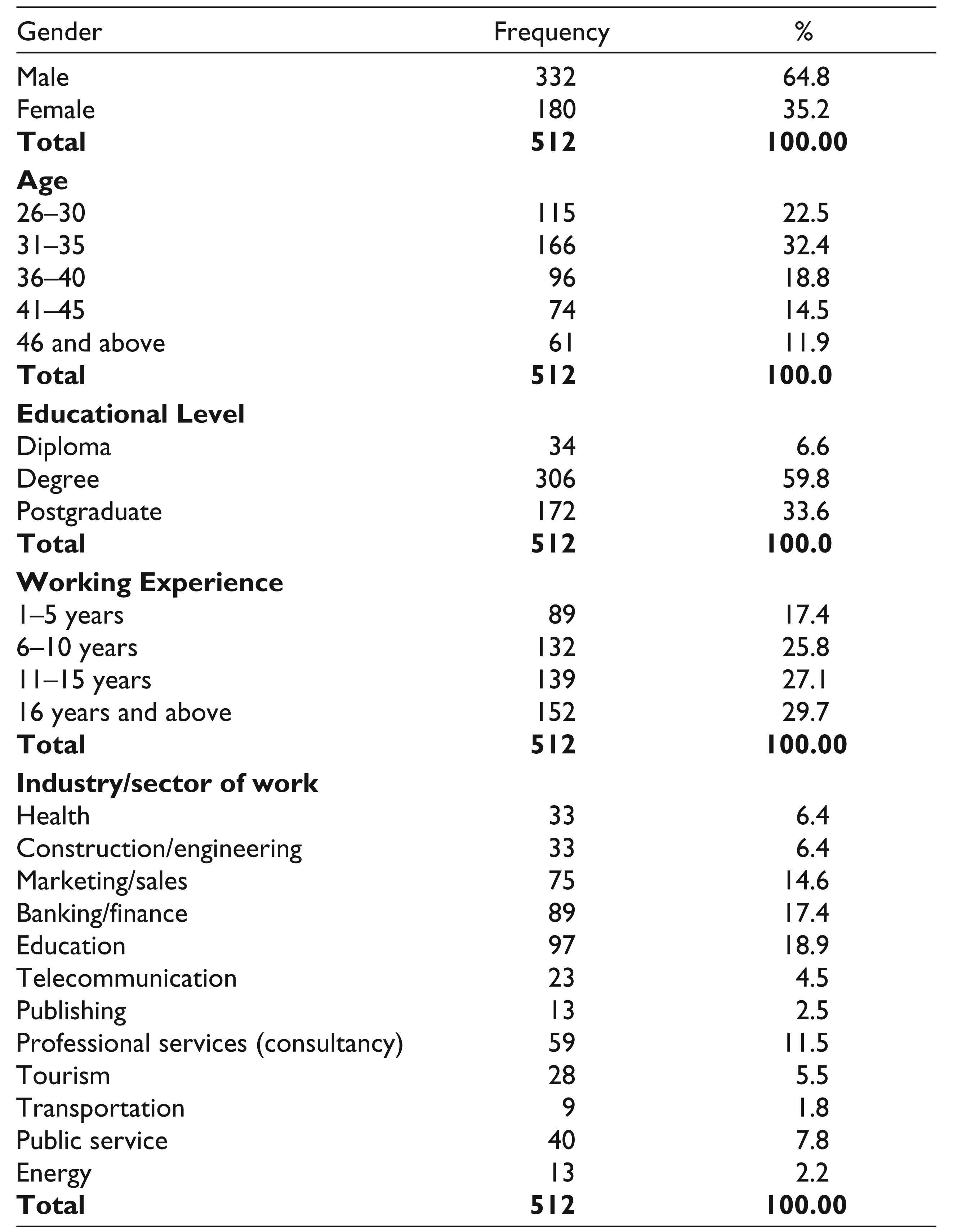
The study of characteristics of those surveyed (see Table 1) show that most of them were youth between 26 and 40, representing 73.8 per cent of the sample. Out of the 512 respondents, 64.8 per cent were male and 35.2 per cent were female, indicating low enrolment of women students for the evening lectures. Majority of the respondents were undergraduate students in various programmes offered by the university, which represent 59.8 per cent of the sample with 33.6 per cent undertaken by postgraduate students in different fields in the university. The majority of the respondents representing 82.6 per cent have been working in their respective fields for over five years.
Descriptive Statistics: Survey Respondents
Reliability and Validity of Measures
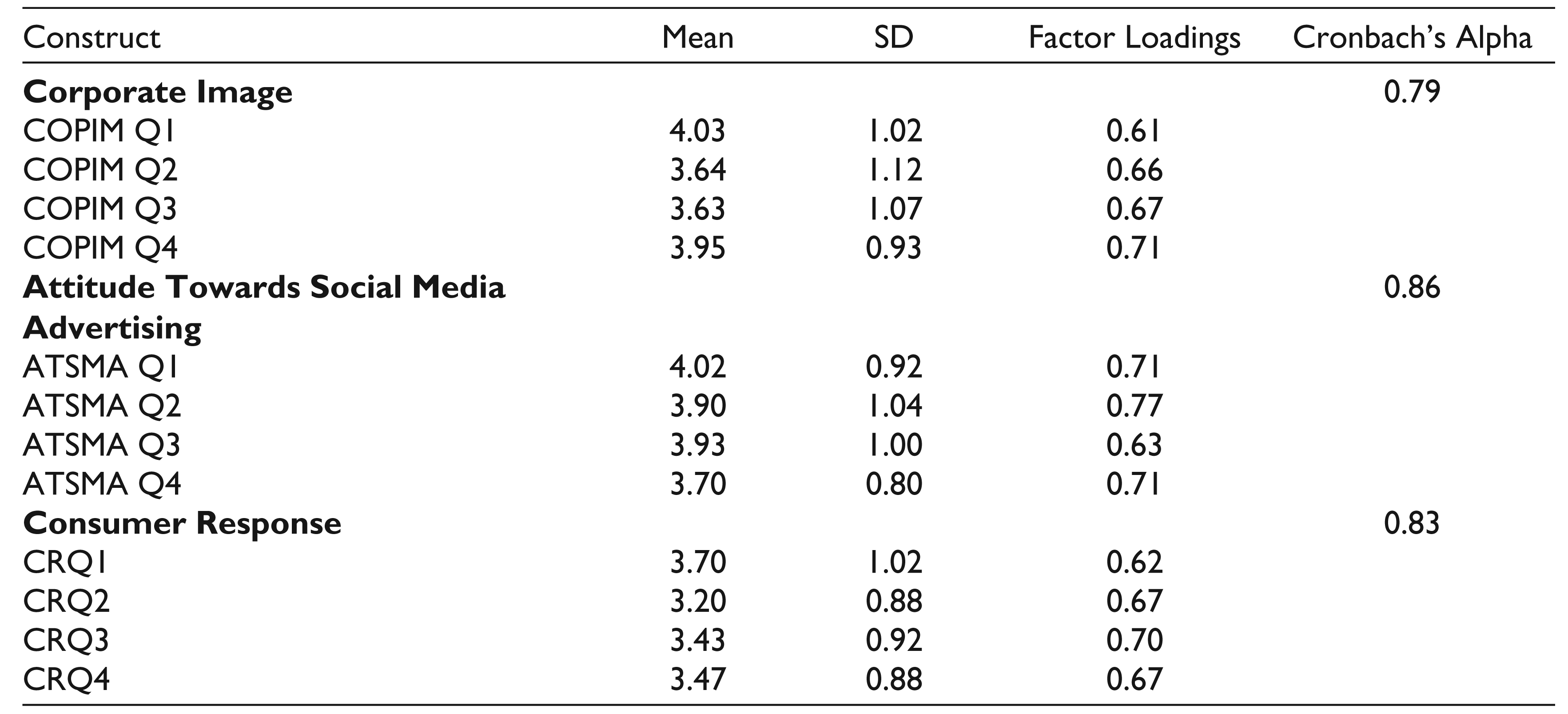
The study assessed construct validity using confirmative factor analysis (CFA). We report Cronbach’s alpha as measures of reliability (see Bagozzi & Yi, 2012). The result shows the composite validity for CI = 0.79, attitude towards SMA = 0.86 and CR = 0.83. For convergent validity, the least average variance extracted (AVE) value was 0.61. For discriminant validity, the study used the more popular Fornell–Lacker criterion (see Fornell & Lacker, 1981). From eyeball inspection of cross-loadings also lend numerical support to discriminant validity of research constructs. Again from Table 2, it can be observed that AVEs are greater than the squared correlations among constructs. Bagozzi and Yi (2012) posit that if the variables load high on their hypothesized constructs and low on the other constructs, the measure has achieved convergent and discriminant validity, and it is free from common method bias. As shown in Table 3, the factor loadings were high (above 0.6), and there were no cross-loadings. Moreover, the Cronbach’s alpha for all the constructs were above 0.7, indicating that the measures are valid (Hair, Black, Babin, Anderson, & Tatham, 2006).
Discriminant Validity Test

Furthermore, the chi-square (x2) statistics show 109.7 with a degree of freedom (df) of 51 (x2/df = 2., p < 0.0001. Since the chi-square is significant, the model fit displayed RMSEA = 0.054, CFI = 0.93, SRMR = 0.032 and NNFI = 0.94. The model was, therefore, valid and met respective thresholds (Bagozzi & Yi, 2012; Bentler & Bonett, 1980).
Factor Loadings and Cronbach’s Alpha
Multiple Regression Analysis
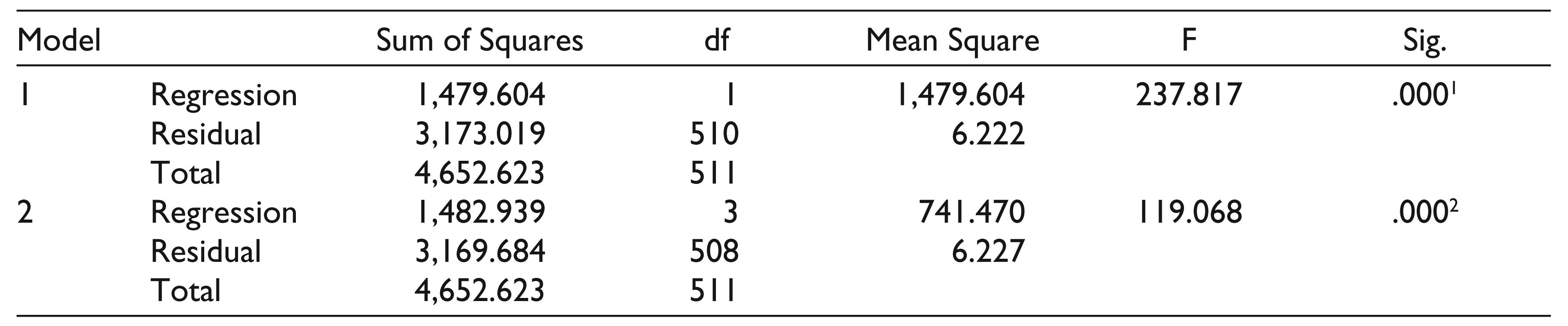
In the analysis, the study relied on hierarchical multiple regression to enable the study to examine the moderation effects of CI and ATSMA on consumers’ behavioural response. The moderation effect of CI (CR × ATSMA) was assessed in Step 1. The R squared change (ΔR2) = 0.32, F change (1,510) = 237.82, was significant, p < 0.001. This indicates that the interaction of CI and attitudes towards SMA explains 5 per cent of the variance in consumers’ behavioural response to SMA (Table 4).
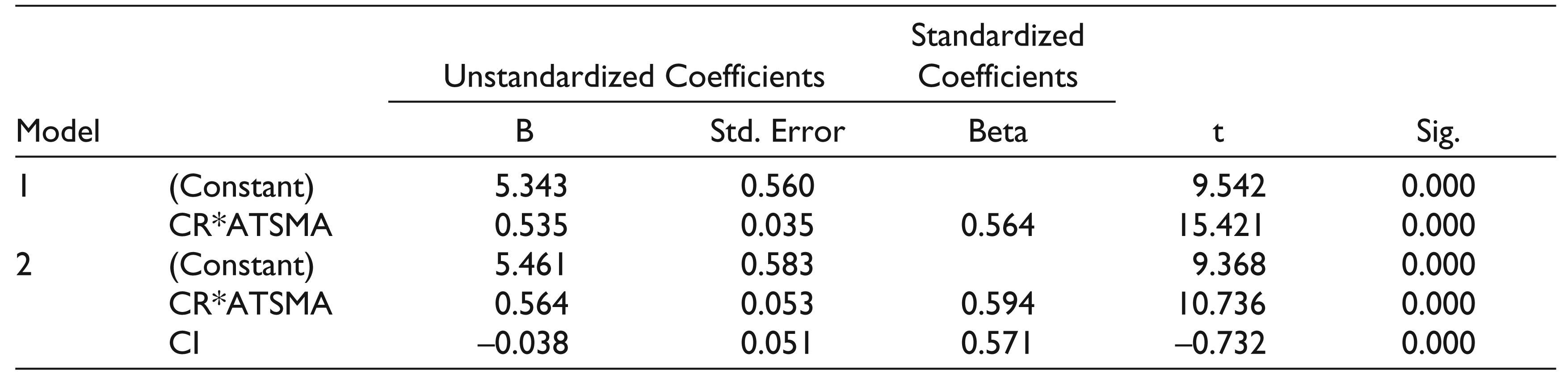
Also, in Step 2, CI and ATSMA were entered and the total variance explained by the model was 32 per cent, F (3,509) = 421.54, p < 0.001. Further analysis shows that, individually, CI and ATSMA significantly predict consumers’ behavioural response to SMA. ATSMA recorded a higher beta value (β = 0.59, p < 0.001) than CI (β = 0.57, p < 0.001).
The study suggests that a unit increase in consumers’ attitude towards online advertising has the potential to cause a 59 per cent favourable response to social media marketing. In the same vein, a unit increment in CI will bring about 57 per cent favourable response of SMA (Tables 5 and 6).
Model Summary

ANOVA
Coefficient
The study found out that though consumers have ATSMA, consumers will still consider the image created by the company before responding to an advert through social media by the company. This means that consumers may choose to ignore an advert coming from an organization which does not have a favourable image.
Discussions and Conclusions
The study aimed at providing empirical evidence from Kenya on how consumers will react towards SMA which will, in turn, build a good CI. To begin with, the study observed that consumers sample had a favourable behavioural response towards SMA from Kenyan companies which is consistent with findings of several studies (e.g., Boateng & Okoe, 2015; Duffet, 2015a, 2015b) who found a favourable response of SMA and CR. This study confirms the findings of earlier scholars (e.g., Boateng & Okoe, 2015a, 2015b; Duffet, 2015) who indicated that favourable behavioural response towards SMA leads to good image. Based on these findings, it is paramount on the part of companies in Kenya to exploit this potential. Evidence (see commentary of Balmer, 1998) suggests that a favourable response could lead to good image which eventually leads to performance and competitiveness of the firm. So, it is very important that companies in Kenya and other similar countries exploit and learn how to craft their advertising messages on social media which will appeal to their audience for them to respond favourably. In addition, there is evidence in the academic literature which shows that CI has influenced the picture held in the minds of target audience concerning the products and services of an organzation (Klein & Leffler, 1981). Also, CI helps people seeking employment to make decision on the kind of company to apply to and which ones not to, as demonstrated by the literature (see Balmer, 1998) that good CI attracts top-notch employees. This means that if companies in Kenya can build on their CI, they will be able to attract the best of employees which would enhance their performance, and the result would be profit to the organization. Another important aspect of CI identified by (Milgrom & Roberts, 1986) is the fact that investors consider the image of an organization before they invest in the organization. This means that companies in Kenya looking for investors need to pay particular attention to building a good image of their companies. This is because no investor will want to invest in an organization without any image which they also cannot trust.
Second, the study findings show that with favourable response from consumers of SMA, as our corollary turn to point out, this could lead to a good CI for most organizations in Kenya. This is in alignment with studies done by Boateng and Okoe (2015a), though on reputation. It is noted in the literature (for more details, see Abratt & Mofokeng, 2001; Balmer, 1998; Poon Teng Fatt et al., 2000; Tran et al., 2015) that favourable response towards SMA would lead to building a good CI by firms in Kenya for firms to remain competitve and outperform their competitiors.
This study, thus, contributes to research in SMA in the academia and CI and how consumers respond. At least, it has brought a different perspective to the discourse, especially from a developing country. Also, this study would help managers of Kenyan companies to understand the importance of investing resources and effort in understanding the dynamics of SMA and the opportunities it presents to them for building a good CI leading to enhanced firm performance.
As regards limitations, the study was limited to undergraduate and postgraduate students of University of Nairobi. Notwithstanding, the sample selected was suitable, as the participants were knowledgeable on the topic and came from various backgrounds regarding where they work and the functions they perform. In addition, the study recorded more males (64.8%) than females (35.2%). As a result, there is a possibility of gender skewness or bias.
As regards future research, it would be prudent for scholars to explore from a developing country perspective, the direction and impact of websites, online presence and mobile phones in building a CI. Lastly, a conceptual model can be developed to look at CI building, using social media in a developing country context. Also, for scholars in similar developing countries, similar study could be undertaken to broaden the discussion and provide a better understanding of behavioural response to CI building through SMA. This is because as our findings support some past researchers such as Duffet (2015) and Boateng and Okoe (2015a, 2015b). However, some other studies (e.g., La Ferle & Lee, 2002) produced different results. That is why it is essential for scholars to continue further research in this area in broadening the discussion on this important subject.
In conclusion, the present investigation helps in appreciating the role of SMA. Hopefully, the study will serve as a point of reflection for marketing managers of companies across the world.