



Abstract
The cellular phone has inaugurated a variety of foundational material and perceptual changes in our urban sensorium in the recent years. The rapid proliferation of the technology however also brought with it its own distinct set of ambiguities and anxieties. This article’s larger interest lies in tracing the recent emergence of two specific kinds of ambiguous figures in the cellular network—the anonymous terrorist caller and the unknown “lover” on the cell phone. While the former increasingly gets processed into various themes of surveillance and terrorism in recent Hindi films, the latter has begun emerging as a prominent presence in newer offsets of the romance genre. This article will first look at films like Aamir (2008) and A Wednesday (2008), instances where these menacing phone-presences untraceably maneuver the cellular network to activate, invigilate, and re-pace the movement of different sets of bodies throughout the city. In a film like Good Night Good Morning (2012) on the other hand, the incognito presences on the phone tend to usher in a radical and entirely novel form of romantic interaction.
The cellular phone has inaugurated a variety of foundational material and perceptual changes in our urban sensorium in the recent years. The rapid proliferation of the technology however has also brought with it its own distinct set of ambiguities and anxieties. This article’s larger interest lies in tracing the recent emergence of two specific kinds of ambiguous figures in the cellular network—the anonymous terrorist caller, and the unknown ‘lover’ on the cell phone. While the former increasingly gets processed into various themes of surveillance and terrorism in quite a few recent Hindi films, the latter has begun to emerge as a prominent presence in newer offsets of the romance genre. This article will first look at films like Aamir (2008) and A Wednesday (2008), instances where these menacing phone-presences untraceably maneuver the cellular network to activate, invigilate, and re-pace the movement of different sets of civic bodies throughout the city. In a film like Good Night Good Morning (2012) on the other hand, the incognito presences on the phone tend to usher in a radical and entirely novel form of romantic interaction.
The Discovery of (Cellular) India
In a description of a sample of life in Indian cities in the mid-1980s Anna Greenspan (2004, p. 4) recalls a time when C. M. Stephen, then communications minister of Prime Minister Indira Gandhi’s cabinet, could easily get offended when quizzed about the inadequacies of the telephone system in parliament, and reply that telephones were “a luxury, not a right… anybody who was not satisfied with the telephone system could return his phone” (cited in Menon and Nigam, 2007, p. 84). This in some ways is an indicator of the supine state the Indian telecom sector long wallowed in as the State maintained an unrelenting vice-grip over the allocation of telephone lines till right up to the late 1980s (Doron and Jeffery, 2012).
In 1985 however, Rajiv Gandhi’s government invited Sam Pitroda, an engineer and businessman based in the United States, and gave him complete control over the Centre for Development of Telematics (C-DOT) (Doron and Jeffery, 2013, p. 400). Pitroda’s brief was to develop the blueprint for the rapid expansion of local telephone exchanges across India. By 1994, the first National Telecom Policy of 1994 (NTP-94) was ratified by the government, which allowed private players to enter the field of national telephony (Ibid.). The “cellphone revolution” in India was purportedly flagged off in August 1995, as the then Chief Minister of West Bengal, Jyoti Basu made the first ever cell call to Union Telecom minister Sukhram, asking him to declare the Calcutta cellular network open. 1 Despite corpulent tariff ceilings initially, cellphone technology in India rapidly burgeoned to become a staggering success, its volume far surpassing even what satellite television had managed to amass over the last decade. Starting off as something of a status symbol that only the affluent could afford, 2005 saw the cost of a phone call plunging dramatically to as low as 1 rupee per minute. Despite a sluggish start, the ratio between landline telephones and cell phones was reversing at breakneck pace. In 2001 there were 36 million phone subscribers of which close to 75 percent were landline connections; in January 2010, there were over 688 million phone connections in India, more than 90 percent of which were now cell phone users (Ibid., p. 399). From Stephan’s comments about telephones being “luxuries,” the country was entering into a phase where businessman Dhirubhai Ambani could confidently claim that by making “a phone call cheaper than a postcard… you will usher in a revolutionary transformation in the lives of millions of Indians” (Ibid., p. 397). From a 5 million strong subscriber database in 2001, India became the second largest cell phone market in the world with a massive 881 million subscribers in 2012 (Joy, 2012). Today, cell phones promise the prospect of a complete media assemblage: they work as the most ubiquitous cameras, music players, Internet portals, credit cards, design pads, and a variety of other technologies.
As mobile handsets fast became ubiquitous (and cell phone companies gained massive muscle) the technology also increasingly became a part of various public events and prominent news narratives. From the Geelani trial (and numerous other “terrorism” cases, where evidence was often solely predicated on call records), to notorious celebrity fracas (actor Vivek Oberoi displayed his cell phone history in a press conference in 2003 claiming that Salman Khan had called 41 times), to colossal telecommunication scams (the 2G spectrum scam unearthed a whole range of government officials undercharging private telecom companies for licenses to the tune of 1766.45 billion), to dazzling intra-media stings (the sensational “Radia tapes” were recorded cell phone conversations between a political lobbyist Mira Radia with senior journalists, politicians, and corporate honchos), to MMS scandals (ministers caught watching porn in parliament, video clips involving school girls, actresses in sexual positions, etc.), cell phones have become an endemic part (and often, source) of various glaring public debates in recent years. 2 As a result, the technology appears in myriad forms in different kinds of cultural representations everyday.
Mobile Modernities: Cellular Bodies and the Materiality of Sound
Before modern telecommunications, topographical distances were mostly calibrated by approximating the time it took to move from one place to another. This sense of stable, self-enclosed geographical distances begins to gradually melt away in the recent years—the “place-centeredness” in our lives (Palen et al., 2001, p. 121) (the sense of inhabiting and belonging to a place) gives way to a sense of belonging to one’s “communicative network” (Geser, 2004, p. 13; cited in Rettie, 2005, p. 17). Cell phones instate their own topologies—electromagnetic networks with their own kinds of “material” facades, densely populated areas and deserted zones. Space gets entirely mitigated by the notion of “connectivity” to the network—the tiny “connectivity tower” icon at the top left of a cellphone screen becomes, in a way, the arch-metaphor of this new regime.
As a personal archive of text messages, contacts, music, pictures, and videos, the cell phone often becomes a distinctive source of intense emotional memory. Moreover, as mail/social media accounts (Facebook, Twitter, Instagram, and so on) and instant messenger services (BBM or WhatsApp) get accessed more and more via the cell phone, the technology becomes a crucial factor in thinking of contemporary individual memory. Joanne Garde-Hansen argues in My Memories? Personal Digital Archive Fever and Facebook (2009) that the main allure of these new technological platforms is that they can aggregate different kinds of memory practices into one place—creating and maintaining photo albums, sharing videos and photographs, joining groups, and constantly doing versions of the same on Facebook and Twitter (Sacasas, 2011). The cell phone can be seen as an instance of what Jacques Derrida has referred to as the “archiving archive” where the “technical structure of the archiving archive also determines the structure of the archivable content … The archivization produces as much as it records the event” (Derrida, 1996, p. 17; cited in Garde-Hansen, 2009).
As a result, the cell phone increasingly becomes a symbol of constant uninterrupted access. The traditional notion of “labour-time” (the limited duration for which the laborer’s body offers service potentiality) gets ceaselessly extended in a culture that presumes constant “contact” even beyond the confines of the work-space/hours (“switching off” the cell phone at night increasingly becomes an outdated practice). “Downtime” (periods with no telecom connection in intransigent places like air-flights) becomes a prominent new factor in the daily chartering of work-lives (Scholz, 2006). Our visual/spatial mode of ordering and arranging memory begins to shift according to this new geography of different mobile screen interfaces.
The norm of constant connectivity within the “cellular network” also radically alters notions of mobility. As cellphones now come equipped with GPS (global positioning system) and touch-screen mapping devices, a culture of performative navigational cartography emerges—users now have the capacity to co-create a dynamic haptic image layout of their navigation, all on the move. The tactile screen now becomes “the interface of an interactive architecture that (…) positions the user spectator in a material and spatial relationship to its surface and its imagery” (Verhoeff, 2012, p. 24). This sort of haptic experience of the tactile screen transforms foundationally the “notion and action of viewing itself” (Ibid.). The GPS creates a new complex between viewing, navigating, and action in day-to-day life—in other words, there is “a temporal collapse between creating images and perceiving them” (Ibid., p. 25).
Unsurprisingly, the better part of recent critical work on cell phones has often centered on the larger idea of “liminality.” When people are on the cell phone, “there is a sense of them being in more than one space at the same time”—they cleave their space, their temporal framework, and their attention to their immediate ecology (Case, 2007). Using Victor Turner’s idea of “liminality” to think about cell phones, while Amber Case talks of the creation of a “sub-zone,” Sadie Plant refers to this as a “by-psyche”: a new mode of presence-embodiment wholly unprecedented in human history where mental and physical space undergoes this constant process of miscegenation. 3 This regime of hybridity obviously ruptures the conventional dichotomies of public and private, ideas of etiquette and social behavior correspondingly. Taking a call during a conversation with someone is considered rude since it entails cleaving off the current place-time by interpolating a new virtual person replete with another simultaneous experience of space-time into one’s current physical environment. Conversely, inserting the impression of another absent person’s presence becomes a crucial gesture during other times (by women for example, pretending to be on the phone, in potentially unsafe areas) becomes common practice. 4 Fascinating in all these instances is the conscious production of decorporealized presences as interlocutors to the physical world (Case, 2007). These phone presences that can effect actual material changes by wielding the cellular network have been a source of constant fascination in the Bombay film industry in the last few years.
The Cell Phone Goes to the (Hindi) Movies
Movies, especially movie scripts, have had a largely uneasy relationship with cell phones. Most extant scriptwriters note that whole coteries of stock situations and plot-movements available for writers less than ten years ago are rendered untenable today given the presence of the device (See Lambie, 2010). Nearly every Hitchcock film would collapse altogether if characters had the facility to communicate with each other while on the move. 5 Various familiar stock “landline” situations in films—“cross connections,” sinister “blank calls,” conversations surreptitiously overheard on parallel lines, and so on, become instantly anachronistic. Cell phones, at the same time produce a new posse of narrative possibilities. Characters, located at disparate places physically, can now participate in the dramatic universe via the cellular topology. Its use precipitates various changes in film editing—the split screen stages a conspicuous comeback, as it becomes a prominent “hook” (aurally and visually) to structure and patch scenes together. While cellphones increasingly get mobilized in some films as the key final revealer/arbiter of concealed villainous identities—Kaho Na Pyar Hai (2000), Ghajini (2008)—in others it functions as a technological object that easily veils itself in various different technological forms—it turns out to be a remote control to explosives in Don (2006), a sonar in 16 December (2002), and so on.
The cell phone also featured prominently in crime/underworld films right from the late 1990s. Figuring in Ram Gopal Varma’s gangster trilogy—Satya (1998), Company (2002), and ‘D’ (2005)—as the primary communication network through which gangsters carry their local and trans-national dealings, the cell phone often served as a central catalyst for major narrative conflicts or crises in a number of these films. 6 In the more recent crime films a whole new paradigm of menacing “loudspeaker characters” begin to emerge. These are largely dehumanized, machine-like speaker-phone voices that intervene in the course of action in crunch dramatic sequences. In Abhishek Chaubey’s Ishqiya (2010) the mafia warlord Mushtaq seems to be in an odd conjugal relationship—he keeps getting calls from his wife throughout the film just moments before he is about to kill people. Mushtaq’s relationship with this phone-wife persona (who we never see) is suggested as a quaintly lyrical, typically old world romance, replete with Urdu couplets, poetry and unending ornate praises for the wife. The ring-tone in Mushtaq’s phone is ‘Ae Mere Zohra Jabeen’ (an old Hindi film song about undying love), they talk in a way that is distinctly reminiscent of old romantic Hindi films of a certain era, and the wife-voice performs an unmistakable coquettishness. Yet the irony becomes conspicuous as it becomes clear eventually that the wife is anything but the ordinary run-of-the-mill housewife. She advocates a level of violence that clearly even Mushtaq cannot abide by. She tells him to shoot the lead duo (who she otherwise refers to as her “brothers”) in the head and later reprimands him for procrastinating in killing them; issuing all her gruesome orders in the same half flippant, playful, and coquettish demeanor.
Similarly, right at the beginning of Vishal Bhardwaj’s Othello adaptation Omkara (2005) a voice on a loudspeaker stops an impending shootout and sets the base for what is to unfold through the rest of the narrative. As an enraged advocate, Raghunath Mishra, is on the verge of shooting the local warlord Omkara for abducting his daughter, Omkara’s aide Kesu Firangi gets a call. As Kesu puts the call on loudspeaker, a calm, motorized voice all of them reverently refer to as “Bhai Saab” (Naseeruddin Shah) speaks into the tense air as characters stand frozen, guns pointed at each other’s heads. The unruffled, congenial telephone voice placidly explains to the aggressors why it is imprudent for them to shoot each other. By the time the voice-of-god like phantasm emanating from Kesu’s hand stops speaking, all the guns are down, with the aggressors already ready to retreat. In a sequence in Vishal Bhardwaj’s gangster caper Kaminey (2010), the assassin duo, the Lobos, are about to shoot an airplane pilot at the behest of the smuggling don Tashi (Tenzing Nima). The bawling pilot begs them for mercy, offering his loyalty to Tashi (“main tashi ka pet dog banne ko taiyyar hun sir”/I’m ready to be Tashi sir’s pet dog). As the duo call Tashi and put him on loudspeaker, the whimpering pilot starts barking like a dog in front of the phone. Tashi (lying comatose on a luxury cruise near Goa, also on loudspeaker) responds by saying “But I only like bitches. Shoo.” One of the brothers immediately shoots the pilot dead. In stylistic terms, the loudspeaker voice becomes like the aural equivalent of the silhouette, or the slow motion within the grammar of powerful character-entries in Hindi films. As a de-corporealized, god like presence that can abruptly intervene and definitively change the course of action in distant places, the machine-like motorized phone voice takes on an awe-ful dramatic persona in a number of contemporary Hindi films.
There are also getaway bildungsroman films like Ashutosh Gowarikar’s Swades (2004) or Zoya Akhtar’s Zindagi Na Milegi Dobara (2011), where cell phones feature prominently. Characters undertake momentary holiday retreats from their frenetic cosmopolitan lives that result in potentially life-changing experiences. The cell phone functions as the last ritualistic tether binding them to their erstwhile urban everyday that they must let go off in order to start their life afresh. In Swades the cell phone becomes the protagonist Mohan’s (Shahrukh Khan) only link to his life as a NASA scientist in America while he comes to spend time with his childhood nanny in rural India. His increasing attachment with the village (and diminishing interest in life in America) is also traced by the changing amounts of interest he puts in to try and get “connection” for his international calls. Similarly, the cell phone becomes the only link the workaholic Rishi (Hrithik Roshan) has with his clients, as he and two friends hike across the bucolic Spanish countryside on a bachelor vacation. The cell phone gets specifically identified amongst friends as the only work-related hindrance in their peaceful holiday. Characters in all these films need to symbolically reject/cast off their cell phones to signal the unencumbered beginning of a fresh new chapter of their lives.
Cellular phones inaugurate a major change in different kinds of surveillance regimes. With the proliferation of digital electronics, the concrete physical nature of the surveillance model undergoes radical change, as power no longer remains exclusively territorial. The cumbersome structures of the panopticon then give way to an infinitely more dispersed version of power transactions; a condition that has of late increasingly been referred to as the “post-panoptical” (Deleuze and Guattari, 2009). Newer forms of control are characterized by their mobility, and deploy regimes of coded information to invigilate, anticipate, and direct the conduct of individuals across all walks of their everyday life. With these newer modalities of power, the manic emphasis on visual surveillance gives way to continuous monitoring of “data trails” subjects leave behind—call records, GPS information, banking details, messages, emails, etc.
Kabir Kaushik’s Seher provides a dramatization of the movement from a purely physical form of surveillance to a more post-panopticonic regime given the abrupt proliferation of cell phones and its incorporation in criminal activities in India in the late 1990s. Sehar is loosely based on the encounter killing of the notorious criminal Shiv Prakash Shukla who was allegedly killed by the newly formed Special Task Force of the Uttar Pradesh Police under DIG (Deputy Inspector General) Arun Kumar. 7 As notorious gangster Gajraj (Sushant Singh) begins using cell phones to conduct operations just around the time cellular technology makes its way into India, a hapless police force deploys a telecom professor Bakshi (Pankaj Kapoor) to train officers in telecom technology and initiate a surveillance wing. Kaushik’s film then traces the journey of the police team as it lets go of its earlier forms of trailing criminals, moving slowly toward an electronic regime of work. In the end, in what seems a moral rites of passage, it is Professor Bakshi who kills Gajraj after every one else from Kumar’s team is dead—it is the surveillance figure that in the end comes out of its purely scientistic pulpit in its effecting of violent police action. The following sections look at Aamir (2008), A Wednesday (2009), and Good Night Good Morning (2012) to trace the emergence of three distinct cell phone characters as the technology increasingly becomes a foundational part of mundane city life.
To Let It Ring: Cellular Bodies and Terror in Aamir
Raj Kumar Gupta’s Aamir (2008) is set in a period where, unlike Sehar, cell phones are a ubiquitous feature in everyday urban life. Aamir (2008) revolves around a day in Dr Aamir Ali’s (Rajeev Khandelwal) life, who is returning to India after practicing medicine in the United Kingdom for four years. On alighting at the Mumbai airport, Aamir is surprised to see that his family is not there to receive him. Instead, two men on motorbike fling a cell phone at him, which begins ringing. On answering, he discovers that his family has been kidnapped and he has to follow instructions given by the voice on the phone to ensure their safety. From here on, Aamir is plunged into the filthy by-lanes and nooks of the old Muslim parts of Mumbai, within which whole swathes of people seem to be helping out in a sinister plan. The film culminates with Aamir realizing that the red briefcase he has been asked to leave in a crowded bus is a bomb. In a final defiant move, he runs with the briefcase to a construction site nearby, in the process sacrificing himself as the bomb goes off.
It is precisely the quotidian ubiquity of the cell phone that threads the impossibly intricate network of surveillance that Raj Kumar Gupta’s film imagines. Ordinary people in banal jobs all collude through seemingly insignificant actions to move toward the larger composite event. The amorphous communal crowd—the Muslim everyman—becomes the terrorist in Aamir, while the titular character is the renegade refusing to get inducted into the collective. This impregnable circuit maintains an extremely tight knit information relay network, instated and navigated by a universe of hundreds of cell phones. What gets formed is a new sort of “aural materiality”—an anonymous menacing phone presence that threatens extreme physical danger and can precipitate the movement of different material agents across the city purely by the dint of its voice. It is this ominous cellular network it wields that the character Aamir struggles to disambiguate throughout the film. The final gesture of resistance against this sort of a cellular antagonist then is the act of not picking up the phone, of becoming “unreachable.” 8
Aamir gets inserted into the territory of the cellphone “network” the minute he steps out of the International airport and into the city of Mumbai. As he is made to navigate into the heart of the bedraggled parts of old Bombay, Aamir increasingly gets a sense that he is continuously being watched and that various people in the places he is led to are fully in on the mysterious plan—the taxi driver seems to know that the outgoing is locked on his cellphone, the restaurant owner has reserved a seat for him, the road corner paan-wallah he purchases dry dates from appears to be expecting him, and even the waiter at the restaurant sternly refuses to give him water. This sense gets intensely heightened when the phone-voice asks him why he isn’t eating the dry dates, just at the moment he slips the packet of dates into his pocket. A flabbergasted Aamir immediately looks around frenetically, now certain that every action of his is being closely watched by the phone voice. The view he is confronted with is of droves of people on the phone in the busy market place, all of them prospective sinister “eyes” that might be surveying every action of his.
Steven Bruhm’s work suggests that processes of embodied presence/absence that a cell phone conversation inevitably entails have in recent times been increasingly mobilized by films to construct atmospherics of fear and horror (Bruhm, 2011). Bruhm looks at two particular films from the 1970s—When a Stranger Calls (1979), and Black Xmas (1974), both slasher horror films where killers call victims from landlines before murdering them—and their remakes which came out in 2006, in which the psychopaths use cell phones to communicate with future victims (Ibid.). Bruhm notes that in the 1970s’ films, the psychopath and hero/ine (usually sorority girls or babysitters) were envisioned as singular autonomous beings locatable in stable and clearly demarcated spaces exclusive of each other. As long as the heroines were on the phone with the murderers, they were assumed to be free from their grasp, the telecommunication structure itself guaranteeing the non-collapsible distance between them (the horror ofcourse came from the landline itself being located nearby, like in When A Stranger Calls where the murderer is calling the babysitter from the children’s room next door after killing them). Cell telephony however radically alters the “phantasmatic quality of the interlocutors presence” since the killer can now be right behind you, and “more often than not, is” (Bruhm, 2011, p. 605). The fear around cell phones stems from the infinite possibilities of the floating voice freed from the hindrance of space—the inherent “ability to be a phantasm but at the same time to be deracinated as phantasm” (Ibid.) as and when it desires. Bruhm observes that while the terrorism of fixed-line telephones rendered the domestic home of the 1970s an unsafe, potentially ominous place, contemporary cell phone based narratives enable the danger to radiate outwards—pervasively reaching everywhere, “like waves from a cell tower”:
In the archive of twenty-first-century telephone terror films, cellphones cut the domestic chord: terror spreads to cars, guesthouses, parks, hospitals, into other people’s cellphones and computers, and eventually into other states and countries. Murder (or terrorism) has become viral and self-replicating, claiming as its ultimate victim the speaking—or telephoning—subject. (Ibid., p. 604)
Michel Chion’s idea of the “acousmatic” might be useful to explore in this context. The acousmatic is a sound that one hears without being able to identify its origin or source (Chion et al., 1994). Chion suggests that acousmatic sound disorients the listeners sense of space and position as the acousmetre, that is, “the phantasmatic producer of sound often seems to emanate from both the listener’s head and outside it” (cited in Bruhm, 2011, p. 610). This acousmatic voice, however, retains its incredible power and capacity to invoke fear and awe only till the time it cannot be pegged to a body, and remains a de-corporealized, ethereal figure (Ibid.). In films like When A Stranger Calls (1979), Phone Booth (2002), Samay (2003), and Joyride (2001), the voice remains a potent threat only till the point it remains veiled as a voice; the moment de-acousement happens (the voice gets re-secured to the physical body) the quality of power starts withering, as the aural entity gets re-humanized.
In Aamir, however, the opposite happens. The acousmatic sound seems even more terrifying because it emerges out of what seems a panoply of extremely banal lives. It seems not just a voice that controls the crowd but a consummation of it—the exemplary will of a complex network of taxi drivers, sex workers, restaurant owners, and waiters, grocery shop owners, PCO booth attendants, garment shop owners, etc. As if underneath the visage of the pedestrian lives exists a deadly pestilent cult, a clandestine life all of them collusively share in—no matter who you are, how square you look, and how hackneyed a life you seem to lead, you lead a terrifying obfuscated double life in subterfuge. The only visible marker of that subterfuge network is the cell phone. The two epistemic phone questions: “who are you?” and (more significantly, in the case of cell phones) “where are you?” yield paralyzing answers in Aamir—everyone and everywhere within the Muslim lower class world.
The central cog of this entangled structure in Aamir is the cell phone. A web of cell phones constantly updates the mysterious phone voice, perpetually giving Aamir the sense that the furtive voice can also constantly see him no matter where he goes—the voice knows he tries calling his family when they don’t show up at the airport, that he is chased by a police officer, and that he throws up after visiting the Bhendi Bazaar toilet. Even more eerily, just like information flows from the dispersed cell phone web to the primary phone voice, it also seems to flow the other way around—the usher at the hotel knows that Aamir was thirsty back at the restaurant, the businessman handing him the red briefcase knows Aamir has a habit of asking pesky questions, and so on. The cell phone network is a busy crossway of different forms of information—the kingpin constantly reads out information for Aamir from other cell phone sets near him, minor characters respond to Aamir’s questions with a cryptic reply: “phone ayega”/A call will come, and it is through the codes of numbers he is made to call that he begins to gauge just how wide the network is (he has to call an ISI official’s residence in Pakistan). 9 Interestingly, the only time Aamir’s life seems to slip into chaos, chance, and coincidence is when he seems to be off the cell phone radar briefly—he gets mugged, his briefcase gets robbed, and he gets into a bloody brawl. At the end however, it is suggested that even this momentary plummeting into a space of contingent chance was infact scripted by the cell phone network. It is as if the cell phone network becomes fate, a supra-human agency controlling and plotting Aamir’s life, and the answer to the aphoristic question the film begins with, “Kaun Kehta Hai Aadmi Apni Kismat Khud Likhta Hai”/who says man writes his own destiny? (Image 1) 10 It is the cell phone network in Aamir that writes his destiny for the better part of the film.
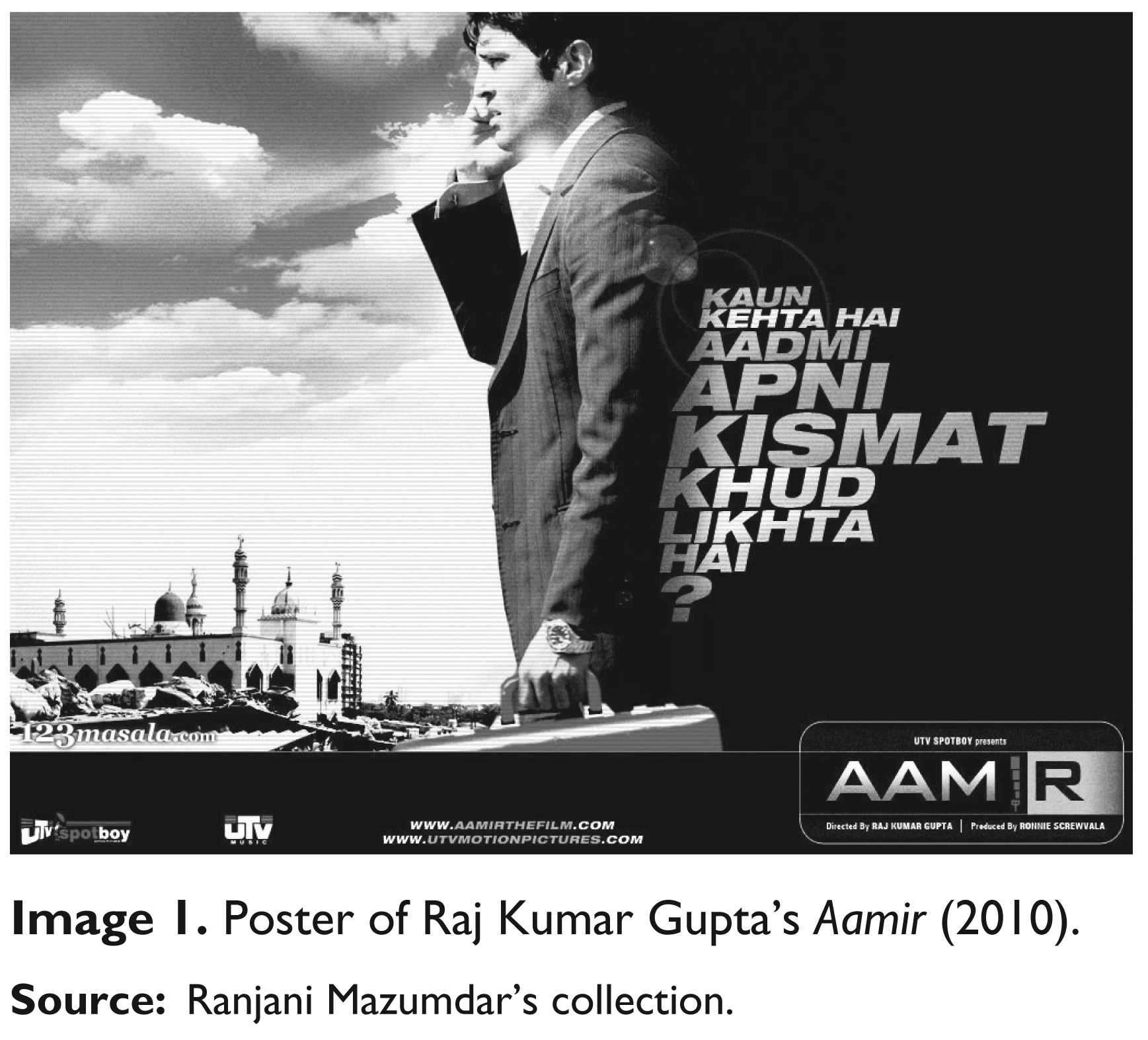
The next question to ask then is, who constitutes this network? Most critical responses to the film have pointed to the blatant communal stereotypes it mobilizes. From the very beginning, an unequivocally palpable connection is made between a particular community’s putative way of life and the fostering of terrorism. Aarti Wani, Kuhu Tanvir, and Ranjani Mazumdar have pointed to the specific use of Islamic iconography to create a climate of paranoia and revulsion in the film (Mazumdar, 2011; Tanvir, 2010; Wani, 2009). 11 The most noticeable concatenation between terrorism and religion is seen in whatever little we see of the Kingpin—he is seen folding a Namaz mat, cutting out newspaper stories about deaths of Taliban members, advises Aamir to eat dates just like the Mughals used to before setting out for battles, and admonishes him for not having read the Shariat. At one point he is seen with a toddler wearing a skull cap sitting on his lap, a nod perhaps toward a future generation of Muslims in the country getting the “Taalim”/education he hopes to give Aamir a sample of. These are the markers of the historical lineage that the whole invisible population manning the cell phone network apparently inherits.
Coming in touch with the cell phone network abruptly yanks Aamir from the antiseptic environments within the airport (and London) into an incredibly filthy, unhygienic set of endemically “Muslim” spaces of chawl bathrooms, meat markets, waste yards, and so on. It is as if the vermin-like quality of life in these spaces extends into a sort of demonic moral and political degeneration of the people breeding within it. The physical scum in the landscape for Raj Kumar Gupta is but an echo of the scum in the human material, and we are made to respond with equal measures of revulsion to both. What we actually see in Aamir is not so much the threat of an Islamic culture of terror, but a modern liberal terror of culture in Aamir. 12
Recent social history would have us believe that cell phones and geo-politics of class are not entirely unrelated. 13 Nearly all post mortem analyses of recent blasts at urban centers are articulated in the language of conspiracies. Cell phones have proved to be an integral part of the investigation scripts in nearly all the major “terrorist blasts.” Post blast investigations abound in detailed information about mysterious labyrinthine networks unveiled by following cell phone records. A lot of these phone trails often reveal their originary points in urban locations not entirely unlike the areas Aamir is made to sift through. As various “suspects,” breakthroughs, and custodial arrests are increasingly being made with cellular exchange records used as substantive evidence, the whole perception of the cell phone with a certain religious and class category begins to congeal. A complex around inexpensive communication, disenfranchised communal margins seeking revenge, and the telecommunication technology begins to foment.
The protagonist’s final act in Aamir is therefore significant. The English speaking, secular Aamir acts in a way truly befitting a leader (the true meaning of his titular name). He remains till the end a defiantly secular “good muslim” refusing to give in to the “barbaric” demands his entire community makes of him. It is not an accident that the final gesture smacks of a resounding act of rejection of the whole cellular network—for the first time he is able to not answer the cell phone, his usual sense of fear and anxiety at its ringing now replaced by a final consummate smile. This ultimate rejection of the cell phone network symbolizes his rejection of this whole sordid world he had momentarily plunged into—his final gesture symbolic of the vulnerable human body announcing its final heuristic sovereignty over the phantasmic cellular voice. It is also with this final defiance of the cellular network that we see the phone kingpin falling to his knees in defeat—the network fails to connect that final effective call to Aamir. Aamir’s heroic martyrdom, then lies in being able to go out-of-range of the malevolent network.
The Ordinary Strikes Back: Cellular Time and Terror in A Wednesday
Neeraj Pandey’s terrorism-thriller A Wednesday (2008) released four months after Aamir. Set between 2pm and 6pm on a Wednesday, the film is narrated by the about-to-retire Police Commissioner Rathod (Anupam Kher) of Mumbai who relates the “toughest case” of his professional career. He recounts the “revenge” orchestrated by a “common man” who parades as an Islamic terrorist to access and kill jailed terrorists, claiming that the State takes too long to mete out necessary retribution. Pandey’s film garnered critical acclaim while also going on to become a commercial success. Media responses to it lauded the histrionics of the two lead thespians Naseeruddin Shah and Anupam Kher, the film’s “terse” script, “slick” editing, and innovative camera work (Masand, 2012; Pinto, 2008). Though the film went on to pick up the “Best First Film” at the 56th National Film Awards, a number of serious responses to it displayed discomfort with the film’s aggressive brand of “Islamophobia,” its “fascistic ending,” and the final maxim to “blow up people who blow us up.”
Technologies of surveillance become the weapon wielded by the ordinary to precipitate long overdue social action in A Wednesday. Just by his ability to remain untraceable within the cellular network, the “common man” (Naseeruddin Shah) is able to project himself as an object of fear and awe, easily dipping into the by now well established lexicon of the terrorist-on-the-phone (Image 2). This enables him to transform the city into a war-zone, a quasi-minefield where fatal explosives could be concealed just about anywhere. And like most minefield situations, it is the distant, unseen cartographer of bombs who re-maps the city, maintaining strict spatial control over bodies and their actions within the space. By doing this, he shoves the State into a veritable “state” of exception, an Emergency State where all actions can be expedited, structural impediments and bureaucratic protocols can be bypassed, new temporal regimes of action can be instated (as “until the next phone call” becomes the modus operandi), and violent acts of retributive cleansing can be effected within the paraphernalia of the State machinery. It is in his invulnerable domination of the cell phone network, vis-à-vis the State, that the common man is able to carve out his Wednesday.
Cell phones serve as a source of consternation from the very beginning in Pandey’s narrative. Albeit in a lighter tone, we are first introduced to the Police Commissioner Prakash Rathod in his professional space as he is addressing a celebrity phone harassment/extortion case. Rathod appears amused as a visibly shaken movie hero recounts alarming extortion calls he has been receiving from the “underworld.” Rathod’s (and by extension, the police department’s) sense of mastery over cellular networks in the city is suggested as his sub-inspector Jai (Aamir Bashir) cavalierly dismisses the case already knowing beforehand that it is a prank a couple of neighborhood boys have been playing. Both Rathod and Jai cursorily joke about how intimidated the movie hero looks after “just one phone call.” The cellular network is clearly an entirely transparent and intelligible space the Mumbai Police cannily understands and closely regulates. The common man’s phone call thus becomes a threat to this system the minute it manages to become an inscrutably “unknown” call (Rathod gets alarmed the minute he hears that the bomb-threat call has been traced to multiple locations). It is the vigilante’s capacity to remain invisible in what was till now a fully invigilated circuit that legitimizes his claim of being a “terrorist.”

At this point however it might be useful to examine how the film cinematically builds up the central characters of the Commissioner and the vigilante as vestiges of different modalities of power. Prakash Rathod is cinematically built up as a man clearly in control of the variety of spaces around him, his artilleries of cops arrayed through the city. The common man is seen bustling through crowded local trains, railway stations, malls, road overpasses, and so on; all the time mixing seamlessly with the crowd as a routine looking pedestrian, yet always subtly distinctive owing to a uncannily watchful, quiet reserve. There remains throughout this initial section a sort of contrapuntal tension in the way he is built up. While he resembles every bit the teeming multitudes of ordinary middle-class men around him, he performs peculiar actions that endow an unmistakably sinister sense to him (leaving a bag in the middle of a crowded railway platform, hiding another under the sink of a police station). 14 Yet there are constant stray markers of an alternate humdrum existence that make it difficult to pin his identity down. A spectacular, panoramic view of the city is revealed when he finally reaches the top of the building he carries his plan out from. The camera gives him a messianic aura, gliding in to a view of the miniscule city through the gap between his legs with a suitably dramatic background score alongside. Yet just then we overhear a phone call from his wife asking him to buy milk on his way back, “since the kids love kheer.” The sublimity of unmitigated evil gets periodically punctured by sudden eruptions of a misplaced banality, both articulated through different kinds of cell phone conversations.
It is only when the arsenal of cell phone gadgetry that lays waiting on a table is revealed that the sense of awe he commands begins changing tonality. The whole corporeality of the common man—of ordinariness and vulnerability—changes texture as he comes into contact with the enormous barrage of wires, computer, transponders, radio, TV, etc. As the Bluetooth device becomes like an extension of his body, he transmogrifies into a sort of cyborg terrorist, armed with a battery of anonymous SIM cards and call re-routers to wield a full-blown sonic blitzkrieg on the police. Physical/material prowess become immaterial for the telecommunications age terrorist; what becomes crucial is his capacity to maneuver the cell phone network. He becomes then an overarching figure controlling the fate of the diminutive city beneath him, purely by the dint of his cellular onslaught.
Alarmed at the prospect of it being a genuine “terror call,” Rathod calls for an emergency team meeting in the “war room.” Mumbai police’s “war room” isn’t one stocked with combative weaponry, explosives or fighter-commandoes, but one that resembles closely the look of a fancy Call Centre. The battle headquarters now is a large CFL lit boardroom, filled with columns of computers, large screens, gadgetry, and collared technicians. White collared technocrats form the war resources as urban warfare gets largely transposed on to the level of airwaves. The first “offensive” that Rathod mounts also deploys the clandestine cell phone networks that the Police have at their disposal—he asks one inspector to call his sources within the underworld to check movement of explosives in the last two days, and another to browse Intelligence’s recent (tapped) phone conversation archive. The beginning of the communications war is figured cinematically by a dramatic montage of a tizzy of hands ferociously tapping away on keyboards, wires being fitted into phone sockets, transponder dials being tuned, and incomprehensible data being downloaded on a multitude of screens.
In response, the vigilante initiates his own strategies at counter surveillance visualization. He asks Naina Roy, a young industrious reporter to reach where Rathod and his team are stationed, with the alluring promise of giving her the biggest news scoop of her life. By doing this, the vigilante is able to mobilize another enigmatic phone persona, commonplace in the contemporary mediatized world—the figure of the anonymous news tipper/informant. The anonymous phone tip-off holds in today’s brimming media market the prospect of a potentially unchartered event—the “novel” news story. It is because of the vigilante’s incisive understanding of the crisis-economy that the post 9/11 live-news industry perpetually flourishes in, that he is able to ensure complete coverage of the police’s action (Hoskote, 2004). Just by mentioning the word “bomb,” Naina Roy and her entire television camera ensemble become for him irrepressibly efficient, live CCTV cameras—a counter-surveillance machinery through which he visiblizes the State’s actions (she becomes, as Rathod later admonishes her, “his eyes”).
The cell call imposes a temporality of its own. “Until the next call comes” becomes the new rationale for apportioning time, as well as the new axis within which all actions (investigating call origins, searching locations, following RDX trails) get coursed. Cell phone time rapidly assumes the qualities of the “ticking-bomb time”—an ever-abbreviating, apocalyptic temporal arrangement steadily moving toward its climax unless specific actions are undertaken to cease its flow. Time (in the form of duration) is also crucial to the efficacy of the police’s surveillance systems—the vigilante manages to keep his location veiled by keeping his conversations too short, (always 23 seconds, or 27 seconds, etc.), or by being timely: punctually re-routing his location every 30 seconds. 15
A larger idea of the passing of Time infact is central to A Wednesday’s basic premise. The common man’s primary point of anger against the State/structure is what he thinks is an inexcusably long time taken in initiating action against those convicted in orchestrating past bomb blasts. As he explains toward the end, “It takes you ten years to prove a person guilty. Do you not consider this a question mark on your ability? If you can’t clean up this mess, then we will have to do something about it.” This effectively is an outburst against a bureaucratized model of time—a lugubrious, sedentary time that keeps coagulating as decisions get transferred around through various circuitous levels of governmental procedures. This delayed time becomes for the common man demonstrative of the government’s monumental inadequacy in dealing with terror and reason for an urgent intervention, albeit in the form of vigilantism. The violent disruption of Time is also at the heart of the syntax the common man chooses to couch his retributive action in. The principal threat of terrorism is premised on the fact that it can strike the routine everyday at just about any time. The everyday as a category is itself to a large extent a coordinate of time/calendrical schedules—the “ordinary” day is the weekday where time is partitioned into nine-to-six work schedules. The trauma of the terror attack is that it ruptures and cleaves open this everyday—Tuesdays, Fridays, Thusdays are violently prevented from continuing as they are meant to. Terror’s true trauma lies in its tendency to incomprehensibly disrupt the banal. The common man (and the film’s title) clearly realizes this basic foundational trauma; in the end he asserts “they asked us this question on a Friday, repeated it on a Tuesday, I am returning the favor on a Wednesday.” The common man’s response thus mimics a similar disruption of a paradigm of quotidian time—even though it is this very quotidian time that actually constitutes his identity and is foundational to his anger. 16
The cell phone is also the chief provocateur available for the vigilante to impose a new regime of temporality. Cell phone time (like bomb-time) becomes the force that can suspend bureaucratic rhythms, expedite actions, bypass sedentary jurisdictional blockades, and move with the speed the vigilante desires. He keeps urging them to pace things up, reminding them that they are “wasting time,” “losing minutes,” as every single call becomes an event, a signpost to the next deadline (“I will call you in 5 minutes”/ “You have 20 minutes till my next call,” etc.). The cell phone-time bomb analogy infact gets literalized as the cellular phone becomes the bomb in both the instances in the film where bombs are actually present. It is the cell phone that enables the common man to time his actions in a way that retributive justice can be efficiently meted and the “flaws” of the system can be finally corrected.
Urban spaces also transform in texture as movements of different agents in it change in rhythm and speed. The Police Station, otherwise a placid place where laidback officers casually take their time with registering cases, takes on the form of a frenzied war-field when information about a hidden bomb is revealed. It then gets characterized by rapid criss-crossing patterns of Inspector Jai and his team of tense officers, bomb squad members, sniffer dogs, media vans outside, and so on. The entire city horizon behind the vigilante’s panopticonic post becomes a minefield, every location in it susceptible to that one ominous phone call. His own tower terrace becomes almost an invisible part of the lofty airwaves that he commands so adeptly, far out of the territorial “range” that the Police looks through. The cell phone thus becomes the device that obfuscates information about the vigilante and creates in turn a sense of opacity around his operations. 17
The cell phone network in A Wednesday works like a perverse inversion of the one in Aamir. The dense network that supposedly grants the extremist presence complete impunity and cover from the law becomes the very agent that mobilizes the ruthless destruction of its bodies. While any common Muslim man using a cell phone is a terrorist in Aamir, the “innocent” (Hindu) common man can mutate into the terrorist by the designed use of the same device. 18 The link between cheap telecommunication technologies, Islamophobia, and the affective quality of menacing “bodies” on the phone in the context of urban terrorism, remains undeniable.
Love in the Time of the Cell Phone: Good Night Good Morning
Aamir and A Wednesday sketch instances where unknown phantasmatic phone figures maneuver the cellular network to activate, invigilate, and pace the movement of different sets of bodies throughout the city. The incognito presences on the phone morph into menacing, threatening personas, easily becoming a part of the throbbing terrorist narratives dominant across cities today. But the phone call works with the logistics of an encounter. While the encounter carries the prospect of inspiring anxiety, fear and danger (like it does in the preceding films); it also bears the more radical potentiality to catalyze affinities, desire, (and in this case) a complex discursive form of aural “romance.” The Hindu’s film critic Sudhish Kamath’s Good Night Good Morning (2012) inaugurates a new type of couple paramour which not only plays out across one very long cell phone conversation, but where the cell phone itself becomes a larger sort of conditional dispositif, an arch-metaphor for our brand of contemporary experience itself. Good Night Good Morning traces this new social formation of the “cellular couple,” a new dyadic configuration with its own principles of time, space, and (re-materialized) body relationships.
Scarred from the experience of producing his first indie film That Four Letter Word (2006) director Sudhish Kamath did not want to make a second film, “unless it’s about three people in a one house or two people talking on the phone.” He observed that:
RGV had already done three people in a house and nobody would watch two people on the phone… Though it started as a joke, we like the challenge. What if we could write something that even we who don’t usually watch talkie films wouldn’t mind watching Encouraged by the success of conversation films like Before Sunrise/Before Sunset we decided that the film had to be one phone call, and through the phone call, we should explore the life cycle of relationships and the dynamic of modern day romance.
19
Influenced by the conversation films of Billy Wilder [(The Seven year Itch) (1955) (Some Like It Hot) (1959)], and the style of K. Balachander and Cameron Crowe, Sudhish Kamath wrote and self-produced Good Night Good Morning. While the film had a PVR Director’s Rare release in the metros, it elicited largely enthusiastic responses from film critics. Karan Johar wrote a guest review on Rediff.com calling it a “cerebral joyride” in a genre that is otherwise “extremely complicated to shoot” (Johar, 2012). Allen O’Brien of The Times of India lauded it, commenting that it proved that “you don’t even need a big budget to the get the techniques of filmmaking bang on” (O’Brien, 2012). Geetha Padmanabhan of the The Hindu referred to it as a “digi-gen flick… Life is lived with the phone attached to the ear, supported by information dug out by Google…(and yet) it’s the lump in your throat, the loss you feel deep in the diaphragm that GNGM’s greatest triumph” (Padmanabhan, 2012).

Considering Good Night Good Morning’s CD cover poster might provide an interesting ingress into the larger changes in interpersonal communication the film explores. On the face of it, the poster seems a conventionally grandiose, archetypal image of classical romance—Actors Manu Narayan and Seema Rahmani are framed in a monochromatic bronze-lit frontal mid-shot, clearly moments before a kiss in an image that reminds of similarly framed shots from legions of earlier romantic films (Image 3). 20 Yet closer scrutiny reveals what Roland Barthes would call “punctum”—the small, tiny detail in an ostensibly familiar and readable image that “pierces it,” and begins to deconstruct the grain of meaning the image appears to announce in casual view (Barthes, 1981). The woman (eyes shut, and head thrown back) in what seems a sublime just-before-the-kiss embrace is holding up a cell phone to the man’s ear. It is an odd detail attesting not only to the fact that it is the cell phone that forges their romance but also perhaps insinuating the larger idea that the sensorial changes the communication device initiates today fundamentally alters the very ideas of classic romance.
On New Year’s Eve, a boy (Manu Narayan) driving from New York to Philadelphia with a group of friends (JC, Hussain, and Abhishek) decides to drunk dial a girl they had met for a minute in a New York pub. The girl (who is in transit in a hotel room in New York with an early morning flight to Mumbai) abruptly hangs up at first. Bored and unable to sleep, she calls him back minutes later, presumably for a few minutes of facetious amusement. What commences is a night-long phone conversation between the two strangers about a whole variety of topics, which as the film’s tagline claims, “almost changes their lives.” Turia and Moira talk (with varying degrees of intensity) about sex, breasts, different kinds of food, favorite movies, religion and god, love and soulmates, science, their past relationships, jobs, and so on, moving slowly from a comfortable anonymity to a strangely chimerical intimacy, revealing to each other in the process, their most guarded vulnerabilities, past failures, and future desires. We eventually learn that Turia is an insurance agent in Philadelphia who is yet to get over his chronically failing eight-year old relationship with a girl he is “now sure never really loved” him, while Moira (who has just submitted a PhD in New Media studies at Chicago) is traveling on New Year’s precisely to get over traumas from a past relationship associated with the day. The whole conversation is graphed according to what Turia at one point himself lightheartedly designates as the eight stages of romance—“the Icebreaker, the Honeymoon, the Reality Check, the Break-up, the Patch-up, the Confiding, the Great Friendship and the Killing Confusion.” Toward the morning, with Turia’s battery about to die, and Moira’s approaching departure, Turia requests Moira to flush her transit SIM card into the toilet, preserving thereby the ephemeral and fortuitous charm of this chance encounter unimpeachably in their memories. The film ends with Moira inside the aircraft (revealing that she does not actually dispose of the SIM card earlier), and connecting a final call to Turia.
The cell phone conversation is simultaneously the film’s core narrative cog, its overarching thematic bulwark (it serves almost as the definitive emblem for the two individuals’ experience in the contemporary post-digital world), and the primary structuring principle for its visual strategies. The film’s most conspicuous strategy in addressing the divergent spatial locations of its protagonists is the use of the split screen. The majority of the film is presented in a split-screen divided between Turia and Moira, lapsing into a single full screen only on rare moments. It might be useful here, to closely interrogate the semiotics of the split-screen in the film and then think through how it gets mobilized as the fundamental visual signature of a contemporary moment that is inundated by increasingly sophisticated forms of visual digital communication.
Jan Olssen (2004) notes that films like The Prisoner of Karlsten Fortress (1912) are the earliest instances of split-screen usage where the style got codified around the visualization of telephone conversation sequences between characters. The simultaneous action of two parties in different space (and possibly time) zones that a phone conversation inherently entails has from the very beginning been signified through a cleaving of the screen—the split-screen. A major ontological change in the dynamic of the split-screen however comes around the early 1990s, with the explosion of various digital technologies. This has to be understood in conjunction with overall changing relations in the production, distribution, and reception of the moving image experienced around the period. The moment marked the dramatic influx of the personal computer (Bizzocchi, 2009), the burgeoning growth of “ambient” public television (TV sets rapidly started cropping up in various places like shopping malls, airports, shops, and railway stations) (McCarthy, 2001), video games, and similar technologies that allowed far greater interaction with the electronic screen. The following decades have witnessed an even greater preponderance of screen technologies which work with exponentially more manipulable interfaces. The rise of MTV (Music Television), particular sport programs, product commercials (also very influenced by the MTV ethic of quick montages, heavily colorful multi-screen montages), the use of comic books and graphic novels in films, the introduction of DVDs and DVD players increasingly foster a viewership paradigm much more acclimatized to the many windowed visual screen (Bizzocchi, 2009). Recent haptic visual technologies like touch phones, I-pads, Kindles, I-pods, or multi-console video games contribute to the creation of an audience endemically accustomed to rapidly switching between multiple screens on different graphic user interfaces, and generally having a complicated intermeshed panoply of frames at disposal on different kinds of screen-oriented devices (Friedberg, 2006; Verhoeff, 2012). The control+tab option of switching between different screens and never really inhabiting one screen becomes a common and everyday experience. This is also a time therefore that the split-screen aesthetic stages a resounding comeback in cinema—significantly prominent in a huge number of Hollywood films (Timecode, Run Lola Run, Rules of Attraction, The Hulk, Requiem for a Dream, Ocean’s Twelve and Phone Booth to name a few) as well as Hindi films [Salaam-E-Ishq (2007), Life in a Metro (2007)]. The plurally framed screen, therefore, has increasingly become integral to our basic urban visual experience, especially over the last few decades.

But the link between cell phones and split-screen image has to be specifically understood in another aspect. The split-screen around the landline telephone conversation involved the visualization of two concrete, stably exclusive coordinates of space within which the characters were located (Images 4 and 5). With the cell phone, the emphasis in the split-screen shifts from the specific spaces in the two halves of the screen to the divisory border in the middle. It is the split itself that becomes important, not the specific areas that have gotten split. As the cell phone introduces vigorously mobile characters constantly navigating through space, the particularity of space gets dissolved into a readily passing fluidity (like the car window behind Turia with dark blurry landscapes whizzing past). As the phone conversant becomes a steadily mobile figure, and space itself lapses into an inexclusive porosity (in contrast to its immutable concrete presence in landline split screens), the key idea becomes the difference—the border in the middle of the frame, and not the specificity of the two halves.

This provides a segue into thinking of how the cell phone works almost as an exemplifying metaphor for the experiential condition Turia and Moira inhabit at a larger level. The cell phone, fundamentally administers a zone of liminality—it creates an inchoate space of its own, a spatial and temporal sub-zone where the original space-time experience of the users collapse into a new amorphous, networked electronic space-time. This sense of a transient in-between-ness seems to be a pervasive feature in Turia and Moira’s life, and the larger philosophical provocation of the film. Moira is in transit, and her hotel room which is a temporary sojourn before her flight to Mumbai serves almost as an architectural approximation of the phone call—a temporarary “space” to inhabit and play different roles out in, before her regular life goes on. Turia is in even more of a flux, on road traveling from New York to Philadelphia in a car as he passes a whole series of intermediate “non-places” like Petrol pumps, shopping malls, and small cross points. The plot itself is premised on the possibility of a brief ephemeral inchoate space where both individuals can momentarily shed their regular identities and play out fictitious ones till Turia’s journey ends and Moira’s flight arrives. Turia can temporarily conceal his geek-ish emotional self and play the “sleek stud” like his friends in the car, while Moira can be the sultry Nona who can confidently discuss the shape of her breasts with a stranger. The piling intimacy between the two is also predicated on the fact that they are in psychologically “betwixt” places—the defining feature of their characters is an inability to let go of the past relationships and move ahead. They inhabit a fundamentally skewed temporal setup—where they are always in, as Turia himself sums up, “the grey area of the past, in a constant post mortem of the last relationship,” not the present. Turia just cannot let go of the eight-year long relationship he was in, insisting over and over that he still loves her, while Moira travels on New Year’s Eve only because she cannot get over the baggage associated with the day from her last relationship. In fact, the possibility of their brief encounter, and their phone conversation gets facilitated by what is a ritualistic public celebration of a temporal liminality—they meet at a New Year’s bash, and talk on the phone as the old year passes and the new one begins. The title itself—Good Night Good Morning—is pegged on the concept of the twilight zone, the passing of an older time and the slow bleeding in of a newer one. Moira’s final “Good Morning” in response to Turia’s “Good Night” is an acknowledgment of the cusp they mutually inhabited for the three hours where they could momentarily shed old “baggages” and re-invent a new self during the suspended fold in time.
Besides functioning as the thematic provocateur of the relationship (and the film), the cell phone also gives the structure and shape to the conversation. “Connectivity,” for example, becomes a central issue—while the call gets disconnected at key points, at others it serves as an excuse to lie about the conversation (when Moira gets miffed at Turia in the middle and abruptly hangs up, Turia tells his friends in the car that they “lost connection,” acting as if he’s not keen to re-kindle the conversation even once the phone enters a connectivity zone). The phone battery similarly, exerts pressure on various instances—Turia’s phone dies and he has to request Hussain to lend him his phone (who is reluctant in lending it on realizing how emotionally invested Turia is getting in the call). In the end the conversation has to end not only because of Moira’s impending flight, but more pressingly because Hussain’s battery is also almost out of charge. The battery, like the unavailable SIM card-recharge, becomes one of the material markers of the transience of the relationship, one that is always inexorably moving toward an inevitable and irrevocable end. The cell phone is also the most heavily laden inventory of emotional exchanges of the past—Turia reveals that he has not deleted his last girlfriend’s messages despite it being over three years since they broke up. Moira in response recommends that the only possible path toward a therapeutic release can be their immediate erasure from his memory bank, and to thereby start “with a clean slate.” Phone messages come to have a certain emotional materiality and an affective charge—they substitute erstwhile material fossils of longing like the letter, the ring/locket, the photo frame, and so on, as the artifact where physical, tangible imprints of another person get restituted. The message is almost seen to have a sort of digital imprint of the person from the past, intertwining it with individual memory in such a way that it becomes the “slate” to be scraped clean in order to adventure a “fresh start.”
The cell phone, then, is not just the communication platform and the master metaphor that best defines the protagonists’ condition; it also begins physically standing in for the people themselves. Just like his ex-girlfriend’s messages are like spectral presences still haunting his (phone) memory, soon the phone’s body itself as a material object begins to also serve as an actual corporeal extension of the person on the other end. At one point Turia kisses the mobile phone in performing an imagined kiss with Moira (which he also observes is “weird”), while at the end he gently caresses the phone after the conversation in a way that almost seems to imbue it with a sentient, emotional cognitive agency. The SIM card similarly, serves as the only marker of temporary identity, the only evidentiary material artifact of the conversation, and the only endurable archive of the short-lived relationship. When Turia playfully asks, “So who is this ‘Nona’ I am speaking to?” Moira replies, “This is Nona—no past, no future, and valid up to 8.30 in the morning. Haha.” Moira’s transit SIM card, which gets invalidated at the time her plane takes off, is her only identity; in fact, it is actually the SIM card’s pithy impermanence that authors “Nona”—the inevitability of its transience giving Moira the license to perform such a character. It is no surprise then that in a final bid to preserve the charm of this surreal encounter Turia requests Moira to destroy the SIM card, erasing thereby any chance for either of them ever being able to trace each other across different countries. The final climactic redemptive moment in the film therefore, has to be when it is revealed that Moira actually does not flush the SIM card like Turia asks her to—its preservation being the final salutary optimistic gesture of faith in human relationship that the film joyously signposts at the end.
The cell phone, ironically also serves as a necessary item for navigation in the car—Hussain uses the GPS in his phone to accurately route directions to Philadelphia. The two mobile sets in the car thus inhabit almost oppositional purposes. Husain’s GPS provides neatly measured, calibrated coordinates through which space (and their own movements across it) can be constantly monitored, comprehended, and controlled. Space itself is understood through a distant scopic regime. It is an aerial (extreme long-shot) optic that looks down at an entirely ordered, geometrical and essentially flat field. The GPS vision is therefore a cartographic vision, which looks at space as the flat perspective of a map—a calculated and disciplined terrain one can easily control and move through. Turia’s cell phone however plunges him deeper and deeper into the ineffable—an unmappable, coordinate-less space that defies a rationalistic, scientistic logic to systematize. This is a close-range space that cannot be navigated by the abstraction of compasses, but by different forms of haptic negotiation. Instead of an optical vision this demands small bristles and tactile grazes with the space around—navigation is only on the basis of brushes, nudges, and perceptual leaps of faith. It is this sort of a messily intimate “aural-haptic” that characterizes the zone Turia’s phone functions in, in complete opposition to Hussain’s. Fittingly, it is only after Turia manages to convince Hussain to lend his phone that Turia can breach the “next step” with Moira, and ask her if there is any chance she can stay back. Deleuze and Guattari (2009) present this idea of the “Smooth space” and the “Striated space.” “Smooth space” is a sort of space “that must be moved through by constant reference to the immediate environment, as when navigating an expanse of snow or sand” (cited in Marks, 2002, p. xii) and therefore has to be experienced sensorially (or as Laura Marks argues, through the haptic). 21 “Striated space,” on the other hand, is a more eye-oriented, optic space negotiated through a vertical, top-down perspective formal geographical maps, like Hussain’s phone. What comes to be formed is an “aural-haptic”—the whole sense of the acute tactile presence of another person’s body being materialized in relation to one’s own purely by the dint of an aural negotiation. Turia and Moira seem to re-materialize each other’s body during their phone conversation; the pauses, tones, pitches of their voice creating almost an intimately “touchable” sense of each other. The quiver in one’s voice seems to cause a bodily response in another’s, toward the end both of them smiling or getting teary eyed almost simultaneously, without having to “say” anything.
It is no surprise then, that the image universe constantly takes cues and follows the aural in Good Night Good Morning. Turia repeatedly says at various points “I just imagined you doing this” in response to Moira’s descriptions of things she iss currently doing (or things she wants to do). He says he cannot help “visualizing it” when Moira talks about being hungry enough to drown in a dollop of blueberry ice-cream and chocolate syrup, or when she talks about the shape and size of her breasts, or when she puts him on hold to change the top she is wearing. A large part of Turia’s initial attraction toward her appears based on how her body gets visualized and figured within the conversation. While the audience for the most part has a privileged omniscient perspective witnessing both the characters simultaneously through the split screen, there are times where the audience perspective merges and lapses into Turia’s imagination. At one point Moira tells Turia that she is changing her top, to which Turia responds by saying she should not tell him this since he cannot help but try and imagine how she looks. This strategically is also the point where Moira leaves her part of the screen, walking back into it only when she has worn the top. This is the only point in the film where a screen section is left vacant, causing an overlap between the audience’s and Turia’s imagination—both are given the aural signal that her body is uncovered, without the image to supplement it.
Oddly enough, the final gesture of ensuring a quasi-romantic consummation is a “real” material one. After three hours of an entirely aural (aural-haptic) and virtual relationship, Moira discovers that Turia had at some point called room service and ordered for a plate of waffle and cream to be delivered to Moira’s room (they had spoken earlier about how much Moira felt like eating waffle and cream). It is only when Moira silently sits and eats the surprise dish—tasting and smelling the actual gustatory presence that a final resolve about the past few hours seems to form within her. This final act of restituting faith in the physical material seems at odds given the impact the virtual aural zone itself manages to muster.
What the film revamps foundationally is the very idea of classical romance. It suggests that classical old worldly romance demands an inherently slow leisurely rhythm and pace, which is rare in today’s frenetic urban experience. The onus of romance therefore has to be shifted to an altogether new site. In his production notes for the film on the film’s website, director Sudhish Kamath writes:
We live in a world of clutter. There are always so many things happening around us that our attention span has become smaller and smaller. The mobile phone has become the extension of all things we want to keep track of. There’s always a mobile ringing somewhere around you. In a movie hall, in the middle of a date or meeting. When was the last time you sat to have an uninterrupted conversation without being interrupted? Ironically, that would have been over the phone. Young people are getting to know each other through phones. The way relationships are forged may have changed but romance has always been the same. So we decided to keep the film in black and white to capture the old world charm of the talkie and romance but set it in today’s mobile, technology-driven world that’s finding it hard to let go of baggage. Almost everyone today is the product of a failed relationship. And many don’t realize the importance of letting go of the old to embrace the new. After night comes morning. Always.
The film’s final message then is a resolutely optimistic one. It claims that the cell phone provides the sole refuge for an old-world like romance to brew in today’s constantly hustling, apathetic world. This new paradigm of romance, however, flags newer perceptual experiences, new sorts of bilateral bodies of desire, and an entirely new set of hindrances in its final consummation. It is not surprising then, that the final signal the film gives us of a positive revival of the relationship in the future is of a lone, reverberant ringing tone of a phone. The film’s proverbial “happy ending” it seems, is in the missed call that is returned.
The contemporary moment has seen growing aggregates of the country’s population accommodate and get entwined increasingly into “technologized” models of experience. As the “ordinary” today is peppered most ubiquitously by cell phones, the technology ushers in a whole new sensory regime of its own (Image 6). This article intended to trace how the technology gets processed within the cinematic, focusing especially on the figure of the “anonymous caller.” Aamir and A Wednesday as we have seen, explore the rise of this figure vis-à-vis terrorism within a city setting, where an impregnable cellular network is all that is needed for machinating a terror plan. The anonymous caller theme increasingly unfolds within the context of fear, anxiety, and paranoia created around popular images of a certain community. Good Night Good Morning provides a glimpse of the changing field of personal relationships post the advent of the technology. Kamath’s film however reiterates faith in the ambiguous “anonymity” that a cell conversation often entails.
