



Abstract
The article examines the process of community’s involvement in protection and management of its local forests resources in Thailand. It attempts to examine the role played by the institution in providing a sustainable solution to the problems of deforestation and forest degradation. The article is based upon qualitative data gathered from three cases of community forest management (CFM) from Kanchanaburi, Lampang and Lamphun provinces of Thailand. The analysis is based on Elinor Ostrom’s framework of Institutional Analysis and Development, and empirically examines the rule configurations associated with sustainable governance of local commons resources. The article highlights that along with a robust institutional design at the local level, two other factors such as availability of external assistance and legal backup by the state, create favourable conditions which enhance the institutional performance in commons governance.
Introduction
For the last two centuries, deforestation has been an integral part of Southeast Asia’s forests. While the global consequences of Southeast Asian deforestation are of great current concern, especially in the context of debate over worldwide environmental and climatic change, the local consequences too had their imprints visible on lives and livelihood of forest dependent communities. For the communities living within and around forest areas, deforestation has often had a profound impact on quality of life and income generation. In the midst of such global and local consequences of deforestation, local community and civil society groups in Southeast Asia have come forward to demand a greater role and responsibility in governance of these resources. In Southeast Asia, as in other parts of the developing world, where people’s life and livelihoods are directly dependent upon forests, community’s involvement in forest protection and management—or ‘Community Forestry’ as it is now being called—has evolved as a grassroots social response to the problem of deforestation. Such a social response to the problem of deforestation and degradation has also influenced the public policies concerning forestry, and many Southeast Asian nations have passed laws and policies to devolve and decentralize government administrative functions concerning forest management to the local level (Ribbot, 2002; Webb & Shivakoti, 2008).
It is in this wider context of community’s engagement in forestry, the present article seeks to examine the process of community’s involvement in protection and management of its local forest resources in Thailand. To be specific, the article attempts to examine the role played by the institution in claiming community control over the resource and ensuring its protection and sustainable management. The article is based upon qualitative information gathered from three cases of community forest management (CFM) in Thailand. The article is divided into five sections. Following this introduction, Section II depicts the wider context of forestry and forest governance in Southeast Asia in general and Thailand in particular. Section III highlights the theoretical and conceptual framework of the study. Section IV discusses the methods of data collection and depicts the three identified cases of community forestry in Thailand. Section V analyses the empirical data on communities, institutions and forest governance in Thailand, and concludes by way of identifying the prospects and problems of community forestry in Thailand.
The Wider Context
Forest and Forest Governance in Southeast Asia
Southeast Asia’s forests have played a crucial role in the regional, national, provincial and local economies, as well as the region’s trade linkages with the rest of the world. Their importance is illustrated by the fact that while only 12 per cent of the world’s tropical rainforests exist in Southeast Asia, the region shares some of 83 per cent of the export of processed tropical timber products trade (ITTO, 2002; World Resources Institute, 1994). During the colonial period, it is these resources, which linked Southeast Asia with the European world, and helped fuel economic growth in the region. Especially, the extraction of timber from the region’s tropical forests has stimulated periodic booms in many Southeast Asia’s economies (Repetto & Gillis, 1988). Further, non-timber and agro-forestry products such as rattans, bamboos, latexes gums, resins, incense woods, fruits and other food items have also played a major role in sustaining local livelihoods.
Albeit their national variations, deforestation and land degradation has been an integral part of the history of Southeast Asia’s forests. As per one estimation, by the end of the twentieth century, 95 per cent of closed forests have been lost in Asia (Salim & Ullsten, 1999). In the twentieth century itself, from 1900 to 1989, Southeast Asia’s forests are declined from 250 million hectares to 60 million hectares, and continue to erode at well over one million hectares per year (Poffenberger, 2006; Scott, 1989). While colonial deforestation has been the focus of the writings of environmental history of South and Southeast Asia, what has now emerged as a matter of serious concern is the current rate of deforestation in the region, especially in the context of the debate over global environmental and climate change, greenhouse warming, fuel-wood shortage and land degradation resulting from reduced natural watershed protection.
The annual rates of change of forest cover for different Southeast Asian countries presented in Table 1 depicts that Indonesia dominates deforestation in the region, accounting for 63 per cent net forest cover loss. Cambodia, Myanmar and Lao PDR also have high reported rate of deforestation in the region. As per a recent FAO projection, if the current trend of deforestation continues in the region, forest areas in Southeast Asia will fall from 49 per cent in 2010 to 46 per cent by 2020, which will be a loss of 16 million hectares—an area just less than the size of Cambodia (FAO, 2011).
Deforestation and Degradation of Forest in Southeast Asia in Recent Times
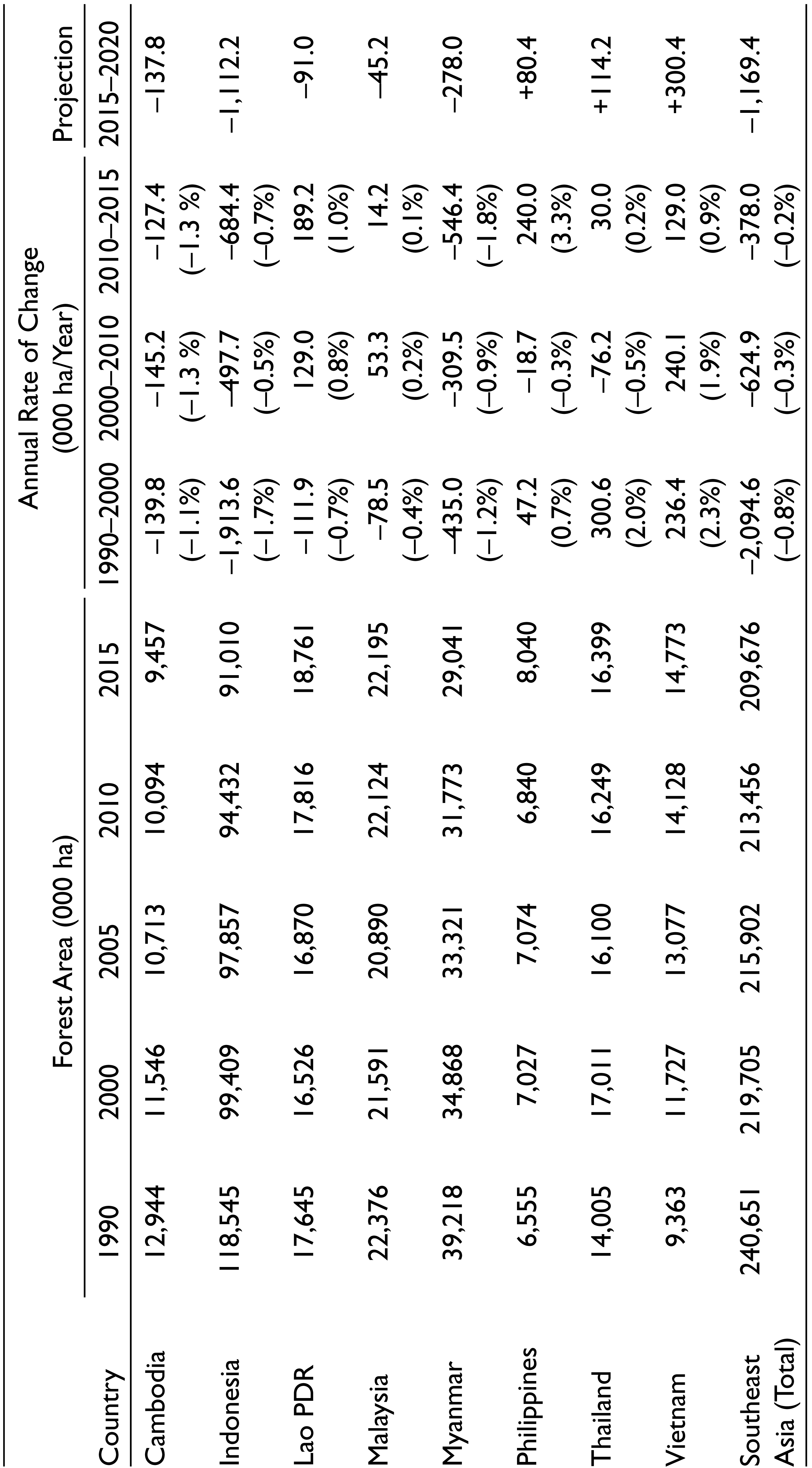
Deforestation and Degradation of Forest in Southeast Asia in Recent Times
Recent literature has highlighted the environmental risks of deforestation in Southeast Asia, and the increased importance of Southeast Asia’s forests in mitigating global climate change (Cruz et al., 2007; FAO, 2011). Intergovernmental Panel on Climate Change (IPCC, 2007) estimated that during the 1990s, 17.4 per cent of greenhouse gas emissions arose from changes in forest cover mostly through deforestation. Deforestation and degradation of Southeast Asia’s forests contribute significantly to global carbon emissions. It is predicted that future reductions in forest area and continued agricultural conversion will have inevitable consequences on the global carbon balance. It is, therefore, argued that substantial benefits could accrue if the region’s forestry sector can be positioned as a feasible mechanism to achieve climate adaptability. Maintenance of the region’s forest health and vitality becomes of key importance to environmental sustainability and climate change-related goals (Sappala, Buck, & Katila, 2009).
Continuing Deforestation and Emergence of Community Forestry in Thailand
It is evident to point out that community forestry in Thailand emerged out of a constant history of deforestation and forest degradation. Despite its measures of forced conservation in the 1960s, being influenced by the American model of National Parks and Forest Reserves (see Laungaramsri, 2005), deforestation continued in a sustained rate till 1989, when the Thailand government imposed a complete ban on all logging activities. In 1961, when the first project of forest assessment was conducted in Thailand by the Ordnance Survey Department, the existing forests amounted to 273,628.50 sq. km covering 53.33 per cent of the total land cover of the country. Since then, deforestation has continued in Thailand despite adoption of conservation measures. It is evident from Table 2 that within a period of 30 years, that is, from 1961 to 1991, forests which covered more than half of the total land of the country, has been reduced to around a quarter of the total geographical area.
Deforestation and Degradation of Forests in Thailand (1961–2015)
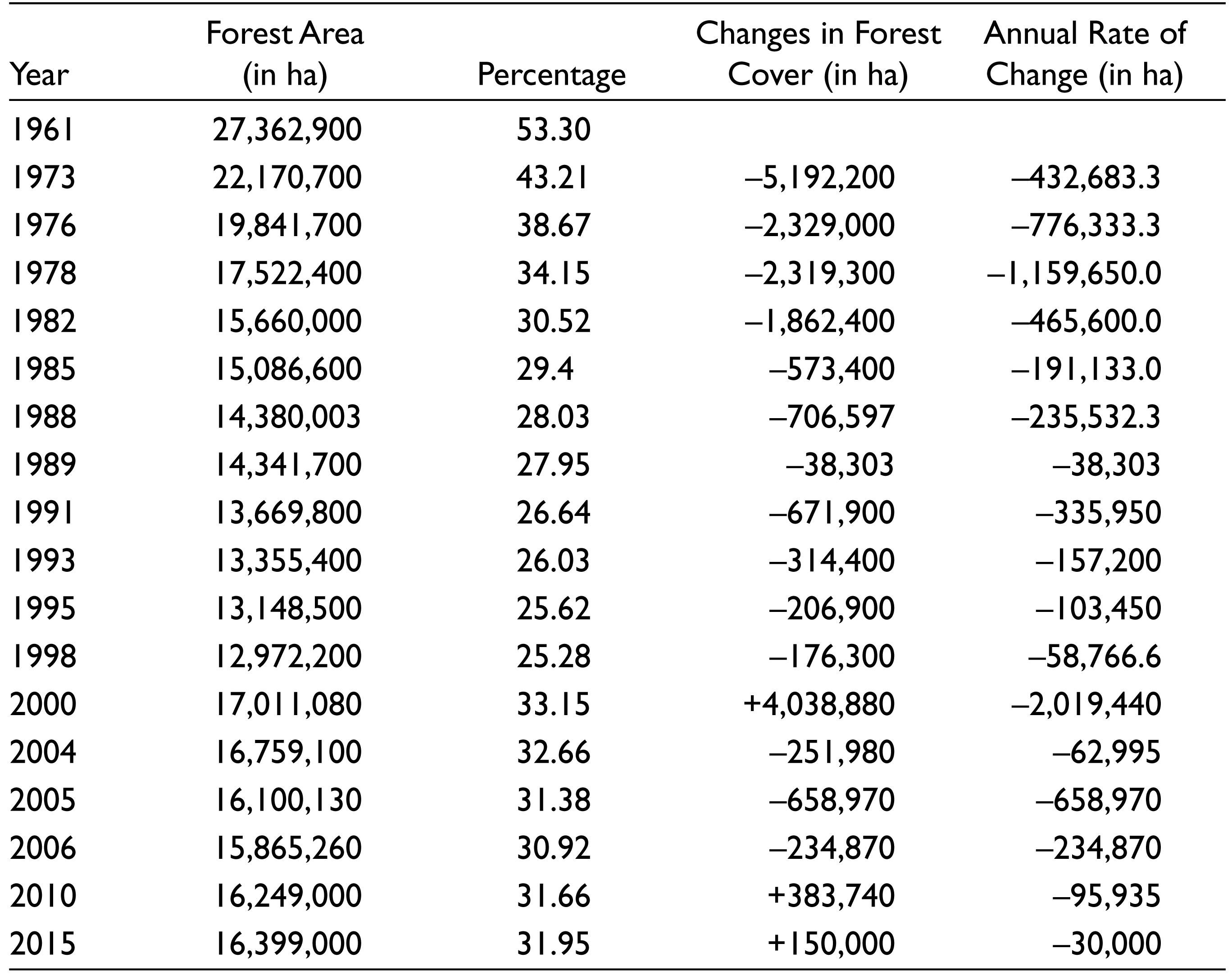
The factors which contributed to deforestation in Thailand is complex and debatable, ranging from population growth to expansion for agricultural production and export of forest timbers. Panayotou and Parasuk’s (1990) study of deforestation in several Northern provinces point out towards growth of population density, increase in price of wood, poverty in terms of real GDP, road density, agricultural production as main factors contributing deforestation in Thailand (also see, Tongpan Panayotou, Jetanavanich, Faichampa, & Mehi, 1990). Besides, state initiated policies favouring rapid economic growth, agricultural production and infrastructural development further deteriorated the condition of forests in Thailand (Binswanger & Panpiemraj, 1983).
By 1980 forest areas have been reduced to 30 per cent of Thailand, out of which National Parks and Wildlife Sanctuaries constituted 6 per cent. Ironically, most of the areas were also covered by harvest concessions. In such a situation, Thailand witnessed severe forest-based conflicts, which ultimately lead to the ‘forest closure’ or ‘logging ban’ in the year 1989 (Laungaramsri & Rajesh, 1992). The post-logging ban period created new scope for community’s involvement in forestry activities. With the success of forcing the government to declare a ban on commercial logging, the social movement against commercial logging focused on establishing a more participatory forestry, and demanded community rights over management of forests. The pressure from the movement forced the Royal Forest Department (RFD) to draft the Community Forest Bill in 1991. The proposed bill by the RFD was countered by activists, academics, grassroots organizations and NGOs for reiterating the idea that forest management as a purely state led activity. In response, the coalition of activists and NGOs such as Foundation for Ecological Recovery developed a new ‘People’s Version’ of the bill that asserted the rights local villagers to access and use forests.
The People’s bill was referred to Thai Forestry Sector Master Plan of 1993, but with the re-emergence of a military government (1991–1992) efforts towards establishing community forestry were held back. In 1996, the Thailand government requested the National Economic and Social Development Board (NESDB) to organize and draft a new version of the bill, with active participation of representatives from government, NGOs, academics and grassroots communities. The NESDB version was approved by the Cabinet, but it still caused controversies among the NGOs concerning whether to allow community forests within protected areas such as National Parks. Further in 1999, a revised version of the NESDB draft was submitted to Parliament along with 50,000 supportive signatures from various parts of the country. In July 2000, this draft along with four other drafts from different parliamentary parties passed the first reading in Parliament (Johnson & Forsyth, 2002). In October 2001, the Lower House passed the Community Forestry Bill, including the controversial Article 18 allowing the establishment of Community Forestry inside the protected areas such as National Parks, which the People’s Version emphasized so much.
However, on 15 March 2002 the Senate made a vote to approve the panel version with an additional crucial clause to the modification of Article 18, mentioning that ‘community forests should not be allowed inside the protected forests’ (Sato, 2003). The current legal status of community forestry in Thailand still is in doldrums in the absence of a legal document permitting establishment of community forestry. Despite lack of formal recognition, many examples of successful communal forest use and management exist throughout the country. As per one estimation, there exist more than 8,000 cases of community forestry in Thailand even without a formal policy to the effect (Daniel, 2002).
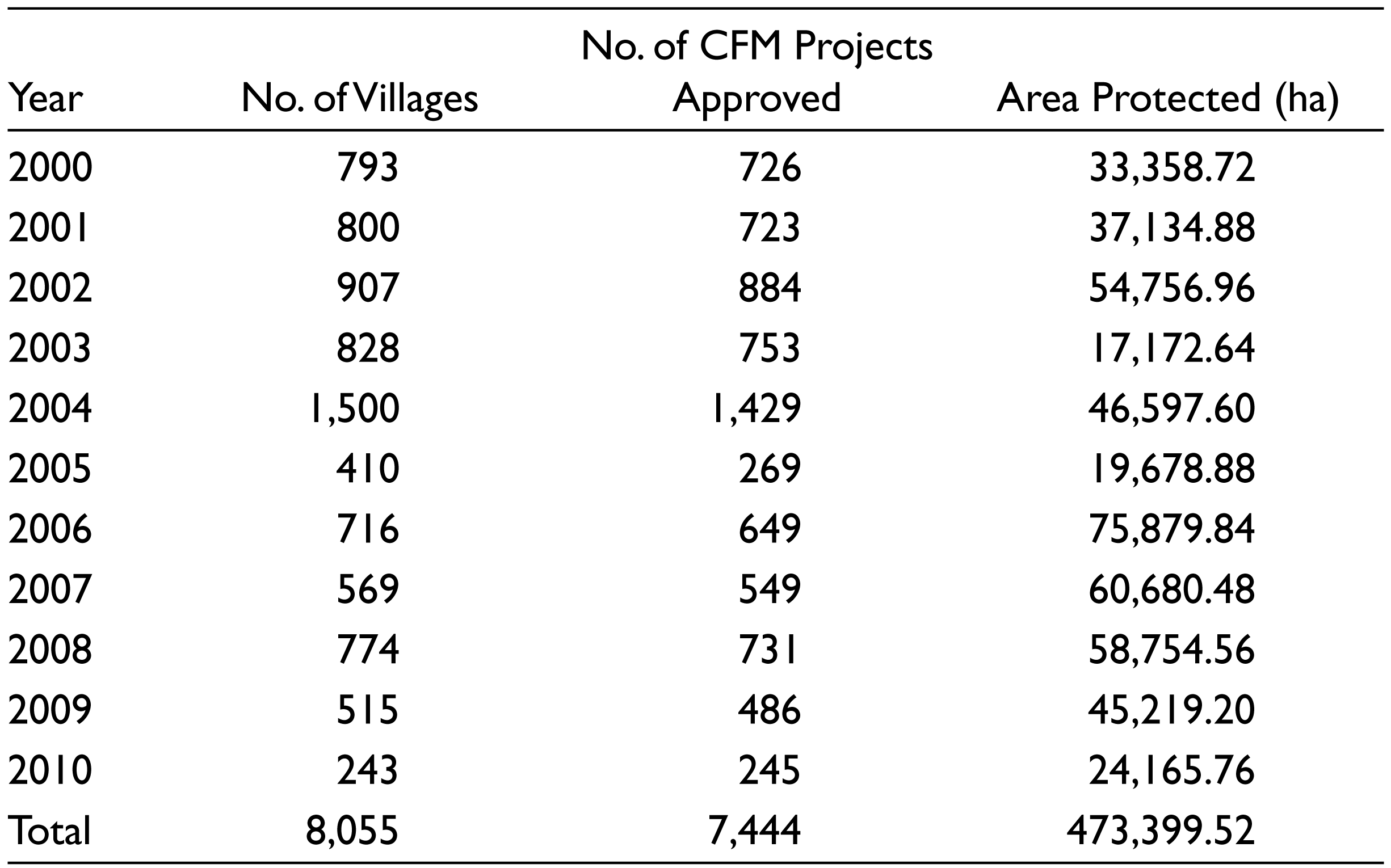
The RFD, however, continued its support for community forestry in Thailand through several programmes of ‘Community Forest Registration’, which it started in the year 1999 (Chankrajang, 2013). Through this registration programme, the RFD formally recognizes the forest communities and supports their activities at the local level. RFD also maintains CFM offices at the local level to support various activities and implementation (Sharp & Nakagoshi, 2006). Even though the registered communities do not possess any legal right over the forest, the RFD formally allows the communities to protect forests and supports them through its local staff in various activities such as: tree plantation, demarcation of boundary, resolving of disputes and penalizing of offenders (Chankrajang, 2013; Salam, Noguchi, & Pothitan, 2006). As per recently available data, during the period 2000 to 2010, a total number of 7,398 Community Forestry Projects were recognized by RFD involving 8,068 villages for protection of 473,399.52 ha of forest (Ongprasert, n.d.) (see Table 3).
Community Forest Management (CFM) Projects Recognized and Approved by RFD (2000–2010)
Natural resources like forests, water and grazing lands exist as common resources, from which it is difficult to exclude other potential users from using the resource, and such joint use by more than one user involves subtraction of the resource (McKean, 2000). These two characteristics, that is, ‘non-excludability’ and ‘subtractability’, make common resources unique, where it becomes difficult to protect these resources, in the absence of some (institutional) mechanisms to exclude the others. Protection and management of these natural resources require evolution of property rights arrangements through institutional mechanisms to exclude the non-members or non-contributors from availing benefits from the resource. In the absence of such arrangements, common resources become de facto ‘open access resource’, susceptible to free-riding, degradation and depletion (Hardin, 1968).
In a commons situation, the resource users mainly face two fundamental challenges, that is, how to ensure availability of the resource, and once available how to use it in a sustainable manner so that future availability is guaranteed. Eminent commons scholar and noble laureate Elinor Ostrom regards these two as ‘provision problem’ and ‘appropriation problem’, respectively (Ostrom, 2001). In the absence of firm rules on who can appropriate how much in a commons environment, the situation becomes like a Prisoner’s Dilemma game and free-riding becomes inherent (Seabright, 1993). However, if access to the commons is limited, and a well-defined group of users collectively rely on the source with well-defined rules of appropriation, possibilities of sustainable resource management becomes emergent (Baland & Platteau, 1996; Ostrom, 1990; Wade, 1988). One of the most important factors for successful commons governance, therefore, has been the presence of institutions, which design these rules towards solving provision and appropriation problems. A study of institutions, in the context of commons, focuses on rules, laws and conventions of community that either directly allocate resources, or establish processes and constraints for its members to make allocative decisions.
It has now been affirmed that the presence of institution is necessary for sustainable governance of commons. In fact, it is the institutional arrangements, which create a property right in resources, establish management regimes; and distinguishes common property from open access resources (Rout, 2010). When the designed institution restricts the access of non-members into the resource and entrusts collective property right to the users, common property regime is said to be evolved. With the presence of an institution, the resource becomes inaccessible to all openly, rather the access is limited to a specific group of users who hold their right in commons (Bromley et al., 1992; Runge, 1981, 1984).
Method and Materials
The empirical work for the research was carried out in three community forestry sites in Thailand. Two of the sites were identified from Lampang and Lamphun provinces, respectively, of Northern Thailand, and the third site was identified from the Kanchanaburi province of Central region of the country. The rationale behind choosing cases from Northern and Central Thailand was relative higher density of forest, as well as large-scale practise of community forestry in these two regions. Northern Thailand still continues to be the most forested region of Thailand with forest cover of almost half of the region’s total land, followed by the central plains, where nearly one-fourth of the area are forested. Besides, deforestation has been a central problem for Northern and Central Thailand ever since forest statistics was collected since 1961 (see Table 4).
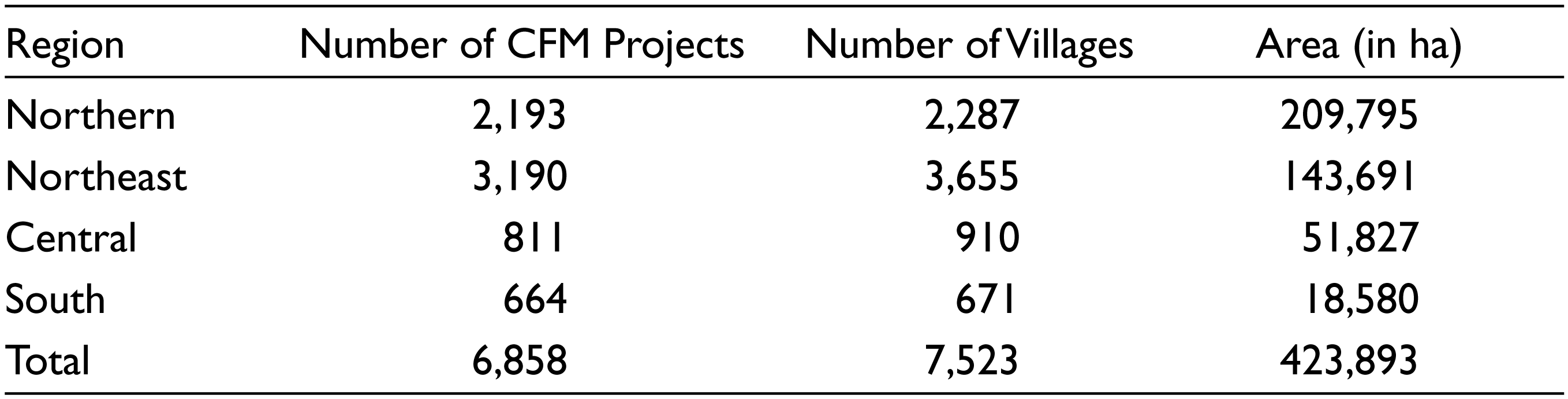
Community’s involvement in governance of local forest resources has a visible presence in the Northern and Central region of Thailand. Further, RFD has also recognized a considerable number of community forestry projects in these regions. As per the data released by RFD (2009), out of the 6,858 community forests recognized by RFD in Thailand, 3,004 projects existed in Northern and Central region of the country (see Table 5). The field sites in these regions were selected based upon suggestions from regional offices of RFD and with research support from academicians from Chiangmai University in Northern Thailand and Mahidol University in Bangkok.
Forest Areas in Thailand by Region

Forest Areas in Thailand by Region
Recognition of Community Forestry Project by RFD in Regions of Thailand
The fieldwork for the study was carried out in two phases with research support from Indian Council for Social Science Research (ICSSR), New Delhi and National Research Council of Thailand (NRCT), Bangkok. The first round of fieldwork was carried out for three weeks during December 2010–January 2011. During this phase, detailed fieldwork was carried out in Kanchanaburi province of Central region of Thailand, and initial visits were made to identify field sites in Northern region of the country. A second round of fieldwork was carried out during 2013–2014 for a period of another three weeks in the Northern region of Thailand in order to complete the study. Case study method, supplemented with focused group discussion with community members, and in-depth interviews with key informants such as members of the Forest Protection Committee, local primary school teachers and researchers from Mahidol University, Bangkok and Chiangmai University, Chiangmai were used to elicit necessary information regarding forest use, forest dependency and efforts taken towards sustainable management of local forest resources. During the course of inquiry, information regarding social composition of the villages, history of forest protection, rules designed for the purpose, and major challenges that the communities face were collected with the help of an interpreter.
Case Study 1: Ban Wan Sing Community Forest
Ban Wan Sing is a small village in the Sing Tambon (sub-district) of Sai Yok Amphoe (district) in the Kanchanaburi Changwat (province) of Thailand. The village is well connected to the town of Kanchanaburi as well as to Bangkok city. Being in the central plains of the country and being nearer to Bangkok (approximately 166 km), the village was quite influenced by urban culture and modernity unlike the remote villages of upland Northern Thailand. The social composition of the village is quite homogeneous, comprising 115 households almost all speaking Thai and belonging to Thai origin. Agriculture was observed to be the main occupation of the villagers, with some farmers cultivating commercial and cash crops like sugar cane.
Case Study 2: Ban Sam Kha Community Forest
Ban Sam Kha is a remote village in the Hua Suea Tambon (sub-district) of Mae Tha Amphoe (district) in Lampang Changwat (province) of Thailand. It is located at a distance of 27 km from the town of Lampang, in the Northern part of Thailand. The village Ban Sam Kha is a remote settlement with hardly any public transportation available to travel to the village. The village is comprised of 167 households with a total population of 721. Agriculture is the primary occupation of most of the households of the village and rice is grown as the main crop in the village, grown both in the plains and in hills.
Case Study 3: Ban Tha Pa Pao Community Forest
The village Ban Tha Pa Pao is located in the Tha Pa Du Tambob (sub-district) of Mae tha Amphoe (district) in Lamphon Chanwat (province) of Thailand. The village has in total 215 households with a total of 834 population. Agriculture is the main occupation of most of the households of the village, with farmers growing rice for self-consumption. There were a few landless households in the village, who are either engaged into share cropping or work as wage labourer.
Communities, Institutions and the Forest Governance
Taking insights from the review of theoretical and conceptual literature of the previous section, we may say that an institution in the context of commons management is characterized by the rules that it designs to govern the behaviour of the people towards resource. The present study while intending to analyse the institutional processes of community management of forests in rural communities of Thailand, would also focus upon the rules that were crafted to govern the use and access to forest resources by the local community members.
Rule Configuration in Community Forestry
In the context of community forestry activities in three field sites, we observed both formal and informal rules in operation. While the Forest Protection Committees of the villages have written down few of the rules in their management register, making it formal; there were plenty of rules that the households were observed to be following, which germinate from cultural traditions and customs. Further, the regulations from RFD also contributed towards formal rules. However, what were more interesting to observe from the field sites were the working rules, which actually were enforced with a backup of monitoring systems. We adopt a framework given by Elinor Ostrom, which explains about seven categories of rules that structure the action situation in the context of commons: boundary rules, position rules, scope rules, choice rules, aggregation rules, information rules and pay-off rules (Ostrom, 2011). The following paragraphs discuss each these category of rules, and explain how these rules governed the action of community members to enable them to manage their local forest resources sustainably.
Bann Wan Sing Forest Protection Committee has marked a clear cut division between bamboo forest and rest of the forest area, with a rule that while harvesting of bamboo is allowed with restrictions, no harvesting of trees is allowed from the rest of the forest. Since forest condition in Ban Wan Sing was more degraded compared to other two villages, their Protection Committee has completely put a halt on tree cutting from the forest area. However, for the requirement of the community members; cutting of bamboo is allowed within the due knowledge of the committee. These rules of access and appropriation were only for the community members, and outsiders were not allowed to harvest any products from any of the forest zones.
In contrast to Ban Wan Sing, the boundary rules Ban Sam Kha and Ban Tha Pa Pao had a different structure. Both villages had put several pillars and stones to demonstrate the boundary, and had divided the forest into three zones, named as Zone ‘A’, Zone ‘B’ and Zone ‘C’, with variations in rules concerning access and appropriation from different zones. Cutting of trees was completely prohibited from Zone A, and people were allowed to collect only non-timber forest products (NTFPs), such as mushrooms, fruits, leaves, etc. The Forest Protection Committee has permitted to cut small timber from Zone B, but with prior permission of the committee. Zone C was meant for use by local communities, and no prior permission is required to appropriate forest produces from this zone. In Ban Sam Kha, the rules concerning boundary varied for the members from that of the non-members of the community. The outsides are not permitted to appropriate timber from any zone of the forest, while they are allowed to collect the NTFPs from Zone C. In Ban Tha Pa Pao, different households have mutually agreed communal rights over Zone C, where they grew mushroom and other forest produces.
In Ban Sam Kha of Lampang province, the protection activities were initiated by the village primary school teacher. The female teacher of the school could organize the protection committee with the help of some of her old students. Later other important individuals of the village joined the Forest Protection Committee, and the membership to the committee was mutually agreed upon by all community members. Likewise, in the case of Ban Tha Pa Pao, the protection initiatives started with three important persons, that is, the temple priest, the local school teacher and the village head. Upon formation of the Forest Protection Committee, these three individuals held important positions of decision-making. The Forest Protection Committee in Ban Tha Pa Pao in Lamphun comprised of 12 members. It was also observed that the committee is further subdivided into three sub-groups, that is, ‘fire protection group’, ‘monitoring group’ and ‘herb/medicine group’. While the fire protection group in Ban Tha Pa Pao was responsible for avoiding the dangers of occurrences of fire inside the forest, by way of removing dried leaves and twigs and keeping vigil; the major tasks of monitoring group included patrolling the forest to notice any cases of forest theft and violation of rules. The herb/medicine group consisted of old and wise individuals of the village, who possessed traditional knowledge about medicinal value of plant varieties.
The scope rules were very clear in the Ban Sam Kha and Ban Tha Pa Pao village due to division of forest into different zones. Both the committees had crafted succinct rules regarding the scope of resource use from different zones. In both villages, appropriation of any type of forest produces was completely prohibited from Zone A, which was meant for preservation. While members of the community had free access to Zone C, appropriation of forest produces was restricted with several rules in Zone B. Cultural, ethical and ritual practices were integrated into community protection, which governed the scope of forest use. In Ban Wan Sing, appropriation of forest produces from a particular region inside the community forestry was totally prohibited as the place was earlier used as the burial ground, and was believed to be the abode of the spirits of their ancestors. It was observed in the Ban Sam Kha and Ban Tha Pa Pao villages that Buddhist monks had adopted certain trees and had wrapped yellow cloth around the trees. People usually restrict themselves from cutting or appropriating products from those trees, since these yellow attires of Buddhist monks symbolized religious and spiritual elements.
The choice rules in Ban Sam Kha clearly restricted the choice of tools for extraction of resource units. It was mutually agreed rule that no appropriation of any produces from the forest would be allowed using vehicles, such as jeeps, cars, tractors or trucks. The committee only allowed resource appropriation through self-carrying or head-load. By restricting vehicles, the committee governed the quantity of produces that can be appropriated from the forest. Besides, the committee had different rules for insiders and outsiders with regard to NTFP collection.
The aggregation rules in the studied community forestry sites created a platform where near total consensus could be brought out, and a situation like free-riding could be avoided. These rules consciously governed the behaviour of resource users, and ensured that none violate the rules for disproportionate personal gain, while others conformed.
Information rules and procedures adopted to disseminate them could help community members in predicting how the other will behave in a situation of resource appropriation, and in turn, governed individual’s behaviour towards the resource. For instance, each individual or household knew that the other person or the household would cooperate in protection activities of the committee. Such understanding restricted non-cooperative individual behaviours, and enabled collective cooperative behaviour. The rules displayed on the notice boards also made outsiders aware that the forests of these communities are guarded by the committees, and thus it would not be easy to trespass.
Monitoring was observed to be everyone’s responsibility in Ban Wan Sing. All members of the village keep a watch on the forest and any case of violation is reported to the leader of the Forest Protection Committee. A graduated system of sanctions against rule violation existed in Ban Wan Sing. The sanctions against rule breaking were divided into three steps. In the first step, any one breaking the rules is given warning against such kind of non-cooperative behaviour. In the second step, if the offence is repeated and serious, certain amount of fine is imposed on the violator. The third step of sanction against rule violation pertained to initiating legal action against the offender with the help of RFD.
Besides, a system of imposing fines, what was striking about Ban Sam Kha and Ban Tha Pa Pao was the use of socio-cultural and religious practices to create an incentive structure, which will govern the pay-off of conforming to the rules. ‘Social ostracism’ and ‘social labelling’ were found to be very strong, and it was common agreement among villagers that a person or household violating forest rules will not get any credit in future from others, and/or will not get any water from other members of the community. The committee also put a provision to cut electricity to those houses, who fail to conform to the rules of forest protection. In Ban Tha Pa Pao, since forest protection activities were initiated by the leaders of the temple and the local school teacher, these two institutions were actively integrated into the monitoring system. In this village, the Buddhists monks preached about forest protection and instilled the religious virtues of protecting forest in the mind and heart of the people. Further, teachers of local primary school, who were the pioneering members of the Protection Committee, inculcated the virtues of forest protection in the minds of young pupils through education, and reminded them to pass on the message to elders in the society.
Explaining Governance Outcomes
The sustained activities of collective action to govern local forest resources in three studied community forestry sites have generated visible impacts both on the socio-economic environment of the community and the physical environment of forest and water eco-system. When we carried out fieldwork, Ban Wan Sing and Ban Tha Pa Pao have completed one and half decades of community protection, and similarly, Ban Sam Kha had a decade old history, which gave us an opportunity to inquire about the outcomes of collective governance of local forest resources. To gain a perspective about the outcomes of community protection, we asked the respondents during focused group discussions to compare between two time periods, that is, 15 years before the beginning of protection activities and the last 15 years of community protection. Such a division allowed us to understand the changes that have been brought about in the condition of forest, people’s access to the resource and the benefits that they now receive due to local level protection. The information gathered about outcomes of community governance of local forest resources may be presented in terms of efficiency, equity; accountability and environmental sustainability (see Ostrom, 2011).
With regard to efficiency, community members stated that due to community protection, NTFPs appropriation has increased many fold. Availability of basic necessities like fuel wood and edible items from forest has increased in all three villages by arresting forest degradation and logging activities. The existence of big trees in the forest has ensured availability of dried leaves, twigs and dried and fallen branches, which are used by community members as fuel wood.
Another dimension, which indicated the efficiency aspect of local level collective protection, was the time and distance coved by members to appropriate NTFPs. It was reported that members of the community, especially women now have to travel less distance and spent less time inside the forest to collect food and fuel wood. Collective protection has increased availability of items like mushroom, several leaves and roots used as food. Such economic gains from the forest due to collective protection, which people considered as definitely more than what they contribute by way of abiding by the rules of protection and sacrificing their immediate gains; point towards the outcomes of community forestry, while at the same time creating an incentive for people to further contribute towards such collective activities.
Community forestry activities in the three villages ensured environmental sustainability of the forests in several ways through locally devised rules and norms of governance. Control over transport used in resource movement, amount of appropriation and specifying seasons in the year for appropriation of specific products helped institutions to ensure sustained growth of forests. All the three villages used some form of control over resource appropriation and regulated the resource appropriation by way of putting conditions on that should appropriate forests produces and how these should be appropriated. Further, complete ban on logging, and building of check dams in Ban Sam Kha and afforestation activities through planting new tree saplings in Ban Tha Pa Pao ensured maintaining a sustainable forest, while at the same time ensuring sustainable livelihood.
Based upon empirical work in three community forestry sites in Northern and Central Plains of Thailand, and literature on commons, we develop a framework that underscores the process of collective action of the communities in rural Thailand. In rural settings as is the case with the studied villages, where communities have a sufficient dependence upon the forest, communities share a reciprocal relationship with the forest. The communities benefit from forest resources, and, at the same time, the condition of the forest depends upon their pattern of use. The terms of reciprocity very much depend upon what the forest has to offer to the community and how the community behaves towards the forest. It is argued through this framework that presence of a robust institution is of crucial significance, since the reciprocal relationship between forests and communities is negotiated and mediated through the institution. Our empirical findings prompt us to state that through the processes of creating rules and establishing a strong monitoring system, the institution mediates the relationship between community and the resource. Such mediation helps community to find solutions to the three most important problems of commons governance, that is, problems of provision, appropriation and free-riding. And a solution to these problems results in sustainable governance of forest resources (see Figure 1).
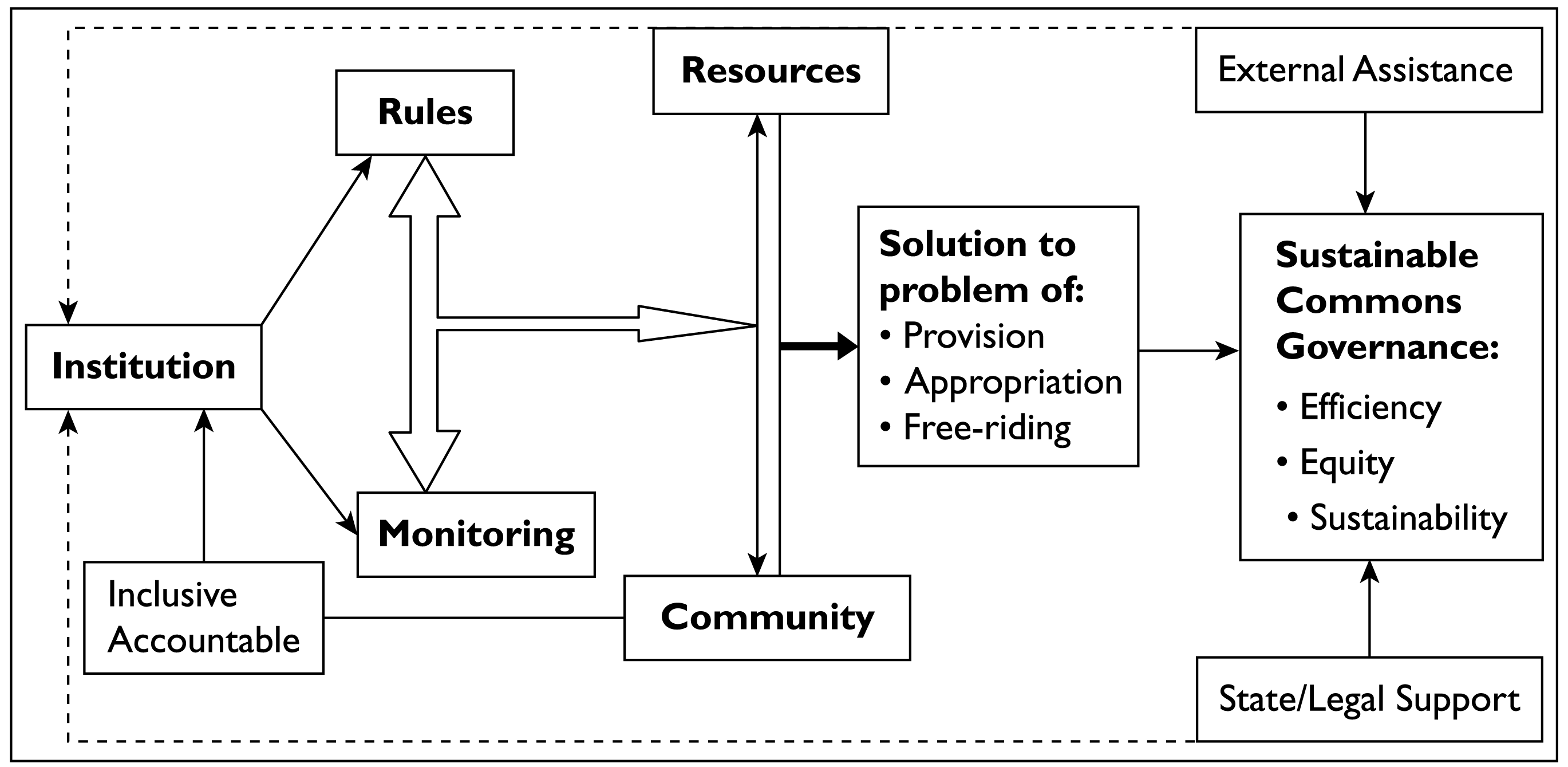
It becomes evident from the figure that institutional mediation between resource and community through creating of rules and instituting a monitoring mechanism is crucial for finding solutions to the problems of commons. In the absence of such institutional process, the relationship between resource community becomes unregulated, and situations of ‘tragedy of commons’ becomes inevitable. The ability of the institution to mediate such relationship is evident from its capability to set up both rules and a monitoring mechanism, which ensures conformity to those rules of resource appropriation. Therefore, sustainable governance of commons resources like forest is a causal process, where the failure of one leads to the failure of other, ultimately leading to resource degradation. A successful institutional process can solve the problems of provision, appropriation and free riding, and a solution to these three problems would lead a community towards sustainable commons governance, indicated through increased economic efficiency, equitable resource appropriation and environmental sustainability.
Having acknowledged the importance of institutional process in commons governance, we may now focus on elaborating the factors that enhanced the potentials of institution to govern local resources sustainably. Based upon empirical findings, we may state that there are two important factors, which enhance institutional performance, that is, internal and external. While the internal factor relates to the interaction between institution and the community, the external factor pertains to the larger context of support by state or other outside agencies. It is important to point out that while the internal factor is an essential condition to institutional success, the external factor creates an enabling environment to increase institutional performance in local resource governance. Therefore, while the associations showing internal factors are depicted in connected arrows in the figure, the association of external factors with the institution is shown by dotted arrows (see Figure 1).
It is evident from our empirical work in community forestry sites of Thailand that more the institution is transparent, accountable and inclusive; greater are the chances of its success. The institutional process in common governance in a dynamic, reciprocal and two-way process, where the institution evolves from the community, and once created it regulates the behaviours of the community. The community creates the institution, and the institution creates rules, which the community members are expected to conform, and again in case of non-conformity, the institution comes into the game by way of imposing sanctions. Therefore, institutional process is a process of constant interaction and negotiation between the community and the institution, and the success of an institution in commons situation depends very much upon the frequency of such interaction. If the institution is flexible, inclusive, accountable and transparent, it increases the probability of rule conformity, and thereby, contributes towards sustainable commons governance.
The external factors enhancing institutional potential that we refer to here pertains to external assistance from outside civil society groups as well as legal and official support from the state. It was observed from the empirical work that in two out of the three community forestry cases, external assistance has helped the institution in carrying out afforestation activities, which substantially mattered in changing the quality of forest. Ban Tha Pa Pao had assistance from RFD and Ban Sam Kha got assistance from Siam Cement Group under its corporate social responsibility. With the help of RFD, Ban Tha Pa Pao Forest Protection Committee carried out extensive afforestation activities in the degraded patches of forest. Further, such an effort of environmental conservation also got recognition from Petroleum Authority of Thailand, which honoured Ban Tha Pa Pao with the Golden Globe Award. Such a prestigious national award helped the village forest protection committee both financially and morally to carry out its protection activities. Similar is also the case with state legal support. In the absence of legal support from Thai state, the future of community forestry is vulnerable as the institutions of forest protection are not sure about their future existence. Such insecurity may affect the sustainability of the institution, which is very much crucial to ensure sustainability of the forest resources. Therefore, we may say that external assistance and legal backup by the state are additional factors for enhancing institutional performance. To conclude, an institution may succeed in sustainable local commons management without them, as in the case of Ban Wan Sing, but presence of these two factors creates favourable conditions which enhance the institutional performance in commons governance.
Declaration of Conflicting Interests
The author declared no potential conflicts of interest with respect to the research, authorship and/or publication of this article.
Funding
Financial support to carry out the fieldwork for this article was provided by Indian Council of Social Science Research (ICSSR), New Delhi and National Research Council, Thailand (NRCT), Bangkok through the Indo-Thai Visiting Scholarship Programme.
Footnotes
Acknowledgements
The empirical research carried out for the article is the outcome of the Cultural Exchange Programme (CEP) under the bilateral arrangements between the ICSSR, New Delhi, and NRCT. The author would like to acknowledge both the organizations for the grants provided for the research. The author would also like to thank Centre for Bharat Studies, Research Institute for Languages and Cultures of Asia, Mahidol University, Thailand for the support and cooperation provided for carrying out the fieldwork for the research.