



Abstract
European negotiations are a relatively new and dynamic phenomenon of company-level industrial relations. Research thus far has mainly focused on the employee and trade union side. This contribution deals with the role of management. Based on case study research, it analyses management’s motivations and negotiation strategies in initiating and implementing European company-level agreements. The research shows that only in very few cases is the employee side able to force central management to the European negotiation table by organizing effective transnationally coordinated collective action or protests. As a rule, negotiations at European company level are only possible if management itself has a manifest interest in regulating certain issues at European level. In these cases, management’s interest in negotiations opens up room for manoeuvre for the employee side as regards not only the content of the agreement, but also the negotiation process itself and its participants.
Introduction
European company agreements are a relatively recent and novel instrument of company-level industrial relations. They are negotiated and concluded between representatives of the company and the employee side at European company level. 1 European company agreements cover a wide range of topics: guidelines for the conduct of transnational company restructurings, HR issues such as personnel development and planning (employment and skills development, equal opportunities and anti-discrimination policies and target-setting interviews), health and safety and data protection policies, the organization of internal company industrial relations, and the establishment of basic minimum social and ethical standards. However, negotiations at European company level also touch upon more traditional domains of trade unions’ national collective bargaining policies for instance by concluding profit-sharing agreements (European Commission, 2008, 2013; Müller et al., 2013). Figure 1 illustrates the continuous increase that has occurred in the number of European company agreements since 2000. 2 By the end of 2012, at least 135 European agreements had been concluded.
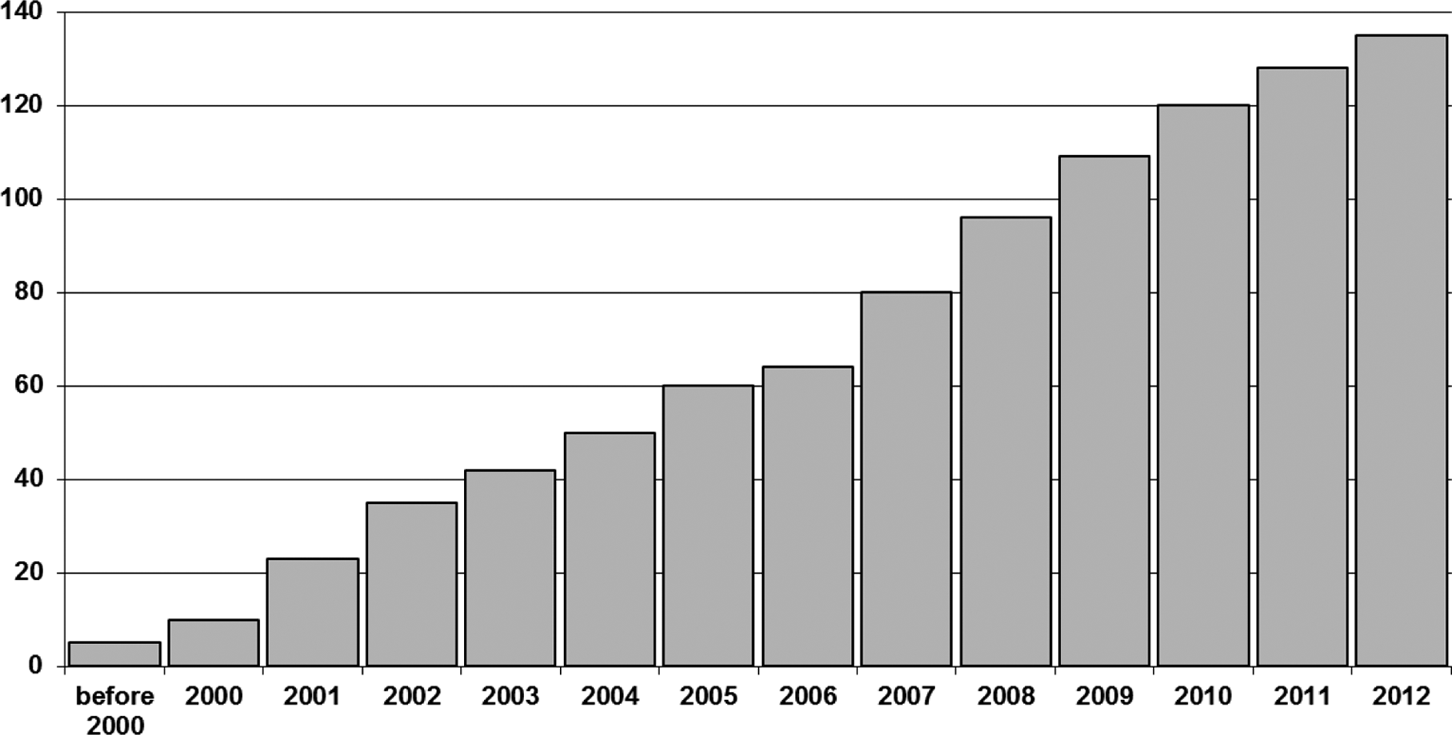
Quantitative development of European company agreements.
European company agreements also possess a political dimension insofar as negotiations are never confined solely to the specific content of the agreement (and the corresponding bargaining and compromise processes between management and employee representatives) but also simultaneously address more general issues pertaining to the procedural order of transnational agreements. For this reason we adapted and further developed Anselm Strauss’ (Strauss, 1978) ‘negotiated order’ concept for our previous case study-based analysis of European company agreements. 3
In this article, we used the metaphor ‘it takes two to tango’ for the following reasons. In national systems of industrial relations legislation or historically evolved customs and practices determine the ‘order’ of company-level participation (information, consultation, co-determination) and collective bargaining (which actors negotiate at which level, is there a right to strike etc.). Accordingly, at national level there is a framework that determines the conditions under which tango will be danced and its form. In more legalistic systems of industrial relations institutional rules also influence the relative power position of the actors involved; i.e. legal regulation can provide the employee side with a ‘secondary’ power resource, which secures employee representatives’ influence and co-decision powers without the need permanently to generate power through political mobilization. All these conditions do not exist at transnational company level, which in essence is a new field for experimentation in cross-border industrial relations. The only certainty which exists is that it takes two to tango. The stakes are high, because in addition to the actual bargaining issue each negotiation also determines the present and future ‘order’ of industrial relations practice. This applies first and foremost to the respective company in which the negotiations take place. By creating a precedent, however, ‘pioneer cases’ can also have more far-reaching spillover effects on other companies.
On the employee side the search for an ‘order’ is inevitably politicized because the role of EWCs is by law and previous practice restricted to information and consultation. By going beyond this role in entering into negotiations, EWCs touch upon the bargaining prerogative of trade unions; i.e. the question emerges which company-level and/or trade union actors should be involved in the negotiation process and who should take the lead in order to ensure both legitimacy and effectiveness in representing and enforcing employee-side interests.
Management also recognizes the need to analyse Transnational Company Agreements (TCAs) in terms of their procedural order, since this also affects industrial relations (IR) within the company: ‘TCAs are also IR tools. Once signed, they form part of a company’s IR “architecture”. Therefore, when engaging in such processes, it is important for a company to look at the TCA not only as a tool for the immediate purpose, but also as part of its long-term IR strategy.’ (ITC, 2010: 9)
The nature of this procedural order concerns three dimensions:
the content and scope of the agreements: which topics and issues can be negotiated at European company level? Who is covered by the formal agreements or informal arrangements that are concluded and how binding are they?
the roles allocated to the different actors (EWC, trade unions and management at local, national, European or even global level): who should be responsible for carrying out the negotiations in the interests of efficiency and/or legitimacy and procedural reliability?
the responsibilities of the different levels: under which circumstances and for which issues is the European company level regarded as the appropriate bargaining level and which issues should continue to be dealt with at national level?
The political side to these company-level bargaining processes acquired an additional dimension and gained added impetus when the European Commission placed the development of a legal framework for transnational collective bargaining at company level on the EU’s policy agenda in 2005. Since then, the question of whether such a legal framework should be introduced and if so what form it should take has been the subject of heated debate (Bé, 2008; Rüb et al., 2013: 67 ff.). Thus, the nature of European company-level agreements and the prospects of them becoming more widespread in the future are not exclusively determined within companies themselves but are also influenced by the political environment of EU legislation. Sandwiched between these levels is the level of the European trade union federations and employers’ associations that acts as the main link between the other two. All three levels interact with and influence each other. Whilst actual bargaining practices on the ground influence what a possible legal framework might look like, a legal framework would likewise affect the development and nature of these bargaining practices. Meanwhile, the European trade union federations and employers’ associations seek to shape the process and influence the development of EU legislation in such a way as to reflect their members’ interests. The guidelines for bargaining at European company level that have been produced by several European trade union federations thus constitute a first response by the trade unions to developments at company level and an attempt to take control of this process and secure the trade unions’ prerogative to act as the sole negotiating partner in the realm of collective bargaining. They are also a blueprint of the trade unions’ policy stance with regard to the plans to introduce supranational regulation.
Against this backdrop of a multi-dimensional, politicized bargaining process that marks a new stage in the Europeanization of industrial relations, the current article will concentrate on the role of management. It will focus on analysing employers’ motives, their material and procedural interests and the relative power enjoyed by management in the bargaining process.
The article will attempt to address a gap in the research, since no comprehensive analysis of management’s policies and strategic interests currently exists in the literature on European bargaining policy 4 . The analysis presented below will focus on empirically observable processes at company level. In addition, Section 2 will provide a brief outline of the attitudes of management and employers’ associations towards the optional regulatory framework.
The empirical basis of the study mainly comprises a series of company case studies carried out by the authors that included interviews with representatives of the respective corporate management teams and were evaluated using a qualitative methodological approach. 5 The total of 11 case studies (eight in the metalworking industry and three in the services sector) provide an empirical basis for sketching out some initial conclusions about the role played by management in the bargaining process. Staying with the metaphor ‘It takes two to tango’, we shall endeavour to provide some preliminary answers to the following questions: Under which company-specific circumstances is management interested in dancing a tango? Is it management that asks the employee side to dance, or does it wait until it is asked? Who is management’s preferred dance partner on the employee and trade union side? Which side leads the dance? How committed is management to the dance, how much stamina does it have and how much passion does it dance with?
In view of the sample size restraint and caution must be exercised when extrapolating the empirical findings presented in this article. Regarding the overall state of research into the Europeanization of company-level industrial relations this also applies to a first attempt at theorizing on the basis of the empirical observations.
The theoretical debate that has primarily arisen as a result of research into European Works Councils (for a systematic overview of the state of play of EWC research see Müller and Hoffmann, 2001; Hertwig et al., 2009) currently can be characterized as follows.
The foundation of EWC research in different academic disciplines (industrial sociology, legal studies, Europeanization research within the field of political sciences) not only leads to a variety of empirical and analytical perspectives but also to a plurality of theoretical and methodological approaches. The theoretical conceptualization of EWC research is therefore based on a wide range of approaches such as multi-level governance and Europeanization concepts used in political science (Platzer, 1998; Rüb et al., 2013), sociological concepts of identity (Whittal et al., 2007) and solidarity (Klemm et al., 2011), and finally elements stemming from research into transnational organization research (Hauser-Dietz et al., 2010).
Methodologically, EWC research is characterized by the co-existence of various approaches: actor- and action-based studies co-exist with structuralist analyses; studies which are based on institutionalist approaches co-exist with analyses which are based on negotiation and bargaining concepts. Often research designs try to integrate elements of different approaches.
The theoretical conceptualization of European Works Councils did thus far not lead to one single (middle range) EWC theory. For the reasons outlined above this is not very likely in the near future. Nonetheless, however, the scientific debate is characterized by a number of (competing) tenets. These tenets regarding the factors or clusters of factors that explain the development of European industrial relations at company level range from contingency-based explanations to explanatory models where specific factors play a key role: (1) the corporate structure and the way the business is organized, i.e. the organizational fit between the corporate structure, management’s strategy and the European Works Council (see e.g. Marginson et al., 2004; Hauser-Ditz et al., 2010; Stöger, 2011), (2) the organizational strength of the trade unions and employee representation bodies (see e.g. da Costa and Rehfeldt, 2007), (3) institutional path dependence: trajectory and the country of origin effect (see e.g. Hauser-Ditz et al., 2010; Rüb et al., 2013), (4) the influence of culture and interests on the behaviour of industrial relations actors (see e.g. Banyuls et al., 2008; Bernaciak, 2010; Greer and Hauptmeier, 2012; Klemm et al., 2011; Lecher et al., 2001, 2002; Waddington, 2011; Whittall et al., 2007) and (5) ‘dramatic events’ as a catalyst of European-level negotiations and transnational solutions (see e.g. Hauser-Ditz et al., 2010; Müller et al., 2004, 2013).
In the final section, we make a preliminary attempt at a theoretical classification and open the perspective by linking our own findings with these tenets on the preconditions and the developmental logic of European company-level industrial relations.
The optional regulatory framework and the attitude of companies and employers’ associations
In 2005, the European Commission placed the development of an (optional) regulatory framework for transnational collective bargaining on the EU’s policy agenda. 6 Its intention in doing so was to provide the social partners with an instrument that would enable them to engage in transnational collective bargaining and formalize the outcomes (European Commission, 2005).
Following a number of expert hearings between 2009 and 2011 and the publication of an expert report at the beginning of 2012, the Commission produced another Commission Staff Working Document in September 2012 entitled ‘Transnational company agreements: realising the potential of social dialogue’. This document outlined a number of alternatives for future initiatives and called on all the stakeholders to submit their opinions (European Commission, 2012). In addition, in September 2013 the European Parliament adopted a resolution on cross-border collective bargaining and transnational social dialogue (European Parliament, 2013). Whilst these activities do not guarantee that the legislative initiative will be successfully progressed and concluded, they do demonstrate that it retains a certain political momentum.
The employers’ associations and the trade unions have hitherto expressed very different opinions at the Commission’s hearings.
The trade unions support a European regulatory framework in principle but tie their support to a number of non-negotiable conditions (the trade unions’ bargaining mandate and their right to sign all agreements, the compatibility of transnational agreements with the collective agreements that exist at the different levels within each country, and the inclusion of a non-regression clause) (ETUC, 2012: 8).
As far as the employers’ associations are concerned, they do not believe that there is any need for action under Community law and are therefore opposed to an EU regulatory framework. This stance is in keeping with a fundamental position that they have expressed on several occasions in the recent past, calling for a moratorium on all EU legislation in the areas of labour and social policy. In this specific instance, the BusinessEurope confederation of employers’ associations argues that ‘An EU “framework” or “reference” would be counterproductive as companies need to tailor the agreements to their specific situation and to the legislative and industrial relations frameworks in which they operate’ (BusinessEurope, 2012). In other words, decisions concerning whether negotiations and agreements should go ahead, who should be involved in them and how they should be conducted should rest exclusively with the management and employee representatives of the affected company. Moreover, since approximately half of the agreements cover non-EU countries, existing global instruments such as the ILO Tripartite Declaration on Multinational Enterprises and Social Policy and the OECD Guidelines for Multinational Enterprises provide a more suitable framework than any EU-only instruments (BusinessEurope, 2012). Finally, ‘A possible initiative by the Commission would be blown out of proportion as only 100 Europe-headquartered multinationals have opted for TCAs while more than 53,000 have not.’ Consequently, while ‘an exchange of experience and practice among companies which have TCAs or consider entering into one’ could be useful, an EU framework would not offer any benefits (BusinessEurope, 2012).
The political opposition to a regulatory framework expressed by the employers’ association was endorsed by the views and attitudes of the HR and IR managers in our case studies. They claimed that there is no need for a regulatory framework, believing that it would not serve any useful purpose and tending to think that it would have negative consequences. The management representatives that we interviewed argued that a European regulatory framework would entail an increase in regulation and red tape; it would prevent companies from adopting flexible solutions tailored to their specific structures and processes that enable rapid responses to concrete problems. Moreover, they felt that a regulatory framework is not suited to addressing two of the key problems associated with European agreements: the structural diversity of different countries’ employee representation bodies and trade unions, which would need to be clarified in advance of any negotiations, and the inconsistency of existing regulations and practices in the field of industrial relations and labour and social policy within the EU.
Bargaining at European company level: management’s motives, interests and preferences
Why does management negotiate European company agreements?
Negotiations may be initiated either by the employee side through the EWC or SE Works Council or by management. In many cases, the decision to enter into negotiations is the outcome of a prior communication process and it is not possible to identify either side as the sole initiator. Nonetheless, it is noteworthy that it is not just the employee side that is seeking to go beyond transnational information and consultation and move towards negotiating and concluding agreements at European level – in a significant number of cases the process was initiated or jointly initiated by the company’s management.
The subjects regulated by European company-level agreements in our case studies can be divided into three groups: (1) labour policy, HR policy and CSR issues, (2) profit-sharing and (3) restructuring programmes.
While management can have a variety of motives for entering into and concluding negotiations, two basic categories can be identified. European negotiations and agreements can result from a direct need to solve a specific problem, i.e. where management wishes to regulate a particular issue via a European agreement. However, their motives for entering into negotiations may also be ‘indirect’. In these cases, management’s desire to initiate negotiations or its willingness to accede to an employee request for negotiations is not related to a wish to regulate a specific issue but is instead a consequence of considerations arising from the company’s corporate philosophy. For example, the conclusion of European agreements might be tied in with a desire to develop or strengthen a European corporate identity. Alternatively, the company might be seeking to promote a particular kind of industrial relations culture by showing that it is willing to cooperate with the EWC.
In our case studies, the actions of management were based on one – or on a combination – of the following motives and interests:
Management is interested in keeping transaction costs down. Concerning problems or corporate decisions, it wishes to negotiate the key points at European level first in order to simplify the subsequent negotiations at national and local level. Such negotiations may relate to the introduction of a profit-sharing scheme for all employees in Europe, but would typically also concern the implementation of transnational restructuring programmes, not only in terms of how to tackle common transnational problems but also potentially with regard to the way that competition and disputes between different countries are resolved.
Management is interested in avoiding industrial disputes. It therefore wishes to involve the EWC and/or the trade unions in the company’s restructuring plans. This may be aimed at smoothing over current ‘acute’ restructuring measures with transnational repercussions, but may also be related to agreeing procedural rules for any future restructuring measures.
Management treats European agreements as an element of a long-term Europeanization strategy. It wishes to increase harmonization of divergent national standards across Europe and the extent to which HR policy and industrial relations in the individual national businesses are subject to centralized regulations and control.
Management views European negotiations and agreements as a means of strengthening the European corporate identity of employees and their representatives.
Management accepts the ‘invitation to dance’ and consents to European negotiations in order to demonstrate its willingness to cooperate with the EWC and its leaders. Its aim in doing so is to promote an industrial relations culture that may have a beneficial effect on relations with employee representatives in other areas.
Management believes that negotiating social and labour policy measures at European level may help make the company more attractive to highly skilled workers and become an ‘employer of choice’.
Management is interested in reinforcing a voluntaristic approach to bargaining. It enters into negotiations in order to demonstrate that it is willing and able to conclude a voluntary agreement with the EWC/SE Works Council. By showing that it already has functioning voluntary arrangements in place, it hopes to provide implicit or explicit ammunition to oppose the need for stronger EU regulation.
Two of these employers’ interests – transaction costs and European identity – are also mentioned by Léonard et al. (2007: 64 ff) as main sources of management representatives’ motivation:
‘The first stems from management concerns to secure legitimacy for pan-European company policies on employment and personnel matters. In companies that are elaborating and implementing common, cross-border policies or policy guidelines across their European operations, management may see advantages in reaching an agreed statement through the EWC in terms of the additional legitimacy that employee representatives’ consent or approval can bring. The second also relates to management, and involves minimizing the transaction costs potentially entailed in a series of parallel local negotiations. The conclusion of a common European frame in negotiation with employee representatives at the EWC can avoid the transaction costs, in terms of management time and resources, involved in a series of local negotiations each searching for a solution to a common problem – not to mention the setting of unfortunate precedents by one or more local negotiations. This is particularly relevant on “new” issues which are not currently the subject of local agreements, such as privacy and e-communication. Considerations of transaction costs are also relevant to cross-border restructurings, where securing agreement on a set of principles for handling a restructuring at European level can speed up the series of local negotiations that will nonetheless have to take place.’
With whom does management prefer to negotiate?
As has already been described above, the question of who should act as management’s bargaining partner is a politically sensitive issue owing to the fact that European-level company agreements are a new phenomenon and in view of the voluntary nature of these agreements.
Our case studies detected the following two main types of management behaviour with regard to this issue and the way that they manage the negotiating process:
(1) Management prefers as a matter of principle to negotiate with employee representatives from within the company as opposed to external trade union officials and attempts strategically to incorporate the EWC or its chairperson into the negotiation process by portraying the negotiations as a joint communication process that is part of the corporate culture. In some individual cases, this preference for negotiating with partners from within the company can lead management explicitly to refuse to allow external trade union officials to be involved.
(2) Management chooses its preferred employee-side bargaining partner based on pragmatic and efficiency-related reasons rather than fixed principles. This pragmatic and efficiency-based attitude involves management trying to work with tried-and-tested partners and through established channels while still responding flexibly to employee-side demands regarding the composition of their negotiating team (even if it may have reservations about the involvement of external trade union officials). This is done in order to ensure that the agreement in question can be negotiated and implemented successfully. This pragmatic and efficiency-based approach is especially common in cases where management has its own issue-related reasons for negotiating a European agreement or where it is the initiator of the negotiations.
As illustrated by the following examples, when management adopts this pragmatic and efficiency-based attitude, it is the company’s corporate and industrial relations culture that determines which negotiating partners are sought out, accepted and preferred by management. Where German industrial relations culture dominates a company’s European-level industrial relations, the central HR management team will tend to regard the chair of the works council as its most reliable and authoritative counterpart and bargaining partner. However, where French industrial relations culture dominates management regards the trade unions’ role as chief negotiating partners very much as part of the company’s corporate culture and recognizes the involvement of the relevant European trade union federation as a positive factor that helps to manage the process more efficiently.
In the following example, the responsible HR managers of a company headquartered in Germany view reliability and authority as the two key characteristics that an appropriate bargaining partner should possess. By ‘reliable’, they mean that they should stick to what they say around the negotiating table and not change their tune a few days later. ‘Authority’ means that their negotiating partner should be able to ensure that employee representation bodies at national level agree to implementation and enforcement of any agreements. A key factor as far as management is concerned is that there should be no ambiguity regarding who is leading the negotiations on the employee side. They are less concerned about whether this is the EWC or the relevant European trade union federation. ‘We just need to know who is in charge. The worst thing that can happen when you are holding negotiations is the scenario where you have five different parties sitting around the table and each one makes different demands and offers different concessions. If that happens, the negotiations drag on for ages and you can’t be sure that everyone will stick to the agreement.’
In practice, the European-level negotiations adopt the established German industrial relations culture that prevails at the company’s headquarters. For pragmatic reasons, management prefers to negotiate with partners whose reliability and authority it has come to recognize over the years and who, in view of Germany’s dominance at European level, ‘have the most influence here’. These qualities are shared by the chairman of the German and European works councils (who also serves as deputy chair of the supervisory board) and the IG Metall official responsible for their company who is also a member of the supervisory board and serves as the EWC coordinator on behalf of the EMF. By contrast, being a European trade union federation counts against the latter, insofar as it is an external organization that is not conversant with the company’s specific circumstances. Moreover, management is unsure about what sort of mandate, if any, it possesses. Thus, while it is allowed to perform a coordinating role within the company’s European employee representation structures and, at least to some extent, contribute its expertise, the European trade union federation is not allowed to act as a bargaining partner.
Things are very different when this pragmatic and efficiency-based underlying attitude occurs in the context of a predominantly French industrial relations culture which is characterized by competition between trade unions of different political persuasions and by the fact that it is usually the trade unions that act as the chief negotiating partners for company-level agreements. The approach taken by management in this situation is illustrated by the following example.
Based on the experience that due to the competition between trade unions the legitimacy of agreements is regularly called into question, the question of efficient implementation of the agreement was a particularly important issue in the negotiations for the responsible HR managers of this French parent company. Previous experience has led management to believe that it is necessary to try and involve all the relevant actors in the negotiations in order to ensure that the agreement is viewed as binding and legitimate at a local level. In some cases, it also sees a clear benefit in conducting negotiations at a European level owing to the more professional approach of the relevant European trade union federation 7 compared to the French trade unions and its ability to achieve a consensus between trade unions of different political colours. As a result, management not only accepted the prominent role played by the European trade union federation in the negotiations, but it also accepted the application of the federation’s negotiating procedure which allows the relevant national affiliates to exercise a veto at the beginning and end of the negotiations but also obliges them to comply with the provisions of the agreement once adopted. 8
How does management plan and organize the implementation of European company agreements?
The managers who took part in our case studies did not regard the fact that European company-level agreements are not legally binding as an obstacle to their implementation.
This factor is not a problem in cases where the European agreement stipulates commitments on behalf of management but not on behalf of the employee side, since it is straightforward to ensure that agreements of this type are implemented by the company’s management hierarchy by incorporating them into the company’s central HR policy. An example of this type of commitment between central management and the EWC/SE Works Council is the agreement on work-related stress. The group’s central management instructed the managers of its (national) subsidiaries to ensure that the agreement was implemented and to involve the employee representatives in the implementation process, as stipulated in the agreement. When after some time it became clear that local management was not moving forward quickly enough with implementation of the agreement, central management intervened once more by requiring each subsidiary to submit a progress report within the next four weeks detailing the implementation measures that it had taken. This ‘ticking off’ from central management was enough to ensure that the management teams in the different countries started taking implementation of the agreement more seriously.
Management also prefers to use in-house procedures to ensure that the provisions of agreements are legally binding, as opposed to being forced to comply with EU regulations. As a result, it makes sure that employee and trade union representatives who are responsible for implementation of the European agreements either locally or nationally are either directly or indirectly involved in their negotiation and conclusion. In doing so, its aim is to try and prevent people from querying the content of the agreements and questioning their legitimacy during the national or local negotiations on their implementation.
If we use the implementation activities undertaken by European HR management as an indicator of the value that they attach to European company-level industrial relations (IR) and agreements, then even in our case studies the spectrum ranges from those who do the bare minimum to those who carry out extensive implementation activities addressing a wide range of needs and having far-reaching effects. In the ‘bare minimum approach’, management believes that in order to fulfil its responsibilities in terms of implementation, all it needs to do is notify the management hierarchy that an agreement has been concluded. At the other end of the spectrum, the European outsourcing agreement is an example where management was required to carry out extremely comprehensive implementation measures, since the agreement involved a highly complex monitoring process. Although the company was not prepared to include a long-term employment guarantee in the agreement, it did agree to purchase a certain quantity of products and parts from the company that was being split off, at least for the first few years after the divestment. Moreover, a detailed appendix to the agreement regulated the future business and purchasing relations between the two companies and specified which products and parts would be bought from the split-off company. The monitoring of the purchasing commitments specified in this appendix was the subject of protracted discussions over many years between the chair of the EWC and the relevant European managers. This was largely due to instability in the economy and the company’s own business over the course of time, meaning that the terms of the agreement had to be constantly adapted to the changing circumstances.
Conclusions
European company-level agreements represent uncharted territory for both management and employee representatives. The negotiations take place on a voluntary basis and can in principle be vetoed or interrupted by both sides. Exactly because European Company Agreements can only be concluded if ‘both sides of industry’ are prepared to tango, the actors’ relative power position and capacity to act as well as their options for political exchanges are crucial issues. First of all, Lo Faro correctly points out that the ‘‘‘voluntary” character [of transnational bargaining] cannot be easily equated with previous voluntary bargaining systems developed at national level, because of the absence of a transnational right to strike’ (Lo Faro, 2012: 158). Only in very few cases, which can be viewed as the exception to the rule, did the employee side manage to force central management to the European negotiation table by organizing effective transnational protests and solidarity actions. 9
Previous EWC research and also our own case study-based analysis show that as a rule the employee side is not strong enough to force management ‘to dance’. Management has to be willing to take up the offer or itself be the one that invites the employee side to join it on the dance floor. This also means that it is management who determines whether or not it enters into and concludes negotiations and under which terms it is prepared to do so. Furthermore, it is also able to influence to its own advantage whether it is the EWC or the trade unions who lead the negotiations by choosing to accept or reject one or other of these actors as its bargaining partner.
Management’s position becomes somewhat less all-powerful when it has its own reasons for wishing to enter into negotiations and find a European solution. In this situation, it needs a dance partner with a mandate to negotiate and conclude agreements. This gives the employee side a chance to articulate and push through its own specific interests, enabling a give-and-take process to occur where management is forced to make concessions.
The overall attitude of the responsible managers with regard to European company-level agreements spans the entire spectrum, from fundamental opposition right up to those who actively seek to initiate negotiations. Often, their position falls somewhere between the two extremes – they may be willing to respond to employee-side initiatives on particular topics or in specific circumstances, or they may adopt a rather cautions and hesitant approach owing to concerns about the uncertainties involved (e.g. the legal implications or the potential unforeseen side-effects).
It is also evident that if management has its own reasons for wishing to conclude an agreement, then the employee side has an opportunity to influence not only the agreement’s content but also the way that the negotiations are conducted and who participates in them. If management’s reasons for entering into European-level negotiations are primarily pragmatic, then they tend not to be overly concerned about the composition of the employee side’s negotiating team and are unlikely to make an issue of it. In such cases, management adopts a pragmatic and efficiency-based approach. Although it will try to work with tried-and-tested partners and through established channels, it will also be prepared to respond flexibly to employee-side demands in order to ensure the successful conclusion and implementation of the agreement in question.
If we finally attempt to place our empirical findings in the context of the theoretical debate surrounding the conditions for the establishment and development of European company-level industrial relations, we can conclude that the motives, interests and negotiation strategies are in line with the tenets outlined at the beginning of this article. However, since the empirically observable patterns of behaviour vary considerably, it is not possible to draw more general conclusions with regard to the relative weight of the explanatory power of these tenets.
According to the literature on EWCs, ‘dramatic events’ – particularly transnational restructuring programmes – act as a catalyst of European-level negotiations and European solutions. The role of ‘dramatic events’ as a catalyst is one explanation for the development and proliferation of European agreements. Management’s motives and interests in promoting European-level agreements are based on a transaction cost rationale. According to this way of thinking, it can sometimes be preferable to seek a negotiated settlement at a central, European level rather than several solutions at a decentralized, national level. If the employee side can be convinced to cooperate in the process, the costs associated with disputes (strikes, damage to the company’s image, etc.) can be kept to a minimum.
Another tenet found in the literature on EWCs argues that the Europeanization of corporate industrial relations and the (relative) importance of individual EWCs or SE Works Councils is largely determined by the corporate structure and the way that the business is organized, i.e. the organizational fit between the corporate structure, management’s strategy and the EWC or SE Works Council. Our case studies endorse this explanation insofar as they indicate that management’s willingness ‘to accept an invitation to dance’ or ‘to ask the employee side to dance’ of its own accord are associated with a management philosophy that seeks to promote the Europeanization of internal company processes in the areas of human resources and industrial relations. In this respect, European agreements on both ‘soft’ topics and procedural issues or ‘hard’ topics are a valuable management tool and serve as a means to an end. Management’s desire to introduce standard European regulations tends to be greater where more responsibilities are (or are supposed to be) centralized and where more transnational decisions are (supposed to be) taken.
Finally, the literature on EWCs also explains the development and concrete form taken by the European level of industrial relations in a company as a result of the culturally influenced and interest-oriented behaviour of different actors. From this perspective, not only management’s power resources but also the organizational strength of the trade unions and employee representation bodies within the company play an important role. These factors were also evident in the case studies, although their importance varied and their influence could not be said to be direct. In the majority of cases, the first identifiable key requirement for management to be willing to enter into negotiations is for the process of concluding European agreements to be based on a cooperative culture of industrial relations (including personal relationships characterized by trust). Transnational solutions at European level are likelier and will have more chance of succeeding if these trust-based institutional or personal relationships have also been developed at a centralized, European level. This entails the existence of a successfully functioning EWC where management perceives and accepts the EWC as a whole and its chairperson or steering committee as reliable partners for the purposes of dialogue and negotiation.
The developed and strong culture of interaction at European company level that has been found to be a necessary requirement for the conclusion of European agreements is both complemented and constrained by the fact that, in many cases, the established industrial relations customs and practices in the company’s home country have a significant influence on the manner in which the negotiations are conducted. European company agreements are always the product of ‘multi-level negotiations’. It is the nature of the beast that a balance needs to be found between the sometimes divergent interests of the company’s different sites and that the course of the negotiations is influenced by the balance of power (relative size and strength of employee representation bodies) between different locations. Thus, ‘home country effects’ play a significant role in the development and nature of European agreements. Depending on how much store it sets by European solutions, management will take these ‘country effects’ into consideration in a pragmatic and efficiency-based manner. As demonstrated above, management is also very astute when it comes to choosing its preferred dance partner from among the company’s own employee representation bodies and/or the (external) trade unions.
Translation from the German by Hugh Keith and Torsten Müller
Footnotes
Funding
This work was supported by the Hans-Böckler-Stiftung [Project No. 2008-188-2; 2011-514-2].