




Abstract
The green transformation and Industry 4.0 are associated with considerable risks for workers in countries with dual labour markets such as Germany. The biggest risks are wage losses due to the involuntary transition into the precarious secondary labour market and insufficient education and training for the new ‘green’ jobs. Institutional reforms are necessary for a ‘just transition’. The ongoing reforms in Germany in education and training and wage setting show that the transition is a critical juncture in which new stakeholder constellations have the opportunity for non-path-dependent changes from a dual to an inclusive employment system with better work. The approaches adopted in recent German reforms are of overarching interest. Featuring the strongest manufacturing base in Europe, Germany is under particularly high pressure to fully embrace the green transformation and digitalisation. The country has learned from other countries and, conversely, can perhaps also help trigger a just transition in other countries.
Introduction
The world of work is currently gripped by major upheavals due to several parallel developments. While the intelligent networking of machines and processes in industry, captured by the term ‘Industry 4.0’, is giving digitalisation a new impetus, ambitious climate protection goals, such as making the German economy CO2-neutral by 2050, can only be achieved through the almost complete decarbonisation of industry. The aim of the green transformation of the economy is to limit global warming to 1.5 degrees Celsius compared to pre-industrial levels. Destined to affect several generations of employees, far-reaching decisions are now being made on climate goals and the new technological paths that they entail, without all parameters of the transformation being known. Due to this uncertainty, committing to this transformation is also a bet on the future innovative capacity of our societies as well as on the necessary political will to innovate and invest in coming decades.
Such a comprehensive structural change is associated with high risks for current and future employees, especially when well-paid jobs are lost without the necessary skills for new jobs being provided. A comprehensive transformation of the economy over a long period of time will only be possible if employees have the necessary new skills and good working conditions. It is equally important to create broad acceptance of the transformation, especially among those most affected by it. They must embrace change and be willing to continue learning and take on new tasks with commitment and, it is to be hoped, enthusiasm. In a worst-case scenario, fears about the future – mainly with respect to precarious working conditions for themselves and their children – will prevail, blocking change and promoting the rise of backward-looking climate deniers. Such negative impacts can only be overcome by a ‘just transition’, in which not only technical solutions for environmental sustainability and Industry 4.0 are developed, but also social innovations aimed at ensuring decent work and the social inclusion of affected employees (Henry et al., 2020; Just Transition Center, 2017).
Where the conditions for a ‘just transition’ are not met in a country, considerable reforms will be necessary for work to get better (Murray et al., 2023). This is the case for Germany with its dual labour market which only guarantees good working conditions in its primary labour market segment. The employment risks associated with the green transformation and Industry 4.0 have triggered far-reaching reforms of Germany’s lifelong learning system and its exclusive wage system. The focus of this article is on the design and redesign of the institutions behind the German employment model that shape the internal and external labour mobility caused by these drivers of change. Its aim is to examine whether these labour market reforms, introduced in recent years, can facilitate a ‘just transition’ characterised by better work – the theme of this special issue.
The approaches adopted in recent German reforms are of overarching interest. Featuring Europe’s strongest industrial base, Germany is under particularly high pressure to embrace the green transformation and digitalisation. It has learned from other countries and, conversely, can perhaps also help promote a just transition in other countries. In other words, the question is whether the green transformation and Industry 4.0 are a ‘critical juncture’ (Thelen, 1999) opening up possibilities for a non-path-dependent shift from a dual to an inclusive employment system characterised by better work. While typologies of the erosion of employment systems have been presented in the literature on institutional change (Streeck and Thelen, 2005), there is a lack of differentiated contributions on the (re-)construction of inclusive employment systems. This article explores the kind of institutional change indispensable for a just transition, whether in Germany or in other countries.
To this end, the article starts by addressing the controversial debates surrounding potential reforms to the dual German employment system, before turning to the risks associated with different forms of labour mobility in the German employment model. The measures to avoid these risks in different policy fields are then examined. The first policy field is intra-company job mobility, focusing on the role played by co-determination (in its German configuration) in the transformation. The second policy field concerns the revival of active labour market policy, an aspect key to the organisation of involuntary job mobility (external mobility). The next section considers self-initiated training, a further aspect gaining in importance. Germany has favourable starting conditions, featuring two VET funding systems that have been expanded from youth-oriented systems to lifelong learning institutions. As the green and digital transformation is set to last several decades and as coming generations must be adequately prepared for future work opportunities, this article then turns to the modernisation of vocational training. Finally, before concluding, the inadequate reforms of the exclusive wage system – one of the main obstacles to a just transition – are examined.
The debate on whether Germany’s dual employment model can be reformed
The extensive literature on the varieties of capitalism shows in which different ways risks for employees were cushioned in past structural changes. These risks are lower in countries with strong institutions applicable to all employment groups. Institutions include an active labour market policy financing the necessary retraining, and a high level of collective bargaining coverage reducing income disparities between companies and sectors and enabling workers to change jobs without any great loss of income. However, structural change becomes a burden when employees are poorly trained and have to cope with high losses of income when forced to change jobs. This is the case in exclusive employment systems where good pay remains the privilege of workers with strong bargaining power and where universal labour market institutions are weakly developed (Bosch et al., 2010).
Such a constellation can be observed in Germany. Until the early 1990s, the German employment system was considered inclusive. Similarly, until German reunification, collective agreement coverage was around 85 per cent (Visser, 2019) and Germany had low market income inequality by international standards (OECD, 1996). Collective agreements in sectors with strong trade unions served as templates for sectors with little bargaining power. As a result, weakly unionised sectors benefited not only from the wage increases achieved in strongly organised sectors, but also from other provisions, such as reductions in working hours.
From the mid-1990s onwards, collective agreement coverage gradually declined, reaching 52 per cent in 2021. The deregulation of product and labour markets in the late 1990s and early 2000s dissolved the bond of solidarity between industries and dualised the labour market. While Germany’s exemplary apprenticeship system has been modernised to take account of digitalisation and the green transformation, other universal institutions important for a ‘just transition’, such as active labour market policies, were severely pruned by the Hartz laws of 2003 (Lehndorff et al., 2009). As a result, Germany now has one of the largest low-wage sectors in Europe, with considerable real wage losses incurred by the lower income groups (Bosch, 2019a).
The shift from coordinated market economies with low income inequality to segmented labour markets featuring a well-protected core workforce and a peripheral workforce with poor working conditions is the central theme of the recent literature on dualisation. Dualisation is conceptually distinguished from polarisation or marginalisation, as it encompasses not only the outcomes of dualisation but also the politics of change (Emmenegger et al., 2012). The argument is that dualisation has succeeded in breaking up previous solidaristic alliances that included all workers. In the case of Germany, Palier and Thelen (2010: 139) even saw the emergence of ‘a new (less egalitarian but possibly quite robust) equilibrium’. Along the same lines, Carlin and Soskice (2009) pointed to new ‘producer coalitions’ between employers and core employees not affected by deregulation: ‘Works councils representing skilled workers had every interest in flexible low-level service labour demands’ (p. 93). The weaknesses of this new equilibrium theory soon became apparent, when, contrary to Hassel’s (2014: 72) predictions, the trade unions representing manufacturing sectors broke away from the ‘producer coalition’ and supported the campaign for the introduction of the statutory minimum wage.
The growing low-wage sector divided society, while deregulation policy lost its political support in parts of society. The Social Democratic Party (SPD) and the Greens, the parties responsible for the Hartz laws deregulating the German labour market under the Schröder SPD government, switched tack in the early 2010s, making their participation in any coalition government dependent on key social policy reform projects. Support came above all from the trade unions in the manufacturing sector, whose hitherto well-protected members felt threatened by the green transformation and feared relegation to the secondary labour market segment. Several reform packages, first in the two grand coalitions between the Christian Democrats (CDU) and the SPD (2013 to 2021) and then in the SPD-Greens-FDP coalition since 2022, have led to a gradual paradigm shift in wage policy through the introduction of the statutory minimum wage and the revival of active labour market policy. One can even speak of a reversal of the Hartz laws in this policy field. The new skills requirements of Industry 4.0 and the green transformation were important drivers of this policy change, as was Germany’s increasing shortage of skilled workers.
What is happening is exactly what was observed in the institution-building of welfare states in the past. They were constructed by stakeholders who, at critical junctures when institutions were in flux and new opportunities to reshape them emerged (Soifer, 2012), put together a range of power resources, formed new political alliances, renewed their narratives, and deployed them to open up new development paths (Crouch and Farrell, 2002; Lévesque and Murray, 2010).
Risks of labour market mobility
Developing a convincing narrative for a just transition requires first and foremost an understanding of the employment risks of the transformation. Numerous studies have been commissioned for this purpose. Studies of the macroeconomic effects of digitalisation 1 see only minor additional productivity effects by 2030, possibly leading to a loss of 60,000 jobs in the economy as a whole. However, this overall balance masks strong shifts between sectors and occupational groups. Employment is projected to decrease in manufacturing and production and to increase in services by 2030 (Wolter et al., 2015). Other simulations look at individual sectors, such as the automotive industry. They project that the transition to electric mobility will cost 114,000 jobs, which will particularly affect some regions due to the regional concentration of car production (Mönnig et al., 2018). These forecasts are all based on assumptions. For example, manufacturing vehicle batteries domestically would largely offset the projected job losses in the automotive industry. If at the same time more is invested in the transformation, there could even be a significant increase in employment.
It is impossible to calculate which job mobility processes are behind these projections for employment development, as we cannot estimate in advance how many employees will move to new jobs within a company or an industry or to other industries. Calculations of substitution potential, however, give an indication of how many occupational tasks can be replaced by new technologies. According to Dengler (2019: 4), around 25 per cent of employees worked in an occupation with high task substitution potential in 2016. However, this does not mean that jobs will all disappear, as the substitution potential only considers technical feasibility. Nor can it be assumed that occupations will disappear altogether, but rather that they will change. The author concludes: ‘Against this background, one of the greatest challenges will be (further) education’ (Dengler, 2019: 5). It can therefore be assumed that skills profiles will change and that many people will change jobs, whether internally or externally. To facilitate a just transition, an institutional framework must therefore be developed to enable further education in different phases of life and for different labour market transitions.
In Germany’s dual labour market, however, risks for workers lie not only in the availability of further training, but also in possible wage losses when changing companies. This is shown by the high wage differences between companies covered by collective agreements and those that are not (Figure 1). The largest differences are found in manufacturing, the sector most affected by the transformation. They are even higher on an annualised basis, since non-covered companies usually also have longer working hours and pay lower or no holiday and/or Christmas bonuses. The transformation-related reorganisation of entire value chains offers companies an ideal starting point to also reduce costs through a targeted shift of various production steps to companies not covered by collective agreements.
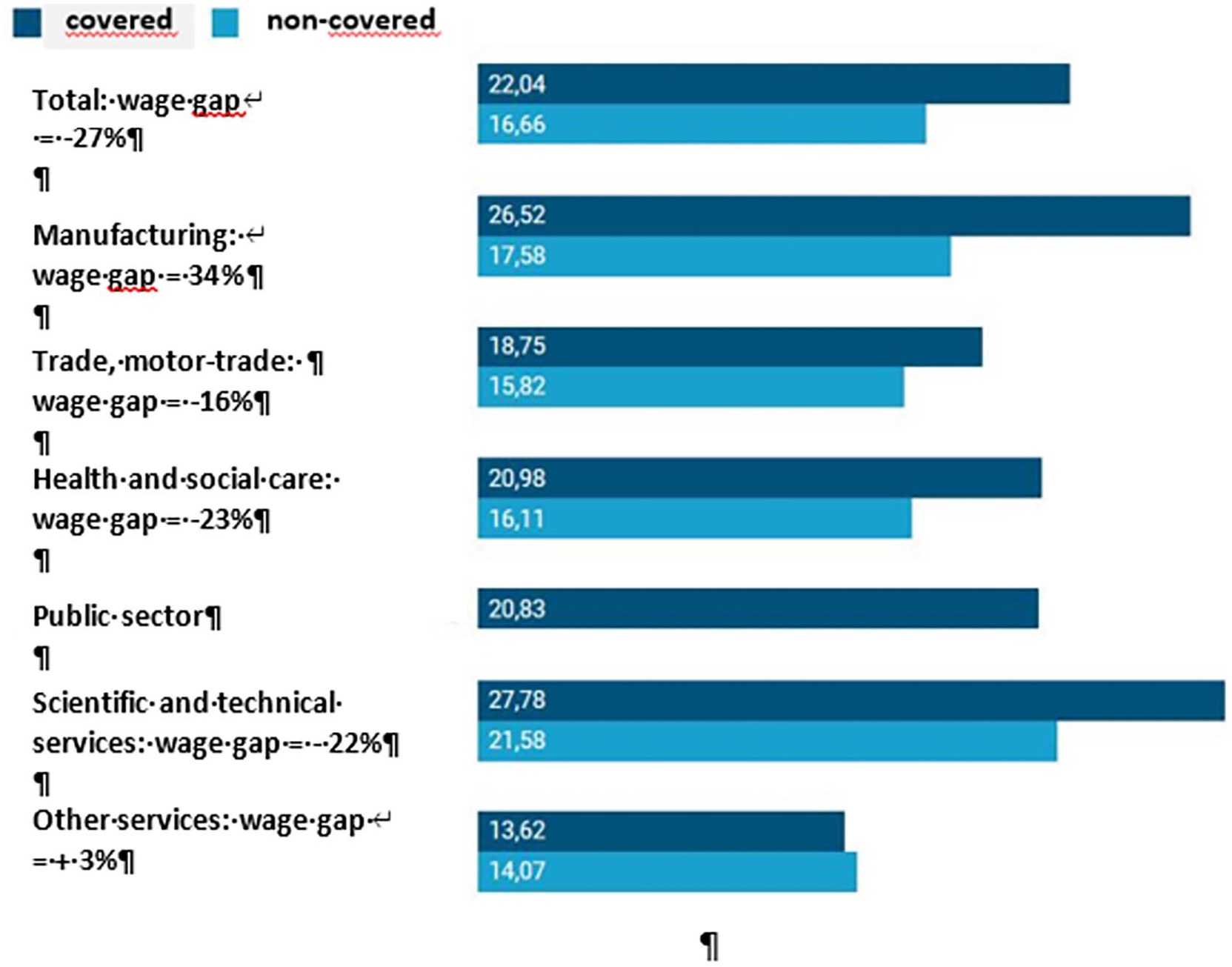
Gross hourly earnings in euros of full-time employees, and the wage gap between employees covered/not covered by a collective agreement, April 2018.
The few studies on income development by different forms of job mobility underline the high risks associated with involuntary changes of occupation or jobs in the German labour market (Hall, 2011; Wolnik and Holtrup, 2017). Hourly gross wages for those affected are significantly lower than for those changing occupation on their own initiative (Table 1). In 2012, it was estimated that the average hourly wage for those continuing to work in their original occupation was €5.40 or 29 per cent higher than that of those forced to change their occupation. Since fast-growing sectors with low collective bargaining coverage, such as transport, logistics and security, are the main ‘catch basins’ for involuntary career changers, this loss of income is not surprising. Wolnik and Holtrup (2017) also show that, in addition to income, multiple subjective indicators related to the quality of work, such as job satisfaction, assessment of one’s own health status or the compatibility of work and family life, are clearly rated lower than in the other groups. In the case of self-initiated job changes, employees are obviously willing to forego income to pursue a different occupation or to escape poor working conditions. Lower incomes are thus partly offset by higher job satisfaction scores. Where a change of occupation was motivated by higher earnings potential, incomes generally improved significantly.
Gross hourly wage mean value in euros after change of jobs, 2012.
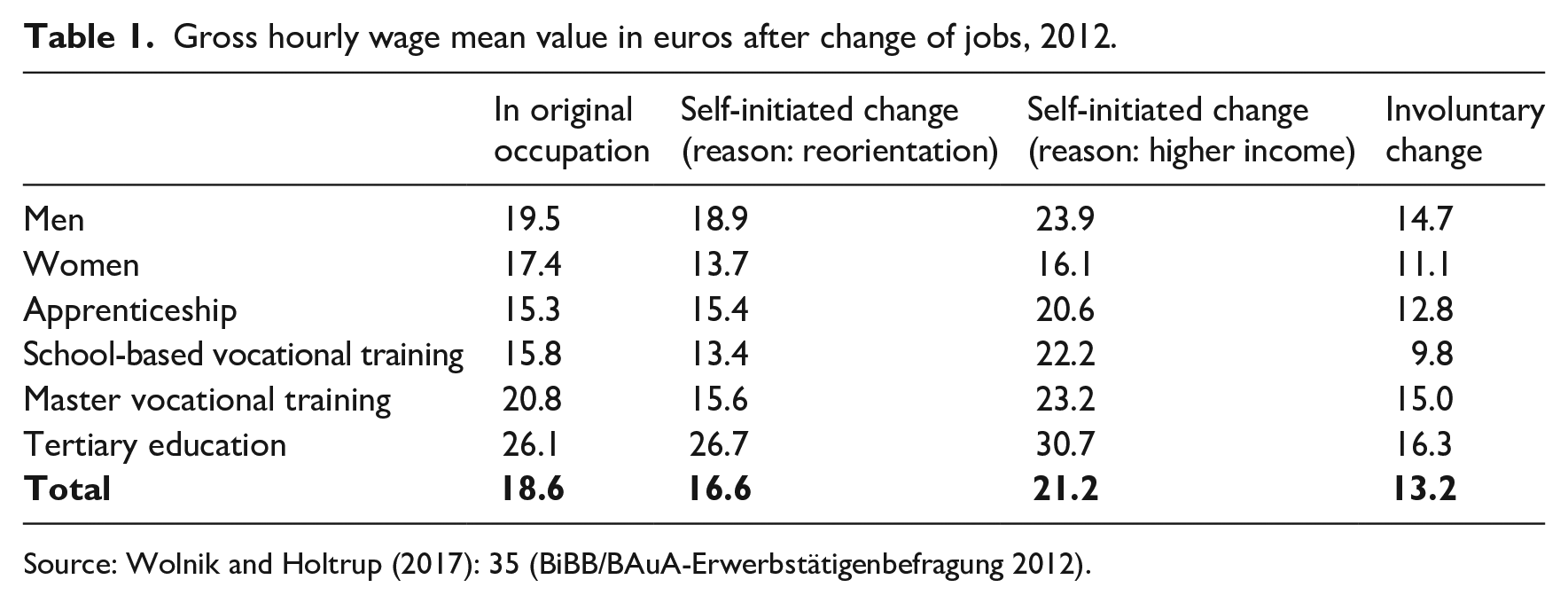
Source: Wolnik and Holtrup (2017): 35 (BiBB/BAuA-Erwerbstätigenbefragung 2012).
Promoting internal transformation
Compared to countries with little protection against dismissal and without statutory co-determination rights for works councils or trade union representatives, such as the US, employees’ external mobility is low in Germany. The costs of a hire-and-fire policy are high in Germany, especially for medium-sized and larger companies, leading to them offering internal opportunities for transfers to other jobs. Internal job mobility has become even more important since 2008 due to the government’s commitment to avoid mass unemployment through subsidised short-time working. The handling of the financial crisis of 2008/2009 without any major increase in unemployment became a model for the COVID crisis. Even in smaller companies, including in the service sector with less protection against dismissal, redundancies were avoided in the COVID crisis (Herzog-Stein et al., 2022).
The green transformation is associated with new challenges for companies. It is not enough to subsidise their transformation-related costs through short-time working models, as in the previous crises. Since the transformation affects entire business models in many sectors and is associated with the long-term restructuring of entire value chains, the planning horizon of all concerned must expand significantly compared to earlier technological changes.
How the German metalworking and electrical industry is positioned was investigated by IG Metall in a survey of 2000 works councils in 2019. In 54 per cent of automotive companies and their suppliers, the number of jobs was expected to decrease, with the highest declines in companies with more than 1000 employees. More than two-thirds of the works councils surveyed saw an increasing need for training. However, most companies were not well prepared for the digital transformation: half of those surveyed had no systematic personnel planning and needs assessment. The same applied to the identification of training needs, a step only carried out systematically in 45 per cent of the companies. The survey results were mapped in a so-called ‘Transformation Atlas’ at local and company level with a view to providing orientation for supplementary measures (IG Metall, 2019).
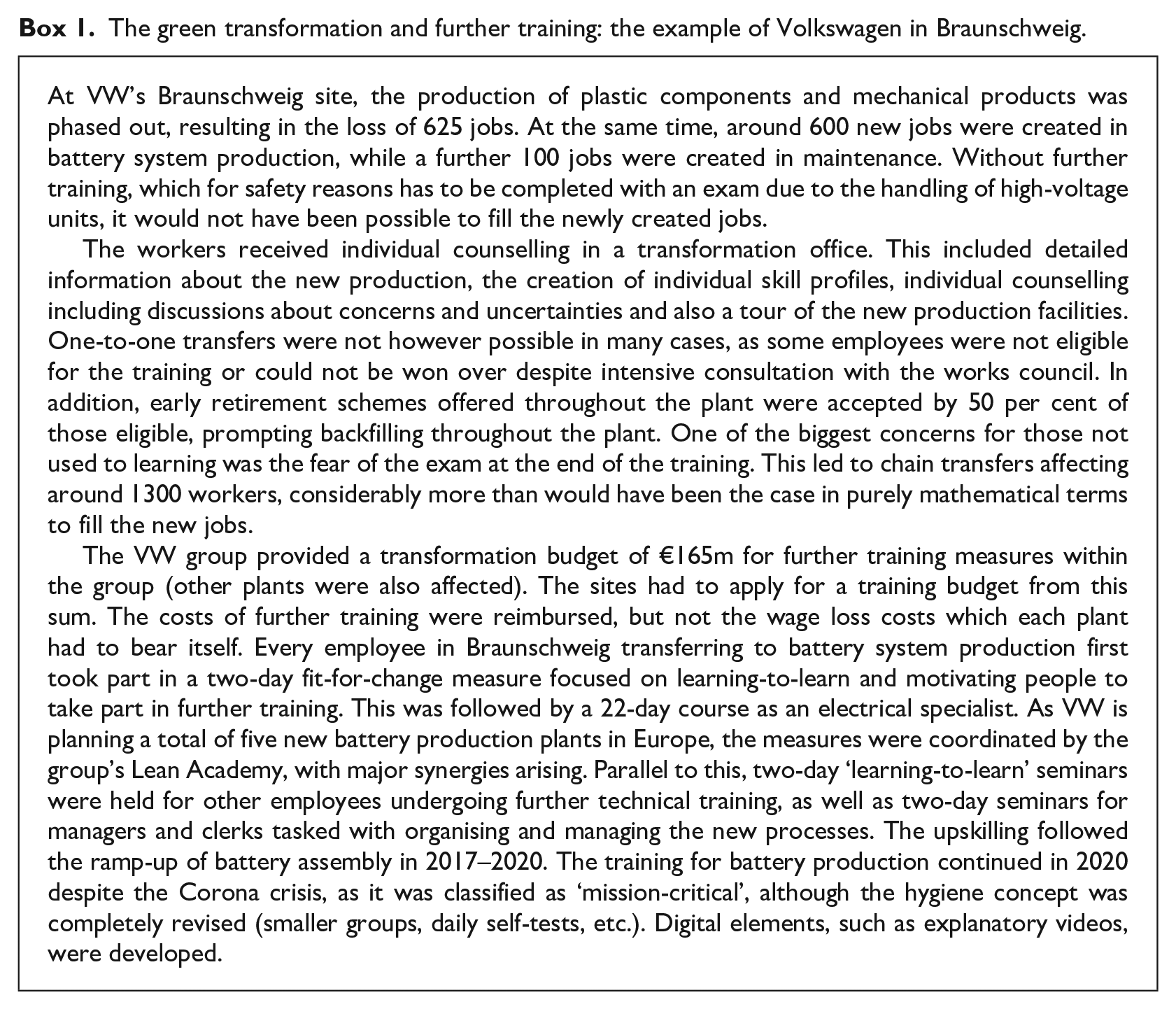
In the past, change in most companies was incremental and spread over long periods of time (Hirsch-Kreinsen, 2015), giving them the opportunity to spread the costs of employee training. The green transformation may, however, require entire workforces to be trained in a short period of time. This applies, for example, to the transition to electromobility in the automotive industry. The skills strategy jointly developed and implemented by the company and the works councils at its Braunschweig Volkswagen plant chart a path to avoid redundancies (see Box 1). This example – representative of several comparable approaches in other German automotive factories – proves that further training for the transformation transcends the technical task of teaching new skills. Successful transformations are for example dependent on reducing employment-related fears, on counselling and convincing workers of new career development opportunities, as well as offering socially acceptable early retirement packages to older workers. It is equally clear that Volkswagen – like many other companies – is quite capable of shouldering considerable expenditure for restructuring its plants and for the training and further education of its employees.
The green transformation and further training: the example of Volkswagen in Braunschweig.
However, in many companies change is not planned as systematically as in the large car manufacturers. In addition, works councils in many medium-sized and small companies or in sectors with financially weaker unions such as the food industry, do not have access to the same levels of expertise and support. With a view to developing proactive approaches in these sectors, several projects were carried out by the German industrial trade unions with the public-funded support of external consultants. They first examined the current and expected change processes in a company (Bosch and Schmitz-Kießler, 2020). Risks for the company and is employees were visualised in a simple form in so-called company maps. Cooperation agreements with company management were recorded in ‘letters of intent’. Many company management boards were very open-minded and interested, as they themselves often had no answers to the challenges of the future.
Based on this stocktaking, future-oriented agreements (Zukunftsvereinbarungen) were concluded in some of the participating companies, in which future negotiation topics such as working time flexibility, data security, project management, leadership, health management and stress reduction, as well as the early involvement of the works councils and the information and participation of employees were agreed. Some agreements also listed concrete steps, such as the expansion of vocational training or the identification of individual skills needs. The topics agreed are to be discussed in joint commissions that meet regularly. In the 2021 round of collective bargaining in the metalworking industry, a collective bargaining framework was created for concluding such agreements in transformation processes. Under it, while there is no obligation to reach agreement, there is an obligation to negotiate, possibly with the involvement of an external moderator (Bosch and Schmitz-Kießler, 2020).
In many companies affected by the green transformation, more jobs are lost than new ones can be created in the short term. In such cases, lay-offs can be avoided through temporary reductions in working hours when short-time working entitlements expire. Almost all German collective agreements provide for the possibility of temporarily reducing working time without wage compensation. In the metalworking industry, for example, reducing weekly working hours to 30 hours is possible as a safeguard. Several companies (e.g. Daimler, Bosch, ZF Friedrichshafen) have made use of this possibility. At Daimler, for example, agreement has been reached not to lay off any employees until 2030 and, in the event of staff surpluses, to temporarily reduce working hours by two hours a week (Schulten and WSI-Tarifarchiv, 2020).
From ‘work first’ to ‘train first’ in labour market policy
Internal job mobility is dependent on replacement production being built up in the event of major upheavals. Where this is not possible, workers will have to reorient. Following the Swedish model, after the first major structural crises in the steel and textile industries as well as in mining in the 1960s to 1980s, the state took over responsibility for financing continuing vocational education and training (CVET) for unemployed workers (Bosch, 2019b). By the beginning of the millennium, several hundred thousand unemployed workers were receiving further training each year, with between 100,000 and 200,000 of them in measures leading to a recognised qualification. The occupations covered by Germany’s apprenticeship system (see below) were the point of reference and quality benchmark for most of these measures. An evaluation of the CVET measures supplied proof of their positive effect on medium- and long-term employment and incomes compared to the control groups (Bosch, 2019b; Kruppe and Lang, 2015). Tregaskis and Nandi (2023) also show the positive effects of structured training on career paths and life satisfaction in the UK, though such effects were not found in low-intensity training.
The Hartz laws initiated a paradigm shift from ‘train first’ to ‘work first’ in labour market policy. CVET was suspected of discouraging workers from searching for the jobs that were available and was only offered by job centres in exceptional cases. This paradigm shift and the parallel reduction in the duration of unemployment benefits were intended to increase pressure to take on a low-paid job. As argued below, labour market policy was to become the vicarious agent of the expanding low-wage sector. As a result, numbers of CVET participants plummeted, especially in the completion-related measures. For the most part, only short ‘fast-food’ measures, such as job application training, were carried out (Table 2).
Number of participants in labour market policy training.
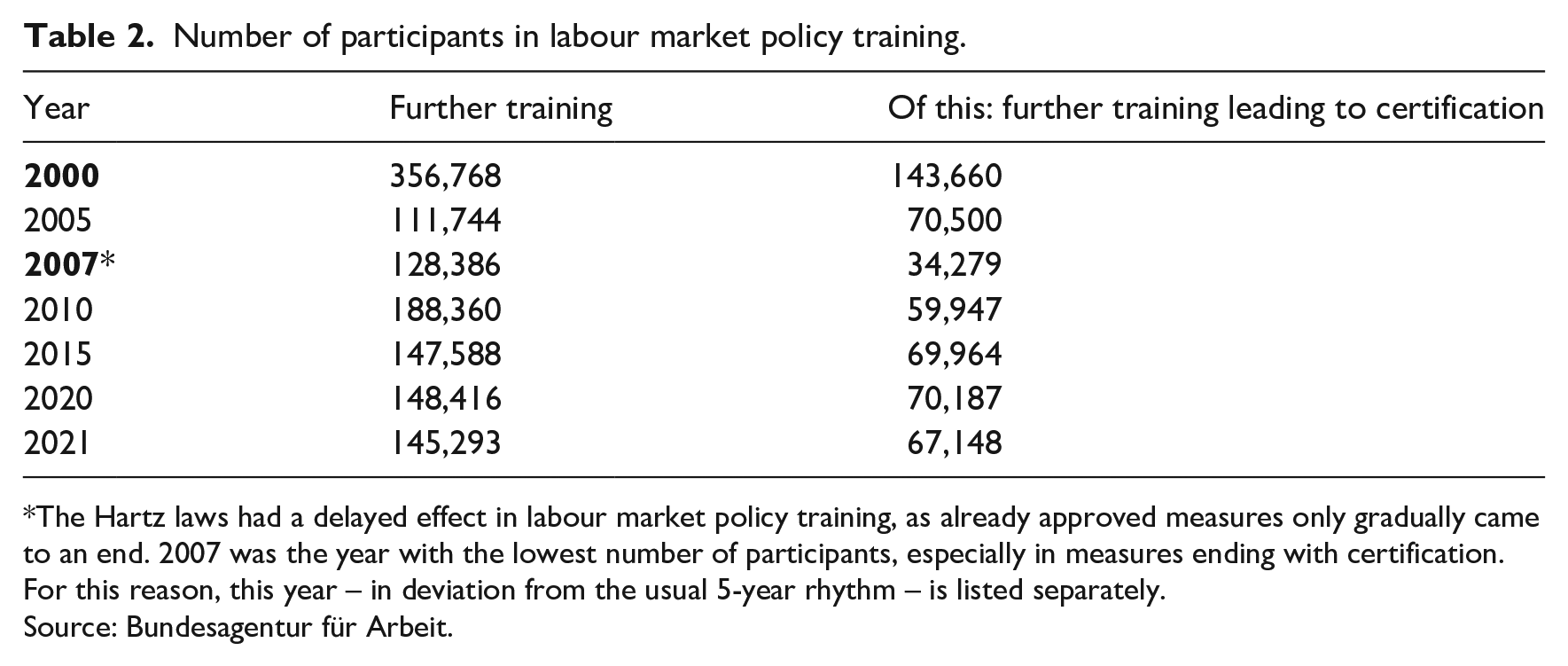
The Hartz laws had a delayed effect in labour market policy training, as already approved measures only gradually came to an end. 2007 was the year with the lowest number of participants, especially in measures ending with certification. For this reason, this year – in deviation from the usual 5-year rhythm – is listed separately.
Source: Bundesagentur für Arbeit.
This deprioritising of CVET was not seen as a problem in 2004, given the large pool of skilled workers among the almost 5 million unemployed. In the following economic upswing and after the financial crisis, unemployment halved and there were massive shortages of skilled workers. The debate on new skills requirements in the context of the introduction of Industry 4.0 and the green transformation gained steam, while the ‘work first’ paradigm and some of the Hartz laws were quietly reversed. A series of legislative reforms re-prioritised CVET, especially for the semi-skilled and unskilled unemployed. Indeed, CVET participants received a bonus of up to €2500 upon successfully completing their training courses. Furthermore, in-company CVET for semi-skilled and unskilled workers was supported, while a right to CVET counselling for all employees and unemployed persons was introduced. In 2022, it was also decided to prioritise CVET for the long-term unemployed and to increase unemployment benefits by €150 a month during a CVET programme to make it financially more attractive. Compared to 2007 – the year with the lowest number of participants, especially in CVET measures leading to a certified qualification –, Table 1 shows a doubling of the number of participants in CVET programmes lasting up to two years and ending with an exam and a vocational certificate. Finally, in July 2023, the parliament decided that employees in companies that are particularly affected by structural change (at least 20 per cent of employees need further training) will receive a qualification allowance equivalent to the unemployment benefit for the duration of the qualification measure, which can last up to two or three years. IG Metall had demanded and pushed for this under the heading of ‘transformation short-time allowance’.
To implement the transition to ‘train first’, 600 new positions for ‘lifelong career guidance’ (Bundesagentur für Arbeit, 2019) were created in the Federal Employment Agency. In addition to individual counselling, these are also for providing counselling to companies in transformation processes. At the same time, it was decided to expand pre-employment career guidance for young people by 942 new positions. Together, these two steps make up the largest investment by the Federal Employment Agency in additional staff in recent decades.
Support for individual CVET
As discussed above, self-initiated career changes mostly involved transitions to decent jobs in other companies. To fully leverage workers’ willingness to take up CVET, individual CVET options are also necessary for those in an employment relationship. These options were expanded through reforms of the two existing grant and loan systems.
One system, under the Federal Training Assistance Act (Bundesausbildungsförderungsgesetz, BAföG), provides funding for students pursuing a wide range of educational paths, including catching up on school-leaving qualifications, vocational training, and higher education studies. In 2020, 639,069 students, including around 173,523 in general education and vocational schools and 465,543 in tertiary education, received benefits under this Act. However, the system was youth-oriented, featuring an age limit of 30. Under the Bologna Process, the age limit for a master’s degree was raised to 35, privileging academics. Since there are no tuition or school fees in Germany, only living expenses are supported. 50 per cent of the support is paid as a grant and 50 per cent as a loan.
The age limits in BAföG dated back to a time when it was still assumed that school education and initial vocational training (IVET) would provide sufficient skills for a person’s entire working life. Those not acquiring the necessary school and vocational qualifications in their youth should, however, be given a second chance, preventing them from becoming unemployed in the German skilled labour market in the long term. In the face of the upcoming transformation processes options are also needed to learn a new occupation. Sweden serves as an example for the further development of the German BAföG. Its educational grant (studiemedel) is paid both for higher education studies as well as for catching up on general education or vocational qualifications at upper secondary level and further vocational measures. In 2022 the age limit for support in Sweden was increased by four years to 60. Following the Swedish example, the German government raised the BAföG age limit to 45 years in 2022. Unlike Sweden, however, the support remains means-tested. A universal entitlement could only be financed via higher tax rates as found in Scandinavia, for which there is no political majority in the German parliament. Unlike Sweden, employees are not entitled to time off with a right of return for either system. It is currently too early to assess the impact.
Regulated further training to become a master craftsman, technician or business administrator is available in all occupations covered by Germany’s VET system and is equivalent to a bachelor’s degree in the German Qualifications Framework. Complementing BAföG, a second grant and loan system, the Further Training Assistance Act (Aufstiegsfortbildungsförderungsgesetz), was created in 1996 specifically for these programmes. Originally only applying to further training within the formal VET system, it has since been extended to other forms of non-academic further training. Today funding is provided for around 700 regulated further training qualifications in the skilled crafts sector, industry and services, including health professions, for further training lasting at least 400 hours. Funding is provided for living expenses, but also for course fees and other material costs, such as for a demonstration object (Meisterprüfungsstück) required in a master craftsman course. The grant share of the support was recently increased from 35 to 50 per cent to ensure parity with BAföG support for university students. There is no age limit in this system. A series of reforms over the last 15 years has steadily increased the number of participants from 135,000 in 2007 to 192,000 in 2021.
Modernising occupations
Slightly more than 60 per cent of the German workforce has completed a mostly three-year apprenticeship, most of them in one of the approximately 320 nationally recognised apprenticed occupations. International research has repeatedly shown that Germany’s VET system imparts broader basic knowledge than in comparative countries. The ‘autonomous capacity to act’ in a changing work environment acquired in VET facilitates the introduction of decentralised forms of work organisation with more decision-making scope for employees and fewer middle managers (see for example Brockmann et al., 2011; Ryan et al., 2011).
VET systems need to be revised faster than general education systems because their content is constantly evolving due to new technological developments, while that of general education evolves only slowly. In the face of accelerated digitalisation in the 1990s and the introduction of new lean production concepts, it became apparent that the pace of modernisation in VET was too slow. The social partners – the parties responsible for the development of VET – agreed on a faster pace to prevent lagging behind technological developments, and to support it through modern training and innovation impulses for companies. Such VET-based impulses are particularly important for small and medium-sized companies without their own R&D.
Between 2011 and 2020 alone, the apprenticeship programmes for 122 occupations were modernised (BiBB, 2021a: 64). Given the high pace of technological change, occupational profiles are open to technology. They describe the competences to be acquired in a broad occupational field (see the example in Box 2), but not the associated technologies as these can change. Just as important as the modernisation of the training content is the change in learning methods. The broad competences listed in Box 2 can only be acquired in holistic learning environments in real-life company situations – and not in small modular units, as in many other countries –, often in cooperation with other trades. The ideas for changed forms of learning were already developed in the 1990s, but it took 20 years for them to be fully implemented.
Skills and competences listed in the state-recognised occupational profile for an industrial mechanic.

Source: BiBB (https://www.bibb.de/de/40.php; accessed 5 September 2022).
This modernisation of vocational training is receiving a further boost through Industry 4.0 and the green transformation. With the formulation of ‘standard vocational training positions’ on digitalisation and sustainability (BiBB, 2021b), detailed specifications have been developed across all occupations as guidelines for future VET modernisation measures. In addition, agreement has been reached to modernise metalworking and electrical occupations in ‘agile procedures’, i.e., in small steps with intermediate targets (so-called ‘sprints’) to keep pace with the rapid technological developments.
Initiated in the 1990s, the reform of VET occupational profiles and learning methods is ongoing. As described by Antonazzo et al. (2023) using the example of VET for Industry 4.0 in the German steel industry, this was a forward-looking ‘adaptive response’, in contrast to the UK’s shorter-term ‘impulsive response’.
However, the declining rate of youngsters taking up an apprenticeship is a problem for securing the next generation of skilled workers. Between 2007 and 2019, the rate fell from 6.5 to 4.8 per cent of all employees (BiBB, 2021a: 192). The reasons for this range from the decreasing willingness of companies to provide training (on cost grounds) to the increasing orientation of young people towards tertiary education. Previously based on the mutual cooperation of competing institutions, the traditional ‘high-skill-equilibrium’ (Finegold and Soskice, 1988) of the German employment model is crumbling. While corporatism still functions in the VET institutions, employers’ associations have become too weak to exert moral pressure on member companies to guarantee sufficient willingness to provide training. Moreover, the erosion of the wage system in part of the economy has pushed many skilled workers into the low-wage sector, thereby negatively impacting the reputation of the apprenticeship system among young people. Between 2000 and 2019, the wage gap, measured in euros, between the average wages of employees with a vocational qualification and those with a university degree doubled (Autorengruppe Bildungsberichterstattung, 2022: 347). The traditional promise of craftspeople belonging to the middle class is no longer valid. The declining apprenticeship rate can be seen as unintended collateral damage caused by the deregulation of product and labour markets in Germany.
Ways to increase collective agreement coverage
While social partner coalitions exist on the modernisation of VET and the promotion of CVET – as companies have a strong interest in well-trained, skilled workers –, this does not apply to income distribution. Against massive employer resistance, the statutory minimum wage was introduced in 2015. Since the major job losses predicted by the majority of German economists did not materialise, the significant increase of the minimum wage (+14.8 per cent to €12 an hour) in October 2022 passed through parliament without major resistance.
However, a minimum wage can only influence income distribution on the bottom rungs of the income ladder. As a rule, a minimum wage leads to wage compression in the two lower deciles. To reduce the significant income losses in the case of involuntary job mobility (see above), corrections to the income distribution up into the middle-income groups are necessary. This can only be done by increasing collective bargaining coverage.
Until the turn of the millennium, employers were still interested in making collective agreements generally binding to ensure a level playing field. However, reduced vertical integration has caused any such interest to decline. The business models of large companies are based on long supply chains with low-cost subcontractors. In fierce price competition with each other, these subcontractors can often only survive by paying wages below those dictated by collective agreements. For this reason, the Confederation of German Employers’ Associations (BDA) has refused to agree to requests to make wage agreements generally binding in the national ‘collective bargaining committee’ (Tarifausschuss) with its parity employer-employee representation. On the other hand, German trade unions are too weak, especially in the private service sector and in small and medium-sized enterprises, to increase collective bargaining coverage on their own.
This refusal can only be overcome through political intervention in the voluntary German collective bargaining system, i.e., a system change is required. Measurable progress in collective bargaining coverage can only be achieved by Collective Agreement Compliance Acts (CACA) for public contracts and by facilitating the extension of collective agreements. Under the impetus from its Social Democrat and Green components the current government coalition has agreed to introduce a CACA for federal government contracts (but not for contracts at lower government levels such as Germany’s federal states or municipalities), under which companies would have to adhere to the customary local wage rates in public contracts. The OECD estimates the volume of public contracts in Germany to be around €500bn. The draft law is expected to be adopted in end-2023. The agreement on a CACA for federal contracts in the coalition agreement can be an important lever to stop the erosion of collective bargaining and trigger a counter-development, especially if compliance with collective agreements is extended to all federal states, municipalities and social security institutions.
To facilitate the extension of collective agreements, the federal states of Bremen, Berlin and Thuringia have tabled a draft law in the Bundesrat, Germany’s second parliamentary chamber (Bundesrat, 2021), under which just one of the two social partners can apply for such an extension, as was the case before 2014. In this case, however, the Tarifausschuss (the federal committee on collective agreements) will be expanded to include an independent member to resolve stalemates. In this way, industry-wide collective agreements could also be established in the many areas not covered by collective agreements. There are many examples of such procedures, especially in the Anglo-Saxon world.
As yet, there is no political consensus for this proposal. The German trade unions plan to make use of the mandatory consultations provided for under the European Minimum Wage Directive (which aims to increase collective bargaining coverage in all countries where less than 80 per cent of employees are paid by collective agreement), to develop a corresponding reform agenda for the 2025 federal elections.
Conclusions
The initial question posed by this article was how to make work better in the green transformation. It has been shown that in countries with a dual labour market, such as Germany, a just transition is only possible with considerable institutional reforms. These reforms must ensure that the affected workers receive the necessary training and do not lose income when changing jobs. Since the long-term transformation of the economy is only possible with the acceptance of the population as a whole and is not blocked by climate opponents, it can be seen as a ‘critical juncture’ offering the opportunity for institutional change. However, this can only succeed if new stakeholder constellations offer a convincing new narrative and initiate change by pooling their resources.
The German labour market reforms of recent years show how these opportunities can be seized. In addition to the ‘producer coalitions’ between core workers and companies (Carlin and Soskice, 2009) which continue to be strong in technology policy at sectoral level and in large companies, alliances for a just transition have developed across all trade unions, the SPD and the Greens. Since core workers also fear falling into the secondary segment, the preconditions for a less egalitarian equilibrium (Palier and Thelen, 2010) were never a given.
The cuts in active labour market policy triggered by the Hartz laws have been reversed, with CVET now being prioritised over rapid placement. Together with the expansion of individual options for CVET, sufficient funding for CVET measures is guaranteed when people change companies. Short-time working, financial support for in-company CVET for semi-skilled and unskilled workers, and trade unions’ forward-looking use of co-determination have also created good conditions for a ‘just transition’ within companies, even if differences between larger companies with a strong representation of workers’ interests and medium-sized and small ones without works councils remain. The ongoing reform of occupational IVET profiles is not only preparing the younger generation for change but is also a central point of orientation for further training measures for adults. This also applies to the internationally little-known master and business adminstrator training schemes, the upper echelon of German VET, for which there is a separate system of grants and loans.
Disregarding the inadequate apprenticeship rate, skills risks have been significantly mitigated, although the same cannot be said for income risks. While it is true that, against considerable resistance from employers and the conservative and liberal parties, the statutory minimum wage was introduced and significantly increased in 2022, the wage gaps between the primary labour market segment with its collectively agreed wages and the secondary segment without such agreements remain considerable. This is the Achilles heel of a just transition. It remains to be seen whether the CACA for federal contracts announced for 2023 will be able to reverse the trend of decreasing collective bargaining coverage.
A significant increase in collective bargaining coverage to reduce income risks will only be possible through greater use of extending collective agreements. Unlike the VET reforms, which are also in the interest of companies to secure skilled labour, no social partner coalitions can be discerned on distribution issues. However, the increasing shortage of skilled workers in the next decade may also lead to renewed interest among companies to sign collective agreements that can be used to make working conditions in their sectors more attractive.
It should be borne in mind that this article is based on observing a moving target since the reform process is ongoing and reversals cannot be ruled out. As argued above, the far-reaching nature of changes only becomes fully visible when the many small steps since the financial crisis are seen in context. But it remains an open question whether these reform steps will ultimately achieve ‘transformative results’, as was the case in the past with the emergence of the dual German employment model (Streeck and Thelen, 2005: 9). One can certainly only speak of a real ‘path change’ in the transformation when labour market dualisation is reduced by generally binding collective agreements. In other words, a substantial institutional reform of the German labour market is required.
In recent decades, all ramifications of the ‘broad process of liberalisation’ of employment models have been studied. We are well equipped to observe forms of deregulation and the erosion of institutions. But we are less equipped to study developments in the opposite direction, perhaps because there are so few encouraging examples, or because institution-building, as opposed to institution-dismantling, often takes so agonisingly long that its cumulative effects are underestimated. Institution-building for a ‘just transition’, notably the evaluation of its effects and developments, should be given more attention, as these issues will continue to occupy us in all countries for at least another 30 years.
Footnotes
Funding
This work was supported by the Rosa-Luxemburg-Foundation.
1
In these studies, no distinction is made between digitalisation and Industry 4.0. Industry 4.0 characterises the intelligent networking of machines and processes in industry with the help of ICT, while digitalisation encompasses all forms of ICT use.